Romans 15:6

Greek (Tischendorf 8th ed.) Romans 15:6 appears in the Greek New Testament. The text above is from the Tischendorf 8th edition. Each word links to its Strong’s number and a concise gloss. Click any word for its full Thayer’s Greek Lexicon entry.
Download image
Cite this verse

Romans 15:6 (World English Bible). Public Domain. Lemma interlinear Bible study tool, https://lemma.gebible.app/v/romans/15/6.

Show BibTeX & RIS
BibTeX
RIS
English Translation
that with one accord you may with one mouth glorify the God and Father of our Lord Jesus Christ.
World English Bible · Public Domain
Download a study sheet

One document with this verse’s original text, its word-by-word gloss line, the meaning frame, cross-references with their text, attributed commentary, and full source and license credits — printable, and it pastes into notes with its structure intact.

This verse Autodidact and up

Study sheet (.html) Plain text (.txt)

A passage Seminary Student

Up to 50 verses in one chapter. A passage sheet keeps up to 6 commentary sources and 12 cross-references per verse, in the order this page ranks them, and says so on the sheet whenever that leaves anything out. Ask for a single verse and you get the Autodidact verse sheet above.

Everything on this page stays free to read, with no account — the sheet is a download of what is already on screen, not access to it.

Want to remove ads? Support Godless Engineer
Compare translations 3

The same verse in 3 English versions, stacked beneath the original-language interlinear above. Click any original word for its lexicon entry.

Each is an independent rendering of the whole verse — the interlinear is not word-aligned to these translations.

Highlighted words mark where these versions differ — a whole-verse word diff, not a word-by-word alignment.

  • World English Bible Public Domain
    that with one accord you may with one mouth glorify the God and Father of our Lord Jesus Christ.
  • King James Version Public Domain
    That ye may with one mind and one mouth glorify God, even the Father of our Lord Jesus Christ.
  • unfoldingWord Literal Text CC BY-SA 4.0
    so that with one accord you might glorify with one mouth the God and Father of our Lord Jesus Christ.

unfoldingWord Literal Text — © unfoldingWord, licensed CC BY-SA 4.0. Word-aligned USFM3 via Door43 (git.door43.org/unfoldingWord/en_ult).

Versions to compare (up to 4)

3 of 4 selected

Show all 19 translations

Every available English version of this verse, each an independent rendering of the whole verse.

  • World English Bible Public Domain
    that with one accord you may with one mouth glorify the God and Father of our Lord Jesus Christ.
  • Berean Standard Bible Public Domain
    so that with one mind and one voice you may glorify the God and Father of our Lord Jesus Christ.
  • Majority Standard Bible Public Domain
    so that with one mind and one voice you may glorify the God and Father of our Lord Jesus Christ.
  • King James Version Public Domain
    That ye may with one mind and one mouth glorify God, even the Father of our Lord Jesus Christ.
  • American Standard Version (1901) Public Domain
    that with one accord ye may with one mouth glorify the God and Father of our Lord Jesus Christ.
  • Revised Version (1885) Public Domain
    that with one accord ye may with one mouth glorify the God and Father of our Lord Jesus Christ.
  • Geneva Bible (1599) Public Domain
    That ye with one minde, and with one mouth may prayse God, euen the Father of our Lord Iesus Christ.
  • Douay-Rheims (1899) Public Domain
    That with one mind, and with one mouth, you may glorify God and the Father of our Lord Jesus Christ.
  • Young's Literal Translation Public Domain
    that with one accord -- with one mouth -- ye may glorify the God and Father of our Lord Jesus Christ;
  • Literal Standard Version CC BY-SA 4.0
    that with one accord—with one mouth—you may glorify the God and Father of our Lord Jesus Christ;
  • Unlocked Literal Bible CC BY-SA 4.0
    May he do this in order that with one mind you may praise with one mouth the God and Father of our Lord Jesus Christ.
  • unfoldingWord Literal Text CC BY-SA 4.0
    so that with one accord you might glorify with one mouth the God and Father of our Lord Jesus Christ.
  • Darby Bible Public Domain
    that ye may with one accord, with one mouth, glorify the God and Father of our Lord Jesus Christ.
  • World Messianic Bible Public Domain
    that with one accord you may with one mouth glorify the God and Father of our Lord Yeshua the Messiah.
  • Webster's Bible Public Domain
    That ye may with one mind and one mouth glorify God, even the Father of our Lord Jesus Christ.
  • Free Bible Version CC BY-SA 4.0
    so that you can with one mind and with one voice together glorify God, the Father of our Lord Jesus Christ!
  • Bible in Basic English Public Domain
    So that with one mouth you may give glory to the God and Father of our Lord Jesus Christ.
  • Text-Critical English NT CC BY 4.0
    so that with one accord and one voice you may glorify the God and Father of our Lord Jesus Christ.
  • Tyndale New Testament (1534) Public Domain
    that ye all agreynge together maye with one mouth prayse God the father of oure Lorde Iesus.

Literal Standard Version (2020), Covenant Press — licensed CC BY-SA 4.0. Text via the HelloAO Bible API (eBible.org). Unlocked Literal Bible (unfoldingWord) — licensed CC BY-SA 4.0. Text via the HelloAO Bible API (eBible.org). unfoldingWord Literal Text — © unfoldingWord, licensed CC BY-SA 4.0. Word-aligned USFM3 via Door43 (git.door43.org/unfoldingWord/en_ult). Free Bible Version, Dr. Jonathan Gallagher — licensed CC BY-SA 4.0. Text via the HelloAO Bible API (eBible.org).

Word by word

More ways to search: Search by grammar → Find every occurrence → Compare this word →

Practice this passage: Drill this verse → Learn its vocabulary →

ὁμοθυμαδὸν
homothymadón
G3661
“with one accord”
Adverb
Part of Speech
Adverb
Full Thayer's Definition

Origin: from a compound of the base of G3674 and G2372

TDNT: 08:05,7

1. with one mind, with one accord, with one passion A unique Greek word, used 10 of its 12 New Testament occurrences inthe Book of Acts, helps us understand the uniqueness of the Christiancommunity. Homothumadon is a compound of two words meaning to "rushalong" and "in unison". The image is almost musical; a number ofnotes are sounded which, while different, harmonise in pitch andtone. As the instruments of a great concert under the direction of aconcert master, so the Holy Spirit blends together the lives ofmembers of Christ's church.
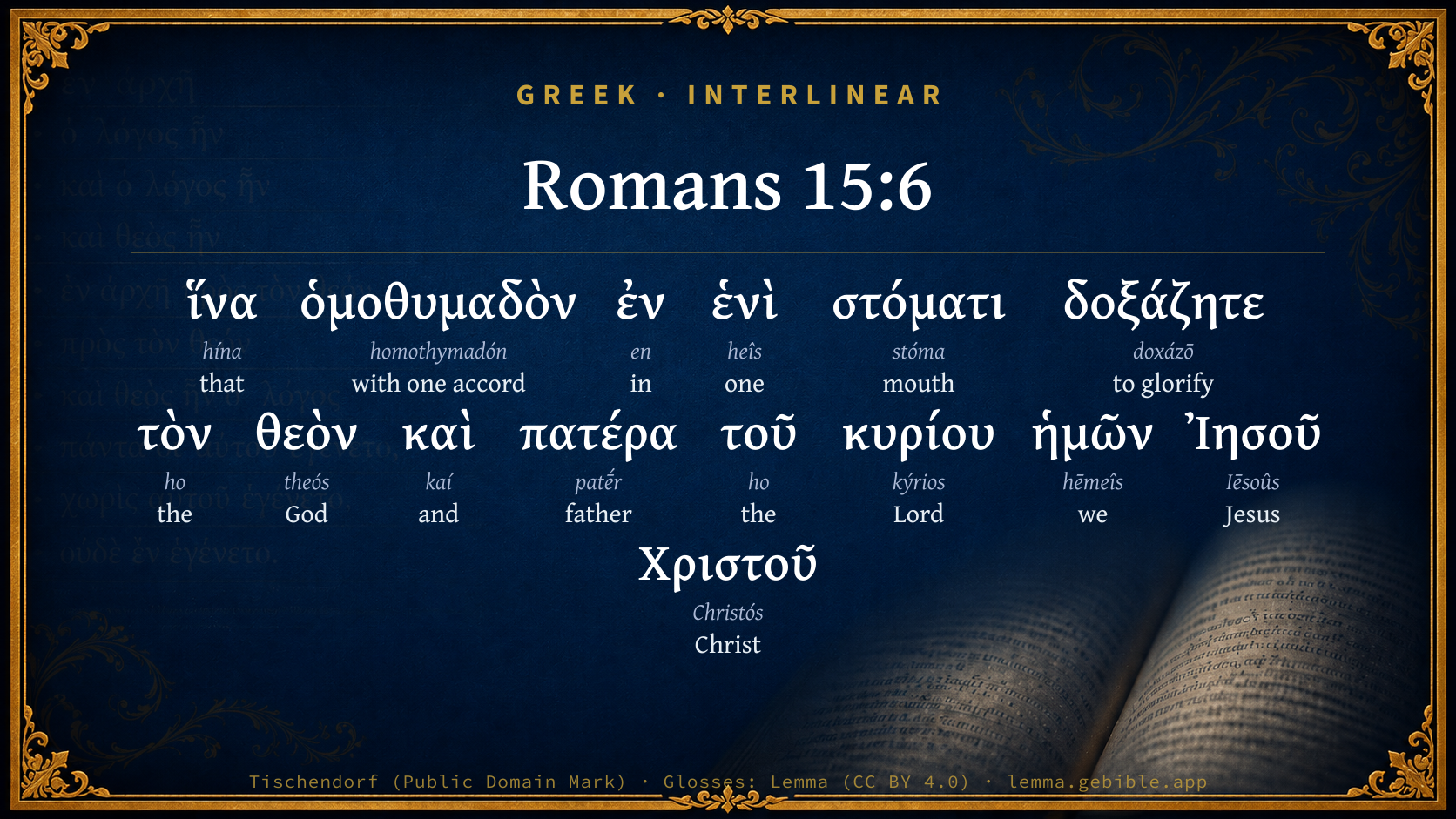
  1. ἵνα hína G2443 “that” Conjunction
  2. ἐν en G1722 “in” Preposition
  3. ἑνὶ heîs G1520 “one” Adjective, Dative, Singular, Neuter
  4. στόματι stóma G4750 “mouth” Noun, Dative, Singular, Neuter
  5. δοξάζητε doxázō G1392 “to glorify” Verb, Present, Active, Subjunctive, 2nd person, Plural
  6. τὸν ho G3588 “the” Article, Accusative, Singular, Masculine
  7. θεὸν theós G2316 “God” Noun, Accusative, Singular, Masculine
  8. καὶ kaí G2532 “and” Conjunction
  9. πατέρα patḗr G3962 “father” Noun, Accusative, Singular, Masculine
  10. τοῦ ho G3588 “the” Article, Genitive, Singular, Masculine
  11. κυρίου kýrios G2962 “Lord” Noun, Genitive, Singular, Masculine
  12. ἡμῶν hēmeîs G2249 “we” Personal pronoun, 1st person, Genitive, Plural
  13. Ἰησοῦ Iēsoûs G2424 “Jesus” Noun, Genitive, Singular, Masculine
  14. Χριστοῦ Christós G5547 “Christ” Noun, Genitive, Singular, Masculine

About this verse

These counts appear in no published source. They are computed here, from the morphology-tagged text and Lemma’s own curated glosses. What Lemma adds →

15
words
14
distinct lemmas
Pauline Epistles
section

Notable vocabulary

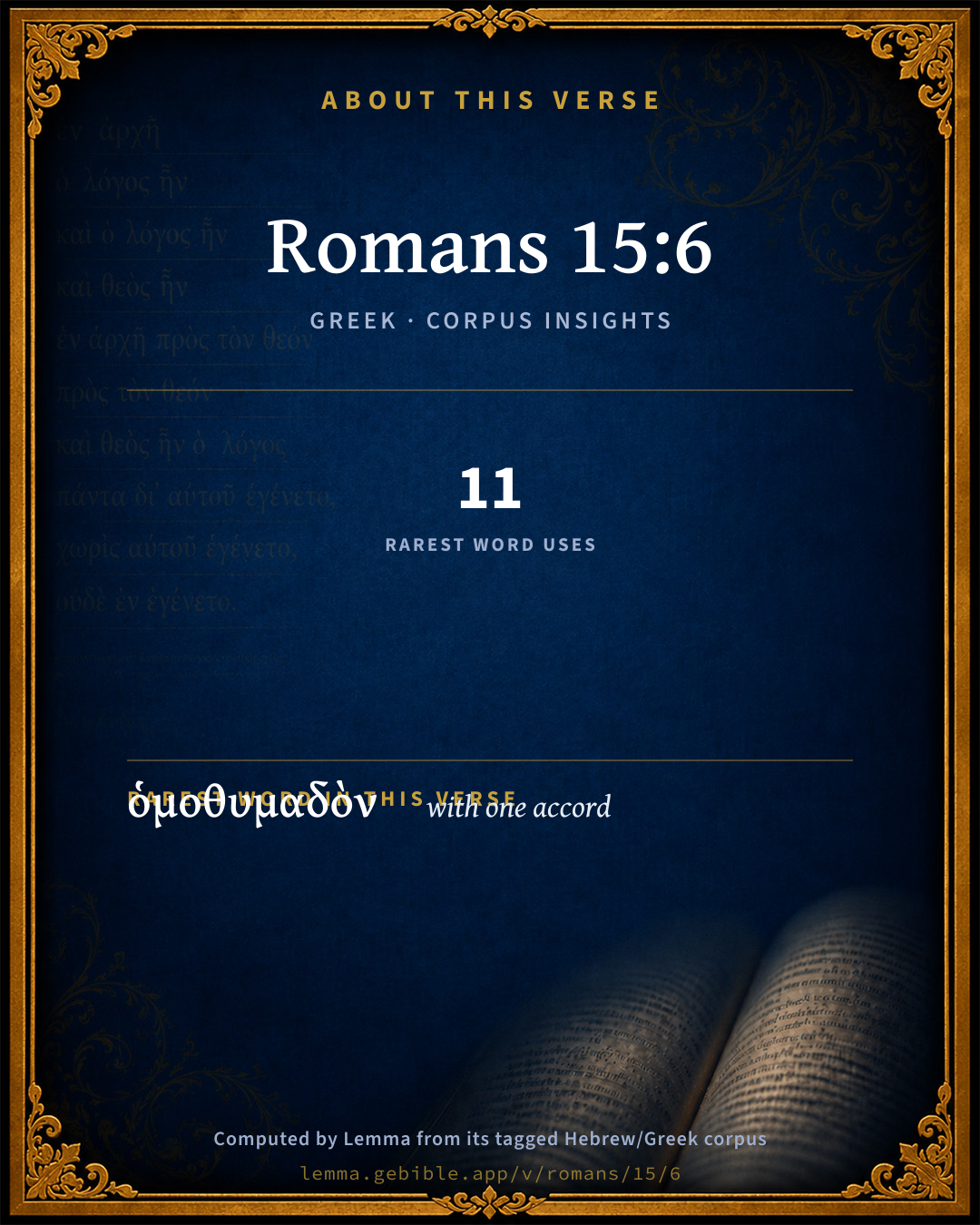
The rarest word here is ὁμοθυμαδὸν with one accord G3661 — appearing just 11 times in the whole Greek New Testament.

Shared distinctive vocabulary

ὁμοθυμαδὸν with one accord G3661 occurs in 11 verses of the Greek New Testament. Also found in:

Repetition

A word recurs within this verse:

Cross-references

12

Topical passages linked to Romans 15:6 in the Treasury of Scripture Knowledge — connected by theme and wording, ordered by reader-vote popularity; previews shown in the World English Bible.

  • John 10:29–30 My Father, who has given them to me, is greater than all. No one is able to snatch them out of my Father's hand.
  • Acts 4:24 When they heard it, they lifted up their voice to God with one accord, and said, "O Lord, you are God, who made the heaven, the earth, the sea, and all that is in them;
  • Ephesians 1:3 Blessed be the God and Father of our Lord Jesus Christ, who has blessed us with every spiritual blessing in the heavenly places in Christ;
  • Revelation 1:6 and he made us to be a Kingdom, priests to his God and Father; to him be the glory and the dominion forever and ever. Amen.
  • 2 Corinthians 11:31 The God and Father of the Lord Jesus Christ, he who is blessed forevermore, knows that I don't lie.
  • Romans 15:9–11 and that the Gentiles might glorify God for his mercy. As it is written, "Therefore will I give praise to you among the Gentiles, And sing to your name."
  • 2 Corinthians 1:3 Blessed be the God and Father of our Lord Jesus Christ, the Father of mercies and God of all comfort;
  • 1 Peter 1:3 Blessed be the God and Father of our Lord Jesus Christ, who according to his great mercy became our father again to a living hope through the resurrection of Jesus Christ from the dead,
  • Acts 4:32 The multitude of those who believed were of one heart and soul. Not one of them claimed that anything of the things which he possessed was his own, but they had all things in common.
  • John 20:17 Jesus said to her, "Don't touch me, for I haven't yet ascended to my Father; but go to my brothers, and tell them, 'I am ascending to my Father and your Father, to my God and your God.'"
  • Zephaniah 3:9 For then I will purify the lips of the peoples, that they may all call on the name of Yahweh, to serve him shoulder to shoulder.
  • Zechariah 13:9 I will bring the third part into the fire, And will refine them as silver is refined, And will test them like gold is tested. They will call on my name, and I will hear them. I will say, 'It is my people;' And they will say, 'Yahweh is my God.'"

Cross-references courtesy of OpenBible.info (CC BY 4.0).

Commentary

Notes on Romans 15:6 from classic Christian and Jewish commentators (each source and its license shown beneath its notes). The classic Christian expositions comment on the surrounding passage and are grouped to its opening verse, so a note may address several verses; the Jewish commentaries on the Tanakh (Rashi and others) are per-verse, so they appear only where the commentator wrote on this verse.

Lemma curates 59 commentaries, every one of them public domain or Creative Commons licensed, each selected and text-cleaned for this edition rather than reprinted as found. About our sources →

John Gill's Exposition

Wherefore receive ye one another,.... Into your hearts and affections; embrace one another cordially, the Jew the Gentile, the Gentile the Jew, the strong brother the weak, the weak the strong:

as Christ also received us. The Alexandrian copy, the Vulgate Latin, Syriac, and Arabic versions, read "you". Both Jews and Gentiles, as appears from the following verses. Christ received all the chosen ones into his heart's love and affection from eternity; he received them in the council of peace, and when the covenant of grace was made at his Father's hands, in the most tender manner, in order to take the care of them, preserve and save them; he assumed their nature, took upon him their sins, and sustained their persons in time, when he became incarnate, and suffered and died for them; and he receives them in the effectual calling on their coming to him, which he encourages by assuring them, that he will in no wise cast them out; so far is he from it, that he embraces them with open arms, and in the most affectionate manner receives them, though sinners, and eats with them; and notwithstanding all their unworthiness, sins, and transgressions:

to the glory of God: that is, either in order to bring them to the enjoyment of eternal life and happiness; which is sometimes so called, because of the glory that shall be beheld by the saints, be revealed in them, and put upon them, both in soul and body; and which is all of God's preparing and bestowing, and will lie in the vision and enjoyment of him: for this they were chosen in Christ, given to him, and received by him before the world began; and that they might enjoy it, Christ came into this world, took on him their persons, and died in their stead; and to this they are called by his grace with an holy calling; and when he has guided them with his counsel through this world, he will receive them to this glory: or else by "the glory of God" is meant the glorifying of God, the perfections of God, as his wisdom, power, faithfulness, truth, justice, holiness, love, grace, and mercy, and the like; which is done by Christ's becoming the surety, and Mediator of the new covenant, Heb 7:22, by his assumption of human nature, by his obedience, sufferings, and death, and by obtaining redemption for his people: and the force of the apostle's exhortation and argument is, that as Christ has received his people both in eternity and time, in so tender a manner, though unworthy, whereby he has glorified God, which was the principal end in view, and next to that the glorifying of them; so it becomes them to be like minded to one another, Rom 15:5, and affectionately receive and embrace each other, that so they may join together in glorifying the God and Father of Christ also, Rom 15:6.

John Gill's Exposition of the Whole Bible (1746–1763) — public domain (CC PDM 1.0). Text via the HelloAO Bible API.

Bengel's Gnomon

Johann Albrecht Bengel

Rom 15:6.[152] Ὁμοθυμαδὸν, with one mind) with one believing mind.—στόματι, with the mouth) confessing.—δοξάζητε, ye may glorify) Ye Jews and Gentiles, Rom 15:7; Rom 15:9.—τὸν Θεὸν καὶ πατέρα τοῦ Κυρίου ἠμῶν Ἰησοῦ Χριστοῦ, the God and Father of our Lord Jesus Christ) a frequent appellation, 2Co 1:3; 2Co 11:31; Eph 1:3; Col 1:3; 1Pe 1:3. It is to be resolved in this manner: The God of our Lord, etc., Eph 1:17, and the Father of our Lord, etc., instead of what men of old said, God the Creator and the Lord of heaven and earth, Psa 124:8, and the God of Abraham and Isaac and Jacob, thereby subscribing [signifying their assent] to the faith of these believers. So elsewhere God and our Father, Gal 1:4. Christ has a double relationship to God and the Father, as compared with us; we also have a double relationship, through Christ, Joh 20:17.

[152] Τὸ αὐτὸ φρονεῖν, to think alike) Patience and comfort promote harmony. He who disagrees with himself shows himself very morose to others. Harmony is founded in Christ Jesus, as full hope is subsequently founded in the Holy Spirit, ver. 13.—V. g.

Bengel's Gnomon of the New Testament — English translation (T&T Clark, Edinburgh, 1860) — public domain. Text from a community e-Sword module.

Meyer's Critical & Exegetical Commentary

Heinrich August Wilhelm Meyer

Rom_15:6. Ἐν ἑνὶ στόματι] By this the preceding ὁμοθυμαδόν is not explained (Reiche)which is an impossible notionbut ὁμοθ. specifies the source of the ἐν ἑνὶ στ., and is to be closely joined with it: unanimously with one mouth, not: unanimously, with one mouth. It is otherwise, e.g., with Dem. 147. 1 : ὁμοθυμαδὸν ἐκ μιᾶς γνώμης, where the explanatory addition has a place. If God is so praised, that each is led by the like disposition to the like utterance of praise, then all dissension is removed, and the unanimity of the fellowship has found in this σύμφωνος ὑμνῳδία (Theodore of Mopsuestia) its holiest expression. On ἐν ἑνὶ στόματι (instrumental), comp. the classical ἐξ ἑνὸς στόματος, Plato, 640 C, p. 364 A; Legg. i. p. 634 E; Rep. Anthol. xi. 159.

τοῦ κυρίου κ.τ.λ.] belongs simply to πατέρα, not also to Θεόν (in opposition to Grotius, Bengel, and others, including Rückert, Reiche, Tholuck (?), Fritzsche), and καί adds epexegetically the specific more precise definition. So throughout with this description of God habitually used by the apostles, as 2Co_1:3; 2Co_11:31; Eph_1:3; Col_1:3; 1Pe_1:3. This is clear from the passages, in which with πατ. the genitive (Ἰησοῦ Χ.) is not subjoined, as 1Co_15:24; Eph_5:20; Col_3:17; Jam_1:27; Jam_3:9. See on 1Co_15:24; 2Co_11:31; Eph_1:3. It ought not to have been objected, that the form of expression must either have been τὸν Θεὸν ἡμῶν κ. πατέρα Ἰ. Χ. or τὸν Θεὸν τὸν πατ. Ἰ. Χ. Either of these would be the expression of another idea. But as Paul has expressed himself, τόν binds the conceptions of God and Father of Christ into unity. Comp. Dissen, ad Dem. de cor. p. 373 f.; Kühner, ad Xen. Mem. i. 1. 19, ad Anab. ii. 2. 8. Rightly Theodoret: ἡμῶν Θεὸν ἐκάλεσα τὸν Θεὸν, τοῦ δὲ κυρίου πατέρα.

Meyer — Critical and Exegetical Commentary on the New Testament — English translation by Peter Christie, edited by Frederick Crombie (T&T Clark, 1880) — public domain. Text from a community e-Sword module.

Expositor's Greek Testament

ed. W. Robertson Nicoll

Rom 15:6 . ἵνα introduces the ultimate aim of this unanimity. ὁμοθυμαδόν here only in Paul, but eleven times in Acts. ἐν ἑνὶ στόματι : in Greek writers usually ἐξ ἑνὸς στόματος . τὸν θεὸν καὶ πατέρα τοῦ Κ . ἡμῶν Ἰ . Χ . The A.V. renders, “God, even the Father of our Lord Jesus Christ,” making τοῦ Κυρίου depend on πατέρα only. This rendering does not make God the God of Christ, but defines the only true God as the Father of Christ. It is defended by Weiss, who appeals to the passages in which “God and Father” is found with no genitive: 1Co 15:24 , Eph 5:20 , Col 3:17 , Jas 1:27 ; Jas 3:9 . The argument is not convincing, especially in view of Eph 1:17 ( ὁ θεὸς τοῦ Κ . ἡμῶν Ἰ . Χ ., ὁ πατὴρ τῆς δόξης ) and Joh 20:17 : hence the R.V. is probably right (“the God and Father of our Lord”). When the Church glorifies such a God with one heart and one mouth it will have transcended all the troubles of chap. 14. It is this accordant praise of all Christians which is the ruling idea in Rom 15:7-13 .

The Expositor's Greek Testament, edited by W. Robertson Nicoll (1897–1910) — public domain. Text from a community e-Sword module.

Hodge's Commentary on Romans, Ephesians & First Corinthians

Charles Hodge

Rom_15:6

That ye may with one mind and with one mouth glorify God, even the Father of our Lord Jesus Christ. This harmony and fellowship among Christians is necessary, in order that they may glorify God aright. To honor God effectually and properly, there must be no unnecessary dissensions among his people. God, even the Father of our Lord Jesus Christ, means either that God who is the Father of the Lord Jesus, or the God and Father of Christ. This expression occurs frequently in the New Testament; see 2Co_1:3; 2Co_11:31; Eph_1:3; 1Pe_1:3. Most commonly the genitive τοῦ κυρίου is assumed to belong equally to the two preceding nouns, God and Father. Many of the later commentators restrict it to the latter, and explain kai& as exegetical: God, who is the Father of the Lord Jesus Christ. In favor of this explanation, reference is made to such passages as 1Co_15:24; Eph_5:20, and others, in which ὁ θεὸς καὶ πατήρ occurs without the genitive τοῦ κυρίου κ.τ.λ.

Charles Hodge — Commentary on Romans (1835), First Corinthians (1857), and Ephesians (1856) — public domain. Text from a community e-Sword module.

Jamieson, Fausset & Brown

Robert Jamieson, A. R. Fausset & David Brown

That, &c.--rather, "that with one accord ye may with one mouth glorify the God and Father of our Lord Jesus Christ"; the mind and the mouth of all giving harmonious glory to His name. What a prayer! And shall this never be realized on earth?

Jamieson, Fausset & Brown — Commentary Critical and Explanatory on the Whole Bible (1871) — public domain (CC PDM 1.0). Text via the HelloAO Bible API.

Adam Clarke's Commentary

Verse 6. That ye - Jews and Gentiles - may with one mind] Thinking the same things, and bearing with each other, after the example of Christ; and one mouth, in all your religious assemblies, without jarring or contentions, glorify God for calling you into such a state of salvation, and showing himself to be your loving compassionate Father, as he is the Father of our Lord Jesus Christ.

It is very likely that the apostle refers here to religious acts in public worship, which might have been greatly interrupted by the dissensions between the converted Jews and the converted Gentiles; these differences he labours to compose; and, after having done all that was necessary in the way of instruction and exhortation, he now pours out his soul to God, who alone could rule and manage the heart, that he would enable them to think the same things, to be of the same judgment, and that all, feeling their obligation to him, might join in the sweetest harmony in every act of religious worship.

Adam Clarke's Commentary on the Bible (1810–1826) — public domain. Text from a community e-Sword/MySword module.

Ellicott's Commentary for English Readers

(6) With one mind and one mouth. . . .—It is in the heart that the spirit of humanity arises, and with the mouth that it is expressed.

A Bible Commentary for English Readers, edited by Charles John Ellicott (1878–1897) — public domain. Text from a community e-Sword module.

The Cambridge Bible for Schools and Colleges

gen. ed. J. J. S. Perowne

6. that ye may—glorify God] Whose praise is the ultimate aim of all His gifts to His people. Cp. on Rom_11:33-36.—See, on the holy unanimity enjoined here, Php_3:15-16.

God, even the Father] Far better, the God and Father. Same words as 2Co_1:3; Eph_1:3; 1Pe_1:3. See Joh_20:17; Heb_1:8-9.

The Cambridge Bible for Schools and Colleges (gen. ed. J. J. S. Perowne; Cambridge University Press, 1878–1918) — public domain. Text from a community e-Sword module.

Trapp's Complete Commentary

John Trapp

6 That ye may with one mind and one mouth glorify God, even the Father of our Lord Jesus Christ.

Ver. 6. With one mind and one mouth, ] It is recorded to the high commendation of the Church of Scotland, that for this 90 years and upwards they have kept unity with purity without schism, much less heresy. (Syntag. Confession, Prefat.)

John Trapp, A Commentary or Exposition upon All the Books of the Old and New Testament (1647–1656) — public domain. Text from a community e-Sword module.

Albert Barnes' Notes on the Bible

That ye may with one mind - The word used here is translated “with one accord;” Act 1:14; Act 2:1; Act 4:24. It means unitedly, with one purpose, without contentions, and strifes, and jars.

And one mouth - This refers, doubtless, to their prayers and praises. That they might join without contention and unkind feeling, in the worship of God. Divisions, strife, and contention in the church prevent union in worship. Though the “body” may be there, and the church “professedly” engaged in public worship, yet it is a “divided” service; and the prayers of strife and contention are not heard; Isa 58:4.

Glorify God - Praise or honor God. This would be done by their union, peace, and harmony; thus showing the tendency of the gospel to overcome the sources of strife and contention among people, and to bring them to peace.

Even the Father ... - This is an addition designed to produce love.

(1) He is “a Father;” we then, his children, should regard him as pleased with the union and peace of his family.

(2) He is the Father of our Lord; our “common” Lord; our Lord who has commanded us to be united, and to love one another. By the desire of honoring “such” a Father, we should lay aside contentions, and be united in the bands of love.

Albert Barnes' Notes on the Bible (1834–1885) — public domain. Text from a community e-Sword/MySword module.

Matthew Poole's English Annotations

That ye may with one mind and one mouth glorify God: q.d. I further pray, that you may not only be like-minded one towards another, but

that ye may with one mouth glorify God; that whether you be Gentiles or Jews, strong or weak in the faith, you may agree and be unanimous in his worship and service; that not only with one mind, but with one mouth, or as if you had all but one mouth. you may pray unto God and praise him: that is one way of glorifying God, Psa 50:23, and it seems to be chiefly intended in this place. See Act 4:32, what accord and unanimity there was among the primitive Christians.

Even the Father of our Lord Jesus Christ; a usual periphrasis of God in the New Testament: see 2Co 1:3; 11:31; Eph 1:3; Col 1:3; 1Pe 1:3. God is the Father of Christ, first, as he is the Son of God; so he begat him by an eternal and ineffable generation, Joh 3:16; 1Jo 4:9. Secondly, as he is man: so he created him, Luk 1:35. Thirdly, as he is Mediator; so he appointed him to and qualified him for that office, Psa 40:8; Joh 20:17. This compellation of God includes all our comfort and happiness, for he is our Father because he is the Father of Jesus Christ. It is added here by way of limitation, to distinguish the true God from the false gods of the earth; and by way of explanation, to show how God will be glorified and worshipped under the gospel, viz. as the God and Father of onr Lord Jesus Christ.

Matthew Poole's English Annotations on the Holy Bible (1683–1685) — public domain. Text from a community e-Sword/MySword module.

Whedon's Commentary on the Bible

Daniel D. Whedon

6. One mind and one mouth glorify God—By this blessed unity wrought by the spirit of Christian endurance the Church becomes as one living person from whose single heart and voice God hears the song of glory.

Father of our Lord Jesus Christ—Who rejoiceth in the sanctity and unity of the Church bought with the blood of his Son.

Daniel D. Whedon (gen. ed.), Commentary on the Old and New Testaments (1874–1909) — public domain. Text from a community e-Sword module.

John Wesley's Explanatory Notes

That ye - Both Jews and gentiles, believing with one mind, and confessing with one mouth.

John Wesley, Explanatory Notes Upon the Whole Bible (1754–1765) — public domain. Text via the GEBible commentary corpus.

McGarvey & Pendleton's Commentaries

J. W. McGarvey

that with one accord ye may with one mouth glorify the God and Father of our Lord Jesus Christ . [Beautiful picture! When in concord the whole church as a harmonious choir renders praise to God, the Father of our Lord, as one mouth! And how this will glorify our Saviour, Christ, showing the perfection of his work in us! Unanimity of inward feeling can not but result in harmony of outward expression, whether in doctrine, worship or praise.]

J. W. McGarvey (with Philip Y. Pendleton), Commentaries on the New Testament (The Fourfold Gospel, 1914; Acts; and the epistles) — public domain. Text from a community e-Sword/MySword module.

The People's New Testament

B. W. Johnson

6. That ye may with one mind, etc. That being in full accord you may with one voice (mouth) utter the praises of God.

B. W. Johnson's The People's New Testament with Notes (1889–1891) — public domain. Electronic text from the Christian Classics Ethereal Library (CCEL) ThML edition.

Cambridge Greek Testament for Schools and Colleges

6. ὁμοθυμαδὸν. Acts (10) and here only: with one heart and mouth,—the expression of τὸ αὐτὸ φρονεῖν.

δοξάζητε τ. θ. “A phrase much used in both O.T. and N.T. for all forms of human recognition of GOD’s true character and work, rendered by word or by act,” Hort, 1Pe 2:12. The special subject of recognition is here indicated by the full description.

τὸν θεὸν κ. π. τ. κ. ἡ. Ἰ. Χρ. Cf. Php 2:11 with context from Rom 15:2. This full description is a compendium of the Gospel, especially as the Gospel of reconciliation; and comes suitably here as the climax of the detailed exhortations to unity, echoing the appeal of Rom 12:1 to ‘the compassions of GOD.’ The whole economy of creation and redemption comes from GOD, revealed as the GOD and Father of our Lord Jesus Christ, and as in Him ‘reconciling the world to Himself.’ The full phrase occurs only in benedictions (Eph 1:3; 2Co 1:3; 1Pe 1:3; cf. Col 1:3) or other places of special solemnity (here and 2Co 11:31 nearly). Both θεὸν and πατέρα are to be taken with τ. κ.; cf. Hort on 1Pe 1:3 (p. 29).

Cambridge Greek Testament for Schools and Colleges (Cambridge University Press, 1896; 21 vols, various authors incl. Carr, Maclear, Plummer, Farrar, Lumby, Moule, M. R. James, Simcox) — public domain. Text from a community e-Sword module.

Alford’s Greek Testament

Henry Alford

6.] Further introduction of the subject, by a prayer that God, who has given the Scriptures for these ends, might grant them unanimity, that they might with one accord shew forth His glory. In the title given to God, the ὑπομονή and παράκλησις just mentioned are taken up again: q. d. “The God who alone can give this patience and comfort.”

The later form of the opt., δῴη, is also found 2Ti 1:16, 2Ti 1:18; Eph 1:17 al., in LXX Gen 27:28; Gen 28:4 al. See Winer, edn. 6, § 14.1. g.

κατὰ χρ. Ἰησοῦν, according to (the spirit and precepts of) Christ Jesus,—see reff.

6. τὸν θεὸν κ. πατ.] De Wette regards τὸν θεὸν as independent of Ἰησοῦ χρ.,—‘God, and the Father of our Lord Jesus Christ.’ The usage of the article will not decide the matter, because on either rendering, the accusatives both refer to the same Person: but the ordinary one, the God and Father … is preferable on account of its simplicity.

Henry Alford, The Greek Testament (1849–1861) — public domain. Text from a community e-Sword module.

International Critical Commentary

6. Unity and harmony of worship will be the result of unity of life.

ὁμοθυμαδόν, ‘with unity of mind.’ A common word in the Acts (1:14, &c.).

τὸν Θεὸν καὶ πατέρα τοῦ Κυρίου ἡμῶν Ἰησοῦ Χριστοῦ. This expression occurs also in 2Co 1:3; 2Co 11:31; Eph 1:3; 1Pe 1:3. In Col 1:3, which is also quoted, the correct reading is τῷ Θεῷ πατρὶ τοῦ Κυρίου ἡμῶν Ἰ. Χ. Two translations are possible: (1) ‘God even the Father of our Lord Jesus Christ’ (Mey.-W.. Gif. Lid., Lips.). In favour of this it is pointed out that while πατήρ expects some correlative word, Θεός is naturally absolute; and that ὁ Θεὸς καὶ πατήρ occurs absolutely (as in 1Co 15:24 ὅταν παραδιδοῖ τὴν βασιλείαν τῷ Θεῷ καὶ πατρί), an argument the point of which does not seem clear, and which suggests that the first argument has not much weight. (2) It is better and simpler to take the words in their natural meaning, ‘The God and Father of our Lord Jesus Christ’; (Va. Oltr. Go. and others), with which cf. Eph 1:17 ὁ Θεὸς τοῦ Κυρίου ἡμῶν Ἰ. Χ.: Mat 27:46; Joh 20:17; Heb 1:9.

International Critical Commentary — older volumes (1896–1929), various authors — public domain. Text from a community e-Sword module.

Godet's Commentaries

Frédéric Louis Godet

Vv. 6. When one common aspiration reigns in the church, secondary diversities no longer separate hearts; and from the internal communion there results common adoration like pure harmony from a concert of well-tuned instruments. All hearts being melted in one, all mouths become only one. And how so? Because one being only appears henceforth to all as worthy of being glorified.

It seems obvious to us, since the two words God and Father are joined in Greek by one and the same article, that the complement: of our Lord Jesus Christ, must depend on both. Comp. Eph 1:17 (“the God of Jesus Christ”); Mat 27:46 (“my God, my God”); Joh 20:17 (“my Father and your Father, my God and your God”). The expression: God of Jesus Christ, denotes the relation of complete dependence; and the expression: Father of Jesus Christ, the relation of perfect intimacy. The ideal here described by the apostle, and which is the supreme object of the prayer which he has just formed, Rom 15:5, is therefore that of the union of the entire church, composed of Jews and Gentiles, in the adoration of the God and Father who has redeemed and sanctified it by Jesus Christ. This union was in a sense his personal work, and the prize of his apostolic labors. How his heart must have leaped, hearing already by the anticipation of faith, the hymn of saved humanity! It is the part of every believer, therefore, to make all the advances and all the sacrifices which love demands in order to work for so magnificent a result. So there is added, as the conclusion of all that precedes (from Rom 14:1), Rom 15:7.

Frédéric Louis Godet — Commentaries on Luke, John, Romans, and 1 Corinthians — English translation (T&T Clark, Edinburgh, 1870s–1890s) — public domain. Text from a community e-Sword module.

Lesson kit

Teaching starters — assembled from the data on this page, not authored interpretation. Every prompt links to the verse data it draws on. Edit before teaching.

Romans, in the Pauline Epistles, opens this verse with 15 words (14 distinct Greek lemmas). Its most distinctive word is homothymadón (“with one accord”). A historical commentator’s framing appears above. Read the whole chapter for the surrounding context.

Discussion questions

  1. The word homothymadón carries the sense “with one accord.” How does it shape the verse?
  2. Acts 1:14 shares the word «with one accord» with this verse. How do the two illuminate each other?
  3. “the” occurs 2× in this one verse. What is the effect of the repetition?
  4. The translations on this page render this verse differently — a whole-verse word diff, not a word-by-word alignment. What might account for the different wordings?
  5. Reading how John Gill's Exposition and Bengel's Gnomon read this verse, where do the two commentators agree and where do they part?

Things to notice

Reading settings

Reading text

Shown beneath each verse's original-language words.

Old Testament
Old Testament edition

Read the OT as the Masoretic Hebrew (MT) or the Greek Septuagint (LXX).

English shown for the Greek Septuagint (in the Hebrew ↔ Greek comparison).

Comparing translations? Open the Compare panel on any verse page to stack up to four side by side.