
Romans 7:23

Greek (Tischendorf 8th ed.) Romans 7:23 appears in the Greek New Testament. The text above is from the Tischendorf 8th edition. Each word links to its Strong’s number and a concise gloss. Click any word for its full Thayer’s Greek Lexicon entry.
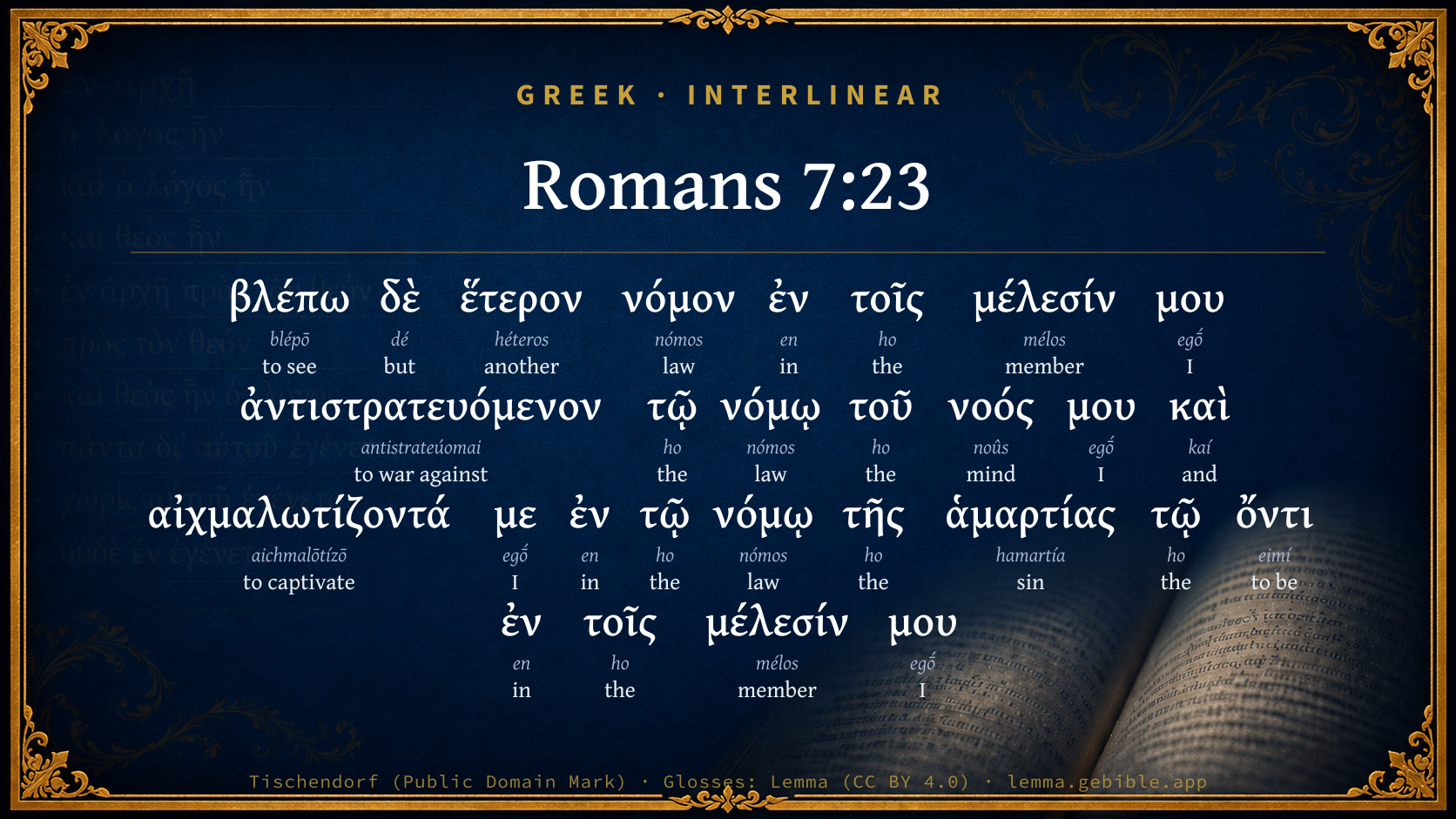
Download image
Cite this verse

Romans 7:23 (World English Bible). Public Domain. Lemma interlinear Bible study tool, https://lemma.gebible.app/v/romans/7/23.

Show BibTeX & RIS
BibTeX
RIS
English Translation
but I see a different law in my members, warring against the law of my mind, and bringing me into captivity under the law of sin which is in my members.
World English Bible · Public Domain
Highlights
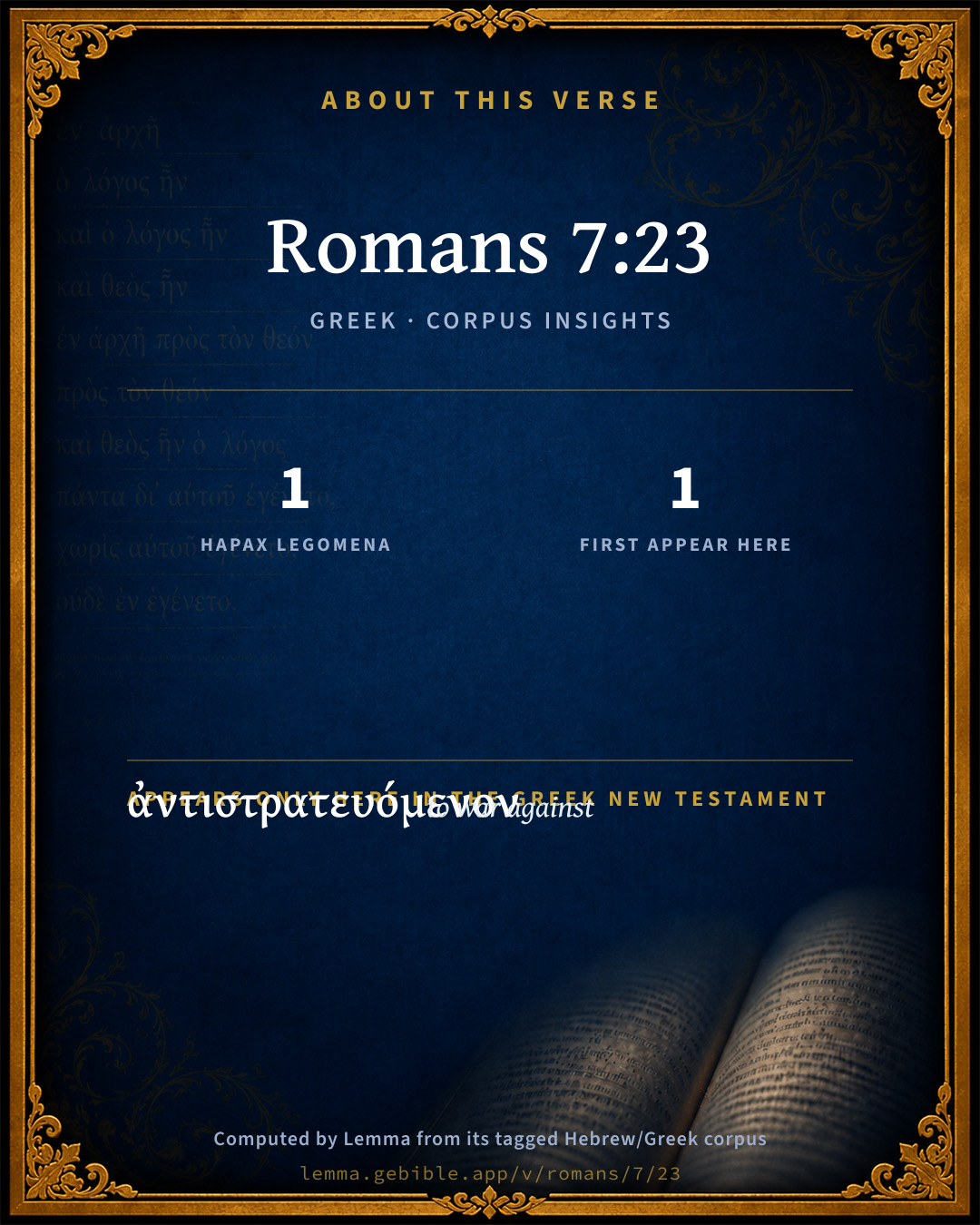
  • 1 hapax legomenon — only here in the Greek New Testament
  • 1 first appearance in the Greek New Testament
Full analysis ↓
Download a study sheet

One document with this verse’s original text, its word-by-word gloss line, the meaning frame, cross-references with their text, attributed commentary, and full source and license credits — printable, and it pastes into notes with its structure intact.

This verse Autodidact and up

Study sheet (.html) Plain text (.txt)

A passage Seminary Student

Up to 50 verses in one chapter. A passage sheet keeps up to 6 commentary sources and 12 cross-references per verse, in the order this page ranks them, and says so on the sheet whenever that leaves anything out. Ask for a single verse and you get the Autodidact verse sheet above.

Everything on this page stays free to read, with no account — the sheet is a download of what is already on screen, not access to it.

Want to remove ads? Support Godless Engineer
Compare translations 3

The same verse in 3 English versions, stacked beneath the original-language interlinear above. Click any original word for its lexicon entry.

Each is an independent rendering of the whole verse — the interlinear is not word-aligned to these translations.

Highlighted words mark where these versions differ — a whole-verse word diff, not a word-by-word alignment.

  • World English Bible Public Domain
    but I see a different law in my members, warring against the law of my mind, and bringing me into captivity under the law of sin which is in my members.
  • King James Version Public Domain
    But I see another law in my members, warring against the law of my mind, and bringing me into captivity to the law of sin which is in my members.
  • unfoldingWord Literal Text CC BY-SA 4.0
    But I see a different law in my members fighting against the law of my mind and taking me captive by the law of the sin that exists in my members.

unfoldingWord Literal Text — © unfoldingWord, licensed CC BY-SA 4.0. Word-aligned USFM3 via Door43 (git.door43.org/unfoldingWord/en_ult).

Versions to compare (up to 4)

3 of 4 selected

Show all 19 translations

Every available English version of this verse, each an independent rendering of the whole verse.

  • World English Bible Public Domain
    but I see a different law in my members, warring against the law of my mind, and bringing me into captivity under the law of sin which is in my members.
  • Berean Standard Bible Public Domain
    But I see another law at work in my body, warring against the law of my mind and holding me captive to the law of sin that dwells within me.
  • Majority Standard Bible Public Domain
    But I see another law at work in my body, warring against the law of my mind and holding me captive to the law of sin that dwells within me.
  • King James Version Public Domain
    But I see another law in my members, warring against the law of my mind, and bringing me into captivity to the law of sin which is in my members.
  • American Standard Version (1901) Public Domain
    but I see a different law in my members, warring against the law of my mind, and bringing me into captivity under the law of sin which is in my members.
  • Revised Version (1885) Public Domain
    but I see a different law in my members, warring against the law of my mind, and bringing me into captivity under the law of sin which is in my members.
  • Geneva Bible (1599) Public Domain
    But I see another Law in my members, rebelling against the Lawe of my minde, and leading me captiue vnto the lawe of sinne, which is in my members.
  • Douay-Rheims (1899) Public Domain
    But I see another law in my members, fighting against the law of my mind, and captivating me in the law of sin, that is in my members.
  • Young's Literal Translation Public Domain
    and I behold another law in my members, warring against the law of my mind, and bringing me into captivity to the law of the sin that `is' in my members.
  • Literal Standard Version CC BY-SA 4.0
    and I behold another law in my members, warring against the law of my mind, and bringing me into captivity to the law of sin that [is] in my members.
  • Unlocked Literal Bible CC BY-SA 4.0
    But I see a different principle in my body parts. It fights against that new principle in my mind. It takes me captive by the principle of sin that is in my body parts.
  • unfoldingWord Literal Text CC BY-SA 4.0
    But I see a different law in my members fighting against the law of my mind and taking me captive by the law of the sin that exists in my members.
  • Darby Bible Public Domain
    but I see another law in my members, warring in opposition to the law of my mind, and bringing me into captivity to the law of sin which exists in my members.
  • World Messianic Bible Public Domain
    but I see a different law in my members, warring against the law of my mind, and bringing me into captivity under the law of sin which is in my members.
  • Webster's Bible Public Domain
    But I see another law in my members warring against the law of my mind, and bringing me into captivity to the law of sin which is in my members.
  • Free Bible Version CC BY-SA 4.0
    but I see a different law at work within me that is at war with the law my mind has decided to follow, making me a prisoner of the law of sin that is within me.
  • Bible in Basic English Public Domain
    But I see another law in my body, working against the law of my mind, and making me the servant of the law of sin which is in my flesh.
  • Text-Critical English NT CC BY 4.0
    but I see another law at work in my members, warring against the law of my mind and making me a prisoner to the law of sin that is in my members.
  • Tyndale New Testament (1534) Public Domain
    But I se another lawe in my membres rebellinge agaynst the lawe of my mynde and subduynge me vnto the lawe of synne which is in my membres.

Literal Standard Version (2020), Covenant Press — licensed CC BY-SA 4.0. Text via the HelloAO Bible API (eBible.org). Unlocked Literal Bible (unfoldingWord) — licensed CC BY-SA 4.0. Text via the HelloAO Bible API (eBible.org). unfoldingWord Literal Text — © unfoldingWord, licensed CC BY-SA 4.0. Word-aligned USFM3 via Door43 (git.door43.org/unfoldingWord/en_ult). Free Bible Version, Dr. Jonathan Gallagher — licensed CC BY-SA 4.0. Text via the HelloAO Bible API (eBible.org).

Word by word

More ways to search: Search by grammar → Find every occurrence → Compare this word →

Practice this passage: Drill this verse → Learn its vocabulary →

ἀντιστρατευόμενον
antistrateúomai
G497
“to war against”
Verb, Present, Middle or Passive deponent, Participle, Accusative, Singular, Masculine
Part of Speech
Verb
Tense
Present
Voice
Middle or Passive deponent
Mood
Participle
Case
Accusative
Number
Singular
Gender
Masculine
Full Thayer's Definition

Origin: from G473 and G4754

TDNT: None

1. to make a military expedition, or take the field, against anyone 2. to oppose, war against
  1. βλέπω blépō G991 “to see” Verb, Present, Active, Indicative, 1st person, Singular
  2. δὲ dé G1161 “but” Conjunction
  3. ἕτερον héteros G2087 “another” Adjective, Accusative, Singular, Masculine
  4. νόμον nómos G3551 “law” Noun, Accusative, Singular, Masculine
  5. ἐν en G1722 “in” Preposition
  6. τοῖς ho G3588 “the” Article, Dative, Plural, Neuter
  7. μέλεσίν mélos G3196 “member” Noun, Dative, Plural, Neuter
  8. μου egṓ G1473 “I” Personal pronoun, 1st person, Genitive, Singular
  9. τῷ ho G3588 “the” Article, Dative, Singular, Masculine
  10. νόμῳ nómos G3551 “law” Noun, Dative, Singular, Masculine
  11. τοῦ ho G3588 “the” Article, Genitive, Singular, Masculine
  12. νοός noûs G3563 “mind” Noun, Genitive, Singular, Masculine
  13. μου egṓ G1473 “I” Personal pronoun, 1st person, Genitive, Singular
  14. καὶ kaí G2532 “and” Conjunction
  15. αἰχμαλωτίζοντά aichmalōtízō G163 “to captivate” Verb, Present, Active, Participle, Accusative, Singular, Masculine
  16. με egṓ G1473 “I” Personal pronoun, 1st person, Accusative, Singular
  17. ἐν en G1722 “in” Preposition
  18. τῷ ho G3588 “the” Article, Dative, Singular, Masculine
  19. νόμῳ nómos G3551 “law” Noun, Dative, Singular, Masculine
  20. τῆς ho G3588 “the” Article, Genitive, Singular, Feminine
  21. ἁμαρτίας hamartía G266 “sin” Noun, Genitive, Singular, Feminine
  22. τῷ ho G3588 “the” Article, Dative, Singular, Masculine
  23. ὄντι eimí G1510 “to be” Verb, Present, Active, Participle, Dative, Singular, Masculine
  24. ἐν en G1722 “in” Preposition
  25. τοῖς ho G3588 “the” Article, Dative, Plural, Neuter
  26. μέλεσίν mélos G3196 “member” Noun, Dative, Plural, Neuter
  27. μου egṓ G1473 “I” Personal pronoun, 1st person, Genitive, Singular

About this verse

These counts appear in no published source. They are computed here, from the morphology-tagged text and Lemma’s own curated glosses. What Lemma adds →

28
words
14
distinct lemmas
Pauline Epistles
section

Notable vocabulary

1 hapax legomenon — a word that appears only here in the entire Greek New Testament:

  • ἀντιστρατευόμενον to war against G497

First appearance in Scripture

This word makes its first canonical appearance in the Greek New Testament here:

  • ἀντιστρατευόμενον to war against G497

Shared distinctive vocabulary

αἰχμαλωτίζοντά to captivate G163 occurs in 4 verses of the Greek New Testament. Also found in:
Repetition

Words recur within this verse:

Cross-references

16

Topical passages linked to Romans 7:23 in the Treasury of Scripture Knowledge — connected by theme and wording, ordered by reader-vote popularity; previews shown in the World English Bible.

  • Galatians 5:17 For the flesh lusts against the Spirit, and the Spirit against the flesh; and these are contrary to one other, that you may not do the things that you desire.
  • James 4:1 Where do wars and fightings among you come from? Don't they come from your pleasures that war in your members?
  • Romans 8:2 For the law of the Spirit of life in Christ Jesus made me free from the law of sin and of death.
  • Romans 6:19 I speak in human terms because of the weakness of your flesh, for as you presented your members as servants to uncleanness and to wickedness upon wickedness, even so now present your members as servants to righteousness for sanctification.
  • Romans 7:25 I thank God through Jesus Christ, our Lord! So then with the mind, I myself serve God's law, but with the flesh, the sin's law.
  • 1 Peter 2:11 Beloved, I beg you as foreigners and pilgrims, to abstain from fleshly lusts, which war against the soul;
  • Hebrews 12:4 You have not yet resisted to blood, striving against sin;
  • 1 Timothy 6:11–12 But you, man of God, flee these things, and follow after righteousness, godliness, faith, love, patience, and gentleness.
  • 2 Timothy 2:25–26 in gentleness correcting those who oppose him: perhaps God may give them repentance leading to a full knowledge of the truth,
  • Psalms 142:7 Bring my soul out of prison, That I may give thanks to your name. The righteous will surround me, For you will be good to me.
  • Ecclesiastes 7:20 Surely there is not a righteous man on earth, who does good and doesn't sin.
  • Romans 6:13 Neither present your members to sin as instruments of unrighteousness, but present yourselves to God, as alive from the dead, and your members as instruments of righteousness to God.
  • Romans 7:5 For when we were in the flesh, the sinful passions which were through the law, worked in our members to bring forth fruit to death.
  • Romans 7:21 I find then the law, that, to me, while I desire to do good, evil is present.
  • Romans 7:14 For we know that the law is spiritual, but I am fleshly, sold under sin.
  • James 3:2 For in many things we all stumble. If anyone doesn't stumble in word, the same is a perfect man, able to bridle the whole body also.

Cross-references courtesy of OpenBible.info (CC BY 4.0).

Commentary

Notes on Romans 7:23 from classic Christian and Jewish commentators (each source and its license shown beneath its notes). The classic Christian expositions comment on the surrounding passage and are grouped to its opening verse, so a note may address several verses; the Jewish commentaries on the Tanakh (Rashi and others) are per-verse, so they appear only where the commentator wrote on this verse.

Lemma curates 59 commentaries, every one of them public domain or Creative Commons licensed, each selected and text-cleaned for this edition rather than reprinted as found. About our sources →

Joseph Benson's Commentary

Rom 7:23-24. But I see another law — Another commanding, constraining power of evil inclinations and fleshly appetites, whose influence is so strong and constant, that it may be fitly called another law; in my members — In my animal part; (of the members, see note on Rom 6:13;) warring against the law of my mind — Against the dictates of my judgment and conscience, which conflict is spoken of Gal 5:17; The flesh lusteth against the spirit, &c.; and bringing me into captivity to the law of sin: As if he had said, The issue of which conflict is not dubious, for passion continually prevails over reason, the flesh over the spirit, and I am led captive in spite of all my efforts to resist. O wretched man — Namely, in this respect, as to this particular; who shall deliver me — Miserable captive as I am; from the body of this death? — Some prefer translating the clause, from this body of death; joining τουτου, this, with σωματος, body, as is done in the Vulgate version. But it seems more proper to consider it as an emphatical Hebraism, signifying the body, that is, the passions and appetites, or the lusts of the body, which cause this death, the death threatened in the curse of the law. Or, as Mr. Smith, in the discourse above mentioned, observes, The body of death may signify death in all its vigour, even that death which is the penalty of a broken law, just as the body of sin signifies the strength of sin. The greatness and insupportable weight of death is its body; and the man here described is represented as exposed to that death, which is the wages of sin. This is the object which chiefly alarms the guilty. Though the remonstrances of conscience are not heard, perhaps, against sin at first, yet after it is committed, conscience raises her voice in more awful accents, and proclaims God’s wrath through the whole soul, which produces a fearful looking for of judgment and fiery indignation from God, which is precisely the state of mind expressed in this passage, namely, the state of a man labouring under the spirit of bondage to fear, or the state described Rom 7:5; when being in the flesh, that is, unregenerate and under the law, sinful passions, manifested and condemned, but not removed by that dispensation, wrought in his members to bring forth fruit unto death.

Joseph Benson's Commentary on the Old and New Testaments (1811–1818) — public domain. Text from a community e-Sword module.

Tyndale Open Study Notes

Tyndale Open Resources

7:23 another power. . . . This power (literally another law. . . . This law): Paul plays on the word law in these verses. Opposed to God’s law (7:22) is another law, a ruling power that prevents Paul from submitting to God’s law even though he fully agrees with it.

Tyndale Open Study Notes — © Tyndale Open Resources, licensed CC BY-SA 4.0. Text via the HelloAO Bible API.

Bengel's Gnomon

Johann Albrecht Bengel

Rom 7:23. Βλέπω) I see, from the higher department of the soul, as from a watch-tower, [the department, or region of the soul] which is called νοῦς, the mind, and is itself the repository of conscience.—ἕτερον, another [law] and one alien [to the law of my mind].—μέλεσι, in the members) The soul is, as it were, the king; the members are as the citizens; sin is, as an enemy, admitted through the fault of the king, who is doomed to be punished by the oppression of the citizens.—τῷ νόμῳ τοῦ νοός μου) the dictate [law] of my mind, which delights in the Divine law.—αἰχμαλωτίζοντά με, bringing me into captivity) by any actual victory which it pleases.[78] The apostle again uses rather a harsh term, arising from holy impatience:[79] the allegory is taken from war, comp. the similar term, warring.

[78] i.e. leading me at will to do whatever it pleases.—ED.

[79] To express his holy impatience to be rid of the tyrant.—ED.

Bengel's Gnomon of the New Testament — English translation (T&T Clark, Edinburgh, 1860) — public domain. Text from a community e-Sword module.

Godet's Commentaries

Frédéric Louis Godet

Vv. 23. This verse is the development of 21b: Evil is present with me. All the expressions of this verse refer to the same figure and form a picture. At the moment when the speaker starts to follow the law of God which attracts him, he beholds (βλέπω, I see) an armed adversary advancing against him to bar his passage; such is the literal meaning of the term ἀντιστρατεύεσθαι, to set oneself in battle against. This enemy is a law opposed to that of God dwelling in his own members. Thereby Paul denotes the egoistical instincts attached to the members of the body, and which seek their gratification through them, in spite of the assent the understanding gives to the law which labors to repress them. Thus two adversaries find themselves as it were face to face, the law of the mind and that which dwells in the members. The prize of the contest is the I, the ego which both seek; and its ordinary result, the taking of the ego by the second.

The words: bringing me into captivity to the law of sin, represent the ego at the moment when it is dragged captive (αἰ χμαλωτίζειν, to make prisoner) by the law of the members, and so given over to the power of sin. St. Paul calls this master the law of sin which is in my members. These last words appear at first sight like a repetition. But they are added to show in these members, which strive so faithfully against the law of the mind to wrest the ego from it, the army equipped as it were by sin to fight in its service and pay.

In the two verses, 22 and 23, we thus find four particular laws mentioned, in which there is summed up the general law, or the entire mode of living belonging to the natural man. Two of these laws are objective, and are imposed on the will as it were from without. The one is the law of God, the moral law written or unwritten; the other is the law of sin, that egoistical instinct which hereditarily reigns over mankind since the fall. To these two objective laws there correspond two subjective ones, which are, so to speak, the representatives of the two former in the individual: the law of the mind, which is nothing else than the moral sense in man, appropriating the law of God, and making it the rule of the individual; and the law of the members, which is, on the other hand, the subjective organ by which the individual falls under the law of sin. And the four laws combined, the habitual fact being added of the victory which the latter two gained over the former two, constitute the general law of our existence before regeneration, that order of life which Paul recognizes within him when he examines himself, the νόμος of Rom 7:21. — If the apostle were merely a cold moralist, dissecting our state of moral misery with the scalpel of psychological analysis, he would have passed directly from Rom 7:23 to the second part of Rom 7:25, where in a precise antithesis he sums up once more the result of this whole investigation. But he writes as an apostle, not as a philosopher. In drawing the picture of this state, the question he feels weighing on his heart is one of salvation. Anguish seizes him as if he were still in the heat of this struggle. He utters the cry of distress (Rom 7:24), then immediately that of thanksgiving, because now when he is writing he knows of deliverance (Rom 7:25 a); after which he resumes the course of exposition in the second part of Rom 7:25.

Frédéric Louis Godet — Commentaries on Luke, John, Romans, and 1 Corinthians — English translation (T&T Clark, Edinburgh, 1870s–1890s) — public domain. Text from a community e-Sword module.

Hodge's Commentary on Romans, Ephesians & First Corinthians

Charles Hodge

Rom_7:23

But I see another law in my members, etc. I see, as though looking into his own soul, and observing the principles there in conflict. Besides the inward man, or principle of the divine life, there was another law, not merely ἄλλον, another numerically, but ἕτερον, another in kind, one that is heterogeneous, of a different nature. This evil principle is called a law, because of its permanency and its controlling power. It is not a transient act or mutable purpose, but a law, something independent of the will which defies and controls it. In my members, i.e. in me. It is equivalent to in my flesh, Rom_7:18. Warring against the law of my mind. It is not only passively antagonistic, but it is a constantly active principle, warring, i.e. endeavoring to overcome and destroy the law of my mind. Ο νόμος τοῦ νοός μου, is not the law of which my mind is the author, but which pertains to my higher nature. As the one law is in the members, or flesh, the other is the mind; νοῦς, not the reason, nor the affections, but the higher or renewed nature. It is antithetical to σάρξ, and as the latter does not mean the body, nor simply our sensuous nature, but our nature considered as corrupt, so the former does not mean the soul, nor the reason, but our nature as renewed. The law of the mind is evidently only another designation for the inward man. It was not the apostles mind, his rational nature, which strove against the law in his members; but it was his mind or rational nature as a Christian, and therefore, as such, the dwelling-place of the Holy Spirit. It is not the reason of the natural man, but the illuminated reason of the spiritual man, of which the apostle here speaks. Bringing me into captivity to the law of sin which is in my members. The principle of evil is not only active, but it is conquering. It takes the soul captive. So that it is, in the sense of Rom_7:14, the slave of sin. Not its willing servant, but its miserable, helpless victim. This does not mean that sin always triumphs in act, but simply that it is a power from which the soul cannot free itself. It remains, and wars, in spite of all that we can do. The law of sin is only a descriptive designation of that other law mentioned in the preceding clause. They are not two laws. The law in the members, which wars against the law of the mind, is a law of sin, i.e. it is sin considered as a law, or controlling power. It is the same as indwelling sin, ης οἰκοῦσα ἐν ἐμοὶ ἁμαρτία. In my members, i.e. in me, as what is here expressed by ἐν τοῖς μέλεσί μου, is before expressed by ἐν ἐμοί. It is only a modification of the old anti-Augustinian interpretation, when Olshausen represents, according to his anthropology, man as composed of three parts, the pneu~ma, yuxh&, and sw~ma, or νοῦς, ψυχή and σάρξ. The ψυχή he makes the real center of our personality. By the νοῦς we are in communion with the spiritual world, by the σάρξ with the material world. The ψυχή, therefore, is the battlefield of the νοῦς and σάρξ. By itself the ψυχή cannot free itself from the dominion or power of the σάρξ, and therefore needs redemption, the effect of which is to give the higher principle of our nature the ascendancy. The conflict is, from first to last, a natural one. It is only a struggle between the good principle in man which has survived the fall, with the disorder introduced into his nature by the apostasy.

Charles Hodge — Commentary on Romans (1835), First Corinthians (1857), and Ephesians (1856) — public domain. Text from a community e-Sword module.

Geneva Bible (1599)

Geneva Bible translators

The law of the mind in this place, is not to be understood of the mind as it is naturally, and as our mind is from our birth, but of the mind which is renewed by the Spirit of God.

Geneva Bible (1599) marginal notes — public domain. Text via Bolls.life.

Jamieson, Fausset & Brown

Robert Jamieson, A. R. Fausset & David Brown

But I see another--it should be "a different"

law in my members--(See on Rom 7:5).

warring against the law of my mind, and bringing me into captivity to the law of sin which is in my members--In this important verse, observe, first, that the word "law" means an inward principle of action, good or evil, operating with the fixedness and regularity of a law. The apostle found two such laws within him; the one "the law of sin in his members," called (in Gal 5:17, Gal 5:24) "the flesh which lusteth against the spirit," "the flesh with the affections and lusts," that is, the sinful principle in the regenerate; the other, "the law of the mind," or the holy principle of the renewed nature. Second, when the apostle says he "sees" the one of these principles "warring against" the other, and "bringing him into captivity" to itself, he is not referring to any actual rebellion going on within him while he was writing, or to any captivity to his own lusts then existing. He is simply describing the two conflicting principles, and pointing out what it was the inherent property of each to aim at bringing about. Third, when the apostle describes himself as "brought into captivity" by the triumph of the sinful principle of his nature, he clearly speaks in the person of a renewed man. Men do not feel themselves to be in captivity in the territories of their own sovereign and associated with their own friends, breathing a congenial atmosphere, and acting quite spontaneously. But here the apostle describes himself, when drawn under the power of his sinful nature, as forcibly seized and reluctantly dragged to his enemy's camp, from which he would gladly make his escape. This ought to settle the question, whether he is here speaking as a regenerate man or the reverse.

Jamieson, Fausset & Brown — Commentary Critical and Explanatory on the Whole Bible (1871) — public domain (CC PDM 1.0). Text via the HelloAO Bible API.

Adam Clarke's Commentary

Verse 23. But I see another law in my members] Though the person in question is less or more under the continual influence of reason and conscience, which offer constant testimony against sin, yet as long as help is sought only from the law, and the grace of Christ in the Gospel is not received, the remonstrances of reason and conscience are rendered of no effect by the prevalence of sinful passions; which, from repeated gratifications, have acquired all the force of habit, and now give law to the whole carnal man.

Warring against the law of my mind] There is an allusion here to the case of a city besieged, at last taken by storm, and the inhabitants carried away into captivity; αντιστρατευομενον, carrying on a system of warfare; laying continual siege to the soul; repeating incessantly its attacks; harassing, battering, and storming the spirit; and, by all these assaults, reducing the man to extreme misery. Never was a picture more impressively drawn and more effectually finished; for the next sentence shows that this spiritual city was at last taken by storm, and the inhabitants who survived the sackage led into the most shameful, painful, and oppressive captivity.

Bringing me into captivity to the law of sin] He does not here speak of an occasional advantage gained by sin, it was a complete and final victory gained by corruption; which, having stormed and reduced the city, carried away the inhabitants with irresistible force, into captivity. This is the consequence of being overcome; he was now in the hands of the foe as the victor's lawful captive; and this is the import of the original word, αιχμαλωτιζοντα, and is the very term used by our Lord when speaking of the final ruin, dispersion, and captivity of the Jews. He says, αιχμαλωτισθησονται, they shall be led away captives into all the nations, Lu 21:24. When all this is considered, who, in his right mind, can apply it to the holy soul of the apostle of the Gentiles? Is there any thing in it that can belong to his gracious state? Surely nothing. The basest slave of sin, who has any remaining checks of conscience, cannot be brought into a worse state than that described here by the apostle. Sin and corruption have a final triumph; and conscience and reason are taken prisoners, laid in fetters, and sold for slaves. Can this ever be said of a man in whom the Spirit of God dwells, and whom the law of the Spirit of life in Christ Jesus has made free from the law of sin and death? See Ro 8:2.

Adam Clarke's Commentary on the Bible (1810–1826) — public domain. Text from a community e-Sword/MySword module.

Ellicott's Commentary for English Readers

(23) Another law.—A different law. “In my members,” i.e., that has its chief seat of activity in my members. This is the law of sin, which is ready to take advantage of every fleshly impulse.

A Bible Commentary for English Readers, edited by Charles John Ellicott (1878–1897) — public domain. Text from a community e-Sword module.

The Cambridge Bible for Schools and Colleges

gen. ed. J. J. S. Perowne

23. I see] The true Self contemplates, as it were, the perverting element, the Alter Ego, the flesh. Such conscious contemplation surely befits the idea of the regenerate state rather than that of the state of nature.

another law] See on Rom_3:27. The word “law” is used here with the elasticity of reference pointed out there. It means here a force making itself felt consistently, and so resulting in a rule of (evil) procedure so far as it acts.—It is called more explicitly “the law of sin,” just below.

in my members] See on Rom_6:13.

warring against] The Gr. word implies not only a battle but a campaign. The conflict is a lasting one in this life. See it described from the other side, 1Co_9:27.

the law of my mind] i.e., practically, the law of God, “with which my mind delights,” (Rom_7:22,) and which in that respect it makes its own. The “mind” is here the “inner man” of Rom_7:22 : so too in Rom_7:25.—The word “mind” sometimes denotes specially the reason, as distinguished e.g. from spiritual intuition (1Co_14:14-15). Sometimes (Col_2:18), apparently, it denotes the rational powers in general as in the unregenerate state; and again, those powers as regenerate (Rom_12:2). In Eph_4:23 it seems to denote the whole inner man, and thus includes the “spirit.” So here.

bringing me into captivity] The word indicates captivity in war.—The Gr. is a present participle, and thus need not imply a successful effort; it cannot imply a completed one. The aim of the “campaign” is described. And no doubt St Paul means to admit a partial success; he feels, in the slightest sin, however it may be (in the world’s estimate) involuntary or inadvertent, a victory of sin and a “capture” of the better self. See note on Rom_7:14 (“sold under sin”).—See 2Co_10:5 for the same metaphor on the other side of the contest.

The Cambridge Bible for Schools and Colleges (gen. ed. J. J. S. Perowne; Cambridge University Press, 1878–1918) — public domain. Text from a community e-Sword module.

John Gill's Exposition

O wretched man that I am,.... Not as considered in Christ, for as such he was a most happy man, being blessed with all spiritual blessings, and secure from all condemnation and wrath; nor with respect to his inward man, which was renewing day by day, and in which he enjoyed true spiritual peace and pleasure; nor with regard to his future state, of the happiness of which he had no doubt: he knew in whom he had believed; he was fully persuaded nothing could separate him from the love of God; and that when he had finished his course, he should have the crown of righteousness laid up for him: but this exclamation he made on account of the troubles he met with in his Christian race; and not so much on account of his reproaches, persecutions, and distresses for Christ's sake; though these were many and great, yet these did not move or much affect him, he rather took delight and pleasure in them; but on account of that continual combat between, the flesh and spirit in him; or by reason of that mass of corruption and body of sin he carried about with him; ranch such a complaint Isaiah makes, Isa 6:5, which in the Septuagint is, , "O miserable I". This shows him to be, and to speak of himself as a regenerate man; since an unregenerate man feels no uneasiness upon that score, or makes any complaint of it, saying as here,

who shall deliver me from the body of this death? or "this body of death"; by which some understand, this mortal body, or the body of flesh subject to death for sin; and suppose the apostle expresses his desire to quit it, to depart out of it, that he might enjoy an immortal life, being weary of the burden of this mortal body he carried about with him: so Philo the Jew (s) represents the body as a burden to the soul, which "it carries about as a dead carcass", and never lays down from his birth till his death: though it should be observed, that when the apostle elsewhere expresses an earnest longing after a state of immortality and glory, some sort of reluctance and unwillingness to leave the body is to be observed, which is not to be discerned here; and was this his sense, one should think he would rather have said, when shall I be delivered? or why am I not delivered? and not who shall deliver me? though admitting this to be his meaning, that he was weary of the present life, and wanted to be rid of his mortal body, this did not arise from the troubles and anxieties of life, with which he was pressed, which oftentimes make wicked men long to die; but from the load of sin, and burden of corruption, under which he groaned, and still bespeaks him a regenerate man; for not of outward calamities, but of indwelling sin is he all along speaking in the context: wherefore it is better by "this body of death" to understand what he in Rom 6:6 calls "the body of sin"; that mass of corruption that lodged in him, which is called "a body", because of its fleshly carnal nature; because of its manner of operation, it exerts itself by the members of the body; and because it consists of various parts and members, as a body does; and "a body of death", because it makes men liable to death: it was that which the apostle says "slew" him, and which itself is to a regenerate man, as a dead carcass, stinking and loathsome; and is to him like that punishment Mezentius inflicted on criminals, by fastening a living body to a putrid carcass (t): and it is emphatically called the body of "this death", referring to the captivity of his mind, to the law of sin, which was as death unto him: and no wonder therefore he so earnestly desires deliverance, saying, "who shall deliver me?" which he speaks not as being ignorant of his deliverer, whom he mentions with thankfulness in Rom 7:25; or as doubting and despairing of deliverance, for he was comfortably assured of it, and therefore gives thanks beforehand for it; but as expressing the inward pantings, and earnest breathings of his soul after it; and as declaring the difficulty of it, yea, the impossibility of its being obtained by himself, or by any other than he, whom he had in view: he knew he could not deliver himself from sin; that the law could not deliver him; and that none but God could do it; and which he believed he would, through Jesus Christ his Lord.

(s) De Agricultura, p. 191. (t) Alexander ab. Alex. Genial. Dier. l. 3. c. 5,

John Gill's Exposition of the Whole Bible (1746–1763) — public domain (CC PDM 1.0). Text via the HelloAO Bible API.

Trapp's Complete Commentary

John Trapp

23 But I see another law in my members, warring against the law of my mind, and bringing me into captivity to the law of sin which is in my members.

Ver. 23. A law in my members] Called the deeds of the body, Rom 8:13, because corruption acteth and uttereth itself by the members of the body. {a} The πανσπερμια ( vox Empedoclea) is within, but easily and often budgeth and breaketh out.

Warring against the law] The regenerate part. Plato in Cratylo pulchre ait; Ut mentem appellamus νοον, ita legem dicimus νομον, quasi μενοντα νοον, alioqui mens hominum vagatur.

And bringing me into captivity] The sins of the saints (those of daily incursion) are either of precipitancy, as Gal 6:1, or of infirmity; when a man wrestles, and hath some time to fight it out, but for want of breath and strength, falls, and is in some captivity to the law of sin; this is the worse.

{a} επιθυμιαν Plato πολυκεφαλον appellat.

John Trapp, A Commentary or Exposition upon All the Books of the Old and New Testament (1647–1656) — public domain. Text from a community e-Sword module.

Albert Barnes' Notes on the Bible

But I see another law - Note, Rom 7:21.

In my members - In my body; in my flesh; in my corrupt and sinful propensities; Note, Rom 6:13; compare 1Co 6:15; Col 3:5. The body is composed of many members; and as the flesh is regarded as the source of sin Rom 7:18, the law of sin is said to be in the members, that is, in the body itself.

Warring against - Fighting against; or resisting.

The law of my mind - This stands opposed to the prevailing inclinations of a corrupt nature. It means the same as was expressed by the phrase “the inward man,” and denotes the desires and purposes of a renewed heart.

And bringing me into captivity - Making me a prisoner, or a captive. This is the completion of the figure respecting the warfare. A captive taken in war was at the disposal of the victor. So the apostle represents himself as engaged in a warfare; and as being overcome, and made an unwilling captive to the evil inclinations of the heart. The expression is strong; and denotes strong corrupt propensities. But though strong, it is believed it is language which all sincere Christians can adopt of themselves, as expressive of that painful and often disastrous conflict in their bosoms when they contend against the native propensities of their hearts.

Albert Barnes' Notes on the Bible (1834–1885) — public domain. Text from a community e-Sword/MySword module.

Matthew Poole's English Annotations

Another law in my members; i.e. a law quite different from the law of God, mentioned in the foregoing verse. By the law in the members understand natural corruption, which, like a law, commandeth and inclineth by sensual rewards and punishments; and by the law in the mind understand a principle of grace, which, as a law, as well as the other, commandeth and inelineth to that which is good. The law in the members and the law in the mind, are the same that are called flesh and Spirit, Gal 5:17. These two laws and principles are in all regenerate persons, and are directly contrary to one another; hence there is continual warring and combating betwixt them; as is expressed in both these places, as also in Jam 4:1; 1Pe 2:11.

Bringing me into captivity to the law of sin; i.e. drawing and hurrying me to the commission of sin, against my will and consent. He pursues the metaphor; the flesh doth not only war in the regenerate, but many times it overcomes and hath success: see Rom 7:15.

To the law of sin which is in my members; i.e. to itself. The antecedent is put in the room of the relative: see Gen 9:16, and elsewhere. The law in the members and the law of sin in the members are the same.

Matthew Poole's English Annotations on the Holy Bible (1683–1685) — public domain. Text from a community e-Sword/MySword module.

Whedon's Commentary on the Bible

Daniel D. Whedon

23. Another law—So uniform and controlling is the mastery of this sin=I, that it has the absoluteness of a law in my members, a law of sin. It is a rebel law warring against the law of my higher mind, namely, the divine law.

Daniel D. Whedon (gen. ed.), Commentary on the Old and New Testaments (1874–1909) — public domain. Text from a community e-Sword module.

John Wesley's Explanatory Notes

But I see another law in my members - Another inward constraining power of evil inclinations and bodily appetites. Warring against the law of my mind - The dictate of my mind, which delights in the law of God. And captivating me - In spite of all my resistance

John Wesley, Explanatory Notes Upon the Whole Bible (1754–1765) — public domain. Text via the GEBible commentary corpus.

Scofield Reference Notes

C. I. Scofield

sin

Sin. (See Scofield "Rom 5:21").

The Scofield Reference Bible (1917 edition), notes by C. I. Scofield — public domain. Text from a community e-Sword module.

Burkitt's Expository Notes on the New Testament

William Burkitt

Here observe, That in this and the foregoing verses, mention is made of four laws contending one against another, whereof two are on one side, and two on the other; namely, the law of God, and the law of the mind; the law of the members, and the law of sin. By the law of God is understood the word of God; by the law of the mind, is understood in the regenerate, grace in the heart; in the unregenerate, light in the conscience; by the law of the members, understand original lust and concupiscence; by the law of sin those corrupt principles according to which lust governs.

Learn hence, That there is a conflict or combat between the law of the mind, and the law of the members, and this both in regenerate and unregenerate persons.

This appears, 1. By the testimony of nature speaking in the Heathen. Thus Medea, video meliora proboque, deterior a sequor their rational appetite displeaseth reason, and leads it captive.

2. By the testimony of scripture, and that

1. As to the unregenerate, witness Herod, Mar 6:26. who had conflict between lust and conscience; as had also Pilate upon the occasion of our Savior’s death: Conscience bid him spare, popularity bid him kill.

2. As to the regenerate, The flesh lusteth against the spirit, and the spirit against the flesh, &c. Gal 5:17

3. By the testimony of experience: Who finds not every day within himself a contest of contrary motions and inclinations? A Christian’s bosom is like Rebecca’s womb, it has twins of two contrary natures: A smooth Jacob and rough Esau, flesh and spirit.

But wherein consists the difference between that conflict which is found in the natural and spiritual, the regenerate and unregenerate man?

Ans. 1. The conflict in an unregenerate person is not between grace and sin, but between one lust and another; the struggle is, which lust shall be in the throne, as rebels in a kingdom, having cast off the authority of their lawful prince, everyone snatches at the sceptre, and would command and rule. Thus every lust is ambitious of superiority, and usurps a regency in the soul: So that though the sinner oft changes his master, yet not his servitude, he is a slave still.

Now, from this contrariety of lust rebelling in a carnal heart, he is necessitated to oppose the lust which he favours less, to gratify another which he favours more. Thus the conflict is between sin and sin, not between grace and sin.

2. As an unregenerate man’s combat with sin is betwixt one lust and another, so it is only between one faculty and another. Thus light in the understanding opposes lust in the will. The judgment and conscience of a sinner says, "Oh do not that abominable thing which the soul of God hates." But then lust in the will votes for it, and is angry with conscience for being so bold as to oppose it.

Whereas, the conflict in a regenerate person, is between grace and sin, not betweixt sin and sin, and not betwixt the understanding and the will, but betwixt the regenerate and unregenerate part in the same will.

And although grace be foiled in a particular combat, yet it keeps the field, and the Christian will not throw down his weapon, till he lays down his life.

William Burkitt's Expository Notes on the New Testament (1700–1703) — public domain. Text from a community e-Sword module.

Godbey's Commentary on the New Testament

William B. Godbey

23. “But I see another law in my members warring against the law of my mind, and striving to bring me into captivity to the law of sin which is in my members.” The E. V. commits a glaring error in this verse by involving the idea that Paul was actually brought into captivity to the law of sin. This conclusion is utterly alien to the Greek, which conveys no such an idea. On the contrary, it is the perpetual present, revealing simply a constant and indefatigable effort on the part of inbred sin to bring him into captivity. But, thank God, it never succeeded, as his testimony repeatedly assures us. In Colossians 3 he gives us a catalogue of the members of this old man of sin, i. e., anger, wrath, malice, envy, jealousy, revenge, lust, temper, pride, vanity, etc. It so happened that this chapter suffered especially in the way of corruptions, which you observe in not only this, but in several other passages, thus accounting for the misunderstandings, misinterpretations and strange applications which have been made by a diversity of exegesis. If the E. V. were correct in this verse, authenticating the conclusion that Paul was ever and anon actually brought into captivity to the law of sin, it would actually require the aorist tense, which does not here occur, but simply the perpetual present, only indicating a continuous effort on the part of the indwelling enemy to bring him into captivity, but fortunately for him never succeeding, as in that case he would have become a backslider.

William B. Godbey, Commentary on the New Testament (1896–1900) — public domain. Text from a community e-Sword module.

McGarvey & Pendleton's Commentaries

J. W. McGarvey

but I see a different law in my members, warring against the law of my mind, and bringing me into captivity under the law of sin which is in my members . [And such a state of conflict is unavoidable; for, in my spiritual and intellectual nature, I not only approve, but actually delight in, the law of God, so that I eagerly and heartily wish to perform its requirements, that I may be righteous; but when it comes to performance, I find a law within my flesh operating its members, antagonistic to that law of God which my intellect approves, and warring against it, and sometimes overcoming my allegiance to it, and bringing me into captivity to the sinful law which influences my flesh.]

J. W. McGarvey (with Philip Y. Pendleton), Commentaries on the New Testament (The Fourfold Gospel, 1914; Acts; and the epistles) — public domain. Text from a community e-Sword/MySword module.

The People's New Testament

B. W. Johnson

23. But I see another law in my members. One law of our being is the approval of righteousness; another is the inclination of the flesh to do evil. This law wars against the law of the mind, the conscience and will, and brings it into captivity. It prevails. Hence, unregenerate man is a captive. There is a struggle in the nature of man; of the “inward man,” with the flesh, with the result of captivity of the soul.

B. W. Johnson's The People's New Testament with Notes (1889–1891) — public domain. Electronic text from the Christian Classics Ethereal Library (CCEL) ThML edition.

Cambridge Greek Testament for Schools and Colleges

23. ἐν τοῖς μέλεσιν describes the flesh as organised and active in various directions = the σῶμα in detail. Observe that S. Paul does not say ‘of my members’ but ‘in my members.’ He carefully avoids using language which implies that this law is proper to the flesh in its essential nature; it has its lodgment there, but the flesh is destined, and must be claimed, for other and higher allegiance.

τῷ νόμῳ τοῦ νοός μου = the law accepted by my mind, GOD’S law made my own in apprehension and acceptance.

αἰχμαλωτίζοντα |[149] πεπραμένος, Rom 7:14.

[149] | parallel to

τῷ νόμῳ τῆς ἁμ. The law imposed by sin.

Cambridge Greek Testament for Schools and Colleges (Cambridge University Press, 1896; 21 vols, various authors incl. Carr, Maclear, Plummer, Farrar, Lumby, Moule, M. R. James, Simcox) — public domain. Text from a community e-Sword module.

Alford’s Greek Testament

Henry Alford

23.] Explanation of the conflict above alleged to exist. For I delight in (σύν not signifying participation with others, but as perhaps in συνλυπούμενος, Mar 3:5, and in the phrase σύνοιδά μοι; denoting ‘apud animum meum.’ Thol.

συνήδομαι is a stronger expression than σύμφημι, ver. 16) the law of God after the inner man (= νοῦς, ver. 25,—see reff.—and compare Peter’s ὁ κρυπτὸς τῆς καρδίας ἄνθρωπος, ref. 1 Pet. But not merely the mental and reasoning part of man:—for that surely does not delight in the law of God:—it is absolutely necessary to presuppose the influence of the Holy Spirit, and to place the man in a state of grace before this assertion can be true. And it is surprising to find Commentators like Tholuck and De Wette, while they acknowledge that συνήδομαι is stronger than σύμφημι, yet denying the gradual introduction of the spiritual man in the description of this conflict. True, the Spirit is not yet introduced, because purposely kept back until treated of as the great deliverer from this state of death; the man is as yet described as compounded of the outer and inner man, of ἡ σάρξ and ὁ νοῦς, and the operations of the two are detailed as if unassisted,—even the term πνεῦμα for the human spirit being as yet avoided,—but all this is done, because the object is to set the conflict and misery, as existing even in the spiritual man, in the strongest light, so that the question in ver. 24 may lead the way to the real uses and blessed results of this conflict in ch. 8); but I see (= ‘find:’—as if he were a spectator of that which is going on within) a different law (differing in kind and aim, not = ἄλλος merely) in my members (= ἐν τῇ σαρκί μου, ver. 18), warring against ([in continual dissension and conflict with] ἀντιστρ. is not to be joined with βλέπω so as to = ἀντιστρατεύεσθαι, though that would be an allowable construction, see Act 8:23; 1Co 8:10,—but βλέπω—μου forms an independent sentence antithetic to συνήδομαι—ἄνθρωπον) the law of my mind (the consent viz., to the law of God, which my mind yields; not = the law of God, any more than the different law in my members = the law of sin,—but both meaning the standard or rule set up, which inclination follows:—the one in the νοῦς, in harmony with the law of God,—the other in the μέλη or σάρξ, subservient, and causing subservience, to the principle or law of sin), and bringing me (the whole complex self—the ‘me’ of personality and action) into captivity with (ἐν, not exactly ‘by means of,’ but pointing out the department in which, the investiture with which, the taking captive has place. Nor would the simple dative be ‘by means of,’ as Chrys, Theodoret, Theophyl.,—but merely ‘to:’ the dat. commodi aft. αἰχμαλ.) the law of sin (the sinful principle, of resistance to God’s law, ἡ ἁμαρτία as awakened and set energizing, ver. 9, by that law) which is in my members.

Commentators have much disputed whether the ἔτερος νόμος, and the νόμος τῆς ἁμαρτ., both ἐν τοῖς μέλεσίν μου, are different, or the same. The former view is held by Calv., Beza, Köllner, Rückert, De W.: the latter by Reiche, Meyer, Fritz., Tholuck. It appears to me (see above) that the identity cannot be maintained without introducing great confusion into the sentence.

Henry Alford, The Greek Testament (1849–1861) — public domain. Text from a community e-Sword module.

International Critical Commentary

23. ἕτερον νόμον: ‘a different law’ (for the distinction between ἕτερος, ‘different,’ and ἅλλος, ‘another,’ ‘a second,’ see the commentators on Gal 1:6, Gal 1:7).

There are two Imperatives (νόμοι) within the man: one, that of conscience; the other, that proceeding from the action of Sin upon the body. One of these Imperatives is the moral law, ‘Thou shalt’ and ‘Thou shalt not’; the other is the violent impulse of passion.

τῷ νόμῳ τοῦ νοός μου. For νοῦς see on 1:28: it is the rational part of conscience, the faculty which decides between right and wrong: strictly speaking it belongs to the region of morals rather than to that of intercourse with God, or religion; but it may be associated with and brought under the influence of the πνεῦμα (Eph 4:23 ἀνανεοῦσθαι τῷ πνεύματι τοῦ νοός: cf. Rom 12:2), just as on the other hand it may be corrupted by the flesh (Rom 1:28).

International Critical Commentary — older volumes (1896–1929), various authors — public domain. Text from a community e-Sword module.

Vincent's Word Studies in the New Testament

Marvin R. Vincent

I see [βλεπω] . See on Joh 1:29. Paul is a spectator of his own personality.

Another [ετερον] . See on Mt 6:24.

Warring against [αντιστρατευομενον] . Only here in the New Testament. Taking the field against.

The law of my mind [τω νομω του νοος μου] . Nouv mind, is a term distinctively characteristic of Paul, though not confined to him. See Luk 24:45; Rev 13:18; Rev 17:9.

Paul 's usage of this term is not based, like that of spirit and flesh, on the Septuagint, though the word occurs six times as the rendering of lebh heart, and once of ruach spirit.

He uses it to throw into sharper relief the function of reflective intelligence and moral judgment which is expressed generally by kardia heart. The key to its Pauline usage is furnished by the contrast in 1Co 14:14 - 19, between speaking with a tongue and with the understanding [τω νοι] , and between the spirit and the understanding (ver. 14). There it is the faculty of reflective intelligence which receives and is wrought upon by the Spirit. It is associated with gnwmh opinion, resulting from its exercise, in 1Co 1:10; and with krinei judgeth in Rom 14:5.

Paul uses it mainly with an ethical reference - moral judgment as related to action. See Rom 12:2, where the renewing of the nouv mind is urged as a necessary preliminary to a right moral judgment (" that ye may prove, " etc.,). The nouv which does not exercise this judgment is ajdokimov not approved, reprobate. See note on reprobate, Rom 1:28, and compare on 2Ti 3:8; Tit 1:15, where the nouv is associated with the conscience. See also on Eph 4:23.

It stands related to pneuma spirit, as the faculty to the efficient power. It is "the faculty of moral judgment which perceives and approves what is good, but has not the power of practically controlling the life in conformity with its theoretical requirements." In the portrayal of the struggle in this chapter there is no reference to the pneuma spirit, which, on the other hand, distinctively characterizes the christian state in ch. 8. In this chapter Paul employs only terms pertaining to the natural faculties of the human mind, and of these nouv mind is in the foreground.

Bringing into captivity [αιχμαλωτιζοντα] . Only here, 2Co 10:5, and Luk 21:24. See on captives, Luk 4:18. The warlike figure is maintained. Lit., making me prisoner of war.

Law of sin. The regime of the sin - principle. sin is represented in the New Testament as an organized economy. See Ephesians 6.

The conflict between the worse and the better principle in human nature appears in numerous passages in the classics. Godet remarks that this is the passage in all Paul 's epistles which presents the most points of contact with profane literature. Thus Ovid : "Desire counsels me in one direction, reason in another." " I see and approve the better, but I follow the worse. "Epictetus :" He who sins does not what he would, and does what he would not. "Seneca :" What, then, is it that, when we would go in one direction, drags us in the other? "See also the passage in Plato (" Phaedrus," 246), in which the human soul is represented as a chariot drawn by two horses, one drawing up and the other down.

Marvin R. Vincent, Word Studies in the New Testament (1887–1900) — public domain. Text from a community e-Sword/MySword module.

Lesson kit

Teaching starters — assembled from the data on this page, not authored interpretation. Every prompt links to the verse data it draws on. Edit before teaching.

Romans, in the Pauline Epistles, opens this verse with 28 words (14 distinct Greek lemmas). Its most distinctive word is antistrateúomai (“to war against”). A historical commentator’s framing appears above. Read the whole chapter for the surrounding context.

Discussion questions

  1. What does “to war against” (antistrateúomai) contribute to the verse as a whole?
  2. This verse holds 1 word here found nowhere else in the Greek New Testament. What might the rare word draw attention to?
  3. The word “to war against” first appears here in Scripture. What is being introduced at this debut?
  4. Luke 21:24 shares the word «to captivate» with this verse. How do the two illuminate each other?
  5. “law” occurs 3× in this one verse. What is the effect of the repetition?
  6. These translations render this verse differently; the difference is in the English rendering, not the original. What questions does that raise?
  7. Reading how Joseph Benson's Commentary and Tyndale Open Study Notes read this verse, where do the two commentators agree and where do they part?

Things to notice

  • 1 word in this verse appears nowhere else in the Greek New Testament.
  • 1 word makes its first canonical appearance in Scripture here.
  • These translations choose different wording for 12 words in this verse.
  • “law” occurs 3× in this single verse.
  • 14 distinct Greek lemmas span 28 words in this verse.

Reading settings

Reading text

Shown beneath each verse's original-language words.

Old Testament
Old Testament edition

Read the OT as the Masoretic Hebrew (MT) or the Greek Septuagint (LXX).

English shown for the Greek Septuagint (in the Hebrew ↔ Greek comparison).

Comparing translations? Open the Compare panel on any verse page to stack up to four side by side.