Romans 11:36

Greek (Tischendorf 8th ed.) Romans 11:36 appears in the Greek New Testament. The text above is from the Tischendorf 8th edition. Each word links to its Strong’s number and a concise gloss. Click any word for its full Thayer’s Greek Lexicon entry.
Download image
Cite this verse

Romans 11:36 (World English Bible). Public Domain. Lemma interlinear Bible study tool, https://lemma.gebible.app/v/romans/11/36.

Show BibTeX & RIS
BibTeX
RIS
English Translation
For of him, and through him, and to him, are all things. To him be the glory for ever! Amen.
World English Bible · Public Domain
Download a study sheet

One document with this verse’s original text, its word-by-word gloss line, the meaning frame, cross-references with their text, attributed commentary, and full source and license credits — printable, and it pastes into notes with its structure intact.

This verse Autodidact and up

Study sheet (.html) Plain text (.txt)

A passage Seminary Student

Up to 50 verses in one chapter. A passage sheet keeps up to 6 commentary sources and 12 cross-references per verse, in the order this page ranks them, and says so on the sheet whenever that leaves anything out. Ask for a single verse and you get the Autodidact verse sheet above.

Everything on this page stays free to read, with no account — the sheet is a download of what is already on screen, not access to it.

Want to remove ads? Support Godless Engineer
Compare translations 3

The same verse in 3 English versions, stacked beneath the original-language interlinear above. Click any original word for its lexicon entry.

Each is an independent rendering of the whole verse — the interlinear is not word-aligned to these translations.

Highlighted words mark where these versions differ — a whole-verse word diff, not a word-by-word alignment.

  • World English Bible Public Domain
    For of him, and through him, and to him, are all things. To him be the glory for ever! Amen.
  • King James Version Public Domain
    For of him, and through him, and to him, are all things: to whom be glory for ever. Amen.
  • unfoldingWord Literal Text CC BY-SA 4.0
    For from him and through him and to him all things. To him the glory to the ages. Amen.

unfoldingWord Literal Text — © unfoldingWord, licensed CC BY-SA 4.0. Word-aligned USFM3 via Door43 (git.door43.org/unfoldingWord/en_ult).

Versions to compare (up to 4)

3 of 4 selected

Show all 19 translations

Every available English version of this verse, each an independent rendering of the whole verse.

  • World English Bible Public Domain
    For of him, and through him, and to him, are all things. To him be the glory for ever! Amen.
  • Berean Standard Bible Public Domain
    For from Him and through Him and to Him are all things. To Him be the glory forever! Amen.
  • Majority Standard Bible Public Domain
    For from Him and through Him and to Him are all things. To Him be the glory forever! Amen.
  • King James Version Public Domain
    For of him, and through him, and to him, are all things: to whom be glory for ever. Amen.
  • American Standard Version (1901) Public Domain
    For of him, and through him, and unto him, are all things. To him `be' the glory for ever. Amen.
  • Revised Version (1885) Public Domain
    For of him, and through him, and unto him, are all things. To him be the glory for ever. Amen.
  • Geneva Bible (1599) Public Domain
    For of him, and through him, and for him are all things: to him be glory for euer. Amen.
  • Douay-Rheims (1899) Public Domain
    For of him, and by him, and in him, are all things: to him be glory for ever. Amen.
  • Young's Literal Translation Public Domain
    because of Him, and through Him, and to Him `are' the all things; to Him `is' the glory -- to the ages. Amen.
  • Literal Standard Version CC BY-SA 4.0
    Because of Him, and through Him, and to Him [are] all things; to Him [is] the glory—for all ages. Amen.
  • Unlocked Literal Bible CC BY-SA 4.0
    For from him and through him and to him are all things. To him be the glory forever. Amen.
  • unfoldingWord Literal Text CC BY-SA 4.0
    For from him and through him and to him all things. To him the glory to the ages. Amen.
  • Darby Bible Public Domain
    For of him, and through him, and for him [are] all things: to him be glory for ever. Amen.
  • World Messianic Bible Public Domain
    For of him and through him and to him are all things. To him be the glory for ever! Amen.
  • Webster's Bible Public Domain
    For from him, and by him, and to him are all things: to whom be glory for ever. Amen.
  • Free Bible Version CC BY-SA 4.0
    Everything comes from him, everything exists through him, and everything is for him. Glory to him forever, Amen!
  • Bible in Basic English Public Domain
    For of him, and through him, and to him, are all things. To him be the glory for ever. So be it.
  • Text-Critical English NT CC BY 4.0
    For from him and through him and to him are all things. To him be the glory forever. Amen.
  • Tyndale New Testament (1534) Public Domain
    For of him and thorow him and for him are all thinges To him be glorye for ever Amen.

Literal Standard Version (2020), Covenant Press — licensed CC BY-SA 4.0. Text via the HelloAO Bible API (eBible.org). Unlocked Literal Bible (unfoldingWord) — licensed CC BY-SA 4.0. Text via the HelloAO Bible API (eBible.org). unfoldingWord Literal Text — © unfoldingWord, licensed CC BY-SA 4.0. Word-aligned USFM3 via Door43 (git.door43.org/unfoldingWord/en_ult). Free Bible Version, Dr. Jonathan Gallagher — licensed CC BY-SA 4.0. Text via the HelloAO Bible API (eBible.org).

Word by word

More ways to search: Search by grammar → Find every occurrence → Compare this word →

Practice this passage: Drill this verse → Learn its vocabulary →

αἰῶνας
aiṓn
G165
“age”
Noun, Accusative, Plural, Masculine
Part of Speech
Noun
Case
Accusative
Number
Plural
Gender
Masculine
Full Thayer's Definition

Origin: from the same as G104

TDNT: 04:17,3

1. for ever, an unbroken age, perpetuity of time, eternity 2. the worlds, universe 3. period of time, age
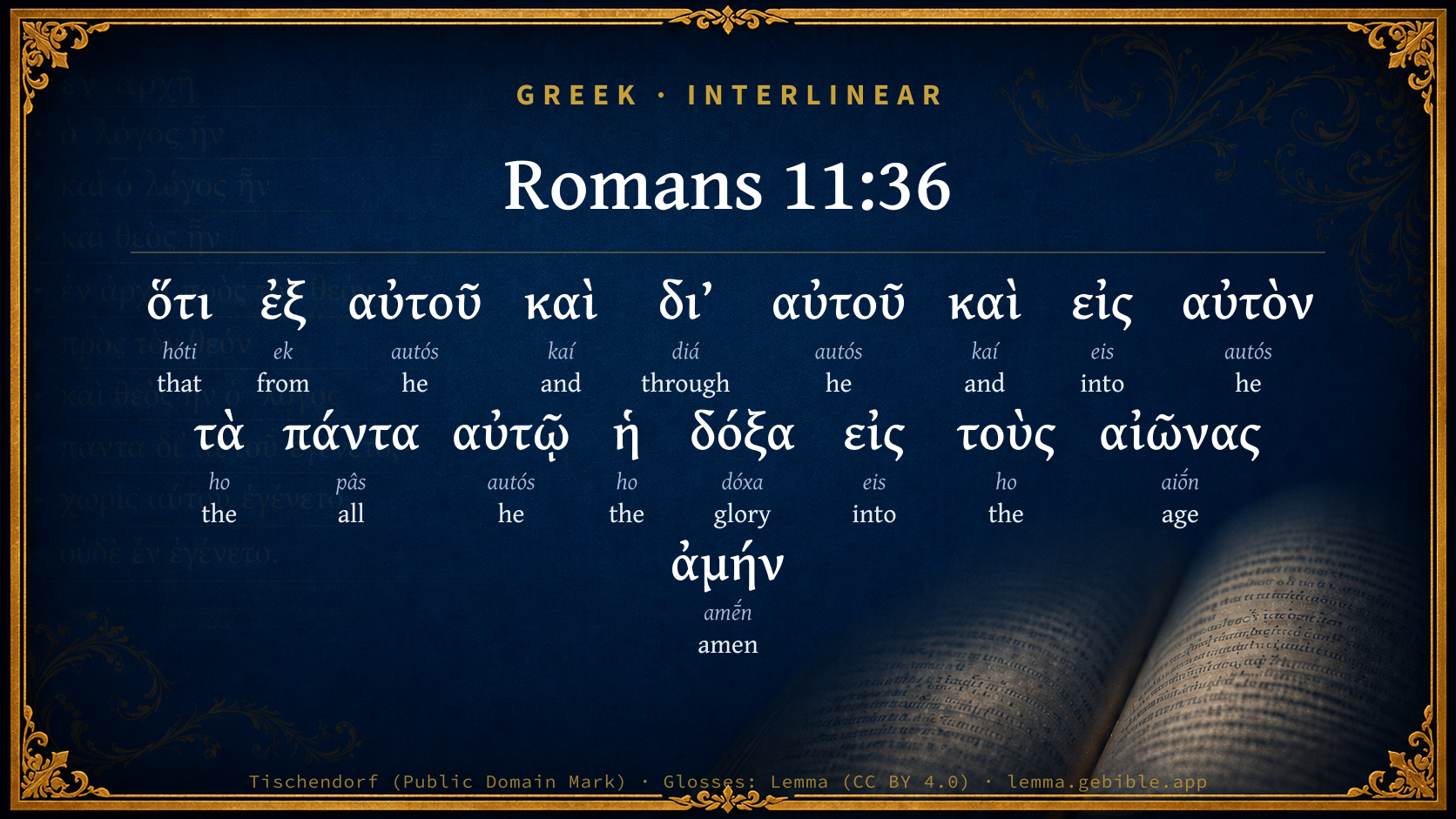
  1. ὅτι hóti G3754 “that” Conjunction
  2. ἐξ ek G1537 “from” Preposition
  3. αὐτοῦ autós G846 “he” Personal pronoun, Genitive, Singular, Masculine
  4. καὶ kaí G2532 “and” Conjunction
  5. δι’ diá G1223 “through” Preposition
  6. αὐτοῦ autós G846 “he” Personal pronoun, Genitive, Singular, Masculine
  7. καὶ kaí G2532 “and” Conjunction
  8. εἰς eis G1519 “into” Preposition
  9. αὐτὸν autós G846 “he” Personal pronoun, Accusative, Singular, Masculine
  10. τὰ ho G3588 “the” Article, Nominative, Plural, Neuter
  11. πάντα pâs G3956 “all” Adjective, Nominative, Plural, Neuter
  12. αὐτῷ autós G846 “he” Personal pronoun, Dative, Singular, Masculine
  13. ἡ ho G3588 “the” Article, Nominative, Singular, Feminine
  14. δόξα dóxa G1391 “glory” Noun, Nominative, Singular, Feminine
  15. εἰς eis G1519 “into” Preposition
  16. τοὺς ho G3588 “the” Article, Accusative, Plural, Masculine
  17. ἀμήν amḗn G281 “amen” Hebrew transliteration

About this verse

These counts appear in no published source. They are computed here, from the morphology-tagged text and Lemma’s own curated glosses. What Lemma adds →

18
words
11
distinct lemmas
Pauline Epistles
section

Repetition

Words recur within this verse:

Cross-references

39

Topical passages linked to Romans 11:36 in the Treasury of Scripture Knowledge — connected by theme and wording, ordered by reader-vote popularity; previews shown in the World English Bible.

  • 1 Corinthians 8:6 yet to us there is one God, the Father, of whom are all things, and we for him; and one Lord, Jesus Christ, through whom are all things, and we live through him.
  • Colossians 1:15–17 who is the image of the invisible God, the firstborn of all creation.
  • Hebrews 2:10 For it became him, for whom are all things, and through whom are all things, in bringing many children to glory, to make the author of their salvation perfect through sufferings.
  • 1 Timothy 1:17 Now to the King eternal, immortal, invisible, to God who alone is wise, be honor and glory forever and ever. Amen.
  • Romans 16:27
  • Acts 17:28 'For in him we live, and move, and have our being.' As some of your own poets have said, 'For we are also his offspring.'
  • 1 Chronicles 29:11–12 Yours, Yahweh, is the greatness, the power, the glory, the victory, and the majesty: for all that is in the heavens and in the earth is yours. Yours is the kingdom, Yahweh, and you are exalted as head above all.
  • Acts 17:25–26 neither is he served by men's hands, as though he needed anything, seeing he himself gives to all life and breath, and all things.
  • Jude 1:25 to God our Savior, who alone is wise, be glory and majesty, dominion and power, both now and forever. Amen.
  • Psalms 115:1 Not to us, Yahweh, not to us, But to your name give glory, For your loving kindness, and for your truth's sake.
  • 2 Peter 3:18 But grow in the grace and knowledge of our Lord and Savior Jesus Christ. To him be the glory both now and forever. Amen.
  • Revelation 21:6 He said to me, "It is done! I am the Alpha and the Omega, the Beginning and the End. I will give freely to him who is thirsty from the spring of the water of life.
  • Ephesians 4:6–10 one God and Father of all, who is over all, and through all, and in us all.
  • Revelation 5:12–14 saying with a loud voice, "Worthy is the Lamb who has been killed to receive the power, wealth, wisdom, strength, honor, glory, and blessing!"
  • Proverbs 16:4 Yahweh has made everything for its own end-- Yes, even the wicked for the day of evil.
  • 2 Timothy 4:18 And the Lord will deliver me from every evil work, and will preserve me for his heavenly Kingdom; to whom be the glory forever and ever. Amen.
  • Revelation 4:10–11 the twenty-four elders fall down before him who sits on the throne, and worship him who lives forever and ever, and throw their crowns before the throne, saying,
  • Psalms 33:6 By Yahweh's word the heavens were made; All their host by the breath of his mouth.
  • Daniel 2:20–23 Daniel answered, Blessed be the name of God forever and ever; for wisdom and might are his.
  • 1 Corinthians 11:12 For as woman came from man, so a man also comes through a woman; but all things are from God.
  • Philippians 4:20 Now to our God and Father be the glory forever and ever! Amen.
  • 1 Peter 5:11 To him be the glory and the power forever and ever. Amen.
  • Psalms 29:1–2 Ascribe to Yahweh, you sons of the mighty, Ascribe to Yahweh glory and strength.
  • Galatians 1:5 to whom be the glory forever and ever. Amen.
  • Ephesians 3:21 to him be the glory in the assembly and in Christ Jesus to all generations forever and ever. Amen.
  • Psalms 96:7–8 Ascribe to Yahweh, you families of nations, Ascribe to Yahweh glory and strength.
  • Revelation 1:5–6 and from Jesus Christ, the faithful witness, the firstborn of the dead, and the ruler of the kings of the earth. To him who loves us, and washed us from our sins by his blood;
  • Revelation 19:1 After these things I heard something like a loud voice of a great multitude in heaven, saying, "Hallelujah! Salvation, power, and glory belong to our God:
  • Isaiah 42:12 Let them give glory to Yahweh, and declare his praise in the islands.
  • Daniel 4:34 At the end of the days I, Nebuchadnezzar, lifted up my eyes to heaven, and my understanding returned to me, and I blessed the Most High, and I praised and honored him who lives forever; for his dominion is an everlasting dominion, and his kingdom from generation to generation.
  • Luke 19:38 saying, "Blessed is the King who comes in the name of the Lord! Peace in heaven, and glory in the highest!"
  • Hebrews 13:21 make you complete in every good work to do his will, working in you that which is well pleasing in his sight, through Jesus Christ, to whom be the glory forever and ever. Amen.
  • 1 Peter 4:11 If any man speaks, let it be as it were oracles of God. If any man serves, let it be as of the strength which God supplies, that in all things God may be glorified through Jesus Christ, to whom belong the glory and the dominion forever and ever. Amen.
  • Revelation 7:10 They cried with a loud voice, saying, "Salvation be to our God, who sits on the throne, and to the Lamb!"
  • Revelation 19:6–7 I heard something like the voice of a great multitude, and like the voice of many waters, and like the voice of mighty thunders, saying, "Hallelujah! For the Lord our God, the Almighty, reigns!
  • Daniel 4:3 How great are his signs! and how mighty are his wonders! his kingdom is an everlasting kingdom, and his dominion is from generation to generation.
  • Matthew 6:13 Bring us not into temptation, but deliver us from the evil one. For yours is the Kingdom, the power, and the glory forever. Amen.'
  • Luke 2:14 "Glory to God in the highest, On earth peace, good will toward men."
  • 1 Timothy 6:16 who alone has immortality, dwelling in unapproachable light; whom no man has seen, nor can see: to whom be honor and eternal power. Amen.

Cross-references courtesy of OpenBible.info (CC BY 4.0).

Commentary

Notes on Romans 11:36 from classic Christian and Jewish commentators (each source and its license shown beneath its notes). The classic Christian expositions comment on the surrounding passage and are grouped to its opening verse, so a note may address several verses; the Jewish commentaries on the Tanakh (Rashi and others) are per-verse, so they appear only where the commentator wrote on this verse.

Lemma curates 59 commentaries, every one of them public domain or Creative Commons licensed, each selected and text-cleaned for this edition rather than reprinted as found. About our sources →

Tyndale Open Study Notes

Tyndale Open Resources

11:36 everything comes from him and exists by his power: This statement is similar to statements found among Greek Stoic philosophers in their descriptions of God. Paul regularly draws on literature from the Greco-Roman world to present and clarify the truth about God and his purposes (cp. Acts 17:24-29).

Tyndale Open Study Notes — © Tyndale Open Resources, licensed CC BY-SA 4.0. Text via the HelloAO Bible API.

Bengel's Gnomon

Johann Albrecht Bengel

Rom 11:36. Εξ αὐτοῦ καὶ διʼ αὐτοῦ καὶ εἰς αὐτὸυ, of Him, and through Him, and to Him) The Origin, Course, and End of [The Source from whom come, the Agent through whom is maintained the continuance of, the End for whom are] all things, is here denoted, comp. 1Co 8:6. [Furthermore, ἐξ αὐτοῦ, refers to riches; διʼ αὐτοῦ, to wisdom; εἰς αὐτὸν, to knowledge.—V. g.]—ἡ δόξα, the glory) of the Riches, Wisdom, Knowledge. [Along with this doxology to Omnipotence, is included the praise of Divine Wisdom and Love, from which the creatures derive their strength, understanding, and blessedness.—V. g.]—ἀμήν. The final word, with which the feeling of the apostle, when he has said all, makes a termination.

Bengel's Gnomon of the New Testament — English translation (T&T Clark, Edinburgh, 1860) — public domain. Text from a community e-Sword module.

Meyer's Critical & Exegetical Commentary

Heinrich August Wilhelm Meyer

Rom_11:36 does not apply to all the three foregoing questions (Hofmann), but simply the last of them is established by the connective ὅτι (for truly) as regards its negative contents: No one has beforehand given to God, etc.

All things are from God (primal cause), in so far as all things have proceeded from Gods creative power; through God (ground of mediate agency), in so far as nothing exists without Gods continuous operation; for God (final cause), in so far as all things serve the ends of God (not merely: the honour of God, as many think). Comp. 1Co_8:6; Col_1:16; Heb_2:10. These passages speak quite against the opinion, that in the present passage the relation of Father, Son, and Spirit (Olshausen, Philippi, Thomasius, Jatho, Krummacher, following Ambrosiaster, Hilary, Toletus, Estius, Calovius, and others) is expressed a view which is also quite remote from the connection. The context speaks simply of God (the Father), to whom no one can have given anything beforehand, etc., because He, as Bengel aptly expresses it, is Origo et Cursus et Terminus rerum omnium. This may be recognised by the exegesis that has the deepest faith in Scripture without any rationalistic idiosyncrasy, as the example of Bengel himself shows. With reason neither Chrysostom, nor Oecumenius, nor Theophylact, neither Erasmus, nor Melanchthon, nor Calvin, nor Beza have expressed any reference to the Trinity in their explanations; but Augustine has this reference, against which also Tholuck, Hofmann, and Gess (v. d. Pers. Chr. p. 158) have been sufficiently unbiassed to declare themselves.

διʼ αὐτοῦ] God is mediate cause of all things by His upholding and ruling. Comp. Heb_2:18. To refer, with others, this statement to creation (Theophylact: ὁ ποιητὴς πάντων; comp. Oecumenius, Rückert, Fritzsche), would fail to bring out at least any popular distinction from ἘΞ ΑὐΤΟῦ, andwhich is decisive against such referencethat would be affirmed of the Father which pertains to the Son (Col_1:16; 1Co_8:6; Joh_1:2). Theodoret rightly remarks: αὐτὸς τὰ γεγονότα ΔΙΑΤΕΛΕῖ ΚΥΒΕΡΝῶΝ.

ΕἸς ΑὐΤΌΝ] All things serve Him (comp. Heb_2:10) as their ultimate end. This is explained by Oecumenius, Theophylact, and Fritzsche of the upholding (συνέχονται ἐπεστραμμένα πρὸς αὐτόν). On the whole, comp. what Marcus Antoninus, iv. 23, says of ΦΎΣΙς: ἘΚ ΣΟῦ ΠΆΝΤΑ, ἘΝ ΣΟῚ ΠΆΝΤΑ, ΕἸς ΣῈ ΠΆΝΤΑ, and Gataker in loc.

ἡ δόξα] sc. εἴη; as at Rom_16:27 : the befitting glory. Gal_1:5; Eph_3:21.

Meyer — Critical and Exegetical Commentary on the New Testament — English translation by Peter Christie, edited by Frederick Crombie (T&T Clark, 1880) — public domain. Text from a community e-Sword module.

Expositor's Greek Testament

ed. W. Robertson Nicoll

Rom 11:36 . ὅτι ἐξ αὐτοῦ κ . τ . λ . Strictly speaking, the ὅτι confirms the last truth man’s absolute dependence on God by making it part of a wider generalisation. ἐξ αὐτοῦ : from Him, as their source; διʼ αὐτοῦ : through Him, as the power by whose continuous energy the world is sustained and ruled; εἰς αὐτὸν : unto Him, as their goal, for whose glory they exist. A reference of any kind to the Trinity is out of the question. It is a question, however, whether τὰ πάντα means “all things” in the sense of the universe ( cf. 1Co 8:6 , Col 1:16 , Heb 2:10 ) or whether it is not limited by the article to all the things which have just been in contemplation, the whole marvellous action of God’s riches and wisdom and knowledge, as interpreted by the Apostle in regard to the work of redemption (for an example of τὰ πάντα in this sense see 2Co 5:18 ). I incline to the last view. The universe of grace, with all that goes on in it for the common salvation of Jew and Gentile, is of God and through God and to God. To Him be the glory which such a display of wisdom and love demands.

The Expositor's Greek Testament, edited by W. Robertson Nicoll (1897–1910) — public domain. Text from a community e-Sword module.

Hodge's Commentary on Romans, Ephesians & First Corinthians

Charles Hodge

Rom_11:36

For of him, and through him, and to him, are all things: to whom be glory for ever. Amen. The reason why man can lay God under no obligation is, that God is himself all and in all; the source, the means, and the end. By him all things are; through his power, wisdom, and goodness, all things are directed and governed; and to him, as their last end, all things tend. The prepositions ἐκ, διά, εἰς, here used, indicate that God is the source, the constantly working cause, and end of all things. Among the fathers, it was a common opinion that the apostle had reference to the Trinity, and intended in these words to indicate the relation of all things to the several persons of the Godhead. All things are of the Father, through the Son, and to the Spirit. So Tholuck and Olshausen. To this, however, it is objected, that such reference is not demanded by the context, and that the Spirits relation to what is out of himself is expressed by ἐν, not by εἰς. Compare Eph_4:6. It is God as God, the Godhead, and not the persons of the Trinity in their distinct relations, that is here brought into view. When Paul asks, Who hath first given to God? the answer is, No one, for of him, through him, and to him, are all things. It is for the display of his character everything exists, and is directed, as the highest and noblest of all possible objects. Creatures are as nothing, less than vanity and nothing in comparison with God. Human knowledge, power, and virtue, are mere glimmering reflections from the brightness of the divine glory. That system of religion, therefore, is best in accordance with the character of God, the nature of man, and the end of the universe, in which all things are of, through, and to God; and which most effectually leads men to say, not unto us, but unto thy name be all glory!

Such is the appropriate conclusion of the doctrinal portion of this wonderful epistle; in which more fully and clearly than in any other portion of the word of God, the plan of salvation is presented and defended. Here are the doctrines of grace; doctrines on which the pious in all ages and nations have rested their hopes of heaven, though they may have had comparatively obscure intimations of their nature. The leading principle of all is, that God is the source of all good; that in fallen man there is neither merit nor ability; that salvation, consequently, is all of grace, as well sanctification as pardon, as well election as eternal glory. For of him, and through him, and to him, are all things; to whom be glory for ever. Amen.

Doctrine

1. There is to be a general conversion of the Jews, concerning which the apostle teaches us

1. That it is to be in some way consequent on the conversion of the Gentiles, vv. 11-31.

2. That it will be attended with the most important and desirable results for the rest of the world, Rom_11:12, Rom_11:15.

3. That it is to take place after the fullness of the Gentiles is brought in; that is, after the conversion of multitudes of the Gentiles, (how many, who can tell?) Rom_11:25.

Nothing is said of this restoration being sudden, or effected by a miracle, or consequent on the second advent, or as attended by a restoration of the Jews to their own land. These particulars have all been added by some commentators, either from their own imagination, or from their views of other portions of the Scriptures. They are not taught by the apostle. On the contrary, it is through the mercy shown to the Gentiles, according to Paul, that the Jews are to be brought in, which implies that the former are to be instrumental in the restoration of the latter. And he everywhere teaches, that within the church the distinction between Jew and Gentile ceases. In Christ there is neither Jew nor Greek, Barbarian nor Scythian, bond nor free, Col_3:11; all classes are merged in one, as was the case under the direction of the apostles in the first ages of the church.

2. The church of God is the same in all ages and under all dispensations. It is the society of the true people of God, together with their children. To this society the ancient patriarchs and their posterity belonged; into this society, at the time of Christ, other nations were admitted, and the great body of the Jews were cast out, and into this same community the ancient people of God are to be again received. In every stage of its progress, the church is the same. The olive tree is one, though the branches are numerous, and sometimes changed, Rom_11:17-24.

3. The web of Providence is wonderfully woven. Good and evil are made with equal certainty, under the government of infinite wisdom and benevolence, to result in the promotion of Gods gracious and glorious designs. The wicked unbelief and consequent rejection of the Jews, are made the means of facilitating the conversion of the Gentiles; the holy faith and obedience of the Gentiles, are to be the means of the restoration of the Jews, Rom_11:11, Rom_11:31.

4. All organized communities, civil and ecclesiastical, have a common responsibility, a moral personality in the sight of God, and are dealt with accordingly, rewarded or punished according to their conduct, as such. As their organized existence is confined to this world, so must the retributive dispensations of God respecting them be. Witness the rejection, dispersion, and sufferings of the Jews, as a national punishment for their national rejection of the Messiah. Witness the state of all the Eastern churches broken off from the olive tree for the unbelief of former generations. Their fathers sinned, and their childrens children, to the third and fourth generation, suffer the penalty, as they share in the guilt, Rom_11:11-24.

5. The security of every individual Christian is suspended on his continuing in faith and holy obedience; which is indeed rendered certain by the purpose and promise of God. In like manner, the security of every civil and ecclesiastical society, in the enjoyment of its peculiar advantages, is suspended on its fidelity as such, for which fidelity there is no special promise with regard to any country or any church, Rom_11:20-24.

6. God does sometimes enter into covenant with communities, as such. Thus he has covenanted with the whole human race that the world shall not be again destroyed by a deluge, and that the seasons shall continue to succeed each other, in regular order, until the end of time. Thus he covenanted with the Jews to be a God to them and to their seed for ever, and that they should be to him a people. This, it seems, is a perpetual covenant, which continues in force until the present day, and which renders certain the restoration of the Jews to the privileges of the church of God, Rom_11:16, Rom_11:28, Rom_11:29.

7. It is the radical principle of the Bible, and consequently of all true religion, that God is all and in all; that of him, and through him, and to him, are all things. It is the tendency of all truth to exalt God, and to humble the creature; and it is characteristic of true piety to feel that all good comes from God, and to desire that all glory should be given to God, Rom_11:33-36.

Remarks

1. The mutual relation between the Christian church and the Jews should produce in the minds of all the followers of Christ,

1. A deep sense of our obligations to the Jews as the people through whom the true religion has been preserved, and the blessings of divine truth extended to all nations, Rom_11:17, Rom_11:18.

2. Sincere compassion for them, because their rejection and misery have been the means of reconciling the world to God, i.e. of extending the gospel of reconciliation among men, Rom_11:11, Rom_11:12, Rom_11:15.

3. The banishment of all feelings of contempt towards them, or exultation over them, Rom_11:18, Rom_11:20.

4. An earnest desire, prompting to prayer and effort, for their restoration, as an event fraught with blessings to them and to all the world, and one which God has determined to bring to pass, Rom_11:12, Rom_11:15, Rom_11:25, etc.

2. The dealings of God with his ancient people should, moreover, teach us

1. That we have no security for the continuance of our privileges but constant fidelity, Rom_11:20.

2. That, consequently, instead of being proud and self-confident, we should be humble and cautious, Rom_11:20, Rom_11:21.

3. That God will probably not bear with us as long as he bore with the Jews, Rom_11:21.

4. That if for our unbelief we. are cast out of the church, our punishment will probably be more severe. There is no special covenant securing the restoration of any apostate branch of the Christian church, Rom_11:21, Rom_11:24, with Rom_11:16, Rom_11:27-29.

3. It is a great blessing to be connected with those who are in covenant with God. The promise is to thee and thy seed after thee. The Lord thy God, he is God, the faithful God, which keepeth covenant and mercy with them that love him and keep his commandments, to a thousand generations, Deu_7:9. The blessing of Abraham reaches, in some of its precious consequences, to the Jews of this and every coming age, Rom_11:16, Rom_11:27-29.

4. The destiny of our children and our childrens children is suspended, in a great measure, on our fidelity. God is a jealous God, visiting the iniquities of the fathers upon the children unto the third and fourth generation of them that hate him. What words of woe for unborn thousands, were those, His blood be on us and on our children! As the Jews of the present age are suffering the consequences of the unbelief of their fathers, and the nominal Christians of the eastern churches suffer for the apostasy of previous generations, so will our children perish, if we, for our unbelief as a church and nation, are cast off from God, Rom_11:19-24.

5. As the restoration of the Jews is not only a most desirable event, but one which God has determined to accomplish, Christians should keep it constantly in view even in their labors for the conversion of the Gentiles. This Paul did, Rom_11:13, Rom_11:14. Every effort to hasten the accession of the fullness of the Gentiles is so much done towards the restoration of Israel, Rom_11:25.

6. Christians should not feel as though they were isolated beings, as if each one need be concerned for himself alone, having no joint responsibility with the community to which he belongs. God will deal with our church and country as a whole, and visit our sins upon those who are to come after us. We should feel, therefore, that we are one body, members one of another, having common interests and responsibilities. We ought to weep over the sins of the community to which we belong, as being in one sense, and in many of their consequences, our sins, Rom_11:11-24.

7. As the gifts and calling of God are without repentance, those to whom he has given the Holy Spirit, and has called unto holiness, may rejoice in the certainty of the continuance of these blessings, Rom_11:29.

8. Does the contemplation of the work of redemption, and the remembrance of our own experience, lead us to sympathize with the apostle in his adoring admiration of the wisdom and goodness of God, and feel that, as it regards our salvation, everything is of him, and through him, and to him? Rom_11:33-36.

9. As it is the tendency and result of all correct views of Christian doctrine to produce the feelings expressed by the apostle at the close of this chapter, those views cannot be scriptural which have a contrary tendency; or which lead us to ascribe, in any form, our salvation to our own merit or power, Rom_11:33-36.

Charles Hodge — Commentary on Romans (1835), First Corinthians (1857), and Ephesians (1856) — public domain. Text from a community e-Sword module.

Geneva Bible (1599)

Geneva Bible translators

To wit, for God, to whose glory all things are referred, not only things that were made, but especially his new works which he worketh in his elect.

Geneva Bible (1599) marginal notes — public domain. Text via Bolls.life.

Jamieson, Fausset & Brown

Robert Jamieson, A. R. Fausset & David Brown

For of him, and through him, and to him, are all things: to whom--"to Him"

be glory for ever. Amen--Thus worthily--with a brevity only equalled by its sublimity--does the apostle here sum up this whole matter. "OF Him are all things," as their eternal Source: "THROUGH HIM are all things," inasmuch as He brings all to pass which in His eternal counsels He purposed: "To Him are all things," as being His own last End; the manifestation of the glory of His own perfections being the ultimate, because the highest possible, design of all His procedure from first to last.

On this rich chapter, Note, (1) It is an unspeakable consolation to know that in times of deepest religious declension and most extensive defection from the truth, the lamp of God has never been permitted to go out, and that a faithful remnant has ever existed--a remnant larger than their own drooping spirits could easily believe (Rom 11:1-5). (2) The preservation of this remnant, even as their separation at the first, is all of mere grace (Rom 11:5-6). (3) When individuals and communities, after many fruitless warnings, are abandoned of God, they go from bad to worse (Rom 11:7-10). (4) God has so ordered His dealings with the great divisions of mankind, "that no flesh should glory in His presence." Gentile and Jew have each in turn been "shut up to unbelief," that each in turn may experience the "mercy" which saves the chief of sinners (Rom. 11:11-32). (5) As we are "justified by faith," so are we "kept by the power of God through faith"--faith alone--unto salvation (Rom 11:20-32). (6) God's covenant with Abraham and his natural seed is a perpetual covenant, in equal force under the Gospel as before it. Therefore it is, that the Jews as a nation still survive, in spite of all the laws which, in similar circumstances, have either extinguished or destroyed the identity of other nations. And therefore it is that the Jews as a nation will yet be restored to the family of God, through the subjection of their proud hearts to Him whom they have pierced. And as believing Gentiles will be honored to be the instruments of this stupendous change, so shall the vast Gentile world reap such benefit from it, that it shall be like the communication of life to them from the dead. (7) Thus has the Christian Church the highest motive to the establishment and vigorous prosecution of missions to the Jews; God having not only promised that there shall be a remnant of them gathered in every age, but pledged Himself to the final ingathering of the whole nation assigned the honor of that ingathering to the Gentile Church, and assured them that the event, when it does arrive, shall have a life-giving effect upon the whole world (Rom 11:12-16, Rom 11:26-31). (8) Those who think that in all the evangelical prophecies of the Old Testament the terms "Jacob," "Israel," &c., are to be understood solely of the Christian Church, would appear to read the Old Testament differently from the apostle, who, from the use of those very terms in Old Testament prophecy, draws arguments to prove that God has mercy in store for the natural Israel (Rom 11:26-27). (9) Mere intellectual investigations into divine truth in general, and the sense of the living oracles in particular, as they have a hardening effect, so they are a great contrast to the spirit of our apostle, whose lengthened sketch of God's majestic procedure towards men in Christ Jesus ends here in a burst of admiration, which loses itself in the still loftier frame of adoration (Rom 11:33-36).

Next: Romans Chapter 12

Jamieson, Fausset & Brown — Commentary Critical and Explanatory on the Whole Bible (1871) — public domain (CC PDM 1.0). Text via the HelloAO Bible API.

Adam Clarke's Commentary

Verse 36. For of him, c.] This is so far from being the case, for εξ αυτου, OF him, as the original designer and author and δι αυτου, BY him, as the prime and efficient cause; and εις αυτον, TO him, as the ultimate end for the manifestation of his eternal glory and goodness, are all things in universal nature, through the whole compass of time and eternity.

The Emperor Marcus Antoninus (εις εαυτον lib. iv.), has a saying very much like this of St. Paul, which it is very probable he borrowed from this epistle to the Romans. Speaking of nature, whom he addresses as God, he says, Ω φυσις εκ σου παντα, εν σοι παντα, εις σε παντα; O, Nature! OF thee are all things; IN thee are all things; TO thee are all things. Several of the Gentile philosophers had expressions of the same import, as may be seen in Wetstein's quotations.

To whom be glory] And let him have the praise of all his works, from the hearts and mouths of all his intelligent creatures, for ever - throughout all the generations of men. Amen - so be it! Let this be established for ever!

I. THE apostle considers the designs of God inscrutable, and his mode of governing the world incomprehensible. His designs, schemes, and ends are all infinite, and consequently unfathomable. It is impossible to account for the dispensations either of his justice or mercy. He does things under both these characters which far surpass the comprehension of men. But though his dispensations are a great deep, yet they are never self-contradictory: though they far surpass our reason, yet they never contradict reason; nor are they ever opposite to those ideas which God has implanted in man, of goodness, justice, mercy, and truth. But it is worthy of remark, that we can more easily account for the dispensations of his justice than we can for the dispensations of his mercy. We can every where see ten thousand reasons why he should display his justice; but scarcely can we find one reason why he should display his mercy. And yet, these displays of mercy for which we can scarcely find a reason, are infinitely greater and more numerous than his displays of justice, for which the reasons are, in a vast variety of cases, as obvious as they are multiplied. The sacrifice of Christ is certainly an infinite reason why God should extend, as he does, his mercy to all men; but Jesus Christ is the gift of God's love: who can account for the love that gave him to redeem a fallen world? The Jews have fallen under the displeasure of Divine justice: why they should be objects of this displeasure is at once seen in their ingratitude, disobedience, unbelief, and rebellion. But a most especial providence has watched over them, and preserved them in all their dispersions for 1700 years: who can account for this? Again, these very persons have a most positive promise of a future deliverance, both great and glorious: why should this be? The Gentile world was long left without a Divine revelation, while the Jews enjoyed one: who can account for this? The Jews are now cast out of favour, in a certain sense, and the reasons of it are sufficiently obvious; and the Gentiles, without any apparent reason, are taken into favour. In all these things his judgments are unsearchable, and his ways past finding out!

II. Once more: Let it be remarked that, although God is every where promising and bestowing the greatest and most ennobling privileges, together with an eternal and ineffable glory, for which we can give no reason but his own endless goodness, through the death of his Son; yet, in no case does he remove those privileges, nor exclude from this glory, but where the reasons are most obvious to the meanest capacity.

III. This epistle has been thought by some to afford proofs that God, by an eternal decree, had predestinated to eternal perdition millions of millions of human souls before they had any existence, except in his own purpose, and for no other reason but his sovereign pleasure! But such a decree can be no more found in this book, than such a disposition in the mind of Him who is the perfection, as he is the model, of wisdom, goodness, justice, mercy, and truth. May God save the reader from profaning his name, by suppositions at once so monstrous and absurd!

Adam Clarke's Commentary on the Bible (1810–1826) — public domain. Text from a community e-Sword/MySword module.

John Calvin's Commentaries

36. For from him and through him, etc. A confirmation of the last verse. He shows, that it is very far from being the case, that we can glory in any good thing of our own against God, since we have been created by him from nothing, and now exist through him. He hence infers, that our being should be employed for his glory: for how unreasonable would it be for creatures, whom he has formed and whom he sustains, to live for any other purpose than for making his glory known? It has not escaped my notice, that the phrase, εἰς αὐτὸν, to him, is sometimes taken for ἐν αὐτῷ, in or by him, but improperly: and as its proper meaning is more suitable to the present subject, it is better to retain it, than to adopt that which is improper. The import of what is said is, — That the whole order of nature would be strangely subverted, were not God, who is the beginning of all things, the end also.

To him be glory, etc. The proposition being as it were proved, he now confidently assumes it as indubitable, — That the Lord’s own glory ought everywhere to continue to him unchangeably: for the sentence would be frigid were it taken generally; but its emphasis depends on the context, that. God justly claims for himself absolute supremacy, and that in the condition of mankind and of the whole world nothing is to be sought beyond his own glory. It hence follows, that absurd and contrary to reason, and even insane, are all those sentiments which tend to diminish his glory.

John Calvin's Commentaries (1540-1563) — public domain. Text from the Calvin Translation Society English edition (1840s-50s) via the Christian Classics Ethereal Library (ccel.org). Calvin's coverage is partial (roughly two-thirds of the Bible); uncommented books and verses are honest gaps, never fabricated. The 19th-century editor's footnotes and remarks are omitted so the notes are faithfully Calvin's own voice.

Ellicott's Commentary for English Readers

(36) Of him, and through him, and to him.—All things proceed from God, all things are made or wrought by Him, and all things exist for His glory, and to carry out His ends. It is a mistake to see in this, as some of the older commentators have done, an allusion to the Trinity. This can hardly be. The subject of the whole verse appears to be God the Father, and the prominent idea is rather the unity of creation corresponding to the unity of the Godhead. The whole system of things issues from and returns to Him, accomplishing in its course His beneficent designs. It is true, however, that the use of the prepositions is such as in more analytical passages would be taken to express the threefold relation (origination, mediate causation, and retrocession) which the doctrine of the Trinity embodies.

A Bible Commentary for English Readers, edited by Charles John Ellicott (1878–1897) — public domain. Text from a community e-Sword module.

The Cambridge Bible for Schools and Colleges

gen. ed. J. J. S. Perowne

36. of him] Lit. out of Him; not in the Pantheistic sense, as if all things were evolved from God—phases of God; but in the Christian sense, that His will is the ultimate source of all being, all life and force, all conscience, will, and thought.

through him] by means of Him. He is not the Source only, but the Means. He did not only originate all things, but incessantly sustains and overrules all. In the special case of the saints, He not only wills their salvation, but—through their regenerated will—gives them power to believe and persevere. “He keeps them, by His power, through faith, unto salvation.” (1Pe_1:5. See too Php_2:13.)

to him] To His glory. He is, to Himself, the Final Cause of all His works. He is greater, higher, nobler, and more precious, than His whole creation; and must view Himself as such: what else, then, but Himself could He make His aim and end?

Cp. Col_1:16, for the same words, “through Him and to Him” used of the Eternal Son; one of the deepest proofs of His proper Deity.

to whom be glory] Lit., to Him [be] the glory; the glory due to Him. Same words as Rom_16:27; Gal_1:5; Php_4:20; 2Ti_4:18; Heb_13:21; and nearly the same as 2Pe_3:18; Rev_1:6. In the last two passages the ascription is to the Eternal Son. See Rev_1:5.

for ever] Lit., unto the ages; through all future periods and developements of existence. Same words as Rom_9:6; where see also note on “Amen.”

The Cambridge Bible for Schools and Colleges (gen. ed. J. J. S. Perowne; Cambridge University Press, 1878–1918) — public domain. Text from a community e-Sword module.

John Gill's Exposition

For of him, and through him, and to him are all things,.... Not only all things in nature and providence, he being the Maker and efficient cause of things, and the preserver and supporter of them their beings, and to whose glory they are all designed and directed; but all things in grace owe their original to him, as their first cause; they are produced by him, and make for his glory; they all spring from his sovereign will, are brought about by his almighty power, and tend to the glory of his grace; as does every thing in election, redemption, and regeneration: particularly the counsels and purposes of God respecting men may be here meant; which all rise out of his own heart, without any motive or inducement to them in the creature; are accomplished by his divine power, notwithstanding all the opposition of men and devils; and all issue in his glory, even such of them as may seem to carry in them severity to some of his creatures: and since this is the case, the following doxology, or ascription of glory to God, is justly and pertinently made,

to whom be glory for ever; and which will be given to him by angels and men to all eternity, for the perfection of his being, the counsels of his will, and the works of his hands, both of nature and grace; to which the, apostle annexes his

amen, so be it, assenting to it, wishing for it, and believing of it.

Next: Romans Chapter 12

John Gill's Exposition of the Whole Bible (1746–1763) — public domain (CC PDM 1.0). Text via the HelloAO Bible API.

Trapp's Complete Commentary

John Trapp

36 For of him, and through him, and to him, are all things: to whom be glory for ever. Amen.

Ver. 36. For of him] As the efficient cause, and "through him" as the administering cause, and "to him" as the final cause, are all things. A wise philosopher could say, that man is the end of all in a semicircle; that is, all things in the world are made for him, and he is made for God.

To whom be glory for ever] God, saith one, counts the works and fruits that come from us to be ours, because the judgment and resolution of will whereby we do them is ours. This he doth to encourage us. But because the grace whereby we judge and will aright comes from God, ascribe we all to him. So shall he lose no praise, we no encouragement.

John Trapp, A Commentary or Exposition upon All the Books of the Old and New Testament (1647–1656) — public domain. Text from a community e-Sword module.

Albert Barnes' Notes on the Bible

For of him - εξ αὐτοῦ ex autou; compare 1Co 1:30; 1Co 8:6. This expression doubtless means that he is the original source and fountain of all blessings. He is the Creator of all, the rich “fountain from which all streams of existence take their rise. The design of this verse is to show that no creature has any claim on God. Jews and Gentiles must alike receive salvation on the ground of his mercy. So far from having a claim on God, the apostle here affirms that all things have come from him, and therefore all must be derived to us. Nothing has been produced by chance, or haphazard; nothing by created skill or might. All has been formed by God; and therefore he has a right to dispose of all.

And through him - δἰ αὐτοῦ di autou.) That is, by his immediate operating agency. The former expression, “of him,” affirmed that he was the original source of all things; this declares that all are by him, or through him, as their immediate cause. It is not merely by his plan or purpose; it is by his agency, by the direct exertion of his power in their creation and bestowment. By his power they are still directed and controlled. Human agency, therefore, could not lay him under any obligation. He does not need the aid of man; and he did not call in that aid in the creation and government of the world. He is the independent Creator and Lord, and on him none can have a claim.

To him - εἰς αὐτὸν eis autos. This expression denotes the final cause, the reason or end for which all things were formed. It is to promote his honor and glory. It is to manifest his praise, or to give a proper putting forth of the glorious attributes of God; that the exceeding greatness, and goodness, and grandeur of his character might be evinced. It is not to promote his happiness, for he was eternally happy; not to add anything to him, for he is infinite; but that he might act as God, and have the honor and praise that is due to God. As this was the design of all things, so it followed that the bestowment of his favors must be in accordance with this in such a way as to promote his glory; and not so as to consult the feelings or views of either Jews or Gentiles.

All things - The universe; the creation, or still more particularly, the things of which the apostle is discoursing. He does not affirm that he is the author of sin or of sinful thoughts; not that he creates evil, or that evil is designed to promote his glory. The apostle is not discoursing of these, but of his method of bestowing his favors; and he says that these are to be conferred in such a way as to promote his honor, and to declare the praise of hint who is the original source, the creator, and the proprietor of all things.

To whom be glory - This ascription of praise is the appropriate close of the argumentative part of the Epistle, as well as appropriate to the train of remarks into which the apostle had fallen. It expresses his hearty amen in concurrence with this view; the deep desire of a pious man that all might be to God’s glory and honor. He had not merely come to it by reasoning, but it was the sincere desire of his soul that it might be so. The Christian does not merely admit this doctrine; he is not merely driven to it by argument, but it finds a hearty response in his bosom. He rejoices in it; and sincerely desires that all may be to the honor of God. Sinners are often compelled by argument to admit it, but they do not love it. They would rejoice were it otherwise, and be glad if they were permitted rather to seek their own glory than that of the living God.

Glory - Praise, honor.

Forever - Not merely amid transitory events now, but ever onward to eternity. This will be the case. There never will be a time when the affairs of the universe shall not be conducted with reference to the glory of God. That honor and glory shall shine brighter and brighter, and all worlds shall be perfectly adapted to show his praise, and to evince his greatness, goodness, power, and love forever and ever. Thus, let it be, is the language of everyone that truly loves him.

This closes the argumentative part of the Epistle. From the close of this chapter we may make the following observations.

1. God is infinitely wise, and just, and good. This is seen in all his plans and doings, and especially in the glorious plan of saving people.

2. It becomes man to be humble. He can see but few of the reasons of the doings of an infinite God. He is not qualified to sit in judgment on his plans. He is not suited to arraign him. There is nothing more absurd than for a man to contend with God, or to find fault with his plans; and yet there is nothing more common. Man speaks, and thinks, and reasons on the great things pertaining to the divine mind and plan, as if he were qualified to counsel the being of infinite wisdom, and to arraign at the bar of his own reason the being of infinite goodness.

3. It is our duty to be submissive to God. His plans may often require him to cross the path of our pleasures, or to remove some of our enjoyments. He tries us by requiring us to put confidence in him where we cannot see the reason of his doings, and to believe that he is qualified for universal empire. In all such cases it is our duty to submit to his will. He is seeking a grander and nobler object than our private good. He is seeking the welfare of a vast universe; and he best knows in what way that can be promoted.

4. God is the creator and proprietor of all things. It would be possible to prove this from his works. But his word unequivocally asserts it. He has formed, and he upholds, and he directs all things for his glory. He who formed all has a right to all. He who is the source of life has the right to direct it, or to withdraw the gift. He on whom all depend has a right to homage and praise.

5. He has formed a universe that is eminently adapted to declare his glory. It evinces infinite power in its creation; and it is suited to fill the mind with ever-growing wonder and gladness in its contemplation. The sacred writers were filled with rapture when they contemplated it; and all the discoveries of astronomy, and geology, and science in general, in modern times, are suited to carry forward the wonder, and fill the lips with new expressions of praise. The universe is vast and grand enough to occupy the thoughts forever. How little do we know of the wonders of his creation, even pertaining to this little world; to our own bodies and souls; to the earth, the ocean, the beast and the reptile, the bird and the insect; how much less of that amazing view of worlds and systems which modern astronomy has opened to our view, the vast starry frame which the eye can penetrate for millions and millions of miles, and where it finds world piled on world, and system rising above system, in wonderful order and grandeur, and where the utmost power of the telescore can as yet find no bounds.

6. Equally true is this in his moral government. The system is such as to excite our wonder and praise. The creation and control of free, and active, and mighty minds is as wonderful as the creation and control of matter, even the vast masses of the planetary systems. Creation is filled with minds. God has peopled the worlds with conscious, free, and active intelligences. The wonderful wisdom by which he controls them; the amazing moral power by which he guards and binds them to himself, by which he restrains and awes the rebellious; and the complete subjection by which he will bring all yet at his feet, is as much replete with wonder as the wisdom and skill by which he framed the heavens. To govern mind requires more wisdom and skill than to govern matter. To control angels and human beings evinces more glory than to roll the streams or the ocean, or than to propel and guide the planets. And especially is this true of the plan of salvation. That wondrous scheme is adapted to call forth eternal, praise, and to show forever the wisdom and mercy of God. Without such a plan, we cannot see how the Divinity could be fully manifested; with that, we see God as God, vast, grand, mighty, infinite; but still seeking to do good, and having power to enter any vast mass of iniquity, and to diffuse purity and peace over the face of an alienated and dying world.

7. The salvation of sinners is not to promote their own glory primarily, but that of God. “He is first, and he is last; he is midst, and without end,” in their salvation. God seeks his own honor, and seeks it by their return and their obedience. But if they will not promote his glory in that way, they must be made to promote it in their ruin.

8. It is the duty of people to seek the honor of this infinitely wise and holy God. It commends itself to every man’s conscience. God has formed us all; and man can have no higher destiny and honor than to be permitted to promote and spread abroad through all the universe the knowledge of a Being whose character is infinitely lovely, whose government is right, and whose presence and favor will diffuse blessings of salvation and eternal peace on all the wide creation that will be obedient to his will.

Albert Barnes' Notes on the Bible (1834–1885) — public domain. Text from a community e-Sword/MySword module.

Haydock's Catholic Bible Commentary

===============================

[BIBLIOGRAPHY]

Et in ipso, Greek: kai eis auton.

====================

George Leo Haydock (1774–1849), Haydock's Catholic Family Bible and Commentary, 1859 edition — public domain. Excludes Psalms (Douay-Rheims chapter numbering differs from Protestant) and Deuterocanonical books (Catholic canon only).

Matthew Poole's English Annotations

For of him, and through him, and to him, are all things; i.e. all things are of him, as the efficient cause; through him, as the disposing cause; to him, as the final cause. They are of him, without any other motive; through him, without any assistance; and to him, without any other end, i.e. for his sake alone.

To whom be glory for ever. Amen: a usual doxology in Scripture: see Gal 1:5; 2Ti 4:18; Heb 13:21; 1Pe 5:11.

Matthew Poole's English Annotations on the Holy Bible (1683–1685) — public domain. Text from a community e-Sword/MySword module.

Whedon's Commentary on the Bible

Daniel D. Whedon

36. In the triad of this verse we recognise a dim reference to the distinctive attributes of the three persons of the Trinity.

Of him—Rather, from him, as primitive source.

Through him—As universal medium and agent.

To him—As End, to which all things redound. This third, however, would seem to refer to the Spirit only as finale deity after the economy of salvation closes. The triad in Eph_4:6, is more perfectly trinitarian, “Above all, through all, and in you all.” Alford very accurately says, “Though Paul has never definitively expressed the doctrine of the Holy Trinity as a definite formula, yet he was conscious of it as a living reality.” Even the triad (Rom_11:33) of riches, wisdom, knowledge—source, medium, and result—is not without its trinitarian look. And to this mystic Trine is ascribed glory eternal under the unquestionable sense of a divine attribute. What a dim yet decisive adumbration of the three-one God!

The entire First Part or Argument (see “Plan”) is now closed. The very shape of the Epistle presents in type the great fact that our obligation to the duties of Life springs as a result from the doctrines of Christianity. Hence we title this Second Part:

Daniel D. Whedon (gen. ed.), Commentary on the Old and New Testaments (1874–1909) — public domain. Text from a community e-Sword module.

The Pulpit Commentary

For of him; and through him, and unto him, are all things. The view advanced by some, that we have here an intimation of the doctrine of the Holy Trinity, cannot fairly be maintained. But it is strikingly significant of the apostle"s view of the essential Deity of Christ, that in 1Co_8:6 and Col_1:16, Col_1:17, similar language is applied to him. In the first of these texts it is said of the Father, ex ou ta panta , and of the "Lord Jesus Christ," di ou ta panta ; and in the second, of "the Son of the Father"s love," en autw ektisyh ta panta , and ta panta di autou kai eiv auto and also ta panta en autw sunesthken . To him be the glory for ever. Amen.

The Pulpit Commentary (1880–1919), ed. H.D.M. Spence-Jones & Joseph S. Exell — public domain. Text from a community e-Sword module.

John Wesley's Explanatory Notes

Of him - As the Creator. Through him - As the Preserver. To him - As the ultimate end, are all things. To him be the glory of his riches, wisdom, knowledge. Amen - A concluding word, in which the affection of the apostle, when it is come to the height, shuts up all.

John Wesley, Explanatory Notes Upon the Whole Bible (1754–1765) — public domain. Text via the GEBible commentary corpus.

Burkitt's Expository Notes on the New Testament

William Burkitt

That is, all things are of God, as the author and efficient cause; all things are through him as the providential director, and preserving cause; and all things tend to him, as the ultimate end and final cause: therefore to him all praise, honour, and glory, ought for ever to be ascribed."

Learn hence, That God is the first cause, and last end.

He is the first cause; that is, he is the cause of all things besides himself, the fountain and original of all created beings; nothing was before him, but all things were created by him, and dependent upon him.

And as he is the first cause, so he is the last end, that is, all things tend to him as their ultimate end; their design and aim was the illustration of God’s glory, and the manifestation of his divine perfections.

And if God be the first cause, let us with humility and thankfulness acknowledge him, admire and adore him, love and serve him, who is the author of our being, and the cause of all other beings.

And if he be the last end, let us refer all our actions to his glory; in all our natural actions, our civil actions, let the glory of God be our supreme aim, and ultimate end.

For if we do not now live unto him, we can never expect hereafter to live with him.

William Burkitt's Expository Notes on the New Testament (1700–1703) — public domain. Text from a community e-Sword module.

McGarvey & Pendleton's Commentaries

J. W. McGarvey

For of him, and through him, and unto him, are all things . [Summary statement of the all-comprehensive riches of God. 1. God, in the beginning or past, is the author, origin and creative source of all existence. He is the efficient original cause from whence all came (hence his perfect knowledge). 2. God, in the middle or present, is the sustaining, supporting means of all existence. He is the continuous cause by which all things are upheld. By ruling and overruling all forces, he is the preserving governor and the providential director of creation in its course toward to-morrow (hence his unerring wisdom). 3. God, in the end or future, is the ultimate purpose or end of all existence. He is the final cause for which creation was and is and will be; for all things move to consummate his purposes, fulfill his pleasure and satisfy his love. They shall glorify him and be glorified by him (hence his riches: he is all in all-- 1Co_15:28 ] To him be the glory for ever. Amen . [Thus with the customary benediction ( Gal_1:5 ; 2Ti_4:18 ; Heb_13:1 ; 1Pe_5:11 ) and the formal "Amen," the apostle closes the doctrinal division of his Epistle.]

J. W. McGarvey (with Philip Y. Pendleton), Commentaries on the New Testament (The Fourfold Gospel, 1914; Acts; and the epistles) — public domain. Text from a community e-Sword/MySword module.

Cambridge Greek Testament for Schools and Colleges

36. ὅτι refers not to the preceding verse only but to the whole explanation Rom 11:33-35.

ἐξ αὐτοῦ κ.τ.λ. In close relation to the context, ascribing to GOD as GOD the whole origin, direction, and end of all these elements in the ordering of creation, and in particular of human life and destiny which have been under discussion. The thought gives strength and hope to faith. The nearest parallel in thought is 2Co 5:18, in language 1Co 11:12.

ἐξ αὐτοῦ. From Him as creator and giver. |[225] πλούτος Rom 11:33.

[225] | parallel to

δι’ αὐτοῦ. Through Him as ruler and guide, cf. Rom 16:26; |[226] σοφία, Rom 11:33. The same rare use of διὰ as is found in 1Th 5:14 (= under the guidance of Jesus), Heb 3:16 (διὰ Μωυσέως); cf. Kuhring, Diss, de Praepos. (Bonn, 1906) who quotes from Papyri only. So Heb 2:10. In 1Co 8:6 the use is different; cf. Joh 1:3; διὰ being used of the Son as agent of creation = Heb 1:2. Blass (p. 132) qu. Aesch. Ag. 1486.

[226] | parallel to

εἰς αὐτὸν. 1Co 8:6. He is the end to which all this leads, |[227] γνώσις Rom 11:33; of. 2Co 5:18 θεὸς ἦν ἐν Χρ. κόσμον καταλλάσσων ἑαυτῷ.

[227] | parallel to

αὐτῷ ἡ δόξα. Cf. Rom 16:27; Eph 3:21; Gal 1:5; Php 4:20; 1Ti 1:17; 2Ti 4:18. In all cases evolved by the thought of GOD’s mercies, either general or special, ἡ δόξα, sc. ἐστίν; cf. 1Pe 4:11 and Lft ad Gal 1:5: = to Him belongs the glory seen in all His works.

ἀμήν. The word at the end of prayers and praises marks the assent of others to the utterance. In these passages it emphasises the statement by the express assent given to it by the Apostle. cf. Dalman, p. 227, Swete on Rev 1:5 (ref. to Chase on Lord’s Prayer p. 168 f.).

Cambridge Greek Testament for Schools and Colleges (Cambridge University Press, 1896; 21 vols, various authors incl. Carr, Maclear, Plummer, Farrar, Lumby, Moule, M. R. James, Simcox) — public domain. Text from a community e-Sword module.

Alford’s Greek Testament

Henry Alford

36.] For (ground of vv. 33-35. Well may all this be true of Him, for) of Him (in their origin:—‘quod dicit, “ex ipso,” hoc ipsum, quod sumus indicat:’ Orig. Chrys. somewhat differently: see above on ver. 33), and through Him (in their subsistence and disposal:—‘ “per Ipsum,” quod per ejus providentiam dispensamur in vita:” Orig.), and unto Him (‘ “in Ipso,” (so Vulg. and some other vss.) quod perfectio omnium et finis in Ipso erit tunc, cum erit Deus omnia in omnibus:’ Orig.) are all things (not only, though chiefly, men,—but the whole creation). Origen remarks, ‘Vides, quomodo in ultimis ostendit, quod in omnibus quæ supra dixit signaverit, mysterium Trinitatis. Sicut enim in præsenti loco quod ait, “quoniam ex Ipso, et per Ipsum, et in Ipso sunt omnia:” convenit illis dictis, quæ idem Apostolus in aliis memorat locis, cum dicit (1Co 8:6): “Unus Deus Pater ex quo omnia, et unus Dominus noster Jesus Christus, per quem omnia:” et item in Spiritu Dei dicit revelari omnia, et per hæc designat, in omnibus esse providentiam Trinitatis: ita et cum dicit “altitudo divitiarum,” Patrem, ex quo omnia dicit esse, significat: et sapientiæ altitudinem, Christum, qui est sapientia ejus, ostendit: et scientiæ altitudinem, Spiritum Sanctum, qui etiam alta Dei novit, declarat.’ And, if this be rightly understood,—not of a formal allusion to the Three Persons in the Holy Trinity, but of an implicit reference (as Thol.) to the three attributes of Jehovah respectively manifested to us by the three coequal and coeternal Persons,—there can hardly be a doubt of its correctness. The objection of De Wette, that not εἰς, but ἐν, would be the designation of the Holy Spirit and His relation to the Universe, applies to that part of Origen’s Commentary which rests on the Vulg. in ipso and to the idea of a formal recognition: but not to Tholuck’s remark, illustrated from ὁ ἐπὶ πάντων κ. διὰ πάντων κ. ἐν πᾶσιν ἡμῖν, Eph 4:6, as referring to εἷς θεός, εἷς κύριος, ἓν πνεῦμα. Only those who are dogmatically prejudiced can miss seeing that, though St. Paul has never definitively expressed the doctrine of the Holy Trinity in a definite formula, yet he was conscious of it as a living reality.

Henry Alford, The Greek Testament (1849–1861) — public domain. Text from a community e-Sword module.

International Critical Commentary

36. God needs no recompense, for all things that are exist in Him, all things come to man through Him, and to Him all return. He is the source, the agent, and the final goal of all created things and all spiritual life.

Many commentators have attempted to find in these words a reference to the work of the different persons of the Trinity (see esp. Liddon, who restates the argument in the most successful form). But (1) the prepositions do not suit this interpretation: διʼ αὐτοῦ indeed expresses the attributes of the Son, but εἰς αὐτόν can not naturally or even possibly be used of the Spirit. (2) The whole argument refers to a different line of thought. It is the relation of the Godhead as a whole to the universe and to created things. God (not necessarily the Father) is the source and inspirer and goal of all things.

This fundamental assumption of the infinite character of the Divine wisdom was one which St. Paul would necessarily inherit from Judaism. It is expressed most clearly and definitely in writings produced immediately after the fall of Jerusalem, when the pious Jew who still preserved a belief in the Divine favour towards Israel could find no hope or solution of the problem but in a tenacious adherence to what he could hold only by faith. God’s ways are deeper and more wonderful than man could ever understand or fathom: only this was certain—that there was a Divine purpose of love towards Israel which would be shown in God’s own time. There are many resemblances to St. Paul, not only in thought but in expression. Apoc. Baruch xiv. 8, 9 Sed quis, Dominator Domine, assequetur iudicium tuum? aut quis investigabit profundum viae tuae? aut quis supputabit gravitatem semitae tuae? aut quis poterit cogitare consilium tuum incomprehensibile? aut quis unquam ex natis inveniet principium aut finem sapientiae tuae? … 20:4 et tunc ostendam tibi iudicium virtutis meae, et vias [in] investigabiles … 21:10 tu enim solus es vivens immortalis et [in] investigabilis et numerum hominum nosti … 54:12, 13 ecquis enim assimilabitur in mirabilibus tuis, Deus, aut quis comprehendet cogitationem tuam profundam vitae? Quia tu consilio tuo gubernas omnes creaturas quas creavit dextera tua, et tu omnem fontem lucis apud te constituisti, et thesaurum sapientiae subtus thronum tuum praeparasti … 74 quis assimilabitur, Domine, bonitati tuae? est enim incomprehensibilis. Aut quis scrutabitur miserationes tuas, quae sunt infinitae? aut quis comprehendet intelligentiam tuam? aut quis poterit consonare cogitationes mentis tuae? 4 Ezra 5:34 torquent me renes mei per omnem horam quaerentem apprehendere semitam Altissimi et investigare partem iudicii eius. et dixit ad me Non potes … 40 et dixit ad me Quomodo non potes facere unum de his quae dicta sunt, sic non poteris invenire iudicium meum aut finem caritatis quam populo promisi.

The Argument of Romans 9-11

In the summary that has been given (pp. 269-275) of the various opinions which have been held concerning the theology of this section, and especially of ch. 9, it will have been noticed that almost all commentators, although they differed to an extraordinary degree in the teaching which they thought they had derived from the passage, agreed in this, that they assumed that St. Paul was primarily concerned with the questions that were exercising their own minds, as to the conditions under which grace is given to man, and the relation of the human life to the Divine will. Throughout the seventeenth and eighteenth centuries a small number of commentators are distinguished from the general tendency by laying stress on the fact that both in the ninth and in the eleventh chapter, it is not the lot of the individual that is being considered, nor eternal salvation, but that the object of the Apostle is to explain the rejection of the Jews as a nation; that he is therefore dealing with nations, not individuals, and with admission to the Christian Church as representing the Messianic σωτηρία and not directly with the future state of mankind. This view is very ably represented by the English philosopher Locke; it is put forward in a treatise which has been already referred to by Beyschlag (p. 275) and forms the basis of the exposition of the Swiss commentator Oltramare, who puts the position very shortly when he says that St. Paul is speaking not of the scheme of election or of election in itself, but ‘of God’s plan for the salvation of mankind, a plan which proceeded on the principle of election.’

It is true that commentators who have adopted this view (in particular Beyschlag) have pressed it too far, and have used it to explain or explain away passages to which it will not apply; but it undoubtedly represents the main lines of the Apostle’s argument and his purpose throughout these chapters. In order to estimate his point of view our starting-point must be the conclusion he arrives at. This, as expressed at the end of ch. 11, is that God wishes to show His mercy upon all alike; that the world as a whole, the fulness of the Gentiles and all Israel, will come into the Messianic Kingdom and be saved; that the realization of this end is a mystery which has now been revealed, and that all this shows the greatness of the Divine wisdom; a wisdom which is guiding all things to their final consummation by methods and in ways which we can only partially follow.

The question at issue which leads St. Paul to assert the Divine purpose is the fact which at this time had become apparent; Israel as a nation was rejected from the Christian Church. If faith in the Messiah was to be the condition of salvation, then the mass of the Jews were clearly excluded. The earlier stages of the argument have been sufficiently explained. St. Paul first proves (9:6-29) that in this rejection God had been neither untrue to His promise nor unjust. He then proves (9:30-10:13) that the Israelites were themselves guilty, for they had rejected the Messiah, although they had had full and complete knowledge of His message, and full warning. But yet there is a third aspect from which the rejection of Israel may be regarded—that of the Divine purpose. What has been the result of this rejection of Israel? It has led to the calling of the Gentiles,—this is an historical fact, and guided by it we can see somewhat further into the future. Here is a case where St. Paul can remember how different had been the result of his own failure from what he had expected. He can appeal to his own experience. There was a day, still vividly before his mind, when in the Pisidian Antioch, full of bitterness and a sense of defeat, he had uttered those memorable words ‘from henceforth we will go to the Gentiles.’ This had seemed at the moment a confession that his work was not being accomplished. Now he can see the Divine purpose fulfilled in the creation of the great Gentile churches, and arguing from his own experience in this one case, where God’s purpose has been signally vindicated, he looks forward into the future and believes that, by ways other than we can follow, God is working out that eternal purpose which is part of the revelation he has to announce, the reconciliation of the world to Himself in Christ. He concludes therefore with this ascription of praise to God for His wisdom and mercy, emphasizing the belief which is at once the conclusion and the logical basis of his argument.

St. Paul’s Philosophy of History

The argument then of this section of the Epistle is not a discussion of the principles on which grace is given to mankind, but a philosophy of History. In the short concluding doxology to the Epistle—a conclusion which sums up the thought which underlies so much of the previous argument—St. Paul speaks of the mystery which has been kept silent in eternal times, but is now revealed, ‘the Counsel,’ as Dr. Hort (in Lft. Biblical Essays, p. 325) expresses it, ‘of the far-seeing God, the Ruler of ages or periods, by which the mystery kept secret from ancient times is laid open in the Gospel for the knowledge and faith of all nations.’ So again in Eph 1:4-11 he speaks of the foreknowledge and plan which God had before the foundation of the world; a plan which has now been revealed: the manifestation of His goodness to all the nations of the world. St. Paul therefore sees a plan or purpose in history; in fact he has a philosophy of History. The characteristics of this theory we propose shortly to sum up.

(1) From Rom 5:12 ff. we gather that St. Paul divides history into three periods represented typically by Adam, Moses, Christ, excluding the period before the Fall, which may be taken to typify an ideal rather than to describe an actual historical period. Of these the first period represents a state not of innocence but of ignorance ‘Until the Law, i. e. from Adam to Moses, sin was in the world; but sin is not imputed when there is no law.’ It is a period which might be represented to us by the most degraded savage tribes. If sin represents failure to attain an ideal, they are sinful; but if sin represents guilt, they cannot be condemned, or at any rate only to a very slight degree and extent. Now if God deals with men in such a condition, how does He do so? The answer is, by the Revelation of Law; in the case of the Jewish people, by the Revelation of the Mosaic Law. Now this revelation of Law, with the accompanying and implied idea of judgement, has fulfilled certain functions. It has in the first place convicted man of sin; it has shown him the inadequacy of his life and conduct. ‘For I had not known lust, except the law had said, Thou shalt not lust.’ It has taught him the difference between right and wrong, and made him feel the desire for a higher life. And so, secondly, it has been the schoolmaster leading men to Christ. It has been the method by which mankind has been disciplined, by which they have been gradually prepared and educated. And thirdly, Law has taught men their weakness. The ideal is there; the desire to attain it is there; a struggle to attain it begins, and that struggle convinces us of our own weakness and of the power of sin over us. We not only learn a need for higher ideals; we learn also the need we have for a more powerful helper. This is the discipline of Law, and it prepares the way for the higher and fuller revelation of the Gospel.

These three stages are represented for us typically, and most clearly in the history of the Jewish dispensation. Even here of course there is an element of inexactness in them. There was a knowledge of right and wrong before Moses, there was an increase in knowledge after him; but yet the stages do definitely exist. And they may be found also running through the whole of history; they are not confined to the Jewish people. The stage of primitive ignorance is one through which presumably every race of men has passed; some in fact have not yet passed beyond it: but there has been progress upwards, and the great principle which has accompanied and made possible that progress is Law. The idea of Law in St. Paul is clearly not exhausted in the Jewish law, although that of course is the highest example of it. All peoples have been under law in some form. It is a great holy beneficent principle, but yet it is one which may become a burden. It is represented by the law of the conscience; it is witnessed by the moral judgements which men have in all ages passed on one another; it is embodied in codes and ordinances and bodies of law; it is that in fact which distinguishes for men the difference between right and wrong. The principle has worked, or is working, among mankind everywhere, and is meant to be the preparation of, as it creates the need for, the highest revelation, that of the Gospel.

(2) These three stages represent the first point in St. Paul’s scheme of history. A second point is the idea of Election or Selection, or rather that of the ‘Purpose of God which worketh by Selection.’ God did not will to redeem mankind ‘by a nod as He might have done, for that, as Athanasius puts it, would be to undo the work of creation; but He accepts the human conditions which He has created and uses them that the world may work out its own salvation. So, as St. Paul feels, He has selected Israel to be His chosen people; they have become the depositary of Divine truth and revelation, that through them, when the fulness of time has come, the world may receive Divine knowledge. This is clearly the conception underlying St. Paul’s teaching, and looking back from the vantage ground of History we can see how true it is. To use modern phraseology, an ‘ethical monotheism’ has been taught the world through the Jewish race and through it alone. And St. Paul’s principle may be extended further. He himself speaks of the ‘fulness of time,’ and it is no unreal philosophy to believe that the purpose of God has shown itself in selecting other nations also for excellence in other directions, in art, in commerce, in science, in statesmanship; that the Roman Empire was built up in order to create a sphere in which the message of the Incarnation might work; that the same purpose has guided the Church in the centuries which have followed. An historian like Renan would tell us that the freer development of the Christian Church was only made possible by the fall of Jerusalem and the divorce from Judaism. History tells us how the Arian persecutions occasioned the conversion of the Goths, and how the division of the Church at the schism of East and West, or at the time of the Reformation, occasioned new victories for Christianity. Again and again an event which to contemporaries must have seemed disastrous has worked out beneficially; and so, guided by St. Paul’s example, we learn to trust in that Divine wisdom and mercy which in some cases where we can follow its track has been so deeply and unexpectedly vindicated, and which is by hypothesis infinite in power and wisdom and knowledge.

(3) These then are two main points in St. Paul’s teaching; first, the idea of gradual progress upwards implied in the stages of Adam, Moses, Christ; secondly, the idea of a purpose running through history, a purpose working by means of Selection. But to what end? The end is looked at under a twofold aspect; it is the completion of the Messianic Kingdom, and the exhibition of the Divine mercy. In describing the completion of the Messianic Kingdom, St. Paul uses, as in all his eschatological passages, the forms and phrases of the Apocalyptic literature of his time, but reasons have been given for thinking that he interpreted them, at any rate to a certain extent, in a spiritual manner. There is perhaps a further difficulty, or at any rate it may be argued that St. Paul is mistaken as regards the Jews, in that he clearly expected that at some time not very remote they would return to the Messianic Kingdom; yet nothing has yet happened which makes this expectation any more probable. We may argue in reply that so far as there was any mistaken expectation, it was of the nearness of the last times, and that the definite limit fixed by St. Paul, ‘until the fulness of the Gentiles come in,’ has not yet been reached. But it is better to go deeper, and to ask whether it is not the case that the rejection of the Jews now as then fulfils a purpose in the Divine plan? The well-known answer to the question, ‘What is the chief argument for Christianity?’—‘the Jews’—reminds us of the continued existence of that strange race, living as sojourners among men, the ever-present witnesses to a remote past which is connected by our beliefs intimately with the present. By their traditions to which they cling, by the O. T. Scriptures which they preserve by an independent chain of evidence, by their hopes, and by their highest aspirations, they are a living witness to the truth of that which they reject. They have their purpose still to fulfil in the Divine plan.

St. Paul’s final explanation of the purpose of God—the exhibition of the Divine mercy—suggests the solution of another class of questions. In all such speculations there is indeed a difficulty, —the constant sense of the limitations of human language as applied to what is Divine; and St. Paul wishes us to feel these limitations, for again and again he uses such expressions as ‘I speak as a man.’ But yet granting this, the thought does supply a solution of many problems. Why does God allow sin? Why does He shut up men under sin? It is that ultimately He may exhibit the depths of His Divine mercy. We may feel that some such scheme of the course of history as was sketched out above explains for us much that is difficult, but yet we always come back to an initial question, Why does God allow such a state of affairs to exist? We may grant that it comes from the free-will of man; but if God be almighty He must have created man with that free-will. We may speak of His limitation of His own powers, and of His Redemption of man without violating the conditions of human life and nature; but if He be almighty, it is quite clear that He could have prevented all sin and misery by a single act. What answer can we make? We can only say, as St. Paul does, that it is that He may reveal the Divine mercy; if man had not been created so as to need this mercy, we should never have known the Love of God as revealed in His Son. That is the farthest that our speculations may legitimately go.

(4) But one final question. What evidence does St. Paul give for a belief in the Divine purpose in history? It is twofold. On the one hand, within the limited circle of our own knowledge or experience, we can see that things have unexpectedly and wonderfully worked out so as to indicate a purpose. That was St. Paul’s experience in the preaching to the Gentiles. Where we have more perfect knowledge and can see the end, there we see God’s purpose working. And on the other hand our hypothesis is a God of infinite power and wisdom. If we have faith in this intellectual conception, we believe that, where we cannot understand, our failure arises from the limitations not of God’s power and will, but of our own intelligence.

An illustration may serve to bring this home. We can read in such Jewish books as 4 Ezra or the Apocalypse of Baruch the bewilderment and confusion of mind of a pious Jew at the fall of Jerusalem. Every hope and aspiration that he had seems shattered. But looked at from the point of view of Christianity, and the wider development of Christianity, that was an inevitable and a necessary step in the progress of the Church. If we believe in a Divine purpose in history, we can see it working here quite clearly. Yet to many a contemporary the event must have been inexplicable. We can apply the argument to our time. In the past, where we can trace the course of events, we have evidence of the working of a Divine purpose, and so in the present, where so much is obscure and dark, we can believe that there is still a Divine purpose working, and that all the failures and misfortunes and rebuffs of the time are yet steps towards a higher end. Et dixit ad me: Initio terreni orbis et antequam starent exitus saeculi …, et antequam investigarentur praesentes anni, et antequam abalienarentur eorum qui nunc peccant adinventiones et consignati essent qui fide thesaurisaverunt: tunc cogitavi et facta sunt per me solum et non per alium, ut et finis per me et non per alium (4 Ezr 6:1-6).

The Salvation of the Individual. Free-will and Predestination

While the ‘Nationalist’ interpretation of these chapters has been adopted, it has at the same time been pointed out that, although it correctly represents St. Paul’s line of argument, it cannot be legitimately used as it has been to evade certain difficulties which have been always felt as to his language. St. Paul’s main line of argument applies to nations and peoples, but it is quite clear that the language of 9:19-23 applies and is intended to apply equally to individuals. Further it is impossible to say, as Beyschlag does, that there is no idea in the Apostle’s mind of a purpose before time. It is God’s purpose ‘before the foundation of the world’ which is being expounded. And again, it is quite true to say that the election is primarily an election to privilege; yet there is a very intimate connexion between privilege and eternal salvation, and the language of 9:22, 23 ‘fitted unto destruction,’ ‘prepared unto glory,’ cannot be limited to a merely earthly destiny. Two questions then still remain to be answered. What theory is implied in St. Paul’s language concerning the hope and future of individuals whether Christian or unbelievers, and what theory is implied as to the relation between Divine foreknowledge and human free-will?

We have deliberately used the expression ‘what theory is implied?’; for St. Paul never formally discusses either of these questions; he never gives a definite answer to either, and on both he makes statements which appear inconsistent. Future salvation is definitely connected with privilege, and the two are often looked at as effect and cause. ‘If while we were enemies we were reconciled to God through the death of His Son, much more being reconciled shall we be saved by His life’ (5:10). ‘Whom He called, them He also justified: and whom He justified, them He also glorified’ (8:30). But, although the assurance of hope is given by the Divine call, it is not irrevocable. ‘By their unbelief they were broken off, and thou standest by thy faith. Be not highminded, but fear: for if God spared not the natural branches, neither will He spare thee’ (11:20, 21). Nor again is future salvation to be confined to those who possess external privileges. The statement is laid down, in quite an unqualified way, that ‘glory and honour and peace’ come ‘to everyone that worketh good, to the Jew first, and also to the Greek’ (2:10). Again, there is no definite and unqualified statement either in support of or against universalism; on the one side we have statements such as those in a later Epistle (1Ti 2:4) ‘God our Saviour, who willeth that all men should be saved and come to the knowledge of the truth’; or again, ‘He has shut allup to disobedience, but that He might have mercy upon all’ (Rom 11:32). On the other side there is a strong assertion of ‘wrath in the day of wrath and revelation of the righteous judgement of God, who will render to every man according to his works; … unto them that are factious and obey not the truth, but obey unrighteousness, wrath and indignation, tribulation and anguish, upon every soul of man that worketh evil’ (2:5-9). St. Paul asserts both the goodness and the severity of God. He does not attempt to reconcile them, nor need we. He lays down very clearly and definitely the fact of the Divine judgement, and he brings out prominently three characteristics of it: that it is in accordance with works, or perhaps more correctly on the basis of works, that is of a man’s whole life and career; that it will be exercised by a Judge of absolute impartiality,—there is no respect of persons; and that it is in accordance with the opportunities which a man has enjoyed. For the rest we must leave the solution, as he would have done, to that wisdom and knowledge and mercy of God of which he speaks at the close of the eleventh chapter.

There is an equal inconsistency in St. Paul’s language regarding Divine sovereignty and human responsibility. Ch. 9 implies arguments which take away Free-will; ch. 10 is meaningless without the presupposition of Free-will. And such apparent inconsistency of language and ideas pervades all St. Paul’s Epistles. ‘Work out your own salvation, for it is God that worketh in you both to will and to do of His good pleasure’ (Php 2:12, Php 2:13). Contrast again ‘God gave them up unto a reprobate mind,’ and ‘wherefore thou art without excuse’ (Rom 1:18; Rom 2:1). Now two explanations of this language are possible. It may be held (as does Fritzsche, see p. 275) that St. Paul is unconscious of the inconsistency, and that it arises from his inferiority in logic and philosophy, or (as Meyer) that he is in the habit of isolating one point of view, and looking at the question from that point of view alone. This latter view is correct; or rather, for reasons which will be given below, it can be held and stated more strongly. The antinomy, if we may call it so, of chaps. 9 and 10 is one which is and must be the characteristic of all religious thought and experience.

(1) That St. Paul recognized the contradiction, and held it consciously, may be taken as proved by the fact that his view was shared by that sect of the Jews among whom he had been brought up, and was taught in those schools in which he had been instructed. Josephus tells us that the Pharisees attributed everything to Fate and God, but that yet the choice of right and wrong lay with men (φαρισαῖοι ̣ ̣ ̣ εἱμαρμένῃ τε καὶ θεῷ προσάπτουσι πάντα καὶ τὸ μὲν πράττειν τὰ δίκατα, καὶ μή, κατὰ τὸ πλεῖστον ἐπὶ τοῖς ἀνθρώποις κεῖσθαι, βοηθεῖν δὲ εἰς ἕκαστον καὶ τὴν εἱμαρμένην B. J. II. viii.14; comp. Ant. XIII. v. 9; XVIII. i. 3): and so in Pirqê Aboth, iii. 24 (p. 73 ed. Taylor) ‘Everything is foreseen; and free-will is given: and the world is judged by grace; and everything is according to work.’ (See also Ps. Sol. ix. 7 and the note on Free-will in Ryle and James’ edition, p. 96, to which all the above references are due.) St. Paul then was only expanding and giving greater meaning to the doctrine in which he had been brought up He had inherited it but he deepened it. He was more deeply conscious of the mercy of God in calling him; he felt more deeply the certainty of the Divine protection and guidance. And yet the sense of personal responsibility was in an equal degree intensified. ‘But I press forward, if so be I may apprehend, seeing that also I was apprehended by Christ’ (Php 3:12).

(2) Nor again is any other solution consistent with the reality of religious belief. Religion, at any rate a religion based on morality, demands two things. To satisfy our intellectual belief the God whom we believe in must be Almighty, i. e. omnipotent and omniscient; in order that our moral life may be real our Will must be free. But these beliefs are not in themselves consistent. If God be Almighty He must have created us with full knowledge of what we should become, and the responsibility therefore for what we are can hardly rest with ourselves. If, on the other hand, our Will is free, there is a department where God (if we judge the Divine mind on the analogy of human minds) cannot have created us with full knowledge. We are reduced therefore to an apparently irreconcilable contradiction, and that remains the language of all deeply religious minds. We are free, we are responsible for what we do, but yet it is God that worketh all things. This antithesis is brought out very plainly by Thomas Aquinas. God he asserts is the cause of everything (Deus causa est omnibus operantibus ut operentur, Cont. Gent. III. lxvii), but the Divine providence does not exclude Free-will. The argument is interesting: Adhuc providentia est multiplicaliva bonorum in rebus gubernatis. Illud ergo per quod multa bona subtraherentur a rebus, non pertinet ad providentiam. Si autem libertas voluntatis tolleretur, multa bona subtraherentur. Tolleretur enim laus virtutis humanae, quae nulla est si homo libere non agit, tolleretur enim iustitia praemiantis et punientis, si non libere homo ageret bonum et malum, cessaret etiam circumspectio in consiliis, quae de his quae in necessitate agunlur, frustra tractarentur, esset igitur contra providentiae rationem si subtraheretur voluntatis libertas (ib. lxxiii). And he sums up the whole relation of God to natural causes, elsewhere showing how this same principle applies to the human will: palet etiam quod non sic idem effectus causae naturali et divinae virtuti attribuitur, quasi partim a Deo, partim a naturali agenti fiat, sed totus ab utroque secundum alium modum, sicut idem effectus totus attribuitur instrumento, et principali agenti etiam totus (ib. lxx). See also Summa Theologiae, Pars Prima, cv. art. 5; Prima Secundae, cxiii).

This is substantially also the view taken by Mozley, On the Augustinian Doctrine of Predestination. The result of his argument is summed up as follows, pp. 326, 327: ‘Upon this abstract idea, then, of the Divine Power, as an unlimited power, rose up the Augustinian doctrine of Predestination and good; while upon the abstract idea of Free-will, as an unlimited faculty, rose up the Pelagian theory. Had men perceived, indeed, more clearly and really than they have done, their ignorance as human creatures, and the relation in which the human reason stands to the great truths involved in this question, they might have saved themselves the trouble of this whole controversy. They would have seen that this question cannot be determined absolutely, one way or another; that it lies between two great contradictory truths, neither of which can be set aside, or made to give way to the other; two opposing tendencies of thought, inherent in the human mind, which go on side by side, and are able to be held and maintained together, although thus opposite to each other, because they are only incipient, and not final and complete truths;—the great truths, I mean, of the Divine Power on the one side, and man’s Free-will, or his originality as an agent, on the other. And this is in fact, the mode in which this question is settled by the practical common-sense of mankind. … The plain natural reason of mankind is thus always large and comprehensive; not afraid of inconsistency, but admitting all truth which presents itself to its notice. It is only when minds begin to philosophize that they grow narrow,—that there begins to be felt the appeal to consistency, and with it the temptation to exclude truths.’

(3) We can but state the two sides; we cannot solve the problem. But yet there is one conception in which the solution lies. It is in a complete realization of what we mean by asserting that God is Almighty. The two ideas of Free-will and the Divine sovereignty cannot be reconciled in our own mind, but that does not prevent them from being reconcilable in God’s mind. We are really measuring Him by our own intellectual standard if we think otherwise. And so our solution of the problem of Free-will, and of the problems of history and of individual salvation, must finally lie in the full acceptance and realization of what is implied by the infinity and the omniscience of God.

Beng. Bengel.

Go. Godet.

Va. Vaughan.

Oltr. Oltramare.

Mey. Meyer.

Gif. Gifford.

Lips. Lipsius.

A Cod. Alexandrinus

D Cod. Claromontanus

Chrys. Chrysostom.

Orig. Origen.

Aug. Augustine.

Fri. Fritzsche (C. F. A.).

אԠCod. Sinaiticus

L Cod. Angelicus

אԠCod. Sinaiticus, corrector c

B Cod. Vaticanus

C Cod. Ephraemi Rescriptus

E Cod. Sangermanensis

F Cod. Augiensis

G Cod. Boernerianus

P Cod. Porphyrianus

Vulg. Vulgate.

Sah. Sahidic.

Boh. Bohairic.

Jos. Josephus.

&c. always qualify the word which precedes, not that which follows:

WH. Westcott and Hort.

Syrr. Syriac.

Aegyptt. Egyptian.

Arm. Armenian.

Orig.-lat. Latin Version of Origen

RV. Revised Version.

Euthym.-Zig. Euthymius Zigabenus.

Lft. Lightfoot.

pauc. pauci.

Theodrt. Theodoret.

K Cod. Mosquensis

om. omittit, omittunt, &c.

d Latin version of D

Aeth. Ethiopic.

Clem.-Alex. Clement of Alexandria.

Ign. Ignatius.

ԠאCod. Sinaiticus

B Cod. Vaticanus

D Cod. Claromontanus

Boh. Bohairic.

A Cod. Alexandrinus

E Cod. Sangermanensis

F Cod. Augiensis

G Cod. Boernerianus

&c. always qualify the word which precedes, not that which follows:

Vulg. Vulgate.

Syrr. Syriac.

Arm. Armenian.

Aeth. Ethiopic.

Orig.-lat. Latin Version of Origen

Tert. Tertullian.

Lft. Lightfoot.

RV. Revised Version.

International Critical Commentary — older volumes (1896–1929), various authors — public domain. Text from a community e-Sword module.

Vincent's Word Studies in the New Testament

Marvin R. Vincent

Of - through - to [εξ - δια - εις] . Of, proceeding from as the source : through, by means of, as maintainer, preserver, ruler : to or unto, He is the point to which all tends. All men and things are for His glory (1Co 14:28). Alford styles this doxology "the sublimest apostrophe existing even in the pages of inspiration itself."

NOTE

PAUL'S ARGUMENT IN ROMANS 9, 10 AND 11

These chapters, as they are the most difficult of Paul 's writings, have been most misunderstood and misapplied. Their most dangerous perversion is that which draws from them the doctrine of God 's arbitrary predestination of individuals to eternal life or eternal perdition.

It can be shown that such is not the intent of these chapters. They do not discuss the doctrine of individual election and reprobation with reference to eternal destiny. The treatment of this question is subordinate to a different purpose, and is not, as it is not intended to be, exhaustive. At the time when the epistle was written, this question was not agitating the Church at large nor the Roman church in particular. Had this been the case, we may be sure, from the analogy of other epistles of Paul, that he would have treated it specifically, as he does the doctrine of justification by faith, in this epistle, and the questions of idol - meats and the resurrection in first Corinthians.

Such a discussion would not have been germane to the design of this epistle, which was to unfold the Christian doctrine of justification by faith, as against the Jewish doctrine of justification by works.

The great question which was then agitating the Church was the relation of Judaism to Christianity. Paul declared that Christianity had superseded Judaism. The Jew maintained, either, that the Messiah had not come in the person of Jesus Christ, and that Christianity was therefore an imposture, or that, admitting Jesus to be the Messiah, He had come to maintain the law and the institutions of Judaism : that, therefore, entrance into the messianic kingdom was possible only through the gate of Judaism; and that the true Christian must remain constant to all the ordinances and commandments of the law of Moses.

According to the Jewish idea, all Gentiles were excluded from the kingdom of God unless they should enter it as Jewish proselytes. Paul himself, before his conversion, had undertaken to stamp out Christianity as heresy, verily thinking that he "ought to do many things contrary to the name of Jesus of Nazareth" (Act 26:9). Hence the Jew "compassed sea and land to make one proselyte" (Mt 23:15). Every Gentile who should resist the conquest of the world by Israel would be destroyed by Messiah. The Jew had no doubts as to the absoluteness of the divine sovereignty, since its fancied application flattered his self - complacency and national pride. All Jews were elect, and all others were reprobate. Paul 's proclamation of Messianic privilege to the Gentiles did, perhaps, quite as much to evoke Jewish hatred against himself, as his allegiance to the Jesus whom the Jews had crucified as a malefactor.

The discussion in these three chapters fits perfectly into this question, It is aimed at the Jews ' national and religious conceit. It is designed to show them that, notwithstanding their claim to be God 's elect people, the great mass of their nation has been justly rejected by God; and further, that God 's elective purpose includes the Gentiles. Hence, while maintaining the truth of divine sovereignty in the strongest and most positive manner, it treats it on a grander scale, and brings it to bear against the very elect themselves.

WHAT IS THE PLACE OF THESE CHAPTERS IN THE ORDER OF THE ARGUMENT?

Early in the discussion, Paul had asserted that the messianic salvation had been decreed to the Jew first (i. 16; Rom 2:10; compare Joh 1:11). In the face of this stood the fact that the Jewish people generally had rejected the offer of God in Christ. Paul himself, after offering the Gospel to the Jews at Antioch in Pisidia, had said : "It was necessary that the word of God should first have been spoken to you; but seeing ye put it from you, and judge yourselves unworthy of everlasting life, lo, we turn to the Gentiles" (Act 13:46; compare Act 18:6). The Jew had fallen under the judgment of God (Rom 2:1, 2). Resting in the law, making his boast of God, claiming to be a guide of the blind, a light of them which are in darkness, an instructor of the foolish, and having the form of knowledge and of the truth in the law, he had made him self a scandal in the eyes of the Gentiles by his notorious depravity, and had proved himself to be not a Jew, since his circumcision was not of the heart (Rom 2:17 - 29) Notwithstanding these facts, the Jew claimed that because he was a Jew God could not reject him consistently with His own election and covenant promise. If the Gospel were true, and Jesus really the Messiah, the promises made to the Jewish people, who rejected the Messiah, were nullified. Or, if the election of God held, Israel was and forever remained the people of God, in which case the Gospel was false, and Jesus an impostor. "Thus the dilemma seemed to be : either to affirm God 's faithfulness to His own election and deny the Gospel, or to affirm the Gospel, but give the lie to the divine election and faithfulness." (Godet.) Paul must face this problem. It lies in the straight line of his argument. Hints of it have already appeared in Rom 3:1 sqq; Rom 4:1. The discussion necessarily involves the truth of the divine sovereignty and election. In studying Paul 's treatment of this question, mistake and misconstruction are easy, because the truths of divine sovereignty and electiv

Marvin R. Vincent, Word Studies in the New Testament (1887–1900) — public domain. Text from a community e-Sword/MySword module.

Godet's Commentaries

Frédéric Louis Godet

Vv. 36. “For of Him, and through Him, and to Him are all things: To whom be glory for ever! Amen.”

God’s absolute independence, man’s total dependence in everything which might be a matter of glory to him: such is the thought of this verse, the termination of this vast survey of the plan of God. The first prep. ἐκ, of, refers to God as Creator; it is of Him that man holds everything: “life, breath, and all things,” Act 17:25. The second, διά, through, refers to the government of mankind. Everything, even the free determinations of the human will, are executed only through Him, and are turned immediately to the accomplishment of His designs. The third, εἰς, to, refers to the final goal. The word to Him does not refer to God’s personal satisfaction, an idea which might undoubtedly be supported; for, as Beck says, “the egoism of God is the life of the world.” But it is more natural to apply the term to Him to the accomplishment of His will, in which His own glory and the happiness of His sanctified creatures blend together as one and the same thing. It has been sometimes attempted to apply these three prepositional clauses to the three persons of the divine Trinity; modern exegesis (Mey., Gess, Hofm.) has in general departed from this parallel; and rightly. When Paul speaks of God, absolutely considered, it is always the God and Father he intends, without, of course, excluding His revelation through Christ and His communication by the Holy Spirit. But this distinction is not raised here, and had no place in the context. What the apostle was concerned to say in closing, was that all things proceeding from the creative will of God, advancing through His wisdom and terminating in the manifestation of His holiness, must one day celebrate His glory, and His glory only.

The application of the word all things might be restricted to the two portions of mankind spoken of (as in Rom 11:32). But Paul rises here to the general principle of which Rom 11:32 was only a particular application, and hence also he substitutes the neuter all things for the masculine all. What is meant, therefore, is the totality of created things, visible and invisible.

The glory of God, the reflection of His perfections in all that exists, that glory, now veiled, in so many respects in the universe, must shine forth magnificently and perfectly forever and ever. For, as Hodge says, “the highest end for which all things can exist and be ordered, is to display the character of God.” This goal of history is, as it were, anticipated by the wish and prayer of the apostle: “To Him be glory!”

The first part of the doctrinal treatise had terminated in the parallel between the two heads of mankind, a passage in which there was already heard a more exalted note. The second part closed, at the end of chap. 8, with a sort of lyrical passage, in which the apostle celebrated the blessing of sanctification crowning the grace of justification, and thus assuring the state of glory. The third, that which we are concluding here, terminates in a passage of the same kind, a hymn of adoration in honor of the divine plan realized in spite of, and even by means of, human unfaithfulness. After thus finishing the exposition of salvation in its foundation (justification), in its internal development (sanctification), and in its historical course among mankind (the successive calling of the different nations, and their final union in the kingdom of God), the apostle puts, as it were, a full period, the Amen which closes this part of the epistle.

Never was survey more vast taken of the divine plan of the world’s history. First, the epoch of primitive unity, in which the human family forms still only one unbroken whole; then the antagonism between the two religious portions of the race, created by the special call of Abraham: the Jews continuing in the father’s house, but with a legal and servile spirit, the Gentiles walking in their own ways. At the close of this period, the manifestation of Christ determining the return of the latter to the domestic hearth, but at the same time the departure of the former. Finally, the Jews, yielding to the divine solicitations and to the spectacle of salvation enjoyed by the Gentiles as children of grace; and so the final universalism in which all previous discords are resolved, restoring in an infinitely higher form the original unity, and setting before the view of the universe the family of God fully constituted.

The contrast between the Jews and Gentiles appears therefore as the essential moving spring of history. It is the actions and reactions arising from this primary fact which form its key. This is what no philosophy of history has dreamed of, and what makes these chaps. 9-11 the highest theodicy.

If criticism has thought it could deduce from this passage the hypothesis of a Judeo-Christian majority in the church of Rome, if it has sought to explain it, as well as the whole of our epistle, by the desire felt by Paul to reconcile this church to his missionary activity among the Gentiles, it is easy to see from the passage, rightly understood, how remote such criticism is from the real thought which inspired this treatise. The conclusion from an altogether general application, Rom 11:30-32, in which he addresses the whole church as former Gentiles whom he expressly distinguishes from Jews, can leave no doubt as to the origin of the Christians of Rome. Supposing even that in Rom 11:13 he had divided his readers into two classes, which we have found to be a mistake, from Rom 11:25 he would in any case be again addressing all his readers. And as to the intention of the whole passage, it is evidently to show that those who should have been first, though now put last, are not, however, excluded, as the Gentiles might proudly imagine, and that if the πρῶτον, firstly, ascribed to the Jews by God’s original plan (Rom 1:16) has not been historically realized (through their own fault), the divine programme in regard to mankind will nevertheless, though in another way, have its complete execution. Rom 11:32 is the counterpart of Rom 1:16. It is therefore to impair the meaning of this passage to see in it an apology for Paul’s mission. The thought is more elevated: it is the defence of the plan of God Himself addressed to the whole church.

Frédéric Louis Godet — Commentaries on Luke, John, Romans, and 1 Corinthians — English translation (T&T Clark, Edinburgh, 1870s–1890s) — public domain. Text from a community e-Sword module.

Lesson kit

Teaching starters — assembled from the data on this page, not authored interpretation. Every prompt links to the verse data it draws on. Edit before teaching.

Romans, in the Pauline Epistles, opens this verse with 18 words (11 distinct Greek lemmas). Its most distinctive word is aiṓn (“age”). A historical commentator’s framing appears above. Read the whole chapter for the surrounding context.

Discussion questions

  1. What does “age” (aiṓn) contribute to the verse as a whole?
  2. How does 1 Corinthians 8:6, which shares this passage’s theme, read alongside this verse?
  3. What does the repetition of “into” (2× in this one verse) do in this verse?
  4. These translations render this verse differently; the difference is in the English rendering, not the original. What questions does that raise?
  5. Compare how Tyndale Open Study Notes and Bengel's Gnomon read this verse. Where do they agree or differ?

Things to notice

  • These translations choose different wording for 3 words in this verse.
  • “into” occurs 2× in this single verse.
  • 11 distinct Greek lemmas span 18 words in this verse.

Reading settings

Reading text

Shown beneath each verse's original-language words.

Old Testament
Old Testament edition

Read the OT as the Masoretic Hebrew (MT) or the Greek Septuagint (LXX).

English shown for the Greek Septuagint (in the Hebrew ↔ Greek comparison).

Comparing translations? Open the Compare panel on any verse page to stack up to four side by side.