
Romans 2:8

Greek (Tischendorf 8th ed.) Romans 2:8 appears in the Greek New Testament. The text above is from the Tischendorf 8th edition. Each word links to its Strong’s number and a concise gloss. Click any word for its full Thayer’s Greek Lexicon entry.
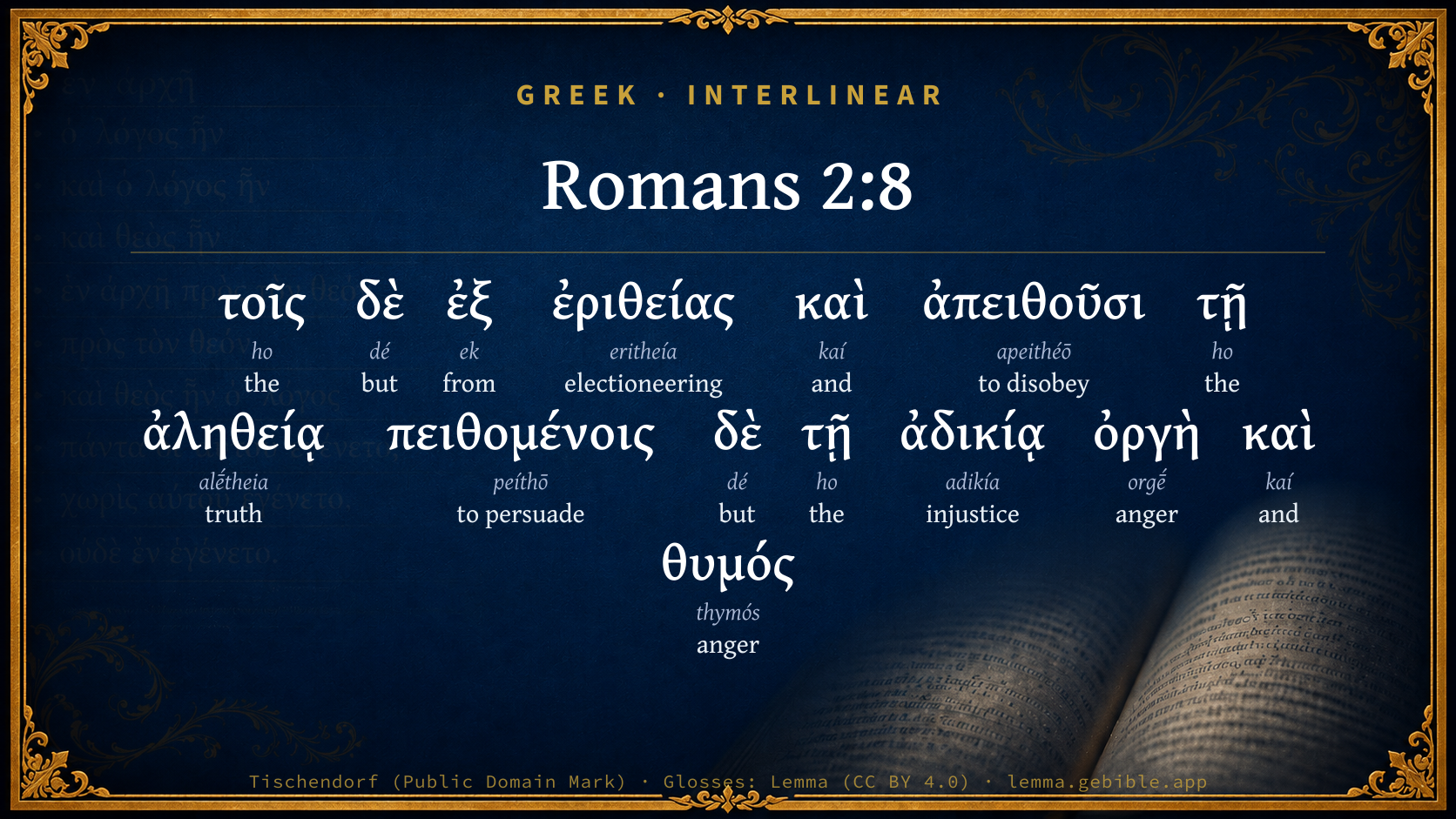
Download image
Cite this verse

Romans 2:8 (World English Bible). Public Domain. Lemma interlinear Bible study tool, https://lemma.gebible.app/v/romans/2/8.

Show BibTeX & RIS
BibTeX
RIS
English Translation
but to those who are self-seeking, and don't obey the truth, but obey unrighteousness, will be wrath and indignation,
World English Bible · Public Domain
Highlights
  • 1 first appearance in the Greek New Testament
Full analysis ↓
Download a study sheet

One document with this verse’s original text, its word-by-word gloss line, the meaning frame, cross-references with their text, attributed commentary, and full source and license credits — printable, and it pastes into notes with its structure intact.

This verse Autodidact and up

Study sheet (.html) Plain text (.txt)

A passage Seminary Student

Up to 50 verses in one chapter. A passage sheet keeps up to 6 commentary sources and 12 cross-references per verse, in the order this page ranks them, and says so on the sheet whenever that leaves anything out. Ask for a single verse and you get the Autodidact verse sheet above.

Everything on this page stays free to read, with no account — the sheet is a download of what is already on screen, not access to it.

Want to remove ads? Support Godless Engineer
Compare translations 3

The same verse in 3 English versions, stacked beneath the original-language interlinear above. Click any original word for its lexicon entry.

Each is an independent rendering of the whole verse — the interlinear is not word-aligned to these translations.

Highlighted words mark where these versions differ — a whole-verse word diff, not a word-by-word alignment.

  • World English Bible Public Domain
    but to those who are self-seeking, and don't obey the truth, but obey unrighteousness, will be wrath and indignation,
  • King James Version Public Domain
    But unto them that are contentious, and do not obey the truth, but obey unrighteousness, indignation and wrath,
  • unfoldingWord Literal Text CC BY-SA 4.0
    but to the ones from selfish ambition indeed being disobedient to the truth and becoming obedient to unrighteousness, wrath and anger.

unfoldingWord Literal Text — © unfoldingWord, licensed CC BY-SA 4.0. Word-aligned USFM3 via Door43 (git.door43.org/unfoldingWord/en_ult).

Versions to compare (up to 4)

3 of 4 selected

Show all 19 translations

Every available English version of this verse, each an independent rendering of the whole verse.

  • World English Bible Public Domain
    but to those who are self-seeking, and don't obey the truth, but obey unrighteousness, will be wrath and indignation,
  • Berean Standard Bible Public Domain
    But for those who are self-seeking and who reject the truth and follow wickedness, there will be wrath and anger.
  • Majority Standard Bible Public Domain
    But for those who are self-seeking and who reject the truth and follow wickedness, there will be anger and wrath.
  • King James Version Public Domain
    But unto them that are contentious, and do not obey the truth, but obey unrighteousness, indignation and wrath,
  • American Standard Version (1901) Public Domain
    but unto them that are factious, and obey not the truth, but obey unrighteousness, `shall be' wrath and indignation,
  • Revised Version (1885) Public Domain
    but unto them that are factious, and obey not the truth, but obey unrighteousness, shall be wrath and indignation,
  • Geneva Bible (1599) Public Domain
    But vnto them that are contentious and disobey the trueth, and obey vnrighteousnesse, shalbe indignation and wrath.
  • Douay-Rheims (1899) Public Domain
    But to them that are contentious, and who obey not the truth, but give credit to iniquity, wrath and indignation.
  • Young's Literal Translation Public Domain
    and to those contentious, and disobedient, indeed, to the truth, and obeying the unrighteousness -- indignation and wrath,
  • Literal Standard Version CC BY-SA 4.0
    and to those contentious, and disobedient, indeed, to the truth, and obeying the unrighteousness—indignation and wrath,
  • Unlocked Literal Bible CC BY-SA 4.0
    But to those who are self-seeking, who disobey the truth but obey unrighteousness, wrath and fierce anger will come.
  • unfoldingWord Literal Text CC BY-SA 4.0
    but to the ones from selfish ambition indeed being disobedient to the truth and becoming obedient to unrighteousness, wrath and anger.
  • Darby Bible Public Domain
    But to those that are contentious, and are disobedient to the truth, but obey unrighteousness, [there shall be] wrath and indignation,
  • World Messianic Bible Public Domain
    but to those who are self-seeking and don’t obey the truth, but obey unrighteousness, will be wrath, indignation,
  • Webster's Bible Public Domain
    But to them that are contentious, and do not obey the truth, but obey unrighteousness; indignation and wrath:
  • Free Bible Version CC BY-SA 4.0
    But those who think only of themselves, rejecting the truth and deliberately choosing to do evil, will receive punishment and furious hostility.
  • Bible in Basic English Public Domain
    But to those who, from a love of competition, are not guided by what is true, will come the heat of his wrath,
  • Text-Critical English NT CC BY 4.0
    but for those who are self-seeking and obey unrighteousness instead of the truth, there will be anger and wrath.
  • Tyndale New Testament (1534) Public Domain
    But vnto them that are rebellious and disobey the trueth yet folowe iniquytie shall come indignacion and wrath

Literal Standard Version (2020), Covenant Press — licensed CC BY-SA 4.0. Text via the HelloAO Bible API (eBible.org). Unlocked Literal Bible (unfoldingWord) — licensed CC BY-SA 4.0. Text via the HelloAO Bible API (eBible.org). unfoldingWord Literal Text — © unfoldingWord, licensed CC BY-SA 4.0. Word-aligned USFM3 via Door43 (git.door43.org/unfoldingWord/en_ult). Free Bible Version, Dr. Jonathan Gallagher — licensed CC BY-SA 4.0. Text via the HelloAO Bible API (eBible.org).

Word by word

More ways to search: Search by grammar → Find every occurrence → Compare this word →

Practice this passage: Drill this verse → Learn its vocabulary →

ἐριθείας
eritheía
G2052
“electioneering”
Noun, Genitive, Singular, Feminine
Part of Speech
Noun
Case
Genitive
Number
Singular
Gender
Feminine
Full Thayer's Definition

Origin: perhaps as the same as G2042

TDNT: 13:00,3

1. electioneering or intriguing for office a. apparently, in the NT a courting distinction, a desire to put one's self forward, a partisan and fractious spirit which does not disdain low arts b. partisanship, fractiousness This word is found before NT times only in Aristotle where it denotesa self-seeking pursuit of political office by unfair means. (A&G)Paul exhorts to be one in the mind of Christ not putting self forwardor being selfish ( Phil 2:2 )
  1. τοῖς ho G3588 “the” Article, Dative, Plural, Masculine
  2. δὲ dé G1161 “but” Conjunction
  3. ἐξ ek G1537 “from” Preposition
  4. καὶ kaí G2532 “and” Conjunction
  5. ἀπειθοῦσι apeithéō G544 “to disobey” Verb, Present, Active, Participle, Dative, Plural, Masculine
  6. τῇ ho G3588 “the” Article, Dative, Singular, Feminine
  7. ἀληθείᾳ alḗtheia G225 “truth” Noun, Dative, Singular, Feminine
  8. πειθομένοις peíthō G3982 “to persuade” Verb, Present, Middle, Participle, Dative, Plural, Masculine
  9. δὲ dé G1161 “but” Conjunction
  10. τῇ ho G3588 “the” Article, Dative, Singular, Feminine
  11. ἀδικίᾳ adikía G93 “injustice” Noun, Dative, Singular, Feminine
  12. ὀργὴ orgḗ G3709 “anger” Noun, Nominative, Singular, Feminine
  13. καὶ kaí G2532 “and” Conjunction
  14. θυμός thymós G2372 “anger” Noun, Nominative, Singular, Masculine

About this verse

These counts appear in no published source. They are computed here, from the morphology-tagged text and Lemma’s own curated glosses. What Lemma adds →

15
words
11
distinct lemmas
Pauline Epistles
section

Notable vocabulary

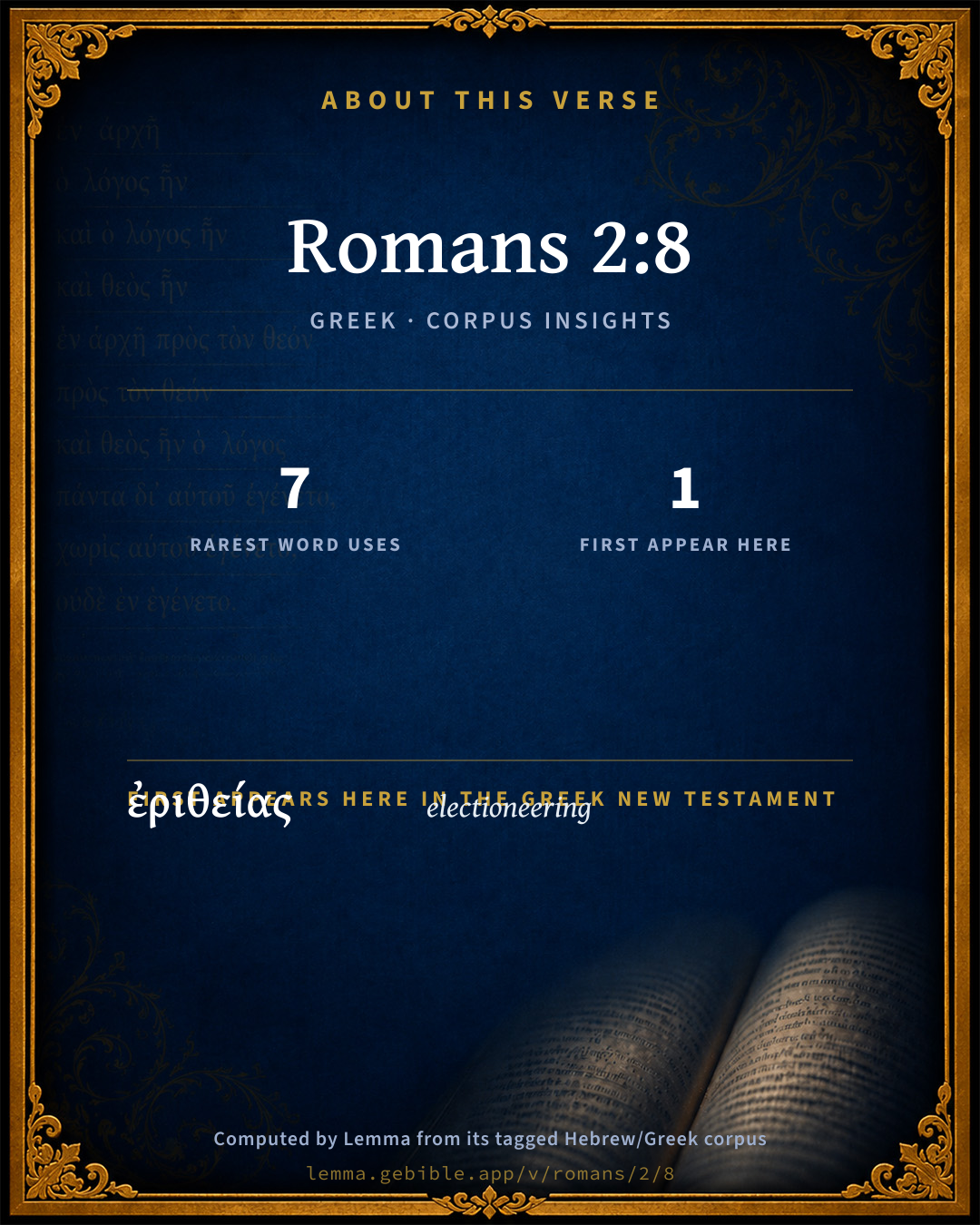
The rarest word here is ἐριθείας electioneering G2052 — appearing just 7 times in the whole Greek New Testament.

First appearance in Scripture

This word makes its first canonical appearance in the Greek New Testament here:

  • ἐριθείας electioneering G2052

Shared distinctive vocabulary

ἐριθείας electioneering G2052 occurs in 7 verses of the Greek New Testament. Also found in:
Repetition

Words recur within this verse:

Cross-references

24

Topical passages linked to Romans 2:8 in the Treasury of Scripture Knowledge — connected by theme and wording, ordered by reader-vote popularity; previews shown in the World English Bible.

  • 1 Timothy 6:3–4 If anyone teaches a different doctrine, and doesn't consent to sound words, the words of our Lord Jesus Christ, and to the doctrine which is according to godliness,
  • 2 Thessalonians 1:8 giving vengeance to those who don't know God, and to those who don't obey the Gospel of our Lord Jesus,
  • John 3:18–21 He who believes in him is not judged. He who doesn't believe has been judged already, because he has not believed in the name of the one and only Son of God.
  • 1 Peter 4:17 For the time has come for judgment to begin at the house of God. If it begins first with us, what will happen to those who don't obey the Gospel of God?
  • Proverbs 13:10 Pride only breeds quarrels, But with ones who take advice is wisdom.
  • 2 Thessalonians 2:10–12 and with all deception of wickedness for those who are being lost, because they didn't receive the love of the truth, that they might be saved.
  • Revelation 16:19 The great city was divided into three parts, and the cities of the nations fell. Babylon the great was remembered in the sight of God, to give to her the cup of the wine of the fierceness of his wrath.
  • Job 24:13 "These are of those who rebel against the light; They don't know the ways of it, Nor abide in the paths of it.
  • Psalms 90:11 Who knows the power of your anger, Your wrath according to the fear that is due to you?
  • Isaiah 50:10 Who is among you who fears Yahweh, who obeys the voice of his servant? He who walks in darkness, and has no light, let him trust in the name of Yahweh, and rely on his God.
  • Nahum 1:6 Who can stand before his indignation? Who can endure the fierceness of his anger? His wrath is poured out like fire, and the rocks are broken apart by him.
  • Romans 1:18 For the wrath of God is revealed from heaven against all ungodliness and unrighteousness of men, who suppress the truth in unrighteousness,
  • Romans 6:17 But thanks be to God, that, whereas you were bondservants of sin, you became obedient from the heart to that form of teaching whereunto you were delivered.
  • Romans 9:22 What if God, willing to show his wrath, and to make his power known, endured with much patience vessels of wrath made for destruction,
  • Romans 10:16 But they didn't all listen to the glad news. For Isaiah says, "Lord, who has believed our report?"
  • Romans 15:18 For I will not dare to speak of any things except those which Christ worked through me, for the obedience of the Gentiles, by word and deed,
  • 1 Corinthians 11:16 But if any man seems to be contentious, we have no such custom, neither do God's assemblies.
  • Titus 3:9 but shun foolish questionings, genealogies, strife, and disputes about the law; for they are unprofitable and vain.
  • Hebrews 3:12–13 Beware, brothers, lest perhaps there be in any one of you an evil heart of unbelief, in falling away from the living God;
  • Hebrews 5:9 Having been made perfect, he became to all of those who obey him the author of eternal salvation,
  • Hebrews 10:27 but a certain fearful expectation of judgment, and a fierceness of fire which will devour the adversaries.
  • Hebrews 11:8 By faith, Abraham, when he was called, obeyed to go out to the place which he was to receive for an inheritance. He went out, not knowing where he went.
  • Revelation 14:10 he also will drink of the wine of the wrath of God, which is prepared unmixed in the cup of his anger. He will be tormented with fire and sulfur in the presence of the holy angels, and in the presence of the Lamb.
  • 1 Peter 3:1 In like manner, wives, be in subjection to your own husbands; so that, even if any don't obey the Word, they may be won by the behavior of their wives without a word;

Cross-references courtesy of OpenBible.info (CC BY 4.0).

Commentary

Notes on Romans 2:8 from classic Christian and Jewish commentators (each source and its license shown beneath its notes). The classic Christian expositions comment on the surrounding passage and are grouped to its opening verse, so a note may address several verses; the Jewish commentaries on the Tanakh (Rashi and others) are per-verse, so they appear only where the commentator wrote on this verse.

Lemma curates 59 commentaries, every one of them public domain or Creative Commons licensed, each selected and text-cleaned for this edition rather than reprinted as found. About our sources →

Albert Barnes' Notes on the Bible

Who are contentious - This expression usually denotes those who are of a quarrelsome or litigious disposition; and generally has reference to controversies among people. But here it evidently denotes a disposition toward God, and is of the same signification as rebellious, or as opposing God. They who contend with the Almighty; who resist his claims, who rebel against his laws, and refuse to submit to his requirements, however made known. The Septuagint use the verb to translate the Hebrew word מרה maarah, in Deu 21:20. One striking characteristic of the sinner is, that he contends with God, that is, that he opposes and resists his claims. This is the case with all sinners; and it was particularly so with the Jews, and hence, the apostle used the expression here to characterize them particularly. His argument he intended to apply to the Jews, and hence he used such an expression as would exactly describe them. This character of being a rebellious people was one which was often charged on the Jewish nation, Deu 9:7, Deu 9:24; Deu 31:27; Isa 1:2; Isa 30:9; Isa 65:2; Jer 5:23; Eze 2:8, Eze 2:5.

Do not obey the truth - Compare Rom 1:18. The truth here denotes the divine will, which is alone the light of truth (Calvin). It means true doctrine in opposition to false opinions; and to refuse to obey it is to regard it as false, and to resist its influence. The truth here means all the correct representations which had been made of God, and his perfections, and law, and claims, whether by the light of nature or by revelation. The description thus included Gentiles and Jews, but particularly the latter, as they had been more signally favored with the light of truth. It had been an eminent characteristic of the Jews that they had refused to obey the commands of the true God, Jos 5:6; Jdg 2:2; Jdg 6:10; 2Ki 18:12; Jer 3:13, Jer 3:25; Jer 42:21; Jer 43:4, Jer 43:7; Jer 9:13.

But obey unrighteousness - The expression means that they yielded themselves to iniquity, and thus became the servants of sin, Rom 6:13, Rom 6:16-17, Rom 6:19. Iniquity thus may be said to reign over people, as they follow the dictates of evil, make no resistance to it, and implicitly obey all its hard requirements.

Indignation and wrath - That is, these shall be rendered to those who are contentious, etc. The difference between indignation and wrath, says Ammonius, is that the former is of short duration, but the latter is a long continued remembrance of evil. The one is temporary, the other denotes continued expressions of hatred of evil. Eustathius says that the word “indignation” denotes the internal emotion, but wrath the external manifestation of indignation. (Tholuck.) Both words refer to the opposition which God will cherish and express against sin in the world of punishment.

Albert Barnes' Notes on the Bible (1834–1885) — public domain. Text from a community e-Sword/MySword module.

Joseph Benson's Commentary

Rom 2:8-11. But unto them that are contentious — Like thee, O Jew, who thus fightest against God. The character of the unbelieving Jews was disobedience, stubbornness, and impatience. Mr. Locke thinks the original expression, οι δε εξ εριθειας, the contentions, here spoken of, are Jews who refused to obey the gospel. “But as the apostle is speaking of the punishment of the wicked Gentiles, as well as of the wicked Jews, εριθεια, contention, must be a vice common to both. Accordingly, εριθειαι, contentions, are mentioned among the works of the flesh, to which wicked men in general are addicted, Gal 5:20. And Suidas tells us, that εριθεια, contention, is η δια λογου φιλονεικια, contention by words, by keen disputing. Wherefore the contentious are persons who spread evil principles, and maintain them by keen disputings. This was the vice of many of the heathen, who disputed themselves into a disbelief of the plainest principles of morality, and argued even in support of atheism. Agreeably to this account of the contentious, the apostle represents them here as enemies of the truth, and as friends of unrighteousness.” — Macknight. Who obey not the truth — Both those who did not walk according to the light of nature, chap. Rom 1:18, and those who disobeyed the gospel, are here intended. The former, because, as truth is here opposed to unrighteousness, it must signify not only the truths discovered by revelation, but those likewise respecting religion and morality, which are discoverable by the light of nature, and which, among the heathen, were the only foundations of a virtuous conduct. The truth, as it is in Jesus, or the gospel, however, seems to be especially intended, this being styled, the truth of God, Rom 3:7; Rom 15:8; the word of truth, Eph 1:13, and elsewhere; the knowledge of it being the knowledge of the truth, 1Ti 2:4; 1Ti 4:3; the belief of it, the belief of the truth, 2Th 2:13; obedience to it, obedience to the truth, Gal 3:1; Gal 5:7; walking according to it, walking in the truth, 1Jn 2:4; the gospel itself being emphatically styled the truth, Eph 4:21; and to know it being to know the truth, 1Jn 2:21. This being so, they that are here said not to obey the truth seem to be especially, first, the unbelieving Jews, and, secondly, the Gentiles, who spake against the truth, and rejected it. And both these obeyed, and gave themselves up to error and falsehood; the Gentiles by changing the truth of God into a lie, Rom 1:25, and the Jews by adhering to their vain traditions, which made void the commands of God, supposing them to be derived from Moses, when they were indeed only the doctrines of men. But obey unrighteousness — Live in known sin; acting contrary to the clear dictates of reason and conscience. Indignation and wrath, tribulation and anguish — He seems to allude to Psa 78:49, He cast upon them, the Egyptians, the fierceness of his anger, wrath, indignation, and trouble, and finely intimating that the Jews would, in the day of vengeance, be more severely punished than even the Egyptians were, when God made their plagues so wonderful. Upon every soul of man that doeth evil — That contradicts the light of his dispensation, or holds in unrighteousness the portion of truth made known to him. Of the Jew first — Here we have the first express mention of the Jews in this chapter. And it is introduced with great propriety. Their having been trained up in the true religion, and their having had Christ and his apostles first sent to them, were circumstances which placed them in the foremost rank of the criminals that obeyed not the truth.

It must be observed, however, that “in this and the following verse, the apostle, by using the most general expression possible, every soul of man, and by twice introducing the distribution of Jew and Greek, which, according to the ideas of the Jews, comprehended all mankind, (see note on chap. Rom 1:16,) has left his reader no room to doubt that he is discoursing of the judgment of all nations, of heathen as well as of Jews and Christians. Therefore, not only what he says of the punishments, but what he observes of the rewards to be distributed at that day, must be understood of the heathen, as well as of those who have enjoyed the benefit of revelation.”

We see also, by these two verses, (Rom 2:9-10,) and Rom 1:16, that the apostle carefully lays it down as a fundamental position that there was now, under the gospel, no other national distinction between the Jews and the Gentiles, save only a priority of right in the Jews to the offer of the gospel, and the allotment of rewards or punishments, according as they obeyed or not. But glory, (just opposite to wrath,) — From the divine approbation; honour, (opposite to indignation,) — By the divine appointment; and peace — Implying a secure and quiet possession of all good, now and for ever, opposed to tribulation and anguish. To every one that worketh good — Sincerely performs his duty to God and man; to the Jew first, &c. — To one as well as another. For there is no respect of persons with God — That is, in passing their final sentence, and in distributing rewards and punishments, he is determined by their real characters, and will reward every one according to his works, not according to their outward condition; such as their country, kindred, sex, dignity, office, wealth, and profession of religion. This declaration concerning God, as Judge, the apostle made to show the Jews their folly in expecting favour at the final judgment, because they had Abraham for their father, and were themselves members of God’s church. And it must appear the more important and seasonable, considering that the Jews thought no Israelite should be deprived of future happiness, whatever his faults had been; unless he were guilty of apostacy, idolatry, and a few other very enormous crimes. But this impartial and equitable proceeding at the final judgment is very consistent with God’s distributing to persons here advantages and opportunities of improvement, according to his own good pleasure.

Joseph Benson's Commentary on the Old and New Testaments (1811–1818) — public domain. Text from a community e-Sword module.

Tyndale Open Study Notes

Tyndale Open Resources

2:8 Live for themselves translates a rare Greek word (eritheia) that seems to convey the idea of selfish ambition or strife. Using this word, Aristotle scolded the politicians of his day for seeking public office for selfish gain rather than from a desire to serve the people (Aristotle, Politics 5.3; see also 2 Cor 12:20; Gal 5:20; Phil 1:17; 2:3; Jas 3:14, 16).

Tyndale Open Study Notes — © Tyndale Open Resources, licensed CC BY-SA 4.0. Text via the HelloAO Bible API.

Bengel's Gnomon

Johann Albrecht Bengel

Rom 2:8. Τοῖς δὲ ἐξ ἐριθείας, but unto them that are [influenced by contention] contentious. Paul shrunk from saying directly: God will render to them, that are contentious, death or everlasting destruction. He therefore leaves that matter to be supplied, by the conscience of the sinner, from the preceding antithesis; He will render, not certainly eternal life; and he turns the discourse to those things, which follow. Τοῖς here, has therefore the force of ì prefixed, and signifies as concerns. Comp. ch. Rom 4:12, notes. Accordingly there follows, with great propriety, ἐπὶ πᾶσαν; for we have also, Exo 20:5, ἐπὶ τέκνα, ἐπὶ τρίτην καὶ τετάρτην γενεὰν, τοῖς μισοῦσί με, upon the children, upon the third and fourth generation, as concerns them that hate me. Furthermore, ἐξ, from or of, as in Rom 2:27, and often elsewhere, denotes a party or sect; in reference to those, who are of a contentious party or nation, like thee, O Jew, setting themselves in resistance to God. The character of false Judaism is disobedience, contumacy, impatience.—τῇ ἀληθείᾳ, τῃ ἀδικίᾳ, truth, unrighteousness) These two are often opposed to each other, 1Co 13:6; 2Th 2:10; 2Th 2:12; truth includes righteousness, and unrighteousness implies at the same time falsehood.—θυμὸς καὶ ὀργή) LXX., Psalms 78 (77):49, θυμὸν καὶ ὀργὴν καὶ θλίψιν; θυμὸς inflicts punishment; ὀργή follows up an offence. The propriety respectively of these words is seen in Eph 4:31-32, where τὸ χαρίζεσθαι is opposed to τῇ ὀργῇ, and εὔσπλαγχνον to θυμὸς. θυμὸς is defined by the Stoics to be ὀργὴ ἀρχομένη, the beginning of anger. Nor should we despise the explanation of Ammonius, θυμὸς μἐν ἐστι πρόσκαιρος, ὀργὴ δὲ πολυχρόνιος μνησικακία; θυμὸς is only temporary; ὀργὴ is the lasting remembrance of injuries.[27]

[27] θύμος Th. θύω, boiling indignation; ὀργή, abiding wrath, with a settled purpose of revenge, ἐπιθνμία τιμωρίας.—ED.

Bengel's Gnomon of the New Testament — English translation (T&T Clark, Edinburgh, 1860) — public domain. Text from a community e-Sword module.

Meyer's Critical & Exegetical Commentary

Heinrich August Wilhelm Meyer

Rom_2:8. Τοῖς δὲ ἐξ ἐριθείας] sc[617] οὖσι: paraphrase of the substantive idea, to be explained from the conception of the moral condition as drawing its origin thence (comp Rom_3:26; Rom_4:12; Rom_4:14; Gal_3:10; Php_1:17, al[619]). See Bernhardy, p. 288 f. Comp the use of ΥἹΟΊ and ΤΈΚΝΑ in Eph_2:2. We are precluded from taking (with Hofmann) ἘΚ in a causal sense (in consequence of ἐριθεία), and as belonging to ἀπειθ. Κ.Τ.Λ[621] by the καί, which would here express the idea, unsuitable to the connection: even (Baeuml. Partik. p. 150, also Xen. Mem. i. 3, 1). This καί, the simple and, which is not however with Hofmann to be interpreted as if Paul had written μᾶλλον or τοὐναντίον (instead of seeking after eternal life, rather, etc.), clearly shows that τοῖς δὲ ἐξ ἐριθείας is to be taken by itself, as it has been correctly explained since the time of the Vulgate and Chrysostom.

ἐριθεία] is not to be derived from ἔρις or ἐρίζω, but from ἔριθος, a hired labourer,[622] a spinner (Homer, xviii. 550, 560; Hesiod, ἔργ. 600 f.; Dem. 1313, 6; LXX. Isa_38:12; hence ἘΡΙΘΕΎΩ, to work for hire (Tob_2:11), then also: to act selfishly, to lay plots. Compare ἐξεριθεύεσθαι, Polyb. x. 25, 9, and ἈΝΕΡΙΘΕΎΤΟς (without party intrigues) in Philo, p. 1001 E. ἐριθεια has therefore, besides the primary sense of work for hire, the twofold ethical signification (1) mercenary greed; and (2) desire of intrigue, pursuit of partisan courses; Arist. Pol. v. 2 f. See Fritzsche, Excursus on ch. 2; regarding the composition of the word, see on 2Co_12:20. The latter signification is to be retained in all passages of the N. T. 2Co_12:20; Gal_5:20; Php_1:16; Php_2:3; Jam_3:14; Jam_3:16.

οἱ ἐξ ἐριθείας are therefore the intriguers, the partisan actors; whose will and striving are conducive not to the truth (for that in fact is a power of an entirely different kind, opposed to their character), but to immorality; wherefore there is added, as further characterizing them: καί ἀπειθοῦσι. Compare Ignatius, ad Philad. 8, where the opposite of ἐριθ. is the ΧΡΙΣΤΟΜΆΘΕΙΑ, i.e. the discipleship of Christ, which excludes all selfish partisan effort. Haughtiness (as van Hengel explains it), and the craving for self-assertion (Mehring and Hofmann) are combined with it, but are not what the word itself signifies. The interpretation formerly usual: qui sunt ex contentione (Vulg.), those fond of strife (Origen, Chrysostom, Oecumenius, Theophylact, Erasmus, Luther, Beza, Calvin, etc.), which was understood for the most part as those rebelling against God, is based partly on the erroneous derivation from ἔρις, partly on the groundless assumption that in the other passages of the N. T. the sense of quarrelsomeness is necessary. Since this is not the case, Reiches conjecture is irrelevant, that the vulgar usus loquendi had erroneously derived the word from ἔρις and had lent to it the corresponding signification. Köllner explains it rightly as partisanship, but gratuitously assumes that this was a special designation for godless character in general. So in substance also Fritzsche: homines nequam. The very addition, further describing these men, καὶ ἀπειθοῦσι.… ἀδικίᾳ, quite allows us to suppose that Paul had before his mind the strict and proper meaning of the word partisanship; and it is therefore unwarrantable to base the common but linguistically erroneous explanation on the affinity between the notions of partisanship and of contentiousness (Philippi). The question to be determined is not the category of ideas to which the ἐριθεύειν belongs, but the definite individual idea which it expresses.

ὈΡΓῊ Κ. ΘΥΜΌς] sc[623] ἔσται. In the animation of his description Paul has broken off the construction previously followed. To connect these words with what follows (Mehring) disturbs unnecessarily the important symmetry of the passage. On the distinction between the two words, see Tittmanns Synon. p. 131 ff. θυμός: vehement passion, in Cic. Tusc. iv. 9, 21 rendered excandescentia, here, as also in Gal_5:20, Eph_4:31, Col_3:8, Rev_16:19; Rev_19:15, often also in the O. T. and the Apocrypha, made known by its combination with ὀργή, and by its being put last as the more vehement, as the holy divine wrath. Compare Isoc. xii. Rom. 81: ὀργῆς κ. θυμοῦ μεστοί. Herodian, viii. 4, 1 : ὈΡΓῆ Κ. ΘΥΜᾮ ΧΡΏΜΕΝΟς. Lucian, de column. 23, al[624]

[617] c. scilicet.

[619] l. and others; and other passages; and other editions.

[621] .τ.λ. καὶ τὰ λοιπά.

[622] See Valck. ad Theocr. Adoniaz. p. 373. Compare συνέριθος frequent in Greek authors.

[623] c. scilicet.

[624] l. and others; and other passages; and other editions.

Meyer — Critical and Exegetical Commentary on the New Testament — English translation by Peter Christie, edited by Frederick Crombie (T&T Clark, 1880) — public domain. Text from a community e-Sword module.

Expositor's Greek Testament

ed. W. Robertson Nicoll

Rom 2:8 . τοῖς δὲ ἐξ ἐριθείας : for the use of ἐκ , cf. Rom 3:26 , τὸν ἐκ πίστεως Ἰησοῦ ; Gal 3:7 , οἱ ἐκ πίστεως ; Ch. Rom 4:14 , οἱ ἐκ νόμου . Lightfoot suggests that it is better to supply πράσσουσιν , and to construe ἐξ ἐριθείας with the participle, as in Phi 1:17 it is construed with καταγγέλλουσιν : but it is simpler not to supply anything. By “those who are of faction” or “factiousness” (Gal 5:20 , 2Co 12:20 , Phi 1:16 f., Rom 2:3 , Jas 3:14 ; Jas 3:16 ) the Apostle probably means men of a self-willed temper, using all arts to assert themselves against God. The result of this temper the temper of the party man carried into the spiritual world is seen in disobedience to the truth and obedience to unrighteousness. See note on ἀλήθεια , Rom 1:18 . The moral import of the word is shown by its use as the counterpart of ἀδικία . Cf. the same contrast in 1Co 13:6 . To those who pursue this course there accrues indignation and wrath, etc.

The Expositor's Greek Testament, edited by W. Robertson Nicoll (1897–1910) — public domain. Text from a community e-Sword module.

Hodge's Commentary on Romans, Ephesians & First Corinthians

Charles Hodge

Rom_2:7-8

The principle laid down in Rom_2:6, is here amplified. God will render eternal life to the good, indignation and wrath to the wicked, without distinction of persons; to the Jews no less than to the Gentiles. Though the sense of these verses is plain, there is great difference of opinion as to the grammatical construction. The explanation adopted by our translators is perhaps the most natural, and is the one which is most generally followed. To the verb ἀποδώσει of Rom_2:6, belong the two accusatives ζωὴν αἰώνιον, and θυμὸν καὶ ὁργήν and the two datives, τοῖς μὲν ζητοῦσι and τοῖς δὲ ἐξ ἐριθείας. The accusatives δόξαν καὶ τιμὴν καὶ ἀφθαρσίαν then of course depend on ζητοῦσι, and καθ ̓ ὑπομονὴν ἔργου ἀγαθοῦ is an adverbial qualification. The passage then reads: To those who through perseverance in good works, seek glory, honor, and immortality, eternal life; but to those who are contentious, indignation and wrath. Another construction, adopted by Bengel, Fritzsche, and others, supposes that τοῖς μὲν καθ ̓ ὑπομονὴν ἔργου ἀγαθοῦ (scil. οὖσι) are to be taken together, to those who are according to perseverance, i.e., to those who persevere; (comp. οἱ κατὰ σάρκα, οἱ σαρκικοί, and οἱ κατὰ Πνεῦμα, οἱ πνευματικοί). The following clause, δόξαν ζητοῦσι, is then in apposition with the preceding: To those who persevere in good works, seeking glory, honor and immortality, he will render eternal life. This view of the passage is recommended by the correspondence thus established between the τοῖς μὲν καθ ̓ ὑπομονήν of Rom_2:7, and the τοῖς δε ἐξ ἐριθείας of Rom_2:8. It is opposed, however, by the following considerations:

1. The interpretation of the phrase οἱ καθ ̓ ὑπομονὴν ἔργου ἀγαθοῦ is hardly born out by a reference to the phrases of οἱ κατὰ σάρκα and οἱ κατὰ Πνεῦμα.

2. The second clause of Rom_2:7, if a mere amplification of the first clause, should be introduced by καὶ, as in Rom_2:8 : Τοῖς δὲ ἐριθείας, καὶ ἀπειθοῦσι.

Luther, after Oecumenius, translates thus: Welcher geben wird Preis und Ehre und unvergängliches Wesen denen, die mit Geduld in guten Werken trachten nach dem ewigen Leben: Who will give glory, honor, and immortality to those who, in patient continuance in well-doing, seek eternal life. According to this view, the accusatives δόξαν, τιμὴν, ἀφθαρσίαν, depend upon ἀποδώσει, and ζωὴν αἰώνιον on ζητοῦσι. But this the position of the words will hardly bear. Luthers fluent and forcible version is effected by an entire transposition of the clauses. The construction therefore first mentioned is on the whole to be preferred. In the English version of the words καθ ̓ ὑπομονήν, κατά is rendered through. So also Grotius, De Wette, and others. See 1Co_12:8; Eph_3:3, Eph_3:7. Others translate it by the Latin preposition secumdùm, according to, or in virtue of. Ὑπομονή is rendered patience by the Vulgate, and Luther; patiens expectatio, by Beza; constancy, or patient continuance in our version. In illustration of the combination ὑπομονὴν ἔργου ἀγαθοῦ comp. ὑπομονὴ τῆς ἐλπίδος, 1Th_1:3. The sing. ἔργου is used collectively for ἔργων, as in Gal_6:4; 1Th_1:3; and elsewhere. What is immediately afterwards expressed by eternal life, is here expressed by the three words, glory, honor, and immortality. The manifested excellence or splendor of the future condition of the saints is expressed by δόξα; the honor due such excellence by τιμή and the endless nature of their blessedness by ἀφθαρσία.

Rom_2:8

To those who are of contention, that is, the contentious. Comp. οἱ ἐκ πίστεως believers; οἱ ἐκ περιτομῆς, the circumcised; οἱ ἐκ ἀκροβυστίας, the uncircumcised; οἱ ἐκ νόμου, those who belong to the law, legalists. Instead of the ordinary derivation of ἐριθεία from ἔρις, Rückert traces it to ἔριθος, a hireling, which derivation is sustained by Tholuck, Beiträge zur Spracherklärung des Neuen Testaments, p. 25, and Fritzsche, Excursus to his Commentary on the second chapter of this Epistle, and is now generally adopted. The signification of the word, as determined by its etymology and its classical usage is, work for hire, selfishness, ambition, party spirit, malice. In the New Testament it is used several times in the same sense as in Phi_1:16, οἱ μὲν ἐξ ἐριθείας, some of rivalry, or malice; the antithetical expression is οἱ δὲ ἐξ ἀγάπης. In Phi_2:3; it is connected with κενοδοξία, vain glory. In Jam_3:14, Jam_3:16 it is connected with ζῆλος, envy. In 2Co_12:20, it is distinguished from ἔρις. These passages show that the scriptural usage of the word agrees with the classical. Still in the present case it seems to have a somewhat wider meaning. It is not envy, or rivalry, but malicious opposition to God and his requirements that is here expressed. This is plain from the explanatory causes that follow. The disposition expressed by ἐριθεία is manifested in disobeying the truth, and obeying unrighteousness. Bretschneider therefore explains οἱ ἐξ ἐριθείας to mean qui malitia ducti Deo, i.e. rei divinae, adversantur: those who through malice oppose themselves to God. The same interpretation is given by Reiche and De Wette, as well as by the older commentators. Who obey not the truth. Ἀπειθέω is to refuse belief, to disbelieve, as well as to disobey. This clause therefore means, who refuse assent and obedience to the truth. Ἀλήθεια is divine truth; what is true and right as to faith and practice. See Rom_1:18. Saepe, says Bengel, haec duo (ἀλήθεια and ἀδικία) inter se opponuntur: veritas continet justitiam, et injustitia connotat mendacium. Who yield themselves to, or follows unrighteousness, indignation, and wrath, (shall be rendered). The words θυμὸς καὶ ὁργή should regularly be in the accusative, as depending on ἀποδώσει of Rom_2:6; but as they are in the nominative, ἔσται or ἀποδώσεται must be supplied. There may be, as some suppose, force in the change of construction and omission of the verb. God gives eternal life; indignation and wrath come as earned by man, so to speak, Deo nolente. God wills all men to be saved. Comp. Rom_6:23. Both words are used for the sake of intensity. As to their specific difference, both ancient and modern philologists differ. The majority make θυμός express the momentary impulse of anger, ὁργή the permanent feeling. Others make ὁργή to include the desire of vengeance, and therein to differ from θυμός. The former distinction is more in accordance with the primary meaning of the words; as θυμός means the mind as the seat of the emotions, and hence is used for any strong passion, and ὁργή means disposition, habit of mind.

Charles Hodge — Commentary on Romans (1835), First Corinthians (1857), and Ephesians (1856) — public domain. Text from a community e-Sword module.

Geneva Bible (1599)

Geneva Bible translators

By truth, he meaneth that knowledge which we have of nature.

God’s indignation against sinners, which shall quickly be kindled.

Geneva Bible (1599) marginal notes — public domain. Text via Bolls.life.

Jamieson, Fausset & Brown

Robert Jamieson, A. R. Fausset & David Brown

But unto them that are contentious, and do not obey the truth, &c.--referring to such keen and determined resistance to the Gospel as he himself had too painfully witnessed on the part of his own countrymen. (See Act 13:44-46; Act 17:5, Act 17:13; Act 18:6, Act 18:12; and compare Th1 2:15-16).

indignation and wrath--in the bosom of a sin-avenging God.

Jamieson, Fausset & Brown — Commentary Critical and Explanatory on the Whole Bible (1871) — public domain (CC PDM 1.0). Text via the HelloAO Bible API.

Adam Clarke's Commentary

Verse 8. But unto them, &c.]

2. He will manifest his indignation, and inflict wrath - punishment, on all who are contentious - who obstinately dispute against the truth, and obey unrighteousness - who act under the influence of the principle of sin, and not under the influence of the Spirit of God.

Adam Clarke's Commentary on the Bible (1810–1826) — public domain. Text from a community e-Sword/MySword module.

John Calvin's Commentaries

8. But to those who are contentious, etc. There is some irregularity in the passage; first, on account of its tenor being interrupted, for the thread of the discourse required, that the second clause of the contrast should be thus connected, — “The Lord will render to them, who by perseverance in good works, seek glory, and honor, and immortality, eternal life; but to the contentious and the disobedient, eternal death.” Then the conclusion might be joined, — “That for the former are prepared glory, and honor, and incorruption; and that for the latter are laid up wrath and misery.” There is another thing, — These words, indignation, wrath, tribulation, and anguish, are joined to two clauses in the context. However, the meaning of the passage is by no means obscure; and with this we must be satisfied in the Apostolic writings. From other writings must eloquence be learnt: here spiritual wisdom is to be sought, conveyed in a plain and simple style.

Contention is mentioned here for rebellion and stubbornness; for Paul was contending with hypocrites who, by their gross and supine self-indulgence, trifled with God. By the word truth, is simply meant the revealed will of God, which alone is the light of truth: for it is what belongs to all the ungodly, that they ever prefer to be in bondage to iniquity, rather than to receive the yoke of God; and whatever obedience they may pretend, yet they never cease perversely to clamor and struggle against God’s word. For as they who are openly wicked scoff at the truth, so hypocrites fear not to set up in opposition to it their artificial modes of worship. The Apostle further adds, that such disobedient persons obey or serve iniquity; for there is no middle course, which those who are unwilling to be in subjection to the law of the Lord can take, so as to be kept from falling immediately into the service of sin. And it is the just reward of outrageous licentiousness, that those become the bondslaves of sin who cannot endure the service of God. Indignation and wrath, so the character of the words induces me to render them; for θυμος in Greek means what the Latins call excandescentia — indignation, as Cicero teaches us, (Tusc. 4,) even a sudden burning of anger. As to the other words I follow Erasmus. But observe, that of the four which are mentioned, the two last are, as it were, the effects of the two first; for they who perceive that God is displeased and angry with them are immediately filled with confusion.

We may add, that though he might have briefly described, even in two words, the blessedness of the godly and also the misery of the reprobate, he yet enlarges on both subjects, and for this end — that he might more effectually strike men with the fear of God’s wrath, and sharpen their desire for obtaining grace through Christ: for we never fear God’s judgment as we ought, except it be set as it were by a lively description before our eyes; nor do we really burn with desire for future life, except when roused by strong incentives, (multis flabellis incitati — incited by many fans.)

John Calvin's Commentaries (1540-1563) — public domain. Text from the Calvin Translation Society English edition (1840s-50s) via the Christian Classics Ethereal Library (ccel.org). Calvin's coverage is partial (roughly two-thirds of the Bible); uncommented books and verses are honest gaps, never fabricated. The 19th-century editor's footnotes and remarks are omitted so the notes are faithfully Calvin's own voice.

Ellicott's Commentary for English Readers

(8) But unto them . . .—The scholar will observe that in the original Greek the construction is changed. At the end of Rom_2:7 is an accusative “(he will render) eternal life;” here we have the nominative, “(there shall be) tribulation and anguish.”

That are contentious.—An error in the Authorised version through a wrong derivation of the word. Strictly, To those who act in the spirit of a hireling; hence, according to the secondary meaning of the word, “to those who act in a spirit of factiousness and self-seeking.” It is, however, quite possible that the mistaken derivation may have been current in St. Paul’s time, as it was, no doubt, somewhat later, from Origen downwards. St. Paul, it is true, distinguishes between the proper word for “contention” and that used here (e.g., in 2Co_12:20; Gal_5:20), but this would not exclude, it would rather seem to imply, not indeed a formal derivation, but some association of ideas. The shade of meaning will, perhaps, be expressed if we translate by some such word as “factiousness.” So in Php_1:16 (properly Php_1:17, the order of the clauses being reversed), “the one (the other) preach Christ of factiousness.”

Indignation and wrath.—The Greek equivalents for these two words are distinguished as the settled angry feeling from the passionate outbreak of anger.

The truth.—Here used in a moral sense, as almost equivalent to “rectitude,” “that which is right.” There is a tendency towards this meaning in Rom_1:18, “Who hold down the truth in unrighteousness,” though there “the truth” appears to mean rather “natural religion” in general. The ethical sense comes out clearly in Joh_3:21, “he that doeth truth,” opposed to “he that doeth evil.” These phrases, “obey the truth,” “obey unrighteousness,” in a plainer style, would be simply “do good,” “do evil.” It may be noted that St. Paul is fond of these quasi-personifications.

A Bible Commentary for English Readers, edited by Charles John Ellicott (1878–1897) — public domain. Text from a community e-Sword module.

The Cambridge Bible for Schools and Colleges

gen. ed. J. J. S. Perowne

8. contentious] Lit. out of partisanship, or factiousness; (the same construction as “of the truth;” Joh_18:37). The phrase implies connexion and attachment; as here, “those who belong to, can be classed under the character of, the factious.”

The “faction” in question is that of the sinful soul against the humbling terms of the Divine peace and love. Cp. Rom_10:3 for a special example of this in the case of the Jews. A pointed, though not explicit, reference to Jewish opponents of the Gospel lies in the word here.

do not obey] The Gr. is sometimes rendered, “disbelieve.” In all cases, however, the resistance of the will is implied in it; the element of disobedience in unbelief towards God. See, for a suggestive example, Heb_4:6, compared with the history there referred to.

the truth] The revelation of the eternal reality of the glory of God. (See on Rom_1:18; Rom_1:25.) It is Truth, not in mere generality, but in that speciality which attaches to the Truth of truths. See, for an important parallel, 2Th_2:10; 2Th_2:12; where “the truth” and “unrighteousness” are contrasted, as here. See also Joh_8:32.

obey unrighteousness] Yielding the will to the impulse of sin; “having pleasure in unrighteousness” (2Th_2:12). Cp. Rom_6:6; Rom_6:16, &c.; Tit_3:3. “Unrighteousness” here, as often, means sin in its largest sense. All wrong, civil, social, moral, personal, overt, secret, violates the eternal rights, even when it least seems to touch temporal and human interests.

indignation and wrath] See on Rom_1:18 and Rom_2:5.

The Cambridge Bible for Schools and Colleges (gen. ed. J. J. S. Perowne; Cambridge University Press, 1878–1918) — public domain. Text from a community e-Sword module.

John Gill's Exposition

Tribulation and anguish,.... These, with the foregoing words, are expressive of the second death, the torments of hell, the worm that never dies, and the fire that is not quenched: which will fall

upon every soul of man that doth evil; whose course of life and conversation is evil; for "the soul that sins shall die", Eze 18:4, unless satisfaction is made for his sins by the blood of Christ:

of the Jew first, and also of the Gentile; regard being had to what nation they belong.

John Gill's Exposition of the Whole Bible (1746–1763) — public domain (CC PDM 1.0). Text via the HelloAO Bible API.

Trapp's Complete Commentary

John Trapp

8 But unto them that are contentious, and do not obey the truth, but obey unrighteousness, indignation and wrath,

Ver. 8. But unto them that are contentious] That wrangle and thwartle against clearest truths, searching the devil’s skull for carnal arguments, as those Athenians, Act 17:16-21; being refractory as Pharaoh, who would not sit down under the miracle, but sent for the magicians. And though the word doth eat up all they say, as Moses’s rod did, yet harden they their hearts, as Pharaoh, and resolve to curse, as Balaam, whatever come of it. These are those contentious ones, εξ εριθειας.

John Trapp, A Commentary or Exposition upon All the Books of the Old and New Testament (1647–1656) — public domain. Text from a community e-Sword module.

Matthew Poole's English Annotations

That are contentious; or, that are of contention: so, they of the circumcision, for such as are circumcised, Act 10:45; Gal 2:12. By contentious, understand such as are refractory and self-willed; that, from a spirit of contradiction, will not be persuaded; that strive and kick against the righteousness of God, from an opinion of their own righteousness, Hos 4:4.

Do not obey the truth: see Rom 1:18, and the note there.

But obey unrighteousness; that are the servants of sin, and of corruption, Rom 6:12; 2Pe 2:19.

Indignation and wrath; these two differ only in degree: thereby understand the judgments of God upon the wicked, which are the effects of his anger: the cause is commonly put for the effect.

Matthew Poole's English Annotations on the Holy Bible (1683–1685) — public domain. Text from a community e-Sword/MySword module.

Whedon's Commentary on the Bible

Daniel D. Whedon

8. Contentious—Who, instead of consenting to seek, (Rom_2:7,) raise factious cavils against the proposal.

Not obey the truth—Refuse to comply with the requirements of the true law of God as the result of their contentiousness.

Indignation and wrath—are rendered. These are the dispositions of the Divine mind toward them. (See note on Rom_1:18.) A period should be placed here, and Rom_2:9-10 form an independent sentence.

Daniel D. Whedon (gen. ed.), Commentary on the Old and New Testaments (1874–1909) — public domain. Text from a community e-Sword module.

John Wesley's Explanatory Notes

But to them that are contentious - Like thee, O Jew, who thus fightest against God. The character of a false Jew is disobedience, stubbornness, impatience. Indignation and wrath, tribulation and anguish - Alluding to Psalm lxxviii, xlix, "He cast upon them," the Egyptians. "the fierceness of his anger, wrath, and indignation, and trouble;" and finely intimating, that the Jews would in the day of vengeance be more severely punished than even the Egyptians were when God made their plagues so wonderful.

John Wesley, Explanatory Notes Upon the Whole Bible (1754–1765) — public domain. Text via the GEBible commentary corpus.

Godbey's Commentary on the New Testament

William B. Godbey

8. “To those who from self-seeking, and who obey not the truth but obey unrighteousness, there will be indignation and wrath.” These rewards and retributions have nothing whatever to do with church membership or its absence, but simply the character of each individual. You either become like God or Satan in this life. In the final judgment, all who truly and inwardly are like God, will go up and live with Him forever, while those who have lived for the world, Satan will claim as his own, since he is the god of this world (2Co 4:4).

William B. Godbey, Commentary on the New Testament (1896–1900) — public domain. Text from a community e-Sword module.

McGarvey & Pendleton's Commentaries

J. W. McGarvey

but unto them that are factious, and obey not the truth, but obey unrighteousness, shall be wrath and indignation [to those who, by steadfastly leading a life of work (which, as Olshausen observes, no man can do, according to Paul, save by faith in Christ), seek for glory (and the future state is one of unparalleled grandeur-- Joh_17:24 ; Rev_21:24 ), honor (and the future state is an honor; bestowed, though unmerited, as a reward-- Mat_25:23 ; Mat_25:40 ) and incorruption (which is also a prime distinction between the future and the present life-- 1Co_15:42 ), eternal life shall be given. But God's wrath and indignation shall be poured upon those who serve party and not God (and the Jews were continually doing this-- Mat_23:15 ; Gal_6:12-13 ), and obey not the truth ( Joh_8:31-32 ), but obey unrighteousness],

J. W. McGarvey (with Philip Y. Pendleton), Commentaries on the New Testament (The Fourfold Gospel, 1914; Acts; and the epistles) — public domain. Text from a community e-Sword/MySword module.

The People's New Testament

B. W. Johnson

8. But unto them. God rewards the righteous according to their works as described in verse 7; so also the wicked, as this verse describes. Contentious. Who seek their own way, instead of God's way, and contend against God. Do not obey the truth. God's law is truth. Sinners fight against God and “obey not the truth, but obey unrighteousness.” This verse describes the character of the wicked. The next verse declares God's judgment upon them.

B. W. Johnson's The People's New Testament with Notes (1889–1891) — public domain. Electronic text from the Christian Classics Ethereal Library (CCEL) ThML edition.

unfoldingWord translationNotes

Door43 World Missions Community

Connecting Statement:

Though this section is speaking to the non-religious wicked person, Paul sums it up by stating both non-Jews and Jews are wicked before God.

self-seeking

"selfish" or "only concerned with what makes themselves happy"

disobey the truth but obey unrighteousness

These two phrases mean basically the same thing. The second intensifies the first. (See: Parallelism)

wrath and fierce anger will come

The words "wrath" and "fierce anger" mean basically the same thing and emphasize God's anger. AT: "God will show his terrible anger" (See: Doublet)

wrath

Here the word "wrath" is a metonym that refers to God's severe punishment of wicked people. (See: Metonymy)

tribulation and distress on

The words "tribulation" and "distress" mean basically the same thing here and emphasize how bad God's punishment will be. AT: "awful punishments will happen to" (See: Doublet)

on every human soul

Here, Paul uses the word "soul" as a synecdoche that refers to the whole person. AT: "upon every person" (See: Synecdoche)

has practiced evil

"has continually done evil things"

to the Jew first, and also to the Greek

"God will judge the Jewish people first, and then those who are not Jewish people"

first

Possible meanings are 1) "first in order of time" or 2) "most certainly"

translationWords

disobey

true

righteous

wrath

anger

tribulation

soul

evil

Jew

Greek

unfoldingWord translationNotes — © Distant Shores Media and the Door43 World Missions Community, licensed CC BY-SA 4.0. Source: git.door43.org/Door43/en_tn.

Cambridge Greek Testament for Schools and Colleges

8. ἐξ ἐριθίας. From the literal sense of ‘work for hire,’ through the political sense of ‘self-seeking or partisan factiousness’ (cf. Gal 5:20), the word gets the general ethical sense of ‘self-seeking’ (cf. Php 2:3; Jas 3:16) to the disregard of service, whether of GOD or man. So = μισθαρνία, ambitus, Wetst. ad lo[82]. Here in sharp contrast to καθ’ ὑπ. ἔ. ἀ. (See Hort on Jas 3:14.)

[82] ad loc ad locum

ἀπειθοῦσι κ.τ.λ. sum up the description given Rom 1:21-32. Disobedience to known truth is again the condition of judgment; cf. Rom 11:30-33.

τῇ ἀληθείᾳ includes as above, Rom 1:18, truth of act and life as is emphasised by the parallelism with δ. κ. τιμ. κ. ἀφθ. ζητοῦσιν, and so )[83] τῇ ἀδικίᾳ.

[83] )( opposed to

ὀργὴ καὶ θυμός. N. the change of construction: “ὀργή the settled feeling, θυμός the outward manifestation,” S. H.

Cambridge Greek Testament for Schools and Colleges (Cambridge University Press, 1896; 21 vols, various authors incl. Carr, Maclear, Plummer, Farrar, Lumby, Moule, M. R. James, Simcox) — public domain. Text from a community e-Sword module.

Alford’s Greek Testament

Henry Alford

8. τοῖς μὲν καθʼ ὑπ.… ὀργὴ κ. θυμός] To those who by endurance in good works seek for glory and honour and immortality (will He render) eternal life: but to those who are (men) of self-seeking, and disobey the truth, but obey iniquity (shall accrue) anger and wrath, &c. The verb ἀποδώσει, ver. 6, should have two accusatives, representing the two sides of the final retribution,—ζωὴν αἰών. and ὀργήν, &c. But the second of these is changed to a nominative and connected with ἔσται understood, and made the first member of the following sentence, δόξα δὲ κ.τ.λ. being opposed to it. Thus also two datives belong to ἀποδώσει, viz. τοῖς.… ζητοῦσιν,—and τοῖς … ἀδικίᾳ. To ζητοῦσιν belong δόξ. κ. τιμ. κ. ἀφθ. as its accusatives, and καθʼ ὑπομ. ἔργ. ἀγ. as its adverb. This, as De Wette remarks, is the only admissible construction: in opposition to (α) Œcum. and Beza, who divide ἔργ. ἀγ. from καθʼ ὑπομ. (iis quidem qui secundum patientem expectationem quœrunt boni operis gloriam),—(β) Bengel, Knapp, Fritzsche, Olsh., and Krehl, who take τοῖς.… ἀγαθοῦ as meaning ‘those who endure in good works’ (as Œ does τοῖς καθʼ ὑπομ. those who endure, absol.), and δόξαν.… ζητοῦσιν, as in apposition with it,—(γ) Photius (in Œcum.), Luther, and Estius, who take it, τοῖς.… ζητοῦσιν ζωὴν αἰών.,—δόξαν κ.τ.λ.,—(δ) Reiche, who takes τοῖς μέν,—‘to the one,’—alone, and makes καθʼ ὑπομ. parallel to κατὰ τὰ ἔργα, representing the rule of judgment, taking the rest as (γ).

ἔργου, sing. of moral habitude in the whole, the general course of life and action (see reff.).

δόξαν, absolute imparted glory like His own, see Mat 13:43; Joh 17:22:—τιμήν, recognition, relative precedence, see Mat 10:32; Mat 25:34:—ἀφθαρσίαν, incorruptibility: so the aim of the Christian athlete is described, 1Co 9:25, as being to obtain στέφανον ἄφθαρτον.

8. τοῖς δὲ ἐξ ἐριθείας] as in reff., to be supplied by οὖσιν, those who live in, act from, are situated in and do their deeds from—ἐριθεία as a status, as οἱ ἐξ spoken of place.

ἐριθεία,—not from ἔρις, from which it is distinguished 2Co 12:20; Gal 5:20, but from ἔρῑθος, a hired workman, whence ἐριθεύω or -ομαι, properly ‘to work for hire,’ but met. and generally, ‘ambitum exercere,’ used principally of official persons, who seek their own purposes in the exercise of their office, and (according to the analogy of παιδεία from παιδεύω, δουλεία from δουλεύω, ἀλαζονεία from ἀλαζονεύομαι) ἐριθεία, ‘ambitus,’ ‘self-seeking,’ ‘greed.’ It stands opposed to ὑπομονὴ ἔργου ἀγαθοῦ, which requires self-denial and forbearance. There seems to be no reason why this, the proper meaning, should not here apply, without seeking for a more far-fetched one, as ‘the party spirit of the Jews.’ Rückert.

The mistake of rendering it ‘contentiousness,’ and imagining a derivation from ἔρις prevailed universally (, Chrys., Theodoret, Theophyl., Œcum., (ἠριθεύετο, ἐφιλονείκει), Vulg., Erasm., Grot., &c., and even the more recent English Commentators, Bloomf., Slade, and Peile, τοῖς ἐξ ἐριθείας, i.e. τοῖς ἐρίζουσι) according to De Wette, down to Rückert, who first suggested the true derivation. It appears to have arisen from ἐρεθίζω being somewhat similar in sound. Aristotle uses it in the sense of ‘ambitus,’ canvassing for office, in Polit. v. 3,—μεταβάλλουσι δὲ αἱ πολιτεῖαι καὶ ἄνευ στάσεως διά τε τὰς ἐριθείας, ὥσπερ ἐν Ἡραίᾳ· ἐξ αἱρετῶν γὰρ διὰ τοῦτο ἐποίησαν κληρωτάς, ὅτι ᾑροῦντο τοὺς ἐριθευομένους. Fritzsche, who has an excursus on the word, renders οἱ ἐξ ἐριθ.,—‘malitiosi fraudum machinatores.’ Ignatius, ad Philad. § 8, p.704, opposes ἐριθ. to χριστομαθία. On the whole, self-seeking seems best to lay hold of the idea of the word: see note on Php 1:16, Php 1:17.

ἀπειθ. μ. τῇ ἀλ.] Hindering (see ch. 1:18) the truth which they possess from working, by self-abandonment to iniquity.

ὀργὴ κ. θυμός] According to this arrangement (see var. readd.) the former word denotes the abiding, settled mind of God towards them (ἡ ὀργὴ τ. θεοῦ μένει ἐπʼ αὐτόν, Joh 3:36),—and the latter, the outbreak of that anger at the great day of retribution. So the grammarians: θυμὸς μέν ἐστι πρόσκαιρος (excandescentia, as Cicero)· ὀργὴ δὲ πολυχρόνιος μνησικακία, Ammon. See the same further brought out by Tittmann, Syn. i. p. 131.

Henry Alford, The Greek Testament (1849–1861) — public domain. Text from a community e-Sword module.

International Critical Commentary

8. τοῖς δὲ ἐξ ἐριθείας: ‘those whose motive is factiousness,’ opp. to the spirit of single-minded unquestioning obedience, those who use all the arts of unscrupulous faction to contest or evade commands which they ought to obey. From ἔριθος ‘a hired labourer’ we get ἐριθεύω ‘to act as a hireling,’ ἐριθεύομαι a political term for ‘hiring paid canvassers and promoting party spirit:’ hence ἐριθεία = the spirit of faction, the spirit which substitutes factious opposition for the willing obedience of loyal subjects of the kingdom of heaven. See Lft. and Ell. on Gal 5:20, but esp. Fri. ad loc.

The ancients were strangely at sea about this word. Hesychius (cent. 5) derived ἔριθος from ἔρα ‘earth’; the Etymologicum Magnum (a compilation perhaps of the eleventh century) goes a step further, and derives it from ἔρα θής agricola mercede conductus; Greg. Nyssen. connects it with ἔριον ‘wool’ (ἔριθος was used specially of woolworkers); but most common of all is the connexion with ἔρις (so Theodrt; on Php 2:3; cf. Vulg. his qui ex contentione [per contentionem Php 2:3; rixae Gal 5:20]). There can be little doubt that the use of ἐριθεία was affected by association with ἔρις, though there is no real connexion between the two words (see notes on ἐπωρώθησαν 11:7, κατανύξεως 11:8).

ὀργὴ … θυμός: see Lft. and Ell. on Gal 5:20; Trench, Syn. p. 125: ὀργή is the settled feeling, θυμός the outward manifestation, ‘outbursts’ or ‘ebullitions of wrath.’

ὀργὴ δέ ἐστιν ὁ ἑπόμενος τοῖς ἁμαρτάνουσιν ἐπὶ τιμωρίᾳ πόνος. θυμὸν δὲ ὁρίζονται ὀργὴν ἀναθυμιωμένην καὶ διοιδαίνουσαν Orig. (in Cramer’s Catena).

International Critical Commentary — older volumes (1896–1929), various authors — public domain. Text from a community e-Sword module.

Vincent's Word Studies in the New Testament

Marvin R. Vincent

Contentious [εξ εριθειας] . Rev., better, factious. Lit., of faction. See on Jas 3:14. Intriguers; partisan agitators.

Indignation and wrath [οργη και θυμος] . See on be patient, Jas 5:7.

Marvin R. Vincent, Word Studies in the New Testament (1887–1900) — public domain. Text from a community e-Sword/MySword module.

Lesson kit

Teaching starters — assembled from the data on this page, not authored interpretation. Every prompt links to the verse data it draws on. Edit before teaching.

Romans, in the Pauline Epistles, opens this verse with 15 words (11 distinct Greek lemmas). Its most distinctive word is eritheía (“electioneering”). A historical commentator’s framing appears above. Read the whole chapter for the surrounding context.

Discussion questions

  1. What does “electioneering” (eritheía) contribute to the verse as a whole?
  2. The word “electioneering” first appears here in Scripture. What is being introduced at this debut?
  3. 2 Corinthians 12:20 shares the word «electioneering» with this verse. How do the two illuminate each other?
  4. “the” occurs 3× in this one verse. What is the effect of the repetition?
  5. The translations on this page render this verse differently — a whole-verse word diff, not a word-by-word alignment. What might account for the different wordings?
  6. Reading how Albert Barnes' Notes on the Bible and Joseph Benson's Commentary read this verse, where do the two commentators agree and where do they part?

Things to notice

  • 1 word makes its first canonical appearance in Scripture here.
  • These translations choose different wording for 17 words in this verse.
  • “the” occurs 3× in this single verse.
  • 11 distinct Greek lemmas span 15 words in this verse.

Reading settings

Reading text

Shown beneath each verse's original-language words.

Old Testament
Old Testament edition

Read the OT as the Masoretic Hebrew (MT) or the Greek Septuagint (LXX).

English shown for the Greek Septuagint (in the Hebrew ↔ Greek comparison).

Comparing translations? Open the Compare panel on any verse page to stack up to four side by side.