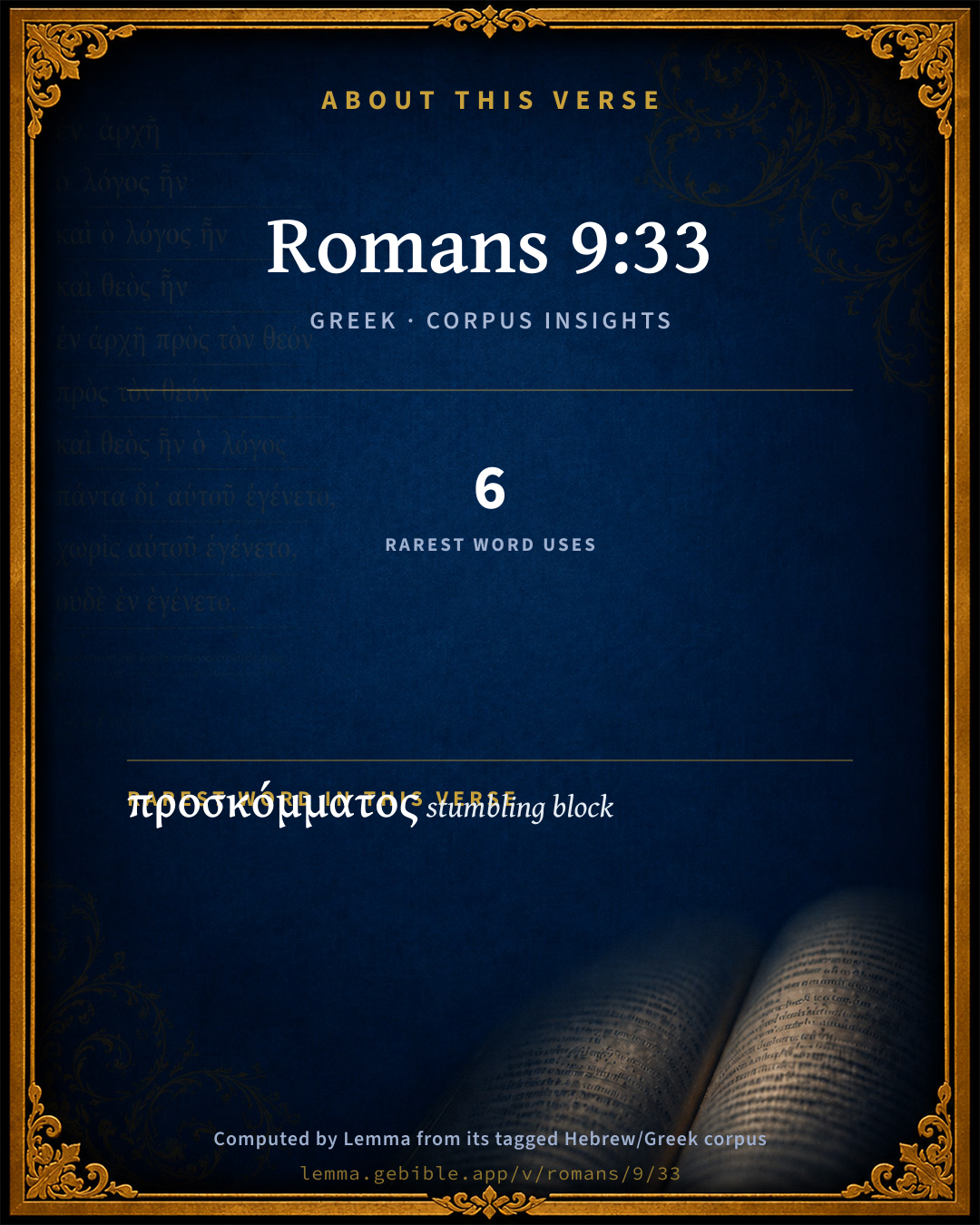
Romans 9:33

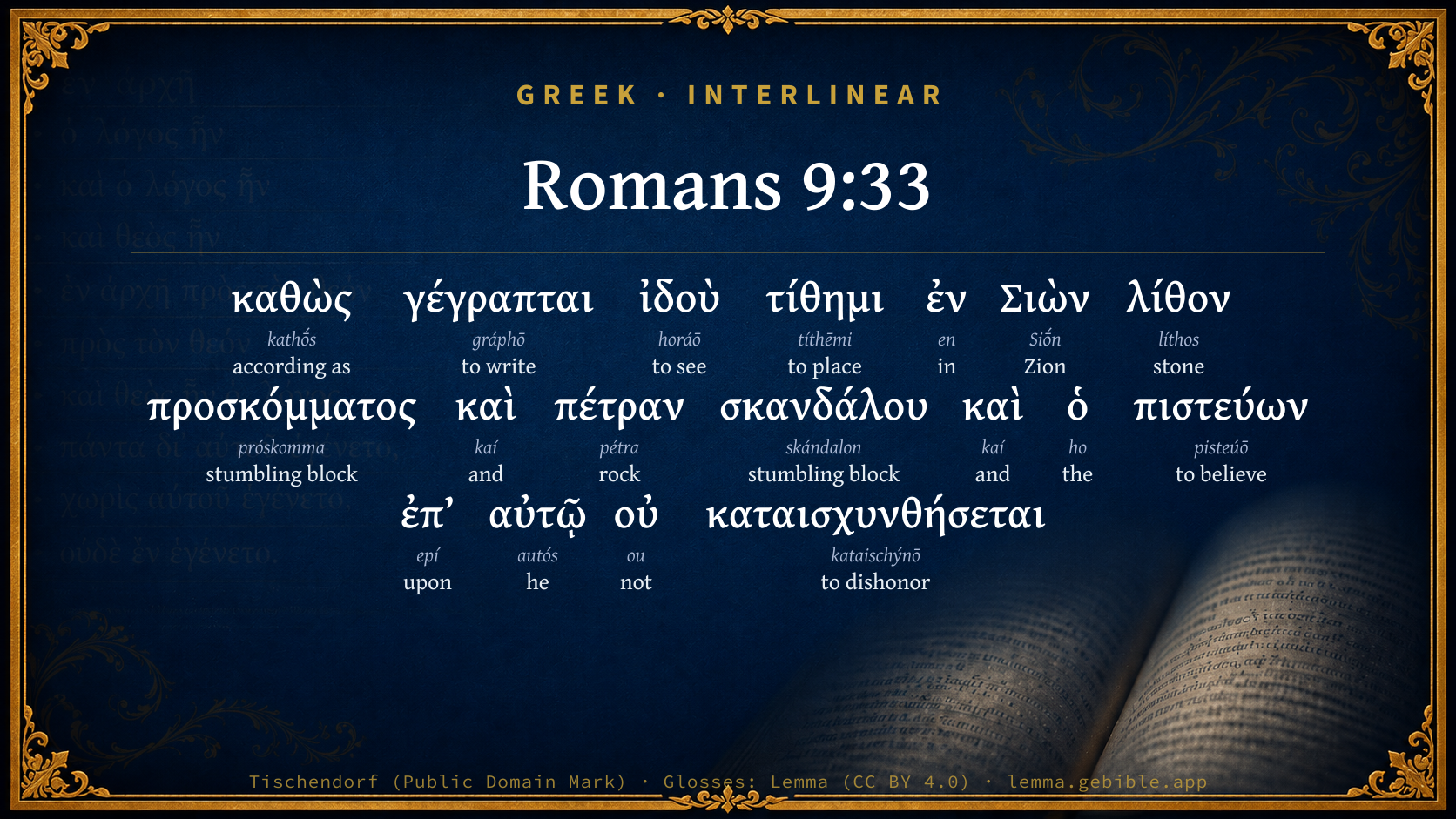
Greek (Tischendorf 8th ed.) Romans 9:33 appears in the Greek New Testament. The text above is from the Tischendorf 8th edition. Each word links to its Strong’s number and a concise gloss. Click any word for its full Thayer’s Greek Lexicon entry.
Download image
Cite this verse

Romans 9:33 (World English Bible). Public Domain. Lemma interlinear Bible study tool, https://lemma.gebible.app/v/romans/9/33.

Show BibTeX & RIS
BibTeX
RIS
English Translation
even as it is written, "Behold, I lay in Zion a stumbling stone and a rock of offense; And no one who believes in him will be disappointed."
World English Bible · Public Domain
Download a study sheet

One document with this verse’s original text, its word-by-word gloss line, the meaning frame, cross-references with their text, attributed commentary, and full source and license credits — printable, and it pastes into notes with its structure intact.

This verse Autodidact and up

Study sheet (.html) Plain text (.txt)

A passage Seminary Student

Up to 50 verses in one chapter. A passage sheet keeps up to 6 commentary sources and 12 cross-references per verse, in the order this page ranks them, and says so on the sheet whenever that leaves anything out. Ask for a single verse and you get the Autodidact verse sheet above.

Everything on this page stays free to read, with no account — the sheet is a download of what is already on screen, not access to it.

Want to remove ads? Support Godless Engineer
Compare translations 3

The same verse in 3 English versions, stacked beneath the original-language interlinear above. Click any original word for its lexicon entry.

Each is an independent rendering of the whole verse — the interlinear is not word-aligned to these translations.

Highlighted words mark where these versions differ — a whole-verse word diff, not a word-by-word alignment.

  • World English Bible Public Domain
    even as it is written, "Behold, I lay in Zion a stumbling stone and a rock of offense; And no one who believes in him will be disappointed."
  • King James Version Public Domain
    As it is written, Behold, I lay in Sion a stumblingstone and rock of offence: and whosoever believeth on him shall not be ashamed.
  • unfoldingWord Literal Text CC BY-SA 4.0
    just as it is written, “Behold, I place in Zion a stone of stumbling and a rock of offense, and the one believing on it will not be ashamed.”

unfoldingWord Literal Text — © unfoldingWord, licensed CC BY-SA 4.0. Word-aligned USFM3 via Door43 (git.door43.org/unfoldingWord/en_ult).

Versions to compare (up to 4)

3 of 4 selected

Show all 19 translations

Every available English version of this verse, each an independent rendering of the whole verse.

  • World English Bible Public Domain
    even as it is written, "Behold, I lay in Zion a stumbling stone and a rock of offense; And no one who believes in him will be disappointed."
  • Berean Standard Bible Public Domain
    as it is written: “See, I lay in Zion a stone of stumbling and a rock of offense; and the one who believes in Him will never be put to shame.”
  • Majority Standard Bible Public Domain
    as it is written: “See, I lay in Zion a stone of stumbling and a rock of offense; and the one who believes in Him will never be put to shame.”
  • King James Version Public Domain
    As it is written, Behold, I lay in Sion a stumblingstone and rock of offence: and whosoever believeth on him shall not be ashamed.
  • American Standard Version (1901) Public Domain
    even as it is written, Behold, I lay in Zion a stone of stumbling and a rock of offence: And he that believeth on him shall not be put to shame.
  • Revised Version (1885) Public Domain
    even as it is written, Behold, I lay in Zion a stone of stumbling and a rock of offence: And he that believeth on him shall not be put to shame.
  • Geneva Bible (1599) Public Domain
    As it is written, Beholde, I lay in Sion a stumbling stone, and a rocke to make men fall: and euery one that beleeueth in him, shall not be ashamed.
  • Douay-Rheims (1899) Public Domain
    As it is written: Behold I lay in Sion a stumblingstone and a rock of scandal; and whosoever believeth in him shall not be confounded.
  • Young's Literal Translation Public Domain
    according as it hath been written, `Lo, I place in Sion a stone of stumbling and a rock of offence; and every one who is believing thereon shall not be ashamed.'
  • Literal Standard Version CC BY-SA 4.0
    according as it has been written: “Behold, I place in Zion a stone of stumbling and a rock of offense; and everyone who is believing thereon will not be ashamed.”
  • Unlocked Literal Bible CC BY-SA 4.0
    as it has been written, “Look, I am laying in Zion a stone of stumbling and a rock of offense. He who believes in it will not be ashamed.”
  • unfoldingWord Literal Text CC BY-SA 4.0
    just as it is written, “Behold, I place in Zion a stone of stumbling and a rock of offense, and the one believing on it will not be ashamed.”
  • Darby Bible Public Domain
    according as it is written, Behold, I place in Zion a stone of stumbling and rock of offence: and he that believes on him shall not be ashamed.
  • World Messianic Bible Public Domain
    even as it is written, “Behold, I lay in Zion a stumbling stone and a rock of offense; and no one who believes in him will be disappointed.”
  • Webster's Bible Public Domain
    As it is written, Behold, I lay in Sion a stumbling-stone, and rock of offense: and whoever believeth on him shall not be ashamed.
  • Free Bible Version CC BY-SA 4.0
    just as Scripture predicted: “Look, I'm placing in Zion a stumbling-block, a rock that will offend people. But those who trust in him won't be disappointed.”
  • Bible in Basic English Public Domain
    As it is said, See, I am putting in Zion a stone causing a fall, and a rock in the way: but he who has faith in him will not be put to shame.
  • Text-Critical English NT CC BY 4.0
    as it is written, “Behold, I am placing in Zion a stone of stumbling and a rock of offense, yet no one who believes in him will be put to shame.”
  • Tyndale New Testament (1534) Public Domain
    As it is written: Beholde I put in Syon a stomblynge stone and a rocke which shall make men faule. And none that beleve on him shalbe a shamed.

Literal Standard Version (2020), Covenant Press — licensed CC BY-SA 4.0. Text via the HelloAO Bible API (eBible.org). Unlocked Literal Bible (unfoldingWord) — licensed CC BY-SA 4.0. Text via the HelloAO Bible API (eBible.org). unfoldingWord Literal Text — © unfoldingWord, licensed CC BY-SA 4.0. Word-aligned USFM3 via Door43 (git.door43.org/unfoldingWord/en_ult). Free Bible Version, Dr. Jonathan Gallagher — licensed CC BY-SA 4.0. Text via the HelloAO Bible API (eBible.org).

Word by word

More ways to search: Search by grammar → Find every occurrence → Compare this word →

Practice this passage: Drill this verse → Learn its vocabulary →

προσκόμματος
próskomma
G4348
“stumbling block”
Noun, Genitive, Singular, Neuter
Part of Speech
Noun
Case
Genitive
Number
Singular
Gender
Neuter
Full Thayer's Definition

Origin: from G4350

TDNT: 18:25,9

1. a stumbling block a. an obstacle in the way which if one strikes his foot against he stumbles or falls b. that over which a soul stumbles i.e. by which is caused to sin
  1. καθὼς kathṓs G2531 “according as” Adverb
  2. γέγραπται gráphō G1125 “to write” Verb, Perfect, Passive, Indicative, 3rd person, Singular
  3. ἰδοὺ horáō G3708 “to see” Verb, Aorist, Middle, Imperative, 2nd person, Singular
  4. τίθημι títhēmi G5087 “to place” Verb, Present, Active, Indicative, 1st person, Singular
  5. ἐν en G1722 “in” Preposition
  6. Σιὼν Siṓn G4622 “Zion” Noun, Proper, indeclinable
  7. λίθον líthos G3037 “stone” Noun, Accusative, Singular, Masculine
  8. καὶ kaí G2532 “and” Conjunction
  9. πέτραν pétra G4073 “rock” Noun, Accusative, Singular, Feminine
  10. σκανδάλου skándalon G4625 “stumbling block” Noun, Genitive, Singular, Neuter
  11. καὶ kaí G2532 “and” Conjunction
  12. ὁ ho G3588 “the” Article, Nominative, Singular, Masculine
  13. πιστεύων pisteúō G4100 “to believe” Verb, Present, Active, Participle, Nominative, Singular, Masculine
  14. ἐπ’ epí G1909 “upon” Preposition
  15. αὐτῷ autós G846 “he” Personal pronoun, Dative, Singular, Masculine
  16. οὐ ou G3756 “not” Particle, Negative
  17. καταισχυνθήσεται kataischýnō G2617 “to dishonor” Verb, Future, Passive, Indicative, 3rd person, Singular

About this verse

These counts appear in no published source. They are computed here, from the morphology-tagged text and Lemma’s own curated glosses. What Lemma adds →

18
words
17
distinct lemmas
Pauline Epistles
section

Notable vocabulary

The rarest word here is προσκόμματος stumbling block G4348 — appearing just 6 times in the whole Greek New Testament.

Shared distinctive vocabulary

προσκόμματος stumbling block G4348 occurs in 6 verses of the Greek New Testament. Also found in:

Repetition

A word recurs within this verse:

Cross-references

16

Topical passages linked to Romans 9:33 in the Treasury of Scripture Knowledge — connected by theme and wording, ordered by reader-vote popularity; previews shown in the World English Bible.

  • Isaiah 28:16 therefore thus says the Lord Yahweh, Behold, I lay in Zion for a foundation a stone, a tried stone, a precious corner -[stone] of sure foundation: he who believes shall not be in haste.
  • Isaiah 8:14–15 He shall be for a sanctuary; but for a stone of stumbling and for a rock of offense to both the houses of Israel, for a gin and for a snare to the inhabitants of Jerusalem.
  • Romans 10:11 For the Scripture says, "Whoever believes in him will not be disappointed."
  • Joel 2:26–27 You will have plenty to eat, and be satisfied, And will praise the name of Yahweh, your God, Who has dealt wondrously with you; And my people will never again be disappointed.
  • Psalms 118:22 The stone which the builders rejected has become the head of the corner.
  • 1 Peter 2:6–8 Because it is contained in Scripture, "Behold, I lay in Zion a chief cornerstone, chosen, and precious: He who believes in him will not be disappointed."
  • Psalms 25:2–3 My God, I have trusted in you, Don't let me be shamed. Don't let my enemies triumph over me.
  • Romans 5:5 and hope doesn't disappoint us, because God's love has been poured out into our hearts through the Holy Spirit who was given to us.
  • Psalms 25:20 Oh keep my soul, and deliver me. Let me not be disappointed, for I take refuge in you.
  • Isaiah 45:17 [But] Israel shall be saved by Yahweh with an everlasting salvation: you shall not be disappointed nor confounded world without end.
  • 1 John 2:28 Now, little children, remain in him, that when he appears, we may have boldness, and not be ashamed before him at his coming.
  • Isaiah 54:4 Don't be afraid; for you shall not be ashamed: neither be confounded; for you shall not be disappointed: for you shall forget the shame of your youth; and the reproach of your widowhood shall you remember no more.
  • Matthew 21:42 Jesus said to them, "Did you never read in the Scriptures, 'The stone which the builders rejected, The same was made the head of the corner. This was from the Lord. It is marvelous in our eyes?'
  • Philippians 1:20 according to my earnest expectation and hope, that I will in no way be disappointed, but with all boldness, as always, now also Christ will be magnified in my body, whether by life, or by death.
  • 2 Timothy 1:12 For this cause I suffer also these things. Yet I am not ashamed, for I know him whom I have believed, and I am persuaded that he is able to guard that which I have committed to him against that day.
  • Matthew 21:44 He who falls on this stone will be broken to pieces, but on whoever it will fall, it will scatter him as dust."

Cross-references courtesy of OpenBible.info (CC BY 4.0).

Where the printed editions differ

1 variant

Places in this verse where the major printed Greek editions disagree on the wording in a way that affects the translation — a comparison of editions, not a manuscript-by-manuscript collation. The editions are the modern critical texts (Nestlé-Aland 28/27, SBL, Westcott-Hort, Tregelles, Tyndale House) and the traditional texts behind the KJV (the Textus Receptus and the Byzantine/Majority text). It is not a claim about which reading is original.

  1. Extra text
    πᾶς

    “everyone”

    In TRByz Not in NA28NA27TynSBLWHTreg

    πᾶς (pas) 'everyone' is only in traditional manuscripts (TR+Byz)

Textual data: Translators Amalgamated Greek New Testament (STEPBible TAGNT) · CC BY 4.0.

Commentary

Notes on Romans 9:33 from classic Christian and Jewish commentators (each source and its license shown beneath its notes). The classic Christian expositions comment on the surrounding passage and are grouped to its opening verse, so a note may address several verses; the Jewish commentaries on the Tanakh (Rashi and others) are per-verse, so they appear only where the commentator wrote on this verse.

Lemma curates 59 commentaries, every one of them public domain or Creative Commons licensed, each selected and text-cleaned for this edition rather than reprinted as found. About our sources →

Tyndale Open Study Notes

Tyndale Open Resources

9:33 This quotation is from Isa 8:14; 28:16. These two texts, along with Ps 118:22, are also quoted together in 1 Pet 2:6-8. The early church likely had a collection of messianic “stone” quotations from the Old Testament that they used to illuminate the significance of Christ (see also Matt 21:42).

Tyndale Open Study Notes — © Tyndale Open Resources, licensed CC BY-SA 4.0. Text via the HelloAO Bible API.

Bengel's Gnomon

Johann Albrecht Bengel

Rom 9:33. Ἰδοὺ τίθημι ἐν Σιὼν λίθον προσκόμματος, καὶ πέτραν σκανδάλου· καὶ πᾶς ὁ πιστεύων ἐπʼ αὐτῷ οὐ καταισχυνθήσεται) LXX., Isa 28:16, ἰδοὺ ἐγὼ ἐμβαλῶ εἰς τὰ θεμέλια Σιὼν λίθον πολντελῆ, ἐκλεκτὸν, ἀκρογωνιᾶιον, ἔντιμον εἰς τὰ θεμέλια αὐτῶν, καὶ ὁ πιστεύων ἐπʼ αὐτῷ οὐ καταισχυνθῇ ἐμβαλῶ εἰς τὰ θεμέλια Σιὼον λίθον πολντελῆ, ἐκλεκτὸν, ἀκρογωνιᾶιον, ἔντιμον εἰς τὰ θεμέλια αὐτῶν, καὶ ὁ πιστεύων ἐπʼ αὐτῷ οὐ καταισχυνθῇ, Isa 8:14. καἰ οὐχ ὠς λίθου προσκόμματι συναντῆσεσθε, οὐδὲ ὡς πέτρας πτώματι. Such a one will not be made ashamed, and so will obtain glory; comp. ch. Rom 5:2; Rom 5:5. This denotes eternal life, Isa 45:17.

Bengel's Gnomon of the New Testament — English translation (T&T Clark, Edinburgh, 1860) — public domain. Text from a community e-Sword module.

Meyer's Critical & Exegetical Commentary

Heinrich August Wilhelm Meyer

Rom_9:33. This προσέκοψαν τῷ λίθῳ τ. προσκ. ensuedand this is the θεία μοῖρα hereinin conformity with the prophetic declaration, according to which Christ is laid as the stone of stumbling in Israel (ἐν Σιών, as the theocratic seat of the people), and faith on Him would have been that very thing which would have preserved them from the forfeiture of salvation.

Isa_28:16; Isa_8:14 are blended into one declaration, with a free but pertinent variation both from the original and also from the LXX. With Isaiah, in the first passage, the theocracythe kingdom of Jehovah, whose sacred basis and central seat is the templeis the stone laid by God; and in the second, God Himself is the stone of stumbling and the rock of offence for His enemies. But Paul (comp. 1Pe_2:6-8) justly perceives in the passages prophecies of the Messiah (as do also the Rabbins), and, in connection with the Messianic character, of all the glory and triumph of the theocracy, the fulfiller of which is the Messiah.

ὁ πιστ. ἐπ. αὐτῷ] he who relies on Him, in the Messianic fulfilment: he who believes on Christ. Comp. Rom_10:11; 1Ti_1:16; 1Pe_2:6; Luk_24:25. Christ, the object of faith, is conceived of as He to whom faith adheres as its foundation (comp. Bernhardy, p. 250); there is therefore no need of the circumlocution: fidem in Deo ponit Christo fretus (van Hengel). See also on Mat_27:42, and comp. ἐλπίζειν ἐπί, Rom_15:12. We may add that πᾶς, if it were the genuine reading, would not have the emphasis; but the latter lies upon ὁ πιστεύων, as the opposite of προσκόπτειν.

καταισχυνθήσεται] The LXX. have this verb (καταισχυνθῇ), apparently deviating from the original text, Isa_28:16, where probably they have merely given an inaccurate translation of יחיש, according to the approximate sense, and have not adopted another reading, namely יביש (Reiche, Olshausen, Hofmann).

In the sense of the Messianic fulfilment of the saying, he will not be put to shame means, he will not forfeit the Messianic salvation. Comp. on Rom_5:5.

REMARK.

The contents of Rom_9:6-29, as they have been unfolded by pure exegesis, certainly exclude, when taken in and by themselves, the idea of a decree of God conditioned by human moral self-activity, as indeed Gods absolute activity, taken as such by itself, cannot depend on that of the individual. On the other hand, a fatalistic determinism, the tremendum mysterium of Calvin, which, following the precedent of Augustine, robs man of his self-determination and free personal attitude towards salvation, and makes him the passive object of divine sovereign will, may just as little be derived as a Pauline doctrine from our passage. It cannot be so, because our passage is not to be considered as detached from the following (Rom_9:30-33, chap. Rom_10:11); and because, generally, the countless exhortations of the apostle to obedience of faith, to stedfastness of faith and Christian virtue, as well as all his admonitions on the possibility of losing salvation, and his warnings against falling from grace, are just so many evidences against that view, which puts aside the divine will of love, and does away the essence of human morality and responsibility. See also, against the Calvinistic exposition, Beyschlag, p. 2 ff. If we should assume, with Reiche and Köllner, Fritzsche and Krehl, that Paul, in his dialectic ardour, has allowed himself to be carried away into self-contradiction, we should thus have a self-contradiction so palpable, and yet so extremely grave and dangerous in a religious and ethical aspect, making the means of grace illusory, and striking so heavily at the Christian moral idea of divine holiness and of human freedom,that we should least of all suppose this very apostle to be capable of it; for, on the one hand, his penetration and his dialectic ability well might, just as, on the other hand, his apostolic illumination in particular, and the clearness and depth of his own moral experience must, have guarded him against it. But this affords no justification of the practice which has been followed by those of anti-predestinarian views from the time of Origen and Chrysostom (see Luthardt, vom freien Willen, p. 14 ff.) until now (see especially Tholuck on Rom_9:16-18; Rom_9:20-22, and also Weiss, ib.; comp. Gerlach, letzte Dinge, 1869, p, 159), of importing into the clear and definite expressions of the apostle in this place, and reading between the lines, the moral self-determination and spontaneity of man as the correlate factor to the divine volition. On the contrary, a correct judgment of the deterministic propositions of Rom_9:15-23 lies in the middle between the admission, which is psychologically and morally impossible, of a self-contradiction, and the importation, which is exegetically impossible, of conceptions of which the apostolic expression is the stark oppositesomewhat as follows. Seeing that the mode of the concurrence, so necessary in the moral world, of the individual freedom and spontaneity of man on one side, and the absolute self-determination and universal efficiency of God on the other,which latter, however, as such by no means lacks the immanent law of holiness (against the objection of Beyschlag, p. 20),is incomprehensible by human reflection, so long, that is, as it does not pass out of the sphere of the Christian fundamental view into the unbiblical identity-sphere of the pantheistic view, in which indeed freedom has no place at all; as often as we treat only one of the two truths: God is absolutely free and all-efficient, and Man has moral freedom, and is, in virtue of his proper self-determination and responsibility as liberum agens, the author of his salvation or perdition, and carry it out in a consistent theory and therefore in a onesided method, we are compelled to speak in such a manner, that the other truth appears to be annulled. Only appears, however; for, in fact, all that takes place in this case is a temporary and conscious withdrawing of attention from the other. In the present instance Paul found himself in this case, and he expresses himself according to this mode of view, not merely in a passing reference, Rom_9:20-21 (Beyschlag), but in the whole reasoning of Rom_9:6-29. In opposition to the Jewish conceit of descent and of works, he desired to establish the free and absolute sovereign power of the divine will and action, and that the more decisively and exclusively, the less he would leave any ground for the arrogant illusion of the Jews, that God must be gracious to them. The apostle has here wholly taken his position on the absolute standpoint of the theory of pure dependence upon God, and that with all the boldness of clear consistency; but only until he has done justice to the polemical object which he has in view. He then returns (see Rom_9:30 ff.) from that abstraction to the human-moral standpoint of practice, so that he allows the claims of both modes of consideration to stand side by side, just as they exist side by side within the limits of human thought. The contemplationwhich lies beyond these limitsof the metaphysical relation of essential interdependence between the two,namely objectively divine, and subjectively human, freedom and activity of will,necessarily remained outside and beyond his sphere of view; as he would have had no occasion at all in this place to enter upon this problem, seeing that it was incumbent upon him to crush the Jewish pretensions with the one side only of itthe absoluteness of God. The fact that, and the extent to which, the divine elective determination is nevertheless no delectus militaris, but is immanently regulated in God Himself by His holiness, and consequently also conditioned by moral conditions on the human side, does not enter into his consideration at all for the moment. It is introduced, however, in Rom_9:30 ff., when the onesided method of consideration temporarily pursued is counterbalanced, and the ground, which had been given up for a while in an apologetic interest to the doctrinal definition of an absolute decree, is again taken away. Comp. also Beck l. c., and Baur, neut. Theol. p. 182 ff. But when Beyschlag places chap. 9 under the point of view, that the discussion therein relates not to a decree, antecedent to time, for mens everlasting salvation or perdition, but only to their adoption or non-adoption into the historical kingdom of God (thus into Christianity), and that of the Jews and Gentiles as the two groups of mankind, not of individual men, and when he finds the true key of exposition in this view; his idea cannot be justified by the simple exegesis of chap. 9, and without anticipating the contents of chap. 10 and 11; and the difficulty in principle, which is involved in the entirely free self-determination of the divine will, remainswhile it is transferred to the sphere of the action of God in the historical government of the worldeven thus unremoved.

Meyer — Critical and Exegetical Commentary on the New Testament — English translation by Peter Christie, edited by Frederick Crombie (T&T Clark, 1880) — public domain. Text from a community e-Sword module.

Expositor's Greek Testament

ed. W. Robertson Nicoll

Rom 9:33 . Yet paradoxical as this may seem, it agrees with the words of Scripture. The quotation is a mixture of Isa 28:16 ; Isa 8:14 : and it is interesting to remark that the same passages are quoted in conjunction, though they are not mixed as here, in 1Pe 2:6-8 . The original reference of them is not exactly Messianic. The stone laid in Zion (Isa 28:16 ) is indeed interpreted by Delitzsch of the kingdom of promise as identified with its Sovereign Head, but the stone of stumbling (Isa 8:14 ) is unequivocally God Himself: all who do not give Him honour are broken against His government as on a stone, or caught in it as in a snare. Paul inserts ἐπʼ αὐτῷ after ὁ πιστεύων (as Peter also does), and applies the figure of the stone in both cases to Christ, and to the contrary relations which men may assume to Him. Some stumble over Him (as the Jews, for the reasons just given); others build on Him and find Him a sure foundation, or (without a figure) put their trust in Him and are not put to shame. Cf. Psa 118:22 , Mat 21:42 , 1Co 3:11 , Act 4:12 , Eph 2:20 .

The Expositor's Greek Testament, edited by W. Robertson Nicoll (1897–1910) — public domain. Text from a community e-Sword module.

Hodge's Commentary on Romans, Ephesians & First Corinthians

Charles Hodge

Rom_9:33

What it was they stumbled at, the apostle declares in this verse, and shows that the rejection of the Messiah by the Jews was predicted in the Old Testament. As it is written, Behold, I lay in Zion a stumbling-stone, and a rock of offense; and whosoever believeth on him shall not be ashamed. This passage is apparently made up of two, one occurring in Isa_28:16, the other in Isa_8:14. In both of these passages mention is made of a stone, but the predicates of this stone, as given in the latter passage, are transferred to the other, and those there mentioned omitted. This method of quoting Scripture is common among all writers, especially where the several passages quoted and merged into each other refer to the same subject. It is obvious that the writers of the New Testament are very free in their mode of quoting from the Old, giving the sense, as they, being inspired by the same Spirit, could do authoritatively without binding themselves strictly to the words. The former of the two passages here referred to stands thus in our version, Behold, I lay in Zion for a foundation a stone, a tried stone, a precious corner stone, a sure foundation; he that believeth shall not make haste, which is according to the Hebrew. The other passage, Isa_8:14, is, And he shall be for a sanctuary; but for a stone of stumbling and a rock of offense to both houses of Israel.

Isaiah 28, is a prophecy against those who had various false grounds of confidence, and who desired a league with Egypt as a defense against the attacks of the Assyrians. God says, he has laid a much more secure foundation for his church than any such confederacy, even a precious, tried cornerstone; those who confided to it should never be confounded. The prophets, constantly filled with the expectation of the Messiah, and, in general, ignorant of the time of his advent, were accustomed, on every threatened danger, to comfort the people by the assurance that the efforts of their enemies could not prevail, because the Messiah was to come. Until his advent, they could not, as a people, be destroyed, and when he came, there should be a glorious restoration of all things; see Isa_7:14-16, and elsewhere. There is, therefore, no force in the objection, that the advent of Christ was an event too remote to be available to the consolation of the people, when threatened with the immediate invasion of their enemies. This passage is properly quoted by the apostle, because it was intended originally to apply to Christ. The sacred writers of the New Testament so understood and explain it; see 1Pe_2:6; Mat_21:42; Act_4:11; compare also Psa_118:22; 1Co_3:11; Eph_2:20, and other passages, in which Christ is spoken of as the foundation or cornerstone of his Church.‹54› The same interpretation of the passage was given by the ancient Jews.

The other passage, Isa_8:14, is of much the same character. God exhorts the people not to be afraid of the combination between Syria and Ephraim. The Lord of hosts was to be feared and trusted, he would be a refuge to those who confided in him, but a stone of stumbling and a rock of offense to all others. This passage, too, as appears from a comparison of the one previously cited with Psa_118:22, and the quotation and application of them by the New Testament writers refers to Christ. What is said in the Old Testament of Jehovah, the inspired penmen of the New do not hesitate to refer to the Savior; compare Joh_12:41; Isa_6:1; Heb_1:10, Heb_1:11; Psa_102:25; 1Co_10:9; Exo_17:2, Exo_17:7. When God, therefore, declared that he should be a sanctuary to one class of the people, and a rock of offense to another, he meant that he, in the person of his Son, as the Immanuel, would thus be confided in by some, but rejected and despised by others. The whole spirit, opinions, and expectations of the Jews were adverse to the person, character, and doctrines of the Redeemer. He was, therefore, to them a stumbling-block, as he was to others foolishness. They could not recognize him as their fondly anticipated Messiah, nor consent to enter the kingdom of heaven on the terms which he prescribed. In them, therefore, were fulfilled the ancient prophecies, which spoke of their rejection of Christ, and consequent excision from the people of God.

Doctrine

1. Exclusion from the pale of any visible church does not of itself imply that men are without the reach of divine mercy, Rom_9:25, Rom_9:26.

2. As the world has hitherto existed, only a small portion of the normal members of the Church, or of the professors of the true religion, has been the real people of God, Rom_9:27, Rom_9:28, Rom_9:29.

3. Error is often a greater obstacle to the salvation of men than carelessness or vice. Christ said that publicans and harlots would enter the kingdom of God before the Pharisees. In like manner the thoughtless and sensual Gentiles were more susceptible of impression from the Gospel, and were more frequently converted to Christ, than the Jews, who were wedded to erroneous views of the plan of salvation, Rom_9:30, Rom_9:31.

4. Agreeably to the declarations of the previous portion of this chapter, and the uniform tenor of Scripture, the ground of the distinction between the saved and the lost, is to be found not in men, but in God. He has mercy on whom he will have mercy. But the ground of the condemnation of men is always in themselves. That God gave his saving grace to more Gentiles than Jews, in the early ages of the Church, must be referred to his sovereign pleasure; but that the Jews were cut off and perished, is to be referred to their own unbelief. In like manner, every sinner must look into his own heart and conduct for the ground of his condemnation, and never to any secret purpose of God, Rom_9:32.

5. Christ crucified has ever been either foolishness or an offense to unrenewed men. Hence, right views of the Saviors character, and cordial approbation of the plan of salvation through him, are characteristic of those who are called; i.e., they are evidences of a renewed heart, Rom_9:33.

Remarks

1. The consideration that God has extended to us, who were not his people, all the privileges and blessings of his children, should be a constant subject of gratitude, Rom_9:25, Rom_9:26.

2. If only a remnant of the Jewish Church, Gods own people, were saved, how careful and solicitous should all professors of religion be, that their faith and hope be well founded, Rom_9:27-29.

3. Let no man think error in doctrine a slight practical evil. No road to perdition has ever been more thronged than that of false doctrine. Error is a shield over the conscience, and a bandage over the eyes, Rom_9:30, Rom_9:31.

4. No form of error is more destructive than that which leads to self dependence; either reliance on our own powers, or on our own merit, Rom_9:32.

5. To criminal God, and excuse ourselves, is always an evidence of ignorance and depravity, Rom_9:33.

6. Christ declared those blessed who were not offended at him. If our hearts are right in the sight of God, Jesus Christ is to us at once the object of supreme affection, and the sole ground of confidence, Rom_9:33.

7. The gospel produced at first the same effects as those we now witness. It had the same obstacles to surmount; and it was received or rejected by the same classes of men then as now. Its history, therefore, is replete with practical instruction.

Charles Hodge — Commentary on Romans (1835), First Corinthians (1857), and Ephesians (1856) — public domain. Text from a community e-Sword module.

Jamieson, Fausset & Brown

Robert Jamieson, A. R. Fausset & David Brown

As it is written-- (Isa 8:14; Isa 28:16).

Behold, &c.--Two Messianic predictions are here combined, as is not unusual in quotations from the Old Testament. Thus combined, the prediction brings together both the classes of whom the apostle is treating: those to whom Messiah should be only a stone of stumbling, and those who were to regard Him as the Cornerstone of all their hopes. Thus expounded, this chapter presents no serious difficulties, none which do not arise out of the subject itself, whose depths are unfathomable; whereas on every other view of it the difficulty of giving it any consistent and worthy interpretation is in our judgment insuperable.

Note, (1) To speak and act "in Christ," with a conscience not only illuminated, but under the present operation of the Holy Ghost, is not peculiar to the supernaturally inspired, but is the privilege, and ought to be the aim, of every believer (Rom 9:1). (2) Grace does not destroy, but only intensify and elevate, the feelings of nature; and Christians should study to show this (Rom 9:2-3). (3) To belong to the visible Church of God, and enjoy its high and holy distinctions, is of the sovereign mercy of God, and should be regarded with devout thankfulness (Rom 9:4-5). (4) Yet the most sacred external distinctions and privileges will avail nothing to salvation without the heart's submission to the righteousness of God (Rom 9:31-33). (5) What manner of persons ought "God's elect" to be--in humility, when they remember that He hath saved them and called them, not according to their works, but according to His own purpose and grace, given them in Christ Jesus before the world began (Ti2 1:9); in thankfulness, for "Who maketh thee to differ, and what hast thou that thou didst not receive?" (Co1 4:7); in godly jealousy over themselves; remembering that "God is not mocked," but "whatsoever a man soweth that shall he also reap" (Gal 6:7); in diligence "to make our calling and election sure" (Pe2 1:10); and yet in calm confidence that "whom God predestinates, and calls, and justifies, them (in due time) He also glorifies" (Rom 8:30). (6) On all subjects which from their very nature lie beyond human comprehension, it will be our wisdom to set down what God says in His word, and has actually done in His procedure towards men, as indisputable, even though it contradict the results at which in the best exercise of our limited judgment we may have arrived (Rom 9:14-23). (7) Sincerity in religion, or a general desire to be saved, with assiduous efforts to do right, will prove fatal as a ground of confidence before God, if unaccompanied by implicit submission to His revealed method of salvation (Rom 9:31-33). (8) In the rejection of the great mass of the chosen people, and the inbringing of multitudes of estranged Gentiles, God would have men to see a law of His procedure, which the judgment of the great day will more vividly reveal that "the last shall be first and the first last" (Mat 20:16).

Next: Romans Chapter 10

Jamieson, Fausset & Brown — Commentary Critical and Explanatory on the Whole Bible (1871) — public domain (CC PDM 1.0). Text via the HelloAO Bible API.

Adam Clarke's Commentary

Verse 33. As it is written, Behold, I lay in Sion] Christ, the Messiah, is become a stone of stumbling to them: and thus what is written in the prophecy of Isaiah is verified in their case, Isa 8:14; Isa 28:16: Behold, I lay in Sion, i.e. I shall bring in my Messiah; but he shall be a widely different person from him whom the Jews expect; for, whereas they expect the Messiah to be a mighty secular prince, and to set up a secular kingdom, he shall appear a man of sorrows and acquainted with griefs; and redeem mankind, not by his sword or secular power, but by his humiliation, passion, and death. Therefore they will be offended at him and reject him, and think it would be reproachful to trust in such a person for salvation.

And whosoever believeth on him] But so far shall any be from confusion or disappointment who believes in Christ; that on the contrary, every genuine believer shall find salvation-the remission of sins here, and eternal glory hereafter. See the notes on Ro 1:16; Ro 1:17, and Dr. Taylor's paraphrase and notes.

1. ON the subject of vicarious punishment, or rather the case of one becoming an anathema or sacrifice for the public good, in illustration of Ro 9:3, I shall make no apology for the following extracts, taken from an author whose learning is vast, and whose piety is unblemished.

"When mankind lost sight of a beneficent Creator, the God of purity, and consecrated altars to the sun, the moon, the stars; to demons; and to hero gods, under the names of Moloch, Ashtaroth and Baalim; these objects of their worship led them to the most horrid acts of cruelty, and to every species of obscenity; even their sons and their daughters they burnt in the fire to their gods, more especially in seasons of distress. Such was the conduct of the king of Moab; for, when he was besieged in his capital, and expected he should fall into the hands of his enemies, he took his eldest son, who should have reigned in his stead, and offered him for a burnt offering on the wall.

With these facts thus related from the Scriptures, all accounts, ancient and modern, exactly correspond. Homer, who it must be recollected wrote more than nine hundred years before the Christian era, although he describes chiefly the common sacrifices of quadrupeds, yet gives one account of human victims. But in succeeding generations, when it was conceived that one great and most malignant spirit was the proper object of their fear, or that subordinate provincial gods, equally malignant, nesciaque humanis precibus mansuescere corda, disposed of all things in our world, men bound their own species to the altar, and in circumstances of national distress presented such as they valued most, either their children or themselves. Herodotus informs us that, when the army of Xerxes came to the Strymon, the magi offered a sacrifice of white horses to that river. On his arrival at the Scamander, the king ascended the citadel of Priam; and having surveyed it, he ordered a thousand oxen to be sacrificed to the Trojan Minerva. But on other occasions he chose human victims; for we are informed that, when, having passed the Strymon, he reached the nine ways, he buried alive nine young men and as many virgins, natives of the country. In this he followed the example of his wife, for she commanded fourteen Persian children, of illustrious birth, to be offered in that manner to the deity who reigns beneath the earth. Thus, in the infancy of Rome we see Curtius, for the salvation of his country, devoting himself to the infernal gods, when, as it appears, an earthquake occasioned a deep and extensive chasm in the forum, and the augurs had declared that the portentous opening would never close until what contributed most to the strength and power of the Romans should be cast into it; but that by such a sacrifice they would obtain immortality for their republic. When all men were at a loss how to understand this oracle, M. Curtius, armed as for battle, presented himself in the forum, and explained it thus: 'What is more valuable to Rome than her courage and her arms?' So saying, he urged forward his impetuous steed, and buried himself in the abyss. His grateful countrymen admired his fortitude, and attributed the increasing splendour of their state to the sacrifice he made. Animated by this example, Decius, in the war between Rome and Latium, having solemnly offered himself as an expiatory sacrifice, rushed single into the thickest ranks of the astonished Latins, that by his death he might appease the anger of the gods, transfer their indignation to the enemy, and secure the victory to Rome. Conspectus ab utroque acie aliquanto augustior humano visu, sicut Caelo missus, piaculum omnis deorum irae, qui pestem ab suis aversam in hostes ferret.

Here we see distinctly marked the notion of vicarious suffering, and the opinion that the punishment of guilt may be transferred from the guilty to the innocent. The gods call for sacrifice-the victim bleeds-atonement is made-and the wrath of the infernal powers falls in its full force upon the enemy. Thus, while Themistocles at Salamine was offering sacrifice, three captives, the sons of Sandance, and nephews to Xerxes, all distinguished for their beauty, elegantly dressed and decked, as became their birth, with ornaments of gold, being brought on board his galley, the augur, Euphrantides, observing at the very instant a bright flame ascending from the altar, whilst one was sneezing on the right, which he regarded as a propitious omen, he seized the hand of Themistocles, and commanded that they should all be sacrificed to Bacchus, (ωμηστη διονυσω - cruel and relentless Bacchus! Homer has the same expression,) predicting, on this occasion, safety and conquests to the Greeks. Immediately the multitude with united voices called on the god, and led the captive princes to the altar, and compelled Themistocles to sacrifice them.

So when AEneas was to perform the last kind office for his friend Pallas, he sacrificed (besides numerous oxen, sheep, and swine) eight captives to the infernal gods. In this he followed the example of Achilles, who had caused twelve Trojans of high birth to bleed by the sacerdotal knife, over the ashes of his friend Patroclus.

A hundred feet in length, a hundred wide,

The glowing structure spreads on every side,

High on the top the manly course they lay,

And well-fed sheep and sable oxen slay;

Achilles covered with their fat the dead,

And the piled victims round the body spread;

Then jars of honey and of fragrant oil

Suspends around, low bending o'er the pile.

Four sprightly coursers with a deadly groan

Pour forth their lives, and on the pyre are thrown

Of nine large dogs, domestic at his board,

Fell two, selected to attend their lord:

The last of all, and horrible to tell,

Sad sacrifice! twelve Trojan captives fell;

On these the rage of fire victorious preys,

Involves and joins them in one common blaze.

Smeared with the bloody rites, he stands on high,

And calls the spirit with a cheerful cry,

All hail, Patroclus! let thy vengeful ghost

Hear, and exult on Pluto's dreary coast.

POPE'S Homer, IL. xxiii. ver. 203

How much was it to be lamented, that even civilized natures should forget the intention for which sacrifices were originally instituted! The bad effects, however, would not have been either so extensive or so great, had they not wholly lost the knowledge of Jehovah; and taken, as the object of their fear, that evil and apostate spirit whose name, with the utmost propriety is called Apollyon, or the destroyer, and whose worship has been universally diffused at different periods among all the nations of the earth.

The practice of shedding human blood before the altars of their gods was not peculiar to the Trojans and the Greeks; the Romans followed their example. In the first ages of their republic they sacrificed children to the goddess Mania; in later periods, numerous gladiators bled at the tombs of the patricians, to appease the manes of the deceased. And it is particularly noticed of Augustus, that, after the taking of Perusia, he sacrificed on the ides of March, three hundred senators and knights to the divinity of Julius Caesar.

The Carthaginians, as Diodorus Siculus informs us, bound themselves by a solemn vow to Chronus that they would sacrifice to him children selected from the offspring of their nobles; but in process of time they substituted for these the children of their slaves, which practice they continued, till, being defeated by Agathocles, tyrant of Sicily, and attributing their disgrace to the anger of the god, they offered two hundred children, taken from the most distinguished families in Carthage; besides which, three hundred citizens presented themselves, that by their voluntary death they might render the deity propitious to their country. The mode of sacrificing these children was horrid in the extreme, for they were cast into the arms of a brazen statue, and from thence dropped into a furnace, as was practised among the first inhabitants of Latium. It was probably in this manner the Ammonites offered up their children to Moloch. The Pelasgi at one time sacrificed a tenth part of all their children, in obedience to an oracle.

The Egyptians, in Heliopolis, sacrificed three men every day to Juno. The Spartans and Arcadians scourged to death young women; the latter to appease the wrath of Bacchus, the former to gratify Diana. The Sabian idolaters in Persia offered human victims to Mithras, the Cretans to Jupiter, the Lacedemonians and Lusitanians to Mars, the Lesbians to Bacchus, the Phocians to Diana, the Thessalians to Chiron.

The Gauls, equally cruel in their worship, sacrificed men, originally to Eso and Teutate, but latterly to Mercury, Apollo, Mars, Jupiter, and Minerva. Caesar informs us that, whenever they thought themselves in danger, whether from sickness, or after any considerable defeat in war, being persuaded that unless life be given for life the anger of the gods can never be appeased, they constructed wicker images of enormous hulk, which they filled with men, who were first suffocated with smoke, and then consumed by fire. For this purpose they preferred criminals; but when a sufficient number of these could not be found, they supplied the deficiency from the community at large.

The Germans are said to have differed from the Gauls in having no druids, and in being little addicted to the service of the altar. Their only gods were the sun, Vulcan, and the moon; yet, among the objects of their worship was Tuisco their progenitor and Woden the hero of the north. It is true that neither Caesar nor Tacitus say any thing of their shedding blood in sacrifice; yet the probability is, that, like the Saxons and other northern nations, they not only offered blood, but took their choicest victims from the human race.

In Sweden the altars of Woden smoked incessantly with blood: this flowed most abundantly at the solemn festivals celebrated every ninth year at Upsal. Then the king, attended by the senate and by all the great officers about his court, entered the temple, which glittered on all sides with gold, and conducted to the altar nine slaves, or in time of war nine captives. These met the caresses of the multitude, as being about to avert from them the displeasure of the gods, and then submitted to their fate: but in times of distress more noble victims bled; and it stands upon record that when Aune their king was ill, he offered up to Woden his nine sons, to obtain the prolongation of his life.

The Danes had precisely the same abominable customs. Every ninth year, in the month of January, they sacrificed ninety-nine men, with as many horses, dogs, and cocks; and Hacon, king of Norway, offered his own son to obtain from Woden the victory over Harold, with whom he was at war.

In Russia the Slavi worshipped a multitude of gods, and erected to them innumerable altars. Of these deities Peroun, that is, the thunderer, was the supreme, and before his image many of their prisoners bled. Their god of physic, who also presided over the sacred fires, shared with him; and the great rivers, considered as gods, had their portion of human victims, whom they covered with their inexorable waves. But Suetovid, the god of war, was the god in whom they most delighted; to him they presented annually, as a burnt offering, three hundred prisoners, each on his horse; and when the whole was consumed by fire, the priests and people sat down to eat and drink till they were drunk. It is worthy of remark, that the residence of Suetovid was supposed to be in the sun.

To this luminary the Peruvians, before they were restrained by their Incas, sacrificed their children.

Among the sacred books of the Hindoos, the Ramayuna demands particular attention, because of its antiquity, the extent of country through which it is revered, and the view which it exhibits of the religion, doctrine, mythology, customs, and manners of their remote progenitors.

In this we have a golden age of short duration, succeeded by a state of universal wickedness and violence, which continued till the deity, incarnate, slew the oppressors of the human race, and thus restored the reign of piety and virtue.

This poem contains a description of the Ushwamedha, or most solemn sacrifice of the white horse, instituted by Swuymbhoo, that is, by the self-existent. At the celebration of this festival, the monarch, as the representative of the whole nation, acknowledged his transgressions; and when the offerings were consumed by the sacrificial fire, he was considered as perfectly absolved from his offences. Then follows a particular account of a human sacrifice, in which the victim, distinguished for filial piety, for resignation to his father's will, and for purity of heart, was bound by the king himself and delivered to the priest; but at the very instant when his blood was to have been shed, this illustrious youth was by miracle delivered; and the monarch, as the reward of his intended sacrifice, received virtue, prosperity, and fame.

It is well known that the Brahmins have in all ages had their human victims, and that even in our days thousands have voluntarily perished under the wheels of their god Jaghernaut."-Townsend's character of Moses, p. 76.

Though in the preceding notes I have endeavoured to make every point as clear and plain as possible; yet it may be necessary, in order to see the scope of the apostle's design more distinctly, to take a general survey of the whole. No man has written with more judgment on this epistle than Dr. Taylor, and from his notes I borrow the principal part of the following observations.

The principal thing that requires to be settled in this chapter is, what kind of election and reprobation the apostle is arguing about: whether election, by the absolute decree and purpose of God, to eternal life; and reprobation, by a like absolute decree, to eternal misery; or only election to the present privileges and external advantages of the kingdom of God in this world; and reprobation, or rejection, as it signifies the not being favoured with those privileges and advantages. I think it demonstrably clear that it is the latter election and rejection the apostle is discoursing on, and not the former; as the following considerations appear to me to demonstrate.

I. The subject of the apostle's argument is manifestly such privileges as are enumerated, Ro 9:4; Ro 9:5: Who are Israelites, to whom pertains the adoption, c. From these privileges he supposes the Jews had fallen, or would fall or, that for a long time they would be deprived of the benefit of them. For it is with regard to the loss of those privileges that he was so much concerned for his brethren, his kinsmen according to the flesh, Ro 9:2; Ro 9:3. And it is with reference to their being stripped of these privileges that he vindicates the word and righteousness of God, Ro 9:24. Not as though the word of God had taken no effect, or failed, c. proving that God, according to his purpose of election, was free to confer them upon any branch of Abraham's family: consequently, those privileges were the singular blessings which by the purpose of God according to election, not of works, but of him that calleth, were conferred upon Jacob's posterity. But those privileges were only such as the whole body of the Israelites enjoyed in this world, while they were the Church and people of God, and such privileges as they might afterwards lose, or of which they might be deprived; therefore the election of Jacob's posterity to those privileges was not an absolute election to eternal life.

II. Agreeably to the purpose of God according to election, it was said unto Rebecca, The elder shall serve the younger, meaning the posterity of the elder and the younger; Ge 25:23: The Lord said unto her, two NATIONS are in thy womb, and two manner of PEOPLE shall be separated from thy bowels; and the one PEOPLE shall be stronger than the other PEOPLE; and the elder shall serve the younger. These are the words which signify the purpose of God according to election: therefore the election refers to Jacob's posterity, or the whole nation of Israel. But all the nation of Israel were not absolutely elected to eternal life: therefore the purpose of God according to election referred to temporal and not to eternal blessings, and was a privilege of which they might be deprived.

III. Agreeably to the purpose of God according to election, it was said to Rebecca, The elder shall serve the younger; but to serve, in Scripture, never meant to be eternally damned in the world to come: consequently the opposite blessing, bestowed upon the posterity of the younger, could not be eternal salvation, but certain privileges in this life; therefore the purpose according to election refers to those privileges, and the servitude does not imply everlasting perdition.

IV. The election the apostle speaks of is not of works, Ro 9:11, but of the mere will of God, who calls and invites, and refers to no qualifications in the persons thus elected and called. But in no part of the sacred writings is final salvation said to be given to any who are not qualified by holiness to receive and enjoy it; therefore election to eternal glory cannot be what the apostle speaks of in this epistle.

V. The election of which the apostle speaks took place, first in Abraham and his seed, before his seed was born; and then (secluding Ishmael and all his posterity) in Isaac and his seed before they were born. And then, secluding Esau and all his posterity, in Jacob and his seed before they were born. But the Scripture no where represents eternal life as bestowed upon any family or race of men in this manner; therefore this election mentioned by the apostle cannot be an election unto eternal life.

VI. Vessels of mercy, Ro 9:23, are manifestly opposed to vessels of wrath, Ro 9:22. The vessels of mercy are the whole body of the Jews and Gentiles, who were called or invited into the kingdom of God under the Gospel, Ro 9:24; consequently, the vessels of wrath are the whole body of the unbelieving Jews. So in Ro 9:30; Ro 9:31, the whole body of believing Gentiles, who, according to God's purpose of election, had attained justification, are opposed to the whole body of the Israelites, who came short of it. But men shall not be received into eternal life or subjected to eternal damnation at the last day in collective bodies, but according as particular persons in those bodies have acted well or ill; therefore, this election is not of these particular bodies unto eternal life, c.

VII. Whoever carefully peruses the ninth, tenth, and eleventh chapters, will find that those who have not believed, Ro 11:31, are the present rejected Jews, or that Israel to whom blindness hath happened in part, Ro 11:25 the same who fell, and on whom God hath shown severity, Ro 11:22; the same with the natural branches whom God spared not, Ro 11:21; who were broken off from the olive tree, Ro 11:20; Ro 11:19; Ro 11:17; who were cast away, Ro 11:15; who were diminished and fallen, Ro 11:12; who had stumbled, Ro 11:11; who were a disobedient and, gainsaying people, Ro 10:21; who, being ignorant of God's righteousness, went about to establish their own, Ro 10:3; because they sought righteousness, not by faith, but as it were by the works of the law, Ro 9:32, and therefore had not attained to the law of righteousness, Ro 9:31; the same people spoken of in all these places, are the vessels of wrath fitted for destruction, Ro 9:22, and the same for whom Paul had great heaviness and continual sorrow of heart, Ro 9:2; Ro 9:3; -in short, they are the unbelieving nation, or people of Israel; and it is with regard to the reprobation or rejection of this people that he is arguing and vindicating the truth, justice, and wisdom of God in this ninth chapter.

Now, if we turn back and review those three chapters, we shall find that the apostle, Ro 11:1, heartily desired and prayed that those same reprobated and rejected people of Israel might be saved; he affirms that they had not stumbled so as to fall finally and irrecoverably, Ro 11:11; that they should have again a fulness, Ro 11:12; that they should be received again into the Church, Ro 11:16; that a holiness still belonged to them, Ro 11:16; that if they did not still abide in unbelief, they should be graffed into their own olive tree again, Ro 11:23; Ro 11:24; that blindness had happened unto them only for a time, till the fulness of the Gentiles be come in, Ro 11:25; and then he proves from Scripture, that all Israel-all those nations at present under blindness, shall be saved, Ro 11:26; Ro 11:27; that, as touching the (original) election, they were still beloved for the fathers', the patriarchs', sake, Ro 11:28; that, in their case, the gifts and calling of God were without repentance, Ro 11:29; that through our (the believing Gentiles') mercy, they shall at length obtain mercy, Ro 11:31. All these several things are spoken of that Israel, or the body of people concerning whose rejection the apostle argues in the ninth chapter. And therefore the rejection which he there argues about cannot be absolute reprobation to eternal damnation, but to their being, as a nation, stripped of those honours and privileges of God's peculiar Church and kingdom in this world, to which, at a certain future period, they shall again be restored.

VIII. Once more: whoever carefully peruses those three chapters will find that the people who in times past believed not God, but have NOW obtained mercy through the unbelief of the Jews, Ro 11:30, are the whole body of the believing Gentiles; the same who were cut out of the olive tree which is wild by nature, and were graffed, contrary to nature, into the good olive tree, Ro 11:24; Ro 11:17; the same to whom God hath shown goodness, Ro 11:22; the WORLD that was reconciled, Ro 11:15; the GENTILES who were enriched by the diminishing of the Jews, Ro 11:12; to whom salvation came through their fall, Ro 11:11; the Gentiles who had attained to righteousness, (justification,) Ro 9:30; who had not been God's people, nor believed; but now were his people, beloved, and children of the living God, Ro 9:25; Ro 9:26; even US whom he hath called, not of the Jews only, out also of the Gentiles, Ro 9:24, who are the vessels of mercy, on whom God has made known the riches of his glory, Ro 9:23; the vessels made unto honour, Ro 9:21. He speaks of the same body of men in all these places; namely, of the believing Gentiles principally, but not excluding the small remnant of the believing Jews, who were incorporated with them. And it is this body of men, whose calling and election he is proving, in whose case the purpose of God according to election stands good, Ro 9:11, and who are the children of the promise that are counted for the seed, Ro 9:8: these are the election, or the elect.

Now, concerning this called or elect body of people, or any particular person belonging to this body, the apostle writes thus, Ro 11:20-22: Well, because of unbelief, they (the Jews) were broken off, (reprobated, rejected,) and thou standest (in the Church among God's called and elect) by faith; be not high minded, but fear. For if God spared not the natural branches, (the Jews,) take heed, lest he also spare not thee, (the Gentiles.) Behold therefore the goodness and severity of God: on them (the Jews) which fell, severity; but towards thee (believing Gentiles) goodness, if thou continue in his goodness; otherwise thou also shalt be cut off, rejected, reprobated. This proves that the calling, and election, for which the apostle is arguing in the ninth chapter, is not absolute election unto eternal life, but to the present privileges of the Church-the honours and advantages of God's peculiar people; which election, through unbelief and misimprovement, may be rendered void and come to nothing. See Dr. Taylor, p. 330, &c.

From thus carefully considering the apostle's discourse, and taking in his scope and design, and weighing the different expressions he uses, in connection with the Scripture facts and Scripture phrases employed in describing those facts, we must be fully convinced that the doctrines of eternal, absolute, unconditional election and reprobation have no place here, and that nothing but a pre-established creed, and a total inattention to the apostles scope and design, could ever have induced men to bend these scriptures to the above purpose, and thus to endeavour to establish as articles of faith, doctrines which, far from producing glory to God in the highest, and peace and good will among men, have filled the Church of God with contention, set every man's sword against his brother, and thus done the work of Apollyon in the name of Christ. If men will maintain these and such like for Scriptural doctrines, it is but reasonable to request that it be done in the spirit of the Gospel.

Adam Clarke's Commentary on the Bible (1810–1826) — public domain. Text from a community e-Sword/MySword module.

John Calvin's Commentaries

33. And every one who believes in him shall not be ashamed. He subjoins this testimony from another part for the consolation of the godly; as though he had said, “Because Christ is called the stone of stumbling, there is no reason that we should dread him, or entertain fear instead of confidence; for he is appointed for ruin to the unbelieving, but for life and resurrection to the godly.” As then the former prophecy, concerning the stumbling and offence, is fulfilled in the rebellious and unbelieving, so there is another which is intended for the godly, and that is, that he is a firm stone, precious, a corner-stone, most firmly fixed, and whosoever builds on it shall never fall. By putting shall not be ashamed instead of shall not hasten or fall, he has followed the Greek Translator. It is indeed certain that the Lord in that passage intended to strengthen the hope of His people: and when the Lord bids us to entertain good hope, it hence follows that we cannot be ashamed. See a passage like this in 1 Peter 2:10

John Calvin's Commentaries (1540-1563) — public domain. Text from the Calvin Translation Society English edition (1840s-50s) via the Christian Classics Ethereal Library (ccel.org). Calvin's coverage is partial (roughly two-thirds of the Bible); uncommented books and verses are honest gaps, never fabricated. The 19th-century editor's footnotes and remarks are omitted so the notes are faithfully Calvin's own voice.

Ellicott's Commentary for English Readers

(33) Behold, I lay in Sion.—A free combination of Isa_28:16—“Behold, I lay in Zion for a foundation a stone; . . . he that believeth shall not make haste”—and Isa_8:14, “And He shall be . . . for a stone of stumbling and for a rock of offence to both the houses of Israel.” In the first of these passages the prophet refers to the foundation-stone of the Temple as a symbol of the divine faithfulness; in the second to God Himself. St. Paul, like the Jewish Rabbis, applied both passages to the Messiah; not wrongly, for they foretold the triumph of the theocracy which was fulfilled in the Messiah. The same two quotations appear in 1Pe_2:6-7, and with similar variation from the LXX., but they are there kept distinct.

Shall not be ashamed.—So, too, the LXX. The Hebrew is, “Shall not make haste.”

A Bible Commentary for English Readers, edited by Charles John Ellicott (1878–1897) — public domain. Text from a community e-Sword module.

The Cambridge Bible for Schools and Colleges

gen. ed. J. J. S. Perowne

33. Behold, &c.] The quotation is a combination of Isa_8:14; Isa_28:16, and is closely after the Heb., but widely differs from the LXX. of Rom_8:14. Both passages (q. v.) refer to the great Promise, which was proposed to Israel of old as a better ground of trust than earthly policy or religious formalism, but was rejected by the worldly majority. Here, as so often, St Paul is led to see in a promise which had a present meaning for Isaiah’s time, a revelation of truth for the whole history of Israel in relation to Him who is the innermost theme of all Scripture prophecy. In such cases the question “what did the Prophet intend?” is only subordinate to “what did his Inspirer intend?”—In the Speaker’s Commentary, on Isaiah 28, the paraphrase of the eminent Rabbi Rashi is quoted: “Behold I have established a King, the Messiah, who shall be in Zion a stone of proof.”

a stumblingstone and rock of offence] i.e. Christ, as the Object of humble and absolute confidence and hope. Cp. Psa_118:22; Mat_21:42; 1Co_1:23; Gal_5:11; 1Pe_2:6-8.—“Offence:”—in its antique sense of an obstacle at which the foot trips.

shall not be ashamed] So too LXX. of Isa_28:16. The Heb. has “shall not make haste.” The idea is the same in both; to “make haste” was to be in the hurry of fear, as when a refuge breaks down before a foe; and so to be “ashamed of,” or bitterly disappointed in, the refuge.

In this prophetic passage St Paul is led to find (1) a prediction of Israel’s stumbling at the truth of Christ our Justification, and thus to re-assure minds disquieted by the sight of Israel’s unbelief; (2) a proclamation of Faith (reposed on Christ) as the means of salvation. See below, Rom_10:11.

The Cambridge Bible for Schools and Colleges (gen. ed. J. J. S. Perowne; Cambridge University Press, 1878–1918) — public domain. Text from a community e-Sword module.

Trapp's Complete Commentary

John Trapp

33 As it is written, Behold, I lay in Sion a stumblingstone and rock of offence: and whosoever believeth on him shall not be ashamed.

Ver. 33.] {See Trapp on "1Pe 2:6"}

Shall not be ashamed] That is, shall be confirmed, comforted, established. The Scripture loves to speak with the least in promising good to God’s people: or else by way of exclamation, "Oh how great is thy goodness which thou hast laid up for them that fear thee!" q.d. it is unutterable; fitter to be believed than possible to be discoursed, Psa 31:19.

John Trapp, A Commentary or Exposition upon All the Books of the Old and New Testament (1647–1656) — public domain. Text from a community e-Sword module.

Albert Barnes' Notes on the Bible

As it is written - see Isa 8:14; Isa 28:16. The quotation here is made up of both these passages, and contains the substance of both; compare also Psa 118:22; 1Pe 2:6.

Behold I lay in Sion - Mount Sion was the hill or eminence in Jerusalem, over-against Mount Moriah, on which the temple was built. On this was the palace of David, and this was the residence of the court; 1Ch 11:5-8. Hence, the whole city was often called by that name; Psa 48:12; Psa 69:35; Psa 87:2. Hence, also it came to signify the capital, the glory of the people of God, the place of solemnities; and hence, also the church itself; Psa 2:6; Psa 51:18; Psa 102:13; Psa 137:3; Isa 1:27; Isa 52:1; Isa 59:20, etc. In this place it means the church. God will place or establish in the midst of that church.

A stumblingstone and rock of offence - Something over which people shall fall; see the note at Mat 5:29. This is by Paul referred to the Messiah. He is called rock of stumbling, not because it was the design of sending him that people should fall, but because such would be the result. The application of the term “rock” to the Messiah is derived from the custom of building, as he is the “cornerstone” or the “immovable foundation” on which the church is to be built. It is not on human merits, but by the righteousness of the Saviour, that the church is to be reared; see 1Pe 2:4,” I lay in Sion “a chief cornerstone;” Psa 118:22, “The stone which the builders rejected, is become the head stone of the corner;” Eph 2:20, “Jesus Christ himself being the chief cornerstone.” This rock, designed as a corner stone to the church, became, by the wickedness of the Jews, the block over which they fall into ruin; 1Pe 2:8.

Shall not be ashamed - This is taken substantially from the Septuagint translation of Isa 28:16, though with some variation. The Hebrew is, “shall not make haste,” as it is in our English version. This is the literal meaning of the Hebrew word; but it means also “to be afraid;” as one who makes haste often is; to be agitated with fear or fright; and hence, it has a signification nearly similar to that of shame. It expresses the substance of the same thing, namely, “failure of obtaining expected success and happiness.” The meaning here is, that the man who believes shall not be agitated, or thrown into commotion, by fear of want or success: shall not be disappointed in his hopes; and, of course, he shall never be ashamed that he became a Christian. They who do not believe in Christ shall be agitated, fall, and sink into eternal shame and contempt. Dan 12:2. They who do believe shall be confident; shall not be deceived, but shall obtain the object of their desires. It is clear that Paul regarded the passage in Isaiah as referring to the Messiah. The same also is the case with the other sacred writers who have quoted it; 1Pe 2:5-8; see also Mat 21:42; Luk 20:17-18; Luk 2:34. The ancient Targum of Jonathan translates the passage, Isa 28:16, “Lo, I will place in Zion a king, a king strong, mighty and terrible;” referring doubtless to the Messiah. Other Jewish writings also show that this interpretation was formerly given by the Jews to the passage in Isaiah.

In view of this argument of the apostle, we may remark,

(1) That God is a sovereign, and has a right to dispose of people as he pleases.

(2) The doctrine of election was manifest in the case of the Jews as an established principle of the divine government, and is therefore true.

(3) It argues great lack of proper feeling to be opposed to this doctrine. It is saving, in other words, that we have not confidence in God; or that we do not believe that he is qualified to direct the affairs of his own universe as well as we.

(4) The doctrine of election is a doctrine which is not arbitrary; but which will yet be seen to be wise, just, and good. It is the source of all the blessings that any mortals enjoy; and in the case before us, it can be seen to be benevolent as well as just. It is better that God should cast off a part of the small nation of the Jews, and extend these blessings to the Gentiles, than that they should always have been confined to Jews. The world is better for it, and more good has come out of it.

(5) The fact that the gospel has been extended to all nations, is proof that it is from heaven. To a Jew there was no motive to attempt to break down all the existing institutions of his nation, and make the blessings of religion common to all nations, unless he knew that the gospel system was true. Yet the apostles were Jews; educated with all the prejudices of the Jewish people.

(6) The interests of Christians are safe. They shall not be ashamed or disappointed. God will keep them, and bring them to his kingdom.

(7) People still are offended at the cross of Christ. They contemn and despise him. He is to them as a root out of dry ground, and they reject him, and fall into ruin. This is the cause why sinners perish; and this only. Thus, as the ancient Jews brought ruin on themselves and their country, so do sinners bring condemnation and woe on their souls. And as the ancient despisers and crucifiers of the Lord Jesus perished, so will all those who work iniquity and despise him now.

Albert Barnes' Notes on the Bible (1834–1885) — public domain. Text from a community e-Sword/MySword module.

Haydock's Catholic Bible Commentary

Why then have not the Jews been justified? because they stumbled at the stumbling-stone: that is, the doctrine of Christ crucified has been a scandal to the Jews, at which being offended, they would not own him their Messias. Yet whosoever believeth in him, and follow his law and doctrine, shall not be confounded, but obtain justification and salvation. (Witham)

George Leo Haydock (1774–1849), Haydock's Catholic Family Bible and Commentary, 1859 edition — public domain. Excludes Psalms (Douay-Rheims chapter numbering differs from Protestant) and Deuterocanonical books (Catholic canon only).

Matthew Poole's English Annotations

As it is written; viz. in Isa 8:14, and Isa 28:16; to which prophecy also the apostle Peter refers, in 1Pe 2:6-8.

A stumbling stone; Jesus Christ is properly a corner-stone, elect and precious; but accidentally and eventually a stumbling-stone, Luk 2:34.

Ashamed; or confounded. Isaiah saith, he that believeth; the apostle, whosoever believeth; which is much the same: an indefinite proposition is equivalent to a universal. The prophet saith: He that believeth shall not make haste; the apostle, he

shall not be ashamed. He that is rash and hasty will at last be ashamed and confounded.

Matthew Poole's English Annotations on the Holy Bible (1683–1685) — public domain. Text from a community e-Sword/MySword module.

Whedon's Commentary on the Bible

Daniel D. Whedon

33. Behold—This verse is a free blending together (after the manner of the Jewish writers) of Isa_8:14; Isa_28:16, both of which passages were applied by the Jews to the Messiah. (See our note on Mat_21:42, and Luk_2:34.)

Daniel D. Whedon (gen. ed.), Commentary on the Old and New Testaments (1874–1909) — public domain. Text from a community e-Sword module.

John Wesley's Explanatory Notes

As it is written - Foretold by their own prophet. Behold, I lay in Zion - I exhibit in my church, what, though it is in truth the only sure foundation of happiness, yet will be in fact a stumblingstone and rock of offense - An occasion of ruin to many, through their obstinate unbelief. Isaiah viii, 14; Isaiah xxviii, 16

John Wesley, Explanatory Notes Upon the Whole Bible (1754–1765) — public domain. Text via the GEBible commentary corpus.

Burkitt's Expository Notes on the New Testament

William Burkitt

Observe here, 1. What use and office our Lord Jesus Christ is of to his church: he is a stone, a corner-stone, the chief corner-stone; a corner-stone for strength, the chief corner-stone for ornament and beauty. As the corner-stone bears the weight of the building, so doth Christ bear the weight of his church, and supports all the pillars and supporters of it; yet this precious corner-stone is accidentally and eventually a stone of stumbling, and rock of offence. Some are offended at the poverty of his person and the meanness of his condition, others at the sublimity and sanctity of his doctrine; some are offended at his cross, others at his free grace; but such as instead of being offended at him do believe on him, shall never be ashamed of, or confounded by, him.

Learn hence, That those who, according to the direction of the gospel, do believe on our Lord Jesus Christ, shall never have cause to be ashamed.

Here note, What they shall not be ashamed of, when and why they shall not be ashamed: 1. What the sincere believer shall not be ashamed of.

Answer He shall never be ashamed of his choice; he shall not be ashamed of his profession; he shall never be ashamed of the cause and interest of Christ, which he has owned and vindicated in the world: he shall never be ashamed of the work and service of Christ, nor of any time sincerely spent in that work and service; he shall never be ashamed of his reproaches and sufferings, tribulation and persecutions, for the sake of Christ.

In a word, he shall never be ashamed hereafter that he never was ashamed here, either of Christ and his gospel, his work and service, or his cause and interest.

Note, 2. When the believer shall not be ashamed; namely, when he is called forth to bear his testimony for Christ before the world, at the hour of death, and at the day of judgment: neither the dreadfulness of the day, nor the majesty of the judge, nor the number of the accusers, nor the impartiality of the sentence, nor the separation that shall then be made, will in the least cause him to be ashamed.

Note, 3. Why the believer shall never be ashamed.

Answer The cause of shame is removed and taken away, namely, sin; those only from whom he can reasonably fear shame, will never be ashamed of him; he can look God and Christ, his own conscience, and the whole world, in the face, without shame and blushing.

O! that sinners would now be ashamed of their unbelief, which otherwise will put them to eternal shame, and bring upon them everlasting confusion in the day of the Lord. Whosoever believeth on him shall never be ashamed; but he that believeth not in him, shame and the wrath of God abideth on him.

William Burkitt's Expository Notes on the New Testament (1700–1703) — public domain. Text from a community e-Sword module.

Godbey's Commentary on the New Testament

William B. Godbey

33. “As has been written: Behold I lay in Zion a stone of stumbling and a rock of offense, and he that believeth on him shall not be ashamed.” Shame is always the progeny of sin. People are ashamed to pray in public and in their own families and invite the erring to the Savior, looking them boldly in the face. What is the solution? Sin is at the bottom. Get rid of sin and your shame is all gone. Here we see that the Jews, having waited four thousand years for their own Christ, stumbled Over Him, plunging into hopeless ruin. Till Christ came the Jews were normally the true people of God. The ministry of Christ, living and dying, proved the fatal epoch in the apostasy of Israel. Before that epoch the Jewish church was adorned with brilliant examples of holiness. Since that day she exhibits not a solitary light, but goes deeper into the darkness of infidelity and atheism as the ages go by. In a similar manner, Romanism stumbled over Christ preached by Luther and his compeers. Before that day Saint Bernard, Abbey de Rance, Thomas a Kempis and many other exemplars of entire sanctification shone brilliantly in their ranks. But, oh, how dark their escutcheon today, unilluminated by a solitary confessor! In a similar manner the Episcopal Church stumbled Over Christ preached by Wesley and his heroic comrades, plunging into darkness and sinking deeper into worldliness. Oh, what a memorable epoch in the history of the Protestant churches the present Holiness movement is marking! We live in an age of thrilling prophetical fulfillments, when “men will not endure sound doctrine.” God has raised up an army of Holiness people, girdling the globe with the evangelism of Christ, the great Protestant churches in all lands stumbling over Him, as revealed by the Holy Ghost in His Omnipotent, sanctifying power.

William B. Godbey, Commentary on the New Testament (1896–1900) — public domain. Text from a community e-Sword module.

McGarvey & Pendleton's Commentaries

J. W. McGarvey

even as it is written [The passage about to be quoted is a compound of the Hebrew at Isa_8:14 and the LXX. at Isa_28:16 . The first reads thus, "But he shall be . . . for a stone of stumbling and for a rock of offence to both the houses of Israel," and the second, "Behold, I lay in Zion for a foundation . . . he that believeth shall not be in haste." The reader can see how the apostle, for brevity, has blended them; quoting only such part of each as suited his purpose], Behold, I lay in Zion [Jerusalem, the capital city of my people] a stone of stumbling and a rock of offence: And he that believeth on him shall not be put to shame . [Why the LXX. substituted "not be put to shame," for "not be in haste," is not clear, though the meaning of the latter phrase is near kin to the former, conveying the idea of fleeing away in confusion. Shame, however, is a very appropriate word here, for it was the chief cause of Christ's rejection by the Jews: they were ashamed of him ( Mar_8:38 ; Luk_9:26 ; Rom_1:16 ; 2Ti_1:8 ). The apostle is justified by New Testament authority in regarding both these Scriptures as Messianic prophecies ( 1Pe_2:6-8 ; Mat_21:42 ; Act_4:11 . Comp. Psa_118:22 ; 1Co_3:11 ; Eph_2:20 ); but it adds greatly to the weight of his argument to know that the Jews also conceded them to be such. "Neither of these passages," says Olshausen, "relates to the Messiah in its immediate connection, but they had been typically applied to him as early as the Chaldean and Rabbinical paraphrases, and Paul with propriety so applies them. The Old Testament is one great prophecy of Christ." And Tholuck says: "Jarchi and Kimchi also testify that it ( Isa_28:16 ) was explained of the Messias." And our Lord was a stone of stumbling! As Moule exclaims: "Was ever prophecy more profoundly verified in event?" If he spake plainly, they were offended; and if he spake in parables, they were equally angered. If he healed, they took offense; and if he forbore healing, and refused to give a sign, they were likewise dissatisfied. If he came to the feast, they sought his life; and if he stayed away, they were busy searching for him. Nothing that he did pleased them, nothing that he forbore to do won him any favor. His whole ministry developed an ever-increasing distaste for his person, and animosity toward his claims. As a final word on this great chapter, let us note that God's foreordination rejected the Jew by presenting a gospel which appealed to sinners, and was offensive to that worst class of sinners, the self-righteous. God sent his Son as Physician to the sick, and those who supposed themselves well, died of their maladies according to a reasonable, rational and equitable plan--but also a foreordained plan. This conclusion of the ninth chapter will be fully discussed in the tenth.]

J. W. McGarvey (with Philip Y. Pendleton), Commentaries on the New Testament (The Fourfold Gospel, 1914; Acts; and the epistles) — public domain. Text from a community e-Sword/MySword module.

The People's New Testament

B. W. Johnson

33. As it is written. That Christ would be a stumbling-stone to Israel had been foretold in Isaiah 8:14, and 28:16. When Jesus came as a lowly one, and was crucified, the Jews, who expected the Christ to be a mighty earthly king, stumbled and fell.

B. W. Johnson's The People's New Testament with Notes (1889–1891) — public domain. Electronic text from the Christian Classics Ethereal Library (CCEL) ThML edition.

Cambridge Greek Testament for Schools and Colleges

33. Isa 28:16, LXX[199] with λιθ. π. κ. π. ς. substituted for λίθον πολυτελῆ κ.τ.λ. and other slighter variations; cf. Rom 10:11; 1Pe 2:6 (see Hort).

[199] LXX. the Septuagint Version of the Old Testament

In the original, the stone is the Divine King or Kingdom of Israel (in contrast with alien alliances), the recognition of which is to steady the mind of the people: the trust in its divine mission will not be baffled by disappointment (cf. Hort, l.[200]). The Apostolic interpretation sees this ‘stone’ in the Messiah, recognising as so often in Christ the fulfilment of what had been said of the true Israel. A good instance of the re-interpretation of O.T. in the light of Christian experience (cf. Mat 21:42 parallels; Act 4:11 qu. Psa 118:22). S. H. refer to Justin M. (Dial. 36, p. 122 l. 34, p. 112 D, Otto) and suggest that λίθος was a name for the Messiah among the Jews from an early (? pre-Christian) date. The point of the quotation here is that the Jews instead of trusting in this stone (of foundation for the true Israel, cf. Eph 2:20) had taken offence at it as revealed in Christ (1Co 1:23) and trusting instead in their own works had come to grief. The tendency of Judaism at this time, in St Paul’s view, was to trust in their performances of law instead of drawing life from communion with the living GOD; the rejection of the Messiah was the culminating instance of this tendency. This reason, why Israel εἰς νόμον οὐκ ἔφθασεν, suggests that Christ is the fulfiller of law; so cf. Rom 10:4; Mat 5:17; Jas 1:25.

[200] l.c locus citatus

καταισχυνθήσεται. Shall not be shamed by being disappointed in the object of trust; cf. Rom 9:5; 2Co 7:14; 2Co 9:4; 2Co 10:8.

Cambridge Greek Testament for Schools and Colleges (Cambridge University Press, 1896; 21 vols, various authors incl. Carr, Maclear, Plummer, Farrar, Lumby, Moule, M. R. James, Simcox) — public domain. Text from a community e-Sword module.

Alford’s Greek Testament

Henry Alford

33.] Appeal to the prophecy of Isaiah, as justifying this comparison of Christ to a stone of stumbling. The citation is gathered from two places in Isaiah. The ‘stone of stumbling and rock of offence,’ mentioned ch. 8:14, is substituted for the ‘corner-stone elect, precious,’ of ch. 28:16. The solution of this is very simple. Isa 8:14 was evidently interpreted by the Jews themselves of the Messiah: for Simeon, Luk 2:34, when speaking of the child Jesus as the Messiah, expressly adduces the prophecy as about to be fulfilled. Similarly Isa 28:16 was interpreted by the Chaldee Targum, the Babylonish Talmud (Tract Sanhedrin, fol. xxxviii. 1, Stuart), &c. What was there then to prevent the Apostle from giving to this Stone, plainly foretold as to be laid in Zion, that designation which prophecy also justifies, and which bears immediately on the matter here in hand? The translation of Isa 8:14 is after the Heb.,—the LXX having apparently read differently. See 1Pe 2:6-8, where the same two texts are joined, and also Psa 118 (117) 22.

οὐ καταισχυνθήσεται, LXX (Isa 28:16), οὐ μὴ καταισχυνθῇ, gives a secondary meaning of the Heb. לֹא יָחִישׁ, ‘shall not make haste.’ i.e. shall not fly in terror, shall not be confounded.

Henry Alford, The Greek Testament (1849–1861) — public domain. Text from a community e-Sword module.

International Critical Commentary

33. ἰδού, τίθημι ἐν Σιὼν κ.τ.λ. The quotation is taken from the LXX of Isa 28:16, fused with words from Isa 8:14. The latter part of the verse is quoted again 10:11, and the whole in 1Pe 2:6.

A comparison of the different variations is interesting. (1) The LXX reads ἰδοὺ ἐγὼ ἐμβάλλω εἰς τὰ θεμέλια Σιών. In both the passages in the N. T. the words are ἰδοὺ τίθημι ἐν Σιών. (2) For the LXX λίθον πολυτελῆ ἐκλεκτὸν ἀκρογωνιαῖον ἔντιμον, St. Peter reads ἀκρογωνιαῖον ἐκλεκτὸν ἔντιμον: while St. Paul substitutes λίθον προσκόμματος καὶ πέτραν σκανδάλου taken from Isa 8:14 καὶ οὐχ ὡς λίθον προσκόμματι συναντήσεσθε οὐδὲ ὡς πέτρας πτώματι. Here St. Peter 2:8 agrees with St. Paul in writing πέτρα σκανδάλου. (3) The LXX proceeds εἰς τὰ θεμέλια αὐτῆς, which both St. Peter and St. Paul omit. (4) The LXX proceeds καὶ ὁ πιστεύων οὐ μὴ καταισχυνθῇ. Both St. Peter and St. Paul bring out the personal reference by inserting ἐπʼ αὐτῷ, while St. Paul reads καταισχυνθήσεται and in 10:11 adds πᾶς.

ἐπʼ αὐτῷ. Personal, of the Messiah, ‘He that believeth on Him shall not be ashamed.’ St. Paul inserts the words, both here and in 10:11, to emphasize the personal reference. If the reference were impersonal, the feminine would be required to agree with the nearest word πέτρα.

καταισχυνθήσεται. Either an incorrect translation of the Hebrew, or based on a different reading. The RV. of Isaiah reads ‘shall not make haste.’

In the O. T. neither of these passages has any direct Messianic reference. In both Jehovah is the rock founded on Zion. In Isa 8:14 He is represented as a ‘stumbling-block’ to the unbeliever; in Isa 28:16 He is the strength of those that believe in Him. But from the very beginning the word λίθος was applied to Christ, primarily with reference to Psa 118:22 ‘the Stone which the builders rejected’ (Mat 21:42; Mar 12:10; Luk 20:17; Act 4:11 by St. Peter). The other passages in which the word λίθος was used in the LXX came to be applied as here, and in Eph 2:20 ἀκρογωνιαίου is used almost as a proper name. By the time of Justin Martyr λίθος is used almost as a name of the Christ: ἔστω καὶ ταῦτα οὕτως ἔχοντα ὡς λέγεις, καὶ ὅτι παθητὸς Χριστὸς προεφητεύθη μέλλειν εἶναι καὶ λίθος κέκληται (Dial. 36. p. 122 C. ed. Otto): ὁ γὰρ Χριστὸς βασιλεὺς καὶ ἱερεὺς καὶ θεὸς καὶ κύριος καὶ ἄγγελος καὶ ἄνθρωπος καὶ ἀρχιστράτηγος καὶ λίθος (ib. 34. p. 112 D.) These quotations seem to imply that λίθος was a name for the Messiah among the Jews, and that Justin wishes to prove that Christ fulfils that title, and this seems to be corroborated by quotations from Jewish writings, not only in later books but even earlier. In Isa 8:14, Sanhedrin 38. 1 Filius Davidis non venit donec duae domus patrum ex Israele deficiant, quae sunt Aechmalotarcha Babylonicus et princeps terrae Israeliticae q. d. Et erit in Sanctuarium et in lapidem percussionis et petram offensionis duabus domibus Israel. Isa 28:16 is paraphrased by the Targum Jonathan, Ecce ego constituam in Sion regem, regem fortem, potentem et terribilem; corroborabo eum et confortabo eum dicit Propheta. Iusti autem qui crediderint haec cum venerit tribulatio non commovebuntur, and some apparently read regem Messias regem potentem. Psa 118:22 is paraphrased by the same Targum, Puerum despexerunt aedificatores, qui fuit inter filios Israel et meruit constitui rex et dominator. For these and other reff. see Schoettgen, ii. 160, 606.

A comparison of Romans and 1 Peter shows that both Apostles agree in quoting the same passages together, and both have a number of common variants from the normal text of the LXX. This may have arisen from St. Peter’s acquaintance with the Romans; but another hypothesis may be suggested, which will perhaps account for the facts more naturally. We know that to prove from the Scriptures that Jesus was the Christ, was the constant practice of the early Christians. Is it not possible that even as early as this there may have been collections of O. T. texts used for controversial purposes arranged according to their subjects, as were the later Testimonia of Cyprian, where one of the chapters is headed: Quod idem et lapis dictus sit (Test. ii. 16)? See on 9:25, 26 supra.

Tert. Tertullian.

Chrys. Chrysostom.

Lft. Lightfoot.

C.I.G. Corpus Inscriptionum Graecarum.

d Latin version of D

B Cod. Vaticanus

L Cod. Angelicus

אԠCod. Sinaiticus

A Cod. Alexandrinus

D Cod. Claromontanus

Fri. Fritzsche (C. F. A.).

Clem.-Rom. Clement of Rome.

C Cod. Ephraemi Rescriptus

K Cod. Mosquensis

Vulg. Vulgate.

T. R. Textus Receptus.

E Cod. Sangermanensis

G Cod. Boernerianus

&c. always qualify the word which precedes, not that which follows:

* In the Latin version the four covenants are Adam, Noah, Moses, Christ.

codd. codices.

Boh. Bohairic.

F Cod. Augiensis

pauc. pauci.

RV. Revised Version.

WH. Westcott and Hort.

* For information on this point and also on the punctuation of the older papyri, we are much indebted to Mr. F G. Kenyon, of the British Museum.

Jos. Josephus.

Orig. Origen.

Go. Godet.

Gif. Gifford.

Beng. Bengel.

Mey. Meyer.

Lips. Lipsius.

e Latin version of E

f Latin version of F

Orig.-lat. Latin Version of Origen

g Latin version of G

Ambrstr. Ambrosiaster.

P Cod. Porphyrianus

Syrr. Syriac.

Hieron. Jerome.

Theod.-Mops. Theodore of Mopsuessia.

Mey.-W. Meyer-Weisa.

Theoph. Theophylact.

Oecum. Oecumenius.

Sah. Sahidic.

Eus. Eusebius.

Pesh. Peshitto.

Aeth. Ethiopic.

Tert. Tertullian.

&c. always qualify the word which precedes, not that which follows:

* For a translation of portions of this Commentary, we are indebted to the kindness of Mr. W. J. Birkbeck, of Magdalen College, Oxford.

Fri. Fritzsche (C. F. A.).

RV. Revised Version.

International Critical Commentary — older volumes (1896–1929), various authors — public domain. Text from a community e-Sword module.

Vincent's Word Studies in the New Testament

Marvin R. Vincent

Offense [σκανδαλου] . See on Mt 5:29; Mt 16:9 3.

Shall not be ashamed [ου καταισχυνθησεται] . The Hebrew in Isa 28:16 is, shall not make haste, or flee hastily. The quotation combines Isa 8:4 and Isa 28:16.

Marvin R. Vincent, Word Studies in the New Testament (1887–1900) — public domain. Text from a community e-Sword/MySword module.

Godet's Commentaries

Frédéric Louis Godet

Vv. 33. Paul combines in this quotation Isa. 27:16 and Isa 8:14, and that in such a way that he borrows the first and last words of his quotation from the former of these passages, and those of the middle from the latter. It is hard to conceive how a great number of commentators can apply the saying of Isaiah, Isa 28:16 : “Behold, I lay in Zion for a foundation a stone, a tried stone”...etc., to the theocracy itself (see Meyer). The theocracy is the edifice which is raised in Zion; how should it be its foundation? According to Rom 8:14, the foundation is Jehovah; and it is on this stone that the unbelieving Israel of both kingdoms stumble, while on this rock he that believes takes refuge. In chap. 28 the figure is somewhat modified; for Jehovah is no longer the foundation; it is He who lays it. The foundation here is therefore Jehovah in His final manifestation, the Messiah. We thus understand why Paul has combined the two passages so closely; the one explains the other. It is in the sense which we have just established that the same figure is applied to Christ, Luk 2:34; Luk 20:17-18; 1Pe 2:4 (comp. Bible annotée on the two passages of Isaiah quoted by the apostle). The terms stone, rock, express the notion of consistency. We break ourselves struggling against the Messiah, rather than break Him.

The two words πρόσκομμα and σκάνδαλον, stumbling and scandal, are not wholly synonymous. The former denotes the shock, the latter the fall resulting from it; and so the former, the moral conflict between Israel and the Messiah, and the latter, the people’s unbelief. The first figure applies, therefore, to all the false judgments passed by the Jews on the conduct of Jesus

His healings on the Sabbath, His alleged contempt of the law, His blasphemies, etc.; the second, to the rejection of the Messiah, and, in His person, of Jehovah Himself.

The adj. πᾶς, every one, which the T. R. adds to the word he who believeth, is omitted by the Alexs. and the Greco-Latins, and also by the Peshito. The context also condemns it. The point to be brought out here is not that whosoever believeth is saved, but: that it is enough to believe in order to be so. The word every one (which is not in Isaiah) has been imported from Rom 10:11, where, as we shall see, it is in its place.

The Hebrew verb, which the LXX. have translated by: shall not be confounded, strictly signifies: shall not make haste (flee away), which gives the same meaning. There is no need, therefore, to hold, with several critics, a difference of reading in the Hebrew text (jabisch for jakisch).

General considerations on chap. ix.

Though we have not reached the end of the passage beginning with Rom 9:30, the essential thought being already expressed in Rom 9:30-33, we may from this point cast a glance backward at Romans 9 taken as a whole.

Three principal views as to the meaning of this chapter find expression in the numerous commentaries to which it has given rise:

1. Some think they can carry up the thought of Paul to complete logical unity, by maintaining that it boldly excludes human freedom, and makes all things proceed from one single factor, the sovereign will of God. Some of these are so sure of their view, that one of them, a Strasburg professor, wrote most lately: “As to determinism, it would be to carry water to the Rhine, to seek to prove that this point of view is that of St. Paul.”

2. Others think that the apostle expounds the two points of view side by side with one another—that of absolute predestination, to which speculative reflection leads, and that of human freedom, which experience teaches—without troubling himself to reconcile them logically. This opinion is perhaps the most widespread among theologians at the present hour.

3. Finally, a third class think that in Paul’s view the fact of human freedom harmonizes logically with the principle of divine predestination, and think they can find in his very exposition the elements necessary to harmonize the two points of view. Let us pass under review each of these opinions.

I. In the first, we immediately distinguish three groups. In the first place: the particularistic predestinarians, who, whether in the salvation of some or in the perdition of others, see only the effect of the divine decree. Such, essentially, are St. Augustine, the Reformers, the theologians of Dort, and the churches which have preserved this type of doctrine down to our day, whether pushing the consequence the length of ascribing the fall itself and sin to the divine will (supralapsarians), like Zwingle, who goes so far as to say, in speaking of Esau: “quem divina providentia creavit ut viveret atque impie viveret” (see Th. p. 500); or whether they stop half way, and, while ascribing the fall to human freedom, make the divine decree of human election bear solely on those among lost men whom God is pleased to save (infralapsarians).

But, first, it is forgotten that the apostle does not think for a moment of speculating in a general way on the relation between human freedom and divine sovereignty, and that he is occupied solely with showing the harmony between the particular fact of the rejection of the Jews and the promises relating to their election. Then it would be impossible, if he really held this point of view, to acquit him of the charge of self-contradiction in all those sayings of his which assume—1st. Man’s entire freedom in the acceptance or rejection of salvation (Rom 2:4; Rom 2:6-10, Rom 6:12-13); 2d. The possibility of one converted falling from the state of grace through want of vigilance or faithfulness (Rom 8:13; 1Co 10:1-12; Gal 5:4; Col 1:23, a passage where he says expressly: “if at least ye persevere”). Comp. also the words of Jesus Himself, Joh 5:40 : “But ye will not come to me;” Mat 23:37 : “How often would I...but ye would not.” Finally, throughout the whole chapter which immediately follows, as well as in the four verses we have just expounded, Rom 9:30-33, the decree of the rejection of the Jews is explained, not by the impenetrable mystery of the divine will, but by the haughty tenacity with which the Jews, notwithstanding all God’s warnings, affected to establish their own righteousness and perpetuate their purely temporary prerogative.

In this first class we meet, in the second place, with the group of the latitudinarian determinists, who seek to correct the harshness of the predestinarian point of departure by the width of the point reached; the final goal, indeed, according to them, is universal salvation. The world is a theatre on which there is in reality but one actor, God, who plays the entire piece, but by means of a series of personages who act under his impulse as simple automata. If some have bad parts to play, they have not to blame or complain of themselves for that; for their culpability is only apparent, and...the issue will be happy for them. All’s well that ends well. Such is the view of Schleiermacher and his school; it is that to which Farrar has just given his adherence in his great work on St. Paul.

But how are we to reconcile this doctrine of universal salvation, I do not say only with declarations such as those of Jesus, Mat 12:23 (“neither in this world nor in the world to come”), Mat 26:24 (“it were better for that man that he had never been born”), Mar 9:43-48, but also with the sayings of Paul himself, 2Th 1:9; Rom 8:13? These declarations, indeed, seem incompatible with the idea of a universal final salvation. Neither does this idea seem to us to arise from the sayings of the apostle here and there whence it is thought possible to deduce it, such as 1Co 15:22 (“in Christ all made alive”) and 1Co 15:28 (“God all in all”); for these passages refer only to the development of the work of salvation in believers. It is impossible to allow that a system according to which sin would be the act of God Himself, remorse an illusion arising from our limited and subjective viewpoint, and the whole conflict, so serious as it is between guilty man and God, a simple apparent embroilment with a view of procuring to us in the end the liveliest sensation of re-established harmony—entered for a single moment the mind of the apostle.

We may say as much of the third form in which this determinist point of view presents itself, that of pantheistic absorption. No one will ever succeed in explaining the words of the apostle by such a formula. Paul emphasizes too forcibly the value and permanence of personality, as well as the moral responsibility of man; and it must not be forgotten that if he says: “God shall be all,” he adds: in all.

In none of these three forms, therefore, can the system which makes everything, even evil, proceed from divine causality, be ascribed to Paul.

II. Must we take refuge in the idea of an internal contradiction attaching to the apostle’s mode of view, whether this contradiction be regarded as a logical inconsequence attributable to the weakness of his mind (so Reiche and Fritzsche, who go so far as to deplore that the apostle “was not at the school of Aristotle rather than that of Gamaliel”); or with Meyer, Reuss, and a host of others, the problem be regarded as insoluble in its very nature, and in consequence of the limits of the human mind; so that, as Meyer says, whenever we place ourselves at one of the two points of view, it is impossible to expound it without expressing ourselves in such a way as to deny the other, as has happened to Paul in this chapter?

We think that in the former case the most striking character of St. Paul’s mind is mistaken, his logical power, which does not allow him to stop short in the study of a question till he has thoroughly completed its elucidation. This characteristic we have seen throughout the whole of our Epistle. As to Meyer’s point of view, if Paul had really thought thus, he would not have failed, in view of this insoluble difficulty, to stop at least once in the course of his exposition to exclaim, after the fashion of Calvin: Mysterium horribile!

III. It is therefore certain that the apostle was not without a glimpse of the real solution of the apparent contradiction on which he was bordering throughout this whole passage. Was this solution, then, that which has been proposed by Julius Müller in his Sündenlehre, and which is found in several critics, according to which Paul in chap. 9 explains the conduct of God from a purely abstract point of view, saying what God has the right to do, speaking absolutely, but what He does not do in reality? It is difficult to believe that the apostle would have thus isolated the abstract right from its historical execution, and we have seen in Rom 9:21 et. seq. that Paul directly applies to the concrete case the view of right expounded in the instance of the potter.

Must we prefer the solution defended by Beyschlag in the wake of many other critics, according to which the question here relates solely to groups of men, and to those groups of men solely as to the providential part assigned them in the general course of God’s kingdom; but not to the lot of individuals, and much less still as to the matter of their final salvation? That it is so in regard to Esau and Jacob, does not seem to us open to doubt, since in those cases we have to do with national dispensations in the course of the preparatory economy. But it seems to me impossible to apply this solution to the essential point treated in the chapter, the rejection of the Jews and the calling of the Gentiles. For among those rejected Jews, Paul proves an election of redeemed ones, who are certainly so, in virtue of their individual faith; and among those Gentile nations who are called, he is very far from thinking there are none but saved individuals; so that the vessels of wrath are not the Jewish nation as such, but the individual unbelievers in the nation; and the vessels of mercy are not the Gentile peoples as such, but the individual believers among them. The point in question therefore is, the lot of individual Jews or Gentiles. When Paul says: “fitted to destruction” and “prepared unto glory,” he is evidently thinking not only of a momentary rejection or acceptance, but of the final condemnation and salvation of those individuals. What is promised as to the final conversion of Israel has nothing to do with this question.

Neither can we adopt the attempt of Weiss to apply the right of God, expounded in chap. 9, solely to the competency belonging to God of fixing the conditions to which He chooses to attach the gift of His grace. The apostle’s view evidently goes further; the cases of Moses and Pharaoh, with the expressions to show grace and to harden, indicate not simple conditions on which the event may take place, but a real action on God’s part to produce it.

A multitude of expositors, Origen, Chrysostom, the Arminians, several moderns, such as Tholuck, etc., have endeavored to find a formula whereby to combine the action of man’s moral freedom (evidently assumed in Rom 9:30-33) with the divine predestination taught in the rest of the chapter. Without being able to say that they have entirely succeeded in showing the harmony between the two terms, we are convinced that it is only in this way that the true thought of the apostle can be explained; and placing ourselves at this viewpoint, we submit to the reader the following considerations, already partly indicated in the course of the exegesis:

1. And first of all, the problem discussed by the apostle is not the speculative question of the relation between God’s sovereign decree and man’s free responsibility. This question appears indeed in the background of the discussion, but it is not its theme. This is simply and solely the fact of the rejection of Israel, the elect people; a fact proved in particular by the preamble Rom 9:1-5, and the Rom 9:30-33, introduced as a conclusion from what precedes by the words: “What shall we say then?” We should not therefore seek here a theory of St. Paul, either regarding the divine decrees or human freedom; he will not touch this great question, except in so far as it enters into the solution of the problem proposed.

2. We must beware of confounding liberty and arbitrariness on the part of God, and aptitude and merit on the part of man. To begin with this second distinction, the free acceptance of any divine favor whatever, and of salvation in general, is an aptitude to receive and possess the gift of God, but does not at all constitute a merit conferring on man the right to claim it. We have already said: How can faith be a merit, that which in its essence is precisely the renunciation of all merit? This distinction once established, the other is easily explained. Face to face with human merit, God would no longer be free, and this is really all that Paul wishes to teach in our chapter. For his one concern is to destroy the false conclusion drawn by Israel from their special election, their law, their circumcision, their ceremonial works, their monotheism, their moral superiority. These were in their eyes so many bonds by which God was pledged to them beyond recall. God had no more the right to free Himself from the union once contracted with them, on any condition whatever. The apostle repels every obligation on God’s part, and from this point of view he now vindicates the fulness of divine liberty. But he does not dream of teaching thereby divine arbitrariness. He does not mean for a moment that without rhyme or reason God resolved to divorce Himself from His people, and to contract alliance with the Gentiles. It God breaks with Israel, it is because they have obstinately refused to follow Him in the way which he wished the development of His kingdom henceforth to take (see the demonstration in chap. 10). If He now welcomes the Gentiles, it is because they enter with eagerness and confidence on the way which is opened to them by His mercy. There is thus no caprice on God’s part in this double dispensation. God simply uses His liberty, but in accordance with the standard arising from His love, holiness, and wisdom. No anterior election can hinder Him either from showing grace to the man who was not embraced in it at the first, but whom he finds disposed to cast himself humbly on His favor; or to reject and harden the man to whom He was united, but who claims to set himself up proudly in opposition to the progress of His work. A free initiative on God’s part in all things, but without a shadow of arbitrariness—such is the apostle’s view. It is that of true monotheism.

3. As to the speculative question of the relation between God’s eternal plan and the freedom of human determinations, it seems to me probable that Paul resolved it, so far as he was himself concerned, by means of the fact affirmed by him, of divine foreknowledge. He himself puts us on this way, Rom 8:29-30, by making foreknowledge the basis of predestination. As a general, who is in full acquaintance with the plans of campaign adopted by the opposing general, would organize his own in keeping with this certain prevision, and would find means of turning all the marches and countermarches of his adversary to the success of his designs; so God, after fixing the supreme end, employs the free human actions, which He contemplates from the depths of His eternity, as factors to which He assigns a part, and which He makes so many means in the realization of His eternal design. Undoubtedly Paul did not think here of resolving the speculative question, for that did not enter into his task as an apostle; but his treatment furnishes us by the way with the necessary elements to convince us that if he had meant to do so, it would have been in this direction he would have guided our thoughts.

What are we to conclude from all this? That the apostle in this chapter, far from vindicating, as is ordinarily thought, the rights of divine election over against human freedom, vindicates, on the contrary, the rights of God’s freedom in regard to His own election relating to Israel. His decree does not bind Him, as an external law imposed on His will would. He remains sovereignly free to direct His mode of acting at every moment according to the moral conditions which he meets with in humanity, showing grace when he finds good, even to men who were not in His covenant, rejecting, when He finds good, even men who were embraced in the circle which formed the object of His election. St. Paul did not therefore think of contending in behalf of divine sovereignty against human freedom; he contended for God’s freedom in opposition to the chains which men sought to lay on Him in the name of His own election. We have here a treatise not for, but against unconditional election,

Frédéric Louis Godet — Commentaries on Luke, John, Romans, and 1 Corinthians — English translation (T&T Clark, Edinburgh, 1870s–1890s) — public domain. Text from a community e-Sword module.

Lesson kit

Teaching starters — assembled from the data on this page, not authored interpretation. Every prompt links to the verse data it draws on. Edit before teaching.

Romans, in the Pauline Epistles, opens this verse with 18 words (17 distinct Greek lemmas). Its most distinctive word is próskomma (“stumbling block”). A historical commentator’s framing appears above. Read the whole chapter for the surrounding context.

Discussion questions

  1. The word próskomma carries the sense “stumbling block.” How does it shape the verse?
  2. How does Romans 9:32, which shares the word «stumbling block», read alongside this verse?
  3. What does the repetition of “and” (2× in this one verse) do in this verse?
  4. The translations on this page render this verse differently — a whole-verse word diff, not a word-by-word alignment. What might account for the different wordings?
  5. Compare how Tyndale Open Study Notes and Bengel's Gnomon read this verse. Where do they agree or differ?

Things to notice

Reading settings

Reading text

Shown beneath each verse's original-language words.

Old Testament
Old Testament edition

Read the OT as the Masoretic Hebrew (MT) or the Greek Septuagint (LXX).

English shown for the Greek Septuagint (in the Hebrew ↔ Greek comparison).

Comparing translations? Open the Compare panel on any verse page to stack up to four side by side.