Romans 4:9

Greek (Tischendorf 8th ed.) Romans 4:9 appears in the Greek New Testament. The text above is from the Tischendorf 8th edition. Each word links to its Strong’s number and a concise gloss. Click any word for its full Thayer’s Greek Lexicon entry.
Download image
Cite this verse

Romans 4:9 (World English Bible). Public Domain. Lemma interlinear Bible study tool, https://lemma.gebible.app/v/romans/4/9.

Show BibTeX & RIS
BibTeX
RIS
English Translation
Is this blessing then pronounced on the circumcised, or on the uncircumcised also? For we say that faith was accounted to Abraham for righteousness.
World English Bible · Public Domain
Download a study sheet

One document with this verse’s original text, its word-by-word gloss line, the meaning frame, cross-references with their text, attributed commentary, and full source and license credits — printable, and it pastes into notes with its structure intact.

This verse Autodidact and up

Study sheet (.html) Plain text (.txt)

A passage Seminary Student

Up to 50 verses in one chapter. A passage sheet keeps up to 6 commentary sources and 12 cross-references per verse, in the order this page ranks them, and says so on the sheet whenever that leaves anything out. Ask for a single verse and you get the Autodidact verse sheet above.

Everything on this page stays free to read, with no account — the sheet is a download of what is already on screen, not access to it.

Want to remove ads? Support Godless Engineer
Compare translations 3

The same verse in 3 English versions, stacked beneath the original-language interlinear above. Click any original word for its lexicon entry.

Each is an independent rendering of the whole verse — the interlinear is not word-aligned to these translations.

Highlighted words mark where these versions differ — a whole-verse word diff, not a word-by-word alignment.

  • World English Bible Public Domain
    Is this blessing then pronounced on the circumcised, or on the uncircumcised also? For we say that faith was accounted to Abraham for righteousness.
  • King James Version Public Domain
    Cometh this blessedness then upon the circumcision only, or upon the uncircumcision also? for we say that faith was reckoned to Abraham for righteousness.
  • unfoldingWord Literal Text CC BY-SA 4.0
    Then this blessedness upon the circumcision, or also upon the uncircumcision? For we say, “His faith was credited to Abraham as righteousness.”

unfoldingWord Literal Text — © unfoldingWord, licensed CC BY-SA 4.0. Word-aligned USFM3 via Door43 (git.door43.org/unfoldingWord/en_ult).

Versions to compare (up to 4)

3 of 4 selected

Show all 19 translations

Every available English version of this verse, each an independent rendering of the whole verse.

  • World English Bible Public Domain
    Is this blessing then pronounced on the circumcised, or on the uncircumcised also? For we say that faith was accounted to Abraham for righteousness.
  • Berean Standard Bible Public Domain
    Is this blessing only on the circumcised, or also on the uncircumcised? We have been saying that Abraham’s faith was credited to him as righteousness.
  • Majority Standard Bible Public Domain
    Is this blessing only on the circumcised, or also on the uncircumcised? We have been saying that Abraham’s faith was credited to him as righteousness.
  • King James Version Public Domain
    Cometh this blessedness then upon the circumcision only, or upon the uncircumcision also? for we say that faith was reckoned to Abraham for righteousness.
  • American Standard Version (1901) Public Domain
    Is this blessing then pronounced upon the circumcision, or upon the uncircumcision also? for we say, To Abraham his faith was reckoned for righteousness.
  • Revised Version (1885) Public Domain
    Is this blessing then pronounced upon the circumcision, or upon the uncircumcision also? for we say, To Abraham his faith was reckoned for righteousness.
  • Geneva Bible (1599) Public Domain
    Came this blessednesse then vpon the circumcision onely, or vpon the vncircumcision also? For we say, that faith was imputed vnto Abraham for righteousnesse.
  • Douay-Rheims (1899) Public Domain
    This blessedness then, doth it remain in the circumcision only, or in the uncircumcision also? For we say that unto Abraham faith was reputed to justice.
  • Young's Literal Translation Public Domain
    `Is' this happiness, then, upon the circumcision, or also upon the uncircumcision -- for we say that the faith was reckoned to Abraham -- to righteousness?
  • Literal Standard Version CC BY-SA 4.0
    [Is] this blessedness, then, on the circumcision, or also on the uncircumcision—for we say that faith was reckoned to Abraham for righteousness?
  • Unlocked Literal Bible CC BY-SA 4.0
    Then is this blessing pronounced only on those of the circumcision, or also on those of the uncircumcision? For we say, “Faith was counted to Abraham as righteousness.”
  • unfoldingWord Literal Text CC BY-SA 4.0
    Then this blessedness upon the circumcision, or also upon the uncircumcision? For we say, “His faith was credited to Abraham as righteousness.”
  • Darby Bible Public Domain
    [Does] this blessedness then [rest] on the circumcision, or also on the uncircumcision? For we say that faith has been reckoned to Abraham as righteousness.
  • World Messianic Bible Public Domain
    Is this blessing then pronounced only on the circumcised, or on the uncircumcised also? For we say that faith was accounted to Abraham for righteousness.
  • Webster's Bible Public Domain
    Cometh this blessedness then upon the circumcision only, or upon the uncircumcision also? For we say that faith was reckoned to Abraham for righteousness.
  • Free Bible Version CC BY-SA 4.0
    Now is this blessing just for the Jews, or is it for others too? We've just stated that Abraham was accepted as good and right because he trusted God.
  • Bible in Basic English Public Domain
    Is this blessing, then, for the circumcision only, or in the same way for those who have not circumcision? for we say that the faith of Abraham was put to his account as righteousness.
  • Text-Critical English NT CC BY 4.0
    Is this blessedness then only for the circumcised, or is it also for the uncircumcised? For we say, “Faith was counted to Abraham as righteousness.”
  • Tyndale New Testament (1534) Public Domain
    Came this blessednes then vpon the circumcised or vpon the vncircumcised? We saye verely how that fayth was rekened to Abraham for rightewesnes.

Literal Standard Version (2020), Covenant Press — licensed CC BY-SA 4.0. Text via the HelloAO Bible API (eBible.org). Unlocked Literal Bible (unfoldingWord) — licensed CC BY-SA 4.0. Text via the HelloAO Bible API (eBible.org). unfoldingWord Literal Text — © unfoldingWord, licensed CC BY-SA 4.0. Word-aligned USFM3 via Door43 (git.door43.org/unfoldingWord/en_ult). Free Bible Version, Dr. Jonathan Gallagher — licensed CC BY-SA 4.0. Text via the HelloAO Bible API (eBible.org).

Word by word

More ways to search: Search by grammar → Find every occurrence → Compare this word →

Practice this passage: Drill this verse → Learn its vocabulary →

μακαρισμὸς
makarismós
G3108
“blessing”
Noun, Nominative, Singular, Masculine
Part of Speech
Noun
Case
Nominative
Number
Singular
Gender
Masculine
Full Thayer's Definition

Origin: from G3106

TDNT: 10:02,5

1. declaration of blessedness 2. to utter a declaration of blessedness upon one 3. to pronounce one blessed
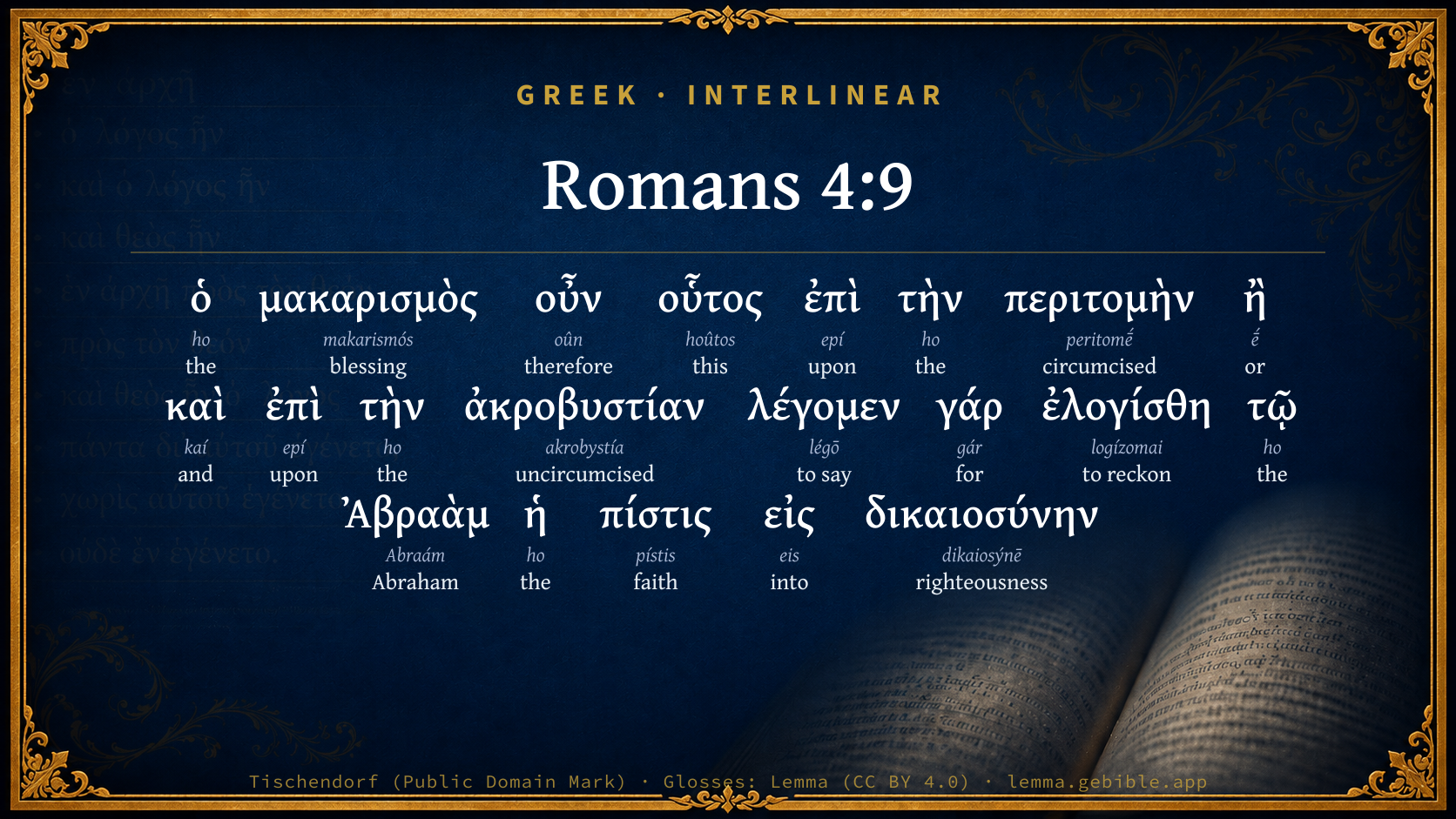
  1. ὁ ho G3588 “the” Article, Nominative, Singular, Masculine
  2. οὖν oûn G3767 “therefore” Conjunction
  3. οὗτος hoûtos G3778 “this” Demonstrative pronoun, Nominative, Singular, Masculine
  4. ἐπὶ epí G1909 “upon” Preposition
  5. τὴν ho G3588 “the” Article, Accusative, Singular, Feminine
  6. περιτομὴν peritomḗ G4061 “circumcised” Noun, Accusative, Singular, Feminine
  7. ἢ ḗ G2228 “or” Particle
  8. καὶ kaí G2532 “and” Conjunction
  9. ἐπὶ epí G1909 “upon” Preposition
  10. τὴν ho G3588 “the” Article, Accusative, Singular, Feminine
  11. ἀκροβυστίαν akrobystía G203 “uncircumcised” Noun, Accusative, Singular, Feminine
  12. λέγομεν légō G3004 “to say” Verb, Present, Active, Indicative, 1st person, Plural
  13. γάρ gár G1063 “for” Conjunction
  14. ἐλογίσθη logízomai G3049 “to reckon” Verb, Aorist, Passive, Indicative, 3rd person, Singular
  15. τῷ ho G3588 “the” Article, Dative, Singular, Masculine
  16. Ἀβραὰμ Abraám G11 “Abraham” Noun, Proper, indeclinable
  17. ἡ ho G3588 “the” Article, Nominative, Singular, Feminine
  18. πίστις pístis G4102 “faith” Noun, Nominative, Singular, Feminine
  19. εἰς eis G1519 “into” Preposition
  20. δικαιοσύνην dikaiosýnē G1343 “righteousness” Noun, Accusative, Singular, Feminine

About this verse

These counts appear in no published source. They are computed here, from the morphology-tagged text and Lemma’s own curated glosses. What Lemma adds →

21
words
16
distinct lemmas
Pauline Epistles
section

Notable vocabulary

The rarest word here is μακαρισμὸς blessing G3108 — appearing just 3 times in the whole Greek New Testament.

Shared distinctive vocabulary

μακαρισμὸς blessing G3108 occurs in 3 verses of the Greek New Testament. Also found in:

Repetition

Words recur within this verse:

Cross-references

12

Topical passages linked to Romans 4:9 in the Treasury of Scripture Knowledge — connected by theme and wording, ordered by reader-vote popularity; previews shown in the World English Bible.

  • Galatians 3:14 that the blessing of Abraham might come on the Gentiles through Christ Jesus; that we might receive the promise of the Spirit through faith.
  • Colossians 3:11 where there can't be Greek and Jew, circumcision and uncircumcision, barbarian, Scythian, bondservant, freeman; but Christ is all, and in all.
  • Romans 4:3 For what does the Scripture say? "Abraham believed God, and it was accounted to him for righteousness."
  • Galatians 3:26–28 For you are all children of God, through faith in Christ Jesus.
  • Ephesians 3:8 To me, the very least of all saints, was this grace given, to preach to the Gentiles the unsearchable riches of Christ,
  • Romans 3:29–30 Or is God the God of Jews only? Isn't he the God of Gentiles also? Yes, of Gentiles also,
  • Romans 10:12–13 For there is no distinction between Jew and Greek; for the same Lord is Lord of all, and is rich to all who call on him.
  • Romans 15:8–19 Now I say that Christ has been made a minister of the circumcision for the truth of God, that he might confirm the promises given to the fathers,
  • Ephesians 2:11–13 Therefore remember that once you, the Gentiles in the flesh, who are called "uncircumcision" by that which is called "circumcision," (in the flesh, made by hands);
  • Isaiah 49:6 yes, he says, It is too light a thing that you should be my servant to raise up the tribes of Jacob, and to restore the preserved of Israel: I will also give you for a light to the Gentiles, that you may be my salvation to the end of the earth.
  • Luke 2:32 A light for revelation to the Gentiles, And the glory of your people Israel."
  • Romans 9:23–24 and that he might make known the riches of his glory on vessels of mercy, which he prepared beforehand for glory,

Cross-references courtesy of OpenBible.info (CC BY 4.0).

Commentary

Notes on Romans 4:9 from classic Christian and Jewish commentators (each source and its license shown beneath its notes). The classic Christian expositions comment on the surrounding passage and are grouped to its opening verse, so a note may address several verses; the Jewish commentaries on the Tanakh (Rashi and others) are per-verse, so they appear only where the commentator wrote on this verse.

Lemma curates 59 commentaries, every one of them public domain or Creative Commons licensed, each selected and text-cleaned for this edition rather than reprinted as found. About our sources →

Matthew Henry's Commentary

St. Paul observes in this paragraph when and why Abraham was thus justified; for he has several things to remark upon that. It was before he was circumcised, and before the giving of the law; and there was a reason for both.

I. It was before he was circumcised, Rom 4:10. His faith was counted to him for righteousness while he was in uncircumcision. It was imputed, Gen 15:6, and he was not circumcised till ch. 17. Abraham is expressly said to be justified by faith fourteen years, some say twenty-five years, before he was circumcised. Now this the apostle takes notice of in answer to the question (Rom 4:9), Cometh this blessedness then on the circumcision only, or on the uncircumcision also? Abraham was pardoned and accepted in uncircumcision, a circumstance which, as it might silence the fears of the poor uncircumcised Gentiles, so it might lower the pride and conceitedness of the Jews, who gloried in their circumcision, as if they had the monopoly of all happiness. Here are two reasons why Abraham was justified by faith in uncircumcision: -

1. That circumcision might be a seal of the righteousness of faith, Rom 4:11. The tenour of the covenants must first be settled before the seal can be annexed. Sealing supposes a previous bargain, which is confirmed and ratified by that ceremony. After Abraham's justification by faith had continued several years only a grant by parole, for the confirmation of Abraham's faith God was pleased to appoint a sealing ordinance, and Abraham received it; though it was a bloody ordinance, yet he submitted to it, and even received it as a special favour, the sign of circumcision, etc. Now we may hence observe, (1.) The nature of sacraments in general: they are signs and seals - signs to represent and instruct, seals to ratify and confirm. They are signs of absolute grace and favour; they are seals of the conditional promises; nay, they are mutual seals: God does in the sacraments seal to us to be to us a God, and we do therein seal to him to be to him a people. (2.) The nature of circumcision in particular: it was the initiating sacrament of the Old Testament; and it is here said to be, [1.] A sign - a sign of that original corruption which we are all born with, and which is cut off by spiritual circumcision, - a commemorating sign of God's covenant with Abraham, - a distinguishing sign between Jews and Gentiles, - a sign of admission into the visible church, - a sign prefiguring baptism, which comes in the room of circumcision, now under the gospel, when (the blood of Christ being shed) all bloody ordinances are abolished; it was an outward and sensible sign of an inward and spiritual grace signified thereby. [2.] A seal of the righteousness of the faith. In general, it was a seal of the covenant of grace, particularly of justification by faith - the covenant of grace, called the righteousness which is of faith (Rom 10:6), and it refers to an Old Testament promise, Deu 30:12. Now if infants were then capable of receiving a seal of the covenant of grace, which proves that they then were within the verge of that covenant, how they come to be now cast out of the covenant and incapable of the seal, and by what severe sentence they were thus rejected and incapacitated, those are concerned to make out that not only reject, but nullify and reproach, the baptism of the seed of believers.

2. That he might be the father of all those that believe. Not but that there were those that were justified by faith before Abraham; but of Abraham first it is particularly observed, and in him commenced a much clearer and fuller dispensation of the covenant of grace than any that had been before extant; and there he is called the father of all that believe, because he was so eminent a believer, and so eminently justified by faith, as Jabal was the father of shepherds and Jubal of musicians, Gen 4:20, Gen 4:21. The father of all those that believe; that is, a standing pattern of faith, as parents are examples to their children; and a standing precedent of justification by faith, as the liberties, privileges, honours, and estates, of the fathers descend to their children. Abraham was the father of believers, because to him particularly the magna charta was renewed. (1.) The father of believing Gentiles, though they be not circumcised. Zaccheus, a publican, if he believe, is reckoned a son of Abraham, Luk 19:9. Abraham being himself uncircumcised when he was justified by faith, uncircumcision can never be a bar. Thus were the doubts and fears of the poor Gentiles anticipated and no room left to question but that righteousness might be imputed to them also, Col 3:11; Gal 5:6. (2.) The father of believing Jews, not merely as circumcised, and of the seed of Abraham according to the flesh, but because believers, because they are not of the circumcision only (that is, are not only circumcised), but walk in the steps of that faith - have not only the sign, but the thing signified - not only are of Abraham's family, but follow the example of Abraham's faith. See here who are the genuine children and lawful successors of those that were the church's fathers: not those that sit in their chairs, and bear their names, but those that tread in their steps; this is the line of succession, which holds, notwithstanding interruptions. It seems, then, those were most loud and forward to call Abraham father that had least title to the honours and privileges of his children. Thus those have most reason to call Christ Father, not that bear his name in being Christians in profession, but that tread in his steps.

II. It was before the giving of the law, Rom 4:13-16. The former observation is levelled against those that confined justification to the circumcision, this against those that expected it by the law; now the promise was made to Abraham long before the law. Compare Gal 3:17, Gal 3:18. Now observe,

1. What that promise was - that he should be the heir of the world, that is, of the land of Canaan, the choicest spot of ground in the world, - or the father of many nations of the world, who sprang from him, besides the Israelites, - or the heir of the comforts of the life which now is. The meek are said to inherit the earth, and the world is theirs. Though Abraham had so little of the world in possession, yet he was heir of it all. Or, rather, it points at Christ, the seed here mentioned; compare Gal 3:16, To thy seed, which is Christ. Now Christ is the heir of the world, the ends of the earth are his possession, and it is in him that Abraham was so. And it refers to that promise (Gen 12:3), In thee shall all the families of the earth be blessed.

2. How it was made to him: Not through the law, but through the righteousness of faith. Not through the law, for that was not yet given: but it was upon that believing which was counted to him for righteousness; it was upon his trusting God, in his leaving his own country when God commanded him, Heb 11:8. Now, being by faith, it could not be by the law, which he proves by the opposition there is between them (Rom 4:14, Rom 4:15): If those who are of the law be heirs; that is, those, and those only, and they by virtue of the law (the Jews did, and still do, boast that they are the rightful heirs of the world, because to them the law was given), then faith is made void; for, if it were requisite to an interest in the promise that there should be a perfect performance of the whole law, then the promise can never take its effect, nor is it to any purpose for us to depend upon it, since the way to life by perfect obedience to the law, and spotless sinless innocency, is wholly blocked up, and the law in itself opens no other way. This he proves, Rom 4:15. The law worketh wrath - wrath in us to God; it irritates and provokes that carnal mind which is enmity to God, as the damming up of a stream makes it swell - wrath in God against us. It works this, that is, it discovers it, or our breach of the law works it. Now it is certain that we can never expect the inheritance by a law that worketh wrath. How the law works wrath he shows very concisely in the latter part of the verse: Where no law is there is no transgression, an acknowledged maxim, which implies, Where there is a law there is transgression and that transgression is provoking, and so the law worketh wrath.

3. Why the promise was made to him by faith; for three reasons, Rom 4:16. (1.) That it might be by grace, that grace might have the honour of it; by grace, and not by the law; by grace, and not of debt, nor of merit; that Grace, grace, might be cried to every stone, especially to the top-stone, in this building. Faith hath particular reference to grace granting, as grace hath reference to faith receiving. By grace, and therefore through faith, Eph 2:8. For God will have every crown thrown at the feet of grace, free grace, and every song in heaven sung to that tune, Not unto us, O Lord, not unto us, but unto thy name be the praise. (2.) That the promise might be sure. The first covenant, being a covenant of works, was not sure: but, through man's failure, the benefits designed by it were cut off; and therefore, the more effectually to ascertain and ensure the conveyance of the new covenant, there is another way found out, not by works (were it so, the promise would not be sure, because of the continual frailty and infirmity of the flesh), but by faith, which receives all from Christ, and acts in a continual dependence upon him, as the great trustee of our salvation, and in whose keeping it is safe. The covenant is therefore sure, because it is so well ordered in all things, Sa2 23:5. (3.) That it might be sure to all the seed. If it had been by the law, it had been limited to the Jews, to whom pertained the glory, and the covenants, and the giving of the law (Rom 9:4); but therefore it was by faith that Gentiles as well as Jews might become interested in it, the spiritual as well as the natural seed of faithful Abraham. God would contrive the promise in such a way as might make it most extensive, to comprehend all true believers, that circumcision and uncircumcision might break no squares; and for this (Rom 4:17) he refers us to Gen 17:5, where the reason of the change of his name from Abram - a high father, to Abraham - the high father of a multitude, is thus rendered: For a father of many nations have I made thee; that is, all believers, both before and since the coming of Christ in the flesh, should take Abraham for their pattern, and call him father. The Jews say Abraham was the father of all proselytes to the Jewish religion. Behold, he is the father of all the world, which are gathered under the wings of the Divine Majesty. - Maimonides.

Matthew Henry's Commentary on the Whole Bible (1708–1710) — public domain (CC PDM 1.0). Text via the HelloAO Bible API.

The Biblical Illustrator

Joseph S. Exell

Rom_4:9-12

Cometh this blessedness then upon the circumcision only?

…Abraham received the sign of circumcision, a seal of the righteousness of the faith which he had yet being uncircumcised.

Circumcision--sacramental efficacy and infant baptism

Rightly have all Protestant churches maintained, as against Romanist, that there are only two sacraments, symbolic acts, instituted by Christ Himself, and enjoined upon all His followers to the end of time. Baptism takes the place of circumcision as the rite of initiation into the Church--it is the circumcision of Christ (Col_2:11-12). And the eucharist succeeds to the passover, in connection with that redemptive act to typify which the passover was instituted (1Co_5:7-8). The eucharist itself has become a sacrifice to be offered up by priestly hands. Note--

I. The significance and efficacy of Christian baptism as it stands related to circumcision.

1. Circumcision did not confer on Abraham the righteousness of faith, nor was it a pre-required condition of it; it was simply given as a sign and for a seal of a righteousness which was already in possession. And so of baptism. This does not itself wash away sin; it is not a condition pre-required in order to this; but it is given as a sign and for a Divine seal of the fact that, for all believers, sin has been put away by the sacrifice of Christ.

2. But the following texts may be cited in opposition: Tit_3:5; 1Co_12:13; Rom_6:3; Joh_3:5. All this is quite true. But the water referred to is the water of which the water in baptism is but the outward sign; which really washes away sin, and secures the answer of a good conscience towards God. What this water is, of which that in baptism is but a type (1Pe_3:21); of which the prophet Ezekiel declared that by the sprinkling thereof Jehovah would cleanse His people from all their filthiness and from all their idols (Eze_36:25); in respect to which David made earnest request (Psa_51:7); may be sought for in that water of purification which was provided by mixing with clear water from a running brook the ashes of the burnt red heifer. The great reality will be found in that mingled stream of blood and water which flowed on Calvary (Joh_19:34; 1Jn_5:6-8). That fountain opened for sin and for uncleanness was the atonement completed. To be born of water is to have the atonement effectually applied. We maintain that the water and the Spirit, in regeneration, are distinct, and produce distinct results; that the water in baptism is significant, not of the renewing of the Holy Ghost, but of the forgiveness and purgation of sin; and moreover that the purgation always precedes the renewing. And so baptism with water is always associated with the remission of sins, as that which shall remove out of the way the fatal obstruction to the incoming of the quickening Spirit (cf. Mar_1:4; Act_2:38; Act_22:16)

.

3. Baptism does not itself wash away the sin. It is not the medium through which the real Divine washing is imparted. But it is a sign that the washing is needed, and has been provided for; and, to all believers, it is a seal, given by Christ Himself, that the iniquity is purged. As circumcision was to Abraham, so is baptism to the believer in Jesus--he received the sign of circumcision, a seal of the righteousness of the faith which he already had before he was circumcised.

II. The bearing of this on infant baptism.

1. It is maintained that the Lord Jesus gave no authority for the baptism of any but actual adult believers. It is at once admitted that, when an assembly of adult Jews or Gentiles heard the preached gospel for the first time, the rite of baptism was only to be administered to those amongst them who were prepared intelligently to make this confession of faith. But it does not follow that the children of such individuals were not to be admitted with them to this sacred rite. We know that children were so admitted into the kingdom of God amongst the Jews; as we know also that all Hebrew-born male infants were required, by Divine command, to be circumcised when eight days old. And the apostles, being Jews, would doubtless continue to act as Jews, unless expressly forbidden so to act by the Master. We know of no such prohibition. Jesus encourages the little ones to be brought to Him, for that of such is the kingdom of God. St. Paul addresses children in the church assemblies as if they, as a matter of course, constituted part of such assemblies (Eph_6:1-3; Col_3:20). And when we read of the apostles baptizing whole households, we are not told that the infants were excluded.

2. But is not this the word of the Master, He that believeth, and is baptized, shall be saved? Truly. And is it not manifest that tender infants cannot believe? Certainly. But what follows? That infants ought not to be baptized, because they cannot believe? Must it then also follow that infants, dying in infancy, cannot be saved, because that they cannot believe, and because it is written, He that believeth not shall be damned? But in whose right, then, do they come to inherit eternal life? In their own? What then did Jesus mean when He said, That which is born of the flesh is flesh, etc., Ye must be born again? According to that teaching, not even infants can enter into the kingdom of God, except they be born of water and of the Spirit. But if they need the thing signified by baptism; if that thing has been provided for them through the great Mediator; if, though they cannot personally believe, they are graciously susceptible of that thing; and if all who die in infancy do really become participators in it, then who is he that shall forbid water, that they should not be baptized?

3. But they ought not to be baptized, because they cannot make a personal profession of faith. Could then the infant children of Abraham and his descendants make a personal profession of faith? Clearly not. And yet, by Gods own appointment, the sign and seal of the righteousness of faith was to be put upon every one of them when eight days old. Yet the children of Christian parents are as capable of the righteousness of faith as were the children of Hebrew parents.

4. The principle on which some Christians proceed is to exclude as many as possible from the Church. That of the Lord and His apostles was to include as many as possible. The former said, in respect to the little children, of such is the kingdom of God; and in respect to earnest adult workers in the cause of righteousness, He that is not against us is on our part. And one of the latter states that the unbelieving husband is sanctified by the (believing) wife, and the unbelieving wife is sanctified by the (believing) husband; and he adds, Else were your children unclean; but now they are holy (1Co_7:14). Now, children who may be pronounced holy must be proper subjects of baptism. Why may they not have been consecrated and sealed as holy in baptism? But, assuming that both parents and children, admitted into the Church of Christ by baptism, are present in the Church assembly, while his pastoral is being read, the apostle would have them to remember that the fact that they are thus admitted and present, even though it be through the bath of baptism, does not do away with their reciprocal obligations, but renders them still more urgently imperative. Therefore the loving words of exhortation to both (Eph_6:1-4). (W. Tyson.)

Circumcision and infant baptism

1. It looks a rational system to make sure of the thing signified ere you impress the sign. We read of this one convert and that other having believed and been baptized, and this should be the order with every grownup person. But mark how it fared with Abraham and his posterity. He believed and was circumcised; and it was laid down for a statute in Israel that all his children should be circumcised in infancy. In like manner, the first Christians believed and were baptized, and then their children. Express authority is needed to warrant a change; but it is not needed to warrant a continuation. It is this want of express authority which stamps on the opposite system a character of innovation. When once bidden to walk in a straight line, it does not require the successive impulse of new biddings, to make us persevere in it. But it would require a new bidding to justify our going off from the line. Had the mode of infant baptism sprung up as a new piece of sectarianism, it would not have escaped notice. But there is no record of its ever having entered amongst us as a novelty; and we have therefore the strongest reason for believing that it has come down in one uncontrolled tide of example and observation from the days of the apostles. And if they have not given us any authority for it, they at least, had it been wrong, and when they saw that whole families of discipleship were getting into this style of observation, would have interposed and lifted up the voice of their authority against it. But we read of no such interdict. We have therefore the testimony of apostolic silence in favour of infant baptism.

2. But is it not wrong when the sign and the thing signified do not go together? Yes. In the case of an adult the thing signified should precede the sign. But in the case of an infant the sign precedes the thing signified. The former has been impressed upon him by the will of his parent, and the latter remains to be worked within him by the care of his parent. If he do not put forth this care, he is in the fault. He is like the steward who is entrusted by his superior with the subscription of his name to a space of blank paper, on the understanding that it was to be filled up in a particular way, agreeable to the will of his lord; and, instead of doing so, has filled it up with matter of a different import altogether. The infant, with its mind unfilled and unfurnished, has been put by the God of providence into his hands; and after the baptism which he himself hath craved, it has been again made over to him with the signature of Christian discipleship, and, by his own consent, impressed upon it; and he, by failing to grave the characters of discipleship upon it, hath unworthily betrayed the trust that was reposed in him. The worthies of the Old Testament circumcised their children in infancy, and the mark of separation reminded them of their duty to rear them as a holy generation; and many a Hebrew parent was solemnised by this observance to say, like Joshua, that whatever others should do, he with all his house should fear the Lord; and this was the testimony of God to Abraham, that He knew him, that he would bring up his children after him in all the ways that he had himself been taught; and it was the commandment of God to His servants of old, that they should teach their children diligently of the loyalty and gratitude that should be rendered to the God of Israel. And if this be enough to rationalise the infant circumcision of the Jews, it is equally enough to rationalise the infant baptism of Christians. The parent of our day, who feels as he ought, will feel himself in conscience to be solemnly charged that the infant whom he has held up to the baptism of Christianity, he should bring up in the belief of Christianity. It is well that there should be one sacrament in behalf of the grownup disciple, for the solemn avowal of his Christianity before men, and the very participation of which binds more closely about his conscience all the duties and all the consistencies of the gospel. But it is also well that there should be another sacrament, the place of which in his history is at the period of his infancy, and the obligation of which is felt, not by his conscience still in embryo, but by the conscience of him whose business is to develop and to guard and to nurture its yet unawakened sensibilities. This is like removing baptism upward on a higher vantage ground. It is assigning for it a station of command and of custody at the very fountainhead of moral influence.

3. Baptism, viewed as a seal, marks the promise of God, to grant the righteousness of faith to him who is impressed by it; but, viewed as a sign, it marks the existence of this faith. But if it be not a true sign, it is not an obligatory seal. He who believes and is baptized shall be saved. But he who is baptized and believes not shall be damned. It is not the circumcision which availeth, but a new creature. It is not the baptism which availeth, but the answer of a good conscience. God hath given a terrible demonstration of the utter Worthlessness of a sign that is deceitful, and hath let us know that on that event as a seal it is dissolved. When a whole circumcised nation lost the spirit, though they retained the letter of the ordinance, He swept it away. Beware, ye parents, who regularly hold up your children to the baptism of water, and make their baptism by the Holy Ghost no part of your concern or of your prayer--lest you thereby swell the judgments of the land, and bring down the sore displeasure of God upon your families. (T. Chalmers, D. D.)

The spiritual family of Abraham

Under the old covenant the ground of mans justification with God was the same as it is under the new, viz., faith. Ordinances varied, being but helpful accessories leading to, or resting upon, the one changeless basis of mans justification.

I. Faith alone could admit Jews or Gentiles to the spiritual family of Abraham.

1. Faith was Abrahams sole ground of acceptance (Rom_4:9; Gal_3:6). The promises (Gen_12:3; Gen_17:4-6) preceded his circumcision.

2. Faith was indispensable for the Jews, although descended from Abraham, and circumcised (Rom_4:12; Rom_2:28-29; Rom_9:6-7). For neglecting this truth, and unduly trusting in their privileges of birth and circumcision, Christ rebuked them in Mat_3:9; Joh_8:39; and in the parable of Dives and Lazarus (Luk_16:22-23).

3. Faith admits Gentiles (verse 11) into the family of Abraham (Gal_3:7; Gal_3:9; Gal_3:29), who is the father of us all (verse 16). Zaccheus was thus admitted (Luk_19:9).

II. Circumcision had a two-fold aspect.

1. To Abraham and adult proselytes it was a seal of antecedent faith (verse 11).

2. To infants receiving it, as did Jesus when eight days old, it was the seal of their admission into covenant with God; an incentive and pledge of future faith. If a child did not receive it, he hath broken My covenant (Gen_17:14).

III. Analogy between baptism and circumcision.

1. St. Paul implies this when naming baptism (Gal_3:26-27; Gal_3:29) in connection with the Christians adoption into the family of Abraham and heirship of the promises.

2. Thus, to adults, baptism is, as circumcision was to Abraham, a seal of antecedent faith (Mar_16:16; Act_2:41; Act_8:12; Act_8:37).

3. To infants, baptism is, like circumcision, the seal of admission to covenant; pledge and incentive to future faith. The analogy of Gen_17:14, he hath broken My covenant, bears strongly on need of infant baptism.

Conclusion:

1. Examine ourselves as to performance of covenant promises made to God in baptism and renewed in confirmation.

2. Shun Jewish error of resting on rites and on privileges while ignoring the spiritual root of the matter--faith (Gal_5:6; Gal_6:15-16). (A. Scott Robertson, M. A.)

That he might be the father of all them that believe.

The father of the faithful

Two points are involved in this name.

I. Abraham was himself faithful. In him was most distinctly manifested the gift of faith. In him, long before Luther, long before Paul, was it proclaimed that man is justified by faith. Abraham believed in the Lord and He counted it to him for righteousness (verse 13; cf. Gen_15:6). Powerful as is the effect of these words when we read them in their untarnished freshness, they gain immensely in their original language, to which neither Greek nor German, much less Latin or English, can furnish any full equivalent. He supported himself, he built himself up, he reposed as a child in his mothers arms in the strength of God; in God whom he did not see, more than in the giant empires of the earth, and the bright lights of heaven, or the claims of tribe and kindred, which were always before him. It was counted to him for righteousness. It was counted to him, and his history seals and ratifies the result. His faith transpires not in any outward profession, but precisely in that which far more nearly concerns him and every one of us, in his prayers, in his actions, in the justice, the uprightness, the elevation of soul and spirit which sent him on his way straightforward without turning to the right hand or to the left. His belief, vague and scanty as it may be, even in the most elementary truths of religion, is implied rather than stated. It is in him simply the evidence of things not seen, the hope against hope. His faith in the literal sense of the word is only known to us through his works. He and his descendants are blessed, not, as in the Koran, because of his adoption of the first article of the creed of Islam, but because he obeyed (Gen_26:5; Gen_18:19).

II. He was the father of the faithful. In modern times it has too often happened that the doctrine of faith has had a narrowing effect on those who have strongly embraced it. It was far otherwise with Paul, to whom it was almost synonymous with the admission of the Gentiles. It was far otherwise with its first exemplification in Abraham. His very name implies this universal mission. The Father (Abba); The lofty Father (Ab-ram); The Father of multitudes (Ab-raham); the venerable parent, surveying, as if from that lofty eminence,, the countless progeny who should look up to him as their spiritual ancestor. He was, first, the Father of the chosen people, the people who by reason of their faith, though in one sense the narrowest of all ancient nations, yet were also the widest in their diffusion and dispersion--the only people that, by virtue of an invisible bond, maintained their national union in spite of local difference and division. But he was much more than the father of the chosen people. It is not a mere allegory or accidental application of separate texts, that justify St. Pauls appeal to the case of Abraham as including within itself the faith of the whole Gentile world. His position, as represented to us in the original records, is of itself far wider than that of any merely Jewish saint or national hero; and he is, on that ground alone, the fitting image to meet us at the outset of the history of the Church. He was the Hebrew to whom the Arabian no less than the Israelite tribes look back as to their first ancestor. The scene of his life, as of the patriarchs generally, breathes a larger atmosphere than the contracted limits of Palestine--the free air of Mesopotamia and the desert--the neighbourhood of the vast shapes of the Babylonian monarchy on one side, and of Egypt on the other. He is not an ecclesiastic, not an ascetic, not even a learned sage, but a chief, a shepherd, a warrior, full of all the affections and interests of family and household, and wealth and power, and for this very reason the first true type of the religious man, the first representative of the whole Church of God. This universality of Abrahams faith--this elevation, this multitudinousness of the patriarchal character has also found a response in later traditions and feelings. When Mohammed attacks the idolatry of the Arabs, he justifies himself by arguing, almost in the language of Paul, that the faith he proclaimed in one supreme God was no new belief, but was identical with the ancient religion of their first father Abraham. When the Emperor Alexander Severus placed in the chapel of his palace the statues of the choice spirits of all times, Abraham rather than Moses was selected as the centre, doubtless, of a more extended circle of sacred associations. (Dean Stanley.)

Abrahams spiritual fatherhood

This idea was quite a familiar one to St. Paul. In Galatians he expands and illustrates it still more fully. It represents Abraham--

I. As a grand type or example of believers (cf. Gen_4:20-21)

.

II. As the first of the saints. No doubt Abel, Enoch, Noah, and Shem were saved by faith, but still it was not until the time of Abraham that one was chosen in whom this great truth should be clearly and conspicuously exemplified.

III. As the federal head of the faithful. All believers are accounted as his seed, so that the promises made to him are also made to them, and the covenant entered into with him is also the same as that entered into with them. We have now another head, that is, Christ, and in Him the promises of God assume a far higher and more spiritual aspect than they did in regard to Abraham; but still the headship of Abraham is not destroyed, but absorbed. So far as Gods covenant with him extended, it is still firm and binding, and it belongs to all his seed, even all believers. It was a germ, out of which has sprung the higher covenant of God in Christ; but still we shall find in it much which may excite our interest, provoke our gratitude and determine our conduct. (T. G. Horton.)

The true children of Abraham

I. How they are reckoned.

1. Not by birth.

2. Not according to law.

3. But by faith.

II. How they are distinguished.

1. By the true circumcision of the heart, which is both a sign and a seal of the righteousness of faith.

2. By walking in the steps of Abrahams faith.

III. What are their privileges.

1. Adoption.

2. Inheritance. (J. Lyth, D. D.)

Who walk in the stops of that faith of our father Abraham.--

The faith of Abraham

This was--

1. A simple child-like dependence on the naked word of God.

2. An acceptance of and trust in Gods promised Saviour.

3. A renouncing of his own works as meritorious.

4. A faith that wrought by love, making him the friend of God (Jam_2:23).

5. One that overcame the world, leading him to seek a hotter country (Heb_11:10).

6. One that evidenced its reality by a self-denying obedience (Heb_11:8; Heb_11:17; Jam_2:21). True Abrahamic faith is love in the battlefield. (T. Robinson, D. D.)

The Biblical Illustrator, edited by Joseph S. Exell (c. 1880s–1900s) — public domain. Text from a community e-Sword module.

Joseph Benson's Commentary

Rom 4:9-10. Cometh this blessedness — Mentioned by Abraham and David; on the circumcision — Those that are circumcised only? or upon the uncircumcision also? — The circumcision are the Jews, the members of God’s visible church, and the uncircumcision are the Gentiles, who are out of the visible church. In this question, therefore, the justification of those who are out of the visible church, but who believe and obey God, is implied: for the apostle proves that such are justified, by appealing to Abraham’s justification while in uncircumcision. Abraham was not circumcised till he was ninety-nine years old, Gen 17:24. At that time Ishmael was thirteen years old, Rom 4:25. But before Ishmael was born, Abraham had his faith counted to him for righteousness, Gen 15:6, compared with Gen 16:16. It is evident, therefore, that Abraham was justified in uncircumcision more than thirteen years before he and his family were made the visible church and people of God by circumcision. Heathen, therefore, who believe and obey the true God, as Abraham did, will, like him, have their faith counted to them for righteousness, though no members of any visible church.

Joseph Benson's Commentary on the Old and New Testaments (1811–1818) — public domain. Text from a community e-Sword module.

Bengel's Gnomon

Johann Albrecht Bengel

Rom 4:9. Ὁ) Paul comprehends in this what he lately said respecting Abraham and David.—περιτομὴν) Does it come on the circumcision only, by itself, to the exclusion of others? or upon the circumcision also?—λέγομεν, we say, Rom 4:3.

Bengel's Gnomon of the New Testament — English translation (T&T Clark, Edinburgh, 1860) — public domain. Text from a community e-Sword module.

Meyer's Critical & Exegetical Commentary

Heinrich August Wilhelm Meyer

Rom_4:9-10. From the connection (καθάπερ, Rom_4:6) of this Davidic μακαρισμός with what had previously been adduced, Rom_4:3-5, regarding Abraham, it is now inferred (οὖν) that this declaration of blessedness affects, not the circumcised as such, but also the uncircumcised; for Abraham in fact, as an uncircumcised person, was included among those pronounced blessed by David.

ἐπὶ τ. περιτ.] The verb obviously to be supplied is most simply conceived as ἐστι (the μακαρισμός extends to etc.; comp Rom_2:9; Act_4:33 et al[994]). Less natural is λέγεται from Rom_4:6 (Fritzsche); and πίπτει (Theophylact, Bos) is arbitrary, as is also ἦλθεν (Oecumenius), and ἔρχεται (Olshausen). Comp Rom_4:13, and see Buttmann, neut. Gr. p. 120 f.

ἐπὶτ. περιτ. κ.τ.λ[996]] to the circumcised, or also to the uncircumcised? The καί shows that the previous ἘΠῚ Τ. ΠΕΡΙΤ. is conceived as exclusive, consequently without a μόνον.

λέγομεν γάρ Κ.Τ.Λ[997]] In saying this Paul cannot wish first to explain, quite superfluously, how he comes to put such questions (Hofmann), but, as is indicated by λέγομεν, which lays down a proposition as premiss to the argument that follows, he enters on the proof (γάρ) from the history of Abraham for the καὶ επὶ τ. ἀκροβ. which is conceived as affirmed. The present denotes the assertion pointing back to Rom_4:3 as continuing: for our assertion, our proposition is, etc. The plural assumes the assent of the readers. The emphasis however is not on τῷ Ἀβρ. (Fritzsche, de Wette, Baumgarten-Crusius, Maier, Philippi, and others), which Paul would have made apparent by the position of the words ὅτι τῷ Ἀβρ. ἐλογίσθη; nor on ἐλογίσθη, which in that case would necessarily have a pregnant meaning not indicated in the whole connection (as a pure act of grace, independent of external conditions); but on ἡ πίστις εἰς δικαιοσύνην (and thus primarily on πίστις) brought together at the end, by which the import of Rom_4:3, ἐπίστευσε.… δικαιοσύνην, is recapitulated.

πῶς οὖν ἐλογίσθη] The proposition, that to Abraham, etc., is certain; consequently the point at issue is the question quomodo, viz. under what circumstances as to status (whether in his circumcision, or whilst he was still uncircumcised) that imputation of his faith to him for righteousness took place.[998] Hofmann places the first mark of interrogation after πῶς οὖν, so that the second question is supposed to begin with ἐλογίσθη. But without sufficient ground, and contrary to the usage elsewhere of the interrogative πῶς by Paul, who has often put τί οὖν thus without a verb, but never πῶς οὖν. We should in such case have to understand ἐλογίσθη; but this word, according to the usual punctuation, is already present, and does not therefore need to be supplied.

οὐκ ἐν περιτομῇ, ἀλλʼ ἐν ἀκροβ.] scil. ὄντι. The imputation in question took place as early as Genesis 15; circumcision not till Genesis 17; the former at least fourteen years earlier.

[994] t al. and others; and other passages; and other editions.

[996] .τ.λ. καὶ τὰ λοιπά.

[997] .τ.λ. καὶ τὰ λοιπά.

[998] Respecting the form of the discourse, Erasmus aptly observes: Praeter interrogationis gratiam multum lucis addit dilemma, cujus altera parte rejecta alteram evincit. Nullum enim argumentandi genus vel apertius vel violentius.

Meyer — Critical and Exegetical Commentary on the New Testament — English translation by Peter Christie, edited by Frederick Crombie (T&T Clark, 1880) — public domain. Text from a community e-Sword module.

Expositor's Greek Testament

ed. W. Robertson Nicoll

Rom 4:9-12 . In these verses the justification of Abraham appears in a new light. In virtue of its ground in his faith, he is not only a forefather κατὰ σάρκα ( i.e. , the natural ancestor of the Jews), but he is the spiritual ancestor of all believers. The faith which was imputed to him for righteousness constitutes him such; it is the same in essence as Christian faith; and so it is a vital bond between him and all who believe, whether they be Jews or Gentiles. God’s method has been the same through all history.

Rom 4:9 . ὁ μακαρισμὸς οὖν οὗτος : This felicitation, then, what is its extent? Does it apply to the circumcision only, or to the uncircumcision also? Just as Rom 4:1-8 correspond to Rom 3:27 f., so do Rom 4:9-12 correspond to Rom 3:29-31 . God is not the God of the Jews only, but of the Gentiles also, and the Apostle’s purpose here is to show that the felicitation of the justified in Psa 32 is not limited by circumcision. λέγομεν γὰρ κ . τ . λ .: for our proposition is, that his faith was reckoned, etc.

The Expositor's Greek Testament, edited by W. Robertson Nicoll (1897–1910) — public domain. Text from a community e-Sword module.

Godet's Commentaries

Frédéric Louis Godet

Vv. 9, 10. “Is this beatification then for the circumcision, or for the uncircumcision also? for we say:Faith was reckoned to Abraham for righteousness. How was it then reckoned? when he was in a state of circumcision, or of uncircumcision? Not in a state of circumcision, but of uncircumcision.”

The then serves merely to resume the discussion: “I ask then if this celebration of the blessedness of the justified applies only to the circumcised, or also to the uncircumcised.” On this everything really depended. For, on the first alternative, the Gentiles had no way left of admission to the privilege of justification by faith except that of becoming Jews; and there was an end of Paul’s gospel. M. Reuss regards all this as an example “of the scholasticism of the Jewish schools of the day,” and of a “theological science” which could supply the apostle only with “extremely doubtful modes of argument.” We shall see if it is really so.

The second part of the verse: for we say...is intended to bring back the mind of the reader from David to Abraham: “For, in fine, we were affirming that Abraham was justified by faith. How is it then with this personage, whose example forms the rule? How was he justified by faith? as uncircumcised or as circumcised?” Such is the very simple meaning of Rom 4:10. The then which connects it with Rom 4:9 is thus explained: “To answer the question which I have just put (9a), let us then examine how the justification of Abraham took place.”

The answer was not difficult; it was furnished by Genesis, and it was peremptory. It is in chap. 15 that we find Abraham justified by faith; and it is in chap. 17, about fourteen years after, that he receives the ordinance of circumcision. The apostle can therefore answer with assurance: “not as circumcised, but as uncircumcised.” There was a time in Abraham’s life when by his uncircumcision he represented the Gentiles, as later after his circumcision he became the representative of Israel. Now, it was in the first of these two periods of his life, that is to say, in his Gentilehood, that he was justified by faith...the conclusion was obvious at a glance. Paul makes full use of it against his adversaries. He expounds it with decisive consequences in the sequel.

Frédéric Louis Godet — Commentaries on Luke, John, Romans, and 1 Corinthians — English translation (T&T Clark, Edinburgh, 1870s–1890s) — public domain. Text from a community e-Sword module.

Hodge's Commentary on Romans, Ephesians & First Corinthians

Charles Hodge

Rom_4:9

Cometh this blessedness upon the circumcision only, or upon the uncircumcision also? etc. The apostles third argument, commencing with this verse and continuing to the 12th, has special reference to circumcision. He had proved that Abraham was not justified on account of his works generally; he now proves that circumcision is neither the ground nor condition of his acceptance. The proof of this point is brief and conclusive. It is admitted that Abraham was justified. The only question is, was it before or after his circumcision? If before, it certainly was not on account of it. As it was before, circumcision must have had some other object.

Cometh this blessedness. There is nothing in the original to answer to the word cometh, although some word of the kind must be supplied. The most natural word to supply is λέγεται, David utters the declaration of the blessedness of the man whose sins are pardoned. Concerning whom is this declaration uttered? The word rendered blessedness means, more properly, declaration of blessedness. This declaration of blessedness, is it upon, i.e., is it about (λέγεται), is it said concerning the circumcision only? The preposition (ἐπί) used by the apostle, often points out the direction of an action, or the subject concerning which anything is said. This question has not direct reference to the persons to whom the offers of acceptance are applicable, as though it were equivalent to asking, Is this blessedness confined to the Jews, or may it be extended to the Gentiles also? because this is not the subject now in hand. It is the ground or condition of acceptance, and not the persons to whom the offer is to be made, that is now under consideration. The question therefore is, in substance, this: Does this declaration of blessedness relate to the circumcised, as such? Is circumcision necessary to justification? the blessing of which Paul is speaking. The answer obviously implied to the preceding question is, It is not said concerning the circumcised, as such; for we say that faith was imputed to Abraham for righteousness. It was his faith, not his circumcision, that was the condition of his justification. The preceding verses are occupied with the testimony of David, which decided nothing as to the point of circumcision. To determine whether this rite was a necessary condition of acceptance, it was requisite to refer again to the case of Abraham. To decide the point presented in the question at the beginning of the verse, the apostle argues from the position already established. It is conceded or proved that Abraham was justified by faith; to determine whether circumcision is necessary, we have only to ask, Under what circumstances was he thus justified, before or after circumcision?

Charles Hodge — Commentary on Romans (1835), First Corinthians (1857), and Ephesians (1856) — public domain. Text from a community e-Sword module.

Geneva Bible (1599)

Geneva Bible translators

A new proposition: that this manner of justification belongeth both to uncircumcised, and also to the circumcised, as is declared in the person of Abraham.

This saying of David, wherein he pronounceth them blessed.

Geneva Bible (1599) marginal notes — public domain. Text via Bolls.life.

Jamieson, Fausset & Brown

Robert Jamieson, A. R. Fausset & David Brown

Cometh this blessedness then, &c.--that is, "Say not, All this is spoken of the circumcised, and is therefore no evidence of God's general way of justifying men; for Abraham's justification took place long before he was circumcised, and so could have no dependence upon that rite: nay, 'the sign of circumcision' was given to Abraham as 'a seal' (or token) of the (justifying) righteousness which he had before he was circumcised; in order that he might stand forth to every age as the parent believer--the model man of justification by faith--after whose type, as the first public example of it, all were to be moulded, whether Jew or Gentile, who should thereafter believe to life everlasting."

Jamieson, Fausset & Brown — Commentary Critical and Explanatory on the Whole Bible (1871) — public domain (CC PDM 1.0). Text via the HelloAO Bible API.

Adam Clarke's Commentary

Verse 9. Cometh this blessedness - upon the circumcision only] The word μονον, only, is very properly supplied by our translators, and indeed is found in some excellent MSS., and is here quite necessary to complete the sense. The apostle's question is very nervous. If this pardon, granted in this way, be essential to happiness - and David says it is so - then is it the privilege of the Jews exclusively? This cannot be; for, as it is by the mere mercy of God, through faith, the circumcision cannot even claim it. But if God offer it to the circumcision, not because they have been obedient, for they also have sinned, but because of his mere mercy, then of course the same blessedness may be offered to the Gentiles who believe in the Lord Jesus. And this is evident; for we say, following our own Scriptures, that faith was reckoned to Abraham for righteousness; he had no merit, he was an idolater; but he believed in God, and his faith was reckoned to him ειςδικαιοσυνην, in reference to his justification; he brought faith when he could not bring works; and God accepted his faith in the place of obedience; and this became the instrumental cause of his justification.

Adam Clarke's Commentary on the Bible (1810–1826) — public domain. Text from a community e-Sword/MySword module.

John Calvin's Commentaries

9-10. As circumcision and uncircumcision are alone mentioned, some unwisely conclude, that the only question is, that righteousness is not attained by the ceremonies of the law. But we ought to consider what sort of men were those with whom Paul was reasoning; for we know that hypocrites, whilst they generally boast of meritorious works, do yet disguise themselves in outward masks. The Jews also had a peculiar way of their own, by which they departed, through a gross abuse of the law, from true and genuine righteousness. Paul had said, that no one is blessed but he whom God reconciles to himself by a gratuitous pardon; it hence follows, that all are accursed, whose works come to judgment. Now then this principle is to be held, that men are justified, not by their own worthiness, but by the mercy of God. But still, this is not enough, except remission of sins precedes all works, and of these the first was circumcision, which initiated the Jewish people into the service of God. He therefore proceeds to demonstrate this also.

We must ever bear in mind, that circumcision is here mentioned as the initial work, so to speak, of the righteousness of the law: for the Jews gloried not in it as the symbol of God’s favor, but as a meritorious observance of the law: and on this account it was that they regarded themselves better than others, as though they possessed a higher excellency before God. We now see that the dispute is not about one rite, but that under one thing is included every work of the law; that is, every work to which reward can be due. Circumcision then was especially mentioned, because it was the basis of the righteousness of the law.

But Paul maintains the contrary, and thus reasons: “If Abraham’s righteousness was the remission of sins, (which he safely takes as granted,) and if Abraham attained this before circumcision, it then follows that remission of sins is not given for preceding merits.” You see that the argument rests on the order of causes and effects; for the cause is always before its effect; and righteousness was possessed by Abraham before he had circumcision.

John Calvin's Commentaries (1540-1563) — public domain. Text from the Calvin Translation Society English edition (1840s-50s) via the Christian Classics Ethereal Library (ccel.org). Calvin's coverage is partial (roughly two-thirds of the Bible); uncommented books and verses are honest gaps, never fabricated. The 19th-century editor's footnotes and remarks are omitted so the notes are faithfully Calvin's own voice.

Ellicott's Commentary for English Readers

(9) Cometh this blessedness.—We shall, perhaps. best see the force of the particles “then” and “for” if we take the sentence out of its interrogative form. “It follows from the language of David that the blessedness thus predicated belongs to the uncircumcised as well as to the circumcised, for”—then comes the first premise of the argument by which this is proved. It was the act of faith which was the cause of Abraham’s justification. But both the act of faith and the justification consequent upon it were prior to the institution of the rite of circumcision. The narrative of this institution falls in Genesis 17, when Abraham was ninety-nine years old, and Ishmael, his son, thirteen (Gen_17:1; Gen_17:24-25), while the vision and promise of Genesis 15 apparently came before the birth of Ishmael.

(9-12) What is the bearing of this upon the relation between Jew and Gentile? Is the blessedness of the justified state reserved only for the former? Is it limited to those who are circumcised? On the contrary, the state of justification was attributed to Abraham himself before he was circumcised. Justification is the result of faith, not of circumcision. Circumcision is so far from superseding faith that it was only the sign or seal of it.

This, then, is the great test. Those who have it may hope for justification, whether their descent from Abraham is spiritual or literal.

A Bible Commentary for English Readers, edited by Charles John Ellicott (1878–1897) — public domain. Text from a community e-Sword module.

The Cambridge Bible for Schools and Colleges

gen. ed. J. J. S. Perowne

9. Cometh this blessedness, &c.] Here the reference to David’s words merges again into the main argument from Abraham’s case. This is indicated by the word “then.” The literal rendering of this verse is, This assertion of blessedness therefore—does it concern the circumcision, or the uncircumcision as well? For we say that to Abraham his faith was reckoned for righteousness. This may be paraphrased: “Can it then be applied only to the circumcised? (for it may be urged that David was a circumcised Hebrew); or can we extend it to the uncircumcised? We ask this; for Abraham’s is the case now in hand; and we may look to that case for an answer.”

The Cambridge Bible for Schools and Colleges (gen. ed. J. J. S. Perowne; Cambridge University Press, 1878–1918) — public domain. Text from a community e-Sword module.

John Gill's Exposition

How was it then reckoned?.... The Arabic version adds, "and when"; and the Ethiopic version reads it, "when was Abraham justified?" expressing the sense, not the words of the original text, with which agree the following questions:

when he was in circumcision, or in uncircumcision? that is, was he justified, or his faith reckoned to him for righteousness, when he was a circumcised, or an uncircumcised person?

not in circumcision; or when he was circumcised; for when it was said of him, that "he believed in the Lord", and "he counted it to him for righteousness", Gen 15:6, he was then uncircumcised, and remained so many years after: for this was before the birth of Ishmael, and Ishmael was "thirteen" years of age when he and his father Abraham were circumcised; so that it must be "fourteen" years, or thereabout, before his circumcision, that this declaration of his being a justified person was made; wherefore the apostle rightly adds,

but in uncircumcision; or whilst an uncircumcised person: hence it clearly appears that circumcision could not be the cause of his justification, since it followed it; and if Abraham when uncircumcised was a justified person, as it is certain he was, why may not uncircumcised Gentiles be justified also? and especially when it is observed, that the covenant made with Abraham when uncircumcised, included the Gentiles; see Gen 12:3.

John Gill's Exposition of the Whole Bible (1746–1763) — public domain (CC PDM 1.0). Text via the HelloAO Bible API.

Trapp's Complete Commentary

John Trapp

9 Cometh this blessedness then upon the circumcision only, or upon the uncircumcision also? for we say that faith was reckoned to Abraham for righteousness.

Ver. 9. Cometh this blessedness] This is the third time that the apostle avoucheth the universality of the subject of justification. For this he had done once before, Rom 3:23, and again, Rom 3:29-31. The Scripture doth not use, saith one, to kill flies with beetles, to cleave straws with wedges of iron, to spend many words where there is no need.

John Trapp, A Commentary or Exposition upon All the Books of the Old and New Testament (1647–1656) — public domain. Text from a community e-Sword module.

Albert Barnes' Notes on the Bible

Cometh ... - The apostle has now prepared the way for an examination of the inquiry whether this came in consequence of obedience to the Law? or whether it was without obedience to the Law? Having shown that Abraham was justified by faith in accordance with the doctrine which he was defending, the only remaining inquiry was whether it was after he was circumcised or before; whether in consequence of his circumcision or not. If it was after his circumcision. the Jew might still maintain that it was by complying with the works of the Law; but if it was before, the point of the apostle would be established, that it was without the works of the Law. Still further, if he was justified by faith before he was circumcised. then here was an instance of justification and acceptance without conformity to the Jewish Law; and if the father of the Jewish nation was so justified, and reckoned as a friend of God, without being circumcised, that is, in the condition in which the pagan world then was, then it would follow that the Gentiles might be justified in a similar way now. It would not be departing, therefore, from the spirit of the Old Testament itself, to maintain, as the apostle had done Rom. 3, that the Gentiles who had not been circumcised might obtain the favor of God as well as the Jew; that is, that it was independent of circumcision, and might be extended to all.

This blessedness - This happy state or condition. This state of being justified by God, and of being regarded as his friends. This is the sum of all blessedness; the only state that can be truly pronounced happy.

Upon the circumcision only - The “Jews” alone, as “they” pretended.

Or upon the uncircumcision also - The “Gentiles” who believed, as the “apostle” maintained.

For we say - We all admit. It is a conceded point. It was the doctrine of the apostle, as well as of the Jews; and as much theirs as his. With this, then, as a conceded point, what is the fair inference to be drawn from it?

Albert Barnes' Notes on the Bible (1834–1885) — public domain. Text from a community e-Sword/MySword module.

Haydock's Catholic Bible Commentary

This blessedness, by which a man’s sins are forgiven, and his soul truly justified, was promised, and is given to the uncircumcised Gentiles, as well as to the circumcised Jews, by the faith and grace of Christ; as Abraham was justified, when he was in the state of uncircumcision. (Witham)

George Leo Haydock (1774–1849), Haydock's Catholic Family Bible and Commentary, 1859 edition — public domain. Excludes Psalms (Douay-Rheims chapter numbering differs from Protestant) and Deuterocanonical books (Catholic canon only).

Matthew Poole's English Annotations

This word cometh is not in the original, but it is aptly inserted by our translators.

Circumcision again is put for the circumcised, and uncircumcision for the uncircumcised: see Rom 2:28.

For we say; q.d. This we have proved, and it is on all hands confessed,

that faith was reckoned to Abraham for righteousness: now, therefore, the question is, whether this blessedness of justification belongs to the circumcised only, or to the uncircumcised also.

Matthew Poole's English Annotations on the Holy Bible (1683–1685) — public domain. Text from a community e-Sword/MySword module.

Whedon's Commentary on the Bible

Daniel D. Whedon

9-12. Not only was Abraham justified by faith, but he was justified as essentially a Gentile; he was justified for twenty-five years before he was circumcised. That circumcision was not the antecedent ground of his justification, but the subsequent sign and seal of it. So under Christian dispensation baptism is the seal of infant justification, or upon the adult convert is the sign and seal consequent upon the justification of actual faith.

Daniel D. Whedon (gen. ed.), Commentary on the Old and New Testaments (1874–1909) — public domain. Text from a community e-Sword module.

The Pulpit Commentary

Vers. 9, 10. Cometh this blessedness then (properly, is then this blessing) upon the circumcision only, or upon the uncircumcision also? For we say that faith was reckoned to Abraham for righteousness. How (i.e., as the context shows, under what circumstances) was it then reckoned? when he was in circumcision, or in uncircumcision? Not in circumcision, but in uncircumcision. Faith, and not works, having been shown to be the principle of Abraham"s justification, and those who were under the Mosaic Law, represented by David, having been seen to have shared the blessing of being so justified, the question still remains, whether it may not be confined to them only, or to Abraham"s circumcised descendants only. That this cannot be is shown in two ways: firstly (vers. 10-13), from the fact that Abraham was himself uncircumcised when he was spoken of as being thus justified, so that neither the capability nor the inheritance of such justification can be viewed as dependent on circumcision; and, secondly (vers. 13-16), it is argued that the Law could not appropriate the privilege to his carnal descendants, the very principle of law being the opposite of that on which Abraham is said to have been justified. Thus the seed, innumerable as the stars, to be understood as inheritors of the promise made to him, and sharers in his blessing, are not his circumcised descendants, but a spiritual seed they which are of faith being the true children of Abraham. (Gal_3:7)

Vers. 9-22. All things are of faith.

The position is now established that righteousness is through faith. But, they might say, through the faith of a circumcised man; and the promise of the inheritance was through the Law; and surely the posterity of Abraham came according to the flesh. He answers Righteousness, heritage, posterity, by faith alone.

I RIGHTEOUSNESS.

1. The righteousness of faith without circumcision. In Gem 15 we have the record of Abraham"s justification; the institution of circumcision is narrated in Genesis 17, fourteen years after. Abraham, therefore, was justified "in his Gentile-hood" (see Godet). Therefore, he is the father of Gentile believers; and in so far as he is the father of Jewish believers, it is because they are believers, not because they are Jews.

2. Circumcision a seal of the righteousness of faith. God strengthens man"s faith by visible signs and seals of the faith and of its results. So to Abraham circumcision was an abiding pledge that God accepted his faith for righteousness. And likewise the existence of a separated nation was a testimony to the world. But it was the faith alone that was effectual; circumcision did but attest.

II HERITAGE. The whole world is promised to the heirs of Abraham as a heritage; this of itself might suffice to show that the heirs are not merely descendants according to the flesh. But the condition of such inheritance shall show the meaning.

1. If the heritage were through Law, then faith and the promise fail.

(1) "Faith is made void;" for it cannot grasp an impossibility, nor can it rightly lay hold of that which must be worked for.

(2) "And the promise is made of none effect;" for an unfulfilled Law works God"s wrath towards man, which is in utter contrariety to the fulfilment of a promise of love.

2. Therefore the heritage is of faith, that it may be according to grace, etc.

(1) Faith the sole condition of promise, that while God"s grace gives freely, man may freely receive.

(2) Faith the sole characteristic of the heirs of the promise, that so the seed may be, not merely that which is of the Law (even combined with faith), but that which is of faith (apart from Law), comprising both Jews and Gentiles who are the spiritual children of the great believer.

III POSTERITY. But it might be objected that an Israel according to the flesh was necessary, in order that the spiritual Israel might be at last accomplished. Truly. But, to cut away the last ground of boasting, even the Israel according to the flesh was the gift of God through faith.

1. The obstacles to such faith. "His own body," etc. And this all full in view: "he considered.

2. The warrant of faith. While viewing the obstacles, he staggered not.

(1) God"s promise "A father of many nations." "So shall thy seed be.

(2) God"s power. "Able to perform;" "quickeneth the dead," etc. "Wherefore also it was reckoned unto him for righteousness." As before, it was virtually the faith of his spiritual salvation; yes, the very faith which laid hold of the promise of posterity a posterity that they deemed according to the flesh. Let us learn that by faith we may be righteous, by faith we may possess the earth, By faith we may impress for good the generations following. What an heirship is possible through the faith of one believer! T.F.L.

The Pulpit Commentary (1880–1919), ed. H.D.M. Spence-Jones & Joseph S. Exell — public domain. Text from a community e-Sword module.

John Wesley's Explanatory Notes

This happiness - Mentioned by Abraham and David. On the circumcision - Those that are circumcised only. Faith was imputed to Abraham for righteousness - This is fully consistent with our being justified, that is, pardoned and accepted by God upon our believing, for the sake of what Christ hath done and suffered. For though this, and this alone, be the meritorious cause of our acceptance with God, yet faith may be said to be "imputed to us for righteousness," as it is the sole condition of our acceptance. We may observe here, forgiveness, not imputing sin, and imputing righteousness, are all one.

John Wesley, Explanatory Notes Upon the Whole Bible (1754–1765) — public domain. Text via the GEBible commentary corpus.

Kretzmann's Popular Commentary

Paul E. Kretzmann

Justification does not presuppose the fulfillment of the Law:

v. 9. Cometh this blessedness, then, upon the circumcision only, or upon the uncircumcision also? For we say that faith was reckoned to Abraham for righteousness.

v. 10. How was it then reckoned, when he was in circumcision or in uncircumcision? Not in circumcision, but in uncircumcision.

v. 11. and he received the sign of circumcision, a seal of the righteousness of the faith which he had yet being uncircumcised, that he might be the father of all them that believe, though they be not circumcised, that righteousness might be imputed unto them also;

v. 12. and the father of circumcision to them who are not of the circumcision only, but who also walk in the steps of that faith of our father Abraham which he had being yet uncircumcised.

St. Paul had proved that Abraham had not been justified on account of his keeping the Law, by reason of his merits in general; he now shows that circumcision is neither the basis nor the condition of his acceptance. That the joyful exclamation of David at the blessedness of the people whom he describes could be applied to the circumcised needed no proof: but the difficulty was whether it could be applied also to people that had not received the sacrament of circumcision. And so the apostle again takes up the case of Abraham. This blessedness now, does it come upon the circumcision or upon the uncircumcision? Does the psalmist’s declaration of blessedness concern the circumcised people only? Is circumcision necessary to justification? For we say that faith was imputed to Abraham for righteousness. This declarative. sentence serves as an illustration for the question, it states a concrete fact, on the basis of which alone the general question may be answered. How, then, was it imputed? In what condition was Abraham when he received the declaration of God concerning his justification? History gives the answer: Not when he was circumcised, but when he was uncircumcised, before the Lord had given him the rite of the Old Testament initiation. The justification of Abraham took place some fourteen years before his circumcision; therefore it was not the specific Jewish rite upon which he depended for acceptance with God. What was the relation, then, between God’s declaration and between the institution of the sacrament? What was the true nature, design, and object of circumcision? Abraham received the sign of circumcision, the sign which consisted in the circumcision, as a seal of the righteousness of faith which he had had in his uncircumcised state. The Jews took a great delight in boasting of circumcision, not only as a mark to distinguish them from the heathen, but as a form of merit, teaching that every circumcised person by that token became a partaker of the blessings of the Kingdom. Thus they believed also of Abraham that he had been acceptable to God on account of the mere external work of carrying out the command of God to circumcise all the males of his household. But Paul here emphasizes that Abraham received the rite as a gift, not as a merit; and furthermore, that Abraham was circumcised only after he had been justified by the express sentence of God. And the purpose of God in ordering matters in this way was a twofold one. Abraham was to be the spiritual father, first, of those who, like himself, received justification while in the state of uncircumcision, in order that to them also righteousness might be imputed. And, in the second place, Abraham was to be the spiritual father of those that, having received the rite of circumcision, proved themselves true children of Abraham by walking in the footsteps of the faith that he had long before God instituted the sacrament and entrusted it to him. "It was God’s intention that Abraham should be the representative and typical believer, in whom all believers without distinction should recognize their spiritual father. " Note: The righteousness of the Christians is the righteousness of faith, that is, the righteousness which they receive by faith and apply to themselves. Mark also: All believers are spiritual children of Abraham, they have their father’s manner, they possess the same justifying faith. "Thus all those that, according to the model of Abraham, believe, are the seed of Abraham and partakers of the blessing, whether they be Gentiles or Jews, circumcised or uncircumcised."

Paul E. Kretzmann, Popular Commentary of the Bible (1921–1924) — public domain. Text from a community e-Sword module.

Burkitt's Expository Notes on the New Testament

William Burkitt

Here the apostle moves the question, namely, Whether the forementioned blessedness of pardon of sin, and justification by faith, belongs to the circumcised Jews only, or to the uncircumcised Gentiles also? which question carrieth with it the force of a strong affirmation, that seeing faith was imputed to Abraham for righteousness, many years before he was circumcised; therefore the uncircumcised Gentiles, as well as the circumcised Jews, shall by faith be made partakers of the same blessedness, unto which Abraham wa intitled before he was circumcised.

Learn hence, That God has appointed one and the same way and method for the justification and salvation of all persons, circumcised and uncircumcised, Jew and Gentile, honourable and ignoble; namely, justification by faith in the blood of his Son, without which no church privileges, or spiritual prerogatives whatsoever, will intitle them to real blessedness. Cometh this blessedness on the circumcision only, or upon the uncircumcision also? Abraham believed unto righteousness before he was circumcised; therefore, the Gentiles by faith shall be accounted righteous, though they never be circumcised.

William Burkitt's Expository Notes on the New Testament (1700–1703) — public domain. Text from a community e-Sword module.

McGarvey & Pendleton's Commentaries

J. W. McGarvey

Is this blessing then pronounced upon the circumcision, or upon the uncircumcision also? for we say, To Abraham his faith was reckoned for righteousness .

J. W. McGarvey (with Philip Y. Pendleton), Commentaries on the New Testament (The Fourfold Gospel, 1914; Acts; and the epistles) — public domain. Text from a community e-Sword/MySword module.

The People's New Testament

B. W. Johnson

9–12. Cometh this blessedness upon the circumcision only. The next question is, Who shall enjoy this blessing of forgiveness? Shall it be Jews only, or shall the uncircumcision, the Gentiles, enjoy it? Abraham's faith was counted for righteousness; will this be true of all, both Jews and Gentiles?

B. W. Johnson's The People's New Testament with Notes (1889–1891) — public domain. Electronic text from the Christian Classics Ethereal Library (CCEL) ThML edition.

unfoldingWord translationNotes

Door43 World Missions Community

Then is this blessing pronounced only on those of the circumcision, or also on those of the uncircumcision?

This remark appears in the form of a question to add emphasis. AT: "Does God bless only those who are circumcised, or also those who are not circumcised?" (See: Rhetorical Question)

those of the circumcision

This is a metonym that refers to the Jewish people. AT: "the Jews" (See: Metonymy)

those of the uncircumcision

This is a metonym that refers to the people who are not Jews. AT: "the Gentiles" (See: Metonymy)

Faith was counted to Abraham as righteousness

You can translate this in an active form. AT: "God considered the faith of Abraham as righteousness" (See: Active or Passive)

So how was it counted? When Abraham was in circumcision, or in uncircumcision?

Paul asks these questions to add emphasis to his remarks. AT: "When did God consider Abraham to be righteous? Was it before his circumcision, or after it?" (See: Rhetorical Question)

It was not in circumcision, but in uncircumcision

"It happened before he was circumcised, not after he was circumcised"

translationWords

bless

circumcise

circumcise

faith

righteous

unfoldingWord translationNotes — © Distant Shores Media and the Door43 World Missions Community, licensed CC BY-SA 4.0. Source: git.door43.org/Door43/en_tn.

Cambridge Greek Testament for Schools and Colleges

9. ὁ μακ. οὖν. The blessing mentioned in the ps. is essentially the same as ‘the reckoning’ of Rom 4:3; and the question is raised whether it extends to the circumcision only or to all. This is answered by insisting on Abraham’s circumstances at the time.

Cambridge Greek Testament for Schools and Colleges (Cambridge University Press, 1896; 21 vols, various authors incl. Carr, Maclear, Plummer, Farrar, Lumby, Moule, M. R. James, Simcox) — public domain. Text from a community e-Sword module.

Alford’s Greek Testament

Henry Alford

9-12.] This declaration of blessedness applies to circumcised and uncircumcised alike. For Abraham himself was thus Justified when in uncircumcision, and was then pronounced the father of the faithful, uncircumcised as well as circumcised.

μακαρισμός of course includes the fact, on account of which the congratulation is pronounced,—the justification itself.

9. ἐπί] sc. λέγεται, see reff.

The form of the question, with ἢ καί, presupposes an affirmative answer to the latter clause; which affirmative answer is then made the ground of the argumentation in vv. 10, 11, 12:—On the uncircumcision (-cised) also. For we say, &c. The stress is on τῷ Ἀβραάμ, not on ἡ πίστις: for we say that to Abraham faith was reckoned for righteousness.

Henry Alford, The Greek Testament (1849–1861) — public domain. Text from a community e-Sword module.

Lesson kit

Teaching starters — assembled from the data on this page, not authored interpretation. Every prompt links to the verse data it draws on. Edit before teaching.

Romans, in the Pauline Epistles, opens this verse with 21 words (16 distinct Greek lemmas). Its most distinctive word is makarismós (“blessing”). A historical commentator’s framing appears above. Read the whole chapter for the surrounding context.

Discussion questions

  1. How does “blessing” (makarismós) shape what this verse is saying?
  2. How does Romans 4:6, which shares the word «blessing», read alongside this verse?
  3. What does the repetition of “upon” (2× in this one verse) do in this verse?
  4. The translations on this page render this verse differently — a whole-verse word diff, not a word-by-word alignment. What might account for the different wordings?
  5. Compare how Matthew Henry's Commentary and The Biblical Illustrator read this verse. Where do they agree or differ?

Things to notice

Reading settings

Reading text

Shown beneath each verse's original-language words.

Old Testament
Old Testament edition

Read the OT as the Masoretic Hebrew (MT) or the Greek Septuagint (LXX).

English shown for the Greek Septuagint (in the Hebrew ↔ Greek comparison).

Comparing translations? Open the Compare panel on any verse page to stack up to four side by side.