
Romans 16:12

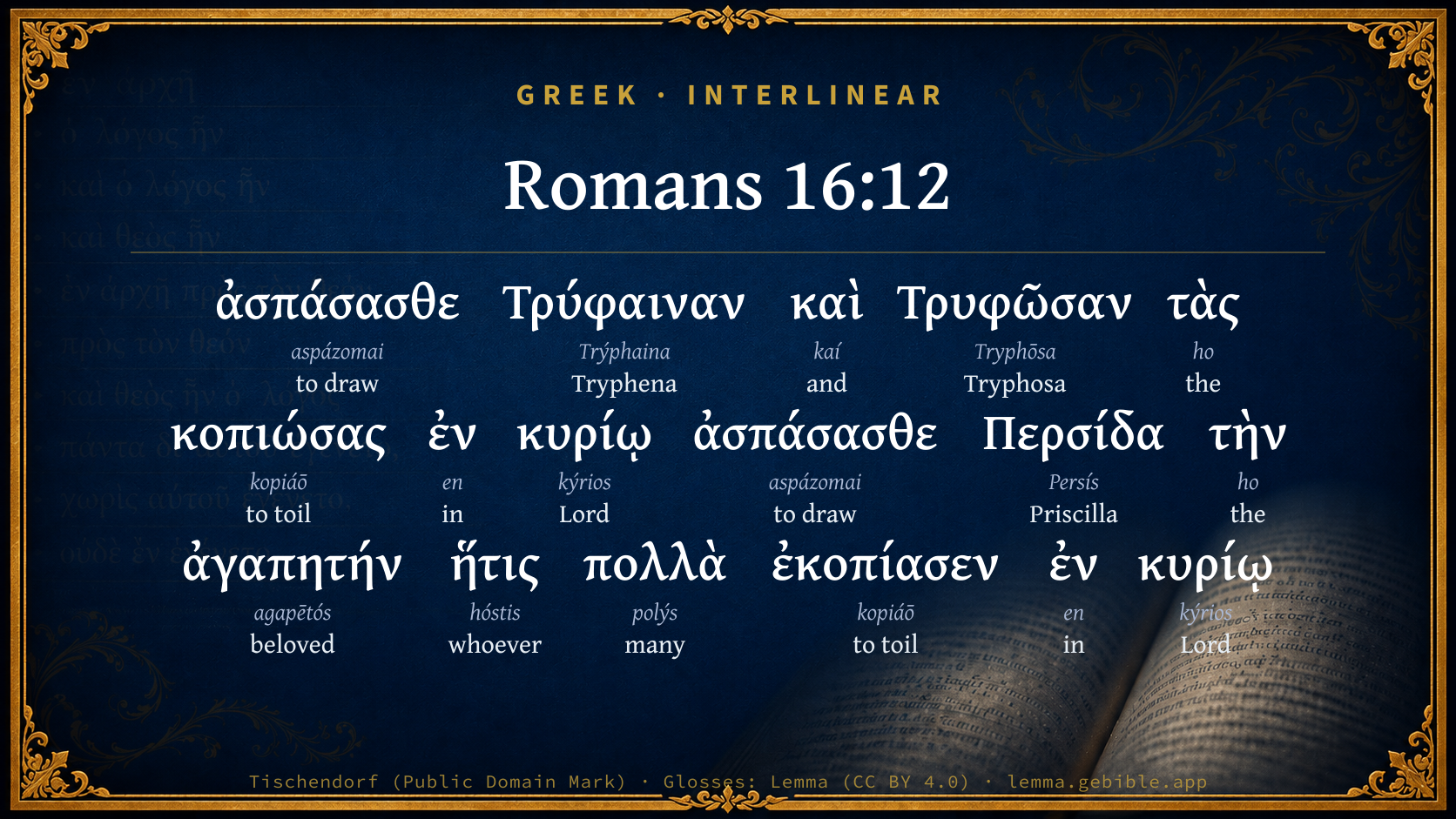
Greek (Tischendorf 8th ed.) Romans 16:12 appears in the Greek New Testament. The text above is from the Tischendorf 8th edition. Each word links to its Strong’s number and a concise gloss. Click any word for its full Thayer’s Greek Lexicon entry.
Download image
Cite this verse

Romans 16:12 (World English Bible). Public Domain. Lemma interlinear Bible study tool, https://lemma.gebible.app/v/romans/16/12.

Show BibTeX & RIS
BibTeX
RIS
English Translation
Greet Tryphaena and Tryphosa, who labor in the Lord. Greet Persis, the beloved, who labored much in the Lord.
World English Bible · Public Domain
Highlights
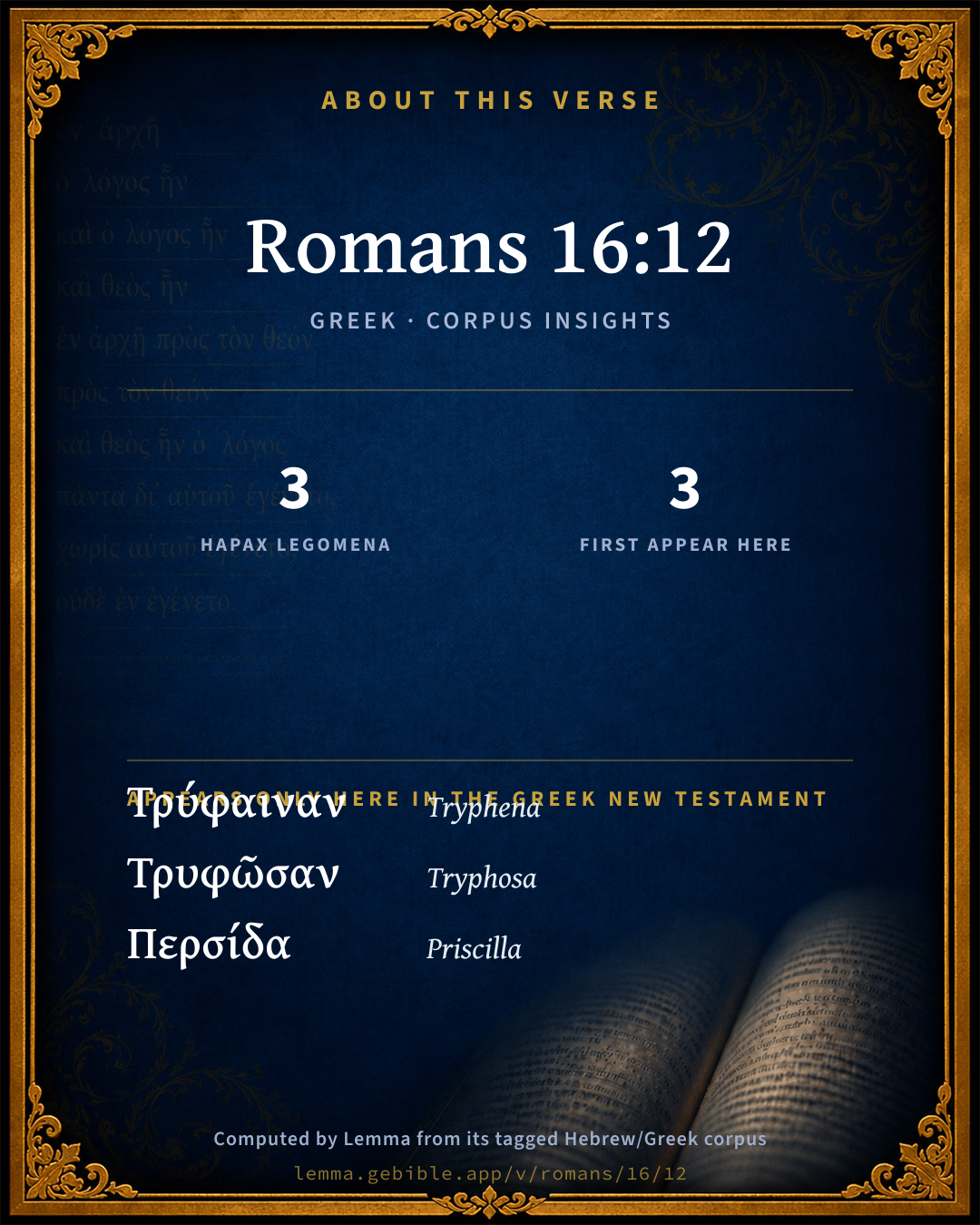
  • 3 hapax legomena — only here in the Greek New Testament
  • 3 first appearances in the Greek New Testament
Full analysis ↓
Download a study sheet

One document with this verse’s original text, its word-by-word gloss line, the meaning frame, cross-references with their text, attributed commentary, and full source and license credits — printable, and it pastes into notes with its structure intact.

This verse Autodidact and up

Study sheet (.html) Plain text (.txt)

A passage Seminary Student

Up to 50 verses in one chapter. A passage sheet keeps up to 6 commentary sources and 12 cross-references per verse, in the order this page ranks them, and says so on the sheet whenever that leaves anything out. Ask for a single verse and you get the Autodidact verse sheet above.

Everything on this page stays free to read, with no account — the sheet is a download of what is already on screen, not access to it.

Want to remove ads? Support Godless Engineer
Compare translations 3

The same verse in 3 English versions, stacked beneath the original-language interlinear above. Click any original word for its lexicon entry.

Each is an independent rendering of the whole verse — the interlinear is not word-aligned to these translations.

Highlighted words mark where these versions differ — a whole-verse word diff, not a word-by-word alignment.

  • World English Bible Public Domain
    Greet Tryphaena and Tryphosa, who labor in the Lord. Greet Persis, the beloved, who labored much in the Lord.
  • King James Version Public Domain
    Salute Tryphena and Tryphosa, who labour in the Lord. Salute the beloved Persis, which laboured much in the Lord.
  • unfoldingWord Literal Text CC BY-SA 4.0
    Greet Tryphaena and Tryphosa, the ones working hard in the Lord. Greet Persis the beloved, who has worked much in the Lord.

unfoldingWord Literal Text — © unfoldingWord, licensed CC BY-SA 4.0. Word-aligned USFM3 via Door43 (git.door43.org/unfoldingWord/en_ult).

Versions to compare (up to 4)

3 of 4 selected

Show all 19 translations

Every available English version of this verse, each an independent rendering of the whole verse.

  • World English Bible Public Domain
    Greet Tryphaena and Tryphosa, who labor in the Lord. Greet Persis, the beloved, who labored much in the Lord.
  • Berean Standard Bible Public Domain
    Greet Tryphena and Tryphosa, women who have worked hard in the Lord. Greet my beloved Persis, who has worked very hard in the Lord.
  • Majority Standard Bible Public Domain
    Greet Tryphena and Tryphosa, women who have worked hard in the Lord. Greet my beloved Persis, who has worked very hard in the Lord.
  • King James Version Public Domain
    Salute Tryphena and Tryphosa, who labour in the Lord. Salute the beloved Persis, which laboured much in the Lord.
  • American Standard Version (1901) Public Domain
    Salute Tryphaena and Tryphosa, who labor in the Lord. Salute Persis the beloved, who labored much in the Lord.
  • Revised Version (1885) Public Domain
    Salute Tryphaena and Tryphosa, who labour in the Lord. Salute Persis the beloved, which laboured much in the Lord.
  • Geneva Bible (1599) Public Domain
    Salute Tryphena and Tryphosa, which women labour in the Lord. Salute the beloued Persis, which woman hath laboured much in the Lord.
  • Douay-Rheims (1899) Public Domain
    Salute Tryphaena and Tryphosa, who labour in the Lord. Salute Persis, the dearly beloved, who hath much laboured in the Lord.
  • Young's Literal Translation Public Domain
    salute Tryphaena, and Tryphosa, who are labouring in the Lord; salute Persis, the beloved, who did labour much in the Lord.
  • Literal Standard Version CC BY-SA 4.0
    greet Tryphaena, and Tryphosa, who are laboring in the LORD; greet Persis, the beloved, who labored much in the LORD.
  • Unlocked Literal Bible CC BY-SA 4.0
    Greet Tryphaena and Tryphosa, who work hard in the Lord. Greet Persis the beloved, who has worked much in the Lord.
  • unfoldingWord Literal Text CC BY-SA 4.0
    Greet Tryphaena and Tryphosa, the ones working hard in the Lord. Greet Persis the beloved, who has worked much in the Lord.
  • Darby Bible Public Domain
    Salute Tryphaena and Tryphosa, who labour in [the] Lord. Salute Persis, the beloved, who has laboured much in [the] Lord.
  • World Messianic Bible Public Domain
    Greet Tryphaena and Tryphosa, who labor in the Lord. Greet Persis, the beloved, who labored much in the Lord.
  • Webster's Bible Public Domain
    Salute Tryphena and Tryphosa, who labor in the Lord. Salute the beloved Persis, who labored much in the Lord.
  • Free Bible Version CC BY-SA 4.0
    My best wishes to Tryphaena and Tryphosa, hard workers for the Lord, and to my friend Persis, who has done so much in the Lord.
  • Bible in Basic English Public Domain
    Give my love to Tryphaena and Tryphosa, workers in the Lord. Give my love to my dear Persis, who did much work in the Lord.
  • Text-Critical English NT CC BY 4.0
    Greet Tryphaena and Tryphosa, who labor in the Lord. Greet the beloved Persis, who has labored earnestly in the Lord.
  • Tyndale New Testament (1534) Public Domain
    Salute Triphena and Triphosa which wemen dyd labour in the Lorde. Salute the beloved Persis which laboured in the Lorde.

Literal Standard Version (2020), Covenant Press — licensed CC BY-SA 4.0. Text via the HelloAO Bible API (eBible.org). Unlocked Literal Bible (unfoldingWord) — licensed CC BY-SA 4.0. Text via the HelloAO Bible API (eBible.org). unfoldingWord Literal Text — © unfoldingWord, licensed CC BY-SA 4.0. Word-aligned USFM3 via Door43 (git.door43.org/unfoldingWord/en_ult). Free Bible Version, Dr. Jonathan Gallagher — licensed CC BY-SA 4.0. Text via the HelloAO Bible API (eBible.org).

Word by word

More ways to search: Search by grammar → Find every occurrence → Compare this word →

Practice this passage: Drill this verse → Learn its vocabulary →

Τρύφαιναν
Trýphaina
G5170
“Tryphena”
Noun, Accusative, Singular, Feminine
Part of Speech
Noun
Case
Accusative
Number
Singular
Gender
Feminine
Full Thayer's Definition

Origin: from G5172

TDNT: None

Tryphena = "luxurious" 1. a Christian woman
  1. ἀσπάσασθε aspázomai G782 “to draw” Verb, Aorist, Middle deponent, Imperative, 2nd person, Plural
  2. καὶ kaí G2532 “and” Conjunction
  3. Τρυφῶσαν Tryphōsa G5173 “Tryphosa” Noun, Accusative, Singular, Feminine
  4. τὰς ho G3588 “the” Article, Accusative, Plural, Feminine
  5. κοπιώσας kopiáō G2872 “to toil” Verb, Present, Active, Participle, Accusative, Plural, Feminine
  6. ἐν en G1722 “in” Preposition
  7. κυρίῳ kýrios G2962 “Lord” Noun, Dative, Singular, Masculine
  8. ἀσπάσασθε aspázomai G782 “to draw” Verb, Aorist, Middle deponent, Imperative, 2nd person, Plural
  9. Περσίδα Persís G4069 “Priscilla” Noun, Accusative, Singular, Feminine
  10. τὴν ho G3588 “the” Article, Accusative, Singular, Feminine
  11. ἀγαπητήν agapētós G27 “beloved” Adjective, Accusative, Singular, Feminine
  12. ἥτις hóstis G3748 “whoever” Relative pronoun, Nominative, Singular, Feminine
  13. πολλὰ polýs G4183 “many” Adjective, Accusative, Plural, Neuter
  14. ἐκοπίασεν kopiáō G2872 “to toil” Verb, Aorist, Active, Indicative, 3rd person, Singular
  15. ἐν en G1722 “in” Preposition
  16. κυρίῳ kýrios G2962 “Lord” Noun, Dative, Singular, Masculine

About this verse

These counts appear in no published source. They are computed here, from the morphology-tagged text and Lemma’s own curated glosses. What Lemma adds →

17
words
12
distinct lemmas
Pauline Epistles
section

Notable vocabulary

3 hapax legomena — words that appear only here in the entire Greek New Testament:

  • Τρύφαιναν Tryphena G5170
  • Τρυφῶσαν Tryphosa G5173
  • Περσίδα Priscilla G4069

First appearance in Scripture

These words make their first canonical appearance in the Greek New Testament here:

  • Τρύφαιναν Tryphena G5170
  • Τρυφῶσαν Tryphosa G5173
  • Περσίδα Priscilla G4069

Shared distinctive vocabulary

κοπιώσας to toil G2872 occurs in 20 verses of the Greek New Testament. Also found in:
Repetition

Words recur within this verse:

  • ἀσπάσασθε to draw G782 ×2
  • κοπιώσας to toil G2872 ×2
  • κυρίῳ Lord G2962 ×2
  • τὰς the G3588 ×2
  • ἐν in G1722 ×2

Cross-references

11

Topical passages linked to Romans 16:12 in the Treasury of Scripture Knowledge — connected by theme and wording, ordered by reader-vote popularity; previews shown in the World English Bible.

  • 1 Thessalonians 5:12–13 But we beg you, brothers, to know those who labor among you, and are over you in the Lord, and admonish you,
  • 1 Corinthians 15:58 Therefore, my beloved brothers, be steadfast, immovable, always abounding in the Lord's work, because you know that your labor is not in vain in the Lord.
  • 1 Corinthians 16:16 that you also be in subjection to such, and to everyone who helps in the work and labors.
  • Hebrews 6:10–11 For God is not unrighteous, so as to forget your work and the labor of love which you showed toward his name, in that you served the saints, and still do serve them.
  • Matthew 9:38 Pray therefore that the Lord of the harvest will send out laborers into his harvest."
  • 1 Corinthians 15:10 But by the grace of God I am what I am. His grace which was bestowed on me was not futile, but I worked more than all of them; yet not I, but the grace of God which was with me.
  • Colossians 1:29 for which I also labor, striving according to his working, which works in me mightily.
  • Colossians 4:12 Epaphras, who is one of you, a servant of Christ, salutes you, always striving for you in his prayers, that you may stand perfect and complete in all the will of God.
  • 1 Thessalonians 1:3 remembering without ceasing your work of faith and labor of love and patience of hope in our Lord Jesus Christ, before our God and Father.
  • 1 Timothy 4:10 For to this end we both labor and suffer reproach, because we have set our trust in the living God, who is the Savior of all men, especially of those who believe.
  • 1 Timothy 5:17–18 Let the elders who rule well be counted worthy of double honor, especially those who labor in the word and in teaching.

Cross-references courtesy of OpenBible.info (CC BY 4.0).

Commentary

Notes on Romans 16:12 from classic Christian and Jewish commentators (each source and its license shown beneath its notes). The classic Christian expositions comment on the surrounding passage and are grouped to its opening verse, so a note may address several verses; the Jewish commentaries on the Tanakh (Rashi and others) are per-verse, so they appear only where the commentator wrote on this verse.

Lemma curates 59 commentaries, every one of them public domain or Creative Commons licensed, each selected and text-cleaned for this edition rather than reprinted as found. About our sources →

Joseph Benson's Commentary

Rom 16:12-15. Salute Tryphena and Tryphosa — Probably two sisters; who labour in the Lord — In the service of the Lord, according to their stations: as did also Persis, who seems to be here termed beloved, because she was distinguished among many for her fidelity and diligence. Salute Rufus — Perhaps the same that is mentioned Mar 15:21. And his mother and mine — This expression may only denote the tender care which Rufus’s mother had taken of him. Salute Asyncritus, Phlegon, &c. — He seems to join those together who were joined by kindred, nearness of habitation, or some other circumstance. It could not but encourage the poor especially to be saluted by name, who, perhaps, did not know that the apostle had ever heard of them. It is observable, that while the apostle forgets none who are worthy, yet he adjusts the nature of his salutation to the degrees of worth in those whom he salutes. Salute all the saints — Here all the believers at Rome, male and female, have the appellation of saints, or holy persons, given them; as being new creatures in Christ Jesus, having in them the mind that was in him, and walking as he walked. The Papists affirm, that at the time the apostle wrote this epistle, Peter was at Rome, exercising the office of bishop in the Christian Church there: but if so, Paul doubtless would have known it; and, in that case, he surely would not have omitted saluting him, and have mentioned so many others of inferior note; and yet if Peter were not there at this time, the whole Roman tradition, with regard to the succession of their bishops, fails in the most fundamental article.

Joseph Benson's Commentary on the Old and New Testaments (1811–1818) — public domain. Text from a community e-Sword module.

MacLaren's Expositions of Holy Scripture

Alexander MacLaren

Romans

TRYPHENA AND TRYPHOSA

Rom 16:12.

The number of salutations to members of the Roman Church is remarkable when we take into account that Paul had never visited it. The capital drew all sorts of people to it, and probably there had been personal intercourse between most of the persons here mentioned and the Apostle in some part of his wandering life. He not only displays his intimate knowledge of the persons saluted, but his beautiful delicacy and ingenuity in the varying epithets applied to them shows how in his great heart and tenacious memory individuals had a place. These shadowy saints live for ever by Paul’s brief characterisation of them, and stand out to us almost as clearly and as sharply distinguished as they did to him.

These two, Tryphena and Tryphosa, were probably sisters. That is rendered likely by their being coupled together here, as well as by the similarity of their names. These names mean luxurious, or delicate, and no doubt expressed the ideal for their daughters which the parents had had, and possibly indicate the kind of life from which these two women had come. We can scarcely fail to note the contrast between the meaning of their names and the Christian lives they had lived. Two dainty women, probably belonging to a class in which a delicate withdrawal from effort and toil was thought to be the woman’s distinctive mark, had fled from luxury, which often tended to be voluptuous, and was always self-indulgent, and had chosen the better part of ‘labour in the Lord.’ They had become untrue to their names, because they must be true to their Master and themselves. We may well take the lesson that lies here, and is eminently needful to-day amidst the senseless, and often sinful, tide of luxury which runs so strongly as to threaten the great and eternal Christian principle of self-denial.

The first thing that strikes us in looking at these salutations is the illustration which it gives of the uniting power of a common faith. Tryphena and Tryphosa were probably Roman ladies of some social standing, and their names may indicate that they at least inherited a tendency to exclusiveness; yet here they occur immediately after the household of Narcissus and in close connection with that of Aristobulus, both of which are groups of slaves. Aristobulus was a grandson of Herod the Great, and Narcissus was a well-known freedman, whose slaves at his death would probably become the property of the Emperor. Other common slave names are those of Ampliatus and Urbanus; and here in these lists they stand side by side with persons of some distinction in the Roman world, and with men and women of widely differing nationalities. The Church of Rome would have seemed to any non-Christian observer a motley crowd in which racial distinctions, sex, and social conditions had all been swept away by the rising tide of a common fanaticism. In it was exemplified in actual operation Paul’s great principle that in Christ Jesus ‘there is neither Jew nor Greek, male nor female, bond nor free, but in Him all are one.’ Roman society in that day, as Juvenal shows us, was familiar with the levelling and uniting power of common vice and immorality, and the few sternly patriotic Romans who were left lamented that ‘the Orontes flowed into the Tiber’; but such common wallowing in filth led to no real unity, whereas, in the obscure corner of the great city where there were members of the infant Church gathered together, there was the beginning of a common life in the one Lord which lifted each participant of it out of the dreary solitude of individuality, and imparted to each heart the tingling consciousness of oneness with all who held the one faith in the one Lord and had received the one baptism in the one Name. That fair dawn has been shadowed by many clouds, and the churches of to-day, however they may have developed doctrine, may look back with reproach and shame to the example of Rome, where Tryphena and Tryphosa, with all their inherited, fastidious delicacy, recognised in the household of Aristobulus and the household of Narcissus ‘brethren in the Lord,’ and were as glad to welcome Jews, Asiatics, Persians, and Greeks, as Romans of the bluest blood, into the family of Christ. The Romish Church of our day has lost its early grace of welcoming all who love the one Lord into its fellowship; and we of the Protestant churches have been but too swift to learn the bad lesson of forbidding all who follow not with us.

Another thought which may be suggested by Tryphena and Tryphosa is the blessed hallowing of natural family relations by common faith. They were probably sisters, or, at all events, as their names indicate, near relatives, and to them that faith must have been doubly precious because they shared it with each other. None of the trials to which the early Christians were exposed was more severe than the necessity which their Christianity so often imposed upon them of breaking the sacred family ties. It saddened even Christ’s heart to think that He had come to rend families in sunder, and to make ‘a man’s foes them of his own household’; and we can little imagine how bitter the pang must have been when family love had to be cast aside at the bidding of allegiance to Him.

But though the stress of that separation between those most nearly related in blood by reason of unshared faith is alleviated in this day, it still remains; and that is but a feeble Christian life which does not feel that it is drawing a heart from closest human embraces and constituting a barrier between it and the dearest of earth. There is still need in these days of relaxed Christian sentiment for the stern austerity of the law, ‘He that loveth father or mother more than Me is not worthy of Me’; and there are many Christian souls who would be infinitely stronger and more mature, if they did not yield to the seductions of family affections which are not rooted in Jesus Christ. But still, though our faith ought to be far more than it often is, the determining element in our affections and associations, its noblest work is not to separate but to unite; and whilst it often must divide, it is meant to draw more closely together hearts that are already knit by earthly love. Its legitimate effect is to make all earthly sweetnesses sweeter, all holy bonds more holy and more binding, to infuse a new constraint and preciousness into all earthly relationships, to make brothers tenfold more brotherly and sisters more sisterly. The heart, in which the deepest devotion is yielded to Jesus Christ, has its capacity for devotion infinitely increased, and they who, looking into each other’s faces, see reflected there something of the Lord whom they both love, love each other all the more because they love Him most, and in their love to Him, and His to them, have found a new measure for all their affection. They who, looking on their dear ones, can ‘trust they live in God,’ will there find them ‘worthier to be loved,’ and will there find a power of loving them. Tryphena and Tryphosa were more sisterly than ever when they clung to their Elder Brother. ‘There is no man that hath left brethren, or sisters, or mother, or father, for My sake, but he shall receive a hundredfold more in this time, brethren, and sisters, and mothers, and in the world to come eternal life.’

The contrast between the names of these two Roman ladies and the characterisation of their ‘labour in the Lord’ may suggest to us the most formidable foe of Christian earnestness. Their names, as we have already noticed, point to a state of society in which the parents ideal for their daughters was dainty luxuriousness and a withdrawal from the rough and tumble of common life; but these two women, magnetised by the love of Jesus, had turned their backs on the parental ideal, and had cast themselves earnestly into a life of toil. That ideal was never more formidably antagonistic to the vigour of Christian life than it is to-day. Rome, in Paul’s time, was not more completely honeycombed with worldliness than England is to-day; and the English churches are not far behind the English ‘world’ in their paralysing love of luxury and self-indulgence. In all ages, earnest Christians have had to take up the same vehement remonstrance against the tendency of the average Christian to let his religious life be weakened by the love of the world and the things of the world. The protests against growing luxury have been a commonplace in all ages of the Church; but, surely, there has never been a time when it has reached a more senseless, sinful, and destroying height than in our day. The rapid growth of wealth, with no capacity of using it nobly, which modern commerce has brought, has immensely influenced all our churches for evil. It is so hard for us, aggregated in great cities, to live our own lives, and the example of our class has such immense power over us that it is very hard to pursue the path of ‘plain living and high thinking’ in communities, all classes of which are more and more yielding to the temptation to ostentation, so-called comfort, and extravagant expenditure; and that this is a danger-we are tempted to say the danger-to the purity, loftiness, and vigour of religious life among us, he must be blind who cannot see, and he must be strangely ignorant of his own life who cannot feel that it is the danger for him. I believe that for one professing Christian whose earnestness is lost by reason of intellectual doubts, or by some grave sin, there are a hundred from whom it simply oozes away unnoticed, like wind out of a bladder, so that what was once round and full becomes limp and flaccid. If Demas begins with loving the present world, it will not be long before he finds a reason for departing from Paul.

We may take these two sisters, finally, as pointing for us the true victory over this formidable enemy. They had turned resolutely away from the heathen ideal enshrined in their names to a life of real hard toil, as is distinctly implied by the word used by the Apostle. What that toil consisted in we do not know, and need not inquire; but the main point to be noted is that their ‘labour’ was ‘in the Lord.’ That union with Christ makes labour for Him a necessity, and makes it possible. ‘The labour we delight in physics pain’; and if we are in Him, we shall not only ‘live in Him,’ but all our work begun, continued, and ended in Him, will in Him and by Him be accepted. There is no victorious antagonist of worldly ease and self-indulgence comparable to the living consciousness of union with Jesus and His life in us. To dwell in the swamps at the bottom of the mountain is to live in a region where effort is impossible and malaria weakens vitality; to climb the heights brings bracing to the limbs and a purer air into the expanding lungs, and makes work delightsome that would have been labour down below. If we are ‘in the Lord,’ He is our atmosphere, and we can draw from Him full draughts of a noble life in which we shall not need the stimulus of self-interest or worldly success to use it to the utmost in acts of service to Him. They who live in the Lord will labour in the Lord, and they who labour in the Lord will rest in the Lord.

Romans

PERSIS

Rom 16:12.

There are a great number of otherwise unknown Christians who pass for a moment before our view in this chapter. Their characterisations are like the slight outlines in the background of some great artist’s canvas: a touch of the brush is all that is spared for each, and yet, if we like to look sympathetically, they live before us. Now, this good woman, about whom we never hear again, and for whom these few words are all her epitaph-was apparently, judging by her name, of Persian descent, and possibly had been brought to Rome as a slave. At all events, finding herself there, she had somehow or other become connected with the Church in that city, and had there distinguished herself by continuous and faithful Christian toil which had won the affection of the Apostle, though he had never seen her, and knew no more about her. That is all. She comes into the foreground for a moment, and then she vanishes. What does she say to us?

First of all, like the others named by Paul, she helps us to understand, by her living example, that wonderful, new, uniting process that was carried on by means of Christianity. The simple fact of a Persian woman getting a loving message from a Jew, the woman being in Rome and the Jew in Corinth, and the message being written in Greek, brings before us a whole group of nationalities all fused together. They had been hammered together, or, if you like it better, chained together, by Roman power, but they were melted together by Christ’s Gospel. This Eastern woman and this Jewish man, and the many others whose names and different nationalities pass in a flash before us in this chapter, were all brought together in Jesus Christ.

If we run our eye over these salutations, what strikes one, even at the first sight, is the very small number of Jewish names; only one certain, and another doubtful. Four or five names are Latin, and then all the rest are Greek, but this woman seemingly came from further east than any of them. There they all were, forgetting the hostile nationalities to which they belonged, because they had found One who had brought them into one great community. We talk about the uniting influence of Christianity, but when we see the process going on before us, in a case like this, we begin to understand it better.

But another point may be noticed in regard to this uniting process-how it brought into action the purest and truest love as a bond that linked men. There are four or five of the people commended in this chapter of whom the Apostle has nothing to say but that they are beloved. This is the only woman to whom he applies that term. And notice his instinctive delicacy: when he is speaking of men he says, ‘My beloved’; when he is greeting Persis he says, ‘the beloved,’ that there may be no misunderstanding about the ‘my’-’the beloved Persis which laboured much in the Lord’-indicating, by one delicate touch, the loftiness, the purity, and truly Christian character of the bond that held them together. And that is no true Church, where anything but that is the bond-the love that knits us to one another, because we believe that each is knit to the dear Lord and fountain of all love.

What more does this good woman say to us? She is an example living and breathing there before us, of what a woman may be in God’s Church. Paul had never been in Rome; no Apostle, so far as we know, had had anything to do with the founding of the Church. The most important Church in the Roman Empire, and the Church which afterwards became the curse of Christendom, was founded by some anonymous Christians, with no commission, with no supervision, with no officials amongst them, but who just had the grace of God in their hearts, and found themselves in Rome, and could not help speaking about Jesus Christ. God helped them, and a little Church sprang into being. And the great abundance of salutations here, and the honourable titles which the Apostle gives to the Christians of whom he speaks, and many of whom he signalises as having done great service, are a kind of certificate on his part to the vigorous life which, without any apostolic supervision or official direction, had developed itself there in that Church.

Now, it is to be noticed that this striking form of eulogium which is attached to our Persis she shares in common with others in the group. And it is to be further noticed that all those who are, as it were, decorated with this medal-on whom Paul bestows this honour of saying that they had ‘laboured,’ or ‘laboured much in the Lord,’ are women that stand alone in the list. There are several other women in it, but they are all coupled with men-husbands or brothers, or some kind of relative. But there are three sets of women, I do not say single women, but three sets of women, standing singly in the list, and it is about them, and them only, that Paul says they ‘laboured,’ or ‘laboured much.’ There is a Mary who stands alone, and she ‘bestowed much labour on’ Paul and others. Then there are, in the same verse as my text, two sisters, Tryphena and Tryphosa, whose names mean ‘the luxurious.’ And the Apostle seems to think, as he writes the two names that spoke of self-indulgence: ‘Perhaps these rightly described these two women once, but they do not now. In the bad old days, before they were Christians, they may have been rightly named luxurious-living. But here is their name now, the luxurious is turned into the self-sacrificing worker, and the two sisters “labour in the Lord.”‘ Then comes our friend Persis, who also stands alone, and she shares in the honour that only these other two companies of women share with her. She ‘laboured much in the Lord.’ In that little community, without any direction from Apostles and authorised teachers, the brethren and sisters had every one found their tasks; and these solitary women, with nobody to say to them, ‘Go and do this or that,’ had found out for themselves, or rather had been taught by the Spirit of Jesus, what they had to do, and they worked at it with a will. There are many things that Christian women can do a great deal better than men, and we are not to forget that this modern talk about the emancipation of women has its roots here in the New Testament. We are not to forget either that prerogative means obligation, and that the elevation of woman means the laying upon her of solemn duties to perform. I wonder how many of the women members of our Churches and congregations deserve such a designation as that? We hear a great deal about ‘women’s rights’ nowadays. I wish some of my friends would lay a little more to heart than they do, ‘women’s duties.’

And now, lastly, the final lesson that I draw from this eulogium of an otherwise altogether unknown woman is that she is a model of Christian service.

First, in regard to its measure. She ‘laboured much in the Lord.’ Now, both these two words, ‘laboured’ and ‘much,’ are extremely emphatic. The word rightly translated ‘laboured’ will appear in its full force if I recall to you a couple of other places in which it is employed in the New Testament. You remember that touching incident about our Lord when, being ‘wearied with His journey, He sat thus on the well.’ ‘Wearied’ is the same word as is here used. Then, you remember how the Apostle, after he had been hauling empty nets all night in the little, wet, dirty fishing-boat, said, perhaps with a yawn, ‘Master, we have toiled all the night and caught nothing.’ He uses the same word as is employed here. Such is the sort of work that these women had done-work carried to the point of exhaustion, work up to the very edge of their powers, work unsparing and continuous, and not done once in some flash of evanescent enthusiasm, but all through a dreary night, in spite of apparent failures.

There is the measure of service. Many of us seem to think that if we say ‘I am tired,’ that is a reason for not doing anything. Sometimes it is, no doubt; and no man has a right so to labour as to impair his capacity for future labour, but subject to that condition I do not know that the plea of fatigue is a sufficient reason for idleness. And I am quite sure that the true example for us is the example of Him who, when He was most wearied, sitting on the well, was so invigorated and refreshed by the opportunity of winning another soul that, when His disciples came back to Him, they looked at His fresh strength with astonishment, and said to themselves, ‘Has any man brought Him anything to eat?’ Ay, what He had to eat was work that He finished for the Father, and some of us know that the truest refreshment in toil is a change of toil. It is almost as good to shift the load on to the other shoulder, or to take a stick into the other hand, as it is to put away the load altogether. Oh, the careful limits which Christian people nowadays set to their work for Jesus! They are not afraid of being tired in their pursuit of business or pleasure, but in regard to Christ’s work they will let anything go to wrack and ruin rather than that they should turn a hair, by persevering efforts to prevent it. Work to the limit of power if you live in the light of blessedness.

She ‘laboured much in the Lord,’ or, as Jesus Christ said about the other woman who was blamed by the people that did not love enough to understand the blessedness of self-sacrifice, ‘she had done what she could.’ It was an apology for the form of Mary’s service, but it was a stringent demand as to its amount. ‘What she could’-not half of what she could; not what she conveniently could. That is the measure of acceptable service.

Then, still further, may we not learn from Persis the spring of all true Christian work? She ‘laboured much in the Lord,’ because she was ‘in Him,’ and in union with Him there came to her power and desire to do things which, without that close fellowship, she neither would have desired nor been able to do. It is vain to try to whip up Christian people to forms of service by appealing to lower motives. There is only one motive that will last, and bring out from us all that is in us to do, and that is the appeal to our sense of union and communion with Jesus Christ, and the exhortation to live in Him, and then we shall work in Him. If you link the spindles in your mill, or the looms in your weaving-shed, with the engine, they will go. It is of no use to try to turn them by hand. You will only spoil the machinery, and it will be poor work that you will get off them.

So, dear brethren, be ‘in the Lord.’ That is the secret of service, and the closer we come to Him, and the more continuously, moment by moment, we realise our individual dependence upon Him, and our union with Him, the more will our lives effloresce and blossom into all manner of excellence and joyful service, and nothing else that Christian people are whipped up to do, from lower and more vulgar motives than that, will. It may be of a certain kind of inferior value, but it is far beneath the highest beauty of Christian service, nor will its issues reach the loftiest point of usefulness to which even our poor service may attain.

Persis seems to me to suggest, too, the safeguard of work. Ah, if she had not ‘laboured in the Lord,’ and been ‘in the Lord’ whilst she was labouring, she would very soon have stopped work. Our Christian work, however pure its motive when we begin it, has in itself the tendency to become mechanical, and to be done from lower motives than those from which it was begun. That is true about a man in my position. It is true about all of us, in our several ways of trying to serve our dear Lord and Master. Unless we make a conscience of continually renewing our communion with Him, and getting our feet once more firmly upon the rock, we shall certainly in our Christian work, having begun in the spirit, continue in the flesh, and before we know where we are, we shall be doing work from habit, because we did it yesterday at this hour, because people expect it of us, because A, B, or C does it, or for a hundred other reasons, all of which are but too familiar to us by experience. They are sure to slip in; they change the whole character of the work, and they harm the workers. The only way by which we can keep the garland fresh is by continually dipping it in the fountain. The only way by which we can keep our Christian work pure, useful, worthy of the Master, is by seeing to it that our work itself does not draw us away from our fellowship with Him. And the more we have to do, the more needful is it that we should listen to Christ’s voice when He says to us, ‘Come ye yourselves apart with Me into a solitary place, and there renew your communion with Me.’

The last lesson about our work which I draw from Persis is the unexpected immortality of true Christian service. How Persis would have opened her eyes if anybody had told her that nearly 1900 years after she lived, people in a far-away barbarous island would be sitting thinking about her, as you and I are doing now! How astonished she would have been if it had been said to her, ‘Now, Persis, wheresoever in the whole world the Gospel is preached, your name and your work and your epitaph will go with it, and as long as men know about Jesus Christ, your and their Master, they will know about you, His humble servant.’ Well, we shall not have our names in that fashion in men’s memories, but Jesus will have your name and mine, if we do His work as this woman did it, in His memory. ‘I will never forget any of their works.’ And if we-self-forgetful to the limit of our power, and as the joyful result of our personal union with that Saviour who has done everything for us-try to live for His praise and glory in any fashion, then be sure of this, that our poor deeds are as immortal as Him for whom they are done, and that we may take to ourselves the great word which He has spoken, when He has declared that at the last He will confess His confessors’ names before the angels in heaven. Blessed are the living that ‘live in the Lord’; blessed are the workers that work ‘in the Lord,’ for when they come to be the dead that ‘die in the Lord’ and rest from their labours, their works shall follow them.

Alexander MacLaren, Expositions of Holy Scripture (1904–1910) — public domain. Text from a community e-Sword module.

Bengel's Gnomon

Johann Albrecht Bengel

Rom 16:12. Τὰς κοπιώσας, who laboured) although they have their name [Τρυφαινα, Τρυφῶσα] from τρυφὴ, a luxurious life; as Näom (agreeable). It is probable that these two were sisters according to the flesh.

Bengel's Gnomon of the New Testament — English translation (T&T Clark, Edinburgh, 1860) — public domain. Text from a community e-Sword module.

Expositor's Greek Testament

ed. W. Robertson Nicoll

Rom 16:12 . Τρύφαιναν καὶ Τρυφῶσαν : “It was usual to designate members of the same family by derivatives of the same root” (Lightfoot): hence these two women were probably sisters. The names, which might be rendered “Dainty” and “Disdain” (see Jas 5:5 , Isa 66:11 ) are characteristically pagan, and unlike the description τὰς κοπιώσας , “who toil in the Lord”. They are still at work, but the “much toil” of Persis, the beloved, belongs to some occasion in the past. τὴν ἀγαπητήν : Paul does not here add μου as with the men’s names in Rom 16:8-9 . Persis was dear to the whole Church.

The Expositor's Greek Testament, edited by W. Robertson Nicoll (1897–1910) — public domain. Text from a community e-Sword module.

Hodge's Commentary on Romans, Ephesians & First Corinthians

Charles Hodge

Rom_16:8-15

My beloved in the Lord. The preposition in (ἐν), here, as frequently elsewhere, points out the relation or respect in which the word, to which it refers is to be understood; brother beloved, both in the flesh and in the Lord (Phm_1:16), both in reference to our external relations, and our relation to the Lord. And thus in the following, Rom_16:9, our helper in Christ, i.e. as it regards Christ; Rom_16:10, approved in Christ, i.e. in his relation to Christ; an approved or tried Christian; Rom_16:12, who labor in the Lord; and, which labored much in the Lord, i.e. who, as it regards the Lord, labored much; it was a Christian or religious service. The names, Tryphena, Tryphosa, and Persis, all are feminine. The last is commonly supposed to indicate the native country of the person who bore it, as it was not unusual to name persons from the place of their origin, as Mysa, Syria, Lydia, Andria, etc.; such names, however, soon became common, and were given without any reference to the birthplace of those who received them. Chosen in the Lord, i.e. not one chosen by the Lord; chosen, (i.e., approved, precious; see 1Pe_2:4,) in his relation to the Lord, as a Christian. It is not merely elect in Christ, that is, chosen to eternal life, for this could be said of every Christian; but Rufus is here designated as a chosen man, as a distinguished Christian. It is worth noticing, that at Rome, as at Corinth, few of the great or learned seem to have been called. These salutations are all addressed to men not distinguished for their rank or official dignity. Mylius, as quoted by Calov, says: Notanda hic fidelium istorum conditio: nemo hic nominatur consul, nemo quaestor aut dictator insignitur, minime omnium episcopatuum et cardinalatuum dignitate hic personant: sed operarum, laborum, captivitate titulis plerique notantur. Ita verum etiam in Romana ecclesia fuit olim, quod apostouls scribit, non multi potentis, non multi nobiles, sed stuta mundi electa sunt a Deo. Papatus autem Caesarei, qualis adjuvante diabolo, in perniciem religionis, posteris saeculis Romae involuit, ne umbra quidem apostolorum aetate istic fuit: tantum abest, ut ille originem ab apostolis ipsis traxerit.

Charles Hodge — Commentary on Romans (1835), First Corinthians (1857), and Ephesians (1856) — public domain. Text from a community e-Sword module.

Jamieson, Fausset & Brown

Robert Jamieson, A. R. Fausset & David Brown

Salute Tryphena and Tryphosa, who labour in the Lord--two active women.

Salute the beloved Persis--another woman.

which laboured much in the Lord--referring probably, not to official services, such as would fall to the deaconesses, but to such higher Christian labors--yet within the sphere competent to woman--as Priscilla bestowed on Apollos and others (Act 18:18).

Jamieson, Fausset & Brown — Commentary Critical and Explanatory on the Whole Bible (1871) — public domain (CC PDM 1.0). Text via the HelloAO Bible API.

Adam Clarke's Commentary

Verse 12. Tryphena and Tryphosa] Two holy women, who it seems were assistants to the apostle in his work, probably by exhorting, visiting the sick, c. Persis was another woman, who it seems excelled the preceding for, of her it is said, she laboured much in the Lord. We learn from this, that Christian women, as well as men, laboured in the ministry of the word. In those times of simplicity all persons, whether men or women, who had received the knowledge of the truth, believed it to be their duty to propagate it to the uttermost of their power. Many have spent much useless labour in endeavouring to prove that these women did not preach. That there were some prophetesses, as well as prophets in the Christian Church, we learn; and that a woman might pray or prophesy, provided she had her head covered, we know; and that whoever prophesied spoke unto others to edification, exhortation, and comfort, St. Paul declares, 1Co 14:3. And that no preacher can do more, every person must acknowledge; because to edify, exhort, and comfort, are the prime ends of the Gospel ministry. If women thus prophesied, then women preached. There is, however, much more than this implied in the Christian ministry, of which men only, and men called of God, are capable.

Adam Clarke's Commentary on the Bible (1810–1826) — public domain. Text from a community e-Sword/MySword module.

Ellicott's Commentary for English Readers

(12) Tryphena and Tryphosa.—Probably sisters or near relatives. They, too, may have been attached to the court.

A Bible Commentary for English Readers, edited by Charles John Ellicott (1878–1897) — public domain. Text from a community e-Sword module.

The Cambridge Bible for Schools and Colleges

gen. ed. J. J. S. Perowne

12. Tryphçna and Tryphôsa] Greek names. These Christian women are otherwise unknown to us. They were very probably, like Phœbe, “servants of the Church.”

labour in the Lord] toil (same word as that rendered “bestow much labour,” Rom_16:6,) in the Lord; as being “in Him,” and working under His presence and influence.

the beloved Persis] A Greek name. It is noticeable, as a sign of St Paul’s faultless Christian delicacy, that he does not call this Christian woman “my beloved.”

laboured] toiled. The aorist may point to some special occasion in the past. Or possibly Persis was an aged believer, whose day of toil, being over, was now viewed as one act of loving work for Christ.

The Cambridge Bible for Schools and Colleges (gen. ed. J. J. S. Perowne; Cambridge University Press, 1878–1918) — public domain. Text from a community e-Sword module.

John Gill's Exposition

Salute Rufus chosen in the Lord,.... This was a Roman name; frequent mention is made Jewish writings (u) of one Turnus Rufus, a Roman officer, that destroyed the temple, and ploughed up the city of Jerusalem; the name was in use among the Cyrenians, for one of the sons of Simon of Cyrene, whom the Jews compelled to carry the cross of Christ, was so called, Mar 15:21; and some have thought that the same person is here meant, nor is it unlikely; he is said to be one of the seventy disciples, and to be bishop of Thebes; See Gill on Luk 10:1. The apostle knew him, and that as one "chosen in the Lord"; meaning either that he was a choice believer in Christ, an excellent Christian, one of the highest form; for though all true believers have like precious faith, yet some are strong, and others weak, in the exercise of it; this man was eminent for his faith in Christ: or he might be one that was chosen to some office in the church, as to that of a deacon, or pastor; though had this been the case, it is much the particular office was not mentioned: rather therefore this is to be understood of his being chosen in Christ to grace and glory and that from all eternity; for the phrase is only used in one place more, Eph 1:4; and there most manifestly designs the election of persons in Christ, before the foundation of the world; which election is made not "for" Christ, or the sake of his merits, his blood, righteousness and sacrifice, which have no causal influence on this act, and which purely arises from the love and grace of God; nor merely "by" him as God equal with the Father, though this is true; but "in" him, as the head and representative of the chosen ones: this instance, as others, shows that election is not of nations, nor churches, but of particular persons; and so expresses the distinguishing, free, and sovereign grace of God in it, that one and not another should be chosen; though these are on an equal foot, and so not owing to foreseen faith, holiness, and good works. The apostle knew this man to be a chosen vessel, not by immediate revelation, or divine inspiration, but by his faith in Christ, and love to him, and by the power of the Gospel on him; and so may anyone know himself, or another man hereby to be chosen, and ought in a judgment of charity so to think of him, as long as his life is agreeably to his profession; see Th1 1:4. The apostle not only salutes this man, but his mother also, who doubtless was a believer in Christ, and highly respected by him:

and his mother and mine; the mother of Rufus in nature, and his mother in affection; and who very probably had endeared herself to the apostle by some kind offices, which she, as a Christian, had performed towards him; for the apostle cannot mean his own natural mother, besides Rufus's, whom he salutes, and whom Anselm on the place suggests might be at Rome; since it can hardly be thought he would have passed the mention of her in so transient a manner.

(u) T. Hieros. Taanioth, fol. 69. 2. T. Bab. Nedar. fol. 50. 2. Avoda Zara, fol. 20. 1. & Sanhedrin, fol. 65. 2. Juchasin, fol. 36. 2.

John Gill's Exposition of the Whole Bible (1746–1763) — public domain (CC PDM 1.0). Text via the HelloAO Bible API.

Trapp's Complete Commentary

John Trapp

12 Salute Tryphena and Tryphosa, who labour in the Lord. Salute the beloved Persis, which laboured much in the Lord.

Ver. 12. Who labour in the Lord] Though not so much as Persis did, yet doth he not defraud them of their due commendation; Prima sequentem honestum est in secundis tertiisque consistere. (Cic. De Orator.) Every man must not look to excel; let him be doing, as he is able.

John Trapp, A Commentary or Exposition upon All the Books of the Old and New Testament (1647–1656) — public domain. Text from a community e-Sword module.

Albert Barnes' Notes on the Bible

Tryphena and Tryphosa - These names, with the participle rendered “who labor,” are in the feminine gender, and these were probably two holy women, who performed the function of deaconesses, or who ministered to the sick, and who with Persia, thus by example, and perhaps by instruction, labored to promote the spread of Christianity. Pious females, then, as now, were able to do much in their proper sphere to extend the truths and blessings of the gospel.

Albert Barnes' Notes on the Bible (1834–1885) — public domain. Text from a community e-Sword/MySword module.

Matthew Poole's English Annotations

He salutes several women as well as men: you read before of Priscilla, Rom 16:3; of Mary, Rom 16:6; and now he adds three more in this verse. He saith of the two first, that they

laboured in the Lord; i.e. in the service of Christ and his church, according to their place and power. See the notes on Rom 16:6.

Salute the beloved Persis, which laboured much in the Lord; he gives this woman a higher commendation, calling her

the beloved Persis; see Rom 16:8. He saith of the other two, that they laboured; but of this, that she hath laboured much in the Lord, noting some special favour or service for which she is here commended.

Matthew Poole's English Annotations on the Holy Bible (1683–1685) — public domain. Text from a community e-Sword/MySword module.

Whedon's Commentary on the Bible

Daniel D. Whedon

12. Persis—Signifying female Persian, but used here as a personal name.

Daniel D. Whedon (gen. ed.), Commentary on the Old and New Testaments (1874–1909) — public domain. Text from a community e-Sword module.

The Pulpit Commentary

Salute Tryphena and Tryphosa who labour in the Lord. Salute the beloved Persia, which laboured much in the Lord. All these seem to have been Church workers; and the last at least, from the way St. Paul speaks of her, must have been known by him personally, and done work of which he was cognizant. It is to be observed how, in calling her "the beloved," he avoids, with delicate propriety, adding "my," as he does in speaking of his male friends.

The Pulpit Commentary (1880–1919), ed. H.D.M. Spence-Jones & Joseph S. Exell — public domain. Text from a community e-Sword module.

John Wesley's Explanatory Notes

Salute Tryphena and Tryphosa - Probably they were two sisters.

John Wesley, Explanatory Notes Upon the Whole Bible (1754–1765) — public domain. Text via the GEBible commentary corpus.

McGarvey & Pendleton's Commentaries

J. W. McGarvey

Salute Tryphæna and Tryphosa, who labor in the Lord. Salute Persis the beloved, who labored much in the Lord .

J. W. McGarvey (with Philip Y. Pendleton), Commentaries on the New Testament (The Fourfold Gospel, 1914; Acts; and the epistles) — public domain. Text from a community e-Sword/MySword module.

The People's New Testament

B. W. Johnson

12. Tryphæna, Tryphosa, … Persis. These are the names of women. From the fact stated of them, they were probably deaconesses.

B. W. Johnson's The People's New Testament with Notes (1889–1891) — public domain. Electronic text from the Christian Classics Ethereal Library (CCEL) ThML edition.

unfoldingWord translationNotes

Door43 World Missions Community

Tryphaena ... Tryphosa ... Persis

These are women's names. (See: How to Translate Names and Translate Unknowns)

Rufus ... Asyncritus ... Phlegon ... Hermes ... Patrobas ... Hermas

These are men's names. (See: How to Translate Names and Translate Unknowns)

chosen in the Lord

You can translate this in an active form. AT: "whom the Lord has chosen" (See: Active or Passive)

his mother and mine

Paul speaks of the mother of Rufus as if she were his own mother. AT: "his mother, whom I also think of as my mother" (See: Metaphor)

brothers

Here this means fellow Christians, including both men and women.

translationWords

in Christ

beloved

chosen one

brother

unfoldingWord translationNotes — © Distant Shores Media and the Door43 World Missions Community, licensed CC BY-SA 4.0. Source: git.door43.org/Door43/en_tn.

Cambridge Greek Testament for Schools and Colleges

12. Τρύφαινον καὶ Τρυφῶσαν, perh. sisters, and belonging to the last-named group. The names are found in household inscriptions: Tryphaena in one case with Tryphonilla, in another with Τρυφω[ν or σα]. Zahn, Einl. pp. 297–8.

Περσίδα κ.τ.λ. A slave name (not in the household inscriptions): the special emphasis (τὴν ἀγ … πολλά) indicates some special knowledge on S. Paul’s part, possibly personal, though μου is omitted.

Cambridge Greek Testament for Schools and Colleges (Cambridge University Press, 1896; 21 vols, various authors incl. Carr, Maclear, Plummer, Farrar, Lumby, Moule, M. R. James, Simcox) — public domain. Text from a community e-Sword module.

International Critical Commentary

12. Τρύφαιναν καὶ Τρυφῶσαν are generally supposed to have been two sisters. Amongst inscriptions of the household we have 4866 d. m. | varia ∙ tryphosa | patrona ∙ et | m. eppivs ∙ clemens | : 5035 d. m. | tryphaena | valeria ∙ tryphaena | matri ∙ b ∙ m ∙ f ∙ et | valerius ∙ fvtianvs (quoted by Lft. from Acc. di Archeol. xi. p. 375): 5343 telesphorvs ∙ et ∙ tryphaena, 5774, 6054 and other inscriptions quoted by Lft. Attention is drawn to the contrast between the names which imply ‘delicate,’ ‘dainty,’ and their labours in the Lord.

The name Tryphaena has some interest in the early history of the Church as being that of the queen who plays such a prominent part in the story of Paul and Thecla, and who is known to have been a real character.

Περσίδα. The name appears as that of a freedwoman, C.I.L. vi. 23959 dis ∙ manib | per ∙ sidi. l. ved | vs ∙ mithres | vxori. It does not appear among the inscriptions of the household.

International Critical Commentary — older volumes (1896–1929), various authors — public domain. Text from a community e-Sword module.

Vincent's Word Studies in the New Testament

Marvin R. Vincent

Tryphaena and Tryphosa. From trufaw to live luxuriously. See on riot, 2Pe 2:13. Perhaps sisters. Farrar says they are slave - names.

Marvin R. Vincent, Word Studies in the New Testament (1887–1900) — public domain. Text from a community e-Sword/MySword module.

Godet's Commentaries

Frédéric Louis Godet

Vv. 12. Paul speaks here of three women, the two former of whom were distinguished at this time, and the third had been distinguished previously in the service of the Lord and of the church, like Priscilla and Mary. The two former were probably sisters; their almost identical names come from the verb τρυφᾶν, to live voluptuously. Paul wishes evidently to contrast this meaning of their name with that of the epithet κοπιώσας, who work laboriously. They are in Christ the opposite of what their name expresses.

Persis, a woman of Persia. Foreigners were often designated by the name of their native country (Lydia, a Lydian). Meyer points out the delicacy with which Paul here omits the pronoun μου (my). Probably she was an aged woman: Paul says: labored.

Frédéric Louis Godet — Commentaries on Luke, John, Romans, and 1 Corinthians — English translation (T&T Clark, Edinburgh, 1870s–1890s) — public domain. Text from a community e-Sword module.

Lesson kit

Teaching starters — assembled from the data on this page, not authored interpretation. Every prompt links to the verse data it draws on. Edit before teaching.

Romans, in the Pauline Epistles, opens this verse with 17 words (12 distinct Greek lemmas). Its most distinctive word is Trýphaina (“Tryphena”). A historical commentator’s framing appears above. Read the whole chapter for the surrounding context.

Discussion questions

  1. How does “Tryphena” (Trýphaina) shape what this verse is saying?
  2. This verse holds 3 words here found nowhere else in the Greek New Testament. What might the rare words draw attention to?
  3. 3 words here appear for the first time in Scripture. What is being introduced at this debut?
  4. Matthew 6:28 shares the word «to toil» with this verse. How do the two illuminate each other?
  5. “to draw” occurs 2× in this one verse. What is the effect of the repetition?
  6. These translations render this verse differently. What is at stake in choosing one wording over another?
  7. Reading how Joseph Benson's Commentary and MacLaren's Expositions of Holy Scripture read this verse, where do the two commentators agree and where do they part?

Things to notice

  • 3 words in this verse appear nowhere else in the Greek New Testament.
  • 3 words make their first canonical appearance in Scripture here.
  • These translations choose different wording for 14 words in this verse.
  • “to draw” occurs 2× in this single verse.
  • 12 distinct Greek lemmas span 17 words in this verse.

Reading settings

Reading text

Shown beneath each verse's original-language words.

Old Testament
Old Testament edition

Read the OT as the Masoretic Hebrew (MT) or the Greek Septuagint (LXX).

English shown for the Greek Septuagint (in the Hebrew ↔ Greek comparison).

Comparing translations? Open the Compare panel on any verse page to stack up to four side by side.