
Romans 9:10

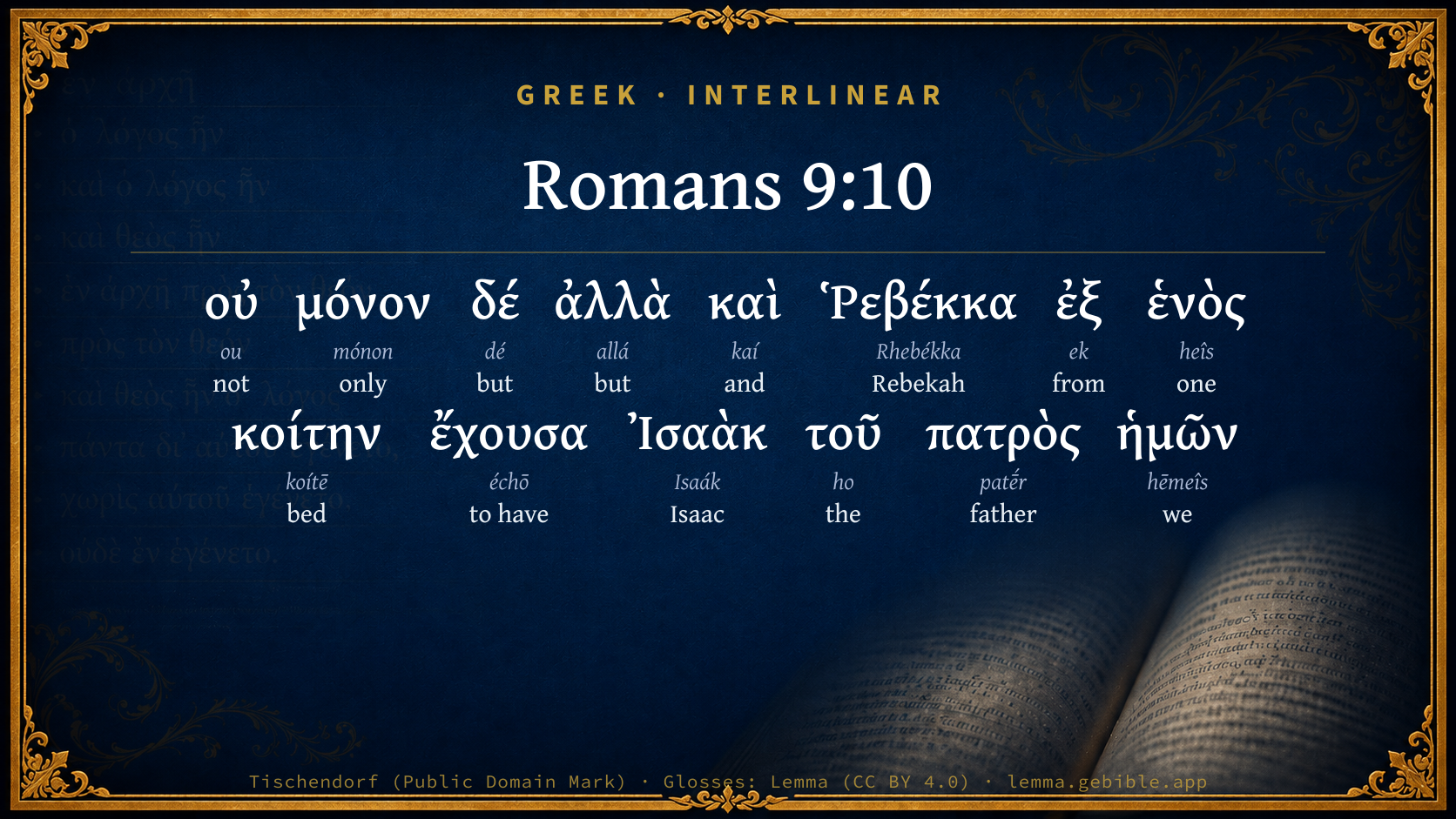
Greek (Tischendorf 8th ed.) Romans 9:10 appears in the Greek New Testament. The text above is from the Tischendorf 8th edition. Each word links to its Strong’s number and a concise gloss. Click any word for its full Thayer’s Greek Lexicon entry.
Download image
Cite this verse

Romans 9:10 (World English Bible). Public Domain. Lemma interlinear Bible study tool, https://lemma.gebible.app/v/romans/9/10.

Show BibTeX & RIS
BibTeX
RIS
English Translation
Not only so, but Rebecca also conceived by one, by our father Isaac.
World English Bible · Public Domain
Highlights
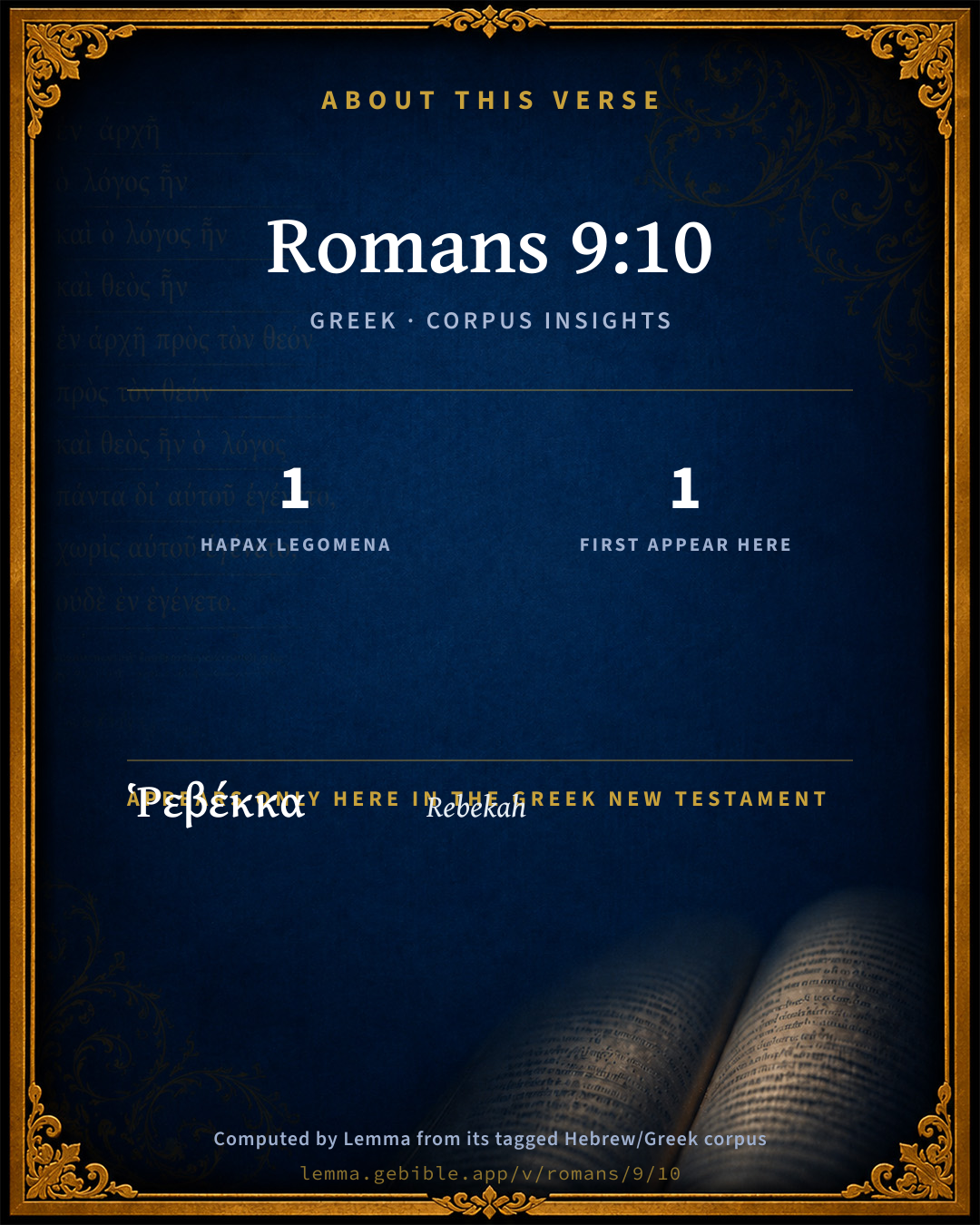
  • 1 hapax legomenon — only here in the Greek New Testament
  • 1 first appearance in the Greek New Testament
Full analysis ↓
Download a study sheet

One document with this verse’s original text, its word-by-word gloss line, the meaning frame, cross-references with their text, attributed commentary, and full source and license credits — printable, and it pastes into notes with its structure intact.

This verse Autodidact and up

Study sheet (.html) Plain text (.txt)

A passage Seminary Student

Up to 50 verses in one chapter. A passage sheet keeps up to 6 commentary sources and 12 cross-references per verse, in the order this page ranks them, and says so on the sheet whenever that leaves anything out. Ask for a single verse and you get the Autodidact verse sheet above.

Everything on this page stays free to read, with no account — the sheet is a download of what is already on screen, not access to it.

Want to remove ads? Support Godless Engineer
Compare translations 3

The same verse in 3 English versions, stacked beneath the original-language interlinear above. Click any original word for its lexicon entry.

Each is an independent rendering of the whole verse — the interlinear is not word-aligned to these translations.

Highlighted words mark where these versions differ — a whole-verse word diff, not a word-by-word alignment.

  • World English Bible Public Domain
    Not only so, but Rebecca also conceived by one, by our father Isaac.
  • King James Version Public Domain
    And not only this; but when Rebecca also had conceived by one, even by our father Isaac;
  • unfoldingWord Literal Text CC BY-SA 4.0
    Now, not only this, but Rebekah also having conceived from one, our father Isaac—

unfoldingWord Literal Text — © unfoldingWord, licensed CC BY-SA 4.0. Word-aligned USFM3 via Door43 (git.door43.org/unfoldingWord/en_ult).

Versions to compare (up to 4)

3 of 4 selected

Show all 18 translations

Every available English version of this verse, each an independent rendering of the whole verse.

  • World English Bible Public Domain
    Not only so, but Rebecca also conceived by one, by our father Isaac.
  • Berean Standard Bible Public Domain
    Not only that, but Rebecca’s children were conceived by one man, our father Isaac.
  • Majority Standard Bible Public Domain
    Not only that, but Rebecca’s children were conceived by one man, our father Isaac.
  • King James Version Public Domain
    And not only this; but when Rebecca also had conceived by one, even by our father Isaac;
  • American Standard Version (1901) Public Domain
    And not only so; but Rebecca also having conceived by one, `even' by our father Isaac--
  • Revised Version (1885) Public Domain
    And not only so; but Rebecca also having conceived by one, even by our father Isaac—
  • Geneva Bible (1599) Public Domain
    Neither he onely felt this, but also Rebecca when shee had conceiued by one, euen by our father Isaac.
  • Young's Literal Translation Public Domain
    And not only `so', but also Rebecca, having conceived by one -- Isaac our father --
  • Literal Standard Version CC BY-SA 4.0
    And not only [so], but also Rebecca, having conceived by one—our father Isaac
  • Unlocked Literal Bible CC BY-SA 4.0
    Not only this, but after Rebekah also had conceived by one man, our father Isaac—
  • unfoldingWord Literal Text CC BY-SA 4.0
    Now, not only this, but Rebekah also having conceived from one, our father Isaac—
  • Darby Bible Public Domain
    And not only [that], but Rebecca having conceived by one, Isaac our father,
  • World Messianic Bible Public Domain
    Not only so, but Rebekah also conceived by one, by our father Isaac.
  • Webster's Bible Public Domain
    And not only this; but when Rebecca also had conceived by one, even by our father Isaac,
  • Free Bible Version CC BY-SA 4.0
    In addition Rebecca's twin sons had the same father, our forefather Isaac.
  • Bible in Basic English Public Domain
    And not only so, but Rebecca being about to have a child by our father Isaac--
  • Text-Critical English NT CC BY 4.0
    Not only that, but when Rebecca had conceived by one man, our father Isaac,
  • Tyndale New Testament (1534) Public Domain
    Nether was it so with her only: but also when Rebecca was with chylde by one I meane by oure father Isaac

Literal Standard Version (2020), Covenant Press — licensed CC BY-SA 4.0. Text via the HelloAO Bible API (eBible.org). Unlocked Literal Bible (unfoldingWord) — licensed CC BY-SA 4.0. Text via the HelloAO Bible API (eBible.org). unfoldingWord Literal Text — © unfoldingWord, licensed CC BY-SA 4.0. Word-aligned USFM3 via Door43 (git.door43.org/unfoldingWord/en_ult). Free Bible Version, Dr. Jonathan Gallagher — licensed CC BY-SA 4.0. Text via the HelloAO Bible API (eBible.org).

Word by word

More ways to search: Search by grammar → Find every occurrence → Compare this word →

Practice this passage: Drill this verse → Learn its vocabulary →

About this verse

These counts appear in no published source. They are computed here, from the morphology-tagged text and Lemma’s own curated glosses. What Lemma adds →

14
words
14
distinct lemmas
Pauline Epistles
section

Notable vocabulary

1 hapax legomenon — a word that appears only here in the entire Greek New Testament:

  • Ῥεβέκκα Rebekah G4479

First appearance in Scripture

This word makes its first canonical appearance in the Greek New Testament here:

  • Ῥεβέκκα Rebekah G4479

Shared distinctive vocabulary

κοίτην bed G2845 occurs in 4 verses of the Greek New Testament. Also found in:
Cross-references

4

Topical passages linked to Romans 9:10 in the Treasury of Scripture Knowledge — connected by theme and wording, ordered by reader-vote popularity; previews shown in the World English Bible.

  • Genesis 25:21–23 Isaac entreated Yahweh for his wife, because she was barren. Yahweh was entreated by him, and Rebekah his wife conceived.
  • Luke 16:26 Besides all this, between us and you there is a great gulf fixed, that those who want to pass from here to you are not able, and that none may cross over from there to us.'
  • Romans 5:3 Not only this, but we also rejoice in our sufferings, knowing that suffering works perseverance;
  • Romans 5:11 Not only so, but we also rejoice in God through our Lord Jesus Christ, through whom we have now received the reconciliation.

Cross-references courtesy of OpenBible.info (CC BY 4.0).

Commentary

Notes on Romans 9:10 from classic Christian and Jewish commentators (each source and its license shown beneath its notes). The classic Christian expositions comment on the surrounding passage and are grouped to its opening verse, so a note may address several verses; the Jewish commentaries on the Tanakh (Rashi and others) are per-verse, so they appear only where the commentator wrote on this verse.

Lemma curates 59 commentaries, every one of them public domain or Creative Commons licensed, each selected and text-cleaned for this edition rather than reprinted as found. About our sources →

The Cambridge Bible for Schools and Colleges

gen. ed. J. J. S. Perowne

10. And not only this] Here a still stronger example of sovereign choice occurs. Isaac and Ishmael had only one parent in common; Jacob and Esau had both. In the former case, the choice of Isaac was declared only after Ishmael’s birth and childhood; in the latter, the choice of Jacob was declared while both brothers were in the womb.—The Greek construction in Rom_9:10-12 is irregular, but perfectly clear.

by one] In contrast to the divided parentage of Abraham’s sons.

our father Isaac] Here named with emphasis, as shewing that even within the inner circle of promise (“In Isaac shall thy seed, &c.,”) there was still an election.

The Cambridge Bible for Schools and Colleges (gen. ed. J. J. S. Perowne; Cambridge University Press, 1878–1918) — public domain. Text from a community e-Sword module.

John Gill's Exposition

For the children being not yet born, So says (h) the Chaldee paraphrast,

"the prophet said unto them, was it not said of Jacob, , "when he was not yet born", that he should be greater than his brother?''

the Syriac version supplies, "his children", that is, Isaac's; and the Arabic version, "his two children". This shows, that the apostle designs not the posterity, but the very persons of Jacob and Esau; since as he speaks of their conception in the verse preceding, so of their birth in this: and though in the words of God to Rebecca, and which are urged in favour of the other sense, it is said, "two nations are in thy womb, and two manner of people shall be separated from thy bowels, and the one people shall be stronger than the other people", Gen 25:23; yet this primarily respects the persons of Jacob and Esau, as the roots of their respective offspring; and only secondarily their posterity, as branches that should sprout from them; it properly regards their persons, and only in an improper, figurative, and metonymical sense, their seed; for in no other sense could two nations, or two manner of people be in Rebecca's womb, than as there were two persons there, who would be the authors of two nations and people; and whatever may be said for their respective posterity, taking their rise from one common father Isaac, or for their being chosen or rejected as nations, before they were in being as such, yet it cannot be said with any propriety, that "Rebecca conceived" their several offspring "by one, even by our father Isaac", Rom 9:10, which sense well agrees with the scope of the apostle, which is to prove, that all were not Israel which were of Israel, and that all Abraham's natural seed were not the children of God; which he could not better exemplify, than in the persons of Jacob and Esau; for to have instanced in the posterity of Esau, would have been foreign to his purpose, and not accord with the continuation of his discourse in the following verses, which entirely proceeds upon the subject of personal election and rejection, and with the scriptural account of the personal characters of Jacob and Esau; and from hence, as from many other passages, it may be concluded, that predestination, whether to life or death, is a personal thing, concerns particular persons, and not nations, or collective bodies of men:

neither having done any good or evil; Jacob and Esau were under all considerations upon an equal foot, were just in the same situation and condition, when the one was loved and the other hated; or in other words, when the one was chosen, and the other rejected; they were neither of them as yet born, and had they been born, their birth and parentage could have been no reason why one was chose and the other not, because in both the same; nor had the one performed a good action, or the other an evil one; so that Jacob was not loved for his good works, nor Esau hated for his evil ones; which confirms the truth of this doctrine, that the objects of predestination, whether to life or death, are alike, are in the same situation and condition: whether they are considered in the corrupt mass, or as fallen, they are all equally such, so that there could not be any reason in them, why some should be chosen and others left; or whether in the pure mass, antecedent to the fall, and without any consideration of it, which is clearly signified in this passage, there could be nothing in the one, which was not in the other, that could be the cause of such a difference made: so that it follows, that works neither good nor evil are the causes moving God to predestinate, whether to life or death; good works are not the cause of election to eternal life, for not only, this act of distinguishing grace, passed before any were done, but also these are fruits, effects, and consequence of it, and so cannot be the causes thereof; God does not proceed in order branches of salvation, as in calling, justification, &c. according to them, and therefore it cannot be thought he should proceed upon this foot in the first step to it; and which is ascribed to his free grace, in opposition to works. Evil works are not the cause of the decree of rejection, for this also being as early as the decree of election, as it must unavoidably be, was before any evil works were done; sin is not the cause of God's decree, but of the thing decreed, eternal death; otherwise all the individuals in the world being equally in sin, must have been rejected: it remains then, that not any works of men, good or bad, are the cause of predestination in either of its branches, but the sovereign will and secret counsel of God: that

the purpose of God according to election might stand: the decree of God, which is entirely free, and depends upon his own will and choice, stands firm and immutable, and is not to be disannulled by earth or hell, for it stands not on the precarious foot of works:

not of works: did it, it would not stand sure, for nothing is more variable and uncertain, than the actions of men:

but of him that calleth: who is the unchangeable Jehovah; it stands upon his invariable will and immutable grace, whose "gifts and calling are without repentance", Rom 11:29.

(h) Targum in Hos. xii. 3.

John Gill's Exposition of the Whole Bible (1746–1763) — public domain (CC PDM 1.0). Text via the HelloAO Bible API.

The Biblical Illustrator

Joseph S. Exell

Rom_9:10-12

And not only this; but when Rebecca also had conceived by … our Father Isaac.

The election of Jacob and the rejection of Esau

1. Not personal, but national.

2. Not to eternal salvation, but to earthly privileges.

3. Not determined by works, but by grace.

4. Not intended to establish the doctrine of unconditional election to eternal life and the predestination of others to eternal damnation, but the unconditional election of the Gentiles to the benefits of the gospel and the national rejection of the Jews. (J. Lyth, D.D.)

Lessons from the case of Esau and Jacob

1. As in Rebeecas womb there was a striving between Esau and Jacob, so in every true Christian there is a combating between corruption and grace; and as Esau is the elder, so is corruption.

2. As in Isaacs family there was a profane Esau as well as a godly Jacob, so is the visible Church a mixed company, as our Saviour teaches by divers parables. Examine how thou standest in the Church, whether as an Esau or as a Jacob.

3. Esau is Isaacs eldest son, yet rejected. Birth, degrees, and blood are to be regarded, and are especial favours of God, yet they further not election. As it was rather a disgrace for Esau to come of virtuous parents, because he was no better, so do thou account of thyself; then is the blood of thy famous ancestors thy credit when thou art like them in virtue. Better the honour of our families should begin than end in us.

4. Esau is disinherited, and yet God gave a law that the firstborn should not be deprived of his birthright, namely, without just and weighty cause. (Elnathan Parr, B.D.)

For the children being not yet born, neither having done any good or evil, that the purpose of God according to election might stand not of works, but of Him that calleth.--

Gods sovereignty

1. He has the indisputable right to determine the conditions of individual life.

2. Exercises the right freely without reference to future conduct.

3. Does not thereby interfere with the possibility of personal salvation, but provides for it. (J. Lyth, D.D.)

Election: how to be regarded

The doctrine ought never to be a stumbling-block in the way of your entertaining the overtures of the gospel. Leave it to God Himself to harmonise those everlasting decrees, by which He hath distinguished between the elect and the reprobate, with His present declarations of goodwill to one and to all of the human family. Your business is to let the decrees alone, and to cast your joyful confidence upon the declarations. Should an earthly monarch send a message of friendship to your door, must you reject it either as unintelligible or unreal because you have not been instructed in all the mysteries of his government? Because you cannot comprehend the policy of his empire, must you therefore not receive the offered kindness which has come from him to your own dwelling-place? And ere you can appreciate the gift which he holds out for your single and specific acceptance, must you first be able to trace all the workings and all the ways of the vast, the varied, superintendence which belongs to him? It is truly so with God, who, although presiding over a management which embraces all worlds and reaches from everlasting to everlasting, has nevertheless sent to each individual amongst us the special intimation of His perfect willingness to admit us into favour; and must we, I ask, suspend our comfort and our confidence therein till we, the occupiers of one of the humblest tenements in creation, and only the creatures but of yesterday--till we shall have mastered the economy of this wondrous universe and scanned the counsels of eternity? (T. Chalmers, D.D.)

The means and end of predestination

Upon the principles of Christian predestination, you are still not less inconsistent; because you go about to separate two things which are inseparably joined together, viz., the end and the means which lead to it; and then you fly to the old threadbare objection of Papists, Quakers, and Arminians--if I am elected, I shall be saved, do what I will; if I am not elected, I must be damned, do what I can. Now, this is the abuse of the doctrine, but by no means the doctrine itself, holiness of heart and life being the middle link of that chain which connects Gods eternal decree with the execution of that decree in the salvation of all His elect. And if you can cast your eyes upon the Christian world in general, you will find that real practical religion is more to be found among those who adopt the Scripture plan of predestination than among those who reject it. But let us have recourse to a familiar illustration of the point in hand. When archbishop Chicheley founded All Souls College, in Oxford, he made a decree that they who in future times were founders kin should succeed to the fellowship of that college, in preference to all others. This decree is inviolable in the choice of the candidates; but I never heard of one that intended offering himself who reasoned after this manner: If I am founders kin, I must succeed, do what I will, or even whether I offer myself or not. No; but they all go about to prove their pedigree and relationship to the founder, and for this purpose they anxiously search the old book entitled Stemmata Chiciliana, and apply themselves diligently to their probation exercises, in order that no requisite may be wanting on their parts. Now, my dear--, produce your pedigree, and learn your exercise, and the thing is done. Take but the same pains (though surely you ought to take more) to prove your relationship to the great Founder of the universe, whose decree is that none shall partake of His spiritual blessings but those who bear a relationship to Him through faith in Jesus Christ; apply yourself to the study of that old book the Bible, from which alone you can trace your descent, and study your exercise as becomes a candidate for a heavenly fellowship with God and glorified spirits. Set about this in earnest, and I will venture my own soul upon the safety of yours; for though I cannot climb up into heaven to read Gods decree, yet I shall be very certain, from that middle link of the chain which is let down upon earth, that it is in your favour. (Sir Richard Hill, M.A., letter to a friend.)

The Divine call

The word calleth, when applied to moral agents, assumes the possession of free will. They are called, not compelled or necessitated. According to the nature of the case, a call may assume the form either of a summons or an invitation. It may sometimes be allied to a commandment, sometimes to an entreaty. In the case before us, where reference is to prerogative, which in its inner ethical content may be either welcomed and prized, or spurned and stamped under foot, the call may be essentially of the nature of a Divine invitation. Some of Gods greatest blessings He simply provides and confers without sending forth an invitation. To the enjoyment of others, He gives invitation, and, as it were, says, Ho, every one! come ye. Some such invitation is addressed to persons, some such to peoples. And in both cases invitation may pave the way for further and ulterior invitation. They who have, in the sense of accepting what has been proffered, and of keeping and prizing what they have got, to them shall be given, and they shall have more abundantly. Invitation to them will follow invitation, till the highest blessing is reached; and they find in their delightful experience that blessed are they who are Gods invited guests to the everlasting banquet of bliss. To all the highest blessings there is a Divine call or invitation For whom He did foreknow … them He also glorifies (Rom_8:29-30). (J. Morison, D.D.)

The Biblical Illustrator, edited by Joseph S. Exell (c. 1880s–1900s) — public domain. Text from a community e-Sword module.

Tyndale Open Study Notes

Tyndale Open Resources

9:10-11 she gave birth to twins: No human circumstances differentiated Isaac’s sons, Jacob and Esau. Not only were they born to the same mother, but they were also conceived at the same time. Instead, Paul argues, the difference between them was of God’s choosing.

Tyndale Open Study Notes — © Tyndale Open Resources, licensed CC BY-SA 4.0. Text via the HelloAO Bible API.

Bengel's Gnomon

Johann Albrecht Bengel

Rom 9:10. Οὐ μόνον δὲ, and not only so) That is: it is wonderful, what I have said; what follows is still more wonderful. Ishmael under Abraham, Esau under Isaac, and those, who resembled Ishmael and Esau under Israel, rebelled.—Ῥεβέκκα, Rebecca) viz., ἐστὶν, is, i.e. occurs in this place. She, the mother, and presently after Isaac the father, are named.—ἐξ ἑνὸς, by one) Isaac was now separated from Ishmael, and yet under Isaac himself, in whom Abraham’s seed is called, Esau also is separated from Jacob. Ishmael and Isaac were born not of the same mother, nor at the same time,—and Ishmael was the son too of a bondmaid, Isaac of a free woman. Jacob and Esau were born both of the same mother, and she a free woman, and at the same time.—κοίτην) so LXX. for שכבה; it often occurs, e.g. Lev 18:20, οὐ δώσεις κοίτην σπέρματος, said of the man, which is opposed to the phrase ἔχειν κοίτην, of the woman in this passage.

Bengel's Gnomon of the New Testament — English translation (T&T Clark, Edinburgh, 1860) — public domain. Text from a community e-Sword module.

Meyer's Critical & Exegetical Commentary

Heinrich August Wilhelm Meyer

Rom_9:10. A fresh and still more decisive proof (for it might be objected that, of Abrahams children, Sarahs son only was legitimate) that only the divine disposal constituted the succession to Abraham which was true and valid in the sight of God. Comp. Barnab. 13. The more definite notion of promise, which was retained in the preceding, is here expanded into the more general one of the appointment of the divine will as made known.

οὐ μόνον δέ] See generally on Rom_5:3. What is supplied must be something that is gathered from the preceding, that fits the nominative Ῥεβέκκα, and that answers as regards sense to the following ἐῤῥέθη αὐτῇ. Hence, because τῇ Σάῤῥᾳ precedes, and with ἀλλὰ καί another mothers name is introduced, we must supply, as subject, not Abraham (Augustine, Beza, Calvin, Reithmayr, van Hengel; comp. also Hofmann, who however thinks any completing supplement useless), but Σάῤῥα; and moreover, not indeed the definite λόγον ἐπαγγελίας εἶχεν or ἐπηγγελμένη ἦν (Vatablus, Fritzsche, Winer, Krehl, Baumgarten-Crusius), but the more general λόγον or ῥῆμα Θεοῦ εἶχεν, which is suitable to the subsequent ἐῤῥέθη, as well as to the contents of the sayings adduced in Rom_9:12-13 : But not only had Sarah a saying of God, but also Rebecca, etc. We must therefore throw aside the manifold arbitrary supplements suggested, some of which are inconsistent with the construction, not suiting the nominative Ῥεβ., as e.g.: non solum id, quod jam diximus, documentum est ejus, quod inferre volumus; Rebecca idem nos docet (so Grotius, also Seb. Schmid, Semler, Ch. Schmid, Cramer, Rosenmüller, and several others; comp. Tholuck and Philippi); or: τοῦτο ἦν (Rückert, de Wette), so that the nominative Ῥεβ. forms an anacoluthon, and the period begun enters with Rom_9:11 upon quite another form (how forced, seeing that Rom_9:11-12 in themselves stand in perfectly regular construction!). It is only the semblance of an objection against our view, that not Sarah, but Abraham, received the word of promise, Rom_9:9; for Sarah was, by the nature of the case, and also according to the representation of Genesis, the co-recipient of the promise, and was mixed up in the conversation of God with Abraham in reference to it (Gen_18:13-15); so that Paul, without incurring the charge of contradicting history, might have no scruple in stating the contrast as between the mothers, as he has done.

ἐξ ἑνὸς κοίτην ἔχουσα] Who had cohabitation of one (man), the effect of which was the conception of the twin children. The contextual importance of this addition does not consist in its denying that there was a breach of conjugal fidelity, but in its making palpably apparent the invalidityfor the history of salvationof bodily descent. She was pregnant by one man, and yet how different was the divine determination with respect to the two children!

ἐξ ἑνός] masculine, without anything being supplied; for Ἰς. τ. π. ἡμ. is in apposition. κοίτη, couch, bed, often marriage bed (Heb_13:4), is found seldom in the classical writers (Eur. Med. 151, Hippol. 154; not Anacr. 23, see Valck. Schol. II. p. 594), with whom εὐνή and λέχος often have the same sense, euphemistically used as equivalent to concubitus, but frequently in the LXX. See Schleusner, Thes. III. p. 347. Comp. Wis_3:13; Wis_3:16.

τοῦ πατρ. ἡμ.] from the Jewish consciousness; for the discourse has primarily to do with the Jews. Comp. Rom_4:1. If Isaac were to be designated as the father of Christians (Reiche, Fritzsche), the context must have necessarily and definitely indicated this, since believers are Abrahams (spiritual) children. We may add that Ἰς. τοῦ πατρ. ἡμῶν is not without a significant bearing on the argument, inasmuch as it contributes to make us feel the independence of the determination of the divine will on the theocratic descent, however legitimate.

Meyer — Critical and Exegetical Commentary on the New Testament — English translation by Peter Christie, edited by Frederick Crombie (T&T Clark, 1880) — public domain. Text from a community e-Sword module.

Expositor's Greek Testament

ed. W. Robertson Nicoll

Rom 9:10 ff. But the argument can be made more decisive. A Jewish opponent might say, “Ishmael was an illegitimate child, who naturally had no rights as against Isaac; we are the legitimate descendants of the patriarch, and our right to the inheritance is indefeasible”. To this the Apostle replies in Rom 9:10-13 . Not only did God make the distinction already referred to, but in the case of Isaac’s children, where there seemed no ground for making any distinction whatever, He distinguished again, and said, The elder shall serve the younger. Jacob and Esau had one father, one mother, and were twin sons; the only ground on which either could have been preferred was that of priority of birth, and this was disregarded by God; Esau, the elder, was rejected, and Jacob, the younger, was made heir of the promises. Further, this was done by God of His sovereign freedom: the decisive word was spoken to their mother while they were as yet unborn and had achieved neither good nor evil. Claims as of right, therefore, made against God, are futile, whether they are based on descent or on works. There is no way in which they can be established; and, as we have just seen, God acts in entire disregard of them. God’s purpose to save men, and make them heirs of His kingdom a purpose which is characterised as κατʼ ἐκλογήν , or involving a choice is not determined at all by consideration of such claims as the Jews put forward. In forming it, and carrying it out, God acts with perfect freedom. In the case in question His action in regard to Jacob and Esau agrees with His word in the prophet Malachi: Jacob I loved but Esau I hated; and further than this we cannot go. To avoid misapprehending this, however, it is necessary to keep the Apostle’s purpose in view. He wishes to show that God’s promise has not broken down, though many of the children of Abraham have no part in its fulfilment in Christ. He does so by showing that there has always been a distinction, among the descendants of the patriarchs, between those who have merely the natural connection to boast of, and those who are the Israel of God; and, as against Jewish pretensions, he shows at the same time that this distinction can be traced to nothing but God’s sovereignty. It is not of works, but of Him Who effectually calls men. We may say, if we please, that sovereignty in this sense is “just a name for what is unrevealed of God” (T. Erskine, The Brazen Serpent , p. 259), but though it is unrevealed we must not conceive of it as arbitrary i.e. , as non-rational or non-moral. It is the sovereignty of God , and God is not exlex ; He is a law to Himself a law all love and holiness and truth in all His purposes towards men. So Calvin: “ubi mentionem gloriæ Dei audis, illic justitiam cogita”. Paul has mentioned in an earlier chapter, among the notes of true religion, the exclusion of boasting (Rom 3:27 ); and in substance that is the argument he is using here. No Jewish birth, no legal works, can give a man a claim which God is bound to honour; and no man urging such claims can say that God’s word has become of no effect though his claims are disallowed, and he gets no part in the inheritance of God’s people.

οὐ μόνον δέ : cf. Rom 5:11 , Rom 8:23 = Not only is this so, but a more striking and convincing illustration can be given. ἀλλὰ καὶ Ῥεβέκκα : the sentence thus begun is never finished, but the sense is continued in Rom 9:12 . Ἰσαὰκ τοῦ πατρὸς ἡμῶν : Paul speaks here out of his own consciousness as a Jew, addressing himself to a problem which greatly exercised other Jews; and calls Isaac “father” as the person from whom the inheritance was to come.

The Expositor's Greek Testament, edited by W. Robertson Nicoll (1897–1910) — public domain. Text from a community e-Sword module.

Hodge's Commentary on Romans, Ephesians & First Corinthians

Charles Hodge

Rom_9:10

And not only (this); but when Rebecca had conceived by one, (even) by our father Isaac. Not only does the case of Isaac and Ishmael prove that the choice of God does not depend on natural descent, but on the sovereign will of God, but that of Rebecca evinces the same truth still more clearly. In the former case, it might be supposed that Isaac was chosen because he was the son of Sarah, a free woman, and the legitimate wife of Abraham, whereas Ishmael was the son of a maid-servant. In the choice between Jacob and Esau, there is no room for any such supposition. They had the same father, the same mother, and were born at one birth. Here, assuredly, the choice was sovereign. The original is here elliptical, something must be supplied to complete the sense. On the principle that an ellipsis should, if possible, be supplied from the immediate context, winner, Meyer, and others, supply the ellipsis thus: Not only did Sarah receive a promise of a son, but Rebecca also. In this view the construction of the passage is regular; otherwise, an irregularity, or change of grammatical construction, must be assumed in Rom_9:12. Not only Rebecca it was said to her. To this however, it is objected, first, that the promise was not made to Sarah, but to Abraham; and secondly, that no promise was made to Rebecca. Others, therefore, prefer supplying simply, did this happen. That is, not only was Isaac chosen instead of Ishmael, although both were the sons of Abraham, but also Rebecca Then we must either assume a grammatical irregularity, or the nominative (Rebecca) must be taken absolutely; or we can supply some such phrase as, Rebecca also proves this, i.e. the sovereignty of God in election. These questions do not affect the sense of the passage. The apostle proceeds with his historical proof that God, according to his own good pleasure, does choose one and reject another. He has therefore the right to cast off the Jews.

Charles Hodge — Commentary on Romans (1835), First Corinthians (1857), and Ephesians (1856) — public domain. Text from a community e-Sword module.

Geneva Bible (1599)

Geneva Bible translators

Another forcible proof, taken from the example of Esau and Jacob, which were both born of the same Isaac, which was the son of promise, of one mother, and at one birth, and not at divers as Ishmael and Isaac were: and yet notwithstanding, Esau being cast off, only Jacob was chosen: and that before their birth, that neither any goodness of Jacob’s might be thought to be the cause of his election, neither any wickedness of Esau, of his casting away.

Geneva Bible (1599) marginal notes — public domain. Text via Bolls.life.

Jamieson, Fausset & Brown

Robert Jamieson, A. R. Fausset & David Brown

And not only this; but when Rebecca, &c.--It might be thought that there was a natural reason for preferring the child of Sarah, as being Abraham's true and first wife, both to the child of Hagar, Sarah's maid, and to the children of Keturah, his second wife. But there could be no such reason in the case of Rebecca, Isaac's only wife; for the choice of her son Jacob was the choice of one of two sons by the same mother and of the younger in preference to the elder, and before either of them was born, and consequently before either had done good or evil to be a ground of preference: and all to show that the sole ground of distinction lay in the unconditional choice of God--"not of works, but of Him that calleth."

Jamieson, Fausset & Brown — Commentary Critical and Explanatory on the Whole Bible (1871) — public domain (CC PDM 1.0). Text via the HelloAO Bible API.

Adam Clarke's Commentary

Verse 10. And not only this] A Jew might object: "Ishmael was rejected, not by the sovereign will of God, but because he was the son of the handmaid, or bond-woman, and therefore unworthy to be the peculiar seed; but observe, this was not the only limitation of the seed of Abraham with regard to inheriting the promise, for when Rebecca was with child by that one person of Abraham's issue to whom the promise was made, namely, our father Isaac, she went to inquire of the Lord, Ge 25:22, Ge 25:23 : And the Lord said unto her, Two nations are in thy womb, and two manner of PEOPLE shall be separated from thy bowels; and the one PEOPLE shall be stronger than the other PEOPLE; and the elder shall serve the younger. That is, the posterity of the younger shall be a nation much more prosperous and happy than the posterity of the elder.

Adam Clarke's Commentary on the Bible (1810–1826) — public domain. Text from a community e-Sword/MySword module.

John Calvin's Commentaries

10. And not only, etc. There are in this chapter some broken sentences, such as this is, — But Rebecca also, who had conceived by one, our father Isaac; for he leaves off in the middle, before he comes to the principal verb. The meaning, however, is, that the difference as to the possession of the promise may not only be seen in the children of Abraham, but that there is a much more evident example in Jacob and Esau: for in the former instance some might allege that their condition was unequal, the one being the son of an handmaid; but these were of the same mother, and were even twins: yet one was rejected, and the other was chosen by the Lord. It is hence clear, that the fulfilment of the promise does not take place in all the children of the flesh indiscriminately.

And as Paul refers to the persons to whom God made known his purpose, I prefer to regard a masculine pronoun to be understood, rather than a neuter, as Erasmus has done: for the meaning is, that God’s special election had not been revealed only to Abraham, but also to Rebecca, when she brought forth her twins.

John Calvin's Commentaries (1540-1563) — public domain. Text from the Calvin Translation Society English edition (1840s-50s) via the Christian Classics Ethereal Library (ccel.org). Calvin's coverage is partial (roughly two-thirds of the Bible); uncommented books and verses are honest gaps, never fabricated. The 19th-century editor's footnotes and remarks are omitted so the notes are faithfully Calvin's own voice.

Ellicott's Commentary for English Readers

(10, 11) Nor was the restriction and special selection confined to the case of Abraham alone. It also appeared when Rebecca bore sons to Isaac. It was indeed pure selection. The children themselves had done nothing to make a preference be given to one over the other. There was no merit in the case. The object of the declaration was to ratify the divine electing purpose which had already chosen Jacob to be the inheritor of the Messianic blessings.

Here we have the doctrine of election and predestination stated in a very unqualified and uncompromising form. And it does indeed necessarily follow from one train of thought. However much we lay stress on freewill, still actions are the result of character—the will itself is a part of character; and character is born in us. Of the two elements which go to determine action, outward circumstances, and inward disposition, neither can be said strictly to be made by the man himself. If we follow this train of thought, then it would certainly appear that God, or the chain of natural causes set in motion and directed by God, made him what he is. In other words, he is elected and predetermined to a certain line of conduct. This is the logic of one set of inferences. On the other hand, the logic of the other set of inferences is just as strong—that man is free. There is an opposition irreconcilable to us with our present means of judging. We can only take the one proposition as qualified by the other.

A Bible Commentary for English Readers, edited by Charles John Ellicott (1878–1897) — public domain. Text from a community e-Sword module.

Trapp's Complete Commentary

John Trapp

10 And not only this; but when Rebecca also had conceived by one, even by our father Isaac;

Ver. 10. But when Rebecca] She, and not Isaac, is named, because she received the oracle, whether from the mouth of Melchisedec or some other way, I have not to determine.

John Trapp, A Commentary or Exposition upon All the Books of the Old and New Testament (1647–1656) — public domain. Text from a community e-Sword module.

Albert Barnes' Notes on the Bible

And not only this - Not only is the principle of making a distinction among the natural descendants of Abraham thus settled by the promise, but it is still further seen and illustrated in the birth of the two sons of Isaac. He had shown that the principle of thus making a distinction among the posterity of Abraham was recognised in the original promise, thus proving that all the descendants of Abraham were not of course to be saved; and he now proceeds to show that the principle was recognised in the case of his posterity in the family of Isaac. And he shows that it is not according to any natural principles that the selection was made; that he not only made a distinction between Jacob and Esau, but that he did it according to his good pleasure, choosing the younger to be the object of his favor, and rejecting the older, who, according to the custom of the times, was supposed to be entitled to special honor and rights. And in order to prove that this was done according to his own pleasure, he shows that the distinction was made before they were born; before they had formed any character; and, consequently, in such a way that it could not be pretended that it was in consequence of any works which they had performed.

But when Rebecca - The wife of Isaac; see Gen 25:21, Gen 25:23.

Albert Barnes' Notes on the Bible (1834–1885) — public domain. Text from a community e-Sword/MySword module.

Haydock's Catholic Bible Commentary

and not only she (Sara) brought forth Isaac, who was the only child of Abraham, to whom the promises descended, though he was the father of Ismael, by Agar, and of all the Ismaelites. And lest the Jews should say that the Ismaelites, though descending from Abraham, according to the flesh, were not to be reputed as his children for another reason, because they came of Agar, who was only the handmaid of Sara; he brings them another example to which they could make no such reply; to wit, that Rebecca also at once had two sons of Isaac, Esau and Jacob; where, though Esau was the first-born, these promises were not reputed as made to him, and his descendants, the Idumeans, who were equally the descendants of Isaac, yet not the favourite people, nor the children of God, as the Jews saw very well. (Witham) --- Not yet born. By this example of these twins, and the preference of the younger to the elder, the drift of the apostle is, to shew that God, in his election, mercy, and grace, is not tied to any particular nation, as the Jews imagined, nor to any prerogative of birth, or any foregoing merits. For as, antecedently, to his grace, he sees no merit in any, but finds all involved in sin, in the common mass of condemnation; and all children of wrath; there is not one whom he might not justly leave in that mass; so that whomsoever he delivers from it, he delivers in his mercy: and whomsoever he leaves in it, he leaves in his justice. As when, of two equally criminal, the king is pleased out of pure mercy to pardon one, whilst he suffers justice to take place in the execution of the other. (Challoner) --- Nor had done any good or evil. God was pleased to prefer, and promise his blessings to the younger of them, Jacob, declaring that the elder shall serve the younger; that is, that the seed of the elder should be subject to that of the younger, as it happened afterwards to the Idumeans. And the prophet, Malachias, said of them, I have loved Jacob, but hated Esau, and turned his mountains into a desert, &c. --- That the purpose of God, his will, and his decree, (see the foregoing chap. ver. 28.) might stand according to election, might be, not according to any works they had done, or that he foresaw they would do, but merely according to his mercy. And though the preference which God gave to Jacob was literally true, as to temporal benefits; yet St. Augustine observes in divers places, that Jacob was a figure of the elect or predestinate, and Esau of the reprobate; and that as Jacob and his posterity was more favoured, purely by the mercy of God, without any merits on their side; so are God’s elect, whom he has called, and to whom, according to his eternal purpose, he decreed to give eternal glory, and special graces to bring them thither. (Witham)

George Leo Haydock (1774–1849), Haydock's Catholic Family Bible and Commentary, 1859 edition — public domain. Excludes Psalms (Douay-Rheims chapter numbering differs from Protestant) and Deuterocanonical books (Catholic canon only).

Matthew Poole's English Annotations

And not only this; some read it, And not only she; the particle this is not in the Greek.

When Rebecca also had conceived by one, even by our father Isaac: this instance is added, because there might be some objection against the former; as if there were some reason why God chose Isaac, and refused Ishmael. Isaac was born of a free-woman, and when Abraham was uncircumcised: besides, Ishmael no sooner came to years, but he showed some tokens of perverseness, and of a wicked spirit. Therefore, in this and the three following verses, he gives another, which was beyond all exception; and that is in Esau and Jacob, betwixt whom there was no disparity, either in birth or in works: they had both one and the same mother; Rebecca conceived with them at one and the same time, and that by no other person than our father Isaac; and yet the one of these is chosen, and the other refused. Tills now was an undeniable proof, that the promise belongs not to all the children of Abraham, or of Isaac, according to the flesh; all the seed of neither are the children of the promise.

Matthew Poole's English Annotations on the Holy Bible (1683–1685) — public domain. Text from a community e-Sword/MySword module.

Whedon's Commentary on the Bible

Daniel D. Whedon

10. Not only this—The Jewish advocate for regeneration by lineal blood and merit-works will, against the above argument of Paul’s, affirm that the discrimination in favour of Isaac was made against Ishmael, because the latter was, by his mother, born of Egyptian blood, and was also cast out for his evil work in abusing pure-blooded Isaac, (Gen_21:9.) The apostle now proceeds to put a more decisive case.

Why was Jacob preferred above Esau? Not because of purer blood, for they were both born of the same pure-blooded parents; nay, as twins, by the same generative act. It was not because of merit-works, for the preference was announced before their birth. It was not from primogeniture, for Esau was the elder of the two. And the argument thus far, if it does not prove the election to have been in view of faith, proves that it could have been from no other known reason. As between the two alternatives, faith and works, held up in all these parts of this epistle, it could not have been for the latter, and so must have been for the former. Jacob and Esau are opposite members in the two great Lines, above given, of Faith versus Unbelief.

But why not for works foreseen? Because works, (in the Jew’s sense merit-works,) imposing upon God obligation for compensation, could impose no obligation before performance. (See note on Rom_3:27.) To him that worketh the reward is of debt: but the debt exists not until the work is done. The future works could not even impose obligation on God to bring the possible worker into existence. And as this precludes merit-work, so it does not preclude faith, which intrinsically claims no merit, but is in itself a trust of all to God. (See note on Rom_3:24.) Alford says that those “making our faith, as foreseen by God, the cause of our election, affirm it to be of works.” This solidly and stolidly contradicts the entire doctrine of Paul; for his whole doctrine is that faith-justification is opposed to work-justification. And if present justification by faith is not by works and is non-meritorious, then foreseen justification by faith is not by works and non-meritorious. In excluding the works of the unborn, the apostle does not exclude the foreseen faith of the unborn; and 30-33 demonstrates that he truly implies and means it.

10. So then—In more modern style this verse might be thus worded: So then the showing of mercy is not of him that willeth or of him that runneth, but of God. On which note, 1. The showing mercy includes not only the particular act of mercy-showing, but the establishing the underlying rule, condition, or law of mercy-showing; 2. Commentators on both sides seem to us to have overlooked the fact that the him that willeth and him that runneth signify not the suppliant or candidate before Jehovah for his mercy, but an intermediate third person (like Moses) between Jehovah and the suppliant. Moses willed, and Moses eagerly ran to Jehovah, to induce him to waver. So Paul’s Jew is pleading and cavilling and menacing in behalf of God’s favour to Jewish unbelief. But divine wisdom will admit no foolish interferers. It will maintain the invariable laws of a just free-agency.

Daniel D. Whedon (gen. ed.), Commentary on the Old and New Testaments (1874–1909) — public domain. Text from a community e-Sword module.

The Pulpit Commentary

But not only this; but Rebecca also, when she had conceived by one, even by Isaac our father. The sentence thus begun is not formally completed, being taken up after the parenthetical ver. 11 by "It was said unto her" in ver. 12.

The Pulpit Commentary (1880–1919), ed. H.D.M. Spence-Jones & Joseph S. Exell — public domain. Text from a community e-Sword module.

John Wesley's Explanatory Notes

And that God's blessing does not belong to all the descendants of Abraham, appears not only by this instance, but by that of Esau and Jacob, who was chosen to inherit the blessing, before either of them had done good or evil. The apostle mentions this to show, that neither were their ancestors accepted through any merit of their own. That the purpose of God according to election might stand - Whose purpose was, to elect or choose the promised seed. Not of works - Not for any preceding merit in him he chose. But of him that called - Of his own good pleasure who called to that privilege whom he saw good.

John Wesley, Explanatory Notes Upon the Whole Bible (1754–1765) — public domain. Text via the GEBible commentary corpus.

Kretzmann's Popular Commentary

Paul E. Kretzmann

An additional example of rejection:

v. 10. And not only this; but when Rebecca also had conceived by one, even by our father Isaac,

v. 11. (for the children being not yet born, neither having done any good or evil, that the purpose of God according to election might stand, not of works, but of Him that calleth,)

v. 12. it was said unto her, the elder shall serve the younger.

v. 13. As it is written, Jacob have I loved, but Esau have I hated.

To give additional corroboration to his statements! Paul introduces another example from the history of the patriarchs: But not only this. The instance just cited is not the only one; Rebecca also furnishes evidence for the point in question. "In the former case it might be supposed that Isaac was chosen because he was the son of Sarah, a free woman, and the legitimate wife of Abraham, whereas Ishmael was the son of a maidservant. " (Hodge.) But here such a supposition would not hold. For Jacob and Esau had one father, one mother, and were twin sons, children of the same conception and birth. There was, therefore, only one point, humanly speaking, in which a preference might be shown, and that was by reason of the right of the firstborn. But this very factor was disregarded by God when it was said to Rebecca: The greater, the older, shall serve the smaller, the younger, Gen 25:21-26. By the will of God and through His power Jacob, the younger, representing the Jewish nation, received the promise of God, became the bearer of the Messianic prophecy, while Esau, the older, representing the Edomites, was not a member of the chosen people of God. This general statement regarding the preference of God and His deliberate choice is explained and placed into its relation to the argument of the apostle by three modifying clauses. The first is: For although they were not yet born, neither had done anything good or bad. This is for the information of people that were not acquainted with the situation and might therefore think that the decree of God was determined by the actions of the two sons. God in no way considered the natural condition or conduct of Esau and Jacob. The second explanation is: That the decree of God according to choice might remain. God had said to Rebecca that the older would serve the younger, in order that the purpose of God according to election might stand, be fulfilled and realized. God had firmly determined to accept Jacob’s offspring as His people and to reveal to them His judgments and testimonies, according to which the Savior of the world should issue from Jacob. This was a selection, or choice; God chose the younger son of Rebecca for His purpose. Jacob, not Esau, was to be the progenitor of the people of God, was to transmit the promise of the inheritance, was to be the forefather of the Redeemer Himself. The third modifying clause is: Not of works, but of Him that called. The statement of God to Rebecca was not made on the basis of works, not in consideration of a future better conduct of the younger son, but solely by reason of Him that called, because God, in His sovereign freedom, chose to make Jacob the bearer of the promise; by His words to the mother, God installed Jacob in his office as patriarch. And the call of Jacob was the consequence, the realization, of the selection of God.

The truth thus brought out is further confirmed by a passage from the Old Testament Scriptures: Jacob have I loved, but Esau have I hated, Mal 1:2-3. The special distinction which was conferred upon Jacob according to the sovereign will of God was denied to Esau. Scripture here speaks in accord with a man’s manner of judging the situation; in the case of men such treatment as is here described would be the effect of love and hatred; with God it is the manifestation of gracious love in the one case and the withholding of the same in the other. God bestowed upon Jacob and his descendants the prerogative of His revelation and of His presence, according to which He accepted the Jews as His people and entrusted to them His Word and promise. The entire passage, therefore, does not refer to the election of grace unto salvation, but only to the relative position of the Israelites and the Edomites over against the history of salvation. Ishmael as well as Esau may very well have been saved; there is no passage in Scriptures which compels us to assume their final condemnation. But the general trend of Paul’s argument stands and is confirmed by this historical reference. Esau, being excluded from the inheritance of the promise, offers evidence of the fact that not all Israelites that are descendants of Abraham are Israelites in the true sense of the word. And even as Jacob was chosen by God for his prominent position in the history of salvation without any merit or worthiness in himself, so the spiritual children of God, the believers, are chosen from the midst of redeemed humanity by the merciful election of God.

Paul E. Kretzmann, Popular Commentary of the Bible (1921–1924) — public domain. Text from a community e-Sword module.

Burkitt's Expository Notes on the New Testament

William Burkitt

Our apostle having in the foregoing verses proved, from what was done in Abraham’s family, that it was the purpose and pleasure of God to account only those for Abraham’s seed who were the children of his faith, and to reject the rest for their unbelief; in these verses he prosecutes the same argument, by insisting upon another special dispensation of God in the family of Isaac, whose wife Rebecca had twins, namely Jacob and Esau, and had neither of them anything in them to move God to love the one and dislike the other: yet a preference was given to the one before the other.

So that the apostle’s argument runs thus: "As Jacob and Esau were begotten of the same father, born of the same mother, laid together in the same womb, and had neither of them done anything at all to oblige or disoblige Almighty God; yet he was pleased to make a difference between them and their posterity after them, giving the beloved Canaan to Jacob and his seed, which by birth-right belonged to Esau and his offspring: so in like manner is it the will and pleasure of God, that the believing Gentiles should become heirs of the promise by faith in Christ, and that the unbelieving Jews should be rejected and cast off for their infidelity."

Learn hence, 1. That Almighty God chooses persons to the participation of divine favours.

Learn, 2. That the choice which God makes of men to the enjoyment of that special favour of being his peculiar people is not according to their external privileges or works, but according to his own free pleasures.

Learn, 3. That as Jacob’s and Esau’s being unborn, and having done neither good nor evil, is used as an argument to prove, that the choice of the one before the other could not be of works; so it is a strong argument against the preexistence of souls, and their being sent into bodies by way of punishment for former sins. For upon that supposition it could not be true, that the children had done neither good nor evil before they were born, seeing they might both have sinned in that state of pre-existence.

Learn, 4, and observe, That the apostle doth not say, That before the children had done either good or evil, God said, Jacob have I loved, and Esau have I hated: but only the elder shall serve the younger.

Hatred here may be taken two ways, either,

1. For a less degree of love; God preferring the seed of Jacob before the posterity of Essau, giving the former the good land of Canaan, to the latter the barren mountains of Seir.

Or, 2. If hatred be taken in the strictest sense, the God is said to hate Esau, that is, the Edomites, after their wicked and unnatural behaviour towards their brethren the Israelites; and upon that occaion see For thy violence against thy brother, Jacob, shame shall cover thee, and thou shalt be cut off for ever Oba 1:10.

Nothing renders a person the object of God’s hatred but sin; he doth not hate the devil himself, as he is his creature, but only as he is a sinner. God adjudges none to eternal perdition, but with respect to sin.

Observe, 5. That Jacob and Esau are not here to be considered personally, but collectively; for the Israel that descended from Jacob, and for the Edomites which sprang from Esau: for Esau in his own person did not serve Jacob, but the Edomites did which sprang from Esau: for Esau in his own person did not serve Jacob, but the Edomites did serve the Israelites. Thus the elder did serve the younger.

Again, it appears that Job and all his friends were of the posterity of Esau: God did not then hate the person of all the posterity of Esau, but only those of them who by their violence and wickedness rendered themselves the object of his hatred.

William Burkitt's Expository Notes on the New Testament (1700–1703) — public domain. Text from a community e-Sword module.

McGarvey & Pendleton's Commentaries

J. W. McGarvey

And not only so [Not only is Ishmael rejected for the promised Isaac, but even Isaac's seed, his two sons Esau and Jacob, are made the subject of choice by God, showing that even the seed of the children of promise may be so sifted that part may be received and part rejected, for God indeed did this, accepting Jacob and rejecting Esau]; but Rebecca also having conceived by one, even by our father Isaac [Now, it might be objected by the Jew (unjustly in view of the fact that four of the tribes of Israel were descended from bondwomen) that his case was not parallel to that of Ishmael, for Ishmael was the son of a bondwoman (an Egyptian), and was of a mocking, spiteful disposition ( Gen_21:9 ). Ishmael's rejection, therefore, was justifiable, while the exclusion of the Jew by Paul's so-called gospel was utterly unwarranted. To this Paul makes answer by citing the cases of Jacob and Esau. They had one father, Isaac the child of promise; and one mother, Rebecca the well beloved, approved of God; they were begotten at one conception, and were twins of one birth, yet God exercised his right to choose between them, and no Jew had ever questioned this, his right of choice. Yea, the unbounded freedom of choice was even more clearly manifest in other details which Paul enumerates]--

J. W. McGarvey (with Philip Y. Pendleton), Commentaries on the New Testament (The Fourfold Gospel, 1914; Acts; and the epistles) — public domain. Text from a community e-Sword/MySword module.

The People's New Testament

B. W. Johnson

10–13. And not only this. The first argument is that the true seed are children of the promise, a spiritual seed rather than of the flesh. The second argument, now begun, is that God has the right to reject what nation he will, including the Jews, and to choose other races if he will. This is shown by facts from history. He did exercise the right of choice when he chose Jacob as the chosen nation, instead of Esau. The facts are recited to show this.

B. W. Johnson's The People's New Testament with Notes (1889–1891) — public domain. Electronic text from the Christian Classics Ethereal Library (CCEL) ThML edition.

unfoldingWord translationNotes

Door43 World Missions Community

our father Isaac ... It is just

In your culture you may need to place Rom 9:11 after Rom 9:12 to make them easier to understand. AT: "our father Isaac, it was said to her, 'The older will serve the younger.' Now the children were not yet born ... because of him who calls. It is just"

our father

Paul refers to Isaac as "our father" because Isaac was the ancestor of Paul and of the Jewish believers in Rome. (See: Inclusive "We")

had conceived

"had become pregnant"

for the children were not yet born and had not yet done anything good or bad

"before the children were born and before they had done anything, whether good or bad"

so that the purpose of God according to choice might stand

"so that what God wants to happen according to His choice will happen"

for the children were not yet born

"before the children were born"

had not yet done anything good or bad

"not because of anything they had done"

because of him

because of God

it was said to her, "The older will serve the younger."

"God said to Rebecca, 'The older son will serve the younger son'"

Jacob I loved, but Esau I hated

The word "hated" is an exaggeration. God loved Jacob much more than he loved Esau. He did not literally hate Esau. (See: Hyperbole and Generalization)

translationWords

Rebekah

ancestor

good

call

Jacob

Esau

unfoldingWord translationNotes — © Distant Shores Media and the Door43 World Missions Community, licensed CC BY-SA 4.0. Source: git.door43.org/Door43/en_tn.

Cambridge Greek Testament for Schools and Colleges

10. οὐ μόνον δέ, κ.τ.λ. The same principle is seen in the selection of one of two sons, born at one birth of one father and mother, even before birth or any act on their part.

Cambridge Greek Testament for Schools and Colleges (Cambridge University Press, 1896; 21 vols, various authors incl. Carr, Maclear, Plummer, Farrar, Lumby, Moule, M. R. James, Simcox) — public domain. Text from a community e-Sword module.

International Critical Commentary

10. οὐ μόνον δέ: see on 5:3, introducing an additional or even stronger proof or example. ‘You may find some flaw in the previous argument; after all Ishmael was not a fully legitimate child like Isaac, and it was for this reason (you may say) that the sons of Ishmael were not received within the covenant; the instance that I am now going to quote has no defect of this sort, and it will prove the principle that has been laid down still more clearly.’

ἀλλὰ καὶ Ῥεβέκκα, κ.τ.λ.: the sentence beginning with these words is never finished grammatically; it is interrupted by the parenthesis in ver. 11 μήπω γὰρ γεννηθέντων … καλοῦντος, and then continued with the construction changed; cf. 5:12, 18; 1Ti 1:3.

ἐξ ἑνός are added to emphasize the exactly similar birth of the two sons. The mother’s name proves that they have one mother, these words show that the father too was the same. There are none of the defective conditions which might be found in the case of Isaac and Ishmael. Cf. Chrys. ad loc. (Hom. in Rom. xvi. p. 610) ἡ γὰρ Ῥεβέκκα καὶ μόνη τῷ Ἰσαὰκ γέγονε γυνή, καὶ δύο τεκοῦσα παῖδας, ἐκ τοῦ Ἰσαὰκ ἔτεκεν ἀμφοτέρους· ἀλλʼ ὅμως οἱ τεχθέντες τοῦ αὐτοῦ πατρὸς ὄντες, τῆς αὐτῆς μητρός, τὰς αὐτὰς λύσαντες ὠδῖνας, καὶ ὁμοπάτριοι ὄντες καὶ ὁμομήτριοι, καὶ πρὸς τούτοις καὶ δίδυμοι, οὐ τῶν αὐτῶν ἀπήλαυσαν.

κοίτην ἔχουσα: ‘having conceived’; cf. Fri. ad loc.

τοῦ πατρὸς ἡμῶν: ‘the ancestor of the Jewish race.’ St. Paul is here identifying himself with the Jews, ‘his kinsmen according to the flesh.’ The passage has no reference to the composition of the Roman community.

International Critical Commentary — older volumes (1896–1929), various authors — public domain. Text from a community e-Sword module.

Vincent's Word Studies in the New Testament

Marvin R. Vincent

And not only so. The thought to be supplied is : Not only have we an example of the election of a son of Abraham by one woman, and a rejection of his son by another, but also of the election and rejection of the children of the same woman.

By one. Though of one father, a different destiny was divinely appointed for each of the twins. Hence only the divine disposal constitutes the true and valid succession, and not the bodily descent.

Marvin R. Vincent, Word Studies in the New Testament (1887–1900) — public domain. Text from a community e-Sword/MySword module.

Godet's Commentaries

Frédéric Louis Godet

Vv. 10-13. “And not only this; but when Rebecca also had conceived by one, even by our father Isaac (for the children being not yet born, neither having done any good or evil, that the purpose of God according to election may stand, not of works, but of Him that calleth); it was said unto her, The elder shall serve the younger, as it is written: Jacob have I loved, but Esau have I hated.”

This second fact is still more significant than the former. We are now in the pure line of Abraham by Isaac, the ancestor from whom is the promised seed; and yet his wife sees that divine selection which had been exercised in regard to the sons of Abraham reproduced as between her own children.

The nominative Rebecca, in Greek, might be regarded as a provisional nominative, its true logical relation being expressed in Rom 9:12 by the dative αὐτῇ, to her; but it is more natural to find a verb in the preceding context, of which this nominative is the subject: She was treated in the same manner, or had to undergo the same lot, ἐπάθη τὸ αὐτό.

The expression by one is occasioned by the contrast here to the case of Isaac and Ishmael. There, there were two mothers, which might justify the preference accorded to Isaac. Here, where the children were of the same mother, the only possible difference would have been on the father’s side. But as the case was one of twins, the commonness of origin was complete; no external motive of preference could therefore influence the divine choice. This is what is brought out once again by the last words: Isaac, our father. The our, no doubt, applies in the first place to the Jews, but also to Christians as children of Isaac by faith (Rom 4:1).

Frédéric Louis Godet — Commentaries on Luke, John, Romans, and 1 Corinthians — English translation (T&T Clark, Edinburgh, 1870s–1890s) — public domain. Text from a community e-Sword module.

Lesson kit

Teaching starters — assembled from the data on this page, not authored interpretation. Every prompt links to the verse data it draws on. Edit before teaching.

Romans, in the Pauline Epistles, opens this verse with 14 words (14 distinct Greek lemmas). Its most distinctive word is Rhebékka (“Rebekah”). A historical commentator’s framing appears above. Read the whole chapter for the surrounding context.

Discussion questions

  1. The word Rhebékka carries the sense “Rebekah.” How does it shape the verse?
  2. This verse holds 1 word here found nowhere else in the Greek New Testament. What might the rare word draw attention to?
  3. The word “Rebekah” first appears here in Scripture. What is being introduced at this debut?
  4. Luke 11:7 shares the word «bed» with this verse. How do the two illuminate each other?
  5. These translations render this verse differently; the difference is in the English rendering, not the original. What questions does that raise?
  6. Reading how The Cambridge Bible for Schools and Colleges and John Gill's Exposition read this verse, where do the two commentators agree and where do they part?

Things to notice

  • 1 word in this verse appears nowhere else in the Greek New Testament.
  • 1 word makes its first canonical appearance in Scripture here.
  • These translations choose different wording for 7 words in this verse.
  • 14 distinct Greek lemmas span 14 words in this verse.

Reading settings

Reading text

Shown beneath each verse's original-language words.

Old Testament
Old Testament edition

Read the OT as the Masoretic Hebrew (MT) or the Greek Septuagint (LXX).

English shown for the Greek Septuagint (in the Hebrew ↔ Greek comparison).

Comparing translations? Open the Compare panel on any verse page to stack up to four side by side.