Romans 14:19

Greek (Tischendorf 8th ed.) Romans 14:19 appears in the Greek New Testament. The text above is from the Tischendorf 8th edition. Each word links to its Strong’s number and a concise gloss. Click any word for its full Thayer’s Greek Lexicon entry.
Download image
Cite this verse

Romans 14:19 (World English Bible). Public Domain. Lemma interlinear Bible study tool, https://lemma.gebible.app/v/romans/14/19.

Show BibTeX & RIS
BibTeX
RIS
English Translation
So then, let us follow after things which make for peace, and things by which we may build one another up.
World English Bible · Public Domain
Download a study sheet

One document with this verse’s original text, its word-by-word gloss line, the meaning frame, cross-references with their text, attributed commentary, and full source and license credits — printable, and it pastes into notes with its structure intact.

This verse Autodidact and up

Study sheet (.html) Plain text (.txt)

A passage Seminary Student

Up to 50 verses in one chapter. A passage sheet keeps up to 6 commentary sources and 12 cross-references per verse, in the order this page ranks them, and says so on the sheet whenever that leaves anything out. Ask for a single verse and you get the Autodidact verse sheet above.

Everything on this page stays free to read, with no account — the sheet is a download of what is already on screen, not access to it.

Want to remove ads? Support Godless Engineer
Compare translations 3

The same verse in 3 English versions, stacked beneath the original-language interlinear above. Click any original word for its lexicon entry.

Each is an independent rendering of the whole verse — the interlinear is not word-aligned to these translations.

Highlighted words mark where these versions differ — a whole-verse word diff, not a word-by-word alignment.

  • World English Bible Public Domain
    So then, let us follow after things which make for peace, and things by which we may build one another up.
  • King James Version Public Domain
    Let us therefore follow after the things which make for peace, and things wherewith one may edify another.
  • unfoldingWord Literal Text CC BY-SA 4.0
    So then, let us pursue the things of peace and the things of the building up for one another.

unfoldingWord Literal Text — © unfoldingWord, licensed CC BY-SA 4.0. Word-aligned USFM3 via Door43 (git.door43.org/unfoldingWord/en_ult).

Versions to compare (up to 4)

3 of 4 selected

Show all 19 translations

Every available English version of this verse, each an independent rendering of the whole verse.

  • World English Bible Public Domain
    So then, let us follow after things which make for peace, and things by which we may build one another up.
  • Berean Standard Bible Public Domain
    So then, let us pursue what leads to peace and to mutual edification.
  • Majority Standard Bible Public Domain
    So then, let us pursue what leads to peace and to mutual edification.
  • King James Version Public Domain
    Let us therefore follow after the things which make for peace, and things wherewith one may edify another.
  • American Standard Version (1901) Public Domain
    So then let us follow after things which make for peace, and things whereby we may edify one another.
  • Revised Version (1885) Public Domain
    So then let us follow after things which make for peace, and things whereby we may edify one another.
  • Geneva Bible (1599) Public Domain
    Let vs then follow those things which concerne peace, and wherewith one may edifie another.
  • Douay-Rheims (1899) Public Domain
    Therefore let us follow after the things that are of peace; and keep the things that are of edification one towards another.
  • Young's Literal Translation Public Domain
    So, then, the things of peace may we pursue, and the things of building up one another;
  • Literal Standard Version CC BY-SA 4.0
    So, then, may we pursue the things of peace, and the things of building up one another.
  • Unlocked Literal Bible CC BY-SA 4.0
    So then, let us pursue the things of peace and the things that build up one another.
  • unfoldingWord Literal Text CC BY-SA 4.0
    So then, let us pursue the things of peace and the things of the building up for one another.
  • Darby Bible Public Domain
    So then let us pursue the things which tend to peace, and things whereby one shall build up another.
  • World Messianic Bible Public Domain
    So then, let’s follow after things which make for peace, and things by which we may build one another up.
  • Webster's Bible Public Domain
    Let us therefore follow after the things which make for peace, and things with which one may edify another.
  • Free Bible Version CC BY-SA 4.0
    So let's pursue the path of peace, and find ways to encourage each other.
  • Bible in Basic English Public Domain
    So then, let us go after the things which make peace, and the things by which we may be a help to one another.
  • Text-Critical English NT CC BY 4.0
    So then, let us pursue what brings about peace and mutual edification.
  • Tyndale New Testament (1534) Public Domain
    Let vs folowe tho thinges which make for peace and thinges wherwith one maye edyfie another.

Literal Standard Version (2020), Covenant Press — licensed CC BY-SA 4.0. Text via the HelloAO Bible API (eBible.org). Unlocked Literal Bible (unfoldingWord) — licensed CC BY-SA 4.0. Text via the HelloAO Bible API (eBible.org). unfoldingWord Literal Text — © unfoldingWord, licensed CC BY-SA 4.0. Word-aligned USFM3 via Door43 (git.door43.org/unfoldingWord/en_ult). Free Bible Version, Dr. Jonathan Gallagher — licensed CC BY-SA 4.0. Text via the HelloAO Bible API (eBible.org).

Word by word

More ways to search: Search by grammar → Find every occurrence → Compare this word →

Practice this passage: Drill this verse → Learn its vocabulary →

οἰκοδομῆς
oikodomḗ
G3619
“building”
Noun, Genitive, Singular, Feminine
Part of Speech
Noun
Case
Genitive
Number
Singular
Gender
Feminine
Full Thayer's Definition

Origin: feminine (abstract) of a compound of G3624 and the base of G1430

TDNT: 07:24,7

1. (the act of) building, building up 2. metaph. edifying, edification a. the act of one who promotes another's growth in Christian wisdom, piety, happiness, holiness 3. a building (i.e. the thing built, edifice)
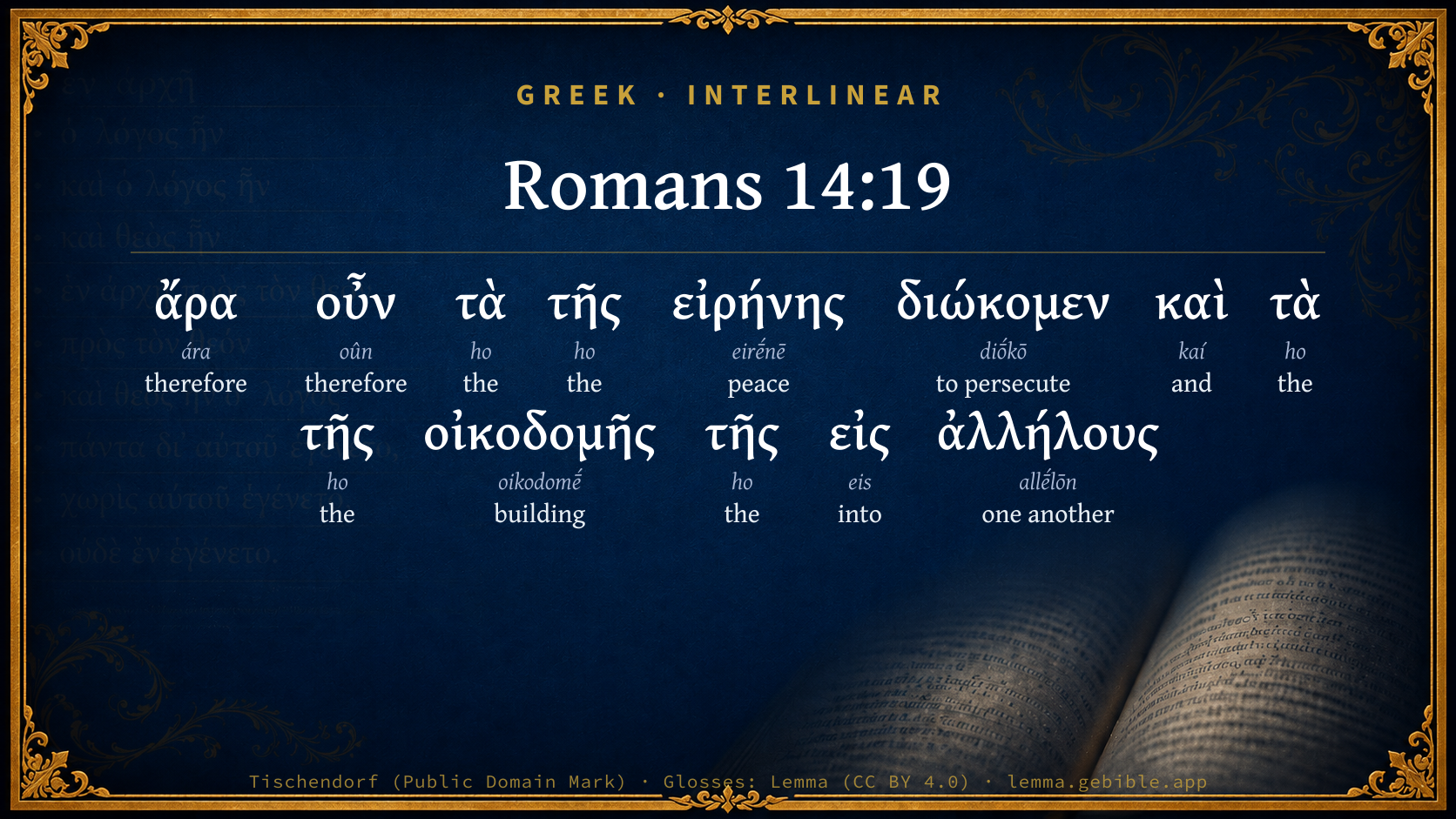
  1. ἄρα ára G686 “therefore” Particle
  2. οὖν oûn G3767 “therefore” Conjunction
  3. τὰ ho G3588 “the” Article, Accusative, Plural, Neuter
  4. τῆς ho G3588 “the” Article, Genitive, Singular, Feminine
  5. εἰρήνης eirḗnē G1515 “peace” Noun, Genitive, Singular, Feminine
  6. διώκομεν diṓkō G1377 “to persecute” Verb, Present, Active, Indicative, 1st person, Plural
  7. καὶ kaí G2532 “and” Conjunction
  8. τὰ ho G3588 “the” Article, Accusative, Plural, Neuter
  9. τῆς ho G3588 “the” Article, Genitive, Singular, Feminine
  10. τῆς ho G3588 “the” Article, Genitive, Singular, Feminine
  11. εἰς eis G1519 “into” Preposition
  12. ἀλλήλους allḗlōn G240 “one another” Reciprocal pronoun, Accusative, Plural, Masculine

About this verse

These counts appear in no published source. They are computed here, from the morphology-tagged text and Lemma’s own curated glosses. What Lemma adds →

13
words
9
distinct lemmas
Pauline Epistles
section

Notable vocabulary

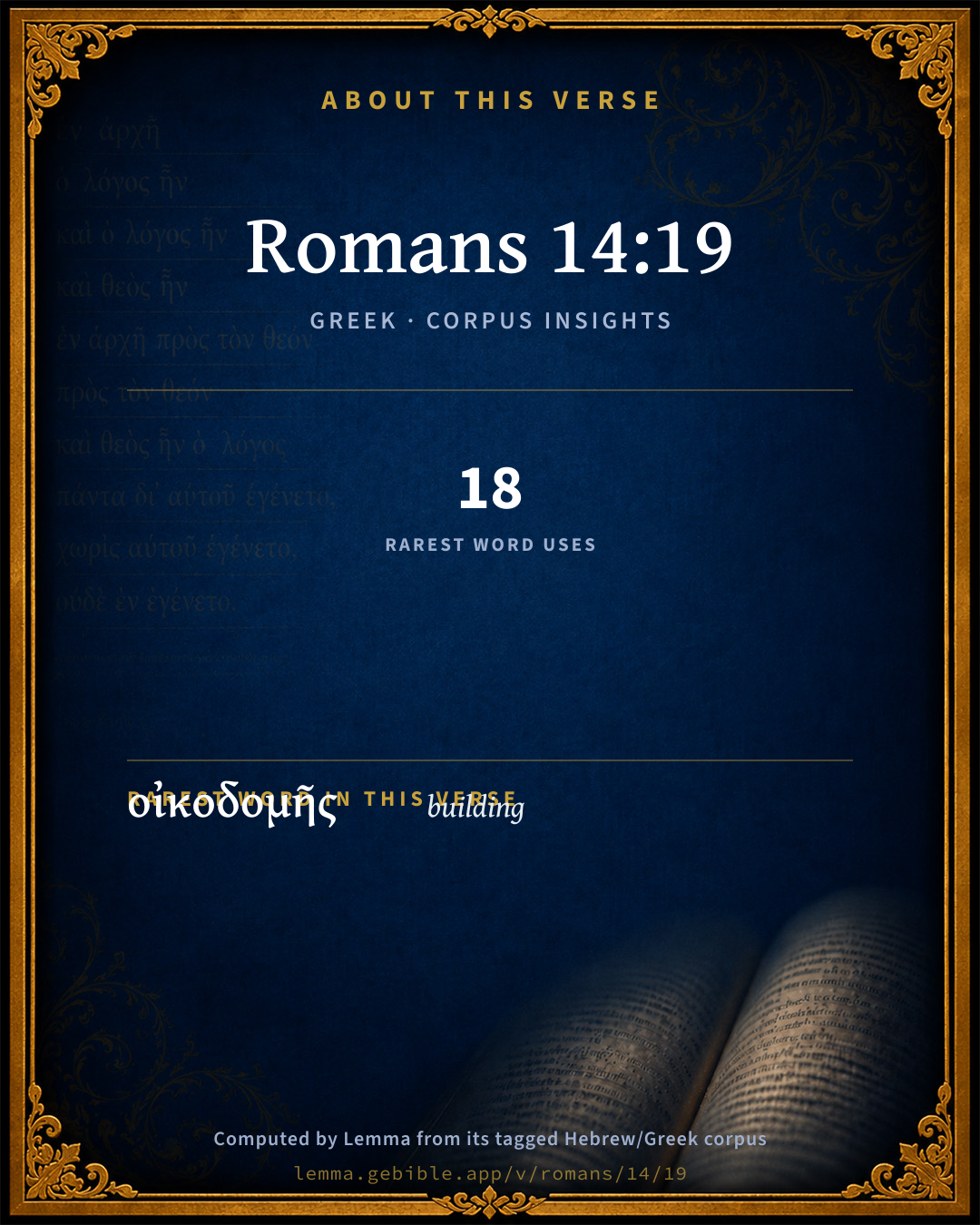
The rarest word here is οἰκοδομῆς building G3619 — appearing just 18 times in the whole Greek New Testament.

Shared distinctive vocabulary

οἰκοδομῆς building G3619 occurs in 18 verses of the Greek New Testament. Also found in:

Repetition

A word recurs within this verse:

Cross-references

22

Topical passages linked to Romans 14:19 in the Treasury of Scripture Knowledge — connected by theme and wording, ordered by reader-vote popularity; previews shown in the World English Bible.

  • Ephesians 4:29 Let no corrupt speech proceed out of your mouth, but such as is good for building up as the need may be, that it may give grace to those who hear.
  • Romans 12:18 If it is possible, as much as it is up to you, be at peace with all men.
  • Psalms 34:14 Depart from evil, and do good. Seek peace, and pursue it.
  • Romans 15:2 Let each one of us please his neighbor for that which is good, to be building him up.
  • Hebrews 12:14 Follow after peace with all men, and the sanctification without which no man will see the Lord,
  • 2 Corinthians 13:11 Finally, brothers, rejoice. Be perfected, be comforted, be of the same mind, live in peace, and the God of love and peace will be with you.
  • 1 Thessalonians 5:11–12 Therefore exhort one another, and build each other up, even as you also do.
  • Matthew 5:9 Blessed are the peacemakers, For they shall be called children of God.
  • Mark 9:50 Salt is good, but if the salt has lost its saltiness, with what will you season it? Have salt in yourselves, and be at peace with one another."
  • Colossians 3:12–15 Put on therefore, as God's chosen ones, holy and beloved, a heart of compassion, kindness, lowliness, humility, and perseverance;
  • Philippians 2:1–4 If there is therefore any exhortation in Christ, if any consolation of love, if any fellowship of the Spirit, if any tender mercies and compassion,
  • 1 Corinthians 14:12–17 So also you, since you are zealous for spiritual gifts, seek that you may abound to the building up of the assembly.
  • 1 Corinthians 14:26 What is it then, brothers? When you come together, each one of you has a psalm, has a teaching, has a revelation, has another language, has an interpretation. Let all things be done to build each other up.
  • James 3:13–18 Who is wise and understanding among you? Let him show by his good conduct that his deeds are done in gentleness of wisdom.
  • 1 Peter 3:11 Let him turn away from evil, and do good. Let him seek peace, and pursue it.
  • Psalms 133:1 See how good and how pleasant it is For brothers to live together in unity!
  • 1 Corinthians 10:33 even as I also please all men in all things, not seeking my own profit, but the profit of the many, that they may be saved.
  • Ephesians 4:3–7 being eager to keep the unity of the Spirit in the bond of peace.
  • 1 Corinthians 7:15 Yet if the unbeliever departs, let there be separation. The brother or the sister is not under bondage in such cases, but God has called us in peace.
  • 2 Corinthians 12:19 Again, do you think that we are excusing ourselves to you? In the sight of God we speak in Christ. But all things, beloved, are for your edifying.
  • 1 Timothy 1:4 neither to pay attention to myths and endless genealogies, which cause disputes, rather than God's stewardship, which is in faith--
  • 2 Timothy 2:22 Flee from youthful lusts; but pursue righteousness, faith, love, and peace with those who call on the Lord out of a pure heart.

Cross-references courtesy of OpenBible.info (CC BY 4.0).

Commentary

Notes on Romans 14:19 from classic Christian and Jewish commentators (each source and its license shown beneath its notes). The classic Christian expositions comment on the surrounding passage and are grouped to its opening verse, so a note may address several verses; the Jewish commentaries on the Tanakh (Rashi and others) are per-verse, so they appear only where the commentator wrote on this verse.

Lemma curates 59 commentaries, every one of them public domain or Creative Commons licensed, each selected and text-cleaned for this edition rather than reprinted as found. About our sources →

The Biblical Illustrator

Joseph S. Exell

Rom_14:19-20

Let us therefore follow after the things which make for peace.

Things which make for peace

I. What these things are.

1. Righteousness.

2. Humility.

3. Love.

4. Faith.

II. We must follow them.

1. Earnestly.

2. Prayerfully.

3. With steady faith in our ultimate attainment of them.

III. The result. Eternal life in heaven with God and Christ. (J. H. Tarson.)

The things which make for peace

1. A peaceable temper.

2. Peaceable measures.

3. Peaceable methods.

Things to be sought after

I. Things which make for peace.

1. Essentials in which we all agree.

2. Objects which we all desire.

3. Blessings in which all can share.

II. Things that edify.

1. Knowledge.

2. Faith.

3. Love. (J. Lyth, D.D.)

The endeavours of the true Christian for the welfare of his brethren

I. Wherein they consist. Endeavours after--

1. Peace.

2. Edification.

II. What are the common hindrances? Offences which--

1. Destroy mutual confidence.

2. Injure weak consciences.

III. How are they to be overcome.

1. By avoiding the occasions of offence.

2. By encouraging in others the growth of faith.

3. By abstaining from everything that might lead another to act in opposition to his own conscience. (J. Lyth, D.D.)

For meat destroy not the work of God.--

Thy weak brother

I. Weak as he is, is a work of god.

II. May easily be destroyed; for--

1. Though all things are pure--

2. They may become a cause of offence--

3. Especially to him that is weak.

III. Therefore abstain.

1. The enjoyment is little.

2. The consequence dreadful to contemplate.

3. The sacrifice noble. (J. Lyth, D.D.)

The Biblical Illustrator, edited by Joseph S. Exell (c. 1880s–1900s) — public domain. Text from a community e-Sword module.

Joseph Benson's Commentary

Rom 14:19-21. Let us therefore — In consistency with these certain and momentous truths; follow after the things which make for peace — Which tend to procure, preserve, and promote peace among the faithful; and things wherewith one may edify another, may build him up in faith and holiness. Observe, reader, peace and edification are closely connected: practical divinity tends equally to peace and edification. Controversial divinity less directly tends to edification, although sometimes we, as they of old, Neh 4:17, cannot build without it. For meat — For so small a matter as the eating a little meat; or, for the use of any indifferent thing, destroy not the work of God — That work which he builds in the soul by faith, and in the church by concord: do nothing toward destroying it. All things indeed are pure — All meats are, in themselves, lawful; but it, the eating what a person thinks to be prohibited, is evil, sinful, and hurtful, to that man who eateth with offence — So as to offend another thereby, or contrary to the dictates of his own conscience, and insnaring to the consciences of others, And in this view I may affirm, It is good, pleasing to God, and profitable for edification, and therefore every Christian’s duty, neither to eat flesh, &c. — Not only to abstain from what is forbidden in the law of Moses, but from every other thing which gives offence; whereby thy brother stumbleth — By imitating thee against his conscience, contrary to righteousness; or is offended at what thou dost to the loss of his peace; or is made weak, hesitating between imitation and abhorrence, to the loss of that joy in the Lord, which was his strength. Macknight interprets the clause rather differently, thus: “The first of these words, προσκοπτει, stumbleth, (which signifies to dash one’s foot against something without falling, or being much hurt,) expresses the case of a person who, being tempted to commit sin, yields a little to the temptation, but recovers himself: the second, σκανδαλιζεται, from σκαζω, to halt, (meaning to fall and be lamed by stumbling,) expresses the case of one who, through temptation, actually commits sin contrary to his knowledge and conviction: the third, ασθενει, (which signifies to be weakened in consequence of such a fall,) expresses the condition of a person who, by sinning, hath his piety so weakened, that he is in danger of apostatizing.”

Joseph Benson's Commentary on the Old and New Testaments (1811–1818) — public domain. Text from a community e-Sword module.

The Preacher's Complete Homiletical Commentary

Joseph S. Exell (gen. ed.)

CRITICAL NOTES

Rom_14:20.—The work of God is the faith of a fellow-Christian.

Rom_14:21.—Three forms of spiritual damage, corresponding with the three blessings in Rom_14:17, which are prejudiced by them.

Rom_14:22.—κρίνω, to judge, question, doubt, condemn; and δοκιμάζω, to approve, finely express in their combination the doubting conscience.

Rom_14:23. He that doubteth is damned.—Condemned by his conscience, his brethren, and God. We must submit undoubtingly to the recognised will of God. The man eats sinfully who eats doubtfully. Happy the man who has faith and an approving conscience.

MAIN HOMILETICS OF THE PARAGRAPH.—Rom_14:19-23

Pursuit and retreat.—In Christian warfare it is well to know when to pursue and when to retreat. We must not endanger success by any rash methods. We must consider, not only our own welfare, but the well-being of the whole Christian community. We must remember that we are parts of a whole, and must consider the proper ordering of the parts, so as to promote the successful edification of the whole. Let us then inquire:—

I. What are we to follow?—The answer to this question is to be given not from a worldly but a Christian standpoint—that is, the standpoint of an enlightened Christian, of one who is not for self, for self’s party, for self’s little sect, but for the Christian state in its widest aspect. Peace is to be followed. Not peace at any price, not peace at the sacrifice of principle. The follower of the little sect says, Just so; but how often are his principles mere crotchets? Externals are not unimportant, but peace is supreme. Edification is to be pursued. The temple will not rise if the workmen spend their time and energies in quarrelling over the shape and position of the stones. Mutual edification is too often sacrificed at the bidding of self-glorification. A man gets hold of some side aspect of the truth, or rather it gets hold of him, and he pursues it to the damage of the spiritual building. Selfish workers cannot succeed in the edification of Christ’s great temple.

II. What are we to avoid?—The answer to this question has to do, not with the Christian’s relation to the moral law, to his fellow-men as citizens of earth, but to his fellow-men as members of the invisible Church, though there are many things to be avoided which even strong faith may allow, from the consideration that their adopt on may do harm to the though less and inconsiderate. It may be good and expedient to abstain from intoxicating beverages, to withdraw from certain modern amusements, to refuse complicity with many modern customs and practices, so as to raise the general moral tone. It is certainly good neither to eat flesh nor to drink wine, if by doing so the Christian brother is either offended or made to stumble.

III. What does the strong Christian treasure in secret?—His mighty faith, which does not mean either his articles of belief or his personal hold on the things and beings invisible. It may mean his large and enlightened view. This is the day of so-called large and enlightened views, and men parade their shop windows, which are well dressed sometimes, while the shop is poor and scanty. Intolerant men make a noise about tolerance. We want more reserve on some things and more openness on other things. Hast thou faith? have it to thyself before God. Art thou above the shibboleth of parties? have it to thyself before God. Happy is he that condemneth not himself in that thing which he alloweth. This freedom from condemnation is not always rightly founded. It springs sometimes from ignorance, sometimes from indifference, and sometimes from carelessness as to the rights of others. Happy is the man who enjoys freedom from condemnation which is rightly originated.

IV. What must all Christians shun?—The one great answer is sin—a word of large significance. “Whatsoever is not of faith is sin.” What the enlightened conscience does not approve is sin. “Whatsoever is not of faith.” Grounded on convictions. But are all convictions infallible? Certainly not. Convictions must be formed in the light of divine truth. Let the converging rays of all light centres bear upon my mind, so that I may form right views. It I doubt, I must refrain from the doubtful course; if I am fully and rightly persuaded, then I must steadfastly and joyfully walk along the appointed pathway. Let us avoid the appearance of evil. Let the strong be tender towards the weak, while the weak do not carp at the strong. Let the desire for peace be strong. Let all thoughts and energies be devoted to the edification of God’s great spiritual temple, which shall overtop and outlast the gorgeous temples of time.

ILLUSTRATIONS TO CHAPTER 14

Rom_14:19. Sir Thomas Burnet thinking of the things which make for peace.—Sir Thomas Burnet, the third son of Bishop Burnet, led at one time a dissipated life. At last he took a serious turn, and one evening his father observing him to be very thoughtful asked what he was meditating. “A greater work,” replied he, “than your lordship’s History of the Reformation.” “Ay,” said his lordship, “what is that?” “The reformation of myself,” said the young man. He fulfilled his promise, and he afterwards became one of the best lawyers of his time, and in 1741 one of the judges in the Court of Common Pleas.

The Preacher's Complete Homiletical Commentary (gen. ed. Joseph S. Exell; Funk & Wagnalls, c. 1892) — public domain (pre-1929). A full-Bible homiletical/sermon-outline anthology covering 65 of 66 books (2 John is absent from the source module). Text from a community e-Sword module.

Bengel's Gnomon

Johann Albrecht Bengel

Rom 14:19. Εἰρήνης, οἰκοδομῆς, of peace, of edification) These two things are very closely connected. Theology is in itself a peace-maker and is designed for edification. Controversy is not so directly useful for edification, although it should sometimes be added.—Comp. Nehem. Rom 4:17.

Bengel's Gnomon of the New Testament — English translation (T&T Clark, Edinburgh, 1860) — public domain. Text from a community e-Sword module.

Meyer's Critical & Exegetical Commentary

Heinrich August Wilhelm Meyer

Rom_14:19. Exhortation, inferred from the doctrinal proposition, Rom_14:17; not a question (Buttmann).

τὰ τῆς εἰρ.] what belongs to peace, composes the substance of peace, not different in matter of fact from τὴν εἰρήνην. See Bernhardy, p. 325 f.; Kühner, II. 1, p. 230.

τῆς οἰκοδομῆς] figurative designation of perfecting (here active) in the Christian life. Comp. 2Co_10:8; 2Co_13:10; 1Co_14:4. According to the context in each case, the individual, as here, or the church, or the whole Christian body, is a building of God (of which Christ is the foundation, 1Co_3:11; Eph_2:20-21), on which the work of building is to proceed until the Parousia.

εἰς ἀλλήλ.] οἰκοδομεῖτε εἰς τὸν ἕνα, 1Th_5:11.

Meyer — Critical and Exegetical Commentary on the New Testament — English translation by Peter Christie, edited by Frederick Crombie (T&T Clark, 1880) — public domain. Text from a community e-Sword module.

Expositor's Greek Testament

ed. W. Robertson Nicoll

Rom 14:19 . ἄρα οὖν : see Rom 14:12 . τὰ τῆς εἰρήνης is not materially different from τὴν εἰρήνην : all that belongs to, makes for, peace: we cannot argue from its use here that the word must have exactly the same shade of meaning in Rom 14:17 . διώκωμεν : the indicative διώκομεν is very strongly supported, and would indicate the actual pursuit of all true Christians: “Our aim is peace,” and τὰ τῆς οἰκοδομῆς τῆς εἰς ἀλλήλους = mutual upbuilding. Cf. 1Th 5:11 , 1Co 14:26 . The practical rule implied here is that, when anything is morally indifferent to me, before I act on that conviction, I must ask how such action will affect the peace of the Church, and the Christian growth of others.

The Expositor's Greek Testament, edited by W. Robertson Nicoll (1897–1910) — public domain. Text from a community e-Sword module.

Hodge's Commentary on Romans, Ephesians & First Corinthians

Charles Hodge

Rom_14:19

Let us therefore follow after the things which make for peace, and things whereby one may edify another. That is, let us earnestly endeavor to promote peace and mutual edification. The things which make for peace, is equivalent to peace itself (τὰ τῆς εἰρήνη = εἰρήνην); and things wherewith one may edify another, is mutual edification (τὰ τῆς οἰκοδμῆς = οἰκοδομήν.) This verse is not an inference from the immediately preceding, as though the meaning were, Since peace is so acceptable to God, therefore let us cultivate it; but rather from the whole passage: Since Christian love, the example of Christ, the comparative insignificance of the matters in dispute, the honor of the truth, the nature of real religion, all conspire to urge us to mutual forbearance, let us endeavor to promote peace and mutual edification.

Charles Hodge — Commentary on Romans (1835), First Corinthians (1857), and Ephesians (1856) — public domain. Text from a community e-Sword module.

Geneva Bible (1599)

Geneva Bible translators

A general conclusion: The use of this liberty, yea and our whole life, ought to be referred to the edifying of one another, insomuch that we esteem that thing unlawful by reason of the offense of our brother, which is of itself pure and lawful.

Geneva Bible (1599) marginal notes — public domain. Text via Bolls.life.

Jamieson, Fausset & Brown

Robert Jamieson, A. R. Fausset & David Brown

the things, &c.--more simply, "the things of peace, and the things of mutual edification."

Jamieson, Fausset & Brown — Commentary Critical and Explanatory on the Whole Bible (1871) — public domain (CC PDM 1.0). Text via the HelloAO Bible API.

Adam Clarke's Commentary

Verse 19. Let us therefore follow] Far from contending about meats, drinks, and festival times, in which it is not likely that the Jews and Gentiles will soon agree, let us endeavour to the utmost of our power to promote peace and unanimity, that we may be instrumental in edifying each other, in promoting religious knowledge and piety instead of being stumbling-blocks in each other's way.

Adam Clarke's Commentary on the Bible (1810–1826) — public domain. Text from a community e-Sword/MySword module.

John Calvin's Commentaries

19. Let us then follow, etc. He recalls us, as much as possible, from a mere regard to meats, to consider those greater things which ought to have the first place in all our actions, and so to have the precedence. We must indeed eat, that we may live; we ought to live, that we may serve the Lord; and he serves the Lord, who by benevolence and kindness edifies his neighbor; for in order to promote these two things, concord and edification, all the duties of love ought to be exercised. Lest this should be thought of little moment, he repeats the sentence he had before announced, — that corruptible meat is not of such consequence that for its sake the Lord’s building should be destroyed. For wherever there is even a spark of godliness, there the work of God is to be seen; which they demolish, who by their unfeeling conduct disturb the conscience of the weak.

But it must be noticed, that edification is joined to peace; because some, not unfrequently, too freely indulge one another, so that they do much harm by their compliances. Hence in endeavoring to serve one another, discretion ought to be exercised, and utility regarded, so that we may willingly grant to our brother whatever may be useful to further his salvation. So Paul reminds us in another place: “All things,” he says, “are lawful to me; but all things are not expedient;” and immediately he adds the reason, “Because all things do not edify.” (1 Corinthians 10:23.)

Nor is it also in vain that he repeats again, For meat destroy not, etc., intimating, that he required no abstinence, by which there would be, according to what he had said before, any loss to piety: though we eat not anything we please, but abstain from the use of meats for the sake of our brethren; yet the kingdom of God continues entire and complete.

John Calvin's Commentaries (1540-1563) — public domain. Text from the Calvin Translation Society English edition (1840s-50s) via the Christian Classics Ethereal Library (ccel.org). Calvin's coverage is partial (roughly two-thirds of the Bible); uncommented books and verses are honest gaps, never fabricated. The 19th-century editor's footnotes and remarks are omitted so the notes are faithfully Calvin's own voice.

Ellicott's Commentary for English Readers

(19) Let us therefore follow.—The best MSS. have the indicative mood, “so then we follow.” There is, however, some good support for the Received text, especially in the patristic quotations and versions; and mistakes of this kind were peculiarly liable to be made.

Edify.—The word has unfortunately lost its freshness of meaning, but we have no other single equivalent for it in English. It is the “upbuilding,” or mutual help and assistance in the spiritual life which Christians receive from their intercourse with each other.

A Bible Commentary for English Readers, edited by Charles John Ellicott (1878–1897) — public domain. Text from a community e-Sword module.

The Cambridge Bible for Schools and Colleges

gen. ed. J. J. S. Perowne

19. the things which make for peace] Lit. the things of peace. So below, the things of mutual edification.—For remarks on the harmony between St Paul’s eirenicon here and his stern warnings (e.g. in Galatians 1) against foundation-error, see long note on Rom_14:1 above.

edify] Cp. Rom_15:2.—The metaphor here has its usual (but not invariable) reference to the state and growth not of the individual but of the community.

The Cambridge Bible for Schools and Colleges (gen. ed. J. J. S. Perowne; Cambridge University Press, 1878–1918) — public domain. Text from a community e-Sword module.

John Gill's Exposition

For meat destroy not the work of God,.... The Syriac reads it, "the works of God"; referring either to righteousness, peace, and joy in the Holy Ghost, of which the kingdom of God consists; or to the weak brother, who both as a creature, and as a new creature, is the workmanship of God; and to the good work of grace, the work of faith upon his soul, which is the work of God; or rather to his peace, and the peace of the church of Christ, which is both the will and work of God; peace is what he calls his people to, and what he himself is the author of; and may be destroyed, and sometimes is, by trifling things; whereas a true believer, though ever so weak, cannot be destroyed, nor the good work of God upon his soul be lost, nor any part of it; not the work of faith, which Christ prays for that it fail not, and is both the author and finisher of; but the work of peace and edification in particular persons, and in a church, may be destroyed, but it is pity it should, by so small a matter, so trivial a thing as meat, or the use of anything that is indifferent:

all things indeed are pure. The Ethiopic version adds, "to the pure"; to them that have pure consciences, sprinkled by the blood of Christ, and have no doubt or scruple about eating things indifferent; but this addition seems to be taken out of Tit 1:15; though it may serve to explain the sense, which is, that all sorts of food, without any distinction, may be eaten; there is nothing common or unclean, every creature in itself is good, and every Christian may lawfully eat thereof, with moderation and thankfulness. This is a concession which stands thus corrected and restrained,

but it is evil for that man who eateth with offence. The Arabic version adds, "of his neighbour"; which is a good interpretation of the passage; for the apostle means not with offence to a man's own conscience, though so to eat is an evil too, but with offence to a fellow Christian; it is not an evil in itself to eat, but when this circumstance of offending another thereby attends it; it is evil, though not in itself, yet in its consequences; it offends a weak brother, displeases Christ, who would not have one of his little ones offended, and brings a woe upon the person by whom the offence comes. The Ethiopic version reads, "who eats inordinately"; which to be sure is sinful, but is not the meaning here.

John Gill's Exposition of the Whole Bible (1746–1763) — public domain (CC PDM 1.0). Text via the HelloAO Bible API.

Trapp's Complete Commentary

John Trapp

19 Let us therefore follow after the things which make for peace, and things wherewith one may edify another.

Ver. 19. Wherewith one may edify another] Discords among good people do edificare in gehennam, build in hell, as Tertullian phraseth it, build backwards. One of the main scandals the Jews take from Protestants is their dissension.

John Trapp, A Commentary or Exposition upon All the Books of the Old and New Testament (1647–1656) — public domain. Text from a community e-Sword module.

Albert Barnes' Notes on the Bible

Let us therefore follow ... - The object of this verse is to persuade the church at Rome to lay aside their causes of contention, and to live in harmony. This exhortation is founded on the considerations which the apostle had presented, and may be regarded as the conclusion to which the argument had conducted him.

The things which make for peace - The high purposes and objects of the Christian religion, and not those smaller matters which produce strife. If men aim at the great objects proposed by the Christian religion, they will live in peace. If they seek to promote their private ends, to follow their own passions and prejudices, they will be involved in strife and contention. There “are” great common objects before “all” Christians in which they can unite, and in the pursuit of which they will cultivate a spirit of peace. Let them all strive for holiness; let them seek to spread the gospel; let them engage in circulating the Bible, or in doing good in any way to others, and their smaller matters of difference will sink into comparative unimportance, and they will unite in one grand purpose of saving the world. Christians have more things in which they “agree” than in which they differ. The points in which they are agreed are of infinite importance; the points on which they differ are commonly some minor matters in which they may “agree to differ,” and still cherish love for all who bear the image of Christ.

And things wherewith ... - That is, those things by which we may render “aid” to our brethren; the doctrines, exhortations, counsels, and other helps which may benefit them in their Christian life.

May edify - The word “edify” means properly to “build,” as a house; then to “rebuild” or “reconstruct;” then to adorn or ornament; then to do any thing that will confer favor or advantage, or which will further an object. Applied to the church, it means to do anything by teaching, counsel, advice, etc. which will tend to promote its great object; to aid Christians, to enable them to surmount difficulties, to remove their ignorance, etc.; Act 9:31; 1Co 8:1; 1Co 14:4. In these expressions the idea of a “building” is retained, reared on a firm, tried cornerstone, the Lord Jesus Christ; Eph 2:20; Isa 28:16. Compare Rom 9:33. Christians are thus regarded, according to Paul’s noble idea Eph 2:20-22, as one great temple erected for the glory of God, having no separate interest, but as united for one object, and therefore bound to do all that is possible, that each other may be suited to their appropriate place, and perform their appropriate function in perfecting and adorning this temple of God.

Albert Barnes' Notes on the Bible (1834–1885) — public domain. Text from a community e-Sword/MySword module.

Matthew Poole's English Annotations

This verse is the application of the foregoing discourse, in which you have an exhortation to the practice of two great duties. The one is peace, or peaceableness; the other is mutual edification. He had persuaded before to peace with all men, Rom 12:18; and here he speaks more especially of peace and concord amongst brethren: see 2Co 13:11; Eph 4:3; Col 3:15; 1Th 5:13; Heb 12:14. This peace is very necessary, and Christians should endeavour all things that will promote it, and avoid all things that will obstruct it. And they must not only live peaceably, but profitably one with another. They should build one another up in grace and knowledge.

Matthew Poole's English Annotations on the Holy Bible (1683–1685) — public domain. Text from a community e-Sword/MySword module.

Whedon's Commentary on the Bible

Daniel D. Whedon

19. Therefore—Since religion consists not in meats, but in spiritual graces.

Follow… peace—By neither insisting on meats, nor stiffly refusing to avoid meats.

Edify—Build up; a metaphor borrowed from architecture. The Christian is a true temple of God. Beware lest instead of building him up we tear him down.

Daniel D. Whedon (gen. ed.), Commentary on the Old and New Testaments (1874–1909) — public domain. Text from a community e-Sword module.

The Pulpit Commentary

Vers. 19-21. Let us therefore follow after the things that make for (literally, the things of) peace, and the things wherewith one may edify another (literally, the things of the edification of one another). For meat"s sake destroy not the work of God. "Destroy," or rather, overthrow the word is katalue , not appollue as in ver. 15 is connected in thought with the edification, or building up (oikodomhn) before spoken of. "The work of God" is that of his grace in the weak Christian"s soul, growing, it may be, to full assurance of faith. (cf. 1Co_3:9," ye are God"s building Upset not the rising structure, which is God"s own, as ye may do by putting a stumbling-block in the weak brother"s way. All things indeed are pure (i.e. in themselves all God"s gifts given for man"s service are so); but it is evil to that man who eateth with offence (i.e. if the eating be to himself a stumbling-block. The idea is the same as in ver. 14). It is good (kalon , not of indispensable obligation, but a right and noble thing to do) neither to eat flesh, nor to drink wine, nor anything whereby thy brother stumbleth, or is offended, or is made weak. The concluding words in italics are of doubtful authority: they are not required for the sense. For St. Paul"s expression of his own readiness to deny himself lawful things, if he might so avoid offence to weak brethren, cf. 1Co_8:13.

The double aspect of Christian service.

The apostle"s mind was as powerful and active in a practical as in a speculative direction. Christ"s law had been, "By their fruits ye shall know them." And in this verse, Paul, reiterating his Master"s principles, vindicates the principles of the new faith by appealing to the excellence of the fruits of the Spirit.

I WHAT CHRISTIAN SERVICE IS.

1. It involves a personal relation between Master and servant.

2. It involves an acknowledgment of Divine authority.

3. It involves a powerful motive to a consecrated life.

4. It involves the inclusion of all activities and relationships within its sphere.

II SUCH SERVICE IS WELL PLEASING TO GOD.

1. For it resembles that of Christ himself, who came to do the will of him who sent him, and who "pleased the Father alway," in whom the Father was "well pleased.

2. It is in conformity to the Divine will. It is the prerogative of the spiritual nature of man that it is capable of apprehending and voluntarily accepting and obeying the perfect will of God.

3. It tends to the Divine glory. This is by no other means so effectively promoted as by the willing consecration to the Lord of all intelligent and moral natures.

III SUCH SERVICE IS APPROVED OF MEN.

1. Even those who do not render it themselves, approve it in others.

2. Even those who verbally censure, in their inner conscience commend it.

3. Legislators and rulers approve it, as contributive to the harmony and just development of human society at large.

A self-denying ordinance.

A society is formed for mutual help. The prosperity of the whole is a prime factor in all our working and living. Wondrous the effect of the gospel in levelling distinctions of class, in banishing national enmities, and in making Jew and Gentile realize their adoption into the same family of God, their oneness of blood, their community of interests.

I THE STRONGER CAN HELP THE WEAKER, AND THE HIGHER STOOP TO THE POSITION OF THE LOWER, MORE EASILY THAN VICE VERSA. It is the glory of the greater to include the less. And the man of far-reaching spiritual views can accommodate himself to his less intellectual brother more readily than the latter can lay aside his prejudices and rejoice in the removal of all restrictions. Hence those in our assemblies capable of assimilating the richest food placed before them are called upon to remember the plainer fare that suits the spiritual digestion of their brethren. Those who delight in climbing to the peaks of spiritual knowledge can learn to moderate their ardour, and sit with their fellows in happy concord in the plain, because otherwise there can be no general assembly, many being devoid of the strength and agility needful for an ascent to the summit. Our exhortation and worship must ever, though not exclusively, take account of the weaker and less educated, the children and the simple.

II IT IS SAFER TO ERR ON THE SIDE OF SELF-REPRESSION RATHER THAN OF LIBERTY. Every man endowed by the Spirit with a clearness and amplitude of vision that discriminates between the essential and the non-essential may refuse to have his freedom compulsorily narrowed by others. But he does well, and acts in the spirit of Christ who "pleased not himself," if he spontaneously renounces part of his privileges, in order that he may remove a possible stumbling-block from his brother"s path. And there is a danger of man"s natural tendency to self-assertion leading him to a violation of conscience. "Happy is he that condemneth not himself in the thing which he alloweth" implies the possibility of insisting on freedom with low motives. An instructive tradition of Christ is recorded by Codex Bezae after ver. 4 in Luke 6.: "On the same day he beheld a man working on the sabbath, and said unto him, Blessed art thou if thou knowest what thou doest: but if thou knowest not, thou art cursed and a transgressor of the Law." To disregard days and unclean food without a perception of the reason found in Christ"s universal cleansing and sanctification is not to justify, but to aggravate, the offence. To act against a conscientious feeling is always wrong. Many a man who boasts of his ability to pass unscathed through a fiery ordeal is being singed and maimed by his recklessness.

III TO HARM A BROTHER IS TO WOUND CHRIST. "Destroy not thy brother, for whom Christ died." See in the weakest member of the community the face and form of thy Lord! The essence of Christianity is self-abnegation; love makes the sacrifice welcome. Christ in us is our better self. and self-love wards off self-injury. The leader of a band anxious for its prosperity end progress feels a pang when any element of discord or weakness is introduced. Jesus Christ is the sensitive Head of the Church, and the inefficiency of any member is a grief to him; the suffering of any limb impairs his joy. Could we more often place ourselves in thought in his position, we should quickly abate aught that lessens the unity and power of the body of Christ. Every pastor of a flock, every teacher of a class, has to think of the effect of his example, lest what he might enjoy without risk himself should exert a dangerous influence on others. It is more blessed to yield than to receive a concession. S.R.A.

The Pulpit Commentary (1880–1919), ed. H.D.M. Spence-Jones & Joseph S. Exell — public domain. Text from a community e-Sword module.

John Wesley's Explanatory Notes

Peace and edification are closely joined. Practical divinity tends equally to peace and to edification. Controversial divinity less directly tends to edification, although sometimes, as they of old, we cannot build without it, Neh. iv, 17.

John Wesley, Explanatory Notes Upon the Whole Bible (1754–1765) — public domain. Text via the GEBible commentary corpus.

Kretzmann's Popular Commentary

Paul E. Kretzmann

Avoid all offense:

v. 19. Let us, therefore, follow after the things which make for peace, and things wherewith one may edify another.

v. 20. For meat destroy not the work of God. All things indeed are pure; but it is evil for that man who eateth with offense.

v. 21. It is good neither to eat flesh, nor to drink wine, nor anything whereby thy brother stumbleth, or is offended, or is made weak.

v. 22. Hast thou faith? Have it to thyself before God. Happy is he that condemneth not himself in that thing which he allows.

v. 23. And he that doubts is damned if he eat, because he eateth not of faith; for whatsoever is not of faith is sin.

Paul now draws a conclusion which is applicable to all conditions and circumstances of Christians: Let us now follow after the things which pertain to peace and to one another’s edification. Everything that brings about and preserves peace, everything that results in mutual edification, should be earnestly pursued and promoted by the Christians at all times. Because through Christ we have peace with God, we want to serve Him in this way, that we live together in peace and edify one another in faith and conduct, instead of quarreling and harming one another. And therefore Paul repeats the thought of v. 15: Do not on account of food destroy the work of God. If we, instead of edifying, building up our fellow Christian in faith, in his spiritual life, tear down the work of God, the spiritual temple, in his heart, and this on account of some paltry food, we certainly become guilty in His sight. It is true indeed that all things are pure, every kind of food is in itself clean and will not produce spiritual uncleanness; but they are all bad and objectionable in the case of him that eats of them with offense, with a bad conscience. Therefore we dare not tempt and lead a brother to do what he believes to be wrong, thus destroying the work of God in him. If our conduct causes our weak brother to eat with offense, to partake of what he esteems impure, then our behavior is harmful, objectionable. On the other hand, it is proper, praiseworthy, not to eat meat nor to drink wine nor to do anything at which our brother takes offense, v. 21. As in the case of meat, so it was with wine in those days: many of the weaker Christians may have feared its use on account of the fact that it may have been used in sacrifices to idols. It is not so much the question of doing the right thing for one’s own person as to avoid doing wrong to one’s weak brother; hence the admonition of the apostle. This is held before us in the next sentence: The faith that thou hast have with thyself before God. The form of the sentence is emphatic: So far as thou art concerned, thou hast the firm confidence, the unshakable conviction, that in eating meat and drinking wine thou art doing right before God. The stronger brethren were not required to make a concession of principle or to renounce the truth; all that was asked of them was that they use their liberty in a considerate and charitable manner. Their conviction they could hold just the same in the sight of God; it was not to be paraded to the injury of someone else, for God would see and recognize it.

And so Paul concludes: Happy is he that does not condemn himself in that which he approves of. The strong in faith uses food and drink of all kinds, also meat and wine. And it must be a source of great satisfaction and happiness to him if he has the conviction of a free conscience and is sure that he is doing right. It is fortunate if one can make use of all the gifts of God without reproaching himself. But what evil consequences it may have if someone makes a tactless use of his Christian liberty and thus offends his weak brother, is shown in the last sentence: But he that holds doubts when he eats is condemned, since it is not of faith; everything, however, which is not of faith is sin. If the weaker Christian comes to that point that he wavers and doubts, he may finally, before coming to the right understanding, follow the example of the stronger Christian and thus at last eat and drink what in his conscience he still condemns. But such a violation of conscience cannot be reconciled with faith, since it is not done with the certainty that it is right, with the certainty of the conviction based upon knowledge. But whatever a person does without being certain that he does the right thing in so doing, whatever a person indulges in with the fear that it probably is wrong, that is sin. "Any and every action of man of which he is not convinced that it is in conformity with the will of God is sinful."

Summary

The apostle admonishes the weak not to condemn the others, the strong in faith, not to despise the weak nor to give them any offense, and both parties to strive after that which promotes peace and mutual edification.

The Christian’s Conduct in Things Indifferent

The admonition which St. Paul gave to the weak in faith in the congregation at Rome as well as to their stronger brethren is the most complete instruction which we have as to the use of things indifferent, such as are in themselves harmless, but may under circumstances become sin. For this was the point of distinction between the strong and weak in the congregation that the former made use of their Christian liberty and believed that all the gifts of God could be enjoyed, while the latter were in doubt concerning the eating of meat and the drinking of wine, and were always battling with a bad conscience.

Now it is very true that the things indifferent lie in neutral territory; they are neither commanded nor prohibited. But from this it does not follow that a Christian in his dealing with these matters leaves his Christian status and assumes a neutral position. A Christian serves the Lord and is the Lord’s even when he eats and drinks and sleeps; he lives to the Lord and dies to the Lord, and his sanctification embraces his whole life. So long as things indifferent concern the individual Christian only, he has the right to act as he sees fit and right. He must, of course, be fully persuaded in his own mind that he is serving the Lord in the form of action which he chooses.

A difference with regard to things indifferent has no effect upon the relation of believers to Christ, nor should it have any influence upon brotherly affection and mutual understanding. Uniformity in things indifferent is not essential for the unity of the Church. And since the apostle seeks to preserve peace in the congregation at Rome, he admonishes both parties to regard each other as brothers in spite of this difference; he warns them against carping criticism and condemnation. And the same admonition and warning is in order today in all cases where there is an evident disagreement in matters concerning which the Lord has not fixed a rule. The proper procedure in such a case is to respect the opinion of the other. For matters of this nature should not interfere with the peace of the Church, if only the Christians are agreed in matters of faith and of obedience to the Word of God, and thus live with one another in peace and love. Criticism is justified and should be applied only in case some brother teaches or lives otherwise than the Word of God teaches. To keep the peace in such a case would mean open opposition to, and denial of, the command of God. But where a matter is left undecided in the Word of God, there differences of opinion are justified, and every one must stand or fall unto his own Lord. Of course, the brother that is troubled with an erring conscience may be instructed with all patience, in order to take his foolish scruples from him; but if he cannot be convinced, he must finally be permitted to continue in his ideas. Under circumstances, things indifferent will remain things indifferent for an indefinite period.

But under other circumstances a matter indifferent may cease to belong in this category. If a Christian is bothered with scruples of conscience concerning the use of a certain thing whose use is neither commanded nor prohibited by God, if he believes that indulgence in this matter will not serve his spiritual life and his soul’s salvation, then the use of such a thing while his conscience is in a state of doubt is to him a sin. And if another Christian, whose conscience is stronger and freer, uses his Christian liberty in such a way as to forget all consideration for his weaker brother, doing something which is not in itself wrong, but which offends his weaker brother, then he sins in setting aside charity. At the same time it is altogether right and proper, under circumstances even demanded, that we insist upon our Christian liberty over against such people as, in spite of better knowledge, endeavor to bind our consciences with the fetters of the Law. It is self-evident, also, that Christians will always examine whether the matter in question is really a matter of indifference before the holy God. lest sinful joys and practices be placed upon the free list.

Paul E. Kretzmann, Popular Commentary of the Bible (1921–1924) — public domain. Text from a community e-Sword module.

Burkitt's Expository Notes on the New Testament

William Burkitt

This verse is an inference drawn from the foregoing discourse. "Seeing the kingdom of God, or our common Christianity, doth not consist either in the doing or declining of these little indifferent things, let us by no means hazard the peace of the church, or break communion with such as in their sentiments differ from us; much less let us despise and set at naught each other, upon the account of these small, yet unhappy differences. But let us earnestly pursue the things that make for the common peace of all Christians, and the things by which we may further each other’s edification and salvation."

Learn hence, That in case of any emergent differences among Christians, it ought to be the joint care and endeavour of all and every one to pursue the things which make for peace, and that this peace be such as will consist with, and greatly help forward, the good of the church: Let us follow after the things which make for peace, and things wherewith one may edify another.

William Burkitt's Expository Notes on the New Testament (1700–1703) — public domain. Text from a community e-Sword module.

Godbey's Commentary on the New Testament

William B. Godbey

19, 20. “Do not destroy the work of God on account of meat. All things are pure, but it is evil to the man who eateth with offense.

William B. Godbey, Commentary on the New Testament (1896–1900) — public domain. Text from a community e-Sword module.

McGarvey & Pendleton's Commentaries

J. W. McGarvey

So then let us follow after things which make for peace, and things whereby we may edify one another . [Humanly prescribed and wholly external ordinances neither usher us into the kingdom nor increase its power within us, nor does the failure to observe them exclude us from it. Its blessings are not linked to sumptuary liberties, but are found in graces socially applied; in righteousness toward God; justice toward our neighbor; peace, or concord and harmony, with all; joy, or expressions of loving happiness prompted in us by the Holy Spirit, the source of all grace: these are the things which work the advance and glorification of the kingdom both within us and about us. These, then, are the habits of life which please both God who reads the heart, and man who looks upon the outward conduct, and, moreover, build up the kingdom.]

J. W. McGarvey (with Philip Y. Pendleton), Commentaries on the New Testament (The Fourfold Gospel, 1914; Acts; and the epistles) — public domain. Text from a community e-Sword/MySword module.

The People's New Testament

B. W. Johnson

19–23. Let us therefore follow … peace. Hence, charitably yield what grieves a brother. May edify. Build up and make strong. Compare 1 Thess. 5:11.

B. W. Johnson's The People's New Testament with Notes (1889–1891) — public domain. Electronic text from the Christian Classics Ethereal Library (CCEL) ThML edition.

Cambridge Greek Testament for Schools and Colleges

19. ἄρα οὖν, ‘so then after all’: brings to the front some of the implications of the preceding verses, for further enforcement of the appeal.

τὰ τῆς εἰρήνης. The aims which the peace established by Christ dictates.

τῆς οἰκοδομῆς τῆς εἰς ἀλλ. οἰκ. = the building up of the individual character so that each can take his place in the one building. This is a duty which each Christian owes to each; cf. 1Co 14:3; 2Co 12:19; 2Co 13:10.

Cambridge Greek Testament for Schools and Colleges (Cambridge University Press, 1896; 21 vols, various authors incl. Carr, Maclear, Plummer, Farrar, Lumby, Moule, M. R. James, Simcox) — public domain. Text from a community e-Sword module.

Alford’s Greek Testament

Henry Alford

19.] Inference from the foregoing two verses—οἰκοδ. τ. εἰς ἀλλ., edification towards one another, i.e. the work of edification, finding its exercise in our mutual intercourse and allowances. So τῇ ἀγάπῃ εἰς ἀλλ., 1Th 3:12.

Henry Alford, The Greek Testament (1849–1861) — public domain. Text from a community e-Sword module.

International Critical Commentary

19. οἰκοδομῆς: cf. 1Co 14:26 πάντα πρὸς οἰκοδομὴν γινέσθω, 1Th 5:11 οἰκοδομεῖτε εἷς τὸν ἕνα.

διώκομεν (א A B F G L P ב) is really more expressive than the somewhat obvious correction διώκωμεν (C D E, Latt.). D E F G add φυλάξωμεν after ἀλλήλους.

International Critical Commentary — older volumes (1896–1929), various authors — public domain. Text from a community e-Sword module.

Vincent's Word Studies in the New Testament

Marvin R. Vincent

Things which make for peace [τα της ειρηνης] . Lit. the things of peace. So the next clause, things of edification. See on build you up, Act 20:32. Edification is upbuilding.

One another [της εις αλληλους] . The Greek phrase has a defining force which is lost in the translations. Lit., things of edification, that, namely, which is with reference to one another. The definite article thus points Paul 's reference to individuals rather than to the Church as a whole.

Marvin R. Vincent, Word Studies in the New Testament (1887–1900) — public domain. Text from a community e-Sword/MySword module.

Godet's Commentaries

Frédéric Louis Godet

Vv. 19, 20. “Let us therefore follow after the things which make for peace, and things which pertain to mutual edification.For food destroy not the work of God; all things indeed are pure, but a thing becomes evil for that man who eateth in a state of scandal.”

Ver. 19 forms the transition from the first to the second reason; 19a repeats the first: the obligation to preserve harmony in the church? 19b introduces the second: the obligation to do nothing which might be injurious to our neighbor’s edification. The call, therefore, is no longer merely to avoid what may wound and vex our neighbor, but also to respect and not compromise the work of God already wrought in his heart. It is obvious, as Meyer acknowledges, that we must read διώκωμεν, let us seek, and not διώκομεν, we seek. The Greco-Latin reading, according to which we should require to read φυλάξωμεν, let us keep, as the verb of the last proposition of the verse: “Let us keep the things which are for edification,” may very probably be authentic. The omission of this verb would be explained by the fact that the copyists did not understand that the apostle was passing to a new reason.

Frédéric Louis Godet — Commentaries on Luke, John, Romans, and 1 Corinthians — English translation (T&T Clark, Edinburgh, 1870s–1890s) — public domain. Text from a community e-Sword module.

Lesson kit

Teaching starters — assembled from the data on this page, not authored interpretation. Every prompt links to the verse data it draws on. Edit before teaching.

Romans, in the Pauline Epistles, opens this verse with 13 words (9 distinct Greek lemmas). Its most distinctive word is oikodomḗ (“building”). A historical commentator’s framing appears above. Read the whole chapter for the surrounding context.

Discussion questions

  1. How does “building” (oikodomḗ) shape what this verse is saying?
  2. How does Matthew 24:1, which shares the word «building», read alongside this verse?
  3. What does the repetition of “the” (5× in this one verse) do in this verse?
  4. These translations render this verse differently; the difference is in the English rendering, not the original. What questions does that raise?
  5. Compare how The Biblical Illustrator and Joseph Benson's Commentary read this verse. Where do they agree or differ?

Things to notice

Reading settings

Reading text

Shown beneath each verse's original-language words.

Old Testament
Old Testament edition

Read the OT as the Masoretic Hebrew (MT) or the Greek Septuagint (LXX).

English shown for the Greek Septuagint (in the Hebrew ↔ Greek comparison).

Comparing translations? Open the Compare panel on any verse page to stack up to four side by side.