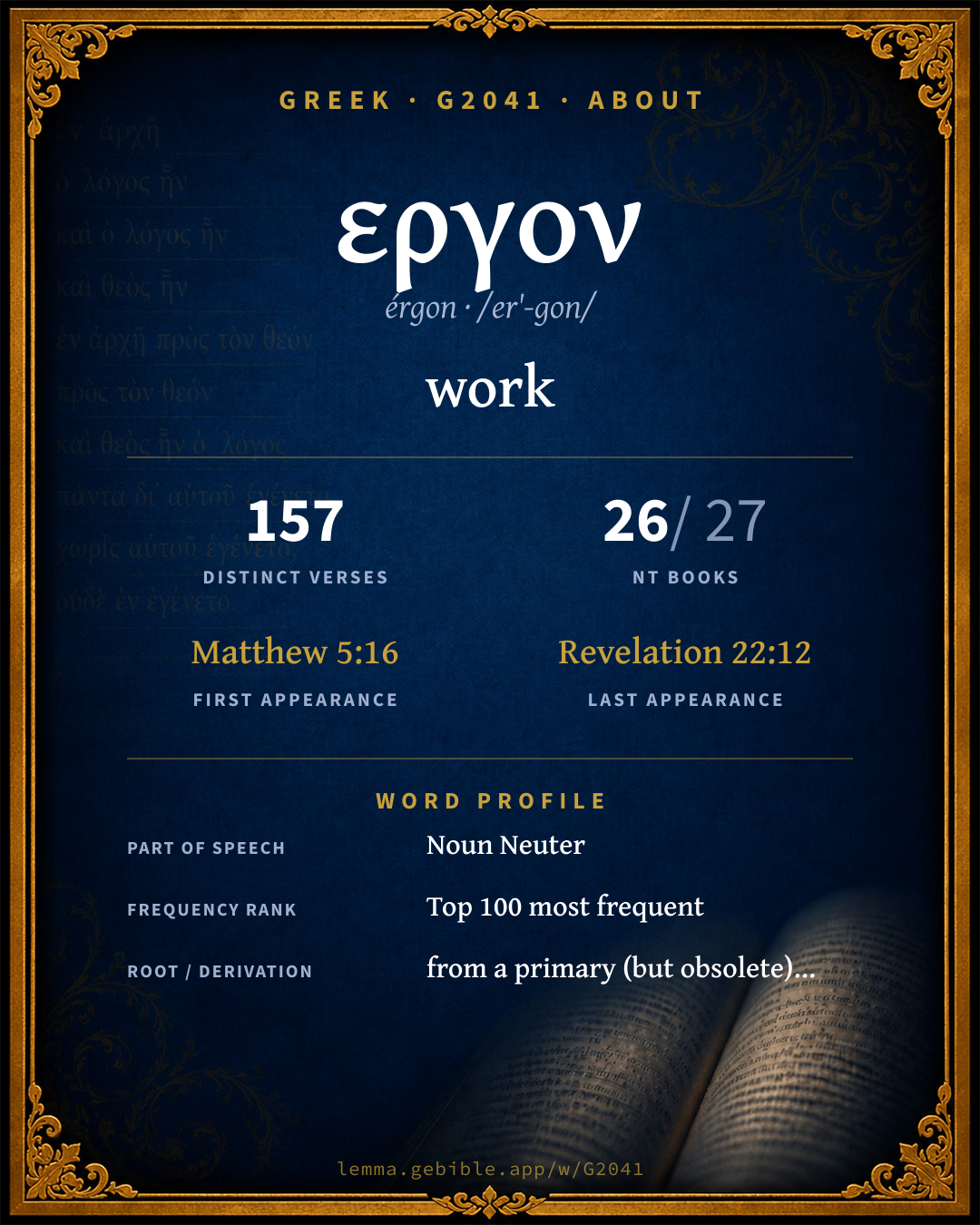
ἔργον
work
‘work’ is one of 3 main senses fuller range ↓
Full lexicon entry — Thayer's Greek Lexicon
From Thayer's Greek Lexicon
Where this word appears
See every Accusative-case word in the Greek New Testament →
Grammar key — what these labels mean
Part of speech
- Noun
- A naming word — a person, place, thing, or idea.
Case
- Accusative
- The case of the direct object and of extent.
- Genitive
- The case of source, possession, or “of” — answers “whose / from what.”
- Nominative
- The case of the subject (and the predicate nominative).
- Dative
- The case of the indirect object, means, or location — “to / for / with / in.”
Gender
- Neuter
- Grammatically neuter.
Number
- Plural
- More than one.
- Singular
- One.
Grammatical forms
- Noun, Accusative, Plural, Neuter 43 times (25%)
- Noun, Genitive, Plural, Neuter 42 times (25%)
- Noun, Accusative, Singular, Neuter 30 times (18%)
- Noun, Nominative, Plural, Neuter 15 times (9%)
- Noun, Dative, Plural, Neuter 13 times (8%)
- Noun, Dative, Singular, Neuter 10 times (6%)
- Noun, Genitive, Singular, Neuter 8 times (5%)
- Noun, Nominative, Singular, Neuter 8 times (5%)
Parsed forms decoded from the imported morphology (Robinson–Tischendorf, public domain), counted across 169 parsed occurrences — not distinct verses.
Every verse where G2041 appears — 157 distinct verses across 26 books. Click any verse to open its interlinear word-by-word view. Verse text shown in the World English Bible for context — . Each verse’s Greek form is shown with its reference; the English is not keyword-highlighted, since the data carries no word-level English alignment. Use “Compare translations” on any verse to read it across multiple English versions. This concordance covers the Greek New Testament; Septuagint (Greek Old Testament) occurrences of this word are not indexed here.
Matthew 6 verses
- Matthew 5:16 ἔργα n acc pl neut Even so, let your light shine before men; that they may see your good works, and glorify your Father who is in heaven.
- Matthew 11:2 ἔργα n acc pl neut Now when John heard in the prison the works of Christ, he sent two of his disciples
- Matthew 11:19 ἔργων n gen pl neut The Son of Man came eating and drinking, and they say, 'Behold, a gluttonous man and a drunkard, a friend of tax collectors and sinners!' But wisdom is justified by her children."
- Matthew 23:3 ἔργα n acc pl neut All things therefore whatever they tell you to observe, observe and do, but don't do their works; for they say, and don't do.
- Matthew 23:5 ἔργα n acc pl neut But all their works they do to be seen by men. They make their phylacteries broad, enlarge the fringes of their garments,
- Matthew 26:10 ἔργον n acc sg neut But Jesus, knowing this, said to them, "Why do you trouble the woman? Because she has done a good work for me.
Mark 2 verses
- Mark 13:34 ἔργον n acc sg neut "It is like a man, traveling to another country, having left his house, and given authority to his servants, and to each one his work, and also commanded the doorkeeper to keep watch.
- Mark 14:6 ἔργον n acc sg neut But Jesus said, "Leave her alone. Why do you trouble her? She has done a good work for me.
Luke 2 verses
- Luke 11:48 ἔργοις n dat pl neut So you testify and consent to the works of your fathers. For they killed them, and you build their tombs.
- Luke 24:19 ἔργῳ n dat sg neut He said to them, "What things?" They said to him, "The things concerning Jesus, the Nazarene, who was a prophet mighty in deed and word before God and all the people;
John 25 verses
- John 3:19 ἔργα n nom pl neut This is the judgment, that the light has come into the world, and men loved the darkness rather than the light; for their works were evil.
- John 3:20 ἔργα n nom pl neut For everyone who does evil hates the light, and doesn't come to the light, lest his works would be exposed.
- John 3:21 ἔργα n nom pl neut But he who does the truth comes to the light, that his works may be revealed, that they have been done in God."
- John 4:34 ἔργον n acc sg neut Jesus said to them, "My food is to do the will of him who sent me, and to accomplish his work.
- John 5:20 ἔργα n acc pl neut For the Father has affection for the Son, and shows him all things that he himself does. He will show him greater works than these, that you may marvel.
- John 5:36 ἔργα ἔργα n nom pl neut n nom pl neut But the testimony which I have is greater than that of John, for the works which the Father gave me to accomplish, the very works that I do, testify about me, that the Father has sent me.
- John 6:28 ἔργα n acc pl neut They said therefore to him, "What must we do, that we may work the works of God?"
- John 6:29 ἔργον n nom sg neut Jesus answered them, "This is the work of God, that you believe in him whom he has sent."
- John 7:3 ἔργα n acc pl neut His brothers therefore said to him, "Depart from here, and go into Judea, that your disciples also may see your works which you do.
- John 7:7 ἔργα n nom pl neut The world can't hate you, but it hates me, because I testify about it, that its works are evil.
- John 7:21 ἔργον n acc sg neut Jesus answered them, "I did one work, and you all marvel because of it.
- John 8:39 ἔργα n acc pl neut They answered him, "Our father is Abraham." Jesus said to them, "If you were Abraham's children, you would do the works of Abraham.
- John 8:41 ἔργα n acc pl neut You do the works of your father." They said to him, "We were not born of sexual immorality. We have one Father, God."
- John 9:3 ἔργα n nom pl neut Jesus answered, "Neither did this man sin, nor his parents; but, that the works of God might be revealed in him.
- John 9:4 ἔργα n acc pl neut I must work the works of him who sent me, while it is day. The night is coming, when no one can work.
- John 10:25 ἔργα n nom pl neut Jesus answered them, "I told you, and you don't believe. The works that I do in my Father's name, these testify about me.
- John 10:32 ἔργα ἔργον n acc pl neut n acc sg neut Jesus answered them, "I have shown you many good works from my Father. For which of those works do you stone me?"
- John 10:33 ἔργου n gen sg neut The Jews answered him, "We don't stone you for a good work, but for blasphemy: because you, being a man, make yourself God."
- John 10:37 ἔργα n acc pl neut If I don't do the works of my Father, don't believe me.
- John 10:38 ἔργοις n dat pl neut But if I do them, though you don't believe me, believe the works; that you may know and believe that the Father is in me, and I in the Father."
- John 14:10 ἔργα n acc pl neut Don't you believe that I am in the Father, and the Father in me? The words that I tell you, I speak not from myself; but the Father who lives in me does his works.
- John 14:11 ἔργα n acc pl neut Believe me that I am in the Father, and the Father in me; or else believe me for the very works' sake.
- John 14:12 ἔργα n acc pl neut Most assuredly I tell you, he who believes in me, the works that I do, he will do also; and greater works than these will he do; because I am going to my Father.
- John 15:24 ἔργα n acc pl neut If I hadn't done among them the works which no one else did, they wouldn't have had sin. But now have they seen and also hated both me and my Father.
- John 17:4 ἔργον n acc sg neut I glorified you on the earth. I have accomplished the work which you have given me to do.
Acts 9 verses
- Acts 5:38 ἔργον n nom sg neut Now I tell you, withdraw from these men, and leave them alone. For if this counsel or this work is of men, it will be overthrown.
- Acts 7:22 ἔργοις n dat pl neut Moses was instructed in all the wisdom of the Egyptians. He was mighty in his words and works.
- Acts 7:41 ἔργοις n dat pl neut They made a calf in those days, and brought a sacrifice to the idol, and rejoiced in the works of their hands.
- Acts 9:36 ἔργων n gen pl neut Now there was at Joppa a certain disciple named Tabitha, which when translated, means Dorcas. This woman was full of good works and acts of mercy which she did.
- Acts 13:2 ἔργον n acc sg neut As they served the Lord and fasted, the Holy Spirit said, "Separate Barnabas and Saul for me, for the work to which I have called them."
- Acts 13:41 ἔργον ἔργον n acc sg neut n acc sg neut 'Behold, you scoffers, and wonder, and perish; For I work a work in your days, A work which you will in no way believe, if one declares it to you.'"
- Acts 14:26 ἔργον n acc sg neut From there they sailed to Antioch, from where they had been committed to the grace of God for the work which they had fulfilled.
- Acts 15:38 ἔργον n acc sg neut But Paul didn't think that it was a good idea to take with them someone who had withdrawn from them in Pamphylia, and didn't go with them to do the work.
- Acts 26:20 ἔργα n acc pl neut but declared first to them of Damascus, at Jerusalem, and throughout all the country of Judea, and also to the Gentiles, that they should repent and turn to God, doing works worthy of repentance.
Romans 15 verses
- Romans 2:6 ἔργα n acc pl neut who "will pay back to everyone according to their works:"
- Romans 2:7 ἔργου n gen sg neut to those who by patience in well-doing seek for glory and honor and incorruptibility, eternal life;
- Romans 2:15 ἔργον n acc sg neut in that they show the work of the law written in their hearts, their conscience testifying with them, and their thoughts among themselves accusing or else excusing them)
- Romans 3:20 ἔργων n gen pl neut Because by the works of the law, no flesh will be justified in his sight. For through the law comes the knowledge of sin.
- Romans 3:27 ἔργων n gen pl neut Where then is the boasting? It is excluded. By what manner of law? Of works? No, but by a law of faith.
- Romans 3:28 ἔργων n gen pl neut We maintain therefore that a man is justified by faith apart from the works of the law.
- Romans 4:2 ἔργων n gen pl neut For if Abraham was justified by works, he has something to boast about, but not toward God.
- Romans 4:6 ἔργων n gen pl neut Even as David also pronounces blessing on the man to whom God counts righteousness apart from works,
- Romans 9:11 ἔργων n gen pl neut For being not yet born, neither having done anything good or bad, that the purpose of God according to election might stand, not of works, but of him who calls,
- Romans 9:32 ἔργων n gen pl neut Why? Because they didn't seek it by faith, but as it were by works of the law. They stumbled over the stumbling stone;
- Romans 11:6 ἔργων n gen pl neut And if by grace, then it is no longer of works; otherwise grace is no longer grace. But if it is of works, it is no longer grace; otherwise work is no longer work.
- Romans 13:3 ἔργῳ n dat sg neut For rulers are not a terror to the good work, but to the evil. Do you desire to have no fear of the authority? Do that which is good, and you will have praise from the same,
- Romans 13:12 ἔργα n acc pl neut The night is far gone, and the day is near. Let's therefore throw off the works of darkness, and let's put on the armor of light.
- Romans 14:20 ἔργον n acc sg neut Don't overthrow God's work for food's sake. All things indeed are clean, however it is evil for that man who creates a stumbling block by eating.
- Romans 15:18 ἔργῳ n dat sg neut For I will not dare to speak of any things except those which Christ worked through me, for the obedience of the Gentiles, by word and deed,
1 Corinthians 7 verses
- 1 Corinthians 3:13 ἔργον ἔργον n nom sg neut n nom sg neut each man's work will be revealed. For the Day will declare it, because it is revealed in fire; and the fire itself will test what sort of work each man's work is.
- 1 Corinthians 3:14 ἔργον n nom sg neut If any man's work remains which he built on it, he will receive a reward.
- 1 Corinthians 3:15 ἔργον n nom sg neut If any man's work is burned, he will suffer loss, but he himself will be saved, but as through fire.
- 1 Corinthians 5:2 ἔργον n acc sg neut You are puffed up, and didn't rather mourn, that he who had done this deed might be removed from among you.
- 1 Corinthians 9:1 ἔργον n nom sg neut Am I not free? Am I not an apostle? Haven't I seen Jesus Christ, our Lord? Aren't you my work in the Lord?
- 1 Corinthians 15:58 ἔργῳ n dat sg neut Therefore, my beloved brothers, be steadfast, immovable, always abounding in the Lord's work, because you know that your labor is not in vain in the Lord.
- 1 Corinthians 16:10 ἔργον n acc sg neut Now if Timothy comes, see that he is with you without fear, for he does the work of the Lord, as I also do.
2 Corinthians 3 verses
- 2 Corinthians 9:8 ἔργον n acc sg neut And God is able to make all grace abound to you, that you, always having all sufficiency in everything, may abound to every good work.
- 2 Corinthians 10:11 ἔργῳ n dat sg neut Let such a person consider this, that what we are in word by letters when we are absent, such are we also in deed when we are present.
- 2 Corinthians 11:15 ἔργα n acc pl neut It is no great thing therefore if his ministers also masquerade as servants of righteousness, whose end will be according to their works.
Galatians 6 verses
- Galatians 2:16 ἔργων ἔργων ἔργων n gen pl neut n gen pl neut n gen pl neut yet knowing that a man is not justified by the works of the law but through the faith of Jesus Christ, even we believed in Christ Jesus, that we might be justified by faith in Christ, and not by the works of the law, because no flesh will be justified by the works of the law.
- Galatians 3:2 ἔργων n gen pl neut I just want to learn this from you. Did you receive the Spirit by the works of the law, or by hearing of faith?
- Galatians 3:5 ἔργων n gen pl neut He therefore who supplies the Spirit to you, and works miracles among you, does he do it by the works of the law, or by hearing of faith?
- Galatians 3:10 ἔργων n gen pl neut For as many as are of the works of the law are under a curse. For it is written, "Cursed is everyone who doesn't continue in all things that are written in the book of the law, to do them."
- Galatians 5:19 ἔργα n nom pl neut Now the works of the flesh are obvious, which are: adultery, sexual immorality, uncleanness, lustfulness,
- Galatians 6:4 ἔργον n acc sg neut But let each man test his own work, and then he will take pride in himself and not in his neighbor.
Ephesians 4 verses
- Ephesians 2:9 ἔργων n gen pl neut not of works, that no one would boast.
- Ephesians 2:10 ἔργοις n dat pl neut For we are his workmanship, created in Christ Jesus for good works, which God prepared before that we would walk in them.
- Ephesians 4:12 ἔργον n acc sg neut for the perfecting of the saints, to the work of serving, to the building up of the body of Christ;
- Ephesians 5:11 ἔργοις n dat pl neut Have no fellowship with the unfruitful works of darkness, but rather even reprove them.
Philippians 3 verses
- Philippians 1:6 ἔργον n acc sg neut being confident of this very thing, that he who began a good work in you will complete it until the day of Jesus Christ.
- Philippians 1:22 ἔργου n gen sg neut But if I live on in the flesh, this will bring fruit from my work; yet I don't make known what I will choose.
- Philippians 2:30 ἔργον n acc sg neut because for the work of Christ he came near to death, risking his life to supply that which was lacking in your service toward me.
Colossians 3 verses
- Colossians 1:10 ἔργῳ n dat sg neut that you may walk worthily of the Lord, to please him in all respects, bearing fruit in every good work, and increasing in the knowledge of God;
- Colossians 1:21 ἔργοις n dat pl neut You, being in past times alienated and enemies in your mind in your evil works,
- Colossians 3:17 ἔργῳ n dat sg neut Whatever you do, in word or in deed, do all in the name of the Lord Jesus, giving thanks to God the Father, through him.
1 Thessalonians 2 verses
- 1 Thessalonians 1:3 ἔργου n gen sg neut remembering without ceasing your work of faith and labor of love and patience of hope in our Lord Jesus Christ, before our God and Father.
- 1 Thessalonians 5:13 ἔργον n acc sg neut and to respect and honor them in love for their work's sake. Be at peace among yourselves.
2 Thessalonians 2 verses
- 2 Thessalonians 1:11 ἔργον n acc sg neut To this end we also pray always for you, that our God may count you worthy of your calling, and fulfill every desire of goodness and work of faith, with power;
- 2 Thessalonians 2:17 ἔργῳ n dat sg neut comfort your hearts and establish you in every good work and word.
1 Timothy 5 verses
- 1 Timothy 2:10 ἔργων n gen pl neut but (which becomes women professing godliness) with good works.
- 1 Timothy 3:1 ἔργου n gen sg neut This is a faithful saying: if a man seeks the office of an overseer, he desires a good work.
- 1 Timothy 5:10 ἔργοις ἔργῳ n dat pl neut n dat sg neut being approved by good works, if she has brought up children, if she has been hospitable to strangers, if she has washed the saints' feet, if she has relieved the afflicted, and if she has diligently followed every good work.
- 1 Timothy 5:25 ἔργα n nom pl neut In the same way also there are good works that are obvious, and those that are otherwise can't be hidden.
- 1 Timothy 6:18 ἔργοις n dat pl neut that they do good, that they be rich in good works, that they be ready to distribute, willing to communicate;
2 Timothy 6 verses
- 2 Timothy 1:9 ἔργα n acc pl neut who saved us and called us with a holy calling, not according to our works, but according to his own purpose and grace, which was given to us in Christ Jesus before times eternal,
- 2 Timothy 2:21 ἔργον n acc sg neut If anyone therefore purges himself from these, he will be a vessel for honor, sanctified, and suitable for the master's use, prepared for every good work.
- 2 Timothy 3:17 ἔργον n acc sg neut that the man of God may be complete, thoroughly equipped for every good work.
- 2 Timothy 4:5 ἔργον n acc sg neut But you be sober in all things, suffer hardship, do the work of an evangelist, and fulfill your ministry.
- 2 Timothy 4:14 ἔργα n acc pl neut Alexander, the coppersmith, did much evil to me. The Lord will repay him according to his works,
- 2 Timothy 4:18 ἔργου n gen sg neut And the Lord will deliver me from every evil work, and will preserve me for his heavenly Kingdom; to whom be the glory forever and ever. Amen.
Titus 7 verses
- Titus 1:16 ἔργοις ἔργον n dat pl neut n acc sg neut They profess that they know God, but by their works they deny him, being abominable, disobedient, and unfit for any good work.
- Titus 2:7 ἔργων n gen pl neut in all things showing yourself an example of good works; in your teaching showing integrity, seriousness, incorruptibility,
- Titus 2:14 ἔργων n gen pl neut who gave himself for us, that he might redeem us from all iniquity, and purify for himself a people for his own possession, zealous for good works.
- Titus 3:1 ἔργον n acc sg neut Remind them to be in subjection to rulers and to authorities, to be obedient, to be ready for every good work,
- Titus 3:5 ἔργων n gen pl neut not by works of righteousness, which we did ourselves, but according to his mercy, he saved us, through the washing of regeneration and renewing by the Holy Spirit,
- Titus 3:8 ἔργων n gen pl neut This saying is faithful, and concerning these things I desire that you affirm confidently, so that those who have believed God may be careful to maintain good works. These things are good and profitable to men;
- Titus 3:14 ἔργων n gen pl neut Let our people also learn to maintain good works for necessary uses, that they may not be unfruitful.
Hebrews 9 verses
- Hebrews 1:10 ἔργα n nom pl neut And, "You, Lord, in the beginning, laid the foundation of the earth. The heavens are the works of your hands.
- Hebrews 3:9 ἔργα n acc pl neut Where your fathers tested me by proving me, And saw my works for forty years.
- Hebrews 4:3 ἔργων n gen pl neut For we who have believed do enter into that rest, even as he has said, "As I swore in my wrath, they will not enter into my rest;" although the works were finished from the foundation of the world.
- Hebrews 4:4 ἔργων n gen pl neut For he has said this somewhere about the seventh day, "God rested on the seventh day from all his works;"
- Hebrews 4:10 ἔργων n gen pl neut For he who has entered into his rest has himself also rested from his works, as God did from his.
- Hebrews 6:1 ἔργων n gen pl neut Therefore leaving the doctrine of the first principles of Christ, let us press on to perfection--not laying again a foundation of repentance from dead works, of faith toward God,
- Hebrews 6:10 ἔργου n gen sg neut For God is not unrighteous, so as to forget your work and the labor of love which you showed toward his name, in that you served the saints, and still do serve them.
- Hebrews 9:14 ἔργων n gen pl neut how much more will the blood of Christ, who through the eternal Spirit offered himself without blemish to God, cleanse your conscience from dead works to serve the living God?
- Hebrews 10:24 ἔργων n gen pl neut Let us consider how to provoke one another to love and good works,
James 12 verses
- James 1:4 ἔργον n acc sg neut Let endurance have its perfect work, that you may be perfect and complete, lacking in nothing.
- James 1:25 ἔργου n gen sg neut But he who looks into the perfect law, the law of freedom, and continues, not being a hearer who forgets but a doer of the work, this man will be blessed in what he does.
- James 2:14 ἔργα n acc pl neut What good is it, my brothers, if a man says he has faith, but has no works? Can faith save him?
- James 2:17 ἔργα n acc pl neut Even so faith, if it has no works, is dead in itself.
- James 2:18 ἔργα ἔργων ἔργων n acc pl neut n gen pl neut n gen pl neut Yes, a man will say, "You have faith, and I have works." Show me your faith from your works, and I by my works will show you my faith.
- James 2:20 ἔργων n gen pl neut But do you want to know, vain man, that faith apart from works is dead?
- James 2:21 ἔργων n gen pl neut Wasn't Abraham our father justified by works, in that he offered up Isaac his son on the altar?
- James 2:22 ἔργοις ἔργων n dat pl neut n gen pl neut You see that faith worked with his works, and by works faith was perfected;
- James 2:24 ἔργων n gen pl neut You see then that by works, a man is justified, and not only by faith.
- James 2:25 ἔργων n gen pl neut In like manner wasn't Rahab the prostitute also justified by works, in that she received the messengers, and sent them out another way?
- James 2:26 ἔργων n gen pl neut For as the body apart from the spirit is dead, even so faith apart from works is dead.
- James 3:13 ἔργα n acc pl neut Who is wise and understanding among you? Let him show by his good conduct that his deeds are done in gentleness of wisdom.
1 Peter 2 verses
- 1 Peter 1:17 ἔργον n acc sg neut If you call on him as Father, who without respect of persons judges according to each man's work, pass the time of your living as strangers here in reverent fear:
- 1 Peter 2:12 ἔργων n gen pl neut having good behavior among the nations, so in that which they speak against you as evil-doers, they may by your good works, which they see, glorify God in the day of visitation.
2 Peter 2 verses
- 2 Peter 2:8 ἔργοις n dat pl neut (for that righteous man dwelling among them, was tormented in his righteous soul from day to day with seeing and hearing lawless deeds):
- 2 Peter 3:10 ἔργα n nom pl neut But the day of the Lord will come as a thief in the night; in which the heavens will pass away with a great noise, and the elements will be dissolved with fervent heat, and the earth and the works that are in it will be burned up.
1 John 3 verses
- 1 John 3:8 ἔργα n acc pl neut He who sins is of the devil, for the devil has been sinning from the beginning. To this end the Son of God was revealed, that he might destroy the works of the devil.
- 1 John 3:12 ἔργα n nom pl neut unlike Cain, who was of the evil one, and killed his brother. Why did he kill him? Because his works were evil, and his brother's righteous.
- 1 John 3:18 ἔργῳ n dat sg neut My little children, let's not love in word only, neither with the tongue only, but in deed and truth.
2 John 1 verse
3 John 1 verse
Jude 1 verse
Revelation 19 verses
- Revelation 2:2 ἔργα n acc pl neut "I know your works, and your toil and perseverance, and that you can't tolerate evil men, and have tested those who call themselves apostles, and they are not, and found them false.
- Revelation 2:5 ἔργα n acc pl neut Remember therefore from where you have fallen, and repent and do the first works; or else I am coming to you swiftly, and will move your lampstand out of its place, unless you repent.
- Revelation 2:6 ἔργα n acc pl neut But this you have, that you hate the works of the Nicolaitans, which I also hate.
- Revelation 2:19 ἔργα ἔργα n acc pl neut n acc pl neut I know your works, your love, faith, service, patient endurance, and that your last works are more than the first.
- Revelation 2:22 ἔργων n gen pl neut Behold, I will throw her into a bed, and those who commit adultery with her into great oppression, unless they repent of her works.
- Revelation 2:23 ἔργα n acc pl neut I will kill her children with Death, and all the assemblies will know that I am he who searches the minds and hearts. I will give to each one of you according to your deeds.
- Revelation 2:26 ἔργα n acc pl neut He who overcomes, and he who keeps my works to the end, to him I will give authority over the nations.
- Revelation 3:1 ἔργα n acc pl neut "And to the angel of the assembly in Sardis write: He who has the seven Spirits of God, and the seven stars says these things: "I know your works, that you have a reputation of being alive, but you are dead.
- Revelation 3:2 ἔργα n acc pl neut Wake up, and keep the things that remain, which you were about to throw away, for I have found no works of yours perfected before my God.
- Revelation 3:8 ἔργα n acc pl neut "I know your works (behold, I have set before you an open door, which no one can shut), that you have a little power, and kept my word, and didn't deny my name.
- Revelation 3:15 ἔργα n acc pl neut "I know your works, that you are neither cold nor hot. I wish you were cold or hot.
- Revelation 9:20 ἔργων n gen pl neut The rest of mankind, who were not killed with these plagues, didn't repent of the works of their hands, that they wouldn't worship demons, and the idols of gold, and of silver, and of brass, and of stone, and of wood; which can neither see, nor hear, nor walk.
- Revelation 14:13 ἔργα n nom pl neut I heard the voice from heaven saying, "Write, 'Blessed are the dead who die in the Lord from now on.'" "Yes," says the Spirit, "that they may rest from their labors; for their works follow with them."
- Revelation 15:3 ἔργα n nom pl neut They sang the song of Moses, the servant of God, and the song of the Lamb, saying, "Great and marvelous are your works, Lord God, the Almighty; Righteous and true are your ways, you King of the nations.
- Revelation 16:11 ἔργων n gen pl neut and they blasphemed the God of heaven because of their pains and their sores. They didn't repent of their works.
- Revelation 18:6 ἔργα n acc pl neut Return to her just as she returned, and repay her double as she did, and according to her works. In the cup which she mixed, mix to her double.
- Revelation 20:12 ἔργα n acc pl neut I saw the dead, the great and the small, standing before the throne, and they opened books. Another book was opened, which is the book of life. The dead were judged out of the things which were written in the books, according to their works.
- Revelation 20:13 ἔργα n acc pl neut The sea gave up the dead who were in it. Death and Hades gave up the dead who were in them. They were judged, each one according to his works.
- Revelation 22:12 ἔργον n nom sg neut "Behold, I come quickly. My reward is with me, to repay to each man according to his work.
About this entry
At a glance — auto-summarized from this page’s data, not written by a person. Every figure links to its source below. This summary describes the numbers; it doesn’t interpret them.
εργον (érgon) is a Greek noun most often rendered “work.” It first appears in Matthew 5:16. With 157 verses in 26 books, it is a common word in the Greek New Testament. Ranging over 3 senses, it is not a single-sense word. It clusters with εργαζομαι, εργατης and ραδιουργημα under a shared root. For the data behind this summary, explore the sense tree and the renderings breakdown below.
Gloss history
Strong's 1890 vs modern scholarship

About this word
Strong's G2041 catalogs a Greek word from the Greek New Testament.
These counts are not copied from any lexicon or concordance. They are computed here, from the morphology-tagged Greek New Testament. What Lemma adds →
- 157
- distinct verses
- The word appears in 157 distinct verses.
- 26 / 27
- NT books
- The word appears in 26 of 27 New Testament books.
- #94
- by frequency
- Top 100 most frequent Greek words (rank 94 of 5,347 Greek words by occurrence).
View all 157 occurrences in the concordance →
Most concentrated in
- John 25 verses 16%
- Revelation 19 verses 12%
- Romans 15 verses 10%
By section of the New Testament
By traditional corpus
Conventional, traditional groupings — biblical authorship is debated, so this is a traditional corpus grouping, not an authorship claim. Some books belong to more than one corpus (Luke is in both the Gospels and the Lukan corpus, and so on), so these shares overlap and need not total 100%. Each figure is a share of the word’s 157 distinct verses.
- Pauline corpus 63 verses · 40%
- Johannine 49 verses · 31%
- Gospels 35 verses · 22%
- General (Catholic) Epistles 22 verses · 14%
- Revelation 19 verses · 12%
- Lukan (Luke–Acts) 11 verses · 7%
- Hebrews 9 verses · 6%
How translations render this word
Counts come from each version’s own published word-to-Strong’s tagging or interlinear alignment — an approximate guide to how each version renders this word, not a word-level alignment the data otherwise carries. Because each total is that version’s own tagged count, the per-version totals vary from one another and need not match the appearance or distinct-verse counts above. These counts may also differ from a printed concordance because Lemma counts each distinctly tagged rendering and does not collapse phrase taggings into a single head-word total. This is a fixed set of word-tagged versions (KJV, ASV, BSB, ULT) and does not change with the reading translation you choose elsewhere. Each version’s license is shown beside its name below (and on Sources).
- King James Version: Works 103×, Work 47×, Deeds 16×
- American Standard Version: Works 110×, Work 40×, Deed 6×
- Berean Standard Bible: Works 51×, Deeds 44×, Work 32×
- unfoldingWord Literal Text: Works 91×, Work 48×, Deeds 20×
King James Version Public Domain
Renders G2041 across 176 tagged occurrences — most commonly:
Plus 4 renderings that appear only once — usually multi-word phrases or single function words the recovered tagging swept in, not distinct renderings.
American Standard Version Public Domain
Renders G2041 across 178 tagged occurrences — most commonly:
Plus 12 renderings that appear only once — usually multi-word phrases or single function words the recovered tagging swept in, not distinct renderings.
Berean Standard Bible Public Domain
Renders G2041 across 163 tagged occurrences — most commonly:
Plus 10 renderings that appear only once — usually multi-word phrases or single function words the recovered tagging swept in, not distinct renderings. Not rendered by a distinct English word in 3 further occurrences.
unfoldingWord Literal Text CC BY-SA 4.0
Renders G2041 across 189 tagged occurrences — most commonly:
Plus 5 renderings that appear only once — usually multi-word phrases or single function words the recovered tagging swept in, not distinct renderings.
Senses in Thayer's
The 3 senses Thayer's distinguishes for this word, in lexicon order (not ranked by frequency or importance). The full entry — with sub-senses — is in the Lexicon Entry tab.
- business, employment, that which any one is occupied
- any product whatever, any thing accomplished by hand, art, industry, or mind
- an act, deed, thing done: the idea of working is emphasised in opp. to that which is less than work
Word origin
Origin: from a primary (but obsolete) ergo (to work)
From ἔργω ergō (a primary but obsolete word; to work ); toil (as an effort or occupation); by implication an act : - deed doing labour work.
— Strong’s Exhaustive Concordance (1890), public domain.
Forms in the corpus
The 6 distinct written forms G2041 takes in the Greek New Testament, most frequent first — each parse links to that case’s occurrences in the concordance.
| Form | Parsing | Example | Uses |
|---|---|---|---|
| ἔργα érga | Noun, Accusative, Plural, Neuter | Matthew 5:16 | 58 |
| ἔργων érgōn | Noun, Genitive, Plural, Neuter | Matthew 11:19 | 42 |
| ἔργον érgon | Noun, Accusative, Singular, Neuter | Matthew 26:10 | 38 |
| ἔργοις érgois | Noun, Dative, Plural, Neuter | Luke 11:48 | 13 |
| ἔργῳ érgō | Noun, Dative, Singular, Neuter | Luke 24:19 | 10 |
| ἔργου érgou | Noun, Genitive, Singular, Neuter | John 10:33 | 8 |
Same root — word family
Other Thayer's entries built from the same root as G2041, grouped by Strong’s listed origin. These share a root / origin per the lexicon — not necessarily a shared meaning. Each links to that word’s own entry.
Derived from this word
- εργαζομαι ergázomai G2038 to work
- εργατης ergátēs G2040 worker
- ραδιουργημα rhaidioúrgēma G4467 rascality
Compare all same-root words → They share a root, not necessarily a meaning.
Septuagint usage
The same Greek word εργον appears 420 times in the Greek Old Testament (Septuagint), across 384 verses in 31 books.
- 420
- LXX occurrences
- Tagged occurrences of this Greek word in the Septuagint.
- 384
- verses
- Distinct Septuagint verses containing this word.
- 31 / 39
- OT books
- The word appears in 31 of the 39 Old Testament books.
Sample Septuagint occurrences
- Genesis 2:2 ἔργον
- Exodus 1:11 ἔργον
- Leviticus 7:24 ἔργον
- Numbers 3:7 ἔργον
- Deuteronomy 2:7 ἔργον
- Joshua 24:29 ἔργον
- Judges 2:7 ἔργον
- 1 Samuel 8:16 ἔργον
- 2 Samuel 23:20 ἔργον
- 1 Kings 2:35 ἔργον
- 2 Kings 12:12 ἔργον
- 1 Chronicles 9:19 ἔργον
Septuagint occurrences (same lexeme)
Every verse where the same Strong’s number (G2041) appears in the Greek Septuagint — showing the first 50 of 384. Verse text shown in the World English Bible for context; the Greek form is the matched word — the English is not keyword-highlighted.
- Genesis 2:2 ἔργον On the seventh day God finished his work which he had made; and he rested on the seventh day from all his work which he had made.
- Genesis 2:3 ἔργον God blessed the seventh day, and made it holy, because he rested in it from all his work which he had created and made.
- Genesis 3:17 ἔργον To Adam he said, "Because you have listened to your wife's voice, and have eaten of the tree, of which I commanded you, saying, 'You shall not eat of it,' cursed is the ground for your sake. In toil you will eat of it all the days of your life.
- Genesis 5:29 ἔργον and he named him Noah, saying, "This same will comfort us in our work and in the toil of our hands, because of the ground which Yahweh has cursed."
- Genesis 8:21 ἔργον Yahweh smelled the sweet savor. Yahweh said in his heart, "I will not again curse the ground any more for man's sake, because the imagination of man's heart is evil from his youth; neither will I ever again strike everything living, as I have done.
- Genesis 20:9 ἔργον Then Abimelech called Abraham, and said to him, "What have you done to us? How have I sinned against you, that you have brought on me and on my kingdom a great sin? You have done deeds to me that ought not to be done!"
- Genesis 39:11 ἔργον It happened about this time, that he went into the house to do his work, and there were none of the men of the house inside.
- Genesis 40:17 ἔργον In the uppermost basket there was all kinds of baked food for Pharaoh, and the birds ate them out of the basket on my head."
- Genesis 46:33 ἔργον It will happen, when Pharaoh summons you, and will say, 'What is your occupation?'
- Genesis 47:3 ἔργον Pharaoh said to his brothers, "What is your occupation?" They said to Pharaoh, "Your servants are shepherds, both we, and our fathers."
- Exodus 1:11 ἔργον Therefore they set taskmasters over them to afflict them with their burdens. They built storage cities for Pharaoh: Pithom and Raamses.
- Exodus 1:14 ἔργον and they made their lives bitter with hard service, in mortar and in brick, and in all manner of service in the field, all their service, in which they ruthlessly made them serve.
- Exodus 2:23 ἔργον It happened in the course of those many days, that the king of Egypt died, and the children of Israel sighed because of the bondage, and they cried, and their cry came up to God because of the bondage.
- Exodus 5:4 ἔργον The king of Egypt said to them, "Why do you, Moses and Aaron, take the people from their work? Get back to your burdens!"
- Exodus 5:5 ἔργον Pharaoh said, "Behold, the people of the land are now many, and you make them rest from their burdens."
- Exodus 5:9 ἔργον Let heavier work be laid on the men, that they may labor therein; and don't let them pay any attention to lying words."
- Exodus 5:13 ἔργον The taskmasters were urgent saying, "Fulfill your work quota daily, as when there was straw!"
- Exodus 6:9 ἔργον Moses spoke so to the children of Israel, but they didn't listen to Moses for anguish of spirit, and for cruel bondage.
- Exodus 12:16 ἔργον In the first day there shall be to you a holy convocation, and in the seventh day a holy convocation; no manner of work shall be done in them, except that which every man must eat, that only may be done by you.
- Exodus 18:20 ἔργον You shall teach them the statutes and the laws, and shall show them the way in which they must walk, and the work that they must do.
- Exodus 20:9 ἔργον You shall labor six days, and do all your work,
- Exodus 20:10 ἔργον but the seventh day is a Sabbath to Yahweh your God. You shall not do any work in it, you, nor your son, nor your daughter, your man-servant, nor your maid-servant, nor your cattle, nor your stranger who is within your gates;
- Exodus 23:12 ἔργον "Six days you shall do your work, and on the seventh day you shall rest, that your ox and your donkey may have rest, and the son of your handmaid, and the alien may be refreshed.
- Exodus 23:16 ἔργον And the feast of harvest, the first fruits of your labors, which you sow in the field: and the feast of harvest, at the end of the year, when you gather in your labors out of the field.
- Exodus 23:24 ἔργον You shall not bow down to their gods, nor serve them, nor follow their practices, but you shall utterly overthrow them and demolish their pillars.
- Exodus 24:10 ἔργον They saw the God of Israel. Under his feet was like a paved work of sapphire stone, like the skies for clearness.
- Exodus 26:31 ἔργον "You shall make a veil of blue, and purple, and scarlet, and fine twined linen, with cherubim. The work of the skillful workman shall it be made.
- Exodus 26:36 ἔργον "You shall make a screen for the door of the Tent, of blue, and purple, and scarlet, and fine twined linen, the work of the embroiderer.
- Exodus 27:4 ἔργον You shall make a grating for it of network of brass: and on the net you shall make four brazen rings in its four corners.
- Exodus 28:6 ἔργον "They shall make the ephod of gold, of blue, and purple, scarlet, and fine twined linen, the work of the skillful workman.
- Exodus 28:11 ἔργον With the work of an engraver in stone, like the engravings of a signet, shall you engrave the two stones, according to the names of the children of Israel: you shall make them to be enclosed in settings of gold.
- Exodus 28:14 ἔργον and two chains of pure gold; you make them like cords shall, of braided work: and you shall put the braided chains on the settings.
- Exodus 28:15 ἔργον "You shall make a breastplate of judgment, the work of the skillful workman; like the work of the ephod you shall make it; of gold, of blue, and purple, and scarlet, and fine twined linen, shall you make it.
- Exodus 28:22 ἔργον You shall make on the breastplate chains like cords, of braided work of pure gold.
- Exodus 28:39 ἔργον You shall weave the coat in checker work of fine linen, and you shall make a turban of fine linen, and you shall make a sash, the work of the embroiderer.
- Exodus 30:35 ἔργον and you shall make incense of it, a perfume after the art of the perfumer, seasoned with salt, pure and holy:
- Exodus 31:3 ἔργον and I have filled him with the Spirit of God, in wisdom, and in understanding, and in knowledge, and in all manner of workmanship,
- Exodus 31:5 ἔργον and in cutting of stones for setting, and in carving of wood, to work in all manner of workmanship.
- Exodus 31:14 ἔργον You shall keep the Sabbath therefore; for it is holy to you. Everyone who profanes it shall surely be put to death; for whoever does any work therein, that soul shall be cut off from among his people.
- Exodus 31:15 ἔργον Six days shall work be done, but on the seventh day is a Sabbath of solemn rest, holy to Yahweh. Whoever does any work on the Sabbath day shall surely be put to death.
- Exodus 32:16 ἔργον The tablets were the work of God, and the writing was the writing of God, engraved on the tables.
- Exodus 34:10 ἔργον He said, "Behold, I make a covenant: before all your people I will do marvels, such as have not been worked in all the earth, nor in any nation; and all the people among which you are shall see the work of Yahweh; for it is an awesome thing that I do with you.
- Exodus 35:2 ἔργον 'Six days shall work be done, but on the seventh day there shall be a holy day for you, a Sabbath of solemn rest to Yahweh: whoever does any work in it shall be put to death.
- Exodus 35:21 ἔργον They came, everyone whose heart stirred him up, and everyone whom his spirit made willing, and brought Yahweh's offering, for the work of the tent of meeting, and for all of its service, and for the holy garments.
- Exodus 35:24 ἔργον Everyone who did offer an offering of silver and brass brought Yahweh's offering; and everyone, with whom was found acacia wood for any work of the service, brought it.
- Exodus 35:29 ἔργον The children of Israel brought a freewill offering to Yahweh; every man and woman, whose heart made them willing to bring for all the work, which Yahweh had commanded to be made by Moses.
- Exodus 35:32 ἔργον and to make skillful works, to work in gold, in silver, in brass,
- Exodus 35:33 ἔργον in cutting of stones for setting, and in carving of wood, to work in all kinds of skillful workmanship.
- Exodus 35:35 ἔργον He has filled them with wisdom of heart, to work all manner of workmanship, of the engraver, of the skillful workman, and of the embroiderer, in blue, in purple, in scarlet, and in fine linen, and of the weaver, even of those who do any workmanship, and of those who make skillful works.
- Exodus 36:1 ἔργον "Bezalel and Oholiab shall work with every wise-hearted man, in whom Yahweh has put wisdom and understanding to know how to work all the work for the service of the sanctuary, according to all that Yahweh has commanded."
These are occurrences of the same Greek lexeme (G2041) in the Septuagint — not a translation of any one Hebrew word. The store carries no word-level Hebrew↔Greek alignment, so no Hebrew original is asserted here. Counts come from the recovered LXX Strong's tagging — high-frequency vocabulary is well covered, while rare or late forms may be untagged — so they reflect tagged occurrences and may slightly undercount.