

Jude 1:15
Greek (Tischendorf 8th ed.) Jude 1:15 appears in the Greek New Testament. The text above is from the Tischendorf 8th edition. Each word links to its Strong’s number and a concise gloss. Click any word for its full Thayer’s Greek Lexicon entry.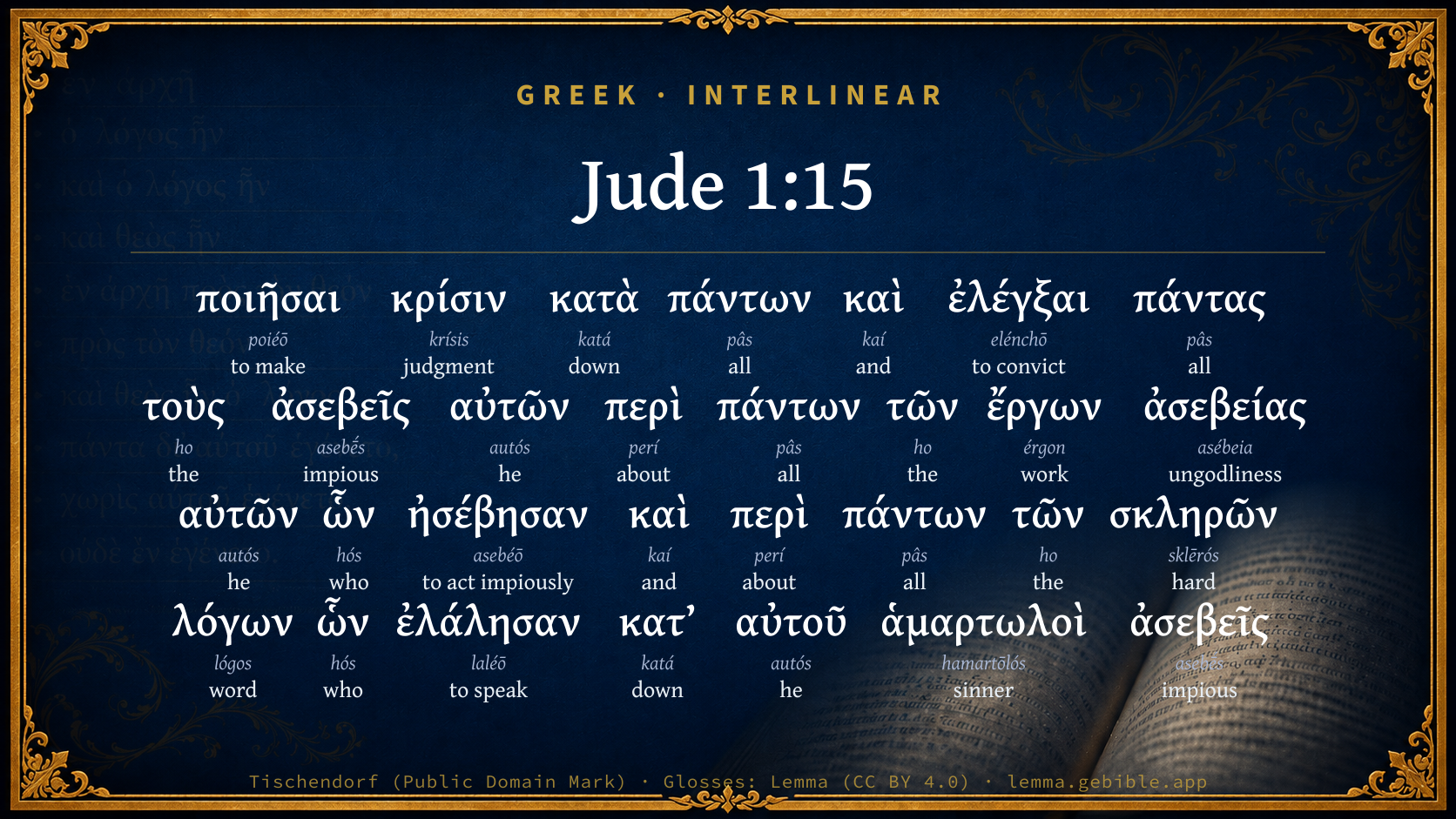
to execute judgment on all, and to convict all the ungodly of all their works of ungodliness which they have done in an ungodly way, and of all the hard things which ungodly sinners have spoken against him."
Download a study sheet
One document with this verse’s original text, its word-by-word gloss line, the meaning frame, cross-references with their text, attributed commentary, and full source and license credits — printable, and it pastes into notes with its structure intact.
This verse Autodidact and up
A passage Seminary Student
Up to 50 verses in one chapter. A passage sheet keeps up to 6 commentary sources and 12 cross-references per verse, in the order this page ranks them, and says so on the sheet whenever that leaves anything out. Ask for a single verse and you get the Autodidact verse sheet above.
Everything on this page stays free to read, with no account — the sheet is a download of what is already on screen, not access to it.
Compare translations 3
The same verse in 3 English versions, stacked beneath the original-language interlinear above. Click any original word for its lexicon entry.
Each is an independent rendering of the whole verse — the interlinear is not word-aligned to these translations.
Highlighted words mark where these versions differ — a whole-verse word diff, not a word-by-word alignment.
-
World English Bible Public Domain
to execute judgment on all, and to convict all the ungodly of all their works of ungodliness which they have done in an ungodly way, and of all the hard things which ungodly sinners have spoken against him."
-
King James Version Public Domain
To execute judgment upon all, and to convince all that are ungodly among them of all their ungodly deeds which they have ungodly committed, and of all their hard speeches which ungodly sinners have spoken against him.
-
unfoldingWord Literal Text CC BY-SA 4.0
to do judgment against everyone and to rebuke every soul concerning all their works of ungodliness, which they did in an ungodly way, and concerning all the harsh things which ungodly sinners spoke against him.”
unfoldingWord Literal Text — © unfoldingWord, licensed CC BY-SA 4.0. Word-aligned USFM3 via Door43 (git.door43.org/unfoldingWord/en_ult).
Show all 19 translations
Every available English version of this verse, each an independent rendering of the whole verse.
-
World English Bible Public Domain
to execute judgment on all, and to convict all the ungodly of all their works of ungodliness which they have done in an ungodly way, and of all the hard things which ungodly sinners have spoken against him."
-
Berean Standard Bible Public Domain
to execute judgment on everyone, and to convict all the ungodly of every ungodly act of wickedness and every harsh word spoken against Him by ungodly sinners.”
-
Majority Standard Bible Public Domain
to execute judgment on everyone, and to convict all the ungodly among them of every ungodly act of wickedness and every harsh word spoken against Him by ungodly sinners.”
-
King James Version Public Domain
To execute judgment upon all, and to convince all that are ungodly among them of all their ungodly deeds which they have ungodly committed, and of all their hard speeches which ungodly sinners have spoken against him.
-
American Standard Version (1901) Public Domain
to execute judgment upon all, and to convict all the ungodly of all their works of ungodliness which they have ungodly wrought, and of all the hard things which ungodly sinners have spoken against him.
-
Revised Version (1885) Public Domain
to execute judgment upon all, and to convict all the ungodly of all their works of ungodliness which they have ungodly wrought, and of all the hard things which ungodly sinners have spoken against him.
-
Geneva Bible (1599) Public Domain
To giue iudgement against al men, and to rebuke all the vngodly among them of all their wicked deeds, which they haue vngodly committed, and of all their cruel speakings, which wicked sinners haue spoken against him.
-
Douay-Rheims (1899) Public Domain
To execute judgment upon all, and to reprove all the ungodly for all the works of their ungodliness, whereby they have done ungodly, and of all the hard things which ungodly sinners have spoken against God.
-
Young's Literal Translation Public Domain
to do judgment against all, and to convict all their impious ones, concerning all their works of impiety that they did impiously, and concerning all the stiff things that speak against Him did impious sinners.'
-
Literal Standard Version CC BY-SA 4.0
to do judgment against all, and to convict all their impious ones, concerning all their works of impiety that they did impiously, and concerning all the harsh [words] that impious sinners spoke against Him.”
-
Unlocked Literal Bible CC BY-SA 4.0
He is coming to execute judgment on everyone. He is coming to convict all the ungodly of all the works they have done in an ungodly way, and of all the harsh words that ungodly sinners have spoken against him.”
-
unfoldingWord Literal Text CC BY-SA 4.0
to do judgment against everyone and to rebuke every soul concerning all their works of ungodliness, which they did in an ungodly way, and concerning all the harsh things which ungodly sinners spoke against him.”
-
Darby Bible Public Domain
to execute judgment against all; and to convict all the ungodly of them of all their works of ungodliness, which they have wrought ungodlily, and of all the hard [things] which ungodly sinners have spoken against him.
-
World Messianic Bible Public Domain
to execute judgment on all, and to convict all the ungodly of all their works of ungodliness which they have done in an ungodly way, and of all the hard things which ungodly sinners have spoken against him.”
-
Webster's Bible Public Domain
To execute judgment upon all, and to convict all that are ungodly among them of all their ungodly deeds which they have impiously committed, and of all their hard speeches which ungodly sinners have spoken against him.
-
Free Bible Version CC BY-SA 4.0
to judge everyone, to reveal all the wicked things people have done, and all the terrible things hostile sinners have said against him.”
-
Bible in Basic English Public Domain
To be the judge of all, and to give a decision against all those whose lives are unpleasing to him, because of the evil acts which they have done, and because of all the hard things which sinners without fear of God have said against him.
-
Text-Critical English NT CC BY 4.0
to execute judgment against all and to convict all the ungodly among them of all their ungodly deeds that they have done in an ungodly way, and to convict ungodly sinners of all the harsh words they have spoken against him.”
-
Tyndale New Testament (1534) Public Domain
to geve iudgement agaynst all men and to rebuke all that are vngodly amonge them of all their vngodly dedes which they have vngodly committed and of all their cruell speakynges which vngodly sinners have spoken agaynst him.
Literal Standard Version (2020), Covenant Press — licensed CC BY-SA 4.0. Text via the HelloAO Bible API (eBible.org). Unlocked Literal Bible (unfoldingWord) — licensed CC BY-SA 4.0. Text via the HelloAO Bible API (eBible.org). unfoldingWord Literal Text — © unfoldingWord, licensed CC BY-SA 4.0. Word-aligned USFM3 via Door43 (git.door43.org/unfoldingWord/en_ult). Free Bible Version, Dr. Jonathan Gallagher — licensed CC BY-SA 4.0. Text via the HelloAO Bible API (eBible.org).
Word by word
More ways to search: Search by grammar → Find every occurrence → Compare this word →
Practice this passage: Drill this verse → Learn its vocabulary →
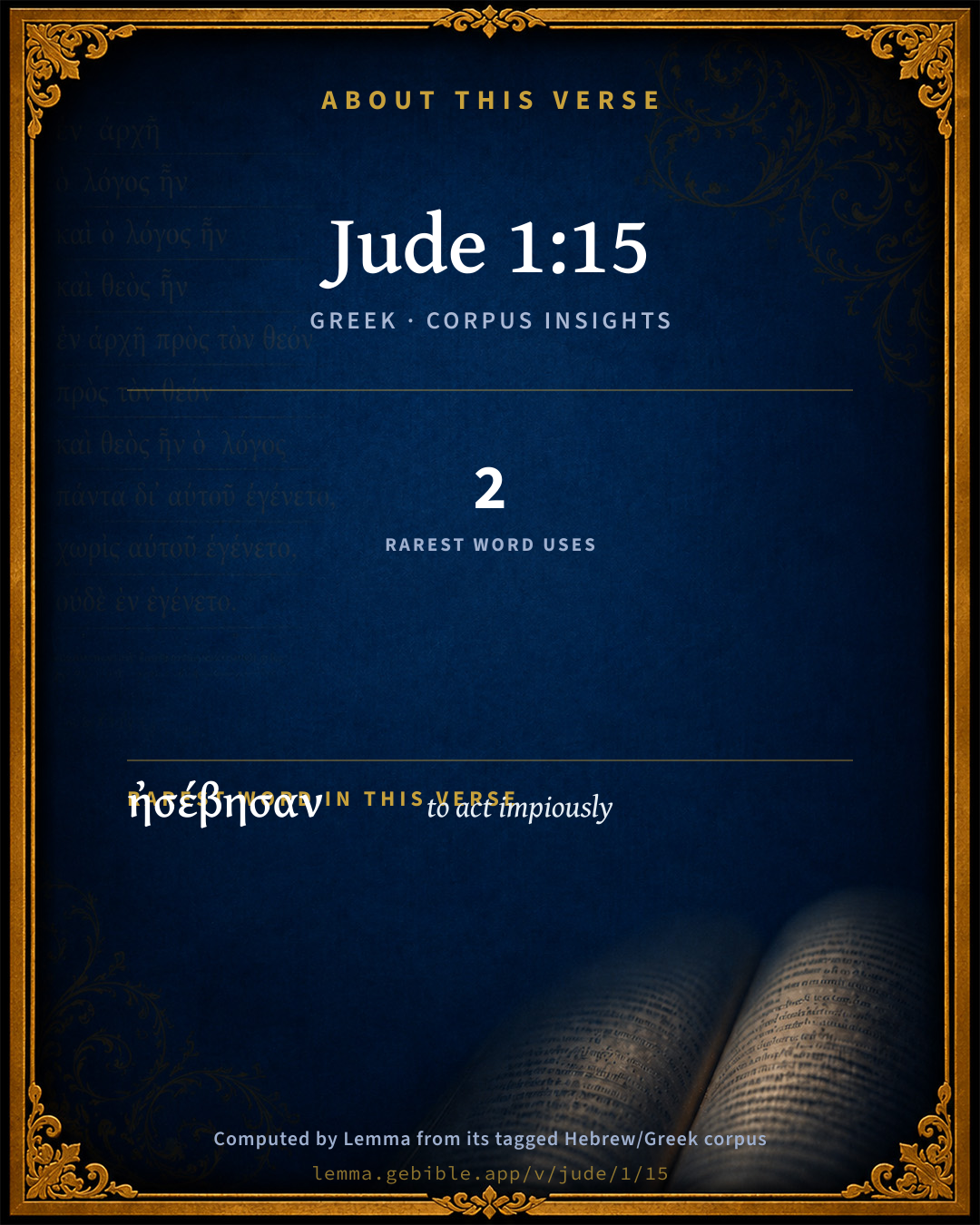
- Appears 2× in the Greek New Testament
- First appears at 2 Peter 2:6
- Part of Speech
- Verb
- Tense
- Aorist
- Voice
- Active
- Mood
- Indicative
- Person
- 3rd person
- Number
- Plural
Full Thayer's Definition
- ποιῆσαι poiéō G4160 “to make” Verb, Aorist, Active, Infinitive
- κρίσιν krísis G2920 “judgment” Noun, Accusative, Singular, Feminine
- κατὰ katá G2596 “down” Preposition
- πάντων pâs G3956 “all” Adjective, Genitive, Plural, Masculine
- καὶ kaí G2532 “and” Conjunction
- ἐλέγξαι elénchō G1651 “to convict” Verb, Aorist, Active, Infinitive
- πάντας pâs G3956 “all” Adjective, Accusative, Plural, Masculine
- τοὺς ho G3588 “the” Article, Accusative, Plural, Masculine
- ἀσεβεῖς asebḗs G765 “impious” Adjective, Nominative, Plural, Masculine
- αὐτῶν autós G846 “he” Personal pronoun, Genitive, Plural, Masculine
- περὶ perí G4012 “about” Preposition
- πάντων pâs G3956 “all” Adjective, Genitive, Plural, Neuter
- τῶν ho G3588 “the” Article, Genitive, Plural, Neuter
- ἔργων érgon G2041 “work” Noun, Genitive, Plural, Neuter
- ἀσεβείας asébeia G763 “ungodliness” Noun, Genitive, Singular, Feminine
- αὐτῶν autós G846 “he” Personal pronoun, Genitive, Plural, Masculine
- ὧν hós G3739 “who” Relative pronoun, Genitive, Plural, Neuter
- ἠσέβησαν asebéō G764 “to act impiously” Verb, Aorist, Active, Indicative, 3rd person, Plural
- καὶ kaí G2532 “and” Conjunction
- περὶ perí G4012 “about” Preposition
- πάντων pâs G3956 “all” Adjective, Genitive, Plural, Neuter
- τῶν ho G3588 “the” Article, Genitive, Plural, Neuter
- σκληρῶν sklērós G4642 “hard” Adjective, Genitive, Plural, Neuter
- λόγων lógos G3056 “word” Noun, Genitive, Plural, Masculine
- ὧν hós G3739 “who” Relative pronoun, Genitive, Plural, Neuter
- ἐλάλησαν laléō G2980 “to speak” Verb, Aorist, Active, Indicative, 3rd person, Plural
- κατ’ katá G2596 “down” Preposition
- αὐτοῦ autós G846 “he” Personal pronoun, Genitive, Singular, Masculine
- ἁμαρτωλοὶ hamartōlós G268 “sinner” Adjective, Nominative, Plural, Masculine
- ἀσεβεῖς asebḗs G765 “impious” Adjective, Nominative, Plural, Masculine
About this verse
These counts appear in no published source. They are computed here, from the morphology-tagged text and Lemma’s own curated glosses. What Lemma adds →
- 30
- words
- 18
- distinct lemmas
- General Epistles
- section
Cross-references
32Topical passages linked to Jude 1:15 in the Treasury of Scripture Knowledge — connected by theme and wording, ordered by reader-vote popularity; previews shown in the World English Bible.
- Ecclesiastes 11:9 Rejoice, young man, in your youth, And let your heart cheer you in the days of your youth, And walk in the ways of your heart, And in the sight of your eyes; But know that for all these things God will bring you into judgment.
- Romans 14:10 But you, why do you judge your brother? Or you again, why do you despise your brother? For we will all stand before the judgment seat of Christ.
- 1 Corinthians 4:5 Therefore judge nothing before the time, until the Lord comes, who will both bring to light the hidden things of darkness, and reveal the counsels of the hearts. Then each man will get his praise from God.
- Revelation 22:12–15 "Behold, I come quickly. My reward is with me, to repay to each man according to his work.
- Exodus 16:8 Moses said, "Now Yahweh shall give you meat to eat in the evening, and in the morning bread to satisfy you; because Yahweh hears your murmurings which you murmur against him. And who are we? Your murmurings are not against us, but against Yahweh."
- 1 Samuel 2:3 Talk no more so exceeding proudly; Don't let arrogance come out of your mouth; For Yahweh is a God of knowledge, By him actions are weighed.
- Psalms 9:7–8 But Yahweh reigns forever. He has prepared his throne for judgment.
- Psalms 50:1–6 The Mighty One, God, Yahweh, speaks, And calls the earth from sunrise to sunset.
- Psalms 98:9 Let them sing before Yahweh, For he comes to judge the earth. He will judge the world with righteousness, And the peoples with equity.
- John 5:27 He also gave him authority to execute judgment, because he is a son of man.
- Acts 17:31 because he has appointed a day in which he will judge the world in righteousness by the man whom he has ordained; of which he has given assurance to all men, in that he has raised him from the dead."
- Romans 2:5 But according to your hardness and unrepentant heart you are treasuring up for yourself wrath in the day of wrath, revelation, and of the righteous judgment of God;
- Romans 2:16 in the day when God will judge the secrets of men, according to my Gospel, by Jesus Christ.
- 1 Timothy 1:9 as knowing this, that law is not made for a righteous man, but for the lawless and insubordinate, for the ungodly and sinners, for the unholy and profane, for murderers of fathers and murderers of mothers, for manslayers,
- Revelation 13:5–6 A mouth speaking great things and blasphemy was given to him. Authority to make war for forty-two months was given to him.
- Psalms 37:6 He will make your righteousness go forth as the light, And your justice as the noon day sun.
- Psalms 149:9 To execute on them the written judgment. All his saints have this honor. Praise Yah!
- Ecclesiastes 12:14 For God will bring every work into judgment, with every hidden thing, whether it is good, or whether it is evil.
- Isaiah 37:22–36 this is the word which Yahweh has spoken concerning him: The virgin daughter of Zion has despised you and ridiculed you; the daughter of Jerusalem has shaken her head at you.
- Daniel 11:36 The king shall do according to his will; and he shall exalt himself, and magnify himself above every god, and shall speak marvelous things against the God of gods; and he shall prosper until the indignation be accomplished; for that which is determined shall be done.
- Malachi 3:13–15 "Your words have been stout against me," says Yahweh. "Yet you say, 'What have we spoken against you?'
- Matthew 12:31–37 Therefore I tell you, every sin and blasphemy will be forgiven men, but the blasphemy against the Spirit will not be forgiven men.
- John 5:22–23 For the Father judges no one, but he has given all judgment to the Son,
- 1 Corinthians 5:13 But those who are outside, God judges. "Put away the wicked man from among yourselves."
- 2 Peter 2:6–9 and turning the cities of Sodom and Gomorrah into ashes, condemned them to destruction, having made them an example to those who would live ungodly;
- Psalms 31:18 Let the lying lips be mute, Which speak against the righteous insolently, with pride and contempt.
- Psalms 73:9 They have set their mouth in the heavens. Their tongue walks through the earth.
- Psalms 94:4 They pour out arrogant words. All the evil-doers boast.
- Daniel 7:20 and concerning the ten horns that were on its head, and the other [horn] which came up, and before which three fell, even that horn that had eyes, and a mouth that spoke great things, whose look was more stout than its fellows.
- Romans 3:19–20 Now we know that whatever things the law says, it speaks to those who are under the law, that every mouth may be closed, and all the world may be brought under the judgment of God.
- Jude 1:16 These are murmurers and complainers, walking after their lusts (and their mouth speaks proud things), showing respect of persons to gain advantage.
- Revelation 22:20 He who testifies these things says, "Yes, I come quickly." Amen! Yes, come, Lord Jesus.
Cross-references courtesy of OpenBible.info (CC BY 4.0).
Where the printed editions differ
3 variantsPlaces in this verse where the major printed Greek editions disagree on the wording in a way that affects the translation — a comparison of editions, not a manuscript-by-manuscript collation. The editions are the modern critical texts (Nestlé-Aland 28/27, SBL, Westcott-Hort, Tregelles, Tyndale House) and the traditional texts behind the KJV (the Textus Receptus and the Byzantine/Majority text). It is not a claim about which reading is original.
-
Different wording
ἐλέγξαι
“to convict”
In NA28NA27TynSBLWHTregByz Not in TRἐξἐλέγξαι (exelegxai) 'to convince' occurs in traditional manuscripts (TR) instead of ἐλέγξαι (elegxai) 'to convict' in older manuscripts (NA28+NA27+Tyn+SBL+WH+Treg+Byz)
-
Different wording
ψυχὴν
“soul”
In NA28NA27 Not in TynSBLWHTregTRByzἀσεβεῖς (asebeis) 'ungodly' occurs in traditional manuscripts (Tyn+SBL+WH+Treg+TR+Byz) instead of ψυχὴν (psuchēn) 'soul' in older manuscripts (NA28+NA27)
-
Extra text
αὐτῶν
“of them”
In TRByz Not in NA28NA27TynSBLWHTregαὐτῶν (autōn) 'of them' is only in traditional manuscripts (TR+Byz)
Textual data: Translators Amalgamated Greek New Testament (STEPBible TAGNT) · CC BY 4.0.
Lesson kit
Teaching starters — assembled from the data on this page, not authored interpretation. Every prompt links to the verse data it draws on. Edit before teaching.
Jude, in the General Epistles, opens this verse with 30 words (18 distinct Greek lemmas). Its most distinctive word is asebéō (“to act impiously”). A historical commentator’s framing appears above. Read the whole chapter for the surrounding context.
Discussion questions
- What does “to act impiously” (asebéō) contribute to the verse as a whole?
- How does 2 Peter 2:6, which shares the word «to act impiously», read alongside this verse?
- What does the repetition of “all” (4× in this one verse) do in this verse?
- These translations render this verse differently. What is at stake in choosing one wording over another?
- Compare how Bengel's Gnomon and Expositor's Greek Testament read this verse. Where do they agree or differ?
Things to notice
- These translations choose different wording for 25 words in this verse.
- “all” occurs 4× in this single verse.
- 18 distinct Greek lemmas span 30 words in this verse.
Commentary
Notes on Jude 1:15 from classic Christian and Jewish commentators (each source and its license shown beneath its notes). The classic Christian expositions comment on the surrounding passage and are grouped to its opening verse, so a note may address several verses; the Jewish commentaries on the Tanakh (Rashi and others) are per-verse, so they appear only where the commentator wrote on this verse.
Lemma curates 59 commentaries, every one of them public domain or Creative Commons licensed, each selected and text-cleaned for this edition rather than reprinted as found. About our sources →
Bengel's Gnomon
Johann Albrecht Bengel
Bengel's Gnomon of the New Testament — English translation (T&T Clark, Edinburgh, 1860) — public domain. Text from a community e-Sword module.
Expositor's Greek Testament
ed. W. Robertson Nicoll
The Expositor's Greek Testament, edited by W. Robertson Nicoll (1897–1910) — public domain. Text from a community e-Sword module.
Jamieson, Fausset & Brown
Robert Jamieson, A. R. Fausset & David Brown
Jamieson, Fausset & Brown — Commentary Critical and Explanatory on the Whole Bible (1871) — public domain (CC PDM 1.0). Text via the HelloAO Bible API.
Adam Clarke's Commentary
Adam Clarke's Commentary on the Bible (1810–1826) — public domain. Text from a community e-Sword/MySword module.
John Calvin's Commentaries
John Calvin's Commentaries (1540-1563) — public domain. Text from the Calvin Translation Society English edition (1840s-50s) via the Christian Classics Ethereal Library (ccel.org). Calvin's coverage is partial (roughly two-thirds of the Bible); uncommented books and verses are honest gaps, never fabricated. The 19th-century editor's footnotes and remarks are omitted so the notes are faithfully Calvin's own voice.
The Cambridge Bible for Schools and Colleges
gen. ed. J. J. S. Perowne
The Cambridge Bible for Schools and Colleges (gen. ed. J. J. S. Perowne; Cambridge University Press, 1878–1918) — public domain. Text from a community e-Sword module.
John Gill's Exposition
John Gill's Exposition of the Whole Bible (1746–1763) — public domain (CC PDM 1.0). Text via the HelloAO Bible API.
Albert Barnes' Notes on the Bible
Albert Barnes' Notes on the Bible (1834–1885) — public domain. Text from a community e-Sword/MySword module.
Haydock's Catholic Bible Commentary
George Leo Haydock (1774–1849), Haydock's Catholic Family Bible and Commentary, 1859 edition — public domain. Excludes Psalms (Douay-Rheims chapter numbering differs from Protestant) and Deuterocanonical books (Catholic canon only).
Matthew Poole's English Annotations
Matthew Poole's English Annotations on the Holy Bible (1683–1685) — public domain. Text from a community e-Sword/MySword module.
Whedon's Commentary on the Bible
Daniel D. Whedon
Daniel D. Whedon (gen. ed.), Commentary on the Old and New Testaments (1874–1909) — public domain. Text from a community e-Sword module.
John Wesley's Explanatory Notes
John Wesley, Explanatory Notes Upon the Whole Bible (1754–1765) — public domain. Text via the GEBible commentary corpus.
Scofield Reference Notes
C. I. Scofield
The Scofield Reference Bible (1917 edition), notes by C. I. Scofield — public domain. Text from a community e-Sword module.
Godbey's Commentary on the New Testament
William B. Godbey
William B. Godbey, Commentary on the New Testament (1896–1900) — public domain. Text from a community e-Sword module.
The People's New Testament
B. W. Johnson
B. W. Johnson's The People's New Testament with Notes (1889–1891) — public domain. Electronic text from the Christian Classics Ethereal Library (CCEL) ThML edition.
Alford’s Greek Testament
Henry Alford
Henry Alford, The Greek Testament (1849–1861) — public domain. Text from a community e-Sword module.