
Romans 4:2

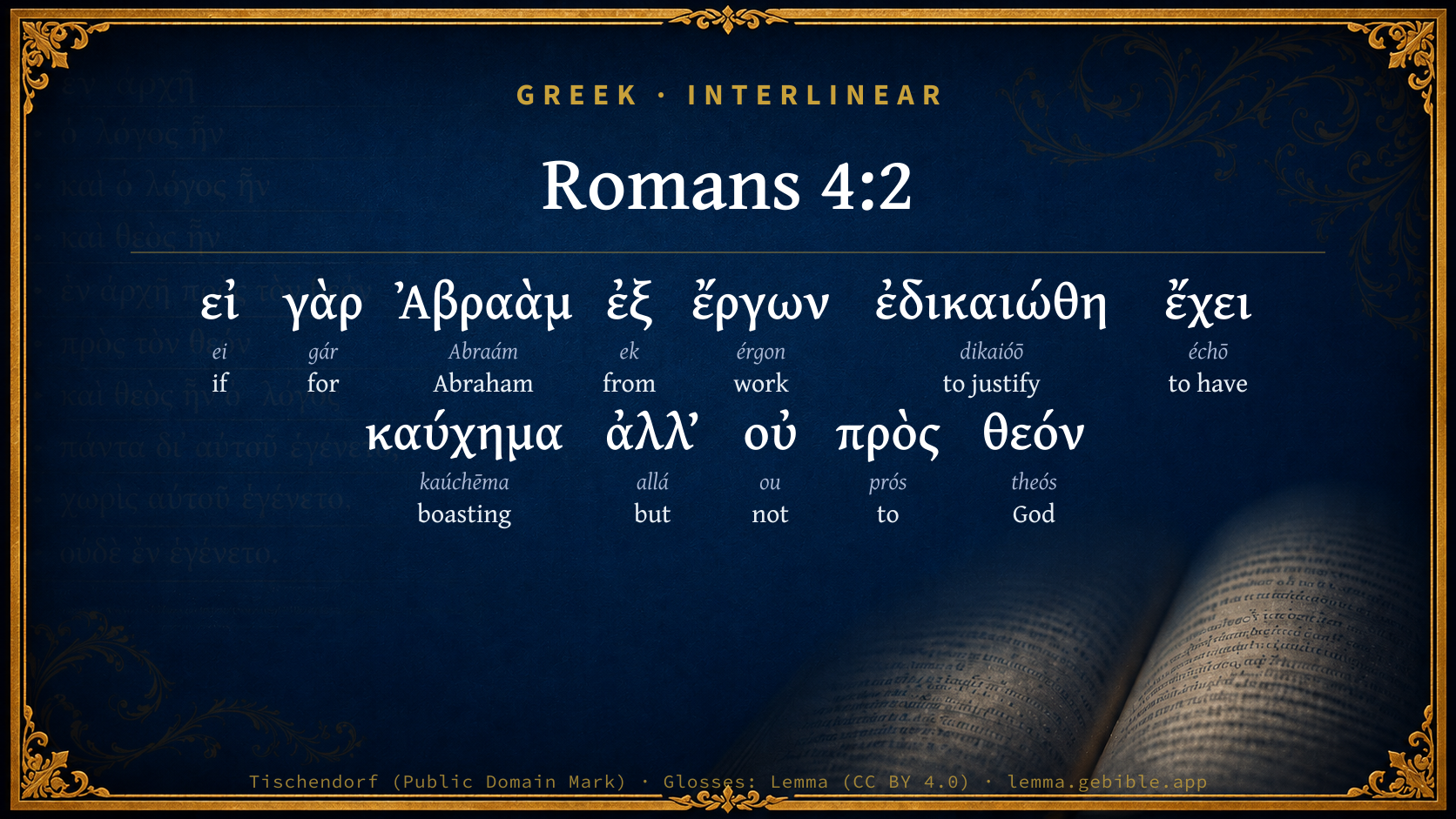
Greek (Tischendorf 8th ed.) Romans 4:2 appears in the Greek New Testament. The text above is from the Tischendorf 8th edition. Each word links to its Strong’s number and a concise gloss. Click any word for its full Thayer’s Greek Lexicon entry.
Download image
Cite this verse

Romans 4:2 (World English Bible). Public Domain. Lemma interlinear Bible study tool, https://lemma.gebible.app/v/romans/4/2.

Show BibTeX & RIS
BibTeX
RIS
English Translation
For if Abraham was justified by works, he has something to boast about, but not toward God.
World English Bible · Public Domain
Highlights
  • 1 first appearance in the Greek New Testament
Full analysis ↓
Download a study sheet

One document with this verse’s original text, its word-by-word gloss line, the meaning frame, cross-references with their text, attributed commentary, and full source and license credits — printable, and it pastes into notes with its structure intact.

This verse Autodidact and up

Study sheet (.html) Plain text (.txt)

A passage Seminary Student

Up to 50 verses in one chapter. A passage sheet keeps up to 6 commentary sources and 12 cross-references per verse, in the order this page ranks them, and says so on the sheet whenever that leaves anything out. Ask for a single verse and you get the Autodidact verse sheet above.

Everything on this page stays free to read, with no account — the sheet is a download of what is already on screen, not access to it.

Want to remove ads? Support Godless Engineer
Compare translations 3

The same verse in 3 English versions, stacked beneath the original-language interlinear above. Click any original word for its lexicon entry.

Each is an independent rendering of the whole verse — the interlinear is not word-aligned to these translations.

Highlighted words mark where these versions differ — a whole-verse word diff, not a word-by-word alignment.

  • World English Bible Public Domain
    For if Abraham was justified by works, he has something to boast about, but not toward God.
  • King James Version Public Domain
    For if Abraham were justified by works, he hath whereof to glory; but not before God.
  • unfoldingWord Literal Text CC BY-SA 4.0
    For if Abraham was justified by works, he has a boast, but not before God.

unfoldingWord Literal Text — © unfoldingWord, licensed CC BY-SA 4.0. Word-aligned USFM3 via Door43 (git.door43.org/unfoldingWord/en_ult).

Versions to compare (up to 4)

3 of 4 selected

Show all 19 translations

Every available English version of this verse, each an independent rendering of the whole verse.

  • World English Bible Public Domain
    For if Abraham was justified by works, he has something to boast about, but not toward God.
  • Berean Standard Bible Public Domain
    If Abraham was indeed justified by works, he had something to boast about, but not before God.
  • Majority Standard Bible Public Domain
    If Abraham was indeed justified by works, he had something to boast about, but not before God.
  • King James Version Public Domain
    For if Abraham were justified by works, he hath whereof to glory; but not before God.
  • American Standard Version (1901) Public Domain
    For if Abraham was justified by works, he hath whereof to glory; but not toward God.
  • Revised Version (1885) Public Domain
    For if Abraham was justified by works, he hath whereof to glory; but not toward God.
  • Geneva Bible (1599) Public Domain
    For if Abraham were iustified by workes, he hath wherein to reioyce, but not with God.
  • Douay-Rheims (1899) Public Domain
    For if Abraham were justified by works, he hath whereof to glory, but not before God.
  • Young's Literal Translation Public Domain
    for if Abraham by works was declared righteous, he hath to boast -- but not before god;
  • Literal Standard Version CC BY-SA 4.0
    For if Abraham was declared righteous by works, he has to boast—but not before God;
  • Unlocked Literal Bible CC BY-SA 4.0
    For if Abraham had been justified by works, he would have had a reason to boast, but not before God.
  • unfoldingWord Literal Text CC BY-SA 4.0
    For if Abraham was justified by works, he has a boast, but not before God.
  • Darby Bible Public Domain
    For if Abraham has been justified on the principle of works, he has whereof to boast: but not before God;
  • World Messianic Bible Public Domain
    For if Abraham was justified by works, he has something to boast about, but not toward God.
  • Webster's Bible Public Domain
    For if Abraham were justified by works, he hath whereof to glory, but not before God.
  • Free Bible Version CC BY-SA 4.0
    For if Abraham was set right by what he did, he would have had something to boast about—but not in God's eyes.
  • Bible in Basic English Public Domain
    For if Abraham got righteousness by works, he has reason for pride; but not before God.
  • Text-Critical English NT CC BY 4.0
    If Abraham was justified by works, he has something to boast about, but not before God.
  • Tyndale New Testament (1534) Public Domain
    If Abraham were iustified by dedes the hath he wherin to reioyce: but not with god.

Literal Standard Version (2020), Covenant Press — licensed CC BY-SA 4.0. Text via the HelloAO Bible API (eBible.org). Unlocked Literal Bible (unfoldingWord) — licensed CC BY-SA 4.0. Text via the HelloAO Bible API (eBible.org). unfoldingWord Literal Text — © unfoldingWord, licensed CC BY-SA 4.0. Word-aligned USFM3 via Door43 (git.door43.org/unfoldingWord/en_ult). Free Bible Version, Dr. Jonathan Gallagher — licensed CC BY-SA 4.0. Text via the HelloAO Bible API (eBible.org).

Word by word

More ways to search: Search by grammar → Find every occurrence → Compare this word →

Practice this passage: Drill this verse → Learn its vocabulary →

About this verse

These counts appear in no published source. They are computed here, from the morphology-tagged text and Lemma’s own curated glosses. What Lemma adds →

12
words
12
distinct lemmas
Pauline Epistles
section

Notable vocabulary

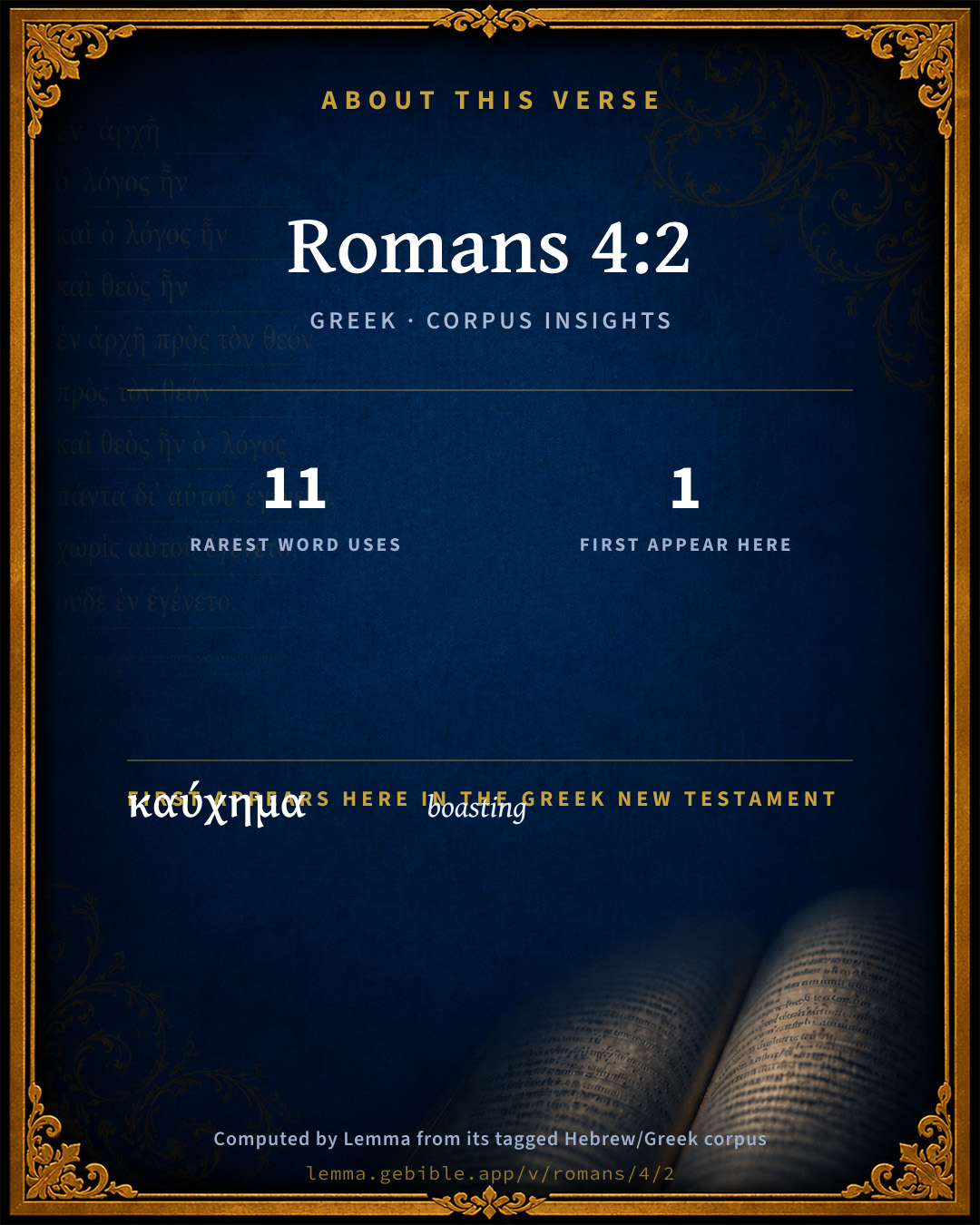
The rarest word here is καύχημα boasting G2745 — appearing just 11 times in the whole Greek New Testament.

First appearance in Scripture

This word makes its first canonical appearance in the Greek New Testament here:

  • καύχημα boasting G2745

Shared distinctive vocabulary

καύχημα boasting G2745 occurs in 11 verses of the Greek New Testament. Also found in:
Cross-references

21

Topical passages linked to Romans 4:2 in the Treasury of Scripture Knowledge — connected by theme and wording, ordered by reader-vote popularity; previews shown in the World English Bible.

  • 1 Corinthians 1:31 that, according as it is written, "He who boasts, let him boast in the Lord."
  • 2 Corinthians 11:30 If I must boast, I will boast of the things that concern my weakness.
  • Philippians 3:9 and be found in him, not having a righteousness of my own, that which is of the law, but that which is through faith in Christ, the righteousness which is from God by faith;
  • Galatians 3:22 But the Scriptures shut up all things under sin, that the promise by faith in Jesus Christ might be given to those who believe.
  • Ephesians 2:9 not of works, that no one would boast.
  • Romans 3:20–28 Because by the works of the law, no flesh will be justified in his sight. For through the law comes the knowledge of sin.
  • 1 Corinthians 1:29 that no flesh should boast before God.
  • 1 Corinthians 9:16 For if I preach the Gospel, I have nothing to boast about; for necessity is laid on me; but woe is to me, if I don't preach the Gospel.
  • 2 Corinthians 12:1–9 It is doubtless not profitable for me to boast. For I will come to visions and revelations of the Lord.
  • Galatians 6:13–14 For even they who receive circumcision don't keep the law themselves, but they desire to have you circumcised, that they may boast in your flesh.
  • Genesis 12:12–13 It will happen, when the Egyptians will see you, that they will say, 'This is his wife.' They will kill me, but they will save you alive.
  • Genesis 12:18 Pharaoh called Abram, and said, "What is this that you have done to me? Why didn't you tell me that she was your wife?
  • Jeremiah 9:23–24 Thus says Yahweh, Don't let the wise man glory in his wisdom, neither let the mighty man glory in his might, don't let the rich man glory in his riches;
  • Romans 15:17 I have therefore my boasting in Christ Jesus in things pertaining to God.
  • 2 Corinthians 5:12 For we are not commending ourselves to you again, but speak as giving you occasion of boasting on our behalf, that you may have something to answer those who boast in appearance, and not in heart.
  • Genesis 12:20 Pharaoh gave men charge concerning him: and they brought him on the way, and his wife, and all that he had.
  • Genesis 20:9–13 Then Abimelech called Abraham, and said to him, "What have you done to us? How have I sinned against you, that you have brought on me and on my kingdom a great sin? You have done deeds to me that ought not to be done!"
  • Joshua 24:2 Joshua said to all the people, Thus says Yahweh, the God of Israel, Your fathers lived of old time beyond the River, even Terah, the father of Abraham, and the father of Nahor: and they served other gods.
  • Ezekiel 8:9 He said to me, Go in, and see the wicked abominations that they do here.
  • 1 Corinthians 4:7 For who makes you different? And what do you have that you didn't receive? But if you did receive it, why do you boast as if you had not received it?
  • 2 Corinthians 11:12 But what I do, that I will do, that I may cut off occasion from them that desire an occasion, that in which they boast, they may be found even as we.

Cross-references courtesy of OpenBible.info (CC BY 4.0).

Commentary

Notes on Romans 4:2 from classic Christian and Jewish commentators (each source and its license shown beneath its notes). The classic Christian expositions comment on the surrounding passage and are grouped to its opening verse, so a note may address several verses; the Jewish commentaries on the Tanakh (Rashi and others) are per-verse, so they appear only where the commentator wrote on this verse.

Lemma curates 59 commentaries, every one of them public domain or Creative Commons licensed, each selected and text-cleaned for this edition rather than reprinted as found. About our sources →

Bengel's Gnomon

Johann Albrecht Bengel

Rom 4:2. Εἰ, if) A particle implying reluctant concession [for argument’s sake].—γὰρ, for) [The γάρ expresses] the cause after the proposition, and the reason why, in Rom 4:1, he added the limitation, hath found as pertaining to the flesh.[43]—πρὸς) to, or before. He was not justified by works before God, and therefore, he has no ground of boasting before God; but both [hold good of him] according to the flesh.

[43] Εξ ἔργων, from works) Abraham was before the law, hence Paul introduces no mention of the law, ver. 1–12.—V. g.

Bengel's Gnomon of the New Testament — English translation (T&T Clark, Edinburgh, 1860) — public domain. Text from a community e-Sword module.

Meyer's Critical & Exegetical Commentary

Heinrich August Wilhelm Meyer

Rom_4:2. The question in Rom_4:1 contained the negative sense, which had therefore necessarily to be limited by κατὰ σάρκα: We may not assert that Abraham has obtained anything according to the flesh. The reason for this is now assigned (γάρ): For, assuming that Abraham has been justified by works (as was the Jewish opinion[964]), he has cause for boasting, namely, that he has attained righteousness through his actions, but he has not this ground of boasting with respect to God (as if his justification were the divine act), since, namely, in the case supposed it is not God to whom he owes the justification, but on the contrary he has himself earned it, and God would simply have to acknowledge it as a human self-acquirement. God has not, in that supposed case, done anything for him, on account of which he might thus boast with regard to God as his justifier; for ἡ τῶν ἀγαθῶν ἔργων πληρῶσις αὐτοὺς στεφανοῖ τοῦς ἐργαζομένους, τὴν δὲ τ. Θεοῦ φιλανθρωπίαν οὐ δείκνυσιν, Theodoret. Comp also Chrysostom, Oecumenius, and Theophylact. Thus for the proper understanding of this difficult passage (Chrysostom: ἀσάφες τὸ εἰρημένον) we must go back to the explanation of the Greek expositors, which is quite faithful both to the words and the context. Comp on Rom_4:3-4. This interpretation, now adopted also by Tholuck (comp Reithmayr and Th. Schott), has especially this advantage, that ἐδικαιώθη is not taken otherwise than in the entire development of the δικαιοσύνη Θεοῦ, not therefore as somewhat indefinite and general (justus apparuit, Grotius), in which case it would remain a question by whom Abraham was found righteous (Rückert, Philippi; comp Beza and others; also Grotius and Koppe, and, with trifling variation, de Wette, likewise Spohn in the Stud. u. Krit. 1843, p. 429 ff., Volckmar, and others). That Abraham was justified with God was known to no Jew otherwise (comp Sir_44:19 ff.; Manass. 8; Joseph. Antt. xi. 5, 7; Eisenmenger, entdeckt. Judenth. I. p. 322, 343), and no reader could in accordance with the entire context understand ἐδικαιώθη otherwise, than in this definite sense, consequently in the solemn absolute sense of the Apostle (in opposition to Lipsius, Rechtfertigungsl. p. 35). The only question was, whether ἐξ ἔργων or ἐκ πίστεως. If we suppose the former case, it is indeed for Abraham worthy of all honour, and he may boast of that which he has himself achieved, but with reference to God, as if He had justified him, he has no ground for boasting.[970] Observe besides, that πρὸς is used not in the sense of ἘΝΏΠΙΟΝ, coram (Hofmann: overagainst), or apud (Vulgate), but in accordance with the quite common usage of ἔχειν with the object of the thing (to have something to do, to say, to boast, to ask, to censure, etc.), and with specification of the relation of reference to some one through πρὸς τινα. The opposite of ἜΧΕΙΝ ΚΑΎΧΗΜΑ ΠΡΌς is ἜΧΕΙΝ ΜΟΜΦῊΝ ΠΡΌς, Col_3:13. The special mode of the reference is invariably furnished by the context, which here, in accordance with the idea of δικαιοσύνη Θεοῦ, suggests the notion that God is the bestower of the blessing meant by καύχημα. To that the ἔχειν καύχημα of Abraham does not refer, if he was justified by works. In the latter case he cannot boast of himself: ὁ Θεὸς με ἐδίκαιωσε, Θεοῦ τὸ δῶρον. Reiche and Fritzsche, following Calvin, Calovius, and many others, have discovered here an incomplete syllogism, in which ἀλλʼ οὐ πρὸς τ. Θεόν is the minor premiss, and the conclusion is wanting, to this effect: Si suis bene factis Dei favorem nactus est, habet quod apud Deum glorietur.…; sed non habet, quod apud Deum glorietur, quum libri s. propter fidem, non propter pulchre facta eum Deo probatum esse doceant (Rom_4:3).…; non est igitur Abr. ob bene facta Deo probatus, Fritzsche. So in substance also Kraussold in the Stud. u. Krit. 1842, p. 783; Baur in the Theol. Jahrb. 1857, p. 71; Köstlin in the Jahrb. f. Deutsche Theol. 1856, p. 92. Forced, and even contrary to the verbal sense; for through the very contrast ἀλλʼ οὐ π. τ. Θ. the simple ΚΑΎΧΗΜΑ is distinguished from the καύχημα πρὸς τ. Θεόν, as one that takes place not πρὸς τὸν Θεόν. Paul must have written: ἜΧΕΙ ΚΑΎΧΗΜΑ ΠΡῸς ΤῸΝ ΘΕΌΝ· ἈΛΛʼ (or ἈΛΛᾺ ΜῊΝ) ΟὐΚ ἜΧΕΙ. Mehring takes ἈΛΛʼ Οὐ ΠΡῸς ΤῸΝ ΘΕΌΝ as a question: If Abraham has become righteous by works, he has glory, but has he it not before God? But in what follows it is the very opposite of the affirmation, which this question would imply, that is proved. If the words were interrogative, ἀλλὰ μή must have been used instead of ἈΛΛʼ Οὐ (but yet not before God?) Hofmann, in consequence of his erroneous exposition of Rom_4:1, supposes that Paul wishes to explain how he came to propose the question in Rom_4:1, and to regard an answer to it as necessary. What is here involved, namely, is nothing less than a contradiction between what Christians say of themselves (when they deny all possibility of becoming righteous by their own actions), and what holds good of an Abraham, the father of the people of God. If the latter has become righteous through his own action, he has glory, and by this very circumstance his ancestorship is distinguished from that of all others. But then the Scripture teaches that what God counted worthy in Abraham was his faith, and it is therefore clear that the glory which he has, if he has become righteous by works, is no glory in presence of God, and consequently is not fitted to be the basis of his position in sacred history. This is a chain of ideas imported into the passage; instead of which it was the object of the Apostle himself merely to set forth the simple proposition that Abraham was not justified by works, and not at all to speak of the mode in which the Christian ancestorship of the patriarch came to subsist.

καύχημα (comp on Php_1:26; Php_2:16) is throughout the N. T. materies gloriandi; as also in the LXX. and Apocrypha; although in classic authors (Pind. Isthm. v. 65; Plut. Ages. 31) it also occurs as the equivalent of καύχησις, gloriatio. In Gal_6:4, also, it is joined with ἔχειν.

[964] In the Talmud it is even inferred from Gen_26:5 that Abraham kept the whole law of Moses. Kiddusch f. 82, 1; Joma f. 28, 2; Beresch. rabba f. 57, 4. Comp. the passages from Philo quoted by Schneckenburger in the Stud. u. Krit. 1833, p. 135.

[970] Van Hengel places a point after καύχ., and takes ἀλλʼ οὐ πρὸς τ. Θεόν as an independent sentence, in which he supplies secundum literas sacras, making the sense: Atqui gloriandi materiam Deum Abrahamo denegare videmus in libris sacris. But that is, in fact, not there. Against my own interpretation in the 1st ed. (making εἰ.… ἐδικαιώθη the question, and then (ἔχει.… Θεόν the answer negativing it) see Philippi. The εἰ must be the dialectic if.

Meyer — Critical and Exegetical Commentary on the New Testament — English translation by Peter Christie, edited by Frederick Crombie (T&T Clark, 1880) — public domain. Text from a community e-Sword module.

Expositor's Greek Testament

ed. W. Robertson Nicoll

Rom 4:2 f. With ἀλλʼ οὐ πρὸς τὸν θεόν the Apostle summarily repels the objection. “You say he has ground of boasting? On the contrary, he has no ground of boasting in relation to God, For what does the Scripture say? Abraham believed God, and it was imputed to Him for righteousness.” The quotation is from Gen 15:6 , and is exactly as in the LXX, except that Paul writes ἐπίστευσεν δὲ τῷ θεῷ instead of καὶ ἐπίστευσεν τῷ θεῷ , which serves partly to bring out the contrast between the real mode of Abraham’s justification, and the mode suggested in Rom 4:2 , partly to give prominence to faith , as that on which his argument turned. The reading ἐπίστευσεν δὲ is also found in Jas 1:23 , Philo i. 605 (Mangey), as well as Clem. Rom., I., x., 6, and Just. Martyr, Dial. , 92: so that it was probably current, and not introduced by Paul. It is assumed that something not in itself righteousness was reckoned to Abraham as righteousness; only on this assumption is boasting in his case excluded.

The Expositor's Greek Testament, edited by W. Robertson Nicoll (1897–1910) — public domain. Text from a community e-Sword module.

Godet's Commentaries

Frédéric Louis Godet

Vv. 2. Some commentators take this verse as the logical proof (for) of the negative answer which must be understood between Rom 4:1-2 : “Nothing; for, if he had been justified by his works, he would have whereof to glory, which is inadmissible.” But why would it be inadmissible? This is exactly the matter to be examined. The reasoning would then be only a vicious circle. The verse must be regarded, not as a proof of the negative answer anticipated, but as the explanation why Paul required to put the question of Rom 4:1 : “I ask this, because if Abraham had been justified by his works, he would really have something of which to glory; and consequently the boasting which I declared to be excluded (Rom 3:27) would reappear once more as right and good.” Did not Abraham’s example form the rule?

The expression by works is substituted for that of Rom 4:1 : according to the flesh, as the term being justified replaces the having found. In both cases, the term appearing in Rom 4:2 indicates the concrete result (works, being justified), as that in Rom 4:1 expressed the abstract principle (the flesh, finding). The word καύχημα signifies a matter for glorying in, which is quite a different thing from καύχησις, the act of glorying. Paul does not say that Abraham would really glory, but only that he would have matter for doing so. But how can the apostle express himself at the end of the verse in the words: but not before God, so as to make us suppose that Abraham was really justified by his works, though not before God? Some commentators (Beza, Grot., de Wette, Rück., Philip.) think themselves obliged to weaken the sense of the word justified, as if it denoted here justification in the eyes of men: “If Abraham was justified by his works (in the judgment of men), he has a right to boast (relatively to them and himself), but not as before God.” But would such an attenuated sense of the word justify be possible in this passage, which may be called Paul’s classical teaching on the subject of justification? Calvin, Fritzsche, Baur, Hodge, assert that we have here an incomplete syllogism; the major: “If Abraham was justified by works, he has whereof to glory;” the minor: “Now he could not have whereof to glory before God;” the conclusion (understood): “Therefore he was not justified by works.” But the minor is exactly what it would have been necessary to prove; for what had been said, Rom 3:27, of the exclusion of boasting or of justification by works, was again made a question by the discussion on the case of Abraham. Besides, the conclusion was the important part, and could not have been left to be understood. The apostle has not accustomed us to such a mode of arguing. Meyer, after some variations in his first editions, has ended by siding with the explanation of Chrysostom and Theodoret, which is to the following effect: “If Abraham was justified by his works, he has undoubtedly something whereof to glory in his own eyes; but in this case he has received no favor from God, nothing which honors him as the object of divine grace; and his justification not coming from God, he has no cause to glory in relation to God.” This meaning is very ingenious; nevertheless it is untenable; for—

1. The term glorying would require to be taken in a good sense: glorying in a real favor received from God, while throughout the whole piece it is applied to an impure boasting, the ground of which man finds in himself and in his own work.

2. Paul must have said in this sense: ἐν Θεῷ, in God, rather than πρὸς τὸν Θεόν, in relation to God, comp. Rom 2:17.

3. Rom 4:3 does not naturally connect itself with Rom 4:2 when thus understood, for this verse proves not what it should (for), to wit, that Abraham has no cause for boasting in the case supposed, but the simple truth that he was justified by his faith. Semler and Glöckler have had recourse to a desperate expedient, that of taking πρὸς τὸν Θεόν as the exclamation of an oath: “But no, by God, it is not so.” But this sense would have required πρὸς τοῦ Θεοῦ; and what could have led Paul to use such a form here? The turn of expression employed by the apostle is certainly singular, we shall say even a little perplexed. He feels he is approaching a delicate subject, about which Jewish national feeling could not but show itself very sensitive. To understand his meaning, we must, after the words: “If he was justified by works, he hath whereof to glory,” add the following: “and he has really great reason for glorying; it is something to have been made an Abraham; one may be proud of having borne such a name, but”...Here the apostle resumes in such a way as to return to his theme: “but all this glorying has nothing to do with the account which he had to render to God.” The words: in relation to God, πρὸς τὸν Θεόν, are evidently opposed to a corresponding: in relation to man, understood. In comparing himself with men less holy than he, Abraham might have some cause for glorying; but the instant he put himself before God, his righteousness vanished. This is exactly the point proved by the following verses.

Frédéric Louis Godet — Commentaries on Luke, John, Romans, and 1 Corinthians — English translation (T&T Clark, Edinburgh, 1870s–1890s) — public domain. Text from a community e-Sword module.

Hodge's Commentary on Romans, Ephesians & First Corinthians

Charles Hodge

Rom_4:2

For if Abraham were justified by works, he hath whereof to glory, but not before God. The apostles mode of reasoning is so concise as often to leave some of the steps of his argument to be supplied, which, however, are almost always sufficiently obvious from the context. As just remarked, a negative answer is to be supposed to the question in the first verse. Abraham did not attain the favor of God through the flesh. The force of for at the beginning of this verse, is then obvious, as introducing the reason for this answer. The passage itself is very concise, and the latter clause admits of different interpretations. If Abraham was justified by works, he might indeed assert his claim to the confidence and favor of his fellowmen, but he could not have any ground of boasting before God. This view, however, introduces an idea entirely foreign from the passage, and makes the conclusion the very opposite of that to which the premises would lead. For if justified by works, he would have ground of boasting before God. The interpretation given by Calvin is altogether the most satisfactory and simple: Epichirema est, id est imperfecta ratiocinatio, quae in hanc fornam colligi debet. Si Abraham operibus justificatus est, potest suo merito gloriari; sed non habet unde glorietur apud Deum; ergo non ex operibus justificatus est. If Abraham was justified by works he hath whereof to glory; but he hath not whereof to glory before God, and therefore he was not justified by works; the very conclusion which Paul intended to establish, and which he immediately confirms by the testimony of the Scriptures. The argument thus far is founded on the assumption that no man can appear thus confidently before God, and boast of having done all that was required of him. If the doctrine of justification by works involves, as Paul shows it does, this claim to perfect obedience, it must be false. And that Abraham was not thus justified, he proves from the sacred record.

Charles Hodge — Commentary on Romans (1835), First Corinthians (1857), and Ephesians (1856) — public domain. Text from a community e-Sword module.

Geneva Bible (1599)

Geneva Bible translators

A preventing of an objection: Abraham may well rejoice and extol himself amongst men, but not with God.

Geneva Bible (1599) marginal notes — public domain. Text via Bolls.life.

Jamieson, Fausset & Brown

Robert Jamieson, A. R. Fausset & David Brown

For if Abraham were justified by works, he hath whereof to glory; but not before God--"If works were the ground of Abraham's justification, he would have matter for boasting; but as it is perfectly certain that he hath none in the sight of God, it follows that Abraham could not have been justified by works." And to this agree the words of Scripture.

Jamieson, Fausset & Brown — Commentary Critical and Explanatory on the Whole Bible (1871) — public domain (CC PDM 1.0). Text via the HelloAO Bible API.

Adam Clarke's Commentary

Verse 2. For if Abraham were justified by works] The JEW proceeds: - I conclude, therefore, that Abraham was justified by works, or by his obedience to this law of circumcision; and, consequently, he has cause for glorying, καυχημα, to exult in something which he has done to entitle him to these blessings. Now, it is evident that he has this glorying, and consequently that he was justified by works.

APOSTLE. But not before God] These seem to be the apostle's words, and contain the beginning of his answer to the arguments of the Jew, as if he had said: - Allowing that Abraham might glory in being called from heathenish darkness into such marvellous light, and exult in the privileges which God had granted to him; yet this glorying was not before God as a reason why those privileges should be granted; the glorying itself being a consequence of these very privileges.

Adam Clarke's Commentary on the Bible (1810–1826) — public domain. Text from a community e-Sword/MySword module.

John Calvin's Commentaries

2. For if Abraham, etc. This is an incomplete argument, which may be made in this form — “If Abraham was justified by works, he might justly glory: but he had nothing for which he could glory before God; then he was not justified by works.” Thus the clause but not before God, is the minor proposition; and to this must be added the conclusion which I have stated, though it is not expressed by Paul. He calls that glorying when we pretend to have anything of our own to which a reward is supposed to be due at God’s tribunal. Since he takes this away from Abraham, who of us can claim for himself the least particle of merit?

John Calvin's Commentaries (1540-1563) — public domain. Text from the Calvin Translation Society English edition (1840s-50s) via the Christian Classics Ethereal Library (ccel.org). Calvin's coverage is partial (roughly two-thirds of the Bible); uncommented books and verses are honest gaps, never fabricated. The 19th-century editor's footnotes and remarks are omitted so the notes are faithfully Calvin's own voice.

Ellicott's Commentary for English Readers

(2) We know that he obtained justification. If that justification had been earned by his own works it would then have been something to be proud of; it would be a pride that he might fairly hold both towards men and towards God; for to men he could point to the privileged position that he had gained, and in the sight of God he would be able to plead a certain merit of his own. But he has not this merit. His justification was not earned, but it was bestowed upon him, not for the sake of his works, but of his faith. This is the express statement of Scripture. And hence it follows that though his privileged position in the sight of men remains, he has nothing to boast of before God.

But not before God.—This is an instance of the rapid and eager dialectic of the Apostle. If the whole train of thought had been given it would probably have run much as above, but the greater part of it is suppressed, and the Apostle strikes straight at the one point which he intended to bring into relief. (Whatever there might be before men) there is no boasting before God.

A Bible Commentary for English Readers, edited by Charles John Ellicott (1878–1897) — public domain. Text from a community e-Sword module.

The Cambridge Bible for Schools and Colleges

gen. ed. J. J. S. Perowne

2. For] Q. d., “the question is asked, because if the answer is yes, Abraham stands in a position of independence before God.”

by works] Lit. out of works; in consequence of them.

he hath] “As he stands before us in Scripture;” a frequent and natural use of the present tense.

whereof to glory] Lit. a boast; a ground of self-congratulation. The word is nearly the same as that in Rom_3:27. Both Gr. words are good or bad according to their connexion; meaning sometimes rightful and even holy exultation (e.g. ch. Rom_5:2; Heb_3:6, “rejoicing”), sometimes vanity and self-assertion.

but not before God] Lit. but not towards God; i.e. “not as looking Him in the face.” Before is thus a fair rendering. The phrase seems to be pregnant: instead of a mere negative to the question proposed, St Paul suggests the ultimate reason of the negative—the impossibility that man can boast rightly before God. We may paraphrase: “But as a fact he had no ground of boasting; for, in view of the holiness of God, that could not be, even for him. And (Rom_4:3) Scripture bears this out in direct terms; for it records that he was accepted as believing.”

The Cambridge Bible for Schools and Colleges (gen. ed. J. J. S. Perowne; Cambridge University Press, 1878–1918) — public domain. Text from a community e-Sword module.

John Gill's Exposition

For if Abraham were justified by works,.... That Abraham was not, and could not be justified by works, is clear from hence, that if this was his case,

he hath whereof to glory; which will be allowed him before men, on account of his pious life and conversation:

but not before God; who saw all the iniquity of his heart, and was privy to all his failings and infirmities: besides, glorying before God in a man's own works, is contrary to the scheme and method of God's grace; is excluded by the doctrine of faith; nor is there any place for glorying before God but in Christ, and his righteousness: if therefore Abraham had not that of which he could glory before God, he could not be justified by works in his sight: but does not the Apostle James say that he was justified by works, Jam 2:21? To this it may be replied, that the two apostles, Paul and James, are not speaking of the same thing: Paul speaks of justification before God, James of justification before men; Paul speaks of the justification of the person, James of the justification of a man's cause, as the truth of his faith, or the uprightness of his conduct; Paul speaks of works, as the causes of justification, James of them as the effects and evidences of faith; Paul had to do with the self-righteous, who trusted in their own works for justification, James with Gnostics, who slighted and neglected the performance of them. These things considered, they will be found to agree.

John Gill's Exposition of the Whole Bible (1746–1763) — public domain (CC PDM 1.0). Text via the HelloAO Bible API.

Trapp's Complete Commentary

John Trapp

2 For if Abraham were justified by works, he hath whereof to glory; but not before God.

Ver. 2. But not before God] Who when he begins to search our sacks, as the steward did Benjamin’s, can find out those our thieveries that we thought not of; bring to mind and light those sins that we had forgotten, or not observed. When he comes to turn the bottom of the bag upwards it will be bitter with us. Abimelech’s excuse was accepted, and yet his sin was chastised, Gen 20:6. Vae hominum vitae quantumvis laudabili, si remora misericordia iudicetur. The best lamb should abide the slaughter, except the rams were sacrificed, that Isaac might be saved.

John Trapp, A Commentary or Exposition upon All the Books of the Old and New Testament (1647–1656) — public domain. Text from a community e-Sword module.

Albert Barnes' Notes on the Bible

For if Abraham ... - This is the answer of the apostle. If Abraham was justified on the ground of his own merits, he would have reason to boast, or to claim praise. He might regard himself as the author of it, and take the praise to himself; see Rom 4:4. The inquiry, therefore, was, whether in the account of the justification of Abraham, there was to be found any such statement of a reason for self-confidence and boasting.

But not before God - In the sight of God. That is, in his recorded judgment, he had no ground of boasting on account of works. To show this, the apostle appeals at once to the Scriptures, to show that there was no such record as that Abraham could boast that he was justified by his works. As God judges right in all cases, so it follows that Abraham had no just ground of boasting, and of course that he was not justified by his own works. The sense of this verse is well expressed by Calvin. “If Abraham was justified by his works, he might boast of his own merits. But he has no ground of boasting before God. Therefore he was not justified by works.”

Albert Barnes' Notes on the Bible (1834–1885) — public domain. Text from a community e-Sword/MySword module.

Haydock's Catholic Bible Commentary

If Abraham were justified by works, or by his own works, he might have glory, and be commended by men, who judge only according to outward appearances; but not with God: that is, he could not be truly justified, so as to deserve a reward in heaven, without faith and the grace of God. (Witham) --- Not with God. Whatever glory or applause such works might procure from men, they would be of no value in the sight of God. (Challoner)

George Leo Haydock (1774–1849), Haydock's Catholic Family Bible and Commentary, 1859 edition — public domain. Excludes Psalms (Douay-Rheims chapter numbering differs from Protestant) and Deuterocanonical books (Catholic canon only).

Matthew Poole's English Annotations

He hath whereof to glory; he hath cause or matter of glorying and boasting; he hath something from whence he may take occasion of so doing.

But not before God; something must be supplied to fill up the sense, i.e. he hath nothing whereof to glory before God. The argument of the apostle might be thus formed: If Abraham had obtained justification by works, he should have had somewhat whereof he might glory before God: but he had nothing whereof to glory before God; therefore he was not justified by works. God’s way of justifying sinners is such, as shuts out all glorying and boasting, as he had before laid down, Rom 3:27.

Matthew Poole's English Annotations on the Holy Bible (1683–1685) — public domain. Text from a community e-Sword/MySword module.

Whedon's Commentary on the Bible

Daniel D. Whedon

2. Not before God—Says old Bishop Jackson: “He [Abraham] might boldly contest (as Job did, and every godly man yet safety may) with others for integrity of life and plenty of works, in which he might justly rejoice or glory; yet with men, not with God.” Humanitarians and secular reformers largely boast of their own high moral standard and inflexible conscientiousness. They plume themselves (often very factitiously) even over the Christian Church, and rebuke the religious professors for their slowness to engage in moral enterprises for the removal of abuses and the advancement of the age. Christians should accept such rebukes as far as just, and arouse to nobler and holier zeal in good works. But let not the merely secular humanitarian fancy that his good works will recommend him to God’s favour. When the Most Holy walks into his heart with his lighted candle to make search, wickedness enough will be there found, even in his most righteous moments and his most conscientious performances, to damn his soul a thousand times forever. He has whereof to glory before men, but not before God! In the earnestness of his soul he should cry, Enter not into judgment with thy servant, O Lord, for in thy sight shall no flesh be justified! He would do well to bow down with the humblest Christian whom he, perhaps justly, rebukes, while both smite upon their hearts and pray, like the Publican, God be merciful to me the sinner!

Many commentators suppose a very harsh ellipsis here; but not any man has whereof to glory before God. Paul assumes this universal principle, but he asserts it only of Abraham.

Daniel D. Whedon (gen. ed.), Commentary on the Old and New Testaments (1874–1909) — public domain. Text from a community e-Sword module.

The Pulpit Commentary

For if Abraham was justified by works, be hath whereof to glory; but not before God. Many commentators take this verse to imply that, even if he was justified by works, he still had no ground of glorying before God, though he might have before men. But the drift of the whole argument being to show that he was not justified by works at all, this interpretation can hardly stand. "Not before God" must therefore have reference to the whole of the preceding sentence, in the sense, "It was not so in the sight of God." Before God (as appears from the text to be quoted) he had not whereof to glory on the ground of being justified by works, and therefore it follows that it was not by works that he was justified.

The Pulpit Commentary (1880–1919), ed. H.D.M. Spence-Jones & Joseph S. Exell — public domain. Text from a community e-Sword module.

John Wesley's Explanatory Notes

The meaning is, If Abraham had been justified by works, he would have had room to glory. But he had not room to glory. Therefore he was not justified by works.

John Wesley, Explanatory Notes Upon the Whole Bible (1754–1765) — public domain. Text via the GEBible commentary corpus.

Scofield Reference Notes

C. I. Scofield

works

Cf. Jas 2:24. These are two aspects of one truth. Paul speaks of that which justifies man before God, viz.: faith alone, wholly apart from works; James of the proof before men, that he who professes to have justifying faith really has it. Paul speaks of what God sees--faith; James of what men see--works, as the visible evidence of faith. Paul draws his illustration from Gen 15:6 James from Gen 22:1-19. James’ key phrase is "ye see" Jas 2:24 for men cannot see faith except as manifested through works.

The Scofield Reference Bible (1917 edition), notes by C. I. Scofield — public domain. Text from a community e-Sword module.

Godbey's Commentary on the New Testament

William B. Godbey

2. “For if Abraham were justified by works, he hath boasting, but not before God.” The covenant which God stipulated with Abraham is identical with the covenant of redemption which he made with His Son in heaven, pursuant to which the mediatorial, involving the redemption of the world, was launched (Gal 3:16). This covenant two thousand years subsequently God renewed and confirmed with Abraham, being ultimately verified in the incarnation of Christ and ratified by His atoning blood. It was pertinent that God should elucidate the plan of salvation by the stipulation of the mediatorial covenant with some human being, who should give it notoriety and thus normally receive the paternity of faith on the earth. This glorious honor, in His wisdom, God conferred on Abraham. The very fact that the Abrahamic is identical with the mediatorial covenant involves the conclusion that human salvation is restricted to that covenant. Hence we see that all the people who seek justification by works are without hope, because out of harmony with Abraham, who was justified by faith alone without works. Hence the utter and hopeless futility of all the legalistic systems, which, like fallen Judaism, have girdled the globe for ages.

“For what saith the Scripture? But Abraham believed God and it was imputed unto him for righteousness” (Gen 15:6).

William B. Godbey, Commentary on the New Testament (1896–1900) — public domain. Text from a community e-Sword module.

McGarvey & Pendleton's Commentaries

J. W. McGarvey

For if Abraham was justified by works, he hath whereof to glory; but not toward God .

J. W. McGarvey (with Philip Y. Pendleton), Commentaries on the New Testament (The Fourfold Gospel, 1914; Acts; and the epistles) — public domain. Text from a community e-Sword/MySword module.

The People's New Testament

B. W. Johnson

2. Hath whereof to glory. If Abraham was justified by his own righteous works, he would have ground for glorying in himself.

B. W. Johnson's The People's New Testament with Notes (1889–1891) — public domain. Electronic text from the Christian Classics Ethereal Library (CCEL) ThML edition.

Cambridge Greek Testament for Schools and Colleges

2. εἰ γὰρ Ἀ. The question bears on our argument, for if Abraham was justified from works, he has the right to boast, and is an exception to our principle which would be a precedent for other exceptions.

ἀλλ’ οὐ πρὸς θεόν, sc. ἔχει καύχημα. Scripture shows that his condition was due to a free act of GOD; not therefore of works, not therefore a subject for personal boasting.

Cambridge Greek Testament for Schools and Colleges (Cambridge University Press, 1896; 21 vols, various authors incl. Carr, Maclear, Plummer, Farrar, Lumby, Moule, M. R. James, Simcox) — public domain. Text from a community e-Sword module.

Alford’s Greek Testament

Henry Alford

2.] For if Abraham was [not ‘were’ as E. V.] justified (assuming, as a fact known to all, that he was justified by some means) by works, he hath matter of boasting (not expressed here whether in the sight of men, or of God, but taken generally: the proposition being assumed, ‘He that has earned justification by works, has whereof to boast’). Then, in disproof of this,—that Abraham has matter of boasting,—whatever men might think of him, or attribute to him (e.g. the perfect keeping of the law, as the Jews did), one thing at least is clear, that he has none before God. (πρός, probably as in the second ref., with, in the sense of chez: apud Deum.) This we can prove, (ver. 3) for what saith the Scripture? Abraham believed God (God’s promise) and it (τὸ πιστεῦσαι) was reckoned (so LXX. Heb., ‘He reckoned it’) to him as (ch. 2:26) righteousness.

The whole question so much mooted between Protestants on the one hand, and Romanists, Arminians, and Socinians on the other, as to whether this righteousness was reckoned (1) ‘per fidem,’ being God’s righteousness imputed to the sinner; or (2) ‘propter fidem,’ so that God made Abraham righteous on account of the merit of his faith, lies in fact in a small compass, if what has gone before be properly taken into account. The Apostle has proved Jews and Gentiles to be all under sin: utterly unable by works of their own to attain to righteousness. Now faith, in the second sense mentioned above, is strictly and entirely a work, and as such would be the efficient cause of man’s justification,—which, by what has preceded, it cannot be. It will therefore follow, that it was not the act of believing which was reckoned to him as a righteous act, or on account of which perfect righteousness was laid to his charge, but that the fact of his trusting God to perform His promise introduced him into the blessing promised. God declared his purpose (Gen 12:3) of blessing all the families of the earth in Abraham, and again (Gen 15:5) that his seed should be as the stars of heaven, when as yet he had no son. Abraham believed this promise, and became partaker of this blessing. But this blessing was, justification by faith in Christ. Now Abraham could not, in the strict sense of the words, be justified by faith in Christ,—nor is it necessary to suppose that he directed his faith forward to the promised Redeemer in Person; but in so far as God’s gracious purpose was revealed to him, he grasped it by faith, and that righteousness which was implied, so far, in it, was imputed to him. Some have said (Tholuck, e.g.) that the parallel is incomplete—Abraham’s faith having been reckoned to him for righteousness, whereas, in our case, the righteousness of Christ is reckoned to us as our righteousness, by faith. But the incompleteness lies in the nature of the respective cases. In his case, the righteousness itself was not yet manifested. He believed implicitly, taking the promise, with all it involved and implied, as true. This then was his way of entering into the promise, and by means of his faith was bestowed upon him that full justification which that faith never apprehended. Thus his faith itself, the mere fact of implicit trust in God, was counted to him for righteousness. But though the same righteousness is imputed to us who believe, and by means of faith also, it is no longer the mere fact of believing implicitly in God’s truth, but the reception of Christ Jesus the Lord by faith, which justifies us (see vv. 23-25 and note). As it was then the realization of God’s words by faith, so now: but we have the Person of the Lord Jesus for the object of faith, explicitly revealed: he had not. In both cases justification is gratuitous, and is by faith; and so far, which is as far as the argument here requires, the parallel is strict and complete.

Henry Alford, The Greek Testament (1849–1861) — public domain. Text from a community e-Sword module.

International Critical Commentary

2. καύχημα: ‘Not materies gloriandi as Meyer, but rather gloriatio, as Bengel, who however might have added facta’ (T. S. Evans in Sp. Comm. on 1Co 5:6). The termination -μα denotes not so much the thing done as the completed, determinate, act; for other examples see esp. Evans ut sup. It would not be wrong to translate here ‘has a ground of boasting,’ but the idea of ‘ground’ is contained in ἕχει, or rather in the context.

ἀλλʼ οὐ πρὸς τὸν Θεόν. It seems best to explain the introduction of this clause by some such ellipse as that which is supplied in the paraphrase. There should be a colon after καύχημα. St. Paul does not question the supposed claim that Abraham has a καύχημα absolutely—before man he might have it and the Jews were not wrong in the veneration with which they regarded his memory,—but it was another thing to have a καύχημα before God. There is a stress upon τὸν Θεόν which is taken up by τῷ Θεῷ in the quotation. ‘A. could not boast before God. He might have done so if he could have taken his stand on works; but works did not enter into the question at all. In God he put faith.’ On the history and application of the text Gen 15:6, see below.

International Critical Commentary — older volumes (1896–1929), various authors — public domain. Text from a community e-Sword module.

Vincent's Word Studies in the New Testament

Marvin R. Vincent

For. Supply, Abraham found nothing according to the flesh; for, if he did. he has something to boast of.

By works [εξ εργων] . Lit., out of works. In speaking of the relation of works to justification, Paul never uses dia by or through, but ejk out of; works being regarded by the Jew as the meritorious source of salvation.

Marvin R. Vincent, Word Studies in the New Testament (1887–1900) — public domain. Text from a community e-Sword/MySword module.

Lesson kit

Teaching starters — assembled from the data on this page, not authored interpretation. Every prompt links to the verse data it draws on. Edit before teaching.

Romans, in the Pauline Epistles, opens this verse with 12 words (12 distinct Greek lemmas). Its most distinctive word is kaúchēma (“boasting”). A historical commentator’s framing appears above. Read the whole chapter for the surrounding context.

Discussion questions

  1. The word kaúchēma carries the sense “boasting.” How does it shape the verse?
  2. The word “boasting” first appears here in Scripture. What is being introduced at this debut?
  3. 1 Corinthians 5:6 shares the word «boasting» with this verse. How do the two illuminate each other?
  4. These translations render this verse differently; the difference is in the English rendering, not the original. What questions does that raise?
  5. Reading how Bengel's Gnomon and Meyer's Critical & Exegetical Commentary read this verse, where do the two commentators agree and where do they part?

Things to notice

  • 1 word makes its first canonical appearance in Scripture here.
  • These translations choose different wording for 8 words in this verse.
  • 12 distinct Greek lemmas span 12 words in this verse.

Reading settings

Reading text

Shown beneath each verse's original-language words.

Old Testament
Old Testament edition

Read the OT as the Masoretic Hebrew (MT) or the Greek Septuagint (LXX).

English shown for the Greek Septuagint (in the Hebrew ↔ Greek comparison).

Comparing translations? Open the Compare panel on any verse page to stack up to four side by side.