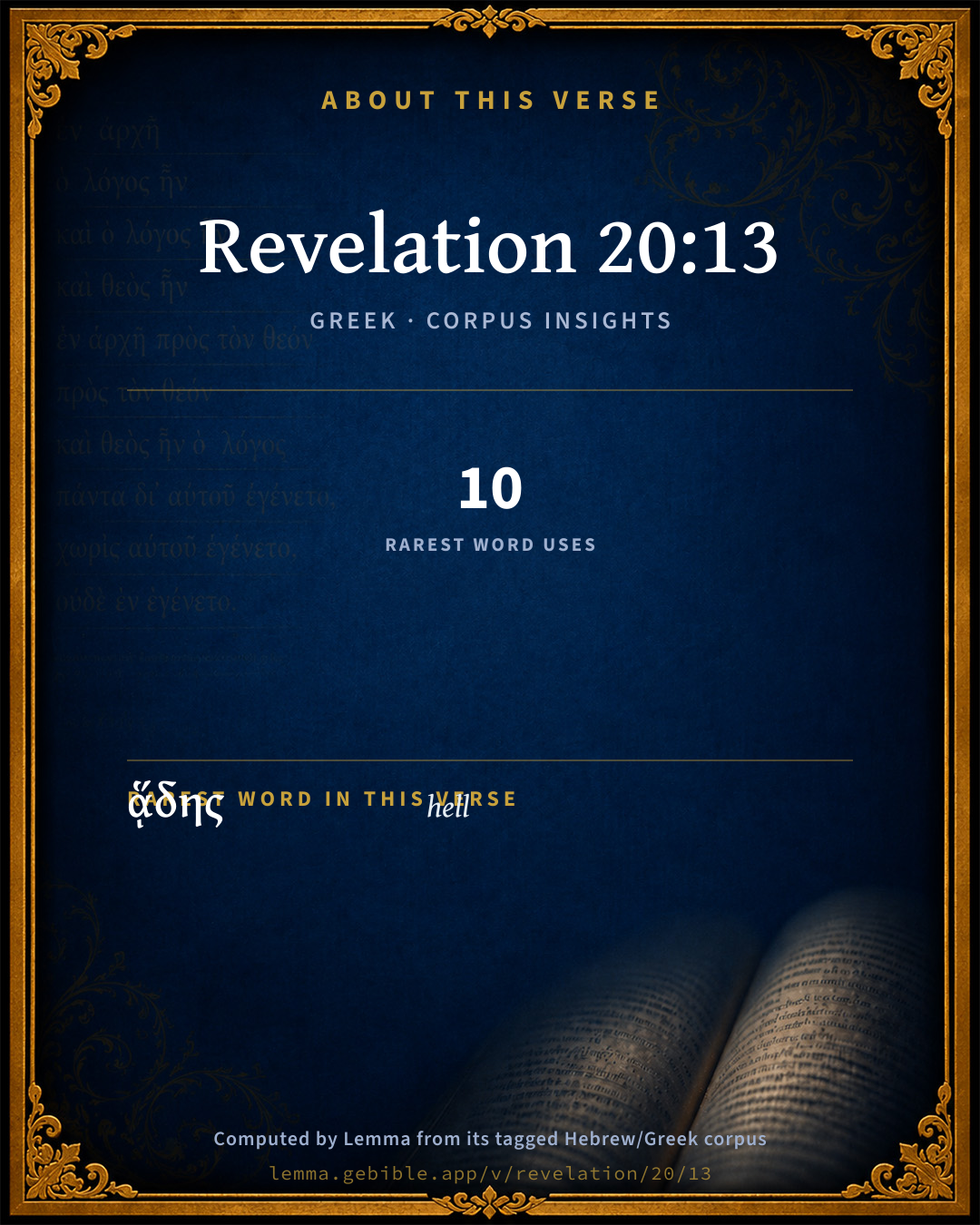
Revelation 20:13

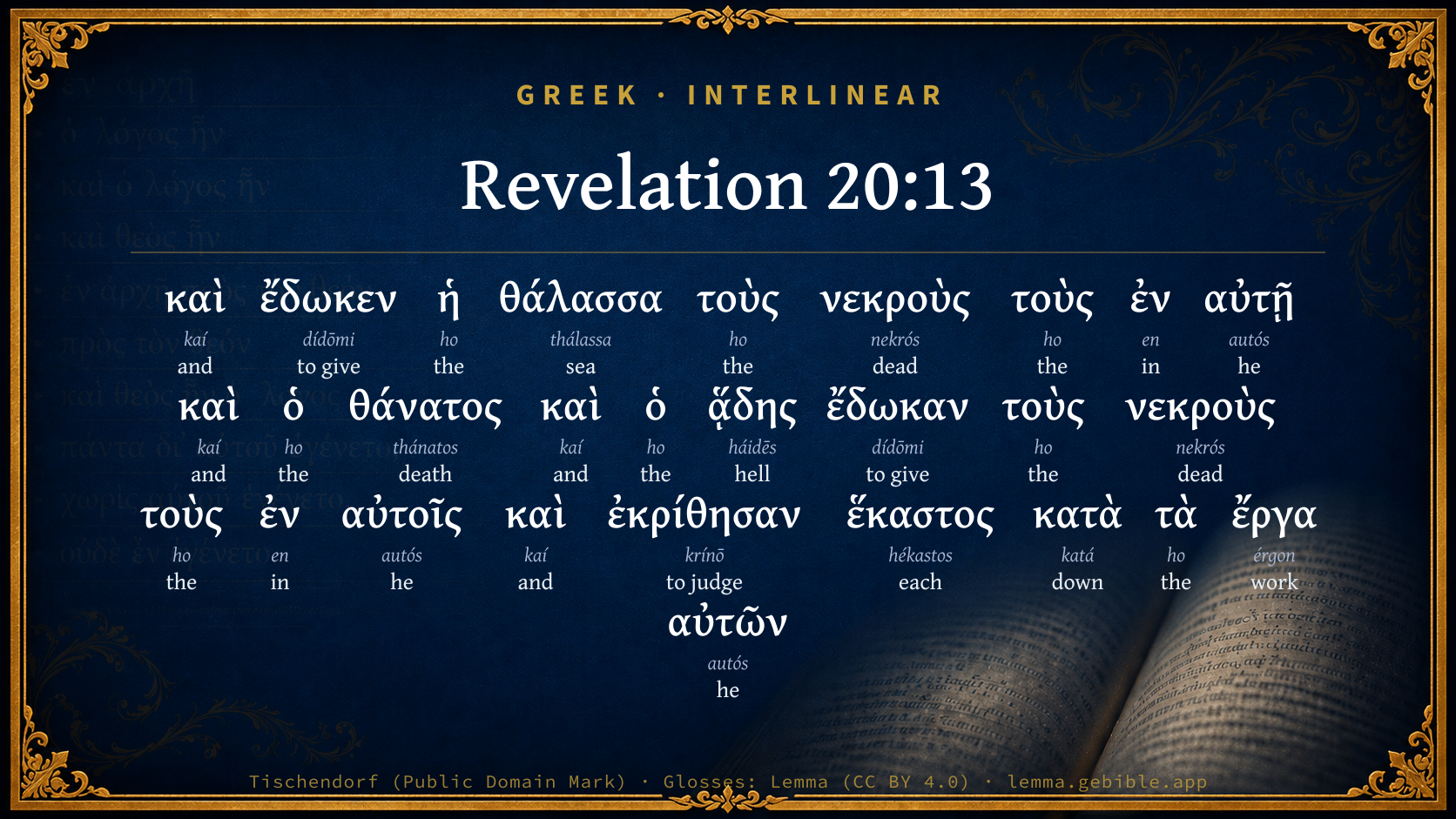
Greek (Tischendorf 8th ed.) Revelation 20:13 appears in the Greek New Testament. The text above is from the Tischendorf 8th edition. Each word links to its Strong’s number and a concise gloss. Click any word for its full Thayer’s Greek Lexicon entry.
Download image
Cite this verse

Revelation 20:13 (World English Bible). Public Domain. Lemma interlinear Bible study tool, https://lemma.gebible.app/v/revelation/20/13.

Show BibTeX & RIS
BibTeX
RIS
English Translation
The sea gave up the dead who were in it. Death and Hades gave up the dead who were in them. They were judged, each one according to his works.
World English Bible · Public Domain
Download a study sheet

One document with this verse’s original text, its word-by-word gloss line, the meaning frame, cross-references with their text, attributed commentary, and full source and license credits — printable, and it pastes into notes with its structure intact.

This verse Autodidact and up

Study sheet (.html) Plain text (.txt)

A passage Seminary Student

Up to 50 verses in one chapter. A passage sheet keeps up to 6 commentary sources and 12 cross-references per verse, in the order this page ranks them, and says so on the sheet whenever that leaves anything out. Ask for a single verse and you get the Autodidact verse sheet above.

Everything on this page stays free to read, with no account — the sheet is a download of what is already on screen, not access to it.

Want to remove ads? Support Godless Engineer
Compare translations 3

The same verse in 3 English versions, stacked beneath the original-language interlinear above. Click any original word for its lexicon entry.

Each is an independent rendering of the whole verse — the interlinear is not word-aligned to these translations.

Highlighted words mark where these versions differ — a whole-verse word diff, not a word-by-word alignment.

  • World English Bible Public Domain
    The sea gave up the dead who were in it. Death and Hades gave up the dead who were in them. They were judged, each one according to his works.
  • King James Version Public Domain
    And the sea gave up the dead which were in it; and death and hell delivered up the dead which were in them: and they were judged every man according to their works.
  • unfoldingWord Literal Text CC BY-SA 4.0
    And the sea gave up the dead in it, and Death and Hades gave up the dead in them, and they were judged, each one, according to their deeds.

unfoldingWord Literal Text — © unfoldingWord, licensed CC BY-SA 4.0. Word-aligned USFM3 via Door43 (git.door43.org/unfoldingWord/en_ult).

Versions to compare (up to 4)

3 of 4 selected

Show all 19 translations

Every available English version of this verse, each an independent rendering of the whole verse.

  • World English Bible Public Domain
    The sea gave up the dead who were in it. Death and Hades gave up the dead who were in them. They were judged, each one according to his works.
  • Berean Standard Bible Public Domain
    The sea gave up its dead, and Death and Hades gave up their dead, and each one was judged according to his deeds.
  • Majority Standard Bible Public Domain
    The sea gave up its dead, and Death and Hades gave up their dead, and each one was judged according to his deeds.
  • King James Version Public Domain
    And the sea gave up the dead which were in it; and death and hell delivered up the dead which were in them: and they were judged every man according to their works.
  • American Standard Version (1901) Public Domain
    And the sea gave up the dead that were in it; and death and Hades gave up the dead that were in them: and they were judged every man according to their works.
  • Revised Version (1885) Public Domain
    And the sea gave up the dead which were in it; and death and Hades gave up the dead which were in them: and they were judged every man according to their works.
  • Geneva Bible (1599) Public Domain
    And the sea gaue vp her dead, which were in her, and death and hell deliuered vp the dead, which were in them: and they were iudged euery man according to their woorkes.
  • Douay-Rheims (1899) Public Domain
    And the sea gave up the dead that were in it, and death and hell gave up their dead that were in them; and they were judged every one according to their works.
  • Young's Literal Translation Public Domain
    and the sea did give up those dead in it, and the death and the hades did give up the dead in them, and they were judged, each one according to their works;
  • Literal Standard Version CC BY-SA 4.0
    and the sea gave up those dead in it, and death and Hades gave up the dead in them, and they were judged, each one according to their works;
  • Unlocked Literal Bible CC BY-SA 4.0
    The sea gave up the dead who were in it. Death and Hades gave up the dead who were in them, and the dead were judged according to what they had done.
  • unfoldingWord Literal Text CC BY-SA 4.0
    And the sea gave up the dead in it, and Death and Hades gave up the dead in them, and they were judged, each one, according to their deeds.
  • Darby Bible Public Domain
    And the sea gave up the dead which [were] in it, and death and hades gave up the dead which [were] in them; and they were judged each according to their works:
  • World Messianic Bible Public Domain
    The sea gave up the dead who were in it. Death and Sheol gave up the dead who were in them. They were judged, each one according to his works.
  • Webster's Bible Public Domain
    And the sea gave up the dead which were in it; and death and hell delivered up the dead which were in them: and they were judged every man according to their works.
  • Free Bible Version CC BY-SA 4.0
    The sea handed over the dead in it, and death and Hades handed over the dead that were in them, and everyone was judged according to what they had done.
  • Bible in Basic English Public Domain
    And the sea gave up the dead which were in it; and death and Hell gave up the dead which were in them; and they were judged every man by his works.
  • Text-Critical English NT CC BY 4.0
    Then the sea gave up the dead who were in it, and Death and Hades gave up the dead who were in them, and each person was judged according to his works.
  • Tyndale New Testament (1534) Public Domain
    and the see gave vp her deed which were in her and deth and hell delyvered vp the deed which were in them: and they were iudged every man accordinge to his dedes.

Literal Standard Version (2020), Covenant Press — licensed CC BY-SA 4.0. Text via the HelloAO Bible API (eBible.org). Unlocked Literal Bible (unfoldingWord) — licensed CC BY-SA 4.0. Text via the HelloAO Bible API (eBible.org). unfoldingWord Literal Text — © unfoldingWord, licensed CC BY-SA 4.0. Word-aligned USFM3 via Door43 (git.door43.org/unfoldingWord/en_ult). Free Bible Version, Dr. Jonathan Gallagher — licensed CC BY-SA 4.0. Text via the HelloAO Bible API (eBible.org).

Word by word

More ways to search: Search by grammar → Find every occurrence → Compare this word →

Practice this passage: Drill this verse → Learn its vocabulary →

ᾅδης
háidēs
G86
“hell”
Noun, Nominative, Singular, Masculine
Part of Speech
Noun
Case
Nominative
Number
Singular
Gender
Masculine
Full Thayer's Definition

Origin: from G1 (as negative particle) and G1492

TDNT: 03:26,2

1. name Hades or Pluto, the god of the lower regions 2. Orcus, the nether world, the realm of the dead 3. later use of this word: the grave, death, hell
  1. καὶ kaí G2532 “and” Conjunction
  2. ἔδωκεν dídōmi G1325 “to give” Verb, Aorist, Active, Indicative, 3rd person, Singular
  3. ἡ ho G3588 “the” Article, Nominative, Singular, Feminine
  4. θάλασσα thálassa G2281 “sea” Noun, Nominative, Singular, Feminine
  5. τοὺς ho G3588 “the” Article, Accusative, Plural, Masculine
  6. νεκροὺς nekrós G3498 “dead” Adjective, Accusative, Plural, Masculine
  7. τοὺς ho G3588 “the” Article, Accusative, Plural, Masculine
  8. ἐν en G1722 “in” Preposition
  9. αὐτῇ autós G846 “he” Personal pronoun, Dative, Singular, Feminine
  10. καὶ kaí G2532 “and” Conjunction
  11. ὁ ho G3588 “the” Article, Nominative, Singular, Masculine
  12. θάνατος thánatos G2288 “death” Noun, Nominative, Singular, Masculine
  13. καὶ kaí G2532 “and” Conjunction
  14. ὁ ho G3588 “the” Article, Nominative, Singular, Masculine
  15. ἔδωκαν dídōmi G1325 “to give” Verb, Aorist, Active, Indicative, 3rd person, Plural
  16. τοὺς ho G3588 “the” Article, Accusative, Plural, Masculine
  17. νεκροὺς nekrós G3498 “dead” Adjective, Accusative, Plural, Masculine
  18. τοὺς ho G3588 “the” Article, Accusative, Plural, Masculine
  19. ἐν en G1722 “in” Preposition
  20. αὐτοῖς autós G846 “he” Personal pronoun, Dative, Plural, Masculine
  21. καὶ kaí G2532 “and” Conjunction
  22. ἐκρίθησαν krínō G2919 “to judge” Verb, Aorist, Passive, Indicative, 3rd person, Plural
  23. ἕκαστος hékastos G1538 “each” Adjective, Nominative, Singular, Masculine
  24. κατὰ katá G2596 “down” Preposition
  25. τὰ ho G3588 “the” Article, Accusative, Plural, Neuter
  26. ἔργα érgon G2041 “work” Noun, Accusative, Plural, Neuter
  27. αὐτῶν autós G846 “he” Personal pronoun, Genitive, Plural, Masculine

About this verse

These counts appear in no published source. They are computed here, from the morphology-tagged text and Lemma’s own curated glosses. What Lemma adds →

28
words
13
distinct lemmas
Revelation
section

Notable vocabulary

The rarest word here is ᾅδης hell G86 — appearing just 10 times in the whole Greek New Testament.

Shared distinctive vocabulary

ᾅδης hell G86 occurs in 10 verses of the Greek New Testament. Also found in:

Repetition

Words recur within this verse:

  • ἔδωκεν to give G1325 ×2
  • νεκροὺς dead G3498 ×2
  • ἡ the G3588 ×8
  • καὶ and G2532 ×4
  • αὐτῇ he G846 ×3
  • ἐν in G1722 ×2

Cross-references

8

Topical passages linked to Revelation 20:13 in the Treasury of Scripture Knowledge — connected by theme and wording, ordered by reader-vote popularity; previews shown in the World English Bible.

  • John 5:28–29 Don't marvel at this, for the hour comes, in which all that are in the tombs will hear his voice,
  • Revelation 6:8 And behold, a pale horse, and he who sat on it, his name was Death. Hades followed with him. Authority over one fourth of the earth, to kill with the sword, with famine, with death, and by the wild animals of the earth was given to him.
  • Hosea 13:14 I will ransom them from the power of Sheol. I will redeem them from death! Death, where are your plagues? Sheol, where is your destruction? Compassion will be hidden from my eyes.
  • Isaiah 26:19 Your dead shall live; my dead bodies shall arise. Awake and sing, you who dwell in the dust; for your dew is [as] the dew of herbs, and the earth shall cast forth the dead.
  • 1 Corinthians 15:50–58 Now I say this, brothers, that flesh and blood can't inherit the Kingdom of God; neither does corruption inherit incorruption.
  • Revelation 20:12 I saw the dead, the great and the small, standing before the throne, and they opened books. Another book was opened, which is the book of life. The dead were judged out of the things which were written in the books, according to their works.
  • Revelation 20:14 Death and Hades were thrown into the lake of fire. This is the second death, the lake of fire.
  • Revelation 1:18 and the Living one. I was dead, and behold, I am alive forevermore. Amen. I have the keys of Death and of Hades.

Cross-references courtesy of OpenBible.info (CC BY 4.0).

Commentary

Notes on Revelation 20:13 from classic Christian and Jewish commentators (each source and its license shown beneath its notes). The classic Christian expositions comment on the surrounding passage and are grouped to its opening verse, so a note may address several verses; the Jewish commentaries on the Tanakh (Rashi and others) are per-verse, so they appear only where the commentator wrote on this verse.

Lemma curates 59 commentaries, every one of them public domain or Creative Commons licensed, each selected and text-cleaned for this edition rather than reprinted as found. About our sources →

Joseph Benson's Commentary

Rev 20:13-15. And — That none might be exempt from being brought to judgment, the resurrection extended even to the waters; the sea — The lakes and rivers; gave up the dead which were in them, and, ο θανατος και ο αδης, death and hades — Or, the state of separate souls, delivered up the dead which were in them — Death gave up all the bodies of men, and hades their souls, to be united to their bodies. And death and hades were cast into the lake of fire — That is, were abolished for ever. For neither the righteous nor the wicked were to die any more; their souls and bodies were to be no more separated. Consequently neither death nor hades could any more have a being. Such is the awful end of the whole human race: they are plunged into that flaming and eternal ruin signified by the lake of fire, or are received into those abodes of glory, which are described in the next two chapters under the figures of a new heaven and a new earth.

Here then we have before us a most affecting view of those important events in which we are all most intimately, yea, infinitely concerned; even the illustrious day of the passing away of the heaven and earth, and the final judgment of all mankind, whether small or great. Therefore let all the living, both small and great, seriously weigh these things; let them often look forward to the awful period when the glorious throne shall be set, the important volumes opened, and our whole lives, all our tempers, words, and works, which are now perfectly known to God, shall be exhibited to the view of men, angels, and devils. Let us, therefore, judge ourselves impartially, that we be not condemned of the Lord; and, conscious how unable we shall be to stand in that judgment if he were to lay justice to the line, let us humbly and penitently apply to the throne of mercy, to the grace of the gospel covenant, through the blood of the Redeemer. So shall we find mercy of the Lord in that day, and reign with him, not a thousand years only, but for everlasting ages. In the mean time, let those who have no reverence for his majesty, nor esteem for his gospel, and who have never taken this awful alarm, have never fled for refuge to lay hold on the hope set before them, tremble at these awakening views. Let them all, of every condition, both small and great, say in their hearts, Who shall dwell with devouring flames, with everlasting burnings? Shall we have our portion in this lake of fire, into which every one who is not found written in the book of life shall be cast? and shall we be those wretched victims of the divine justice, who shall be tormented for ever and ever? Nay, rather let us turn to God in sincerity and truth that our souls may live, and an entrance be administered unto us into his everlasting kingdom!

Joseph Benson's Commentary on the Old and New Testaments (1811–1818) — public domain. Text from a community e-Sword module.

Whedon's Commentary on the Bible

Daniel D. Whedon

2. The final penal award—the lake of fire, Rev_20:13-15.

13. The sea gave up—Even while the heaven and earth are fleeing in flames before the throne, the sea surrenders the myriads who have perished in its waves. Death and hell (hades)—From three sources do the dead, body and soul, come forth. From the sea and from death (by land) come their bodies; from hell or hades, (the intermediate state of disembodied spirits,) come their souls. How unhappy here the term hell is for hades is illustrated by the fact that it was the abode of the blessed as well as of the unholy souls. It included Paradise as well as Tartarus.

Judged—Solemn and emphatic repetition of closing clause of last verse.

Daniel D. Whedon (gen. ed.), Commentary on the Old and New Testaments (1874–1909) — public domain. Text from a community e-Sword module.

Tyndale Open Study Notes

Tyndale Open Resources

20:13 the grave: See study note on 6:7-8.

Tyndale Open Study Notes — © Tyndale Open Resources, licensed CC BY-SA 4.0. Text via the HelloAO Bible API.

Geneva Bible (1599)

Geneva Bible translators

This is a prevention or an answer to an objection: for happily some man will say, but they are dead, whom the sea, death and the grave hath consumed, how shall they appear before the judge? S. John answereth by resurrection from death, whereunto all things (however repugnant) shall minister and serve at the commandment of God, as Dan. 12.

Geneva Bible (1599) marginal notes — public domain. Text via Bolls.life.

Jamieson, Fausset & Brown

Robert Jamieson, A. R. Fausset & David Brown

death and hell--Greek, "Hades." The essential identity of the dying and risen body is hereby shown; for the sea and grave give up their dead. The body that sinned or served God shall, in righteous retribution, be the body also that shall suffer or be rewarded. The "sea" may have a symbolical [CLUVER from AUGUSTINE], besides the literal meaning, as, in Rev 8:8; Rev 12:12; Rev 13:1; Rev 18:17, Rev 18:19; so "death" and "hell" are personifications (compare Rev 21:1). But the literal sense need hardly be departed from: all the different regions wherein the bodies and souls of men had been, gave them up.

Jamieson, Fausset & Brown — Commentary Critical and Explanatory on the Whole Bible (1871) — public domain (CC PDM 1.0). Text via the HelloAO Bible API.

Adam Clarke's Commentary

Verse 13. The sea gave up the dead] Those who had been drowned in it, and those millions slain in naval contests, who had no other grave.

And death] All who died by any kind of disease. Death is here personified, and represented as a keeper of defunct human beings; probably no more than earth or the grave is meant, as properly belonging to the empire of death.

And hell] αιδης, Hades, the place of separate spirits. The sea and death have the bodies of all human beings; hades has their spirits. That they may be judged, and punished or rewarded according to their works, their bodies and souls must be reunited; hades, therefore, gives up the spirits; and the sea and the earth give up the bodies.

Adam Clarke's Commentary on the Bible (1810–1826) — public domain. Text from a community e-Sword/MySword module.

The Cambridge Bible for Schools and Colleges

gen. ed. J. J. S. Perowne

13. death and hell] See Rev_6:8. Sheol, the Hebrew equivalent of Hades, seems not quite determined in meaning between the receptacle of the bodies of the dead and of their souls, but is sometimes translateable as “the grave.” Here it seems implied that those who died in the sea are not in Hades, as those who were buried are: but all, whether buried or unburied, are raised and judged.

The Cambridge Bible for Schools and Colleges (gen. ed. J. J. S. Perowne; Cambridge University Press, 1878–1918) — public domain. Text from a community e-Sword module.

John Gill's Exposition

And the sea gave up the dead which were in it,.... Which is not to be interpreted metaphorically of the world, and the men of it, who are like the troubled sea; but literally of the sea, and of all such who have been drowned in the waters of it, as were Pharaoh and his host; or have died upon the mighty waters, and have been cast into them, and devoured by the fishes; and particular regard may be had to the men of the old world, drowned by the flood; these shall be raised from thence; the sea shall deliver them up: now this, and what is expressed in the next clause, will not be done after the judgment is set, the books are opened, and the sentence passed, but before all this, and in order to it, as the last clause of this verse shows:

and death and hell delivered up the dead which were in them; "death", which is here represented as a person, and elsewhere as a king, reigning and having power over men, signifies death in general, and every kind of death of which men have died, whether natural or violent, over whom it will now have no longer dominion, but will be obliged to deliver up all its subjects; and "hell" signifies the grave, which will now be opened, and deliver up all its prisoners, all that have been buried in the earth; see Job 26:5 the Ethiopic version adds, "and the earth delivered up them that were dead in it": but this seems unnecessary after the former:

and they were judged every man according to their works; some to greater, some to lesser punishment, as their sinful works deserved.

John Gill's Exposition of the Whole Bible (1746–1763) — public domain (CC PDM 1.0). Text via the HelloAO Bible API.

Trapp's Complete Commentary

John Trapp

13 And the sea gave up the dead which were in it; and death and hell delivered up the dead which were in them: and they were judged every man according to their works.

Ver. 13. And the sea] Those that perish in the waters, and those whose ashes were scattered upon the waters, as John Huss’s; whom after they had burnt, they beat his heart with their staves, and cast his ashes into the river. But there is a substance of the saints’ bodies preserved, by a secret influence from Christ their Head; and their dust is precious.

John Trapp, A Commentary or Exposition upon All the Books of the Old and New Testament (1647–1656) — public domain. Text from a community e-Sword module.

Albert Barnes' Notes on the Bible

And the sea gave up the dead which were in it - All that had been buried in the depths of ocean. This number in the aggregate will be great. If we include all who were swept off by the flood, and all who have perished by shipwreck, and all who have been killed in naval battles and buried in the sea, and all who have been swept away by inundations of the ocean, and all who have peacefully died at sea, as sailors, or in the pursuits of commerce or benevolence, the number in the aggregate will be immense - a number so vast that it was proper to notice them particularly in the account of the general resurrection and the last judgment.

And death and hell delivered up the dead which were in them - That is, all the dead came, from all regions where they were scattered - on the land and in the ocean - in this world and in the invisible world. “Death and hell” are here personified, and are represented as having dominion over the dead, and as now “delivering” up, or “surrendering” those who were held tinder them. On the meaning of the words used here, see the notes on Rev 1:18; Rev 6:8. Compare the Mat 10:23 note; Job 10:21-22 notes; Isa 14:9 note. This whole representation is entirely inconsistent with the supposition that a large part of the dead had been already raised up at the beginning of the millennial period, and had been permitted, in their glorified bodies, to reign with Christ.

And they were judged, ... - All these were judged - the righteous and the wicked; those buried at sea, and those buried on the land; the small and the great; the dead, in whatever world they may have been.

Albert Barnes' Notes on the Bible (1834–1885) — public domain. Text from a community e-Sword/MySword module.

Matthew Poole's English Annotations

By hell is meant all places where the dead are; whosoever shall be at that day in the state of the dead; the bodies of men, whether buried in the earth or sea; and the souls of men, whether they be in the place of torments or happiness, shall all be re-united to their bodies, that they may both in soul and body receive their final doom of eternal happiness, or eternal misery, accordingly as they have lived in the world; and those who shall be alive at that day, who shall be changed, ( as the apostle speaks, 1Co 15:51), are to be counted dead in the sense of this text, their change being instead of death to them. It is not said they shall be judged for their works, (though that as to the wicked is true), but

according to their works; which is true as to the elect, who though their names be written in the book of life, yet must work righteousness; and they shall have judgment of absolution, not according to the perfection, but the sincerity, of their works, done in obedience to the will of God.

Matthew Poole's English Annotations on the Holy Bible (1683–1685) — public domain. Text from a community e-Sword/MySword module.

The Pulpit Commentary

And the sea gave up the dead which were in it. It is difficult to decide upon the exact signification of this clause.

(1) It may be inserted in order to show the universal nature of this resurrection, although it may not, in conjunction with the next part of the verse, constitute a strictly logical classification of the dead.

(2) The sea being a type of the ungodly nations, the sentence may mean those spiritually dead, but living on the earth at the time of the judgment. The next clause seems to support this view. And death and hell delivered up the dead which were in them; death and Hades. (see Rev_1:18 Rev_6:8) As in Rev_6:8, the two really one are mentioned separately, the latter being looked upon as the guard house of those whom the former has seized. This clause, taken in conjunction with the preceding one, may mean From the ungodly nations, those physically living but spiritually dead were called up for judgment, and also those who were actually dead, having been seized by death and Hades. And they were judged every man according to their works. A solemn repetition of ver. 12 (which see).

The Pulpit Commentary (1880–1919), ed. H.D.M. Spence-Jones & Joseph S. Exell — public domain. Text from a community e-Sword module.

John Wesley's Explanatory Notes

Death and hades gave up the dead that were in them - Death gave up all the bodies of men; and hades, the receptacle of separate souls, gave them up, to be re-united to their bodies.

John Wesley, Explanatory Notes Upon the Whole Bible (1754–1765) — public domain. Text via the GEBible commentary corpus.

Scofield Reference Notes

C. I. Scofield

hell

(See Scofield "Luk 16:23").

The Scofield Reference Bible (1917 edition), notes by C. I. Scofield — public domain. Text from a community e-Sword module.

The People's New Testament

B. W. Johnson

13. The sea. A symbol of the lost dead of whom no man knoweth. Death and Hades. The unseen world which hides from our view those who have departed from earth. The thought of the verse is that all the dead shall be judged.

B. W. Johnson's The People's New Testament with Notes (1889–1891) — public domain. Electronic text from the Christian Classics Ethereal Library (CCEL) ThML edition.

unfoldingWord translationNotes

Door43 World Missions Community

The sea gave up the dead ... Death and Hades gave up the dead

Here John speaks of the sea, death, and Hades as if they were living persons. (See: Personification)

the dead were judged

This can be stated in active form. AT: "God judged the dead people" (See: Active or Passive)

Death and Hades were thrown

This can be stated in active form. AT: "God threw Death and Hades" or "God's angel threw Death and Hades" (See: Active or Passive)

Hades

Here "Hades" is a metonym that represents the place where unbelievers go when they die, to wait for God's judgment. (See: Metonymy)

the second death

"dying a second time." This is described as eternal punishment in the lake of fire in Revelation 20:14 and Revelation 21:08. See how you translated this in Revelation 2:11. AT: "the final death in the lake of fire" (See: Symbolic Language)

If anyone's name was not found written

This can be stated in active form. AT: "If God's angel did not find a person's name" (See: Active or Passive)

he was thrown into the lake of fire

This can be stated in active form. AT: "the angel threw him into the lake of fire" or "the angel threw him into the place where fire burns forever" (See: Active or Passive)

translationWords

die

Hades

judge

hell

written

Book of Life

unfoldingWord translationNotes — © Distant Shores Media and the Door43 World Missions Community, licensed CC BY-SA 4.0. Source: git.door43.org/Door43/en_tn.

Expositor's Greek Testament

ed. W. Robertson Nicoll

See Pirke Aboth, iv. 32: “Let not thine imagination assure thee that the grave is an asylum” (for, like birth and life and death, judgment is appointed before the King of the kings of kings). “And the earth shall restore those that are asleep in her, and so shall the dust those that dwell therein in silence, and the secret chambers shall deliver up those souls (of the righteous, iv. 35) that were committed unto them,” 4 Esd. 7:32 reproducing, as here, Enoch Lev 1 , “and in those days will the earth also give back those who are treasured up within it, and Sheol also will give back that which it has received, and hell will give back that which it owes”. Also En. lxi. 5 where the restoration includes “those who have been destroyed by the desert, or devoured by the fish of the sea and by the beasts”. Evidently drowned people are supposed not to be in Hades; they wander about or drift in the ocean (Achill. Tat. ver 313), μηδὲ εἰς ᾅδου καταβαίνειν ὅλως . According to the prophet’s conception ( cf. Rev 13:8 ; Rev 13:14 .f.) the fate of pagans must have been a foregone conclusion, when the Imperial cultus was made the test of character; in which case “the scene before the white throne is rather a final statement of judgment than a statement of final judgment” (Gilbert). But the broader allusioni to works here shows that the prophet is thinking of the general ethical judgment, which embraced issues wider than the particular historical test of the Emperor-worship. ᾅδης κ . τ . λ ., cf. Plutarch’s ( de Iside , 29) derivation of Amenthes, the Egyptian name for Hades, as “that which receives and gives”. As in Slav. En. lxv. 6 and the later Iranian Bundehesh ( S. B. E. ver 123 f.), the resurrection of the body is not mentioned, though it is probably implied ( cf. En. Lev 1 , lxii. 14 and Mat 27:52 f.).

The Expositor's Greek Testament, edited by W. Robertson Nicoll (1897–1910) — public domain. Text from a community e-Sword module.

Cambridge Greek Testament for Schools and Colleges

13. ἔδωκαν. Lach[780] reads ἔδωκαν with A.

[780] Lachmann’s larger edition.

ἐκρίθησαν. א reads κατεκρίθησαν.

13. ὁ θάνατος καὶ ὁ ᾅδης. See Rev 6:8. Sheol, the Hebrew equivalent of Hades, seems not quite determined in meaning between the receptacle of the bodies of the dead and of their souls, but is sometimes translateable as “the grave.” Here it seems implied that those who died in the sea are not in Hades, as those who were buried are: but all, whether buried or unburied, are raised and judged.

Cambridge Greek Testament for Schools and Colleges (Cambridge University Press, 1896; 21 vols, various authors incl. Carr, Maclear, Plummer, Farrar, Lumby, Moule, M. R. James, Simcox) — public domain. Text from a community e-Sword module.

Vincent's Word Studies in the New Testament

Marvin R. Vincent

The sea. As commonly understood, the sea means the literal sea, and the passage signifies that the dead contained in it shall rise. So Alford. Other interpreters, however, say that it cannot mean the literal sea. Thus Milligan argues that the symbols of the Apocalypse must always be interpreted in the same way. "Symbols," he says, "are a form of speech, and therefore subject to the rules that regulate the interpretation of all speech... The power of that convention which links a certain sense to a certain sound in ordinary terms, is not less binding in the presence than in the absence of metaphor of any kind whatever. Thus when we read in the Apocalypse of 'the sea ' as an emblem of the troubled and sinful nations of the earth, we are bound, unless forbidden by the context, to carry that interpretation through, and to understand the sea of the troubled and sinful world."

Hell [ο αδης] . Rev., Hades. See on Mt 16:18.

Marvin R. Vincent, Word Studies in the New Testament (1887–1900) — public domain. Text from a community e-Sword/MySword module.

Lesson kit

Teaching starters — assembled from the data on this page, not authored interpretation. Every prompt links to the verse data it draws on. Edit before teaching.

Revelation, in the Revelation, opens this verse with 28 words (13 distinct Greek lemmas). Its most distinctive word is háidēs (“hell”). A historical commentator’s framing appears above. Read the whole chapter for the surrounding context.

Discussion questions

  1. What does “hell” (háidēs) contribute to the verse as a whole?
  2. How does Matthew 11:23, which shares the word «hell», read alongside this verse?
  3. What does the repetition of “to give” (2× in this one verse) do in this verse?
  4. These translations render this verse differently. What is at stake in choosing one wording over another?
  5. Compare how Joseph Benson's Commentary and Whedon's Commentary on the Bible read this verse. Where do they agree or differ?

Things to notice

Reading settings

Reading text

Shown beneath each verse's original-language words.

Old Testament
Old Testament edition

Read the OT as the Masoretic Hebrew (MT) or the Greek Septuagint (LXX).

English shown for the Greek Septuagint (in the Hebrew ↔ Greek comparison).

Comparing translations? Open the Compare panel on any verse page to stack up to four side by side.