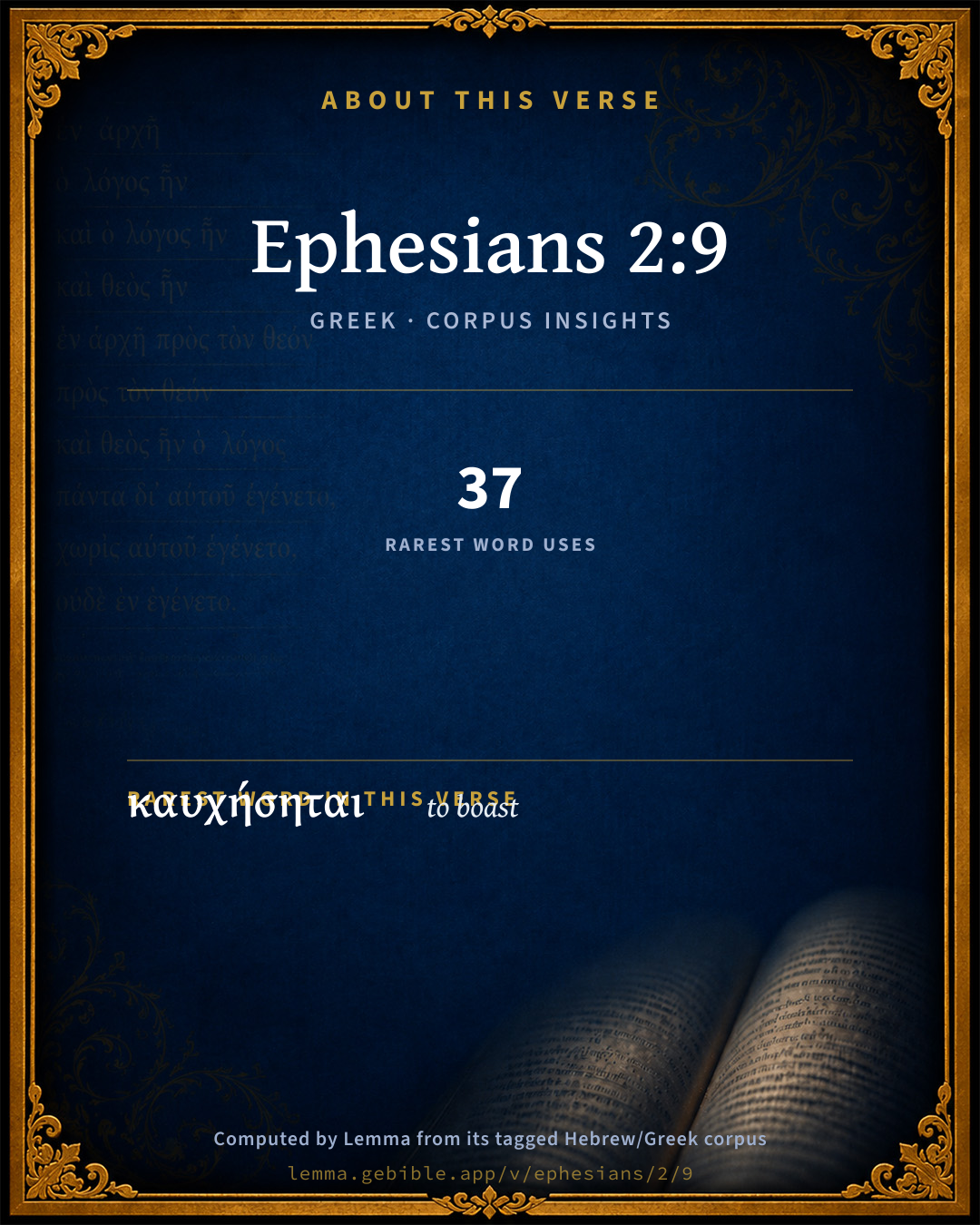
Ephesians 2:9

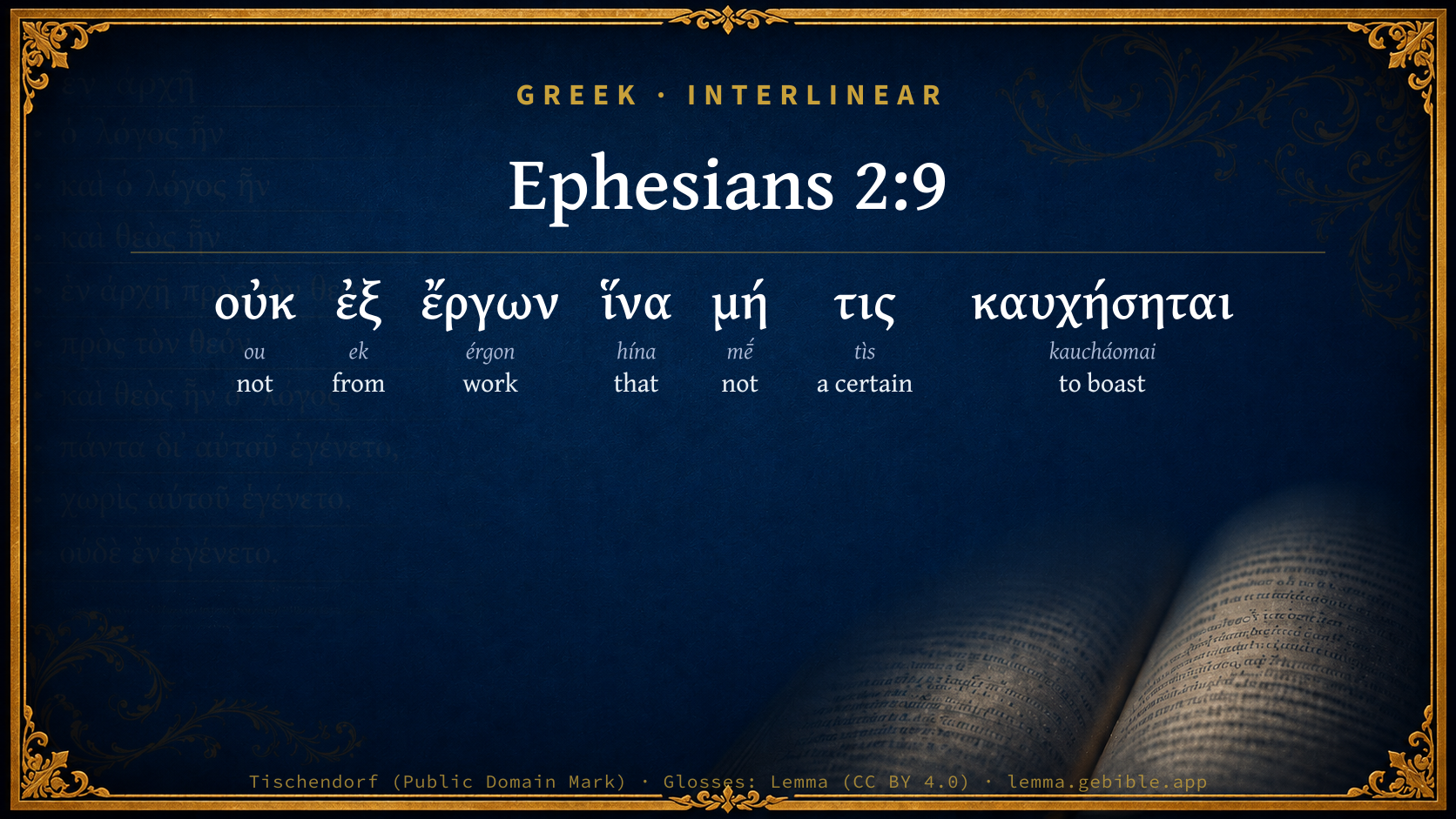
Greek (Tischendorf 8th ed.) Ephesians 2:9 appears in the Greek New Testament. The text above is from the Tischendorf 8th edition. Each word links to its Strong’s number and a concise gloss. Click any word for its full Thayer’s Greek Lexicon entry.
Download image
Cite this verse

Ephesians 2:9 (World English Bible). Public Domain. Lemma interlinear Bible study tool, https://lemma.gebible.app/v/ephesians/2/9.

Show BibTeX & RIS
BibTeX
RIS
English Translation
not of works, that no one would boast.
World English Bible · Public Domain
Download a study sheet

One document with this verse’s original text, its word-by-word gloss line, the meaning frame, cross-references with their text, attributed commentary, and full source and license credits — printable, and it pastes into notes with its structure intact.

This verse Autodidact and up

Study sheet (.html) Plain text (.txt)

A passage Seminary Student

Up to 50 verses in one chapter. A passage sheet keeps up to 6 commentary sources and 12 cross-references per verse, in the order this page ranks them, and says so on the sheet whenever that leaves anything out. Ask for a single verse and you get the Autodidact verse sheet above.

Everything on this page stays free to read, with no account — the sheet is a download of what is already on screen, not access to it.

Want to remove ads? Support Godless Engineer
Compare translations 3

The same verse in 3 English versions, stacked beneath the original-language interlinear above. Click any original word for its lexicon entry.

Each is an independent rendering of the whole verse — the interlinear is not word-aligned to these translations.

Highlighted words mark where these versions differ — a whole-verse word diff, not a word-by-word alignment.

  • World English Bible Public Domain
    not of works, that no one would boast.
  • King James Version Public Domain
    Not of works, lest any man should boast.
  • unfoldingWord Literal Text CC BY-SA 4.0
    not from works, so that no one may boast.

unfoldingWord Literal Text — © unfoldingWord, licensed CC BY-SA 4.0. Word-aligned USFM3 via Door43 (git.door43.org/unfoldingWord/en_ult).

Versions to compare (up to 4)

3 of 4 selected

Show all 19 translations

Every available English version of this verse, each an independent rendering of the whole verse.

  • World English Bible Public Domain
    not of works, that no one would boast.
  • Berean Standard Bible Public Domain
    not by works, so that no one can boast.
  • Majority Standard Bible Public Domain
    not by works, so that no one can boast.
  • King James Version Public Domain
    Not of works, lest any man should boast.
  • American Standard Version (1901) Public Domain
    not of works, that no man should glory.
  • Revised Version (1885) Public Domain
    not of works, that no man should glory.
  • Geneva Bible (1599) Public Domain
    Not of workes, least any man should boast himselfe.
  • Douay-Rheims (1899) Public Domain
    Not of works, that no man may glory.
  • Young's Literal Translation Public Domain
    not of works, that no one may boast;
  • Literal Standard Version CC BY-SA 4.0
    not of works, that no one may boast;
  • Unlocked Literal Bible CC BY-SA 4.0
    not from works and so no one may boast.
  • unfoldingWord Literal Text CC BY-SA 4.0
    not from works, so that no one may boast.
  • Darby Bible Public Domain
    not on the principle of works, that no one might boast.
  • World Messianic Bible Public Domain
    not of works, that no one would boast.
  • Webster's Bible Public Domain
    Not by works, lest any man should boast.
  • Free Bible Version CC BY-SA 4.0
    This has nothing to do with human effort, so don't be proud of yourselves.
  • Bible in Basic English Public Domain
    Not by works, so that no man may take glory to himself.
  • Text-Critical English NT CC BY 4.0
    not by works, so that no one may boast.
  • Tyndale New Testament (1534) Public Domain
    and commeth not of workes lest eny man shuld bost him silfe.

Literal Standard Version (2020), Covenant Press — licensed CC BY-SA 4.0. Text via the HelloAO Bible API (eBible.org). Unlocked Literal Bible (unfoldingWord) — licensed CC BY-SA 4.0. Text via the HelloAO Bible API (eBible.org). unfoldingWord Literal Text — © unfoldingWord, licensed CC BY-SA 4.0. Word-aligned USFM3 via Door43 (git.door43.org/unfoldingWord/en_ult). Free Bible Version, Dr. Jonathan Gallagher — licensed CC BY-SA 4.0. Text via the HelloAO Bible API (eBible.org).

Word by word

More ways to search: Search by grammar → Find every occurrence → Compare this word →

Practice this passage: Drill this verse → Learn its vocabulary →

About this verse

These counts appear in no published source. They are computed here, from the morphology-tagged text and Lemma’s own curated glosses. What Lemma adds →

7
words
7
distinct lemmas
Pauline Epistles
section

Cross-references

9

Topical passages linked to Ephesians 2:9 in the Treasury of Scripture Knowledge — connected by theme and wording, ordered by reader-vote popularity; previews shown in the World English Bible.

  • 2 Timothy 1:9 who saved us and called us with a holy calling, not according to our works, but according to his own purpose and grace, which was given to us in Christ Jesus before times eternal,
  • Romans 11:6 And if by grace, then it is no longer of works; otherwise grace is no longer grace. But if it is of works, it is no longer grace; otherwise work is no longer work.
  • Titus 3:3–5 For we were also once foolish, disobedient, deceived, serving various lusts and pleasures, living in malice and envy, hateful, and hating one another.
  • Romans 9:16 So then it is not of him who wills, nor of him who runs, but of God who has mercy.
  • 1 Corinthians 1:29–31 that no flesh should boast before God.
  • Romans 3:20 Because by the works of the law, no flesh will be justified in his sight. For through the law comes the knowledge of sin.
  • Romans 4:2 For if Abraham was justified by works, he has something to boast about, but not toward God.
  • Romans 9:11 For being not yet born, neither having done anything good or bad, that the purpose of God according to election might stand, not of works, but of him who calls,
  • Romans 3:27–28 Where then is the boasting? It is excluded. By what manner of law? Of works? No, but by a law of faith.

Cross-references courtesy of OpenBible.info (CC BY 4.0).

Commentary

Notes on Ephesians 2:9 from classic Christian and Jewish commentators (each source and its license shown beneath its notes). The classic Christian expositions comment on the surrounding passage and are grouped to its opening verse, so a note may address several verses; the Jewish commentaries on the Tanakh (Rashi and others) are per-verse, so they appear only where the commentator wrote on this verse.

Lemma curates 59 commentaries, every one of them public domain or Creative Commons licensed, each selected and text-cleaned for this edition rather than reprinted as found. About our sources →

Expositor's Greek Testament

ed. W. Robertson Nicoll

Eph 2:9 . οὐκ ἐξ ἔργων , ἵνα μή τις καυχήσηται : not of works, that no one should glory . The OT protest against glorying in any but the Lord and the prophet’s jealousy for the honour of God (Jer 9:23-24 ; Isa 42:8 ; Isa 42:14 , etc.) burn with a yet intenser flame in Paul, most of all when he touches the great theme of man’s salvation. That the glory of that salvation belongs wholly to God and in no degree to man, and that it has been so planned and so effected as to take from us all ground for boasting, is enforced on Paul’s hearers again and again, in different connections, with anxious concern and utmost plainness of expression ( cf. Rom 3:17 ; 1Co 1:29 ; 1Co 4:7 ; Gal 6:14 ; Phi 3:3 , etc.).

The Expositor's Greek Testament, edited by W. Robertson Nicoll (1897–1910) — public domain. Text from a community e-Sword module.

Geneva Bible (1599)

Geneva Bible translators

He taketh away expressly and namely from our works the praise of justification, seeing that the good works themselves are the effects of grace in us.

Geneva Bible (1599) marginal notes — public domain. Text via Bolls.life.

Jamieson, Fausset & Brown

Robert Jamieson, A. R. Fausset & David Brown

Not of works--This clause stands in contrast to "by grace," as is confirmed by Rom 4:4-5; Rom 11:6.

lest--rather, as Greek, "that no man should boast" (Rom 3:27; Rom 4:2).

Jamieson, Fausset & Brown — Commentary Critical and Explanatory on the Whole Bible (1871) — public domain (CC PDM 1.0). Text via the HelloAO Bible API.

John Calvin's Commentaries

9. Not of works. Instead of what he had said, that their salvation is of grace, he now affirms, that “it is the gift of God.” Instead of what he had said, “Not of yourselves,” he now says, “Not of works.” Hence we see, that the apostle leaves nothing to men in procuring salvation. In these three phrases, — not of yourselves, — it is the gift of God, — not of works, — he embraces the substance of his long argument in the Epistles to the Romans and to the Galatians, that righteousness comes to us from the mercy of God alone, — is offered to us in Christ by the gospel, — and is received by faith alone, without the merit of works.

This passage affords an easy refutation of the idle cavil by which Papists attempt to evade the argument, that we are justified without works. Paul, they tell us, is speaking about ceremonies. But the present question is not confined to one class of works. Nothing can be more clear than this. The whole righteousness of man, which consists in works, — nay, the whole man, and everything that he can call his own, is set aside. We must attend to the contrast between God and man, — between grace and works. Why should God be contrasted with man, if the controversy related to nothing more than ceremonies?

Papists themselves are compelled to own that Paul ascribes to the grace of God the whole glory of our salvation, but endeavor to do away with this admission by another contrivance. This mode of expression, they tell us, is employed, because God bestows the first grace. It is really foolish to imagine that they can succeed in this way, since Paul excludes man and his utmost ability, — not only from the commencement, but throughout, — from the whole work of obtaining salvation.

But it is still more absurd to overlook the apostle’s inference, lest any man should boast. Some room must always remain for man’s boasting, so long as, independently of grace, merits are of any avail. Paul’s doctrine is overthrown, unless the whole praise is rendered to God alone and to his mercy. And here we must advert to a very common error in the interpretation of this passage. Many persons restrict the word gift to faith alone. But Paul is only repeating in other words the former sentiment. His meaning is, not that faith is the gift of God, but that salvation is given to us by God, or, that we obtain it by the gift of God.

John Calvin's Commentaries (1540-1563) — public domain. Text from the Calvin Translation Society English edition (1840s-50s) via the Christian Classics Ethereal Library (ccel.org). Calvin's coverage is partial (roughly two-thirds of the Bible); uncommented books and verses are honest gaps, never fabricated. The 19th-century editor's footnotes and remarks are omitted so the notes are faithfully Calvin's own voice.

Ellicott's Commentary for English Readers

(9) Not of works, lest any man should boast.—In this verse we have the echo of the past Judaising controversy; it sums up briefly the whole argument of Rom_3:27 to Rom_4:25. There is a similar reminiscence, but more distinct and detached, in Php_3:2-9.

A Bible Commentary for English Readers, edited by Charles John Ellicott (1878–1897) — public domain. Text from a community e-Sword module.

The Cambridge Bible for Schools and Colleges

gen. ed. J. J. S. Perowne

9. lest any man should boast] Lit., any one; there is no emphasis on “man.”—For the thought, cp. Rom_3:27, (and see Eph_4:2); 1Co_1:29; 1Co_4:7; Gal_6:14; Php_3:3; in all which passages the Gr. word is the same. The Apostle is everywhere jealous for the sovereign claim of God to the whole praise of our salvation.

The Cambridge Bible for Schools and Colleges (gen. ed. J. J. S. Perowne; Cambridge University Press, 1878–1918) — public domain. Text from a community e-Sword module.

John Gill's Exposition

Not of works,.... Of any kind, moral or ceremonial, before or after conversion, done without faith or in it, nor of these in any sense; works are neither the moving causes, nor the procuring causes, nor the helping causes, nor "causa sine qua non", or conditions of salvation; the best works that are done by men, are not done of themselves, but by the grace of God, and therefore can never merit at his hand: and salvation is put upon such a foot,

lest any man should boast; of his works before God, and unto men; wherefore he has denied works any place in justification and salvation, in order to exclude all boasting in man; and has fixed it in a way of grace, and has chosen and called poor sinful worthless creatures to enjoy it, that whoever glories, may glory in the Lord.

John Gill's Exposition of the Whole Bible (1746–1763) — public domain (CC PDM 1.0). Text via the HelloAO Bible API.

Trapp's Complete Commentary

John Trapp

9 Not of works, lest any man should boast.

Ver. 9. Lest any man should boast] As that fool did that said, Caelum gratis non accipiam, I will not have heaven but at a rate. (Vega.) Non sic Deos coluimus, aut sic vivimus, ut ille nos vinceret, said the emperor Antoninus Philosophus. We have not so lived and deserved of God that the enemy should vanquish us.

John Trapp, A Commentary or Exposition upon All the Books of the Old and New Testament (1647–1656) — public domain. Text from a community e-Sword module.

Albert Barnes' Notes on the Bible

Not of works - see the notes at Rom 3:20, 27.

Albert Barnes' Notes on the Bible (1834–1885) — public domain. Text from a community e-Sword/MySword module.

Haydock's Catholic Bible Commentary

Not of works, as of our own growth, or from ourselves: but as from the grace of God. (Challoner)

George Leo Haydock (1774–1849), Haydock's Catholic Family Bible and Commentary, 1859 edition — public domain. Excludes Psalms (Douay-Rheims chapter numbering differs from Protestant) and Deuterocanonical books (Catholic canon only).

Matthew Poole's English Annotations

Not of works; any works whatever, and not only works of the ceremonial law: for if they only were excluded, the opposition between God and man, grace and works, were not right, which yet we find so often elsewhere; {see Rom 11:6} men might not be saved by works of the ceremonial law, and yet still be saved by works, and of themselves.

Lest any man should boast; glory in their own works or worth, as men are apt to do when they think they have any thing of their own which contributes to their salvation see Rom 3:27; 4:2.

Matthew Poole's English Annotations on the Holy Bible (1683–1685) — public domain. Text from a community e-Sword/MySword module.

Whedon's Commentary on the Bible

Daniel D. Whedon

9. Not of works—Neither the works of the Jewish ritual, nor the works of the moral law by Gentiles. If either ritual Jew or moral Gentile were saved, it would not be because of the value of their doings, but for that deep spirit-seated faith, according to their dispensation. It is the heart inspiring the act, and not the act, that saves. And that spirit of faith in Jew or Gentile would, if Christ were truly presented and understood, heartily embrace him.

Boast—A self-saviour needs no Christ-saviour. All Christ’s history in Eph_1:17-23, and all God’s mercy in 1-7, are to him null. He can boast, “I need no free pass; I pay my own way.”

Daniel D. Whedon (gen. ed.), Commentary on the Old and New Testaments (1874–1909) — public domain. Text from a community e-Sword module.

The Pulpit Commentary

Not of works, lest any man should boast. Exegetical of the last clause, "Not of yourselves; certainly not of your works." The suppression of boasting was a purpose of God in his scheme of salvation; not the chief or final purpose, any more than the manifestation of his grace in coming ages was his chief or final purpose in showing mercy to the Ephesians, but inseparable from the nature of his plan. The spirit of glorying is essentially unsuited to the relations between the creature and the Creator, between the Redeemer and the redeemed. It is the very opposite of the spirit, "Not unto us, O Lord" (Psa_115:1) the spirit that casts its crown before the throne, and that breathes in the songs of heaven, "Unto him that loved us ... be glory and dominion forever and. (Rev_1:5, Rev_1:6)

The Pulpit Commentary (1880–1919), ed. H.D.M. Spence-Jones & Joseph S. Exell — public domain. Text from a community e-Sword module.

John Wesley's Explanatory Notes

Not by works - Neither this faith nor this salvation is owing to any works you ever did, will, or can do.

John Wesley, Explanatory Notes Upon the Whole Bible (1754–1765) — public domain. Text via the GEBible commentary corpus.

The People's New Testament

B. W. Johnson

9. Not of works. The salvation is not due to works of law, or to our own merit; hence there is no ground for boasting.

B. W. Johnson's The People's New Testament with Notes (1889–1891) — public domain. Electronic text from the Christian Classics Ethereal Library (CCEL) ThML edition.

Cambridge Greek Testament for Schools and Colleges

9. οὐκ ἐξ ἔργων. Here the thought reverts to the main idea, the gift of salvation. It is in no sense earned by our conformity to the requirements whether of the Law or the Gospel, cf. Romans 1-4.

ἵνα μή τις καυχήσηται. The exclusion of ‘boasting’ is a familiar topic in the earlier Epistles, 1Co 1:31, &c. Here only in E ph. and Col.

Cambridge Greek Testament for Schools and Colleges (Cambridge University Press, 1896; 21 vols, various authors incl. Carr, Maclear, Plummer, Farrar, Lumby, Moule, M. R. James, Simcox) — public domain. Text from a community e-Sword module.

International Critical Commentary

9. οὐκ ἐξ ἔργων. He does not say ἔργων νόμου, because not writing to Jewish believers. De Wette (who does not accept the Pauline authorship) thinks the opposition in οὐκ ἐξ ἔργων has no meaning, since the writer is not thinking of Jews, and heathen believers did not need to be warned against taking pride in the righteousness of works, especially after what had preceded in vv. 1 and 5. But the οὐκ ἐξ ἔργων was such an essential principle of St. Paul’s teaching that no doubt he must have often repeated it amongst both Jews and Gentiles; nor is there any force in the reference to the past condition of the readers. Might not Gentile converts be tempted to regard their salvation as secured by their new holiness of life? and not the less because their former sins were when they were in darkness.

ἵνα μή τις καυχήσηται. Some commentators insist on giving ἵνα its full final force, “in order that”; so that to prevent boasting was God’s purpose, or one of His purposes, in appointing that men should not be justified by works. Are we then to say that, in order that men should not boast, He has refused to allow salvation or justification by works? Nay; but no man can be justified by his works, and “when they have been betrayed by these,” God appointed that He should save them χάριτι διὰ πίστεως. So in substance Chrysostom and Theophylact, whose words are: τὸ γὰρ ἵνα οὐκ αἰτιολγικόν ἐστι, ἀλλʼ ἐκ τῆς ἀποβάσεως τοῦ πράγματος. Yet the clause is not to be reduced to a mere statement of result, since it is a result inseparable from God’s purpose. Stier suggests that ἵνα, κ.τ.λ., may be viewed as the expression of the writer’s purpose: “This I say in order that,” etc. This cannot fairly be called unnatural, but it would require the verb to be present.

International Critical Commentary — older volumes (1896–1929), various authors — public domain. Text from a community e-Sword module.

Hodge's Commentary on Romans, Ephesians & First Corinthians

Charles Hodge

Ephesians 1:7

In whom we have redemption. In whom, i.e. not in ourselves. We are not self-redeemed. Christ is our Redeemer. The word redemption, ἀπολύτρωσις, means deliverance in the general, without reference to the mode in which it is accomplished. When used of the work of Christ it is always to be understood in its strict sense, viz. deliverance by ransom; because this particular mode of redemption is always either expressed or implied. We are redeemed neither by power, nor truth, but by blood; that is, by the sacrificial death of the Lord Jesus. A sacrifice is a ransom, as to its effect. It delivers those for whom it is offered and accepted. The words διὰ τοῦ αἵματὸς αὐτὸυ, by his blood, are explanatory of the words in whom. In whom, i.e. by means of his blood. They serve to explain the method in which Christ redeems.

The redemption of which the apostle here speaks is not the inward deliverance from sin, but it is an outward work, viz. the forgiveness of sins, as the words τὴν ἄφεσιν τῶν παραπτωμάτων necessarily mean. It is true this is not the whole of redemption, but it is all the sacred writer here brings into view, because forgiveness is the immediate end of expiation. Though this clause is in apposition with the preceding, it is by no means coextensive with it. So in Romans. 8:23, where believers are said to be waiting for the adoption, to wit, the redemption of the body, the two clauses are not coextensive in meaning. The redemption of the body does not exhaust the idea of adoption. Neither in this passage does the forgiveness of sin exhaust the idea of redemption. This passage is often quoted in controversy to prove that justification is merely pardon.

This redemption is not only gratuitous, but it is, in all its circumstances, an exhibition and therefore a proof of the riches of his grace. The word πλοῦτος, riches in such connections as a favorite one with the apostle, who speaks of the riches of glory, the riches of wisdom, and the exceeding riches of grace. It is the overflowing abundance of unmerited love, inexhaustible in God and freely accessible through Christ. There is, therefore, nothing incompatible between redemption, i.e. deliverance on the ground of a ransom (or a complete satisfaction to justice), and grace. The grace consists

l. In providing this satisfaction and in accepting it in behalf of sinners.

2 In accepting those who are entirely destitute of merit.

3. In bestowing this redemption and all its benefits without regard to the comparative goodness of men.

It is not because one is wiser, better, or more noble than others, that he is made a partaker of this grace; but God chooses the foolish, the ignorant, and those who are of no account, that they who glory may glory only in the Lord.

Charles Hodge — Commentary on Romans (1835), First Corinthians (1857), and Ephesians (1856) — public domain. Text from a community e-Sword module.

Lesson kit

Teaching starters — assembled from the data on this page, not authored interpretation. Every prompt links to the verse data it draws on. Edit before teaching.

Ephesians, in the Pauline Epistles, opens this verse with 7 words (7 distinct Greek lemmas). Its most distinctive word is kaucháomai (“to boast”). A historical commentator’s framing appears above. Read the whole chapter for the surrounding context.

Discussion questions

  1. The word kaucháomai carries the sense “to boast.” How does it shape the verse?
  2. How does Romans 2:17, which shares the word «to boast», read alongside this verse?
  3. These translations render this verse differently. What is at stake in choosing one wording over another?
  4. Compare how Expositor's Greek Testament and Geneva Bible (1599) read this verse. Where do they agree or differ?

Things to notice

Reading settings

Reading text

Shown beneath each verse's original-language words.

Old Testament
Old Testament edition

Read the OT as the Masoretic Hebrew (MT) or the Greek Septuagint (LXX).

English shown for the Greek Septuagint (in the Hebrew ↔ Greek comparison).

Comparing translations? Open the Compare panel on any verse page to stack up to four side by side.