Revelation 2:22

Greek (Tischendorf 8th ed.) Revelation 2:22 appears in the Greek New Testament. The text above is from the Tischendorf 8th edition. Each word links to its Strong’s number and a concise gloss. Click any word for its full Thayer’s Greek Lexicon entry.
Download image
Cite this verse

Revelation 2:22 (World English Bible). Public Domain. Lemma interlinear Bible study tool, https://lemma.gebible.app/v/revelation/2/22.

Show BibTeX & RIS
BibTeX
RIS
English Translation
Behold, I will throw her into a bed, and those who commit adultery with her into great oppression, unless they repent of her works.
World English Bible · Public Domain
Download a study sheet

One document with this verse’s original text, its word-by-word gloss line, the meaning frame, cross-references with their text, attributed commentary, and full source and license credits — printable, and it pastes into notes with its structure intact.

This verse Autodidact and up

Study sheet (.html) Plain text (.txt)

A passage Seminary Student

Up to 50 verses in one chapter. A passage sheet keeps up to 6 commentary sources and 12 cross-references per verse, in the order this page ranks them, and says so on the sheet whenever that leaves anything out. Ask for a single verse and you get the Autodidact verse sheet above.

Everything on this page stays free to read, with no account — the sheet is a download of what is already on screen, not access to it.

Want to remove ads? Support Godless Engineer
Compare translations 3

The same verse in 3 English versions, stacked beneath the original-language interlinear above. Click any original word for its lexicon entry.

Each is an independent rendering of the whole verse — the interlinear is not word-aligned to these translations.

Highlighted words mark where these versions differ — a whole-verse word diff, not a word-by-word alignment.

  • World English Bible Public Domain
    Behold, I will throw her into a bed, and those who commit adultery with her into great oppression, unless they repent of her works.
  • King James Version Public Domain
    Behold, I will cast her into a bed, and them that commit adultery with her into great tribulation, except they repent of their deeds.
  • unfoldingWord Literal Text CC BY-SA 4.0
    Behold! I will throw her onto a bed, and the ones committing adultery with her into great tribulation, if they do not repent of her deeds.

unfoldingWord Literal Text — © unfoldingWord, licensed CC BY-SA 4.0. Word-aligned USFM3 via Door43 (git.door43.org/unfoldingWord/en_ult).

Versions to compare (up to 4)

3 of 4 selected

Show all 19 translations

Every available English version of this verse, each an independent rendering of the whole verse.

  • World English Bible Public Domain
    Behold, I will throw her into a bed, and those who commit adultery with her into great oppression, unless they repent of her works.
  • Berean Standard Bible Public Domain
    Behold, I will cast her onto a bed of sickness, and those who commit adultery with her will suffer great tribulation unless they repent of her deeds.
  • Majority Standard Bible Public Domain
    Behold, I will cast her onto a bed of sickness, and those who commit adultery with her will suffer great tribulation unless they repent of her deeds.
  • King James Version Public Domain
    Behold, I will cast her into a bed, and them that commit adultery with her into great tribulation, except they repent of their deeds.
  • American Standard Version (1901) Public Domain
    Behold, I cast her into a bed, and them that commit adultery with her into great tribulation, except they repent of her works.
  • Revised Version (1885) Public Domain
    Behold, I do cast her into a bed, and them that commit adultery with her into great tribulation, except they repent of her works.
  • Geneva Bible (1599) Public Domain
    Beholde, I will cast her into a bed, and them that commit fornication with her, into great affliction, except they repent them of their workes.
  • Douay-Rheims (1899) Public Domain
    Behold, I will cast her into a bed: and they that commit adultery with her shall be in very great tribulation, except they do penance from their deeds.
  • Young's Literal Translation Public Domain
    lo, I will cast her into a couch, and those committing adultery with her into great tribulation -- if they may not repent of their works,
  • Literal Standard Version CC BY-SA 4.0
    behold, I will cast her into a bed, and those committing adultery with her into great tribulation—if they may not convert from her works,
  • Unlocked Literal Bible CC BY-SA 4.0
    Look! I will throw her onto a sickbed, and those who commit adultery with her into great suffering, unless they repent of her deeds.
  • unfoldingWord Literal Text CC BY-SA 4.0
    Behold! I will throw her onto a bed, and the ones committing adultery with her into great tribulation, if they do not repent of her deeds.
  • Darby Bible Public Domain
    Behold, I cast her into a bed, and those that commit adultery with her into great tribulation, unless they repent of her works,
  • World Messianic Bible Public Domain
    Behold, I will throw her and those who commit adultery with her into a bed of great oppression, unless they repent of her works.
  • Webster's Bible Public Domain
    Behold, I will cast her into a bed, and them that commit adultery with her into great tribulation, except they repent of their deeds.
  • Free Bible Version CC BY-SA 4.0
    So I'm throwing her into a bed together with her adulterous partners and they will suffer terribly unless they repent of what they have done with her.
  • Bible in Basic English Public Domain
    See, I will put her into a bed, and those who make themselves unclean with her, into great trouble, if they go on with her works.
  • Text-Critical English NT CC BY 4.0
    Behold, I will throw her onto a sickbed, and those who commit adultery with her I will throw into great tribulation, unless they repent from her works.
  • Tyndale New Testament (1534) Public Domain
    Beholde I will caste her into a beed and them that commyt fornicacion with her into gret adversite excepte they tourne from their deades.

Literal Standard Version (2020), Covenant Press — licensed CC BY-SA 4.0. Text via the HelloAO Bible API (eBible.org). Unlocked Literal Bible (unfoldingWord) — licensed CC BY-SA 4.0. Text via the HelloAO Bible API (eBible.org). unfoldingWord Literal Text — © unfoldingWord, licensed CC BY-SA 4.0. Word-aligned USFM3 via Door43 (git.door43.org/unfoldingWord/en_ult). Free Bible Version, Dr. Jonathan Gallagher — licensed CC BY-SA 4.0. Text via the HelloAO Bible API (eBible.org).

Word by word

More ways to search: Search by grammar → Find every occurrence → Compare this word →

Practice this passage: Drill this verse → Learn its vocabulary →

κλίνην
klínē
G2825
“couch”
Noun, Accusative, Singular, Feminine
Part of Speech
Noun
Case
Accusative
Number
Singular
Gender
Feminine
Full Thayer's Definition

Origin: from G2827

TDNT: None

1. a small bed, a couch 2. a couch to recline on at meals 3. a couch on which a sick man is carried
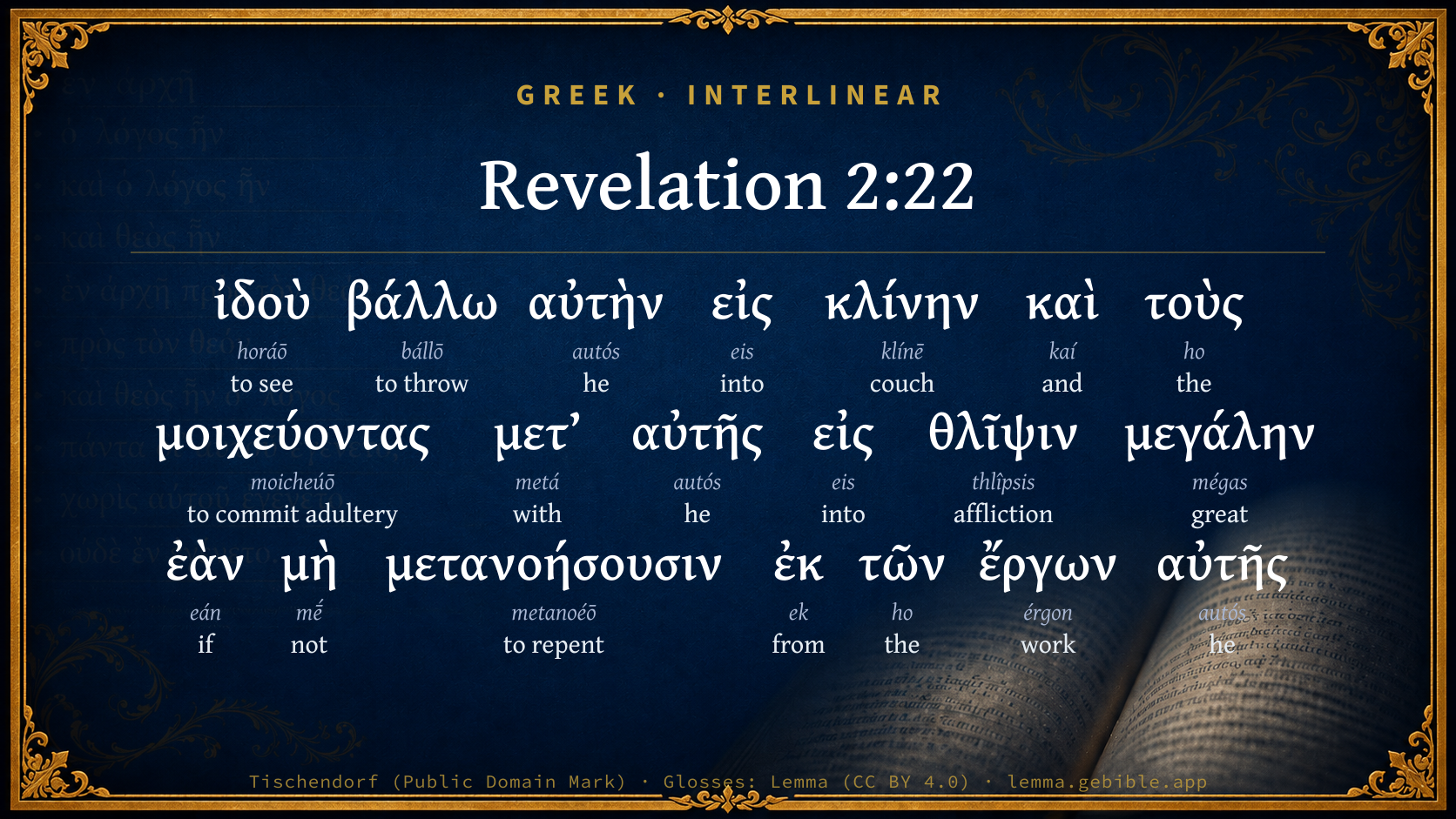
  1. ἰδοὺ horáō G3708 “to see” Verb, Aorist, Middle, Imperative, 2nd person, Singular
  2. βάλλω bállō G906 “to throw” Verb, Present, Active, Indicative, 1st person, Singular
  3. αὐτὴν autós G846 “he” Personal pronoun, Accusative, Singular, Feminine
  4. εἰς eis G1519 “into” Preposition
  5. καὶ kaí G2532 “and” Conjunction
  6. τοὺς ho G3588 “the” Article, Accusative, Plural, Masculine
  7. μοιχεύοντας moicheúō G3431 “to commit adultery” Verb, Present, Active, Participle, Accusative, Plural, Masculine
  8. μετ’ metá G3326 “with” Preposition
  9. αὐτῆς autós G846 “he” Personal pronoun, Genitive, Singular, Feminine
  10. εἰς eis G1519 “into” Preposition
  11. θλῖψιν thlîpsis G2347 “affliction” Noun, Accusative, Singular, Feminine
  12. μεγάλην mégas G3173 “great” Adjective, Accusative, Singular, Feminine
  13. ἐὰν eán G1437 “if” Conditional
  14. μὴ mḗ G3361 “not” Particle, Negative
  15. μετανοήσουσιν metanoéō G3340 “to repent” Verb, Future, Active, Indicative, 3rd person, Plural
  16. ἐκ ek G1537 “from” Preposition
  17. τῶν ho G3588 “the” Article, Genitive, Plural, Neuter
  18. ἔργων érgon G2041 “work” Noun, Genitive, Plural, Neuter
  19. αὐτῆς autós G846 “he” Personal pronoun, Genitive, Singular, Feminine

About this verse

These counts appear in no published source. They are computed here, from the morphology-tagged text and Lemma’s own curated glosses. What Lemma adds →

20
words
16
distinct lemmas
Revelation
section

Notable vocabulary

The rarest word here is κλίνην couch G2825 — appearing just 8 times in the whole Greek New Testament.

Shared distinctive vocabulary

κλίνην couch G2825 occurs in 8 verses of the Greek New Testament. Also found in:

Repetition

Words recur within this verse:

  • εἰς into G1519 ×2
  • αὐτὴν he G846 ×3
  • τοὺς the G3588 ×2

Cross-references

15

Topical passages linked to Revelation 2:22 in the Treasury of Scripture Knowledge — connected by theme and wording, ordered by reader-vote popularity; previews shown in the World English Bible.

  • Revelation 17:2 with whom the kings of the earth committed sexual immorality, and those who dwell in the earth were made drunken with the wine of her sexual immorality."
  • Ezekiel 16:37–41 therefore see, I will gather all your lovers, with whom you have taken pleasure, and all those who you have loved, with all those who you have hated; I will even gather them against you on every side, and will uncover your nakedness to them, that they may see all your nakedness.
  • Luke 13:5 I tell you, no, but, unless you repent, you will all perish in the same way."
  • Jeremiah 36:3 It may be that the house of Judah will hear all the evil which I purpose to do to them; that they may return every man from his evil way; that I may forgive their iniquity and their sin.
  • Ezekiel 18:30–32 Therefore I will judge you, house of Israel, everyone according to his ways, says the Lord Yahweh. Return you, and turn yourselves from all your transgressions; so iniquity shall not be your ruin.
  • Revelation 18:3 For all the nations have drunk of the wine of the wrath of her sexual immorality, the kings of the earth committed sexual immorality with her, and the merchants of the earth grew rich from the abundance of her luxury."
  • Revelation 18:9 The kings of the earth, who committed sexual immorality and lived wantonly with her, will weep and wail over her, when they look at the smoke of her burning,
  • Ezekiel 23:29 and they shall deal with you in hatred, and shall take away all your labor, and shall leave you naked and bare; and the nakedness of your prostitution shall be uncovered, both your lewdness and your prostitution.
  • Luke 13:3 I tell you, no, but, unless you repent, you will all perish in the same way.
  • Ezekiel 33:11 Tell them, As I live, says the Lord Yahweh, I have no pleasure in the death of the wicked; but that the wicked turn from his way and live: turn you, turn you from your evil ways; for why will you die, house of Israel?
  • Zephaniah 3:7 I said, "Just fear me. Receive correction, so that her dwelling won't be cut off, according to all that I have appointed concerning her." But they rose early and corrupted all their doings.
  • 2 Timothy 2:25–26 in gentleness correcting those who oppose him: perhaps God may give them repentance leading to a full knowledge of the truth,
  • Revelation 19:18–21 that you may eat the flesh of kings, the flesh of captains, the flesh of mighty men, and the flesh of horses and of those who sit on them, and the flesh of all men, both free and slave, and small and great."
  • Ezekiel 23:45–48 Righteous men, they shall judge them with the judgment of adulteresses, and with the judgment of women who shed blood; because they are adulteresses, and blood is in their hands.
  • 2 Corinthians 12:21 that again when I come my God would humble me before you, and I would mourn for many of those who have sinned before now, and not repented of the uncleanness and sexual immorality and lustfulness which they committed.

Cross-references courtesy of OpenBible.info (CC BY 4.0).

Where the printed editions differ

1 variant

Places in this verse where the major printed Greek editions disagree on the wording in a way that affects the translation — a comparison of editions, not a manuscript-by-manuscript collation. The editions are the modern critical texts (Nestlé-Aland 28/27, SBL, Westcott-Hort, Tregelles, Tyndale House) and the traditional texts behind the KJV (the Textus Receptus and the Byzantine/Majority text). It is not a claim about which reading is original.

  1. Different wording
    αὐτῆς.

    “of her.”

    In NA28NA27TynSBLWHTregByz Not in TR

    αὐτῶν (autōn) 'of them' occurs in traditional manuscripts (TR) instead of αὐτῆς. (autēs) 'of her.' in older manuscripts (NA28+NA27+Tyn+SBL+WH+Treg+Byz)

Textual data: Translators Amalgamated Greek New Testament (STEPBible TAGNT) · CC BY 4.0.

Commentary

Notes on Revelation 2:22 from classic Christian and Jewish commentators (each source and its license shown beneath its notes). The classic Christian expositions comment on the surrounding passage and are grouped to its opening verse, so a note may address several verses; the Jewish commentaries on the Tanakh (Rashi and others) are per-verse, so they appear only where the commentator wrote on this verse.

Lemma curates 59 commentaries, every one of them public domain or Creative Commons licensed, each selected and text-cleaned for this edition rather than reprinted as found. About our sources →

Joseph Benson's Commentary

Rev 2:22-23. Behold — I will at length execute judgment upon her, and let the process of my righteous vengeance be observed. I will cast her into a bed — Not of pleasure, but of great tribulation — I will severely punish these seducers for their evil principles and practices; and this punishment shall reach all who have been partakers in such acts of wickedness: and this threatening shall be accomplished as surely as the punishment was which the Prophet Elijah denounced in the name of the Lord against Jezebel, 1Ki 21:23. Except they repent, &c. — Except they be humbled for, and forsake their vile practices. And I will kill her children — I will slay those that presume to follow her in her wickedness; with death — An expression which denotes death by the plague, or by some manifest stroke of God’s hand. Probably the remarkable vengeance taken on these was the token of the certainty of all the rest. And all the churches — To which thou now writest; shall know that I am he which searcheth the reins — The desires; and hearts — Thoughts; and that though I am very long- suffering with respect to many sinners, and am unwilling immediately to come to extremities; yet I am not to be mocked and trifled with; and therefore they will learn to respect and honour the administration of my government; who, as I know the secrets of men’s hearts, so I will at length give unto every one of you according to your works — And according to those principles from which I know they have proceeded; and thus I will approve the perfect justice of my treatment of you all. It is observable, the angel of the church at Thyatira was only blamed for suffering such deceivers to seduce Christ’s servants. This fault ceased when God took vengeance on these seducers. Therefore he is not expressly exhorted to repent, though that is implied.

Joseph Benson's Commentary on the Old and New Testaments (1811–1818) — public domain. Text from a community e-Sword module.

Tyndale Open Study Notes

Tyndale Open Resources

2:22-23 Christ’s judgment on this “Jezebel” and her followers comes in three stages: (1) Jezebel is on a bed of suffering; (2) her followers will suffer greatly; and (3) her children will die (cp. Acts 5:5, 10; 1 Cor 11:30). This judgment echoes the plagues on Egypt that ended with the deaths of Egypt’s firstborn sons (see Exod 12:29-30). • God sees thoughts and intentions (see Jer 17:10; Acts 1:24; Heb 4:12-13), and he gives whatever sentence people deserve (see Rev 22:12; Jer 17:10; Matt 16:27).

Tyndale Open Study Notes — © Tyndale Open Resources, licensed CC BY-SA 4.0. Text via the HelloAO Bible API.

Bengel's Gnomon

Johann Albrecht Bengel

Rev 2:22. Βαλῶ[42]) Thus Hunt. Æth. Arab. Lat. and many others, who read I will send, and Tertullian, who has I will give. The others read βάλλω. For the copyists frequently put ΛΛ for Λ in the use of this verb; and ἸΔΟῪ is usually construed with a present, though sometimes also with a future: Luk 1:20; Luk 1:31; Luk 1:48. And the future agrees with this passage, because the condition, unless they shall repent, gives an interval of time: and ἀποκτενῶ accords with ΒΑΛῶ: and lastly, in all these denunciations, the sense of the future prevails: ch. Rev 2:5, ΚΙΝΉΣΩ; Rev 2:16, ΠΟΛΕΜΉΣΩ; Rev 2:24, ΒΑΛῶ, where also many read ΒΆΛΛΩ; ch. Rev 3:4, ΠΕΡΙΠΑΤΗΣΟΥΣΙ; Rev 2:9, ΠΟΙΉΣΩ, with ἸΔΟΎ; Rev 2:20, ΕἸΣΕΛΕΎΣΟΜΑΙ, Κ.Τ.Λ.

[42] So B (βάλω) and Memph. But Vulg. and most authorities, βάλλω.—E.

Bengel's Gnomon of the New Testament — English translation (T&T Clark, Edinburgh, 1860) — public domain. Text from a community e-Sword module.

Meyer's Critical & Exegetical Commentary

Heinrich August Wilhelm Meyer

Rev_2:22-23. The ἰδού so strongly emphasizes the succeeding threat, and makes us so to expect something new in comparison with Rev_2:21, that the discredited ἐγώ appears in an exegetical respect entirely superfluous.

Already the βάλλω αὐτ. shows that the κλίνη is a bed which the woman takes only when so compelled. Yet the κλίνη does not designate the punishments in hell,[1251] but the sick-bed,[1252] in opposition to the bed of sensuality. But by this description of such judgment, the reference to Jezebel and her entirely different[1253] punishment is abandoned,[1254] so that even in Rev_2:23, in the words Κ. Τ. ΤΈΚΝΑ ΑὐΤ., an allusion to the destruction of the sons of Ahab[1255] dare not be sought. The punishment of the woman and her companions, without regard to the significant designation existing in the name Jezebel, is determined in accordance with the manner of their sins. It is to be observed, however, that the expression now chosen, ΜΟΙΧΕΎΕΙΝ

Τ. ΜΟΙΧ. ΜΕΤʼ ΑὐΤῆς, i.e., those who shared in her deeds,[1256] designates the entire conduct of the woman and her party in a double sense, embracing the ΠΟΡΝΕΊΑ and the ΦΑΓ. ΕἸΔΩΛ., since the ethnicizing disorder must be punished more than adultery in a theocratical-symbolical sense, as in fact actual fornication was what was chiefly designed. Thus the ΜΟΙΧΕΎΟΝΤΕς ΜΕΤʼ ἈΥΤῆς are those who perform ΤᾺ ἜΡΓΑ ΑὐΤῆς, i.e., the works taught and practised by the woman; or as in Rev_2:23 it is again said, according to another application of the symbolical idea,[1257] ΤᾺ ΤΈΚΝΑ ΑὐΤῆς,[1258] and therefore not actually bastards.[1259] Incorrectly, N. de Lyra: gehenna. It is possible to think of a pest,[1260] because the LXX. have rendered the Heb. דֶּבֶר, Eze_33:27, by ΘΆΝΑΤΟς. Meanwhile it is sufficient to leave the matter in its universality; the entire formula ἈΠΟΚΤ. ἘΝ ΘΑΝΆΤῼ then in its fulness corresponds in some measure to the Hebrew mode of combining an infin. with the finite tense of its root, as, e.g., Lev_20:10, where the punishment of adultery is stated מות־יומַת (LXX., ΘΑΝἈΤῷ ΘΑΝΑΤΟΎς ΘΩΣΑΝ). But any allusion to this precise passage is, to say the least, doubtful. The independence of the Johannean formula, notwithstanding its adoption, of Hebraic modes of statement, lies partly in the distinction between the words ἈΠΟΚΤΕΝῶ and ΘΑΝἈΤῷ, and partly in the fact that by the addition of the preposition ἘΝ the precise idea of the means[1261] is marked.

ΚΑῚ ΓΝΏΣΟΝΤΑΙ, Κ.Τ.Λ. Every judgment of the Lord upon the world is a revelation of his glory, and has the intentional result to advance and strengthen believers more and more in their knowledge. Thus the idea of the ΓΝΩΣ. is entirely too general[1262] to admit of any special opposition to the false gnosis[1263] of the Nicolaitans. It is different with Rev_2:24.

ΠᾶΣΑΙ ΑΊ ἘΚΚΛ. Not only the Asiatic;[1264] but rather, as the judgment upon false teachers in Thyatira is an act which belongs to the coming of the Lord, so also this special act shares in the absolutely universal significance of Christs final appearance.

ὍΤΙ ἘΓΏ ΕἸΜΙ, Κ.Τ.Λ. A forcible designation of the person of whom so great a thing is said as Ὁ ΕῤΕΎΝΩΝ, Κ.Τ.Λ. Cf. Psa_7:10. The Son of God who executes judgment (ΚΑῚ ΔΈΣΩ, Κ.Τ.Λ.) has also the divine attribute of searching the deepest recesses of man, and thus the condition for just judgment,[1265] as he has both eyes as a flame of fire, and feet like brass.[1266]

ΝΕΦΡΟῪς ΚΑῚ ΚΑΡΔΊΑς. According to Grot. and Beng., the former is intended to designate the desires, and the latter the thoughts. But the expression designates rather the entire inner part without any distinction of the two points.

ὙΜῖΝ. An animated turn to those guilty.[1267] Cf. Rev_2:24.

ΚΑΤᾺ ΤᾺ ἜΡΓΑ ὙΜΩΝ. Because the Lord, who recognizes the inner source of the works, sees also their worth.[1268]

[1251] Beda, N. de Lyra. Cf. also C. a Lap., Tirin.

[1252] Psa_41:4.

[1253] 2Ki_9:31 sqq.

[1254] Against Herder, etc.

[1255] 2Ki_10:7. Züll., Ebrard.

[1256] Areth., Vitr., Ew., De Wette, etc.

[1257] Cf. Isa_57:3.

[1258] Areth., N. de Lyra, Calov., Vitr., Eichh., De Wette, Stern, Hengstenb., Ebrard, Ew. ii.

[1259] Aretius, Grot., Beng., Ew., Klief.

[1260] Grot., Vitr., Wetst., Bengel, Ewald, etc. Cf. Rev_6:8.

[1261] Cf. Rev_2:16.

[1262] Cf. Joe_3:17; Isa_37:20.

[1263] Hengstenb.

[1264] Grot.

[1265] Jer_11:20; Jer_17:10.

[1266] Rev_2:18.

[1267] Grotius, De Wette.

[1268] Cf. De Wette.

Meyer — Critical and Exegetical Commentary on the New Testament — English translation by Peter Christie, edited by Frederick Crombie (T&T Clark, 1880) — public domain. Text from a community e-Sword module.

Expositor's Greek Testament

ed. W. Robertson Nicoll

Rev 2:22 . κλίνην (bed, not a couch of revelry) aegritudinis non amoris; disease or sickness ( cf. for the phrase, 1MMal 1:5 ) the punishment of error, especially of error accompanied by licentiousness. The inscriptions from Asia Minor abound with instances of the popular belief that impurity, moral and even physical, was punished by disease or disaster to oneself, one’s property, one’s children. Sickness might even go the length of death (1Co 11:29-30 ). The prophet, however, seems to avoid calling Jesus or God σωτὴρ or σώζων , a term appropriated by the popular religions of Phrygia and lavished on many deities as healers and helpers ( C. B. P. i. 262 f.). μοιχ ., men and women who imitate her licentiousness. θλ ., physical distress, illness. μετανοήσουσιν , the fut. indic., expresses rather more probability than subj. with ἐὰν μή ( cf. Blass, § 65, 5). For tense of βάλλω see Zec 8:7 , LXX, etc.

The Expositor's Greek Testament, edited by W. Robertson Nicoll (1897–1910) — public domain. Text from a community e-Sword module.

Jamieson, Fausset & Brown

Robert Jamieson, A. R. Fausset & David Brown

Behold--calling attention to her awful doom to come.

I will--Greek present, "I cast her."

a bed--The place of her sin shall be the place of her punishment. The bed of her sin shall be her bed of sickness and anguish. Perhaps a pestilence was about to be sent. Or the bed of the grave, and of the hell beyond, where the worm dieth not.

them that commit adultery with her--spiritually; including both the eating of idol-meats and fornication. "With her," in the Greek, implies participation with her in her adulteries, namely, by suffering her (Rev 2:20), or letting her alone, and so virtually encouraging her. Her punishment is distinct from theirs; she is to be cast into a bed, and her children to be killed; while those who make themselves partakers of her sin by tolerating her, are to be cast into great tribulation.

except they repent--Greek aorist, "repent" at once; shall have repented by the time limited in My purpose.

their deeds--Two of the oldest manuscripts and most ancient versions read "her." Thus, God's true servants, who by connivance, are incurring the guilt of her deeds, are distinguished from her. One oldest manuscript, ANDREAS, and CYPRIAN, support "their."

Jamieson, Fausset & Brown — Commentary Critical and Explanatory on the Whole Bible (1871) — public domain (CC PDM 1.0). Text via the HelloAO Bible API.

Adam Clarke's Commentary

Verse 22. Behold, I will cast her into a bed] "This again alludes to the same history. Ahaziah, son of Ahab and Jezebel, by his mother's ill instruction and example, followed her ways. God punished him by making him fall down, as is supposed, from the top of the terrace over his house, and so to be bedridden for a long time under great anguish, designing thereby to give him time to repent; but when, instead of that, he sent to consult Baalzebub, Elijah was sent to pronounce a final doom against his impenitence. Thus the son of Jezebel, who had committed idolatry with and by her advice, was long cast into the bed of affliction, and not repenting, died: in the same manner his brother Jehoram succeeded likewise. All this while Jezebel had time and warning enough to repent; and though she did not prevail with Jehoram to continue in the idolatrous worship of Baal, yet she persisted in her own way, notwithstanding God's warnings. The sacred writer, therefore, here threatens the Gnostic Jezebel to make that wherein she delighteth, as adulterers in the bed of lust, to be the very place, occasion, and instrument, of her greatest torment. So in Isaiah, the bed is made a symbol of tribulation, and anguish of body and mind. See Isa 28:20; Job 33:19.

Adam Clarke's Commentary on the Bible (1810–1826) — public domain. Text from a community e-Sword/MySword module.

Ellicott's Commentary for English Readers

(22) I will cast her into a bed.—The chamber of voluptuousness will become the chamber of sickness. The spot of the sin shall be the scene of punishment. (Comp. 1Ki_21:19.)

A Bible Commentary for English Readers, edited by Charles John Ellicott (1878–1897) — public domain. Text from a community e-Sword module.

The Cambridge Bible for Schools and Colleges

gen. ed. J. J. S. Perowne

22. I will cast] lit. ‘I am casting’ i.e. am about to cast. Cf. ‘I ascend’, Joh_20:17.

a bed] Perhaps of sickness, as “death” in the next v. is perhaps to be taken of pestilence: cf. Rev_6:8.

with her] Possibly the sense is “I will cast them together with her into …,” but the sense “the partners of her adulteries” is at least equally natural. It seems probably intended, that she and they are to be separated in punishment: Francesca’s “Questi che mai da me non fia diviso” is rather a poetical sentiment than a moral one. But if Jezebel be understood to mean a sect rather than an individual woman, it will be possible to distinguish her “adulteries” as metaphorical from the literal “fornication” which she encouraged: if so, her paramours are the false teachers, her children their disciples.

The Cambridge Bible for Schools and Colleges (gen. ed. J. J. S. Perowne; Cambridge University Press, 1878–1918) — public domain. Text from a community e-Sword module.

John Gill's Exposition

Behold, I will cast her into a bed,.... Of sickness and languishing; and which denotes the sickly, pining, and languishing state of the church of Rome, as a just retaliation for her bed of luxury and deliciousness, adultery and idolatry, she had indulged herself in; this was threatened, and was yet to come, and began at the time of the Reformation, signified by the next church state; and, ever since, the whore of Rome has been visibly sickening and decaying. The Alexandrian copy reads, "into a prison":

and them that commit adultery with her into great tribulation: the kings of the earth, and their subjects, who have joined in the idolatries and corruptions of the Romish church, Rev 17:2, which may be understood either of that distress and uneasiness the Reformation in some countries gave them; or those outward troubles, wars, and desolations they have been since attended with, particularly the empire of Germany; which has been in great tribulation, formerly by the Turks, and of late by internal broils among themselves, and by the armies of other princes entering into it; or it may regard that eternal vengeance that will be recompensed to all such persons:

except they repent of their deeds; their spiritual fornication or idolatry, and all the abominations the members of that apostate church are guilty of. There seems to be an allusion in this verse to Ahaziah and Joram, sons of Ahab and Jezebel, who followed their mother's idolatrous practices, and were cast upon a bed of sickness, Kg2 1:2.

John Gill's Exposition of the Whole Bible (1746–1763) — public domain (CC PDM 1.0). Text via the HelloAO Bible API.

Trapp's Complete Commentary

John Trapp

22 Behold, I will cast her into a bed, and them that commit adultery with her into great tribulation, except they repent of their deeds.

Ver. 22. Behold, I will cast her into a bed] A bed of affliction for that bed of security upon which she had stretched herself, Amo 6:4. God hath his season, his harvest for judgment, Mat 13:30. Men may expect a time of healing when they shall find nothing else but a time of trouble, Jer 14:19. One may defer a sore till it be incurable. See Eze 24:13.

John Trapp, A Commentary or Exposition upon All the Books of the Old and New Testament (1647–1656) — public domain. Text from a community e-Sword module.

Albert Barnes' Notes on the Bible

Behold, I will cast her into a bed - Not into a bed of ease, but a bed of pain. There is evidently a purpose to contrast this with her former condition. The harlot’s bed and a sick-bed are thus brought together, as they are often, in fact, in the dispensations of Providence and the righteous judgments of God. One cannot be indulged without leading on, sooner or later, to the horrid sufferings of the other: and how soon no one knows.

And them that commit adultery with her - Those who are seduced by her doctrines into this sin; either they who commit it with her literally, or who are led into the same kind of life.

Into great tribulation - Great suffering; disease of body or tortures of the soul. How often - how almost uniformly is this the case with those who thus live! Sooner or later, sorrow always comes upon the licentious; and God has evinced by some of his severest judgments, in forms of frightful disease, his displeasure at the violation of the laws of purity. There is no sin that produces a mere withering and desolating effect upon the soul than what is here referred to; none which is more certain to be followed with sorrow.

Except they repent of their deeds - It is only by repentance that we can avoid the consequences of sin. The word “repent” here evidently includes both sorrow for the past, and abandonment of the evil course of life.

Albert Barnes' Notes on the Bible (1834–1885) — public domain. Text from a community e-Sword/MySword module.

Matthew Poole's English Annotations

I will cast her into a bed; another kind of bed than she hath sinned in and by, not a bed of ease and pleasure, but of pain and torment. Nor shall the seduced escape, they shall also be cast into

great tribulation, pains and torments of conscience, or afflictions more corporal, either from the more immediate hand of God, or the hands of men.

Except they repent of their deeds; this is to be supposed to all God’s threatenings of judgments, the execution of them ordinarily may be prevented by repentance, and such is the patience of God, that he gives the vilest sinners a space to repent.

Matthew Poole's English Annotations on the Holy Bible (1683–1685) — public domain. Text from a community e-Sword/MySword module.

Whedon's Commentary on the Bible

Daniel D. Whedon

22. Behold—A challenge of attention to this threatened judgment; a judgment so clear and palpable as to strike all the Churches, Rev_2:23.

Cast her into a bed—Her bed of adulteries shall be exchanged for a bed of tribulation; a figurative bed of penalty for the literal bed of sin.

Daniel D. Whedon (gen. ed.), Commentary on the Old and New Testaments (1874–1909) — public domain. Text from a community e-Sword module.

The Pulpit Commentary

Behold! The exclamation "arrests attention, and prepares the way for something unexpected and terrible." It is one of the many differences between the Fourth Gospel and the Apocalypse, that in the former ide is the dominant form, while in the latter idou is the invariable form; (kai ide in Rev_6:1, Rev_6:5, 7 is a spurious addition) idou is very rare in the Gospel; ide is found nowhere in the Apocalypse. In the Epistles neither form occurs. I do cast her into a bed. Ballw , not balw , is the true reading; the future has been substituted for the present to match the futures in ver. 23. Forbearance having failed, God tries severity; and, as so often in his dealings with man, the instrument of wrong doing is made the instrument of punishment. The bed of sin becomes a bed of suffering. Compare "In the place where dogs licked the blood of Naboth shall dogs lick thy blood, even thine;" and "I will requite thee in this plat, saith the Lord". (1Ki_21:19 2Ki_9:26) Ballw is one of many words which has become weakened in meaning in late Greek: it often means no more than "place" or "put". (Joh_5:7 Joh_12:6 Joh_13:2 Joh_18:11 Joh_20:25) In the passive it is rather common of being laid up in sickness. (Mat_8:6, 14 9:2 Mar_7:30) But perhaps we should rather compare such expressions as "cast into prison, into the sea, into the fire, into Gehenna". (Mat_18:30 Mat_21:21 Mat_18:8, Mat_18:9) It may be doubted whether there is any significance in the fact that her sin is spoken of as porneina (ver. 21), whereas those who sin with her are said moiceuein . Idolatry is spoken of both as whoredom and as adultery. In the one case it is a contrast to the marriage tie between God and his faithful worshippers; in the other it is a violation of it. Jezebel anticipates the harlot of Revelation 17, as Balaam anticipates the false prophet of Re 13. The remarkable construction, "repent out of (metanohsai ek), is peculiar to this book (vers. 21, 22 Rev_9:20, 21 16:11; but in Act_8:22 we have metanohson apo , and in Heb_6:1 we have metanoia apo , compare the converse, metanoia eiv , Act_20:21) "Her works" is to be preferred to "their works." Authv might easily be changed to autwn , either accidentally, owing to the preceding ergwn , or deliberately, because it seems strange to talk of repenting from the works of another person. But the point is that those who have become partakers in her sins have abandoned their own works for hers; and it is therefore from her works that they are bidden to repent (compare "my works" in ver. 26).

The Pulpit Commentary (1880–1919), ed. H.D.M. Spence-Jones & Joseph S. Exell — public domain. Text from a community e-Sword module.

John Wesley's Explanatory Notes

I will cast her into a bed-into great affliction-and them that commit either carnal or spiritual adultery with her, unless they repent - She had her time before. Of her works - Those to which she had enticed their and which she had committed with them. It is observable, the angel of the church at Thyatira was only blamed for suffering her. This fault ceased when God took vengeance on her. Therefore he is not expressly exhorted to repent, though it is implied.

John Wesley, Explanatory Notes Upon the Whole Bible (1754–1765) — public domain. Text via the GEBible commentary corpus.

The People's New Testament

B. W. Johnson

22. Behold, I will cast her into a bed. Sickness and a bed are symbols of affliction and punishment. Them that commit adultery with her. This is the term applied to idolatrous Israel (Jer. 3:9; Ezek. 16:32). To practice the idolatrous rites of this faction would be spiritual adultery.

B. W. Johnson's The People's New Testament with Notes (1889–1891) — public domain. Electronic text from the Christian Classics Ethereal Library (CCEL) ThML edition.

unfoldingWord translationNotes

Door43 World Missions Community

I will throw her onto a sickbed ... into great suffering

Her having to lie in bed would be the result of Jesus making her very sick. AT: "I will make her lie sick in bed ... I will make suffer greatly" or "I will make her very sick ... I will make suffer greatly" (See: Metonymy)

those who commit adultery with her into great suffering

Jesus speaks of causing people to suffer as throwing them into suffering. AT: "I will make those who commit adultery with her to suffer greatly" (See: Metaphor)

commit adultery

"practice adultery"

unless they repent of her deeds

This implies that they have participated with her in her wicked behavior. By repenting of her deeds, they also repent of participating in her behavior. AT: "if they do not repent from doing the evil that she does" or "if they do not repent of participating in her deeds" (See: Assumed Knowledge and Implicit Information)

I will strike her children dead

"I will kill her children"

her children

Jesus spoke of her followers as if they were her children. AT: 'her followers" or "the people who do what she teaches" (See: Metaphor)

thoughts and hearts

The term "heart" a metonym that represents feelings and desires. AT: "what people think and want" (See: Metonymy)

I will give to each one of you

This is an expression about punishment and reward. AT: "I will punish or reward each one of you" (See: Idiom)

translationWords

adultery

suffer

repent

die

church

unfoldingWord translationNotes — © Distant Shores Media and the Door43 World Missions Community, licensed CC BY-SA 4.0. Source: git.door43.org/Door43/en_tn.

Cambridge Greek Testament for Schools and Colleges

22. εἰς κλίνην. Arm[108] reads εἰς κάμινον, A reads εἰς φυλακὴν. It is not easy to connect either with the text. We might account for A by supposing that a scribe was misled by a reminiscence of Rev 2:10 sup.; if κάμινον were substituted for κλίβανον the latter might be contracted into κλῑν, so too φυλακὴν might be a gloss on some non-classical derivative of κλείω which would like κλίνην be capable of contraction into κλῑν.

[108] Armenian.

22. βάλλω. Lit. “I am casting” i.e. “am about to cast.” Cf. ἀναβαίνω, St Joh 20:17, and note on ἔρχομαι sup. Rev 2:5.

εἰς κλίνην. See crit. note. Perhaps a bed of sickness, as “death” in the next verse is perhaps to be taken of pestilence, cf. Rev 6:8.

μετʼ αὐτῆς. Possibly the sense is “I will cast them together with her into …,” but the sense “the partners of her adulteries” is at least equally natural. It seems probably intended, that she and they are to be separated in punishment: Francesca’s “Questi che mai da me non fia diviso” is rather a poetical sentiment than a moral one. But if Jezebel be understood to mean a sect rather than an individual woman, it will be possible to distinguish her “adulteries” as metaphorical from the literal “fornication “which she encouraged: if so, her paramours are the false teachers, her children their disciples.

Cambridge Greek Testament for Schools and Colleges (Cambridge University Press, 1896; 21 vols, various authors incl. Carr, Maclear, Plummer, Farrar, Lumby, Moule, M. R. James, Simcox) — public domain. Text from a community e-Sword module.

Alford’s Greek Testament

Henry Alford

22.] Behold (arrests attention, and prepares the way for something unexpected and terrible), I cast her (evidently against her will: but there is not necessarily violence in the word: it is the ordinary verb for being “cast” on a bed of sickness: see reff. and Mat 8:6, Mat 8:14) into a bed (ἀντὶ τοῦ, εἰς ἀῤῥωστίαν, Areth.: will change her bed of whoredom into a bed of anguish: see Psa 41:3. So most Commentators. Perhaps the threat has reference to a future pestilence. Bede, Lyra, al., understand the bed to be “infernalis pœna,” the latter referring to Isa 14:11. Ansbert, curiously enough, “severitatis vel audaciæ lectum,” into which God casts his enemies before their destruction), and those who commit adultery (not now πορνεύοντας, but a more general term, embracing in its wide meaning both the πορνεῦσαι and εἰδωλόθυτα φαγεῖν, and well known as the word used of rebellious and idolatrous Israel, cf. Jer 3:8, Jer 3:5:7; Eze 16:32 al.) together with her μετʼ αὐτῆς is not = αὐτήν, so that she should be the ‘conjux adulterii,’ but implies merely participation—those who share with her in her adulteries. These μοιχεύοντες μετʼ αὐτῆς, as interpreted by the tone with which the rebuke began, will mean, those who by suffering and encouraging her, make themselves partakers of her sin. And this rather favours the idea that not one individual, but a dominant party, is intended. See below) into great tribulation (this clause forms a kind of parallelism with the former, so that εἰς θλίψιν μεγ. is parallel with εἰς κλίνην. But it is not to be regarded as interpreting κλίνη. Her punishment and that of her children (see below) is one thing; that of the partakers in her adulteries, those in the church who tolerated and encouraged her, another, viz. great tribulation. This is forcibly shewn by the ἔργων αὐτῆς following), if they do not (aor.: speedily and effectually, shall not have done so by the time which I have in my thoughts) repent of her (not their: they are Christ’s servants who are tampering with her temptations and allowing themselves in her works, which are alien from their own spiritual life) works. And her children (emphatically put forward as distinguished from the last mentioned: q. d., “And as to her children, &c.” These are her proper adherents: not those who suffer her, but those who are begotten of her, and go to constitute her. Some Commentators have vainly dreamt of the slaughter of Ahab’s 70 sons, 2Ki_10: but they were not Jezebel’s children. The historical figure is obviously dropped here) I will slay with (in, but perhaps merely instrumental: see above, on ver. 16) death (the expression is probably a rendering of the Heb. מוֹת־יוּמַת, as in Lev 20:10, which the LXX render by θανάτῳ θανατούσθωσαν, and which there occurs in reference to adultery. But we need not, as Hengst., suppose a direct reference to that passage: for there is nothing of adultery here: we have done with τοὺς μοιχεύοντας μετʼ αὐτῆς, and are come to the judgment on τὰ τέκνα αὐτῆς): and all the churches (this remarkable expression, meaning not, all the Asiatic churches, but all the churches in the world till the end of time, lifts the whole of this threatening and its accompanying encouragements out of proconsular Asia, and gives us a glimpse into the œcumenical character of these messages) shall know (the fanciful Hengst. imagines a reference in γνώσονται to the false γνῶσις: but in so common and solemn a formula of the O. T., this must surely be out of the question) that I am he that searcheth the reins and the hearts (which, see reff. is the attribute of God: and therefore of the Son of God. Cf. ver. 18 above, and note. Grotius says, “Per renes intelliguntur desideria, ut et Psa 139:13, Jer 12:2, Pro 23:16: per cor, cogitata, 1Sa 16:7, 1Sa 16:1 Reg. 8:39 al.” But it seems doubtful whether so minute a distinctionis in the words; whether they are not rather a general designation for the whole inward parts of a man): and I will give to you (‘will render, in My doom of judgment.’ The strain of the Lord’s message is Suddenly changed into a direct address to those threatened) to each according to your works (ἔργα, not the mere outward products of the visible life, but the real acts and verities of the inward man, discerned by the piercing eye of the Son of God).

Henry Alford, The Greek Testament (1849–1861) — public domain. Text from a community e-Sword module.

Lesson kit

Teaching starters — assembled from the data on this page, not authored interpretation. Every prompt links to the verse data it draws on. Edit before teaching.

Revelation, in the Revelation, opens this verse with 20 words (16 distinct Greek lemmas). Its most distinctive word is klínē (“couch”). A historical commentator’s framing appears above. Read the whole chapter for the surrounding context.

Discussion questions

  1. What does “couch” (klínē) contribute to the verse as a whole?
  2. How does Matthew 9:2, which shares the word «couch», read alongside this verse?
  3. What does the repetition of “into” (2× in this one verse) do in this verse?
  4. These translations render this verse differently. What is at stake in choosing one wording over another?
  5. Compare how Joseph Benson's Commentary and Tyndale Open Study Notes read this verse. Where do they agree or differ?

Things to notice

Reading settings

Reading text

Shown beneath each verse's original-language words.

Old Testament
Old Testament edition

Read the OT as the Masoretic Hebrew (MT) or the Greek Septuagint (LXX).

English shown for the Greek Septuagint (in the Hebrew ↔ Greek comparison).

Comparing translations? Open the Compare panel on any verse page to stack up to four side by side.