
Revelation 20:12

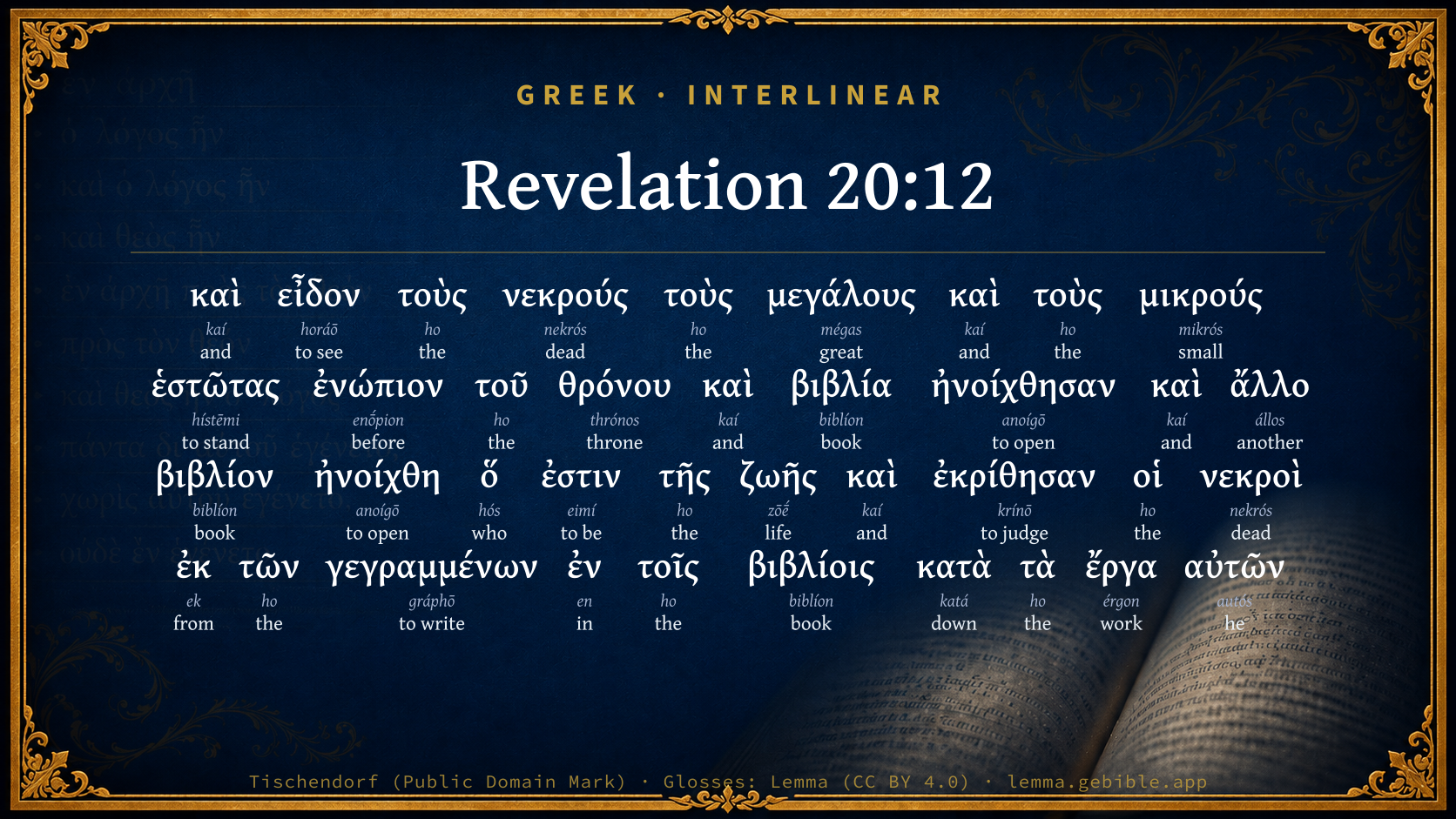
Greek (Tischendorf 8th ed.) Revelation 20:12 appears in the Greek New Testament. The text above is from the Tischendorf 8th edition. Each word links to its Strong’s number and a concise gloss. Click any word for its full Thayer’s Greek Lexicon entry.
Download image
Cite this verse

Revelation 20:12 (World English Bible). Public Domain. Lemma interlinear Bible study tool, https://lemma.gebible.app/v/revelation/20/12.

Show BibTeX & RIS
BibTeX
RIS
English Translation
I saw the dead, the great and the small, standing before the throne, and they opened books. Another book was opened, which is the book of life. The dead were judged out of the things which were written in the books, according to their works.
World English Bible · Public Domain
Download a study sheet

One document with this verse’s original text, its word-by-word gloss line, the meaning frame, cross-references with their text, attributed commentary, and full source and license credits — printable, and it pastes into notes with its structure intact.

This verse Autodidact and up

Study sheet (.html) Plain text (.txt)

A passage Seminary Student

Up to 50 verses in one chapter. A passage sheet keeps up to 6 commentary sources and 12 cross-references per verse, in the order this page ranks them, and says so on the sheet whenever that leaves anything out. Ask for a single verse and you get the Autodidact verse sheet above.

Everything on this page stays free to read, with no account — the sheet is a download of what is already on screen, not access to it.

Want to remove ads? Support Godless Engineer
Compare translations 3

The same verse in 3 English versions, stacked beneath the original-language interlinear above. Click any original word for its lexicon entry.

Each is an independent rendering of the whole verse — the interlinear is not word-aligned to these translations.

Highlighted words mark where these versions differ — a whole-verse word diff, not a word-by-word alignment.

  • World English Bible Public Domain
    I saw the dead, the great and the small, standing before the throne, and they opened books. Another book was opened, which is the book of life. The dead were judged out of the things which were written in the books, according to their works.
  • King James Version Public Domain
    And I saw the dead, small and great, stand before God; and the books were opened: and another book was opened, which is the book of life: and the dead were judged out of those things which were written in the books, according to their works.
  • unfoldingWord Literal Text CC BY-SA 4.0
    And I saw the dead, both the great and the small, standing before the throne, and books were opened, and another book was opened, which is the of Life. And the dead were judged from the written in the books, according to their deeds.

unfoldingWord Literal Text — © unfoldingWord, licensed CC BY-SA 4.0. Word-aligned USFM3 via Door43 (git.door43.org/unfoldingWord/en_ult).

Versions to compare (up to 4)

3 of 4 selected

Show all 19 translations

Every available English version of this verse, each an independent rendering of the whole verse.

  • World English Bible Public Domain
    I saw the dead, the great and the small, standing before the throne, and they opened books. Another book was opened, which is the book of life. The dead were judged out of the things which were written in the books, according to their works.
  • Berean Standard Bible Public Domain
    And I saw the dead, great and small, standing before the throne. And there were open books, and one of them was the Book of Life. And the dead were judged according to their deeds, as recorded in the books.
  • Majority Standard Bible Public Domain
    And I saw the dead, great and small, standing before the throne. And books were opened, and one of them was the Book of Life. And the dead were judged according to their deeds, as recorded in the books.
  • King James Version Public Domain
    And I saw the dead, small and great, stand before God; and the books were opened: and another book was opened, which is the book of life: and the dead were judged out of those things which were written in the books, according to their works.
  • American Standard Version (1901) Public Domain
    And I saw the dead, the great and the small, standing before the throne; and books were opened: and another book was opened, which is `the book' of life: and the dead were judged out of the things which were written in the books, according to their works.
  • Revised Version (1885) Public Domain
    And I saw the dead, the great and the small, standing before the throne; and books were opened: and another book was opened, which is the book of life: and the dead were judged out of the things which were written in the books, according to their works.
  • Geneva Bible (1599) Public Domain
    And I saw the dead, both great and small stand before God: and the bookes were opened, and another booke was opened, which is the booke of life, and the dead were iudged of those thinges, which were written in the bookes, according to their woorkes.
  • Douay-Rheims (1899) Public Domain
    And I saw the dead, great and small, standing in the presence of the throne, and the books were opened; and another book was opened, which is the book of life; and the dead were judged by those things which were written in the books, according to their works.
  • Young's Literal Translation Public Domain
    and I saw the dead, small and great, standing before God, and scrolls were opened, and another scroll was opened, which is that of the life, and the dead were judged out of the things written in the scrolls -- according to their works;
  • Literal Standard Version CC BY-SA 4.0
    and I saw the dead, small and great, standing before God, and scrolls were opened, and another scroll was opened, which is that of the life, and the dead were judged out of the things written in the scrolls—according to their works;
  • Unlocked Literal Bible CC BY-SA 4.0
    I saw the dead—the mighty and the unimportant—standing before the throne, and the books were opened. Then another book was opened—the Book of Life. The dead were judged by what was recorded in the books, according to their deeds.
  • unfoldingWord Literal Text CC BY-SA 4.0
    And I saw the dead, both the great and the small, standing before the throne, and books were opened, and another book was opened, which is the of Life. And the dead were judged from the written in the books, according to their deeds.
  • Darby Bible Public Domain
    And I saw the dead, great and small, standing before the throne, and books were opened; and another book was opened, which is [that] of life. And the dead were judged out of the things written in the books according to their works.
  • World Messianic Bible Public Domain
    I saw the dead, the great and the small, standing before the throne, and they opened books. Another book was opened, which is the book of life. The dead were judged out of the things which were written in the books, according to their works.
  • Webster's Bible Public Domain
    And I saw the dead, small and great, stand before God; and the books were opened: and another book was opened, which is the book of life: and the dead were judged out of the things which were written in the books, according to their works.
  • Free Bible Version CC BY-SA 4.0
    I saw the dead, great and small, standing before the throne, and the books were opened. Another book, the Book of Life, was opened and the dead were judged based on what was written in the books about what they had done.
  • Bible in Basic English Public Domain
    And I saw the dead, great and small, taking their places before the high seat; and the books were open, and another book was open, which is the book of life; and the dead were judged by the things which were in the books, even by their works.
  • Text-Critical English NT CC BY 4.0
    And I saw the dead, great and small, standing before the throne, and books were opened. Then another book was opened, which is the book of life. And the dead were judged by what was written in the books, according to their works.
  • Tyndale New Testament (1534) Public Domain
    And I sawe the deed both grett and small stonde before God: And the bokes were opened and another boke was opened which is the boke of lyfe and the deed were iudged of thoo thynges which weer wrytten in the bokes accordinge to their dedes:

Literal Standard Version (2020), Covenant Press — licensed CC BY-SA 4.0. Text via the HelloAO Bible API (eBible.org). Unlocked Literal Bible (unfoldingWord) — licensed CC BY-SA 4.0. Text via the HelloAO Bible API (eBible.org). unfoldingWord Literal Text — © unfoldingWord, licensed CC BY-SA 4.0. Word-aligned USFM3 via Door43 (git.door43.org/unfoldingWord/en_ult). Free Bible Version, Dr. Jonathan Gallagher — licensed CC BY-SA 4.0. Text via the HelloAO Bible API (eBible.org).

Word by word

More ways to search: Search by grammar → Find every occurrence → Compare this word →

Practice this passage: Drill this verse → Learn its vocabulary →

βιβλία
biblíon
G975
“book”
Noun, Nominative, Plural, Neuter
Part of Speech
Noun
Case
Nominative
Number
Plural
Gender
Neuter
Full Thayer's Definition

Origin: a diminutive of G976

TDNT: 11:17,1

1. a small book, a scroll, a written document 2. a sheet on which something has been written a. a bill of divorcement
  1. καὶ kaí G2532 “and” Conjunction
  2. εἶδον horáō G3708 “to see” Verb, Aorist, Active, Indicative, 1st person, Singular
  3. τοὺς ho G3588 “the” Article, Accusative, Plural, Masculine
  4. νεκρούς nekrós G3498 “dead” Adjective, Accusative, Plural, Masculine
  5. τοὺς ho G3588 “the” Article, Accusative, Plural, Masculine
  6. μεγάλους mégas G3173 “great” Adjective, Accusative, Plural, Masculine
  7. καὶ kaí G2532 “and” Conjunction
  8. τοὺς ho G3588 “the” Article, Accusative, Plural, Masculine
  9. μικρούς mikrós G3398 “small” Adjective, Accusative, Plural, Masculine
  10. ἑστῶτας hístēmi G2476 “to stand” Verb, Perfect, Active, Participle, Accusative, Plural, Masculine
  11. ἐνώπιον enṓpion G1799 “before” Adverb
  12. τοῦ ho G3588 “the” Article, Genitive, Singular, Masculine
  13. θρόνου thrónos G2362 “throne” Noun, Genitive, Singular, Masculine
  14. καὶ kaí G2532 “and” Conjunction
  15. ἠνοίχθησαν anoígō G455 “to open” Verb, Aorist, Passive, Indicative, 3rd person, Plural
  16. καὶ kaí G2532 “and” Conjunction
  17. ἄλλο állos G243 “another” Adjective, Nominative, Singular, Neuter
  18. βιβλίον biblíon G975 “book” Noun, Nominative, Singular, Neuter
  19. ἠνοίχθη anoígō G455 “to open” Verb, Aorist, Passive, Indicative, 3rd person, Singular
  20. ὅ hós G3739 “who” Relative pronoun, Nominative, Singular, Neuter
  21. ἐστιν eimí G1510 “to be” Verb, Present, Active, Indicative, 3rd person, Singular
  22. τῆς ho G3588 “the” Article, Genitive, Singular, Feminine
  23. ζωῆς zōḗ G2222 “life” Noun, Genitive, Singular, Feminine
  24. καὶ kaí G2532 “and” Conjunction
  25. ἐκρίθησαν krínō G2919 “to judge” Verb, Aorist, Passive, Indicative, 3rd person, Plural
  26. οἱ ho G3588 “the” Article, Nominative, Plural, Masculine
  27. νεκροὶ nekrós G3498 “dead” Adjective, Nominative, Plural, Masculine
  28. ἐκ ek G1537 “from” Preposition
  29. τῶν ho G3588 “the” Article, Genitive, Plural, Neuter
  30. γεγραμμένων gráphō G1125 “to write” Verb, Perfect, Passive, Participle, Genitive, Plural, Neuter
  31. ἐν en G1722 “in” Preposition
  32. τοῖς ho G3588 “the” Article, Dative, Plural, Neuter
  33. βιβλίοις biblíon G975 “book” Noun, Dative, Plural, Neuter
  34. κατὰ katá G2596 “down” Preposition
  35. τὰ ho G3588 “the” Article, Accusative, Plural, Neuter
  36. ἔργα érgon G2041 “work” Noun, Accusative, Plural, Neuter
  37. αὐτῶν autós G846 “he” Personal pronoun, Genitive, Plural, Masculine

About this verse

These counts appear in no published source. They are computed here, from the morphology-tagged text and Lemma’s own curated glosses. What Lemma adds →

38
words
22
distinct lemmas
Revelation
section

Shared distinctive vocabulary

βιβλία book G975 occurs in 27 verses of the Greek New Testament. Also found in:
Repetition

Words recur within this verse:

  • βιβλία book G975 ×3
  • νεκρούς dead G3498 ×2
  • ἠνοίχθησαν to open G455 ×2
  • τοὺς the G3588 ×9
  • καὶ and G2532 ×5

Cross-references

32

Topical passages linked to Revelation 20:12 in the Treasury of Scripture Knowledge — connected by theme and wording, ordered by reader-vote popularity; previews shown in the World English Bible.

  • 2 Corinthians 5:10 For we must all be revealed before the judgment seat of Christ; that each one may receive the things in the body, according to what he has done, whether good or bad.
  • Matthew 16:27 For the Son of Man will come in the glory of his Father with his angels, and then he will render to everyone according to his deeds.
  • Daniel 7:10 A fiery stream issued and came forth from before him: thousands of thousands ministered to him, and ten thousand times ten thousand stood before him: the judgment was set, and the books were opened.
  • Ecclesiastes 12:14 For God will bring every work into judgment, with every hidden thing, whether it is good, or whether it is evil.
  • Revelation 2:23 I will kill her children with Death, and all the assemblies will know that I am he who searches the minds and hearts. I will give to each one of you according to your deeds.
  • Jeremiah 17:10 I, Yahweh, search the mind, I try the heart, even to give every man according to his ways, according to the fruit of his doings.
  • Revelation 22:12 "Behold, I come quickly. My reward is with me, to repay to each man according to his work.
  • Revelation 11:18 The nations were angry, and your wrath came, as did the time for the dead to be judged, and to give your bondservants the prophets, their reward, as well as to the saints, and those who fear your name, to the small and the great; and to destroy those who destroy the earth."
  • Romans 14:10–12 But you, why do you judge your brother? Or you again, why do you despise your brother? For we will all stand before the judgment seat of Christ.
  • Revelation 3:5 He who overcomes will be arrayed in white garments, and I will in no way blot his name out of the book of life, and I will confess his name before my Father, and before his angels.
  • Daniel 12:1–2 "At that time shall Michael stand up, the great prince who stands for the children of your people; and there shall be a time of trouble, such as never was since there was a nation even to that same time: and at that time your people shall be delivered, everyone who shall be found written in the book.
  • John 5:28–29 Don't marvel at this, for the hour comes, in which all that are in the tombs will hear his voice,
  • Revelation 20:13 The sea gave up the dead who were in it. Death and Hades gave up the dead who were in them. They were judged, each one according to his works.
  • Psalms 28:4 Give them according to their work, and according to the wickedness of their doings. Give them according to the operation of their hands. Bring back on them what they deserve.
  • Revelation 21:27 There will in no way enter into it anything profane, or one who causes an abomination or a lie, but only those who are written in the Lamb's book of life.
  • Psalms 62:12 Also to you, Lord, belongs loving kindness, For you reward every man according to his work.
  • Acts 24:15 having hope toward God, which these also themselves look for, that there will be a resurrection of the dead, both of the just and unjust.
  • Revelation 20:11 I saw a great white throne, and him who sat on it, from whose face the earth and the heaven fled away. There was found no place for them.
  • Proverbs 24:12 If you say, "Behold, we didn't know this;" Doesn't he who weighs the hearts consider it? He who keeps your soul, doesn't he know it? Shall he not render to every man according to his work?
  • Jeremiah 32:19 great in counsel, and mighty in work; whose eyes are open on all the ways of the sons of men, to give everyone according to his ways, and according to the fruit of his doings:
  • Luke 10:20 Nevertheless, don't rejoice in this, that the spirits are subject to you, but rejoice that your names are written in heaven."
  • John 11:25–26 Jesus said to her, "I am the resurrection and the life. He who believes in me, though he die, yet will he live.
  • Romans 2:6 who "will pay back to everyone according to their works:"
  • 1 Corinthians 4:5 Therefore judge nothing before the time, until the Lord comes, who will both bring to light the hidden things of darkness, and reveal the counsels of the hearts. Then each man will get his praise from God.
  • 1 Thessalonians 4:15–17 For this we tell you by the word of the Lord, that we who are alive, who are left to the coming of the Lord, will in no way precede those who have fallen asleep.
  • Revelation 19:5 A voice came forth from the throne, saying, "Give praise to our God, all you his servants, you who fear him, the small and the great!"
  • 1 Corinthians 15:21–23 For since death came by man, the resurrection of the dead also came by man.
  • Philippians 4:3 Yes, I beg you also, true yoke-fellow, help these women, for they labored with me in the Gospel, with Clement also, and the rest of my fellow workers, whose names are in the book of life.
  • Revelation 13:8 All who dwell on the earth will worship him, everyone whose name has not been written from the foundation of the world in the book of life of the Lamb who has been killed.
  • Psalms 69:28 Let them be blotted out of the book of life, And not be written with the righteous.
  • Proverbs 24:29 Don't say, "I will do to him as he has done to me; I will render to the man according to his work."
  • Revelation 17:8 The beast that you saw was, and is not; and is about to come up out of the abyss and to go into destruction. Those who dwell on the earth and whose names have not been written in the book of life from the foundation of the world will marvel when they see that the beast was, and is not, and shall be present.

Cross-references courtesy of OpenBible.info (CC BY 4.0).

Where the printed editions differ

1 variant

Places in this verse where the major printed Greek editions disagree on the wording in a way that affects the translation — a comparison of editions, not a manuscript-by-manuscript collation. The editions are the modern critical texts (Nestlé-Aland 28/27, SBL, Westcott-Hort, Tregelles, Tyndale House) and the traditional texts behind the KJV (the Textus Receptus and the Byzantine/Majority text). It is not a claim about which reading is original.

  1. Different wording
    θρόνου,

    “throne,”

    In NA28NA27TynSBLWHTregByz Not in TR

    θεοῦ (theou) 'God' occurs in traditional manuscripts (TR) instead of θρόνου, (thronou) 'throne,' in older manuscripts (NA28+NA27+Tyn+SBL+WH+Treg+Byz)

Textual data: Translators Amalgamated Greek New Testament (STEPBible TAGNT) · CC BY 4.0.

Commentary

Notes on Revelation 20:12 from classic Christian and Jewish commentators (each source and its license shown beneath its notes). The classic Christian expositions comment on the surrounding passage and are grouped to its opening verse, so a note may address several verses; the Jewish commentaries on the Tanakh (Rashi and others) are per-verse, so they appear only where the commentator wrote on this verse.

Lemma curates 59 commentaries, every one of them public domain or Creative Commons licensed, each selected and text-cleaned for this edition rather than reprinted as found. About our sources →

Joseph Benson's Commentary

Rev 20:12. And I saw the dead, small and great — Of every age and condition, rank and degree; as well those who perished at sea, and were buried in the waters, as those who died on land, and were buried in graves: all are raised, and stand before the judgment-seat of God, as also those who are found alive at Christ’s second coming, and undergo a change equivalent to death, 1Co 15:51. All these stand before their Judge, whether they had been rich or poor, kings or subjects, in one grand assembly, waiting to receive their final doom from him who once stood at the bar of a weak and sinful mortal, by whom he was condemned to suffer the ignominious and painful death of crucifixion, but now, how unlike: —

The babe of Bethlehem!

how unlike the man

That groan’d on Calvary!

Yet he it is;

That Man of sorrows!

O how changed!

And the books were opened — The records of the Divine Omniscience on the one hand, and those of the sinners’ consciences on the other; and the book of the natural law, the rule by which those shall be judged who had not been favoured with the Holy Scriptures, and the book of the revealed law, including the Old Testament and the New: by which they shall be judged who were favoured, and as far as they were favoured, with these divine oracles. Human judges have their books written with pen and ink; but how different is the nature of these books, and how many hidden things will be brought to light when they are opened! And how many will have a quite different appearance, in the sight of men, from what they had before? With the book of God’s omniscience that of conscience will exactly tally. It is not said the books will be read; the light of that day will make them visible to all: then particularly shall every man know himself, and that with the utmost exactness. This will be the first true, full, impartial, universal history that was ever published. And now, if these were the only books that will be opened, no flesh could be saved: for all heathen will be found to have violated the law of nature, or to have fallen short of its demands: all Jews to have transgressed the law of Moses, and to have contracted guilt thereby, though in different degrees; and all Christians, so called, to have deviated, more or less, from the spirituality and strictness of the law of Christ, at one time or another. But another book was opened — Wherein were enrolled all that had turned to God in true repentance and living faith, and had been accepted in the Beloved; had been both justified and sanctified through the mediation and grace of Christ, and had lived and died in the possession of that faith in God and his truth, which worketh by love. Which is the book of life — That is, without a figure, that divine wisdom or remembrance, whereby the Lord knows them that are his, namely, them that, in the days of their flesh, had been truly pardoned and renewed in the spirit of their minds; had been taken into God’s favour, stamped with his image, possessed of communion with him, and had brought forth the genuine fruits of righteousness, by a patient continuance in well-doing. All these shall be acquitted at the bar of Christ, and acknowledged as his genuine followers. Nevertheless even these shall be judged out of those things which were written in the books — That is, in a manner agreeable to the tenor of them; according to their works — That is, according as their spirit and conduct, their intentions and affections, their tempers, words, and actions, had been agreeable or disagreeable to the discoveries which God had made to them of his will. In other words their reward shall be greater or less in proportion to the degrees of holiness which they had attained, the endeavours they had used to glorify God, and do good to mankind in their generation, and to the patience and resignation wherewith they had endured the various sufferings which, in the course of Divine Providence, they had been called to sustain for the trial of their grace, and to render them examples of patience to others. On the other hand, those who are not found written in the book of life, (Rev 20:15,) who in the days of their flesh did not turn to God in repentance, faith, and new obedience, and therefore were not accepted of him through the mediation of his Son, are cast into the lake of fire, where they are punished in different degrees, according to their evil works; that is, according to the unholiness and unrighteousness of their tempers, words, and actions; their internal enmity against, or unlikeness to God, the dishonour they had done to him, and the evil they had done to their fellow-creatures by their iniquitous conduct, including their abuse of their time and talents, of the privileges afforded them, and the various means used in vain to reclaim and bring them to repentance.

Joseph Benson's Commentary on the Old and New Testaments (1811–1818) — public domain. Text from a community e-Sword module.

Tyndale Open Study Notes

Tyndale Open Resources

20:12 books were opened: See Ps 56:8; Dan 7:10. • The Book of Life holds the names of faithful people who have experienced God’s saving power (Mal 3:16; see Rev 3:5; 13:8; 17:8; 20:15); they are probably the same ones as those who experience the “first resurrection” (20:5-6). • And the dead were judged: The works of both the redeemed and the unredeemed will be judged (see 22:12; Matt 16:27; 25:31-46).

Tyndale Open Study Notes — © Tyndale Open Resources, licensed CC BY-SA 4.0. Text via the HelloAO Bible API.

Bengel's Gnomon

Johann Albrecht Bengel

Rev 20:12. Ἑστῶτας, standing) The standing of infants, of whom by far the greatest part of mankind consists, is surprising.[222]

[222] κατὰ τὰ ἔργα αὐτῶν, according to their works) There is nothing which will not then be brought to light. Let your works be good and not evil.—V. g.

Bengel's Gnomon of the New Testament — English translation (T&T Clark, Edinburgh, 1860) — public domain. Text from a community e-Sword module.

Geneva Bible (1599)

Geneva Bible translators

The book of the eternal decree of God, in which God the Father hath elected in Christ according to the good pleasure of his will, those that shall be heirs of life. This also is spoken according to the manner of men.

That is, Christ the judge, 2 Cor. 5:10.

As it were, our books of reckoning or accompts: that is, the testimony of our conscience, and of our works, which by no means can be avoided. This is spoken after the manner of men.

Geneva Bible (1599) marginal notes — public domain. Text via Bolls.life.

Jamieson, Fausset & Brown

Robert Jamieson, A. R. Fausset & David Brown

the dead--"the rest of the dead" who did not share the first resurrection, and those who died during the millennium.

small and great--B has "the small and the great." A, Vulgate, Syriac, and ANDREAS have "the great and the small." The wicked who had died from the time of Adam to Christ's second advent, and all the righteous and wicked who had died during and after the millennium, shall then have their eternal portion assigned to them. The godly who were transfigured and reigned with Christ during it, shall also be present, not indeed to have their portion assigned as if for the first time (for that shall have been fixed long before, Joh 5:24), but to have it confirmed for ever, and that God's righteousness may be vindicated in the case of both the saved and the lost, in the presence of an assembled universe. Compare "We must ALL appear," &c. Rom 14:10; Co2 5:10. The saints having been first pronounced just themselves by Christ out of "the book of life," shall sit as assessors of the Judge. Compare Mat 25:31-32, Mat 25:40, "these My brethren." God's omniscience will not allow the most insignificant to escape unobserved, and His omnipotence will cause the mightiest to obey the summons. The living are not specially mentioned: as these all shall probably first (before the destruction of the ungodly, Rev 20:9) be transfigured, and caught up with the saints long previously transfigured; and though present for the confirmation of their justification by the Judge, shall not then first have their eternal state assigned to them, but shall sit as assessors with the Judge.

the books . . . opened-- (Dan 7:10). The books of God's remembrance, alike of the evil and the good (Psa 56:8; Psa 139:4; Mal 3:16): conscience (Rom 2:15-16), the word of Christ (Joh 12:48), the law (Gal 3:10), God's eternal counsel (Psa 139:16).

book of life-- (Rev 3:5; Rev 13:8; Rev 21:27; Exo 32:32-33; Psa 69:28; Dan 12:1; Phi 4:3). Besides the general book recording the works of all, there is a special book for believers in which their names are written, not for their works, but for the work of Christ for, and in, them. Therefore it is called, "the Lamb's book of life." Electing grace has singled them out from the general mass.

according to their works--We are justified by faith, but judged according to (not by) our works. For the general judgment is primarily designed for the final vindication of God's righteousness before the whole world, which in this checkered dispensation of good and evil, though really ruling the world, has been for the time less manifest. Faith is appreciable by God and the believer alone (Rev 2:17). But works are appreciable by all. These, then, are made the evidential test to decide men's eternal state, thus showing that God's administration of judgment is altogether righteous.

Jamieson, Fausset & Brown — Commentary Critical and Explanatory on the Whole Bible (1871) — public domain (CC PDM 1.0). Text via the HelloAO Bible API.

Adam Clarke's Commentary

Verse 12. The dead, small and great] All ranks, degrees, and conditions of men. This description seems to refer to Da 7:9-10.

And the books were opened] See Da 12:1. "Rab. Jehuda said: All the actions of men, whether good or bad, are written in a book, and of all they shall give account."-Sohar Gen., fol. 79, col. 298. "How careful should men be to shun vice, and to act uprightly before the holy blessed God, seeing there are so many which go throughout the earth, see the works of men, testify of them, and write them in a book!"-Ibid., fol. 105, col. 417.

"In the first day of the new year the holy blessed God sits that he may judge the world; and all men, without exception, give an account of themselves; and the books of the living and the dead are opened." Sohar Chadash, fol. 19, 1.

The books mentioned here were the books of the living and the dead, or the book of life and the book of death: that is, the account of the good and evil actions of men; the former leading to life, the latter to death. St. John evidently alludes here to Da 7:10, on which the rabbinical account of the books appears to be founded. The expressions are figurative in both.

According to their works.] And according to their faith also, for their works would be the proof whether their faith were true or false; but faith exclusively could be no rule in such a procedure.

Adam Clarke's Commentary on the Bible (1810–1826) — public domain. Text from a community e-Sword/MySword module.

Ellicott's Commentary for English Readers

(12, 13) And I saw the dead, small and great . . .—Or rather, And I saw the dead, the great and the small, standing before (not “God,” as in text, but) the throne, and books (or, rolls) were opened; and another book (or, roll) was opened, which is (the book) of life; and the dead were judged out of the things which had been written in the books (or, rolls) according to their works. And the sea gave forth the dead that were in it; and death and Hades gave forth the dead who were in them; and they were judged each according to their works. The latter of these verses is added to assure us that the dead, in whatever quarter, must appear before the judgment throne. Death and Hades—“the grave world,” and “the great watery grave”—the sea, “the universal hidden region of the dead,” give up its prey; for there is One who sits upon the throne who has the keys of death and Hades (Rev_1:18). It has been said by some that the dead here spoken of as coming forth from the grave are not all the dead, but only “the rest of the dead” mentioned in Rev_20:5. Those who believe that the first resurrection there mentioned is a literal physical resurrection are compelled to limit the resurrection here to the resurrection only of the remainder of the dead. But the verses before us suggest no limitation, and the language most assuredly tends to the idea that saints and faithful servants of God take part in this later resurrection. If all the saints and righteous men of old are raised prior to the millennium, and take no part in this last judgment scene, then only the faithless and wicked are left to be judged before the great white throne, and as none of these can be found written in the book of life, the bringing forth of that book becomes meaningless. This is one result of vicious literalism of interpretations. The real significance of the scene lies in the vivid picturing of that great and solemn truth that we must all stand before the judgment-seat of Christ, and that before Him there is nothing hidden which shall not be revealed (Mat_10:26; comp. 1Co_4:5). Then shall every human life appear in its true light. stripped of all the deceptive adornments which have given a fictitious respectability to ingenious fraud, and a fatal popularity to adroit wickedness and splendid vice. Then shall men be judged, not by rank, or success, or achievement, but according to their works, as it is twice stated here, and according to whether they have any life towards God. The works and the life towards God must be combined. A man may have, from the activities of his Christian works, a name to live, and yet be dead: the life-book and the workbook combine to mark the real servant of Christ. If he labours more abundantly than all, it is Christ who works in him, for his life is a life by the faith of the Son of God. (Comp. Gal_2:20; 1Co_15:10; Jas_2:14-26.)

A Bible Commentary for English Readers, edited by Charles John Ellicott (1878–1897) — public domain. Text from a community e-Sword module.

The Cambridge Bible for Schools and Colleges

gen. ed. J. J. S. Perowne

12. small and great] Read the great and the small. The sense, as in Rev_19:5, is probably to indicate the nothingness of human distinctions before God. Those who are “great in the Kingdom of Heaven” have been raised already, Rev_20:4-5.

before God] Read, before the throne. This verse therefore does not absolutely prove Who it is that sits on the throne, but shews how it was understood by the Church, in which the common text grew up and was received.

the books were opened] Rather, simply books: see Dan_7:13, where also the article (or equivalent form) is wanting.

and another book was opened] The salvation of those who are saved is not due to their own works, but to God’s electing love, which (however we punctuate Rev_13:8) preceded any work of theirs. Yet reference to their works is not ignored, but the “books would be as it were vouchers for the book of life.” (Alford); shewing that those written in that book had lived as became the grace given to them.

the book of life] See Rev_3:5, Rev_13:8, Rev_21:27 : also note on Rev_5:1. The image is used exactly in this sense in Dan_12:1, though the phrase “Book of Life” is not used. We have a near approach to that in Psa_69:28, but there and in Exo_32:32-33 it is not equally certain that eternal life is meant. Words and meaning are exactly the same in this book as in Php_4:3.

the dead were judged &c.] We see then that “the books” contained the record of “their works.” Thus this passage justifies, in some measure, the modern popular myth of “the recording Angel.”

according to their works] St Mat_16:27; Rom_2:6.

The Cambridge Bible for Schools and Colleges (gen. ed. J. J. S. Perowne; Cambridge University Press, 1878–1918) — public domain. Text from a community e-Sword module.

John Gill's Exposition

And I saw the dead,.... An account being given of the Judge, next the persons to be judged are described, and in this clause, by the state and condition in which they had been; for it cannot be thought they were dead when they stood before the throne, but were raised from the dead; for this character is not descriptive of them as dead in trespasses and sins, though they are such as die in their sins, and rise in them, who are meant, but as having been corporeally dead; these are the rest of the dead, the wicked, who lived not again until the thousand years were ended, Rev 20:5 as for the righteous, they will be judged upon their resurrection from the dead in the beginning of the day of the Lord; and will be declared righteous and blessed, and be called upon and introduced to inherit the kingdom prepared for them, which they shall have possessed a thousand years when these wicked dead will be raised: who are said to be small and great; which may refer either to their age, being children and adult persons; or to their condition, being kings and peasants, high and low, rich and poor; or to their characters, as greater or lesser sinners; and this description respects them as they are in this world, and is designed to show that no consideration whatever, of age, condition, or character, will exempt them from the general judgment. This is a way of speaking used among the Jews (h), who say,

"in the world of souls, , "the great and the small", stand before God.''

The disputations of the schoolmen, about the age and stature in which mankind will rise and be judged, are vain and foolish: these John saw stand before God; that is, Christ, who is God and Judge of all; before his judgment seat and throne, in order to be judged; for they will stand not as ministering to him, nor as having confidence before him; in this sense they shall not stand in the judgment, Psa 1:5 but as guilty persons, to receive their sentence of condemnation. The Alexandrian copy, the Vulgate Latin, and all the Oriental versions read, "before the throne"; the sense is the same; for if they stood before the throne, they must stand before God, that sat upon it: and the books were opened; the book of God's omniscience, which contains all the actions of the wicked, in which all their sins are taken notice of, and will now be brought to light; and the book of his remembrance, in which they are all written as with a pen of iron, and with the point of a diamond; and the book of the creatures, which they have abused, and which will witness against them; and the book of providence, the riches of whose goodness have been despised by them; and the book of the Scriptures, both of law and Gospel, as well as the book of nature, of the light of nature, see Rom 2:12 to which may be added, the book of conscience; the consciences of men will be awakened, and will accuse them, and bear witness against them, and be as good as a thousand witnesses:

and another book was opened, which is the book of life: the same that is mentioned in Rev 3:5 the book of eternal election, See Gill on Rev 3:5, See Gill on Rev 13:8, See Gill on Rev 17:8. No other use seems to be made of this book in the judgment of the wicked, than only to observe whose names were not written in it, as appears from Rev 20:15 reference seems to be had to Dan 7:10. It is a notion that has obtained among the Jews (i), that

"at the beginning of the year (or every new year's day) , "three books are opened", one of the wicked perfect, another of the righteous perfect, and a third of those between both; the righteous perfect are written and sealed immediately for life; the wicked perfect are written and sealed immediately for death; the middlemost are in suspense, and continue from the beginning of the year to the day of atonement; if they are worthy, they are written for life, if not worthy, they are written for death:''

and in the same treatise (k), they represent God at the same time of the year as a

"King, sitting on a throne of judgment, and the books of the living, and the books of the dead, "open", before him:''

this with them was a prelude and a figure of the future judgment:

and the dead were judged out of those things which were written in the books, according to their works; that is, they were sentenced to everlasting condemnation and death, according to the just demerit of their wicked works; for no other are done by wicked men, nor can any other be in the books, since they are without God and Christ, and destitute of the Spirit, have no principle of grace to act from, nor any good end in view in any action of theirs. So the Jews say (l),

"all the works which a man does in this world are "written in a book", and they come into thought before the holy King, and they are manifest before him.''

(h) Tzeror Hammor, fol. 154. 2. (i) T. Bab. Roshhashanah, fol. 16. 21. (k) T. Bab. Roshhashanah, fol. 32. 2. & Erachin, fol. 10. 2. (l) Zohar in Gen. fol. 118. 3.

John Gill's Exposition of the Whole Bible (1746–1763) — public domain (CC PDM 1.0). Text via the HelloAO Bible API.

Trapp's Complete Commentary

John Trapp

12 And I saw the dead, small and great, stand before God; and the books were opened: and another book was opened, which is the book of life: and the dead were judged out of those things which were written in the books, according to their works.

Ver. 12. Small and great] It is the common opinion that men shall rise again in that tall and goodly stature of body wherein Adam was created; or at least in that vigour of age that a perfect man is at about 33 years old, each in their proper sex. And hereunto some think, the apostle alludeth, Eph 4:13. But Mr Brightman holds, that in the resurrection every one shall appear in that stature in which he departed out of this life, and that the contrary opinion doth manifestly contradict this Scripture.

And the books were opened] The books of conscience, saith Origen; of the Scriptures, saith Augustine; of both, say I; for according to law written shall the Judge pass sentence, the conscience either accusing or excusing.

Another book] That is, that of God’s decree of free grace; the book that hath our names in it, and our pardon.

The book of life] That God’s elect may be seen and known. God neither needeth nor useth books to judge by; but this is spoken after the manner of men. Mordecai’s name was registered in the Chronicles of Persia. Tamerlane had always by him a catalogue of his best servants, and their good works, which he daily perused.

John Trapp, A Commentary or Exposition upon All the Books of the Old and New Testament (1647–1656) — public domain. Text from a community e-Sword module.

Albert Barnes' Notes on the Bible

And I saw the dead, small and great - All the dead - for this language would express that - the whole race being composed of the “small and great.” Thus, in other language, the same idea might be expressed by saying, the young and old; the rich and poor; the bond and free; the sick and well; the happy and the unhappy; the righteous and the wicked; for all the human family might, in these respects, be considered as thus divided. The fair meaning in this place therefore is, that all the dead would be there, and of course this would preclude the idea of a “previous” resurrection of any part of the dead, as of the saints, at the beginning of the millennium. There is no intimation here that it is the wicked dead that are referred to in this description of the final judgment. It is the judgment of all the dead.

Stand before God - That is, they appear thus to be judged. The word “God” here must naturally refer to the final Judge on the throne, and there can be no doubt (see Mat 25:31) that this is the Lord Jesus. Compare 2Co 5:10. None can judge the secrets of the heart; none can pronounce on the moral character of all mankind, of all countries and ages, and determine their everlasting allotment, but he who is divine.

And the books were opened - That is, the books containing the record of human deeds. The representation is, that all that people have done is recorded, and that it will be exhibited on the final trial, and will constitute the basis of the last judgment. The imagery seems to be derived from the accusations made against such as are arraigned before human courts of justice.

And another book was opened, which is the book of life - The book containing the record of the names of all who shall enter into life, or into heaven. See the notes on Rev 3:5. The meaning here is, that John saw not only the general books opened containing the records of the deeds of people, but that he had a distinct view of the list or roll of those who were the followers of the Lamb. It would seem that in regard to the multitudes of the impenitent and the wicked, the judgment will proceed “on their deeds” in general; in regard to the righteous, it will turn on the fact that their names had been enrolled in the book of life. That will be sufficient to determine the nature of the sentence that is to be passed on them. He will be safe whose name is found in the book of life; no one will be safe who is to have his eternal destiny determined by his own deeds. This passage proves particularly that the righteous dead are referred to here as being present at the final judgment; and is thus an additional argument against the supposition of a resurrection of the righteous, and a judgment on them, at the beginning of the millennium.

And the dead were judged out of those things which were written in the books - The records which had been made of their deeds. The final judgment will proceed on the record that has been made. It will not be arbitrary, and will not be determined by rank, condition, or profession, but it will be according to the record.

According to their works - See the notes on 2Co 5:10. The fact that the name of anyone was found in the book of life would seem, as above remarked, to determine the “certainty” of salvation; but the amount of reward would be in proportion to the service rendered to the Redeemer, and the attainments made in piety.

Albert Barnes' Notes on the Bible (1834–1885) — public domain. Text from a community e-Sword/MySword module.

Matthew Poole's English Annotations

The former verses gave us an account of Christ, the great Judge of the quick and the dead in the last day; the Lord Jesus Christ sat upon a throne of glory, about to execute his last holy and righteous judgment. Now he describes the persons to be judged, viz. all, both

small and great.

And the books were opened: to show the justice and righteousness according to which this Judge would proceed, books are said to be opened. What books? The book of God’s law; the book of God’s omniscience; the book of men’s consciences. In the former is contained what all men should have done; the two latter will discover what they have thought, spake, or done in the flesh.

And another other book was opened, which is the book of life; the book of life, mentioned Rev 3:5, by which is to be understood the book of God’s election, wherein are the names of all those who, being from eternity chosen to life, were redeemed with the blood of Christ, and afterwards effectually called, justified, and sanctified.

And the dead were judged out of those things which were written in the books, according to their works; according to these books shall the last judgment be, Rom 2:16, with respect had unto every one’s work.

Matthew Poole's English Annotations on the Holy Bible (1683–1685) — public domain. Text from a community e-Sword/MySword module.

Whedon's Commentary on the Bible

Daniel D. Whedon

12. Dead… stand—Not that they were dead and standing at the same time. Just so it is said, Mat_11:5, “the lame walk, the deaf hear;” not that they were deaf and hearing at the same time: but the previously deaf now hear; and so the previously dead now stand. This presupposes the one universal resurrection (see Rev_20:13) declared by the Lord’s mouth, as related by this same John in his Gospel, Joh_5:28-29. The dead implies the universal dead; small and great implies every individual.

Before God—True reading before the throne; identical with “the throne of glory” of the “Son of man,” in Mat_25:31. But the received reading God would not contradict the idea that it was visibly God the Son, to whom, indeed, the office of judging is committed.

The books—The volumes both of the human and of the divine memory. These form a perfect universal human history, read by the eye of omniscience by the light of a blazing world, in the ears of the human race. Physiological facts render it probable that the human soul never truly forgets any idea once impressed upon its memory. So Byron:—

“Each fainter trace that memory holds

So darkly of departed years,

In one broad glance the soul beholds,

And all that was, at once appears.”

Besides the record-books of the facts of human histories—the universal particular biographies—there is another book. There is a “double-entry;” one of facts condemning or justifying; the other a register of the true citizens of the New Jerusalem. The record of the name in the book of life decides the case, but that record is verified and sustained by the books of memory.

Judged—Their eternal destiny decided.

Works—The deeds done in the body. For there is a truth in the doctrine that we are justified by works.

Daniel D. Whedon (gen. ed.), Commentary on the Old and New Testaments (1874–1909) — public domain. Text from a community e-Sword module.

The Pulpit Commentary

And I saw (see on ver. 11) the dead, small and great, stand before God; the dead, the great and the small, standing before the throne. All the dead, good and bad, as in Mat_25:31-33. This is the general resurrection; what St. John might have called the second resurrection, with regard to the godly, who have once before risen to a life with Christ (see on ver. 5). Now, those who would not voluntarily share in the first resurrection are compelled to share in the second. And the books were opened. Omit the article. (cf. the description in Dan_7:10) And another book was opened, which is the book of life. This book has been frequently referred to. (Rev_3:5 Rev_13:8 Rev_17:8) The idea is not uncommon throughout the Bible. (cf. Psa_69:28 Dan_12:1 Luk_10:20) And the dead were judged out of those things which were written in the books, according to their works. Both the godly and the ungodly. "The books" show fully why certain names are selected and inscribed in the "book of life." Here is enforced again the lesson with which the Apocalypse opens in the epistles to the seven Churches, viz. that the reward will follow according to the works. (cf. Rev_2:5 Rev_3:15, etc.)

The Pulpit Commentary (1880–1919), ed. H.D.M. Spence-Jones & Joseph S. Exell — public domain. Text from a community e-Sword module.

John Wesley's Explanatory Notes

And I saw the dead, great and small - Of every age and condition. This includes, also, those who undergo a change equivalent to death, 1 Cor. xv, 51. And the books - Human Judges have their books written with pen and ink: how different is the nature of these books! Were opened - O how many hidden things will then come to light; and how many will have quite another appearance than they had before in the sight of men! With the book of God's omniscience, that of conscience will then exactly tally. The book of natural law, as well as of revealed, will then also be displayed. It is not said, The books will be read: the light of that day will make them visible to all. Then, particularly, shall every man know himself, and that with the last exactness This will be the first true, full, impartial, universal history. And another book - Wherein are enrolled all that are accepted through the Beloved; all who lived and died in the faith that worketh by love. Which is the book of life, was opened - What manner of expectation will then be, with regard to the issue of the whole! Mal. iii, 16, &c.

John Wesley, Explanatory Notes Upon the Whole Bible (1754–1765) — public domain. Text via the GEBible commentary corpus.

Scofield Reference Notes

C. I. Scofield

judged

The final judgment. The subjects are the "dead." As the redeemed were raised from among the dead one thousand years before Rev 20:5 and have been in glory with Christ during that period, the "dead" can only be the wicked dead, from the beginning to the setting up of the great white throne in space. As there are degrees of punishment Luk 12:27; Luk 12:48 the dead are judged according to their works. The book of life is there to answer such as plead their works for justification, e.g. Mat 7:22; Mat 7:23 an awful blank where the name might have been.

The Judgments, Summary: Among the many judgments mentioned in Scripture, seven are invested with especial significance. These are:

(1) The judgment of the Believer’s sins in the cross of Christ (See Scofield "Joh 12:31").

(2) the believer’s self-judgment (See Scofield "1Co 11:31").

(3) the judgment of the believers’ works (See Scofield "2Co 5:10")

(4) the judgment of the nations at the return of Christ (See Scofield "Mat 25:32")

(5) the judgment of Israel at the return of Christ (See Scofield "Eze 20:37")

(6) the judgment of angels after the one thousand years (See Scofield "Jud 1:6"), and

(7) the judgment of the wicked dead with which the history of the present earth ends.

The Scofield Reference Bible (1917 edition), notes by C. I. Scofield — public domain. Text from a community e-Sword module.

The People's New Testament

B. W. Johnson

12. And I saw the dead, small and great. As we learn from the next verse the dead of every land, of earth, and sea and hades deliver their dead and all come to judgment. The books are opened. The records that contain all the deeds of men. Another book. The book of life in which the names of the saints are recorded. From these books all are judged according to their works.

B. W. Johnson's The People's New Testament with Notes (1889–1891) — public domain. Electronic text from the Christian Classics Ethereal Library (CCEL) ThML edition.

Expositor's Greek Testament

ed. W. Robertson Nicoll

The books opened in God’s court contain the deeds of men, whose fate is determined by the evidence of these “vouchers for the book of life” (Alford); the latter volume forms as it were a register of those predestinated to eternal life ( cf. Gfrörer ii. 121 f., and below on Rev 20:15 ). The figure of books containing a record of man’s career was a realistic expression of Jewish belief in moral retribution, which prevailed especially in eschatological literature ( e.g. , Jubil. xxx.; Enoch. lxxxix. xc.; Dan 7:10 , etc.) after the exile. “And in these days I saw the Head of days, when he had seated himself upon the throne of his glory, and the books of the living were opened before him” (Enoch xlvii. 3; cf. Driver’s Daniel , p. 86). It is obvious, from Rev 20:15 , that the resurrection is general (as Dan 7:20 ; Dan 4 Esd. 6:20, 7:32; Test. Jud 1:25 ; Test. Benj. 10; Apoc. Bar. 7, etc.; cf. Gfrörer, ii. 277 f.; and Charles’s Eschatology , 340 f.), in opposition to the primitive and still prevalent belief which confined it to the righteous ( E. Bi. 1390). Hence the books contain not the good deeds alone of the saints (the prevalent Jewish idea, cf. Charles on En. 51:1; Mal 3:16 ; Jub. xxx.; Psa 56:8 , etc.), nor bad deeds alone (Isa 65:6 ; En. lxxxi. 4; cf. En. xl. 20; Apoc. Bar. xxiv. 1) but good and bad deeds alike (as Dan 7:10 ; Asc. Isa. ix. 20 f.). This again tallies with the Iranian faith (Hübschmann, 229), according to which, at the command of Ormuzd, the righteous and the wicked alike were raised for their recompense. Here the tribunal is a throne, before which the king’s subjects have to answer for their conduct; rebels are punished and the loyal get the reward of good service ( cf. Rev 22:12 , etc.). γεγραμμ ., by whom? Jewish speculation conjectured Raphael as the recording angel (En. xx. 3) or a band of angels (Slav. En. xix. 5); but the Jewish idea of the heavenly tables ( πλάκες τοῦ οὐρανοῦ ) is omitted in the Apoc., nor is there the slightest mention of those living at the era of judgment. Did John mean that none would survive ( cf. Rev 20:5 )? Or were any survivors to be taken directly to heaven at the coming of Christ, as in Paul’s primitive outlook (see on 1Th 4:16-17 )?

The Expositor's Greek Testament, edited by W. Robertson Nicoll (1897–1910) — public domain. Text from a community e-Sword module.

Cambridge Greek Testament for Schools and Colleges

12. ἑστῶτας … θρόνου. Augustin omits. Text. Rec[779] has θεοῦ for θρόνου, with 1, two Latin writers have throni domini, and throni dei.

[779] Rec. Textus Receptus as printed by Scrivener.

τῆς ζωῆς. Aug. has vitae uniuscujusque.

12. τοὺς μεγάλους καὶ τοὺς μικρούς. The sense, as in Rev 19:5, is probably to indicate the nothingness of human distinctions before God. Those who are “great in the Kingdom of Heaven” have been raised already, Rev 20:4-5.

ἐνώπιον τοῦ θρόνου. “The throne” in this Book without addition is always the throne of God: so the gloss which has superseded the text in T. R. is correct. It may have arisen from the question discussed under τὸν καθήμενον sup.

βιβλία, simply books: see Dan 7:13, where also the article (or equivalent form) is wanting. In the Testament of Abraham pp. 91, 93 there are two angels at the right and left of the judgement seat of Abel, one always writing down good deeds and the other evil. The book, six cubits thick and ten cubits broad, which lies on a table before the judge, seems to contain the history of every soul, for when it is opened for a certain woman who comes into judgement it is found a that her good deeds and her sins are equal. In another text, ib. 114, 115, Enoch the Scribe of Righteousness seems to make up the account of each soul from two books carried by cherubim (forgiven sins being blotted out of the book that Enoch keeps). This is doubtless implied in the curious Latin gloss (see crit. note) on τῆς ζωῆς. In the Coptic Apocalypse of Zephaniah there are two angels at heaven’s gate who write the good deeds of the righteous and they are carried up to the Lord that He may write their names in the Book of the Living. Probably the books opened here are records like those kept by the angels in the Apocryphal apocalypses, but they bear a different relation to the Book of Life, where it is plain from Rev 17:8 and probable from Rev 13:8, the elect are written before they have done good or evil. The record of their righteous acts proves that they have been enabled to walk worthy of their calling. In this sense Alford is right in calling the books in this clause ‘vouchers for the Book of Life.’

ὅ ἐστιν τῆς ζωῆς. See Rev 3:5, Rev 13:8, Rev 21:27: also note on Rev 5:1. The image is used exactly in this sense in Dan 12:1, though the phrase “Book of Life “is not used. We have a near approach to that in Psa 69:28, but there and in Exo 32:32-33 it is not equally certain that eternal life is meant. Words and meaning are exactly the same as in this book in Php 4:3.

ἐκρίθησαν. We see then that “the books “contained the record of “their works.” Thus this passage justifies, in some measure, the modern popular myth of “the recording Angel.”

κατὰ τὰ ἔργα αὐτῶν. St Mat 16:27; Rom 2:6.

Cambridge Greek Testament for Schools and Colleges (Cambridge University Press, 1896; 21 vols, various authors incl. Carr, Maclear, Plummer, Farrar, Lumby, Moule, M. R. James, Simcox) — public domain. Text from a community e-Sword module.

Vincent's Word Studies in the New Testament

Marvin R. Vincent

Before God. Read qronou throne for Qeou God. So Rev., before the throne.

The books [βιβλια] . No article. Read books. Compare Dan 7:10.

Book of life. See on ch. Rev 3:5.

Marvin R. Vincent, Word Studies in the New Testament (1887–1900) — public domain. Text from a community e-Sword/MySword module.

Lesson kit

Teaching starters — assembled from the data on this page, not authored interpretation. Every prompt links to the verse data it draws on. Edit before teaching.

Revelation, in the Revelation, opens this verse with 38 words (22 distinct Greek lemmas). Its most distinctive word is biblíon (“book”). A historical commentator’s framing appears above. Read the whole chapter for the surrounding context.

Discussion questions

  1. What does “book” (biblíon) contribute to the verse as a whole?
  2. Matthew 19:7 shares the word «book» with this verse. How do the two illuminate each other?
  3. “book” occurs 3× in this one verse. What is the effect of the repetition?
  4. These translations render this verse differently. What is at stake in choosing one wording over another?
  5. Reading how Joseph Benson's Commentary and Tyndale Open Study Notes read this verse, where do the two commentators agree and where do they part?

Things to notice

  • These translations choose different wording for 9 words in this verse.
  • “book” occurs 3× in this single verse.
  • 22 distinct Greek lemmas span 38 words in this verse.

Reading settings

Reading text

Shown beneath each verse's original-language words.

Old Testament
Old Testament edition

Read the OT as the Masoretic Hebrew (MT) or the Greek Septuagint (LXX).

English shown for the Greek Septuagint (in the Hebrew ↔ Greek comparison).

Comparing translations? Open the Compare panel on any verse page to stack up to four side by side.