2 Timothy 4:18

Greek (Tischendorf 8th ed.) 2 Timothy 4:18 appears in the Greek New Testament. The text above is from the Tischendorf 8th edition. Each word links to its Strong’s number and a concise gloss. Click any word for its full Thayer’s Greek Lexicon entry.
Download image
Cite this verse

2 Timothy 4:18 (World English Bible). Public Domain. Lemma interlinear Bible study tool, https://lemma.gebible.app/v/2-timothy/4/18.

Show BibTeX & RIS
BibTeX
RIS
English Translation
And the Lord will deliver me from every evil work, and will preserve me for his heavenly Kingdom; to whom be the glory forever and ever. Amen.
World English Bible · Public Domain
Download a study sheet

One document with this verse’s original text, its word-by-word gloss line, the meaning frame, cross-references with their text, attributed commentary, and full source and license credits — printable, and it pastes into notes with its structure intact.

This verse Autodidact and up

Study sheet (.html) Plain text (.txt)

A passage Seminary Student

Up to 50 verses in one chapter. A passage sheet keeps up to 6 commentary sources and 12 cross-references per verse, in the order this page ranks them, and says so on the sheet whenever that leaves anything out. Ask for a single verse and you get the Autodidact verse sheet above.

Everything on this page stays free to read, with no account — the sheet is a download of what is already on screen, not access to it.

Want to remove ads? Support Godless Engineer
Compare translations 3

The same verse in 3 English versions, stacked beneath the original-language interlinear above. Click any original word for its lexicon entry.

Each is an independent rendering of the whole verse — the interlinear is not word-aligned to these translations.

Highlighted words mark where these versions differ — a whole-verse word diff, not a word-by-word alignment.

  • World English Bible Public Domain
    And the Lord will deliver me from every evil work, and will preserve me for his heavenly Kingdom; to whom be the glory forever and ever. Amen.
  • King James Version Public Domain
    And the Lord shall deliver me from every evil work, and will preserve me unto his heavenly kingdom: to whom be glory for ever and ever. Amen.
  • unfoldingWord Literal Text CC BY-SA 4.0
    The Lord will rescue me from every evil work and will save for his heavenly kingdom. To him the glory forever ever. Amen.

unfoldingWord Literal Text — © unfoldingWord, licensed CC BY-SA 4.0. Word-aligned USFM3 via Door43 (git.door43.org/unfoldingWord/en_ult).

Versions to compare (up to 4)

3 of 4 selected

Show all 19 translations

Every available English version of this verse, each an independent rendering of the whole verse.

  • World English Bible Public Domain
    And the Lord will deliver me from every evil work, and will preserve me for his heavenly Kingdom; to whom be the glory forever and ever. Amen.
  • Berean Standard Bible Public Domain
    And the Lord will rescue me from every evil action and bring me safely into His heavenly kingdom. To Him be the glory forever and ever. Amen.
  • Majority Standard Bible Public Domain
    And the Lord will rescue me from every evil action and bring me safely into His heavenly kingdom. To Him be the glory forever and ever. Amen.
  • King James Version Public Domain
    And the Lord shall deliver me from every evil work, and will preserve me unto his heavenly kingdom: to whom be glory for ever and ever. Amen.
  • American Standard Version (1901) Public Domain
    The Lord will deliver me from every evil work, and will save me unto his heavenly kingdom: to whom `be' the glory forever and ever. Amen.
  • Revised Version (1885) Public Domain
    The Lord will deliver me from every evil work, and will save me unto his heavenly kingdom: to whom be the glory for ever and ever. Amen.
  • Geneva Bible (1599) Public Domain
    And the Lord will deliuer me from euery euil worke, and will preserue me vnto his heauenly kingdome: to whome be praise for euer and euer, Amen.
  • Douay-Rheims (1899) Public Domain
    The Lord hath delivered me from every evil work: and will preserve me unto his heavenly kingdom, to whom be glory for ever and ever. Amen.
  • Young's Literal Translation Public Domain
    and the Lord shall free me from every evil work, and shall save `me' -- to his heavenly kingdom; to whom `is' the glory to the ages of the ages! Amen.
  • Literal Standard Version CC BY-SA 4.0
    and the LORD will free me from every evil work, and will save [me]—to His heavenly kingdom; to whom [is] the glory through the ages of the ages! Amen.
  • Unlocked Literal Bible CC BY-SA 4.0
    The Lord will rescue me from every evil deed and will save me for his heavenly kingdom. To him be the glory forever and ever. Amen.
  • unfoldingWord Literal Text CC BY-SA 4.0
    The Lord will rescue me from every evil work and will save for his heavenly kingdom. To him the glory forever ever. Amen.
  • Darby Bible Public Domain
    The Lord shall deliver me from every wicked work, and shall preserve [me] for his heavenly kingdom; to whom [be] glory for the ages of ages. Amen.
  • World Messianic Bible Public Domain
    And the Lord will deliver me from every evil work and will preserve me for his heavenly Kingdom. To him be the glory forever and ever. Amen.
  • Webster's Bible Public Domain
    And the Lord will deliver me from every evil work, and will preserve me to his heavenly kingdom; to whom be glory for ever and ever. Amen.
  • Free Bible Version CC BY-SA 4.0
    The Lord will rescue me from all the evil things done against me, and will bring me safely to his heavenly kingdom. His is the glory forever and ever. Amen.
  • Bible in Basic English Public Domain
    The Lord will keep me safe from every evil work and will give me salvation in his kingdom in heaven: to whom be glory for ever and ever. So be it.
  • Text-Critical English NT CC BY 4.0
    And the Lord will rescue me from every evil deed and preserve me for his heavenly kingdom. To him be the glory forever and ever. Amen.
  • Tyndale New Testament (1534) Public Domain
    And the Lorde shall delivre me from all evyll doynge and shall kepe me vnto his hevenly kyngdome. To who be prayse for ever and ever. Amen.

Literal Standard Version (2020), Covenant Press — licensed CC BY-SA 4.0. Text via the HelloAO Bible API (eBible.org). Unlocked Literal Bible (unfoldingWord) — licensed CC BY-SA 4.0. Text via the HelloAO Bible API (eBible.org). unfoldingWord Literal Text — © unfoldingWord, licensed CC BY-SA 4.0. Word-aligned USFM3 via Door43 (git.door43.org/unfoldingWord/en_ult). Free Bible Version, Dr. Jonathan Gallagher — licensed CC BY-SA 4.0. Text via the HelloAO Bible API (eBible.org).

Word by word

More ways to search: Search by grammar → Find every occurrence → Compare this word →

Practice this passage: Drill this verse → Learn its vocabulary →

ῥύσεταί
rhýomai
G4506
“to draw”
Verb, Future, Middle deponent, Indicative, 3rd person, Singular
Part of Speech
Verb
Tense
Future
Voice
Middle deponent
Mood
Indicative
Person
3rd person
Number
Singular
Full Thayer's Definition

Origin: middle voice of an obsolete verb, akin to G4482 (through the idea of a current, cf G4511 )

TDNT: 22:39,0

1. to draw to one's self, to rescue, to deliver 2. the deliverer
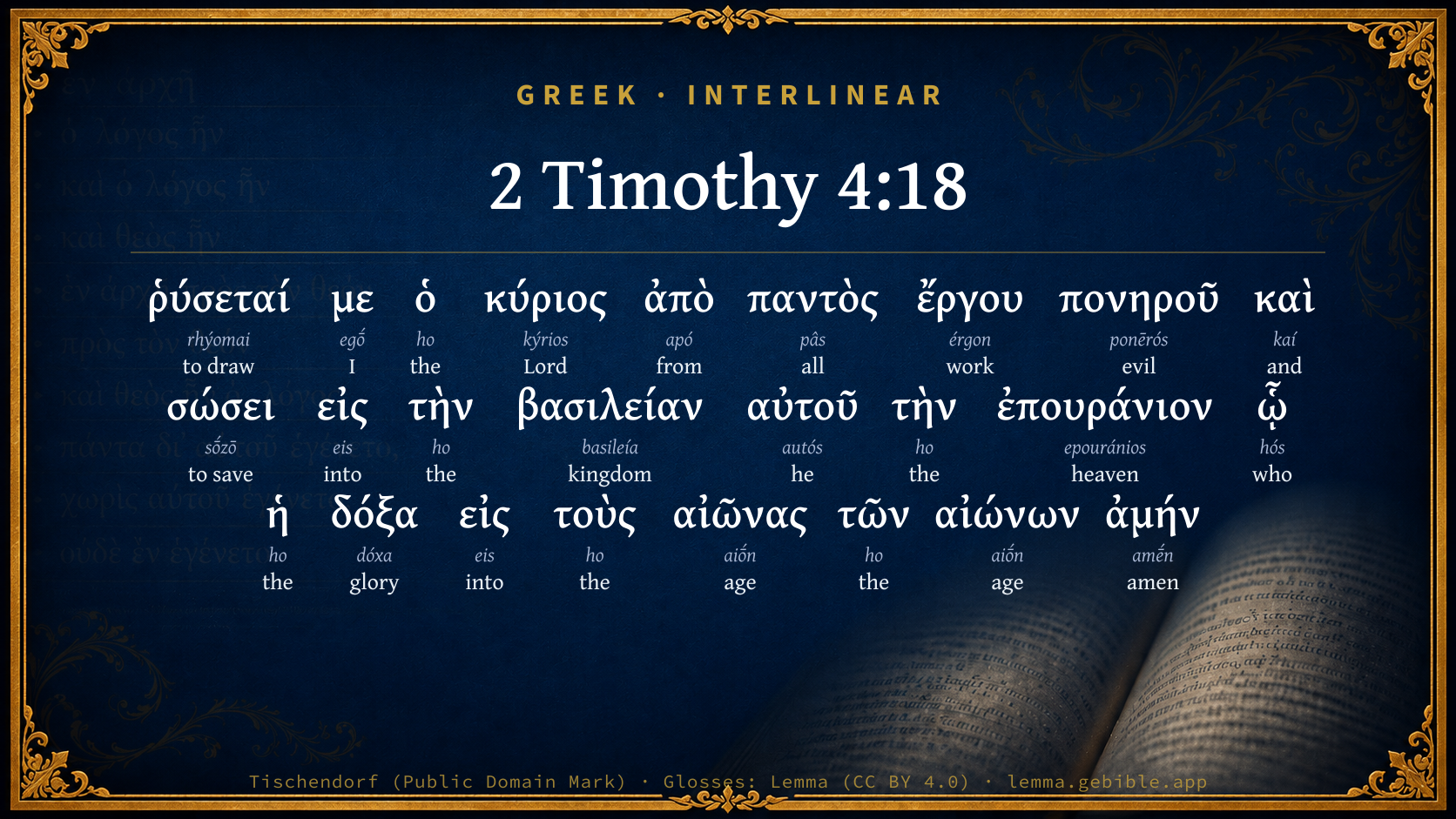
  1. με egṓ G1473 “I” Personal pronoun, 1st person, Accusative, Singular
  2. ὁ ho G3588 “the” Article, Nominative, Singular, Masculine
  3. κύριος kýrios G2962 “Lord” Noun, Nominative, Singular, Masculine
  4. ἀπὸ apó G575 “from” Preposition
  5. παντὸς pâs G3956 “all” Adjective, Genitive, Singular, Neuter
  6. ἔργου érgon G2041 “work” Noun, Genitive, Singular, Neuter
  7. πονηροῦ ponērós G4190 “evil” Adjective, Genitive, Singular, Neuter
  8. καὶ kaí G2532 “and” Conjunction
  9. σώσει sṓzō G4982 “to save” Verb, Future, Active, Indicative, 3rd person, Singular
  10. εἰς eis G1519 “into” Preposition
  11. τὴν ho G3588 “the” Article, Accusative, Singular, Feminine
  12. βασιλείαν basileía G932 “kingdom” Noun, Accusative, Singular, Feminine
  13. αὐτοῦ autós G846 “he” Personal pronoun, Genitive, Singular, Masculine
  14. τὴν ho G3588 “the” Article, Accusative, Singular, Feminine
  15. ἐπουράνιον epouránios G2032 “heaven” Adjective, Accusative, Singular, Feminine
  16. ᾧ hós G3739 “who” Relative pronoun, Dative, Singular, Masculine
  17. ἡ ho G3588 “the” Article, Nominative, Singular, Feminine
  18. δόξα dóxa G1391 “glory” Noun, Nominative, Singular, Feminine
  19. εἰς eis G1519 “into” Preposition
  20. τοὺς ho G3588 “the” Article, Accusative, Plural, Masculine
  21. αἰῶνας aiṓn G165 “age” Noun, Accusative, Plural, Masculine
  22. τῶν ho G3588 “the” Article, Genitive, Plural, Masculine
  23. αἰώνων aiṓn G165 “age” Noun, Genitive, Plural, Masculine
  24. ἀμήν amḗn G281 “amen” Hebrew transliteration

About this verse

These counts appear in no published source. They are computed here, from the morphology-tagged text and Lemma’s own curated glosses. What Lemma adds →

25
words
18
distinct lemmas
Pauline Epistles
section

Notable vocabulary

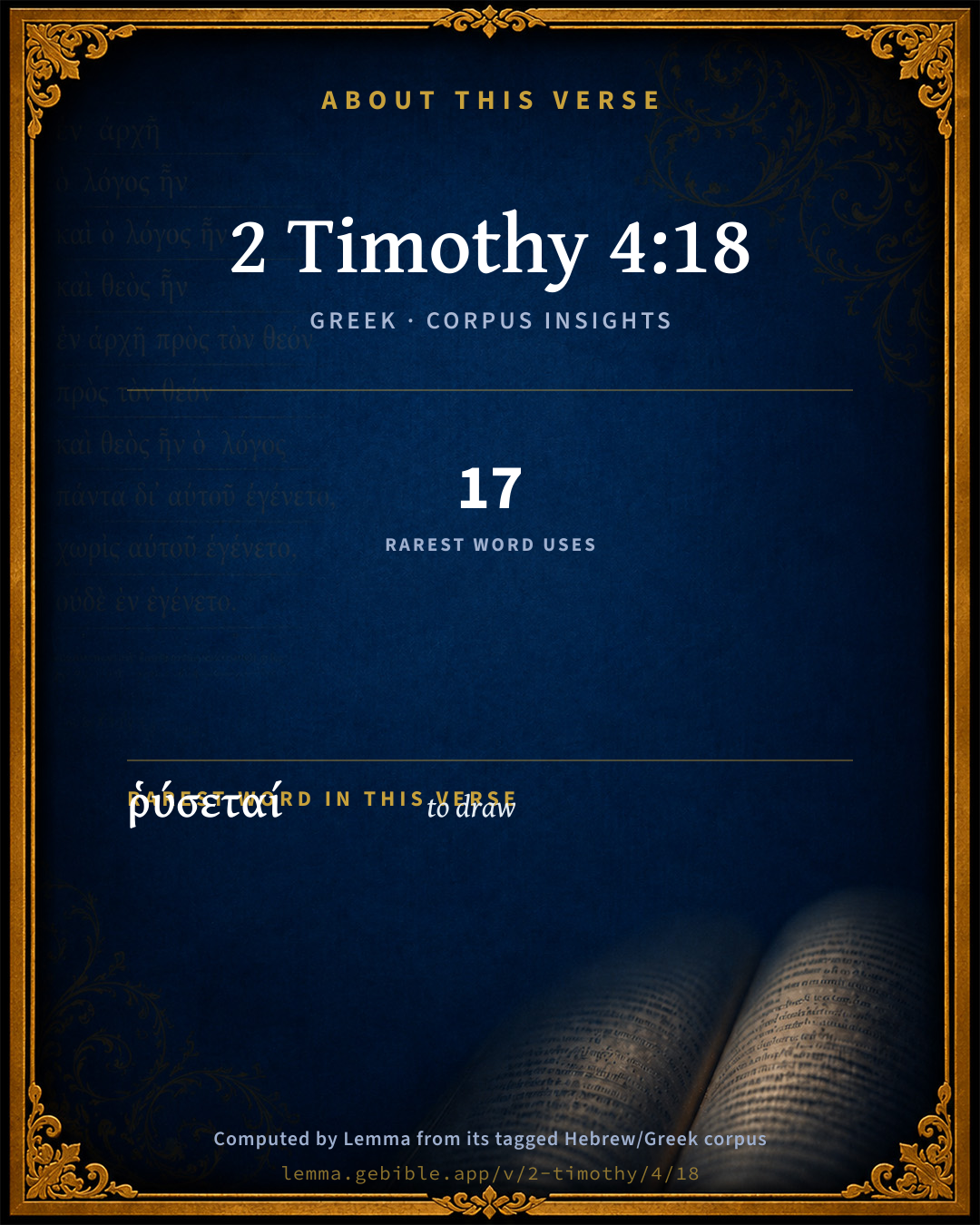
The rarest word here is ῥύσεταί to draw G4506 — appearing just 17 times in the whole Greek New Testament.

Shared distinctive vocabulary

ῥύσεταί to draw G4506 occurs in 15 verses of the Greek New Testament. Also found in:

Repetition

Words recur within this verse:

  • εἰς into G1519 ×2
  • αἰῶνας age G165 ×2
  • ὁ the G3588 ×6

Cross-references

31

Topical passages linked to 2 Timothy 4:18 in the Treasury of Scripture Knowledge — connected by theme and wording, ordered by reader-vote popularity; previews shown in the World English Bible.

  • Psalms 121:7 Yahweh will keep you from all evil. He will keep your soul.
  • 2 Thessalonians 3:3 But the Lord is faithful, who will establish you, and guard you from the evil one.
  • Jude 1:24–25 Now to him who is able to keep them from stumbling, and to present you faultless before the presence of his glory in great joy,
  • Matthew 6:13 Bring us not into temptation, but deliver us from the evil one. For yours is the Kingdom, the power, and the glory forever. Amen.'
  • 1 Thessalonians 5:23 May the God of peace himself sanctify you completely. May your whole spirit, soul, and body be preserved blameless at the coming of our Lord Jesus Christ.
  • John 10:28–30 I give eternal life to them. They will never perish, and no one will snatch them out of my hand.
  • 1 Peter 1:5 who by the power of God are guarded through faith for a salvation ready to be revealed in the last time.
  • Psalms 73:24 You will guide me with your counsel, And afterward receive me to glory.
  • 2 Corinthians 1:10 who delivered us out of so great a death, and does deliver; on whom we have set our hope that he will also still deliver us;
  • 2 Timothy 1:12 For this cause I suffer also these things. Yet I am not ashamed, for I know him whom I have believed, and I am persuaded that he is able to guard that which I have committed to him against that day.
  • Hebrews 13:21 make you complete in every good work to do his will, working in you that which is well pleasing in his sight, through Jesus Christ, to whom be the glory forever and ever. Amen.
  • Psalms 37:28 For Yahweh loves justice, And doesn't forsake his saints. They are preserved forever, But the children of the wicked shall be cut off.
  • Romans 11:36 For of him, and through him, and to him, are all things. To him be the glory for ever! Amen.
  • 1 Chronicles 4:10 Jabez called on the God of Israel, saying, Oh that you would bless me indeed, and enlarge my border, and that your hand might be with me, and that you would keep me from evil, that it not be to my sorrow! God granted him that which he requested.
  • Matthew 13:43 Then the righteous will shine forth like the sun in the Kingdom of their Father. He who has ears to hear, let him hear.
  • Psalms 92:10 But you have exalted my horn like that of the wild ox. I am anointed with fresh oil.
  • John 17:15 I pray not that you would take them from the world, but that you would keep them from the evil one.
  • Luke 12:32 Don't be afraid, little flock, for it is your Father's good pleasure to give you the Kingdom.
  • 1 Corinthians 10:13 No temptation has taken you except what is common to man. God is faithful, who will not allow you to be tempted above what you are able, but will with the temptation also make the way of escape, that you may be able to endure it.
  • Genesis 48:16 the angel who has redeemed me from all evil, bless the lads, and let my name be named on them, and the name of my fathers Abraham and Isaac. Let them grow into a multitude in the midst of the earth."
  • 1 Timothy 6:16 who alone has immortality, dwelling in unapproachable light; whom no man has seen, nor can see: to whom be honor and eternal power. Amen.
  • Matthew 25:34 Then the King will tell those on his right hand, 'Come, blessed of my Father, inherit the Kingdom prepared for you from the foundation of the world;
  • Romans 16:27
  • 1 Timothy 1:17 Now to the King eternal, immortal, invisible, to God who alone is wise, be honor and glory forever and ever. Amen.
  • 1 Peter 5:11 To him be the glory and the power forever and ever. Amen.
  • 1 Samuel 25:39 When David heard that Nabal was dead, he said, Blessed be Yahweh, who has pleaded the cause of my reproach from the hand of Nabal, and has kept back his servant from evil: and the evil-doing of Nabal has Yahweh returned on his own head. David sent and spoke concerning Abigail, to take her to him as wife.
  • Luke 11:4 Forgive us our sins, For we ourselves also forgive everyone who is indebted to us. Bring us not into temptation, But deliver us from the evil one.'"
  • Galatians 1:5 to whom be the glory forever and ever. Amen.
  • Jude 1:1 Jude, a servant of Jesus Christ, and brother of James, to those who are called, sanctified by God the Father, and kept for Jesus Christ:
  • James 2:5 Listen, my beloved brothers. Didn't God choose those who are poor in this world to be rich in faith, and heirs of the Kingdom which he promised to those who love him?
  • Luke 22:29 I confer on you a kingdom, even as my Father conferred on me,

Cross-references courtesy of OpenBible.info (CC BY 4.0).

Commentary

Notes on 2 Timothy 4:18 from classic Christian and Jewish commentators (each source and its license shown beneath its notes). The classic Christian expositions comment on the surrounding passage and are grouped to its opening verse, so a note may address several verses; the Jewish commentaries on the Tanakh (Rashi and others) are per-verse, so they appear only where the commentator wrote on this verse.

Lemma curates 59 commentaries, every one of them public domain or Creative Commons licensed, each selected and text-cleaned for this edition rather than reprinted as found. About our sources →

Tyndale Open Study Notes

Tyndale Open Resources

4:18 God would continue to strengthen Paul and keep him strong in the faith (4:7) to the end of his life (see 1:12). • The Lord’s heavenly Kingdom contrasts with the earthly kingdom that was about to pass judgment on Paul (see also 4:1; 1 Cor 15:48-49; Heb 12:18-29). • All glory . . . Amen: Paul’s doxology in the face of execution expresses confidence that God’s glory will be upheld (cp. 1 Tim 1:17; 6:15-16). • to God (literally to him): The Greek suggests that this praise is ascribed to “the Lord” of the preceding sentence—namely, to Jesus (cp. Titus 2:13).

Tyndale Open Study Notes — © Tyndale Open Resources, licensed CC BY-SA 4.0. Text via the HelloAO Bible API.

Bengel's Gnomon

Johann Albrecht Bengel

2Ti 4:18. Καὶ, and) Hope draws its conclusions from the past to the future.—ῥύσεταί με, shall deliver me) Paul understands (views) all things on the side of salvation. Does he live? He has been delivered. Shall he be beheaded? He will be delivered; the Lord being his deliverer.—ἔργου πονηροῦ) The antithesis is αὐτοῦ, His.—καὶ, and) A sweet conjunction. He is the Lord, and the Deliverer, 1Th 1:10; and Saviour, Php 3:20. He takes away evil, He confers good things.—σώσει, will preserve) This word was in Paul’s mind from the Psalm quoted above.—βασιλείαν, kingdom) better than that of Nero.—ᾧ ἡ δόξα, to whom be the glory) The very hope produces a doxology: how much greater will be the doxology, which the actual enjoyment will produce!

Bengel's Gnomon of the New Testament — English translation (T&T Clark, Edinburgh, 1860) — public domain. Text from a community e-Sword module.

Meyer's Critical & Exegetical Commentary

Heinrich August Wilhelm Meyer

2Ti_4:18. In the assured confidence of faith, the apostle adds to ἐῤῥύσθην the word of hope: ῥύσεταί με ὁ κύριος ἀπὸ πάντος ἔργου πονηροῦ, for he knows that the Lordeven if it be through death (2Ti_4:6)will bring him into His kingdom. ἔργον πονηρόν is not equivalent to evil, as Luther translates it and Matthies explains it: from every evil circumstance. Taken in this sense, the thought would be quite irreconcilable with the apostles conviction in 2Ti_4:6. Besides, in the N. T. πονηρόν never refers to merely external affliction; it denotes rather what is morally evil. Still it cannot here mean the evil work which the apostle might do (Chrysostom: πᾶν ἁμάρτημα; Grotius: liberabit me, ne quid agam Christiano, ne quid Apostolo indignum; de Wette: from all evil work which I might do through want of stedfastness, through apostasy, and the like; so, too, Beza, Heydenreich, and others). It must be interpreted of the wicked works of the enemies of the divine word; only with this view is the verb ῥύσεται appropriate, especially when combined with σώσει (Wiesinger, van Oosterzee, Hofmann). The apostle was still exposed to the attacks of the evil one, but he expresses the hope that the Lord would save him from them, so that they would do him no harm. Not, indeed, that he would not suffer the martyrdom he expected, but that through this he would come into the heavenly kingdom of the Lord, where there was prepared for him στέφανος τῆς δικαιοσύνης (2Ti_4:8).

καὶ σώσει εἰς τὴν βασιλείαν αὑτοῦ τὴν ἐπουράνιον] σώσει εἰς is a pregnant construction: he will save me and bring me into = σώζων ἄξει μὲ εἰς (Heydenreich).

The expression ἡ βασιλεία ἡ ἐπουράνιος does not occur elsewhere in the N. T.; but the idea is thoroughly apostolic and Pauline. For though Paul often calls Christs kingdom a future one, Christ is also present to him as βασιλεὺς ἐν τοῖς ἐπουρανίοις, whose βασιλεία, therefore, is also a present one.[72] The context points to this meaning here. In Php_1:23, Paul expresses the longing to come to Christ through death; here he expresses the hope that the Lord would remove him into His kingdom ἐκ παντὸς ἔργου πονηροῦ.

As a suitable and natural utterance of awakened feeling, there follows a doxology which in this place cannot surprise us, though commonly his doxologies refer to God and not to Christ specially.[73]

[72] There is nothing to indicate that the apostle is here alluding to the heavenly kingdom of the Lord, in contrast with the earthly dominion of the present (Hofmann).

[73] In Rom_16:27; Rom_9:5, Heb_13:21, the reference is at the very least doubtful.

Meyer — Critical and Exegetical Commentary on the New Testament — English translation by Peter Christie, edited by Frederick Crombie (T&T Clark, 1880) — public domain. Text from a community e-Sword module.

Expositor's Greek Testament

ed. W. Robertson Nicoll

2Ti 4:18 . ἔργου πονηροῦ : The form of the clause may be modelled on the petition in the Lord’s Prayer, ῥῦσαι ἡμᾶς ἀπὸ τοῦ πονηροῦ ; but the addition of ἔργου proves that the deliverance spoken of is not from an external Evil Personality, but from a possible evil deed of the apostle’s own doing. The expression has always a subjective reference. See reff. This exegesis is in harmony with the view taken above of “the mouth of the lion”. Failure to be receptive of the strengthening grace of the Lord would have been, in St. Paul’s judgment, an “evil deed,” though others might easily find excuses for it. Chrys. takes a similar view of ἔργου πονηροῦ , but gives it a wider application: “He will yet again deliver me from every sin, that is, He will not suffer me to depart with condemnation”. This view is also supported by what follows, σώσει , κ . τ . λ . At one moment the apostle sees the crown of righteousness just within his grasp, at another, while no less confident, he acknowledges that he could not yet be said “to have apprehended”.

σώσει εἰς : shall bring me safely to, salvum faciet (Vulg.). “Dominus est et Liberator, 1Th 1:10 , et Salvator, Phi 3:20 ” (Bengel).

βασιλείαν … ἐπουράνιον : That the Father’s kingdom is also the Son’s is Pauline doctrine. ἐπουράνιος became a necessary addition to βασιλεία as it became increasingly evident that the kingdom of heaven which we see is very different from the kingdom of heaven to be consummated hereafter. It is difficult not to see a connexion between this passage and the doxology appended in primitive times to the Lord’s Prayer, ὄτι σοῦ ἐστιν ἡ βασιλεία καὶ ἡ δύναμις καὶ ἡ δόξα εἰς τοὺς αἰῶνας .

ᾦ ἡ δόξα : The doxology, unmistakably addressed to Christ, need only cause a difficulty to those who maintain that “God blessed for ever” in Rom 9:5 cannot refer to Christ, because St. Paul was an Arian. Yet Rom 16:27 , 1Pe 4:11 , not to mention 2Pe 3:18 , Rev 1:6 ; Rev 5:13 , are other examples of doxologies to the Son.

The Expositor's Greek Testament, edited by W. Robertson Nicoll (1897–1910) — public domain. Text from a community e-Sword module.

Cambridge Greek Testament for Schools and Colleges

18. ῥύσεται. The rec. text prefixes καί; it is omitted by אACD2* 17, the Bohairic and the Latin versions.

18. ῥύσεταί με ὁ κύριος ἀπὸ παντὸς ἔργου πονηροῦ. The Lord, sc. Christ, will deliver me from every evil work. The change of preposition, ἀπό instead of ἐκ, after ῥύεσθαι is significant. ἐκ was used in 2Ti 4:17 because the Apostle was in the very jaws of the lion, before he was rescued; ἀπό is used here, because the evils contemplated are only potential, and the Apostle has not been actually in their thraldom. ἐκ, in short, indicates emergence from, ἀπό, removal from the neighbourhood of, a danger[526].

[526] This is brought out in Chase’s Lord’s Prayer in the Early Church, pp. 71 ff. The parallel between 2Ti 4:17-18 and portions of the Lord’s Prayer is fully traced at p. 119 ff. of the same work.

The deliverance of which St Paul speaks thus confidently is not a second deliverance ‘from the mouth of the lion’; that, he knew, he could not expect. But he will be delivered, if not from bodily pain, yet from ‘every evil work,’ from the opposition of adversaries without and from the conflict with temptation in his own heart. The prayer ῥῦσαι ἡμᾶς ἀπὸ τοῦ πονηροῦ will be fully answered, but it will be by the gate of martyrdom that deliverance shall come. As Bengel has it: “Decollabitur? liberabitur, liberante Domino.” Cp. 2Co 1:9-10.

καὶ σώσει εἰς τὴν βασιλείαν αὐτοῦ τὴν ἐπουράνιον, and will save me unto His heavenly kingdom, a ‘praegnans constructio’ equivalent to ‘save me and bring me to,’ &c. The faithful martyr is ‘saved’ in the highest sense, for ὂς δʼ ἂν ἀπολέσῃ τὴν ψυχὴν αὐτοῦ ἕνεκεν ἐμοῦ, οὗτος σώσει αὐτήν (Luk 9:24). The exact phrase ἡ βασιλεία ἡ ἐπουράνιος does not occur again in St Paul (or, indeed, in the N.T.), but it is quite harmonious with his teaching about the Kingdom of Christ. cp. 1Co 15:25; Eph 1:20; Col 3:1, and (for the confident hope here expressed by the Apostle) Php 1:23; Php 3:20.

ᾧ ἡ δόξα εἰς τοὺς αἰῶνας τῶν αἰώνων, ἀμήν, to Whom, sc. to Christ, be glory for ever and ever, Amen. That the doxology should be addressed to our Lord, rather than to God the Father (as e.g. at Php 4:20), will not surprise the attentive student of St Paul’s theology; cp. especially Rom 9:5. For εἰς τοὺς αἰῶνας κ.τ.λ. see note on 1Ti 1:17.

The doxology, which was early added at the end of the Lord’s Prayer and is incorporated in the received text of St Mat 6:13, deserves careful comparison with the verse before us. In the early part of 2Ti 4:18 we saw that a reflection might be traced of the petition ‘Deliver us from the evil one,’ and we now find that the thought of the heavenly Kingdom and the glory of Christ is derived from the doxology ὅτι σοῦ ἐστὶν ἡ βασιλεία καὶ ἡ δύναμις καὶ ἡ δόξα εἰς τοὺς αἰῶνας. Ἀμήν.

Cambridge Greek Testament for Schools and Colleges (Cambridge University Press, 1896; 21 vols, various authors incl. Carr, Maclear, Plummer, Farrar, Lumby, Moule, M. R. James, Simcox) — public domain. Text from a community e-Sword module.

Geneva Bible (1599)

Geneva Bible translators

Preserve me pure from committing anything unworthy my Apostleship.

To make me partaker of his kingdom.

Geneva Bible (1599) marginal notes — public domain. Text via Bolls.life.

Jamieson, Fausset & Brown

Robert Jamieson, A. R. Fausset & David Brown

And the Lord shall, &c.--Hope draws its conclusions from the past to the future [BENGEL].

will preserve me--literally, "will save" (Psa 22:21), "will bring me safe to." Jesus is the Lord and the Deliverer (Phi 3:20; Th1 1:10): He saves from evil; He gives good things.

heavenly kingdom--Greek, "His kingdom which is a heavenly one."

to whom, &c.--Greek, "to whom be the glory unto the ages of ages." The very hope produces a doxology: how much greater will be the doxology which the actual enjoyment shall produce! [BENGEL].

Jamieson, Fausset & Brown — Commentary Critical and Explanatory on the Whole Bible (1871) — public domain (CC PDM 1.0). Text via the HelloAO Bible API.

Adam Clarke's Commentary

Verse 18. And the Lord shall deliver me from every evil work] None of the evil designs formed against me to make me unfaithful or unsteady, to cause me to save my life at the expense of faith and a good conscience, shall succeed; my life may go, but he will preserve me unto his heavenly kingdom. A continuance on earth the apostle expects not; but he has glory full in view, and therefore he gives God glory for what he had done, and for what he had promised to do.

Adam Clarke's Commentary on the Bible (1810–1826) — public domain. Text from a community e-Sword/MySword module.

John Calvin's Commentaries

18 And the Lord will deliver me from every evil work He declares, that he hopes the same for the future; not that he will escape death, but that he will not be vanquished by Satan, or turn aside from the right course. This is what we ought chiefly to desire, not that the interests of the body may be promoted, but that we may rise superior to every temptation, and may be ready to suffer a hundred deaths rather than that it should come into our mind to pollute ourselves by any “evil work.” Yet I am well aware, that there are some who take the expression evil work in a passive sense, as denoting the violence of wicked men, as if Paul had said, “The Lord will not suffer wicked men to do me any injury.” But the other meaning is far more appropriate, that he will preserve him pure and unblemished from every wicked action; for he immediately adds, to his heavenly kingdom, by which he means that that alone is true salvation, when the Lord — either by life or by death — conducts us into his kingdom.

This is a remarkable passage for maintaining the uninterrupted communication of the grace of God, in opposition to the Papists. After having confessed that the beginning of salvation is from God, they ascribe the continuation of it to freewill; so that in this way perseverance is not a heavenly gift, but a virtue of man. And Paul, by ascribing to God this work of “preserving us to his kingdom,” openly affirms that we are guided by his hand during the whole course of our life, till, having discharged the whole of our warfare, we obtain the victory. And we have a memorable instance of this in Demas, whom he mentioned a little before, because, from being a noble champion of Christ, he had become a base deserter. All that follows has been seen by us formerly, and therefore does not need additional exposition.

END OF THE SECOND EPISTLE TO TIMOTHY.

John Calvin's Commentaries (1540-1563) — public domain. Text from the Calvin Translation Society English edition (1840s-50s) via the Christian Classics Ethereal Library (ccel.org). Calvin's coverage is partial (roughly two-thirds of the Bible); uncommented books and verses are honest gaps, never fabricated. The 19th-century editor's footnotes and remarks are omitted so the notes are faithfully Calvin's own voice.

Ellicott's Commentary for English Readers

(18) And the Lord shall deliver me from every evil work . . .—Many commentators have explained these words as the expression of St. Paul’s confidence that the Lord not only had, in the late trial, strengthened His servant, and given him courage to endure, but that He would watch over him in the future which still lay before him, and would preserve him from every danger of faint-heartedness, from every risk of doing dishonour to his Master; but such an interpretation seems foreign to the spirit in which St. Paul was writing to Timothy. In the whole Epistle there is not one note of fear—nothing which should lead us to suspect that the martyr Apostle was fearful for himself. It reads—does this last letter of the great Gentile teacher—in many places like a triumphant song of death. It, therefore, appears unnatural to introduce into the closing words of the Epistle the thought of the Lord’s help in the event of the Apostle’s losing heart. Far better is it to supply after “every evil work” the words “of the enemies,” and to understand the deliverance which the Lord will accomplish for him, not as a deliverance from any shrinking or timidity unworthy of an apostle of the Lord, not even as a deliverance from the martyr-death, which he knew lay before him, but that through this very death, the Lord Jesus would deliver him from all weariness and toil, and would bring him safe into His heavenly kingdom. (See Psa_23:4.) St. Paul before (Php_1:23 had expressed a longing to come to Christ through death. He then bursts into an ascription of praise to that Lord Jesus Christ whom he had loved so long and so well, and who, in all his troubles and perplexities, had never left him friendless. For a similar ascription of glory to the Second Person of the ever blessed Trinity, see Heb_13:21. (Comp. also Rom_9:5.)

A Bible Commentary for English Readers, edited by Charles John Ellicott (1878–1897) — public domain. Text from a community e-Sword module.

The Cambridge Bible for Schools and Colleges

gen. ed. J. J. S. Perowne

18. And the Lord shall deliver] The ‘and’ is omitted in the better mss. The Apostle for the last time ‘goes off abruptly’ at the word ‘deliver,’ and breaks into a final song of ‘faith, hope and love.’ The preposition after the verb is changed to suit the noun it goes with.

every evil work] Substantially the same in reference as above, ‘the mouth of the lion’; ‘Fightings and fears within, without.’ It has been thought that the Apostle had the Lord’s Prayer in his mind, giving faith’s application of the clause ‘deliver us from the evil’; and if so it is interesting to observe his interpretation, not ‘from the evil one,’ masculine, but ‘from the evil,’ neuter. The phrase ‘his heavenly kingdom’ which does not occur elsewhere, and the ascription of the ‘glory,’ may also be a reminiscence of the doxology; which must in that case have been already in use, as an addition to the prayer. And this is what we should expect from its occurrence in Mat_6:13 in so large a proportion of mss. and versions; see Carr in loco.

preserve me unto] lit. save me into, ‘bring me safe unto.’ Cf. 2Ti_2:25. The same construction is found in classical writers. Cf. Soph. Philoct. 311.

The Cambridge Bible for Schools and Colleges (gen. ed. J. J. S. Perowne; Cambridge University Press, 1878–1918) — public domain. Text from a community e-Sword module.

John Gill's Exposition

Erastus abode at Corinth,.... He was chamberlain of that city, Rom 16:23 who being sent along with Timothy into Macedonia, Act 19:22 very probably went from thence into Achaia, to Corinth, his native place, where he stayed.

But Trophimus have I left at Miletum sick. Trophimus was an Asian, of the city of Ephesus, the same that is spoken of in Act 20:4. Some say he suffered martyrdom the same day the Apostle Paul did; but others say, that after that time he was bishop of Arles in France. This man went with the apostle into Asia, and from thence to Jerusalem, and came along with him in his voyage to Rome, but falling sick by the way, was left at Miletum. Some, instead of Miletum, would read Melita, that being the island Paul, and the ship's company, escaped to, when they were shipwrecked, Act 28:1 here it is supposed Trophimus was left sick. Others have observed, that there was a city called Miletus in the island of Crete, under which Paul sailed, Act 27:7, see footnote (j), and is the place intended; but there is no need to suppose either of these; no doubt Miletum, near to Ephesus, is meant; and as the apostle sailed by the coast of Asia, Act 27:7, on which shore Miletum was, there is no difficulty in supposing him put ashore there. The Alexandrian copy reads "Melotus".

(j) Plin. l. 4. c. 12.

John Gill's Exposition of the Whole Bible (1746–1763) — public domain (CC PDM 1.0). Text via the HelloAO Bible API.

Trapp's Complete Commentary

John Trapp

18 And the Lord shall deliver me from every evil work, and will preserve me unto his heavenly kingdom: to whom be glory for ever and ever. Amen.

Ver. 18. And the Lord shall deliver] Experience breeds confidence. St Paul got an opportunity after this from Rome to make an excursion to plant and confirm Churches, returned again to Rome, and was there martyred by bloody Nero, as the story is told.

Unto his heavenly kingdom] So David argues from temporals to eternals, Psa 23:5-6.

John Trapp, A Commentary or Exposition upon All the Books of the Old and New Testament (1647–1656) — public domain. Text from a community e-Sword module.

Albert Barnes' Notes on the Bible

And the Lord shall deliver me from every evil work - He does not say from “death,” for he expected now to die; see 2Ti 4:6. But he was assured that God would keep him from shrinking from death when the hour approached; from apostasy, and from the manifestation of an improper spirit when he came to die.

And will preserve me unto his heavenly kingdom - So keep me from evil that I shall reach his heavenly kingdom; see 2Ti 4:8.

To whom be glory forever and ever - Paul was accustomed to introduce a doxology in his writings when his heart was full (compare Rom 9:5), and in no place could it be more appropriate than here, when he had the fullest confidence that he was soon to be brought to heaven. If man is ever disposed to ascribe glory to God, it is on such an occasion.

Albert Barnes' Notes on the Bible (1834–1885) — public domain. Text from a community e-Sword/MySword module.

Matthew Poole's English Annotations

And the Lord shall deliver me from every evil work; faith riseth upon experiences, 1Sa 17:37,46; 2Co 1:10. By evil work may be understood any sin into which Paul might fall through temptation; or the evil works of others, designing mischief to the apostle. He expresseth his faith in this term or various signification, to learn us how to exercise our faith in God in an evil time, viz. believing that God will either deliver us from our danger, or from sinning by reason of our danger, for we have no foundation for out faith to believe that God will at all times keep us from evils of suffering.

And will preserve me unto is heavenly kingdom; and that he will save us, and preserve us, if not as to a temporal life, yet to a celestial, honourable, glorious inheritance.

To whom be glory for ever and ever. Amen; this is a usual form of giving praise to God, desiring all honour might be given to him.

Matthew Poole's English Annotations on the Holy Bible (1683–1685) — public domain. Text from a community e-Sword/MySword module.

Whedon's Commentary on the Bible

Daniel D. Whedon

18. Preserve me—Whether from death, as at his first arraignment, or through death, as at his second. For the real preserve consists in securing his transit unto his heavenly kingdom. And so rich in both arraignments is St. Paul’s triumph, that he finishes his account of this first one with a doxology, as he had (in 2Ti_4:6-8) the second with a pean.

It seems surprising, at first, that while St. Paul is in prison and on trial for life for his Christianity any of his fellow Christian preachers should dare to visit and associate with him, bringing him aid and carrying his letters. But, similarly, Socrates in Athens while condemned as a false teacher was visited by his disciples in his prison and discoursed with them at length upon his philosophy. So Christian martyrs, subsequent to St. Paul, as St. Ignatius and Cyprian, were allowed visits and correspondence. The pagan satirist, Lucian, in the early half of the second century describes the career of a Christian itinerant in his day, named Peregrinus, and narrates the eager zeal of Christians in ministering to his wants in prison. “From early dawn old women, widows, and orphan children might be seen waiting about the doors of his prison; while their eminent men, by feeing the keepers, were allowed to pass the night with him in his prison… Moreover, deputies came from certain cities of Asia from the Christian associations to assist, advise, and console the man. They show, indeed, incredible dispatch in any undertaking which would aid a common interest. Sums of money so large were contributed as to furnish no little revenue to Peregrinus.” The government seemed satisfied with destroying the apparent leader, expecting that his followers would come to nothing; and the immediate jailers were ready to grant privileges for a consideration.

Daniel D. Whedon (gen. ed.), Commentary on the Old and New Testaments (1874–1909) — public domain. Text from a community e-Sword module.

The Pulpit Commentary

The Lord for and the Lord, A.V and T.R.; will for shall, A.V; save for preserve, A.V; the glory for glory, A.V Deliver me... save me (see preceding note). The language here is also very like that of the Lord"s Prayer: JRusai hJmav ajpo tou ponhrou sou gaa kaixa eijv toun. (Mat_6:13) Every evil work. Alford goes altogether astray in his remarks on this passage. Interpreted by the Lord"s Prayer, and by its own internal evidence, the meaning clearly is, "The Lord, who stood by me at my trial, will continue to be my Saviour. He will deliver me from every evil design of mine enemies, and from all the wiles and assaults of the devil, in short, from the whole power of evil, and will bring me safe into his own kingdom of light and righteousness." There is a strong contrast, as Bengel pithily observes, between "the evil work" and "his heavenly kingdom." A triumphant martyrdom is as true a deliverance as escape from death. Compare our Lord"s promise, "There shall not a hair of your head perish" Luk_21:18 compared with ver. 16). St. Paul"s confidence simply is that the Lord would, in his own good time and way, transfer him from this present evil world, and from the powers of darkness, into his eternal kingdom of light and righteousness.

The Pulpit Commentary (1880–1919), ed. H.D.M. Spence-Jones & Joseph S. Exell — public domain. Text from a community e-Sword module.

John Wesley's Explanatory Notes

And the Lord will deliver me from every evil work - Which is far more than delivering me from death. Yea, and, over and above, preserve me unto his heavenly kingdom - Far better than that of Nero.

John Wesley, Explanatory Notes Upon the Whole Bible (1754–1765) — public domain. Text via the GEBible commentary corpus.

Fairbairn on Ezekiel, Jonah & the Pastoral Epistles

Patrick Fairbairn

Ver. 18. From the past the apostle turns to the future, giving expression in this respect also to his filial confidence: The Lord will deliver me from every evil work, and preserve me safe to His heavenly kingdom. The and (καὶ) with which in the received text this utterance of faith and hope is introduced, is more than doubtful. It is wanting in א, A, C, D, Vulg., Copt., Arm. versions. The καὶ appears only in F, K, L, and is represented in the Syriac versions. While in this reference to the future the apostle uses the same verb as in regard to his late deliverance, he changes the preposition: it was there ἐρύσατο ἐκ; here it is ῥύσεταί ἀπὸ, pointing, as Ellicott notes, “more generally to the removal from all the evil efforts that were directed against the apostle, and the evil influences around him—not merely all that threatened him personally, but all that in his person thwarted the gospel.” Clearly, what he means by deliverance in this connection is a safe issue, as regards all that is really great and important, out of the endless machinations and troubles with which he had to contend here as the servant of Christ in the gospel. He should be so delivered, that none of them would be allowed to bear down his intrepidity, or make him flinch from the path of obedience, so that he should reach in safety the kingdom of everlasting bliss and glory. The expression βασιλείαν τὴν ἐπουράνιον, with respect to Christ’s kingdom, is found only here in St. Paul’s epistles, and has consequently been deemed un-Pauline by the opponents of the genuineness of this epistle. But it is a frivolous objection, as in other places he associates Christ’s existence in glory with a present reigning or kingdom (1Co 15:25; Eph 1:20; Col 3:1).

The passage fitly ends with a doxology: to whom be glory for the ages of ages—that is, for ever and ever (1Ti 1:17) —Amen. The context obliges us to connect this ascription of divine glory with Christ; for it was He, doubtless, of whom the apostle spake as standing by him, strengthening and delivering him.

Patrick Fairbairn — An Exposition of Ezekiel (1851), Jonah (1849), and The Pastoral Epistles (1874) — public domain. Text from a community e-Sword module.

Burkitt's Expository Notes on the New Testament

William Burkitt

Mark, He doth not say, The Lord will deliver me from every evil worker, but from every evil work; though he doth not save me from my temporal enemies, blessed be God my spiritual enemies shall never hurt me, neither sin not Satan.

Lord! it is a far greater favour to be preserved from sin, than from any temporal affliction that can befal us, yea, than from death itself; The Lord will deliver me from every evil work; yea, farther, He will preserve me to his heavenly kingdom.

God has a kingdom, an heavenly kingdom for all his saints, his suffering saints especially; it is prepared for them, they are preparing for it, and they shall be put into the possession of it in due time.

He closes with a doxology here: To whom be glory for ever and ever. Amen. As God has prepared an eternal kingdom for his saints, so they desire that God may have glory from them to eternal ages: Grace enlargeth the heart towards God, in fervent desires that his glory may be eternized.

William Burkitt's Expository Notes on the New Testament (1700–1703) — public domain. Text from a community e-Sword module.

The People's New Testament

B. W. Johnson

18. And the Lord shall deliver me. In the future as in the past. From every evil work. From evil doers.

B. W. Johnson's The People's New Testament with Notes (1889–1891) — public domain. Electronic text from the Christian Classics Ethereal Library (CCEL) ThML edition.

Alford’s Greek Testament

Henry Alford

18.] The Lord (Jesus) shall deliver me from every evil work (see above: from every danger of faint-heartedness, and apostasy: so, even without adopting the above meaning of ἐκ στόματος λέοντος, Chrys., καὶ γὰρ καὶ τοῦτο τὸ δυνηθῆναι μέχρις αἵματος ἀντικαταστῆναι πρὸς τὴν ἁμαρτίαν, καὶ μὴ ἐνδοῦναι, ἑτέρου λέοντός ἐστι ῥύσασθαι, τοῦ διαβόλου. So also Grot., De W., al. The meaning adopted by Huther, Wiesinger, al., that the ἔργα πονηρά are the works of his adversaries plotting against him, is totally beside the purpose: he had no such confidence (ver. 6), nor would his conservation to Christ’s heavenly kingdom depend in the least upon such deliverance. Besides which, the correspondence of this declaration of confidence to the concluding petition of the Lord’s Prayer cannot surely be fortuitous, and then πονηροῦ, here joined to ἔργου as neuter, must be subjective, evil resulting from our falling into temptation, not evil happening to us from without. It is hardly necessary to observe, that πονηροῦ here cannot be gen. masc., ‘of the evil one,’—as Pelagius and Mosheim, in De W.), and shall preserve me safe (σώσει in its not uncommon, pregnant sense of ‘bring safe:’ cf. σώζειν πόλινδε, Il. ε. 224; ἐς οἴκους, Soph. Philoct. 311; ἐς τὴν Ἑλλάδα, Xen. An. vi. 4. 8: 6. 23, al. freq.) unto his kingdom in heaven (though it may be conceded to De W. that this expression is not otherwise found in St. Paul, it is one to which his existing expressions easily lead on: e.g. Php 1:23, compared with 3:20): to whom be the glory unto the ages of ages, Amen (it is again objected, that in St. Paul we never find doxologies ascribing glory to Christ, but always to God. This however is not strictly true: cf. Rom 9:6. And even if it were, the whole train of thought here leading naturally on to the ascription of such doxology, why should it not occur for the first and only time? It would seem to be an axiom with some critics, that a writer can never use an expression once only. If the expression be entirely out of keeping with his usual thoughts and diction, this may be a sound inference: but this is certainly not the case in the present instance. Besides, the petition of the Lord’s Prayer having been transferred to our Lord as its fulfiller (cf. Joh 14:13, Joh 14:14), the doxology, which seems to have come into liturgical use almost as soon as the prayer itself (sea Mat 6:13 var. readd.), would naturally suggest a corresponding doxology here).

Henry Alford, The Greek Testament (1849–1861) — public domain. Text from a community e-Sword module.

International Critical Commentary

18. ῥύσεται] in the future as He had done in the past, 3:11. ἀπὸ … πονηροῦ, not “from any wrong-doing, any failure of courage” (as in Deu 23:9, Job 1:8, Test. XII. Patr., Dan 6:8; ἀπὸ πάντος ἁμαρτήματος, Chrys.), but “from any harmful attack,” “from anything that may harm me,” whether coming from πονηροὶ ἄνθρωποι, 3:13, or from ὁ πονηρός. The phrase is perhaps based on the Lord’s Prayer, ῥῦσαι ἡμᾶς ἀπὸ τοῦ πονηροῦ, which itself may be based on Jewish liturgical forms; cf. Taylor, Sayings of the Jewish Fathers, p. 142.

τὴν ἐπουράνιον] “regnum Neroniano melius” (Bengel); but the contrast is rather with the present kingdom on earth, Col 1:13 “that kingdom whose real seat is in the heavens,” cf. 1. ᾧ ἡ δόξα, so 4 Mac 18:24; cf. Charles, Revelation, 1:6.

International Critical Commentary — older volumes (1896–1929), various authors — public domain. Text from a community e-Sword module.

Vincent's Word Studies in the New Testament

Marvin R. Vincent

Every evil work [εκ εργου πονηρου] . Every design and attempt against him and his work. Ponhrov evil cannot be limited to evil on its active side. See on 1Co 5:13. The word is connected at the root with penesqai to be needy, and ponein to toil; and this connection opens a glimpse of that sentiment which associated badness with a poor and toiling condition. The word means originally full of or oppressed by labors; thence, that which brings annoyance or toil. Comp. hJmera ponhra evil day, Eph 5:16; Eph 6:13 : elkov ponhron a grievous sore, Revelation 16 2.

Heavenly kingdom [την βασιλειαν την επουρανιον] . The phrase N. T. o. Epouraniov heavenly only here in Pastorals. Mostly in Paul and Hebrews. Heavenly kingdom, here the future, glorified life, as 1Co 6:9, 10; 1Co 14:50; Luk 13:29. In the same sense, kingdom of Christ and of God, Eph 5:5; kingdom of their Father, Mt 13:43; my Father 's kingdom, Mt 26:29; kingdom prepared for you, Mt 25:34; eternal kingdom of our Lord and Savior Jesus Christ, 2Pe 1:11.

Marvin R. Vincent, Word Studies in the New Testament (1887–1900) — public domain. Text from a community e-Sword/MySword module.

Lesson kit

Teaching starters — assembled from the data on this page, not authored interpretation. Every prompt links to the verse data it draws on. Edit before teaching.

2 Timothy, in the Pauline Epistles, opens this verse with 25 words (18 distinct Greek lemmas). Its most distinctive word is rhýomai (“to draw”). A historical commentator’s framing appears above. Read the whole chapter for the surrounding context.

Discussion questions

  1. The word rhýomai carries the sense “to draw.” How does it shape the verse?
  2. How does Matthew 6:13, which shares the word «to draw», read alongside this verse?
  3. What does the repetition of “into” (2× in this one verse) do in this verse?
  4. The translations on this page render this verse differently — a whole-verse word diff, not a word-by-word alignment. What might account for the different wordings?
  5. Compare how Tyndale Open Study Notes and Bengel's Gnomon read this verse. Where do they agree or differ?

Things to notice

  • These translations choose different wording for 8 words in this verse.
  • “into” occurs 2× in this single verse.
  • 18 distinct Greek lemmas span 25 words in this verse.

Reading settings

Reading text

Shown beneath each verse's original-language words.

Old Testament
Old Testament edition

Read the OT as the Masoretic Hebrew (MT) or the Greek Septuagint (LXX).

English shown for the Greek Septuagint (in the Hebrew ↔ Greek comparison).

Comparing translations? Open the Compare panel on any verse page to stack up to four side by side.