Galatians 6:4

Greek (Tischendorf 8th ed.) Galatians 6:4 appears in the Greek New Testament. The text above is from the Tischendorf 8th edition. Each word links to its Strong’s number and a concise gloss. Click any word for its full Thayer’s Greek Lexicon entry.
Download image
Cite this verse

Galatians 6:4 (World English Bible). Public Domain. Lemma interlinear Bible study tool, https://lemma.gebible.app/v/galatians/6/4.

Show BibTeX & RIS
BibTeX
RIS
English Translation
But let each man test his own work, and then he will take pride in himself and not in his neighbor.
World English Bible · Public Domain
Download a study sheet

One document with this verse’s original text, its word-by-word gloss line, the meaning frame, cross-references with their text, attributed commentary, and full source and license credits — printable, and it pastes into notes with its structure intact.

This verse Autodidact and up

Study sheet (.html) Plain text (.txt)

A passage Seminary Student

Up to 50 verses in one chapter. A passage sheet keeps up to 6 commentary sources and 12 cross-references per verse, in the order this page ranks them, and says so on the sheet whenever that leaves anything out. Ask for a single verse and you get the Autodidact verse sheet above.

Everything on this page stays free to read, with no account — the sheet is a download of what is already on screen, not access to it.

Want to remove ads? Support Godless Engineer
Compare translations 3

The same verse in 3 English versions, stacked beneath the original-language interlinear above. Click any original word for its lexicon entry.

Each is an independent rendering of the whole verse — the interlinear is not word-aligned to these translations.

Highlighted words mark where these versions differ — a whole-verse word diff, not a word-by-word alignment.

  • World English Bible Public Domain
    But let each man test his own work, and then he will take pride in himself and not in his neighbor.
  • King James Version Public Domain
    But let every man prove his own work, and then shall he have rejoicing in himself alone, and not in another.
  • unfoldingWord Literal Text CC BY-SA 4.0
    But let each one examine his own work, and then he will have reason to boast in himself alone and not in someone else.

unfoldingWord Literal Text — © unfoldingWord, licensed CC BY-SA 4.0. Word-aligned USFM3 via Door43 (git.door43.org/unfoldingWord/en_ult).

Versions to compare (up to 4)

3 of 4 selected

Show all 19 translations

Every available English version of this verse, each an independent rendering of the whole verse.

  • World English Bible Public Domain
    But let each man test his own work, and then he will take pride in himself and not in his neighbor.
  • Berean Standard Bible Public Domain
    Each one should test his own work. Then he will have reason to boast in himself alone, and not in someone else.
  • Majority Standard Bible Public Domain
    Each one should test his own work. Then he will have reason to boast in himself alone, and not in someone else.
  • King James Version Public Domain
    But let every man prove his own work, and then shall he have rejoicing in himself alone, and not in another.
  • American Standard Version (1901) Public Domain
    But let each man prove his own work, and then shall he have his glorying in regard of himself alone, and not of his neighbor.
  • Revised Version (1885) Public Domain
    But let each man prove his own work, and then shall he have his glorying in regard of himself alone, and not of his neighbour.
  • Geneva Bible (1599) Public Domain
    But let euery man prooue his owne worke: and then shall he haue reioycing in himselfe onely and not in another.
  • Douay-Rheims (1899) Public Domain
    But let every one prove his own work, and so he shall have glory in himself only, and not in another.
  • Young's Literal Translation Public Domain
    and his own work let each one prove, and then in regard to himself alone the glorying he shall have, and not in regard to the other,
  • Literal Standard Version CC BY-SA 4.0
    and let each one prove his own work, and then he will have the glorying in regard to himself alone, and not in regard to the other,
  • Unlocked Literal Bible CC BY-SA 4.0
    Each one should examine his own work, and then his reason to boast will be in himself alone and not in someone else.
  • unfoldingWord Literal Text CC BY-SA 4.0
    But let each one examine his own work, and then he will have reason to boast in himself alone and not in someone else.
  • Darby Bible Public Domain
    but let each prove his own work, and then he will have his boast in what belongs to himself alone, and not in what belongs to another.
  • World Messianic Bible Public Domain
    But let each man examine his own work, and then he will have reason to boast in himself, and not in someone else.
  • Webster's Bible Public Domain
    But let every man prove his own work, and then shall he have rejoicing in himself alone, and not in another.
  • Free Bible Version CC BY-SA 4.0
    Carefully examine your actions. Then you can be satisfied with yourself, without comparing yourself to anyone else.
  • Bible in Basic English Public Domain
    But let every man make test of his work, and then will his cause for glory be in himself only, and not in his neighbour.
  • Text-Critical English NT CC BY 4.0
    But each person should test his own work, and then he will have reason for boasting in regard to himself alone, and not in regard to another.
  • Tyndale New Testament (1534) Public Domain
    Let every man prove his awne worke and then shall he have reioysinge in his awne silfe and not in another.

Literal Standard Version (2020), Covenant Press — licensed CC BY-SA 4.0. Text via the HelloAO Bible API (eBible.org). Unlocked Literal Bible (unfoldingWord) — licensed CC BY-SA 4.0. Text via the HelloAO Bible API (eBible.org). unfoldingWord Literal Text — © unfoldingWord, licensed CC BY-SA 4.0. Word-aligned USFM3 via Door43 (git.door43.org/unfoldingWord/en_ult). Free Bible Version, Dr. Jonathan Gallagher — licensed CC BY-SA 4.0. Text via the HelloAO Bible API (eBible.org).

Word by word

More ways to search: Search by grammar → Find every occurrence → Compare this word →

Practice this passage: Drill this verse → Learn its vocabulary →

καύχημα
kaúchēma
G2745
“boasting”
Noun, Accusative, Singular, Neuter
Part of Speech
Noun
Case
Accusative
Number
Singular
Gender
Neuter
Full Thayer's Definition

Origin: from G2744

TDNT: 13:45,4

1. that of which one glories or can glory, matter or ground of glorying 2. a glorying or boasting
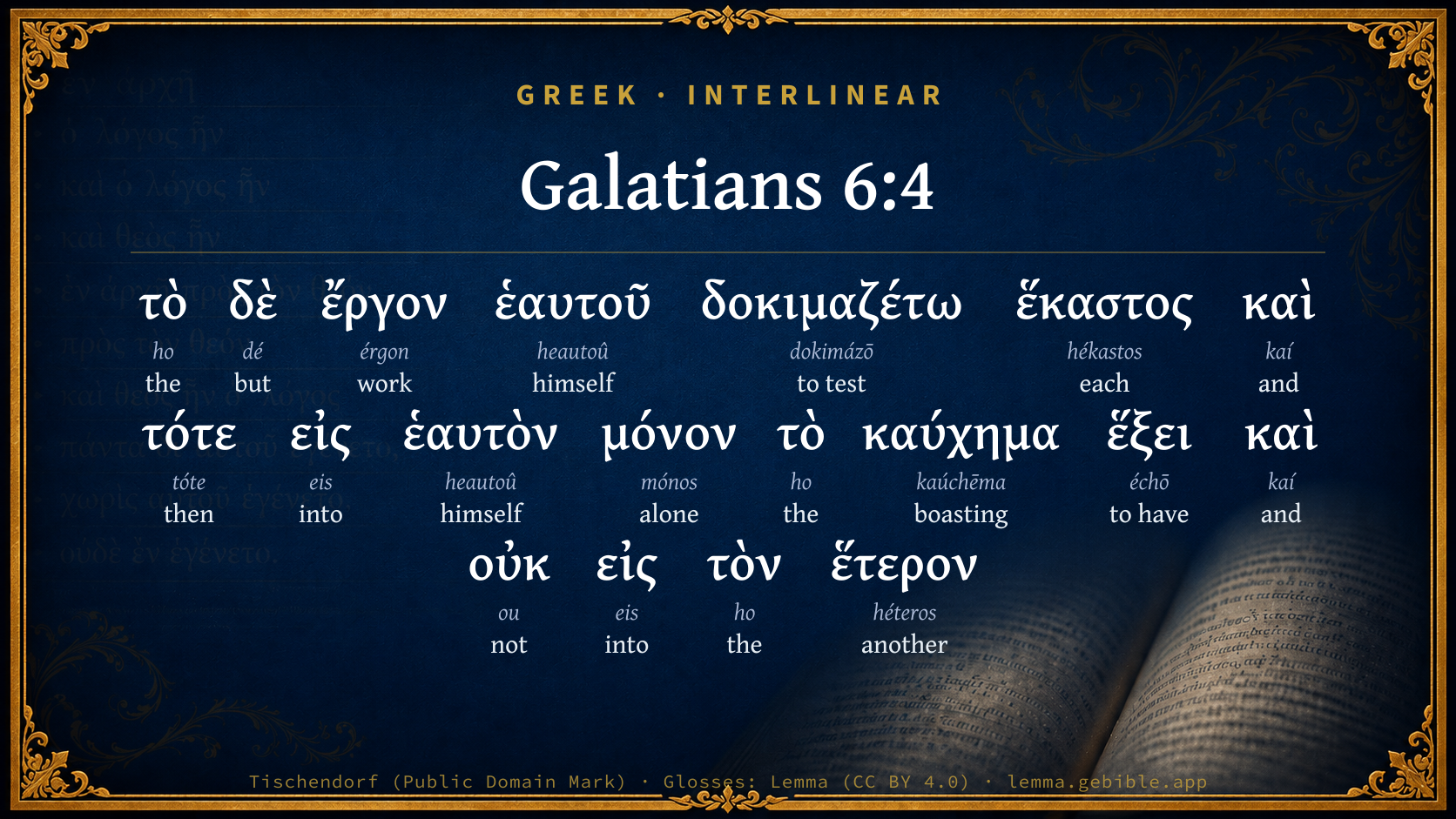
  1. τὸ ho G3588 “the” Article, Accusative, Singular, Neuter
  2. δὲ dé G1161 “but” Conjunction
  3. ἔργον érgon G2041 “work” Noun, Accusative, Singular, Neuter
  4. ἑαυτοῦ heautoû G1438 “himself” Reflexive pronoun, 3rd person, Genitive, Singular, Masculine
  5. δοκιμαζέτω dokimázō G1381 “to test” Verb, Present, Active, Imperative, 3rd person, Singular
  6. ἕκαστος hékastos G1538 “each” Adjective, Nominative, Singular, Masculine
  7. καὶ kaí G2532 “and” Conjunction
  8. τότε tóte G5119 “then” Adverb
  9. εἰς eis G1519 “into” Preposition
  10. ἑαυτὸν heautoû G1438 “himself” Reflexive pronoun, 3rd person, Accusative, Singular, Masculine
  11. μόνον mónos G3441 “alone” Adjective, Accusative, Singular, Masculine
  12. τὸ ho G3588 “the” Article, Accusative, Singular, Neuter
  13. ἕξει échō G2192 “to have” Verb, Future, Active, Indicative, 3rd person, Singular
  14. καὶ kaí G2532 “and” Conjunction
  15. οὐκ ou G3756 “not” Particle, Negative
  16. εἰς eis G1519 “into” Preposition
  17. τὸν ho G3588 “the” Article, Accusative, Singular, Masculine
  18. ἕτερον héteros G2087 “another” Adjective, Accusative, Singular, Masculine

About this verse

These counts appear in no published source. They are computed here, from the morphology-tagged text and Lemma’s own curated glosses. What Lemma adds →

19
words
14
distinct lemmas
Pauline Epistles
section

Notable vocabulary

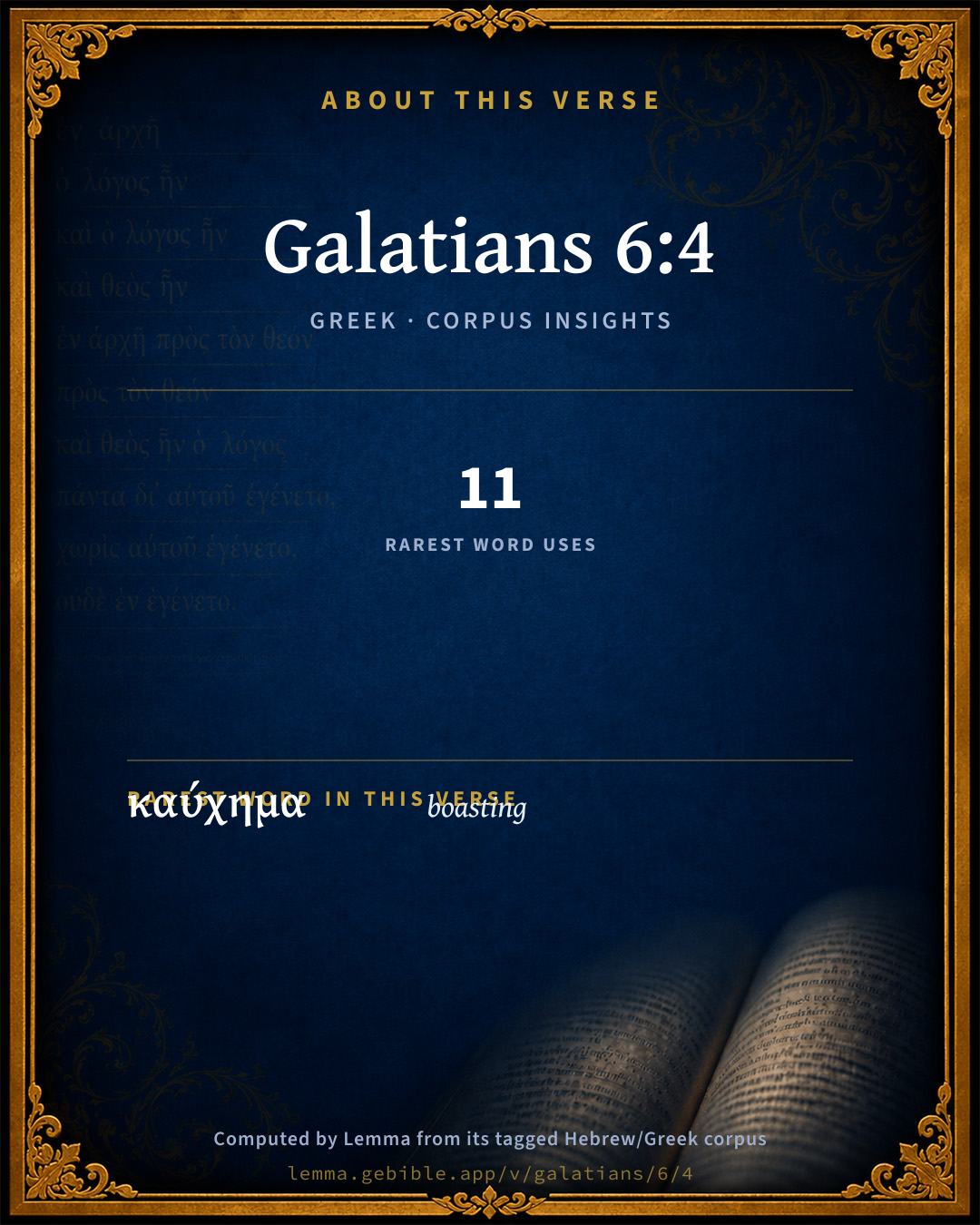
The rarest word here is καύχημα boasting G2745 — appearing just 11 times in the whole Greek New Testament.

Shared distinctive vocabulary

καύχημα boasting G2745 occurs in 11 verses of the Greek New Testament. Also found in:

Repetition

Words recur within this verse:

Cross-references

12

Topical passages linked to Galatians 6:4 in the Treasury of Scripture Knowledge — connected by theme and wording, ordered by reader-vote popularity; previews shown in the World English Bible.

  • 2 Corinthians 13:5 Test your own selves, whether you are in the faith. Test your own selves. Or don't you know as to your own selves, that Jesus Christ is in you?--unless indeed you are disqualified.
  • Psalms 26:2 Examine me, Yahweh, and prove me. Try my heart and my mind.
  • 1 Corinthians 11:28 But let a man examine himself, and so let him eat of the bread, and drink of the cup.
  • 2 Corinthians 1:12 For our boasting is this: the testimony of our conscience, that in holiness and sincerity of God, not in fleshly wisdom but in the grace of God we behaved ourselves in the world, and more abundantly toward you.
  • 2 Corinthians 11:12–13 But what I do, that I will do, that I may cut off occasion from them that desire an occasion, that in which they boast, they may be found even as we.
  • 1 John 3:19–22 And by this we know that we are of the truth, and persuade our hearts before him,
  • Luke 18:11 The Pharisee stood and prayed to himself like this: 'God, I thank you, that I am not like the rest of men, extortioners, unrighteous, adulterers, or even like this tax collector.
  • 1 Corinthians 3:21–23 Therefore let no one boast in men. For all things are yours,
  • Proverbs 14:14 The unfaithful will be repaid for his own ways; Likewise a good man will be rewarded for his ways.
  • 1 Corinthians 4:3–4 But with me it is a very small thing that I should be judged by you, or by man's judgment. Yes, I don't judge my own self.
  • Job 13:15 Behold, he will kill me; I have no hope. Nevertheless, I will maintain my ways before him.
  • 1 Corinthians 1:12–13 Now I mean this, that each one of you says, "I follow Paul," "I follow Apollos," "I follow Cephas," and, "I follow Christ."

Cross-references courtesy of OpenBible.info (CC BY 4.0).

Commentary

Notes on Galatians 6:4 from classic Christian and Jewish commentators (each source and its license shown beneath its notes). The classic Christian expositions comment on the surrounding passage and are grouped to its opening verse, so a note may address several verses; the Jewish commentaries on the Tanakh (Rashi and others) are per-verse, so they appear only where the commentator wrote on this verse.

Lemma curates 59 commentaries, every one of them public domain or Creative Commons licensed, each selected and text-cleaned for this edition rather than reprinted as found. About our sources →

The Biblical Illustrator

Joseph S. Exell

Gal_6:4

But let every man prove his own work.

Faithful self-examination

Let us be careful to get the true balance to weigh ourselves. There are the scales in which the world weighs men and things, and decides their amount of good or evil. But these, or the like balance, are so appended to the beam as to favour one scale more than the other. They will therefore deceive us in forming our estimate of things; for sin, when put into them, and love for God, and devotedness to Him, like two feathers east into the scale, will weigh so light that they will kick the beam when the meanest worldly trifle is weighed against them, while the scale in which the world weighs their virtues will have a vast preponderance in their favour. There is also the balance of conscience, and this is more false and deceitful (if possible) than the other. The conscience of the natural man is like a fraudulent man with false weights and measures, from whom we shall be sure to have no just weight. We must therefore take the golden balance of the sanctuary. Here, indeed, even our best services, when weighed with the law of God, will be found wanting; but the fulness of the redemption in the blood of Jesus, the freeness of His promises to every repenting sinner, the merit of His sinless obedience--these, on which the believer builds his hopes, however nicely weighed in the balance of truth, will want nothing of that true weight which the justice of God will demand at our hands. (H. G. Salter.)

Necessity of self-examination

The reason why there is so little self-condemnation is because there is so little self-examination. For want of this many persons are like travellers, skilled in other countries, but ignorant of their own. (Archbishop Seeker.)

True self-examination

Around the masterpieces in the galleries of Europe artists are always congregated. You may see them standing before Raphaels transfiguration, copying with the nicest care every line and tint of that matchless work, glancing constantly from their canvas to the picture, that, even in the minutest parts, they may reproduce the original. But if, at one side, you saw an artist who only looked up occasionally from his work and drew a line, but filled in there a tree or a waterfall, and there a deer or a cottage, just as his fancy suggested, what kind of a copyist would you call him? Now, true self-examination lies in ascertaining how nearly we are reproducing Christ. He has painted for us in no gallery; but His life glows fourfold in the Gospels, and our hearts are the canvas upon which we are to copy it. Let us not take occasional glimpses, and work meanwhile upon earthly designs; but let us look long and earnestly till our lives reflect the whole Divine image. (H. W. Beecher.)

Dread of self-examination

As it is an evidence that those tradesmen are embarrassed in their estates, who are afraid to look into their books, so it is plain that there is something wrong within, among all those who are afraid to look within He that buys a jewel in a case deserves to be cozened with a Bristol stone. (Archbishop Seeker.)

Urgency of self-examination

Remember that the time you have for self-examination is, after all, very short. Soon thou wilt know the great secret. I may not say words rough enough to rend off the mask which thou hast now upon thee; but there is one called Death who will stand no compliment. You may masquerade it out to-day in the dress of a saint; but Death will soon strip you, and you must stand before the judgment-seat after Death has discovered you in all your nakedness, be that naked innocence or naked guilt. (C. H. Spurgeon.)

True and false standards of character

I. The false standard of character. There is a very common mode of judging of ourselves and our friends which is in itself utterly false and unsatisfactory; I mean that mode of estimating character and works, not by what these are in themselves, but by what they are in comparison with the life of others. I may not be what I ought to be, a man says; but, side by side with my neighbour, I have no cause to be ashamed. The picture seems fairer if it has a dark background; and we fall into the habit of measuring our own goodness by other mens want of goodness. Instead of making conscience the standard of duty, they practically make other mens want of conscience the standard. They have no sorrow or compunction for anything they have done or left undone, so long as they can point to others who are more to blame than themselves--as if health were to be measured, not by the pulse and vigour of the patient, but by the feverishness and insensibility of another patient lying at his side!

II. The true standard of character. Let every man prove his own work; let him test it on its own merits and for its own sake; and let it be judged, not by the indolence and failures of others, but by its own character and worth. This method of judgment, whereby every man must; prove his own work, is in accordance with facts of the spiritual world; for every man must bear his own burden. The character is the outcome of a mans life and labours. What the man is, is really the fruit of what he does, and of what he thinks and speaks day by day. The character of every man is the measure of his works. The character will continue to tell what a mans life has been, and what in its inmost nature it continues to be. And in this matter each man bears his own burden--a burden in which others may sympathize, but which no human sympathy can relieve him of. God has made visible in man His eternal law, that every mans own work is proved, so as to give him rejoicing or sorrow, as the case may be, in himself, and not in another. And there is all the more need to test and prove our own work, that the time for doing our work is fast passing away. Our influence is gradually, and in modes unnoticed and unseen, pervading all around us; and that influence for good and evil is what we are responsible for. (A. Watson, D. D.)

Self-examination

Mind is the principal distinguishing attribute of man. This undying principle enables us to reflect on our condition as accountable creatures, and on the connection between our present state and final destiny. It is to man, thus constituted, that Divine revelation is addressed. It regards him as capable of reasoning as well as feeling. Every man is required to prove his own work. Those who most need this counsel will probably least feel their need of it, which is the strongest argument for attempting to enforce it. The text prescribes an important measure, and enforces it by weighty considerations. Let us advert--

I. To the measure which it prescribes. Let every man prove his own work. This seems to imply that every man should be seriously concerned to ascertain his own real character and condition before God; and that in order to this he should carefully examine both his principles and practice, his heart and life, and thus prove his own work. Probably there is in these words an allusion to the process of proving the genuineness of metals, by putting them to the test.

1. The text supposes the existence of an authorized test. In the absence of a test the process of proof is impracticable. Every man must have some rule by which to try his work, or he cannot prove his own work. The Word of God, and nothing but the Word of God, is the authorized test of Christian character.

2. It requires the application of this test by every man to himself. The application of this test includes two things, namely, the examination of the Scriptures, and the examination of ourselves by the Scriptures. If either of these is neglected, the examination is but partial.

II. The motives by which this measure is enforced. Beyond the obvious importance and necessity of this self-scrutiny, the apostle adduces two considerations to prompt every man to the adoption of the measure.

1. He adduces the advantage that may arise from it at present. Then shall he have rejoicing in himself alone, and not in another. The apostle supposes a favourable result of the investigation, and in this case he affirms it would yield peculiar satisfaction and joy. He whose own work is thus proved to be genuine has just ground for rejoicing.

(1) As it respects the question decided. Many questions about which we often perplex our minds and waste our time are after all but trifling, comparatively very trifling! But in the case before us the question is of the highest importance, of infinite moment. The extremes of bliss and woe, immortal bliss and endless woe, are involved in this question.

(2) As it respects the manner of deciding it. Then shall he have rejoicing in himself alone, and not in another. His rejoicing arises from the testimony of his own conscience, and not from the opinion of others respecting him. He has not rested in the vain conceit of his own imagination.

2. He adduces the nature of the proceedings of the last great day. For every man shall bear his own burden.

Having endeavoured to explain the measure which the text prescribes, and the motives by which it enforces this measure, I shall close by--

1. Urging its immediate adoption.

2. By attempting to obviate sonic difficulties attending it.

In undertaking and prosecuting an examination of ourselves, we shall probably discover many and great defects. If the trial be impartial, this will certainly be the case. (Essex Congregational Remembrancer.)

Self-proving

I. A duty. Our work is good, and approved by God, if it have--

1. A good ground, viz., the will and Word of God, and not will-worship and human invention.

2. A good performance. Sincere, as in the presence of God, and with an honest heart.

3. A good end.

(1) Gods glory (1Co_10:30).

(2) Our brothers good (1Co_14:26).

II. A privilege.

1. Independence of men.

2. The blessed testimony of a good conscience (2Co_1:12). Hence learn--

(1) That if we would have a light heart we must approve ourselves unto God.

(2) That the common estimate of religion as gloomy is false (Pro_15:15; 1Pe_1:18).

(3) That there is much spurious joy in the world, which arises, not from within, but without. There are those

(a) who rejoice in the opinions of others;

(b) in the fact that they have not been open offenders;

(c) in the virtue of their ancestors (Joh_8:33; Mat_3:9);

(d) in that others are worse than themselves. (R. Cudworth.)

The Biblical Illustrator, edited by Joseph S. Exell (c. 1880s–1900s) — public domain. Text from a community e-Sword module.

Tyndale Open Study Notes

Tyndale Open Resources

6:4 Instead of regarding ourselves as better than others, we should examine our own work and ensure that we obey Christ in everything (cp. 1 Cor 3:12-15).

Tyndale Open Study Notes — © Tyndale Open Resources, licensed CC BY-SA 4.0. Text via the HelloAO Bible API.

Bengel's Gnomon

Johann Albrecht Bengel

Gal 6:4. Τὸ δὲ ἔργον, but his own work) Again by anticipation another extreme is obviated, lest, whilst assisting others, we should forget ourselves.—ἔργον) a real work, not a mere opinion concerning one’s self.—εἰς ἑαυτὸν μόνον, in regard to himself alone) Many, while they compare themselves with others, who seem to be inferior to them, are apt to glory: therefore Paul dissuades them from this comparison. We should not even glory over our own good qualities and deeds; much less over the vices of others, from which we are free. While he excludes glory from the latter, he seems to concede glorying over the former; but the concession is not great, for the proving of a man’s own concerns will at once start many objections, by which glorying will necessarily be diminished: moreover, presently after he speaks not of glorying, but of φόρτιον, a burden. Nay, the very word glorying, used by Mimesis,[60] at the same time includes the contrary.—τὸ καύχημα, glorying) that, by which he says: I am something.—ἕξει, shall have) he himself being judge.

[60] Alluding to the opinion of the Galatians, not to his own opinions.—ED.

Bengel's Gnomon of the New Testament — English translation (T&T Clark, Edinburgh, 1860) — public domain. Text from a community e-Sword module.

Meyer's Critical & Exegetical Commentary

Heinrich August Wilhelm Meyer

Gal_6:4. But men ought to act in a way entirely different from what is indicated by this δοκεῖ εἶναί τι. His own work let every man prove, and then etc.

The emphasis lies on τὸ ἔργον (which is collective, and denotes the totality of the actions, as in Rom_2:7; Rom_2:15; 1Pe_1:17; Rev_22:12), opposing the objective works to the subjective conceit.

δοκιμαζέτω] not: probatum reddat (Beza, Piscator, Rambach, Semler, Michaelis, Rückert, Matthies), a meaning which it never has (comp. on 1Co_11:28), but: let him try, investigate of what nature it is.

καὶ τότε] and then, when he shall have done this (1Co_4:5), not: when he shall have found himself approved (Erasmus, Estius, Borger, and others).

εἰς ἑαυτὸν μόνον τὸ καύχημα ἕξει, κ.τ.λ.] does not mean, he will keep his glorying for himself (comp. Hilgenfeld), that is, abstinebit a gloriando (Koppe); for although ἔχειν may, from the context, obtain the sense of keeping back (Hom. Il. v. 271, xxiv. 115; Eur. Cycl. 270), it is in this very passage restricted by καὶ οὐκ εἰς τὸν ἕτερον to its simple meaning, to have; and καύχημα is not equivalent to καύχησις, but must retain its proper signification, materies gloriandi (Rom_4:2; 1Co_5:6, and always). Nearest to the view of Koppe in sense come those of Winer: non tantas in se ipso reperiet laudes, quibus apud alios quoque glorietur; of Usteri: then will he have to glory towards himself alone, and not towards others,a delicate way of turning the thought: then he will discover in himself faults and weaknesses sufficient to make him think of himself modestly; and of Wieseler, he will be silent toward others as to his καύχημα. But in accordance with the context, after the requirement of self-examination, the most natural sense for εἰς (on account of the antithesis, εἰς ἑαυτὸν

εἰς τὸν ἕτερον) is: in respect to, as regards; moreover, in the above-named interpretations, neither the singular nor the article in τὸν ἕτερον obtains its due weight. The sentence must be explained: then will he have cause to glory merely as regards himself, and not as regards the other; that is, then will he have cause to boast merely in respect of good of his own, which he may possibly find on this self-examination, and not in reference to the other, with whom otherwise he would advantageously compare himself. Castalio aptly remarks: probitas in re, non in collatione; and Grotius: gaudebit recto sui examine, non deteriorum comparatione,as, for instance, was done by the Pharisee, who compared himself with robbers, adulterers, etc., instead of simply trying his own action, and not boasting as he looked to others, whom he brought into comparison. Comp. Calvin and others; also Reithmayr. καύχημα with the article denotes, not absolute glory (Matthies), which no one has (Rom_3:23), but the relevant cause for the καυχᾶσθαι which he finds in himself, so far as he does so, on that trial of his own work. It is therefore the καύχημα, supposed or conceived by Paul, as the result of the examination in the several cases; Bernhardy, p. 15. This relative character of the idea removes the seeming inconsistency with Gal_6:3; Gal_6:5 (in opposition to de Wette), and excludes all untrue and impious boasting; but the taking καύχημα ἔχειν ironically (against which Calvin justly pronounces), or as mimesis (Bengel and others; also Olshausen: a thorough self-examination reveals so much in ones own heart, that there can be no question of glory at all),1[251] is forbidden even by ΚΑῚ ΟὐΚ ΕἸς ΤῸΝ ἝΤΕΡΟΝ. Hofmann interprets, although similarly in the main, yet without irony, and with a more exact unfolding of the purport: while otherwise he found that he might glory as he contrasted his own person with others, he will now in respect to the good which he finds in himself, seeing that he also discovers certain things in himself which are not good, have cause to glory only towards himselfhimself, namely, who has done the good, as against himself, who has done what is not good. But in this interpretation the ideas, which are to form the key to the meaning, are gratuitously imported; a paraphrase so subtle, and yet so clumsy, especially of the words εἰς ἑαυτὸν μόνον, could not be expected to occur to the reader. More simply, but introducing a different kind of extraneous matter, de Wette interprets: and then he will for himself alone (to his own joy) have the glory (if he has any such thing, which is evidently called in question) not for others (in order thereby to provoke and challenge them). But how arbitrary it is to assign to εἰς two references so entirely different, and with regard to ΚΑΎΧΗΜΑ to foist in the idea: if he has aught such! A most excellent example of the εἰς ἑαυτὸν ΜΌΝΟΝ ΤῸ ΚΑΎΧΗΜΑ ἜΧΕΙΝ is afforded by Paul himself, 2Co_10:12. Comp. 2Co_1:12 ff.

[251] 1 So in substance Chrysostom and Theophylact hold, that Paul has spoken συγκαταβατικῶς, in order to wean his readers gradually from the habit of glorying; ὁ γὰρ ἐθισθεὶς μὴ τοῦ πλησίον ὡς ὁ Φαρισαῖος, κατακαυχᾶσθαι, ταχέως καὶ τοῦ καθʼ ἑαυτὸν ἐναβρύνεσθαι ἀποστήσεται, Theophylact. Comp. Oecumenius, according to whom the substantial sense is: ἑαυτοῦ καταγνώσεται, καὶ οὐχὶ ἑτέρων.

Meyer — Critical and Exegetical Commentary on the New Testament — English translation by Peter Christie, edited by Frederick Crombie (T&T Clark, 1880) — public domain. Text from a community e-Sword module.

Expositor's Greek Testament

ed. W. Robertson Nicoll

Gal 6:4 . τὸν ἕτερον . This phrase denotes originally the other of two persons, but in this connexion another than self , the world being classified under two heads self and not self , so that any other man with whom we are brought into contact belongs to the second division.

The Expositor's Greek Testament, edited by W. Robertson Nicoll (1897–1910) — public domain. Text from a community e-Sword module.

Jamieson, Fausset & Brown

Robert Jamieson, A. R. Fausset & David Brown

his own work--not merely his own opinion of himself.

have rejoicing in himself alone--Translate, "Have his (matter for) glorying in regard to himself alone, and not in regard to another (namely, not in regard to his neighbor, by comparing himself with whom, he has fancied he has matter for boasting as that neighbor's superior)." Not that really a man by looking to "himself alone" is likely to find cause for glorying in himself. Nay, in Gal 6:5, he speaks of a "burden" or load, not of matter for glorying, as what really belongs to each man. But he refers to the idea those whom he censures had of themselves: they thought they had cause for "glorying" in themselves, but it all arose from unjust self-conceited comparison of themselves with others, instead of looking at home. The only true glorying, if glorying it is to be called, is in the testimony of a good conscience, glorying in the cross of Christ.

Jamieson, Fausset & Brown — Commentary Critical and Explanatory on the Whole Bible (1871) — public domain (CC PDM 1.0). Text via the HelloAO Bible API.

Adam Clarke's Commentary

Verse 4. Prove his own work] Let him examine himself and his conduct by the words and example of Christ; and if he find that they bear this touchstone, then he shall have rejoicing in himself alone, feeling that he resembles his Lord and Master, and not in another-not derive his consolation from comparing himself with another who may be weaker, or less instructed than himself. The only rule for a Christian is the word of Christ; the only pattern for his imitation is the example of Christ. He should not compare himself with others; they are not his standard. Christ hath left us an example that we should follow his steps.

Adam Clarke's Commentary on the Bible (1810–1826) — public domain. Text from a community e-Sword/MySword module.

John Calvin's Commentaries

4. But let every man prove his own work. By a powerful blow, Paul has already struck down the pride of man. But it frequently happens that, by comparing ourselves with others, the low opinion which we form of them leads us to entertain a high opinion of ourselves. Paul declares that no such comparison ought to be allowed. Let no man, he says, measure himself by the standard of another, or please himself with the thought, that others appear to him less worthy of approbation. Let him lay aside all regard to other men, examine his own conscience, and inquire what is his own work. It is not what we gain by detracting from others, but what we have without any comparison, that can be regarded as true praise.

Some consider Paul to be speaking in irony. “Thou flatterest thyself by a comparison with the faults of others; but if thou wilt consider who thou art, thou wilt then enjoy the praise which is justly due to thee.” In other words, no praise whatever shall be thine; because there is no man by whom the smallest portion of praise is really deserved. In conformity with this view, the words that follow, every man shall bear his own burden, are supposed to mean, that it is usual for every man to bear his own burden. But the plain and direct sense of the words agrees better with the apostle’s reasoning. “With respect to thyself alone, and not by comparison with others, thou wilt have praise.” I am well aware that the next sentence, which annihilates all the glory of man, has been regarded as justifying the ironical interpretation. But the glorying of which this passage treats, is that of a good conscience, in which the Lord allows his people to indulge, and which Paul elsewhere expresses in very animated language.

“Paul earnestly beholding the council, said, Men and brethren, I have lived in all good conscience before God until this day.” (Acts 23:1.)

This is nothing more than an acknowledgment of Divine grace, which reflects no praise whatever on man, but excites him to give God the glory. Such a reason for glorying do the godly find in themselves; and they ascribe it, not to their own merits, but to the riches of the grace of God.

“For our rejoicing is this, the testimony of a good conscience, that in simplicity and godly sincerity, not with fleshly wisdom, but by the grace of God, we have had our conversation in the world.” (2 Corinthians 1:12.)

Our Lord himself instructs us:

“But thou, when thou prayest, enter into thy closet; and when thou hast shut thy door, pray to thy Father who is in secret; and thy Father, who seeth in secret, shall reward thee openly.” (Matthew 6:6.)

Strictly speaking, he makes no assertion, but leads us to conclude, that, when a man is valued for his own worth, and not for the baseness of others, the praise is just and substantial. The statement is therefore conditional, and imports that none are entitled to be regarded as good men, who are not found to be so, apart from the consideration of others.

John Calvin's Commentaries (1540-1563) — public domain. Text from the Calvin Translation Society English edition (1840s-50s) via the Christian Classics Ethereal Library (ccel.org). Calvin's coverage is partial (roughly two-thirds of the Bible); uncommented books and verses are honest gaps, never fabricated. The 19th-century editor's footnotes and remarks are omitted so the notes are faithfully Calvin's own voice.

Ellicott's Commentary for English Readers

(4) Prove.—Test, or examine, by reference to an objective standard. The word is used specially of the assaying of metals.

Rejoicing in himself alone, and not in another.—Rather, he shall have his ground of boasting with reference to himself alone, and not with reference to his neighbour. He will judge his own actions by the standard properly applicable to them, and will find as much ground for boasting as this will give him, and no more. His standard will be absolute and not relative, and the amount of his boasting will be proportioned accordingly. He will not seek to excuse himself by dwelling upon his neighbour’s weaknesses.

(4, 5) The best antidote for such false estimates of self is severe self-criticism. Let a man judge his own work, not by comparison with others, but by the ideal standard, then he will see what it is worth and how much he has to boast of. His boasting will be at least real, and not based upon any delusive comparisons. He must stand or fall by himself. He must bear the weight of his own virtues and his own sins. By them he will be judged, and not by any fancied superiority or inferiority to others. For the thought, compare 2Co_10:12-14.

A Bible Commentary for English Readers, edited by Charles John Ellicott (1878–1897) — public domain. Text from a community e-Sword module.

The Cambridge Bible for Schools and Colleges

gen. ed. J. J. S. Perowne

4. This is an individual matter—‘Let every man’, lit. ‘let each one’.

prove his own work] ‘test his own conduct’. Self-examination will lead to a true estimate of self, ascertained by comparison, not with the attainments of others, but with the requirements of the law of Christ. The result may be humiliation, self-abasement, shame; but the ground of boasting will not be that of the Pharisee, ‘God, I thank thee that I am not as other men are’, but of that other Pharisee, ‘By the grace of God I am what I am’.

The Cambridge Bible for Schools and Colleges (gen. ed. J. J. S. Perowne; Cambridge University Press, 1878–1918) — public domain. Text from a community e-Sword module.

John Gill's Exposition

But let every man prove his own work,.... Not concern himself about the actions and works of others; let him review his own heart and actions; let him examine, try, and prove his whole conduct in life by the rule of God's word, when he will find enough at home, without bearing hard upon, and censuring others:

and then shall he have rejoicing in himself alone, and not in another; which is either ironically said, he will then see what reason he has to rejoice and glory in his own works, and vaunt over others, and to boast of his performances, and despise others; so far from it, that he will have reason to be ashamed of himself, and to own and acknowledge his unworthiness and unprofitableness: or if, upon such a review, examination, and probation of his works, it shall appear that he has had his conversation in the world, by the grace of God, in simplicity and godly sincerity, this testimony of his conscience will be his rejoicing; see Co2 1:12. He may rejoice "in himself", in his own works, as the fruits of grace, but not as the effects of his own power and strength; and may glory and boast of them before men, in vindication of his cause and character, and as evidences of the truth of grace, but not before God, as if they were the matter of his justification and acceptance:

and not in another; that is fallen into sin; making use of his sins and faults to set off himself, and to increase his own praise and condemnation; rejoicing in this, that he is better than others, and is not, as the Pharisee said, as other men are, as wicked as they, or has not fallen into such sins as others have done. He will have occasion to take such a method as this, if his conversation will bear the test; he will have rejoicing in the testimony of his own conscience, and will have no need to compare himself with others; his glorying will be on account of his own actions, and not through a comparison of other men's. This no ways contradicts a man's glorying in God, and rejoicing in Christ Jesus alone, in the business of salvation. It only regards a man's glorying before men, in a modest and humble manner, of what he is enabled to do, by the grace of God, without fetching in the characters of other men that are wicked, or have fallen, to illustrate his own.

John Gill's Exposition of the Whole Bible (1746–1763) — public domain (CC PDM 1.0). Text via the HelloAO Bible API.

Trapp's Complete Commentary

John Trapp

4 But let every man prove his own work, and then shall he have rejoicing in himself alone, and not in another.

Ver. 4. But let every man prove] This is an excellent remedy against self-deceit, and a means to make one fit to reprove others with mercy and meekness.

And then shall he have rejoicing] Ut testimonium perhibeat conscientia propria, non lingua aliena, saith Augustine, that thine own conscience and not another man’s tongue may testify for thee. Omnis Sarmatarum virtus extra ipsos, saith Tacitus. All the self-deceiver’s goodness is shored up by popularity or other base respects.

John Trapp, A Commentary or Exposition upon All the Books of the Old and New Testament (1647–1656) — public domain. Text from a community e-Sword module.

Albert Barnes' Notes on the Bible

But let every man prove - That is, try or examine in a proper manner. Let him form a proper estimate of what is due to himself, according to his real character. Let him compare himself with the word of God, and the infallible rule which he has given, and by which we are to be judged in the last great day; compare the Rom 12:3 note; 1Co 11:28 note; 2Co 13:5 note.

His own work - What he does. Let him form a fair and impartial estimate of his own character.

And then shall he have rejoicing - That is, he will be appropriately rewarded, and will meet with no disappointment. The man who forms an improper estimate of his own character will be sure to be disappointed. The man who examines himself, and who forms no extravagant expectation in regard to what is due to himself, will be appropriately rewarded, and will be made happy. If, by the careful examination of himself, he finds his life to be virtuous, and his course of conduct pure; if he has done no wrong to others, and if he finds evidence that he is a child of God, then he will have cause of rejoicing.

In himself alone - Compare Pro 14:14; “A good man shall be satisfied from himself.” The sentiment is, that he will find in himself a source of pure joy. He will not be dependent on the applause of others for happiness. In an approving conscience; in the evidence of the favor of God; in an honest effort to lead a pure and holy life, he will have happiness. The source of his joys will be within; and he will not be dependent, as the man of ambition, and the man who thinks of himself more highly than he ought, will, on the favors of a capricious multitude, and on the breath of popular applause.

And not in another - He will not be dependent on others for happiness. Here is the true secret of happiness. It consists:

(1) In not forming an improper estimate of ourselves; in knowing just what we are, and what is due to us; in not thinking ourselves to be something, when we are nothing.

(2) In leading such a life that it may be examined to the core, that we may know exactly what we are without being distressed or pained. That is, in having a good conscience, and in the honest and faithful discharge of our duty to God and man.

(3) In not being dependent on the fickle applause of the world for our comfort. The man who has no internal resources, and who has no approving conscience; who is happy only when others smile, and miserable when they frown, is a man who can have no security for enjoyment. The man who has a good conscience, and who enjoys the favor of God, and the hope of heaven, carries with him the source of perpetual joy. He cannot be deprived of it. His purse may be taken, and his house robbed, but the highwayman cannot rob him of his comforts. He carries with him an unfailing source of happiness when abroad, and the same source of happiness abides with him at home; he bears it into society, and it remains with him in solitude; it is his companion when in health, and when surrounded by his friends, and it is no less his companion when his friends leave him, and when he lies upon a bed of death.

Albert Barnes' Notes on the Bible (1834–1885) — public domain. Text from a community e-Sword/MySword module.

Matthew Poole's English Annotations

Let every man prove his own work: the apostle, by a man’s

own work here, understands his own actions and manners, which he would have every man to busy himself to search, try, and examine by the Divine rule, whether they be conformable to the will of God, yea or no;

and then, he saith,

shall he have rejoicing in himself alone, and not in another; a man shall (if he findeth his work such as is agreeable to the will of God) have a cause to rejoice in himself; not in the merit or perfection of his works, but in his own works; not in others; that is, he shall rejoice in something which God hath wrought in and by him, and not in others. This the apostle wisely propounds, as a means to bring a man to know his own measures; it being a great error for men to measure themselves by the measures of other men, their perfections by others’ imperfections.

Matthew Poole's English Annotations on the Holy Bible (1683–1685) — public domain. Text from a community e-Sword/MySword module.

Whedon's Commentary on the Bible

Daniel D. Whedon

4. Prove—In the manner suggested by St. Jas_1:25, by bringing the law of love to bear upon his work, to see if it is a work, not of vainglory, but of love.

Work—His work of reproof; but inferentially applicable to all other moral work in life. That Paul means this special work is clear from the blessed result that he next deduces.

Rejoicing—A true glory instead of a vainglory. The test by which we are to prove our own work, namely, the law of love, is not only an easy one but a delightful one: easy, because we can easily know whether love has pervaded our whole work or not, if we honestly examine our thoughts in the act; and delightful, if we find that the work of reproving has truly been a work of meek, restoring love. To find this love in our hearts is a matter of rejoicing far above any glory. To find it absent is truly to catch ourselves in a transgression as bad, perhaps, as our fellow sinners.

In himself—In his own case, as it stands in the sight of conscience and of God.

Another—And that other the poor transgressor over whose case we were gathering glory to ourselves in pretending to restore him. The words rejoicing and other should both have the article. He shall have the exultation in reference to himself alone, and not to the other.

Daniel D. Whedon (gen. ed.), Commentary on the Old and New Testaments (1874–1909) — public domain. Text from a community e-Sword module.

The Pulpit Commentary

But let every man prove his own work (to detw ekastov); but his own work let each man bringing to the proof. "His own work;" his own actual conduct. Both "work" and "his own" are weighted with emphasis; "work," as practical behaviour contrasted with professions or self-illusions; (comp. 1Pe_1:17, "Who without respect of persons judgeth according to each man"s work "his own," as contrasted with these others with whom one is comparing himself to find matter for self-commendation. "Be bringing to the proof;" that is, testing his actual life by the touchstone of God"s law, especially of "Christ"s law," with the honest purpose of bringing it into accordance therewith. In other words, "Let each man be endeavouring in a spirit of self-watch-fulness to walk orderly according to the Spirit." This notion of practical self-improving attaches to the verb dokimazw ("prove" or" examine") also in Rom_12:2; 1Co_11:28; Eph_3:10. And then shall he have rejoicing in himself alone (kaite eijv eJautonon tochma exei); and then in regard to himself alone shall he have whereof to glory. The preposition eijv is used as in Mat_14:31, Eijv ti ejdistasav; "What didst thou look at that thou didst doubt?" Act_2:25, "concerning him;" Eph_5:32; chma Rom_4:20 Rom_13:14 Rom_16:19. It depends upon the whole phrase, "shall have his ground of glorying," and not upon the word rendered "ground of glorying" alone. The distinction which ordinarily obtains between verbals of the form of pragma and those of the form of praxiv appears to hold good also in respect to kau and kauchsiv. Compare the use of kauchsiv in 2Co_7:4 and chma Jam_4:16, with that of kau incei Rom_4:2, e kauchma, "hath whereof to glory;" sti 1Co_9:16, oujk e moi kauchma, "I have nothing to glory of." Inchsiv, 1Co_5:6, ouj kalon tochma uJmwn, the substantive seems to mean "boast," that is, what is said in boasting, as distinguished from kau) the action of uttering a beast. The verb kaucwmai, with its derivatives a favourite term with St. Paul often appears to mean "rejoicing" rather than" boasting" (cf. Rom_5:2; Heb_3:6) but it seems desirable as a rule to render it by "glorying," with the understanding that the writer has frequently the joyous state of feeling more prominently in his view than the utterance of self-gratulation. What the apostle meant by "having one"s ground of glorying in regard to one"s own self alone," is well illustrated by what he says respecting himself in 2Co_1:12, "Our glorying is this, the testimony of our conscience, that in holiness and sincerity of God, not in fleshly wisdom, but in the grace of God, we behaved ourselves in the world, and more abundantly to you-ward." he had been himself in the habit of testing his conduct and spirit by the standard of Christ"s law; and this was the fruit. And not in another (kai oujk eijv ton eteron) and not in regard to that neighbour of his. The article probably points to that neighbour with whom he has been comparing himself; and so, perhaps, also Rom_2:1. But it may be simply "his neighbour;" "the man who is other than himself;" as it is in 1Co_6:1 1Co_10:24, in neither of which passages has any particular "other person" been before referred to.

The necessity of testing our work.

let each one prove his own work." It is not a mere call to self-examination, though that is a commanded duty which tends to deepen the sense of our infirmity and our need of a higher strength; it is a call to prove, not himself, but his work for there is a sort of introspection which might only foster his self-importance; but a powerful check is provided by a rigorous account being taken of "work." The self-deception is mainly subjective; the correction is supplied by an objective standard applied to the work done the broad practical result of his life. The result will be that "then," on the supposition that the work has stood the test, "he shall have his ground of boasting only in relation to himself, and not in relation to the other: the man with whom he was comparing himself. He may test his own work, but he cannot test the work of the other man. The apostle does not mean to say that the test would be favourable, for, judging by himself, self-examination would discover, along with graces and virtues, many frailties and follies, that would lead him to glory, not in himself, but in the mercy and love of the Lord. Self-examination is not designed to leave us satisfied with ourselves or even free from doubts and fears, but to lead us to the Lord for fresh pardon and grace. It is a useful corrective to the merely morbid self-scrutiny with which men torment themselves, to have the test applied to their work.

The Pulpit Commentary (1880–1919), ed. H.D.M. Spence-Jones & Joseph S. Exell — public domain. Text from a community e-Sword module.

John Wesley's Explanatory Notes

But let every man try his own work - Narrowly examine all he is, and all he doeth. And then he shall have rejoicing in himself - He will find in himself matter of rejoicing, if his works are right before God. And not in another - Not in glorying over others.

John Wesley, Explanatory Notes Upon the Whole Bible (1754–1765) — public domain. Text via the GEBible commentary corpus.

Luther on Galatians

Martin Luther

VERSE 4. But let every man prove his own work, and then shall he have rejoicing in himself alone, and not in another.

In this verse the Apostle continues his attack upon the vainglorious sectarians. Although this passage may be applied to any work, the Apostle has in mind particularly the work of the ministry.

The trouble with these seekers after glory is that they never stop to consider whether their ministry is straightforward and faithful. All they think about is whether people will like and praise them. Theirs is a threefold sin. First, they are greedy of praise. Secondly, they are very sly and wily in suggesting that the ministry of other pastors is not what it should be. By way of contrast they hope to rise in the estimation of the people. Thirdly, once they have established a reputation for themselves they become so chesty that they stop short of nothing. When they have won the praise of men, pride leads them on to belittle the work of other men and to applaud their own. In this artful manner they hoodwink the people who rather enjoy to see their former pastors taken down a few notches by such upstarts.

"Let a minister be faithful in his office," is the apostolic injunction. "Let him not seek his own glory or look for praise. Let him desire to do good work and to preach the Gospel in all its purity. Whether an ungrateful world appreciates his efforts is to give him no concern because, after all, he is in the ministry not for his own glory but for the glory of Christ."

A faithful minister cares little what people think of him, as long as his conscience approves of him. The approval of his own good conscience is the best praise a minister can have. To know that we have taught the Word of God and administered the sacraments rightly is to have a glory that cannot be taken away.

The glory which the sectarians seek is quite unstable, because it rests in the whim of people. If Paul had had to depend on this kind of glory for his ministry he would have despaired when he saw the many offenses and evils following in the wake of his preaching.

If we had to feel that the success of our ministry depended upon our popularity with men we would die, because we are not popular. On the contrary, we are hated by the whole world with rare bitterness. Nobody praises us. Everybody finds fault with us. But we can glory in the Lord and attend to our work cheerfully. Who cares whether our efforts please or displease the devil? Who cares whether the world praises or hates us? We go ahead "by honour and dishonour, by evil report and good report." (2Co 6:8.)

The Gospel entails persecution. The Gospel is that kind of a doctrine. Furthermore, the disciples of the Gospel are not all dependable. Many embrace the Gospel today and tomorrow discard it. To preach the Gospel for praise is bad business especially when people stop praising you. Find your praise in the testimony of a good conscience.

This passage may also be applied to other work besides the ministry. When an official, a servant, a teacher minds his business and performs his duty faithfully without concerning himself about matters that are not in his line he may rejoice in himself. The best commendation of any work is to know that one has done the work that God has given him well and that God is pleased with his effort.

Martin Luther — Commentary on the Epistle to the Galatians (1535), English translation by Theodore Graebner (Zondervan, 1939) — public domain (U.S. copyright not renewed). Text from a community e-Sword module.

McGarvey & Pendleton's Commentaries

J. W. McGarvey

But let each man prove his own work, and then shall he have his glorying in regard of himself alone, and not of his neighbor.

J. W. McGarvey (with Philip Y. Pendleton), Commentaries on the New Testament (The Fourfold Gospel, 1914; Acts; and the epistles) — public domain. Text from a community e-Sword/MySword module.

The People's New Testament

B. W. Johnson

4. But let every man prove his own work. Instead of commenting upon the weaknesses of others, let him test his own work. If his work stands the test, there he can rejoice in it alone, not because he is superior to another.

B. W. Johnson's The People's New Testament with Notes (1889–1891) — public domain. Electronic text from the Christian Classics Ethereal Library (CCEL) ThML edition.

Cambridge Greek Testament for Schools and Colleges

4. [ἕκαστος] omitted by B, sahidic.

4. τὸ δὲ ἔργον ἑαυτοῦ. The emphasis lies on “work.” To test oneself (1Co 11:28; 2Co 13:5) might under the circumstances only increase the mental deception. Work as something external can be considered more dispassionately. Also it is his own work that he must test, not that of another. Neque enim si alius perfecte non potest ad Christianismum a Judaismo transire, idcirco tu perfectus es Christianus (Jerome).

δοκιμαζέτω. Although δοκ. in itself is neutral it generally has in the N.T. the connotation of approval, and so here, as is evident from the next clause; see both Lightfoot and Milligan on 1Th 2:4. Trench, N.T. Syn. § 74, compares our English expression “tried men.”

[ἕκαστος.] See notes on Textual Criticism.

καὶ τότε: on the presupposition that the result is satisfactory.

εἰς ἑαυτὸν μόνον τὸ καυχημα ἔξει: “his ground for glorying about himself alone.” For καύχημα εἰς cf., besides the next clause, 2Co 10:16.

καὶ οὐκ εἰς τὸν ἔτερον: “and not about another.” Lit. the other with whom he compares himself. St Paul is condemning the spirit of the Pharisee, Luk 18:11. Luther (p. 282 a) understands it of glorying in being praised by another, but even if this interpretation is possible, it is not so near the thought of the context.

Cambridge Greek Testament for Schools and Colleges (Cambridge University Press, 1896; 21 vols, various authors incl. Carr, Maclear, Plummer, Farrar, Lumby, Moule, M. R. James, Simcox) — public domain. Text from a community e-Sword module.

Alford’s Greek Testament

Henry Alford

4.] The test applied: emphasis on τὸ ἔργον, which (as Mey.) is the complex, the whole practical result of his life, see reff.

δοκ.] put to the trial (reff.): not ‘render δόκιμον,’ which the word will not bear.

κ. τότε] And then (after he has done this) he will have his matter of boasting (the article makes it subjective: the καὐχημα, that whereof to boast, not without a slight irony,—whatever matter of boasting he finds, after such a testing, will be) in reference to himself alone (εἰς ἑαυ. μόν. emphatic—corresponds to εἰς τὸν ἕτ. below), and not (as matter of fact: not μή) in reference to the other, (or, his neighbour—the man with whom he was comparing himself: general in its meaning, but particular in each case of comparison).

Henry Alford, The Greek Testament (1849–1861) — public domain. Text from a community e-Sword module.

International Critical Commentary

4. τὸ δὲ ἔργον ἑαυτοῦ δοκιμαζέτω ἕκαστος, καὶ τότε εἰς ἑαυτὸν μόνον τὸ καύχημα ἕξει καὶ οὐκ εἰς τὸν ἕτερον, “And let every man prove his own work, and then shall he have his ground of glorying in respect to himself and not in respect to his fellow.” This sentence being, like v. 2, a command, δέ joins it not to v. 3 (οὖν would in that case have been the appropriate particle), but to v. 2, or, better, to vv. 2, 3 taken together. The self-deceived man may boast of his superiority to the man who has fallen into a fault, not perceiving his own real condition. He has in reality ground of glorying only in respect to his fellow and his shortcomings. But the man who tests himself has his ground of glorying, whatever that be, in respect to himself. Cf. Mat 7:1-5.

WH. bracket ἕκαστος on the basis of its omission by B Sah. But the omission is so easily explainable as in both cases a wholly inadvertent error, that even the measure of doubt expressed by the bracket seems hardly justifiable.

On the use of ἔργον, meaning “what one achieves, the result of one’s effort,” cf. 1Co 3:12-15. ἑαυτοῦ is here, as usually in N. T., emphatic. Cf. 1Co 13:5, 2Co 10:12.

Δοκιμάζω, a frequent word in classical writers from Herodotus down, in the Lxx, and in N. T., occurs in Paul in the three senses: (a) “to test,” “to discriminate”: 1Th 2:4b, 1Th 2:5:21; (b) “to approve”: Rom 14:22; ) “to think best”: “to choose”: Rom 1:28 (so also Jos. Ant. 2. 176[7:4]). Here clearly in the first sense. Cf. esp. 1Co 3:13ff. 1Co 3:11:28.

Τότε, though doubtless temporal, “then, when he shall have tested his own work,” has nearly the force of ἄρα, as in 5:11. Cf. 1Co 4:5. A protasis may be mentally supplied, “if his work shall be proved good,” or τὸ καύχημα may mean in effect, “his ground of glorying, whatever that be,” the implication in such case being that he who examines himself will not fail to find something of good in himself. On εἰς, meaning “in respect to,” see Rom 4:20, 2Co 10:16 (cf. vv. 15, 17, where ἐν is used in a similar relation, but expressing strictly basis or ground of boasting) Php 1:5. Note the emphatic position of εἰς ἑαυτὸν μόνον at the beginning of the sentence with its correlative εἰς τὸν ἕτερον.

Καύχημα, found in Pindar, but not observed elsewhere in classical writers, occurs not infrequently in the Lxx and Apocr., but not in Ps. Sol.; in N. T. in Heb 3:6 and ten times in Paul; in Patr. Ap. in Clem. Rom. 34:5 only, probably under the influence of Heb 3:6. It is in itself a less opprobrious term than the English word “boast,” referring rather to exultation, gratulation, without the implication of the English word that it is excessive or unjustified. Though sometimes used in the active sense, “boasting, glorying” (thus in the proper sense of καύχησις, as καύχησις in turn is used in the sense of καύχημα in 2Co 1:12 and probably in Rom 15:17), as, for example, in 2Co 5:12, and probably in 1Co 5:6, Php 1:26 (contra Mey. Ell., who maintain that καύχημα never has this sense), yet in the present passage standing as the object of ἕξει, it naturally demands the more common and proper meaning, “ground of glorying.” Cf. Rom 4:2, 2Co 1:14, etc. The use of εἰς ἑαυτόν in preference to ἐν ἑαυτῷ (cf. Rom 15:17, 2Th 1:4 and note above on εἰς ἑαυτόν) favours, indeed, the meaning “glorying,” since εἰς ἑαυτόν can, strictly speaking, limit only the element of glorying, καύχησις, which is involved in καύχημα, “ground of glorying.” Yet such a limitation of an element of a word of complex meaning is, of course, possible, and there is, therefore, no sufficient reason for departing from the proper sense of καύχημα, especially as ἕξει also calls for the thought, “ground of glorying.” The article with καύχημα is restrictive, “his ground of glorying.” It emphasises the idea expressed by μόνον. He is to have, not “a ground of glorying in respect to himself,” but “his (only) ground in respect to himself alone.”

Τὸν ἕτερον is understood by Ell. as meaning “the other one with whom he is contrasting himself”; and this interpretation, making the article restrictive, but only as designating the individual who belongs to an imaginary situation presented to the mind, not one definitely named in the context, is not impossible (cf. Luk 11:11, Luk 11:15:8, Luk 11:9, Joh 16:21). But Rom 2:1, Rom 2:13:8, 1Co 4:6, 1Co 4:6:1, 1Co 4:10:24, 29, 1Co 4:14:17, Php 2:4 show clearly that ὁ ἕτερος was used in the sense of “fellow, neighbour” (cf. the similar use of τὸν πλησίον in Mar 12:33, Act 7:27, Rom 13:10, Jas 4:12). On the other hand, in quotations from the Lxx of Lev 19:18, σου is always present, Mar 12:31, etc., the article having the generic indefinite force, i. e., making the noun refer not to the whole class (as, e. g., in Mar 2:27), but to any member whatever of the class. See illustrations of this latter use in the cases of τὸν πλησίον without σου cited above, and in Mat 15:1, Act 10:25, Gal 4:1, et freq. The two interpretations differ only in that if the article is restrictive the reference is to the particular imagined wrong-doer with whom one compares himself; if it is generic the statement is more general; one’s glorying pertains to himself, not to his (i. e., any) fellow. The usage of ὁ ἕτερος and ὁ πλησίον, a synonym of ὁ ἕτερος, favours the latter view.

International Critical Commentary — older volumes (1896–1929), various authors — public domain. Text from a community e-Sword module.

Vincent's Word Studies in the New Testament

Marvin R. Vincent

Prove [δοκιμαζετω] . In Class. of assaying metals Comp. LXX, Pro 8:10; Pro 17:3; Sir. 2 5; also 1Co 3:13; 1Pe 1:7. It is the classical verb for testing money; see Plato, Tim. 65 100 Dokimazein and purousqai to burn or try by fire occur together, Jer 9:7; Psa 11:6; Psa 65:10. Generally, to prove or examine, as 1Co 11:28; 1Th 5:21. To accept that which is approved, 1Co 16:3; 2Co 8:22; 1Th 2:4.

Rejoicing [το καυχημα] . Better, as giving the force of the article, "his glorying." Kauchma is the matter or ground of glorying, see Rom 4:2; 1Co 9:15; not the act [καυχησις] , as Rom 3:27; 2Co 1:12. 89 In himself [εις εαυτον] . Better, with regard to himself, or as concerns. For this use of eijv see Rom 4:20; Rom 14:2; Rom 16:6; Eph 3:16. Not, he will keep his glorying to himself or abstain from boasting. He means that if, on examination, one finds in himself anything to boast of, his cause of boasting will lie simply and absolutely in that, and not in his merit as compared, to his own advantage, with that of another.

Another [τον ετερον] . Better, the other, or, as Rev., his neighbor. See on Mt 6:24.

Marvin R. Vincent, Word Studies in the New Testament (1887–1900) — public domain. Text from a community e-Sword/MySword module.

Lesson kit

Teaching starters — assembled from the data on this page, not authored interpretation. Every prompt links to the verse data it draws on. Edit before teaching.

Galatians, in the Pauline Epistles, opens this verse with 19 words (14 distinct Greek lemmas). Its most distinctive word is kaúchēma (“boasting”). A historical commentator’s framing appears above. Read the whole chapter for the surrounding context.

Discussion questions

  1. The word kaúchēma carries the sense “boasting.” How does it shape the verse?
  2. Romans 4:2 shares the word «boasting» with this verse. How do the two illuminate each other?
  3. “himself” occurs 2× in this one verse. What is the effect of the repetition?
  4. These translations render this verse differently. What is at stake in choosing one wording over another?
  5. Reading how The Biblical Illustrator and Tyndale Open Study Notes read this verse, where do the two commentators agree and where do they part?

Things to notice

Reading settings

Reading text

Shown beneath each verse's original-language words.

Old Testament
Old Testament edition

Read the OT as the Masoretic Hebrew (MT) or the Greek Septuagint (LXX).

English shown for the Greek Septuagint (in the Hebrew ↔ Greek comparison).

Comparing translations? Open the Compare panel on any verse page to stack up to four side by side.