James 2:22

Greek (Tischendorf 8th ed.) James 2:22 appears in the Greek New Testament. The text above is from the Tischendorf 8th edition. Each word links to its Strong’s number and a concise gloss. Click any word for its full Thayer’s Greek Lexicon entry.
Download image
Cite this verse

James 2:22 (World English Bible). Public Domain. Lemma interlinear Bible study tool, https://lemma.gebible.app/v/james/2/22.

Show BibTeX & RIS
BibTeX
RIS
English Translation
You see that faith worked with his works, and by works faith was perfected;
World English Bible · Public Domain
Download a study sheet

One document with this verse’s original text, its word-by-word gloss line, the meaning frame, cross-references with their text, attributed commentary, and full source and license credits — printable, and it pastes into notes with its structure intact.

This verse Autodidact and up

Study sheet (.html) Plain text (.txt)

A passage Seminary Student

Up to 50 verses in one chapter. A passage sheet keeps up to 6 commentary sources and 12 cross-references per verse, in the order this page ranks them, and says so on the sheet whenever that leaves anything out. Ask for a single verse and you get the Autodidact verse sheet above.

Everything on this page stays free to read, with no account — the sheet is a download of what is already on screen, not access to it.

Want to remove ads? Support Godless Engineer
Compare translations 3

The same verse in 3 English versions, stacked beneath the original-language interlinear above. Click any original word for its lexicon entry.

Each is an independent rendering of the whole verse — the interlinear is not word-aligned to these translations.

Highlighted words mark where these versions differ — a whole-verse word diff, not a word-by-word alignment.

  • World English Bible Public Domain
    You see that faith worked with his works, and by works faith was perfected;
  • King James Version Public Domain
    Seest thou how faith wrought with his works, and by works was faith made perfect?
  • unfoldingWord Literal Text CC BY-SA 4.0
    You see that the faith was working with his works and the faith was perfected from the works.

unfoldingWord Literal Text — © unfoldingWord, licensed CC BY-SA 4.0. Word-aligned USFM3 via Door43 (git.door43.org/unfoldingWord/en_ult).

Versions to compare (up to 4)

3 of 4 selected

Show all 19 translations

Every available English version of this verse, each an independent rendering of the whole verse.

  • World English Bible Public Domain
    You see that faith worked with his works, and by works faith was perfected;
  • Berean Standard Bible Public Domain
    You see that his faith was working with his actions, and his faith was perfected by what he did.
  • Majority Standard Bible Public Domain
    You see that his faith was working with his actions, and his faith was perfected by what he did.
  • King James Version Public Domain
    Seest thou how faith wrought with his works, and by works was faith made perfect?
  • American Standard Version (1901) Public Domain
    Thou seest that faith wrought with his works, and by works was faith made perfect;
  • Revised Version (1885) Public Domain
    Thou seest that faith wrought with his works, and by works was faith made perfect;
  • Geneva Bible (1599) Public Domain
    Seest thou not that the faith wrought with his workes? and through the workes was the faith made perfect.
  • Douay-Rheims (1899) Public Domain
    Seest thou, that faith did co-operate with his works; and by works faith was made perfect?
  • Young's Literal Translation Public Domain
    dost thou see that the faith was working with his works, and out of the works the faith was perfected?
  • Literal Standard Version CC BY-SA 4.0
    Do you see that faith was working with his works, and faith was perfected out of the works?
  • Unlocked Literal Bible CC BY-SA 4.0
    You see that faith worked with his works, and that by works his faith was fully developed.
  • unfoldingWord Literal Text CC BY-SA 4.0
    You see that the faith was working with his works and the faith was perfected from the works.
  • Darby Bible Public Domain
    Thou seest that faith wrought with his works, and that by works faith was perfected.
  • World Messianic Bible Public Domain
    You see that faith worked with his works, and by works faith was perfected.
  • Webster's Bible Public Domain
    Seest thou how faith wrought with his works, and by works was faith made perfect?
  • Free Bible Version CC BY-SA 4.0
    You notice that his trust in God worked together with what he did, and through what he did his trust in God was made complete.
  • Bible in Basic English Public Domain
    You see that his faith was helping his works and was made complete by them;
  • Text-Critical English NT CC BY 4.0
    Do yoʋ see how faith was active along with his works, and by works his faith was brought to completion?
  • Tyndale New Testament (1534) Public Domain
    Thou seist how that fayth wrought with his dedes and through the dedes was the fayth made parfect:

Literal Standard Version (2020), Covenant Press — licensed CC BY-SA 4.0. Text via the HelloAO Bible API (eBible.org). Unlocked Literal Bible (unfoldingWord) — licensed CC BY-SA 4.0. Text via the HelloAO Bible API (eBible.org). unfoldingWord Literal Text — © unfoldingWord, licensed CC BY-SA 4.0. Word-aligned USFM3 via Door43 (git.door43.org/unfoldingWord/en_ult). Free Bible Version, Dr. Jonathan Gallagher — licensed CC BY-SA 4.0. Text via the HelloAO Bible API (eBible.org).

Word by word

More ways to search: Search by grammar → Find every occurrence → Compare this word →

Practice this passage: Drill this verse → Learn its vocabulary →

συνήργει
synergéō
G4903
“to work together”
Verb, Imperfect, Active, Indicative, 3rd person, Singular
Part of Speech
Verb
Tense
Imperfect
Voice
Active
Mood
Indicative
Person
3rd person
Number
Singular
Full Thayer's Definition

Origin: from G4904

TDNT: 21:31,1

1. to work together, help in work, be partner in labour 2. to put forth power together with and thereby to assist
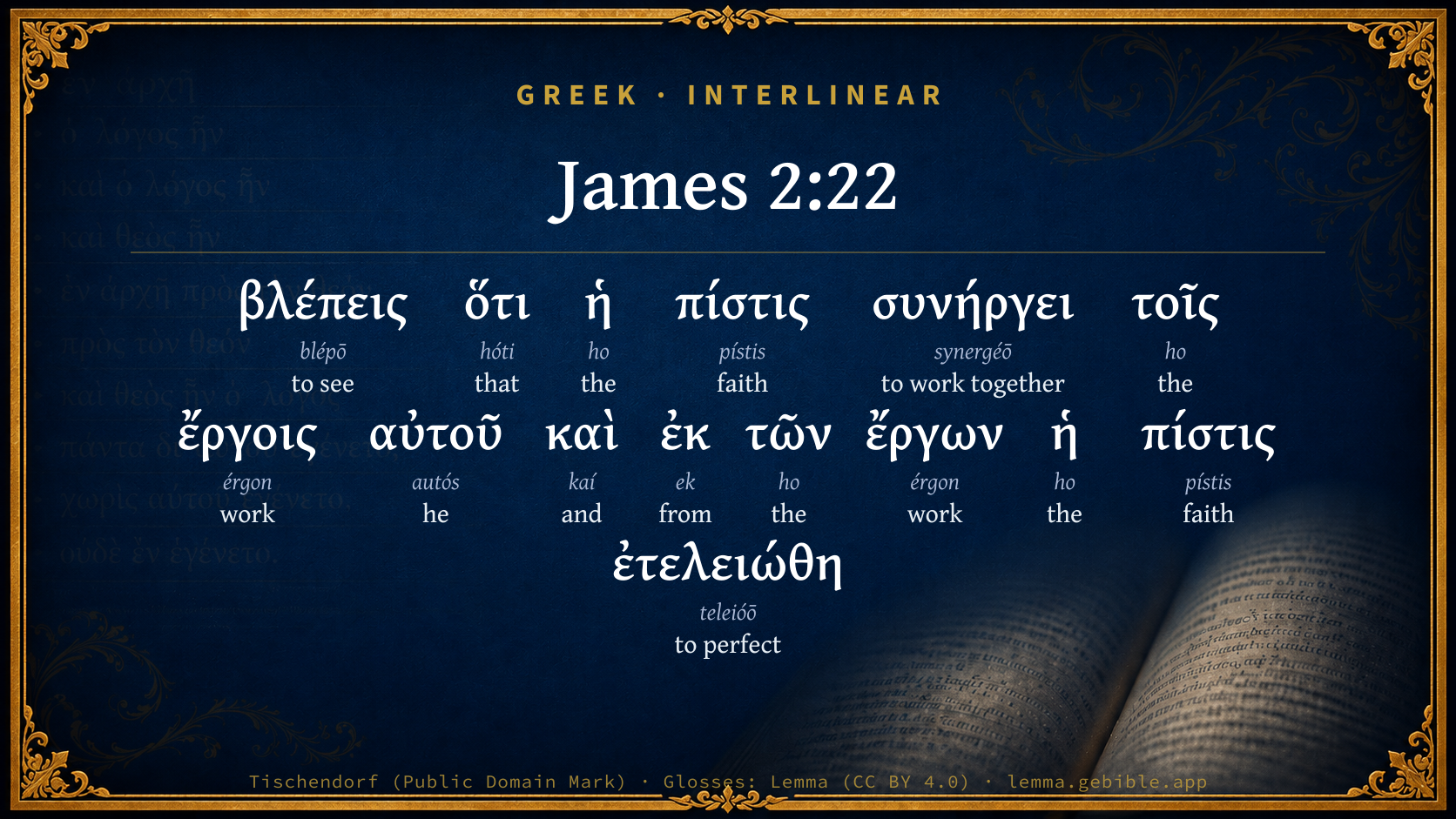
  1. βλέπεις blépō G991 “to see” Verb, Present, Active, Indicative, 2nd person, Singular
  2. ὅτι hóti G3754 “that” Conjunction
  3. ἡ ho G3588 “the” Article, Nominative, Singular, Feminine
  4. πίστις pístis G4102 “faith” Noun, Nominative, Singular, Feminine
  5. τοῖς ho G3588 “the” Article, Dative, Plural, Neuter
  6. ἔργοις érgon G2041 “work” Noun, Dative, Plural, Neuter
  7. αὐτοῦ autós G846 “he” Personal pronoun, Genitive, Singular, Masculine
  8. καὶ kaí G2532 “and” Conjunction
  9. ἐκ ek G1537 “from” Preposition
  10. τῶν ho G3588 “the” Article, Genitive, Plural, Neuter
  11. ἔργων érgon G2041 “work” Noun, Genitive, Plural, Neuter
  12. ἡ ho G3588 “the” Article, Nominative, Singular, Feminine
  13. πίστις pístis G4102 “faith” Noun, Nominative, Singular, Feminine
  14. ἐτελειώθη teleióō G5048 “to perfect” Verb, Aorist, Passive, Indicative, 3rd person, Singular

About this verse

These counts appear in no published source. They are computed here, from the morphology-tagged text and Lemma’s own curated glosses. What Lemma adds →

15
words
10
distinct lemmas
General Epistles
section

Notable vocabulary

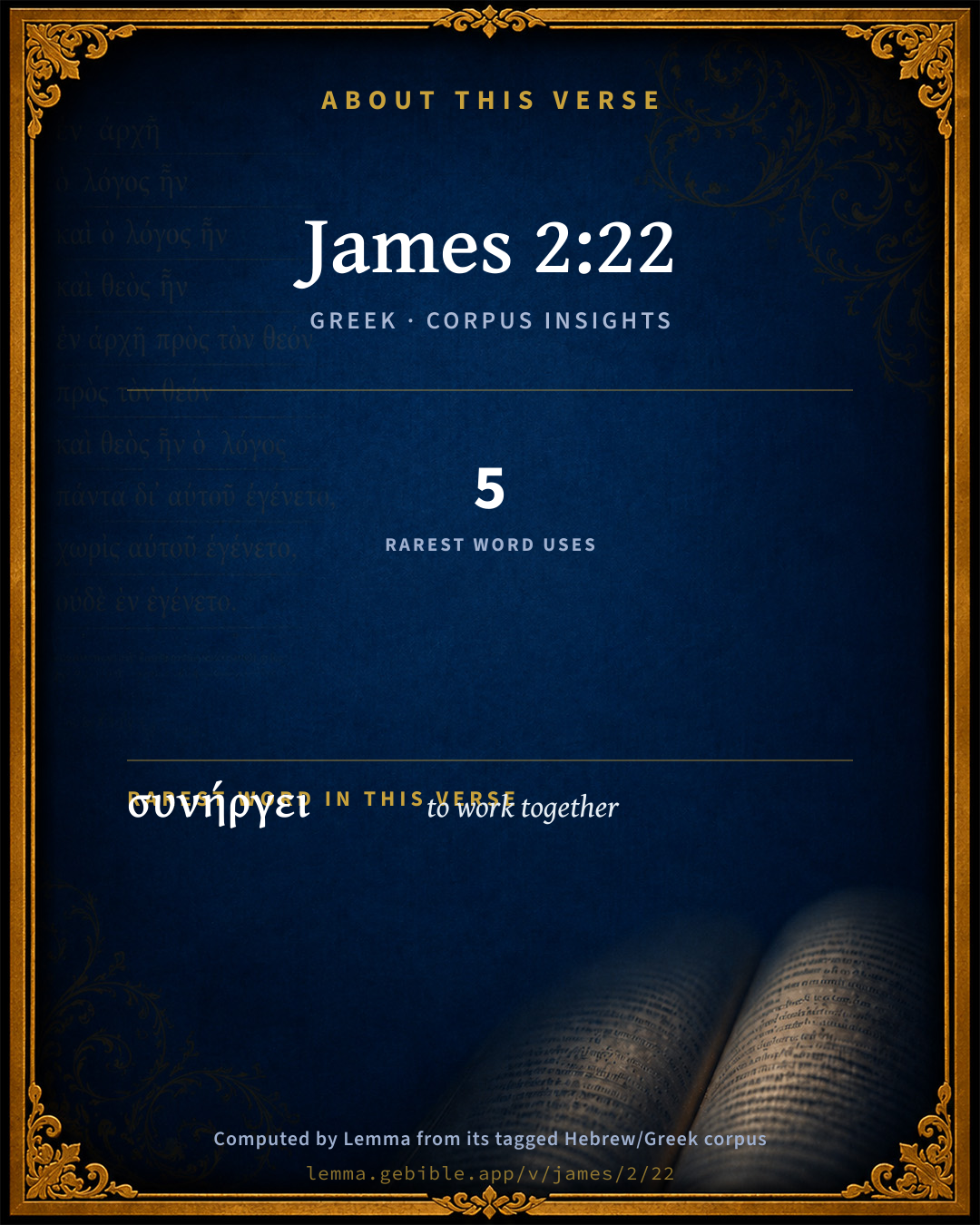
The rarest word here is συνήργει to work together G4903 — appearing just 5 times in the whole Greek New Testament.

Shared distinctive vocabulary

συνήργει to work together G4903 occurs in 5 verses of the Greek New Testament. Also found in:

Repetition

Words recur within this verse:

  • πίστις faith G4102 ×2
  • ἔργοις work G2041 ×2
  • ἡ the G3588 ×4

Cross-references

6

Topical passages linked to James 2:22 in the Treasury of Scripture Knowledge — connected by theme and wording, ordered by reader-vote popularity; previews shown in the World English Bible.

  • 1 Thessalonians 1:3 remembering without ceasing your work of faith and labor of love and patience of hope in our Lord Jesus Christ, before our God and Father.
  • Hebrews 11:17–19 By faith, Abraham, being tested, offered up Isaac. Yes, he who had gladly received the promises was offering up his one and only son;
  • Galatians 5:6 For in Christ Jesus neither circumcision amounts to anything, nor uncircumcision, but faith working through love.
  • 1 John 2:5 But whoever keeps his word, God's love has most assuredly been perfected in him. This is how we know that we are in him:
  • James 2:18 Yes, a man will say, "You have faith, and I have works." Show me your faith from your works, and I by my works will show you my faith.
  • 1 John 4:17–18 In this love has been made perfect among us, that we may have boldness in the day of judgment, because as he is, even so are we in this world.

Cross-references courtesy of OpenBible.info (CC BY 4.0).

Commentary

Notes on James 2:22 from classic Christian and Jewish commentators (each source and its license shown beneath its notes). The classic Christian expositions comment on the surrounding passage and are grouped to its opening verse, so a note may address several verses; the Jewish commentaries on the Tanakh (Rashi and others) are per-verse, so they appear only where the commentator wrote on this verse.

Lemma curates 59 commentaries, every one of them public domain or Creative Commons licensed, each selected and text-cleaned for this edition rather than reprinted as found. About our sources →

Joseph Benson's Commentary

Jas 2:22. Seest thou — Or thou seest then, in this instance; how faith wrought together with his works — And animated him to great zeal and self-denial in them. Therefore faith has one energy and operation, works another. And the energy and operation of faith are before works, and together with them. Works do not give life to faith, but faith begets works, and then is completed by them. And by works was faith made perfect — “The command to offer Isaac for a burnt-offering, (Gen 22:2,) appearing directly contrary to the promise, (Gen 21:12,) In Isaac shall thy seed be called, Abraham’s faith was thereby put to the severest trial. Yet it was not staggered by the seeming contrariety of the divine revelation: Abraham reasoned with himself, (Heb 11:19,) that God was able to raise Isaac even from the dead; and firmly believing that he would actually do so, he therefore set himself to obey the divine command without the least gain-saying. James therefore had good reason to say that Abraham’s faith co-operated with his works in procuring him the promises confirmed with an oath, because it was his faith in God which enabled him to perform the difficult works, requisite to the offering of Isaac as a burnt- offering. He had equally good reason to say, by works his faith was perfected, or rendered complete; because, if, when tried, he had refused to obey, his would not have been a complete faith. In this passage, therefore, 1st, James hath declared that faith and works are inseparably connected, as cause and effect, and that good works must flow from faith as their principle.” 2d, He here fixes the sense wherein he uses the word justified; so that no shadow of contradiction remains between his assertion and St. Paul’s. Abraham returned from that sacrifice perfected in faith, and far higher in the favour of God. Faith hath not its existence from works; for it is before them; but its perfection. That vigour of faith which begets works is then excited and increased thereby: as the natural heat of the body begets motion, whereby itself is then excited and increased: see 1Jn 3:22.

Joseph Benson's Commentary on the Old and New Testaments (1811–1818) — public domain. Text from a community e-Sword module.

Tyndale Open Study Notes

Tyndale Open Resources

2:22 This verse explains 2:21 so it won’t be misunderstood: Abraham was not justified by his actions alone; instead, his faith and his actions worked together. This describes the full scope of Abraham’s faithful response to God throughout his life (see Gen 12:1-4; 18:1-27).

Tyndale Open Study Notes — © Tyndale Open Resources, licensed CC BY-SA 4.0. Text via the HelloAO Bible API.

Bengel's Gnomon

Johann Albrecht Bengel

Jas 2:22. Ὅτι, that) Here are two clauses; and if emphasis is laid on the word faith in the former clause, and on works in the latter, the sense will be plainly seen, by which the bearing of the one part upon the other is clearly expressed.—ἡ πίστις, faith) It was by faith that Abraham offered his son, Heb 11:17.—συνήργει, wrought with) Therefore faith has one kind of efficacy and operation (ἐνέργειαν), works another: and indeed faith before works and with them. Works do not give life to faith; but faith produces works, and works make perfect faith.—ἐτελειώθη, was made perfect) He does not say, was made alive. That which faith derives from works is not its reality and truth, for it has a true existence before works, but its perfection and its attaining to the Divine friendship; Jas 2:23. Comp. Joh 15:10. The vigour of faith, which produces works, is increased, excited, and strengthened by the very act of producing them, just as the natural heat of the body is promoted by the exercise which it first stimulates. See 1Jn 3:22. Abraham returned from that sacrifice much more perfect in faith than he had gone to it. The same word, τελειοῦσθαι, is used by Alexander Aphrodisiensis, in his 2d Book, respecting the soul, Chapter III., τρίτος δέ ἐστι, when he describes the intellect as increased by the knowledge of things situated beyond [external to] itself. Faith itself is made perfect, that is, is shown to be true, by works.

Bengel's Gnomon of the New Testament — English translation (T&T Clark, Edinburgh, 1860) — public domain. Text from a community e-Sword module.

Meyer's Critical & Exegetical Commentary

Heinrich August Wilhelm Meyer

Jam_2:22. The direct inference from the preceding. Since the necessity of faith to the attainment of salvation was not contested by those with whom James disputed, but only the necessity of works; and since James (Jam_2:21) had adduced the example of Abraham to prove that only a faith which is not ἀργή and χωρὶς τῶν ἔργων profits: in this verse it can only be intended to represent how important to Abraham were his works, but not how important to him was his faith. This thought is thus clearly and evidently expressed in the second hemistich: καὶ ἐκ τῶν ἔργων κ.τ.λ. On the other hand, the first hemistich: ὅτι ἡ πίστις συνήργει τοῖς ἔργοις αὐτοῦ, has been generally understood by expositors as if the necessity of faith was intended to be brought forward. In this meaning Bengel says: duo commata, quorum in priore, si illud, fides, in altero opcribus cum accentu pronunciaveris, sententia liquido percipitur, qua exprimitur, quid utravis pars alteri conferat. According to this, James would have expressed in the first hemistich, that faith was not wanting to Abraham, that rather it was this from which his works sprung, that accordingly Abraham was justified ἐξ ἔργων, because they were works of faith. The same explanation is given by Erasmus, Tremellus, Beza, Baumgarten, Gebser, Pott, Kern, and others; also by Hofmann and Wiesinger. But the context is against it, as this thought does not follow as a consequence from Jam_2:21. Those expositors have accordingly understood the passage more correctly who find in the words in question the meaning that the πίστις of Abraham was not dead but operative; Estius: operosa fuit, non otiosa, non mortua (so Calvin, Laurentius, Hornejus, and others), although their interpretation is inaccurate in particulars.

συνήργει] If συνεργεῖν is taken in its strictly literal sense: to be a συνεργός, to labour or to work along with (1Co_16:16; 2Co_6:1), and is translated: faith wrought with his works, the idea of James (according to the usage of the word συνεργεῖν in this meaning) would be, that whilst works wrought, faith participated in their work.[147] But this thought does not correspond with the context, and is, moreover, not in itself to be vindicated, since faith and works are not two principles working along with one another.

Kern, with whom de Wette coincides, takes τοῖς ἔργοις as the dative of reference, and explains it: faith wrought to his works, i.e. was the operative principle for the production of works. This gives, indeed, a suitable enough thought, but linguistic usage is against the explanation; besides, it is not the case that συν has only a vague reference, or, to speak more correctly, no reference at all (Hofmann). On this account other interpreters, as Hofmann, Wiesinger, Brückner, also Philippi, correctly take συνεργεῖν here in the meaning of: to help (Rom_8:28; 1Ma_12:1). The support which faith gave to works is to be found in this, that as it operates to their production, so also to their accomplishment in correspondence with the will of God.[148] By this explanation a special emphasis is placed on the expression συνήργει, it being thereby brought prominently forward that the faith of Abraham was not ἀργός (ἀ-εργός), but exercised an activity, namely, the activity mentioned as helpful to works. Against Langes explanation: faith manifested itself operatively at one with the works, besides not being linguistically justified, Brückner rightly remarks that here the discourse is not concerning a co-operation of these two points.

The second hemistich is not in antithesis with the first, but constitutes its complement; whilst the faith of Abraham aided his works, faith itself received by works its completion.

ἐτελειώθη] is by many interpreters understood as declarative; Gomarus: fides est causa, opera effectus; causa autem non perficitur a suo effectu, sed perfecta declaratur, ut fructus boni arborem bonam non efficiunt, sed indicant. The same explanation is adopted by Calvin, Laurentius, Baumgarten, Gebser, Bengel, Philippi,[149] and others. Also Wiesinger indicates the same meaning with the remark: faith could not be proved complete if it were not already so in itself, for the complete work presupposes the complete faith; but τελειοῦσθαι does not signify to be proved, but to be completed.[150] Certainly the meaning of James cannot be, that faith hitherto incomplete was completed by works, as something which was externally added to faith, since faith is the impulse to the works; but as little is it his meaning, that faith is already complete (τέλειος) before works, and is by works only proved or demonstrated to be so; but faith and works are in his view so closely connected, that faith only when it produces works or by works (ἐξ ἔργων) becomes ever more completely that which it should be according to its nature and destination, and in so far only by works attains to its completion; for as the power of love grows and is completed by the practice of works of love, so does faith grow and is completed by the practice of works in which it manifests itself.[151] Thus was Abrahams faith only completed when he stood the severest test, and brought his son as an offering upon the altar.[152]

[147] In the first edition of this commentary it is said: Faith was the συνεργός of his worksthat is, it operated not by itself, but with his works. James will here make prominent that with Abraham both were combined, the emphasis, however, according to the context, being placed on τοῖς ἔργοις. This explanation, which has found favour with von Oettingen and Rauch, is, however, not tenable, as, on the one hand, linguistic usage is against it, and, on the other hand, it was not insisted on by James that the faith of Abraham wrought not alone, but that it was no inactive (inoperative) faith.

[148] The explanation of Hofmann (with whom Wiesinger and Brückner coincide): that his action would not have been what is represented in an act of willing obedience, unless faith had assisted to its performance, has this against it, that the principal thought would not thereby be expressed, but must be added. Philippi correctly: Abrahams faith was no inert faith, but was helpful to his works, namely, to their production and accomplishment, i.e. it assisted him to the performance of good works.

[149] Philippi incorrectly appeals for this meaning to 1Jn_2:5, and to ἔσεσθε in Luk_6:35.

[150] Also Hofmanns explanation: The τελείωσις of his faith consisted not in this, that it attained from incompleteness to completeness, but in this, that by the action, in which it proved itself, it attained to its complete formationto its historical accomplishment, cannot be reckoned as appropriate, because τελειοῦσθαι never means to be completely formed, if by this expression a becoming complete is not intended. Lange agrees with the above remark, only he introduces something strange when he says: Abraham by his faith-offering attained typically and ideally the τελείωσις, which the Jewish Christians were to attain by the full proof of Christian brotherly love out of faith, and which with them all Israel was to attain.

[151] Luther (in his introduction to First Peter, published by Irmischer, vol. lxx. p. 223 f.) says of the fruits of faith: Although they belong to our neighbour, that he may be profited thereby, yet the fruit is not externalfaith becomes stronger thereby. It is an entirely different strength than that of the body, for this decays and is consumed; but this spiritual strength, the more one uses and exercises it, the stronger it becomes; it decays when one does not exercise it. See also the appropriate remarks of Hengstenberg (Evang. Kirchenz. 1866, p. 1124 ff.).

[152] When it is objected against this explanation, that faith must already have been perfect in order to produce the perfect work, it is to be observed, that it is in the nature of living faith always to be becoming stronger, in and with the production of works, and thus to perfect itself in its nature more and more. Brückner, indeed, grants that the practice of works has a strengthening reflex efficacy on faith, but observes that by this cannot be meant that faith was not before already sufficient to justify Abraham. But to this it is to be observed, that James does not derive the justification (meant by him) of Abraham from his faith preceding works, but from his faith made perfect by works.

Meyer — Critical and Exegetical Commentary on the New Testament — English translation by Peter Christie, edited by Frederick Crombie (T&T Clark, 1880) — public domain. Text from a community e-Sword module.

Expositor's Greek Testament

ed. W. Robertson Nicoll

Jas 2:22 . βλέπεις …: as these words are the deduction drawn from what precedes, it is better to take them in the form of a statement, and not as interrogative. ἡ πίστις συνήρ γει : this implies a certain modification, with regard to πίστις , of the earlier position taken up by the writer, for in Jas 2:21 he says: “Was not Abraham our father justified by works?” no mention being made of faith; while here faith is accorded an equal place with works; cf. Gal 5:6 , πίστις διʼ ἀγάπης ἐνεργουμένη , concerning which words Lightfoot says that they “bridge over the gulf which seems to separate the language of St. Paul and St. James. Both assert a principle of practical energy, as opposed to a barren, inactive theory”. On συνήργει see Test. of the Twelve Patriarchs , Gad. iv. 7, “But the spirit of love worketh together with the law of God …” (Charles). καὶ ἐκ τῶν ἔργων ἡ πίστις ἐτελειώθη : it is obvious that “faith” is used here in the highest sense, not merely as an attitude of mind, but as a God-given possession. It must, however, be further remarked that if the Judaism of the Jewish-Christian writer of this part of the Epistle had been somewhat less strong, the words under consideration would probably have been put a little differently; for according to the purely Christian idea of faith, works, while being an indispensable proof of its existence, could not be said to perfect it, any more than the preaching of the faith could be said to perfect the preacher’s belief; though works are the result and outcome of faith, they belong, nevertheless, to a different category.

The Expositor's Greek Testament, edited by W. Robertson Nicoll (1897–1910) — public domain. Text from a community e-Sword module.

Geneva Bible (1599)

Geneva Bible translators

That the faith was declared to be a true faith, and that by works.

Was effectual and fruitful with good works.

Geneva Bible (1599) marginal notes — public domain. Text via Bolls.life.

Jamieson, Fausset & Brown

Robert Jamieson, A. R. Fausset & David Brown

Or, "thou seest."

how--rather, "that." In the two clauses which follow, emphasize "faith" in the former, and "works" in the latter, to see the sense [BENGEL].

faith wrought with his works--for it was by faith he offered his son. Literally, "was working (at the time) with his works."

by works was faith made perfect--not was vivified, but attained its fully consummated development, and is shown to be real. So "my strength is made perfect in weakness," that is, exerts itself most perfectly, shows how great it is [CAMERON]: so Jo1 4:17; Heb 2:10; Heb 5:9. The germ really, from the first, contains in it the full-grown tree, but its perfection is not attained till it is matured fully. So Jam 1:4, "Let patience have her perfect work," that is, have its full effect by showing the most perfect degree of endurance, "that ye may be perfect," that is, fully developed in the exhibition of the Christian character. ALFORD explains, "Received its realization, was entirely exemplified and filled up." So Paul, Phi 2:12, "Work out your own salvation": the salvation was already in germ theirs in their free justification through faith. It needed to be worked out still to fully developed perfection in their life.

Jamieson, Fausset & Brown — Commentary Critical and Explanatory on the Whole Bible (1871) — public domain (CC PDM 1.0). Text via the HelloAO Bible API.

Adam Clarke's Commentary

Verse 22. Seest thou how faith wrought] Here is a proof that faith cannot exist without being active in works of righteousness. His faith in God would have been of no avail to him, had it not been manifested by works; for by works - by his obedience to the commands of God, his faith was made perfect - it dictated obedience, he obeyed; and thus faith ετελειωθη, had its consummation. Even true faith will soon die, if its possessor do not live in the spirit of obedience.

Adam Clarke's Commentary on the Bible (1810–1826) — public domain. Text from a community e-Sword/MySword module.

John Calvin's Commentaries

22 By works was faith made perfect By this he again shews, that the question here is not respecting the cause of our salvation, but whether works necessarily accompany faith; for in this sense it is said to have been perfected by works, because it was not idle. It is said to have been perfected by works, not because it received thence its own perfection, but because it was thus proved to be true. For the futile distinction which the Sophists draw from these words, between formed and unformed faith, needs no labored refutation; for the faith of Abram was formed and therefore perfected before he sacrificed his son. And this work was not as it were the finishing, or last work. Formerly things afterwards followed by which Abraham proved the increase of his faith. Hence this was not the perfection of his faith, nor did it then for the first time put on its form. James then understood no other thing, than that the integrity of his faith then appeared, because it brought forth that remarkable fruit of obedience.

John Calvin's Commentaries (1540-1563) — public domain. Text from the Calvin Translation Society English edition (1840s-50s) via the Christian Classics Ethereal Library (ccel.org). Calvin's coverage is partial (roughly two-thirds of the Bible); uncommented books and verses are honest gaps, never fabricated. The 19th-century editor's footnotes and remarks are omitted so the notes are faithfully Calvin's own voice.

Ellicott's Commentary for English Readers

(22) Seest thou how . . .?—Better taken simply, and not as a question, Thou seest how, &c.

A Bible Commentary for English Readers, edited by Charles John Ellicott (1878–1897) — public domain. Text from a community e-Sword module.

The Cambridge Bible for Schools and Colleges

gen. ed. J. J. S. Perowne

22. Seest thou how faith wrought with his works …?] Better, perhaps, not as a question, Thou seest that … Attention is called, not as the English “how” suggests, to the manner of co-operation, but only to the fact. The tense of the verb emphasises the continued co-operation of Abraham’s faith with his works. The one was all along working together with the other. What St James presses is, not that works can justify without faith, but that faith cannot justify unless it includes “the promise and the potency” of the life that shews itself in acts.

by works was faith made perfect?] Here the tense is changed to that which denotes completion in a single act. It was “by works” (i. e. out of, as from the originating cause) that faith was brought to its completion. The interpretation which sees in the words nothing more than that faith was shewn to be perfect, must be rejected as one of the afterthoughts of controversy. It may be added, however, as pointing to the true reconciliation of St James and St Paul, that the very form of the statement implies that the faith existed prior to the works by which it was made perfect.

The Cambridge Bible for Schools and Colleges (gen. ed. J. J. S. Perowne; Cambridge University Press, 1878–1918) — public domain. Text from a community e-Sword module.

John Gill's Exposition

Seest thou how faith wrought with his works,.... Not to justify him before God; for neither faith nor works are ever said in Scripture to justify any man; but his faith being of the right kind, a faith which works by love, it put him upon doing this work, and many others; for this was done in faith, Heb 11:17 as all good works are, which are properly such; and where there is true faith, it will influence and engage a man to do good works, as it did Abraham.

And by works was faith made perfect? not with an absolute perfection; for though Abraham's faith was very great, yet there were things lacking in it, and he had his fits and times of unbelief; and had he lived till now, his faith, in this sense, would not have been perfect; and he would have had reason to have used the apostle's petition, Luk 17:5 much less would it have been made thus perfect by works; but the sense is, that hereby his faith was declared to be sincere, unfeigned, true, and genuine; just as love is said to be perfected, Jo1 4:17.

John Gill's Exposition of the Whole Bible (1746–1763) — public domain (CC PDM 1.0). Text via the HelloAO Bible API.

Trapp's Complete Commentary

John Trapp

22 Seest thou how faith wrought with his works, and by works was faith made perfect?

Ver. 22. Wrought with his works] Or, was a help to his works, and was her own midwife to bring them forth of herself into the open light, Heb 11:17.

Was faith made perfect] That is, declared to be operative and effectual.

John Trapp, A Commentary or Exposition upon All the Books of the Old and New Testament (1647–1656) — public domain. Text from a community e-Sword module.

Albert Barnes' Notes on the Bible

Seest thou - Margin, “Thou seest.” Either rendering is correct, and the sense is the same. The apostle means to say that this was so plain that they could not but see it.

How faith wrought with his works - συνήργει sunērgei. Cooperated with. The meaning of the word is, “to work together with anyone; to co operate,” 1Co 16:16; 2Co 6:1; then to aid, or help, Mar 16:20; to contribute to the production of any result, where two or more persons or agents are united. Compare Rom 8:28. The idea here is, that the result in the case of Abraham, that is, his salvation, or his religion, was secured, not by one of these things alone, but that both contributed to it. The result which was reached, to wit, his acceptance with God, could not have been obtained by either one of them separately, but both, in some sense, entered into it. The apostle does not say that, in regard to the merit which justifies, they came in for an equal share, for he makes no affirmation on that point; he does not deny that in the sight of God, who foresees and knows all things, he was regarded as a justified man the moment he believed, but he looks at the result as it was, at Abraham as he appeared under the trial of his faith, and says that in that result there was to be seen the co-operation of faith and good works. Both contributed to the end, as they do now in all cases where there is true religion.

(By the somewhat unhappy term “merit,” the author clearly means nothing more than “principle,” as is obvious from his acute and evangelical comment on the verse; as well as from the admirable reconciliation of Paul and James below.)

And by works was faith made perfect - Made complete, finished, or entire. It was so carried out as to show its legitimate and fair results. This does not mean that the faith in itself was defective before this, and that the defect was remedied by good works; or that there is any deficiency in what the right kind of faith can do in the matter of justification, which is to be helped out by good works; but that there was that kind of completion which a thing has when it is fully developed, or is fairly carried out.

Albert Barnes' Notes on the Bible (1834–1885) — public domain. Text from a community e-Sword/MySword module.

Matthew Poole's English Annotations

Seest thou how faith wrought with his works? He doth not say, works wrought with his faith, as he should have said, if he had intended their concurrence in justification; but

faith wrought with his works, i.e. his faith was not idle, but effectual in producing good works, it being the office and business of faith to respect Christ for sanctification, as well as righteousness, Act 26:18.

And by works was faith made perfect; either:

1. Faith by producing good works is itself encouraged, heightened, improved; and so not made perfect by any communication of the perfection of works to it, but by being stirred up and exercised as to the internal strength and power of it. Or rather:

2. Faith is made perfect by works declaratively, inasmuch as works evidence and manifest the perfection and strength of faith.

Faith is the cause, and works are the effects; but the cause is not perfected by the effect, only its perfection is demonstrated by it, as good fruit doth not make a tree good, but show that it is so. See 2Co 12:9.

Matthew Poole's English Annotations on the Holy Bible (1683–1685) — public domain. Text from a community e-Sword/MySword module.

Whedon's Commentary on the Bible

Daniel D. Whedon

22. Faith wrought… works—As remarked in our notes on the passages referred to in our last note, Abraham was a believer years before the offering of Isaac, and justified. That act of self-surrendering faith by which a man enters into reconciliation with God was performed years before. Yet every signal external act of faith was a renewal of the first. Abraham’s justification came, as Paul says, from his faith alone. Yet the faith which alone justifies is never really alone: it ever combines with works.

Faith made perfect—Had Abraham died at the instant of his first justification he would have been completely justified by faith alone. But his faith would have wanted its proper counterpart in actual works, and so have been in a sense imperfect. Yet it was saving in its quality, being of such a nature and power as would generate works but for the cessation of life. In other words, it was such a self-surrender to, trust in, and oneness of heart and spirit with, God, as would have poured forth works in accord with God’s will. Or, to vary the statement, on condition of such self-surrendering faith a full flow of the divine Spirit is poured into the heart, inspiring a life and course of action accordant with the divine will. When, then, this internal faith is answered to by the correspondent act and course of life, it becomes completed, made perfect.

Daniel D. Whedon (gen. ed.), Commentary on the Old and New Testaments (1874–1909) — public domain. Text from a community e-Sword module.

John Wesley's Explanatory Notes

Thou seest that faith - For by faith Abraham offered him, Heb. xi, 17. Wrought together with his works - Therefore faith has one energy and operation; works, another: and the energy and operation of faith are before works, and together with them. Works do not give life to faith, but faith begets works, and then is perfected by them. And by works was faith made perfect - Here St. James fixes the sense wherein he uses the word justified; so that no shadow of contradiction remains between his assertion and St. Paul's. Abraham returned from that sacrifice perfected in faith, and far higher in the favour of God. Faith hath not its being from works, (for it is before them,) but its perfection. That vigour of faith which begets works is then excited and increased thereby, as the natural heat of the body begets motion, whereby itself is then excited and increased. See 1 John iii, 22.

John Wesley, Explanatory Notes Upon the Whole Bible (1754–1765) — public domain. Text via the GEBible commentary corpus.

Scofield Reference Notes

C. I. Scofield

perfect

(See Scofield "Mat 5:48").

The Scofield Reference Bible (1917 edition), notes by C. I. Scofield — public domain. Text from a community e-Sword module.

The People's New Testament

B. W. Johnson

22. Seest thou how faith wrought. Abraham's faith was a working faith. By works was faith made perfect. The element of works is essential to make it complete. Without works it is an imperfect, “a dead faith.” It must have energy to avail. Abraham's faith “wrought.”

B. W. Johnson's The People's New Testament with Notes (1889–1891) — public domain. Electronic text from the Christian Classics Ethereal Library (CCEL) ThML edition.

Cambridge Greek Testament for Schools and Colleges

22.συνήργει, so W. H. with א*BCKLP and the Vulgate (cooperabatur): συνεργεῖ, Tischendorf with אA and O. L. (communicat).

22. ἡ πίστις συνήργει, faith was all along cooperating with. The works were an exercise of faith, and the result of them was perfection of faith. So Gideon was stronger in faith after the exercise of his faith. For the principle comp. the Aristotelian doctrine, ἐκ τῶν ὁμοίων ἐνεργειῶν αἱ ἕξεις γίγνονται, Eth. Nic. II. i. 7.

Cambridge Greek Testament for Schools and Colleges (Cambridge University Press, 1896; 21 vols, various authors incl. Carr, Maclear, Plummer, Farrar, Lumby, Moule, M. R. James, Simcox) — public domain. Text from a community e-Sword module.

Alford’s Greek Testament

Henry Alford

22.] Thou seest (better not a question: in which case the καί of ver. 23 does not follow so naturally as when we couple the direct verb βλέπεις with the direct verb ἐπληρώθη) that (not, “how,” as E.V.: it is not the manner in which, nor even “how” in the sense of ‘how that,’ which is meant. The assertion is, that the inference is indubitable, that the fact was as stated) faith (the art. is abstract here, not possessive, as αὐτοῦ being expressed below shews) wrought (at the time, ‘was working,’ imperf.) with his works (τοῖς ἕργοις again categorical, the work in the example being but one), and by (out of, as the ground and source) works (again categorical; the general proposition proved by the particular case. Doubtless this second time it might be ‘by his works, his faith,’ &c.: but the other is more like St. James, who is singularly given to introduce abstract propositions as applicable to particular cases) faith (see above) was made complete (in one act, once for all: not imperf. as συνήργει, but aor.: not, as again many Commentators, even Bengel and De Wette, and so Calvin, “quod vera esse inde comprobetur;” an impossible meaning, and very far from the context of the Apostle’s argument; which is, that faith is developed and brought to perfection by obedience: see below on ver. 26. And hence also is it evident, how faith συνήργει τοῖς ἔργοις ἀυτοῦ. By the Apostle’s own comparison, ver. 26, faith is the body, obedience the spirit: faith without obedience is dead, until obedience, the spirit, sets faith in motion: then faith, like the limbs of the body, moves with and works with the acts of obedience. Which is prior in time, which the ground of the other, is a point not touched by St. James at all. Pool collects well in his Synops. ad loc., the opinions of others: “Opera autem fidem perficiunt ratione operationis et consummationis, quum per opera fides ad maturitatem pervenit, quomodo arbor perfecta sit quum ita excrevit ut fructum ferat, Num 17:8; et peccatum perficitur, Jac. 1:15, quum in habitum evasit … Fides tum demum consummata redditur, postquam bonos fructus protulit.” But when he goes on to say, “Fides est causa: opera, effectus. Causa autem non perficitur a suo effectu, sed perfecta declaratur: ut fructus boni arborem bonum non efficiunt, sed indicant,” he is travelling out of the record, and giving meanings unknown to this passage):

Henry Alford, The Greek Testament (1849–1861) — public domain. Text from a community e-Sword module.

International Critical Commentary

22. ὅτι. The force of ὅτι probably runs through vv. 22 and 23.

ἡ πίστις. The existence and efficiency of Abraham’s faith (which has not previously been mentioned) is assumed, but alone it is declared not to have been adequate to secure justification.

συνήργει τοῖς ἔργοις αὐτοῦ.

συνήργει] א*A ff read συνεργεῖ. The weight of ff is here diminished by the fact that it also renders ἐτελειώθη (for which there is no Greek variant) by the present tense confirmatur.

“Faith helped works, and works completed faith,” sc. toward the end of justification, as v. 21 indicates. In this general statement the mutual relation of faith and works is made plain—the two are inseparable in a properly conducted life (cf. v. 18 b). It is thus hardly true to say that the whole emphasis here rests on τοῖς ἔργοις. Bengel: duo commata quorum in priore si illud, fides, in altero operibus cum accentu pronunciaveris, sententia liquido percipietur, qua exprimitur, quid utravis pars alteri conferat.

The change of tense (συνήργει, ἐτελειώθη) is due to the differing nature of the two words (“linear” and “punctiliar,” cf. J. H. Moulton, Prolegomena, pp. 108 f.).

τοῖς ἔργοις, dat. of advantage.

συνεργεῖν is a common enough Greek word, but is found in the LXX only in 1 Ezr 7:2; Ezr 7:1 Macc. 12:1, and in the N. T. only Mar 16:20, Rom 8:28, 1Co 16:16, 2Co 6:1. It means “cooperate with,” “assist,” “help.” The E.V. “wrought with” is misleading, because it tends to put too much emphasis on “wrought” and not enough on “with.”

Grimm (Lex.. s. v. συνεργέω) interprets: “Faith (was not inactive, but by coworking) caused Abraham to produce works,” and this view is held by many. V. 18 does, indeed, suggest that James had reached this conception of the relation of faith and works as source and product, but it is not expressed in v. 22, nor is it directly implied there. The persistent attempts to find it in v. 22 are ultimately due to Protestant commentators’ interest in the doctrine of the supremacy of faith. Not the power of vital faith to produce works, but the inseparability of faith and works is James’s contention throughout this passage. The argument is directed against those who would excuse lack of works by appealing to their faith; faith alone, it is declared, is ineffective for securing salvation.

That συνήργει is used in conscious contrast to ἀργή (ἀ-εργη) is commonly affirmed, but this interpretation spoils the sense. James does not mean that Abraham’s faith, being accompanied by (συν-) works, was effective (-ήργει), but that faith and works co-operated.

ἐτελειώθη, “was perfected,” not as if previously, before the works, it had been an imperfect kind of faith, but meaning that it “was completed” (almost “supplemented”), and so enabled to do its proper work. If, when the test came, the faith had not been matched by works, then it would have been proved to be an incomplete faith. The works showed that the faith had always been of the right kind, and so “completed” it.

Schneckenburger and many others take the opposite view, “fides theoretica imperfecta est donec accedat praxis”; but these plain people’s faith was no such theologian’s theory. Huther and Beyschlag think of faith as “perfected,” in the sense of growing strong by exercise in works, but this is not exactly the writer’s thought here. Calvin and others try to give to ἐτελειώθη the unlikely sense “was shown to be perfect.” Others urge that the process was the complete development of what faith really was. The difficulties which the commentators find are due partly to dogmatic prepossession, partly to their error in supposing that James was a subtle theologian who did not write his practical maxims and swift popular arguments until he had thought out the exact definitions, psychological distinctions, and profound and elusive relations involved in the subject.

23 καὶ ἐπληρώθη. καὶ introduces the result of συνήργει καὶ ἐτελειώθη.

ἡ γραφή, viz. Gen 15:6, quoted accurately from the LXX, except that all but two of the chief Mss. have καὶ ἐπίστευσεν for ἐπίστευσεν δέ.

Paul’s quotation in Rom 4:3 has δέ, but so do Philo, De mut. nom. 33; Clem. Rom 10:6; Justin Martyr, Dial. 92, so that the agreement need not be significant for the relation of James to Paul. See Hatch, Essays, p. 156, where the evidence is given in full.

The passage Gen 15:6 (ἐλογίσθη κτλ.) is taken as a prophecy. As such, it was really fulfilled by Abraham’s conduct set forth in Gen_22. “And so, by the addition of conduct (whereby his faith was manifested) his faith was perfected, the Scripture promise that he should be justified was fulfilled, and he was called God’s friend.” The same passage of Genesis is also used by Paul (Rom 4:3, Gal 3:6) as proof of his doctrine of justification by faith; James, as if in reply, points out that what he has been saying in v. 21 shows that works had to come in and perfect this faith in order to bring about the desired end of justification.

ἐπίστευσεν.

In Gen 15:6 the object of Abraham’s faith is that God will fulfil the promise just given and grant him an heir. In 1 Macc. 2:52, Ἀβραὰμ οὐκ ἐν πειρασμῷ εὑρέθη πιστός, καὶ ἐλογίσθη αὐτῷ δικαιοσύνη (Codd. א× εἰς δικαιοσύνην), Gen 15:6 is alluded to, and the signal exhibition of this faith in the sacrifice of Isaac (Gen_22, note 22:1) appears to be in mind. So here in James the sacrifice of Abraham is the act which manifests the faith, cf. Gen 22:16-18; and this seems to follow the ordinary Jewish understanding of the matter. In other passages of the N. T. the case is various. Rom 4:17 ff. refers to the belief of God’s promise of a son; Heb 11:8 ff. to the faith shown by Abraham’s departure for an unknown country; Heb 11:9 to his residence in Canaan; Heb 11:17 ff. to the sacrifice of Isaac. Clem. Rom. 31 connects the sacrifice of Isaac with Abraham’s righteousness and faith; Gen 15:6 is quoted, but the precise nature of Abraham’s faith is not indicated.

ἐλογίσθη αὐτῷ εἰς δικαιοσύνην. From Gen 15:6.

The same expression is found (of Phinehas) in Psa 106:30, Psa 106:31; cf. Gen 15:6 (with Skinner’s note), Deu 24:13, “it shall be righteousness unto thee before the Lord, thy God,” Deu 6:25, Pro 27:14. It means that God accounted the act (here an act of faith) to be righteous, i. e. righteous in special and distinguished measure. The developed use of δικαιοσύνη to denote the possession of God’s approval on the whole, and not merely with reference to a single act, necessarily enlarged the meaning of the expression, which in the N. T. is treated as equivalent to ἐδικαιώθη.

The name of God is avoided in the LXX translation by recasting the sentence and using the passive voice ἐλογίσθη for the active verb of the Hebrew (see Dalman, Worte Jesu, i, pp. 183 ff., Eng. transl., pp. 224-226). Similarly in Psa 106:30 f., Psa 106:1 Macc. 2:52.

καὶ φίλος θεοῦ ἐκλήθη.

This sentence, which is not to be included as a part of ἡ γραφή, is parallel to ἡ πίστις ἐτελειώθη καὶ ἐπληρώθη ἡ γραφή, “In this fact (i. e. ἐκλήθη) the promise implied in ἐλογίσθη was fulfilled.” The reward was greater than in the case of the justification and salvation of ordinary men.

“Friend of God,” i. e. “beloved by God,” appears to have been a designation commonly applied to Abraham. So Isa 41:8 (Ἀβραὰμ ὃν ἠγάπησα, Aq. ἀγαπητοῦ μου, Sym. τοῦ φίλου μου); Philo, De sobr. 11, M. p. 401 (where in quoting Gen 18:17 φίλου μου is substituted for παιδός μου), Jubilees 19:9, 30:20, Test. Abraham, passim. The same idea is expressed in different language in 2Ch 20:7 (ἠγαπημένος), Dan. 3:35, Dan 3:4 Ezra 3:14, Philo, De Abrahamo, 19 (θεοφιλής), and Abraham’s love to God is emphasised in Pirke Aboth, v, 4. Among modern Arabs the common designation of Abraham is “the friend of God,” el khalil Allah, or el khalil (cf. Koran, sura iv, 124), and the name is even given to Hebron, his burial-place; cf. Hughes, Dictionary of Islam, 1885, p. 269.

In view of this evidence it can only be said that Clem. Rom 10:1 (Ἀβραάμ, ὁ φίλος προσαγορευθείς), 17:2, Tertullian, Adv. Judœos 2, unde Abraham amicus dei deputatus ? do not furnish proof of the dependence of Clement of Rome and Tertullian on James. In Iren. iv, 16:2, ipse Abraham sine circumcisione et sine observatione sabbatorum, credidit deo, et reputatum est illi ad justitiam, et amicus dei vocatus est, the similar combination of Gen 15:6 and this sentence is probably a mere coincidence. See Introduction, pp. 87, 90 f.

It seems more likely that James writes here with the title already commonly applied to Abraham in mind than that he uses φίλος as merely equivalent to δικαιωθείς, as many (e. g. Spitta, pp. 82 f.) hold. Yet the repeated use in the Book of Jubilees (chs. 19, 30) of the expression “written down as a friend of God,” in the sense of “having been granted salvation,” and the connection in one instance (ch. 30) of this expression with the phrase, “it became righteousness to them,” gives some plausibility to such a view. In any case φίλος θεοῦ ἐκλήθη and ἐδικαιώθη relate to the same act of God, whether the former is a mere equivalent of the latter or has a larger meaning.

But to assume that James was thinking of the “heavenly tablets” when he wrote ἐκλήθη is gratuitous. Jewish thought knew of other ways by which God could give a name besides inscribing it in a book.

24 ὁρᾶτε, direct address in plural, as everywhere in the epistle except vv. 18-23, cf. 4 Macc. 12:4, Clem. Rom 12:8.

KL minnpler add τοίνυν.

ἐκ πίστεως μόνον, i. e. without the aid and co-operation (cf. v. 22) of works. This is a formal and conclusive reply to the question of v. 14.

It is not to be inferred that James held to a justification by works without faith. Such a misunderstanding is so abhorrent to his doctrine of the inseparability of faith and works that it does not occur to him to guard himself against it. And the idea itself would have been foreign to Jewish as well as to Christian thought. The fate of the heathen does not come into the question.

25 An additional argument from Scripture: Rahab’s justification came from works.

Ῥαὰβ ἡ πόρνη, so Jos 6:17, Jos 6:23, Jos 6:25; cf. Jos 2:1-21, Jos 2:6:17, 22-25, Heb 11:31, Mat 1:5, Clem. Rom_12.

Older writers tried to soften the reference by taking πόρνη in some unnatural sense, as cook, landlady (here following Jewish guidance), or idolater; but the literal sense is the only possible one; see Lightfoot’s note on Clem. Rom_12.

In Jewish midrash of various ages Rahab was the subject of much interest. She was believed to have become a sincere proselyte, to have married Joshua, and to have been the ancestress of many priests and prophets, including Jeremiah and Ezekiel. Her faith as implied in Jos 2:11 was deemed notably complete, and was said to have evoked the express recognition of God himself; and she, with certain other proselyte women, was called “the pious.” See JE, “Rahab.” This evidence of special Jewish attention to Rahab, although the actual rabbinical passages are some of them late, fully justifies the assumption that the references to Rahab in Hebrews and Clement of Rome are independent of this verse in James; cf. Introduction, pp. 22, 87. It is noteworthy that none of the words used to describe Rahab’s conduct are the same in Hebrews and in James. Clement of Rome may, of course, here as elsewhere, be dependent on Hebrews.

ἐξ ἔργων. The works consisted in the friendly reception (ὑποδεξαμένη) and aid in escaping (ἐκβαλοῦσα) given to the spies, as described in Jos_2. The faith to which an opponent might have pointed (cf. Heb 11:31, Clem. Rom_12) is displayed in Rahab’s words, Jos 2:9-11, especially v. 11 ὅτι κύριος ὁ θεὸς ὑμῶν θεὸς (so Cod. A) ἐν οὐρανῷ ἄνω καὶ ἐπὶ τῆς γῆς κάτω.

The choice of Abraham and Rahab as examples here is probably to be explained by observing that the one was the accepted and natural representative of faith and justification, while the other is an extreme case, where, if anywhere, James’s argument might seem to fail. Notice καί, and a certain emphasis on ἡ πόρνη, “even though a harlot.” These two instances thus cover the whole wide range of possibilities. This is better than the view, long ago suggested, that the mention of Rahab, a proselyte from the Gentiles, shows that the epistle was addressed to Christian communities containing Gentiles as well as Jews (Zahn, Einleitung, § 4, Eng. transl. 1, p. 91).

ἀγγέλους] CKmgL minn ff boh syrpesh. hcl read κατασκόπους, cf. Heb 11:31.

ἐκβαλοῦσα, “sent out,” with no thought of any violence of action, cf. Mat 9:38, Mat 12:35, Luk 6:42, Luk 10:35.

26 Concluding statement

ὥσπερ. The deadness of faith without works is illustrated from a dead body. With works absent, faith is no more alive than is a body without the πνεῦμα.

The comparison is sometimes said to halt, because, whereas the death of the body is caused by the departure of the spirit, the deadness of faith is not caused, but only recognised, by its failure to produce works; and it is suggested that faith, as the source of activity, could better be compared with the spirit, and works with the body. But to the mind of James faith and works co-operate to secure justification, and by works faith is kept alive. So the body and the spirit co-operate to secure continued life, and by the spirit the body is kept alive. When v. 22 is given its true meaning, the parallel is seen to be better than is often thought.

γάρ] B syrpesh arm omit. ff renders autem.

πνεύματος. This is most naturally taken of “the vital principle by which the body is animated.”

A less probable interpretation takes πνεῦμα as meaning “breath,” which the body is thought of as producing. This makes a more complete parallel to the relation of faith and the works which it ought to produce, but is forced. Cf. Psa 104:29, Tob. 3:6; Q. Curtius Rufus, x, 19 illud scire debetis militarem sine duce turbam corpus esse sine spiritu.

Mayor J. B. Mayor, The Epistle of St. James, 1892, 21897, 31910.

Winer G. B. Winer, A Grammar of the Idiom of the New Testament, Thayer’s translation, 21873.

Hadley-Allen J. Hadley, A Greek Grammar for Schools and Colleges, revised by F. D. Allen, 1884.

L. and S. H. G. Liddell and R. Scott, A Greek-English Lexicon, 71883.

HDB J. Hastings, A Dictionary of the Bible, 1898-1902.

Buttmann A. Buttmann, A Grammar of the New Testament Greek, Thayer’s translation, 1876.

Heisen H. Heisen, Novae hypotheses interpretandae epistolae Jacobi, Bremen, 1739.

Zahn, Theodor Zahn, Einleitung in das Neue Testament, 31906-1907.

Schürer, E. Schürer, Geschichte des jüdischen Volkes im Zeitalter Jesu Christi, 41901-1909.

EB Encyclopœdia Biblica, 1899-1903.

Lex. J. H. Thayer, A Greek-English Lexicon of the New Testament, 1886.

Hatch, Edwin Hatch, Essays in Biblical Greek, 1889.

Bultmann R. Bultmann, Der Stil der Paulinischen Predigt und die kynisch-stoische Diatribe (Forschungen zur Religion und Literatur des Alten und Neuen Testaments, xiii), 1910.

Burton, E. D. Burton, Syntax of the Moods and Tenses in New Testament Greek, 41900.

Blass-Debrunner A. Debrunner, Friedrich Blass’ Grammatik des neutestamentlichen Griechisch, vierte vöilig neugearbeitete Auflage, 1913.

J. H. Moulton, A Grammar of New Testament Greek. Vol I. Prolegomena, 1906, 31908.

Blass F. Blass, Grammatik des Neutestamentlichen Griechisch, 21902.

Krüger K. W. Krüger, Griechische Sprachlehre für Schulen, 41861-1862.

Pott D. J. Pott, in Novum Testamentum Grœce, editio Koppiana, Göttingen, 31816.

Zahn Theodor Zahn

Trench, R. C. Trench, Synonyms of the New Testament, 121894.

JE The Jewish Encyclopedia, 1901-1906.

International Critical Commentary — older volumes (1896–1929), various authors — public domain. Text from a community e-Sword module.

Vincent's Word Studies in the New Testament

Marvin R. Vincent

Wrought with his works [συνηργει τοις εργοις] . There is a play on the words in the Greek : worked with his works.

Marvin R. Vincent, Word Studies in the New Testament (1887–1900) — public domain. Text from a community e-Sword/MySword module.

Lesson kit

Teaching starters — assembled from the data on this page, not authored interpretation. Every prompt links to the verse data it draws on. Edit before teaching.

James, in the General Epistles, opens this verse with 15 words (10 distinct Greek lemmas). Its most distinctive word is synergéō (“to work together”). A historical commentator’s framing appears above. Read the whole chapter for the surrounding context.

Discussion questions

  1. How does “to work together” (synergéō) shape what this verse is saying?
  2. Mark 16:20 shares the word «to work together» with this verse. How do the two illuminate each other?
  3. “faith” occurs 2× in this one verse. What is the effect of the repetition?
  4. The translations on this page render this verse differently — a whole-verse word diff, not a word-by-word alignment. What might account for the different wordings?
  5. Reading how Joseph Benson's Commentary and Tyndale Open Study Notes read this verse, where do the two commentators agree and where do they part?

Things to notice

Reading settings

Reading text

Shown beneath each verse's original-language words.

Old Testament
Old Testament edition

Read the OT as the Masoretic Hebrew (MT) or the Greek Septuagint (LXX).

English shown for the Greek Septuagint (in the Hebrew ↔ Greek comparison).

Comparing translations? Open the Compare panel on any verse page to stack up to four side by side.