Galatians 5:19

Greek (Tischendorf 8th ed.) Galatians 5:19 appears in the Greek New Testament. The text above is from the Tischendorf 8th edition. Each word links to its Strong’s number and a concise gloss. Click any word for its full Thayer’s Greek Lexicon entry.
Download image
Cite this verse

Galatians 5:19 (World English Bible). Public Domain. Lemma interlinear Bible study tool, https://lemma.gebible.app/v/galatians/5/19.

Show BibTeX & RIS
BibTeX
RIS
English Translation
Now the works of the flesh are obvious, which are: adultery, sexual immorality, uncleanness, lustfulness,
World English Bible · Public Domain
Download a study sheet

One document with this verse’s original text, its word-by-word gloss line, the meaning frame, cross-references with their text, attributed commentary, and full source and license credits — printable, and it pastes into notes with its structure intact.

This verse Autodidact and up

Study sheet (.html) Plain text (.txt)

A passage Seminary Student

Up to 50 verses in one chapter. A passage sheet keeps up to 6 commentary sources and 12 cross-references per verse, in the order this page ranks them, and says so on the sheet whenever that leaves anything out. Ask for a single verse and you get the Autodidact verse sheet above.

Everything on this page stays free to read, with no account — the sheet is a download of what is already on screen, not access to it.

Want to remove ads? Support Godless Engineer
Compare translations 3

The same verse in 3 English versions, stacked beneath the original-language interlinear above. Click any original word for its lexicon entry.

Each is an independent rendering of the whole verse — the interlinear is not word-aligned to these translations.

Highlighted words mark where these versions differ — a whole-verse word diff, not a word-by-word alignment.

  • World English Bible Public Domain
    Now the works of the flesh are obvious, which are: adultery, sexual immorality, uncleanness, lustfulness,
  • King James Version Public Domain
    Now the works of the flesh are manifest, which are these; Adultery, fornication, uncleanness, lasciviousness,
  • unfoldingWord Literal Text CC BY-SA 4.0
    Now the works of the flesh are evident, which are: sexual immorality, impurity, licentiousness,

unfoldingWord Literal Text — © unfoldingWord, licensed CC BY-SA 4.0. Word-aligned USFM3 via Door43 (git.door43.org/unfoldingWord/en_ult).

Versions to compare (up to 4)

3 of 4 selected

Show all 19 translations

Every available English version of this verse, each an independent rendering of the whole verse.

  • World English Bible Public Domain
    Now the works of the flesh are obvious, which are: adultery, sexual immorality, uncleanness, lustfulness,
  • Berean Standard Bible Public Domain
    The acts of the flesh are obvious: sexual immorality, impurity, and debauchery;
  • Majority Standard Bible Public Domain
    The acts of the flesh are obvious: adultery, sexual immorality, impurity, and debauchery;
  • King James Version Public Domain
    Now the works of the flesh are manifest, which are these; Adultery, fornication, uncleanness, lasciviousness,
  • American Standard Version (1901) Public Domain
    Now the works of the flesh are manifest, which are `these': fornication, uncleanness, lasciviousness,
  • Revised Version (1885) Public Domain
    Now the works of the flesh are manifest, which are these, fornication, uncleanness, lasciviousness,
  • Geneva Bible (1599) Public Domain
    Moreouer the workes of the flesh are manifest, which are adulterie, fornication, vncleannes, wantonnes,
  • Douay-Rheims (1899) Public Domain
    Now the works of the flesh are manifest, which are fornication, uncleanness, immodesty, luxury,
  • Young's Literal Translation Public Domain
    And manifest also are the works of the flesh, which are: Adultery, whoredom, uncleanness, lasciviousness,
  • Literal Standard Version CC BY-SA 4.0
    And the works of the flesh are also evident, which are: adultery, whoredom, uncleanness, licentiousness,
  • Unlocked Literal Bible CC BY-SA 4.0
    Now the works of the sinful nature are evident: sexual immorality, impurity, depravity,
  • unfoldingWord Literal Text CC BY-SA 4.0
    Now the works of the flesh are evident, which are: sexual immorality, impurity, licentiousness,
  • Darby Bible Public Domain
    Now the works of the flesh are manifest, which are fornication, uncleanness, licentiousness,
  • World Messianic Bible Public Domain
    Now the deeds of the flesh are obvious, which are: adultery, sexual immorality, uncleanness, lustfulness,
  • Webster's Bible Public Domain
    Now the works of the flesh are manifest, which are these, Adultery, fornication, uncleanness, lasciviousness,
  • Free Bible Version CC BY-SA 4.0
    It's clear what the sinful human nature produces: sexual immorality, indecency, sensuality,
  • Bible in Basic English Public Domain
    Now the works of the flesh are clear, which are these: evil desire, unclean things, wrong use of the senses,
  • Text-Critical English NT CC BY 4.0
    Now the works of the flesh are obvious: adultery, fornication, impurity, sensuality,
  • Tyndale New Testament (1534) Public Domain
    The dedes of the flesshe are manyfest whiche are these advoutrie fornicacion vnclenes wantannes

Literal Standard Version (2020), Covenant Press — licensed CC BY-SA 4.0. Text via the HelloAO Bible API (eBible.org). Unlocked Literal Bible (unfoldingWord) — licensed CC BY-SA 4.0. Text via the HelloAO Bible API (eBible.org). unfoldingWord Literal Text — © unfoldingWord, licensed CC BY-SA 4.0. Word-aligned USFM3 via Door43 (git.door43.org/unfoldingWord/en_ult). Free Bible Version, Dr. Jonathan Gallagher — licensed CC BY-SA 4.0. Text via the HelloAO Bible API (eBible.org).

Word by word

More ways to search: Search by grammar → Find every occurrence → Compare this word →

Practice this passage: Drill this verse → Learn its vocabulary →

ἀκαθαρσία
akatharsía
G167
“uncleanness”
Noun, Nominative, Singular, Feminine
Part of Speech
Noun
Case
Nominative
Number
Singular
Gender
Feminine
Full Thayer's Definition

Origin: from G169

TDNT: 10:07,4

1. uncleanness a. physical b. in a moral sense: the impurity of lustful, luxurious, profligate living 1. of impure motives
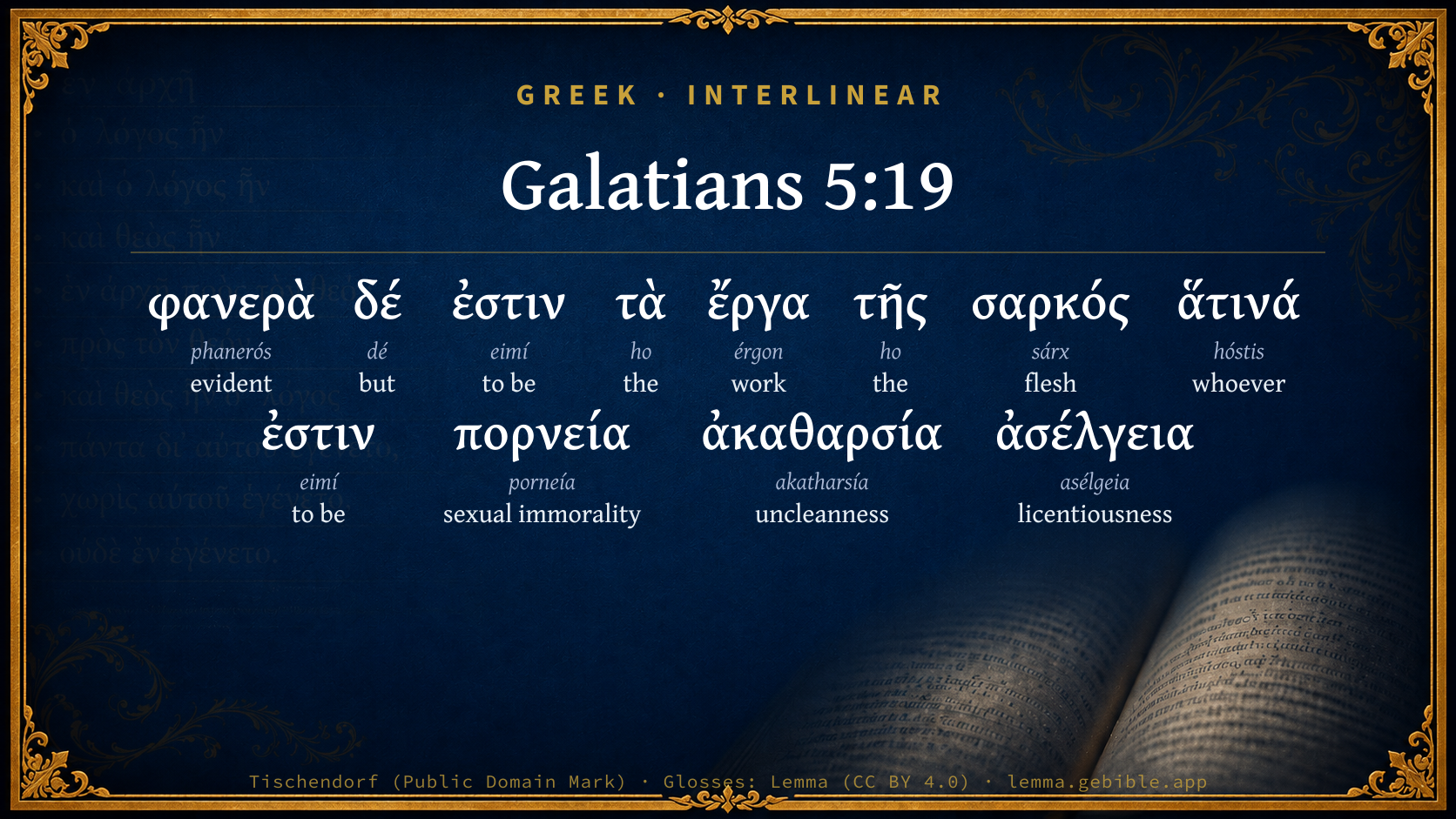
  1. φανερὰ phanerós G5318 “evident” Adjective, Nominative, Plural, Neuter
  2. δέ dé G1161 “but” Conjunction
  3. ἐστιν eimí G1510 “to be” Verb, Present, Active, Indicative, 3rd person, Singular
  4. τὰ ho G3588 “the” Article, Nominative, Plural, Neuter
  5. ἔργα érgon G2041 “work” Noun, Nominative, Plural, Neuter
  6. τῆς ho G3588 “the” Article, Genitive, Singular, Feminine
  7. σαρκός sárx G4561 “flesh” Noun, Genitive, Singular, Feminine
  8. ἅτινά hóstis G3748 “whoever” Relative pronoun, Nominative, Plural, Neuter
  9. ἐστιν eimí G1510 “to be” Verb, Present, Active, Indicative, 3rd person, Singular
  10. πορνεία porneía G4202 “sexual immorality” Noun, Nominative, Singular, Feminine
  11. ἀσέλγεια asélgeia G766 “licentiousness” Noun, Nominative, Singular, Feminine

About this verse

These counts appear in no published source. They are computed here, from the morphology-tagged text and Lemma’s own curated glosses. What Lemma adds →

12
words
10
distinct lemmas
Pauline Epistles
section

Notable vocabulary

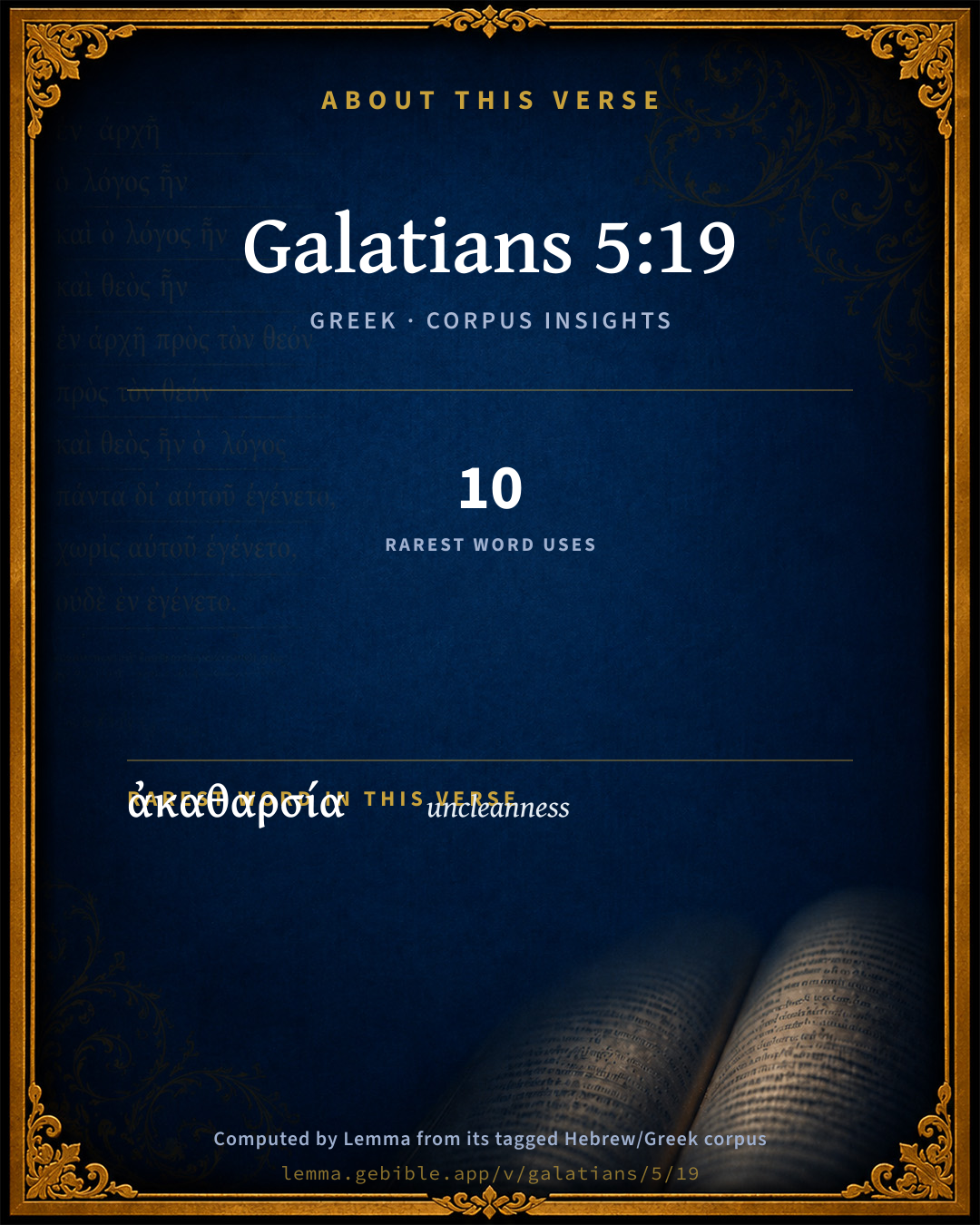
The rarest word here is ἀκαθαρσία uncleanness G167 — appearing just 10 times in the whole Greek New Testament.

Shared distinctive vocabulary

ἀκαθαρσία uncleanness G167 occurs in 10 verses of the Greek New Testament. Also found in:

Repetition

Words recur within this verse:

Cross-references

29

Topical passages linked to Galatians 5:19 in the Treasury of Scripture Knowledge — connected by theme and wording, ordered by reader-vote popularity; previews shown in the World English Bible.

  • 1 Corinthians 6:9–10 Or don't you know that the unrighteous will not inherit the Kingdom of God? Don't be deceived. Neither the sexually immoral, nor idolaters, nor adulterers, nor male prostitutes, nor homosexuals,
  • Colossians 3:5–8 Put to death therefore your members which are on the earth: sexual immorality, uncleanness, depraved passion, evil desire, and covetousness, which is idolatry;
  • Matthew 15:18–19 But the things which proceed out of the mouth come out of the heart, and they defile the man.
  • 1 Peter 4:2–4 that you no longer should live the rest of your time in the flesh for the lusts of men, but for the will of God.
  • Revelation 21:8 But for the cowardly, unbelieving, sinners, abominable, murderers, sexually immoral, sorcerers, idolaters, and all liars, their part is in the lake that burns with fire and sulfur, which is the second death."
  • Ephesians 5:3–6 But sexual immorality, and all uncleanness, or covetousness, let it not even be mentioned among you, as becomes saints;
  • Galatians 6:8 For he who sows to his own flesh will from the flesh reap corruption. But he who sows to the Spirit will from the Spirit reap eternal life.
  • 1 Corinthians 3:3 for you are still fleshly. For insofar as there is jealousy, strife, and factions among you, aren't you fleshly, and don't you walk in the ways of men?
  • Titus 3:3 For we were also once foolish, disobedient, deceived, serving various lusts and pleasures, living in malice and envy, hateful, and hating one another.
  • Mark 7:21–23 For from within, out of the hearts of men, proceed evil thoughts, adulteries, sexual sins, murders, thefts,
  • Romans 8:13 For if you live after the flesh, you must die; but if by the Spirit you put to death the deeds of the body, you will live.
  • Romans 8:5 For those who live according to the flesh set their minds on the things of the flesh, but those who live according to the Spirit, the things of the Spirit.
  • James 3:14–15 But if you have bitter jealousy and selfish ambition in your heart, don't boast and don't lie against the truth.
  • Revelation 22:15 Outside are the dogs, the sorcerers, the sexually immoral, the murderers, the idolaters, and everyone who loves and practices falsehood.
  • 1 Corinthians 6:18 Flee sexual immorality! "Every sin that a man does is outside the body," but he who commits sexual immorality sins against his own body.
  • 1 Timothy 1:9–10 as knowing this, that law is not made for a righteous man, but for the lawless and insubordinate, for the ungodly and sinners, for the unholy and profane, for murderers of fathers and murderers of mothers, for manslayers,
  • Romans 7:5 For when we were in the flesh, the sinful passions which were through the law, worked in our members to bring forth fruit to death.
  • 2 Corinthians 12:20–21 For I am afraid that by any means, when I come, I might find you not the way I want to, and that I might be found by you as you don't desire; that by any means there would be strife, jealousy, outbursts of anger, factions, slander, whisperings, proud thoughts, riots;
  • John 3:6 That which is born of the flesh is flesh. That which is born of the Spirit is spirit.
  • Romans 1:21–32 Because, knowing God, they didn't glorify him as God, neither gave thanks, but became vain in their reasoning, and their senseless heart was darkened.
  • Romans 8:9 But you are not in the flesh but in the Spirit, if it is so that the Spirit of God dwells in you. But if any man doesn't have the Spirit of Christ, he is not his.
  • Galatians 5:13 For you, brothers, were called for freedom. Only don't use your freedom for gain to the flesh, but through love be servants to one another.
  • Galatians 5:17 For the flesh lusts against the Spirit, and the Spirit against the flesh; and these are contrary to one other, that you may not do the things that you desire.
  • Psalms 17:4 As for the works of men, by the word of your lips I have kept myself from the ways of the violent.
  • Romans 7:18 For I know that in me, that is, in my flesh, dwells no good thing. For desire is present with me, but I don't find it doing that which is good.
  • Romans 8:3 For what the law couldn't do, in that it was weak through the flesh, God did, sending his own Son in the likeness of sinful flesh and for sin, he condemned sin in the flesh;
  • Ezekiel 22:6–13 Behold, the princes of Israel, everyone according to his power, have been in you to shed blood.
  • Romans 7:25 I thank God through Jesus Christ, our Lord! So then with the mind, I myself serve God's law, but with the flesh, the sin's law.
  • Ephesians 4:17–19 This I say therefore, and testify in the Lord, that you no longer walk as the rest of the Gentiles also walk, in the futility of their mind,

Cross-references courtesy of OpenBible.info (CC BY 4.0).

Where the printed editions differ

1 variant

Places in this verse where the major printed Greek editions disagree on the wording in a way that affects the translation — a comparison of editions, not a manuscript-by-manuscript collation. The editions are the modern critical texts (Nestlé-Aland 28/27, SBL, Westcott-Hort, Tregelles, Tyndale House) and the traditional texts behind the KJV (the Textus Receptus and the Byzantine/Majority text). It is not a claim about which reading is original.

  1. Extra text
    μοιχεία

    “adultery”

    In TRByz Not in NA28NA27TynSBLWHTreg

    μοιχεία (moicheia) 'adultery' is only in traditional manuscripts (TR+Byz)

Textual data: Translators Amalgamated Greek New Testament (STEPBible TAGNT) · CC BY 4.0.

Commentary

Notes on Galatians 5:19 from classic Christian and Jewish commentators (each source and its license shown beneath its notes). The classic Christian expositions comment on the surrounding passage and are grouped to its opening verse, so a note may address several verses; the Jewish commentaries on the Tanakh (Rashi and others) are per-verse, so they appear only where the commentator wrote on this verse.

Lemma curates 59 commentaries, every one of them public domain or Creative Commons licensed, each selected and text-cleaned for this edition rather than reprinted as found. About our sources →

The Biblical Illustrator

Joseph S. Exell

Gal_5:19; Gal_5:21

Now the works of the flesh are manifest.

The works of the flesh our own

It is the same with all the passions and appetites. No one of them ever leaves a man, who indulges them, just where he was before. No one of them is a mere dry, isolated fact, that drops into his record and stops there. If a bank-clerk steals his employers money, we do not put our funds in his hands, as if that were a simple fact, and he the same as before. If a woman loses her purity by a single act, no sensible man seeks her in marriage, on any theory that he can afford to condone the fall. Such is the nature of the soul that it lives in its own issues, or dies in its own empoisoned evil deeds. They are all our works--ours only. God has no part in them; good angels have no part in them; yea, that thing in us, which is truest self, the conscience, resists and struggles against them. As the eye weeps and inflames at the irritation of a grain of sand, so the conscience resists and inflames before the works of the flesh--before adultery, fornication, uncleanness, and such like. I do not wonder at the despair, the black despair, which, like a dark night in winter of clouds and sleet and chill, settles down on such souls as are victims to bodily lusts, namely, hatred, envyings, murders, drunkenness, and such like; and men hear the howling of fiends, and see lurid lights, and moan of a hell of fears, horrible to think of, as yawning before them. These things are the inheritance of their election. (C. H. Hall, D. D.)

The works of the flesh

I. What is flesh? It is taken for--

1. The whole man (Gen_6:3).

2. The mortal body (2Co_7:1; Gal_2:20).

3. The ceremonies of the law (Gal_3:3; Gal_6:12; Php_3:3), because performed by the body.

4. The human nature of Christ (Rom_1:3; 1Pe_3:18; 1Pe_4:1) as spirit for the Divine (Rom_1:4).

5. All mankind (Gen_6:12; Isa_40:6).

6. The human nature, as corrupt, or a state of sin (Eph_2:3; Rom_7:5). This denotes the corruption of soul as well as body (Rom_8:6 Col_2:18).

7. The unregenerate part in the regenerate man (Rom_7:18).

II. What are works? Whatsoever proceeds from the body of death.

III. How are they manifest?

1. By the light of nature.

2. They cannot be hid (Heb_4:13).

Conclusion:

1. Take notice of them.

(1) The power of the flesh in your heart.

(2) The works of the flesh in your life,

2. Labour against them. They are

(1) pleasing to Satan,

(2) offensive to God,

(3) tormenting to the conscience,

(4) injurious to religion,

(5) destructive to the soul. (Bishop Beveridge.)

Though some have all flesh and no spirit, none have all spirit and no flesh. (Bishop Beveridge.)

Adultery

I. Its nature. It is a vice opposed to chastity, and may be committed--

1. In the heart (Mat_5:28); and therefore

(1)look not oh yourselves as innocent because not actual idolaters.

(2) Repent of unchaste thoughts.

(3) Labour against them.

2. In the act.

II. its greatness as a sin.

1. It is frequently forbidden.

2. It is destructive to self and others.

3. It is the occasion of many sins.

4. It is a punishment as well as a sin (Pro_22:14; Rom_1:24).

5. It consumes a mans estate (Pro_5:10; Pro_6:26; Job_31:12).

6. The body also (Pro_5:11).

7. It defiles the body (1Co_6:18).

8. It darkens a mans judgment and understanding Hos_4:11).

9. It destroys the whole soul (Pro_6:32).

10. It brings irreparable is grace (Pro_6:33).

11. Ordinarily it is punished in this life (Num_25:6; 1Co_10:8).

12. Certainly in the life to come (Heb_13:4; 1Co_6:9-10).

III. Its prevention.

1. Avoid the occasions.

(1) Idleness (Eze_16:49; 2Sa_11:2);

(2) Bad company (Pro_7:25);

(3) All other sins (Pro_1:25).

2. Make a covenant with thine eyes (Job_31:1).

3. Watch over thy thoughts (Mal_2:16),

4. Keep in with God (Pro_22:14).

5. Delight in the Word of God (Pro_2:10-16).

6. Be much in prayer and meditation (Psa_119:37). (Bishop Beveridge.)

Fornication

I. What It Is. When two single persons come together out of the state of matrimony (Deu_22:28).

II. Its Sinfulness.

1. Contrary to Gods command (1Co_6:18; Eph_5:3; 1Th_4:3).

2. Provokes Gods anger (Col_3:5-6; Jer_5:7; Hos_4:14).

3. God will judge it (Heb_13:4; 1Co_3:9). (Bishop Beveridge.)

Uncleanness

I. Inward.

1. The desire of strange flesh, with a resolution to enjoy it if he could (Col_3:5; 1Th_4:5).

2. Sinful lusts and affections (Jam_1:15).

3. Unclean thoughts.

II. Outward. Adultery, fornication, incest or nameless infamies. (Bishop Beveridge.)

Lasciviousness

Wantonness, whereby the soul is inflamed to the other sins, expressed:

I. In apparel.

1. Excess.

2. Lightness (Pro_7:10).

3. Singularity (2Sa_13:18).

4. Of a contrary sex,

II. Gestures.

1. Wanton looks, etc. (2Pe_2:14; Job_31:1).

2. Wanton walking, etc. (Isa_3:16).

III. Meat and drink.

1. The quantity (Eze_16:49).

2. The quality (Luk_16:19).

IV. Words.

1. Foolish (Eph_5:3-4).

2. Obscene talking (1Co_15:33). (Bishop Beveridge.)

Idolatry

I. Its nature. The worshipping of anything besides God, so as--

1. To pray to them (Isa_44:17),

2. To sacrifice to them (2Ki_17:35).

3. To build temples and altars to them (Hos_12:11).

4. Asking counsel of them (Hos_4:12).

5. Thanking them (Jdg_16:23-24; Dan_5:4).

II. Those who are guilty of it.

1. Heathens, who worship--

(1) Men; as Jupiter, Saturn, etc.

(2) Devils.

(3) Beasts.

(4) Stars.

(5) Images.

2. Christians.

(1) Popish, who worship the sacramental bread, saints, images, relics.

(2) Protestants: the covetous (Col_3:5; Eph_5:5); voluptuous (Php_3:19); ambitious; sinful.

III. the greatness of the sin.

1. It is frequently forbidden (Exo_20:3-4).

2. Severely punished (Exo_22:20 : Deu_17:3-5).

3. No sin can bring greater dishonour to God (Jer_2:13).

4. It will certainly bring thee to hell (Rev_21:8; Rev_22:15).

Witchcraft

I. The biblical estimate of it.

1. As a stern and diabolical reality (Lev_20:27; Deu_18:19).

2. As unlawful trafficking with the unseen world (Lev_19:31; Isa_8:19).

3. As sometimes trickery and imposture (Isa_8:19).

4. As filthy defilement (Lev_19:31).

5. As deserving death (Lev_20:6; Exo_22:18).

6. As one of the crimes for which the Canaanites were destroyed.

7. As inconsistent with a trust in God (Isa_8:19).

8. As frustrated by God (Isa_44:25).

9. As a power from which the godly have nothing to fear.

II. Its prevalence.

1. Amongst the heathen. Pythagoras, Plutarch, Pompey, Croesus, Caesar, were all under its spell.

2. The progress of modern civilization has not exterminated it.

3. But whilst it assumes the form of astrology, with its star-gazing; palmistry, with its handwriting; or spiritualism, with its media and trances and dark seances; it is the same abomination reprobated in the Word of God.

Hatred (of God)

I. What is this? (Rom_1:30).

1. God is the chiefest good (Luk_18:19): the essential, original, universal, infinite, satisfying, necessary, and eternal good.

2. Therefore He ought to be loved supremely.

3. The want of this love is accounted as hatred.

II. Who are guilty of it.

1. Those who wish there were no God (Psa_14:1).

2. Who hate the knowledge of Him (Psa_50:17; Job_21:14; Pro_8:36).

3. Who hate His ways and ordinances.

4. Who love other things more than God (2Ti_3:4).

5. Who love sin.

6. Who break His commandments (Exo_20:5-6; Joh_14:15). (Bishop Beveridge.)

Hatred (of man)

I. Its nature: the transgression of the commandment to love our neighbours as ourselves.

II. Its sinfulness.

1. It is contrary to the law.

2. It is the cause of many sins, as--

(1) Anger (Eph_4:26; Eph_4:31).

(2) Envy (Jam_3:14).

(3) Unmercifulness (Rom_1:31; Amo_6:6).

(4) Cruelty (Psa_5:6).

(5) Pride (Pro_13:10).

(6) Desire of revenge (Rom_12:19).

(7) Uncharitable suspicions (1Co_13:5-7).

(8) Refractoriness (Rom_1:31).

3. It is the breaking of the whole law (Rom_13:9; Gal_5:14).

III. Who are guilty of it? All who--

1. Wish their neighbours evil, or not good.

2. Who do not what good they can.

3. Who do not reprove of sin and excite to good (Lev_19:17; Heb_10:24).

4. Who bear any secret grudge and malice. (Bishop Beveridge.)

Variance

I. Its nature. A sin opposed to amity.

1. In opinion (Eph_4:13).

2. Affection (Eph_4:3).

II. Its sinfulness.

1. It is contrary to Gods law.

2. It springs from--

(1) Pride and ambition (Pro_13:10).

(2) Want of true love.

3. Its effects are sinful.

(1) Vexation and trouble to self and others.

(2) Hatred.

III. Those guilty of it.

1. Infidels.

2. Such as fall out for trifles.

3. Such as being fallen out refuse to be reconciled. (Bishop Beveridge.)

Emulation

I. What is it? Twofold.

1. Good (Gal_4:18).

2. Evil.

(1) To grieve for anothers excelling us.

(2) To desire to excel him.

II. IT IS A SIN.

1. It proceeds from an evil root.

(1) Error.

(2) Pride.

2. It brings forth sinful fruit.

(1) Contention.

(2) Envy.

III. Who are guilty of it.

1. Such as are zealous in a bad cause.

2. In a good cause in a bad manner (Rom_10:2).

3. More for themselves than God.

4. Such as love to see nobody above them. (Bishop Beveridge.)

Anger

It is sinful when with--

1. The providence of God.

2. The laws of God.

3. The doctrines of the gospel.

4. The good we see in others.

5. Those who differ from us in religious sentiments.

6. Reproof.

7. Our reprover, wishing him evil.

8. When we use unlawful means to avenge ourselves. (J. Beaumont, M. D.)

I. What is it? A passion raised up in the mind against some present evil that cannot easily be removed.

II. Whether a man may be ever lawfully angry? Yes (Eph_4:26).

1. When it proceeds from a lawful cause (Mar_3:5).

2. When it is placed on a lawful object (Exo_11:8; Exo_32:19; Lev_10:16-17).

3. In a lawful manner (Mat_8:22).

4. To a lawful end.

III. Who sin in their anger? Such as are angry--

1. Not so much at the offence as the offender.

2. At anything rather because it dishonours them than God.

3. Without a cause (Mat_5:22).

4. Excessively, though in a good cause (Gen_49:7).

5. And hateful.

6. And curse (Psa_106:33).

7. And therefore indisposed to duties.

8. From sinful causes.

9. For a wrong end.

10. And continue long in their auger (Eph_4:26).

IV. Motives against it.

1. God forbids it (Eph_4:31; Col_3:8).

2. It disturbs soul and body.

3. It is not only a sin but a folly (Ecc_7:9; Pro_14:17; Pro_14:29).

4. It may prove thy ruin.

5. It may keep thee out of heaven. (Bishop Beveridge.)

Strife

I. Lawful.

1. Which should bring the most glory to Gods name.

2. Perform the exactest obedience to His precepts (Php_3:10-13).

3. Believe the firmest in His Son.

4. Grow the fastest in His grace (2Pe_3:18).

5. Make our calling and election surest (2Pe_1:10).

II. Sinful.

1. When proceeding from anger and malice.

2. About trifles.

3. In opprobrious terms.

4. Ending in hatred and revenge. (Bishop Beveridge.)

Seditions

I. To oppose lawful governors (Rom_13:1).

II. To consent to and connive at those who do it.

III. To raise tumults in a kingdom, commonwealth, or parish. (Bishop Beveridge.)

Heresies

There is no heresy in the long list of heresies which have invaded the Church, like the heresy of negativeness, of inaction, of death. The dead man is the great heresiarch. (H. W. Beecher.)

Envyings

I. In what consists the sinfulness of envy.

1. It is contrary to Gods command (Rom_13:13; 1Pe_2:1).

2. Repining at Gods providence and goodness.

3. The fruit of pride.

4. The root of confusion and evil (Jam_3:16).

5. The cause of hatred.

II. Have a care of it.

1. Thou art never the worse for others being better.

2. Envy makes him never the worse, nor thee the better.

3. Thou hast more cause to rejoice than to be troubled at anothers goodness.

4. Thy envying Gods goodness to others may hinder it to thyself. (Bishop Beveridge.)

I. Its nature.

1. Its object is something good, natural, or acquired, even religious excellence.

2. Something in the possession of another which is grudged and desired,

3. Something not altogether unattainable.

II. Its properties.

1. It is common.

2. Odious.

3. Destructive.

III. Its cure.

1. A scriptural estimate of the objects which excite envy. They are not so valuable as they appear to be.

2. A just opinion of ourselves. We do not deserve as much as we imagine.

3. An entire change of heart.

Application:

1. Do not needlessly provoke envy.

2. Do not wickedly indulge it.

3. Do net basely fear it.

4. Do not angrily resent it. (G. Brooks.)

Envy is the daughter of pride, the author of revenge and murder, the beginning of sedition and the perpetual tormentor of virtue. (Socrates.)

Murders

Life is threefold of the body, mind, and spirit; and murder against each may be deliberate or careless, resulting from action or inaction.

1. Deliberate murder is life taken by malice aforethought.

2. Careless murder, resulting from careless or culpable ignorance; e.g., the builder who neglects the drains; the parent who spreads an infectious disorder through sending his children to school while tainted with it.

3. Inactive murder (Jam_4:17), e.g., a man who allows another to commit murder, or who neglects to save life physical or moral. (C. A. Goodheart.)

Murder is not mere blood-shedding.

1. Anger without cause is murder.

2. So is oppression of the weak.

3. So is depriving a man of the means of getting his livelihood to gratify revenge.

4. Whosoever hateth his brother in his heart is a murderer. (J. Parker, D. D.)

Drunkenness

I. What is it? An immoderate use of any liquor (Eph_5:18).

II. Its sinfulness.

1. It transgresses the law (Eph_5:18; Rom_13:13).

2. Abuses the creature.

3. Destroys the body (Pro_23:29).

4. Disturbs the soul (Hos_4:11).

5. Spends time.

6. Unfits for employment (Luk_21:34).

7. Entails woe (Isa_5:11). (Bishop Beveridge.)

Evil of hatred

If you hate your enemies, you will contract such a vicious habit of mind as by degrees will break out upon those who are your friends, or those who are indifferent to you. (Plutarch.)

All sin is seen by God

In Mr. Ralph Wellss school the other day, the lesson was about Gods all-seeing eye. On the blackboard, Mr. Wells placed the words, Thou God seest me. He then held up a vase of water, in which a gold-fish was swimming about. Now, children, said Mr. Wells, see this fish hide. Do you see him now? Yes, sir, the children shouted. Do you see him now? Yes, sir. Now do you see him? Yes, sir: yes, sir, they all said. Cant he hide from you? No, sir. Why? Because we see right through the glass. So, said Mr. Wells, God sees right through our hearts. We cannot hide from Him. (Picture Paper.)

Fleshly sins

The list of fleshly sins here given is not an exhaustive one; merely samples. Seventeen distinct sins are specified, which may be roughly grouped in four classes.

1. Sensuality--viz., adultery, fornication, uncleanness, wantonness.

2. Idolatry, or unlawful dealing in things spiritual; consisting of idolatry, or the open recognition of false gods, and sorcery or witchcraft, the secret tampering with the powers of evil.

3. Malice, or violation of the principle of brotherly love; such as hatreds, strife, rivalry, outbursts of wrath, cabals, dissensions, heretical factions, envyings, murders.

4. Intemperance--viz., drunkenness and riotous revelry. These vices are probably named by St. Paul as being those to which the Galatians had been specially addicted, and to which they might now be tempted. From early habit a Gentile Church would be exposed to sins of the first two classes, sensuality and idolatry. Sins of the third class, consisting of breaches of brotherly love, would be a probable consequence of their religious dissensions. Vices of the fourth class, when once established, are not easily shaken off, and, as we know from the example of the Corinthian Church, may even find their way into the holiest services of the Christian religion. But we must not confine this catalogue of sins to the Galatians, as though it had no application to ourselves (1Co_10:11-12). (Emilius Bayley, B. D.)

The old life

As St. Paul looks back at that bad life out of which he had snatched the souls of his Gentile converts, it is its bitter brutality that he most vividly remembers and recalls. It was a jarring life, in which there was no tenderness, no courtesy, no kindliness, no peace. It was full of collisions, of frictions, of wounds, of sores. It was a loud and violent life, in which men fought, and hit, and swore. As he runs over his list of old habits once familiar to them, his picture is as of some back alley in our crowded towns, in which all is shrill, rough, boisterous, with women screaming, with children shrieking, a nest of noises, a swarm of jangling cries. This is what they have left behind, this which had made life one long quarrel, pitiless and brutal. They had left it, mastered and enthralled by the sweet vision of Him, the Man of peace, and meekness, and lowliness, who had been led, quiet and patient, as a lamb to the slaughter, and, as a sheep before its shearers, had never opened His mouth; who, when He was reviled, reviled not again; and when He was threatened, threatened not; One who never gave back railing for railing, but only blessing. You all remember it, he keeps crying to them, those old days, so merciless, so angry, so cruel; how you grated on one another, how you rasped one another, how you bit and devoured one another like snarling dogs. It had been one long quarrel, a life of wrath, full of bitterness, clamour, evil speaking; they knew it all but too well what he meant, for the works of the flesh are manifest, which are these--hatred, etc. Works of the flesh, he calls them His keen eye sweeps over the whole range of this loud quarrelling; to him, it is no senseless storm that rages on without rhyme or reason. Nay! it has, all of it, a story and a cause; it is the witness, on the surface of life, to inner disorder. These rough oaths, these venomous taunts, this bitter tumult--these are the natural issues of the root from which they spring. They are works--normal, and anticipated, and legitimate deeds, which appear in obedience to a law of rational production. They are fruits--results that grow out of certain creative activities, as accurately and inevitably as grapes from vines and figs from fig-trees. And what is this root which so legitimately flowers into these uncomfortable blossoms? The flesh, St. Paul names it; the flesh is as much the seat and home of this passionate violence as it is of those other passions and appetites with which we commonly identify it. This petulance, this savagery, this hail of malice, this outcry of rage, this havoc of revenge, this recklessness of cruelty--all this finds its principle, its origin, its motive-cause in that same activity of the flesh. Set the law of the flesh in action, and you must have quarrels. Out of the flesh they fly, these oaths and screams, just as sparks out of a smitten flint. It would be a miracle if men who lived after the methods of the flesh failed to envy and to hate one another. (Canon Scott Holland.)

St. Pauls conception of the flesh

Try to enter into the solid and broad meaning which St. Paul attaches to this, his favourite term for the root-principle of human sin--the flesh. Obviously, it is much more to him than the mere matter of animal passions. It expresses to him the typical nature, the essential form, of all that can be set in antithesis to spirit. It includes the pride and the falsity of intellect. It embraces the disorder and stubbornness of the will. What, then, is this flesh? How can we describe and define it?… The flesh represents all that a man is, when he is his own aim, his own end. His power of self-observation, that Divine gift, in possessing which he is the image of his God, has about its use this terrible risk--that he may cease to observe himself as he is in God, as he is in Gods ordered world, set to fulfil an office in combination with his fellows, the member of a vast body, pledged to a peculiar or disciplined service; he may forget all this, and only observe himself, himself just as he stands, with his own private appetites, likes, gifts, feelings. And, so observing, he may separate himself off from all else, hold himself up before his own eyes, and fasten upon himself all his interest, all his thought, and his imagination, and his pains; and may spend his every effort in scheming how best to serve, in richness of pleasurable experience, this self, who has become his idol, and before which he bows himself to minister as to a god. This he may do; and that which a man has then in front of him as his aim or end whether it be low and gross, or whether it be delicate and intellectual--that is the flesh. And the life that he lives in obeying its behest, that is the life after the flesh; that is minding the things of the flesh; that is walking after the flesh. And the end of that walk is Death. (Canon Scott Holland.)

Result of walking after the flesh

We can easily understand why life in the flesh is a life of jars and quarrels, as much as a life of passion and lust. The man who walks after the flesh is absorbed in self-interests. He has dropped his eyes from their outward gaze at that busy and social world which encompasses him. That world is calling to him with all its voices, but he hears them no longer; it is appealing to him to act, to hope, to aspire, to give, but he pays no heed to its invocations. He has forgotten its wants and its movements; he is dead to its touch and to its cry. His brothers look to him for help, but they have ceased to interest him: his sisters turn to him for tenderness, but he is chill as a blind stone. All this crowded scene of our human story has lost for him its charm, its colour, its warmth, its neighbourly friendliness. He has turned his eyes within; he has bent all his gaze in upon himself; it is his own feelings that alone have an interest to him, his own needs that alone entice. He is busy night and day in considering himself; he is picturing his own success; he is planning his own pleasures; he is brooding over his own possibilities; he is filled with his own imaginations. Round and round himself he is always weaving the ever-thickening web of his own fancies, and his own schemes; and fainter and more distant grows the sound of outward things. He walks abroad, brimming with self-interests; and he is bent on things fulfilling themselves according to his fostered expectations; and so, walking, he must of necessity jar at once against a world that he has not taken the pains to study, or understand, or revere. He clashes against it, as against a wall; he is pushed and squeezed by the crowd of bustling men, who have no time to give to his breedings, and are at variance with his designs, and upset his favourite plans, and traverse his ambitions. He is disappointed, as he must be; for this earth demands of us a social temper,.and he is hopelessly and helplessly individual; it asks us to give, and he is proposing only to take. He is wholly out of tune with a world that exists only through self-sacrifice, and is bonded together by the grace of humility; he must be repudiated by it, he must be disregarded, he is bound to be checked at every turn, and he gets cross, angry, bitter. The world ignores him, laughs at him, brushes him aside, bowls him over. And the man, so treated, grows more and more wounded, hurt, indignant. Perhaps he rails and storms at the world that he finds so hard, at the men whom he thinks so unsympathetic and so cruel. Perhaps he retreats into sulky silence, and shuts himself up in clouds of vaporous passion, and fumes out his angry soul in secret breedings, and hugs himself the closer, and vents his grudge against life in spite, and scorn, and uncomfortable depression. (Canon Scott Holland.)

Remedy for selfishness

Self-pre-occupation, self-breedings, self.interest, self-love--these are the reasons why you go jarring against your fellows. Turn your eyes off yourself; forget your own pet schemes, the hopes you are always nursing to yourself, the self-importance that you hug. Forget them, throw them aside, push through them. Look up, and out! There is a larger world outside you, brimming over with far other hopes than yours, illumined by a vaster sun, travelling to some far historic goal. Look up, and out upon it! It has its interests, its purposes, its ends, which it is your glad privilege to learn, and, by learning, to obey and follow. Give it your heart, and it will show you its own. Take its road, and it will, then, take yours. Look up, and out! There are men, your brothers, and women, your sisters; they have needs that you can aid. Listen for their confidences; keep your heart wide open to their calls, and your hands alert for their service. Learn to give, and not to take; to drown your own hungry wants in the happiness of lending yourself to fulfil the interests of those nearest or dearest. Break through your own moody musings, and run out abroad, from these closed and darkened chambers of self-consideration--out into the wide and teeming earth, where not your scheme, but Gods great hope, is working out its world-wide triumph. Look up and out, from this narrow, cabined self of yours, and you will jar no longer, you will fret no more, you will provoke no more, you will quarrel no more; but you will, to your own glad surprise, find the secret of the meekness and the gentleness of Jesus; and the peace of God which passeth all understanding will drop down like dew upon your happy-hearted days; and the fruits of the Spirit will all bud and blossom from out of your life--love, joy, peace, gentleness, meekness, goodness, long-suffering, faith, temperance. (Canon Scott Holland.)

The spirit above nature

I. Natural desires are never to rule, always to be ruled.

II. By the help of the Spirit of God they are kept in subjections.

III. Unrestrained, they produce all kinds of wickedness.

IV. Present goodness and happiness are the fruit of the Spirit of God.

V. Self-denial and suffering are requisite for the highest good.

VI. By faith in Christ men follow Him and become like Him. (J. H. Godwin.)

Drunkenness, revellings

The apostle is not speaking merely of the habit and custom of drinking; therefore it is a false excuse if any one thinks that a debauch is no sin if one does not make a business of it. The devil invented this excuse. When any one so overfills himself that he is unfit for prayer and the business of his calling, that is drunkenness. What, then, are we to think of the respectable world with its sinful and damnable Christian drinking bouts? and what, too, of this continual drinking of healths, but as of a temptation to swill down liquor? (Starke.)

The list of vices

These works of the flesh have often been divided into four classes. Any classification or system, however, is scarcely to be expected; but each term of the catalogue may have been suggested by some law of association, especially as some of the terms are similarly arranged in other places. In the first class are sensual sins--fornication, impurity, wantonness; in the second class are sins of superstition--idolatry and sorcery; in the third class, sins of malice and social disorder--hatred, strife, jealousy, wraths, caballing, divisions, heresies, envying, murders; and in the fourth class-are sins of personal excess--drunkenness and revellings. In the first class, the first term, which has a distinct meaning, may have suggested the other and allied vices--miscellaneous and grosser aspects of forbidden indulgence. The two terms of the second class are somewhat similar--the first more precise in meaning, and the second more comprehensive--all occult dealings with the powers of evil. In the third class there is a climatic enumeration--hatreds ripening into strife; jealousy venting itself in passionate outbursts; cabals yet darker and more selfish; divisions, the result of deepening hostility; envyings quite fiendish in nature; and murders--the extreme result, and no uncommon thing in such countries, to obtain an end and consummate an intrigue by the removal of a rival. In the fourth class are first the simple term drunkenness, and the more inclusive term after it, referring either to scenes of dissipation so gay and wanton, or to orgies so gross and sensual, that they may not be described. (John Eadie, D. D.)

The Biblical Illustrator, edited by Joseph S. Exell (c. 1880s–1900s) — public domain. Text from a community e-Sword module.

Joseph Benson's Commentary

Gal 5:19-21. Now the works of the flesh — By which that inward corrupt principle is discovered; are manifest — Are plain and undeniable. He says works, in the plural, because those of the flesh are distinct from, and often inconsistent with each other. But the fruit of the Spirit is mentioned in the singular, (Gal 5:22,) the graces thereof being all consistent, and connected together. Which are these — He enumerates those works of the flesh to which the Galatians were most inclined, and those parts of the fruit of the Spirit of which they stood in the greatest need; adultery — A crime to be considered in the first rank of enormities, as being the most prejudicial to society, destroying conjugal happiness, introducing confusion and ruin into families, alienating the affection of parents from their children, causing them to neglect their education; fornication — Which, how light soever heathen may make it, is in the sight of God a very grievous offence; uncleanness — Of every kind and degree; lasciviousness — All immodesty, as the indulging of wanton thoughts, and reading lascivious books. The Greek word means any thing, inward or outward, that is contrary to chastity; idolatry — The worshipping of idols; this sin is justly reckoned among the works of the flesh, because the worship paid to many of the gods consisted in the most impure fleshly gratifications; witchcraft — Or sorcery, as Macknight renders φαρμακεια, observing, that the expression “being placed immediately after idolatry, means those arts of incantation and charming, and all the pretended communications with invisible and malignant powers, whereby the heathen priests promoted the reverence and worship of their idol gods, and enriched themselves. In this sense the word is used concerning Babylon, (Rev 18:23,) εν τη φαρμακεια σου, By thy sorcery were all nations deceived; that is, by a variety of wicked arts and cheats, the nations were deluded to support Babylon in her idolatries and corruptions. Hatred — Or enmities, as εχθραι signifies; variance — Ερεις, strifes; emulations — Transports of ill-placed and ill-proportioned zeal; wrath — Θυμοι, resentments; εριθειαι, contentions, as the word appears here to signify; seditions — Or divisions, in domestic or civil matters; heresies — Parties formed in religious communities; who, instead of maintaining true candor and benevolence, renounce and condemn each other. Envyings — Frequently manifesting themselves against the prosperity and success of others; murders — Which are often the effect of such evil dispositions and practices as those above mentioned; and, to complete the catalogue, all kinds of irregular self-indulgence, and particularly drunkenness — Which renders a man worse than a beast; and those disorderly and gluttonous revellings — Or luxurious entertainments, by which the rational powers are, in a great measure, extinguished, or, at least, rendered incapable of performing their offices in a proper manner. Some of the works here mentioned are wrought principally, if not entirely, in the mind, and yet they are called works of the flesh. Hence it is clear that the apostle does not, by the flesh, mean the body, or sensual appetites and inclinations only, but the corruption of human nature, as it spreads through all the powers of the soul, as well as the members of the body; of which I tell you before — Before the event; I forewarn you; as I have told you also in time past — When I was present with you; that they who do such things — Who are guilty of such evil practices; shall not inherit the kingdom of God — Whatever zeal they may pretend for the externals of religion, in any of the forms of it. Awful declaration!

Joseph Benson's Commentary on the Old and New Testaments (1811–1818) — public domain. Text from a community e-Sword module.

The Preacher's Complete Homiletical Commentary

Joseph S. Exell (gen. ed.)

CRITICAL AND EXPLANATORY NOTES

Gal_5:19. The works of the flesh.—

1. Sensual vices—“adultery [omitted in the oldest MSS.], fornication, uncleanness, lasciviousness.”

2. Theological vices—“idolatry, witchcraft.”

3. Malevolent vices—“hatred, variance, emulations, wrath, strife, seditions, heresies, envyings, murders.”

4. Vices of excess—“drunkenness, revellings.”

MAIN HOMILETICS OF THE PARAGRAPH.—Gal_5:19-21

The Works of the Flesh—

I. Are offensively obtrusive.—“Now the works of the flesh are manifest” (Gal_5:19). Sin, though at first committed in secret, will by-and-by work to the surface and advertise itself with shameless publicity. The rulers of the civilised world in the first century of the Christian era, such as Tiberius, Caligula, Nero, Domitian, are the execration of history as monsters of vice and cruelty. Their enormities would have been impossible if the people they governed had not been equally corrupt. It is the nature of evil to develop a terrible energy the more it is indulged, and its works are apparent in every possible form of wickedness. “Every man blameth the devil for his sins; but the great devil, the house-devil of every man that eateth and lieth in every man’s bosom, is that idol which killeth all—himself.”

II. Furnish a revolting catalogue.—The sins enumerated may be grouped into four classes:—

1. Sensual passions.—“Adultery [omitted in the oldest MSS.], fornication, uncleanness, lasciviousness” (Gal_5:19). Fornication was practically universal. Few were found, even among severe moralists, to condemn it. It is a prostitution of the physical nature which Jesus Christ wore and still wears, which He claims for the temple of His Spirit, and will raise from the dead to share His immortality. Uncleanness is the general quality of licentiousness, and includes whatever is contaminating in word or look, in gesture or in dress, in thought or sentiment. Lasciviousness is uncleanness open and shameless. It is the final loathsome analysis of the works of the flesh.

2. Unlawful dealing in things spiritual.—“Idolatry, witchcraft [sorcery]” (Gal_5:20). Idolatry and sensuality have always been closely related. Some of the most popular pagan systems were purveyors of lust, and lent to it the sanctions of religion. When man loses the true conception of God he becomes degraded. Sorcery is closely allied to idolatry. A low, naturalistic notion of the divine lends itself to immoral purposes. Men try to operate upon it by material causes, and to make it a partner in evil. Magical charms are made the instruments of unholy indulgence.

3. Violations of brotherly love.—“Hatred [enmities], variance [strife], emulations [jealousies], wrath [ragings], strife [factions], seditions [divisions], heresies [keen controversial partisanship], envyings, murders” (Gal_5:20-21). A horrible progeny of evils having their source in a fruitful hotbed of unreasoning hatred, each vice preying upon and feeding the other. Settled rancour is the worst form of contentiousness. It nurses its revenge, waiting, like Shylock, for the time when it shall “feed fat its ancient grudge.”

4. Intemperate excesses.—“Drunkenness, revellings, and such like” (Gal_5:21). These are the vices of a barbarous people. Our Teutonic and Celtic forefathers were alike prone to this kind of excess. The Greeks were a comparatively sober people. The Romans were more notorious for gluttony than for hard drinking. The practice of seeking pleasure in intoxication is a remnant of savagery which exists to a shameful extent in our own country. With Europe turned into one vast camp, and its nations groaning audibly under the weight of their armaments, with hordes of degrading women infesting the streets of its cities, with discontent and social hatred smouldering throughout its industrial populations, we have small reason to boast of the triumphs of modern civilisation. Better circumstances do not make better men (Findlay).

III. Exclude the sinner from the kingdom of God.—“They which do such things shall not inherit the kingdom of God” (Gal_5:21). How poor life seems outside that kingdom! How beautiful and glorious inside its gates! If I tried to tell you how Christ brings us there, I should repeat to you once more the old familiar story. He comes and lives and dies for us. He touches us with gratitude. He sets before our softened lives His life. He makes us see the beauty of holiness and the strength of the spiritual life in Him. He transfers His life to us through the open channel of faith, and so we come to live as He lives, by every word that proceedeth out of the mouth of God. How old the story is, but how endlessly fresh and true to Him whose own career it describes (Phillips Brooks). Exclusion from the kingdom of God is man’s own act; it is self-exclusion. He will not enter in; he loves darkness rather than light.

Lessons.—

1. Sin is an active principle whose works are perniciously evident.

2. Sin is the primal cause of every possible vice.

3. Sin persisted in involves moral ruin.

GERM NOTES ON THE VERSES

Gal_5:19-21. Biblical Account of Sin.—A mournful catalogue of words, based on a great variety of images, is employed in Scripture to describe the state of sinfulness which man inherits from his birth. Sometimes it is set forth as the missing of a mark or aim; sometimes as the transgressing of a line—the word occurs seven times in the New Testament, and is twice applied to Adam’s fall (Rom_5:14; 1Ti_2:14); sometimes as disobedience to a voice, i.e. to hear carelessly, to take no heed of—the word occurs three times (Rom_5:19; 2Co_10:6; Heb_2:2); sometimes as ignorance of what we ought to have done (Heb_9:7); sometimes as a defect or discomfiture—to be worsted, because, as Gerhard says, “A sinner yields to, is worsted by, the temptations of the flesh and of Satan”; sometimes as a debt (Mat_6:12); sometimes as disobedience to law—the word occurs fourteen times in the New Testament, and is generally translated by “iniquity.” The last figure is employed in the most general definition of sin given in the New Testament—sin is the transgression of the law (1Jn_3:4).—Trench and Maclear.

The Works of the Flesh.

I. Sins against chastity.—Adultery, fornication, uncleanness, wantonness.

1. We must stock up the root of these things, mortify the passion of concupiscence.

2. All occasions of these sins must be cut off, two especially, idleness and the pampering of the body.

3. All signs of these vices must be avoided, any speech or action that may give suspicion of incontinent disposition, as light talk, wanton behaviour, curiousness and excess in trimming of the body, suspected company.

II. Sins against religion.—Idolatry, witchcraft, heresies.

III. Sins against charity.—Enmity, debate, emulations, anger, contention, seditions.

IV. Sins against temperance.—Drunkenness, gluttony.

1. We may use meat and drink not only for necessity, but also for delight.

2. That measure of meat and drink which in our experience makes us fit both in body and mind for the service of God and the duties of our calling is convenient and lawful. To be given to drinking and to love to sit by the cup, when there is no drunkenness, is a sin. Drunkenness:

(1) Destroys the body.

(2) Hurts the mind.

(3) Vile imaginations and affections that are in men when they are drunk remain in them when they are sober, so being sober they are drunk in affection.—Perkins.

The Preacher's Complete Homiletical Commentary (gen. ed. Joseph S. Exell; Funk & Wagnalls, c. 1892) — public domain (pre-1929). A full-Bible homiletical/sermon-outline anthology covering 65 of 66 books (2 John is absent from the source module). Text from a community e-Sword module.

The Expositor's Bible

Chapter 24

THE WORKS OF THE FLESH.

Gal_5:19-21

THE tree is known by its fruits: the flesh by its "works." And these works are "manifest." The field of the world-"this present evil world" {Gal_1:4} -exhibits them in rank abundance. Perhaps at no time was the civilised world so depraved and godless as in the first century of the Christian era, when Tiberius, Caligula, Nero, Domitian, wore the imperial purple and posed as masters of the earth. It was the cruelty and vileness of the times which culminated in these deified monsters. By no accident was mankind cursed at this epoch with such a race of rulers. The world that worshipped them was worthy of them. Vice appeared in its most revolting and abandoned forms. Wickedness was rampant and triumphant. The age of the early Roman Empire has left a foul mark in human history and literature. Let Tacitus and Juvenal speak for it.

Pauls enumeration of the current vices in this passage has, however, a character of its own. It differs from the descriptions drawn by the same hand in other Epistles; and this difference is due doubtless to the character of his readers. Their temperament was sanguine; their disposition frank and impulsive. Sins of lying and injustice, conspicuous in other lists, are not found in this. From these vices the Galatic nature was comparatively free. Sensual sins and sins of passion-unchastity, vindictiveness, intemperance- occupy the field. To these must be added idolatry, common to the Pagan world. Gentile idolatry was allied with the practice of impurity on the one side; and on the other, through the evil of "sorcery," with "enmities" and "jealousies." So that these works of the flesh belong to four distinct types of depravity, three of which come under the head of immorality, while the fourth is the universal principle of Pagan irreligion, being in turn both cause and effect of the moral debasement connected with it.

1. "The works of the flesh are these-fornication, uncleanness, lasciviousness." A dark beginning! Sins of impurity find a place in every picture of Gentile morals given by the Apostle. In whatever direction he writes-to Romans or Corinthians, Galatians, Ephesians, or Thessalonians-it is always necessary to warn against these evils. They are equally "manifest" in heathen literature. The extent to which they stain the pages of the Greek and Roman classics sets a heavy discount against their value as instruments of Christian education. Civilised Society in Pauls day was steeped in sexual corruption.

Fornication was practically universal. Few were found, even among severe moralists, to condemn it. The overthrow of the splendid classical civilisation, due to the extinction of manly virtues in the dominant race, may be traced largely to this cause. Brave men are the sons of pure women. John in the Apocalypse has written on the brow of Rome, "the great city which reigneth over the kings of the earth," this legend: "Babylon the great, mother of harlots". {Rev_17:5} Whatever symbolic meaning the saying has, in its literal sense it was terribly true. Our modern Babylons, unless they purge themselves, may earn the same title and the same doom.

In writing to Corinth, the metropolis of Greek licentiousness, Paul deals very solemnly and explicitly with this vice. He teaches that this sin, above others, is committed "against the mans own body." It is a prostitution of the physical nature which Jesus Christ wore and still wears, which He claims for the temple of His Spirit, and will raise from the dead to share His immortality. Impurity degrades the body, and it affronts in an especial degree "the Holy Spirit which we have from God." Therefore it stands first amongst these "works of the flesh" in which it shows itself hostile and repugnant to the Spirit of our Divine sonship. "Joined to the harlot" in "one body," the vile offender gives himself over in compact and communion to the dominion of the flesh, as truly as he who is "joined to the Lord" is "one Spirit with Him". {1Co_6:13-20}

On this subject it is difficult to speak faithfully and yet directly. There are many happily in our sheltered Christian homes who scarcely know of the existence of this heathenish vice, except as it is named in Scripture. To them it is an evil of the past, a nameless thing of darkness. And it is well it should be so. Knowledge of its horrors may be suitable for seasoned social reformers, and necessary to the publicist who must understand the worst as well as the best of the world he has to serve; but common decency forbids its being put within the reach of boys and innocent maidens. Newspapers and novels which reek of the divorce-court and trade in the garbage of human life, in "things of which it is a shame even to speak," are no more fit for ordinary consumption than the air of the pesthouse is for breathing. They are sheer poison to the young imagination, which should be fed on whatsoever things are honourable and pure and lovely. But bodily self respect must be learned in good time. Modesty of feeling and chastity of speech must adorn our youth. "Let marriage be honourable in the eyes of all," let the old chivalrous sentiments of reverence and gentleness towards women be renewed in our sons, and our countrys future is safe. Perhaps in our revolt from Mariolatry we Protestants have too much forgotten the honour paid by Jesus to the Virgin Mother, and the sacredness which His birth has conferred on motherhood. "Blessed," said the heavenly voice, "art thou among women." All our sisters are blessed and dignified in her, the holy "mother of our Lord". {Luk_1:42-43}

Wherever, and in whatever form, the offence exists which violates this relationship, Pauls fiery interdict is ready to be launched upon it. The anger of Jesus burned against this sin. In the wanton look He discerns the crime of adultery, which in the Mosaic law was punished with death by stoning. "The Lord is an avenger in all these things"-in everything that touches the honour of the human person and the sanctity of wedded life. {1Th_4:1-8} The interests that abet whoredom should find in the Church of Jesus Christ an organisation pledged to relentless war against them. The man known to practise this wickedness is an enemy of Christ and of his race. He should be shunned as we would shun a notorious liar-or a fallen woman. Pauls rule is explicit, and binding on all Christians, concerning "the fornicator, the drunkard, the extortioner-with such a one no, not to eat". {1Co_5:9-11} That Church little deserves the name of a Church of Christ, which has not means of discipline sufficient to fence its communion from the polluting presence of "such a one."

Uncleanness and lasciviousness are companions of the more specific impurity. The former is the general quality of this class of evils, and includes whatever is contaminating in word or look, in gesture or in dress, in thought or sentiment. "Lasciviousness" is uncleanness open and shameless. The filthy jest, the ogling glance, the debauched and sensual face, these tell their own tale; they speak of a soul that has rolled in corruption till respect for virtue has died out of it. In this direction "the works of the flesh" can go no further. A lascivious human creature is loathsomeness itself. To see it is like looking through a door into hell.

A leading critic of our own times has, under this word of Pauls, put his finger upon the plague-spot in the national life of our Gallic neighbours - Aselgeia, or Wantonness: There may be a certain truth in this charge. Their disposition in several respects resembles that of Pauls Galatians. But we can scarcely afford to reproach others on this score. English society is none too clean. Home is for our people everywhere, thank God, the nursery of innocence. But outside its shelter, and beyond the reach of the mothers voice, how many perils await the weak and unwary. In the night-streets of the city the "strange woman" spreads her net, "whose feet go down to death." In workshops and business-offices too often coarse and vile language goes on unchecked, and one unchaste mind will infect a whole circle. Schools, wanting in moral discipline, may become seminaries of impurity. There are crowded quarters in large towns, and wretched tenements in many a country village, where the conditions of life are such that decency is impossible; and a soil is prepared in which sexual sin grows rankly. To cleanse these channels of social life is indeed a task of Hercules; but the Church of Christ is loudly called to it. Her vocation is in itself a purity crusade, a war declared against "all filthiness of flesh and spirit."

2. Next to lust in this procession of the Vices comes idolatry. In Paganism they were associated by many ties. Some of the most renowned and popular cults of the day were open purveyors of sensuality and lent to it the sanctions of religion. Idolatry is found here in fit company. {comp. 1Co_10:6-8} Peters First Epistle, addressed to the Galatian with other Asiatic Churches, speaks of "the desire of the Gentiles" as consisting in "lasciviousness, lusts, wine-bibbings, revellings, carousings, and abominable idolatries". {1Pe_4:3}

Idolatry forms the centre of the awful picture of Gentile depravity drawn by our Apostle in his letter to Rome (chap. 1) It is, as he there shows, the outcome of mans native antipathy to the knowledge of God. Willingly men "took lies in the place of truth, and served the creature rather than the Creator." They merged God in nature, debasing the spiritual conception of the Deity with fleshly attributes. This blending of God with the world gave rise, amongst the mass of mankind, to Polytheism; while in the minds of the more reflective it assumed a Pantheistic shape. The manifold of nature, absorbing the Divine, broke it up into "gods many and lords many"-gods of the earth and sky and ocean, gods and goddesses of war, of tillage, of love, of art, of statecraft and handicraft, patrons of human vices and follies as well as of excellences, changing with every climate and with the varying moods and conditions of their worshippers. Nor longer did it appear that God made man in His image; now men made gods in "the likeness of the image of corruptible man, and of winged and four-footed and creeping things."

When at last under the Roman Empire the different Pagan races blended their customs and faiths, and "the Orontes flowed into the Tiber," there came about a perfect chaos of religions. Gods Greek and Roman, Phrygian, Syrian, Egyptian jostled each other in the great cities-a colluvies deorum more bewildering even than the colluvies gentium, each cultus striving to outdo the rest in extravagance and license. The system of classic Paganism was reduced to impotence. The false gods destroyed each other. The mixture of heathen religions, none of them pure, produced complete demoralisation.

The Jewish monotheism remained, the one rock of human faith in the midst of this dissolution of the old nature-creeds. Its conception of the Godhead was not so much metaphysical as ethical. "Hear, O Israel," says every Jew to his fellows, "the Lord our God is one Lord." But that "one Lord" was also "the Holy One of Israel." Let his holiness be sullied, let the thought of the Divine ethical transcendence suffer eclipse, and He sinks back again into the manifold of nature. Till God was manifest in the flesh through the sinless Christ, it was impossible to conceive of a perfect purity allied to the natural. To the mind of the Israelite, Gods holiness was one with the aloneness in which He held Himself sublimely aloof from all material forms, one with the pure spirituality of His being. "There is none holy save the Lord; neither is there any rock like our God": such was his lofty creed. On this ground prophecy carried on its inspired struggle against the tremendous forces of naturalism. When at length the victory of spiritual religion was gained in Israel, unbelief assumed another form; the knowledge of the Divine unity hardened into a sterile and fanatic legalism, into the idolatry of dogma and tradition; and Scribe and Pharisee took the place of Prophet and of Psalmist.

The idolatry and immorality of the Gentile world had a common root. Gods anger, the Apostle declared, blazed forth equally against both. {Rom_1:18} The monstrous forms of uncleanness then prevalent were a fitting punishment, an inevitable consequence of heathen impiety. They marked the lowest level to which human nature can fall in its apostasy from God. Self-respect in man is ultimately based on reverence for the divine. Disowning his Maker, he degrades himself. Bent on evil, he must banish from his soul that warning, protesting image of the Supreme Holiness in which he was created.

"He tempts his reason to deny, God whom his passions dare defy."

"They did not like to retain God in their knowledge." "They loved darkness rather than light, because their deeds were evil." These are terrible accusations. But the history of natural religion confirms their truth.

Sorcery is the attendant of idolatry. A low, naturalistic conception of the Divine lends itself to immoral purposes. Men try to operate upon it by material causes, and to make it a partner in evil. Such is the origin of magic. Natural objects deemed to possess supernatural attributes, as the stars and the flight of birds, have divine omens ascribed to them. Drugs of occult power, and things grotesque or curious made mysterious by the fancy, are credited with influence over the Nature-gods. From the use of drugs in incantations and exorcisms the word pharmakeia, here denoting sorcery, took its meaning. The science of chemistry has destroyed a world of magic connected with the virtues of herbs. These superstitions formed a chief branch of sorcery and witchcraft, and have flourished under many forms of idolatry. And the magical arts were common instruments of malice. The sorcerers charms were in requisition, as in the case of Balaam, to curse ones enemies, to weave some spell that should involve them in destruction. Accordingly sorcery finds its place there between idolatry and enmities.

3. On this latter head the Apostle enlarges with edifying amplitude. Enmities, strife, jealousies, ragings, factions, divisions, parties, envyings-what a list! Eight out of fifteen of "the works of the flesh manifest" to Paul in writing to Galatia belong to this one category. The Celt all over the world is known for a hot-tempered fellow. He has high capabilities; he is generous, enthusiastic, and impressionable. Meanness and treachery are foreign to his nature. But he is irritable. And it is in a vain and irritable disposition that these vices are engendered. Strife and division have been proverbial in the history of the Gallic nations. Their jealous temper has too often neutralised their engaging qualities; and their quickness and cleverness have for this reason availed them but little in competition with more phlegmatic races. In Highland clans, in Irish septs, in French wars and Revolutions the same moral features reappear which are found in this delineation of Galatic life. This persistence of character in the races of mankind is one of the most impressive facts of history.

"Enmities" are private hatreds or family feuds, which break out openly in "strife." This is seen in Church affairs, when men take opposite sides not so much from any decided difference of judgment, as from personal dislike and the disposition to thwart an opponent. "Jealousies" and "wraths" (or "rages") are passions attending enmity and strife. There is jealousy where ones antagonist is a rival, whose success is felt as a wrong to oneself. This may be a silent passion, repressed by pride but consuming the mind inwardly. Rage is the open eruption of anger which, when powerless to inflict injury. will find vent in furious language and menacing gestures. There are natures in which these tempests of rage take a perfectly demonic form. The face grows livid, the limbs move convulsively, the nervous organism is seized by a storm of frenzy; and until it has passed, the man is literally beside himself. Such exhibitions are truly appalling. They are "works of the flesh" in which, yielding to its own ungoverned impulse, it gives itself up to be possessed by Satan and is "set on fire of hell."

Factions, divisions, parties are words synonymous. "Divisions" is the more neutral term, and represents the state into which a community is thrown by the working of the spirit of strife. "Factions" imply more of self-interest and policy in those concerned; "parties" are due rather to self-will and opinionativeness. The Greek word employed in this last instance, as in, 1Co_11:19, has become our heresies. It does not imply of necessity any doctrinal difference as the ground of the party distinctions in question. At the same time, this expression is an advance on those foregoing, pointing to such divisions as have grown, or threaten to grow into "distinct and organised parties" (Lightfoot).

Envyings (or grudges) complete this bitter series. This term might have found a place betide "enmities" and "strife." Standing where it does, it seems to denote the rankling anger, the persistent ill-will caused by party-feuds. The Galatian quarrels left behind them grudges and "resentments" which became inveterate. These "envyings," the fruit of old contentions, were in turn the seed of new strife. Settled rancour is the last and worst form of contentiousness. It is so much more culpable than "jealousy" or "rage," as it has not the excuse of personal conflict; and it does not subside, as the fiercest outburst of passion may, leaving room for forgiveness. It nurses its revenge, waiting, like Shylock, for the time when it shall "feed fat its ancient grudge."

"Where jealousy and faction are, there," says James, "is confusion and every vile deed." This was the state of things to which the Galatian societies were tending. The Judaisers had sown the seeds of discord and they had fallen on congenial soil. Paul has already invoked Christs law of love to exorcise this spirit of destruction (Gal_5:13-15). He tells the Galatians that their vainglorious and provoking attitude towards each other and their envious disposition are entirely contrary to the life in the Spirit which they professed to lead (Gal_5:25-26), and fatal to the existence of the Church. These were the "passions of the flesh" which most of all they needed to crucify.

4. Finally we come to sins of intemperance-drunkenness, revellings, and the like.

These are the vices of a barbarous people. Our Teutonic and Celtic forefathers were alike prone to this kind of excess. Peter warns the Galatians against "wine-bibbings, revellings, carousings." The passion for strong drink, along with "lasciviousness" and "lusts" on the one hand, and "abominable idolatries" on the other, had in Asia Minor swelled into a "cataclysm of riot," overwhelming the Gentile world. {1Pe_4:3-4} The Greeks were a comparatively sober people. The Romans were more notorious for gluttony than for hard drinking. The practice of seeking pleasure in intoxication is a remnant of savagery, which exists to a shameful extent in our own country. It appears to have been prevalent with the Galatians, whose ancestors a few generations back were northern barbarians.

A strong and raw animal nature is in itself a temptation to this vice. For men exposed to cold and hardship, the intoxicating cup has a potent fascination. The flesh, buffeted by the fatigues of a rough days work, finds a strange zest in its treacherous delights. The man "drinks and forgets his poverty, and remembers his misery no more." For the hour, while the spell is upon him, he is a king; he lives under another sun; the worlds wealth is his. He wakes up to find himself a sot! With racked head and unstrung frame he returns to the toil and squalor of his life, adding new wretchedness to that he had striven to forget. Anon he says, "I will seek it yet again!" When the craving has once mastered him, its indulgence becomes his only pleasure. Such men deserve our deepest pity. They need for their salvation all the safeguards that Christian sympathy and wisdom can throw around them.

There are others "given to much wine," for whom one feels less compassion. Their convivial indulgences are a part of their general habits of luxury and sensuality, an open, flagrant triumph of the flesh over the Spirit. These sinners require stern rebuke and warning. They must understand that "those who practise such things shall not inherit the kingdom of God," that "he who soweth to his own flesh, shall of the flesh reap corruption." Of these and their like it was that Jesus said, "Woe unto you that laugh now; for ye shall mourn and weep."

Our British Churches at the present time are more alive to this than perhaps to any other social evil. They are setting themselves sternly against drunkenness, and none too soon. Of all the works of the flesh this has been, if not the most potent, certainly the most conspicuous in the havoc it has wrought amongst us. Its ruinous effects are "manifest" in every prison and asylum, and in the private history of innumerable families in every station of life. Who is there that has not lost a kinsman, a friend, or at least a neighbour or acquaintance, whose life was wrecked by this acursed passion? Much has been done, and is doing, to check its ravages. But more remains to be accomplished before civil law and public opinion shall furnish all the protection against this evil necessary for a people so tempted by climate and by constitution as our own.

With fornication at the beginning and drunkenness at the end, Pauls description of "the works of the flesh" is, alas! far indeed from being out of date. The dread procession of the Vices marches on before our eyes. Races and temperaments vary; science has transformed the visible aspect of life; but the ruling appetites of human nature are unchanged, its primitive vices are with us to-day. The complicated problems of modern life, the gigantic evils which confront our social reformers, are simply the primeval corruptions of mankind in a new guise-the old lust and greed and hate. Under his veneer of manners, the civilised European, untouched by the grace of the Holy Spirit of God, is still apt to be found a selfish, cunning, unchaste, revengeful, superstitious creature, distinguished from his barbarian progenitor chiefly by his better dress and more cultivated brain, and his inferior agility. Witness the great Napoleon, a very "god of this world," but in all that gives worth to character no better than a savage!

With Europe turned into one vast camp and its nations groaning audibly under the weight of their armaments, with hordes of degraded women infesting the streets of its cities, with discontent and social hatred smouldering throughout its industrial populations, we have small reason to boast of the triumphs of modern civilisation. Better circumstances do not make better men. James old question has for our day a terrible pertinence: "Whence come wars and fightings among you? Come they not hence, even of your pleasures that war in your members? Ye lust, and have not: ye kill, and covet, and cannot obtain. Ye ask and receive not, because ye ask amiss, that ye may spend it on your pleasures."

William Robertson Nicoll, ed., The Expositor's Bible (London: Hodder & Stoughton, 1887–1910) — public domain. 65 of 66 books (1 Corinthians is not separately keyed, as that volume carries no machine-parseable verse references); section-level commentary keyed to the opening verse. Introductory and overview sections not keyed to a specific passage are excluded.

Tyndale Open Study Notes

Tyndale Open Resources

5:19-26 These two lists contrast life dominated by the sinful nature (5:19-21) with life led by the Spirit (5:22-26). Living by the Spirit means observing a higher ethical standard than can be achieved under the law.

5:19 When you follow . . . the results are (literally The works of the flesh are): An emphasis on law-keeping and sinful actions both flow from trying to live apart from the power of God’s Spirit. • very clear: Basic understanding of right and wrong is universal (cp. Rom 1:32; 2:14-15; 1 Cor 5:1), though some people suppress this awareness (Rom 1:18-21). • The list begins with sexual immorality; in contrast, the list of Christian virtues begins with love (Gal 5:22). All kinds of sexual misconduct were common (cp. Rom 1:24-27; 1 Cor 5:1; 6:15-18; 2 Cor 12:21; 2 Pet 3:10, 18). Sexual immorality was connected in paganism with fertility worship (cp. Rev 2:14, 20). • Moral impurity removes holiness and makes fellowship with a holy God impossible (see Matt 23:27; Rom 6:19; 2 Cor 12:21; Eph 5:3; Col 3:5; 1 Thes 4:7).

Tyndale Open Study Notes — © Tyndale Open Resources, licensed CC BY-SA 4.0. Text via the HelloAO Bible API.

Bengel's Gnomon

Johann Albrecht Bengel

Gal 5:19. Φανερὰ δὲ now manifest) The flesh concealed betrays itself by its own works, so that its discovery is easy.—τὰ ἔργα, the works) unfruitful [as opposed to “the fruit of the Spirit,” Gal 5:22]. The works, in the plural, because they are divided and are often at variance with one another, and even severally [taken each one by itself] betray the flesh. But the fruit, being good, Gal 5:22, is in the singular, because it is united and harmonious. Comp. Eph 5:11; Eph 5:9.—ἅτινα, which) He enumerates those works of the flesh, to which the Galatians were most prone; on the other hand, also those parts of the fruit of the Spirit, which needed to be most recommended to them; comp. Gal 5:15. He maintains this order, that he may enumerate the sins committed with our neighbour, those against God, those against our neighbour, and those in regard to ourselves; and to this order the enumeration of the fruit of the Spirit corresponds.—ἀκαθαρσία, ἀσέλγεια, uncleanness, lasciviousness) 2Co 12:21, note.

Bengel's Gnomon of the New Testament — English translation (T&T Clark, Edinburgh, 1860) — public domain. Text from a community e-Sword module.

Meyer's Critical & Exegetical Commentary

Heinrich August Wilhelm Meyer

Gal_5:19. Φανερὰ δὲ κ.τ.λ.] Manifest, however (now to explain myself more precisely as to this οὐκ ἐστὲ ὑπὸ νόμον), open to the eyes of all, evidently recognisable as such by every one, are the works of the flesh, that is, those concrete actual phenomena which are produced when the flesh, the sinful nature of man (and not the Holy Spirit), is the active principle. The δέ (in opposition to Hofmanns objection) is the δέ explicativum, frequently used by Greek authors and in the N.T. (Winer, p. 421 [E. T. 553]; Kühner, ad Xen. Mem. ii. 1. 1). That one who is led by the Spirit will abstain from the ἔργα which follow, is obvious of itself; but Paul does not state this, and therefore does not by δέ make the transition to it, as Hofmann thinks, who gratuitously defines the sense of φανερά as: well known to the Christian without law. On φανερός, lying open to cognition, manifestus, see van Hengel, ad Rom. I. p. 111. The list which follows of the ἔργα τῆς σαρκός contains four approximate divisions: (1) lust: πορνεία, ἀκαθαρσ., ἀσέλγ.; (2) idolatry: εἰδωλολατρ., φαρμακ.; (3) enmity: ἔχθραι … φόνοι; (4) intemperance: μέθαι, κῶμοι.

ἀκαθαρσία] lustful impurity (lewdness) generally, after the special πορνεία. Comp. Rom_1:24; 2Co_12:21.

ἀσέλγεια] lustful immodesty and wantonness. See on Rom_13:13. Comp. 2Co_12:21; Eph_4:19; 1Pe_4:3; 2Pe_2:7.

Gal_5:19-23. The assertion just made by Paul, that the readers as led by the Spirit would not be under the law, he now illustrates more particularly (δέ), by setting forth the entirely opposite moral states, which are produced by the flesh and by the Spirit respectively (Gal_5:22 f.): the former exclude from the Messiahs kingdom (are therefore abandoned to the curse of the law), while against the latter there is no law.

Meyer — Critical and Exegetical Commentary on the New Testament — English translation by Peter Christie, edited by Frederick Crombie (T&T Clark, 1880) — public domain. Text from a community e-Sword module.

Expositor's Greek Testament

ed. W. Robertson Nicoll

Gal 5:19 . Though this verse enumerates only evil works of the flesh, it is not thereby suggested that its action is wholly evil; for the flesh has been shown to have its appointed function from God, and to be essential to the human will. The opening ἅτινα puts the following catalogue of crimes and vices in its true light as samples, produced by way of specimen of the evil effects wrought by excessive indulgence of natural appetites without due control, and not an exhaustive list of the works of the flesh, as the rendering which , in our versions, rather suggests. The list begins and ends with sensual vices due to the lower animal nature; it couples idolatry with its habitual ally sorcery : in specifying the various quarrels between man and man it adds two διχοστασίαι and αἱρέσεις to the corresponding list in 2Co 12:20 , perhaps owing to the prevalence of religious dissensions in the Galatian churches. ἀσέλγεια . This term, which in classical Greek expresses insolent contempt for public opinion, denotes in the N.T. shameless outrages on public decency a fit climax to fornication and uncleanness.

The Expositor's Greek Testament, edited by W. Robertson Nicoll (1897–1910) — public domain. Text from a community e-Sword module.

Cambridge Greek Testament for Schools and Colleges

19. ἅτινά ἐστιν πορνεία. א*ABCP vulg. syrpesh. μοιχεία is inserted after ἐστιν by Text. Rec. with אcD(G)KL syrHarcl.

19. φανερά δέ ἐστιν. In Gal 5:19-23 St Paul contrasts the signs that mark the nature of each kind of life.

δέ either explicativum, when the contrast always underlying δέ is to the summary statement that precedes—I have spoken of two sets of desires; I now unfold my meaning—or primarily in direct contrast to the life led by the Spirit. This perhaps is more in accordance with St Paul’s method of conducting his argument (cf. Gal 5:16 note).

φανερά. Open to all to see. In contrast to the ἐπιθυμία of Gal 5:16. Its position is emphatic; everywhere, especially in heathen lands, it is not necessary to look for these things.

τὰ ἔργα τῆς σαρκός. When ἡ ἐπιθυμία τῆς σαρκὸς is τελεία (see Gal 5:16 and cf. also Jas 1:15). The phrase is unique. Compare τὰ ἔργα τοῦ σκότους, Rom 13:12; Eph 5:11; and, τά ἔργα τοῦ διαβόλου 1Jn 3:8. The contrast between τά ἔργα and ὁ καρπός, Gal 5:22, is pithily expressed by Bengel, “Opera, infructuosa. Opera, in plurali; quia divisa sunt, et saepe inter se pugnantia, et vel singula carnem produnt. At fructus, bonus, Gal 5:22, in singulari quia conjunctus et concors. Cf. Eph 5:11; Eph 5:9.”

ἅτινά ἐστιν. ἄτινα said by Win.-Schm., § 24.14 d, to be equivalent to ἅ, but it seems rather to mean that the following items fall under the class of τὰ ἔργα. Cf. Gal 4:24 note.

πορνεία κ.τ.λ. Ramsay, Gal., pp. 446 sqq., pleading for the South Galatian theory, gives a very ingenious division of the fifteen faults mentioned into “three groups, corresponding to three different kinds of influence likely to affect recent South Galatian converts from paganism.” (1) Faults fostered by the old Anatolian religion: “fornication, impurity, wantonness, idolatry, sorcery or magic.” (2) Faults connected with the municipal life in the cities of Asia Minor: “enmities, strife, rivalry, outbursts of wrath, caballings, factions, parties, jealousies,” whether due to the rivalry of city against city or the result of personal or national jealousy within the cities. (3) Faults connected with the society and manners of the Graeco-Asiatic cities: “drinkings, revellings.” The division is perhaps the best that has been suggested, but the value of it as evidence for the South Galatian theory may be doubted. He shows without much difficulty that all these faults were in South Galatia, but is not so successful in his argument that they were not the faults of North Galatia also. For the first group describes sins hardly thought to be sins by any heathen; the second, sins at least as distinctive of clans and chieftains as of municipalities[143]; and the third, sins not really peculiar to Greek life.

[143] Ramsay writes (p. 452) “Vainglory and pride in petty distinctions was the leading motive in municipal life; the challenging of one another to competition in this foolish strife was almost the largest part of their history [i.e. the history of the Graeco-Asiatic cities] amid the peace and prosperity of the Roman rule. But that is not the type of the North Galatian tribes; the Gaulish element was an aristocratic one, and such are not the faults of an aristocracy.” It would appear that the Professor has forgotten his Scott’s novels, or does not believe in the accuracy of their description of the bickerings and jealousies of the petty aristocrats of the Highlands. This second group of faults would suit the latter admirably.

πορνεία, ἀκαθαρσία, ἀσέλγεια. Three forms of imparity, inclusive of but not limited to the public adoption of immorality in the temples. πορνεία is the specific sin of fornication; ἀκαθαρσία, is general; ἀσέλγεια is open shamelessness, probably sensuality, but possibly, as Ramsay suggests, the self-mutilation of the devotees in the Phrygian Mysteries (cf. Gal 5:12), which seems to have been as prevalent in North as in South Galatia.

Cambridge Greek Testament for Schools and Colleges (Cambridge University Press, 1896; 21 vols, various authors incl. Carr, Maclear, Plummer, Farrar, Lumby, Moule, M. R. James, Simcox) — public domain. Text from a community e-Sword module.

Geneva Bible (1599)

Geneva Bible translators

He setteth out that particularly, which he spake generally, reckoning up some chief effects of the flesh, and opposing them to the fruits of the Spirit, that no man may pretend ignorance.

Geneva Bible (1599) marginal notes — public domain. Text via Bolls.life.

Jamieson, Fausset & Brown

Robert Jamieson, A. R. Fausset & David Brown

Confirming Gal 5:18, by showing the contrariety between the works of the flesh and the fruit of the Spirit.

manifest--The hidden fleshly principle betrays itself palpably by its works, so that these are not hard to discover, and leave no doubt that they come not from the Spirit.

which are these--Greek, "such as," for instance.

Adultery--omitted in the oldest manuscripts.

lasciviousness--rather, "wantonness" petulance, capricious insolence; it may display itself in "lasciviousness," but not necessarily or constantly so (Mar 7:21-22, where it is not associated with fleshly lusts) [TRENCH]. "Works" (in the plural) are attributed to the "flesh," because they are divided, and often at variance with one another, and even when taken each one by itself, betray their fleshly origin. But the "fruit of the Spirit" (Gal 5:23) is singular, because, however manifold the results, they form one harmonious whole. The results of the flesh are not dignified by the name "fruit"; they are but works (Eph 5:9, Eph 5:11). He enumerates those fleshly "works" (committed against our neighbor, against God, and against ourselves) to which the Galatians were most prone (the Celts have always been prone to disputations and internal strifes): and those manifestations of the fruit of the Spirit most needed by them (Gal 5:13, Gal 5:15). This passage shows that "the flesh" does not mean merely sensuality, as opposed to spirituality: for "divisions" in the catalogue here do not flow from sensuality. The identification of "the natural (Greek, 'animal-souled') man," with the "carnal" or fleshly man (Co1 2:14), shows that "the flesh" expresses human nature as estranged from God. TRENCH observes, as a proof of our fallen state, how much richer is every vocabulary in words for sins, than in those for graces. Paul enumerates seventeen "works of the flesh," only nine manifestations of "the fruit of the Spirit" (compare Eph 4:31).

Jamieson, Fausset & Brown — Commentary Critical and Explanatory on the Whole Bible (1871) — public domain (CC PDM 1.0). Text via the HelloAO Bible API.

Adam Clarke's Commentary

Verse 19. Now the works of the flesh are manifest] By flesh we are to understand the evil and fallen state of the soul, no longer under the guidance of God's Spirit and right reason, but under the animal passions; and they are even rendered more irregular and turbulent by the influence of sin; so that man is in a worse state than the brute: and so all-commanding is this evil nature that it leads men into all kinds of crimes; and among them the following, which are manifest-known to all, and most prevalent; and, though these are most solemnly forbidden by your law, the observance of its ordinances gives no power to overcome them, and provides no pardon for the guilt and condemnation produced by them.

Adultery] μοιχεια. Illicit connection with a married person. This word is wanting in this place in the best MSS., versions, and fathers; the next term often comprehending both.

Fornication] πορνεια. Illicit connection between single or unmarried persons; yet often signifying adultery also.

Uncleanness] ακαθαπσια. Whatever is opposite to purity; probably meaning here, as in Ro 1:24; 2Co 12:21, unnatural practices; sodomy, bestiality.

Lasciviousness] ασελγεια. Whatever is contrary to chastity; all lewdness.

Adam Clarke's Commentary on the Bible (1810–1826) — public domain. Text from a community e-Sword/MySword module.

John Calvin's Commentaries

19. Now the works of the flesh are manifest. To obey the spirit and to oppose the flesh, are two great objects which have been set before Christians, and for the attainment of which they have been urged to make the most strenuous exertions. In accordance with these views, he now draws a picture both of the flesh and of the spirit. If men knew themselves, they would not need this inspired declaration, for they are nothing but flesh; but such is the hypocrisy belonging to our natural state, we never perceive our depravity till the tree has been fully made known by its fruits. (Matthew 7:16; Luke 6:44.)

The apostle therefore now points out to us those sins against which we must fight, in order that we may not live according to the flesh. He does not indeed enumerate them all, and so he himself states at the conclusion of the list; but from those brought forward, the character of the remainder may be easily ascertained. Adultery and fornication are placed first, and next follows uncleanness, which extends to every species of unchastity. Lasciviousness appears to be a subsidiary term, for the Greek word ασέλγεια, which is thus translated, is applied to those who lead wanton and dissolute lives. These four denote sins forbidden by the seventh commandment. The next mentioned is idolatry, which is here employed as a general term for services grossly superstitious and openly practiced.

Seven classes which immediately follow, are closely allied, and another two are afterwards added. Anger and hatred differ chiefly in this, that anger is short, and hatred is lasting. Emulations and envyings are the occasions of hatred; and the following distinction between them is stated by Aristotle, in his second book on Rhetoric: — He who emulates is grieved that another should excel him, not because the virtue or worth of that person, in itself considered, gives him uneasiness, but because he would wish to be superior. The envious man has no desire to excel, but is grieved at the excellence of other men. None, therefore, he tells us, but low and mean persons indulge in envy, while emulation dwells in lofty and heroic minds. Paul declares both to be diseases of the flesh. From anger and hatred arise variance, strife, seditions; and he even traces the consequences so far as to mention murders and witchcraft By revellings, he means a dissolute life, and every kind of intemperance in the gratification of the palate. It deserves notice, that heresies are enumerated among the works of the flesh; for it shows clearly that the word flesh is not confined, as the sophists imagine, to sensuality. What produces heresies but ambition, which deals not with the lower senses, but with the highest faculties of the mind? He says that these works are manifest, so that no man may think that he will gain anything by evading the question; for what avails it to deny that the flesh reigns in us, if the fruit betrays the quality of the tree?

John Calvin's Commentaries (1540-1563) — public domain. Text from the Calvin Translation Society English edition (1840s-50s) via the Christian Classics Ethereal Library (ccel.org). Calvin's coverage is partial (roughly two-thirds of the Bible); uncommented books and verses are honest gaps, never fabricated. The 19th-century editor's footnotes and remarks are omitted so the notes are faithfully Calvin's own voice.

Ellicott's Commentary for English Readers

(19) Now the works of the flesh are manifest.—It needs no elaborate disquisition to show what is meant by fulfilling the lust of the flesh. The effects which the flesh produces are plain and obvious enough. The catalogue which follows is not drawn up on any exact scientific principle, but divides itself roughly under four heads: (1) sins of sensuality; (2) sins of superstition; (3) sins of temper; (4) excesses.

It has been said that all our sinfulness may be resolved “into two elementary instincts: the instinct of self-preservation and the reproductive instinct.” The third class of sins—sins of temper—would be referred to the first of the heads; sins of sensuality and excess—the one immediately, the other more remotely—to the second. The sins of superstition mentioned are of a more secondary character, and arise out of intellectual errors.

Adultery.—This word is omitted in the best MSS.

Uncleanness, lasciviousness.—The first of these words signifies any kind of impurity, secret or open; the second flagrant breaches of public decency.

A Bible Commentary for English Readers, edited by Charles John Ellicott (1878–1897) — public domain. Text from a community e-Sword module.

The Cambridge Bible for Schools and Colleges

gen. ed. J. J. S. Perowne

19–23. St Paul supplies a test whereby men may ascertain whether they are under the curse of the law or heirs of the promise.

First, the Apostle gives a list of the works of the flesh—not complete but comprehensive—the commission of which excludes men from the inheritance. They cannot plead the promise. It is not for such as they. They shall not inherit the Kingdom of God. Then follows, not an enumeration of the works of the Spirit, but a statement of its fruit. Vital Christianity is not a set of acts—a list of good deeds—it is a disposition of the heart—a character. If the tree is good, the fruit will be good; and by its effects ‘a lively faith may be as evidently known as a tree discerned by the fruit’, Art. XII.

19 … 21. A fourfold classification of the sins here mentioned has been suggested; (1) sins of sensuality; (2) sins connected with heathenism as a religion (idolatry and sorcery); (3) violations of the law of love, in feeling and in act; (4) sins of intemperance.

which are these] ‘such as, for example.’ The catalogue does not pretend to be complete.

adultery] Omitted in the best MSS. Jerome, after observing that in the Latin copies ‘adulteries’ and ‘murders’ are contained in St Paul’s catalogue, adds, ‘but it should be known that only fifteen works of the flesh are specified’. It is included in the general term ‘fornication’, which here denotes all improper relations between the sexes, married or single. (Mat_5:32.)

uncleanness] Impurity generally, but with special reference to those unnnatural vices to which many heathen were addicted.

lasciviousness] Rather, ‘open, shameless profligacy’.

The Cambridge Bible for Schools and Colleges (gen. ed. J. J. S. Perowne; Cambridge University Press, 1878–1918) — public domain. Text from a community e-Sword module.

John Gill's Exposition

Idolatry,.... Which some understand of covetousness, which is so called; but rather it means the worshipping of other gods, or of graven images:

witchcraft; any real or pretended league and association with the devil, seeking to converse with familiar spirits, to gain unlawful knowledge, or to do hurt to fellow creatures; which, as it is doing honour to Satan, detracts from the glory of God, and rightly follows idolatry; conjuration, soothsaying, necromancy, and all kind of magic are included and condemned hereby:

hatred: internal hatred of any man's person, even of our very enemies, is forbidden; in the original text it is "enmities": as the carnal mind is nothing else but enmity against God and Christ, against law and Gospel, and all good men, and everything that is good:

variance, or "contentions"; fighting and quarrelling, by words scandalous and reproachful, what we commonly call scolding:

emulations or "zeals"; not good, but bad: a boiling and rising up of the spirits and passions, at the honour and happiness of another:

wrath or "wraths" violent emotions of the mind, moving to revenge, and seeking the hurt and mischief of others:

strife or "strifes"; perpetual contradictions and cavilings, either expressed by words, or working in the mind; for this strife may be in a man's heart, according to Jam 3:14

seditions or "divisions": schisms and factions, dissensions in things domestic, civil, and religious:

heresies; bad principles and tenets, relating to doctrine, which are subversive of the fundamentals of the Gospel and the Christian religion; and are the produce of a man's own invention, and the matter of his choice, without any foundation in the word of God; and these are works of the flesh, for they spring from a corrupt and carnal mind, and are propagated with carnal views, as popular applause, worldly advantage, and indulging the lusts of the flesh.

John Gill's Exposition of the Whole Bible (1746–1763) — public domain (CC PDM 1.0). Text via the HelloAO Bible API.

Trapp's Complete Commentary

John Trapp

19 Now the works of the flesh are manifest, which are these; Adultery, fornication, uncleanness, lasciviousness,

Ver. 19. Now the works of the flesh] Sinners are sore labourers; wicked men great workmen. Would they take but half that pains for heaven that they do for hell, they could not, likely, miss of it. The Hebrew and Greek words for sin import labour (Gnamal, πονηρια).

Are manifest] φανερα, they lie above ground, and are condemned by the light of nature. Wicked men also hang out their sins to the sight of the sun, Isa 3:9, that they must needs be manifest even to a natural conscience; not so the fruits of the Spirit.

John Trapp, A Commentary or Exposition upon All the Books of the Old and New Testament (1647–1656) — public domain. Text from a community e-Sword module.

Albert Barnes' Notes on the Bible

Now the works of the flesh - What the flesh, or what corrupt and unrenewed human nature produces.

Are manifest - Plain, well-known. The world is full of illustrations of what corrupt human nature produces, and as to the existence and nature of those works, no one can be ignorant. It is evident here that the word σὰρξ sarx, “flesh,” is used to denote corrupt human nature, and not merely the body; since many of the vices here enumerated are the passions of the mind or the soul, rather than of the body. Such are “wrath,” “strife,” “heresies,” “envyings,” etc., which cannot be said to have their seat in the body. If the word, therefore, is used to denote human nature, the passage furnishes a sad commentary on its tendency, and on the character of man. It is closely parallel to the declaration of the Saviour in Mat 15:19. Of the nature of most of these sins, or works of the flesh, it is unnecessary to offer any comment. They are not so rare as not to be well known, and the meaning of the words requires little exposition. In regard to the existence of these vices as the result of human nature, the notes at Rom. 1 may be examined; or a single glance at the history of the past, or at the present condition of the pagan and a large part of the Christian world, would furnish an ample and a painful demonstration.

Albert Barnes' Notes on the Bible (1834–1885) — public domain. Text from a community e-Sword/MySword module.

Matthew Poole's English Annotations

The works of the flesh; the products of the natural inclinations and propensions in the heart of man.

Are manifest, which are these; he saith, these are manifest, the filthiness of them appears by the light of nature, by the checks of conscience men meet with for them; or else, it is manifest that these actions are not from the Spirit of God, (because of their contrariety to the Divine rule), but are from the corrupt part of man. These (he saith) are adultery, or the defiling of our neighbour’s bed; fornication, which is the uncleanness of single persons each with other; and all other species of uncleanness, or unclean conjunctions: lasciviousness; whatsoever wanton carriage, gestures, or behaviour lead to these acts.

Matthew Poole's English Annotations on the Holy Bible (1683–1685) — public domain. Text from a community e-Sword/MySword module.

Whedon's Commentary on the Bible

Daniel D. Whedon

19. Works of the flesh are manifest—Are made by God obvious to the human conscience; yet St. Paul gives them both to show the shape of the new Christian morality and to impress it upon the newly-converted Galatians. He doubtless selects those transgressions to which the Galatians were most prone. This verse gives that list of vices that specially belong to the sensual nature.

Adultery—The lawless intercourse of the married. Omitted by the best readings.

Fornication—Of the unmarried.

Uncleanness—General impurity, and violations of sexual nature.

Lasciviousness—Wantonness, recklessness of consequences in sensualities.

Daniel D. Whedon (gen. ed.), Commentary on the Old and New Testaments (1874–1909) — public domain. Text from a community e-Sword module.

The Pulpit Commentary

Now the works of the flesh are manifest (fanera ejsti tav). The apostle"s purpose is here altogether one of practical exhortation. Having in ver. 13 emphatically warned the Galatians against making their emancipation from the Mosaic Law an occasion for the flesh, and in ver. 16 affirmed the incompatibility of a spiritual walk with the fulfilment of the desire of the flesh, he now specifies samples of the vices, whether in outward conduct or in inward feeling, in which the working of the flesh is apparent, as if cautioning them; adducing just those into which the Galatian converts would naturally be most in danger of falling. Both in the list which he gives them of., ins, and in that of Christian graces, he is careful to note those relative to their Church life as well as those bearing upon their personal private life. Instances of enumeration of sins which may be compared with that here given, are found, with respect to the heathen world, in Rom_1:29-31; with reference to Christians, Rom_13:13; 1Co_6:9, 1Co_6:10; 2Co_12:20, 2Co_12:21; Eph_5:3-5, followed by a brief indication of fruits of the Spirit in ver. 9; Col_3:5-9; 1Ti_1:9, 1Ti_1:10; 2Ti_3:2-4. "Manifest;" namely, to our moral sense; we at once feel that these are the outcome of an evil nature, and are incompatible with the influence of the Spirit of God. "Works of the flesh" means works in which the prompting of the flesh is recognizable. The phrase is equivalent to "the deeds or doings of the body," which we are called to "mortify, put to death, by the Spirit". (Rom_8:13) in Rom_13:12 and Eph_5:13 they are styled "works of darkness," that is, works belonging properly to a state in which the moral sense has not been quickened by the Spirit, or in which the light of Christ"s presence has not shone. Which are these (atina ejti); of which sort are. Adultery, fornication, uncleanness, lasciviousness (porneia Receptus, moiceia porneia, ajkaqarsia ajselgeia). This is the first group, consisting of offences against chastity sins against which the Church has to contend in all ages and in all countries; but which idolatry, especially such idolatry as that of Cybele in Galatia, has generally much fostered. The first in our English Bible, adultery," is rejected from the Greek text by the general consent of editors. But in fact, fornication" (porneia) may be taken as including it, (Mat_5:32) though it may also stand at its side as a distinct species of unchastity. uncleanness" covers a wider range of sensual sin ("all uncleanness,"; Eph_4:19) solitary impurity, whether in thought or deed; unnatural lust, (Rom_1:24) though it can hardly be taken as meaning this lust alone. "Lasciviousness," or wantonness," is scarcely an adequate rendering of ajselgeia in this connection; it appears to point to reckless shamelessness in unclean indulgences. In classical Greek the adjective ajselghv describes a man insolently and wantonly reckless in his treatment of others; but in the New Testament it generally appears to point more specifically to unabashed open indulgence in impurity. The noun is connected with "uncleanness" and "fornication" "in 2Co_12:21; with "uncleanness" in Eph_4:19; is used of the men of Sodom in 2Pe_2:7; comp. also 2Pe_2:18 2Pe 4:3; Jud_1:4 (cf. 7). Only in Mar_7:22 can it from the grouping be naturally taken in its classical sense.

Vers. 19-21.

Classification of the works of the flesh.

The picture here exhibited by the apostle is a frightful abyss into which he asks us to look down. We have sin in its many varieties pictured in many parts of Scripture (Rom_1:18-32; 2Co_13:2) but here we have a most complete account of the works of the flesh.

I THE WORKS OF THE FLESH. The flesh and the body are not synonymous. The apostle usually speaks of the body in terms of respect unlike ascetics, who regard it as an enemy, load it with abusive epithets, and try to weaken it with fasts and vigils and penances. He always depreciates and condemns the flesh as a constantly evil tendency in our actual nature. There are sins in this catalogue of an intellectual nature, which cannot be properly ascribed to the body, though they are true works of the flesh. The flesh represents, then, the whole system of corrupt nature, as it breaks forth into seventeen different forms of transgression. They fall naturally under four heads.

1. Sins of sensual passion. "Fornication, uncleanness, lasciviousness:" the first hardly reckoned a sin in pagan countries; the second including unnatural sins, which had a fearful import in the East; the third, the impure propensity indulged without check of reason or shame. All three are grouped together elsewhere. (2Co_12:21)

2. Sins of superstition. "Idolatry, sorcery:" the first referring to the worship of false gods and of images, which was familiar to the Galatians in connection with idol-feasts; the second to the occult dealings with the world of spirits, so common in Asia Minor.

3. Sins of social disorder. "Hatred, strife, envy, outbursts of anger, cavillings, divisions, factions, envyings, murders." It has been remarked that there is a climax in this catalogue of nine evils, for what begins in hatred ends in murder, after it has passed through a whole succession of disturbing and distracting experiences. They are all violations of brotherly love, representing the selfish, unyielding, bitter spirit, which too often enters into reactionary agitations both in Church and state.

4. Individual excesses. Drunkenness, revellings: having exclusive relation to ourselves, not to others. The two terms refer to scenes of gay and wanton dissipation.

II THE WORKS OF THE FLESH HAVE AN OVERT CHARACTER. They are "manifest." The flesh, as the sinful principle, breaks out into open acts of transgression, which are manifest alike to God and man, manifest by the light of nature and by the Law of God. We see the history of the flesh in the whole record of man"s moral degradation and his resulting misery. These seventeen sins may not all be equally manifest, for some are gross and others more refined; they may not all be equally heinous in the sight either of God or of man; and many of them, hateful in God"s sight, carry no brand of social reprobation with man. Yet they are all manifest, open, tangible proofs of a life at enmity with God.

III THE APOSTOLIC WARNING. "They who practise such things shall not inherit the kingdom of God.

1. The kingdom of God, founded by Christ, is a holy kingdom, and consistsof those who have entered it by regeneration, who are led by the Spirit, who are heirs of the promise, who are "made meet for the inheritance of the saints in light.

2. Transgressors prove their want of meetness for it; they find no enjoyment in it; it has no attraction for them; for these works of the flesh are altogether inconsistent with the character of the kingdom of God.

IV THE NECESSITY THAT EXISTS FOR REPEATED WARNINGS AGAINST SIN. "I tell you before, as I have already told you in time past." We need "line upon line, precept upon precept," to deepen the impression of the hatefulness of sin. It is well to convince sinners of their individual sins, that they may be shut up to fly to the Refuge.

The Pulpit Commentary (1880–1919), ed. H.D.M. Spence-Jones & Joseph S. Exell — public domain. Text from a community e-Sword module.

John Wesley's Explanatory Notes

Now the works of the flesh - By which that inward principle is discovered. Are manifest - Plain and undeniable. Works are mentioned in the plural because they are distinct from, and often inconsistent with, each other. But "the fruit of the Spirit" is mentioned in the singular, ver. 22, as being all consistent and connected together. Which are these - He enumerates those "works of the flesh" to which the Galatians were most inclined; and those parts of "the fruit of the Spirit" of which they stood in the greatest need. Lasciviousness - The Greek word means anything inward or outward that is contrary to chastity, and yet short of actual uncleanness.

John Wesley, Explanatory Notes Upon the Whole Bible (1754–1765) — public domain. Text via the GEBible commentary corpus.

Luther on Galatians

Martin Luther

VERSE 19. Now the works of the flesh are manifest, which are these.

Paul is saying: "That none of you may hide behind the plea of ignorance I will enumerate first the works of the flesh, and then also the works of the Spirit."

There were many hypocrites among the Galatians, as there are also among us, who pretend to be Christians and talk much about the Spirit, but they walk not according to the Spirit; rather according to the flesh. Paul is out to show them that they are not as holy as they like to have others think they are.

Every period of life has its own peculiar temptations. Not one true believer whom the flesh does not again and again incite to impatience, anger, pride. But it is one thing to be tempted by the flesh, and another thing to yield to the flesh, to do its bidding without fear or remorse, and to continue in sin.

Christians also fall and perform the lusts of the flesh. David fell horribly into adultery. Peter also fell grievously when he denied Christ. However great these sins were, they were not committed to spite God, but from weakness. When their sins were brought to their attention these men did not obstinately continue in their sin, but repented. Those who sin through weakness are not denied pardon as long as they rise again and cease to sin. There is nothing worse than to continue in sin. If they do not repent, but obstinately continue to fulfill the desires of the flesh, it is a sure sign that they are not sincere.

No person is free from temptations. Some are tempted in one way, others in another way. One person is more easily tempted to bitterness and sorrow of spirit, blasphemy, distrust, and despair. Another is more easily tempted to carnal lust, anger, envy, covetousness. But no matter to which sins we are disposed, we are to walk in the Spirit and resist the flesh. Those who are Christ’s own crucify their flesh.

Some of the old saints labored so hard to attain perfection that they lost the capacity to feel anything. When I was a monk I often wished I could see a saint. I pictured him as living in the wilderness, abstaining from meat and drink and living on roots and herbs and cold water. This weird conception of those awesome saints I had gained out of the books of the scholastics and church fathers. But we know now from the Scriptures who the true saints are. Not those who live a single life, or make a fetish of days, meats, clothes, and such things. The true saints are those who believe that they are justified by the death of Christ. Whenever Paul writes to the Christians here and there he calls them the holy children and heirs of God. All who believe in Christ, whether male or female, bond or free, are saints; not in view of their own works, but in view of the merits of God which they appropriate by faith. Their holiness is a gift and not their own personal achievement.

Ministers of the Gospel, public officials, parents, children, masters, servants, etc., are true saints when they take Christ for their wisdom, righteousness, sanctification, and redemption, and when they fulfill the duties of their several vocations according to the standard of God’s Word and repress the lust and desires of the flesh by the Spirit. Not everybody can resist temptations with equal facilities. Imperfections are bound to show up. But this does not prevent them from being holy. Their unintentional lapses are forgiven if they pull themselves together by faith in Christ. God forbid that we should sit in hasty judgment on those who are weak in faith and life, as long as they love the Word of God and make use of the supper of the Lord.

I thank God that He has permitted me to see (what as a monk I so earnestly desired to see) not one but many saints, whole multitudes of true saints. Not the kind of saints the papists admire, but the kind of saints Christ wants. I am sure I am one of Christ’s true saints. I am baptized. I believe that Christ my Lord has redeemed me from all my sins, and invested me with His own eternal righteousness and holiness. To hide in caves and dens, to have a bony body, to wear the hair long in the mistaken idea that such departures from normalcy will obtain some special regard in heaven is not the holy life. A holy life is to be baptized and to believe in Christ, and to subdue the flesh with the Spirit.

To feel the lusts of the flesh is not without profit to us. It prevents us from being vain and from being puffed up with the wicked opinion of our own work-righteousness. The monks were so inflated with the opinion of their own righteousness, they thought they had so much holiness that they could afford to sell some of it to others, although their own hearts convinced them of unholiness. The Christian feels the unholy condition of his heart, and it makes him feel so low that he cannot trust in his good works. He therefore goes to Christ to find perfect righteousness. This keeps a Christian humble.

VERSES 19, 20. Now the works of the flesh are manifest, which are these: adultery, fornification, uncleanness, lasciviousness, idolatry, witchcraft ...

Paul does not enumerate all the works of the flesh, but only certain ones. First, he mentions various kinds of carnal lusts, as adultery, fornication, wantonness, etc. But carnal lust is not the only work of the flesh, and so he counts among the works of the flesh also idolatry, witchcraft, hatred, and the like. These terms are so familiar that they do not require lengthy explanations.

IDOLATRY

The best religion, the most fervent devotion without Christ is plain idolatry. It has been considered a holy act when the monks in their cells meditate upon God and His works, and in a religious frenzy kneel down to pray and to weep for joy. Yet Paul calls it simply idolatry. Every religion which worships God in ignorance or neglect of His Word and will is idolatry.

They may think about God, Christ, and heavenly things, but they do it after their own fashion and not after the Word of God. They have an idea that their clothing, their mode of living, and their conduct are holy and pleasing to Christ. They not only expect to pacify Christ by the strictness of their life, but also expect to be rewarded by Him for their good deeds. Hence their best "spiritual" thoughts are wicked thoughts. Any worship of God, any religion without Christ is idolatry. In Christ alone is God well pleased.

I have said before that the works of the flesh are manifest. But idolatry puts on such a good front and acts so spiritual that the sham of it is recognized only by true believers.

WITCHCRAFT

This sin was very common before the light of the Gospel appeared. When I was a child there were many witches and sorcerers around who "bewitched" cattle, and people, particularly children, and did much harm. But now that the Gospel is here you do not hear so much about it because the Gospel drives the devil away. Now he bewitches people in a worse way with spiritual sorcery.

Witchcraft is a brand of idolatry. As witches used to bewitch cattle and men, so idolaters, i.e., all the self-righteous, go around to bewitch God and to make Him out as one who justifies men not by grace through faith in Christ but by the works of men’s own choosing. They bewitch and deceive themselves. If they continue in their wicked thoughts of God they will die in their idolatry.

SECTS

Under sects Paul here understands heresies. Heresies have always been found in the church. What unity of faith can exist among all the different monks and the different orders? None whatever. There is no unity of spirit, no agreement of minds, but great dissension in the papacy. There is no conformity in doctrine, faith, and life. On the other hand, among evangelical Christians the Word, faith, religion, sacraments, service, Christ, God, heart, and mind are common to all. This unity is not disturbed by outward differences of station or of occupation.

DRUNKENESS, GLUTTONY

Paul does not say that eating and drinking are works of the flesh, but intemperance in eating and drinking, which is a common vice nowadays, is a work of the flesh. Those who are given to excess are to know that they are not spiritual but carnal. Sentence is pronounced upon them that they shall not inherit the kingdom of heaven. Paul desires that Christians avoid drunkenness and gluttony, that they live temperate and sober lives, in order that the body may not grow soft and sensual.

Martin Luther — Commentary on the Epistle to the Galatians (1535), English translation by Theodore Graebner (Zondervan, 1939) — public domain (U.S. copyright not renewed). Text from a community e-Sword module.

Burkitt's Expository Notes on the New Testament

William Burkitt

Our apostle having in the foregoing verses, exhorted the Galatians to walk in the Spirit, to be led and guided by the Spirit, and by no means to obey or fulfil the lusts of the flesh; he comes in these and the following verses, to discover how they might, with certainty and assurance, know whether they were spiritual or carnal, whether the Spirit or the flesh had a prevalency in them, or dominion over them.

Accordingly, he describes particularly the flesh and the Spirit, by their various and different effects, and gives us a catalogue of the one and the other; he reckons up no fewer than seventeen works of the flesh, all which, yea, any of which, continued in, and unrepented of, are damnable; after this, he enumerates nine special and gracious fruits of the Spirit, which qualify us for, and entitle us to the kingdom of heaven; The works of the flesh are manifest, &c.

Here observe, 1. That sin is called a work, thereby intimating to us the labour and toil, the drudgery and pains, which sinners meet with in a sinful course: The ways of sin are very toilsome, although in their issue very unfruitful; sin is no pleasurable service, but a laborious servitude.

Observe, 2. The apostle calls sin by the name of works, in the plural number, the works of the flesh; intimating, that sin never goes single, but has a dangerous train and retinue: He that yields himself a servant to one sin, shall soon find himself a slave to many.

Observe, 3. That sin is called a work of the flesh, because most sins are committed by the flesh; the body is the soul’s instrument, as well in the work of sin, as in the service of Christ; and the flesh is the object, about which these works are conversant, as well as the organ and instrument by which they are committed.

Observe, 4. These works of the flesh are here said to be manifest: But how so? First, they are most of them manifestly condemned by the light of nature: a natural conscience in men startles at them at first, till by custom and frequent practice they become habitual and natural to them. Secondly, they are all of them manifest by the light of scripture; the word of God, which is in all our hands, condemns all these works of the flesh to the pit of hell.

Observe, 5. The particular enumeration of the works of the flesh, here made by the apostle;

adultery, or the defiling our neighbour’s bed;

fornication, or the unlawful mixture of single persons one with another;

uncleanness, under which is comprehended all sorts of filthiness, and filthy lusts, whether natural or unnatural;

lasciviousness, by which is meant all wanton behaviour, either in speech or action, tending to excite filthy desires, either in themselves or others;

idolatry, whereby God is represented to corporeal eyes by pictures and images, and so brought down to human senses; properly, therefore, is idolatry, as such, called here a work of the flesh.

Again, witchcraft, a devilish art, whereby some men and women, having made a compact with the devil, either expressly or implicitly, are enabled, with God’s permission, and by the assistance of Satan, to produce effects beyond the ordinary course and order of nature, and these for the most part rather mischievous to others, than beneficial to themselves;

hatred, or a secret enmity in our hearts against our neighbour, either for real or apprehended injuries;

variance, or outward contention by words or action, arising from the forementioned enmity in the heart;

emulations, or an inward grief and displeasure at some good in others, or done by others, which eclipses and overshadows us;

wrath, or violent anger, and immoderate passion, depriving a man for the time of his reason, and transforming him into a beast;

strife, or a litigious spirit, a continual proneness to quarrelling and contending;

seditions, or rending of societies into factions, and divinding communities into parties; which dividing work, when it falls out in the state, is called sedition; when in the church, by the name of schism;

heresies, or dangerous errors in the fundamental points of religion; not arising purely from mistakes of judgment, but from the espousing of false doctrines out of disgust or pride, or from worldly principles, to avoid persecution or trouble in the flesh; these may well be accounted carnal lusts, and called works of the flesh, although they be mental errors, and their first seat is in the understanding and judgment;

envyings, a pestilent lust, which makes another’s good our grief; our eyes smart at the sight of what another enjoys, though we have never the less, because another has more;

murders, that is, the executing of private revenge, by shedding of blood, and taking away our neighbour’s life unjustly;

drunkenness, revellings, the one is intemperance in drinking, the other an excess in eating; all sinful abuse of the creatures of God, which he has given, not barely for necessity, but delight, is censured here as a work of the flesh.

Observe, 6. The solemn warning which the apostle gives the Galatians to watch against all these sins, and not indulge or allow themselves in the wilful commission of any one of them; I tell you, says he, that such shall not inherit the kingdom of God, but be eternally banished from him.

Now, from the whole, learn, 1. That the ministers of the gospel must not satisfy themselves barely to reprove and condemn sin in general, but must descend to particulars; though invectives against sin, at large, are of good use to expose the deformity of sin, yet, in order to the awakening of particular sinners, we must take into our consideration their particular sins, and endeavour to convince them of them, and turn them from them; so doth our apostle here, in the foregoing catalogue of vices.

Learn, 2. That the ministers of Christ must acquaint their people, not only with the danger of allowing themselves in the grosser acts of sin, as adultery, fornication, drunkenness, and revellings, and such like, but also with the danger of indulging themselves in secret sins, heart sins, sins which the eye of the world can never accuse them of, but God will condemn them for; such are hatred, emulation, envy, &c. not only the outward act of sin, but the inward desire, is dangerous and damning. It is easy for a man to murder his neighbour, in the account of God, by a secret wish, and a passionate desire; he that hateth his brother is a murderer, and he that looks upon a woman unduly, is an adulterer, in the sight of God.

Learn, 3. That the ministers of Christ can never often enough warn sinners of the danger of sin, and continuance in it; we must do it over and over again; every sabbath, and every sermon, must ring a peal in the sinner’s ears, of the fatal danger of a resolute impiety: Thus here, I tell you now, as I told you in time past, that they which do such things, shall not inherit, &c.

William Burkitt's Expository Notes on the New Testament (1700–1703) — public domain. Text from a community e-Sword module.

McGarvey & Pendleton's Commentaries

J. W. McGarvey

Now the works of the flesh are manifest, which are these: fornication, uncleanness, lasciviousness,

J. W. McGarvey (with Philip Y. Pendleton), Commentaries on the New Testament (The Fourfold Gospel, 1914; Acts; and the epistles) — public domain. Text from a community e-Sword/MySword module.

The People's New Testament

B. W. Johnson

19–21. Now the works of the flesh … are these. The tree is known by its fruits. We show our fruits whether we are of the flesh or Spirit. The works of the flesh are first given. Paul names (1) Three sins of sensuality; (2) two spiritual sins of false religion; (3) sins against our fellow men, of which nine are specified; (4) sins of intemperance, of which two are named. The sins of sensuality were sanctioned by the heathen religion in the worship of Venus, and sanctioned by the purest heathen moralists. Christianity had to breast the current of the whole world. It differs from heathen morality as day from night.

B. W. Johnson's The People's New Testament with Notes (1889–1891) — public domain. Electronic text from the Christian Classics Ethereal Library (CCEL) ThML edition.

unfoldingWord translationNotes

Door43 World Missions Community

the works of the sinful nature

The abstract noun "works" can be translated with the verb "does." AT: "what the sinful nature does"

the works of the sinful nature

The sinful nature is spoken of as if it were a person who does things. AT: "what people do because of their sinful nature" or "the things people do because they are sinful" (See: Personification)

inherit

Receiving what God has promised believers is spoken of as if it were inheriting property and wealth from a family member. (See: Metaphor)

translationWords

works

flesh

lust

false god

sorcerer

inherit

kingdom of God

unfoldingWord translationNotes — © Distant Shores Media and the Door43 World Missions Community, licensed CC BY-SA 4.0. Source: git.door43.org/Door43/en_tn.

Alford’s Greek Testament

Henry Alford

19-23.] substantiates (see above) ver. 18.

19.] φανερά (emphatic), plain to all, not needing, like the more hidden fruits of the Spirit, to be educed and specified: and therefore more clearly amenable to law, which takes cognizance of τὰ φανερά.

ἅτινά ἐστιν] almost = ‘for example:’ ‘qualia sunt:’ see on ch. 4:24.

ἀκαθ., impurity in general.

ἀσέλγ., ἑτοιμότης πρὸς πᾶσαν ἡδονήν, Etym. Mag. It does not seem to include necessarily the idea of lasciviousness: “Demosthenes, making mention of the blow which Meidias had given him, characterizes it as in keeping with the well-known ἀσέλγεια of the man (Meid. 514). Elsewhere he joins δεσποτικῶς and ἀσελγῶς and προπετῶς.” Trench, New Test. Synonyms, p. 64. The best word for it seems to be wantonness, ‘protervitas.’

Henry Alford, The Greek Testament (1849–1861) — public domain. Text from a community e-Sword module.

International Critical Commentary

19. φανερὰ δέ ἐστιν τὰ ἔργα τῆς σαρκός, “Now the works of the flesh are manifest.” Having in v. 17 affirmed the mutual antipathy of Spirit and flesh, the apostle now reverts to that statement (δέ is resumptive), and explicates it by enumerating the respective manifestations of the two, doubtless having in mind, as he writes this sentence, the content not only of vv. 20, 21, but also of vv. 22, 23. The purpose of both enumerations is, of course, the same as that of the whole paragraph from vv. 14-26, viz., to enforce the exhortation of v. 13b, not to convert their liberty into an occasion to the flesh, but to rule their lives by love, which is itself to be achieved by living by the Spirit. This the repellent catalogue of vices is well calculated to do.

Φανερός (cf. 1Co 3:13, 1Co 14:25, etc.) signifies “open, evident,” so that any one may see, hence, “well-known.” The appeal is to common knowledge. ἔργα is probably to be taken in the active sense, deeds, rather than in the passive, products; for though the latter sense is occasionally found, 1Co 3:14, 1Co 3:15 (sing.), Act 7:41 (plur.), yet Paul always uses ἔργα (plur.) in the active sense. The term as here used may be associated in his mind with the ἔργα νόμου so often spoken of in the epistle. For that he regarded life under law as tending to produce sinful deeds is clear from Rom 6:14, Rom 7:7-25. Yet τὰ ἔργα τῆς σαρκός is not here equivalent to ἔργα νόμου; for by the latter phrase he designates not such evil deeds of sensuality, violence, etc., as are here enumerated, but the deeds of obedience to statutes which fall short of righteousness because they lack the inner spirit of faith and love. πορνεία, etc., could not be called ἔργα νόμου in Paul’s sense of this term.

ἅτινά ἐστιν πορνεία, ἀκαθαρσία, ἀσέλγεια, 20. εἰδωλολατρία, φαρμακία, ἔχθραι, ἔρις, ζῆλος, θυμοί, ἐριθίαι, διχοστασίαι, αἱρέσεις, 21. φθόνοι, μέθαι, κῶμοι, καὶ τὰ ὅμοια τούτοις, which are fornication, uncleanness, wantonness; idolatry, witchcraft; enmities, strife, jealousy, angers, self-seekings, parties, divisions, envyings; drunkenness, carousings, and the things like these.” The words in this list of vices fall into four groups, indicated by the punctuation of the translation. The first group includes three sins in which sensuality in the narrower sense is prominent; the second includes two that are associated with heathen religions, the third group contains eight in which the element of conflict with others is present; the fourth consists of drunkenness and its natural accompaniments.

After ἔχθραι, some authorities (CKL. al pler.) maintain the plural to the end of the list, reading ἔρεις and ζῆλοι, and after φθόνοι add φόνοι. This text Sd. adopts. The text above is that of אB, supported by other pre-Syrian authorities (varying somewhat in the case of each word), and is clearly the original.

On ἅτινα, see note on 4:24, p. 257. ἅτινά ἐστιν may mean “of which class are” (so Ell. and substantially Ltft.), but the evidence is by no means decisive for this meaning in general, and in this passage it is the less probable because the idea “with others of the same class” supposed to be conveyed by the compound form is expressed in the words καὶ τὰ ὅμοια τούτοις in v. 21.

Πορνεία, rarely used in the classics (the lexicons give exx. from Dem. only) but frequent in the Lxx and in N. T., probably signified originally “prostitution” (cf. πόρνη, “a prostitute,” probably related to πέρνημι, “to sell [slaves],” prostitutes being commonly bought slaves), but in biblical writings, (1) “unlawful sexual intercourse” (πόρνος in the classics usually meant one guilty of unnatural vice) whether involving violation of marriage or not: Gen 38:24, Hos 1:2, Mat 5:33, Act 15:20, Act 15:29, etc., and (2) tropically, “the worshipping of other gods than Jehovah”: Hos 5:4, Isa 57:9, Eze 16:15, Joh 8:41 (?) Rev 2:21, Rev 9:21, etc. Here evidently, in the literal sense, “fornication.” On the prevalence of this vice among Gentiles, and the tendency even in the Christian church to regard it as innocent, see 1Co 5:9, 1Co 5:10, 1Co 5:6:12ff., and commentaries on the latter passage, esp. Mey.; 1Th 4:3ff.

Ἀκαθαρσία, employed in Hippocrates and Plato of the uncleanness of a sore or wound, and in Demosthenes of moral depravity, is used in the Lxx either of ceremonial impurity, Lev 5:3 et freq. (so in 2Ch 29:5, 2Ch 29:16, or perhaps in the more literal sense, “dirt”), as in Pap. Oxyr. VIII 1128:25, or of “moral impurity,” “wickedness,” with no special emphasis on sexual vice: Pro 6:16 (Lxx); 1 Esdr. 1:42, Eze 9:9, etc. In N. T. once only of physical filth, or of that which is ceremonially defiling, Mat 23:27 (yet even here as a figure for wickedness); elsewhere of moral impurity. The latter instances are all in Paul (Rom 1:24, Rom 6:19, etc.) and seven out of the nine stand in association with πορνεία or other word denoting sexual vice. It is probable, therefore, that in the present instance also the apostle has in mind especially sins of the flesh in the narrower sense, ἀκαθαρσία being a somewhat broader term even than πορνεία. Cf. Eph 5:3, πορνεία δὲ καὶ ἀκαθαρσία πᾶσα.

Ἀσέλγεια, of doubtful etymology, is used by Greek authors with the meaning “wantonness,” “violence”; so in Plato, Isæus, Demosthenes, Aristotle. In Polyb. 37. 2:4 the addition of the words περὶ τὰς σωματικὰς ἐπιθυμίας makes it refer especially to lewdness, yet ἀσέλγεια itself means simply “wantonness.” It is not found in the Lxx (canonical books), and in the Apocr. only in Wisd. 14:26 and 3 Mac. 2:26, in the former passage with probable reference to sensuality, lewdness; in the latter without indication of such limitation. In N. T. it occurs in Mar 7:22 without restriction to sensual sin, in 1Pe 4:3, 2Pe 2:2, 2Pe 2:7, 2Pe 2:18, without decisive indication of this limitation. Cf. Trench, Synom. § XVI, who gives further evidence that ἀσέλγεια is not exclusively “lasciviousness,” but “wantonness,” “unrestrained wilfulness.” Yet in view of Paul’s association of it elsewhere with words denoting sensuality (Rom 13:12, 2Co 12:21, Eph 4:19) and its grouping here with πορνεία and ἀκαθαρσία, it is probable that it refers here especially to wantonness in sexual relations. Like ἀκαθαρσία, less specific than πορνεία, and referring to any indecent conduct, whether involving violation of the person or not, ἀσέλγεια differs from ἀκαθαρσία in that the latter emphasises the grossness, the impurity of the conduct, the former its wantonness, its unrestrainedness. Lightfoot’s distinction: “A man may be ἀκάθαρτος and hide his sin; he does not become ἀσελγής until he shocks public decency” seems scarcely sustained by the usage of the words. ἀσέλγεια is, indeed, unrestrained, but not necessarily public, and ἀκαθαρσία carries no more suggestion of secrecy than ἀσέλγεια. Cf. Eph 4:19.

Εἰδωλολατρία, not found in classic writers or in the Lxx, occurs in N. T. (1Co 10:14, Col 3:5, 1Pe 4:3) and thereafter in ecclesiastical writers. Greek writers did not use εἴδωλον with specific reference to the gods of the Gentiles or their images, and the term εἰδωλολατρία apparently arose on Jewish soil. εἴδωλον, signifying in the Lxx and N. T. either the image of the god (Act 7:41, Rev 9:20) or the god represented by the image (1Co 8:4, 1Co 8:7, 1Co 8:10:19), εἰδωλολατρία doubtless shared its ambiguity, denoting worship of the image or of the god represented by it.

Φαρμακία [or -εία], a classical word occurring from Plato down, is derived from φάρμακον, which from Homer down denotes a drug, whether harmful or wholesome. φαρμακία signifies in general the use of drugs, whether helpfully by a physician, or harmfully, hence poisoning. In Demosthenes, Aristotle, Polybius, and the Lxx it is used of witchcraft (because witches employed drugs). In Isa 47:9 it is a synonym of ἐπαοιδή, enchantment (cf. also Philo, Migr. Abr. 83, 85 (15); 1 Enoch, chap. VIII, Syn.). In the Lxx the word is uniformly employed in a bad sense, of witchcrafts or enchantments: of the Egyptians (Exo 7:11, Exo 7:22), of the Canaanites (Wisd. 12:4), of Babylon (Isa 47:9, Isa 47:12). So also in N. T. passages, Rev 9:21 (WH. text φαρμακῶν, mg. φαρμακιῶν, as also Tdf.); 18:23 (the latter referring, like Isa 47:9, Isa 47:12, to Babylon), and in the present passage, the reference is to witchcraft, sorcery, magic art of any kind, without special reference to the use of drugs. The meaning “poisoning” (Demosthenes, Polybius) is excluded here by the combined evidence of contemporary usage and the association with είδωλολατρία. On the prevalence of witchcraft and its various forms, see Act 8:9ff. Act 8:13:8ff. Act 8:19:13ff. 2Ti 3:13; Ltft. ad loc.; Bible Dictionaries, under “Magic,” and literature cited there and in Ltft.

Ἔχθραι, a classical word, from Pindar down, occurs frequently in the Lxx and N. T. Standing at the beginning of the third group it gives the key-note of that group. It is the opposite of ἀγάπη, denoting “enmity,” “hostility,” in whatever form manifested.

Ἔρις, a classical word, of frequent occurrence from Homer down; in Homer of “contention,” “rivalry,” “strife for prizes,” also “fighting,” “strife”; after Homer “strife,” “discord,” “quarrel,” “wrangling,” “contention.” It occurs in Psa 139:20 (B); Sir. 28:11, 40:5, 9, in the latter two passages in an enumeration of the common ills of life. The nine N. T. instances are all found in the epistles ascribed to Paul.

Ζῆλος occurs in classical writers from Hesiod down; by Plato and Aristotle it is classed as a noble passion, “emulation,” as opposed to φθόνος, “envy”; but in Hesiod is already used as equivalent to φθόνος. In the Lxx used for קִנְאָה, but with considerable variety of meaning. The common element in all the uses of the word is its expression of an intense feeling, usually eager desire of some kind. In the Lxx and N. T. three meanings may be recognised: (1) “intense devotion to, zeal for, persons or things” (Psa 69:10, quoted in Joh 2:17, Joh 2:1 Mac. 2:58, Rom 10:2, 2Co 7:7, Php 3:6); (2) “anger,” perhaps always with the thought that it arises out of devotion to another person or thing (Num 25:11b, Eze 23:25, Act 5:17, Act 13:45, Heb 10:27, the last a quotation from the Lxx); (3) “jealousy,” the unfriendly feeling excited by another’s possession of good, or “envy,” the eager desire for possession created by the spectacle of another’s possession (Son 8:6, Ecc 4:4, Ecc 9:6, Rom 13:13, 1Co 3:3, Jas 3:14, Jas 3:16). In the present passage it is clearly used in the last-named sense.

Θυμός, a classical word in frequent use from Homer down, signifying “breath,” “soul,” “spirit,” “heart” (as the seat of emotion, both the gentler and the more turbulent, and as the seat of thought), “temper,” “courage,” “anger.” It occurs very frequently in the Lxx, translating various Hebrew words, and in the Apocr. (over three hundred times in all). Its meanings are (1) “disposition” (Wisd. 7:20); (2) “courage” (2 Mac. 7:21); but in the great majority of cases both in Lxx and Apocr. (3) “anger,” occasionally in the expressions ἡ ὀργὴ τοῦ θυμοῦ and ὁ θυμὸς τῆς ὀργῆς; it is ascribed both to God and to men.* In N. T. the Apocalypse uses it (a) in the meaning “wrath”; with reference to the wrath of God in 14:10, 19, 15:1, 7, 16:1, 19:15 (in 16:19 and 19:15 in the phrase ὁ θυμὸς τῆς ὀργῆς); of the rage of Satan in 12:12, and (b) with the meaning, “ardour,” “passion,” in the expression ὁ θυμὸς τῆς πορνείας αὐτῆς in 14:8, 18:3. Elsewhere in N. T. it means “anger”: of men in Luk 4:28, Act 19:28, 2Co 12:20, Gal 5:20, Eph 4:31, Col 3:8, Heb 11:27; of God in Rom 2:8 only. As compared with ὀργή, θυμός denotes an outburst of passion, ὀργή a more settled indignation; in accordance with which distinction θυμός tends to be used of the reprehensible anger of men, ὀργή of the righteous wrath of God. Yet the distinction is not steadfastly maintained, as appears from the facts above stated, and especially from the occurrence of the expressions θυμὸς ὀργῆς and ὀργὴ θυμοῦ. The meaning of the word in the present passage is its most common one in biblical writers, “anger,” “passionate outburst of hostile feeling.”

Ἐριθία (of uncertain etymology, but having no relation to ἔρις and doubtful relation to ἔριον, wool) is cognate with ἔριθος, “a day-labourer,” “a wage-earner” (from Homer down), specifically ἡ ἔριθος, “a woman weaver,” Dem. 1313:6; in this sense in the only Lxx instance, Isa 38:12. ἐριθία first appears in Aristotle, when it means “canvassing for office” (Pol. 5. 2:9 [1303 b14]) but by Hesychius and Suidas is defined as “working for hire.” In Polyb. 10. 25:9 the verb ἐριθεύομαι, used also by Aristotle in the passage just quoted, means “to seek the political co-operation of,” “to inveigle into one’s party,” but in Tob. 2:11 still means “to labour for wages,” or more probably “to spin.” In Philo, II 555 (Mangey) ἀνερίθευτος is used in connection with ἀφιλόνεικος (ἡγεμονία δʼ ἀφιλόνεικος καὶ ἀνερίθευτος ὀρθὴ μόνη), apparently meaning “without self-seeking.” It is thus evident that though the extant examples of the noun are relatively few (more in N. T. than in all previous literature so far as noted), yet the word had a long history and probably bore side by side both its original meaning, “working for wages,” and its derived sense, referring to office-seeking. The paucity of other examples gives to the N. T. instances a special value for lexicography. When these are examined it appears that in none of them is either the literal sense or precisely the Aristotelian sense of office-seeking possible. It remains, therefore, to seek a meaning cognate with the meanings elsewhere vouched for and consonant with the context of the N. T. passages. Examination of the passages from this point of view suggests two meanings: (1) “self-seeking,” “selfishness.” (2) “factiousness,” “party spirit.” The former of these is easily derivable from the original sense, “working for wages,” and is appropriate to the context of all the examples (Rom 2:8, 2Co 12:20, Php 1:17, Php 2:3, Jas 3:14, Jas 3:16 et h.l.). The second is cognate with the Aristotelian sense, “office-seeking,” and is appropriate to some of the passages (2Co 12:20, Php 1:17, Php 2:3 et h.l.), less so to the other passages, and distinctly inappropriate to Rom 2:8. Respecting this last-named passage it should be observed (a) that there is nothing in the context to suggest the meaning “party spirit”; (b) that the term denotes what is for the apostle the very root-vice of all sin; it is certainly more probable that he found this in selfishness, the antithesis of the all-inclusive virtue, love, than in so specialised a form of selfishness as party spirit; (c) that the expression τοῖς δὲ ἐξ ἐριθίας ἀπειθοῦσι τῇ ἀληθείᾳ in effect repeats the idea of τῶν τὴν ἀλήθειαν ἐν ἀδικίᾳ κατεχόντων (Rom 1:18), and that this phrase neither in itself, nor by its further explication in the context, refers specifically to party spirit, but does by its contextual definition refer to the self-willed, self-seeking spirit. We seem, therefore, justified in deciding that ἐριθία in N. T. means “self-seeking,” “selfish devotion to one’s own interest”; that this is a possible meaning for all the instances; but that “party spirit” is in some passages a possible alternative. In the present passage the use of the plural might seem to favour the second meaning, or, rather, the corresponding concrete sense, factions. But there is no evidence to show that the word had such a concrete sense, and both the meaning of the word ἔργα (v. 19) and the use of other abstract terms in this passage in the plural (to designate various instances or manifestations of the kind of conduct expressed by the noun) deprive this argument of any force. The position of ἐριθίαι between θυμοί and διχοστασίαι is consistent with either meaning; if ἐριθίαι means self-seekings, this is naturally followed by terms denoting those things to which such self-seekings lead, διχοστασίαι and αἱρέσεις; if it means efforts to advance one’s party, actions inspired by party-spirit, it stands as the first in a group of three nearly synonymous terms. On the whole the preponderance is slightly, though only slightly, in favour of that meaning which is for the N. T. as a whole best established, “self-seeking,” “selfishness.”

Διχοστασία, a classical word, used by Herodotus and Solon in the sense of “dissension,” by Theognis, meaning “sedition,” is not found in the Lxx; occurs in Apocr. in 1 Mac. 3:29 only, with the meaning “dissension”; is found in N. T. here and Rom 16:17 only, in both cases in the plural and without doubt meaning “dissensions.”

Αἵρεσις, in classical writers, has two general meanings, one associated with the active meaning of the cognate verb, αἱρέω, hence “a taking,” “capture” (Hdt.), the other with the meaning of the middle, αἱρέομαι, hence “choice,” “plan,” “purpose,” “preference” (Pind. Æsch. Hdt. etc.). So in the Lxx, meaning “free will,” “choice.” In late Greek, after Plato and Aristotle, there arises the meaning “philosophic tendency,” “school,” “party.” So in Dion. Hal., Sext. Emp., but also in Jos. Bell. 2:137 (8:7), τοῖς δὲ ζηλοῦσιν τὴν αἵρεσιν αὐτῶν (the Essenes). In Arrian’s report of the teachings of Epictetus αἵρεσις and προαίρεσις are used of the soul, doubtless as that in which the power of choice lies. Cf. M. and M. Voc. s. v. In N. T. it is always associated in meaning with the middle of the verb, and usually signifies a body of people holding a chosen set of opinions; thus without reproach, of the Sadducees, Act 5:17; of the Pharisees, Act 15:5, Act 15:26:5; of the Christians, spoken of as Nazarenes, Act 24:5. As a term of reproach, denoting a group or sect reprehensibly departing from the general body, it occurs in Act 24:14. In 1Co 11:19 and 2Pe 2:1 it seems to signify, rather, “difference of opinion,” “division of sentiment,” than concretely “party,” “sect.” The abstract meaning is also (cf. above on ἐριθίαι) more appropriate to the present passage. The meaning “heresy,” a doctrine at variance with that of the general body, is not found in N. T. or in Patr. Ap. (see Ign. Trall. 6:1; Eph 6:2; cf. Zahn on the former passage) unless possibly in Herm. Sim. 9. 23:5 and probably not here. Cf. also Kühl on 2Pe 2:1 in Meyer-Weiss.6 In Just. Mart. Apol. 26:8; Dial. 35:3; Iren. Haer. 1. 11:1, it is probably still used in the sense of “sect,” or “division,” as a term of reproach. It clearly means “heresy” in Mart. Pol. Epil. 1 (Ltft. 2), which is, however, of considerably later date.

Φθόνος, a classical word from Pindar and Herodotus down, means “ill-will,” “malice,” “envy” (cf. under ζῆλος above); not in Lxx; in Apocr., Wisd. 2:24, 6:23, 1 Mac. 8:16, 3 Mac. 6:7; always in a bad sense, “envy.” So also in N. T. (Mat 27:18, Mar 15:10, Rom 1:29, etc.) except in Jas 4:5, where it is used tropically, meaning “eager desire for (exclusive) possession of,” and is ascribed to the Spirit of God. In the present passage it can not be sharply distinguished from ζῆλος. If the words are to be discriminated, ζῆλος would signify “jealousy,” φθόνοι “envyings.” The plural denotes different acts, or specific forms of envious desire.

Μέθαι and κῶμοι fall in a class by themselves. μέθη occurs in classic writers from Herodotus and Antipho down, meaning, (1) “strong drink,” (2) “drunkenness,” and with the same meanings in the Lxx (in Hag 1:6 apparently meaning “satiety” rather than “drunkenness”). In the Apocr. and N. T. it occurs in the second sense only. κῶμος (of doubtful etymology) occurs in classic writers from Homer down, meaning “revelling,” “carousing,” such as accompanies drinking and festal processions in honour of the gods, especially Bacchus; it is not found in the Lxx; occurs in the Apocr. in Wisd. 14:23 2 Mac. 6:4, and in N. T. in the same sense as in classical writers; in Rom 13:13 it is associated as here with μέθη, in 1Pe 4:3, with οἰνοφλυγία, “drunkenness.”

For a similar catalogue of vices, see Corpus Hermeticum XIII (XIV) 7, in Reitzenstein, Poimandres, p. 342; Mead, Thrice Greatest Hermes, Vol. II, p. 224. For a discussion of Gentile morals, see L. Friedländer, Darstellungen aus der Sittengeschichte Roms, 8th ed., 4 vols., Leipzig, 1910; E. T. from 7th ed., New York, 1909, 1910; de Pressensé, The Ancient World and Christianity, Bk. V, Chap. II, § II, pp. 424-432; Döllinger, The Gentile and the Jew, London, 1862. For the same kind of material in the form of a connected story, see Becker, Gallus; Walter Pater, Marius the Epicurean; Böttiger, Sabina. References to Gentile authors are to be found in de Pressensé and Becker, and with especial copiousness in Friedländer’s great work.

ἃ προλέγω ὑμῖν καθὼς προεῖπον ὅτι οἱ τὰ τοιαῦτα πράσσοντες βασιλείαν θεοῦ οὐ κληρονομήσουσιν. “respecting which I tell you beforehand, as I have (already) told you in advance, that they who do such things will not inherit the kingdom of God.” To the list of the works of the flesh, calculated by their very quality to deter the Galatians from following its impulses, Paul adds the weighty statement which he had already made to them on some previous occasion that such things exclude one from participation in the kingdom of God. By βασιλείαν θεοῦ the apostle doubtless means the reign of God which is to be inaugurated on the return of Christ from the heavens and the resurrection of the dead. Cf. 1Co 15:50, 1Co 15:52 with 1Th 1:10, 1Th 1:4:16, 17. The phrase used without the article with either noun is qualitative and emphasises the ethical quality of the order of things for which the phrase stands and the incongruity between it and οἱ τὰ τοιαῦτα πράσσοντες; thus suggesting the reason for their exclusion. Cf. 1Co 6:9, 1Co 6:10, 1Co 6:15:50, in all of which the phrase is as here anarthrous. This qualitative force can be imperfectly reproduced in English by the translation, “shall not inherit a kingdom of God,” but at the cost of obscuring the definite reference of the expression.

καθώς (without καί) is the reading of א*BFG f Vulg. (am. fu. demid al.) Syr. (psh.) Eth. Goth. Tert. Cyp. Aug. al. καί is added by אcACDKLP al. omn. vid. d e g tol. Syr. (harcl.) Boh. Arm. Mcion. Clem. Chr. Euthal. Thdrt. Dam. Irint. Hier. Ambrst. Both readings are pre-Syrian but καί on the whole seems to be a Western corruption adopted by the Syrian text, occasioned by the natural impulse to emphasise the comparison between προλέγω and προεῖπον. Cf. 1Th 4:6.

Ἅ is doubtless accusative as ὅν clearly is in Joh 8:54, ὃν ὑμεῖς λέγετε ὃτι θεὸς ὑμῶν ἐστίν, but in precisely what relation Paul meant to set it, when he wrote it, it is impossible to say, for the reason that after καθὼς προεῖπον he has reproduced the thought of ἅ in τὰ τοιαῦτα and given it a new construction. Cf. Ell. ad loc.

Προλέγω might consistently with the usual force of προ in composition and the classical usage of this word mean either “foretell” or “forth tell,” “tell publicly.” But the fact that in all the instances in which Paul uses it (2Co 13:2, 1Th 3:4 and here, the only N. T. instances) the object of the verb is, in fact, a prediction, and the inappropriateness of the meaning “tell publicly” (for the meaning “tell plainly” there seems no evidence) make it quite certain that its meaning here is “to predict.”

Οἱ πράσσοντες is a general present participle with the article, meaning “those that are wont to practise.”

Τὰ τοιαῦτα means either “the things previously mentioned being of such quality as they are,” or “the class of things to which those named belong.” Cf. 1Co 5:5, Rom 1:32, Rom 1:2:2, Rom 1:3, Eph 5:27, and for τοιαῦτα without the article, meaning “things like those spoken of,” Mar 7:13, Joh 9:16, Heb 8:1. See Kühner-Gerth 465. 5; Butt. 124. 5; Bl.-D. 274.

The considerations that necessitate taking the phrase βασιλεἰαν θεοῦ here in its eschatological sense are the following: (1) The apostle undoubtedly looked for a personal visible return of Christ from the heavens and expected the resurrection of the righteous dead in connection therewith. 1Th 1:10, 1Th 4:15-17. (2) In 1Co 15:50 he speaks of inheriting the kingdom of God in connection with the resurrection of men, and in such way as to show clearly that the inheritance of the kingdom, as thought of in that passage at least, is achieved through the resurrection. It is natural to suppose that the expression has the same meaning in the other passages in the same epistle (6:9, 10), there being nothing in the context to oppose this meaning. In 1Th 2:12 the eschatological significance is most probably though not quite certainly present. There are, indeed, a number of passages in Paul in which the kingdom of God is spoken of with so distinct emphasis on its ethical quality and with such absence of eschatological suggestion that it must be questioned whether he uniformly gave to the phrase eschatological significance. See Rom 14:17, 1Co 4:20. It is probable, therefore, that the apostle thought of the kingdom of God both as present and as future, in the latter case to be inaugurated at the return of Christ. But the considerations named above are sufficient to show clearly that it is the future kingdom that is here in mind, while it is also clear that he intended to emphasise the ethical quality of the kingdom, which is, of course, essentially the same whether present or future.

International Critical Commentary — older volumes (1896–1929), various authors — public domain. Text from a community e-Sword module.

Vincent's Word Studies in the New Testament

Marvin R. Vincent

Manifest. You have a clearly defined standard by' which to decide whether you are led by the Spirit or by the flesh. Each exhibits its peculiar works or fruits.

Adultery [μοιχεια] . To be dropped from the text.

Uncleanness [ακαθαρσια] . See on 1Th 2:3.

Lasciviousness [ασελγεια] . See on Mr 7:22.

Marvin R. Vincent, Word Studies in the New Testament (1887–1900) — public domain. Text from a community e-Sword/MySword module.

Lesson kit

Teaching starters — assembled from the data on this page, not authored interpretation. Every prompt links to the verse data it draws on. Edit before teaching.

Galatians, in the Pauline Epistles, opens this verse with 12 words (10 distinct Greek lemmas). Its most distinctive word is akatharsía (“uncleanness”). A historical commentator’s framing appears above. Read the whole chapter for the surrounding context.

Discussion questions

  1. How does “uncleanness” (akatharsía) shape what this verse is saying?
  2. How does Matthew 23:27, which shares the word «uncleanness», read alongside this verse?
  3. What does the repetition of “to be” (2× in this one verse) do in this verse?
  4. The translations on this page render this verse differently — a whole-verse word diff, not a word-by-word alignment. What might account for the different wordings?
  5. Compare how The Biblical Illustrator and Joseph Benson's Commentary read this verse. Where do they agree or differ?

Things to notice

Reading settings

Reading text

Shown beneath each verse's original-language words.

Old Testament
Old Testament edition

Read the OT as the Masoretic Hebrew (MT) or the Greek Septuagint (LXX).

English shown for the Greek Septuagint (in the Hebrew ↔ Greek comparison).

Comparing translations? Open the Compare panel on any verse page to stack up to four side by side.