
Romans 9:32

Greek (Tischendorf 8th ed.) Romans 9:32 appears in the Greek New Testament. The text above is from the Tischendorf 8th edition. Each word links to its Strong’s number and a concise gloss. Click any word for its full Thayer’s Greek Lexicon entry.
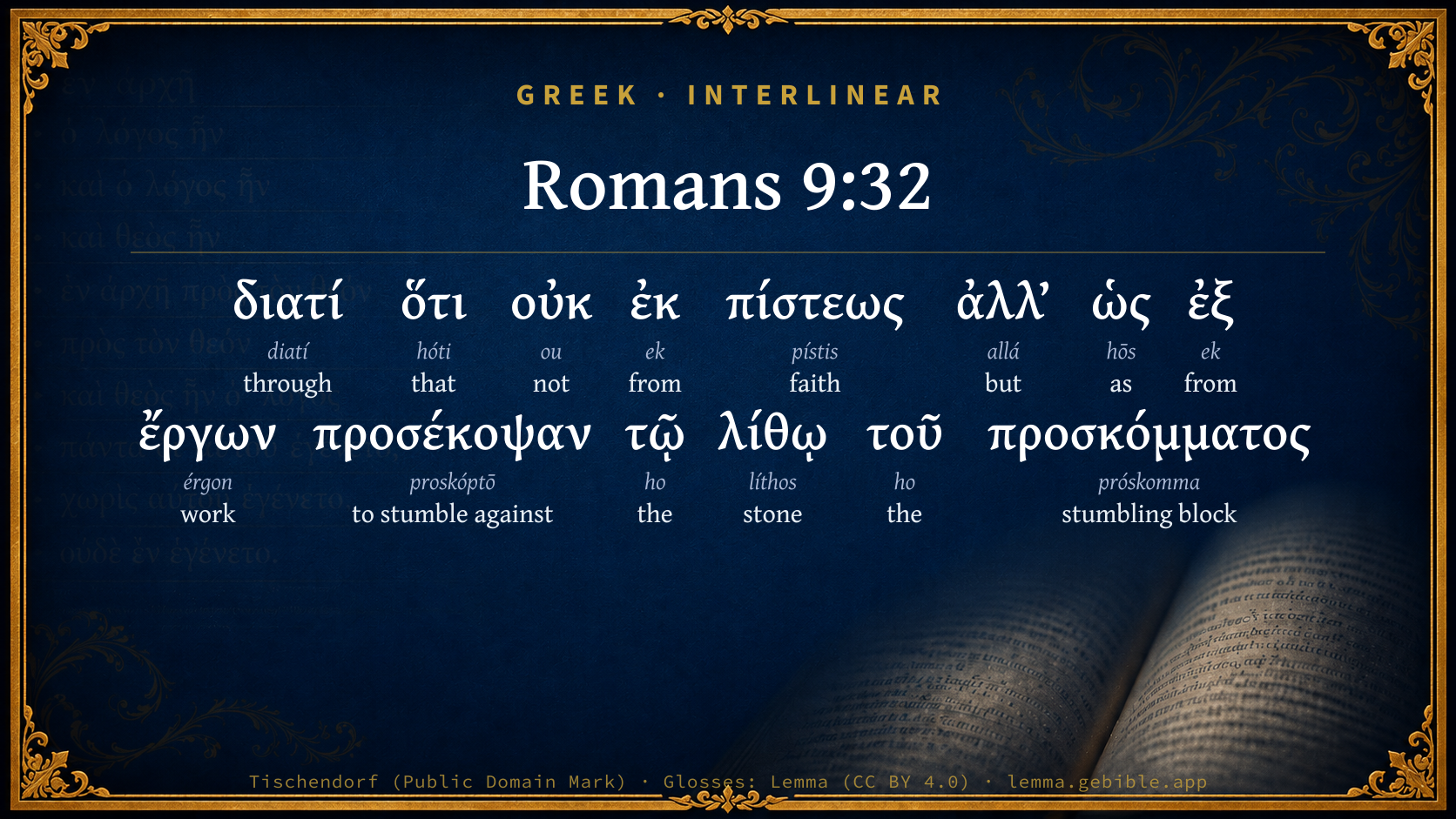
Download image
Cite this verse

Romans 9:32 (World English Bible). Public Domain. Lemma interlinear Bible study tool, https://lemma.gebible.app/v/romans/9/32.

Show BibTeX & RIS
BibTeX
RIS
English Translation
Why? Because they didn't seek it by faith, but as it were by works of the law. They stumbled over the stumbling stone;
World English Bible · Public Domain
Highlights
  • 1 first appearance in the Greek New Testament
Full analysis ↓
Download a study sheet

One document with this verse’s original text, its word-by-word gloss line, the meaning frame, cross-references with their text, attributed commentary, and full source and license credits — printable, and it pastes into notes with its structure intact.

This verse Autodidact and up

Study sheet (.html) Plain text (.txt)

A passage Seminary Student

Up to 50 verses in one chapter. A passage sheet keeps up to 6 commentary sources and 12 cross-references per verse, in the order this page ranks them, and says so on the sheet whenever that leaves anything out. Ask for a single verse and you get the Autodidact verse sheet above.

Everything on this page stays free to read, with no account — the sheet is a download of what is already on screen, not access to it.

Want to remove ads? Support Godless Engineer
Compare translations 3

The same verse in 3 English versions, stacked beneath the original-language interlinear above. Click any original word for its lexicon entry.

Each is an independent rendering of the whole verse — the interlinear is not word-aligned to these translations.

Highlighted words mark where these versions differ — a whole-verse word diff, not a word-by-word alignment.

  • World English Bible Public Domain
    Why? Because they didn't seek it by faith, but as it were by works of the law. They stumbled over the stumbling stone;
  • King James Version Public Domain
    Wherefore? Because they sought it not by faith, but as it were by the works of the law. For they stumbled at that stumblingstone;
  • unfoldingWord Literal Text CC BY-SA 4.0
    Why? Because not by faith, but as by works. They stumbled over the stone of stumbling,

unfoldingWord Literal Text — © unfoldingWord, licensed CC BY-SA 4.0. Word-aligned USFM3 via Door43 (git.door43.org/unfoldingWord/en_ult).

Versions to compare (up to 4)

3 of 4 selected

Show all 19 translations

Every available English version of this verse, each an independent rendering of the whole verse.

  • World English Bible Public Domain
    Why? Because they didn't seek it by faith, but as it were by works of the law. They stumbled over the stumbling stone;
  • Berean Standard Bible Public Domain
    Why not? Because their pursuit was not by faith, but as if it were by works. They stumbled over the stumbling stone,
  • Majority Standard Bible Public Domain
    Why not? Because their pursuit was not by faith, but as if it were by works of the law. For they stumbled over the stumbling stone,
  • King James Version Public Domain
    Wherefore? Because they sought it not by faith, but as it were by the works of the law. For they stumbled at that stumblingstone;
  • American Standard Version (1901) Public Domain
    Wherefore? Because `they sought it' not by faith, but as it were by works. They stumbled at the stone of stumbling;
  • Revised Version (1885) Public Domain
    Wherefore? Because they sought it not by faith, but as it were by works. They stumbled at the stone of stumbling;
  • Geneva Bible (1599) Public Domain
    Wherefore? Because they sought it not by faith, but as it were by the workes of the Lawe: for they haue stumbled at the stumbling stone,
  • Douay-Rheims (1899) Public Domain
    Why so? Because they sought it not by faith, but as it were of works. For they stumbled at the stumblingstone.
  • Young's Literal Translation Public Domain
    wherefore? because -- not by faith, but as by works of law; for they did stumble at the stone of stumbling,
  • Literal Standard Version CC BY-SA 4.0
    why? Because—not by faith, but as by works of law; for they stumbled at the stone of stumbling,
  • Unlocked Literal Bible CC BY-SA 4.0
    Why not? Because they did not pursue it by faith, but by works. They stumbled over the stone of stumbling,
  • unfoldingWord Literal Text CC BY-SA 4.0
    Why? Because not by faith, but as by works. They stumbled over the stone of stumbling,
  • Darby Bible Public Domain
    Wherefore? Because [it was] not on the principle of faith, but as of works. They have stumbled at the stumblingstone,
  • World Messianic Bible Public Domain
    Why? Because they didn’t seek it by faith, but as it were by works of the law. They stumbled over the stumbling stone,
  • Webster's Bible Public Domain
    Why? Because they sought it not by faith, but as it were by the works of the law. For they stumbled at that stumbling-stone;
  • Free Bible Version CC BY-SA 4.0
    Why not? Because they relied on what they did rather than trusting in God. They tripped on the stumbling-block,
  • Bible in Basic English Public Domain
    Why? Because they were not searching for it by faith, but by works. They came up against the stone which was in the way;
  • Text-Critical English NT CC BY 4.0
    Why? Because they did not pursue it by faith, but as though it were by works of the law. They stumbled over the stone of stumbling,
  • Tyndale New Testament (1534) Public Domain
    And wherfore? Because they sought it not by fath: but as it were by the workes of the lawe. For they have stombled at the stomblynge stone.

Literal Standard Version (2020), Covenant Press — licensed CC BY-SA 4.0. Text via the HelloAO Bible API (eBible.org). Unlocked Literal Bible (unfoldingWord) — licensed CC BY-SA 4.0. Text via the HelloAO Bible API (eBible.org). unfoldingWord Literal Text — © unfoldingWord, licensed CC BY-SA 4.0. Word-aligned USFM3 via Door43 (git.door43.org/unfoldingWord/en_ult). Free Bible Version, Dr. Jonathan Gallagher — licensed CC BY-SA 4.0. Text via the HelloAO Bible API (eBible.org).

Word by word

More ways to search: Search by grammar → Find every occurrence → Compare this word →

Practice this passage: Drill this verse → Learn its vocabulary →

About this verse

These counts appear in no published source. They are computed here, from the morphology-tagged text and Lemma’s own curated glosses. What Lemma adds →

14
words
12
distinct lemmas
Pauline Epistles
section

Notable vocabulary

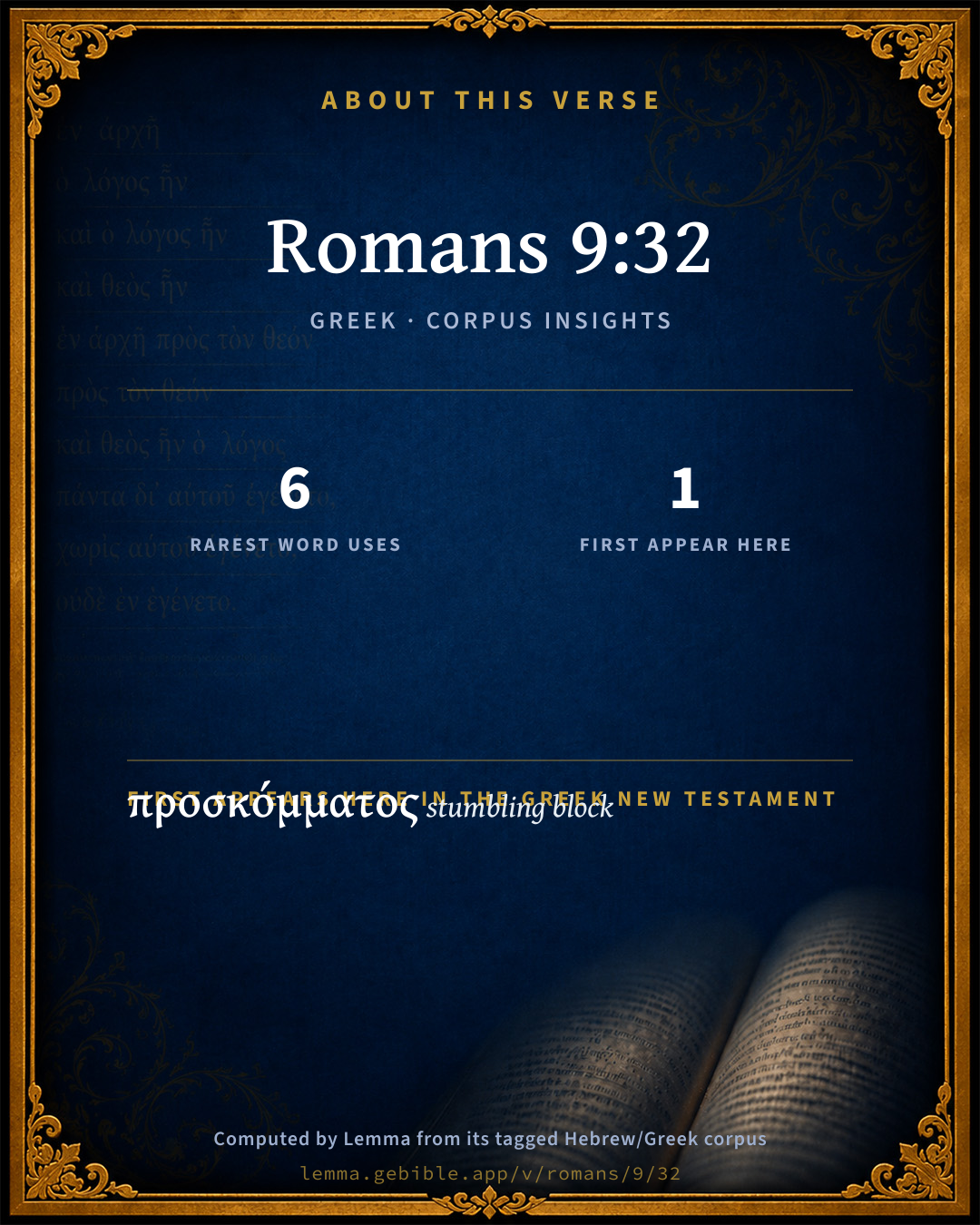
The rarest word here is προσκόμματος stumbling block G4348 — appearing just 6 times in the whole Greek New Testament.

First appearance in Scripture

This word makes its first canonical appearance in the Greek New Testament here:

  • προσκόμματος stumbling block G4348

Shared distinctive vocabulary

προσκόμματος stumbling block G4348 occurs in 6 verses of the Greek New Testament. Also found in:
Repetition

Words recur within this verse:

Cross-references

12

Topical passages linked to Romans 9:32 in the Treasury of Scripture Knowledge — connected by theme and wording, ordered by reader-vote popularity; previews shown in the World English Bible.

  • Luke 7:23 Blessed is he who is not offended by me."
  • 1 Corinthians 1:23 but we preach Christ crucified; a stumbling block to Jews, and foolishness to Greeks,
  • Romans 4:16 For this cause it is of faith, that it may be according to grace, to the end that the promise may be sure to all the seed, not to that only which is of the law, but to that also which is of the faith of Abraham, who is the father of us all.
  • Romans 11:11 I ask then, did they stumble that they might fall? May it never be! But by their fall salvation has come to the Gentiles, to provoke them to jealousy.
  • 1 Peter 2:8 and, "A stone of stumbling, and a rock of offense." For they stumble at the word, being disobedient, whereunto also they were appointed.
  • Matthew 13:57 They were offended by him. But Jesus said to them, "A prophet is not without honor, except in his own country, and in his own house."
  • Luke 2:34 and Simeon blessed them, and said to Mary, his mother, "Behold, this child is set for the falling and the rising of many in Israel, and for a sign which is spoken against.
  • John 6:27–29 Don't work for the food which perishes, but for the food which remains to eternal life, which the Son of Man will give to you. For God the Father has sealed him."
  • Acts 16:30–34 and brought them out and said, "Sirs, what must I do to be saved?"
  • Romans 10:3 For being ignorant of God's righteousness, and seeking to establish their own righteousness, they didn't subject themselves to the righteousness of God.
  • Matthew 19:16–20 Behold, one came to him and said, "Good teacher, what good thing shall I do, that I may have eternal life?"
  • 1 John 5:9–12 If we receive the witness of men, the witness of God is greater; for this is God's testimony which he has testified concerning his Son.

Cross-references courtesy of OpenBible.info (CC BY 4.0).

Where the printed editions differ

1 variant

Places in this verse where the major printed Greek editions disagree on the wording in a way that affects the translation — a comparison of editions, not a manuscript-by-manuscript collation. The editions are the modern critical texts (Nestlé-Aland 28/27, SBL, Westcott-Hort, Tregelles, Tyndale House) and the traditional texts behind the KJV (the Textus Receptus and the Byzantine/Majority text). It is not a claim about which reading is original.

  1. Extra text
    νόμου·

    “of law;”

    In TRByz Not in NA28NA27TynSBLWHTreg

    νόμου· (nomou) 'of law;' is only in traditional manuscripts (TR+Byz)

Textual data: Translators Amalgamated Greek New Testament (STEPBible TAGNT) · CC BY 4.0.

Commentary

Notes on Romans 9:32 from classic Christian and Jewish commentators (each source and its license shown beneath its notes). The classic Christian expositions comment on the surrounding passage and are grouped to its opening verse, so a note may address several verses; the Jewish commentaries on the Tanakh (Rashi and others) are per-verse, so they appear only where the commentator wrote on this verse.

Lemma curates 59 commentaries, every one of them public domain or Creative Commons licensed, each selected and text-cleaned for this edition rather than reprinted as found. About our sources →

Tyndale Open Study Notes

Tyndale Open Resources

9:32-33 The great rock in their path is Christ. People either build on him by putting their faith in him, or they stumble over his message that faith, and not human works, is the key to getting right with God.

Tyndale Open Study Notes — © Tyndale Open Resources, licensed CC BY-SA 4.0. Text via the HelloAO Bible API.

Bengel's Gnomon

Johann Albrecht Bengel

Rom 9:32. Ὃτι because) viz. they sought after it [followed after it].—οὐκ—ἀλλʼ ὠς) The Basle Lexicon says: ὡς in comparing things dissimilar is doubled, and the one ὡς is elegantly understood in the former member, and ὡς is only joined to [expressed in] the latter part. Examples are there subjoined from Aristotle; we may compare Joh 7:10; 2Co 11:17; likewise Act 28:19; Phm 1:14; Php 2:12.

Bengel's Gnomon of the New Testament — English translation (T&T Clark, Edinburgh, 1860) — public domain. Text from a community e-Sword module.

Expositor's Greek Testament

ed. W. Robertson Nicoll

Rom 9:32 . διὰ τί ; Why? A result so confounding needs explanation. ὅτι οὐκ ἐκ πίστεως ἀλλʼ ὡς ἐξ ἔργων : it seems too precise to supply with Weiss ἐδίωξεν νόμον δικαιοσύνης . The reason of Israel’s religious failure was that its whole religious effort and attitude was not of faith, but (so they conceived the case) of works. By inserting ὡς Paul dissociates himself from this conception, and leaves it to Israel; he does not believe (having learned the contrary by bitter experience) that there is any outlet along this road. Everything in religion depends on the nature of the start. You may start ἐκ πίστεως , from an utter abandonment to God, and an entire dependence on Him, and in this case a righteousness is possible which you will recognise as δικαιοσύνη θεοῦ , God’s own gift and work in you; or you may start ἐξ ἔργων , which really means in independence of God, and try to work out, without coming under obligation to God, a righteousness of your own, for which you may subsequently claim His approval, and in this case, like the Jews, all your efforts will be baffled. Your starting-point is unreal, impossible; it is not truly ἐξ ἔργων , but only ὡ ς ἐξ ἔργων ; it is an idea of your own, not a truth on which life can be carried out, that you are in any sense independent of God. Such an idea, however, rooted in the mind, may effectually pervert and wreck the soul, by making the Divine way of attaining righteousness and life offensive to it; and this is what happened to the Jews. Because of that profoundly false relation to God προσέκοψαν τῷ λίθῳ τοῦ προσκόμματος . The stone on which they stumbled was Christ, and especially His Cross. The σκάνδαλον of the Cross, at which they stumbled, is not simply the fact that it is a cross, whereas they expected a Messianic throne; the Cross offended them because, as interpreted by Paul, it summoned them to begin their religious life, from the very beginning, at the foot of the Crucified, and with the sense upon their hearts of an infinite debt to Him, which no “works” could ever repay.

The Expositor's Greek Testament, edited by W. Robertson Nicoll (1897–1910) — public domain. Text from a community e-Sword module.

Hodge's Commentary on Romans, Ephesians & First Corinthians

Charles Hodge

Rom_9:32

Because they sought it not by faith, but, as it were, by the works of the law. In other words, they would not submit to the method of justification proposed by God, which was alone suitable for sinners, and persisted in trusting to their own imperfect works. The reason why one man believes and is saved, rather than another, is to be sought in the sovereign grace of God, according to Pauls doctrine in the preceding part of this chapter, and Rom_8:28; 2Ti_1:9, etc.; but the ground of the rejection and condemnation of men is always in themselves. The vessels of wrath which are destroyed, are destroyed on account of their sins. No man, therefore, can throw the blame of his perdition on any other than himself. This verse, consequently, is very far from being inconsistent with the doctrine of the divine sovereignty as taught above. The force of the word rendered as it were, may be explained by paraphrasing the clause thus, as though they supposed it could be obtained by the works of the law. (See 2Co_3:5; 2Co_13:7,) They sought it as (being) of the works of the law. For they stumbled at that stumbling-stone. That is, they did as it had been predicted they would do, they took offense at the Messiah and at the plan of salvation which he came to reveal.

Charles Hodge — Commentary on Romans (1835), First Corinthians (1857), and Ephesians (1856) — public domain. Text from a community e-Sword module.

Geneva Bible (1599)

Geneva Bible translators

Seeking to come by righteousness, they followed the Law of righteousness.

Geneva Bible (1599) marginal notes — public domain. Text via Bolls.life.

Jamieson, Fausset & Brown

Robert Jamieson, A. R. Fausset & David Brown

Wherefore? Because they sought it not by faith, but as it were--rather simply, "as"

by the works of the law--as if it were thus attainable, which justification is not: Since, therefore, it is attainable only by faith, they missed it.

for--it is doubtful if this particle was originally in the text.

they stumbled at that stumbling-stone--better, "against the stone of stumbling," meaning Christ. But in this they only did.

Jamieson, Fausset & Brown — Commentary Critical and Explanatory on the Whole Bible (1871) — public domain (CC PDM 1.0). Text via the HelloAO Bible API.

Adam Clarke's Commentary

Verse 32. Wherefore?] And where lies their mistake? Being ignorant of God's righteousness-of his method of saving sinners by faith in Christ, they went about to establish their own righteousness-their own method of obtaining everlasting salvation. They attend not to the Abrahamic covenant, which stands on the extensive principles of grace and faith; but they turn all their regards to the law of Moses. They imagine that their obedience to that law gives them a right to the blessings of the Messiah's kingdom. But, finding that the Gospel sets our special interest in God and the privileges of his Church on a different footing, they are offended, and refuse to come into it.

Adam Clarke's Commentary on the Bible (1810–1826) — public domain. Text from a community e-Sword/MySword module.

John Calvin's Commentaries

32. Not by faith, but as it were by works, etc. As false zeal seems commonly to be justly excused, Paul shows that they are deservedly rejected, who attempt to attain salvation by trusting in their own works; for they, as far as they can, abolish faith, without which no salvation can be expected. Hence, were they to gain their object, such a success would be the annihilation of true righteousness. You farther see how faith and the merits of works are contrasted, as things altogether contrary to each other. As then trust in works is the chief hinderance, by which our way to obtain righteousness is closed up, it is necessary that we should wholly renounce it in order that we may depend on God’s goodness alone. This example of the Jews ought indeed justly to terrify all those who strive to obtain the kingdom of God by works. Nor does he understand by the works of the law, ceremonial observances, as it has been before shown, but the merits of those works to which faith is opposed, which looks, as I may say, with both eyes on the mercy of God alone, without casting one glance on any worthiness of its own.

For they have stumbled at the stone, etc. He confirms by a strong reason the preceding sentence. There is indeed nothing more inconsistent than that they should obtain righteousness who strive to destroy it. Christ has been given to us for righteousness, whosoever obtrudes on God the righteousness of works, attempts to rob him of his own office. And hence it appears that whenever men, under the empty pretence of being zealous for righteousness, put confidence in their works, they do in their furious madness carry on war with God himself.

But how they stumble at Christ, who trust in their works, it is not difficult to understand; for except we own ourselves to be sinners, void and destitute of any righteousness of our own, we obscure the dignity of Christ, which consists in this, that to us all he is light, life, resurrection, righteousness, and healing. But how is he all these things, except that he illuminates the blind, restores the lost, quickens the dead, raises up those who are reduced to nothing, cleanses those who are full of filth, cures and heals those infected with diseases? Nay, when we claim for ourselves any righteousness we in a manner contend with the power of Christ; for his office is no less to beat down all the pride of the flesh, than to relieve and comfort those who labour and are wearied under their burden.

The quotation is rightly made; for God in that passage declares that he would be to the people of Judah and of Israel for a rock of offence, at which they should stumble and fall. Since Christ is that God who spoke by the Prophets, it is no wonder that this also should be fulfilled in him. And by calling Christ the stone of stumbling, he reminds us that it is not to be wondered at if they made no progress in the way of righteousness, who through their wilful stubbornness stumbled at the rock of offence, when God had showed to them the way so plainly. But we must observe, that this stumbling does not properly belong to Christ viewed in himself; but, on the contrary, it is what happens through the wickedness of men, according to what immediately follows.

John Calvin's Commentaries (1540-1563) — public domain. Text from the Calvin Translation Society English edition (1840s-50s) via the Christian Classics Ethereal Library (ccel.org). Calvin's coverage is partial (roughly two-thirds of the Bible); uncommented books and verses are honest gaps, never fabricated. The 19th-century editor's footnotes and remarks are omitted so the notes are faithfully Calvin's own voice.

Ellicott's Commentary for English Readers

(32) For they stumbled.—“For,” in this clause, should be omitted, and the two clauses thrown together, the words “of the law” also going out—Because (seeking righteousness), not of faith, but as if of works, they stumbled, &c.

That stumblingstone.—Christ. When Christianity, with the justification by faith which goes with it, was offered to them, they “were offended,” and refused it.

A Bible Commentary for English Readers, edited by Charles John Ellicott (1878–1897) — public domain. Text from a community e-Sword module.

The Cambridge Bible for Schools and Colleges

gen. ed. J. J. S. Perowne

32. Wherefore?] See ch. 4 for the fullest commentary on this verse.

as it were] Lit. and better, as; i.e. “under the belief that it could be so reached.”

works of the law] “Of the law” should be omitted, on evidence of documents.

that stumblingstone] Lit. and better, the stumblingstone; i.e. the Stone predicted, in the words now to be quoted.—“Stumblingstone:”—lit. stone of stumbling, as in E. V. of 1Pe_2:8, where the same prophecy is quoted by allusion.

The Cambridge Bible for Schools and Colleges (gen. ed. J. J. S. Perowne; Cambridge University Press, 1878–1918) — public domain. Text from a community e-Sword module.

John Gill's Exposition

As it is written,.... In Isa 8:14; for the beginning and end of this citation are out of the latter, and the middle of it out of the former. This is an instance of "skipping", from place to place, concerning which the rules with the Jews were (s), that the reader

"might skip from text to text, but he might not skip from prophet to prophet, except only in the twelve prophets, only he might not skip from the end of the book to the beginning; also they might skip in the prophets, but not in the law;''

which rules are exactly complied with by the apostle. The beginning of this citation is out of Isa 28:16,

behold I lay in Zion. The "stone" said to be laid in Zion, is by the "Chaldee paraphrast" interpreted of a "king"; by R. David Kimchi, of King Hezekiah, and by Jarchi of the King Messiah; and is truly applied by the apostle to Jesus Christ: the layer of this stone is God the Father, who laid him as the foundation stone, in his eternal purposes and decrees, in his counsels and covenant, in promise and in prophecy, in the mission of him into this world, and in the preaching of the everlasting Gospel: the place where he is laid is Zion, meaning either literally Judea or Jerusalem, where the Messiah was to appear, whither he came, and from whence his Gospel went forth; or mystically the church, where he is laid as the foundation of it, and of the salvation of all the members thereof; though, through the sin and unbelief of others, he proves to be

a stumbling stone, and rock of offence; which phrases are to be seen in Isa 8:14, and are spoken of, and ascribed to a divine person, even to the Lord of hosts; and are by the Targumist thus paraphrased, "and if ye obey not", "his word shall be for revenge, and for a stone smiting, and a rock of offence", and in the Talmud (t), it is said, that

"the son of David (the Messiah) shall not come until the two houses of the fathers are destroyed out of Israel; and these are the head of the captivity which is in Babylon, and the prince in the land of Israel, as it is said, Isa 8:14.''

So that, according to the ancient Jews, this passage belongs to the Messiah, and is properly made use of for this purpose by the apostle, who had seen the accomplishment of it in the Jews; who stumbled at the outward meanness of Jesus of Nazareth, at his parentage, the manner of his birth, his education, the mean appearance of himself and followers; at his company and audience, his ministry, miracles, death, and the manner of it; and so believed not in him, for righteousness, life, and salvation; and thus it came about that they did not attain, or come up to the law of righteousness, or the righteousness of the law: but

whosoever believeth on him shall not be ashamed; that is, who believes in Christ unto righteousness, who builds his faith, and hope of eternal salvation on him, the foundation God has laid in Zion, and at which the unbelieving Jews stumbled and fell; he shall neither be ashamed here nor hereafter: he shall not be ashamed of his faith and hope in Christ; nor of Christ, as the Lord his righteousness; nor shall he be ashamed or confounded at his appearing, but shall be justified before men and angels, and be received into his kingdom and glory. There is some difference between the passage as here cited, and as it stands in Isa 28:16, where it is read, "he that believeth shall not make haste": either to lay any other foundation, being fully satisfied with this, which is laid by God; or shall not make haste to flee away, through fear of any enemy, or of any danger, being safe as built on this foundation; and so shall never fall, be moved, or ashamed and confounded. Some have fancied a various reading, but without any reason. A very learned Oriental critic (u) of our own nation has observed, that the Arabic words "Haush" "Hish" answer to the Hebrew word, the prophet uses, and which have three significations in them, "hasten", to "fear", and be "ashamed"; the first of these is retained here by the Jewish commentators and modern versions; the second by the "Chaldee paraphrast", and Syriac translation; and the third by the Septuagint, and the apostle; and they may be all taken into sense, for he that is afraid runs about here and there, and at length is put to shame and confusion.

(s) T. Bab. Megilla, fol. 24. 1. Yoma, fol. 69. 2. Maimon. Tephilla, c. 12. sect. 14. (t) T. Bab. Sanhedrin, fol. 38. 1. (u) Pocock. Not. Miscell. in Port. Mosis, p. 10, 11.

Next: Romans Chapter 10

John Gill's Exposition of the Whole Bible (1746–1763) — public domain (CC PDM 1.0). Text via the HelloAO Bible API.

Trapp's Complete Commentary

John Trapp

32 Wherefore? Because they sought it not by faith, but as it were by the works of the law. For they stumbled at that stumblingstone;

Ver. 32. For they stumbled] So they do to this day. So do Papists and carnal Protestants, Non frustra Lutherus in libris toties vaticinatus videtur, sese vereri dictitans, ne se extincto vera illa iustificationis disciplina prorsus apud Christianos exolescat. {a}

{a} John Fox, Christus Triumphans, Epist.

John Trapp, A Commentary or Exposition upon All the Books of the Old and New Testament (1647–1656) — public domain. Text from a community e-Sword module.

Albert Barnes' Notes on the Bible

Wherefore? - Why? The apostle proceeds to state the reason why so uniform and remarkable a result happened. “They sought it not by faith, etc.” They depended on their own righteousness, and not on the mercy of God to be obtained by faith.

By the works of the law - By complying with all the demands of the Law so that they might merit salvation. Their attempted obedience included their prayers, fastings, sacrifices, etc., as well as compliance with the demands of the moral law. It may be asked here, perhaps, how the Jews could know any better than this? how should they know anything about justification by faith? To this I answer:

(1) That the doctrine was stated in the Old Testament; see Hab 2:4; compare Rom 1:17; Psa 32:1-11; Psa 130:1-8; Psa 14:1-7; compare Rom. 3; Job 9:2.

(2) The sacrifices had reference to a future state of things, and were doubt less so understood; see the Epistle to the Hebrews.

(3) The “principle” of justification, and of living by faith, had been fully brought out in the lives and experience of the saints of old; see Rom. 4 and Heb. 11.

They stumbled - They fell; or failed; or “this was the cause why they” did not obtain it.

At that stumbling-stone - To wit, at what he specifies in the following verse. “A stumbling-stone” is a stone or impediment in the path over which people may fall. Here it means “that obstacle which prevented their attaining the righteousness of faith; and which was the occasion of their fall, rejection, and ruin.” That was the rejection and the crucifixion of their own Messiah; their unwillingness to be saved by him; their contempt of him and his message. For this God withheld from them the blessings of justification, and was about to cast them off as a people. This also the apostle proceeds to prove was foretold by the prophets.

Albert Barnes' Notes on the Bible (1834–1885) — public domain. Text from a community e-Sword/MySword module.

Matthew Poole's English Annotations

Here is the reason of the foregoing seeming paradox; why they, who followed after the law of righteousness, should not attain it, rather than other.

Because they sought it not aright; they sought it not in a way of believing, but of working. These two are opposed in the business of justification, as before at large, in Rom 9:3,4.

As it were by the works of the law; i.e. as if they could have attained righteousness or justification in that way, which it was impossible to do.

They stumbled at that stumbling-stone; i.e. the true Messiah: q.d. So far were they from seeking righteousness by Christ, that, on the contrary, they took offence at him, to their own destruction, Mar 6:3; 1Co 1:23. They thought it impossible that he should give them a righteousness better than their own. This happened to them according to the prophecy that went before them: so it followeth;

Matthew Poole's English Annotations on the Holy Bible (1683–1685) — public domain. Text from a community e-Sword/MySword module.

Whedon's Commentary on the Bible

Daniel D. Whedon

32. Wherefore?—This wherefore really asks what was the solution of the election and rejection of Rom_9:6-19, and the answer furnishes the solution. Reprobation is not antecedent to but consequent upon want of faith.

Works of the law—Works unenlivened by the spirit of faith and love, and performed as if the drudgery entitled the performers to heaven. Hence the heart was regenerate and the soul unsaved.

Stumbled—An image of mistake and failure. Yet the apostle will avail himself of its gentler meaning to distinguish the failure from a total irrevocable fall, (Rom_11:11.)

That stumbling-stone—That famous one described by the prophets.

Daniel D. Whedon (gen. ed.), Commentary on the Old and New Testaments (1874–1909) — public domain. Text from a community e-Sword module.

The Pulpit Commentary

Vers. 32, 33. Wherefore? Because they sought it not of faith, but as of works of law. The genuineness of the concluding word nomou here is doubtful. Its omission does not affect the sense. If retained, it must, according to the rule observed in this Exposition, be translated law, not the Law. For they stumbled at the stone of stumbling; as it is written, Behold, I lay in Zion a stone of stumbling and rock of offence: and he that (pav before o pisteuwn , expressed in the Authorized Version by "whosoever," has no good support, having probably been supplied from Rom_10:11) believeth on him shall not be ashamed. Here, as throughout the Epistle, the apostle"s position is supported by an Old Testament reference. In this instance it is to two passages of Isaiah intermingled. (Isa_28:16 and Isa_8:14) The way in which they are fused is illustrative of St. Paul"s way, elsewhere apparent, of referring to Scripture. As a rule, he quotes the LXX, but often varies from it, and sometimes so as to be closer to the Hebrew. Sometimes he seems to be quoting from memory, as one who is familiar with the general drift of prophecy on the subject in hand, and satisfied if the form of his quotation expresses such general drift. In the ease before us, he follows the Hebrew in Rom_8:14, and the LXX: Psa_28:1-6, where for the Hebrew expression rendered "shall not make haste," the LXX has ou mh kataiscunyh , apparently with the same essential meaning; for "make haste" seems to signify "haste away in terror and confusion." The two texts combined express the idea of a stone being laid by the Lord in Zion, which should be the support of the faithful, but a stumbling-block to others. It is not necessary to inquire whether the texts themselves have in the original any obvious Messianic reference. Enough that they denote God"s plan of dealing with his people. But to understand the full idea in the apostle"s mind, when he speaks of "the stone of stumbling," we must take into account also Psa_118:22, and our Lord"s language, as recorded in Mat_21:42, 44 and Luk_20:17, Luk_20:18. In the Psalms we find the figure of "the stone" used thus: "The stone which the builders refused is become the head stone of the corner;" and in the Gospels our Lord refers to this text as de. noting himself, and subjoins, with reference to Isaiah, the idea of the same stone being one on which some should fall and be broken, with the additional conception of its crushing those on whom itself should fall. The same view essentially is expressed in Simeon"s words, (Luk_2:34) that "this Child" should be for the fall as well as for the rising again of many in Israel; and it is repeated definitely in 1Pe_2:7. (cf. also Act_4:11 1Co_1:23)

Vers. 32, 33. The rock of offence.

In one point of view it would seem all but incredible that the highest display of Divine wisdom and goodness should be regarded, by those for whose benefit it was provided, with indifference and even hostility. But in order to understand how this should be, it is necessary to bear in mind the distorting influence of sin upon the minds of men. True religion comes into conflict with men"s errors, prejudices, and guilty conscience; and is a stone of stumbling, and rock of offence.

I CHRISTIANITY HAS NO RESPECT FOR NATIONAL PREJUDICES AND PRIDE. Jew and Gentile, civilized and barbarian, stand before God, and his Law and gospel, upon the same footing. All alike are treated as guilty, as needing to repent in order to salvation.

II CHRISTIANITY HAS NO RESPECT FOR PERSONAL RANK OR FAMILY REPUTATION. In the first age it was especially observed that not many great, or mighty, or noble were chosen. Such as were chosen were accepted upon the same terms as the lowly and the obscure.

III CHRISTIANITY DOES NOT MAKE SPIRITUAL BLESSING DEPEND UPON EXTERNAL PRIVILEGE. Such advantages were enjoyed in abundance by the Jews; but the preachers of Christianity made no account of them. When Israelites counted themselves unworthy of everlasting life, the heralds of salvation turned to the Gentiles. No wonder that such a reversal of customary methods angered those who prided themselves upon their position of advantage.

IV CHRISTIANITY DISPARAGES MERE EXTERNAL CONFORMITY AND OBEDIENCE. Most religions are content with words, gestures, gifts, etc. The new faith repudiated all such observances as in themselves valueless, laying stress upon the thoughts and intents of the heart. This was a paradox which was not unnaturally encountered with resentment.

V CHRISTIANITY PRESCRIBES HUMILIATION AND REPENTANCE AS THE INDISPENSABLE CONDITIONS OF PARDON. And this in every case a provision which is galling to the self-righteous and self-confident, who have little conscience of sin, and little pining for forgiveness. "The natural man" stumbles at this condition, which may, he thinks, be applicable to others, but has no appropriateness to him.

VI CHRISTIANITY INCULCATES SPIRITUALITY OF CHARACTER AS ALONE SUFFICIENT AND ACCEPTABLE IN THE SIGHT OF GOD. Christ"s own commands and counsels appeal to the heart the inmost nature of man. A new nature, renewed dispositions, heavenly desires, nothing less avails in his sight. "It is a hard saying," is the objection; "who can hear it?

Jesus as the Stumbling-stone.

"Behold, I lay in Zion a Stumbling-stone and Rock of offence: and whosoever believeth on him shall not be ashamed." It seems a strange thing that Jesus, the Saviour of men, should at all be set before us in this way. But the truth is, the great object is to cause us to consider what our own attitude is toward Christ. Have I accepted Jesus as my Saviour, or am I hesitating to commit myself to him? Am I clinging to him as my Rock of safety, or am I being repelled from him as from a rock of offence? It was no new idea, this which St. Paul brings forward here, of Christ being a Stumbling-stone. It was spoken of by Isaiah, when he said, "And he shall be for a Sanctuary; but for a stone of stumbling and for a Rock of offence to both the houses of Israel". (Isa_8:14) Jesus himself alluded to the same idea when he said to the chief priests and Pharisees, "Did ye never read in the Scriptures, The Stone which the builders rejected, the same is become the Head of the corner?" And then he added, to show the evil results of rejecting him, "And whosoever shall fall on this Stone shall be broken: but on whomsoever it shall fall, it will grind him to powder". (Mat_21:42, Mat_21:44) The Stone of stumbling, the Rock of offence, and the Stone against which men fall to their own destruction, all these convey the same truth. It is a truth which conveys a solemn warning the danger of rejecting Christ. How is it, then, that men stumble at Christ?

I THERE ARE SOME THINGS IN CHRIST"S LIFE AND WORK AT WHICH MEN STUMBLE. I do not mean to say that there is anything in the life and work of Jesus Christ at which men ought to stumble, but such is the depravity of the human heart, such is the power of the great enemy of souls, that men find difficulties even in the way of salvation. They raise mental objections to the very way in which the Creator of the world wants to give them a share in his heavenly inheritance, and have their doubts as to whether there might not be some other way, some other Teacher, some other Saviour, just as good as the eternal Son of God, who, in his matchless love, gave himself to die for the redemption of their souls.

1. Christ is a stumbling-stone to many because of the way in which he came into the world. So it was when he was on earth. Men asked the question, "Can any good thing come out of Nazareth?" And when he was come into his own country, they said, "Whence hath this Man this wisdom, and these mighty works? Is not this the carpenter"s Son? And they were offended in him", (Mat_13:54-57) or stumbled at this difficulty of his lowly parentage. And yet there should be no difficulty, no stumbling-block in this; for Jesus came in the very way and in the very place it had been predicted several hundred years before that he would come. Micah had predicted the place of his birth when he spoke of Bethlehem, and Isaiah the manner of his birth when he spoke of the miraculous event of a virgin who should conceive and bear a son, and call his name Immanuel. That which is a stumbling-block to many ought to be a strength and confirmation of faith in the Son of God.

2. Others, again, find a difficulty in the surroundings of his daily life. It was with the poor and lowly that he chiefly mingled; he ate and drank with publicans and sinners, and his intimate followers and disciples were chosen mainly from the humbler walks of life. Here, however, is the very proof that Christ was indeed Divine. God is no respecter of persons. Had Christ been a mere man, with an ambition to found an earthly kingdom, he would have sought the society of the great; he would not have put away from him all the attempts to make him a King. But his kingdom was not of this world. The very persons whom he chose to be its first ambassadors and founders were in themselves a proof that their religion was Divine. Without earthly rank or riches, without learning or worldly influence, they went forth from an obscure province of the Roman empire, and, only by the power of the words they spoke, founded a religion which today is placing a girdle round the world, and before whose mighty power the temples of heathenism and the mosques of the Mohammedan are destined yet to fall.

3. God hath indeed chosen the foolish things of the world to confound the wise, and the weak things of the world to confound the things which are mighty. This fact also about Jesus Christ, his lowly surroundings and his humble followers, instead of being a stumbling-block, should be a strength to faith.

4. There are many who find a great difficulty in the death of Christ. St. Paul said that in his day Christ crucified was to the Jews a stumbling-block, and to the Greeks foolishness. And it is the cross of Christ that is the stumbling-block to many at the present day. They are willing to regard Christ as the greatest of all teachers, as a beautiful and holy example, but they can see no meaning in the atonement. They stumble at the cross. They call the preaching of salvation by the sufferings of Christ "a doctrine of blood," Be it so. And if you take the doctrine of blood out of the Bible, how much of it have you left? Was it not the shedding of blood that was the feature of Abel"s sacrifice, which, because it foreshadowed the need of an atonement for sin, was preferred to that of Cain, in which there was no recognition of guilt or unworthiness? The lamb which God himself provided for a burnt offering in lieu of Abraham"s intended sacrifice; the lamb slain, and the blood sprinkled on the door-posts of the Israelites in Egypt; the sacrificial offerings of the Mosaic Law; were not all these but types, pointing to the great Sacrifice, and teaching the children of Israel their need for his atonement? But those who accept Christ as a great Teacher, and reject the doctrine of his atonement, are hardly consistent. It seems incredible how any one can accept the gospel narrative of Christ"s own teaching, without believing that he taught that his death was a sacrifice. Just immediately after he entered on his ministry, he permitted John the Baptist to say of him, "Behold the Lamb of God, who taketh away the sin of the world." He himself said, "As Moses lifted up the serpent in the wilderness, even so must the Son of man be lifted up: that whosoever believeth on him should not perish, but have eternal life." Such words plainly convey that not only would there be the power of a good example in the life of Christ, but that there would be a healing, saving power in his death when he was lifted up upon the cross. He speaks of laying down his life for the sheep; and when he instituted the Lord"s Supper, he clearly indicated that his sufferings on the cross were to be the leading thought in that commemoration, and that those sufferings were endured on behalf of his people. "This is my body, broken for you; ! This cup is the new testament in my blood, shed for the remission of sins." If men stumble at the cross, they stumble at the very threshold of the gospel. "Without the shedding of blood is no remission." If men find a difficulty in the cross, they find a difficulty in the most convincing evidence given to men of God"s love for the world and of the desire of Jesus Christ for their salvation. "God forbid that I should glory, save in the cross of our Lord Jesus Christ." Instead of stumbling at it, let me cling to it, let me live under its power. "For the preaching of the cross is to them that perish foolishness, but unto us who are saved it is the power of God.

II THERE ARE SOME THINGS IN THEMSELVES WHICH CAUSE MEN TO STUMBLE AT CHRIST.

1. Christ is a Stumbling-block to human pride. If we are to be saved by Jesus Christ, then we must confess ourselves to be guilty sinners, we must lay aside all trust in any merit of our own, all hope of heaven because of our own good works. This is a stumbling-block to many. Penances are no stumbling-block. Men will freely inflict on themselves fastings and bodily sufferings, to purchase for themselves, as they think, the pardon of their sins and the hope of heaven; but simply to accept the salvation provided by Jesus Christ when they are asked to do this, they hesitate, they raise difficulties, they entertain doubts. God"s way of salvation is too simple for many. If he would bid us do "some great thing" we would gladly do it. Here, again, is it not plain that such a cause of stumbling is unreasonable? If I will not take God"s way of getting to heaven, how can I expect to get there by any other? And if there could be any other way, what necessity was there for God to give up his own Son to death for us all?

2. Christ is a Stumbling-block to human sins. Many would like to get to heaven, but they do not like to give up their sins. Many are inclined to ask, "May one be pardoned, and retain the offence?" How unreasonable to choose a few hours of sin and to destroy both body and soul, rather than to follow that Saviour whose service is perfect peace, and at whose right hand are pleasures for evermore!

3. Christ is a Stumbling-block to human selfishness. Many who are not the slaves of grosser sins are nevertheless the slaves of worldliness and self. They fear that Christ"s service would be too much of a restraint upon them. They know that they cannot serve God and mammon. Their conscience tells them that if they would be conformed to this world and imitate the customs and fashions of those around them, they must violate. the precepts and incur the displeasure of Christ. And so they make their choice, like Esau, who for one morsel of meat sold his birthright. They are not prepared for the service of him who said, "If any man will come after me, let him deny himself, and take up his cross daily, and follow me." But how great is the loss of those who for any of these reasons reject Christ! C.H.I.

Either an offence or a refuge.

An offence is caused by some obstacle upon the road, something that trips up the feet or bars our progress, or some stone pillar that overthrows the unwary charioteer in his course. The apostle combines two passages from Isaiah to prove that the rejection of Christ by the Jews was long ago foretold; nothing, therefore, to be wondered at, much less a reason for abandoning Christianity. To John the Baptist, encompassed with doubts born of the shadows of a prison, the stirring assurance was sent, "Blessed is he who shall not be offended in me.

I THE WORK OF CHRIST A DIVINE APPOINTMENT. "Behold, I lay in Zion" etc. There were hints and predictions of the gospel in nature, providence, and Jewish symbolism. And now that the purpose of grace has been clearly manifested, we can everywhere trace intimations corroborative of the significance of the Saviour"s mission, though we might not without this key in our hands have discovered the opening of the locks. Much in the mystery of redemption transcends expectation. Who could have invented a narrative of such Divine condescension? And many things connected with the intercession of Christ recall the language of Leviticus, "I have given it you to make atonement for your souls." Christ is God"s Gift to our fallen world. He came according to the flesh an Israelite; he came to Zion, and in the midst of his own people made his soul an offering for sin.

II THIS WORK A STUMBLING-BLOCK TO SOME. The people in Zion could not understand how a Galilaean Prophet could become a Corner-stone of a nobler edifice than they had ever beheld. They had respect to the outward meanness of the Messiah, and could not comprehend his spiritual glory. They were unprepared for a system that secured righteousness, not by human merit and obedience to statutory and ceremonial regulations, but by faith in the Righteous One. A Messiah crucified was the reversal of every hope. And when the gospel was proclaimed to the Gentiles, multitudes could see in it naught to evoke their admiration or claim their intellectual homage. It humbles pride, makes severe demands upon our power of credence. The facts are extraordinary, and the doctrines based thereon run counter to many a deep-rooted, warmly cherished prejudice. And thus the preaching of Christ becomes "a savour of death.

III A SURE FOUNDATION TO BELIEVERS. Three translations of the original word are found in the Authorized Version not make haste," "shall not be confounded" "shall not be ashamed." These terms all lay stress on the durableness of Christian hope. When the hail "sweeps away the refuges of lies," he that trusteth in the Lord shall find he has not believed in vain; his Ark survives the flood, his Tower withstands the assault of the foe. The consciousness of peace and satisfaction which the disciple of Christ enjoys must ultimately be accepted as the strongest weapon in the controversy, the plainest indication of the reconcilement of the natural and the supernatural. A foundation which bears unmoved the strain of a heavy superstructure cannot be treated as worthless. According to our position, then, as in the camp of Israel or of Egypt, will the Divine cloud minister light or darkness, succour or bewilderment. S.R.A.

The Pulpit Commentary (1880–1919), ed. H.D.M. Spence-Jones & Joseph S. Exell — public domain. Text from a community e-Sword module.

John Wesley's Explanatory Notes

And wherefore have they not? Is it because God eternally decreed they should not? There is nothing like this to be met with but agreeable to his argument the apostle gives us this good reason for it, Because they sought it not by faith - Whereby alone it could be attained. But as it were - In effect, if not professsedly, by works. For they stumbled at that stumblingstone - Christ crucified.

John Wesley, Explanatory Notes Upon the Whole Bible (1754–1765) — public domain. Text via the GEBible commentary corpus.

Godbey's Commentary on the New Testament

William B. Godbey

32. “Wherefore, because they sought it not by faith, but by works.” The true religion in all ages is salvation by the free grace of God in Christ, received and appropriated by faith alone, without works; while false religions in all ages teach salvation by faith and works, the latter always eclipsing the former and running them into idolatry. “They stumbled over the stone of stumbling,

William B. Godbey, Commentary on the New Testament (1896–1900) — public domain. Text from a community e-Sword module.

McGarvey & Pendleton's Commentaries

J. W. McGarvey

Wherefore? [Why, then, did the Jews fail to find any law of life? Answer: Because there is but one such law, and they sought another.] Because they sought it not by faith, but as it were by works . [In interpreting, we have contrasted the law of works with what we have called "the law of faith," but the apostle does not use this latter term: with him life it attained by "faith," though he treats it as a working principle in that he contrasts it with the other active principle, or law of works. In this verse, however, he drops the abstract altogether, and places the concrete "faith" and "works" in vivid opposition. It is not so much a question of law against law, and principle against principle; it is one of faith which appropriates the perfect righteousness of Christ, and of Jewish works which, scorning the garment of the purity of God, revealed in his Son, still clings to the filthy rags of self-righteousness, self-sufficiency, Phariseeism, etc.-- Phi_3:4-14 ] They stumbled at the stone of stumbling [The language here still follows the metaphor of the race-course. The Jew, running with his eye on an imaginary, non-existing, phantom goal, and blind as to the real goal, stumbles over it and falls. The picture presented by the apostle suggests the sad truth that the Jew has run far enough and fast enough to win, but, as he has rejected the terms and rules of the race, his efforts are not counted by the Lord of the race. Christ was placed of God as a goal, and not as a stumbling-block; as a Saviour, not as a source of condemnation; but he is indeed either man's salvation or his ruin-- Mat_21:42-45 ];

J. W. McGarvey (with Philip Y. Pendleton), Commentaries on the New Testament (The Fourfold Gospel, 1914; Acts; and the epistles) — public domain. Text from a community e-Sword/MySword module.

The People's New Testament

B. W. Johnson

32. Wherefore. Why this failure on the part of Israel? Not because God willed that they should be rejected, not because of any foreordination, but because of their unbelief in Christ. They sought it not by faith. Sought not the righteousness that comes from faith in Christ, but a righteousness of works by keeping the law of Moses. They stumbled at the stumbling-stone. At faith in Christ, in a Crucified Christ. This is the one cause of Israel's failure. They fell through unbelief.

B. W. Johnson's The People's New Testament with Notes (1889–1891) — public domain. Electronic text from the Christian Classics Ethereal Library (CCEL) ThML edition.

unfoldingWord translationNotes

Door43 World Missions Community

Why not?

This is an ellipsis. You can include the implied words in your translation. Paul asks this question to get the attention of his readers. AT: "Why could they not attain righteousness?" (See: Ellipsis and Rhetorical Question)

by works

This refers to things that people do to try to please God. You can make this explicit in your translation. AT: "by trying to do things that would please God" or "by keeping the Law" (See: Assumed Knowledge and Implicit Information)

as it has been written

You can indicate that Isaiah wrote this. You can also translate it in an active form. AT: "as Isaiah the prophet wrote" (See: Assumed Knowledge and Implicit Information and Active or Passive)

in Zion

Here Zion is a metonym that represents Israel. AT: "in Israel" (See: Metonymy)

stone of stumbling and a rock of offense

Both of these phrases mean basically the same thing and are metaphors that refer to Jesus and his death on the cross. It was as if the people stumbled over a stone because they were disgusted when they considered Jesus' death on the cross. (See: Doublet and Metaphor)

believes in it

Because the stone stands for a person, you may need to translate "believes in him."

translationWords

works

stumble

stumbling block

written

Zion

believe

shame

unfoldingWord translationNotes — © Distant Shores Media and the Door43 World Missions Community, licensed CC BY-SA 4.0. Source: git.door43.org/Door43/en_tn.

Cambridge Greek Testament for Schools and Colleges

32. διὰ τί; Sc. οὐκ ἔφθασεν.

ὅτι. Sc. ἐδίωκεν. ὡς ἐξ ἔργων = with the idea that they could attain by starting from works.

τῷ λίθῳ τοῦ π. Allusion to Isa 8:14, LXX[198] λίθον πρόσκομμα. The sense in Isaiah is that the Lord of Hosts will be a sanctuary for Israel if they trust in Him; they will not then find Him as a stone to stumble against. The absence of faith makes Him so.

[198] LXX. the Septuagint Version of the Old Testament

Cambridge Greek Testament for Schools and Colleges (Cambridge University Press, 1896; 21 vols, various authors incl. Carr, Maclear, Plummer, Farrar, Lumby, Moule, M. R. James, Simcox) — public domain. Text from a community e-Sword module.

International Critical Commentary

32. ὅτι οὐκ ἐκ πίστεως … προσέκοψαν. Two constructions are possible for these words. (1) We may put a comma at ἔργων and supply διώκοντες. Then the passage will run: ‘Why did they not attain it? because pursuing after it not by faith but by works they stumbled,’ &c.; or (2) we may put a full stop at ἔργων and supply ἐδίωξαν. ‘Why did they not attain it? because they pursued after it not by faith but by works, they stumbled,’ &c. The sentence has more emphasis if taken in this way, and the grammatical construction is on the whole easier.

ἀλλʼ ὡς ἐξ ἔργων. The ὡς introduces a subjective idea. St. Paul wishes to guard himself from asserting definitely that ἐξ ἔργων was a method by which νόμον δικαιοσύνης might be pursued. He therefore represents it as an idea of the Jews, as a way by which they thought they could gain it. So in 2Co 2:17 ἀλλʼ ὡς ἐξ εἰλικρινείας represents the purpose and aim of the Apostle; 2Co 11:17 ὄ λαλῶ, οὐ κατὰ Κύριον λαλῶ, ἀλλʼ ὡς ἐν ἀφροσύνη: represents an aspect from which his words may be regarded; Phm 1:14 ἵνα μὴ ὡς κατὰ ἀνάγκην τὸ ἀγαθόν σου ᾖ ἀλλὰ κατὰ ἑκούσιον: ‘even the appearance of constraint must be avoided’ (cf. Lightfoot, ad loc.). The ὡς gives a subjective idea to the phrase with which it is placed, but the exact force must be determined by the context.

προσέκοψαν: προσκόπτειν τινί means not ‘to stumble over by inadvertence,’ but ‘to be annoyed with,’ ‘show irritation at.’ The Jews, in that the cross was to them a σκάνδαλον, had stumbled over Christ, shown themselves irritated and annoyed, and expressed their indignation, see Grm. Thayer, sub voc.

τῷ λίθῳ τοῦ προσκόμματος: ‘a stone which causes men to stumble.’ Taken from the LXX of Isa 8:14. The stone at which the Jewish nation has stumbled, which has been to them a cause of offence, is the Christ, who has come in a way, which, owing to their want of faith, has prevented them from recognizing or accepting Him, cf. 1Pe 2:8.

International Critical Commentary — older volumes (1896–1929), various authors — public domain. Text from a community e-Sword module.

Vincent's Word Studies in the New Testament

Marvin R. Vincent

Not by faith [ουκ εκ πιστεως] . A. V. and Rev. supply the ellipsis, they sought it not.

They stumbled [προσεκοψαν] . "In their foolish course Israel thought they were advancing on a clear path, and lo! all at once there was found in this way an obstacle upon which they were broken; and this obstacle was the very Messiah whom they had so long invoked in all their prayers" (Godet).

Marvin R. Vincent, Word Studies in the New Testament (1887–1900) — public domain. Text from a community e-Sword/MySword module.

Godet's Commentaries

Frédéric Louis Godet

Vv. 32, 33. “Wherefore? Because [seeking] not by faith, but as it were by works, they stumbled at the stumbling-stone; as it is written, Behold, I lay in Sion a stumbling-stone and rock of offence: and he who believeth on Him shall not be ashamed.”

The apostle has just declared (Rom 9:30) the moral fact which is the real cause of Israel’s rejection, and he now asks how this fact could have come about. The question, wherefore? does not signify for what end (εἰς τί)? but on account of what (διὰ τί)? If, with the T. R. and some Byz. Mjj., we read γάρ, for, with they stumbled, this verb necessarily begins a new proposition, and a finite verb must be understood with the conjunction because: “because they sought, not by faith, but as it were by works.” But this reading seems too slenderly supported to be admissible, and it is difficult to extract from it a rational meaning; for the act of stumbling is rather the effect than the cause, or than the proof of seeking in a false way. It would require, consequently, to be, “they stumbled therefore.” If, with the most numerous and important documents, we reject, the for, two possible constructions remain: Either the whole may be taken as a single proposition (see the translation); the two regimens: not by faith and as it were by works, depend in this case on they stumbled, the participle seeking being understood; this construction is somewhat analogous to that of Rom 9:11. The meaning is excellent. “Wherefore did they not find true righteousness? Because, seeking it in the way of works, they ended in stumbling against the stumbling-stone, the Messiah who brought to them true righteousness, that of faith.” Or it is possible, even without the for, to find here two propositions, as is done by most commentators; the first: “Because they sought not in the way of faith, but in that of works;” the second, which would follow by way of asyndeton, and which would require to be regarded as pronounced with emotion: “Yea; they stumbled”...! But what prevents us from adopting this last construction is, that the idea of stumbling thus comes on us too abruptly. It would require a καὶ οὕτως, and so, to establish the relation between the two acts of seeking in the false way and stumbling. We hold, therefore, by the preceding construction.

Paul can with good reason make it a charge against the Jews that they have not sought righteousness in the way of faith; for he had shown (chap. 4) by the example of Abraham that this way was already marked out in the O. T.; comp. also the saying of Habakkuk quoted (Rom 1:17), and that of Isaiah about to be referred to (Rom 9:33), etc. Every day the experiences made under the law should have brought the serious Jew to the feet of Jehovah in the way of repentance and faith to obtain pardon and help (see the Psalms). And following this course, they would have avoided stumbling at the Messianic righteousness; they would, on the contrary, have grasped it greedily, as was done by the élite of the people. The as it were, added to the regimen by works, signifies quite naturally: “As if it were possible to find righteousness by this means.” Meyer explains it somewhat differently. “To seek righteousness by a process such as that of works.” But the first meaning much better describes the contrast between the real and the imaginary means.

The complement νόμου, of the law, in the T. R. is omitted by the Alexs. and the Greco-Latins; it adds nothing to the idea. Seeking in this false way, they have ended by stumbling on the stone which made them fall. This stone was Jesus, who brought them a righteousness acquired by Himself and offered only to faith. The figure of stumbling is in keeping with all those that precede: follow after, attain to, reach (obtain). In their foolish course, Israel thought they were advancing on a clear path, and lo! all at once there was found on this way an obstacle upon which they were broken. And this obstacle was the very Messiah whom they had so long invoked in all their prayers! But even this result was foretold.

Frédéric Louis Godet — Commentaries on Luke, John, Romans, and 1 Corinthians — English translation (T&T Clark, Edinburgh, 1870s–1890s) — public domain. Text from a community e-Sword module.

Lesson kit

Teaching starters — assembled from the data on this page, not authored interpretation. Every prompt links to the verse data it draws on. Edit before teaching.

Romans, in the Pauline Epistles, opens this verse with 14 words (12 distinct Greek lemmas). Its most distinctive word is próskomma (“stumbling block”). A historical commentator’s framing appears above. Read the whole chapter for the surrounding context.

Discussion questions

  1. The word próskomma carries the sense “stumbling block.” How does it shape the verse?
  2. The word “stumbling block” first appears here in Scripture. What is being introduced at this debut?
  3. Romans 9:33 shares the word «stumbling block» with this verse. How do the two illuminate each other?
  4. “from” occurs 2× in this one verse. What is the effect of the repetition?
  5. The translations on this page render this verse differently — a whole-verse word diff, not a word-by-word alignment. What might account for the different wordings?
  6. Reading how Tyndale Open Study Notes and Bengel's Gnomon read this verse, where do the two commentators agree and where do they part?

Things to notice

  • 1 word makes its first canonical appearance in Scripture here.
  • These translations choose different wording for 10 words in this verse.
  • “from” occurs 2× in this single verse.
  • 12 distinct Greek lemmas span 14 words in this verse.

Reading settings

Reading text

Shown beneath each verse's original-language words.

Old Testament
Old Testament edition

Read the OT as the Masoretic Hebrew (MT) or the Greek Septuagint (LXX).

English shown for the Greek Septuagint (in the Hebrew ↔ Greek comparison).

Comparing translations? Open the Compare panel on any verse page to stack up to four side by side.