2 Timothy 2:21

Greek (Tischendorf 8th ed.) 2 Timothy 2:21 appears in the Greek New Testament. The text above is from the Tischendorf 8th edition. Each word links to its Strong’s number and a concise gloss. Click any word for its full Thayer’s Greek Lexicon entry.
Download image
Cite this verse

2 Timothy 2:21 (World English Bible). Public Domain. Lemma interlinear Bible study tool, https://lemma.gebible.app/v/2-timothy/2/21.

Show BibTeX & RIS
BibTeX
RIS
English Translation
If anyone therefore purges himself from these, he will be a vessel for honor, sanctified, and suitable for the master's use, prepared for every good work.
World English Bible · Public Domain
Highlights
  • 1 first appearance in the Greek New Testament
Full analysis ↓
Download a study sheet

One document with this verse’s original text, its word-by-word gloss line, the meaning frame, cross-references with their text, attributed commentary, and full source and license credits — printable, and it pastes into notes with its structure intact.

This verse Autodidact and up

Study sheet (.html) Plain text (.txt)

A passage Seminary Student

Up to 50 verses in one chapter. A passage sheet keeps up to 6 commentary sources and 12 cross-references per verse, in the order this page ranks them, and says so on the sheet whenever that leaves anything out. Ask for a single verse and you get the Autodidact verse sheet above.

Everything on this page stays free to read, with no account — the sheet is a download of what is already on screen, not access to it.

Want to remove ads? Support Godless Engineer
Compare translations 3

The same verse in 3 English versions, stacked beneath the original-language interlinear above. Click any original word for its lexicon entry.

Each is an independent rendering of the whole verse — the interlinear is not word-aligned to these translations.

Highlighted words mark where these versions differ — a whole-verse word diff, not a word-by-word alignment.

  • World English Bible Public Domain
    If anyone therefore purges himself from these, he will be a vessel for honor, sanctified, and suitable for the master's use, prepared for every good work.
  • King James Version Public Domain
    If a man therefore purge himself from these, he shall be a vessel unto honour, sanctified, and meet for the master's use, and prepared unto every good work.
  • unfoldingWord Literal Text CC BY-SA 4.0
    Therefore, if someone has cleansed himself from these, he will be a container for honor, having been sanctified, useful to the master, having been prepared for every good work.

unfoldingWord Literal Text — © unfoldingWord, licensed CC BY-SA 4.0. Word-aligned USFM3 via Door43 (git.door43.org/unfoldingWord/en_ult).

Versions to compare (up to 4)

3 of 4 selected

Show all 19 translations

Every available English version of this verse, each an independent rendering of the whole verse.

  • World English Bible Public Domain
    If anyone therefore purges himself from these, he will be a vessel for honor, sanctified, and suitable for the master's use, prepared for every good work.
  • Berean Standard Bible Public Domain
    So if anyone cleanses himself of what is unfit, he will be a vessel for honor: sanctified, useful to the Master, and prepared for every good work.
  • Majority Standard Bible Public Domain
    So if anyone cleanses himself of what is unfit, he will be a vessel for honor: sanctified, useful to the Master, and prepared for every good work.
  • King James Version Public Domain
    If a man therefore purge himself from these, he shall be a vessel unto honour, sanctified, and meet for the master's use, and prepared unto every good work.
  • American Standard Version (1901) Public Domain
    If a man therefore purge himself from these, he shall be a vessel unto honor, sanctified, meet for the master's use, prepared unto every good work.
  • Revised Version (1885) Public Domain
    If a man therefore purge himself from these, he shall be a vessel unto honour, sanctified, meet for the master’s use, prepared unto every good work.
  • Geneva Bible (1599) Public Domain
    If any man therefore purge him selfe from these, he shalbe a vessell vnto honour, sanctified, and meete for the Lord, and prepared vnto euery good worke.
  • Douay-Rheims (1899) Public Domain
    If any man therefore shall cleanse himself from these, he shall be a vessel unto honour, sanctified and profitable to the Lord, prepared unto every good work.
  • Young's Literal Translation Public Domain
    if, then, any one may cleanse himself from these, he shall be a vessel to honour, sanctified and profitable to the master -- to every good work having been prepared,
  • Literal Standard Version CC BY-SA 4.0
    if, then, anyone may cleanse himself from these, he will be a vessel to honor, sanctified and profitable to the master—having been prepared to every good work;
  • Unlocked Literal Bible CC BY-SA 4.0
    If someone cleans himself from dishonorable use, he is an honorable container. He is set apart, useful to the Master, and prepared for every good work.
  • unfoldingWord Literal Text CC BY-SA 4.0
    Therefore, if someone has cleansed himself from these, he will be a container for honor, having been sanctified, useful to the master, having been prepared for every good work.
  • Darby Bible Public Domain
    If therefore one shall have purified himself from these, [in separating himself from them], he shall be a vessel to honour, sanctified, serviceable to the Master, prepared for every good work.
  • World Messianic Bible Public Domain
    If anyone therefore purges himself from these, he will be a vessel for honor, sanctified, and suitable for the master’s use, prepared for every good work.
  • Webster's Bible Public Domain
    If a man therefore will cleanse himself from these, he will be a vessel to honor, sanctified and meet for the master's use, and prepared to every good work.
  • Free Bible Version CC BY-SA 4.0
    So if you get rid of what is evil, you will become a cup or bowl that is holy and special, useful to the Lord, ready to do all that's good.
  • Bible in Basic English Public Domain
    If a man makes himself clean from these, he will be a vessel for honour, made holy, ready for the master's use, ready for every good work.
  • Text-Critical English NT CC BY 4.0
    Therefore, if anyone cleanses himself from what is dishonorable, he will be a vessel for honorable use, set apart as holy, useful to the master, and prepared for every good work.
  • Tyndale New Testament (1534) Public Domain
    But Yf a man purdge him silfe from suche felowes he shalbe a vessell sanctified vnto honoure mete for the lorde and prepared vnto all good workes.

Literal Standard Version (2020), Covenant Press — licensed CC BY-SA 4.0. Text via the HelloAO Bible API (eBible.org). Unlocked Literal Bible (unfoldingWord) — licensed CC BY-SA 4.0. Text via the HelloAO Bible API (eBible.org). unfoldingWord Literal Text — © unfoldingWord, licensed CC BY-SA 4.0. Word-aligned USFM3 via Door43 (git.door43.org/unfoldingWord/en_ult). Free Bible Version, Dr. Jonathan Gallagher — licensed CC BY-SA 4.0. Text via the HelloAO Bible API (eBible.org).

Word by word

More ways to search: Search by grammar → Find every occurrence → Compare this word →

Practice this passage: Drill this verse → Learn its vocabulary →

ἐκκαθάρῃ
ekkathaírō
G1571
“to cleanse”
Verb, Aorist, Active, Subjunctive, 3rd person, Singular
Part of Speech
Verb
Tense
Aorist
Voice
Active
Mood
Subjunctive
Person
3rd person
Number
Singular
Full Thayer's Definition

Origin: from G1537 and G2508

TDNT: 10:10,4

1. to cleanse out, clean thoroughly, to cleanse
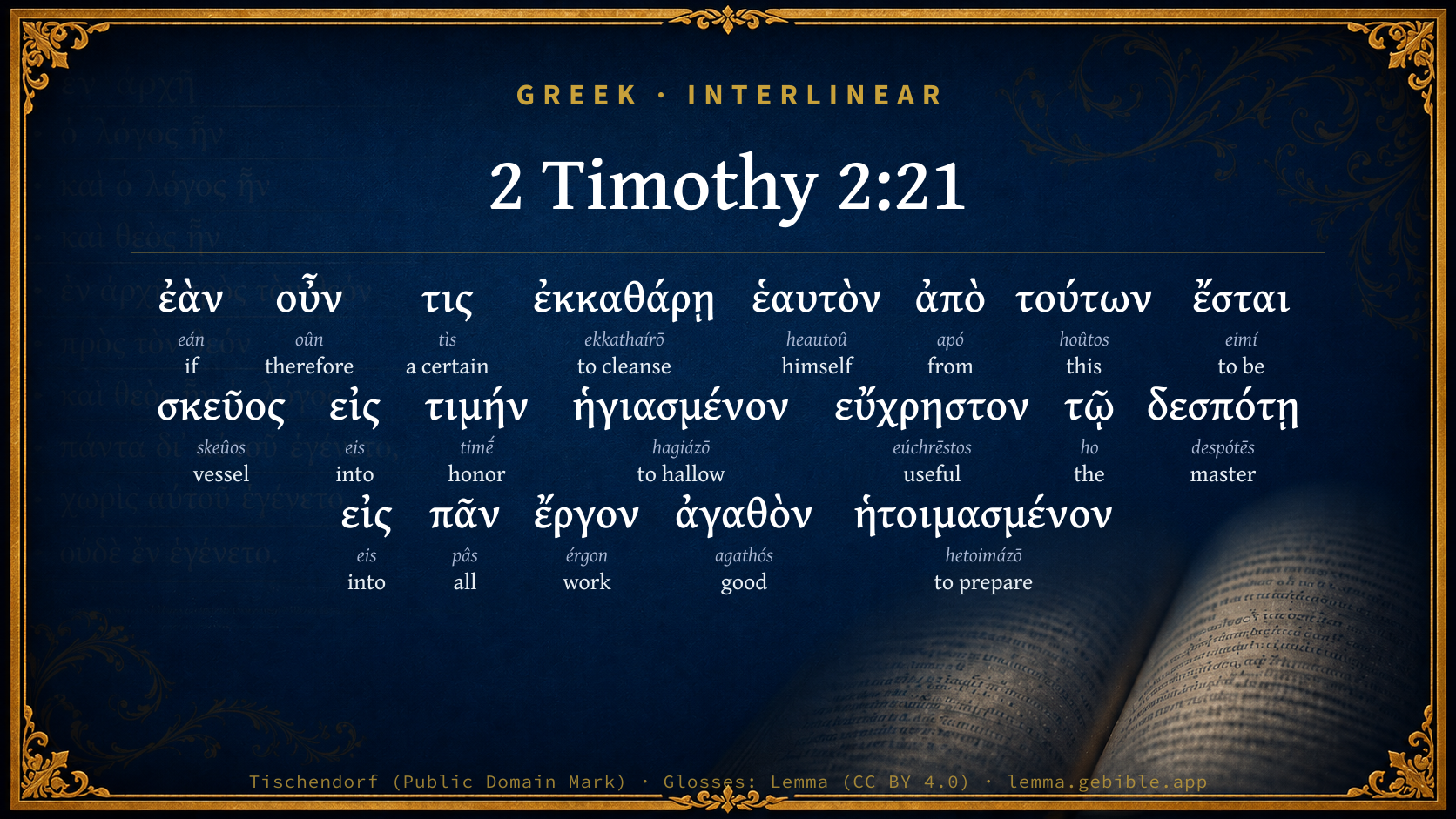
  1. ἐὰν eán G1437 “if” Conditional
  2. οὖν oûn G3767 “therefore” Conjunction
  3. τις tìs G5100 “a certain” Indefinite pronoun, Nominative, Singular, Masculine
  4. ἑαυτὸν heautoû G1438 “himself” Reflexive pronoun, 3rd person, Accusative, Singular, Masculine
  5. ἀπὸ apó G575 “from” Preposition
  6. τούτων hoûtos G3778 “this” Demonstrative pronoun, Genitive, Plural, Neuter
  7. ἔσται eimí G1510 “to be” Verb, Future, Middle deponent, Indicative, 3rd person, Singular
  8. σκεῦος skeûos G4632 “vessel” Noun, Nominative, Singular, Neuter
  9. εἰς eis G1519 “into” Preposition
  10. τιμήν timḗ G5092 “honor” Noun, Accusative, Singular, Feminine
  11. ἡγιασμένον hagiázō G37 “to hallow” Verb, Perfect, Passive, Participle, Nominative, Singular, Neuter
  12. εὔχρηστον eúchrēstos G2173 “useful” Adjective, Nominative, Singular, Neuter
  13. τῷ ho G3588 “the” Article, Dative, Singular, Masculine
  14. δεσπότῃ despótēs G1203 “master” Noun, Dative, Singular, Masculine
  15. εἰς eis G1519 “into” Preposition
  16. πᾶν pâs G3956 “all” Adjective, Accusative, Singular, Neuter
  17. ἔργον érgon G2041 “work” Noun, Accusative, Singular, Neuter
  18. ἀγαθὸν agathós G18 “good” Adjective, Accusative, Singular, Neuter
  19. ἡτοιμασμένον hetoimázō G2090 “to prepare” Verb, Perfect, Passive, Participle, Nominative, Singular, Neuter

About this verse

These counts appear in no published source. They are computed here, from the morphology-tagged text and Lemma’s own curated glosses. What Lemma adds →

20
words
19
distinct lemmas
Pauline Epistles
section

Notable vocabulary

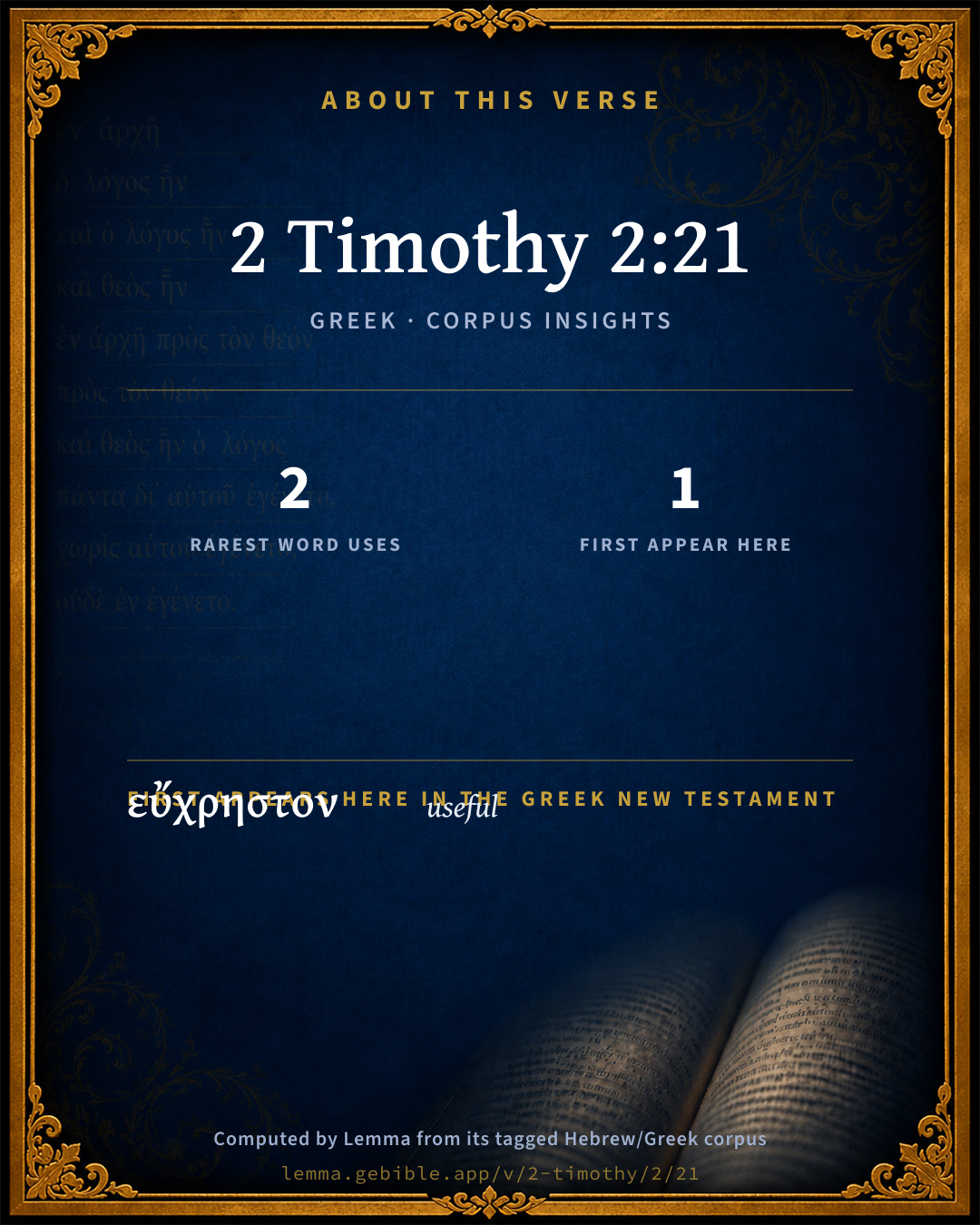
The rarest word here is ἐκκαθάρῃ to cleanse G1571 — appearing just 2 times in the whole Greek New Testament.

First appearance in Scripture

This word makes its first canonical appearance in the Greek New Testament here:

  • εὔχρηστον useful G2173

Shared distinctive vocabulary

ἐκκαθάρῃ to cleanse G1571 occurs in 2 verses of the Greek New Testament. Also found in:

Repetition

A word recurs within this verse:

Cross-references

17

Topical passages linked to 2 Timothy 2:21 in the Treasury of Scripture Knowledge — connected by theme and wording, ordered by reader-vote popularity; previews shown in the World English Bible.

  • 2 Timothy 3:17 that the man of God may be complete, thoroughly equipped for every good work.
  • Ephesians 2:10 For we are his workmanship, created in Christ Jesus for good works, which God prepared before that we would walk in them.
  • Psalms 119:9 How can a young man keep his way pure? By living according to your word.
  • 2 Corinthians 7:1 Having therefore these promises, beloved, let us cleanse ourselves from all defilement of flesh and spirit, perfecting holiness in the fear of God.
  • 1 Peter 1:22 Seeing you have purified your souls in your obedience to the truth through the Spirit in sincere brotherly affection, love one another from the heart fervently:
  • 1 John 3:3 Everyone who has this hope set on him purifies himself, even as he is pure.
  • 2 Timothy 2:20 Now in a great house there are not only vessels of gold and of silver, but also of wood and of clay. Some are for honor, and some for dishonor.
  • Isaiah 52:11 Depart you, depart you, go you out from there, touch no unclean thing; go you out of the midst of her; cleanse yourselves, you who bear the vessels of Yahweh.
  • Jeremiah 15:19 Therefore thus says Yahweh, If you return, then will I bring you again, that you may stand before me; and if you take forth the precious from the vile, you shall be as my mouth: they shall return to you, but you shall not return to them.
  • Acts 9:15 But the Lord said to him, "Go your way, for he is my chosen vessel to bear my name before the nations and kings, and the children of Israel.
  • Titus 3:8 This saying is faithful, and concerning these things I desire that you affirm confidently, so that those who have believed God may be careful to maintain good works. These things are good and profitable to men;
  • Malachi 3:3 and he will sit as a refiner and purifier of silver, and he will purify the sons of Levi, and refine them as gold and silver; and they shall offer to Yahweh offerings in righteousness.
  • 1 Corinthians 5:7 Purge out the old yeast, that you may be a new lump, even as you are unleavened. For indeed Christ, our Passover, has been sacrificed in our place.
  • Titus 3:1 Remind them to be in subjection to rulers and to authorities, to be obedient, to be ready for every good work,
  • Titus 3:14 Let our people also learn to maintain good works for necessary uses, that they may not be unfruitful.
  • 1 Peter 1:7 that the proof of your faith, which is more precious than gold that perishes even though it is tested by fire, may be found to result in praise, glory, and honor at the revelation of Jesus Christ--
  • Isaiah 1:25 And I will turn my hand on you, Thoroughly purge away your dross, And will take away all your tin.

Cross-references courtesy of OpenBible.info (CC BY 4.0).

Commentary

Notes on 2 Timothy 2:21 from classic Christian and Jewish commentators (each source and its license shown beneath its notes). The classic Christian expositions comment on the surrounding passage and are grouped to its opening verse, so a note may address several verses; the Jewish commentaries on the Tanakh (Rashi and others) are per-verse, so they appear only where the commentator wrote on this verse.

Lemma curates 59 commentaries, every one of them public domain or Creative Commons licensed, each selected and text-cleaned for this edition rather than reprinted as found. About our sources →

Bengel's Gnomon

Johann Albrecht Bengel

2Ti 2:21. Ἐὰν οὖν τις, if a man therefore) for example, Timothy.—ἐκκαθάρῃ ἑαυτὸν ἀπὸ τούτων) by purging himself, shall go forth from the number of these vessels, to dishonour. The active voice with the reciprocal pronoun indicates the utmost freedom of power on the part of believers.—ἡγιασμένον, sanctified) The peculiar property of God, and entirely devoted to Him.—καὶ, and) εἰς τιμήν—ἡτοιμασμένον, for honour—prepared, forms four clauses; of which the first is explained by the second, the third by the fourth. Therefore and connects these two pairs. Comp. 2Ti 3:17, ἄρτιος—ἐξηρτισμένος.—τῷ δεσπότῃ, truly-serviceable to the Master) viz. God, whose house Paul in his epistles to Timothy calls the church.—πᾶν ἔργον ἀγαθὸν, every good work) ch. 2Ti 3:17; Tit 1:16.

Bengel's Gnomon of the New Testament — English translation (T&T Clark, Edinburgh, 1860) — public domain. Text from a community e-Sword module.

Meyer's Critical & Exegetical Commentary

Heinrich August Wilhelm Meyer

2Ti_2:21. Without explaining the figure, the apostle carries it on, but in such a way as to show to the members of the church how each one may become a vessel to honour.

ἐὰν οὖν τις ἐκκαθάρῃ ἑαυτὸν ἀπὸ τούτων] ἐκκαθαίρειν, according to classic Greek (also 1Co_5:7), is an intensive form of καθαίρειν (N. T. καθαρίζειν). Chrysostom rightly says: οὐκ εἶπε· καθάρῃ, ἀλλʼ ἐκκαθάρῃ, τουτέστι, παντελῶς καθάρῃ. The opinion (formerly expressed in this commentary) was incorrect, that ἐκ only foreshadows the ἀπὸ τούτων. The translation is inaccurate: if one keeps himself pure (Heydenreich, equivalent to καθαρὸν, ἁγνὸν ἑαυτὸν τηρεῖν); Luther rightly: purifies himself. The word indicates the departure from impure companionship; comp. 2Ti_2:19, ἀποστήτω, and 1Ti_6:5 (according to Rec.), ἀφίστασο ἀπὸ τῶν τοιούτων.[40] Wiesinger makes the construction pregnant: separate oneself from these by self-purification; it is more correct, however, to regard the separation itself as the purification.

ἈΠῸ ΤΟΎΤΩΝ] cannot according to the context be taken as a collective neuter: from such things, ἈΠῸ ΤῶΝ ΕἸΡΗΜΈΝΩΝ, ἨΓΟῦΝ ἈΔΙΚΊΑς, ἈΤΙΜΊΑς, or even ἈΠῸ ΤῶΝ ΒΕΒΉΛΩΝ ΚΕΝΟΦΟΝΙῶΝ, 2Ti_2:16; it refers rather to Ἃ ΔῈ ΕἸς ἈΤΙΜΊΑΝ. Luther: from such people; comp. the passage quoted, 1Ti_6:5. Hofmann is altogether mistaken in his curious idea that ἈΠῸ ΤΟΎΤΩΝ means from that time forward, and is to be connected with what follows. This reference is nowhere in the N. T. expressed by ἈΠῸ ΤΟΎΤΩΝ (comp. Mat_26:29 : ἈΠʼ ἌΡΤΙ); besides, this more precise definition of ἜΣΤΑΙ is quite superfluous, whereas ἘΚΚΑΘΆΡῌ ἘΑΥΤΌΝ without more precise definition is too general.

ἜΣΤΑΙ ΣΚΕῦΟς ΕἸς ΤΙΜῊΝ, ἩΓΙΑΣΜΈΝΟΝ] Lachmann has wrongly deleted the comma between ΤΙΜ. and ἩΓΙΑΣΜ. ΕἸς does not depend on ἩΓ., but ΣΚ. ΕἸς ΤΙΜ. forms here, like Ἃ ΜῈΝ ΕἸς ΤΙΜΉΝ in 2Ti_2:20, one idea to which various attributes, ἡγιασμένον being the first, are added in order to describe the nature of such a ΣΚ. ΕἸς ΤΙΜ.

ἩΓΙΑΣΜΈΝΟΝ] is not = ΣΚΕῦΟς ἘΚΛΟΓῆς, Act_9:15 (Heydenreich), but: sanctified; as belonging to the Lord. Εὔχρηστον = good for using; τῷ δεσπότῃ, the master of the house; εἰς πᾶν ἔργον ἀγαθὸν ἡτοιμασμένον (comp. Rev_9:7), prepared for every good work. While all expositors join τῷ δεσπότῃ with ΕὔΧΡΗΣΤΟΝ, Hofmann prefers to refer it to what follows, without giving any reason for so doing. Elsewhere in the N. T. ΕὔΧΡΗΣΤΟς occurs only in connection with the dative of more precise definition (2Ti_4:11; Phm_1:11).

[40] Bengel remarks: Activum cum pronomine reciproco indicat liberrimam facultatem fidelium.Beza seeks, on the other hand, to save the doctrine of predestination: Volumus et efficimus, sed per eum qui gratis et in solidum efficit in nobis bonam et efficacem voluntatem, turn quod ad διάθεσιν, tum quod ad ἐνέργειαν attinet.

Meyer — Critical and Exegetical Commentary on the New Testament — English translation by Peter Christie, edited by Frederick Crombie (T&T Clark, 1880) — public domain. Text from a community e-Sword module.

Expositor's Greek Testament

ed. W. Robertson Nicoll

2Ti 2:21 . St. Paul drops the metaphor. The general meaning is clear enough, that a man may become “heaven’s consummate cup,” σκεῦος ἐκλογῆς (Act 9:15 ), if he “mistake not his end, to slake the thirst of God”. When we endue the vessels with consciousness, it is seen that they may “rise on stepping-stones of their dead selves to higher things”. The τις has been, it is implied, among the “vessels unto dishonour”. “Paul was an earthen vessel, and became a golden one. Judas was a golden vessel, and became an earthen one” (Chrys.). Bengel supposes that the ἐάν τις is an exhortation to Timothy himself. This is suggested in R.V. of 2Ti 2:22 , “But flee,” etc. The reference in τούτων is not quite clear. It is best perhaps to explain it of the false teachers themselves, “vessels unto dishonour,” rather than of their teaching or immoral characteristics, though of course this is implied. The thoroughness of the separation from the corrupting environment of evil company is expressed by the ἐκ - and ἀπό . Where ἐκκαθαίρω occurs again, 1Co 5:7 , the metaphor (leaven) also refers to the removal of a corrupting personal element. There the person is to be expelled; here the persons are to be forsaken. ἡγιασμένον is the equivalent in actual experience of the simile σκεῦος εἰς τιμήν , as εἰς πᾶν ἡτοιμασμένον is of εὔχρηστον τῷ δεσπότῃ . Compare 1Co 6:11 , “And such were some of you: but ye were washed [lit. washed yourselves], but ye were sanctified” ( ἡγιάσθητε ).

ἡτοιμασμένον : “Even though he do not do it, he is fit for it, and has a capacity for it” (Chrys.). Cf. Eph 2:10 , κτισθέντες … ἐπὶ ἔργοις ἀγαθοῖς οἶς προητοίμασεν ὁ θεὸς ἵνα ἐν αὐτοῖς περιπατήσωμεν , and reff.

The Expositor's Greek Testament, edited by W. Robertson Nicoll (1897–1910) — public domain. Text from a community e-Sword module.

Geneva Bible (1599)

Geneva Bible translators

By these words is meant the execution of the matter, and not the cause: for in that we purge ourselves, it is not to be attributeth to any free will that is in us, but to God, who freely and wholly worketh in us a good and an effectual will.

Geneva Bible (1599) marginal notes — public domain. Text via Bolls.life.

Jamieson, Fausset & Brown

Robert Jamieson, A. R. Fausset & David Brown

If a man . . . purge himself from these--The Greek expresses "If one (for example, thou, Timothy) purify himself (so as to separate) from among these" (vessels unto dishonor).

sanctified--set apart as wholly consecrated to the Lord.

and meet--Some oldest manuscripts omit "and."

the master's--the Lord's. Paul himself was such a vessel: once one among those of earth, but afterwards he became by grace one of gold.

prepared unto every good work-- (Ti2 3:17; Tit 3:1). Contrast Tit 1:16.

Jamieson, Fausset & Brown — Commentary Critical and Explanatory on the Whole Bible (1871) — public domain (CC PDM 1.0). Text via the HelloAO Bible API.

Adam Clarke's Commentary

Verse 21. If a man therefore purge himself from these] He that takes heed to his ways and to his doctrines, and walks with God, will separate himself, not only from all false doctrine, but from all wicked men, and thus be sanctified and proper to be employed by the Master in every good word and work. The apostle has not made the application of these different similes, and it is very difficult to tell what he means.

Adam Clarke's Commentary on the Bible (1810–1826) — public domain. Text from a community e-Sword/MySword module.

John Calvin's Commentaries

21 If any man shall cleanse himself from these If the reprobate are “vessels for dishonor,” they have that dishonor confined to themselves, but they do not disfigure the house, or bring any disgrace on the head of the family, who, while he has a variety of articles of furniture, appropriates each vessel to its proper use. But let us learn, by their example, to apply them to better and worthier uses; for in the reprobate, as in mirrors, we perceive how detestable is the condition of man, if he do not sincerely promote the glory of God. Such examples, therefore, afford to us good ground for exhortation to devote ourselves to a holy and blameless life.

There are many who misapply this passage, for the sake of proving that what Paul elsewhere (Romans 9:16) declares to belong “to God that sheweth mercy,” is actually within the power of “him that willeth and him that runneth.” This is exceedingly frivolous; for Paul does not here argue about the election of men, in order to shew what is the cause of it, as he does in the ninth chapter of the Epistle to the Romans (Romans 9); but only means that we are unlike wicked men, whom we perceive to have been born to their perdition. It is consequently foolish to draw an inference from these words, about the question whether it is in a man’s power to place himself in the number of the children of God, and to be the author of his own adoption. That is not the present question. Let this short warning suffice against those who bid a man cause himself to be predestinated; as if Paul enjoined men to do what they must have done before they were born, and even before the foundations of the world were laid.

Others, who infer from these words that free-will is sufficient for preparing a man, that he may be fit and qualified for obeying God, do not at first sight appear to be so absurd as the former, yet there is no solidity in what they advance. The Apostle enjoins that men who desire to consecrate themselves to the Lord cleanse themselves from the pollution of wicked men; and throughout the Scriptures God gives the same injunction; for we find nothing here but what we have seen in many passages of Paul’s writings, and especially in the Second Epistle to the Corinthians,

“Be ye clean, that bear the vessels of the Lord.”

Beyond all controversy, we are called to holiness. But the question about the calling and duty of Christians is totally different from the question about their power or ability. We do not deny that it is demanded from believers that they purify themselves; but elsewhere the Lord declares that this is their duty, while he promises by Ezekiel that he will send

“clean waters, that we may be cleansed.” (Ezekiel 36:25.)

Wherefore we ought to supplicate the Lord to cleanse us, instead of vainly trying our strength in this matter without his assistance.

A vessel sanctified for honor means, set apart for honorable and magnificent purposes. In like manner, what is useful to the head of the family is put for that which is applied to agreeable purposes. He afterwards explains the metaphor, when he adds, that we must be prepared for every good work. Away with the wild language of fanatics, “I will contribute to the glory of God, as Pharaoh did; for is it not all one, provided that God be glorified?” For here God explicitly states in what manner he wishes us to serve him, that is, by a religious and holy life.

John Calvin's Commentaries (1540-1563) — public domain. Text from the Calvin Translation Society English edition (1840s-50s) via the Christian Classics Ethereal Library (ccel.org). Calvin's coverage is partial (roughly two-thirds of the Bible); uncommented books and verses are honest gaps, never fabricated. The 19th-century editor's footnotes and remarks are omitted so the notes are faithfully Calvin's own voice.

Ellicott's Commentary for English Readers

(21) If a man therefore purge himself from these.—Again the reference is general, but there was a special thought for Timothy when St. Paul wrote this. If he would separate from all that was evil in his Church at Ephesus, then would he indeed be one of those golden vessels unto honour. The image of the great house, and its many and varied vessels, though still not quite lost sight of, is passing out of sight. This verse changes into a note of direct exhortation. The good and faithful must separate themselves from the evil and faithless. The thought of those deniers of the resurrection of the body was uppermost in St. Paul’s mind. There must, as it has been well said, be no communion on the part of God’s servants with impugners of fundamentals. It was imperatively necessary for Timothy—and, by implication, for all members of Christ’s Church—if they aimed at becoming vessels for honour in the great Temple, to break off from all Church fellowship, from all intimate friendship, with those above referred to under the image of wooden or earthen vessels.

He shall be a vessel unto honour.—Chrysostom’s note upon these words is somewhat remarkable. He points out the possibility of the vessel for dishonour becoming a vessel for honour, and the reverse; and refers to St. Paul, once an earthen vessel, who became a vessel of gold, and to the traitor Judas, who, on the other hand, from being a vessel of gold became an earthen vessel.

Meet for the master’s use.—Or, useful for the master (of the house). “Useful,” as the next sentence shows us, through those good works by means of which others’ needs are ministered to, and the salvation of others is furthered, and the glory of God is increased.

Prepared unto every good work.—“Prepared”—that is, ready to take advantage of any opportunity which may offer itself to do a generous, noble action. So, too, Chrysostom, who would have the “vessel unto honour” ready for every emergency which would enhance the glory of the Lord—ready even for death, or (any painful) witness.

A Bible Commentary for English Readers, edited by Charles John Ellicott (1878–1897) — public domain. Text from a community e-Sword module.

The Cambridge Bible for Schools and Colleges

gen. ed. J. J. S. Perowne

21. If a man therefore purge himself from these] That is, as Bengel puts it, ‘if any one shall by purifying himself have gone out of their number.’ The compound verb ‘purge out’ only occurs besides in 1Co_5:7 where the preposition gives the force ‘purge out from your houses the old leaven.’ Wordsworth forcibly notes here; ‘a man may at one time of his life be numbered among vessels to dishonour, and yet may become a vessel to honour, by cleansing himself out from their number and condition. Mark this assertion of Free Will.’ And again, ‘a Christian man may not go out of the great house which is the Visible Church of God: he cannot separate himself wholly from sinners, but he must cleanse himself from them as sinners; that is, he must not communicate with them in their sins.’

sanctified] Or perhaps better ‘purified.’ ‘Sanctified’ belongs to metaphor, the implied Christian life and service; but in form the sentence remains a simile to the end. Hence R.V. rightly renders the master’s use, i.e. the master of the house, not with some printed copies of A.V. ‘the Master’s,’ which would imply an immediate reference to God. ‘Meet for use’ is the same word as in 2Ti_4:11 ‘serviceable,’ and in Phm_1:11, where Onesimus formerly ‘unprofitable’ is ‘now profitable.’

prepared] This word and ‘sanctified’ are both perfect passive participles, and are more expressive than our English can shew of the resulting final state reached. See note on 2Ti_2:26.

The Cambridge Bible for Schools and Colleges (gen. ed. J. J. S. Perowne; Cambridge University Press, 1878–1918) — public domain. Text from a community e-Sword module.

John Gill's Exposition

If a man therefore purge himself from these,.... That is, if a man clears himself, and keeps himself clear from such men as Hymenaeus and Philetus, who are comparable to wooden and earthen vessels, and are dishonourable ones; if he shuns their defiling company, and polluting principles; if he keeps clear of their heresies, and is not carried away with the errors of these wicked men, and is not drawn aside by them into immoral practices, but stands fast in the faith, and departs from iniquity:

he shall be a vessel unto honour; he will be made manifest, and appear to be a vessel chosen to honour; and will be an honourable member of the church here, and will be honoured by Christ hereafter:

sanctified: he will appear to be one that is set apart by God the Father, and whose sins are purged away by the blood of Christ, and who is sanctified internally by the Spirit of God; for external holiness springs from internal holiness, and is, an evidence of it:

and meet for the master's use: the use and service of Christ, who is the master of the house; either for the ministry of the word, the administration of ordinances, or for some service or another, which he calls him to, and employs him in.

And prepared unto every good work; which an unregenerate man is not; he is to every good work reprobate; he is not capable of performing good works; he is not prepared for them, nor ready at them; but a true believer, one that is regenerated, and sanctified by the Spirit of God, he is created in Christ Jesus unto good works; and has in the performing of them right principles, aims, and ends, as well as a supply of grace, by which he is enabled to do them.

John Gill's Exposition of the Whole Bible (1746–1763) — public domain (CC PDM 1.0). Text via the HelloAO Bible API.

Trapp's Complete Commentary

John Trapp

21 If a man therefore purge himself from these, he shall be a vessel unto honour, sanctified, and meet for the master’s use, and prepared unto every good work.

Ver. 21. Purge himself from these] From these seducers or arch-heretics, those vessels of dishonour, whose doctrine defileth worse than any kitchen stuff or leprosy.

He shall be a vessel, &c.] You know (said John Careless, the martyr, in a letter to Mr Philpot) that the vessel before it be made bright is soiled with oil and many other things, that it may scour the better. Oh, happy be you that you be now in this scouring house; for shortly you shall be set upon the celestial shelf as bright as angels, &c.

John Trapp, A Commentary or Exposition upon All the Books of the Old and New Testament (1647–1656) — public domain. Text from a community e-Sword module.

Albert Barnes' Notes on the Bible

If a man therefore purge himself from these, he shall be a vessel unto honour - If a man “cleanse” or “purify” himself; compare the notes on Joh 15:2. The word “these” refers, here, to the persons represented by the vessels of wood and of earth - the vessels made to dishonor, as mentioned in the previous verse 2Ti 2:20. The idea is, that if one would preserve himself from the corrupting influence of such men, he would be fitted to be a vessel of honor, or to be employed in the most useful and honorable service in the cause of his Master. On the word “vessel,” see the notes at Act 9:15.

And meet for the master’s use - Suitable to be employed by the Lord Jesus in promoting his work on earth.

Albert Barnes' Notes on the Bible (1834–1885) — public domain. Text from a community e-Sword/MySword module.

Haydock's Catholic Bible Commentary

Man, we see here, hath free-will to make himself a vessel of salvation or reprobation; though salvation be attributed to God’s mercy, the other to his justice, neither repugnant to our free-will, but working with and by the same, all such effects in us, as to his providence and our deserts are agreeable. (Bristow)

George Leo Haydock (1774–1849), Haydock's Catholic Family Bible and Commentary, 1859 edition — public domain. Excludes Psalms (Douay-Rheims chapter numbering differs from Protestant) and Deuterocanonical books (Catholic canon only).

Matthew Poole's English Annotations

If a man therefore purge himself from these; from these wicked men that subvert the faith of others, or from their wicked opinions and courses.

He shall be a vessel unto honour, sanctified, and meet for the master’s use; God will honour him; and he will by it be set apart, and made fit for Christ’s use in his church.

And prepared unto every good work; and made fit for every good work; which men are not, while they are either tainted with pernicious, damnable errors relating to the doctrine of faith, or the companions of those fools.

Matthew Poole's English Annotations on the Holy Bible (1683–1685) — public domain. Text from a community e-Sword/MySword module.

Whedon's Commentary on the Bible

Daniel D. Whedon

21. Purge himself (in obedience to the second motto in 2Ti_2:19) from these modern Korahites, the vessels of dishonour. The simile is carried out with much completeness. The cleaned dish is ready for all cleanly use by the owner.

Daniel D. Whedon (gen. ed.), Commentary on the Old and New Testaments (1874–1909) — public domain. Text from a community e-Sword module.

The Pulpit Commentary

Meet for and meet, A.V and T.R.; prepared for and prepared, A.V Purge himself from these (ejkkaqarh); stronger than the simple kaqarh, "thoroughly purge himself," as in 1Co_5:7 (the only other place in the New Testament where it occurs) and as in classical Greek. It is used also by the LXX inx; Jud_1:7:4, as the rendering ofpr) to try metals. The idea, therefore, seems to be that of separation, and, if so, "from these" may certainly mean from the false teachers described under the image of the vessels unto dishonour, as usually explained. At the same time, the image is better sustained if we understand "from these" to mean the babblings, and ungodliness, and eating words of the heretics denounced. It is hardly natural to imply that one vessel in the house will become a golden vessel by purging itself from the wooden and earthen vessels. Neither is separation from the false teachers the point which St. Paul is here pressing, but avoidance of false doctrines. Meet foruse (eucrhstov); only here and ch. 4:11 and Phm_1:11. Also Pro 29:(31) Pro_29:13, LXX Common in classical Greek. The master (tw despoth); the master of the house, the oijkodespothv.

Fitness for service.

for the Master"s use." Christ is our Lord as well as our Saviour. We are under a Master, and must bring our thought in captivity unto him.

I MEETNESS. For in man there is a power that grows by culture. Not so with the inferior animals. Take the bee: the first cell it makes is as geometrically perfect as the last. So take the bird: the first nest it makes is as soft and complete as the last. But man can grow in meetness. Self-discipline meetens. Sorrow meetens. Suffering meetens.

II MINISTRATIONS. Use. This characterizes all the works of God. The river is not only a silver thread running through the landscape; it brings freshness and verdure, and the cattle come to the banks to drink, and there is emerald verdure by the riverside. Ships, too, float on its waters. We are to be of use to the Master. He deigns to use us. "Son, go work today in my vineyard." Many in this age dislike the word "Master;" but we are always under some master, consciously or unconsciously. We serve God or Mammon, and we cannot serve both. We are to attend to spiritual means of grace, and to seek out modes of service, so as to be of use to the Master. W.M.S.

The Pulpit Commentary (1880–1919), ed. H.D.M. Spence-Jones & Joseph S. Exell — public domain. Text from a community e-Sword module.

John Wesley's Explanatory Notes

If a man purge himself from these - Vessels of dishonour, so as to have no fellowship with them.

John Wesley, Explanatory Notes Upon the Whole Bible (1754–1765) — public domain. Text via the GEBible commentary corpus.

Fairbairn on Ezekiel, Jonah & the Pastoral Epistles

Patrick Fairbairn

Ver. 21. There follows, therefore, a virtual exhortation to separate oneself from this class, and make sure of reaching the state and destination of the other. Without explaining what corresponded to the two kinds of vessels, taking for granted that this was understood, the apostle says, If any one, then, shall have purged himself from these—that is, as Bengel well explains, shall by purifying himself have gone out of their number, those, namely, represented by the vessels associated with dishonour—he shall be a vessel for honour, sanctified, serviceable to the Master, prepared for every good work. Looking at the matter simply from a human point of view, and as connected with each man’s personal responsibilities, the apostle merely points to the result to be aimed at and attained, leaving it to be ascertained from the great principles of the gospel how the end in question was to be accomplished. He contents himself with putting before men a plain practical issue: moving no question about election, or about adoption into the family of God; but simply teaching, as Calvin well puts it, “that all who would consecrate themselves to the Lord must purge themselves from the filthiness of the ungodly—the same, indeed, that God everywhere teaches. For we hear nothing else in this passage than what we find in many other parts of Paul’s epistles, and particularly in his second to the Corinthians: Be ye clean who bear the vessels of the Lord. It is hence clear beyond contradiction that we are called to holiness. But the calling and duty of Christians is one thing, and it is another whence the faculty or power of effecting it. That the faithful are required to purify themselves, we deny not; but that this is a matter which belongs to the Lord, He declares Himself, when through the prophet Ezekiel He promises to send forth the Holy Spirit, that we may be cleansed (Eze 36:25). Wherefore Ave should rather beseech the Lord to purge us, than vainly make trial in such a matter of our own strength without His aid.” In a word, the thing itself must be done by us: every individual should lay it upon his conscience as a condition he is morally bound to have made good; but when he comes in earnest to attempt it, he finds he can only succeed by throwing himself on the redeeming mercy and sanctifying grace of God.

Patrick Fairbairn — An Exposition of Ezekiel (1851), Jonah (1849), and The Pastoral Epistles (1874) — public domain. Text from a community e-Sword module.

The People's New Testament

B. W. Johnson

21. If a man therefore purge himself from these. If a man wishes to be a noble vessel, of gold, for honorable uses in the Lord's house, let him cleanse himself from earthly lusts.

B. W. Johnson's The People's New Testament with Notes (1889–1891) — public domain. Electronic text from the Christian Classics Ethereal Library (CCEL) ThML edition.

Cambridge Greek Testament for Schools and Colleges

21. εὔχρηστον. καί is prefixed in the rec. text, following אcC*KLP; א*AD2*EG omit it. Versions may be cited on both sides, but on such a point their evidence is not very convincing.

21. ἐὰν οὖν τις ἐκκαθάπῃ ἑαυτὸν ἀπὸ τούτων. If a man therefore purge himself from these. Quite generally it may be necessary from time to time to cast out the ‘vessels for dishonour’; here St Paul seems specially to have had in mind Timothy’s situation in respect of the ψευδοδιδάσκαλοι. It will be a stern duty to ‘purge himself’ from them. For ἐκκαθαίρειν cp. 1Co 5:7.

ἕσται σκεῦος εἰς τιμήν, he shall be a vessel unto honour. (Cp. Act 9:15, σκεῦος ἐκλογῆς.) Otherwise, we know that “evil communications corrupt good manners” (1Co 15:34).

ἡγιασμένον, sanctified. For this word as applied to believers by St Paul cp. Rom 15:16 and Act 20:32; Act 26:18.

εὔχρηστον τῷ δεσπότῃ, meet for the master’s, or owner’s, use. See crit. note. εὔχρηστος is only found again in N.T. 2Ti 4:11; Phm 1:11.

For δεσπότης see on 1Ti 6:1.

εἰς πᾶν ἔργον ἀγαθὸν ἡτοιμασμένον, prepared unto every good work. Cp. ch. 2Ti 3:17; Tit 3:1; and cp. also 2Co 9:8; Tit 1:16. As it is true that the ἔργα ἀγαθά are prepared of God for us to walk in (Eph 2:10), so it is also true, and equally important to remember, that God’s servants must be on their part prepared for these ἔργα ἀγαθά.

Cambridge Greek Testament for Schools and Colleges (Cambridge University Press, 1896; 21 vols, various authors incl. Carr, Maclear, Plummer, Farrar, Lumby, Moule, M. R. James, Simcox) — public domain. Text from a community e-Sword module.

Alford’s Greek Testament

Henry Alford

21.] Here the thing signified is mingled with the similitude: the voluntary act described belonging, not to the vessels, but to the members of the church who are designated by them. If then (οὖν deduces a consequence from the similitude: q. d. ‘his positis’) any man (member of the church) shall have purified himself (not as Chrys., παντελῶς καθάρῃ: but as Bengel, ‘purgando sese exierit de numero horum:’ the ἐκ corresponds to the ἀπο below, and I have attempted to give that in the following) from among these (viz. the latter mentioned vessels in each parallel; but more especially the σκεύη εἰς ἀτιμίαν, from what follows), he shall be a vessel for honour (Chrys. remarks: ὁρᾷς ὅτι οὐ φύσεως οὐδὲ ὑλικῆς ἀνάγκης ἐστὶ τὸ εἶναι χρυσοῦν ἢ ὀστράκινον. ἀλλὰ τῆς ἡμετέρας προαιρέσεως (?); ἐκεῖ μὲν γὰρ τὸ ὀστράκινον οὐκ ἂν γένηται χρυσοῦν, οὐδὲ τοῦτο εἰς τὴν ἐκείνου καταπεσεῖν εὐτέλειαν δυνήσεται· ἐνταῦθα δὲ πολλὴ μεταβολὴ καὶ μετάστασις. σκεῦος ὀστράκινον ἦν ὁ Παῦλος, ἀλλʼ ἐγένετο χρυσοῦν. σκεῦος χρυσοῦν ἦν (?) ὁ Ἰούδας, ἀλλʼ ἐγένετο ὀστράκινον), hallowed (not to be joined, as Calv. and Lachmann, who expunges the comma after τιμήν,—with εἰς τιμήν, seeing that εἰς τιμήν stands absolutely in the former verse. ἡγιασμένος (reff.) is a favourite word with our Apostle to describe the saints of God), useful (see instances of the meaning of this epithet in the two N. T. reff.) for the master (of the house), prepared for every good work (κἂν μὴ πράττῃ, ἀλλʼ ὅμως ἐπιτήδειόν ἐστι, δεκτικόν. δεῖ οὖν πρὸς πάντα παρεσκευάσθαι, κἂν πρὸς θάνατον, κἂν πρὸς μαρτύριον· κἂν πρὸς παρθενίαν, κἂν πρὸς ταῦτα πάντα. Chrys.).

Henry Alford, The Greek Testament (1849–1861) — public domain. Text from a community e-Sword module.

International Critical Commentary

21. τις] any member of the Church, but, especially, any who would be a teacher.

ἐκκαθ. ἑαυτόν] Keep himself (cf. 15 and 2Co 7:1) completely (ἐκ) pure by separation from these, i.e. from the vessels to dishonour: τούτων, prob. neuter, though the reference is primarily to the false teachers, “a doctoribus hæreticis,” Pelagius. σκεῦος ὀστράκινον ἦν ὁ Παῦλος ἀλλʼ ἐγένετο χρυσοῦν, Chrys.

εὔχρηστον] 4:11, Phm 1:11, easily usable (“utile,” Vulg; “optimum,” Thd.); contrast ἐπʼ οὐδὲν χρήσιμον 14; cf. Epict. ii. 16, τόλμησον ἀναβλέψας πρὸς τὸν θεὸν εἰπεῖν, χ̔ρῶ μοι λοιπὸν εἰς ὃ ἂν θέλῃς . . . σός εἰμι . . . ὅπου θέλεις, ἄγεʼ.

εἰς . . . ἀγαθόν] Tit 1:16, Tit 3:1. ἡτοιμασμένον he is prepared for the tasks prepared for him, Eph 2:10 κτισθέντες ἐν Χριστῷ Ἰησοῦ ἐπὶ ἔργοις ἀγαθοῖς οἷς προητοίμασεν ὁ θεός.

International Critical Commentary — older volumes (1896–1929), various authors — public domain. Text from a community e-Sword module.

Vincent's Word Studies in the New Testament

Marvin R. Vincent

Purge [εκκαθαρη] . Only here and 1Co 5:7. The meaning is, separate himself from communion with.

From these [απο τουτων] . From such persons as are described as; 'vessels "unto dishonor." Some attempt to relieve the awkwardness of this figure by referring these to persons mentioned in vv. 16, 17. Unto honor [εις τιμην] . Const. with vessel, not with sanctified. Sanctified [ηγιασμενον] . Comp. 1Ti 4:5. Set al art to noble and holy uses, as belonging to God. See on aJgiasmov sanctification, Rom 6:19. For agiov holy, see on 1Ti 5:10.

Meet [ευχρηστον] . From euj well and crasqai to use. Hence, easy to make use of, useful. The A. V. meet, is fit, suitable. Rend. serviceable. In contrast with to no profit, verse 14. See Phl 1:11, where the contrast with acrhstov useless is brought out. Only here, chapter 2Ti 4:11, Phl 1:11.

For the master's use [τω δεσποτη] . Use is superfluous. Rend. for the master. The master of the household. See on 1Ti 6:1.

Prepared [ητοιμασμενον] . In Paul, 1Co 2:9; Phl 1:22. Only here in Pastorals. Comp. Tit 3:1.

Every good work. The phrase in Paul, 2Co 9:8; Col 1:10; 2Th 2:17. In Pastorals, 1Ti 5:10; 2Ti 3:17; Tit 1:16; Tit 3:1.

Marvin R. Vincent, Word Studies in the New Testament (1887–1900) — public domain. Text from a community e-Sword/MySword module.

Lesson kit

Teaching starters — assembled from the data on this page, not authored interpretation. Every prompt links to the verse data it draws on. Edit before teaching.

2 Timothy, in the Pauline Epistles, opens this verse with 20 words (19 distinct Greek lemmas). Its most distinctive word is ekkathaírō (“to cleanse”). A historical commentator’s framing appears above. Read the whole chapter for the surrounding context.

Discussion questions

  1. What does “to cleanse” (ekkathaírō) contribute to the verse as a whole?
  2. This is the first place “useful” appears in Scripture (first appears here). What does its debut here establish?
  3. How does 1 Corinthians 5:7, which shares the word «to cleanse», read alongside this verse?
  4. What does the repetition of “into” (2× in this one verse) do in this verse?
  5. These translations render this verse differently; the difference is in the English rendering, not the original. What questions does that raise?
  6. Compare how Bengel's Gnomon and Meyer's Critical & Exegetical Commentary read this verse. Where do they agree or differ?

Things to notice

  • 1 word makes its first canonical appearance in Scripture here.
  • These translations choose different wording for 21 words in this verse.
  • “into” occurs 2× in this single verse.
  • 19 distinct Greek lemmas span 20 words in this verse.

Reading settings

Reading text

Shown beneath each verse's original-language words.

Old Testament
Old Testament edition

Read the OT as the Masoretic Hebrew (MT) or the Greek Septuagint (LXX).

English shown for the Greek Septuagint (in the Hebrew ↔ Greek comparison).

Comparing translations? Open the Compare panel on any verse page to stack up to four side by side.