
1 Timothy 2:10

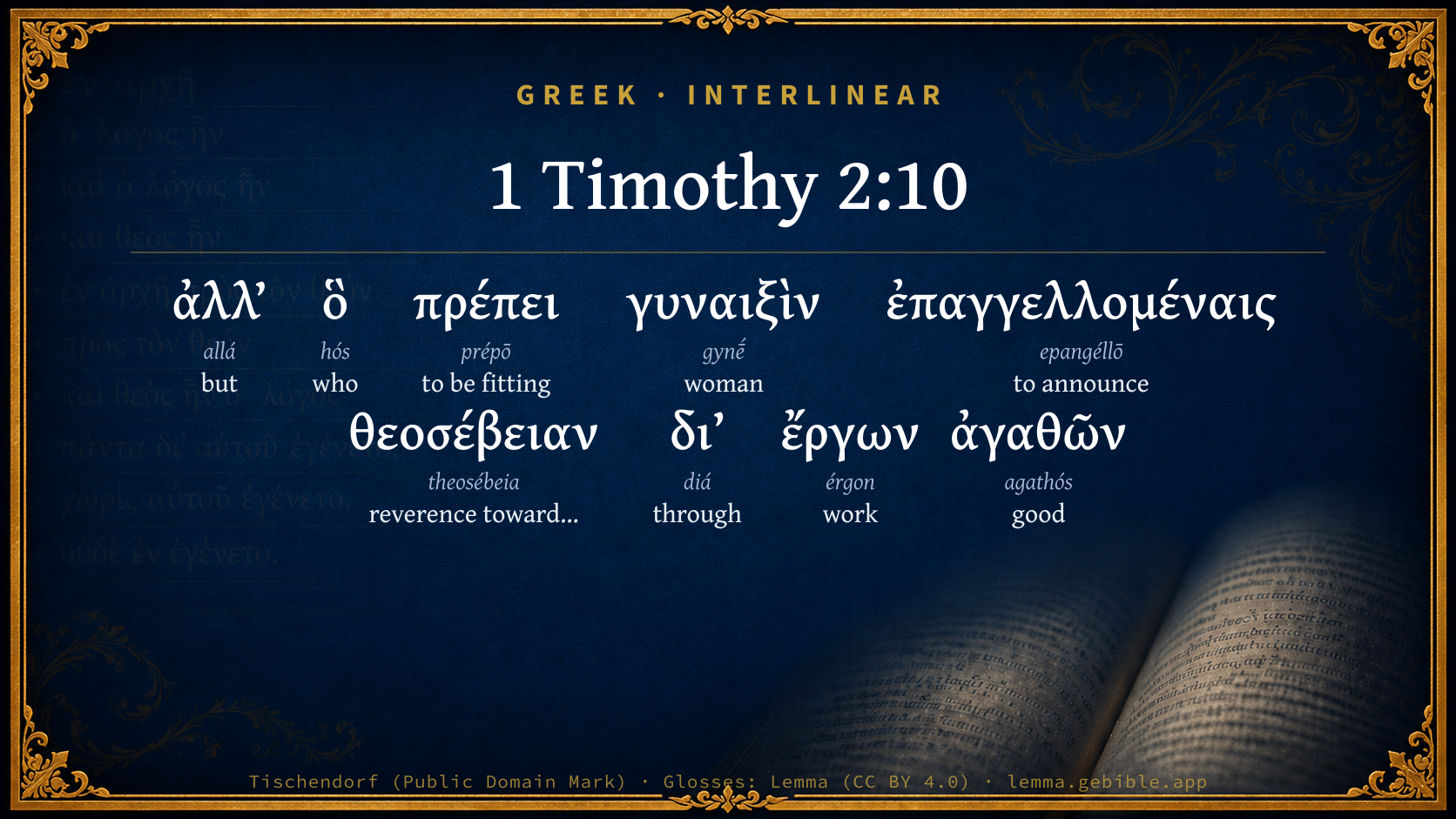
Greek (Tischendorf 8th ed.) 1 Timothy 2:10 appears in the Greek New Testament. The text above is from the Tischendorf 8th edition. Each word links to its Strong’s number and a concise gloss. Click any word for its full Thayer’s Greek Lexicon entry.
Download image
Cite this verse

1 Timothy 2:10 (World English Bible). Public Domain. Lemma interlinear Bible study tool, https://lemma.gebible.app/v/1-timothy/2/10.

Show BibTeX & RIS
BibTeX
RIS
English Translation
but (which becomes women professing godliness) with good works.
World English Bible · Public Domain
Highlights
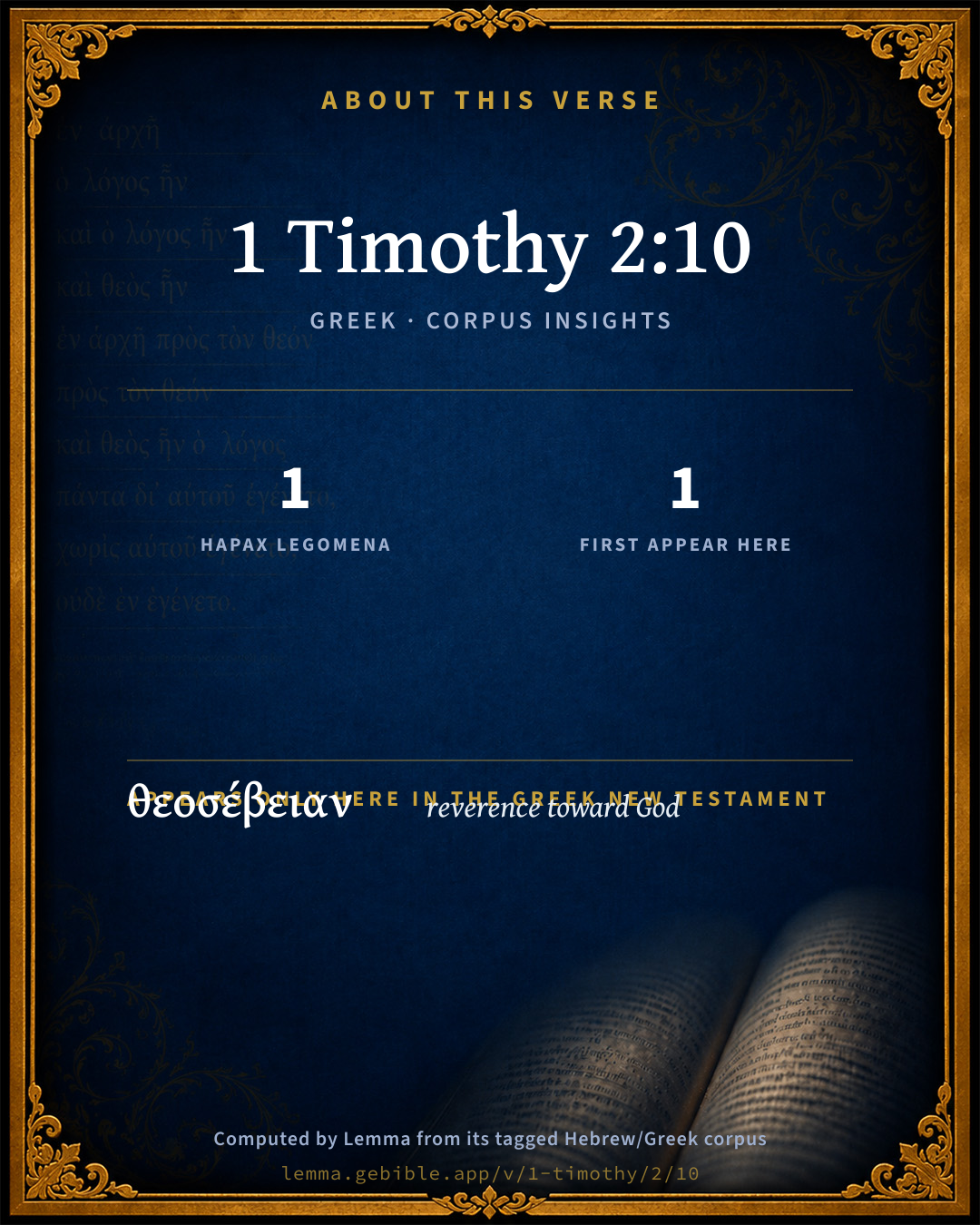
  • 1 hapax legomenon — only here in the Greek New Testament
  • 1 first appearance in the Greek New Testament
Full analysis ↓
Download a study sheet

One document with this verse’s original text, its word-by-word gloss line, the meaning frame, cross-references with their text, attributed commentary, and full source and license credits — printable, and it pastes into notes with its structure intact.

This verse Autodidact and up

Study sheet (.html) Plain text (.txt)

A passage Seminary Student

Up to 50 verses in one chapter. A passage sheet keeps up to 6 commentary sources and 12 cross-references per verse, in the order this page ranks them, and says so on the sheet whenever that leaves anything out. Ask for a single verse and you get the Autodidact verse sheet above.

Everything on this page stays free to read, with no account — the sheet is a download of what is already on screen, not access to it.

Want to remove ads? Support Godless Engineer
Compare translations 3

The same verse in 3 English versions, stacked beneath the original-language interlinear above. Click any original word for its lexicon entry.

Each is an independent rendering of the whole verse — the interlinear is not word-aligned to these translations.

Highlighted words mark where these versions differ — a whole-verse word diff, not a word-by-word alignment.

  • World English Bible Public Domain
    but (which becomes women professing godliness) with good works.
  • King James Version Public Domain
    But (which becometh women professing godliness) with good works.
  • unfoldingWord Literal Text CC BY-SA 4.0
    but—what is proper for women professing godliness—through good works.

unfoldingWord Literal Text — © unfoldingWord, licensed CC BY-SA 4.0. Word-aligned USFM3 via Door43 (git.door43.org/unfoldingWord/en_ult).

Versions to compare (up to 4)

3 of 4 selected

Show all 19 translations

Every available English version of this verse, each an independent rendering of the whole verse.

  • World English Bible Public Domain
    but (which becomes women professing godliness) with good works.
  • Berean Standard Bible Public Domain
    but with good deeds, as is proper for women who profess to worship God.
  • Majority Standard Bible Public Domain
    but with good deeds, as is proper for women who profess to worship God.
  • King James Version Public Domain
    But (which becometh women professing godliness) with good works.
  • American Standard Version (1901) Public Domain
    but (which becometh women professing godliness) through good works.
  • Revised Version (1885) Public Domain
    but (which becometh women professing godliness) through good works.
  • Geneva Bible (1599) Public Domain
    But (as becommeth women that professe the feare of God) with good workes.
  • Douay-Rheims (1899) Public Domain
    But as it becometh women professing godliness, with good works.
  • Young's Literal Translation Public Domain
    but -- which becometh women professing godly piety -- through good works.
  • Literal Standard Version CC BY-SA 4.0
    but—which becomes women professing godly piety—through good works.
  • Unlocked Literal Bible CC BY-SA 4.0
    I want them to dress with what is appropriate for women who profess godliness through good works.
  • unfoldingWord Literal Text CC BY-SA 4.0
    but—what is proper for women professing godliness—through good works.
  • Darby Bible Public Domain
    but, what becomes women making profession of the fear of God, by good works.
  • World Messianic Bible Public Domain
    but with good works, which is appropriate for women professing godliness.
  • Webster's Bible Public Domain
    But (which becometh women professing godliness) with good works.
  • Free Bible Version CC BY-SA 4.0
    but by the good things they do—as is appropriate for women who claim to follow God.
  • Bible in Basic English Public Domain
    But clothed with good works, as is right for women who are living in the fear of God.
  • Text-Critical English NT CC BY 4.0
    but with good works, which is proper for women who profess godly reverence.
  • Tyndale New Testament (1534) Public Domain
    but with suche as becometh wemen that professe the worshippynge of God thorow good workes.

Literal Standard Version (2020), Covenant Press — licensed CC BY-SA 4.0. Text via the HelloAO Bible API (eBible.org). Unlocked Literal Bible (unfoldingWord) — licensed CC BY-SA 4.0. Text via the HelloAO Bible API (eBible.org). unfoldingWord Literal Text — © unfoldingWord, licensed CC BY-SA 4.0. Word-aligned USFM3 via Door43 (git.door43.org/unfoldingWord/en_ult). Free Bible Version, Dr. Jonathan Gallagher — licensed CC BY-SA 4.0. Text via the HelloAO Bible API (eBible.org).

Word by word

More ways to search: Search by grammar → Find every occurrence → Compare this word →

Practice this passage: Drill this verse → Learn its vocabulary →

About this verse

These counts appear in no published source. They are computed here, from the morphology-tagged text and Lemma’s own curated glosses. What Lemma adds →

9
words
9
distinct lemmas
Pauline Epistles
section

Notable vocabulary

1 hapax legomenon — a word that appears only here in the entire Greek New Testament:

  • θεοσέβειαν reverence toward God G2317

First appearance in Scripture

This word makes its first canonical appearance in the Greek New Testament here:

  • θεοσέβειαν reverence toward God G2317

Shared distinctive vocabulary

πρέπει to be fitting G4241 occurs in 7 verses of the Greek New Testament. Also found in:
Cross-references

12

Topical passages linked to 1 Timothy 2:10 in the Treasury of Scripture Knowledge — connected by theme and wording, ordered by reader-vote popularity; previews shown in the World English Bible.

  • 1 Peter 2:12 having good behavior among the nations, so in that which they speak against you as evil-doers, they may by your good works, which they see, glorify God in the day of visitation.
  • 1 Peter 3:3–5 Let your beauty be not just the outward adorning of braiding the hair, and of wearing jewels of gold, or of putting on fine clothing;
  • Proverbs 31:31 Give her of the fruit of her hands! Let her works praise her in the gates!
  • Acts 9:36 Now there was at Joppa a certain disciple named Tabitha, which when translated, means Dorcas. This woman was full of good works and acts of mercy which she did.
  • Revelation 2:19 I know your works, your love, faith, service, patient endurance, and that your last works are more than the first.
  • Ephesians 2:10 For we are his workmanship, created in Christ Jesus for good works, which God prepared before that we would walk in them.
  • Titus 3:8 This saying is faithful, and concerning these things I desire that you affirm confidently, so that those who have believed God may be careful to maintain good works. These things are good and profitable to men;
  • 2 Peter 1:6–8 and in knowledge, self-control; and in self-control patience; and in patience godliness;
  • 2 Peter 3:11 Therefore since all these things are thus to be destroyed, what manner of persons ought you to be in holy living and godliness,
  • Acts 9:39 Peter got up and went with them. When he had come, they brought him into the upper chamber. All the widows stood by him weeping, and showing the coats and garments which Dorcas had made while she was with them.
  • 1 Timothy 5:6–10 But she who gives herself to pleasure is dead while she lives.
  • Titus 2:14 who gave himself for us, that he might redeem us from all iniquity, and purify for himself a people for his own possession, zealous for good works.

Cross-references courtesy of OpenBible.info (CC BY 4.0).

Commentary

Notes on 1 Timothy 2:10 from classic Christian and Jewish commentators (each source and its license shown beneath its notes). The classic Christian expositions comment on the surrounding passage and are grouped to its opening verse, so a note may address several verses; the Jewish commentaries on the Tanakh (Rashi and others) are per-verse, so they appear only where the commentator wrote on this verse.

Lemma curates 59 commentaries, every one of them public domain or Creative Commons licensed, each selected and text-cleaned for this edition rather than reprinted as found. About our sources →

Jamieson, Fausset & Brown

Robert Jamieson, A. R. Fausset & David Brown

professing--Greek, "promising": engaging to follow.

with good works--The Greek preposition is not the same as in Ti1 2:9; "by means of," or "through good works." Their adorning is to be effected by means of good works: not that they are to be clothed in, or with, them (Eph 2:10). Works, not words in public, is their province (Ti1 2:8, Ti1 2:11-12; Pe1 3:1). Works are often mentioned in the Pastoral Epistles in order to oppose the loose living, combined with the loose doctrine, of the false teachers. The discharge of everyday duties is honored with the designation, "good works."

Jamieson, Fausset & Brown — Commentary Critical and Explanatory on the Whole Bible (1871) — public domain (CC PDM 1.0). Text via the HelloAO Bible API.

Bengel's Gnomon

Johann Albrecht Bengel

1Ti 2:10. Ἐπαγγελλομέναις) promising (engaging to follow), professing. The same word is at ch. 1Ti 6:21.—διʼ ἔργων, with works) construed with adorn; with works, without speaking, which is competent for (the province belonging to) men, 1Ti 2:8; 1Ti 2:11-12; 1Pe 3:1. There is a very frequent mention of works in the epistles to Timothy and Titus, and those are adorned with the appellation of good works, which come to be performed in the ordinary affairs of human life.

Bengel's Gnomon of the New Testament — English translation (T&T Clark, Edinburgh, 1860) — public domain. Text from a community e-Sword module.

Expositor's Greek Testament

ed. W. Robertson Nicoll

1Ti 2:10 . ἀλλʼ ὃ πρέπει : It has been assumed above that διʼ ἔργων ἀγαθῶν is to be connected with κοσμεῖν . In this case ὃ πρέπει θεοσέβειαν is a parenthetical clause in apposition to the sentence. It is, however, possible, though not so natural, to connect διʼ ἔργων ἀγαθῶν with ἐπαγγ . θεοσ . So Vulg., promittentes pietatem per bona opera . Then ὃ would mean καθʼ ὃ , or ἐν τούτῳ ὅ (Math.), and the whole clause, ἀλλʼ ὃ ἀγαθῶν , would be an awkward periphrasis for, and repetition of, ἐν καταστολῇ σωφροσύνης .

ἐπαγγέλλεσθαι usually means to promise as in Tit 1:2 ; but here and in 1Ti 6:21 to profess .

θεοσέβεια : ἅπ . λεγ ., but the adj. θεοσεβής occurs Joh 9:31 .

διά is instrumental, as in 1Ti 4:5 , 2Ti 1:6 ; 2Ti 1:10 ; 2Ti 1:14 ; 2Ti 3:15 ; 2Ti 4:17 , Tit 3:5-6 , not of accompanying circumstances, as in 1Ti 2:15 ; 1Ti 4:14 , 2Ti 2:2 .

ἔργων ἀγαθῶν : see note on chap. 1Ti 3:1 .

The Expositor's Greek Testament, edited by W. Robertson Nicoll (1897–1910) — public domain. Text from a community e-Sword module.

Cambridge Greek Testament for Schools and Colleges

10. The adornment is to be διʼ ἔργων ἀγαθῶν. This is certainly the true construction; ὅ πρέπει … θεοσέβειαν is parenthetical. The stress laid on ‘good works’ all through the Pastoral Epistles is very remarkable; no other Epistles of St Paul lay at all the same emphasis on right living, as the index to right belief. It is possible that the particular forms of heresy with which the Churches of Ephesus and Crete were threatened rendered it necessary to expose the vanity of theological speculations without ethical background, and the impossibility of treating creed apart from life. Thus the heretics of Tit 1:16 while they ‘confess that they know God’ yet ‘deny Him by their works’; they are πρὸς πᾶν ἔργον ἀγαθὸν ἀδόκιμοι. As here the best adornment of womanhood is found διʼ ἔργων ἀγαθῶν, so the test of a widow to be placed on the Church’s list is εἰ παντὶ ἔργῳ ἀγαθῳ ἐπηκολούθησεν (1Ti 5:10). The phrase, prepared (or ‘equipped’) for every good work occurs three times (2Ti 2:21; 2Ti 3:17; Tit 3:1).

There is nothing, of course, in all this inconsistent with St Paul’s previous teaching. Similar expressions occur, though with less frequency, in his earlier Epistles. ἵνα περισσεύητε εἰς πᾶν ἔργον ἀγαθόν was his hope for the Corinthians (2Co 9:8); ὑπομονὴ ἔργου ἀγαθοῦ is the spirit which shall be rewarded hereafter (Rom 2:7); he prays for the Colossians that they may be fruitful ἐν παντὶ ἔργῳ ἀγαθῷ (Col 1:10); and in another Epistle he explains that these ἔργα ἀγαθά are prepared of God that we should walk in them (Eph 2:10). And in the Pastoral Epistles themselves there are passages which bring out the complementary truth, that it is not by works that we are saved, with all the clearness and distinctness of the Epistle to the Romans. Thus in 2Ti 1:9 Paul speaks of God who saved us οὐ κατὰ τὰ ἕργα ἡμῶν ἀλλὰ κατὰ ἰδίαν πρόθεσιν; and again in Tit 3:5 οὐκ ἐξ ἔργων τῶν ἐν δικαιοσύνῃ ἃ ἐποιήσαμεν ἡμεῖς ἀλλὰ κατὰ τὸ αὐτοῦ ἔλεος ἔσωσεν ἡμᾶς κ.τ.λ.

We have not yet, however, exhausted the references in the Pastorals to ‘good works.’ In eight other passages ἔργα καλά are spoken of, a phrase similar to though not identical with ἔργα ἀγαθά, and specially noteworthy because it is not found in any of the other letters of St Paul.

Something has already been said (see on 1Ti 1:8) of the distinction between ἀγαθός and καλός, and the usage of the phrase καλὰ ἔργα in the Gospels (Mat 5:16; Mar 14:6; Joh 10:32), in the Ep. to the Hebrews (Heb 10:24), and the First Ep. of St Peter (1Pe 2:12) corroborates the distinction there suggested. So in the Pastoral Epistles the phrase καλὰ ἔργα is used in reference to good works which are seen of men and which illustrate the beauty of the Christian life. If not πρόδηλα, notoriously evident, at all events they cannot remain always hidden (1Ti 5:25). The true riches are those of ἔργα καλά (1Ti 6:18); if a man desires a bishopric he desires a καλὸν ἔργον (1Ti 3:1); God’s chosen are a λαὸς περιούσιος, ζηλωτὴς καλῶν ἔργων (Tit 2:14); Titus is to be a τύπος καλῶν ἔργων (Tit 2:7); and he is to bid the people under his care καλῶν ἔργων προΐστασθαι (Tit 3:8; Tit 3:14).

It would, however, be unsafe to press the distinction between ἔργα καλά and ἔργα ἀγαθά in the Pastorals. The two phrases seem to be used interchangeably in 1Ti 5:9-10, and it is not impossible that they are renderings of an Aramaic phrase which had come into use. To speak of ἔργα καλά or of ἔργα ἀγαθά is quite foreign to Greek ethics.

ὃ πρέπει κ.τ.λ. Cp. Eph 5:3 καθὼς πρέπει ἁγίοις.

ἐπαγγελλομέναις θεοσέβειαν. I.e. professing religion. ἐπαγγέλλεσθαι in N.T. generally means ‘to promise’; but the meaning to profess, necessary for the sense here, is quite legitimate and is exemplified by the lexicons; cp. 1Ti 6:21. θεοσέβεια is a LXX. and classical word, occurring here only in N.T. It is used in a quasi-technical sense for ‘the religious life’; and θεοσεβής has something of the same ambiguity as our word ‘religious,’ which, rightly applicable to all God-fearing persons, is yet sometimes confined to members of a conventual or monastic order. The A.V. and R.V. make no distinction between θεοσέβεια and εὐσέβεια, rendering both words godliness. see on 1Ti 2:2 above.

Some Latin authorities (r and Cyprian) render θεοσέβειαν curiously by castitatem, and am has pudicitiam, but the usual Latin rendering is pietatem.

Cambridge Greek Testament for Schools and Colleges (Cambridge University Press, 1896; 21 vols, various authors incl. Carr, Maclear, Plummer, Farrar, Lumby, Moule, M. R. James, Simcox) — public domain. Text from a community e-Sword module.

International Critical Commentary

10. ἐπαγγ. (cf. 6:21, Wisd 2:12): θεοσεβείαν. (“promittentes castitatem,” O.L.; “pietatem,” Vulg. Ambros.; “professing godliness,” R.V., A.V.; but better, “promittentibus Deum colere,” Thd., “that professe the worshippynge of God,” Tyndale), refers to their action in coming to the Church’s worship. There is perhaps a comparison with heathen priestesses; cf. ὁσίους χεῖρας, 8; ἱεροπρεπεῖς, Tit 2:8, and an inscription describing the dress of the ἱεραὶ γυναῖκες in the mysteries, μὴ ἐχέτω μηδεμία χρυσία . . . μηδὲ τὰς τρίχας ἀναπεπλεγμένας. Dittenberg, Syll. ii.2 653 (quoted by Dibelius); cf. Tert. de C. F. ii. 12, “sacerdotes pudicitiæ.”

διʼ ἔργων ἀγαθῶν] “Etiam sine sermone,” Bengel: prob. with κοσμεῖν, Cf. Tit 2:10, Clem. Rom. 1:33, ἐν ἔργοις ἀγαθοῖς . . . ἐκοσμήθησαν, not with ἐπαγγελλομέναις: cf. Tert. de C. F. ii. 13, for a rhetorical expansion of this passage, and Hipp. Canons 82-87, “Neque enim to quae pretiosorum lapidum et margaritarum ornamentis superbis tam pulchra es ut illa quæ sola natura et bonitate splendet.”

International Critical Commentary — older volumes (1896–1929), various authors — public domain. Text from a community e-Sword module.

Adam Clarke's Commentary

Verse 10. But (which becometh, c.] That is: Good works are the only ornaments with which women professing Christianity should seek to be adorned. The Jewish matrons were accustomed to cry to the bride: "There is no need of paint, no need of antimony, no need of braided hair she herself is most beautiful." The eastern women use a preparation of antimony, which they apply both to the eyes and eyelids, and by which the eye itself acquires a wonderful lustre.

Adam Clarke's Commentary on the Bible (1810–1826) — public domain. Text from a community e-Sword/MySword module.

John Calvin's Commentaries

10 Which becometh women; for undoubtedly the dress of a virtuous and godly woman must differ from that of a strumpet. What he has laid down are marks of distinction; and if piety must be testified by works, this profession ought also to be visible in chaste and becoming dress.

John Calvin's Commentaries (1540-1563) — public domain. Text from the Calvin Translation Society English edition (1840s-50s) via the Christian Classics Ethereal Library (ccel.org). Calvin's coverage is partial (roughly two-thirds of the Bible); uncommented books and verses are honest gaps, never fabricated. The 19th-century editor's footnotes and remarks are omitted so the notes are faithfully Calvin's own voice.

Ellicott's Commentary for English Readers

(10) But (which becometh women professing godliness) with good works.—That is to say, “Let them adorn themselves in that which is befitting women who profess godliness—viz., in good works.” The Apostle, still speaking of women’s true part in public divine service—urges that their works should be in accord with their words of prayer—tells them that a woman’s truest and most beautiful ornament consisted in those tender works of mercy and pity—her peculiar province—in other words, that they, like Dorcas of Joppa, whose praise is in the Book of Life, “should be full of good works and alms deeds” (Act_9:36).

A Bible Commentary for English Readers, edited by Charles John Ellicott (1878–1897) — public domain. Text from a community e-Sword module.

The Cambridge Bible for Schools and Colleges

gen. ed. J. J. S. Perowne

10. which becometh women professing godliness] Best as A.V. and R.V. forming a parenthesis to justify the boldness of the dress recommended immediately after.

godliness] The noun occurs only here, the adjective only in Joh_9:31, ‘a worshipper of God.’ It seems to be distinguished from its kindred word above, 1Ti_2:2, thus: theosebeia looks to the worship being that of God in contrast to idols, and embodies the phrase in use for converts from heathen polytheism to Judaism throughout the Act_13:43; Act_13:50; Act_16:14; Act_17:4; Act_17:17; Act_18:7, ‘one that worshipped,’ and in full ‘one that worshipped God.’ While eusebeia, above and in nine other places in these epistles, by its prefix goes deeper than the change of outward worship—heart reverence and devotion, ‘the best worship’: as the years went on a natural advance urged on the Christian converts in whom the seed was ‘to grow secretly.’ In this place then, where it is a question of public worship and the right surroundings, the word chosen here is the exactly appropriate one; ‘You profess the worship of God by your coming to the public prayers: your best dress is to be known and esteemed for your zeal in acts of love and service for Him in His church.’

with good works] R.V. through; the change of preposition suggests a change in the character of the phrase, that St Paul is now speaking metaphorically.

The Cambridge Bible for Schools and Colleges (gen. ed. J. J. S. Perowne; Cambridge University Press, 1878–1918) — public domain. Text from a community e-Sword module.

John Gill's Exposition

Let the woman learn in silence,.... The apostle goes on to give some other instructions to women, how they should behave themselves in public worship, in the church of God; he would have them be learners and not teachers, sit and hear, and learn more of Christ, and of the truth of the Gospel, and to maintain good works; and he would have them learn in silence, and not offer to rise and speak, under a pretence of having a word from the Lord, or of being under an impulse of the Spirit of the Lord, as some frantic women have done; and if they should meet with anything, under the ministry of the word, they did not understand, or they had an objection to, they were not to speak in public, but ask their own husbands at home; see Co1 14:34. And thus, they were to behave

with all subjection; both to the ministers of the word, and to their own husbands; obeying from the heart the form of doctrine delivered to them; and submitting cheerfully to the ordinances of Christ; the whole of which is a professed subjection to the Gospel, and which becomes all professing godliness.

John Gill's Exposition of the Whole Bible (1746–1763) — public domain (CC PDM 1.0). Text via the HelloAO Bible API.

Trapp's Complete Commentary

John Trapp

10 But (which becometh women professing godliness) with good works.

Ver. 10. But which becometh] Our common conversation should be as becometh the gospel of Christ, πολιτευεσθε, Php 1:27. And it is a sure sign of a base mind, to think that one can make himself great with anything that is less than himself; or that he can win more credit by his garments than by his graces. The worst apparel, saith one, is nature’s garment; the best, but folly’s garnish.

John Trapp, A Commentary or Exposition upon All the Books of the Old and New Testament (1647–1656) — public domain. Text from a community e-Sword module.

Albert Barnes' Notes on the Bible

with good works}But (which becometh women professing godliness) with good works - That is, it is not appropriate for women who profess to be the followers of the Saviour, to seek to be distinguished for personal, external decorations. If they are Christians, they have seen the vanity of these things, and have fixed the heart on more substantial realities. They are professed followers of Him “who went about doing good,” and the performance of good works especially becomes them. They profess to have fixed the affections on God their Saviour, and to be living for heaven; and it is not becoming in them to seek such ornaments as would indicate that the heart is supremely attached to worldly things. There is great beauty in this direction. Good works, or deeds of benevolence, eminently become a Christian female. The nature of woman seems to be adapted to the performance of all deeds demanding kindness, tenderness, and gentleness of feeling; of all that proceeds from pity, sympathy, and affection; and we feel instinctively that while acts of hardy enterprise and daring in a good cause especially become a Christian man, there is something exquisitely appropriate to the female character in deeds of humble and unobtrusive sympathy and benevolence. God seems to have formed her mind for just such things, and in such things it occupies its appropriate sphere rather than in seeking external adorning.

Albert Barnes' Notes on the Bible (1834–1885) — public domain. Text from a community e-Sword/MySword module.

Matthew Poole's English Annotations

They ought to look at the ornament of good works; for those are the ornaments which best become women professing godliness, whose hearts should despise the ornament of the figure of excrementitious hair, or a little yellow earth, or a stone, or the work of a pitiful silkworm.

Matthew Poole's English Annotations on the Holy Bible (1683–1685) — public domain. Text from a community e-Sword/MySword module.

Whedon's Commentary on the Bible

Daniel D. Whedon

10. Good works—Are the true ornamentation of the Christian lady. She need make no display of asceticism, nor spend her time, money, and health in elaborating a singular plainness of style. Nor is it any virtue to dress cheaply to hoard money in the coffers. It is a poor sham to mistake cheap apparel for humility, when its savings are laid up for one’s children, perhaps to squander in dissipation. But a great appropriateness to her profession of godliness it is if she studies a true simplicity of taste, and spends what she saves by avoidance of extravagance in charities and good works. And all this good advice may be addressed, perhaps with double force, to the Christian gentleman. The money burnt up in cigars, and that largely by Christian men, might give the gospel to the world.

Daniel D. Whedon (gen. ed.), Commentary on the Old and New Testaments (1874–1909) — public domain. Text from a community e-Sword module.

The Pulpit Commentary

Through for with, A.V (The change from "with" to "through" is quite unnecessary, though more strictly accurate. "With" does equally well for ejn and dia, the one applied to the ornaments and dress in or with which the woman adorns herself, the other to the good works by which she is adorned.) Professing godliness. In all ether passages in the New Testament where it occurs, ejpaggellesqai means "to promise," except inllesqai 1Ti_6:21, where, as here, it means "to profess," as it frequently does in classical Greek: Epagge ajrethn sofian, etc. Qeosebeia only occurs here in the New Testament; but it is used in the LXX in Job_28:28; Gen_20:11; also in Xenophon. In Joh_9:31 we have Qeosebhv, "a worshipper of God." Through good works. Compare the description of Dorcas. (Act_9:36, Act_9:39) Erga ajgaqa mean especially acts of charity (comp. 1Ti_5:10; 2Co_9:8, 2Co_9:9; rga Col_1:11; elsewhere it is us, d more generally, like e kala, though this phrase also sometimes points especially to acts of charity, as in 1Ti_5:10 1Ti_6:18; Heb_10:24

The Pulpit Commentary (1880–1919), ed. H.D.M. Spence-Jones & Joseph S. Exell — public domain. Text from a community e-Sword module.

The People's New Testament

B. W. Johnson

10. But. There is another adorning which better becomes godly women. Let their lives be adorned by kindly, helpful deeds.

B. W. Johnson's The People's New Testament with Notes (1889–1891) — public domain. Electronic text from the Christian Classics Ethereal Library (CCEL) ThML edition.

Vincent's Word Studies in the New Testament

Marvin R. Vincent

Professing [επαγγελλομεναις] . In the sense of professing only in the Pastorals. In Tit 1:2, and everywhere else in N. T. it means promise. See Act 7:5; Rom 4:21; Gal 3:19, etc.

Godliness [θεοσεβειαν] . N. T. o. Several times in LXX The adjective qeosebhv worshipping God, Joh 9:31. It is = eujsebeia. See ver. 2. Const. by good works with professing godliness : omit the parenthesis which - godliness; take which [ο] as = with that which [εν τουτω ο] and construe it with adorn. The whole will then read : "That women adorn themselves in modest apparel, with shamefastness and sobriety; not with braided hair, or gold, or pearls, or costly array, but (adorn themselves) with that which becometh women professing godliness through good works." 100

Marvin R. Vincent, Word Studies in the New Testament (1887–1900) — public domain. Text from a community e-Sword/MySword module.

Lesson kit

Teaching starters — assembled from the data on this page, not authored interpretation. Every prompt links to the verse data it draws on. Edit before teaching.

1 Timothy, in the Pauline Epistles, opens this verse with 9 words (9 distinct Greek lemmas). Its most distinctive word is theosébeia (“reverence toward God”). A historical commentator’s framing appears above. Read the whole chapter for the surrounding context.

Discussion questions

  1. What does “reverence toward God” (theosébeia) contribute to the verse as a whole?
  2. This verse holds 1 word here found nowhere else in the Greek New Testament. What might the rare word draw attention to?
  3. The word “reverence toward God” first appears here in Scripture. What is being introduced at this debut?
  4. Matthew 3:15 shares the word «to be fitting» with this verse. How do the two illuminate each other?
  5. These translations render this verse differently. What is at stake in choosing one wording over another?
  6. Reading how Jamieson, Fausset & Brown and Bengel's Gnomon read this verse, where do the two commentators agree and where do they part?

Things to notice

  • 1 word in this verse appears nowhere else in the Greek New Testament.
  • 1 word makes its first canonical appearance in Scripture here.
  • These translations choose different wording for 7 words in this verse.
  • 9 distinct Greek lemmas span 9 words in this verse.

Reading settings

Reading text

Shown beneath each verse's original-language words.

Old Testament
Old Testament edition

Read the OT as the Masoretic Hebrew (MT) or the Greek Septuagint (LXX).

English shown for the Greek Septuagint (in the Hebrew ↔ Greek comparison).

Comparing translations? Open the Compare panel on any verse page to stack up to four side by side.