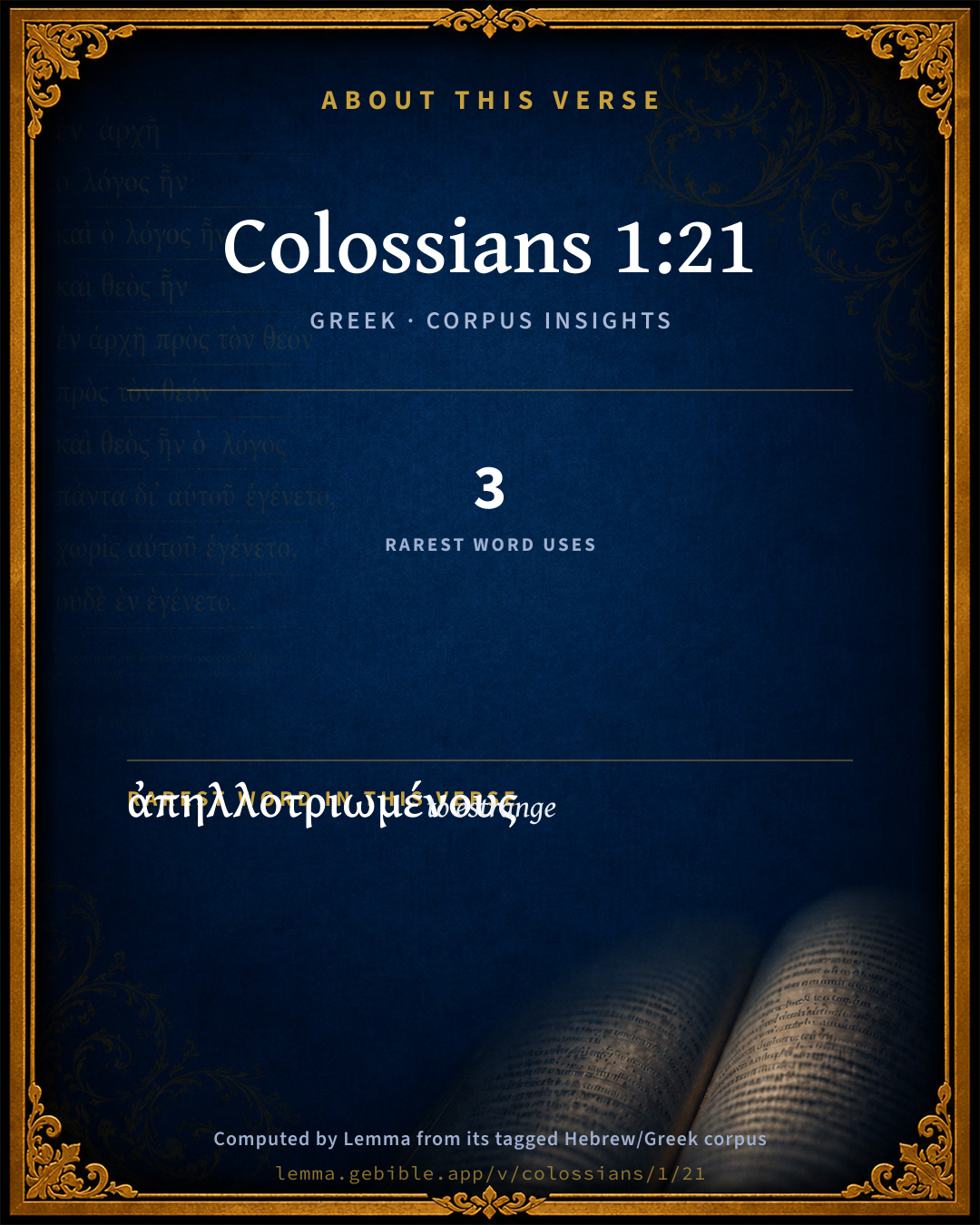
Colossians 1:21

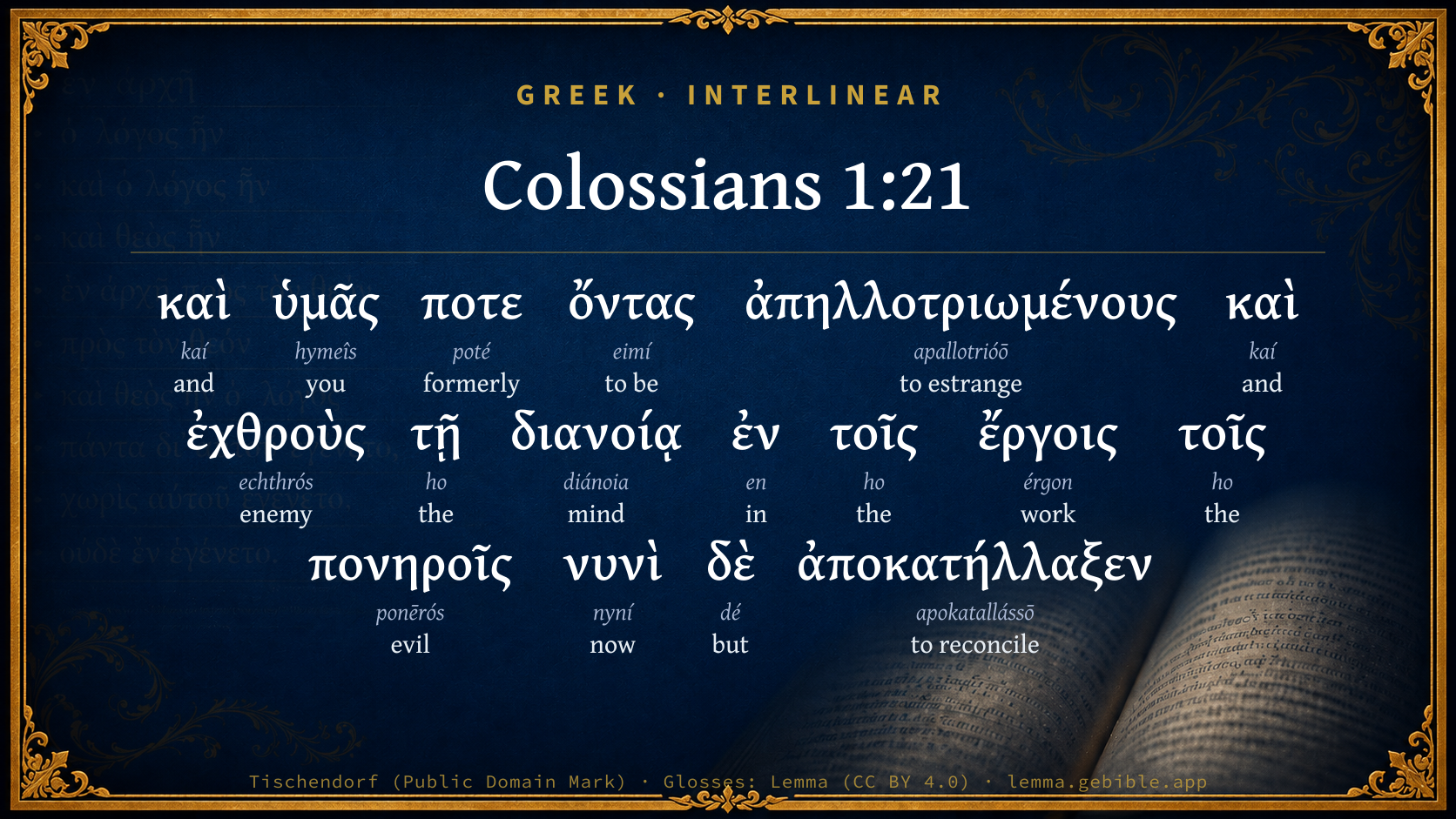
Greek (Tischendorf 8th ed.) Colossians 1:21 appears in the Greek New Testament. The text above is from the Tischendorf 8th edition. Each word links to its Strong’s number and a concise gloss. Click any word for its full Thayer’s Greek Lexicon entry.
Download image
Cite this verse

Colossians 1:21 (World English Bible). Public Domain. Lemma interlinear Bible study tool, https://lemma.gebible.app/v/colossians/1/21.

Show BibTeX & RIS
BibTeX
RIS
English Translation
You, being in past times alienated and enemies in your mind in your evil works,
World English Bible · Public Domain
Download a study sheet

One document with this verse’s original text, its word-by-word gloss line, the meaning frame, cross-references with their text, attributed commentary, and full source and license credits — printable, and it pastes into notes with its structure intact.

This verse Autodidact and up

Study sheet (.html) Plain text (.txt)

A passage Seminary Student

Up to 50 verses in one chapter. A passage sheet keeps up to 6 commentary sources and 12 cross-references per verse, in the order this page ranks them, and says so on the sheet whenever that leaves anything out. Ask for a single verse and you get the Autodidact verse sheet above.

Everything on this page stays free to read, with no account — the sheet is a download of what is already on screen, not access to it.

Want to remove ads? Support Godless Engineer
Compare translations 3

The same verse in 3 English versions, stacked beneath the original-language interlinear above. Click any original word for its lexicon entry.

Each is an independent rendering of the whole verse — the interlinear is not word-aligned to these translations.

Highlighted words mark where these versions differ — a whole-verse word diff, not a word-by-word alignment.

  • World English Bible Public Domain
    You, being in past times alienated and enemies in your mind in your evil works,
  • King James Version Public Domain
    And you, that were sometime alienated and enemies in your mind by wicked works, yet now hath he reconciled
  • unfoldingWord Literal Text CC BY-SA 4.0
    At one time you also were alienated and enemies in thought, in evil deeds.

unfoldingWord Literal Text — © unfoldingWord, licensed CC BY-SA 4.0. Word-aligned USFM3 via Door43 (git.door43.org/unfoldingWord/en_ult).

Versions to compare (up to 4)

3 of 4 selected

Show all 19 translations

Every available English version of this verse, each an independent rendering of the whole verse.

  • World English Bible Public Domain
    You, being in past times alienated and enemies in your mind in your evil works,
  • Berean Standard Bible Public Domain
    Once you were alienated from God and were hostile in your minds, engaging in evil deeds.
  • Majority Standard Bible Public Domain
    Once you were alienated from God and were hostile in your minds, engaging in evil deeds.
  • King James Version Public Domain
    And you, that were sometime alienated and enemies in your mind by wicked works, yet now hath he reconciled
  • American Standard Version (1901) Public Domain
    And you, being in time past alienated and enemies in your mind in your evil works,
  • Revised Version (1885) Public Domain
    And you, being in time past alienated and enemies in your mind in your evil works, yet now hath he reconciled
  • Geneva Bible (1599) Public Domain
    And you which were in times past strangers and enemies, because your mindes were set in euill workes, hath he nowe also reconciled,
  • Douay-Rheims (1899) Public Domain
    And you, whereas you were some time alienated and enemies in mind in evil works:
  • Young's Literal Translation Public Domain
    And you -- once being alienated, and enemies in the mind, in the evil works, yet now did he reconcile,
  • Literal Standard Version CC BY-SA 4.0
    And you—once being alienated, and enemies in the mind, in the evil works, yet now He reconciled,
  • Unlocked Literal Bible CC BY-SA 4.0
    At one time, you also were strangers to God and were his enemies in mind and in evil deeds.
  • unfoldingWord Literal Text CC BY-SA 4.0
    At one time you also were alienated and enemies in thought, in evil deeds.
  • Darby Bible Public Domain
    And you, who once were alienated and enemies in mind by wicked works, yet now has it reconciled
  • World Messianic Bible Public Domain
    You, being in past times alienated and enemies in your mind in your evil deeds,
  • Webster's Bible Public Domain
    And you, that were formerly alienated and enemies in your mind by wicked works, yet now hath he reconciled,
  • Free Bible Version CC BY-SA 4.0
    You once were alienated from God, enemies in the way you thought and the way you acted,
  • Bible in Basic English Public Domain
    And you, who in the past were cut off and at war with God in your minds through evil works, he has now made one
  • Text-Critical English NT CC BY 4.0
    At one time you were alienated from God and hostile in your minds because of your evil works. But now God has reconciled you to himself
  • Tyndale New Testament (1534) Public Domain
    And you (which were in tymes past straungers and enymes because youre myndes were set in evyll workes) hath he now reconcilied

Literal Standard Version (2020), Covenant Press — licensed CC BY-SA 4.0. Text via the HelloAO Bible API (eBible.org). Unlocked Literal Bible (unfoldingWord) — licensed CC BY-SA 4.0. Text via the HelloAO Bible API (eBible.org). unfoldingWord Literal Text — © unfoldingWord, licensed CC BY-SA 4.0. Word-aligned USFM3 via Door43 (git.door43.org/unfoldingWord/en_ult). Free Bible Version, Dr. Jonathan Gallagher — licensed CC BY-SA 4.0. Text via the HelloAO Bible API (eBible.org).

Word by word

More ways to search: Search by grammar → Find every occurrence → Compare this word →

Practice this passage: Drill this verse → Learn its vocabulary →

ἀπηλλοτριωμένους
apallotrióō
G526
“to estrange”
Verb, Perfect, Passive, Participle, Accusative, Plural, Masculine
Part of Speech
Verb
Tense
Perfect
Voice
Passive
Mood
Participle
Case
Accusative
Number
Plural
Gender
Masculine
Full Thayer's Definition

Origin: from G575 and a derivative of G245

TDNT: 05:25,4

1. to alienate, estrange 2. to be shut out from one's fellowship and intimacy
  1. καὶ kaí G2532 “and” Conjunction
  2. ὑμᾶς hymeîs G5210 “you” Personal pronoun, 2nd person, Accusative, Plural
  3. ποτε poté G4218 “formerly” Particle
  4. ὄντας eimí G1510 “to be” Verb, Present, Active, Participle, Accusative, Plural, Masculine
  5. καὶ kaí G2532 “and” Conjunction
  6. ἐχθροὺς echthrós G2190 “enemy” Adjective, Accusative, Plural, Masculine
  7. τῇ ho G3588 “the” Article, Dative, Singular, Feminine
  8. διανοίᾳ diánoia G1271 “mind” Noun, Dative, Singular, Feminine
  9. ἐν en G1722 “in” Preposition
  10. τοῖς ho G3588 “the” Article, Dative, Plural, Neuter
  11. ἔργοις érgon G2041 “work” Noun, Dative, Plural, Neuter
  12. τοῖς ho G3588 “the” Article, Dative, Plural, Neuter
  13. πονηροῖς ponērós G4190 “evil” Adjective, Dative, Plural, Neuter
  14. νυνὶ nyní G3570 “now” Adverb
  15. δὲ dé G1161 “but” Conjunction
  16. ἀποκατήλλαξεν apokatallássō G604 “to reconcile” Verb, Aorist, Active, Indicative, 3rd person, Singular

About this verse

These counts appear in no published source. They are computed here, from the morphology-tagged text and Lemma’s own curated glosses. What Lemma adds →

17
words
14
distinct lemmas
Pauline Epistles
section

Notable vocabulary

The rarest word here is ἀπηλλοτριωμένους to estrange G526 — appearing just 3 times in the whole Greek New Testament.

Shared distinctive vocabulary

ἀπηλλοτριωμένους to estrange G526 occurs in 3 verses of the Greek New Testament. Also found in:

Repetition

Words recur within this verse:

Cross-references

11

Topical passages linked to Colossians 1:21 in the Treasury of Scripture Knowledge — connected by theme and wording, ordered by reader-vote popularity; previews shown in the World English Bible.

  • Ephesians 2:12 that you were at that time separate from Christ, alienated from the commonwealth of Israel, and strangers from the covenants of the promise, having no hope and without God in the world.
  • Ephesians 2:1–3 You were made alive when you were dead in transgressions and sins,
  • Titus 3:3–7 For we were also once foolish, disobedient, deceived, serving various lusts and pleasures, living in malice and envy, hateful, and hating one another.
  • Romans 5:9–10 Much more then, being now justified by his blood, we will be saved from God's wrath through him.
  • Ephesians 4:18 being darkened in their understanding, alienated from the life of God, because of the ignorance that is in them, because of the hardening of their hearts;
  • Ephesians 2:19 So then you are no longer strangers and foreigners, but you are fellow citizens with the saints, and of the household of God,
  • Romans 8:7–8 because the mind of the flesh is hostile towards God; for it is not subject to God's law, neither indeed can it be.
  • 1 Corinthians 6:9–11 Or don't you know that the unrighteous will not inherit the Kingdom of God? Don't be deceived. Neither the sexually immoral, nor idolaters, nor adulterers, nor male prostitutes, nor homosexuals,
  • Titus 1:15–16 To the pure, all things are pure; but to those who are defiled and unbelieving, nothing is pure; but both their mind and their conscience are defiled.
  • Romans 1:30 backbiters, hateful to God, insolent, haughty, boastful, inventors of evil things, disobedient to parents,
  • James 4:4 You adulterers and adulteresses, don't you know that friendship with the world is enmity with God? Whoever therefore wants to be a friend of the world makes himself an enemy of God.

Cross-references courtesy of OpenBible.info (CC BY 4.0).

Commentary

Notes on Colossians 1:21 from classic Christian and Jewish commentators (each source and its license shown beneath its notes). The classic Christian expositions comment on the surrounding passage and are grouped to its opening verse, so a note may address several verses; the Jewish commentaries on the Tanakh (Rashi and others) are per-verse, so they appear only where the commentator wrote on this verse.

Lemma curates 59 commentaries, every one of them public domain or Creative Commons licensed, each selected and text-cleaned for this edition rather than reprinted as found. About our sources →

Joseph Benson's Commentary

Col 1:21-23. And you — Colossians, in particular, with all other Gentiles; that were sometime — Greek, ποτε, once, formerly; alienated — Estranged from the knowledge, love, and life of the one living and true God, (see note on Eph 4:18,) being destitute not only of all conformity to him, and union with him, but of all fear of him, and acquaintance with his nature and attributes; yea, and enemies — To him and to his worship and service; in your mind — Your understanding, judgment, will, and affections; by wicked works — Which at once manifested your inward enmity, and continually fed and increased it. Observe, reader, every violation of the divine law, every instance of disobedience to his commands, is an undeniable proof of enmity to him. This, however, is not the only evidence thereof: for, as he manifests his will by the dispensations of his providence, as well as by the precepts of his word, so far as we do not receive these dispensations, however afflictive, with resignation and patience, we manifest our enmity to him; as we do likewise, according to Rom 8:6-7, (where see the note,) so far as we are carnally minded; that is, esteem, desire, and delight in visible and temporal, in preference to spiritual and eternal things; or set our affection on things beneath, instead of setting it on things above, and seek that happiness in the creature which ought to be sought, and certainly can only be found, in the Creator. Yet now hath he reconciled — To himself and to the society of his people. That is, he is both reconciled to you, having forgiven you all your trespasses, and also hath reconciled you, or removed your enmity, by shedding his love abroad in your hearts; in the body of his flesh — (Thus distinguished from his body the church,) namely, his entire manhood, offered up upon the cross for you; through death — Endured to expiate your guilt, and thereby both to render a holy and just God reconcileable, on the terms of repentance toward him, and faith in his Son, and to procure for you the Holy Spirit to work that repentance and faith in you, and give you such a display of God’s love to you as should win and engage your affections to him. See on Rom 5:10; to present you holy — Toward God, dedicated to him in heart and life, conformed to his image, and employed in his service; and unblameable — Αμωμους, spotless in yourselves; cleansed from all filthiness of the flesh and spirit; and unreproveable — With respect to your neighbour, cultivating truth in your words, and justice and mercy in your actions toward all men. If ye continue — That is, you will assuredly be so presented, if you continue in the faith, exercising living faith in Christ and his gospel; grounded and settled — Τεθεμελιωμενοι και εδραιοι, placed on a good foundation, and firmly fixed upon it; and be not moved away from the hope of the gospel — Namely, that lively hope of eternal life, felicity, and glory, (Tit 1:2; 1Pe 1:3,) to which you were begotten again when made children of God by adoption and grace, Rom 8:17. This is termed the hope of the gospel, because the gospel reveals that future and immortal state which is the great object of this hope, and shows us how we may secure a title to that state. Faith and hope are the principal means of our salvation, from first to last. By the former, we are not only justified, and made the children of God, (Rom 3:28; Gal 3:26,) but sanctified and saved eternally; (Act 26:18;) and by the latter, we have patience, gratitude, joy, purity, with a disposition to be zealous and diligent in the work of the Lord, 1Th 1:3; 1Pe 1:3; Rom 5:2; 1Jn 3:3; 1Co 15:58. It is therefore of absolute necessity, in order to our eternal salvation, that we should continue in the lively exercise of these graces. Which ye have heard — Even ye Gentiles; and which was preached — Or is already begun to be preached, by a special commission from God; to every creature which is under heaven — Being no longer confined to the Jews, but extended to all the different nations and languages of men; whereof — Of which gospel; I, Paul, am made a minister — By the singular mercy and grace of God.

Joseph Benson's Commentary on the Old and New Testaments (1811–1818) — public domain. Text from a community e-Sword module.

Whedon's Commentary on the Bible

Daniel D. Whedon

3. The idea realized in the experience of the Colossians, Col_1:21-23.

21. You that were… alienated—As in science, so in religion, experience establishes the theory. Formerly alienated from God in affection, and enemies—hostile to him in intellectual action and notions of truth, as abundantly manifest in wicked life, they were now actually reconciled with God through Christ.

Daniel D. Whedon (gen. ed.), Commentary on the Old and New Testaments (1874–1909) — public domain. Text from a community e-Sword module.

The Preacher's Complete Homiletical Commentary

Joseph S. Exell (gen. ed.)

CRITICAL AND EXPLANATORY NOTES

Col_1:21. You, that were sometime alienated.—Does not mean, of course, occasionally alienated, but as the R.V. gives it, “being in time past alienated”—up to the time of the reconciliation always estranged. Enemies in your mind by wicked works.—The most interesting question here is whether God is reconciled to the sinner or only the sinner to God. Is “enemies” to mean “hostile” or “hateful”? Lightfoot says, “It is the mind of man, not the mind of God, which must undergo a change that a reunion may be effected.”

Col_1:22. In the body of His flesh through death.—When a teacher has to be explicit it may seem to those familiar with the subject as if he were verbose or tautological. So here the body is no phantasm, but fleshly and mortal. To present you holy.—They were professedly holy “saints” (Col_1:2), and the final purpose of their reconciliation is reproachless saintship (on this word, and “unblamable,” see Eph_1:4). Unreprovable in His sight.—It is a lofty eminence to which the holy apostle invites us to look in this word. The light in which we walk—fierce indeed towards sin—reveals no evil, so that the most captious critic has no objection (Tit_2:8).

MAIN HOMILETICS OF THE PARAGRAPH.—Col_1:21-22

The Personal Blessings of Reconciliation.

Having shown the relation of Christ to God, to the whole creation, and to the Church, and His connection with all moral beings, the writer now proceeds to point out the relation of Christ to individual man in delivering him from the fetters of sin, and opening up the way of reconciliation with an outraged but loving Deity. In this passage we have a description of the attitude of sinful man towards God and the method of His restoration. We learn that:—

I. Sin has placed man in antagonism to God.—

1. Man is estranged from God. “And you that were sometime alienated” (Col_1:21). Sin severs the soul from God. The principle of cohesion—the consciousness of rectitude which God implanted in man in his sinless state—is weakened, and the sinner, breaking away from the centre of all goodness, drifts into an ever-widening and ever-darkening wilderness of alienation and evil. Sin places man at an infinite distance from God, leads him to shun the divine presence and disregard the divine overtures. A state of alienation is a state of danger; it is a state of spiritual death; and yet it is painful to observe how few in this state are conscious of their awful peril.

2. Man is hostile to God.—“Enemies in your mind” (Col_1:21). The enmity follows from the estrangement, and both have their seat in the mind—“in the original and inmost force of the mind which draws after it the other faculties.” The mind of man opposes the mind of God, sets up a rival kingdom, and organises an active rebellion against the divine Ruler. “The carnal mind is enmity against God” (Rom_8:7). If the hostility is not always flagrantly open, it is in the mind; the fountain of all sin is there. To be a stranger to God is to be an enemy of God: “He that is not with Me is against Me.” The sinner is his own greatest enemy. It is a vain thing to fight against God; terrible will be the vengeance He will ere long wreak upon His enemies.

3. Man’s estrangement and hostility are evident in his actions.—“By wicked works” (Col_1:21). Man is stimulated by his sinful mind to perpetrate the most outrageous acts of rebellion against God, and to indulge in the most fiendish cruelty towards his fellow-man. But there are “wicked works” that may not figure in the criminal columns of the newspapers, nor be detected by the most vigilant watcher. To cherish envy, hatred, malice, and all uncharitableness is equally heinous in the sight of God, and an unmistakable evidence of hostility towards Him. Sin conceived in the mind will, sooner or later, manifest itself in action.

II. Man is reconciled to God in Christ.—

1. The distinguished blessing. “Yet now hath He reconciled” (Col_1:21). To effect this all that is necessary is to persuade the sinner to cease his rebellion and submit to God. In Christ God is reconciled to the sinner; there is no need to persuade Him. He is love; the sinner is enmity. He is light; the sinner is darkness. He is nigh unto the sinner, but the sinner is afar off. The great object is to destroy the sinner’s enmity, that he may have divine love; bring him from darkness into divine light, bring him from his evil works nigh unto God, and reconciliation is the result (Biblical Museum). The amity existing between the soul and God, and which sin had interrupted, is now restored. Dear as are the friendships of earth, none can equal friendship with God.

“He calls a worm His friend,

He calls Himself my God;

And He shall save me to the end

Through Jesu’s blood.”

The loftiest communion of the soul with God is renewed. In this the soul finds its strength, consolation, life, rapture. How much does that man lose whose heart is not reconciled to God?

2. The gracious medium of the blessing.—“In the body of His flesh through death” (Col_1:22). The apostle here refers in the most explicit terms to the sufferings and death of Jesus Christ, and shows that the great work of reconciliation was effected in His body, and through death, for that body was crucified and actually died. The apostle perhaps aimed at correcting certain pseudo-spiritualistic notions regarding the person of Christ, busily propagated by the false teachers; some of whom held that Christ was an angelic emanation which animated the man Jesus for a time and withdrew from Him before He suffered. While maintaining the proper deity and glory of Christ’s nature, the apostle plainly indicates that the divine method of reconciliation was by the incarnation and sacrificial death of Christ. He thus exalts the significance and value of the death of Christ. Reconciliation was not accomplished by the faultless example of Christ’s life or the supernal wisdom of His teaching, but by His crucifixion and death. The cross, with its unfathomable mystery, is to them that perish foolishness; but to them that believe it is still the power and wisdom of God.

III. The divine purpose in reconciliation is to promote man’s highest blessedness.—The magnificence of the believer’s future career will be in marked contrast with the obscurity and imperfection of the present; but even in this life he is lifted by the reconciling grace of God to a high standard of moral excellence. The terms here employed, while referring to the same spiritual state, delineate its different aspects.

1. The highest blessedness of man consists in his moral purity.—“To present you holy” (Col_1:22). This shows the condition of the soul in relation to God; it is freely offered to Him as a living sacrifice; the inward consciousness is wholly consecrated to the permanent indwelling of the Holy One; every thought, affection, and aspiration of the soul is hallowed; the whole man is enriched, ennobled, and radiant with a holy character.

2. The highest blessedness of man consists in his personal blamelessness.—“Unblamable” (Col_1:22). This aspect of character has reference to one’s self; it is the development in the outward life of the purity and consecration of the heart; it is a sacrificial term, and means without blemish. The soul is inspired with a sense of integrity, and of always acting for the best. When Socrates was asked, just before his trial, why he did not prepare himself for his defence, he calmly answered, “I have been doing nothing else all my life.” A noble, blameless life is its own defence.

3. The highest blessedness of man consists in his freedom from censure.—“Unreprovable in His sight” (Col_1:22). This feature of a holy character has reference to others. If man thus purified and blessed can bear the piercing glance of Him whose scrutiny no defect can escape, his character is unchallengeable. To be accepted and approved of God places him beyond the accusations of man or demon; the subtle insinuations of the Great Accuser are powerless to hurt. “It is God that justifieth; who is he that condemneth?” To be holy, unblamable, and unreprovable in the sight of God is to enjoy the highest honour and completest bliss. This is the ultimate result of reconciliation in Christ.

Lessons.—

1. Sin is the great foe of God and man.

2. The death of Christ is the means of reconciling sinful man to God.

3. The aim of reconciliation is to produce an irreproachable character.

GERM NOTES ON THE VERSES

Col_1:21. Reconciliation by Christ.

I. Estrangement.—

1. The cause—by wicked works.

2. The result—not merely that God is angry, but we have become enemies to God.

II. Reconciliation.—

1. Christ has reconciled man to God.

2. He hath reconciled man to man.

3. He hath reconciled man to himself.

4. He hath reconciled man to duty.—Robertson.

Col_1:22. Holiness the Supreme End of Reconciliation.

I. Holiness an inward state and an outward result.—“Holy, unblamable and unreprovable.”

II. Holiness alone can satisfy God.—“In His sight.”

III. Holiness is the final completion of the soul.—“To present you.”

The Preacher's Complete Homiletical Commentary (gen. ed. Joseph S. Exell; Funk & Wagnalls, c. 1892) — public domain (pre-1929). A full-Bible homiletical/sermon-outline anthology covering 65 of 66 books (2 John is absent from the source module). Text from a community e-Sword module.

Tyndale Open Study Notes

Tyndale Open Resources

1:21-23 Paul applies the truth of 1:15-20 to the Colossian Christians. As people who have been reconciled to God, they enjoy a new spiritual status and need to stand firm in the truth they have been taught.

1:21 The phrase once far away from God probably refers to their condition as Gentiles (see Eph 2:12).

Tyndale Open Study Notes — © Tyndale Open Resources, licensed CC BY-SA 4.0. Text via the HelloAO Bible API.

Bengel's Gnomon

Johann Albrecht Bengel

Col 1:21. Καὶ ὑμᾶς, and you) Eph 2:1; Eph 2:12.—ἀπηλλοτριωμένους καὶ ἐχθροὺς, alienated and enemies) Actual alienation makes habitual enemies.—τῇ διανοίᾳ) in the original and inmost force [bias, Vulg. ‘sensu,’ in feeling] of the mind, which draws after it the other faculties.—νυνὶ) now, when you have received that faith, by which you have been brought to the reconciliation made on the cross; i.e. you were formerly alienated, but now He has reconciled you; although you were enemies, nevertheless He has reconciled you. The Apodosis is to be referred to the words immediately preceding, although they do not render the sentence complete.—ἀποκατήλλαξεν, reconciled) i.e. God hath.

Bengel's Gnomon of the New Testament — English translation (T&T Clark, Edinburgh, 1860) — public domain. Text from a community e-Sword module.

Meyer's Critical & Exegetical Commentary

Heinrich August Wilhelm Meyer

Col_1:21. As far as Col_1:23, an application to the readers of what had been said as to the reconciliation, in order to animate them, through the consciousness of this blessing, to stedfastness in the faith (Col_1:23).

καὶ ὑμᾶς κ.τ.λ.] you also, not: and you, so that it would have to be separated by a mere comma from the preceding verse, and νυνὶ δὲ … θανάτου would, notwithstanding its great importance, come to be taken as parenthetical (Lachmann), or as quite breaking off the discourse, and leaving it unfinished (Ewald). It begins a new sentence, comp. Eph_2:1; but observe, at the same time, that Ephesians 2 is much too rich in its contents to admit of these contents being here compressed into Col_1:20-21 (in opposition to Holtzmann, p. 150). As to the way in which Holtzmann gains an immediate connection with what precedes, see on Col_1:19. The construction (following the reading ἀποκατηλλάγητε, see the critical notes) has become anacoluthic, inasmuch as Paul, when he began the sentence, had in his mind the active verb (which stands in the Recepta), but he does not carry out this formation of the sentence; on the contrary, in his versatility of conception, he suddenly starts off and continues in a passive form, as if he had begun with καὶ ὑμεῖς κ.τ.λ. See Matthiae, p. 1524; Winer, p. 527 ff. [E. T. 714]; and upon the aorist, Buttmann, Neut. Gr. p. 171 [E. T. 197].

ἀπηλλοτρ. κ.τ.λ] when ye were once in the state of estrangement, characterizes their heathen condition. As to ἀπηλλοτρ., see on Eph_2:12; from which passage ἀπὸ τῆς πολιτείας τ. Ἰσρ. is here as unwarrantably supplied (Heinrichs, comp. Flatt), as is from Eph_4:14 τῆς ζωῆς τοῦ Θεοῦ (Bähr). In conformity with the context, seeing that previously God was the subject as author of reconciliation, the being estranged from God (τοῦ Θεοῦ), the being excluded from His fellowship, is to be understood. Comp. ἄθεοι ἐν τ. κόσμῳ, Eph_2:12. On the subject-matter, Rom_1:21 ff.

ἐχθρούς] sc. τῷ Θεῷ, in a passive sense (comp. on Rom_5:10; Rom_11:28): invisos Deo,[55] as is required by the idea of having become reconciled, through which Gods enmity against sinful men, who were τέκνα φύσει ὀργῆς (Eph_2:3), has changed into mercy towards them.[56] This applies in opposition to the usual active interpretation, which Hofmann also justly rejects: hostile towards God, Rom_8:7; Jam_4:4 (so still Huther, de Wette, Ewald, Ritschl, Holtzmann), which is not to be combined with the passive sense (Calvin, Bleek).

τῇ διανοίᾳ and ἘΝ ΤΟῖς ἜΡΓΟΙς Τ. Π. belong to both the preceding elements; the former as dative of the cause: on account of their disposition of mind they were once alienated from God and hateful to Him; the latter as specification of the overt, actual sphere of life, in which they had been so (in the wicked works, in which their godless and God-hated behaviour had exhibited itself). Thus information is given, as to ἀπηλλ. and ἘΧΘΡΟΎς, of an internal and of an external kind. The view which takes Τῇ ΔΙΑΝΟΊᾼ as dative of the respect (comp. Eph_4:18): as respects disposition (so, following older expositors, Huther, de Wette, Baumgarten-Crusius, Ewald), would no doubt suit the erroneous active explanation of ἐχθρ., but would furnish only a superfluous definition to it, as it is self-evident that the enmity towards God resides in the disposition. Luther incorrectly renders: through the reason; for the διάν. is not the reason itself, but its immanent activity (see especially, Plato, Soph. p. 263 E), and that here viewed under its moral aspect; comp. on Eph_4:18. Beza (mente operibus malis intenta), Michaelis, Storr, and Bähr attach ἐν τοῖς ἔργοις κ.τ.λ. to Τῇ ΔΙΑΝΟΊᾼ. This is grammatically admissible, since we may say ΔΙΑΝΟΕῖΣΘΑΙ ἘΝ, animo versari in (Psa_73:8; Sir_6:37; Plato, Prot. p. 341 E), and therefore the repetition of the article was not necessary. But the badness of the disposition was so entirely self-evident from the context, that the assumed more precise definition by ἐν τοῖς ἔργ. τ. πονηρ. would appear tediously circumstantial.

The articles Τῇ and ΤΟῖς denote the disposition which they have had, and the works which they have done. In the latter case the subjoined attributive furnished with the article (τοῖς πονηροῖς) is not causal (because they were bad, Hofmann), but emphatically brings into prominence the quality, as at Eph_6:13; 1Co_7:14, and often (Winer, p. 126 [E. T. 167]).

νυνὶ δὲ ἀποκατηλλάγητε] as if previously ὙΜΕῖς Κ.Τ.Λ. were used (see above): Ye also … have nevertheless now become reconciled. On δέ after participles which supply the place of the protasis, as here, where the thought is: although ye formerly, etc., see Klotz, ad Devar. p. 374 ff.; Maetzner, ad Antiph. p. 136; Kühner, ad Xen. Mem. iii. 7. 8, Anab. vi. 6. 16. On νυνί, with the aorist following, comp. Col_1:26; Rom_7:6; Eph_2:13; Plat. Symp. p. 193 A: πρὸ τοῦ … ἓν ἦμεν, νυνὶ δὲ διὰ τὴν ἀδικίαν διῳκίσθημεν ὑπὸ τ. θεοῦ. Ellendt, Lex Soph. II. p. 176; Kühner, II. 2, p. 672. It denotes the present time, which has set in with the ἀποκατηλλ. (comp. Buttmann, Neut. Gr. p. 171 [E. T. 197]); and the latter has taken place objectively through the death of Christ, Col_1:22, although realized subjectively in the readers only when they became believerswhereby the reconciliation became appropriated to them, and there existed now for them a decisive contrast of their νυνί with their ΠΟΤΈ.[57] The reconciling subject is, according to the context (Col_1:19-20), not Christ (as at Eph_2:16), through whom (comp. Rom_5:10; 2Co_5:18) the reconciliation has taken place (see Col_1:20), but, as at 2Co_5:19, God (in opposition to Chrysostom, Theodoret, Oecumenius, Beza, Calvin, Estius, Calovius, Heinrichs, and others, including de Wette and Ewald). For the reference to Christ even the reading ἀποκατήλλαξεν would by no means furnish a reason, far less a necessity, since, on the contrary, even this active would have, according to the correct explanation of εὐδόκησε in Col_1:19, to be taken as referring to God (in opposition to Hofmann).

[55] Compare the phrase very current in the classical writers, from Homer onward, ἐχθρὸς θεοῖς, quem Dii oderunt.

[56] See Fritzsche, ad Rom. I. p. 276 ff., who aptly explains καταλλάσσεσθαί τινι: in alicujus favorem venire, qui antea succensuerit. Comp. Philippi, Glaubensl. IV. 2, p. 265 ff., ed. 2. The reconciliation of men takes place, when God, instead of being further angry at them, has become gracious towards them,when, consequently, He Himself is reconciled. Comp. Luk_18:13; 2Co_5:19. So long as His wrath is not changed, and consequently He is not reconciled, men remain unreconciled. 2Ma_7:33 : ὁ ζῶν κύριος … βραχέως ἑπώργισται καὶ πάλιν καταλλαγήσεται τοῖς ἑαυτοῦ δούλοις, comp. 2Ma_8:29, 2Ma_1:5, 2Ma_5:20; Clem. Cor. I. 48: ἱκετεύοντες αὐτόν (God), ὅπως ἵλεως γενόμενος ἐπικαταλλαγῇ ἡμῖν. In Constt. Apost. viii. 12. 14, it is said of Christ that He τῷ κόσμῳ κατήλλαξε God, and § 17, of God: σοῦ καταλλαγέντος αὐτοῖς (with believers).

[57] Comp. Luthardt, vom freien Willen, p. 403.

Meyer — Critical and Exegetical Commentary on the New Testament — English translation by Peter Christie, edited by Frederick Crombie (T&T Clark, 1880) — public domain. Text from a community e-Sword module.

Expositor's Greek Testament

ed. W. Robertson Nicoll

Col 1:21 . For this verse cf. Eph 2:1 ; Eph 2:12 . Usually καὶ ὑμᾶς is made to begin a new sentence. Even with the reading ἀποκατήλλαξεν the construction is not quite regular, but with the probably correct reading, ἀποκατηλλάγητε , a violent break in the context is involved, since Paul begins with the second person as the object and suddenly makes it the subject. Such an anacoluthon is possible in dictation, but very improbable unless several words had intervened, so that the beginning of the sentence should be forgotten. This is not the case here. Lachmann (followed by Lightf. and others) takes νυνὶ δὲ … θανάτου as a parenthesis, in which case παραστῆσαι depends on εὐδόκησε , and ὑμᾶς is repeated “to disentangle the construction”. The irregularity is thus avoided. Haupt objects that it is unlikely that Paul should have continued after so long a sentence as Col 1:20 with the same construction, and also that the thought in this part of the sentence, “to present you holy,” is not co-ordinated to the thoughts in κατοικ . and ἀποκατ . For in the latter the thought is that it is the Son in whom the fulness dwells and through whom reconciliation is effected. But this thought of the pre-eminence of the Son in the work of salvation is not continued in Col 1:22 , where the thought is of the Christian standing of the Colossians before God. It is therefore unlikely that παραστ . should depend on εὐδοκ . Accordingly, with Haupt and Weiss, a comma should be placed at the end of Col 1:20 , and a full stop at the end of Col 1:21 . ὑμᾶς in Col 1:21 will then depend on ἀποκατ . It might seem an anti-climax after the wide sweep of Col 1:20 to narrow down the reference to the Colossians. But we have a similar case in Col 1:6 , and the personal application of a universal truth is anti-climax only to a rhetorician. The danger of the Colossians makes it peculiarly appropriate here. καὶ ὑμᾶς : “you also”. ὄντας emphasises that this state was continuous. ἀπηλλοτριωμένους : “estranged,” i.e. , from God, probably not to be taken as counted as aliens by God, but as expressing their attitude to God. ἐχθροὺς τῇ διανοίᾳ . Meyer takes ἐχθ . as passive, regarded as enemies by God, but the qualification τῇ διαν . and the further addition ἐν . τ . ἔργ . τ . πον . makes this very improbable. It involves the translation of τῇ διαν . “on account of your state of mind,” for which διά with the accusative would have been expected. But it is much simpler to take διαν . as dative of the part affected, and ἐχθ . as active, hostile to God in your mind. διανοία (used only here and Eph 2:3 ; Eph 4:18 by Paul) means the higher intellectual nature, but specially on the ethical side; it is usually in the LXX the translation of “heart”. Cremer defines it as “the faculty of moral reflexion”. ἐν τ . ἔργοις τοῖς πονηροῖς : to be connected with ἀπηλλ . καὶ ἐχθ . The preposition indicates the sphere in which they were thus estranged and enemies.

The Expositor's Greek Testament, edited by W. Robertson Nicoll (1897–1910) — public domain. Text from a community e-Sword module.

Cambridge Greek Testament for Schools and Colleges

21. καὶ ὑμᾶς κ.τ.λ. The construction of this verse in relation to Col 1:20; Col 1:22 is extremely uncertain, and the uncertainty of the reading ἀποκατήλλαξεν or ἀποκατηλλάγητε somewhat increases the difficulty. Three constructions deserve consideration.

(1) Place a comma instead of a colon at the end of Col 1:20, and place a full stop at πονηροῖς, in Col 1:21. Then the words καὶ ὑμᾶς, “you also,” are dependent on ἀποκαταλλάξαι, and a new sentence begins with νυνί. This requires the reading ἀποκατηλλάγητε (Meyer-Haupt). But it is very unlike St Paul to bring in the personal reference so brusquely at the very close of a sentence.

(2) The clause νυνὶ δὲ … θανάτου is to be treated as a parenthesis (W.H.), and ὑμᾶς (Col 1:21) is governed directly by παραστῆσαι, and is taken up in the second ὑμᾶς (Col 1:22) (cf. Eph 2:1; Eph 2:5), παραστῆσαι itself being dependent on εὐδόκησεν (Col 1:19, “He was pleased … to reconcile all things … and to present you”). Whether ἀποκατήλλαξεν or ἀποκατηλλάγητε be right makes little difference in this case.

(3) There is no proper parenthesis, but νυνὶ δὲ ἀποκατήλλαξεν takes up the contrast to ποτὲ ἀπηλλοτριωμένους. In this case ὑμᾶς (Col 1:21) is governed directly by ἀποκατήλλαξεν, and παραστῆσαι is also dependent on it as expressing the result of reconciliation. For νυνὶ δέ with a finite verb indicating an apodosis after a participle compare νῦν δέ, Col 1:26 (see Blass, § 79. 10 and Winer, § liii. 7 b). According to this construction the anacolouthon is due to δέ, which St Paul inserted (ex hypothesi) to emphasize the νυνί: “the oppositive δὲ in the apodosis being evoked by the latent ‘although’ (Donalds. Gr. § 621) involved in the participial protasis” (Ellicott). Compare Bengel, “Apodosis refertur ad proxime praecedentia, licet non faciant sententiam completam.”

If ἀποκατηλλάγητε be right the anacolouthon is very much stronger, but it is just possible that the construction of παραστῆσαι is the same.

Of the three methods the first is very improbable, and in the second and third the incidence of probability is largely determined by the reading. If ἀποκατήλλαξεν be accepted the third method appears to be the best.

Observe that in the parallel passage, Eph 2:12-13, the sentences run smoothly enough. This suggests that Colossians was the earlier of the two Epistles.

ποτὲ. For this meaning of “once but no longer so” compare Col 3:7; Phm 1:11.

ὄντας. With participle Eph 4:18†. Compare Col 2:13; Rom 5:6. It lays stress on the continuance, and, probably, the reality of their state of alienation and enmity.

ἀπηλλοτριωμένους, Eph 2:12; Eph 4:18†, “alienated,” i.e. positively estranged, and not merely designated aliens. Compare Psalms 57(58):4, 68(69):9; Eze 14:5: also Aq., Sym., Theod. in Isa 1:4.

καὶ ἐχθροὺς. ἐχθροὺς is probably not passive (“hateful”) but active (“hostile”). For although the expression that a man is “hateful” to God may be defended theologically, because there is a true sense in which sin has caused God to look upon even the sinner in anger (cf. Sand.-Head. on Rom 5:10, additional note), and although, again, the passive meaning of ἐχθρός is probably found elsewhere in the N.T. (Rom 11:28; Rom 5:10), yet (1) ἐχθρός is generally active (Php 3:18; Gal 4:16; Act 13:10); (2) τῇ διανοίᾳ is more readily explained if ἐχθροί be active (vide infra); (3) the parallel passage, Eph 2:12-14, favours the active sense here, for although ἐχθροί does not occur there yet τὴν ἔχθραν expresses the active hatred between Jew and Gentile.

The word thus expresses concisely both the negative and the positive statement of St John, (1) Joh 3:19; (2) Joh 7:7.

τῇ διανοίᾳ. Dative of the “side, aspect, regard or property, on and in which the predicate shows itself,” Madv. § 40 (253). So Mat 11:29, πραΰς εἰμι καὶ ταπεινὸς τῇ καρδίᾳ. Their active enmity shows itself in their διάνοια.

If ἐχθρούς be passive this explanation of the dative can hardly be maintained, for it would limit the sphere in which they were hateful to God to their διάνοια. The dative must then be explained as indicating the cause of God’s hatred. But it then becomes somewhat clumsy.

διάνοια = the active principle of the mind, nearly our “thought.” Compare Hort on 1Pe 1:13, who says that in Eph 4:18 “it belongs to St Paul’s exposition of the foolishness, unreality, and falsehood of the view of the world generally prevalent among the heathen and to his exhibition of the Gospel as a message of truth as well as of salvation.” So the LXX. use it fairly often in the Hexateuch (29 times) to translate leb and lebab (but καρδία 80 times), though only occasionally elsewhere. It is curious that it never occurs in the Psalms.

ἐν τοῖς ἔργοις τοῖς πονηροῖς. The enmity has its seat in their thought, its sphere of action in their works, and these evil works.

Contrast Col 1:10, ἐν παντὶ ἔργῳ ἀγαθῷ. Cf. Joh 3:19; Joh 7:7; 2Ti 4:18; 1Jn 3:12; 2Jn 1:11†.

The primary notion of πονηρός appears to be worthlessness, essential badness (see Chase, The Lord’s Prayer, p. 93). Hence the meaning here is probably that their enmity makes itself felt in works that will not stand God’s test, they are not δίκαια (1Jn 3:12).

νυνὶ δὲ. Although the MSS. often vary between νῦν and νυνί the latter is confined to the Pauline Epistles (? 15 times), Hebr. (? 2), Acts (2). It is always followed by δέ except in Act 22:1; Act 24:13. Also, it should be observed, νυνὶ δέ never elsewhere marks the apodosis, as probably here (see note at the beginning of verse), but either begins a fresh sentence (e.g. Col 3:8 and even Rom 15:25), or by a fresh epithet indicates a contrast, 2Co 8:22; Phm 1:9; Phm 1:11. It is apparently a stronger and more argumentative form than νῦν, “now, as the case really stands.”

ἀποκατήλλαξεν. See notes on Textual Criticism. For the word see note on ἀποκαταλλάξαι, Col 1:20, and for the construction see note at the beginning of verse. The subject is the same as that of εὐδόκησεν … ἀποκαταλλάξαι (Col 1:20), viz. the Father, the following words being parallel to εἰρηνοποιήσας διὰ τοῦ αἵματος τοῦ σταυροῦ αὐτοῦ.

Cambridge Greek Testament for Schools and Colleges (Cambridge University Press, 1896; 21 vols, various authors incl. Carr, Maclear, Plummer, Farrar, Lumby, Moule, M. R. James, Simcox) — public domain. Text from a community e-Sword module.

Geneva Bible (1599)

Geneva Bible translators

The Son.

Sanctification is another work of God in us by Christ, in that that he restored us (which hated God extremely, and were wholly and willingly given to sin) to his gracious favor, in such sort, that he therewithall purifieth us with his holy Spirit, and consecrateth us to righteousness.

Geneva Bible (1599) marginal notes — public domain. Text via Bolls.life.

Jamieson, Fausset & Brown

Robert Jamieson, A. R. Fausset & David Brown

The Colossians are included in this general reconciliation (compare Eph 2:1, Eph 2:12).

sometime--"once."

alienated--from God and salvation: objectively banished from God, through the barrier which God's justice interposed against your sin: subjectively estranged through the alienation of your own wills from God. The former is the prominent thought (compare Rom 5:10), as the second follows, "enemies in your mind." "Actual alienation makes habitual 'enemies'" [BENGEL].

in your mind--Greek, "in your understanding" or "thought" (Eph 2:3; Eph 4:18).

by wicked works--rather as Greek, "in your wicked works" (wicked works were the element in which your enmity subsisted).

yet now--Notwithstanding the former alienation, now that Christ has come, God hath completely reconciled, or restored to His friendship again (so the Greek, compare Note, see on Col 1:20).

Jamieson, Fausset & Brown — Commentary Critical and Explanatory on the Whole Bible (1871) — public domain (CC PDM 1.0). Text via the HelloAO Bible API.

Adam Clarke's Commentary

Verse 21. And you, that were sometime alienated] All men are alienated from God, and all are enemies in their minds to him, and show it by their wicked works; but this is spoken particularly of the Gentiles. The word απαλλοτριοω, which we render to alienate, to give to another, to estrange, expresses the state of the Gentiles: while the Jews were, at least by profession, dedicated to God, the Gentiles were alienated, that is, given up to others; they worshipped not the true God, but had gods many and lords many, to whom they dedicated themselves, their religious service, and their property. The verb αλλοτριοω, to alienate, being compounded here with the preposition απο, from, signifies to abalienate, to estrange utterly, to be wholly the property of another. Thus the Gentiles had alienated themselves from God, and were alienated or rejected by him, because of their wickedness and idolatry.

Enemies in your mind] They had the carnal mind, which is enmity against God; and this was expressed in their outward conduct by wicked works. See Clarke on Ro 5:10. The mind is taken here for all the soul, heart, affections, passions, &c.

Adam Clarke's Commentary on the Bible (1810–1826) — public domain. Text from a community e-Sword/MySword module.

John Calvin's Commentaries

21. And whereas ye were formerly. The general doctrine which he had set forth he now applies particularly to them, that they may feel that they are guilty of very great ingratitude, if they allow themselves to be drawn away from Christ to new inventions. And this arrangement must be carefully observed, because the particular application of a doctrine, so to speak, affects the mind more powerfully. Farther, he leads their views to experience, that they may recognize in themselves the benefit of that redemption of which he had made mention. “You are yourselves a sample of that grace which I declare to have been offered to mankind through Christ. For ye were alienated, that is, from God. Ye were enemies; now ye are received into favor: whence comes this? It is because God, being appeased by the death of Christ, has become reconciled to you.” At the same time, there is in this statement a change of person, for what he has previously declared as to the Father, he now affirms respecting Christ; for we must necessarily explain it thus, in the body of HIS flesh

The term διανοίας (thought) I explain, as employed by way of amplification, as though he had said, that they were altogether, and in the whole of their mental system, alienated from God, that no one may imagine, after the manner of philosophers, that the alienation is merely in a particular part, as Popish theologians restrict it to the lower appetites. “Nay,” says Paul, “what made you odious to God, had taken possession of your whole mind.” In fine, he meant to intimate, that man, whatever he may be, is wholly at variance with God, and is an enemy to him. The old interpreter renders it (sensum) sense. Erasmus renders it mentem, (mind.) I have made use of the term cogitationis, to denote what the French call intention. For such is the force of the Greek word, and Paul’s meaning requires that it should be rendered so.

Farther, while the term enemies has a passive as well as active signification, it is well suited to us in both respects, so long as we are apart from Christ. For we are born children of wrath, and every thought of the flesh is enmity against God. (Romans 8:7.)

In wicked works. He shews from its effects the inward hatred which lies hid in the heart. For as mankind endeavor to free themselves from all blame, until they have been openly convicted, God shews them their impiety by outward works, as is more amply treated of in Romans 1:19. Farther, what is told us here as to the Colossians, is applicable to us also, for we differ nothing in respect of nature. There is only this difference, that some are called from their mother’s womb, whose malice God anticipates, so as to prevent them from breaking forth into open fruits, while others, after having wandered during a great part of their life, are brought back to the fold. We all, however, stand in need of Christ as our peace maker, because we are the slaves of sin, and where sin is, there is enmity between God and men.

John Calvin's Commentaries (1540-1563) — public domain. Text from the Calvin Translation Society English edition (1840s-50s) via the Christian Classics Ethereal Library (ccel.org). Calvin's coverage is partial (roughly two-thirds of the Bible); uncommented books and verses are honest gaps, never fabricated. The 19th-century editor's footnotes and remarks are omitted so the notes are faithfully Calvin's own voice.

Ellicott's Commentary for English Readers

(21) Alienated.—Not naturally aliens, but estranged. (See Note on Eph_2:12.)

By wicked works.—Properly, in your wicked works. The enmity of heart is not properly caused by wicked works, but shown in them, and probably intensified by reflex action through them.

A Bible Commentary for English Readers, edited by Charles John Ellicott (1878–1897) — public domain. Text from a community e-Sword module.

The Cambridge Bible for Schools and Colleges

gen. ed. J. J. S. Perowne

21–23. The Subject pursued: the special case of the Colossians with regard to Redemption

21. you] In the Greek “you” is accusative, and (in the best supported reading) the only verb to govern it is “to reconcile” in Col_1:20. (See note on “hath He reconciled” just below.) Thus the construction runs unbroken from Col_1:20 into this verse. But there is a break, a paragraph, practically, in the thought and treatment.

As in Eph_1:13, so here, the Apostle moves from the general case of the “all things” to the particular case of the Colossian believers, included among “the things on the earth.” Cp. also Eph_2:1; a close parallel.

sometimes] Ideally, before Christ’s work; biographically, before their conversion to Him.

alienated] Estranged, Lightfoot.—Cp. Eph_2:12; Eph_4:18, and our notes there. Here, as there, the unregenerate man, and now particularly the heathen man, is viewed as (ideally) once in covenant and peace with God, and recipient of His “life,” but “fallen” thence.—See note above on “to reconcile,” Col_1:20.

enemies] Not, as some render, “hated.” The Greek does mean “hated” Rom_11:28; but scarcely so anywhere else in N.T.—For the truth, cp. Rom_8:7. In its inmost essence, sinfulness is hostility to the nature, will, and claims of the Holy One. He therefore on His part must be judicially adverse to the sinner, apart from the propitiation He has provided. But this side of the fact is less prominent here.

in your mind] The word rendered “mind” commonly denotes the rational powers in general; cp. e.g. Eph_4:17; 1Pe_1:13. The Colossians in their heathen state had shewn their “enmity” “in those powers,” inasmuch as the approved principles of their lives were contrary to the will of God.

by wicked works] More lit., in your wicked works; the orbit, so to speak, traced by their life of “enmity.” For the truth, cp. 1Co_6:9-11; Eph_2:1-3; Tit_3:3-7.

now] “As the fact is,” in the actual provision of mercy and gift of grace. “Comp. e.g. Col_1:26, Rom_5:11; Rom_7:6; Rom_11:30-31; Rom_16:26; Eph_2:13; Eph_3:5; 2Ti_1:10; 1Pe_1:12; 1Pe_2:10; 1Pe_2:23.” (Lightfoot.)

hath he reconciled] More lit., did He reconcile, in the finished work of Christ. But the somewhat better supported reading gives the passive; you were reconciled. Thus (see note on “you” just above) we have here a new sentence, grammatically, although the order of thought practically justifies the rendering of the A.V. Reading thus, we may regard the words from “yet now” to “through death” as a parenthesis in the construction.

The Cambridge Bible for Schools and Colleges (gen. ed. J. J. S. Perowne; Cambridge University Press, 1878–1918) — public domain. Text from a community e-Sword module.

John Gill's Exposition

And you that were sometime alienated,.... The general blessing of grace and reconciliation, which belongs to the whole body of Christ, the church universal, all the elect of God, whether in heaven or in earth, is here particularly applied to the saints at Colosse, who were eminent instances of it; and that the free grace of God towards them in it might more illustriously appear, the apostle takes notice of what they were before the coming of Christ in the flesh, before the Gospel came among them, and while in a state of unregeneracy, as that they were "alienated": that is from God, not from his general presence, power, and providence, which reach to all his creatures, but from the life of God; see Eph 4:18; from living agreeably to the will of God, being estranged from him who is the fountain of moral and spiritual, as well as natural life; from the law, the rule of life, and from a principle of life in themselves; and altogether disapproving of such a life, as contrary to their carnal affections and lusts: and which alienation from God greatly lay in their forsaking him, the one only and true God, and following and serving strange gods, not attending to the dictates and light of nature; and being destitute of a divine revelation, they went further and further off from God, and from his people, worship, and ordinances; and were aliens from the commonwealth of Israel, and strangers to the covenants of promise; the source of all which was sin, and was owing to themselves: God did not alienate himself from them first; they alienated themselves from him; their sins separated between God and them, set them at a distance from him, and at enmity to him, and which very early appeared, for they were estranged from the womb:

and enemies in your mind by wicked works. They were enemies to God, the true God, and were lovers and worshippers of idols; they were enemies to the being and perfections of God, as all men in a state of nature are; and more or less show it, by either denying there is a God, or wishing there was none, or fancying him to be such an one as themselves; or they dispute his sovereignty, deny his omniscience, arraign his justice and faithfulness, and despise the riches of his grace and goodness; they are enemies to his purposes, providences, and word; cannot bear that he should determine any thing concerning them or others; their eye is evil to him because he is good to others; they reply against him, they run upon him, and charge his decrees with unrighteousness and cruelty; murmur at and quarrel with the dispensations of his providence, as unequal and unjust; cast away the law of the Lord, will not be subject to it, and condemn the revelation of his will. They are enemies to Christ in one shape or another; either to his person, denying his proper deity, or real humanity; or to his offices, not hearkening to him as a prophet, trampling on his blood and sacrifice as a priest, and unwilling to have him to rule over them as a King; or to the way of salvation by him, of pardon by his blood, atonement by his sacrifice, justification by his righteousness, and acceptance with God through his person; or to his doctrines and ordinances, which are unsuitable to their vicious tastes, carnal affections, and appetites: they are enemies to the Spirit of Christ, by either denying his deity and personality, or by ridiculing the operations of his grace; or treating with contempt, and as foolish, everything of his, the Bible and all the truths contained in it, dictated by him. They are enemies to the people of God, exceeding mad against them, hate them and persecute them, reckon them the faith of the world, and the offscouring of all things, living in malice to them, and hateful and hating one another: and this enmity to everything divine and good is seated "in the mind"; the mind is not the object of this enmity, as some read the words, "to the mind": for the mind of a carnal man is enmity itself against God; but it is the subject of it, where it has its chief place, and from whence it proceeds, and shows itself in evil actions; and though the word "your" is not in the original text, it is rightly supplied; for the meaning is not that they were enemies "of his mind"; of the mind of the Lord, of his counsels and will, as some read and explain the words, though there is a truth in this, but in their own minds: so that not the body but the soul is the seat of this enmity; and not the inferior faculties of the soul only, the sensitive appetite and passions, but the understanding, the judgment and will, the more noble and rational powers of the soul; from hence spring all the malice and enmity expressed in word and actions: where then is man's free will to that which is good? and hence it is that the mind stands in need of being renewed, enlightened, cleansed and sanctified, and renovation begins here, which is the effect of almighty power; for nothing else can remove the rooted enmity in the heart of men; and which, as deep and as secret as it is, sooner or later, in one way or another, shows itself "by wicked works"; and that frequently, as by loving what God hates, and hating what he loves; by omitting what he commands, and committing what he forbids; by maintaining friendship with the world, and by harbouring his professed enemies, and persecuting his dear friends; and by their wicked words, and evil lives and conversations; and by the various works of the flesh, which are manifest, some being more directly against God, others by which they wrong themselves, and others by which they injure their neighbours:

yet now hath he reconciled; which may be understood either of the Father's reconciling them to himself by his Son; and so the words are a continuation of the account of the Father's grace, as to all the elect in general, so to the Colossians in particular, notwithstanding the black characters in which they stand described in their natural estate: or else of Christ's reconciling them to his Father, by the sacrifice of himself, which he voluntarily offered for them, though this was their case, and of enemies made them friends: and may be meant either of the impetration of reconciliation for them by his sufferings and death; or of the virtue and efficacy of it in the application of it; in the former sense the "now" refers to the coming of Christ into the world, and the time of his death, and the offering up of his body once for all, when peace and reconciliation were completely made at once for all God's elect; in the latter sense it refers to the time of the conversion of these Colossians, when Christ by his Spirit, in consequence of reconciliation made in the body of his flesh, through death reconciled them to God; to his mind and will, to the way of salvation by himself, to the saints the excellent in the earth, to the Gospel and the ordinances of it, and to all his ways and worship.

John Gill's Exposition of the Whole Bible (1746–1763) — public domain (CC PDM 1.0). Text via the HelloAO Bible API.

Trapp's Complete Commentary

John Trapp

21 And you, that were sometime alienated and enemies in your mind by wicked works, yet now hath he reconciled

Ver. 21. Enemies in your mind] Haters of God, Rom 1:30, and so, God slayers, 1Jn 3:15. Omne peccatum est Deicidium. All sin is a killer of God.

John Trapp, A Commentary or Exposition upon All the Books of the Old and New Testament (1647–1656) — public domain. Text from a community e-Sword module.

Albert Barnes' Notes on the Bible

And you, that were sometime alienated - In this work of reconciling heaven and earth, you at Colossae, who were once enemies of God, have been reached. The benefit of that great plan has been extended to you, and it has accomplished in you what it is designed to effect everywhere - to reconcile enemies to God. The word “sometime” here - ποτε pote - means “formerly.” In common with all other men they were, by nature, in a state of enmity against God; compare the notes at Eph 2:1-3.

In your mind - It was not merely by wicked works, or by an evil life; it was alienation seated in the mind, and leading to wicked works. It was deliberate and purposed enmity. It was not the result of passion and excitement; it had a deeper seat, and took hold of the intellectual powers The understanding was perverse and alienated from God, and all the powers of the soul were enlisted against him. It is this fact which renders reconciliation with God so difficult. Sin has corrupted and perverted alike the moral and the intellectual powers, and thus the whole man is arrayed against his Creator; compare the notes at Eph 4:18.

By wicked works - The alienation of the mind showed itself by wicked works, and those works were the public evidence of the alienation; compare Eph 2:1-2.

Yet now hath he reconciled - Harmony has been secured between you and God, and you are brought to friendship and love. Such a change has been produced in you as to bring your minds into friendship with that of God. All the change in producing this is on the part of man, for God cannot change, and there is no reason why he should, if he could. In the work of reconciliation man lays aside his hostility to his Maker, and thus becomes his friend; see the notes at 2Co 5:18.

Albert Barnes' Notes on the Bible (1834–1885) — public domain. Text from a community e-Sword/MySword module.

Matthew Poole's English Annotations

And you, that were sometime alienated: the particle and, by a Hebraism, is put for therefore, or wherefore, leading the Colossians from the doctrines he had proposed, to consider their own estrangement from God and the things that please him, before they were effectually called by the gospel, being then in such a miserable condition as others were in a state of corrupted nature. See Psa 5:9; Rom 6:19; 1Co 6:11; Eph 2:1,3,11,12.

And enemies; not only in their outward deportment had they no communion with the true God, but inwardly they hated God as an enemy, and they were hated of him as his enemies; by their willing and nilling that which was contrary to him and his pleasure, in opposing his revealed will, Joh 15:18,21; Ro 1:29,30; 5:10; 8:7; Jam 4:4.

In your mind by wicked works; this enmity was predominant in their mind, or cogitation, or carnal reasoning, not receiving or comprehending the things of the Spirit of God, 1Co 2:14; that leading power of their souls being darkened, Eph 4:18, there was an enmity against God, so that they neither could be subject to God’s law, Rom 8:7, under the prevaleney of that corrupt reasoning which was so intent upon their corrupt courses, Gen 6:5, that then they thought not of peace with God.

Yet now hath he reconciled; yet such was the unconstrained compassion of God, that now while sinners, (in a divided sense), Rom 5:10, they were actually reconciled; now, not before, not from eternity in his decree, nor meritoriously when upon the cross, 2Co 5:19; he doth not mean simply the action, of such virtue, necessary and efficacious to make reconciliation, and the appeasing of God’s displeasure; but compriseth the efect of it also when it is wrought in time, 2Co 5:20, and the enmity in the subject is actually removed.

Matthew Poole's English Annotations on the Holy Bible (1683–1685) — public domain. Text from a community e-Sword/MySword module.

The Pulpit Commentary

And you, at one time being (men) alienated, and enemies in your thought, (engaged) in your wicked works, yet now did he reconcile; or, were ye reconciled so Meyer, Lightfoot, Westcott and Hort, and R.V margin, following Codex B (Col_2:11 Col_3:7; Eph_2:1-3, Eph_2:11, 12 4:18 5:5-8; 1Co_6:4; Rom_6:21 1Pe_1:11 1Pe_4:3) The combination of ontev ("being") with perfect passive participle ("having been alienated") implies a fixed condition, that has become as a part of one"s nature. (so in Eph_4:18, Revised Text) As the opposite of "reconciled," "alienated" is strictly passive, and denotes, not a subjective feeling on the part of the sinner, but an objective determination on the part of God, an exclusion from the Divine favour, from "the kingdom of the Son" and "the lot of the saints". (vers. 12, 13; Eph_5:9 Eph_2:3, 11-13 4:18; Rom_1:18: comp. usage of LXX in. Psa_68:9 RAPC 1Est_9:4 Sir 11:34) "Enemies in your thought" sets forth the disposition of the sinner towards God Rom_8:7; Php_3:18: so Alford,ellicott, Lightfoot) Meyer maintains the passive sense of "enemies," as found in Rom_5:10 Rom_11:28; a Gal_4:16. On the latter view, sh dianoi) is instrumental dative, "by," "in virtue of your state of mind;" on the former, it is dative of reference or definition. Dianoia (here only and Eph_2:3 and 4:18 in St. Paul) has possibly a polemical reference. It denotes in Greek philosophy, the faculty of thought, as opposed to the bodily powers. In Philo"s teaching it signifies the higher part of human nature, akin to God, and opposed to evil which belongs to the senses: "Thought (dianoia) is the best thing in us" ("On Fugitives," "Every man in regard to his intellect (dianoia) is united to the Divine Word, being an impression or fragment or ray of that blessed nature; but in respect of his body he belongs to the entire world" ("On the Creation of the World," But here sin is associated With the intellect in man, and redemption with "the body of Christ"s flesh" (ver. 22): comp. notes on "reason," Col_2:18, and "body," Col_2:23; also Eph_4:18, where the reason is vain, the intellect darkened.

emphasized by its position in the Greek, denoting active evil; see Trench"s "Synonyms," on ponhrov works" is a phrase common in St. John, only used here by St. Paul. (comp. Col_3:7; Rom_6:19, Rom_6:20; Gal_5:19; Heb_9:14) These works are the practices of life in which the sinner is abidingly excluded from "the kingdom of Christ and God", (Eph_5:5) and manifests the radical antipathy of his mind toward God. "Yet or, "but" now:" comp. ver. 26; Col_3:8; Eph_2:13; Rom_3:21, etc. a lively form of transition characteristic of St. Paul, primarily temporal, then also logical in sense. "Were ye reconciled" breaks through the grammatical structure of the sentence, as in vers. 26, 27 (see Lightfoot, and Winer"s "N. T. Grammar," p. 717). If "did he reconcile" (or, "hath he reconciled") be the correct reading, "Christ" is still subject of the verb, as in vers. 19-22, and consistently with Eph_2:15, Eph_2:16. (On "reconcile," see ver. 20.)

Vers. 21-23.

Application of the reconciliation to the special case of the Colossians.

I THE NATURAL STATE OF THE COLOSSIANS. "And you, being in time past estranged and enemies in your mind in evil works, hath he reconciled.

1. They were estranged from God. The original term denotes that they had fallen from a prior relationship of amity. It points suggestively to the original innocence of man in Eden, and to the deplorable effects of the Fall, as separating between God and man. (Isa_59:2) They had become strangers to God,

(1) because strangers to the life of God (Eph_4:10)

(2) because they followed strange gods (Deu_32:16; Rom_1:25)

(3) because they were "aliens from the commonwealth of Israel". (Eph_2:12)

2. They were hostile to God both in thought and deed. A strange thought that man should cherish a living enmity in a dead heart! It is enmity to God as Lawgiver and Punisher of sin.

(1) Mark the reality of this enmity.

(a) The threatening of the second command asserts it: "Them that hate me". (Exo_20:5)

(b) The friendship of the world involves it: "Whosoever will be a friend of the world will be an enemy of God". (Jam_4:4)

(c) The carnal mind is full of it. (Rom_8:7)

(d) All scoffs and blasphemies manifest it. (Psa_74:18)

(2) The seat of this enmity. "In your mind." It is an essentially carnal mind. The enmity lies deep down in the heart, which is a "chamber of imagery," full of all shapes of hatred to God and man. Strange that there should be hatred to him who is Author of our being and Fountain of our happiness! We need, indeed, in regeneration to be "renewed in our mind", (Eph_4:23) that we may exchange our hatred for love.

(3) The practical sphere of this enmity. "In evil works." The enmity is not caused by evil works, but is manifested through them. (Mat_15:19) They whose "mind and conscience are defiled" are "unto all good works reprobate". (Tit_1:16)

II THE RECONCILIATION OF THE COLOSSIANS. "Yet now hath he reconciled in the body of his flesh through death." The reconciliation has been already explained. The means of it are here expressively set forth by the apostle. The passage suggests:

1. That the atonement was a great historic fact; so that no person might conclude that the reconciliation was effected apart from the person of the incarnate Son or after his return to glory.

2. That he was a real man in a human body, as if to refute Gnostic theories as to a phantom body or as to the body being essentially evil. It was a heresy to say that "Jesus Christ had not come in the flesh". (1Jn_4:2, 1Jn_4:3)

3. That he carried about with him on earth a sin-bearing humanity. It was, therefore, a "weak, abased, and suffering humanity". (Rom_8:3)

4. That his life was consummated by death, as the completion of his atoning sacrifice for sin.

III THE FRUIT OR EFFECT OF THE RECONCILIATION, "To present you holy and without blemish and unreprovable before him.

1. We see that sanctification follows reconciliation and does not precede it. It confounds the relations of things and perverts Christian doctrine to reverse the order.

2. The atonement provides for our sanctification. It purchased for us all the communications of Divine life. Christ is made to us at once "Wisdom, Righteousness, Sanctification, and Redemption"; (1Co_1:30)

1. The nature of this sanctification. "Holy and without blemish and unreprovable." The words point, not to the relative standing before God, but to the externally observable advances in spiritual life. These are

2. represented, first, positively and then negatively blemish and unreprovable.

3. The end of this sanctification. "To present you holy and without blemish and unreprovable before him." Not, as some allege, at the day of judgment, but for his personal approbation, implying

(1) that all we do is in God"s presence (Luk_2:18 Luk_13:26; Act_10:33)

(2) that God is the Witness of all our acts (Luk_8:47; 2Co_7:12; Gal_1:20)

(3) that God not only accepts what is in any measure good, (Luk_1:75) but highly esteems what is good in the saints (Luk_1:25; 2Ti_2:2, 3 5:4)

IV AN EXHORTATION TO PERSEVERANCE IN CONNECTION WITH THE PROVISION FOR THEIR RECONCILIATION. "If at least ye continue in the faith grounded and steadfast, and are not constantly shifting from the hope of the gospel, which ye heard, which was preached in all creation under heaven.

1. There is nothing strictly hypothetical in this passage, as the tense clearly indicates; yet warning is needed as the divinely ordered means of averting failure. There were risks to faith in the presence of Judaeo-Gnostic teachers. We need to be reminded that "he that endureth to the end shall be saved"; (Mat_24:13) but God himself provides for us the grace of continuance.

2. The mode of this continuance. "Grounded and steadfast.

(1) Marking its positive side.

(a) We must be built on the true Foundation. (Eph_2:20) We must be grounded in the doctrines of grace as well as "built as living stones" on "the precious Cornerstone" laid in Zion. (1Pe_2:6) Otherwise we shall be swept away in the rising floods of judgment. (Luk_6:48, Luk_6:49)

(b) We must be steadfast as the result of this grounding. An ungrounded Christian cannot be a growing Christian. It is well to be settled in the faith if we would make progress in Christian life. Suffering has its influence in increasing our stability. Therefore our apostle prays that the God of grace, "after that ye have suffered a while," may "make you perfect, stablish, strengthen, settle you". (1Pe_5:10)

(2) Marking its negative side. "And are not constantly shifting from the hope of the gospel, which ye heard, which was preached in all creation under heaven.

(a) The apostle points to the danger of drifting. When the anchors are lifted, it is impossible to know where the ship may go on a dangerous shore. The false teachers were subtle and plausible and speculative. It may have been hard to resist their logic. But the end of their speculations was death the sacrifice of the hope of the gospel.

(b) He points to a sure anchorage hope of the gospel, which ye heard, which was preached in all creation under heaven.

(a) This hope may have been that of the resurrection, of which the false teachers said it "was past already", (2Ti_2:18) and thus cut up by the roots the true expectations of the Christian.

(b) It was more probably the "hope of the gospel" generally, which is described in Eph_1:18 as "the hope of our calling," including all the blessings of redemption with resurrection itself.

(c) It was a hope

(i.) made known by the gospel;

(ii.) imparted to them by Epaphras, the delegate of the apostle ye heard;

(iii.) and proclaimed as the universal hope of man to all creation.

It was not, therefore, reserved for a select coterie of men. "Its universal tendency was already realized," and its wide publicity was not to be called in question.

(3) Consider the importance of religious steadfastness. "We must hold fast the confidence and rejoicing of hope unto the end". (Heb_3:6) Let us, therefore, bless God that "he has begotten us to a lively hope". (1Pe_1:3)

(4) Seek wisdom from on high "to know what is the hope of our calling". (Eph_1:18)

(5) Let us read the Scriptures prayerfully, that "through patience and comfort of the Scriptures we may have hope". (Rom_15:4)

(6) Let us acknowledge that "truth that is according to godliness". T.C. (Tit_1:1, Tit_1:2)

Vers. 21-29.

The indwelling Christ the believer"s Hope of glory.

The apostle now passes from the general idea of the reconciliation in Christ of all things, to its particular application to the Colossians. We may allow the idea, by its very vastness and grandeur, to become indefinite. We need, therefore, to see its application to the individual soul. Paul consequently brings the reconciliation home to every heart. And here we noticeI THE COLOSSIANS" NATURAL STATE. (Ver. 21.) They were "alienated, and the alienation passed into downright enmity, which manifested itself in "wicked works." Not only were they alienated from God, but from one another and even from themselves. For sin is such a separating power that it not only cuts us off from God and from our fellow-men, but also from ourselves, so that we are divided and dissipated in the faculties and energies of our souls. Hence we find ourselves incurring, not only the Divine anger and the anger of our fellows, but we become angry with ourselves. It will be seen, therefore, that the reconciliation needed is a very wide one.

II THEIR GRACIOUS RECONCILIATION. (Vers. 22-27.) The reconciliation has been brought about at no less a cost than the death of the Son of God. It must be precious. And now we are to notice how real it is. For just as the alienation and enmity have been towards God and men and self, so the reconciliation brings us into unity with God, unity with men, and unity with self. We are reconciled to God; we are reconciled to our fellow men; we are reconciled to ourselves. This is secured by Christ"s indwelling, so that he becomes our Hope of glory (ver. 27) and the Source of that holiness and blamelessness which are the characteristics of redeemed men. Let us look at this reconciliation through atonement and indwelling.

1. We are reconciled to God by it. The Divine hatred to sin found fitting outlet in the cross of Jesus, and in consequence Christ"s Spirit comes and dwells in the believer as the Source and Fountain of a holy character. The inspired, Christ-inhabited soul becomes the object of restored fellowship and complacency; God looks down in love, and he and man are one.

2. We are reconciled to our fellow men by it. The indwelling Christ leads us to peace-making, and we refuse to continue at war with those around us. We rather rejoice in the assurance that the atonement and inspiration of Christ are intended to bring about peace and concord among men.

3. We are reconciled to ourselves by it. For in sin, as we have seen, we are divided and dissipated; but grace comes and we are united to fear God"s Name. We doubtless battle with our sins, but we realize that this is the way to regain our true selves and put internal discord away.

III THEIR EXPECTED PERSEVERANCE AND PERFECTION. (Vers. 23-28.) This faith in Christ, this body of truth through which we have been brought into such intimate relations to Christ, is that in which we are grounded and settled. We expect to continue therein, and this is the meaning of our perseverance. Now, if Christ dwells within us by his Spirit, our progress is assured through his inspiration, and perfection in him is the goal we are to reach at last. This perfection which Paul aims at for the Colossians is not the imputed perfection which "completeness in him" implies, but the perfection of sanctification which his inspiration secures in due season. Only thus are we brought into complete harmony with the universe of God.

IV THE APOSTLE"S PAINFUL MINISTRY IN SECURING THIS. (Vers. 24-29.) As the minister or servant of the Colossian Church, he had taken "pains" to instruct them properly. In this respect every good and noble work is painful; unless we take pains we cannot do it well. But over and above this, Paul was called upon to suffer special trials. He was a prisoner at this time at Rome. He was a suffering member in Christ"s mystical body. Now, one member often suffers in the interests of other members. The atonement of Christ was the suffering of the Head in the interests of all the members. In this none of the members can have any share. But Christ"s afflictions had a wider meaning than simply atonement. He was perfected in experience by them, so as to be sympathetic in a degree impossible otherwise. In this department Paul could have fellowship with Christ in his sufferings. (Php_3:10) Now, the Colossians profited by Paul"s sufferings for them at Rome. All his pain, all his agonizings for them, all the devotedness of spirit he had manifested for them during many years, went to make up the needful basis for their spiritual progress. If he had not suffered as he did, he could not have composed these Epistles of the captivity. To this painful ministry all earnest souls are called. It is part of our heritage, and the experiences found within it are altogether glorious. R.M.E.

Vers. 21-23.

The apostle"s comprehensive view of salvation.

The work of Christ, though comprehensive enough to affect the whole universe, is so penetrative and personal that not a single human soul is overlooked in it. Note how Paul narrows his range of view from the universe to the individual: "To reconcile all things you hath he reconciled I was made a minister." But in his view of what the salvation of each individual was, there was no narrowness. In vers. 21-23 he gives us a comprehensive view of salvation. He speaks of the past, the present, and the future.

I WHAT WE WERE. "Alienated." True in an especial sense of the heathen Colossians, (Eph_2:11, 12 4:17-19) we yet must not shrink from recognizing this as a description of the natural state of all sinful men who have not yet accepted the offer of reconciliation. It thus agrees with our Lord"s verdict on humanity. (Joh_3:3) If we do not relish communion with God or conversation about him, and have no eager desire to do his will and enjoy his favour, these are clear signs of alienation, that there is a gulf between us and our Father. Such alienation does not end in mere indifference; it leads to positive enmity. (Rom_8:7) This "hard saying" of Scripture can easily be justified in the court of conscience, and needs to be impressed on the hearts of the unconverted. They may feel a complacent regard towards a God of their own imagining, but a positive aversion to the living and true God, who hates iniquity and "is angry with the wicked every day." Are they subject to the Law of God? that is the test. They are not. Both hearts and acts are in antagonism to him; "enemies in your mind in your evil works." Not to speak of those sins of the flesh from which they may have been restrained, selfishness and all its kindred sins of the Spirit are sufficient proofs of the alienation and enmity of mind in its relations to God. The lamentable indifference of men to Christ and his salvation is the crowning proof of the enmity of the heart towards God. (Joh_3:18, Joh_3:19)

II WHAT WE ARE. "Reconciled. The work of reconciliation is twofold. There was a reconciliation effected on the cross (ver. 23; 2Co_5:19) There is a reconciliation still to be accomplished in the heart of every impenitent sinner. (2Co_5:20) For there are two obstacles in the way of complete reconciliation the one is in the character of God; the other, in the character of man. The first arises from God"s holiness; the second, from man"s wilfulness. The first was removed by the work of Christ as a propitiatory sacrifice he might himself be just, and the Justifier of hint that hath faith in Jesus; the second is taken away, immediately by the work of the Holy Spirit on man"s heart, but mediately through the death and resurrection of Christ and all the spiritual powers that flow therefrom (Joh_16:7-11; Rom_5:10) What a manifestation of" the riches of his grace which he made to abound toward us in all wisdom and prudence," thus to open a pathway by which a holy God might righteously make the first overtures of mercy to a reluctant rebel race! And was it not equally glorious to be able, without destroying man"s freedom or doing any violence to his nature, to overcome his own unwillingness, and open a pathway into his sinful heart for "the peace of God which passeth all understanding"? But at what a cost this has been done! Paul never shrinks from "the offence of the cross." In the face cf false teachers at Colossae and amongst ourselves, he affirms the reality of the sacrificial death of the Divine Son in whom "all the fulness" dwelt. None but incarnate God could effect this reconciliation, and even he only "in the body of his flesh through death. (Heb_10:5-10)

III WHAT WE SHALL BE. "Presented faultless." That the apostle is looking forward to the future we infer from ver. 23. He holds out before us the prospect of attaining that perfection of character which we are striving to attain to, but which, as an ideal, is perpetually rising and receding as we reach after it. (Php_3:12-14) We shall gain that holiness which we now "follow". (Heb_12:14 1Pe_1:13-16) We shall be "unblamable," or "without blemish" (a sacrificial term). The precept in Romans 12. I will be perfectly fulfilled then. The confession in 1Co_4:3 will be needless then. We shall be "unreprovable." Now Christ must at least say, "I have a few things against thee," and we confess Job_9:20, etc. But then neither the accuser of the brethren, nor our own enlightened consciences, nor God himself, will reprove us. (Rom_8:33, Rom_8:34) And all this "before him." We shall be pure enough to bear the scrutiny and to be happy in the presence of that God whose holiness is a consuming fire and whose presence would therefore be intolerable to a sinful soul (1Jn_3:1, 1Jn_3:2; Jud_1:24, 25) But there is a condition attached. Paul describes it in terms of generous confidence:" If, as I would take for granted," etc. ) cf. (Php_1:6) There is a truth to be believed ("the gospel"), a confidence to be maintained (your "faith,", 2Co_1:24) and an expectation to be cherished ("hope;" cf. (Heb_3:14 Heb_6:11; 1Pe_1:3-5; Jud_1:20, 21) Learn:

1. Our steadfastness in Christ is the best evidence of our reconciliation by Christ, and our earnest of a presentation in glory. The loss of faith is the knell of hope.

2. Our assurance of reconciliation and our hope of final perfection are both bound up with the glorious gospel, and may be the privilege of all; for that gospel is a message of salvation for every creature under heaven. E.S.P.

Vers. 21-23.

Our reconciliation.

St. Paul had just been describing the great universal reconciliation. He now directs attention to the enjoyment of a share in it by himself and his readers. It is useless to think of a grand and glorious restoration if we lie outside its blessings, dead and lost. Yet there is a constant danger lest we should be merely interested in the contemplation of the riches of redemption from the outside. Especially when we are considering very large, sublime truths, we are tempted to ignore our own experience. It is instructive to observe that St. Paul always connects his most abstract speculations with practical results, and descends from soaring visions of truth to personal experience.

I A PAST ALIENATION. This was the early condition of the Colossians; it is the condition of all of us before we are renewed in Christ.

1. The alienation arises out of wicked works. We cannot keep our sins to ourselves. They affect our relations with God; they separate us from him. This is the worst result of them.

2. The alienation consists in the state of our minds. The deeds of the hand react on the thoughts of the heart. He who begins by breaking God"s Law ends by separating his whole inner life from God.

3. The alienation results in enmity to God. It cannot remain in passive neglect of the will of God. He who is not with Christ is against him. He who does wicked works may think that his deeds have no relation to God; but, in truth, he is fighting against God.

II A PRESENT RECONCILIATION.

1. It is accomplished at a great cost. Nothing less than death the death of the Son of God could bring it about. How stubborn must have been our enmity! How great must the love of God be! How highly should we value the reconciliation which God has provided at such a fearful price!

2. It is enjoyed through our union with Christ. The reconciliation is "in the body of his flesh." As we eat his flesh, spiritually, by faith and communion, we receive the blessing of reconciliation.

3. It is a present condition. "Yet now hath he reconciled." Reconciliation is accomplished at once, fully, perfectly, and ungrudgingly, with no hints or reminders of the old sins ever again brought up. In the strength of the reconciliation we go on to the working out of the salvation that is only perfected when all sin is conquered.

III A FUTURE PERFECTION. Though reconciled, we are not yet presented to God. A process of preparation is necessary for this.

1. The reconciled must be made holy. Forgiveness is the first step; but it is not the last. Without holiness no man can see God. The whole of life should be a cleansing and purifying and preparing for the unblemished condition in which only Christ can present us to God. But the reconciliation is a necessary preliminary, an important beginning, and a constraining motive for the perfect purification.

2. We must do ore-Tart to realize the future perfection. It depends on our continuing in the faith. W.F.A.

The Pulpit Commentary (1880–1919), ed. H.D.M. Spence-Jones & Joseph S. Exell — public domain. Text from a community e-Sword module.

John Wesley's Explanatory Notes

And you that were alienated, and enemies - Actual alienation of affection makes habitual enmity. In your mind - Both your understanding and your affections. By wicked works - Which continually feed and increase inward alienation from, and enmity to, God. He hath now reconciled - From the moment ye believed.

John Wesley, Explanatory Notes Upon the Whole Bible (1754–1765) — public domain. Text via the GEBible commentary corpus.

Scofield Reference Notes

C. I. Scofield

reconciled

Reconciliation. The Greek word signifies "to change thoroughly from," and occurs, Rom 5:10; Rom 11:15; 1Co 7:11; 2Co 5:18; 2Co 5:19; 2Co 5:20. Reconciliation looks toward the effect of the death of christ upon man, as propitiation (See Scofield "Rom 3:25"), is the Godward aspect, and is that effect of the death of Christ upon the believing sinner which, through divine power, works in him a "thorough change" toward God from enmity and aversion to love and trust. It is never said that God is reconciled. God is propitiated, the sinner reconciled (cf) 2Co 5:18-21.

The Scofield Reference Bible (1917 edition), notes by C. I. Scofield — public domain. Text from a community e-Sword module.

Kretzmann's Popular Commentary

Paul E. Kretzmann

The application of these truths to the Christians of Colossae:

v. 21. And you, that were sometime alienated and enemies in your mind by wicked works, yet now hath he reconciled

v. 22. in the body of His flesh through death, to present you holy and unblamable and unreprovable in His sight,

v. 23. if ye continue in the faith grounded and settled, and be not moved away from the hope of the Gospel, which ye have heard, and which was preached to every creature which is under heaven; whereof I, Paul, am made a minister.

All the blessed truths which he has discussed in the previous paragraph the apostle wants to apply to the Colossians, his aim being to make them conscious of the unspeakable glories which are the lot of the believers here and in the world to come: And you that were formerly strangers and enemies as to your mind in wicked works. The Colossian Christians, for the most part Gentiles by birth, had not merely been alienated, estranged, from God, as though they had at one time been in fellowship with Him, but they had been absolute strangers to Him, shut out entirely from His love and mercy; they had been His outspoken and inveterate enemies in their own nature. See Eph 2:1; Eph 2:12; Eph 4:18. They were in a state and condition of estrangement as to their affections, passions, desires, understanding. The sphere in which they were moving was that of wicked works, of deeds which increased the alienation between God and them day after day, Rom 8:7. They were thus under the wrath of God and doomed to the judgment of everlasting damnation.

But now the miracle of God’s mercy is brought out: But now has He reconciled (you) in the body of His flesh through death, to present you holy and blameless and unreprovable before Him. This characterizes the present state of the Colossians, the state into which they entered through faith in conversion. Now they have been reconciled, now they have become partakers of the reconciliation of Christ. By God they were reconciled to Himself, in the body of His flesh. The Son of the God of love, the only-begotten Son, the eternal Word, was made flesh, and earned and effected a full reconciliation between the righteous God and the sinful world, through His vicarious death. He bore the curse of being forsaken by God, of being condemned to the fires of eternal death; He paid the debt, He delivered mankind from sin, death, and the devil. This reconciliation is ours by faith, it is a gift of God’s free love, whose purpose was to set us forth, to present us before Himself and His judgment as holy, as people that have been cleansed from sin and consecrated to God, as blameless, free from the faults and stains of sin, as unreprovable, no one being able to fasten an accusation upon us. See 2Co 5:19-21.

How this condition may obtain and continue is shown in the next words: If, indeed, you remain firmly grounded through faith, and firm and not to be moved from the hope of the Gospel which you have heard, which was preached before every creature under heaven, of which I, Paul, have become a servant. Faith is a condition of salvation inasmuch as it is the instrument and means by which salvation is accepted. Paul writes in a very delicate way: Assuming that, by which he means to say that there could surely be no doubt as to their remaining in faith. With this faith in their hearts, faith in the redemption through the death of Christ, the Christians of Colossae and of all times are grounded, firmly established, they have the surest foundation, for their trust is grounded in Jesus, the Author and Finisher of their faith. It was not only thus in the past, it is thus in the present. And with the help of the Holy Spirit the Christians will not be moved away from the hope of the Gospel which they have heard. The Gospel holds out the aim and object of the believers’ faith, the salvation of their souls, the glory of heaven. No suggestions and persecutions from without, no foolish lusts and desires from within should make us deviate from the directness of our way to heaven. For the promises of the Gospel which have been given us are so sure and certain that no other certainty can compare with their simple assurance. Paul adds that this same Gospel which the Colossians had heard had been preached in the presence of every creature under heaven. Even then the Gospel had been carried forth into every part of the civilized world; it was being spoken of in all the earth, Rom 10:18. All men in search of the truth were being given an opportunity of hearing and learning the way of salvation, of becoming acquainted with the message of redemption, of which Paul had become a minister. The Gospel as preached by Paul is the only way to heaven.

Paul E. Kretzmann, Popular Commentary of the Bible (1921–1924) — public domain. Text from a community e-Sword module.

Burkitt's Expository Notes on the New Testament

William Burkitt

St. Paul having treated of Christ’s work of reconciliation in general, in the preceding verse, in this he applies it ot the Colosssians in particular:

Where 1. He describes to them the miserable state and deplorable condition they were in before they were converted to the Christian faith; they were strangers, nay, enemies unto God: Enemies in their minds, which implies a deep rooted enmity, advancing so high as to hate God, not as a Creator, but as a lawgiver; not as a Benefactor, but as a judge and revenger of sin.

O deplorable degradation, to be at enmity in our minds against him who is the author of our being, and the fountain of our happiness!

Observe, 2. The gracious change wrought in their condition by virtue of Christ’s mediation, you hath he reconciled; not only laid own his life to purchase reconciliation for them, but by the ministry of his word, accompanied with the operation of his holy Spirit, working upon their hearts, even then when they had a strong aversion from God, to accept of terms of peace and reconciliation with him: You, who were alienated and enemies in your mind by wicked works, now hath he reconciled.

Observe, 3. The way and means by which Christ effected this work of reconciliation for them and us, namely, by taking upon him a true body, subject to fleshly infirmities, though without sin; and in that body suffering death for us, that we might be presented at the last day, perfectly holy unto god.

In order to our reconciliation with God, it pleased Christ, the second Person in the ever-glorious Trinity, to assume a body of flesh, that he might be of the same nature with us, and in that body of flesh to die for sin; that the same nature which had sinned, might give satisfaction for sin.

And further, to make us completely happy, he has not only taken away the legal enmity on God’s part, but the natural anmity on our part; for he sanctifies those whom he reconciles initially in this life, but perfectly and completely in the next, and where and when they shall be presented holy, unblameable, and unreproveable, to his heavenly Father.

William Burkitt's Expository Notes on the New Testament (1700–1703) — public domain. Text from a community e-Sword module.

The People's New Testament

B. W. Johnson

21–29. You, that were some time alienated. In a state of estrangement before conversion. Enemies in your mind. Hostile on account of wicked works. A wicked life will fill a man with hostile thoughts to God. Yet now hath he reconciled. Christ has changed them by the gospel so that they are enemies no longer. God needs no change. The change must be wrought in man.

B. W. Johnson's The People's New Testament with Notes (1889–1891) — public domain. Electronic text from the Christian Classics Ethereal Library (CCEL) ThML edition.

unfoldingWord translationNotes

Door43 World Missions Community

Connecting Statement:

Paul makes it clear that God has now revealed that Christ exchanges the sin of Gentile believers for his holiness.

At one time, you also

"There was a time when you Colossian believers also"

were strangers to God

"were like people whom God did not know" or "had pushed God away"

to present you holy, blameless, and above reproach before him

Paul is describing the Colossians as though Jesus had physically cleaned them, put them in clean clothes, and brought them to stand before God the Father. (See: Metaphor)

blameless, and above reproach

Paul uses two words that mean almost the same thing to emphasize the idea of perfection. AT: "perfect" (See: Parallelism)

before him

This expression of location stands for "in God's view" or "in God's mind" (See: Metaphor)

that was proclaimed

that believers proclaimed (See: Active or Passive)

to every person created under heaven

"to every person in the world"

the gospel of which I, Paul, became a servant

Paul was actually a servant of God. AT: "the gospel that I, Paul, serve God by proclaiming" (See: Metonymy)

translationWords

God

evil

reconcile

die

holy

blameless

faith

good news

preach

create

heaven

Paul

servant

unfoldingWord translationNotes — © Distant Shores Media and the Door43 World Missions Community, licensed CC BY-SA 4.0. Source: git.door43.org/Door43/en_tn.

Alford’s Greek Testament

Henry Alford

21-23.] Inclusion of the Colossians in this reconciliation and its consequences, if they remained firm in the faith.

21,

Henry Alford, The Greek Testament (1849–1861) — public domain. Text from a community e-Sword module.

International Critical Commentary

21-23. The Colossians are reminded that this reconciliation applies to them also, and that the object in view is that they may be blameless in the sight of God. But this depends on their holding fast by the truth which they have been taught

21. We must first note the difference of reading in the last word of the verse. ἀποκαταλλάγητε is read by B, 17 (ἀποκατηλλάκηται); ἀποκαταλλαγέντες by D* G, the Latin d g m Goth., Iren. (transl.) al.; but all other authorities have ἀποκατήλλαξεν. Lachm., Meyer, Lightfoot, Weiss adopt ἀποκατηλλάγητε, which is given a Place in the margin by Treg., WH. and Rev. It is argued that ἀποκαταλλαγέντες is an emendation, for grammatical reasons, of ἀποκατηλλάγητε (though a careless one, for it should be accus.). These two sets of authorities, then, may be taken together as attesting the Passive. As between ἀποκατηλλάγητε and ἀποκατήλλαξεν, there is in favour of the former the consideration that, if the latter had been the original reading, the construction would be Plain, and no reason would exist for altering it. Lightfoot regards this reading of B as perhaps the highest testimony of all to the great value of that MS.

With the reading ἀποκατήλλαξεν there is a slight anacoluthon, there being no direct protasis. Examples, however, are not infrequent of a clause with δέ following a participle which indirectly supplies the protasis. The anacoluthon might indeed be avoided by making ὑμᾶς depend on ἀποκαταλλάξαι; but this would be more awkward; and, besides, ver. 21 obviously begins a new Paragraph, resuming the thought from which the apostle had digressed in 15.

With the reading ἀποκατηλλάγητε it is possible to regard the clause νυνὶ δὲ—θανάτου as parenthetical. “And you who once were estranged (but now ye have been reconciled) to present you, I say,” the second ὑμᾶς repeating the first; and so Lachmann, Lightfoot, Moule. But, considering the importance of the clause, it is perhaps better (with Meyer) to understand the construction as an anacoluthon, the apostle having begun the sentence with the active in his mind, and, in a manner not unusual with him, passing to a more independent form of statement. This, too, seems much more in St. Paul’s manner than the parenthesis supposed by Lachmann.

καὶ ὑμᾶς, “and you also,” ποτὲ ὄντας ἀπηλλοτριωμένους, “who were once in a state of estrangement.” ὄντας expresses more forcibly the settledness of the alienation. For ἀπαλλοτριόω see on Eph 2:12. Here the remote object must be God, as of its opposite ἀποκαταλλάσσειν, and the word implies that they belonged to another (ἀλλότριος) (they were, in fact, subject to the ἐξουσία τοῦ σκότους), and that this was the consequence of movement away from Him (ἀπο-) Alford understands the verb here objectively, “banished”; but it seems more congruous to the whole context (ἀποκαταλ., ἐχθρούς) to understand it subjectively, “estranged (in mind).”

ἐχθροὺς τῇ διανοίᾳ ἐχθρούς is taken passively by Meyer, “invisos Deo.” But such a meaning is not justified either by the context here or by the use of the word elsewhere; cf. Rom 8:7, τὸ φρόνημα τῆς σαρκός ἔχθρα εἰς Θεόν. Even in Rom 5:10, εἰ γὰρ ἐχθρὀι ὄντες κατηλλὰγημεν τῷ Θεῷ, κ.τ.λ., it is best understood actively; there, as here, the sinner is spoken of as reconciled to God, not God to the sinner. Indeed, nowhere in the N.T. is the latter expression used. The fact that it occurs in Clement, in the Const. Apost., and in the Apocrypha (Meyer), only makes its absence from the N.T. the more noticeable. As Lightfoot observes, “it is the mind of man, not the mind of God, which must undergo a change, that a reunion may be effected.” It was not because God hated the world, but because He loved it, that He sent His Son. In Rom 11:28, where the Jews are said to be ἐχθροί in a passive sense, this is not absolute, but κατὰ τὸ εὐαγγέλιον, and they are at the same time ἀγαπητοί. Here, in particular, the active sense is required by the following τῇ διανοίᾳ, which Meyer indeed interprets as a “causal dative” (as if it were = διὰ τὴν διανοιαν). But in ἐχθρὸς τῇ διανοίᾳ the two notions must have the same subject (ὑμῶν not being added). Besides, if so intended, διανοίᾳ would surely be qualified by πονηρᾷ or the like. τῇ διανπίᾳ then, is the dative of the part affected, as in ἐσκοτωμένοι τῇδιανοίᾳ Eph 4:18; καθαροὶ τῇ καρδίᾳ, Mat 5:8.

ἐν τοῖς ἔργοις τοῖς πονηροῖς, the practical sphere in which the preceding characteristics exhibited themselves. A striking contrast to the description of the Christian walk in ver. 10.

International Critical Commentary — older volumes (1896–1929), various authors — public domain. Text from a community e-Sword module.

Vincent's Word Studies in the New Testament

Marvin R. Vincent

Enemies. To God, in the active sense.

Mind [διανοια] . See on imagination, Luk 1:51. The spiritual seat of enmity.

By wicked works [εν τοις εγροις τοις πονηροις] . Rev., better, in your evil works. In the performance of - the sphere in which, outwardly, their alienation had exhibited itself.

Marvin R. Vincent, Word Studies in the New Testament (1887–1900) — public domain. Text from a community e-Sword/MySword module.

Lightfoot's Colossians and Philemon

J. B. Lightfoot

εἰς αὐτόν] ‘to Him,’ i.e. ‘to Himself.’ The reconciliation is always represented as made to the Father. The reconciler is sometimes the Father Himself (2 Cor. v. 18, 19 ἐκ τοῦ Θεοῦ τοῦ καταλλάξαντος ἡμᾶς ἑαυτῷ διὰ Χριστοῦ ... Θεὸς ἐν Χριστῷ κόσμον καταλλάσσων ἑαυτῷ), sometimes the Son (Ephes. ii. 16: comp. Rom. v. 10, 11). Excellent reasons are given (Bleek Hebr. II. p. 69, A. Buttmann Gramm. p. 97) for supposing that the reflexive pronoun ἑαυτοῦ etc. is never contracted into αὐτοῦ etc. in the Greek Testament. But at the same time it is quite clear that the oblique cases of the personal pronoun αὐτός are there used very widely, and in cases where we should commonly find the reflexive pronoun in classical authors: e.g. Ephes. i. 4, 5 ἐξελέξατο ἡμᾶς ... εἶναι ἡμᾶς ἁγίους καὶ ἀμώμους κατενώπιον αὐτοῦ ... προορίσας ἡμᾶς εἰς ὑιοθεσίαν διὰ Ἰησοῦ Χριστοῦ εἰς αὐτόν . See also the instances given in A. Buttmann p. 98. It would seem indeed that αὐτοῦ etc. may be used for ἑαυτοῦ etc. in almost every connexion, except where it is the direct object of the verb.

εἰρηνοποιήσας] The word occurs in the LXX, Prov. x. 10, and in Hermes in Stob. Ecl. Phys. xli. 45. The substantive εἰρηνοποιός (see Matt. v. 9) is found several times in classical writers.

δι’ αὐτοῦ] The external authority for and against these words is nearly evenly balanced: but there would obviously be a tendency to reject them as superfluous. They are a resumption of the previous δι’ αὐτοῦ. For other examples see ii. 13 ὑμᾶς, Rom. viii. 23 καὶ αὐτοὶ, Gal. ii. 15, 16 ἡμεῖς, Ephes. i. 13 ἐν ᾧ καί, iii. 1, 14 τούτου χάριν, where words are similarly repeated for the sake of emphasis or distinctness. In 2 Cor. xii. 7 there is a repetition of ἵνα μὴ ὑπεραίρωμαι, where again it is omitted in several excellent authorities.

21–23. ‘And ye too—ye Gentiles—are included in the terms of this peace. In times past ye had estranged yourselves from God. Your hearts were hostile to Him, while ye lived on in your evil deeds. But now, in Christ’s body, in Christ’s flesh which died on the Cross for your atonement, ye are reconciled to Him again. He will present you a living sacrifice, an acceptable offering unto Himself, free from blemish and free even from censure, that ye may stand the piercing glance of Him whose scrutiny no defect can escape. But this can only be, if ye remain true to your old allegiance, if ye hold fast (as I trust ye are holding fast) by the teaching of Epaphras, if the edifice of your faith is built on solid foundations and not reared carelessly on the sands, if ye suffer not yourselves to be shifted or shaken but rest firmly on the hope which ye have found in the Gospel—the one universal unchangeable Gospel, which was proclaimed to every creature under heaven, of which I Paul, unworthy as I am, was called to be a minister.’

21. ἀπηλλοτριωμένους] ‘estranged,’ not ἀλλοτρίους, ‘strangers’; comp. Ephes. ii. 12, iv. 18. See the note on ἀποκαταλλάξαι ver. 20.

J. B. Lightfoot, St Paul's Epistles to the Colossians and Philemon: a revised text with introductions, notes and dissertations (London: Macmillan, 1875) — public domain. Electronic text from Project Gutenberg (ebook #50857). Covers Colossians and Philemon only (the verse-by-verse notes; introductions and dissertations are omitted); Lightfoot's companion Galatians and Philippians volumes are not included, as the available public-domain scans carry garbled Greek that cannot be faithfully reproduced.

Lesson kit

Teaching starters — assembled from the data on this page, not authored interpretation. Every prompt links to the verse data it draws on. Edit before teaching.

Colossians, in the Pauline Epistles, opens this verse with 17 words (14 distinct Greek lemmas). Its most distinctive word is apallotrióō (“to estrange”). A historical commentator’s framing appears above. Read the whole chapter for the surrounding context.

Discussion questions

  1. What does “to estrange” (apallotrióō) contribute to the verse as a whole?
  2. Ephesians 2:12 shares the word «to estrange» with this verse. How do the two illuminate each other?
  3. “the” occurs 3× in this one verse. What is the effect of the repetition?
  4. These translations render this verse differently. What is at stake in choosing one wording over another?
  5. Reading how Joseph Benson's Commentary and Whedon's Commentary on the Bible read this verse, where do the two commentators agree and where do they part?

Things to notice

Reading settings

Reading text

Shown beneath each verse's original-language words.

Old Testament
Old Testament edition

Read the OT as the Masoretic Hebrew (MT) or the Greek Septuagint (LXX).

English shown for the Greek Septuagint (in the Hebrew ↔ Greek comparison).

Comparing translations? Open the Compare panel on any verse page to stack up to four side by side.