
1 Timothy 5:25

Greek (Tischendorf 8th ed.) 1 Timothy 5:25 appears in the Greek New Testament. The text above is from the Tischendorf 8th edition. Each word links to its Strong’s number and a concise gloss. Click any word for its full Thayer’s Greek Lexicon entry.
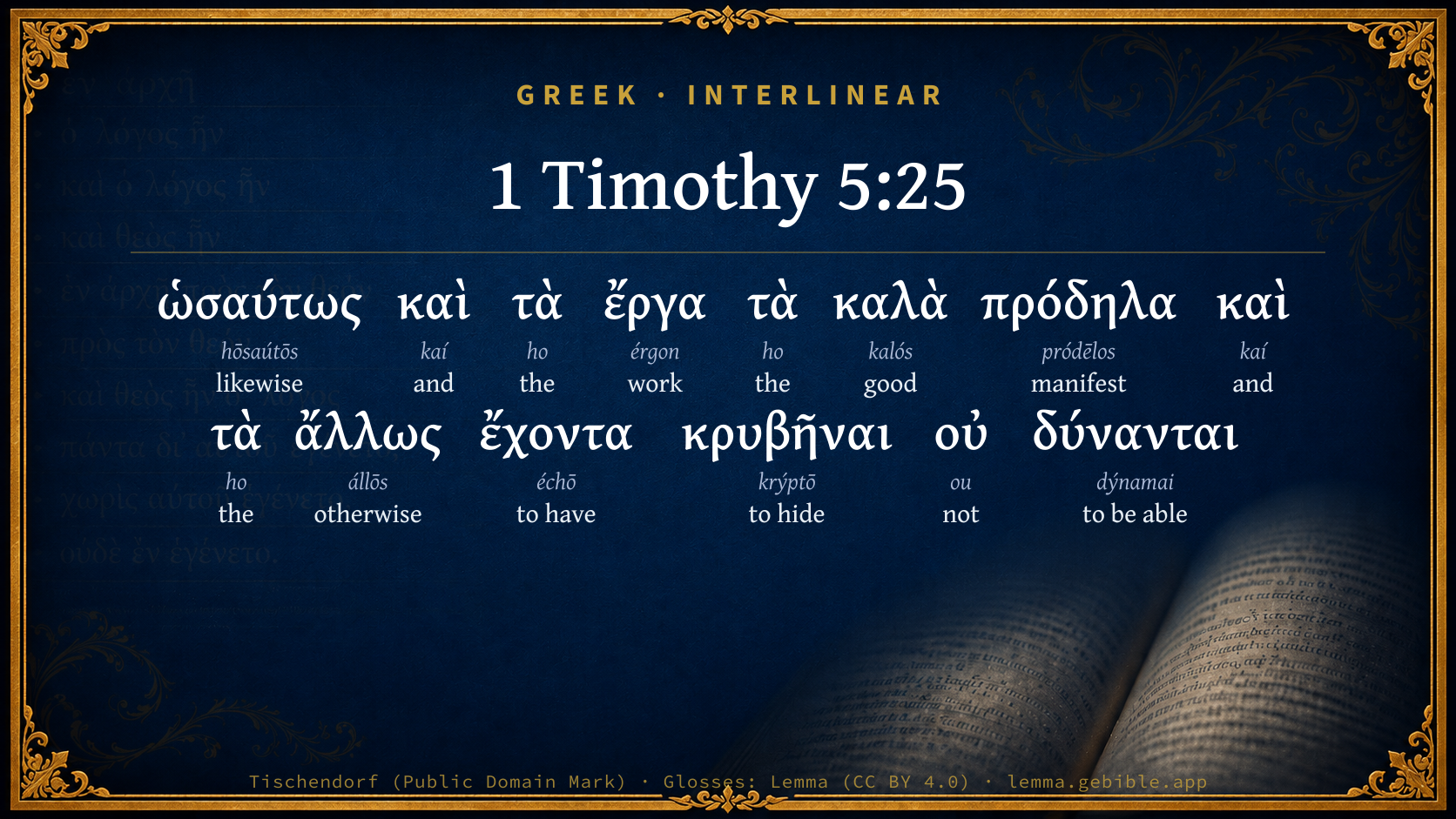
Download image
Cite this verse

1 Timothy 5:25 (World English Bible). Public Domain. Lemma interlinear Bible study tool, https://lemma.gebible.app/v/1-timothy/5/25.

Show BibTeX & RIS
BibTeX
RIS
English Translation
In the same way also there are good works that are obvious, and those that are otherwise can't be hidden.
World English Bible · Public Domain
Highlights
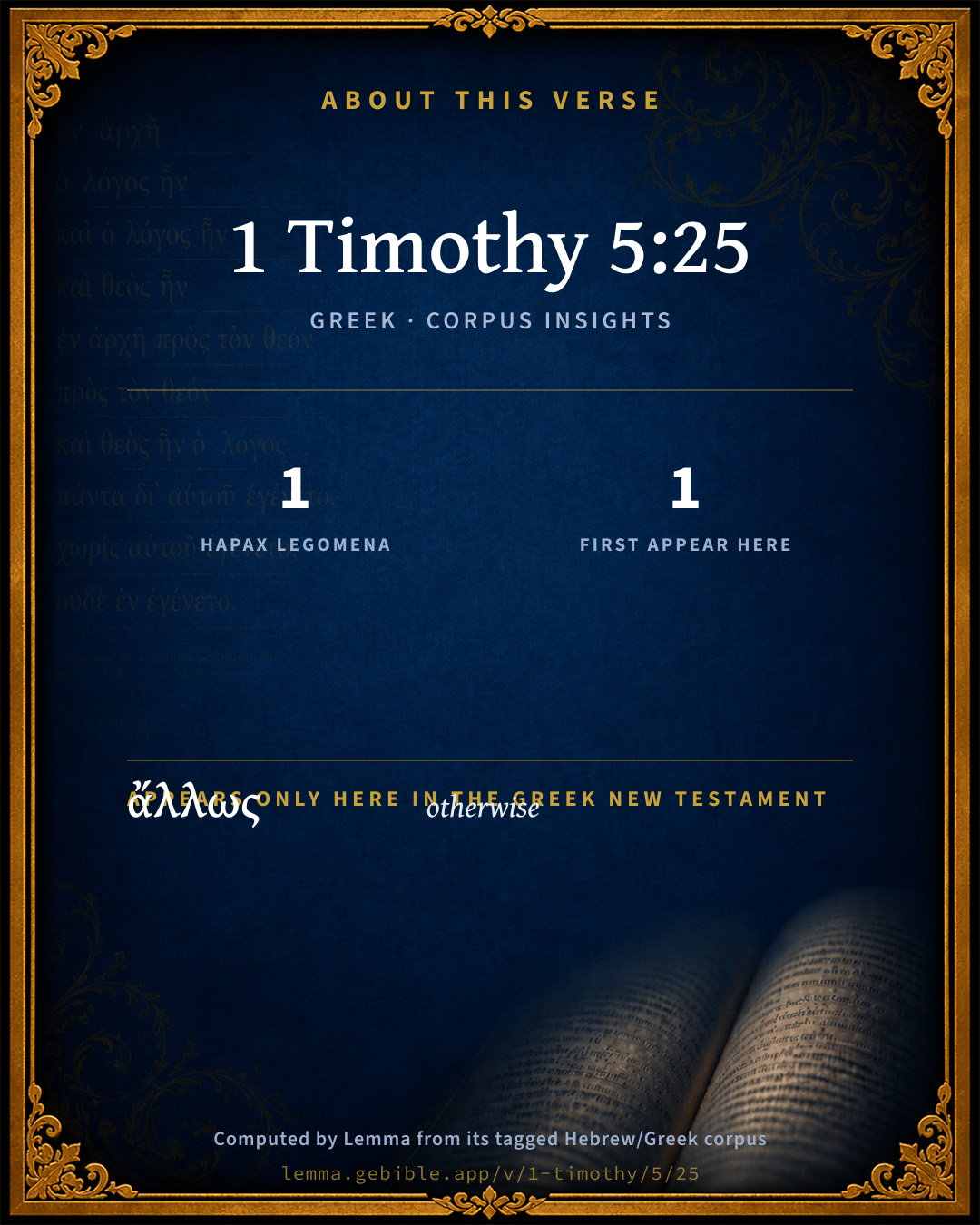
  • 1 hapax legomenon — only here in the Greek New Testament
  • 1 first appearance in the Greek New Testament
Full analysis ↓
Download a study sheet

One document with this verse’s original text, its word-by-word gloss line, the meaning frame, cross-references with their text, attributed commentary, and full source and license credits — printable, and it pastes into notes with its structure intact.

This verse Autodidact and up

Study sheet (.html) Plain text (.txt)

A passage Seminary Student

Up to 50 verses in one chapter. A passage sheet keeps up to 6 commentary sources and 12 cross-references per verse, in the order this page ranks them, and says so on the sheet whenever that leaves anything out. Ask for a single verse and you get the Autodidact verse sheet above.

Everything on this page stays free to read, with no account — the sheet is a download of what is already on screen, not access to it.

Want to remove ads? Support Godless Engineer
Compare translations 3

The same verse in 3 English versions, stacked beneath the original-language interlinear above. Click any original word for its lexicon entry.

Each is an independent rendering of the whole verse — the interlinear is not word-aligned to these translations.

Highlighted words mark where these versions differ — a whole-verse word diff, not a word-by-word alignment.

  • World English Bible Public Domain
    In the same way also there are good works that are obvious, and those that are otherwise can't be hidden.
  • King James Version Public Domain
    Likewise also the good works of some are manifest beforehand; and they that are otherwise cannot be hid.
  • unfoldingWord Literal Text CC BY-SA 4.0
    Likewise, also the good works evident, and the ones having otherwise are not able to be hidden.

unfoldingWord Literal Text — © unfoldingWord, licensed CC BY-SA 4.0. Word-aligned USFM3 via Door43 (git.door43.org/unfoldingWord/en_ult).

Versions to compare (up to 4)

3 of 4 selected

Show all 19 translations

Every available English version of this verse, each an independent rendering of the whole verse.

  • World English Bible Public Domain
    In the same way also there are good works that are obvious, and those that are otherwise can't be hidden.
  • Berean Standard Bible Public Domain
    In the same way, good deeds are obvious, and even the ones that are inconspicuous cannot remain hidden.
  • Majority Standard Bible Public Domain
    In the same way, good deeds are obvious, and even the ones that are inconspicuous cannot remain hidden.
  • King James Version Public Domain
    Likewise also the good works of some are manifest beforehand; and they that are otherwise cannot be hid.
  • American Standard Version (1901) Public Domain
    In like manner also there are good works that are evident; and such as are otherwise cannot be hid.
  • Revised Version (1885) Public Domain
    In like manner also there are good works that are evident; and such as are otherwise cannot be hid.
  • Geneva Bible (1599) Public Domain
    Likewise also the good woorkes are manifest before hande, and they that are otherwise, cannot be hid.
  • Douay-Rheims (1899) Public Domain
    In like manner also good deeds are manifest: and they that are otherwise, cannot be hid.
  • Young's Literal Translation Public Domain
    in like manner also the right works are manifest beforehand, and those that are otherwise are not able to be hid.
  • Literal Standard Version CC BY-SA 4.0
    in like manner the right works are also evident beforehand, and those that are otherwise are not able to be hid.
  • Unlocked Literal Bible CC BY-SA 4.0
    Likewise, some good works are openly known, but even the others cannot be hidden.
  • unfoldingWord Literal Text CC BY-SA 4.0
    Likewise, also the good works evident, and the ones having otherwise are not able to be hidden.
  • Darby Bible Public Domain
    In like manner good works also are manifest beforehand, and those that are otherwise cannot be hid.
  • World Messianic Bible Public Domain
    In the same way also there are good works that are obvious, and those that are otherwise can’t be hidden.
  • Webster's Bible Public Domain
    Likewise also the good works of some are manifest beforehand; and they that are otherwise cannot be hid.
  • Free Bible Version CC BY-SA 4.0
    Similarly some good works are obvious, and even those that are hidden won't be for long.
  • Bible in Basic English Public Domain
    In the same way, there are good works which are clearly seen; and those which are not so, may not be kept secret.
  • Text-Critical English NT CC BY 4.0
    In the same way, good works are obvious, and even those that are not obvious cannot remain hidden.
  • Tyndale New Testament (1534) Public Domain
    Lykwyse also good workes are manyfest before honde and they that are other wyse cannot be hid.

Literal Standard Version (2020), Covenant Press — licensed CC BY-SA 4.0. Text via the HelloAO Bible API (eBible.org). Unlocked Literal Bible (unfoldingWord) — licensed CC BY-SA 4.0. Text via the HelloAO Bible API (eBible.org). unfoldingWord Literal Text — © unfoldingWord, licensed CC BY-SA 4.0. Word-aligned USFM3 via Door43 (git.door43.org/unfoldingWord/en_ult). Free Bible Version, Dr. Jonathan Gallagher — licensed CC BY-SA 4.0. Text via the HelloAO Bible API (eBible.org).

Word by word

More ways to search: Search by grammar → Find every occurrence → Compare this word →

Practice this passage: Drill this verse → Learn its vocabulary →

About this verse

These counts appear in no published source. They are computed here, from the morphology-tagged text and Lemma’s own curated glosses. What Lemma adds →

14
words
11
distinct lemmas
Pauline Epistles
section

Notable vocabulary

1 hapax legomenon — a word that appears only here in the entire Greek New Testament:

  • ἄλλως otherwise G247

First appearance in Scripture

This word makes its first canonical appearance in the Greek New Testament here:

  • ἄλλως otherwise G247

Shared distinctive vocabulary

πρόδηλα manifest G4271 occurs in 3 verses of the Greek New Testament. Also found in:
Repetition

Words recur within this verse:

Cross-references

12

Topical passages linked to 1 Timothy 5:25 in the Treasury of Scripture Knowledge — connected by theme and wording, ordered by reader-vote popularity; previews shown in the World English Bible.

  • Proverbs 10:9 He who walks blamelessly walks surely, But he who perverts his ways will be found out.
  • Luke 11:33 "No man, when he has lit a lamp, puts it in a cellar, nor under a basket, but on a stand, that those who enter in may see the light.
  • Psalms 37:5–6 Commit your way to Yahweh. Trust also in him, and he will do this:
  • Matthew 6:3–6 But when you do merciful deeds, don't let your left hand know what your right hand does,
  • Matthew 5:16 Even so, let your light shine before men; that they may see your good works, and glorify your Father who is in heaven.
  • Acts 9:36 Now there was at Joppa a certain disciple named Tabitha, which when translated, means Dorcas. This woman was full of good works and acts of mercy which she did.
  • Acts 10:22 They said, "Cornelius, a centurion, a righteous man and one who fears God, and well spoken of by all the nation of the Jews, was directed by a holy angel to invite you to his house, and to listen to what you say."
  • Acts 16:1–3 He came to Derbe and Lystra: and behold, a certain disciple was there, named Timothy, the son of a Jewess who believed; but his father was a Greek.
  • Acts 22:12 One Ananias, a devout man according to the law, well reported of by all the Jews who lived in Damascus,
  • Galatians 5:22–23 But the fruit of the Spirit is love, joy, peace, patience, kindness, goodness, faithfulness,
  • 1 Timothy 3:7 Moreover he must have good testimony from those who are outside, to avoid falling into reproach and the snare of the devil.
  • Philippians 1:11 being filled with the fruits of righteousness, which are through Jesus Christ, to the glory and praise of God.

Cross-references courtesy of OpenBible.info (CC BY 4.0).

Commentary

Notes on 1 Timothy 5:25 from classic Christian and Jewish commentators (each source and its license shown beneath its notes). The classic Christian expositions comment on the surrounding passage and are grouped to its opening verse, so a note may address several verses; the Jewish commentaries on the Tanakh (Rashi and others) are per-verse, so they appear only where the commentator wrote on this verse.

Lemma curates 59 commentaries, every one of them public domain or Creative Commons licensed, each selected and text-cleaned for this edition rather than reprinted as found. About our sources →

Ellicott's Commentary for English Readers

(25) Likewise also the good works of some are manifest beforehand; and they that are otherwise cannot be hid.—In his difficult post Timothy might fear lest, especially in his selection of men for the Lord’s service, true nobility of character might not unfrequently escape his notice and be overlooked, and that thus the best and truest might never be enrolled on the register of church officers. St. Paul bids him take courage in the thought that in many a case self-sacrifice, generosity, stern principle, will be sufficiently manifest to guide him in his choice of fit persons for the holy calling; and in those rarer cases where the higher and sweeter virtues are hidden, he may be sure that in God’s good season these too will become known to him, in ample time for him to call them also into his Master’s service.

EXCURSUS ON NOTES TO I. TIMOTHY.

ON A SUGGESTED INTERPRETATION OF CHAPTER 5:25.

IT has been suggested, with considerable ingenuity, that 1Ti_5:25 belongs to, and is an introduction of, a new division of the Epistle, where the Apostle gives Timothy instructions respecting certain teachings to be addressed to different ranks in the Christian society of Ephesus. The connection with 1Ti_5:24 then would be—as it is in the case of sins, so, too, it is in the case of good works. These latter are not always on the surface distinguishable. Some, of course, are manifest, but there is many a noble life the secrets of which will only come to light at the last day—“they cannot be hid” THEN. And this is too often the case with that unhappy class (the slaves), “those under the yoke,” of whom the Apostle was about to speak (1Ti_6:1-2). It is possible that St. Paul meant here to turn Timothy’s attention especially to those in slavery, that he might diligently search out the noblest and most devoted, and ordain (see 1Ti_5:22) them to perform sacred duties, so that each class—the slaves as well as the rich and well-born—should possess representatives among the ordained ministers. This is at least possible when we consider the vast number of slaves—not a few of them, too, possessing high culture—in the world known by St. Paul and Timothy.

In connection with, but not necessarily linked with, this thought is an interpretation of the general subject matter of the sixth chapter, which views the whole as instructions to the three broad divisions into which Christian society of the first century may be said to have been roughly divided:—

(1) SLAVES . . .1Ti_5:25 to 1Ti_6:3. Instructions respecting slaves, who possessed nothing of their own.1Ti_6:4-5. The allusion to the false teachers, whose teaching respecting slavery was very different from his.(2) MIDDLE CLASS.1Ti_6:6-16. St. Paul introduces the warning against covetousness and the wish to be rich, the special danger of the middle class—the free, but who were the reverse of wealthy—to which order Timothy belonged. Then followed(3) THE RICH1Ti_6:17-19. Special instructions to the rich and the highly horn.

A Bible Commentary for English Readers, edited by Charles John Ellicott (1878–1897) — public domain. Text from a community e-Sword module.

Bengel's Gnomon

Johann Albrecht Bengel

1Ti 5:25. Τὰ ἄλλως ἔχοντα, the works that are otherwise) Those which are not beforehand manifest. The saying, which is found at Ecc 8:14, is remarkable, and should in the present day be especially attended to.—κρυβῆναι be hid) long.—οὐ δύναται, cannot) although they who do them may often wish to keep them concealed.

—————

Bengel's Gnomon of the New Testament — English translation (T&T Clark, Edinburgh, 1860) — public domain. Text from a community e-Sword module.

Meyer's Critical & Exegetical Commentary

Heinrich August Wilhelm Meyer

1Ti_5:25 supplements 1Ti_5:24, the distinction between manifest and hidden being applied to good works.

ὡσαύτως καὶ τὰ ἔργα τὰ καλὰ πρόδηλα] It may be supposed from what precedes that τινῶν ἀνθρώπων is to be supplied here. But it is improbable that Paul was thinking definitely of this, otherwise the clause following would have received another form. Hofmann maintains that the Rec. πρόδηλά ἐστιν is the original reading, taking the words ὡσαύτως … καλά as a complete clause, and explaining πρόδηλά ἐστιν by: there are manifest (ones). This purely arbitrary view needs no refutation. The assertion that the apostle could not say that the good works were manifest, is contradicted by the addition of the necessary restriction in the next words.

καὶ τὰ ἄλλως ἔχοντα is not to be referred to καλά, but to πρόδηλα: the good works with which it is different, i.e. which are not πρόδηλα.

κρυβῆναι οὐ δύνανται] can, however, not remain continually hidden; they will likewise become manifest on a careful κρίσις. 1Ti_5:24 was a warning against showing favour too hastily; this verse is a warning against condemning too hastily.

Meyer — Critical and Exegetical Commentary on the New Testament — English translation by Peter Christie, edited by Frederick Crombie (T&T Clark, 1880) — public domain. Text from a community e-Sword module.

Expositor's Greek Testament

ed. W. Robertson Nicoll

1Ti 5:25 . ὡσαύτως here, as in chap. 1Ti 2:9 , naturally introduces an antithesis to what has gone before; and this determines the meaning of τὰ ἄλλως ἔχοντα ; not as ἔργα which are not καλά , but as ἔργα καλά which are not πρόδηλα ; and justifies the R.V. rendering, There are good works that are evident . The next clause is parallel to the corresponding part of 1Ti 5:24 : Sins and good works alike cannot be successfully and indefinitely concealed; they follow are disclosed some time or other in justification of the κρίσις of men. The literal rendering in R.V. [289] ., The works that are good are evident , could only be defended by laying emphasis on καλά , “good in appearance as well as in reality”; but καλὰ ἔργα is of frequent occurrence in these epistles without any such special signification; see on 1Ti 3:1 ; and this rendering deprives ὡσαύτως of any force. Von Soden thinks that we have here a reference to the sayings in Mat 5:14-16 .

[289] Speculum

The Expositor's Greek Testament, edited by W. Robertson Nicoll (1897–1910) — public domain. Text from a community e-Sword module.

Geneva Bible (1599)

Geneva Bible translators

Another comfort belonging to them, which sometimes are slandered and misreported of.

Geneva Bible (1599) marginal notes — public domain. Text via Bolls.life.

Adam Clarke's Commentary

Verse 25. Likewise also the good works of some] Though those who are very holy and very useful in the Church cannot be unknown, yet there are others not less holy who need to be brought forward; who do much good in private; and their character and good works are not fully known till after diligent inquiry. These are they who do not let their left hand know what their right doeth.

1. AFTER so long and minute an examination of the subjects in this chapter, little remains to be said in the way of farther and more satisfactory explanation. The whole account concerning the widows, who they were, and what their provision, and what their occupation, and how supported, are to me questions of considerable difficulty. In the notes I have given the best account of the different subjects in my power. If the reader be satisfied and edified, I have gained my end.

2. On the subject of the imposition of hands, or what is vulgarly but improperly called ordination, I have not said much here, having given my views of the subject elsewhere in these notes. See note on 1Ti 3:1, c. I must again state my conviction that what is said on this subject in this chapter, and indeed in the epistle, is rather to be understood prophetically and to have been intended for a much lower age of the Christian Church. That any person should, from impure or secular motives, desire to be appointed to the ministerial office at such a time, when poverty and persecution were the least they would reasonably expect, to me seems altogether inexplicable. But that many, after the Church got accredited and established, and an ample revenue appointed for its ministers by emperors and kings, should wish to get into the priesthood for its emoluments, is a melancholy truth, which every year's experience testifies. To those who have the authority from the state to appoint ministers for the Church, this chapter reads a solemn and awful lesson. And not to them only, but to all who have the appointment of ministers or preachers in every sect and party. How few are there who would kindle a fire on God's altar were there not secular emoluments attending it! I am afraid the Scottish poet spoke the truth who said: -

"'Tis gow'd maks sogers feight the fiercer,

Without it, preaching wad be scarcer."

Gold or money is the primum mobile through every department of life. Proh dolor!

Adam Clarke's Commentary on the Bible (1810–1826) — public domain. Text from a community e-Sword/MySword module.

John Calvin's Commentaries

25 In like manner also the good works He means, that sometimes piety and other virtues obtain early and speedily their applause among men; so that great men are held in estimation; and that, if it happen otherwise, the Lord will not suffer innocence and uprightness to be always oppressed; for it is often obscured by calumnies, or by clouds, but at length shall be fulfilled the prediction, (Daniel 12:3; Matthew 13:43,) that God will cause them to shine forth like the dawn of the day. But we have need of a calm spirit to endure; and therefore we must always consider what is the limit of our knowledge, that we may not go beyond it; for that would be to assume to ourselves the prerogative of God.

John Calvin's Commentaries (1540-1563) — public domain. Text from the Calvin Translation Society English edition (1840s-50s) via the Christian Classics Ethereal Library (ccel.org). Calvin's coverage is partial (roughly two-thirds of the Bible); uncommented books and verses are honest gaps, never fabricated. The 19th-century editor's footnotes and remarks are omitted so the notes are faithfully Calvin's own voice.

The Cambridge Bible for Schools and Colleges

gen. ed. J. J. S. Perowne

25. Likewise also the good works of some] R.V. excellently, drawing out the double article with substantive and adjective which has the best authority of mss., in like manner also there are good works that are evident. See the interpretation on the previous verse, according to which the more obvious departments in ‘the ruling well,’ the ‘labouring devotedly in speech and teaching,’ are here meant.

they that are otherwise] The such as are otherwise of R.V. renders the generalness of the phrase and makes it clear that ‘works’ not ‘men are meant; such part—often the best part—of the pastor’s work of ‘ruling well,’ and of ‘labouring devotedly in speech and teaching,’ as does not come before the world.

The Cambridge Bible for Schools and Colleges (gen. ed. J. J. S. Perowne; Cambridge University Press, 1878–1918) — public domain. Text from a community e-Sword module.

Trapp's Complete Commentary

John Trapp

25 Likewise also the good works of some are manifest beforehand; and they that are otherwise cannot be hid.

Ver. 25. Cannot be hid] As putrid hypocrisy shall be detected (for the name of the wicked must rot), so wronged innocence shall be cleared, as the eclipsed moon wades out of the shadow, and recovers her splendour.

John Trapp, A Commentary or Exposition upon All the Books of the Old and New Testament (1647–1656) — public domain. Text from a community e-Sword module.

Albert Barnes' Notes on the Bible

Likewise also the good works of some are manifest beforehand - The character of some people is clear, and accurately understood. There can be no doubt, from their works, that they are good people. We need not wait for the day of judgment to determine that, but may treat them here as good men, and introduce them to offices which only good men can fill. The idea here is that their character may be so certain and undoubted that there need be no hesitation in setting them apart to the office of the ministry.

And they that are otherwise cannot be hid - That is, they cannot be ultimately concealed or misunderstood. There are arrangements in the divine government for bringing out the character of every man so that it may be clearly understood. The expression here refers to good men. The idea is, that there are some good men whose character is known to all. Their deeds spread a glory around them, so that no one can mistake what they are. They correspond, in respect to the publicity of their character with those mentioned in 1Ti 5:24, whose “sins are open beforehand;” for the good deeds of the one are as manifest as the sins of the other. But there are those who are “otherwise.” They are modest, retiring, unobtrusive, unknown. They may live in obscurity; may have slender means for doing good; may be constitutionally so diffident that they never appear on the stage of public action. What they do is concealed from the world. These correspond in respect to publicity with those mentioned in 1Ti 5:24, “whose deeds follow after them.” Yet, says the apostle, these cannot always be hid. There are arrangements for developing every man’s character, and it will be ultimately known what he is. The connection here, seems to be this. As Timothy 1Ti 5:24 was to be on his guard in introducing men into the ministry, against those whose character for evil was not developed, but who might be concealing their plans and practicing secret sins, so he was to endeavor to search out the modest, the unobtrusive, and those who, though now unknown, were among the excellent of the earth, and bring them forward to a station of usefulness where their virtues might shine on the world.

Apart from the reference of this beautiful passage 1Ti 5:24-25 to the ministry, it contains truth important to all:

(1) The character of many wicked people is now clearly known. No one has any doubt of it. Their deeds have gone before them, and are recorded in the books that will be open at the judgment. They might even now be judged without the formality of appearing there, and the universe would acquiesce in the sentence of condemnation.

(2) The character of many wicked people is concealed. They hide their plans. They are practicing secret iniquity. They do not mean that the world shall know what they are. More than half the real depravity of the world is thus concealed from human view, and in regard to more than half the race who are going up to the judgment there is an entire mistake as to their real character. If all the secret wickedness of the earth were disclosed, no one would have any doubt about the doctrine of human depravity.

(3) There is a process steadily going forward for bringing out the real character of people, and showing what they are. This process consists, first, in the arrangements of Providence for developing their character here. Many a man, who was supposed to be virtuous, is shown, by some sudden trial, to have been all along a villain at heart. Many a minister of the gospel, a lawyer, a physician, an officer in a bank, a merchant, whose character was supposed to stand fair, has been suffered to fall into open sin, that he might develope the long-cherished secret depravity of his soul. Secondly, the process will be completed on the final trial. Then nothing will be concealed. Every man will been seen as he is. All they whose characters were understood to be wicked here, will be seen then also to be wicked, and many who were supposed on earth to have a good character, will be seen there to have been hollow-hearted and base hypocrites.

(4) Every man in the last day will be judged according to his real character. No one, however successful he may have been here, can hope to practice a deception on his final Judge.

(5) There is a fitness and propriety in the fact that there will be a final judgment. Indeed, there must be such a judgment, in order that God may be just. The characters of people are not fully developed here. The process is not completed. Many are taken away before their schemes of iniquity are accomplished, and before their real characters are understood. If they were to live long enough on the earth, their characters would be ultimately developed here, but the divine arrangement is, that man shall not live long here, and the development, therefore, must be in the future world.

(6) The modest, the retiring, the humble, and those here unknown, will not be overlooked in the last great day. There is much good, as there is much evil in the world, that is now concealed. There are many plans of benevolence formed which they who formed them are not permitted to complete; many desires of benefiting others are cherished which there are no means of gratifying; many a deed of kindness is performed which is not blazoned abroad to the world; and many a wish is entertained for the progress of virtue, the freedom of the enslaved, the relief of the oppressed, and the salvation of the world, which can find expression only in prayer. We are not to suppose then that all that is concealed and unknown in the world is evil.

(7) There will be amazing developments in the last great day; and as it will then be seen in the revelations of the secret deeds of evil that human nature is corrupt, so it will be seen that there was much more good in the world than was commonly supposed. As a large portion of the wickedness of the earth is concealed, so, from the necessity of the case, it is true that no small portion of the goodness on earth is hidden. Wickedness conceals itself from shame, from a desire better to effect its purposes, from the dread of punishment; goodness, from its modesty, its retiring nature, and from the want of an opportunity of acting out its desires; but whatever may have been the cause of the concealment, in all cases all will be made known on the final trial - to the shame and confusion of the one class; to the joy and triumph of the other.

Albert Barnes' Notes on the Bible (1834–1885) — public domain. Text from a community e-Sword/MySword module.

Matthew Poole's English Annotations

In like manner some men’s holy life and conversation hath been so evident, that there needs little judgment concerning them; and for others, under a due government they cannot be long concealed, but by thy due management of and vigilance in thy office they will soon be discovered, by their publishing their erroneous principles, and the breaking out of their lusts into enormous acts, so as they will soon fall under thy censure. Or else thus: The good works of some whose life hath not been so exemplary, but yet such as in charity thou mayst judge them to have the root of the matter in them, (if thou be not mistaken), cannot be long hid, so as thou shalt soon see what they are, and accordingly know how to behave thyself to them. Thus I should choose rather to interpret this text than concerning the judgment of God, who sometimes rewards good works presently, and always rewards them certainly, either in this life or that which is come.

Matthew Poole's English Annotations on the Holy Bible (1683–1685) — public domain. Text from a community e-Sword/MySword module.

Whedon's Commentary on the Bible

Daniel D. Whedon

25. Also the good works—Which are the well-known antecedents of some, are manifest beforehand; so that the trial will be only matter of form. The characters of the men refute the charges. They, the good deeds, that are otherwise than previously manifest, cannot be hid; they will come out at last.

Daniel D. Whedon (gen. ed.), Commentary on the Old and New Testaments (1874–1909) — public domain. Text from a community e-Sword module.

The Pulpit Commentary

In like maturer for likewise, A.V; there are good works that are evident for the good works of some are manifest beforehand, A.V; such as for they that, A.V There are good works, etc. It is much best to understand pinwn, as the A.V does, and render the good works of some, answering to tinwn aiJ aJmartiai of ver. 24. Such as are otherwisei.e. , not manifest beforehandcannot be hid. "They will be seen and recognized some time or other" (Ellicott). Alford seems to catch the true spirit of the passage when he says, The tendency of this verse is to warn Timothy against hasty condemnation, as the former had done against hasty approval. Sometimes thou wilt find a mans good character go before him.... but where this is not so.... be not rash to condemn: thou mayest on examination discover it there be any good deeds accompanying him: for they... cannot be hidden."

The Pulpit Commentary (1880–1919), ed. H.D.M. Spence-Jones & Joseph S. Exell — public domain. Text from a community e-Sword module.

John Wesley's Explanatory Notes

They that are otherwise - Not so manifest. Cannot be long hid - From thy knowledge. On this account, also, be not hasty in laying on of hands.

John Wesley, Explanatory Notes Upon the Whole Bible (1754–1765) — public domain. Text via the GEBible commentary corpus.

Fairbairn on Ezekiel, Jonah & the Pastoral Epistles

Patrick Fairbairn

Ver. 25. In like manner also, the works that are good are manifest, and those that are otherwise cannot be hid. The τὰ before καλὰ is evidently designed to give prominence to the quality of the actions as good; and this is best brought out in the English idiom by rendering, not the good works, but the works that are good. It is a general proposition, and is not to be limited to the some men immediately preceding, whose bad deeds done in secret ultimately come to light. Deeds fully deserving the name of good have a kind of self-evidencing character; they speak in a manner for themselves; and those which are of a different description, even though for a time, or under certain aspects, they may appear otherwise, will by and by be discovered in their true character. They cannot be hid—that is, when the searching light of God’s judgment is let in upon them; but the saying is strictly applicable only to that, and so confirms the view taken of the judgment in the preceding verse. But Christian men, of course, and especially Christian rulers, should, as far as they are called to act in such matters, be at pains to have the truth brought to light.

Patrick Fairbairn — An Exposition of Ezekiel (1851), Jonah (1849), and The Pastoral Epistles (1874) — public domain. Text from a community e-Sword module.

The People's New Testament

B. W. Johnson

25. Likewise also the good works. The same rule applies to good works. Some get credit for more by far than they deserve, while the good deeds of others will not be fully revealed until judgment. Then all will be estimated aright.

B. W. Johnson's The People's New Testament with Notes (1889–1891) — public domain. Electronic text from the Christian Classics Ethereal Library (CCEL) ThML edition.

Cambridge Greek Testament for Schools and Colleges

25. Rec. text has τὰ καλὰ ἔργα with KL; txt follows אAD2GP. Also rec. after πρόδηλα adds ἔστι with KL (D2GP add εἰσι); om. אA. At the end of the verse rec. text has δύναται with אGKL, but the reading δύναται is found in AD2P17 and some other cursives, and is adopted by recent editors. The use of a plural verb after a neuter plural subject (which is never found in Attic Greek) is very common in the N.T., and it is the ordinary rule in Modern Greek.

25. ὡσαύτως κ.τ.λ. So also (and this is the second maxim to be remembered in the diagnosis of character) while some kinds of good works are notoriously evident, there are also good works which, though not conspicuous, cannot remain hidden, if full investigation is made. This maxim will prohibit hasty rejection or condemnation of any man, on the plea that his good works are not apparent at the first glance, for καλὰ ἔργα are not always done in public, though they cannot be concealed from a careful scrutiny.

τὰ ἄλλως ἔχοντα, those that are otherwise, sc. those that are not πρόδηλα, as explained above.

Cambridge Greek Testament for Schools and Colleges (Cambridge University Press, 1896; 21 vols, various authors incl. Carr, Maclear, Plummer, Farrar, Lumby, Moule, M. R. James, Simcox) — public domain. Text from a community e-Sword module.

Alford’s Greek Testament

Henry Alford

25.] So also (in like manner on the other side of men’s conduct) the good works (of some) are openly manifest: and those which are otherwise situated (which are not πρόδηλα) cannot be hidden (will come out, just as the sins in ver. 24, on examination. The tendency of this verse is to warn him against hasty condemnation, as the former had done against hasty approval. Sometimes thou wilt find a man’s good character go before him, and at once approve him to thee: but where this is not so, do not therefore be rash to condemn—thou mayest on examination soon discover, if there really be any good deeds accompanying him: for they are things which cannot be hidden—the good tree like the bad will be known by his fruits, and that speedily, on enquiry). I have abstained from detailing all the varieties of interpretation of these verses, following as they do those already specified on verses 20-22. They may be seen shortly enumerated in De W. and Ellicott, and commented on at somewhat tedious length in Wiesinger. Chrys., al., confuse the context by understanding κρίσις of eternal judgment, and the sentiment as equivalent to ἐκεῖ πάντα γυμνά ἐστιν. And so even Ellicott, who in objecting to the above interpretation (which is also Bp. Wordsworth’s) charges it somewhat naïvely with failure in explaining the context. That it only does explain it satisfactorily, is, in my view, the decisive consideration in its favour.

Henry Alford, The Greek Testament (1849–1861) — public domain. Text from a community e-Sword module.

International Critical Commentary

25. τὰ ἄλλως ἔχοντα] i.e. not πρόδηλα. They cannot in the end be hidden, and you will be able to honour them adequately. τὰ ἔργα τὰ καλά recalls καλῶς 17 but goes beyond that instance.

M.M. The Vocabulary of the Greek Testament, by J. H. Moulton and G. Milligan, 1914-

Blass, Grammar of New Testament Greek, English translation, 1898.

O.G.I.S. Orientis Grœci Inscriptiones Selectœ, ed. W. Dittenberger, 1903-1905.

1 Wetstein quotes, to illustrate the thought, Isocrates, ad Demonic, § 38, εἰς ἀρχὴν κατασταθεὶς μηδένι χρῶ πονηρῷ πρὸς τὰς διοικήσεις· ὧν γὰρ ἂν ἐκεῖνος ἁμάρτοι, σοὶ τὰς αἰτίας ἀναθήσουσιν. Hor. Ep. i. 18. 77, “Qualem commendes etiam atque etiam aspice, ne mox Incutiant aliena tibi peccata pudorem.”

International Critical Commentary — older volumes (1896–1929), various authors — public domain. Text from a community e-Sword module.

Vincent's Word Studies in the New Testament

Marvin R. Vincent

Otherwise [αλλως] . N. T. o. Not. otherwise than good, but otherwise than manifest.

Be hid [κρυβηναι] . In Paul only Col 3:3. The good works, although not conspicuous [προδηλ

Marvin R. Vincent, Word Studies in the New Testament (1887–1900) — public domain. Text from a community e-Sword/MySword module.

Lesson kit

Teaching starters — assembled from the data on this page, not authored interpretation. Every prompt links to the verse data it draws on. Edit before teaching.

1 Timothy, in the Pauline Epistles, opens this verse with 14 words (11 distinct Greek lemmas). Its most distinctive word is állōs (“otherwise”). A historical commentator’s framing appears above. Read the whole chapter for the surrounding context.

Discussion questions

  1. The word állōs carries the sense “otherwise.” How does it shape the verse?
  2. 1 word here appears nowhere else in the Greek New Testament. Why might the author reach for such rare wording?
  3. This is the first place “otherwise” appears in Scripture (first appears here). What does its debut here establish?
  4. How does 1 Timothy 5:24, which shares the word «manifest», read alongside this verse?
  5. What does the repetition of “the” (3× in this one verse) do in this verse?
  6. These translations render this verse differently; the difference is in the English rendering, not the original. What questions does that raise?
  7. Compare how Ellicott's Commentary for English Readers and Bengel's Gnomon read this verse. Where do they agree or differ?

Things to notice

  • 1 word in this verse appears nowhere else in the Greek New Testament.
  • 1 word makes its first canonical appearance in Scripture here.
  • These translations choose different wording for 16 words in this verse.
  • “the” occurs 3× in this single verse.
  • 11 distinct Greek lemmas span 14 words in this verse.

Reading settings

Reading text

Shown beneath each verse's original-language words.

Old Testament
Old Testament edition

Read the OT as the Masoretic Hebrew (MT) or the Greek Septuagint (LXX).

English shown for the Greek Septuagint (in the Hebrew ↔ Greek comparison).

Comparing translations? Open the Compare panel on any verse page to stack up to four side by side.