2 Timothy 3:17

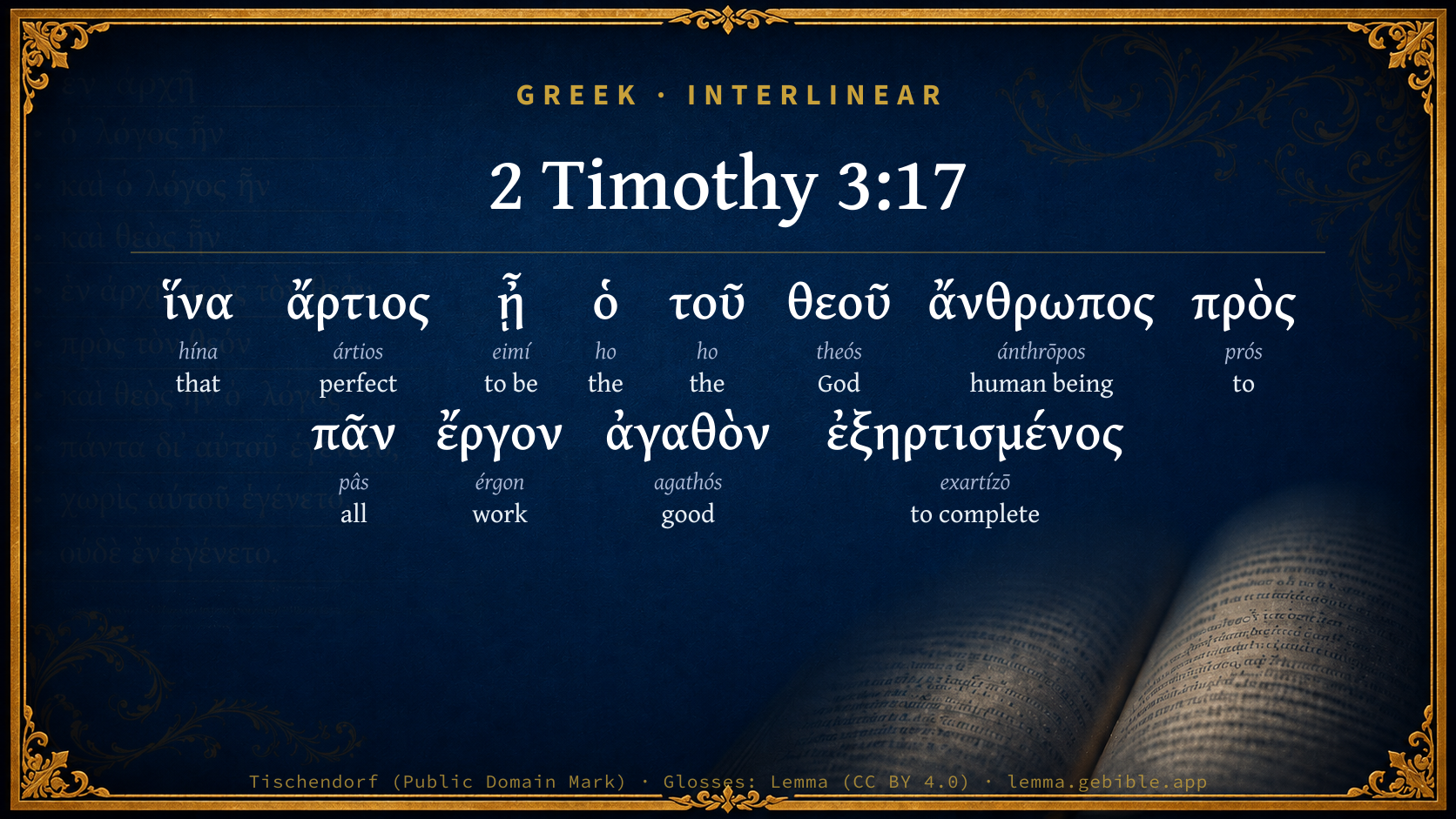
Greek (Tischendorf 8th ed.) 2 Timothy 3:17 appears in the Greek New Testament. The text above is from the Tischendorf 8th edition. Each word links to its Strong’s number and a concise gloss. Click any word for its full Thayer’s Greek Lexicon entry.
Download image
Cite this verse

2 Timothy 3:17 (World English Bible). Public Domain. Lemma interlinear Bible study tool, https://lemma.gebible.app/v/2-timothy/3/17.

Show BibTeX & RIS
BibTeX
RIS
English Translation
that the man of God may be complete, thoroughly equipped for every good work.
World English Bible · Public Domain
Highlights
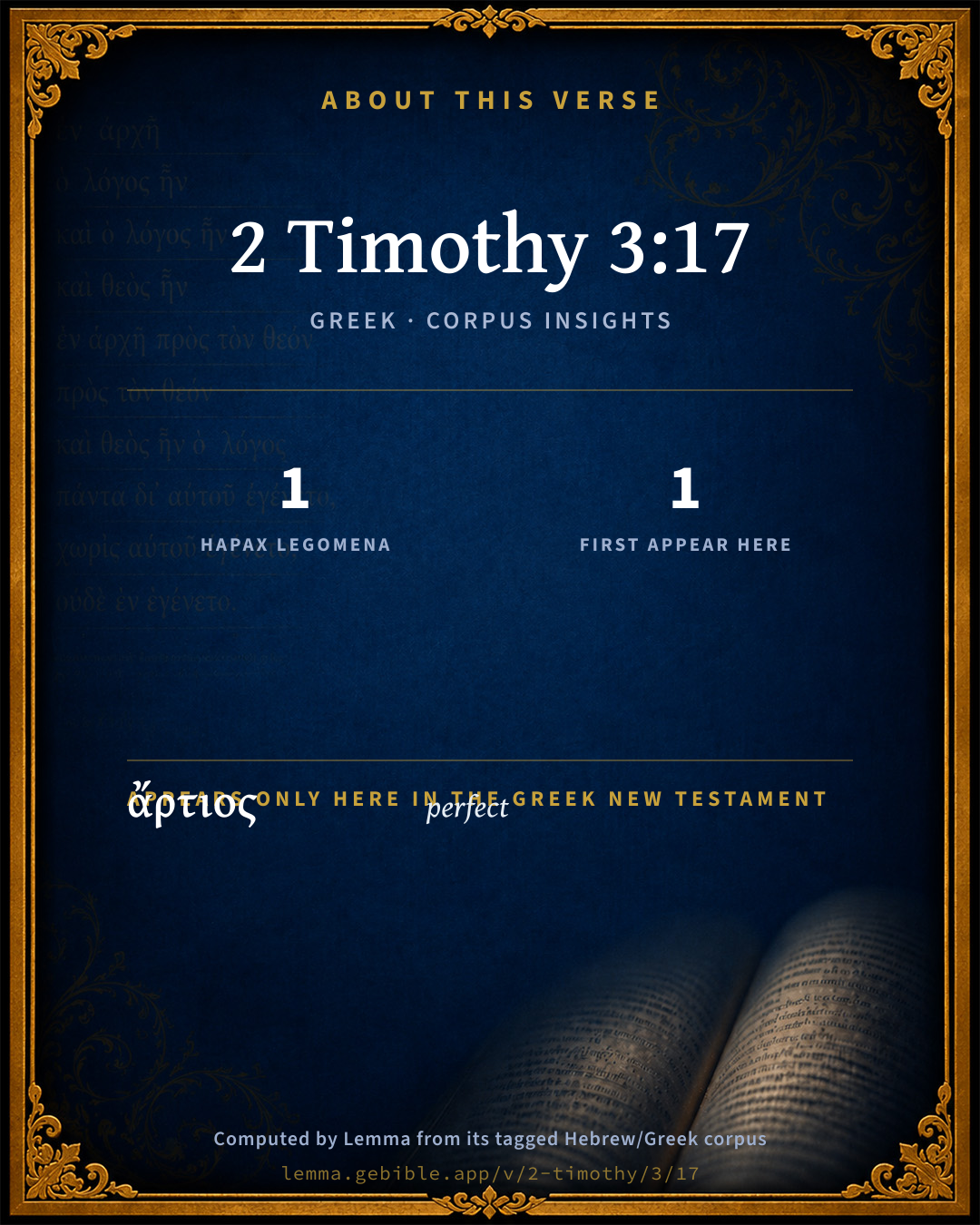
  • 1 hapax legomenon — only here in the Greek New Testament
  • 1 first appearance in the Greek New Testament
Full analysis ↓
Download a study sheet

One document with this verse’s original text, its word-by-word gloss line, the meaning frame, cross-references with their text, attributed commentary, and full source and license credits — printable, and it pastes into notes with its structure intact.

This verse Autodidact and up

Study sheet (.html) Plain text (.txt)

A passage Seminary Student

Up to 50 verses in one chapter. A passage sheet keeps up to 6 commentary sources and 12 cross-references per verse, in the order this page ranks them, and says so on the sheet whenever that leaves anything out. Ask for a single verse and you get the Autodidact verse sheet above.

Everything on this page stays free to read, with no account — the sheet is a download of what is already on screen, not access to it.

Want to remove ads? Support Godless Engineer
Compare translations 3

The same verse in 3 English versions, stacked beneath the original-language interlinear above. Click any original word for its lexicon entry.

Each is an independent rendering of the whole verse — the interlinear is not word-aligned to these translations.

Highlighted words mark where these versions differ — a whole-verse word diff, not a word-by-word alignment.

  • World English Bible Public Domain
    that the man of God may be complete, thoroughly equipped for every good work.
  • King James Version Public Domain
    That the man of God may be perfect, throughly furnished unto all good works.
  • unfoldingWord Literal Text CC BY-SA 4.0
    so that the man of God may be complete, having been equipped for every good work.

unfoldingWord Literal Text — © unfoldingWord, licensed CC BY-SA 4.0. Word-aligned USFM3 via Door43 (git.door43.org/unfoldingWord/en_ult).

Versions to compare (up to 4)

3 of 4 selected

Show all 19 translations

Every available English version of this verse, each an independent rendering of the whole verse.

  • World English Bible Public Domain
    that the man of God may be complete, thoroughly equipped for every good work.
  • Berean Standard Bible Public Domain
    so that the man of God may be complete, fully equipped for every good work.
  • Majority Standard Bible Public Domain
    so that the man of God may be complete, fully equipped for every good work.
  • King James Version Public Domain
    That the man of God may be perfect, throughly furnished unto all good works.
  • American Standard Version (1901) Public Domain
    That the man of God may be complete, furnished completely unto every good work.
  • Revised Version (1885) Public Domain
    that the man of God may be complete, furnished completely unto every good work.
  • Geneva Bible (1599) Public Domain
    That the man of God may be absolute, being made perfect vnto all good workes.
  • Douay-Rheims (1899) Public Domain
    That the man of God may be perfect, furnished to every good work.
  • Young's Literal Translation Public Domain
    that the man of God may be fitted -- for every good work having been completed.
  • Literal Standard Version CC BY-SA 4.0
    that the man of God may be fitted—having been completed for every good work.
  • Unlocked Literal Bible CC BY-SA 4.0
    This is so that the man of God may be competent, equipped for every good work.
  • unfoldingWord Literal Text CC BY-SA 4.0
    so that the man of God may be complete, having been equipped for every good work.
  • Darby Bible Public Domain
    that the man of God may be complete, fully fitted to every good work.
  • World Messianic Bible Public Domain
    that each person who belongs to God may be complete, thoroughly equipped for every good work.
  • Webster's Bible Public Domain
    That the man of God may be perfect, thoroughly furnished to all good works.
  • Free Bible Version CC BY-SA 4.0
    This is how God provides a thorough preparation for those who work for him to accomplish all that's good.
  • Bible in Basic English Public Domain
    So that the man of God may be complete, trained and made ready for every good work.
  • Text-Critical English NT CC BY 4.0
    so that the man of God may be complete, fully equipped for every good work.
  • Tyndale New Testament (1534) Public Domain
    that the man of god maye be perfect and prepared vnto all good workes.

Literal Standard Version (2020), Covenant Press — licensed CC BY-SA 4.0. Text via the HelloAO Bible API (eBible.org). Unlocked Literal Bible (unfoldingWord) — licensed CC BY-SA 4.0. Text via the HelloAO Bible API (eBible.org). unfoldingWord Literal Text — © unfoldingWord, licensed CC BY-SA 4.0. Word-aligned USFM3 via Door43 (git.door43.org/unfoldingWord/en_ult). Free Bible Version, Dr. Jonathan Gallagher — licensed CC BY-SA 4.0. Text via the HelloAO Bible API (eBible.org).

Word by word

More ways to search: Search by grammar → Find every occurrence → Compare this word →

Practice this passage: Drill this verse → Learn its vocabulary →

About this verse

These counts appear in no published source. They are computed here, from the morphology-tagged text and Lemma’s own curated glosses. What Lemma adds →

12
words
11
distinct lemmas
Pauline Epistles
section

Notable vocabulary

1 hapax legomenon — a word that appears only here in the entire Greek New Testament:

  • ἄρτιος perfect G739

First appearance in Scripture

This word makes its first canonical appearance in the Greek New Testament here:

  • ἄρτιος perfect G739

Shared distinctive vocabulary

ἐξηρτισμένος to complete G1822 occurs in 2 verses of the Greek New Testament. Also found in:

Repetition

A word recurs within this verse:

Cross-references

10

Topical passages linked to 2 Timothy 3:17 in the Treasury of Scripture Knowledge — connected by theme and wording, ordered by reader-vote popularity; previews shown in the World English Bible.

  • 2 Timothy 2:21 If anyone therefore purges himself from these, he will be a vessel for honor, sanctified, and suitable for the master's use, prepared for every good work.
  • 2 Corinthians 9:8 And God is able to make all grace abound to you, that you, always having all sufficiency in everything, may abound to every good work.
  • Ephesians 2:10 For we are his workmanship, created in Christ Jesus for good works, which God prepared before that we would walk in them.
  • 1 Timothy 6:11 But you, man of God, flee these things, and follow after righteousness, godliness, faith, love, patience, and gentleness.
  • Hebrews 10:24 Let us consider how to provoke one another to love and good works,
  • Titus 2:14 who gave himself for us, that he might redeem us from all iniquity, and purify for himself a people for his own possession, zealous for good works.
  • Acts 9:36 Now there was at Joppa a certain disciple named Tabitha, which when translated, means Dorcas. This woman was full of good works and acts of mercy which she did.
  • Titus 3:1 Remind them to be in subjection to rulers and to authorities, to be obedient, to be ready for every good work,
  • Nehemiah 2:18 I told them of the hand of my God which was good on me, as also of the king's words that he had spoken to me. They said, Let us rise up and build. So they strengthened their hands for the good [work].
  • Psalms 119:98–100 Your commandments make me wiser than my enemies, For your commandments are always with me.

Cross-references courtesy of OpenBible.info (CC BY 4.0).

Commentary

Notes on 2 Timothy 3:17 from classic Christian and Jewish commentators (each source and its license shown beneath its notes). The classic Christian expositions comment on the surrounding passage and are grouped to its opening verse, so a note may address several verses; the Jewish commentaries on the Tanakh (Rashi and others) are per-verse, so they appear only where the commentator wrote on this verse.

Lemma curates 59 commentaries, every one of them public domain or Creative Commons licensed, each selected and text-cleaned for this edition rather than reprinted as found. About our sources →

Tyndale Open Study Notes

Tyndale Open Resources

3:17 Paul makes it clear that salvation (3:15) results in godliness (see Gal 1:4; 5:16-26; Eph 2:8-10).

Tyndale Open Study Notes — © Tyndale Open Resources, licensed CC BY-SA 4.0. Text via the HelloAO Bible API.

Bengel's Gnomon

Johann Albrecht Bengel

2Ti 3:17. Ἄρτιος ᾖ may be perfect) in his duty.—ὁ τοῦ Θεοῦ ἄνθρωπος, the man of God) 1Ti 6:11, note.—πρὸς πᾶν, for every good work) These kinds of such works are enumerated, 2Ti 3:16. For the man of God ought to teach, reprove, correct, train or instruct; comp. 2Ti 4:2.—ἐξηρτισμένος, thoroughly fitted or perfected [furnished]) by Scripture. He ought ἐξαρτίζεσθαι, to be thoroughly perfected, then he will be ἄρτιος, perfect. To become and to be differ.

—————

Bengel's Gnomon of the New Testament — English translation (T&T Clark, Edinburgh, 1860) — public domain. Text from a community e-Sword module.

Meyer's Critical & Exegetical Commentary

Heinrich August Wilhelm Meyer

2Ti_3:17. Ἵνα declares the purpose which Scripture is to serve.

ἄρτιος ᾖ ὁ τοῦ Θεοῦ ἄνθρωπος] ἄρτιος (literally, adapted) is a ἅπ. λεγ., equivalent to τέλειος, Col_1:28, perfect; according to Hofmann: in suitable condition, which, however, agrees with the notion of perfection.

ὁ τοῦ Θεοῦ ἄνθρωπος] is mostly understood by expositors to denote those entrusted with the office of evangelist, and is referred specially to Timothy. The latter point is clearly wrong, since 2Ti_3:16 is general in sense; the apostle speaks here not of Timothy only, but of every one who is an ἄνθρ. τ. Θεοῦ. Even although Timothy is so named in 1Ti_6:11 with reference to his office, it does not follow that here, where the thought is quite general, it is a name for the office; every believing Christian by his relation to God (van Oosterzee: he who by the Holy Spirit is born of God and is related to God) may receive the same name.

πρὸς πᾶν ἔργον ἀγαθὸν ἐξηρτισμένος] a more precise definition of ἄρτιος.

πᾶν ἔργ. ἀγ. is also, for the most part, understood to have an official reference. Bengel: genera talium operum enumerantur 2Ti_3:16; nam homo Dei debet docere, convincere, corrigere, instituere 2Ti_4:2. But this is wrong; it is rather to be taken quite generally (Wiesinger, van Oosterzee; de Wette differs). 2Ti_3:16 does not tell for what purpose Scripture may be used with others, but what is its influence on one who occupies himself with it; and though 2Ti_4:2 does deal with Timothys official work, that does not prove that πᾶν ἔργ. ἀγ. is only to be limited to this special thought.

ἐξηρτιομένος] equipped, Luther: skilled.

The same word occurs in Act_21:5, but in another connection (see Meyer on the passage); corresponding to it we find κατηρτισμένος in Luk_6:40 and other passages.

Meyer — Critical and Exegetical Commentary on the New Testament — English translation by Peter Christie, edited by Frederick Crombie (T&T Clark, 1880) — public domain. Text from a community e-Sword module.

Expositor's Greek Testament

ed. W. Robertson Nicoll

2Ti 3:17 . ἄρτιος : perfectus, completely equipped for his work as a Man of God. τέλειος would have reference to his performance of it.

ὁ τοῦ θεοῦ ἄνθρωπος : See on 1Ti 6:11 . The Man of God has here a primary reference to the minister of the Gospel.

πρὸς πᾶν , κ . τ . λ .: see 2Ti 2:21 ; and, for this use of πρός , 1Pe 3:15 , 2Co 2:16 ; 2Co 10:4 , Eph 4:29 , Heb 5:14 and on ἐξαρτίζω , Moulton and Milligan, Expositor , vii., vii. 285.

Cf. the use of καταρτίζω , Luk 6:40 , 2Co 13:11 , Heb 13:21 , 1Pe 5:10 .

The Expositor's Greek Testament, edited by W. Robertson Nicoll (1897–1910) — public domain. Text from a community e-Sword module.

Geneva Bible (1599)

Geneva Bible translators

The Prophets and expounders of God’s will, are properly and peculiarly called, Men of God.

Geneva Bible (1599) marginal notes — public domain. Text via Bolls.life.

Jamieson, Fausset & Brown

Robert Jamieson, A. R. Fausset & David Brown

man of God--(See on Ti1 6:11).

perfect, throughly furnished--Greek, "thoroughly perfected," and so "perfect." The man of God is perfectly accoutred out of Scripture for his work, whether he be a minister (compare Ti2 4:2 with Ti2 3:16) or a spiritual layman. No oral tradition is needed to be added.

Next: 2 Timothy Chapter 4

Jamieson, Fausset & Brown — Commentary Critical and Explanatory on the Whole Bible (1871) — public domain (CC PDM 1.0). Text via the HelloAO Bible API.

Adam Clarke's Commentary

Verse 17. That the man of God] The preacher of righteousness, the minister of the Gospel, the person who derives his commission from God, and always appears as his herald and servant.

May be perfect] αρτιος. From αρω, to fit or adapt. It properly signifies an integer or whole number in arithmetic, to which nothing needs to be added to make it complete.

Throughly furnished] εξηρτισμενος. From εξ, intensive, and αρτιος, complete; see above. Not only complete in himself as to his integrity, religious knowledge, faith in Jesus, and love to God and man, but that he should have all those qualifications which are necessary to complete the character, and insure the success of a preacher, of the Gospel. Timothy was to teach, reprove, correct, and instruct others; and was to be to them a pattern of good works.

From what the apostle says here concerning the qualifications of a Christian minister, we may well exclaim: Who is capable of these things? Is it such a person as has not intellect sufficient for a common trade or calling? No. A preacher of the Gospel should be a man of the soundest sense, the most cultivated mind, the most extensive experience, one who is deeply taught of God, and who has deeply studied man; one who has prayed much, read much, and studied much; one who takes up his work as from God, does it as before God, and refers all to the glory of God; one who abides under the inspiration of the Almighty, and who has hidden the word of God in his heart, that he might not sin against him. No minister formed by man can ever be such as is required here. The school of Christ, and that alone, can ever form such a preacher.

Adam Clarke's Commentary on the Bible (1810–1826) — public domain. Text from a community e-Sword/MySword module.

John Calvin's Commentaries

17 That the man of God may be perfect. Perfect means here a blameless person, one in whom there is nothing defective; for he asserts absolutely, that the Scripture is sufficient for perfection. Accordingly, he who is not satisfied with Scripture desires to be wiser than is either proper or desirable.

But here an objection arises. Seeing that Paul speaks of the Scriptures, which is the name given to the Old Testament, how does he say that it makes a man thoroughly perfect? for, if it be so, what was afterwards added by the apostles may be thought superfluous. I reply, so far as relates to the substance, nothing has been added; for the writings of the apostles contain nothing else than a simple and natural explanation of the Law and the Prophets, together with a manifestation of the things expressed in them. This eulogium, therefore, is not inappropriately bestowed on the Scriptures by Paul; and, seeing that its instruction is now rendered more full and clear by the addition of the Gospel, what can be said but that we ought assuredly to hope that the usefulness, of which Paul speaks, will be much more displayed, if we are willing to make trial and receive it?

John Calvin's Commentaries (1540-1563) — public domain. Text from the Calvin Translation Society English edition (1840s-50s) via the Christian Classics Ethereal Library (ccel.org). Calvin's coverage is partial (roughly two-thirds of the Bible); uncommented books and verses are honest gaps, never fabricated. The 19th-century editor's footnotes and remarks are omitted so the notes are faithfully Calvin's own voice.

Ellicott's Commentary for English Readers

(17) That the man of God may be perfect, throughly furnished unto all good works.—The “man of God” here is no official designation, but simply designates the Christian generally, who is striving, with his Master’s help, to live a life pleasing to God; and the “good works” have no special reference to the labours of Timothy and his brother presbyters, but include all those generous and self-sacrificing acts to which, in these Epistles, so many references have been made.

It was in the Holy Scriptures that the true servant of the Lord, the man of God, would find defined with clearness and precision the nature of those works the Holy Spirit was pleased to call “good.”

A Bible Commentary for English Readers, edited by Charles John Ellicott (1878–1897) — public domain. Text from a community e-Sword module.

The Cambridge Bible for Schools and Colleges

gen. ed. J. J. S. Perowne

17. the man of God] As in 1Ti_6:11.

perfect] In the sense in which, for example, Confirmation is sometimes said to make ‘a perfect Christian,’ i.e. one perfectly equipped and supplied with the full measure of gifts and graces through the Holy Spirit. The word for ‘perfect’ here occurs nowhere else in N.T. It is derived from an adverb meaning ‘exactly,’ and so occurs in Homer, Il. xiv. 92, of speaking ‘exactly to the purpose,’ in Theophrastus H. P. 2. 5. 5, of being ‘full-grown.’ Complete, then, as R.V. renders, is more correct than A.V. So when the word is compounded with hand, foot, mind, we get ‘perfect of hand,’ ‘of feet,’ ‘sound of mind,’ &c.

throughly furnished] The perfect participle again expressing the resulting and abiding state; the verb is from the same root as the adjective; hence R.V. rightly preserves the play upon the words by rendering furnished completely. It only occurs again in Act_21:5, ‘we had accomplished,’ completely finished, the days. Another compound occurs Luk_6:40, ‘Every one, when he is perfected, shall be as his master.’

The Cambridge Bible for Schools and Colleges (gen. ed. J. J. S. Perowne; Cambridge University Press, 1878–1918) — public domain. Text from a community e-Sword module.

Trapp's Complete Commentary

John Trapp

17 That the man of God may be perfect, throughly furnished unto all good works.

Ver. 17. That the man of God] The minister, and so consequently the people too, for whose use the minister hath all. This is observed of them, that still the scholar goes one step farther than the teacher.

May be perfect] αρτιος ( omnibus numeris absotutus), with a perfection of parts, able and apt to make use of the Holy Scriptures to all the former purposes, for the behoof or benefit of his hearers. The authority of the Fathers, saith a grave and learned divine, I never urge for necessity of proof (the Scripture is thereto all-sufficient and superabundant), but only either in some singular points to show consent; or, 2. In our controversies against anti-christians, anti-nomists, Neopelagians; or, 3. When some honest passage of sanctification or seasonable opposition to the corruption of the times is falsely charged with novelty, singularity, and too much preciseness. (Mr Bolton’s Four Last Things.)

John Trapp, A Commentary or Exposition upon All the Books of the Old and New Testament (1647–1656) — public domain. Text from a community e-Sword module.

Albert Barnes' Notes on the Bible

That the man of God may be perfect - The object is not merely to convince and to convert him; it is to furnish all the instruction needful for his entire perfection. The idea here is, not that any one is absolutely perfect, but that the Scriptures have laid down the way which leads to perfection, and that, if any one were perfect, he would find in the Scriptures all the instruction which he needed in those circumstances. There is no deficiency in the Bible for man, in any of the situations in which he may be placed in life; and the whole tendency of the book is to make him who will put himself fairly under its instructions, absolutely perfect.

Thoroughly furnished unto all good works - Margin, “perfected.” The Greek means, to bring to an end; to make complete. The idea is, that whatever good work the man of God desires to perform, or however perfect he aims to be, he will find no deficiency in the Scriptures, but will find there the most ample instructions that he needs. He can never advance so far, as to become forsaken of his guide. He can never make such progress, as to have gone in advance of the volume of revealed truth, and to be thrown upon his own resources in a region which was not thought of by the Author of the Bible. No new phase of human affairs can appear in which it will not direct him; no new plan of benevolence can be started, for which he will not find principles there to guide him; and he can make no progress in knowledge or holiness, where he will not feel that his holy counsellor is in advance of him still, and that it is capable of conducting him even yet into higher and purer regions. Let us, then, study and prize the Bible. It is a holy and a safe guide. It has conducted millions along the dark and dangerous way of life, and has never led one astray. The human mind, in its investigations of truth, has never gone beyond its teachings; nor has man ever advanced into a region so bright that its light has become dim, or where it has not thrown its beams of glory on still far distant objects. We are often in circumstances in which we feel that we have reached the outer limit of what man can teach us; but we never get into such circumstance in regard to the Word of God.

How precious is the book divine,

By, inspiration given!

Bright as a lamp its doctrines shine.

To guide our souls to heaven.

It sweetly cheers our drooping hearts.

In this dark vale of tears:

Life, light, and joy, it still imparts,

And quells our rising fears.

This lamp, through all the tedious night.

Of life, shall guide our way;

Till we behold the clearer light.

Of an eternal day.

Albert Barnes' Notes on the Bible (1834–1885) — public domain. Text from a community e-Sword/MySword module.

Matthew Poole's English Annotations

That the man of God may be perfect; that both ministers and all godly men may be as perfect as they can be in the state of mortality, fitted for the duties of their several callings and places.

Throughly furnished unto all good works; and be prepared to every work which is good, acceptable and well-pleasing unto God, whether it be a work of piety, or justice and charity. The Scripture, as to all, is so full a direction, that Christians need not go down to the Philistines to whet their tools, nor be beholden to unwritten traditions, or to the writings of pagan philosophers, for directions what to do, how to worship God, or manage any part of their conversation, either as to their general calling, or as to their particular relations.

Matthew Poole's English Annotations on the Holy Bible (1683–1685) — public domain. Text from a community e-Sword/MySword module.

Whedon's Commentary on the Bible

Daniel D. Whedon

17. Man of God—The Christian minister. Huther objects that Paul does not here prescribe Scripture as an instrument to use in morally forming others, but in forming one’s self. Very true. But it is for forming one’s self to be a perfect former of others. Yet while addressed to Timothy as pastor in Ephesus, it implies inclusively every man who is zealous unto all good works.

Daniel D. Whedon (gen. ed.), Commentary on the Old and New Testaments (1874–1909) — public domain. Text from a community e-Sword module.

The Pulpit Commentary

Complete for perfect, A.V; furnished completely for throughly furnished, A.V; every good work for all good works, A.V Complete (artiov); only here in the New Testament, but common in classical Greek. "Complete, perfect of its kind" (Liddell and Scott). Furnished completely (ejxhrtismenov, containing the same root as artiov); elsewhere in the New Testament only inzw Act_21:5 in the sense of "completing" a term of days. It is nearly synonymous with katarti) (Mat_21:16; Luk_6:40; 2Co_13:11; Heb_13:21; 1Pe_5:10) In late classical Greek ejxartizw means, as here, "to equip fully." As regards the question whether the man of God is restricted in its meaning to the minister of Christ, or comprehends all Christians, two things seem to decide in favour of the former: the one that "the man of God" is in the Old Testament invariably applied to prophets in the immediate service of God; (see 1Ti_6:11, note) the other that in 1Ti_6:11 it undoubtedly refers to Timothy in his character of chief pastor of the Church, and that here too the whole force of the description of the uses and excellence of Holy Scripture is brought to bear upon the exhortations in ver. 14, "Continue thou in the things which thou hast heard," addressed to Timothy as the Bishop of the Ephesian Church (see, too, ch. 4:1-5, where it is abundantly clear that all that precedes was intended to bear directly upon Timothy"s faithful and vigorous discharge of his office as an evangelist).

The Pulpit Commentary (1880–1919), ed. H.D.M. Spence-Jones & Joseph S. Exell — public domain. Text from a community e-Sword module.

John Wesley's Explanatory Notes

That the man of God - He that is united to and approved of God. May be perfect - Blameless himself, and throughly furnished - By the scripture, either to teach, reprove, correct, or train up others.

John Wesley, Explanatory Notes Upon the Whole Bible (1754–1765) — public domain. Text via the GEBible commentary corpus.

Fairbairn on Ezekiel, Jonah & the Pastoral Epistles

Patrick Fairbairn

Ver. 17. Then follows the practical aim and result of this profitableness, when turned to proper account: in order that the man of God may be perfect (ἄρτιος, aptus in officio, Bengel; every way complete), thoroughly furnished for every good work. This explains more fully what is meant by ἄρτιος—denoting one who, by the study of the Scripture, and the intimate acquaintance thereby obtained with the mind and Spirit of God, is well equipped for every good work to which he may be called. The minister of God’s word should be this in a pre-eminent sense; what should be found generally in such as can be called men of God, should be found more especially in him. And we can scarcely doubt the apostle had persons of that class peculiarly in view: in an emphatic sense, they are men of God; but the expression is not to be limited to such—it must be extended in a measure to all true believers in Christ (see at 1Ti 6:11).

Patrick Fairbairn — An Exposition of Ezekiel (1851), Jonah (1849), and The Pastoral Epistles (1874) — public domain. Text from a community e-Sword module.

Scofield Reference Notes

C. I. Scofield

perfect

complete. (See Scofield "Mat 5:48").

The Scofield Reference Bible (1917 edition), notes by C. I. Scofield — public domain. Text from a community e-Sword module.

The People's New Testament

B. W. Johnson

17. That the man of God. The preacher. See 1 Tim. 6:11; 1 Kings 13:1; 2 Kings 6:6. May be perfect. Fully fitted for his work. The sense is “complete.” Thoroughly furnished. Fully equipped. If he is master of the Holy Scriptures, he is so equipped. If this was true when Paul wrote, with only a part of the New Testament written, with what emphasis may it be said now when we have both the Old and New Testaments in full!

B. W. Johnson's The People's New Testament with Notes (1889–1891) — public domain. Electronic text from the Christian Classics Ethereal Library (CCEL) ThML edition.

Cambridge Greek Testament for Schools and Colleges

17. ἵνα ἄρτιος ᾖ ὁ τοῦ θεοῦ ἄνθρωπος, that the man of God may be complete. The phrase ‘man of God’ is used quite generally, as in Philo (de mut. nom. 3), of any devout person, and has no reference to Timothy’s official position; see further on 1Ti 6:11. ἄρτιος is a common Greek word, but does not happen to occur again in the Greek Bible.

πρὸς πᾶν ἔργον ἀγαθὸν ἐξηρτισμένος, furnished completely unto every good work. ἐξαρτίζω is not used elsewhere by St Paul, but cp. Act 21:5. See on ch. 2Ti 2:21 above.

Cambridge Greek Testament for Schools and Colleges (Cambridge University Press, 1896; 21 vols, various authors incl. Carr, Maclear, Plummer, Farrar, Lumby, Moule, M. R. James, Simcox) — public domain. Text from a community e-Sword module.

International Critical Commentary

17. ἄρτιος] here only in N.T., fit for his task; cf. 2:21 εὔχρηστον τῷ δεσπότῃ, εἰς πᾶν ἔργον ἀγαθὸν ἡτοιμασμένον.

ὁ τοῦ θεοῦ ἄνθρωπος] Is this the teacher fitted for his task by the study of Holy Scripture? or the pupil fitted for his task by the teacher’s training? The context favours the former, cf. I 6:11; but the analogy of 2:21, I 5:10, Tit 3:1, makes the wider reference more probable, by which every Christian is thought of as “a man of God.” The thought of Luk 6:40 κατηρτισμένος δὲ πᾶς ἔσται ὡς ὁ διδάσκαλος αὐτοῦ, supplies a link between the two applications.

ἐξηρτισμένος] cf. κατηρτισμένος, Luk 6:40, of the pupil trained by the teacher, and πρὸς τὸν κατατισμὸν τῶν ἁγίων εἰς ἔργον διακονίας, Eph 4:12, of the training of the Saints by the Ministry for their work of service.

Trench, Synonyms of the New Testament, by Archbishop Trench, 8th edition, 1876.

Nägeli Das Wortschatz des Apostel’s Paulus, von T. Nägeli, 1905.

Schürer, A History of the Jewish People in the time of Jesus Christ, Eng. tr. 1890.

W.-H The New Testament in Greek, with Introduction and Appendix, by Westcott and Hort, Cambridge, 1881.

Pap. Tebt. The Tebtunis Papyri, ed. Grenfell, Hunt, and Smyly, London, 1902-1907.

M.M. The Vocabulary of the Greek Testament, by J. H. Moulton and G. Milligan, 1914-

International Critical Commentary — older volumes (1896–1929), various authors — public domain. Text from a community e-Sword module.

Vincent's Word Studies in the New Testament

Marvin R. Vincent

Perfect [αρτιος] . N. T. o. LXX Rev. complete; but the idea is rather that of mutual, symmetrical adjustment of all that goes to make the man : harmonious combination of different qualities and powers. Comp. katartisiv perfecting, 2Co 13:9 : katartismov perfecting (as accomplished), Eph 4:12 : katartisai make perfect or bring into complete adjustment, Heb 13:21.

Thoroughly furnished [εξηρτισμενος] . The same root as artiov. It fills out the idea artiov; fitted out. Only here and Act 11:5 (note). o Class.

Unto all good works [προς παν εργον αγαθον] . More correctly, every good work. Any writing which can produce such profitable results vindicates itself as inspired of God. It is to be noted that the test of the divine inspiration of Scripture is here placed in its practical usefulness.

Marvin R. Vincent, Word Studies in the New Testament (1887–1900) — public domain. Text from a community e-Sword/MySword module.

Lesson kit

Teaching starters — assembled from the data on this page, not authored interpretation. Every prompt links to the verse data it draws on. Edit before teaching.

2 Timothy, in the Pauline Epistles, opens this verse with 12 words (11 distinct Greek lemmas). Its most distinctive word is ártios (“perfect”). A historical commentator’s framing appears above. Read the whole chapter for the surrounding context.

Discussion questions

  1. What does “perfect” (ártios) contribute to the verse as a whole?
  2. 1 word here appears nowhere else in the Greek New Testament. Why might the author reach for such rare wording?
  3. This is the first place “perfect” appears in Scripture (first appears here). What does its debut here establish?
  4. How does Acts 21:5, which shares the word «to complete», read alongside this verse?
  5. What does the repetition of “the” (2× in this one verse) do in this verse?
  6. These translations render this verse differently. What is at stake in choosing one wording over another?
  7. Compare how Tyndale Open Study Notes and Bengel's Gnomon read this verse. Where do they agree or differ?

Things to notice

  • 1 word in this verse appears nowhere else in the Greek New Testament.
  • 1 word makes its first canonical appearance in Scripture here.
  • These translations choose different wording for 12 words in this verse.
  • “the” occurs 2× in this single verse.
  • 11 distinct Greek lemmas span 12 words in this verse.

Reading settings

Reading text

Shown beneath each verse's original-language words.

Old Testament
Old Testament edition

Read the OT as the Masoretic Hebrew (MT) or the Greek Septuagint (LXX).

English shown for the Greek Septuagint (in the Hebrew ↔ Greek comparison).

Comparing translations? Open the Compare panel on any verse page to stack up to four side by side.