
Acts 7:22

Greek (Tischendorf 8th ed.) Acts 7:22 appears in the Greek New Testament. The text above is from the Tischendorf 8th edition. Each word links to its Strong’s number and a concise gloss. Click any word for its full Thayer’s Greek Lexicon entry.
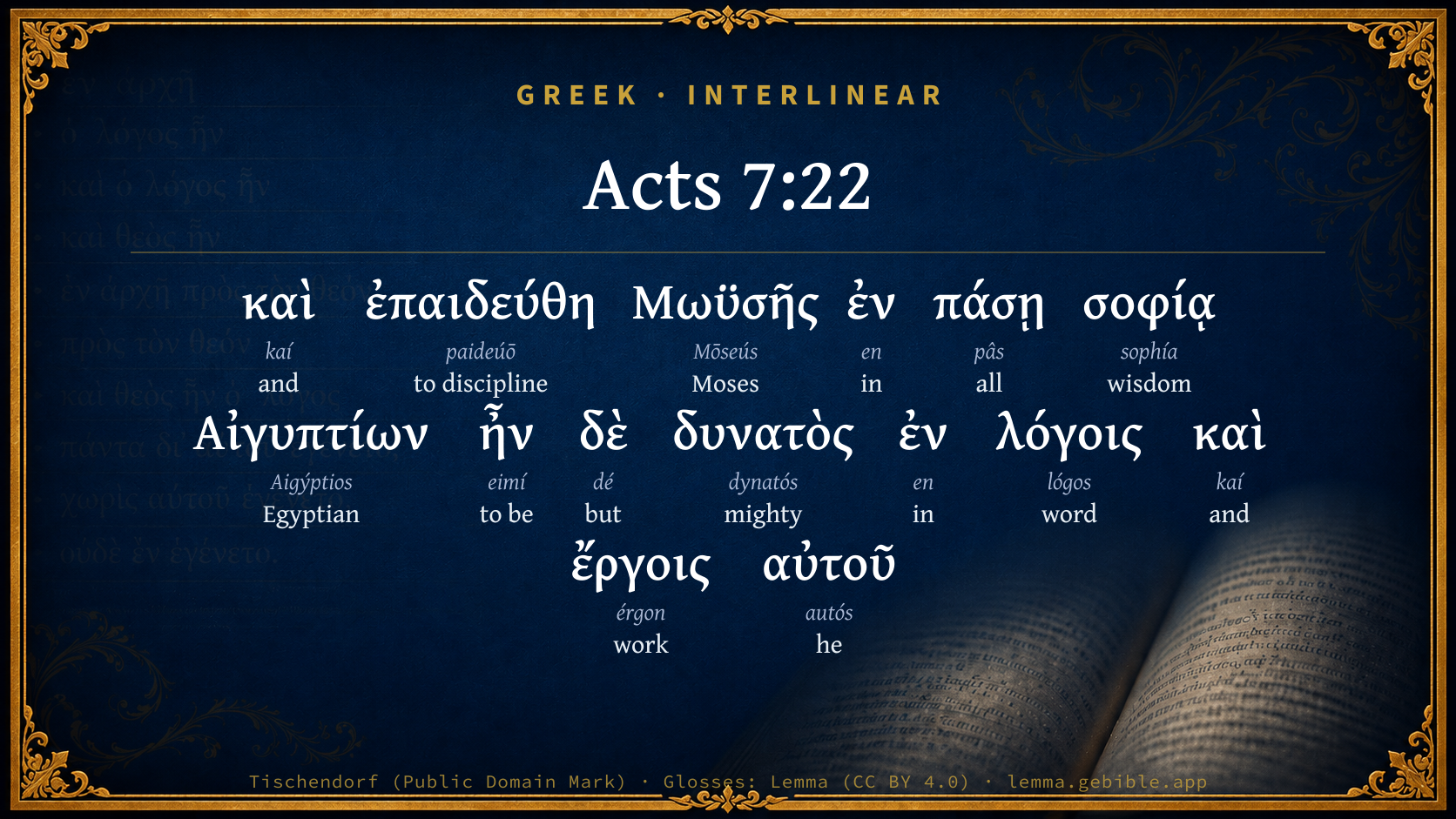
Download image
Cite this verse

Acts 7:22 (World English Bible). Public Domain. Lemma interlinear Bible study tool, https://lemma.gebible.app/v/acts/7/22.

Show BibTeX & RIS
BibTeX
RIS
English Translation
Moses was instructed in all the wisdom of the Egyptians. He was mighty in his words and works.
World English Bible · Public Domain
Highlights
  • 1 first appearance in the Greek New Testament
Full analysis ↓
Download a study sheet

One document with this verse’s original text, its word-by-word gloss line, the meaning frame, cross-references with their text, attributed commentary, and full source and license credits — printable, and it pastes into notes with its structure intact.

This verse Autodidact and up

Study sheet (.html) Plain text (.txt)

A passage Seminary Student

Up to 50 verses in one chapter. A passage sheet keeps up to 6 commentary sources and 12 cross-references per verse, in the order this page ranks them, and says so on the sheet whenever that leaves anything out. Ask for a single verse and you get the Autodidact verse sheet above.

Everything on this page stays free to read, with no account — the sheet is a download of what is already on screen, not access to it.

Want to remove ads? Support Godless Engineer
Compare translations 3

The same verse in 3 English versions, stacked beneath the original-language interlinear above. Click any original word for its lexicon entry.

Each is an independent rendering of the whole verse — the interlinear is not word-aligned to these translations.

Highlighted words mark where these versions differ — a whole-verse word diff, not a word-by-word alignment.

  • World English Bible Public Domain
    Moses was instructed in all the wisdom of the Egyptians. He was mighty in his words and works.
  • King James Version Public Domain
    And Moses was learned in all the wisdom of the Egyptians, and was mighty in words and in deeds.
  • unfoldingWord Literal Text CC BY-SA 4.0
    And Moses was educated in all the wisdom of the Egyptians, and he was mighty in his words and works.

unfoldingWord Literal Text — © unfoldingWord, licensed CC BY-SA 4.0. Word-aligned USFM3 via Door43 (git.door43.org/unfoldingWord/en_ult).

Versions to compare (up to 4)

3 of 4 selected

Show all 19 translations

Every available English version of this verse, each an independent rendering of the whole verse.

  • World English Bible Public Domain
    Moses was instructed in all the wisdom of the Egyptians. He was mighty in his words and works.
  • Berean Standard Bible Public Domain
    So Moses was educated in all the wisdom of the Egyptians and was powerful in speech and action.
  • Majority Standard Bible Public Domain
    So Moses was educated in all the wisdom of the Egyptians and was powerful in speech and action.
  • King James Version Public Domain
    And Moses was learned in all the wisdom of the Egyptians, and was mighty in words and in deeds.
  • American Standard Version (1901) Public Domain
    And Moses was instructed in all the wisdom of the Egyptians; and he was mighty in his words and works.
  • Revised Version (1885) Public Domain
    And Moses was instructed in all the wisdom of the Egyptians; and he was mighty in his words and works.
  • Geneva Bible (1599) Public Domain
    And Moses was learned in all the wisdome of the Egyptians, and was mightie in wordes and in deedes.
  • Douay-Rheims (1899) Public Domain
    And Moses was instructed in all the wisdom of the Egyptians; and he was mighty in his words and in his deeds.
  • Young's Literal Translation Public Domain
    and Moses was taught in all wisdom of the Egyptians, and he was powerful in words and in works.
  • Literal Standard Version CC BY-SA 4.0
    and Moses was taught in all wisdom of the Egyptians, and he was powerful in words and in works.
  • Unlocked Literal Bible CC BY-SA 4.0
    Moses was educated in all the wisdom of the Egyptians, and he was mighty in his words and works.
  • unfoldingWord Literal Text CC BY-SA 4.0
    And Moses was educated in all the wisdom of the Egyptians, and he was mighty in his words and works.
  • Darby Bible Public Domain
    And Moses was instructed in all [the] wisdom of the Egyptians, and he was mighty in his words and deeds.
  • World Messianic Bible Public Domain
    Moses was instructed in all the wisdom of the Egyptians. He was mighty in his words and works.
  • Webster's Bible Public Domain
    And Moses was learned in all the wisdom of the Egyptians, and was mighty in words and in deeds.
  • Free Bible Version CC BY-SA 4.0
    Moses received instruction in all areas of Egyptian knowledge, and he became a powerful speaker and leader.
  • Bible in Basic English Public Domain
    And Moses was trained in all the wisdom of Egypt, and was great in his words and works.
  • Text-Critical English NT CC BY 4.0
    So Moses was trained in all the wisdom of the Egyptians, and he was mighty in words and deeds.
  • Tyndale New Testament (1534) Public Domain
    And Moses was learned in all maner wisdome of the Egipcians and was mighty in dedes and in wordes.

Literal Standard Version (2020), Covenant Press — licensed CC BY-SA 4.0. Text via the HelloAO Bible API (eBible.org). Unlocked Literal Bible (unfoldingWord) — licensed CC BY-SA 4.0. Text via the HelloAO Bible API (eBible.org). unfoldingWord Literal Text — © unfoldingWord, licensed CC BY-SA 4.0. Word-aligned USFM3 via Door43 (git.door43.org/unfoldingWord/en_ult). Free Bible Version, Dr. Jonathan Gallagher — licensed CC BY-SA 4.0. Text via the HelloAO Bible API (eBible.org).

Word by word

More ways to search: Search by grammar → Find every occurrence → Compare this word →

Practice this passage: Drill this verse → Learn its vocabulary →

About this verse

These counts appear in no published source. They are computed here, from the morphology-tagged text and Lemma’s own curated glosses. What Lemma adds →

15
words
13
distinct lemmas
Acts
section

Notable vocabulary

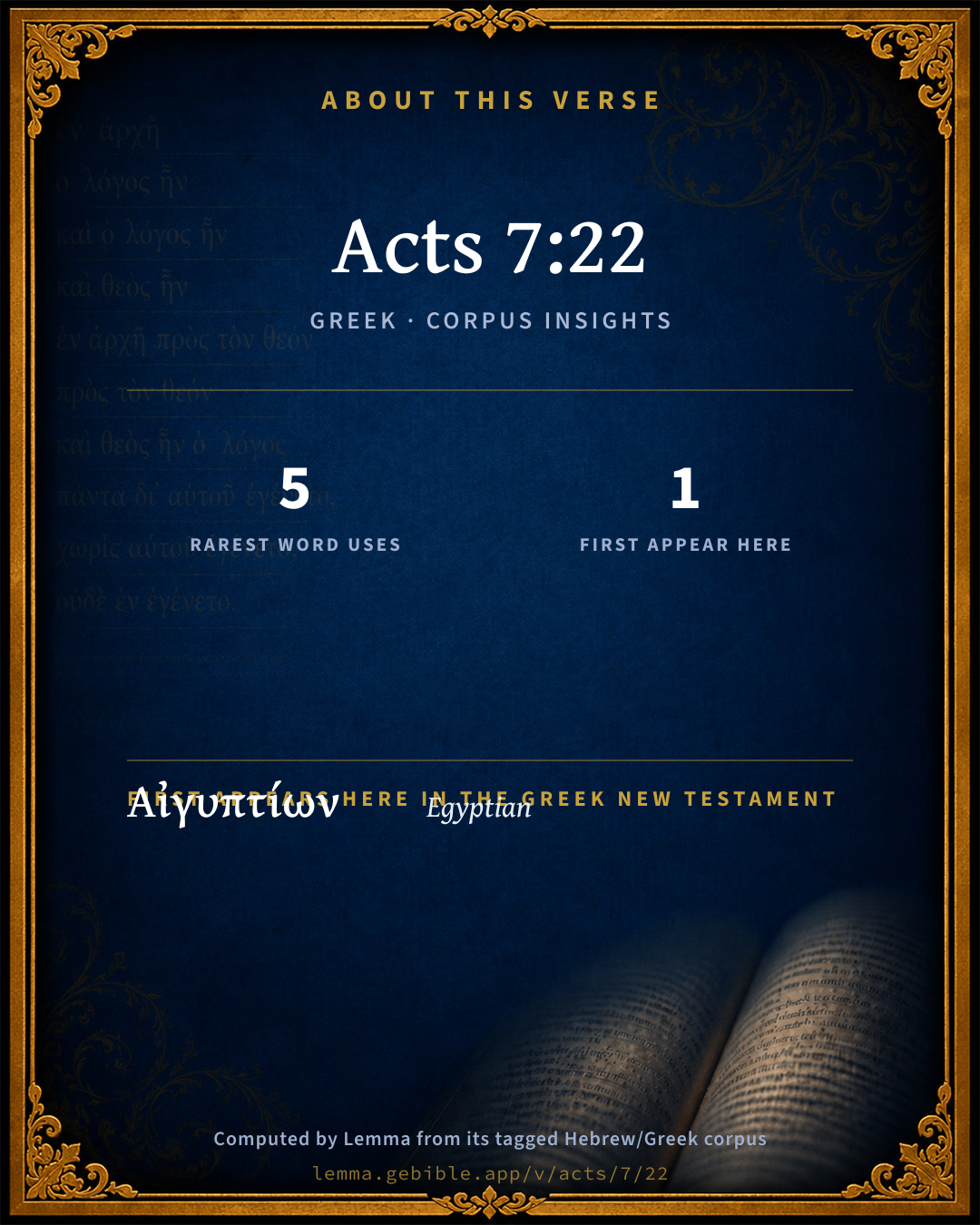
The rarest word here is Αἰγυπτίων Egyptian G124 — appearing just 5 times in the whole Greek New Testament.

First appearance in Scripture

This word makes its first canonical appearance in the Greek New Testament here:

  • Αἰγυπτίων Egyptian G124

Shared distinctive vocabulary

Αἰγυπτίων Egyptian G124 occurs in 5 verses of the Greek New Testament. Also found in:
Repetition

Words recur within this verse:

Cross-references

6

Topical passages linked to Acts 7:22 in the Treasury of Scripture Knowledge — connected by theme and wording, ordered by reader-vote popularity; previews shown in the World English Bible.

  • Isaiah 19:11 The princes of Zoan are utterly foolish; the counsel of the wisest counselors of Pharaoh is become brutish: how do you say to Pharaoh, I am the son of the wise, the son of ancient kings?
  • 2 Chronicles 9:22 So king Solomon exceeded all the kings of the earth in riches and wisdom.
  • Daniel 1:4 youths in whom was no blemish, but well-favored, and skillful in all wisdom, and endowed with knowledge, and understanding science, and such as had ability to stand in the king's palace; and that he should teach them the learning and the language of the Chaldeans.
  • Daniel 1:17–20 Now as for these four youths, God gave them knowledge and skill in all learning and wisdom: and Daniel had understanding in all visions and dreams.
  • Luke 24:19 He said to them, "What things?" They said to him, "The things concerning Jesus, the Nazarene, who was a prophet mighty in deed and word before God and all the people;
  • 1 Kings 4:29–30 God gave Solomon wisdom and understanding exceeding much, and very great understanding, even as the sand that is on the sea-shore.

Cross-references courtesy of OpenBible.info (CC BY 4.0).

Commentary

Notes on Acts 7:22 from classic Christian and Jewish commentators (each source and its license shown beneath its notes). The classic Christian expositions comment on the surrounding passage and are grouped to its opening verse, so a note may address several verses; the Jewish commentaries on the Tanakh (Rashi and others) are per-verse, so they appear only where the commentator wrote on this verse.

Lemma curates 59 commentaries, every one of them public domain or Creative Commons licensed, each selected and text-cleaned for this edition rather than reprinted as found. About our sources →

Joseph Benson's Commentary

Act 7:22. Moses was learned in all the wisdom of the Egyptians — Which was then celebrated in all the world, and for many ages after. Geography, geometry, arithmetic, astronomy, natural history, physic, and hieroglyphics, are all mentioned by ancient writers as branches of Egyptian literature. Several ancient testimonies to the extraordinary learning of Moses may be seen in Philo, Justin Martyr, Origen, and Clemens Alexandrinus. And was mighty in words — Deep, solid, weighty, though not of a ready utterance. “It expresses,” says Doddridge, “such a weight and solidity in his counsels and speeches, as may be very consistent with the want of a flowing elocution;” and in deeds — Referring to the astonishing miracles which God wrought by him. We may observe here, that it must have been a great piece of self-denial, such as none but a lover of learning, and one who has made some progress in it, can understand, for a person of such a genius and education as Moses, in the prime of life, to leave the polite court of Egypt, and live as a retired shepherd in the Arabian desert.

Joseph Benson's Commentary on the Old and New Testaments (1811–1818) — public domain. Text from a community e-Sword module.

Bengel's Gnomon

Johann Albrecht Bengel

Act 7:22. Ἐπαιδεύθη, was learned) as being designed for the kingdom (to be king). Comp. Heb 11:26.—σοφίᾳ, the wisdom) This wisdom the Egyptians had learned from Joseph: Psa 105:22. This wisdom was surpassed by that of Solomon: 1Ki 4:30. This was held in great account by the adversaries of Stephen, especially the Alexandrians: ch. Act 6:9—δυνατὸς, powerful) This power was of more consequence than all the wisdom of the Egyptians, which Stephen, however, mentions in order to commend Moses; nor was it the wisdom that produced that power, but the promise and faith: Heb 11:24-25. Often wisdom and power are joined.—ἐν λόγοις, in words) viz. eloquence: although his utterance was defective: Exo 4:10.—ἐν ἔργοις, in deeds) viz. power.

Bengel's Gnomon of the New Testament — English translation (T&T Clark, Edinburgh, 1860) — public domain. Text from a community e-Sword module.

Expositor's Greek Testament

ed. W. Robertson Nicoll

Act 7:22 . ἐπαιδεύθη , cf. Act 22:3 here with instrumental dative, or, better, dative of respect or manner; not mentioned in Exodus, but see Philo, Vita Moys. , ii., 83, Mang., and also Schürer, Jewish People , div. ii., vol. i., p. 343, E.T.; cf. the knowledge of magic ascribed to Pharaoh’s wise men in Exo 7:11 , and “Jannes and Jambres,” B.D. 2 , and also 1Ki 4:30 , and Isa 19:2 ; Isa 19:11-12 ; Hamburger, Real-Encyclopädie des Judentums “Zauberei,” i., 7, 1068, and references in Wetstein, in loco . παιδεύω , both in LXX and N.T., used in the sense of training ; cf. Pro 5:13 (Jos., C. Apion , i., 4), 1Ti 1:20 , Tit 2:12 , and also in the sense of chastising , so often in LXX and in N.T., and also similarly used in classical Greek. The passage is also important because it helped to fix the attention of cultivated early Christian writers upon the wisdom of Greek poets and philosophers, and to give a kind of precedent for the right pursuit of such studies; cf. Clem. Alex., Strom. , i., 5, 28; vi., 5, 42; Justin Martyr, Dial. c. Tryph. , c., 1 4; see Dean Plumptre’s note, in loco . ἦν δὲ δυνατὸς , cf. Act 18:24 , and especially Luk 24:19 ; see also Sir 21:7 , Jdt 11:8 . If αὐτοῦ is retained, the mode of expression is Hebraistic (Blass). There is no contradiction with Exo 4:10 , and no need to explain the expression of Moses’ writings, for Stephen has in his thoughts not so much, as we may believe, the oratorical form as the powerful contents of Moses’ words ( e.g. , his prophetical teaching, Hamburger, “Moses,” Real-Encyclopädie des Judentums , i., 5, 772). Josephus speaks of him as πλήθει ὁμιλεῖν πιθανώτατος , Ant. , iii., 1, 4 (see also Jos., Ant. , ii., 10, 1, for the traditional exploits of Moses, and Hamburger, u. s. , p. 771).

The Expositor's Greek Testament, edited by W. Robertson Nicoll (1897–1910) — public domain. Text from a community e-Sword module.

Jamieson, Fausset & Brown

Robert Jamieson, A. R. Fausset & David Brown

mighty in words--Though defective in utterance (Exo 4:10); his recorded speeches fully bear out what is here said.

and deeds--referring probably to unrecorded circumstances in his early life. If we are to believe JOSEPHUS, his ability was acknowledged ere he left Egypt.

Jamieson, Fausset & Brown — Commentary Critical and Explanatory on the Whole Bible (1871) — public domain (CC PDM 1.0). Text via the HelloAO Bible API.

Adam Clarke's Commentary

Verse 22. In all the wisdom of the Egyptians] Who were, at that time, the most intelligent and best instructed people in the universe. Philo says, Moses was taught arithmetic, geometry, poetry, music, medicine, and the knowledge of hieroglyphics. In Sohar Cadash, fol. 46, it is said, "that, of the ten portions of wisdom which came into the world, the Egyptians had nine, and that all the inhabitants of the earth had only the remaining portion." Much of the same nature may be seen in the rabbins, though they apply the term wisdom here to magic.

Was mighty in words and in deeds.] This may refer to the glorious doctrines he taught, and the miracles he wrought in Egypt. Josephus Ant. lib. ii. cap. 10, sect. 1, gives an account of his being general of an Egyptian army, defeating the Ethiopians, who had invaded Egypt, driving them back into their own country, and taking Saba their capital, which was afterwards called Meroe. But this, like many other tales of the same writer, is worthy of little credit.

Phoenix says the same of Achilles:-

Μυθων τε ῥητηρ' εμεναι, πρηκτηρα τε εργων. Il. ix. v. 443.

Not only an orator of words, but a performer of deeds.

Adam Clarke's Commentary on the Bible (1810–1826) — public domain. Text from a community e-Sword/MySword module.

John Calvin's Commentaries

22. Whereas Luke reporteth that he was taught in all wisdom of the Egyptians, he putteth that in his commendation as a point of excellency. Notwithstanding, it might have so fallen out, as it doth oftentimes, that being puffed up with profane sciences, he might have despised the base common people; yet because God had determined to redeem his people, he doth, in the mean season, frame both the mind of Moses and all other things to finish his work. The reason of man’s flesh should murmur in this place, Why doth God wink at so long miseries of the people? Why doth he suffer Pharaoh to rage more cruelly daily? Why doth he not suffer Moses to grow up amongst his own people? Why doth he after a sort cut him off from the kindred of Israel, being adopted by the king’s daughter? Why will he suffer him to remain amidst courtly pleasures, and doth not rather pull him thence? But the end itself is so wonderful, that we are enforced to confess that all these things were governed by singular counsel and order to set forth the glory of God.

Whereas I said that Luke speaketh in this place of the learning of the Egyptians for honor’s sake, I would not have it so taken as if there were in the same no corruption. Forasmuch as astrology doth consider the wonderful workmanship of God, not only in the placing of the stars, and in such excellent variety, but also in their moving, force, and secret offices, it is a science both profitable and worthy of praise. The Egyptians bestowed great study in this, but being not content with the simple order of nature, they wandered also into many foolish speculations, as did the Chaldeans. It is uncertain whether Moses was infected with these superstitions or no. Yet, howsoever it be, we see how sincerely and plainly he setteth that before us to be considered in the frame of the world, which is appertinent unto godliness. Surely this was excellent modesty, in that he which could reason with learned and witty men of the secrets of nature, doth not only omit higher subtleties, but doth also descend unto the common capacity of every most simple man, and doth, in a common style, set forth unto men unlearned those things which they perceive by experience. When Justinian [Justin] babbleth concerning Moses, he maketh him a magician, which, with juggling and enchantments, made passage for the people through the Red Sea; so that Satan did not only go about to bury the power of God, but also to blaspheme the same. But we know that Moses did not strive with the enchanters by magic, but did that only which God had enjoined him.

Furthermore, the Egyptians had mystical divinity, wherewith they colored their doting inventions and monstrous abominations, as if they would prove that they went mad not without reason: as the Papists, whereas they delude and mock men like stage-players, in their mass and other foolish rites, yet they invent mysteries, that they may persuade men that there is nothing there but that which is divine. The common sort of priests cannot climb so high, but those which amongst them will be accounted more cunning do omit no rite, how foolish and childish soever it be, affirming that there is some spiritual mystery in every [one] of them. There is extant concerning this matter a most foolish mingle-mangle, which they call the Rationall [Rationale] of Divine Offices. But forasmuch as sacrificing priests alone did use such dotings amongst themselves, it is not to be thought that Moses spent any time in these, whose bringing up was princely, but that he was taught in liberal arts.

He was mighty. This phrase doth express among the Hebrews a double excellency, when as he which doth excel in wit and learning, is also apt to attempt and bring to pass great and weighty matters. Stephen’s meaning is, therefore, that Moses was furnished with rare gifts, so that they did all confess that he was a singular man. But seeing he was in such estimation, the Israelites had the less hope that he should be the minister which should work their deliverance.

John Calvin's Commentaries (1540-1563) — public domain. Text from the Calvin Translation Society English edition (1840s-50s) via the Christian Classics Ethereal Library (ccel.org). Calvin's coverage is partial (roughly two-thirds of the Bible); uncommented books and verses are honest gaps, never fabricated. The 19th-century editor's footnotes and remarks are omitted so the notes are faithfully Calvin's own voice.

Ellicott's Commentary for English Readers

(22) Moses was learned in all the wisdom of the Egyptians.—Better, was trained, or instructed. There is no direct statement to this effect in the history of the Pentateuch, but it was implied in Moses being brought up as the son of Pharaoh’s daughter, and was in harmony with later paraphrases and expansions of the earlier history. The narrative of Josephus (as above) and the references in the New Testament to Jannes and Jambres as the magicians who withstood Moses (2Ti_3:8), and to the dispute of Michael and Satan as to his body (Jud_1:9), indicate the wide acceptance of some such half-legendary history. The passage is instructive, (1) as an indirect plea on the part of Stephen, like that afterwards made by Clement of Alexandria (Strom. i. 5, § 28; 6:5, § 42) and Justin (Dial. c. Tryph. c. 1-4), for the recognition of heathen wisdom as an element in the divine education of mankind; (2) as having contributed to fix the attention of the more cultivated and scholarly of the early Christian critics, such as those named, and Origen, and Jerome, and Augustine, on the teaching of Greek poets and philosophers, and having furnished them with a sanction for such studies.

Mighty in words and in deeds.—Josephus (Ant. ii. 10), still following the same traditional history, relates that Moses commanded the Egyptian forces in a campaign against the Ethiopians, and protected them against the serpents that infected the country, by transporting large numbers of the ibis that feeds on serpents. The romance was completed by the marriage of Moses with the daughter of the Ethiopian king who had fallen passionately in love with him. This was possibly a development of the brief statement in Num_12:1. The language of Moses (Exo_4:10), in which he speaks of himself as “not eloquent” and “slow of speech,” seems at first inconsistent with “mighty in words,” but may fairly be regarded as simply the utterance of a true humility shrinking from the burden of a mighty task.

A Bible Commentary for English Readers, edited by Charles John Ellicott (1878–1897) — public domain. Text from a community e-Sword module.

The Cambridge Bible for Schools and Colleges

gen. ed. J. J. S. Perowne

22. And Moses was learned [instructed] in all the wisdom of the Egyptians] As was to be expected if he were designed for the kingdom. The wisdom on which the Jewish traditions most dwell is the power of magic, and such knowledge as Pharaoh’s wise men are represented as having in the book of Exodus.

and was mighty in [his] words and in deeds] The same traditions tell of Moses as a great captain among the Egyptians, and as leading them to victory against the Ethiopians (Josephus, ii. 10. 2).

The Cambridge Bible for Schools and Colleges (gen. ed. J. J. S. Perowne; Cambridge University Press, 1878–1918) — public domain. Text from a community e-Sword module.

John Gill's Exposition

And Moses was learned in all the wisdom of the Egyptians, Which was reckoned very considerable: Kg1 4:30 Philo the Jew says (e) that he learned arithmetic, geometry, and every branch of music, the hieroglyphics, the Assyrian language, and the Chaldean knowledge of the heavens, and the mathematics; yet was not a magician, or skilled in unlawful arts, as Justin suggests (f):

and was mighty in words; he had a command of language, and a large flow of words, and could speak properly and pertinently upon any subject; for though he was slow of speech, and of tongue, and might have somewhat of a stammering in speaking, yet he might have a just diction, a masculine style, and a powerful eloquence, and the matter he delivered might be very great and striking:

and in deeds; or in "his deeds", as the Alexandrian copy, the Vulgate Latin, Syriac, and Ethiopic versions read: he was a man of great abilities, and fit for business both in the cabinet and in the field. Josephus (g) relates an expedition of his against the Ethiopians, whilst he was in Pharaoh's court, in which he obtained victory over them, when the Egyptians had been greatly oppressed by them; in which his prudence and fortitude were highly commended.

(e) De Vita Mosis, l. 1. p. 859. Clement. Alex. Strom. l. 1. p. 343. (f) L. 36. c. 2. (g) Antiqu l. 2. c. 10. sect. 1. 2. 3.

John Gill's Exposition of the Whole Bible (1746–1763) — public domain (CC PDM 1.0). Text via the HelloAO Bible API.

Trapp's Complete Commentary

John Trapp

22 And Moses was learned in all the wisdom of the Egyptians, and was mighty in words and in deeds.

Ver. 22. And Moses was learned] See my Common Place of Arts. Lactantius saith of Tertullian, that he was in omni genere doctrinae peritus, skilful in all kinds of learning. Jerome saith of him, that his works contained cunctam seculi doctrinam, all the learning of the world; better may this be said of Moses and his writings.

John Trapp, A Commentary or Exposition upon All the Books of the Old and New Testament (1647–1656) — public domain. Text from a community e-Sword module.

Albert Barnes' Notes on the Bible

Moses was learned - Or, was “instructed.” It does not mean that he had that learning, but that he was carefully “trained” or educated in that wisdom. The passage does not express the fact that Moses was distinguished for “learning,” but that he was carefully “educated,” or that pains were taken to make him learned.

In all the wisdom ... - The learning of the Egyptians was confined chiefly to astrology, to the interpretation of dreams, to medicine, to mathematics, and to their sacred science or traditionary doctrines about religion, which were concealed chiefly under their hieroglyphics. Their learning is not infrequently spoken of in the Scriptures, 1Ki 4:30; compare Isa 19:11-12. Their knowledge is equally celebrated in the pagan world. It is known that science was carried from Egypt to Phoenicia, and thence to Greece; and not a few of the Grecian philosophers traveled to Egypt in pursuit of knowledge. Herodotus himself frankly concedes that the Greeks derived very much of their knowledge from Egypt. (See Rawlinson’s Herodotus, vol. 2, pp. 80, 81; Herodotus, bk. 2, pp. 50, 51.)

And was mighty - Was powerful, or was distinguished. This means that he was eminent in Egypt before he conducted the children of Israel forth. It refers to his addresses to Pharaoh, and to the miracles which he performed “before” their departure.

In words - From Exo 4:10, it seems that Moses was “slow of speech, and of a slow tongue.” When it is said that he was mighty in words, it means that he was mighty in his communications to Pharaoh, though they were spoken by his brother Aaron. Aaron was in his place, and “Moses” addressed Pharaoh through him, who was appointed to deliver the message, Exo 4:11-16.

Deeds - Miracles, Exo. 7, etc.

Albert Barnes' Notes on the Bible (1834–1885) — public domain. Text from a community e-Sword/MySword module.

Haydock's Catholic Bible Commentary

In words and in deeds. Moses was persuasive and powerful in reasoning; but had an impediment in his speech, as we know from Exodus iv. 10. and iv. 12. He possessed, moreover, strength, energy, and grandeur, in his discourse. Of this we have abundant proofs in his books. He is inimitable in narrating, as often as he writes laws, composes canticles, or makes harangues. He is simple, clear, sublime, vehement, concise, prolix, and rapid, in turns, as the nature of his subject requires. He was likewise powerful in work. All his conduct was wise, virtuous, enlightened, as well in affairs of policy, as in war. He was an able captain, before he put himself at the head of the Israelites. (Calmet) --- Josephus assures us that he became a great conqueror.

George Leo Haydock (1774–1849), Haydock's Catholic Family Bible and Commentary, 1859 edition — public domain. Excludes Psalms (Douay-Rheims chapter numbering differs from Protestant) and Deuterocanonical books (Catholic canon only).

Matthew Poole's English Annotations

Learned in all the wisdom of the Egyptians; the Egyptians were anciently famous for learning, especially in astronomy, and some other parts of philosophy.

Mighty in words; he was eloquent.

And in deeds; his deeds were equal to his words; he could do, as well as say, what became him.

Matthew Poole's English Annotations on the Holy Bible (1683–1685) — public domain. Text from a community e-Sword/MySword module.

Whedon's Commentary on the Bible

Daniel D. Whedon

22. Wisdom of the Egyptians—As a result of his adoption by a princess of Egypt, he was trained in all the science of Egypt. And Egypt was indeed a fountain head of a large amount of ancient erudition. And Hebrew writers, like Philo and Josephus, exercised their imaginations in describing the accomplishments with which Moses was thereby endowed. Arithmetic, geometry, music, rhetoric, astrology, and all forms of philosophy, were embraced in his course of study. The sacred history coolly omits these details, and furnishes but these few words of description.

Mighty in words—Moses indeed complained of himself (Exo_4:10; Exo_6:12) as being slow of speech; but words may be at once slow and mighty.

In deeds—Deeds military, legislative, and miraculous, such as no other mere human agent has ever performed.

22. Repent… of wickedness—Literally, repent from thy wickedness. For repentance is a mental turning away from the wrong, and its effect is separation from it.

Perhaps—This word does not express doubt of the mercy of God if Simon truly repents, but of the probability of Simon’s ever truly repenting. There are so many depths and so many bottoms to his duplicity and depravity that Peter has slight faith in any repentance he may profess.

Daniel D. Whedon (gen. ed.), Commentary on the Old and New Testaments (1874–1909) — public domain. Text from a community e-Sword module.

The Pulpit Commentary

Instructed for learned, A.V.; he was mighty for was mighty, A.V.; in his words and works for in words and in deeds, A.V. and T.R. The statement of Moses being instructed in all the wisdom of the Egyptians, though not found in Exodus, was doubtless true. Josephus makes Thermeutis speak of him as "of a noble understanding;" and says that he was "brought up with much care and diligence." And Philo, in his life of Moses (quoted by Whitby), says he was smiled in music, geometry, arithmetic, and hieroglyphics, and the whole circle of arts and sciences.

The Pulpit Commentary (1880–1919), ed. H.D.M. Spence-Jones & Joseph S. Exell — public domain. Text from a community e-Sword module.

John Wesley's Explanatory Notes

In all the wisdom of the Egyptians - Which was then celebrated in all the world, and for many ages after. And mighty in words - Deep, solid, weighty, though not of a ready utterance.

John Wesley, Explanatory Notes Upon the Whole Bible (1754–1765) — public domain. Text via the GEBible commentary corpus.

Godbey's Commentary on the New Testament

William B. Godbey

22. “Indeed Moses was educated in all the wisdom of the Egyptians: and was mighty in his words and deeds.” God needed in Moses the highest scholarship in the world to reveal the Bible, write the Pentateuch and legislate for all mankind. Therefore He avails Himself of the Egyptians, whose philosophers and magicians stood at the head of the world’s learning and became the educators of Moses, believing him to be the son of their queen, the heir of the blood-royal and their future king. Of course, they lay under contribution all the scholarship of the age to educate their bright and promising young king, flattering themselves that in Moses Egypt would have a Pharaoh eclipsing all his illustrious predecessors of the royal line. To be “mighty in his words,” or as the Greek says, “in sciences,” was to be a great intellectualist and scholar, such as Moses doubtless was, reaching the very acme of the world, and little dreaming that God in His wonderful providence was preparing him to be prophet, legislator, leader and mediator of Israel, thus treading an apex hitherto reached by no human being. To be “mighty in his works” in that age meant to be a great military man. This is abundantly corroborated by Egyptian history, which certifies that Moses led the Egyptian armies in the Ethiopian wars, rising to pre-eminence as a military chieftain. Thus the statement in the Pentateuch that he received “an Ethiopian woman for a wife” is accounted for. During the memorable siege of Thebes, the beautiful and magnificent Ethiopian capital, the rival of Memphis, the capital of Egypt, the daughter of the Ethiopian king ever and anon gazed from the high towers of the royal palace far out over the wall, beholding with admiration the military evolutions of the Egyptian army. Recognizing their grand, beautiful and majestic leader, she falls in love with him at a distance, sends him a messenger, proposing to maneuver the opening of the gates and the admission of his army into the city, on condition that she receive his hand in wedlock. It works out to a charm; magnificent Thebes is captured by the Egyptian army, and the long war winds up with victory perched on the banner of the Pharaohs. Of course she becomes the wife of Moses. Having either passed away by death or returned to her own country, she was not his wife at the time of the above quotation, as he was then the husband of Zipporah, the daughter of Jethro.

William B. Godbey, Commentary on the New Testament (1896–1900) — public domain. Text from a community e-Sword module.

McGarvey & Pendleton's Commentaries

J. W. McGarvey

See notes on verse 17

J. W. McGarvey (with Philip Y. Pendleton), Commentaries on the New Testament (The Fourfold Gospel, 1914; Acts; and the epistles) — public domain. Text from a community e-Sword/MySword module.

The People's New Testament

B. W. Johnson

22. Moses was learned. He was reared as “the son of Pharaoh's daughter” (Heb. 11:24), and would be educated in all the accomplishments of his time. We know from the researches of the Egyptologists (see Rawlinson's Egypt) that at the period of Moses there were great universities for the education of all who were expected to engage in public employments. Eber's Uarda gives a good picture of Egypt when Moses was a child.

B. W. Johnson's The People's New Testament with Notes (1889–1891) — public domain. Electronic text from the Christian Classics Ethereal Library (CCEL) ThML edition.

unfoldingWord translationNotes

Door43 World Missions Community

Moses was educated

This can be stated in active form. AT: "The Egyptians educated Moses" (See: Active or Passive)

all the wisdom of the Egyptians

This is an exaggeration to emphasize that he was trained in the best schools in Egypt. (See: Hyperbole and Generalization)

mighty in his words and works

"effective in his speech and actions" or "influential in what he said and did"

it came into his heart

Here "heart" is a metonym for "mind." The phrase "it came into his heart" is an idiom that means to decide something. AT: "it came into his mind" or "he decided" (See: Metonymy and Idiom)

visit his brothers, the children of Israel

This refers to his people, and not just to his family. AT: "see how his own people, the children of Israel, were doing" (See: Assumed Knowledge and Implicit Information)

Seeing an Israelite being mistreated ... the Egyptian

This can be stated in active form by rearranging the order. AT: "Seeing an Egyptian mistreating an Israelite, Moses defended and avenged the Israelite by striking the Egyptian who was oppressing him" (See: Active or Passive)

striking the Egyptian

Moses hit the Egyptian so hard that he died.

he thought

"he imagined"

by his hand was rescuing them

Here "hand" refers to the actions of Moses. AT: "was rescuing them through what Moses was doing" or "was using the actions of Moses to rescue them" (See: Metonymy)

translationWords

Moses

Egypt

might

works

heart

brother

Israel

understand

hand

unfoldingWord translationNotes — © Distant Shores Media and the Door43 World Missions Community, licensed CC BY-SA 4.0. Source: git.door43.org/Door43/en_tn.

Cambridge Greek Testament for Schools and Colleges

22. ἐν πάσῃ σοφίᾳ with אACE.

ἐν before ἔργοις omitted with אABCDH. Vulg. has ‘in.’

22. ἐπαιδεύθη Μωϋσῆς, Moses was instructed. As was to be expected if he were designed for the kingdom. The wisdom on which the Jewish traditions most dwell is the power of magic, and such knowledge as Pharaoh’s wise men are represented as having in the book of Exodus.

ἧν δὲ … αὐτοῦ, and was mighty in his words and deeds. Josephus (Ant. II. 10. 2) tells that Moses was a great captain among the Egyptians and led that people to victory against the Ethiopians.

Cambridge Greek Testament for Schools and Colleges (Cambridge University Press, 1896; 21 vols, various authors incl. Carr, Maclear, Plummer, Farrar, Lumby, Moule, M. R. James, Simcox) — public domain. Text from a community e-Sword module.

Alford’s Greek Testament

Henry Alford

22.] That Moses was instructed in the wisdom of the Egyptians, is not found in the O. T., but derived from tradition, and following as a matter of course from his adopted station as the son of Pharaoh’s daughter. This wisdom of the Egyptians, celebrated by so many ancient writers (see Wetst. ad loc), consisted mainly in natural philosophy, medicine, and mathematics, and its teachers were the priests. Philo de vita Mos. § 5, p. 84, enters into minute detail: ἀριθμοὺς μὲν οὖν κ. γεωμετρίαν, κ. τήν τε ῥυθμικὴν κ. ἁρμονικὴν κ. μετρικὴν θεωρίαν, κ. μουσικὴν τὴν σύμπασαν, διά τε χρήσεως ὀργάνων, κ. λόγων τῶν ἐν ταῖς τέχναις, κ. διεξόδοις τοπικωτέραις, Αἰγυπτίων οἱ λόγιοι παρέδοσαν. κ. προσέτι τὴν διὰ συμβόλων φιλοσοφίαν, ἣν ἐν τοῖς λεγομένοις ἱεροῖς γράμμασιν ἐπιδείκνυνται, κ. διὰ τῆς τῶν ζώων ἀποδοχῆς, ἃ καὶ θεῶν τιμαῖς γεραίρουσι. τὴν δὲ ἄλλην ἐγκύκλιον παιδείαν Ἕλληνες ἐδίδασκον· οἱ δʼ ἐκ τῶν πλησιοχώρων, τά τε Ἀσσυρίων γράμματα, κ. τὴν τῶν οὐρανίων Χαλδαϊκὴν ἐπιστήμην.

δυνατὸς ἐν λόγοις] So Josephus calls Moses πλήθεσιν ὁμιλεῖν πιθανώτατος, but late in his course, during the journey through the wilderness;—when the divine Spirit, as the book of Deuteronomy abundantly testifies, had turned his ‘slowness of speech’ into the most fervid eloquence. That he was so thus early, during his Egyptian course, was probably reported by tradition, but hardly seems to agree with Exo 4:10-16.

Henry Alford, The Greek Testament (1849–1861) — public domain. Text from a community e-Sword module.

Lesson kit

Teaching starters — assembled from the data on this page, not authored interpretation. Every prompt links to the verse data it draws on. Edit before teaching.

Acts, in the Acts, opens this verse with 15 words (13 distinct Greek lemmas). Its most distinctive word is Aigýptios (“Egyptian”). A historical commentator’s framing appears above. Read the whole chapter for the surrounding context.

Discussion questions

  1. The word Aigýptios carries the sense “Egyptian.” How does it shape the verse?
  2. The word “Egyptian” first appears here in Scripture. What is being introduced at this debut?
  3. Acts 7:24 shares the word «Egyptian» with this verse. How do the two illuminate each other?
  4. “and” occurs 2× in this one verse. What is the effect of the repetition?
  5. The translations on this page render this verse differently — a whole-verse word diff, not a word-by-word alignment. What might account for the different wordings?
  6. Reading how Joseph Benson's Commentary and Bengel's Gnomon read this verse, where do the two commentators agree and where do they part?

Things to notice

  • 1 word makes its first canonical appearance in Scripture here.
  • These translations choose different wording for 5 words in this verse.
  • “and” occurs 2× in this single verse.
  • 13 distinct Greek lemmas span 15 words in this verse.

Reading settings

Reading text

Shown beneath each verse's original-language words.

Old Testament
Old Testament edition

Read the OT as the Masoretic Hebrew (MT) or the Greek Septuagint (LXX).

English shown for the Greek Septuagint (in the Hebrew ↔ Greek comparison).

Comparing translations? Open the Compare panel on any verse page to stack up to four side by side.