James 2:21

Greek (Tischendorf 8th ed.) James 2:21 appears in the Greek New Testament. The text above is from the Tischendorf 8th edition. Each word links to its Strong’s number and a concise gloss. Click any word for its full Thayer’s Greek Lexicon entry.
Download image
Cite this verse

James 2:21 (World English Bible). Public Domain. Lemma interlinear Bible study tool, https://lemma.gebible.app/v/james/2/21.

Show BibTeX & RIS
BibTeX
RIS
English Translation
Wasn't Abraham our father justified by works, in that he offered up Isaac his son on the altar?
World English Bible · Public Domain
Download a study sheet

One document with this verse’s original text, its word-by-word gloss line, the meaning frame, cross-references with their text, attributed commentary, and full source and license credits — printable, and it pastes into notes with its structure intact.

This verse Autodidact and up

Study sheet (.html) Plain text (.txt)

A passage Seminary Student

Up to 50 verses in one chapter. A passage sheet keeps up to 6 commentary sources and 12 cross-references per verse, in the order this page ranks them, and says so on the sheet whenever that leaves anything out. Ask for a single verse and you get the Autodidact verse sheet above.

Everything on this page stays free to read, with no account — the sheet is a download of what is already on screen, not access to it.

Want to remove ads? Support Godless Engineer
Compare translations 3

The same verse in 3 English versions, stacked beneath the original-language interlinear above. Click any original word for its lexicon entry.

Each is an independent rendering of the whole verse — the interlinear is not word-aligned to these translations.

Highlighted words mark where these versions differ — a whole-verse word diff, not a word-by-word alignment.

  • World English Bible Public Domain
    Wasn't Abraham our father justified by works, in that he offered up Isaac his son on the altar?
  • King James Version Public Domain
    Was not Abraham our father justified by works, when he had offered Isaac his son upon the altar?
  • unfoldingWord Literal Text CC BY-SA 4.0
    Was not Abraham our father justified by works when he offered up Isaac his son on the altar?

unfoldingWord Literal Text — © unfoldingWord, licensed CC BY-SA 4.0. Word-aligned USFM3 via Door43 (git.door43.org/unfoldingWord/en_ult).

Versions to compare (up to 4)

3 of 4 selected

Show all 19 translations

Every available English version of this verse, each an independent rendering of the whole verse.

  • World English Bible Public Domain
    Wasn't Abraham our father justified by works, in that he offered up Isaac his son on the altar?
  • Berean Standard Bible Public Domain
    Was not our father Abraham justified by what he did when he offered his son Isaac on the altar?
  • Majority Standard Bible Public Domain
    Was not our father Abraham justified by what he did when he offered his son Isaac on the altar?
  • King James Version Public Domain
    Was not Abraham our father justified by works, when he had offered Isaac his son upon the altar?
  • American Standard Version (1901) Public Domain
    Was not Abraham our father justified by works, in that he offered up Isaac his son upon the altar?
  • Revised Version (1885) Public Domain
    Was not Abraham our father justified by works, in that he offered up Isaac his son upon the altar?
  • Geneva Bible (1599) Public Domain
    Was not Abraham our father iustified through workes, when he offred Isaac his sonne vpon the altar?
  • Douay-Rheims (1899) Public Domain
    Was not Abraham our father justified by works, offering up Isaac his son upon the altar?
  • Young's Literal Translation Public Domain
    Abraham our father -- was not he declared righteous out of works, having brought up Isaac his son upon the altar?
  • Literal Standard Version CC BY-SA 4.0
    Was not our father Abraham considered righteous out of works, having brought up his son Isaac on the altar?
  • Unlocked Literal Bible CC BY-SA 4.0
    Was not Abraham our father justified by works when he offered up Isaac his son on the altar?
  • unfoldingWord Literal Text CC BY-SA 4.0
    Was not Abraham our father justified by works when he offered up Isaac his son on the altar?
  • Darby Bible Public Domain
    Was not Abraham our father justified by works when he had offered Isaac his son upon the altar?
  • World Messianic Bible Public Domain
    Wasn’t Abraham our father justified by works, in that he offered up Isaac his son on the altar?
  • Webster's Bible Public Domain
    Was not Abraham our father justified by works, when he had offered Isaac his son upon the altar?
  • Free Bible Version CC BY-SA 4.0
    Wasn't our father Abraham made right by what he did—by offering his son Isaac on the altar?
  • Bible in Basic English Public Domain
    Was not the righteousness of Abraham our father judged by his works, when he made an offering of Isaac his son on the altar?
  • Text-Critical English NT CC BY 4.0
    Was not our father Abraham justified by works when he offered his son Isaac on the altar?
  • Tyndale New Testament (1534) Public Domain
    Was not Abraham oure father iustified thorow workes when he offered Isaac his sonne vpo the aultre?

Literal Standard Version (2020), Covenant Press — licensed CC BY-SA 4.0. Text via the HelloAO Bible API (eBible.org). Unlocked Literal Bible (unfoldingWord) — licensed CC BY-SA 4.0. Text via the HelloAO Bible API (eBible.org). unfoldingWord Literal Text — © unfoldingWord, licensed CC BY-SA 4.0. Word-aligned USFM3 via Door43 (git.door43.org/unfoldingWord/en_ult). Free Bible Version, Dr. Jonathan Gallagher — licensed CC BY-SA 4.0. Text via the HelloAO Bible API (eBible.org).

Word by word

More ways to search: Search by grammar → Find every occurrence → Compare this word →

Practice this passage: Drill this verse → Learn its vocabulary →

ἀνενέγκας
anaphérō
G399
“to offer”
Verb, Aorist, Active, Participle, Nominative, Singular, Masculine
Part of Speech
Verb
Tense
Aorist
Voice
Active
Mood
Participle
Case
Nominative
Number
Singular
Gender
Masculine
Full Thayer's Definition

Origin: from G303 and G5342

TDNT: 10:00,1

1. to carry or bring up, to lead up a. men to a higher place 2. to put upon the altar, to bring to the altar, to offer 3. to lift up one's self, to take upon one's self a. to place on one's self anything as a load to be carried b. to sustain, i.e. their punishment
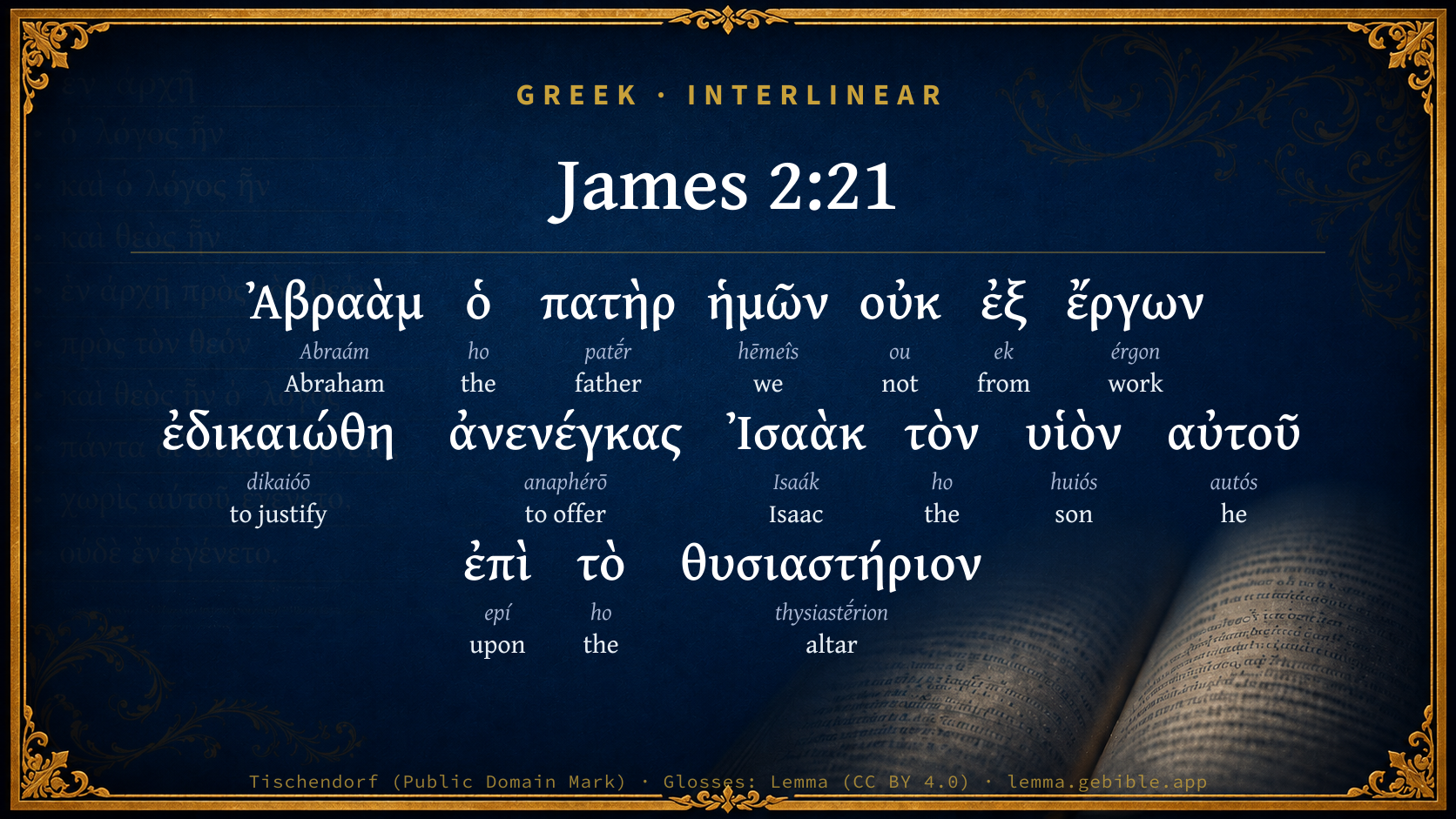
  1. Ἀβραὰμ Abraám G11 “Abraham” Noun, Proper, indeclinable
  2. ὁ ho G3588 “the” Article, Nominative, Singular, Masculine
  3. πατὴρ patḗr G3962 “father” Noun, Nominative, Singular, Masculine
  4. ἡμῶν hēmeîs G2249 “we” Personal pronoun, 1st person, Genitive, Plural
  5. οὐκ ou G3756 “not” Particle, Negative
  6. ἐξ ek G1537 “from” Preposition
  7. ἔργων érgon G2041 “work” Noun, Genitive, Plural, Neuter
  8. ἐδικαιώθη dikaióō G1344 “to justify” Verb, Aorist, Passive, Indicative, 3rd person, Singular
  9. Ἰσαὰκ Isaák G2464 “Isaac” Noun, Proper, indeclinable
  10. τὸν ho G3588 “the” Article, Accusative, Singular, Masculine
  11. υἱὸν huiós G5207 “son” Noun, Accusative, Singular, Masculine
  12. αὐτοῦ autós G846 “he” Personal pronoun, Genitive, Singular, Masculine
  13. ἐπὶ epí G1909 “upon” Preposition
  14. τὸ ho G3588 “the” Article, Accusative, Singular, Neuter
  15. θυσιαστήριον thysiastḗrion G2379 “altar” Noun, Accusative, Singular, Neuter

About this verse

These counts appear in no published source. They are computed here, from the morphology-tagged text and Lemma’s own curated glosses. What Lemma adds →

16
words
14
distinct lemmas
General Epistles
section

Notable vocabulary

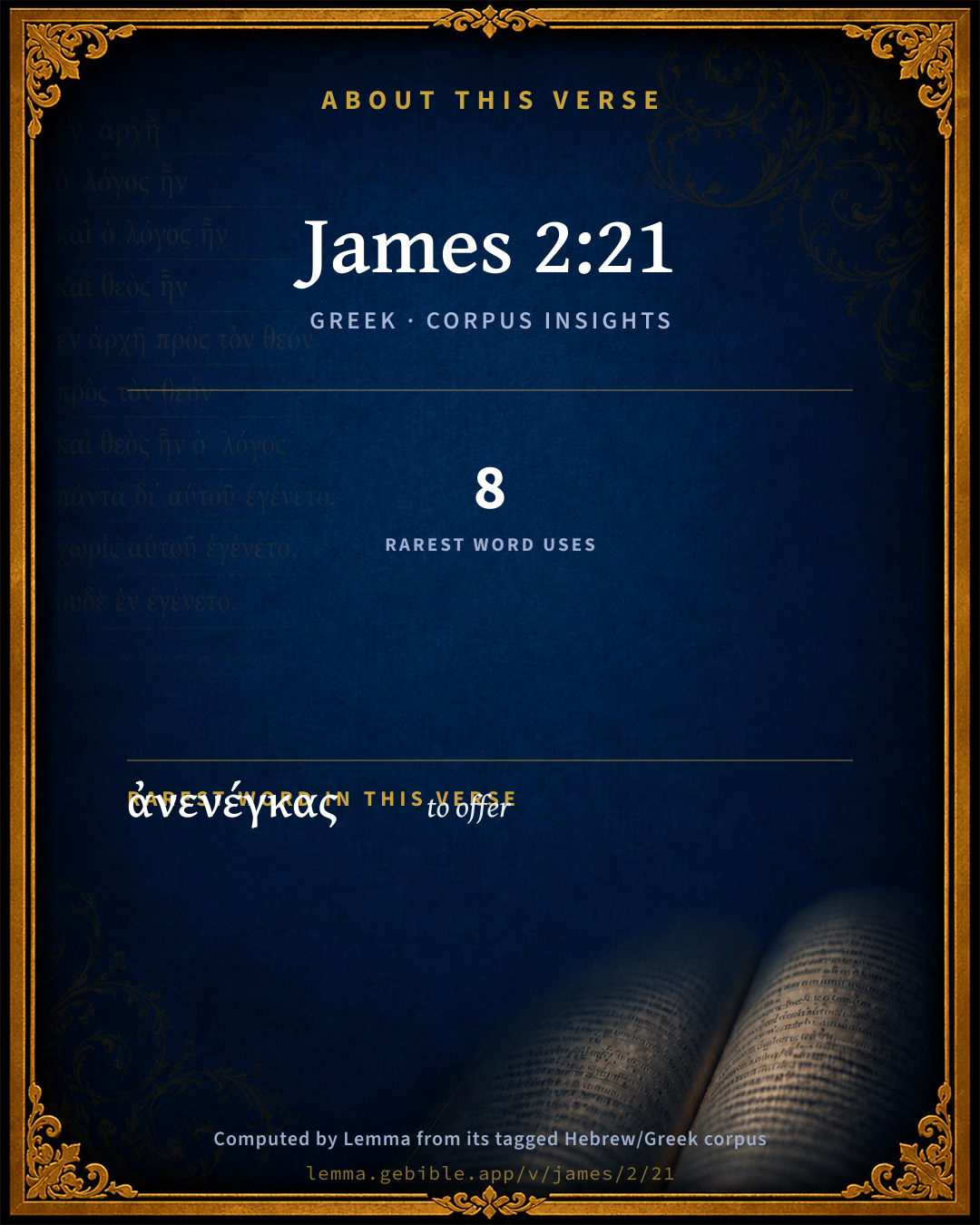
The rarest word here is ἀνενέγκας to offer G399 — appearing just 8 times in the whole Greek New Testament.

Shared distinctive vocabulary

ἀνενέγκας to offer G399 occurs in 8 verses of the Greek New Testament. Also found in:

Repetition

A word recurs within this verse:

Cross-references

20

Topical passages linked to James 2:21 in the Treasury of Scripture Knowledge — connected by theme and wording, ordered by reader-vote popularity; previews shown in the World English Bible.

  • Genesis 22:16–18 and said, "I have sworn by myself, says Yahweh, because you have done this thing, and have not withheld your son, your only son,
  • Genesis 22:9–12 They came to the place which God had told him of. Abraham built the altar there, and laid the wood in order, bound Isaac his son, and laid him on the altar, on the wood.
  • John 8:39 They answered him, "Our father is Abraham." Jesus said to them, "If you were Abraham's children, you would do the works of Abraham.
  • Matthew 12:37 For by your words you will be justified, and by your words you will be condemned."
  • Romans 4:16 For this cause it is of faith, that it may be according to grace, to the end that the promise may be sure to all the seed, not to that only which is of the law, but to that also which is of the faith of Abraham, who is the father of us all.
  • Joshua 24:3 I took your father Abraham from beyond the River, and led him throughout all the land of Canaan, and multiplied his seed, and gave him Isaac.
  • Psalms 143:2 Don't enter into judgment with your servant, For in your sight no man living is righteous.
  • Isaiah 51:2 Look to Abraham your father, and to Sarah who bore you; for when he was but one I called him, and I blessed him, and made him many.
  • Matthew 3:9 Don't think to yourselves, 'We have Abraham for our father,' for I tell you that God is able to raise up children to Abraham from these stones.
  • Matthew 25:31–40 "But when the Son of Man comes in his glory, and all the holy angels with him, then he will sit on the throne of his glory.
  • Luke 1:73 The oath which he spoke to Abraham, our father,
  • Luke 16:24 He cried and said, 'Father Abraham, have mercy on me, and send Lazarus, that he may dip the tip of his finger in water, and cool my tongue! For I am in anguish in this flame.'
  • Luke 16:30 "He said, 'No, father Abraham, but if one goes to them from the dead, they will repent.'
  • John 8:53 Are you greater than our father, Abraham, who died? The prophets died. Who do you make yourself out to be?"
  • Acts 7:2 He said, "Brothers and fathers, listen. The God of glory appeared to our father Abraham, when he was in Mesopotamia, before he lived in Haran,
  • Romans 3:20 Because by the works of the law, no flesh will be justified in his sight. For through the law comes the knowledge of sin.
  • Romans 4:1 What then will we say that Abraham, our forefather, has found according to the flesh?
  • Romans 4:12 The father of circumcision to those who not only are of the circumcision, but who also walk in the steps of that faith of our father Abraham, which he had in uncircumcision.
  • James 2:18 Yes, a man will say, "You have faith, and I have works." Show me your faith from your works, and I by my works will show you my faith.
  • James 2:24 You see then that by works, a man is justified, and not only by faith.

Cross-references courtesy of OpenBible.info (CC BY 4.0).

Commentary

Notes on James 2:21 from classic Christian and Jewish commentators (each source and its license shown beneath its notes). The classic Christian expositions comment on the surrounding passage and are grouped to its opening verse, so a note may address several verses; the Jewish commentaries on the Tanakh (Rashi and others) are per-verse, so they appear only where the commentator wrote on this verse.

Lemma curates 59 commentaries, every one of them public domain or Creative Commons licensed, each selected and text-cleaned for this edition rather than reprinted as found. About our sources →

Joseph Benson's Commentary

Jas 2:21. Was not, &c. — As if he had said, Take an instance of this in the most celebrated of all the patriarchs, our father Abraham. Was not he justified by works — Did not his works manifest the truth and liveliness of his faith; when — In consequence of the full persuasion he had of a divine command to do it; he offered Isaac his son upon the altar? — Intending, in obedience to what he apprehended to be the will of God, actually to have slain him, and to have trusted in God to accomplish the promise of a numerous seed to descend from him, by raising him from the dead: see notes on Heb 11:17-19. St. Paul says Abraham was justified by faith, (Rom 4:2, &c.,) yet St. James does not contradict him. For he does not speak of the same justification. St. Paul speaks of that which Abraham received many years before Isaac was born, Gen 15:6; St. James of that which he did not receive till he had offered up Isaac on the altar. He was justified, therefore, in St. Paul’s sense; that is, accounted righteous by faith, antecedent to his works. He was justified in St. James’s sense, that is, made righteous by works, subsequent to his faith: so that St. James’s justification by works is the fruit of St. Paul’s justification by faith.

Joseph Benson's Commentary on the Old and New Testaments (1811–1818) — public domain. Text from a community e-Sword module.

The Preacher's Complete Homiletical Commentary

Joseph S. Exell (gen. ed.)

CRITICAL AND EXEGETICAL NOTES

Jas_2:22. Made perfect.—Or, “a complete, and therefore acceptable, thing.”

Jas_2:23. Imputed.—“Was accounted as equivalent to righteousness.” His willingness to do, joined with the effort to do, was reckoned as if the thing was actually done.

MAIN HOMILETICS OF THE PARAGRAPH.—Jas_2:21-24

The Imputation of Righteousness.—St. James’s point in this paragraph seems to be this—Abraham did not gain the righteousness of an actual obedience of God’s will. He did not actually carry through the Divine command, and sacrifice his son on the altar. But he did fully purpose obedience; he did make every effort to carry his obedient purpose through. He was stopped, not by any change in his purpose, but by a new revelation of the Divine will; and it was therefore perfectly right that the intention and effort should be recognised as the righteousness which would have accrued to him if the sacrifice had been carried through. What St. James suggests is this—Would it have been reckoned as righteousness if Abraham had only thought about obeying, only talked about obeying, only resolved to obey, and had made no effort? It was that “rising up early in the morning, saddling his ass, cleaving the wood, carrying the fire and knife, journeying to Moriah, laying the wood in order, binding Isaac, laying him on the altar, and raising the knife to slay his son”—proving the reality of his faith, which was counted to him for righteousness. And here is a truth full of encouragement for us. Constantly we find that we cannot accomplish what we plan. Again and again we have to mourn that “our purposes are broken off.” Abraham was not permitted to do what he would. David was not permitted to carry through that which was in his heart. But incomplete works, which are incomplete through orderings of Divine Providence, not through our moral weakness, suffice to show God the reality, the activity, of our faith, and can be the basis on which righteousness is imputed to us. To prove faith obedience is necessary, but the obedience may be providentially stopped. The active effort to obey suffices; the precise result is unimportant. In Abraham there was faith in God’s command; but it was only known and shown by the works of obedience which he so resolutely endeavoured to perform.

SUGGESTIVE NOTES AND SERMON SKETCHES

Jas_2:22. Perfect, or All-round, Faith.—A thing is perfect when all its capacities are healthily developed, and are finding healthy exercise. Physical training aims to secure a perfect body, by nourishing into harmonious efficiency every organ, every sense, every power. Faith may be thought of as having its capacities, spheres, relations, possibilities, of service.

1. It has the sphere of the mental and moral life of the individual, and needs to get its full influence there.

2. It has its sphere of the relationship with God, and it needs to make full response to all the claims of God.

3. It has its sphere in its earth surroundings, with their various relationships and calls for influence; and it must be exercised into a wise efficiency of service in all that sphere. Perfect faith is all-round, efficient faith, fully responding in the faith spheres of self, God, and others.

Jas_2:23. El Khalil, the Friend of God.—Khalil-Allah, the “friend of God,” is the fuller form of Abraham’s title. In many ways it has a peculiar significance. The ancestor of the chosen people is not, as in the legends of Greece and Rome, or even of Germany, a god, or a demi-god, or the son of a god; he is a mere man. The interval between the human and Divine is never confounded. Close as are the communications with Deity, yet the Divine essence is always veiled, the man is never absorbed into it. Abraham is “the friend,” but he is nothing more. He is nothing more, but he is nothing less. He is “the friend of God.” The title includes a double meaning. He is “beloved of God.” In him was exemplified the fundamental truth of all religion,—that God has not deserted the world; that His work is carried on by His chosen instruments; that good men are not only His creatures and His servants, but His friends. And not only was Abraham beloved by God, but God was “beloved by him”; not only was God the friend of Abraham, but Abraham was the “friend of God.” To expand this truth is to see what was the religion, the communion with the Supreme, which raised Abraham above his fellow-men.—Dean Stanley.

Jas_2:21-22; Jas_2:24. Faith and Works.—The truths revealed by the gospel are not merely verbal statements, but great facts concerning the spiritual world, which exist quite independently of the words by which they are related to us in the New Testament. And the same spiritual truths are presented to us in Holy Scripture from different points of view. This is especially the case with the relation between the faith and works of a Christian, as set forth by St. Paul and St. James. If we dwell merely on the words they use, we may think they contradict each other. If we seek for their whole scope and meaning, we shall find that they are only treating the same subject from different points of view. Probably the epistle of St. James was written before that to the Romans. St. Paul tells us that pardon of our past sins and reconciliation to God are not earned by any works done in order to merit them. “To him that worketh is the reward not reckoned of grace, but of debt”; but the pardon of our past sins is the gift of God—it is simply an act of “grace,” or free mercy on the part of God towards sinful men. St. James tells us that Abraham, in the hour of trial, when he had offered up Isaac, was justified by his works also, or by the evidence which his works gave to angels and to men of the reality of his faith in God. St. James never says that Abraham was not justified by faith. He uses the word “works” in a sense wholly distinct from that of St. Paul. When St. James speaks of a man being “justified by works,” he means works which are the result of loving faith—works which are wrought by the Spirit of Christ in His faithful followers, works which evidence their faith and are ever tending to perfect it. St. Paul means by “works” the doing of certain outward things in order to purchase salvation. He speaks not of works wrought by the Holy Spirit, but of the “works of the flesh,” and directs us to seek that great inward change which is the gift of God.—Robert Barclay.

Jas_2:24. Justification by Works.—Of all questions the first and greatest is, “How shall a man be just before God?” Many differences of opinion. Text a deduction from a preceding argument. We should carefully examine the argument.

I. The apostle’s argument.—

1. Whence did it arise? He was reproving an evil in the early Church—the showing partiality to the richer members, oppressing and holding in contempt the poorer (Jas_2:1). This gives a clue to the whole. Hold not the true faith in so erroneous and unworthy a manner.

2. Trace the steps of his argument. This partiality is contrary to the law and the gospel. He appeals to the whole Church. No person can be saved so holding the faith of Christ. How vain pretences to love would be if it were as inoperative as this faith! (Jas_2:15-16). He confirms these assertions by an appeal to the Scriptures themselves. Whatever degrees of faith people might pretend to, they can never be accepted by God unless their faith works by love.

II. The conclusion drawn from it.—

1. The future judgment will proceed on grounds of perfect equity. God dispenses rewards and punishments not on arbitrary but strictly equitable grounds. God will judge men not by their faith, which He alone can see, but by their works, which all can see.

2. Faith is of no value unless attested by works. Faith at first sees Christ as Saviour from guilt and condemnation. It does not rest there; it lays hold on Him for sanctification, and for righteousness.

A common objection.—St. Paul’s sentiments and declarations on this subject are directly opposed to those of St. James. St. Paul is proving that a man is not to seek salvation by any righteousness of his own, but simply by faith in the Lord Jesus Christ; whereas St. James is proving that a man who professes to have faith in Christ must show forth his faith by his works. St. Paul endeavours to convince the self-justiciary; St. James the Antinomian. St. Paul—works are nothing without faith; St. James—faith is nothing without works.

A few words—

1. Of caution.

(1) Do not separate faith and works. If your faith be strong enough to remove mountains, yet if it work not by love, it is but “sounding brass and tinkling cymbal.”

(2) Do not confound the two. You must lay Christ as your foundation first, and afterward raise on Him the superstructure of good works. Faith will honour Christ as the only Saviour of mankind, and works will honour Him as Lord and Master.

2. Of encouragement. All difficulties in the subject vanish before a broken and contrite heart; not all verbal difficulties, perhaps, but all doubts on the main subject. No righteousness but that of Christ can ever avail for our acceptance before God; and holiness is no less necessary for our final enjoyment of His favours. He will not “despise the contrite heart.”—Charles Simeon, M.A.

The Preacher's Complete Homiletical Commentary (gen. ed. Joseph S. Exell; Funk & Wagnalls, c. 1892) — public domain (pre-1929). A full-Bible homiletical/sermon-outline anthology covering 65 of 66 books (2 John is absent from the source module). Text from a community e-Sword module.

Bengel's Gnomon

Johann Albrecht Bengel

Jas 2:21. Ἀβραὰμ ὁ πατὴρ ἡμῶν, Abraham our father) So St Paul, Rom 4:1.—ἐξ ἔργων ἐδικαιώθη, was justified by works) St James recognises the inward and peculiar power of faith, which is previous to works, and distinct from works and from their influence, which reacts upon faith (Jas 2:22): but hypocrites are ignorant of this; speaking more readily in flattering terms of works, of which they themselves are destitute. Therefore James employs an argument ad hominem; and that he may convince them, he especially mentions works, while in mentioning them, he understands (as lying underneath the works) the active principle of faith. Nor does James use the word δικαιοῦσθαι, to be justified, in a different sense from that in which St Paul uses it; in which sense righteousness is most intimately connected with salvation, Jas 2:14. But that sense is a very pregnant one; so that the term righteousness is co-extensive in its meaning on the opposite side with sin (see especially the note, Rom 3:20); and as sin includes both guilt (reatus) and the taint (vitium) of our nature, so does righteousness denote the whole process, by which a man is righteous, and is judged and pronounced to he so; that is, one with whom God is no longer angry on account of his guilt, but reconciled to him: and one who on his part is no longer an enemy to God, but a friend, Jas 2:23. Comp. Rom 8:7 with what precedes and follows. Now both St James and St Paul use this word, δικαιοῦν, to justify, in one and the same sense, though St Paul in a more restricted, and St James in a wider application; and for this reason, that St Paul is accustomed to speak of the act of justification, which chiefly consists in the remission of sins; whereas St James, which is especially to be observed, speaks of the state resulting from the same justification (which is incorrectly but frequently termed a second justification), when a man continues in the righteousness which is of faith, and makes progress in that which is of works. Hence it is that St Paul, from Gen 15:6, brings forward Abraham as believing; St James, from Gen 22:10, as even offering his son upon the altar, long afterwards. The former simply adduces the saying, It was counted to him; the latter also this, He was called friend, which was afterwards added. The former says, God justifies, and justifies the ungodly, and we are justified; the latter simply says, A man is justified. The former makes mention of faith only, and not of works, although they proceed from faith; the latter makes mention of faith and works.—ἐπὶ τὸ θυσιατήριον, upon the altar) He designs to show, that the work of Abraham was undertaken altogether in earnest.

Bengel's Gnomon of the New Testament — English translation (T&T Clark, Edinburgh, 1860) — public domain. Text from a community e-Sword module.

Meyer's Critical & Exegetical Commentary

Heinrich August Wilhelm Meyer

Jam_2:21. The testimony to which James first appeals is what happened to Abraham. The reference to Abraham is completely explained from his historical importance, and which is also indicated by ὁ πατὴρ ἡμῶν.

ἡμῶν] because both James and his readers belonged to the nation of Israel sprung from Abraham. By the question with οὐ the thought is characterized as such to which allthus all the opponentsmust assent: Was not Abraham our father justified by works? The participial sentence which follows declares what works procured for him justification: when he offered Isaac his son upon the altar?

The reference to the doctrine of the Apostle Paul, and especially to his declaration in Rom_4:1 ff., has misled expositors into many arbitrary explanations of this verse, and particularly of the word ἐδικαιώθη. In order to have a sure foundation for interpretation, two things are to be examined,(1) the context, and (2) the linguistic usage. (1) As regards the context, the question treated in this whole section is, How the Christian is saved;[142] comp. the question in Jam_2:14 : μὴ δύναται ἡ πίστις σῶσαι αὐτόν; and the connection of that section with the preceding, where the discourse is about the divine judgment (Jam_2:12 : κρίνεσθαι; Jam_2:13 : ἡ κρίσις). As James appeals to Abraham for his assertion that faith without works cannot save, it is evident that by ἐδικαιώθη he cannot mean something which happened to Abraham from himself, but only something which happened to him from God; so that the meaning cannot be, Abraham justified himself by his works, but only that God justified him on the ground of his works.[143] (2) As regards the linguistic usage, δικαιοῦν corresponds to the Hebrew הַצְדִּיק, which, as a judicial term, has the meaning: to declare one צַדִּיק by an acquittal from guilt, and is opposed to הַרְשִׁיעַ (LXX.: καταγινώσκειν, καταδικάζειν) = to declare one רָשָׁע by a sentence of condemnation; comp. Exo_23:7; Deu_25:1; 1Ki_8:32; 2Ch_6:23; Pro_17:15; Isa_5:23; Isa_50:8; Isa_53:11; in the Apocrypha, comp. Sir_10:29; Sir_13:22; Sir_23:11; Sir_34:5; Sir_42:2. δικαιοῦν has also the same meaning in the N. T., where, especially (besides the passages treating of the Pauline doctrine of justification), Mat_12:37, Rom_2:13, Luk_18:14 are to be compared. This judicial meaning of the word is here to be retained. It is true, as δικαιοῦν (similarly the English word to justify) occurs not only in the judicial sense, but, also more generally, as also הַצְדִּיק, in the sense set forth as righteous[144] (comp. Mat_11:19; Luk_7:29; Rom_3:4; 1Ti_3:16), the passage has been explained: Abraham has been proved righteous, or, has proved himself righteous (so already Calvin, and, in recent times, Philippi). But this explanation is unsuitable, since, according to this view, justification did not happen to Abraham from God (as must be conceived according to the context), but from his works; thus it was Abraham who justified himself by his works, i.e. proved himself to be righteous.[145] If we hold fast to the judicial meaning, then it is to be observed that, in the conception of the word, neither anything about the disposition of him who is the object of the declaration of righteousness, nor about the ground of justification (whether it rests in the judge or in the conduct of him who is justified), is indicated. For this reason the explanation of Wiesinger: a Deo justus agnitus, is incorrect, as the idea of a ratifying recognition of the already existing condition is not contained in the word. As little is it to be vindicated when Hofmann thinks that δικαιοῦσθαι here imports: to become a δίκαιος, inasmuch as he then answered to the will of God relating to him; for, on the one hand, by this a meaning (namely, being made a righteous person) is ascribed to the word which it has not; and, on the other hand, no one can make himself a righteous person by his works, but only can prove himself to be such.[146] James says nothing else than that Abraham was declared righteous (by God) ἐξ ἔργων. By ἐξ ἔργων the reason is specified, on Abrahams part, on account of which a declaration of righteousness was granted to him. By these works are to be understood not all the works which Abraham has done, nor his whole pious life, but, as the clause ἀνενέγκας Ἰσαὰκ κ.τ.λ. shows, the actual offering of his son Isaac on the altar. The plural ἐξ ἔργων is used because the category, at first entirely general, is specified which here comes into consideration. It may appear surprising that James here should emphasize precisely that offering as the reason of the declaration of righteousness, since in the O. T. narrative (Genesis 22.) a δικαιοῦσθαι of Abraham is not mentioned. What James has in view is not the judgment of God there; Gen_22:12 comp. with Jam_2:16 ff. (Wiesinger); for in these words, which, moreover, only serve as an introduction to the declaration which follows, nothing is addressed to Abraham, but only it is testified of him that God in his action has recognised his fear of God. Not in this, but only in what God addresses to him on account of it, because He has recognised him as a God-fearing man, can James have found the declaration of Abrahams righteousness. This is the bestowal of the promise (Jam_2:16-18) by which it is expressly said, because thou hast done this thing (Jam_2:16), and because thou hast obeyed my voice (Jam_2:18); by which is definitely brought forward that the promise was granted on account of his obediencethat is, on account of his works. What importance, with regard to the promise, the obedience of Abraham had in the eyes of God is clearly brought out from Gen_26:5, where God ratifies this same promise with Isaac in these words: Because that Abraham obeyed my voice and kept my charge, my commandments, my statutes, and my laws; and not less is it to be observed when it is said in Sir_44:20 : ὃς συνετήρησεν νόμον ὑψίστου … καὶ ἐν πειρασμῷ εὑρέθη πιστός· διὰ τοῦτο ἐν ὅρκῳ ἔστησεν αὐτῷ κ.τ.λ. It is true that the same promise was made to Abraham at an earlier period, and that before he had done anything (Gen_12:2-3); but the difference is, that after the offering of his son it was imparted to him as an inalienable blessing on account of this action, and that at the close of his theocratic historical life. In this James could rightly recognise a formal declaration of Abrahams righteousness on the part of God.

On the construction ἐδικαιώθη ἐκ, comp. Mat_12:37 : ἐκ τῶν λόγων σου δικαιωθήσῃ, where the λόγοι are reckoned as that on the ground of which acquittal (or condemnation) takes place.

The words: ἀνενέγκας … ἐπὶ τὸ θυσιαστήριον] are not, with Luther, to be translated: when he had sacrificed his son upon the altar; for ἀναφέρειν joined with ἐπί, with the accusative, is not to sacrifice, but to bring as a sacrifice to the altar (comp. 1Pe_2:24); it is therefore incorrect to supply the idea will (Estius: cum obtulisset = offere voluisset). Hottinger falsely explains ἐπὶ τ. θυσ. = before the altar. To the name Ἰσαάκ is emphatically added τὸν υἱὸν αὐτοῦ; comp. Gen_22:16.

[142] Philippi erroneously maintains that the question here treated, is to prove that faith has to manifest itself by works if it is to be regarded as true faith. But James designates the faith of his opponents as νεκρά, not merely because it has no works, but because it cannot effect the σωτηρία which they expected from it.

[143] Correctly, Wiesinger: In ἐδικαιώθη the passive sense is decidedly to be retained, and, indeed, a Deo …; not of the human judgment is the discourse here and in ver. 23, but of the divine; as it treats of the proposition in ver. 14, that only an active faith can save. This is the more to be maintained, as the thought, that faith has to justify itself before men as living, is so void of importance that James could not lay such stress upon it.

[144] This is the prevailing meaning of הַצְדִּיק, which is differently modified according to the different circumstances to which it is referred. It is chiefly used of a judicial sentence, whether of God or of a human judge, by which one is declared צַדִּיק; yet it also occurs in another reference, namely, of every agency which causes one to appear as righteous, whether that agency is exercised by the person in question or by others. The N. T. δικαιοῦν corresponds to this usage. Strictly taken, it is accordingly not correct to translate δικαιοῦν by proved to be righteous, or approved to be righteous, as the ideas proving and approving, according to their proper and strict meaning, are not contained in it. Comp., however, the excellent treatment of the word in Cremers dictionary.

[145] Philippi explains the words: Abraham was justified before men by works, as a justified man before God by faith. But here there are evidently introduced into the idea δικαιοῦσθαι a series of more precise statements which are not contained in it. The explanation of Brückner is simpler, who considers ἑδικαιώθη to indicate: that moral righteousness which displays itself on the ground of the activity of faith; but also this interpretation is not to be considered correct for the reasons above stated. The unsuitableness of this and similar interpretations is particularly evident from ver. 24. It is also to be observed, that in these explanations the passive is converted into the middle voice. In the O. T., it is true, the hithpael of צָדַק is translated in the LXX. by the preterite passive of δικαιοῦν (see Gen_44:16); but in the N. T. the passive of this verb never occurs in this meaning; the middle import is here rather expressed by the active with the reflex pronoun; comp. Luk_10:29; Luk_16:15.

[146] The following explanations are also incorrect: he was loved as a righteous man (Grotius); he was made a partaker of the favour of God and of all the blessings springing from it (Theile); his justification was ratified by man (Baumgarten). The translation: he was pardoned (Pott), is inaccurate, because the idea of pardon always supposes a crime, which δικαιοῦν does not. Also the explanation of Lange is arbitrary: δικαιοῦν, in the N. T. deeper sense, denotes that God declares righteousness in the theocratical forum before the theocratical congregation conceived as permanent; for how can the precise statement be contained in the simple verbal idea, before whom the declaration of righteousness was made?

Meyer — Critical and Exegetical Commentary on the New Testament — English translation by Peter Christie, edited by Frederick Crombie (T&T Clark, 1880) — public domain. Text from a community e-Sword module.

Expositor's Greek Testament

ed. W. Robertson Nicoll

Jas 2:21 . Ἀβραὰμ ὁ πατὴρ ἡμῶν : A stereotyped phrase in Jewish literature. οὐκ ἐξ ἔργων ἐδικαιώθη : the writer is referring to the well-known Jewish doctrine of זכות ( Zecûth ), on this subject see Introduction IV., § 2. ἀνενέγκας Ἰσαὰκ …: on this subject an example of Jewish haggadic treatment may be of interest: “When Abraham finally held the knife over his beloved son, Isaac seemed doomed, and the angels of heaven shed tears which fell upon Isaac’s eyes, causing him blindness in later life. But their prayer was heard. The Lord sent Michael the archangel to tell Abraham not to sacrifice his son, and the dew of life was poured on Isaac to revive him. The ram to be offered in his place had stood there ready, prepared from the beginning of Creation ( Aboth , Jas 2:6 ). Abraham had given proof that he served God not only from fear, but also out of love, and the promise was given that, whenever the ‘Aḳedah [= the “binding,” i.e. , of Isaac] chapter was read on New Year’s day, on which occasion the ram’s horn is always blown, the descendants of Abraham should be redeemed from the power of Satan, of sin, and of oppression, owing to the merit of him whose ashes lay before God as though he had been sacrificed and consumed,” Pesiḳ . R. , § 40 (quoted in Jewish Encycl. , i. 87 a ). It is interesting to notice that even in the Talmud (e.g., Ta‘anir , 4 a ) the attempted sacrifice of Isaac is regarded also from a very different point of view, such words as those of Jer 19:5 ; Mic 6:7 , being explained as referring to this event (see further Proceedings of the Soc. of Bibl. Arch. , xxiv. pp. 235 ff.).

The Expositor's Greek Testament, edited by W. Robertson Nicoll (1897–1910) — public domain. Text from a community e-Sword module.

Geneva Bible (1599)

Geneva Bible translators

Was he not by his works known and found to be justified? for he speaketh not here of the causes of justification, but by what effects we may know that a man is justified.

Geneva Bible (1599) marginal notes — public domain. Text via Bolls.life.

Jamieson, Fausset & Brown

Robert Jamieson, A. R. Fausset & David Brown

Abraham . . . justified by works--evidentially, and before men (see on Jam 2:18). In Jam 2:23, James, like Paul, recognizes the Scripture truth, that it was his faith that was counted to Abraham for righteousness in his justification before God.

when he had offered--rather, "when he offered" [ALFORD], that is, brought as an offering at the altar; not implying that he actually offered him.

Jamieson, Fausset & Brown — Commentary Critical and Explanatory on the Whole Bible (1871) — public domain (CC PDM 1.0). Text via the HelloAO Bible API.

Adam Clarke's Commentary

Verse 21. Was not Abraham our father] Did not the conduct of Abraham, in offering up his son Isaac on the altar, sufficiently prove that he believed in God, and that it was his faith in him that led him to this extraordinary act of obedience?

Adam Clarke's Commentary on the Bible (1810–1826) — public domain. Text from a community e-Sword/MySword module.

John Calvin's Commentaries

21 Was not Abraham. The Sophists lay hold on the word justified, and then they cry out as being victorious, that justification is partly by works. But we ought to seek out a right interpretation according to the general drift of the whole passage. We have already said that James does not speak here of the cause of justification, or of the manner how men obtain righteousness, and this is plain to every one; but that his object was only to shew that good works are always connected with faith; and, therefore, since he declares that Abraham was justified by works, he is speaking of the proof he gave of his justification.

When, therefore, the Sophists set up James against Paul, they go astray through the ambiguous meaning of a term. When Paul says that we are justified by faith, he means no other thing than that by faith we are counted righteous before God. But James has quite another thing in view, even to shew that he who professes that he has faith, must prove the reality of his faith by his works. Doubtless James did not mean to teach us here the ground on which our hope of salvation ought to rest; and it is this alone that Paul dwells upon.

That we may not then fall into that false reasoning which has deceived the Sophists, we must take notice of the two fold meaning, of the word justified. Paul means by it the gratuitous imputation of righteousness before the tribunal of God; and James, the manifestation of righteousness by the conduct, and that before men, as we may gather from the preceding words, “Shew to me thy faith,” etc. In this sense we fully allow that man is justified by works, as when any one says that a man is enriched by the purchase of a large and valuable chest, because his riches, before hid, shut up in a chest, were thus made known.

John Calvin's Commentaries (1540-1563) — public domain. Text from the Calvin Translation Society English edition (1840s-50s) via the Christian Classics Ethereal Library (ccel.org). Calvin's coverage is partial (roughly two-thirds of the Bible); uncommented books and verses are honest gaps, never fabricated. The 19th-century editor's footnotes and remarks are omitted so the notes are faithfully Calvin's own voice.

Ellicott's Commentary for English Readers

(21) Was not Abraham our father justified by works . . .?—St. James now addresses his two examples from familiar history in force of his plea for active faith. The first is the marvellous devotion and trust of Abraham (Genesis 22) when he offered Isaac his son upon the altar; that boy himself the type of God’s dear Son, who bore, like His meek ancestor, the sacrificial wood up the long weary road of death. Happily, the story is as well known to Christian readers as to the Jewish of old time, and may safely be left here without further comment.

A Bible Commentary for English Readers, edited by Charles John Ellicott (1878–1897) — public domain. Text from a community e-Sword module.

The Cambridge Bible for Schools and Colleges

gen. ed. J. J. S. Perowne

21. Was not Abraham our father justified by works] The close correspondence of phraseology with Rom_4:2 at first seems to favour the view that St James is correcting or modifying St Paul’s statement It is obvious, however, that the agreement equally admits of the explanation that St Paul is correcting or modifying the language of St James. He presses the fact that “Abraham believed God,” and that this “was counted to him for righteousness,” i. e. that he was justified prior to any act but that of simple trust. And the impression left by a careful study of the passage referred to is that St Paul is there referring to something that had been urged, as having a high authority, against his teaching that a man is justified by faith. It is clear, at all events, that no inference can be drawn from the two passages in favour of the assumption that the Epistle of St James was later than that of St Paul to the Romans.

The use of the word “justify” shews that its meaning is to “acquit” or “count as righteous” (Mat_12:37; Act_13:39; Sir_26:29; Sir_23:11).

The preposition used in the Greek points to “works” as being the source rather than the instrument of justification.

when he had offered Isaac his son upon the altar?] Better, when he offered Isaac, the two acts being thought of, not as successive, but simultaneous. It is remarkable that the only scriptural references, after Genesis 22, to the sacrifice of Isaac, are found in Wis_10:5 and Heb_11:17. It is hardly likely that the latter could have been known to St James, the internal evidence pointing to a later date; but the former, whether, as some have supposed, by the same author as the Epistle to the Hebrews, or written fifty or sixty years earlier, might well have come under his notice. In relation to St Paul’s teaching, as noticed above, it must be remembered that the one writer speaks of the beginning of Abraham’s course, the other of its consummation. St James might well urge that if Abraham had not shewn his faith by his works, up to the crowning work of the sacrifice of his son, it would have proved that his faith too was dead.

The Cambridge Bible for Schools and Colleges (gen. ed. J. J. S. Perowne; Cambridge University Press, 1878–1918) — public domain. Text from a community e-Sword module.

John Gill's Exposition

Was not Abraham our father justified by works,.... Not as the causes of his justification, that is denied, Rom 4:2 but as effects of it, showing the truth of his faith, and the reality of his justification: he had both faith and works, and the former were known by the latter; and even the faith which he had expressed years ago was manifested, demonstrated, and confirmed to be true and genuine, by the instance of his obedience to God, here produced; by which it appeared he was a true believer, a justified person, approved of God, and loved by him. Now if this was the case of Abraham, the father of the Jewish nation, yea, the father of the faithful, of all that believe, he is, and must be a vain man, that talks of faith without works; and his faith must be a dead one, and he be very unlike the father of them that believe: the good work instanced in is the offering up of Isaac;

when he had offered Isaac his son upon the altar: for when he was bid to take his son, his only and beloved son, Isaac, and offer him up on one of the mountains, that should be shown him, he made haste to do it; he provided everything for it; he split the wood, and carried it with him, and fire in his hand; he built an altar, laid the wood on it, bound his son, laid the wood on the altar, and his son on the wood, and stretched out his hand, with his knife in it, to slay him; so that it was all one, with respect to his intention and will, as if he had actually offered him, and was a full trial and proof of his obedience to God. This was not the only act of obedience, or good work, which he performed; but this being a very eminent one, the apostle instances in it, as a very considerable evidence of his faith in God, and love to him; and which showed him to be a justified person, as he was long before he performed this action, even before Isaac was born; see Gen 15:6 and therefore it can never be the apostle's meaning, that he was justified before God by this, or any other good work or works, as cause or causes of it; but only that he was declared to be so; or, in other words, that his faith was attended with good works, and evidenced by them.

John Gill's Exposition of the Whole Bible (1746–1763) — public domain (CC PDM 1.0). Text via the HelloAO Bible API.

Trapp's Complete Commentary

John Trapp

21 Was not Abraham our father justified by works, when he had offered Isaac his son upon the altar?

Ver. 21. Justified by works] sc. Declarative et in fore humano, but not before God, Rom 3:2. It is faith that justifieth the man; but they are works that justify faith to be right and real, saving and justifying.

John Trapp, A Commentary or Exposition upon All the Books of the Old and New Testament (1647–1656) — public domain. Text from a community e-Sword module.

Albert Barnes' Notes on the Bible

Was not Abraham our father - Our progenitor, our ancestor; using the word “father,” as frequently occurs in the Bible, to denote a remote ancestor. Compare the notes at Mat 1:1. A reference to his case would have great weight with those who were Jews by birth, and probably most of those to whom this Epistle was addressed were of this character. See the Introduction.

Justified by works - That is, in the sense in which James is maintaining that a man professing religion is to be justified by his works. He does not affirm that the ground of acceptance with God is that we keep the law, or are perfect; or that our good works make an atonement for our sins, and that it is on their account that we are pardoned; nor does he deny that it is necessary that a man should believe in order to be saved. In this sense he does not deny that men are justified by faith; and thus he does not contradict the doctrine of the apostle Paul. But he does teach that where there are no good works, or where there is not a holy life, there is no true religion; that that faith which is not productive of good works is of no value; that if a man has that faith only, it would be impossible that he could be regarded as justified, or could be saved and that consequently, in that large sense, a man is justified by his works that is, they are the evidence that he is a justified man, or is regarded and treated as righteous by his Maker. The point on which the apostle has his eye is the nature of saving faith; and his design is to show that a mere faith which would produce no more effect than that of the demons did, could not save.

In this he states no doctrine which contradicts that of Paul. The evidence to which he appeals in regard to faith, is good works and a holy life; and where that exists it shows that the faith is genuine. The case of Abraham is one directly in point. He showed that he had that kind of faith which was not dead. He gave the most affecting evidence that his faith was of such a kind as to lead him to implicit obedience, and to painful sacrifices. Such an act as that referred to - the act of offering up his son - demonstrated, if anything could, that his faith was genuine, and that his religion was deep and pure. In the sight of heaven and earth it would justify him as a righteous man, or would prove that he was a righteous man. In regard to the strength of his faith, and the nature of his obedience in this sacrifice, see the notes at Heb 11:19. That the apostle here cannot refer to the act of justification as the term is commonly understood, referring by that to the moment when he was accepted of God as a righteous man, is clear from the fact that in a passage of the Scriptures which he himself quotes, that is declared to be consequent on his believing: “Abraham believed God, and it was imputed unto him for righteousness.”

The act here referred to occurred long subsequent to that, and was thus a fulfillment or confirmation of the declaration of Scripture, which says that “he believed God.” It showed that his faith was not merely speculative, but was an active principle, leading to holy living. See the notes at Jam 2:23. This demonstrates that what the apostle refers to here is the evidence by which it is shown that a man’s faith is genuine, and that he does not refer to the question whether the act of justification, where a sinner is converted, is solely in consequence of believing. Thus the case proves what James purposes to prove, that the faith which justifies is only that which leads to good works.

When he had offered Isaac his son upon the altar - This was long after he believed, and was an act which, if any could, would show that his faith was genuine and sincere. On the meaning of this passage, see the notes at Heb 11:17.

Albert Barnes' Notes on the Bible (1834–1885) — public domain. Text from a community e-Sword/MySword module.

Haydock's Catholic Bible Commentary

Was not Abraham....justified by works? We may observe, that St. James here brings the very same examples of Abraham and Rahab, which it is likely he knew some had miscontrued in St. Paul, as if the great apostle of the Gentiles had taught that faith alone was sufficient to salvation. But St. Paul neither excludes good works done by faith, when he commends faith, excluding only the works of the law of Moses, as insufficient to a true justification. See Romans iii. 27. And St. James by requiring good works does not exclude faith, but only teacheth that faith alone is not enough. This is what he clearly expresseth here in the 22nd and in the 24th verse. Man, says he, is justified, and not by faith only. And (ver. 22.) seest thou that faith did co-operate with Abraham’s works, and by works faith was made perfect. In fine, we must take notice, that when St. James here brings example of Abraham offering his son Isaac, to shew that he was justified by works, his meaning is not that Abraham then began first to be justified, but that he then received an increase of his justice. He was justified at least from his first being called, and began then to believe and to do good works. It is true his faith was made perfect, and his justice increased, when he was willing to sacrifice his son. (Witham)

George Leo Haydock (1774–1849), Haydock's Catholic Family Bible and Commentary, 1859 edition — public domain. Excludes Psalms (Douay-Rheims chapter numbering differs from Protestant) and Deuterocanonical books (Catholic canon only).

Matthew Poole's English Annotations

Was not Abraham our father; not only the father of us as Jews, (for to them he wrote), and according to the flesh, but as believers, and according to the promise; so all believers are called Abraham’s children, Rom 4:11; Gal 3:7.

Justified by works; found or declared to be justified, not only before God, but in the face of the world; and his faith (by which he had been justified above thirty years before in the sight of God) now approved as a true, lively, justifying faith, by this proof he gave of it, upon God’s trying him in the offering up his son, Gen 22:9,12,

Now I know that thou fearest God, & c. Abraham did fear God, and believe him before, and was justified before in the sight of God; but by the working of his faith in so eminent an act of obedience, the sincerity of all his graces, and so of his faith, was manifested and made known, and so his faith itself justified, as his person was before, and he obtained this ample testimony from the mouth of God himself. So that Abraham’s justification here was not the absolution of a sinner; but the solemn approbation of a believer; not a justifying him as ungodly, but commending him for his godliness. He was by his works justified as a righteous person, but not made righteous, or constituted in a justified state, by his works. The design of the apostle is not to show how sinners are justified in God’s court, but only what kind of faith it is whereby they are justified, viz. such a one as purifies the heart, Act 15:9, and looks to Christ, not only as made righteousness, but sanctification to them, 1Co 1:30; and consequently not only rests on him for justification, but stirs them up to yield obedience to him.

When he had offered Isaac his son; viz. in his firm purpose and resolution, and was about to do it actually, had not God hindered him. It was no fault in Abraham that it was not actually done, and therefore it was counted to him as if it had been really done, Gen 22:12; Heb 11:17.

Upon the altar; this shows the settled purpose of Abraham to sacrifice Isaac, when he proceeded so far as to bind him, and lay him upon the altar; for that argues, that he expected and intended nothing but his death, which generally was wont to follow in sacrifices when once laid upon the altar.

Matthew Poole's English Annotations on the Holy Bible (1683–1685) — public domain. Text from a community e-Sword/MySword module.

Whedon's Commentary on the Bible

Daniel D. Whedon

21. Abraham—As Abraham is the instance discussed by St. Paul, (Rom_4:1-13 and Gal_3:6-9,) we deem it very probable, but by no means certain, that James has Paul’s statements in view, and purposes to give, not a disputation in order to refute them, but a counter statement in order to correct those who overstated Paul’s.

Our father— Namely, of both unconverted and converted Jew.

Offered—But did not fulfil the offering by actual sacrifice.

Upon—Or at.

Daniel D. Whedon (gen. ed.), Commentary on the Old and New Testaments (1874–1909) — public domain. Text from a community e-Sword module.

John Wesley's Explanatory Notes

Was not Abraham justified by works - St. Paul says he was justified by faith, Rom. iv, 2, &c.: yet St. James does not contradict him; for he does not speak of the same justification. St. Paul speaks of that which Abraham received many years before Isaac was born, Gen. xv, 6. St. James, of that which he did not receive till he had offered up Isaac on the altar. He was justified, therefore, in St. Paul's sense, (that is, accounted righteous,) by faith, antecedent to his works. He was justified in St. James's sense, (that is, made righteous,) by works, consequent to his faith. So that St. James's justification by works is the fruit of St. Paul's justification by faith.

John Wesley, Explanatory Notes Upon the Whole Bible (1754–1765) — public domain. Text via the GEBible commentary corpus.

Scofield Reference Notes

C. I. Scofield

justified

(See Scofield "Rom 4:2").

The Scofield Reference Bible (1917 edition), notes by C. I. Scofield — public domain. Text from a community e-Sword module.

Kretzmann's Popular Commentary

Paul E. Kretzmann

The example of Abraham and Rahab:

v. 21. Was not Abraham, our father, justified by works when he had offered Isaac, his son, upon the altar?

v. 22. Seest thou how faith wrought with his works, and by works was faith made perfect?

v. 23. And the scripture was fulfilled which saith, Abraham believed God, and it was imputed unto him for righteousness; and he was called the friend of God.

v. 24. Ye see, then, how that by works a man is justified, and not by faith only.

v. 25. Likewise also, was not Rahab, the harlot, justified by works when she had received the messengers and had sent them out another way?

v. 26. Far as the body without the spirit is dead, so faith without works is dead also.

In bringing examples from the Old Testament to illustrate his argument, the apostle first refers to an incident in the life of Abraham: Was not Abraham, our father, justified by works when he sacrificed his son Isaac upon the altar? Gen 22:9. Abraham had received the command from God to take his only son, Isaac, to make a three days’ journey with him to a certain mountain, and there to offer him up as a sacrifice upon an altar to be built by him. The fact that Abraham carried out the commandment of God without remonstrance was a proof of his faith, Heb 11:17; in other words, his work in sacrificing his son was evidence that justifying, saving faith was living in his heart. It follows, then: Thou seest that his faith was manifested as being one with his works, and that out of works faith was completed. Abraham’s faith was active in his works, in all the matters connected with this sacrifice, the two being thus joined in their efficacy, and his faith receiving its final, definite proof by his works. That is, any one seeing Abraham perform this work as he was commanded to do by the Lord could not doubt for as much as a minute that true faith lived in his heart.

That this is the argument of the writer is shown in the next verse: And there was fulfilled the scripture which says, Abraham believed God, and it was reckoned to Him for righteousness, and he was called a friend of God. The order to be observed in estimating faith is this: Abraham performed the very difficult task which was assigned to him; this work he could perform only by faith; by virtue of this saving faith the righteousness of the Messiah was imputed to him, or, his faith was accounted to him for righteousness, Gen 15:6; Rom 4:3. Moreover, on the strength of this evidence of faith the Old Testament ascribed to Abraham the honoring title of the friend of God, 2Ch 20:7; Isa 41:8. From this standpoint, also, the conclusion is correct: You see that out of works a man is justified, and not out of faith alone. Good works are not necessary to earn salvation, but they are necessary for evidence as to the existence of faith in the heart of a man; for where they are to be found, there one may conclude that true faith lives in the heart, and so the works indirectly justify a person.

The example of Rahab is also adduced: So likewise Rahab, the harlot: was she not justified out of works when she received the messengers and sent them out by a different way? The act of Rahab in hiding the spies that came to her house was an act of faith, Heb 11:31. It was this faith that prompted her to hide the messengers and to aid them in escaping from the city. This good work proved the existence of saving faith in her heart, and she was thus justified on the basis of the deed which manifested the condition of her heart. Thus the apostle, from the standpoint which he here desires to impress upon his readers, is right in concluding: For just as the body without breath is dead, so faith without works is dead. A corpse may have the appearance of a live human being in every way, all the members and organs being present and apparently able to function. But while the breath of life, the soul, is lacking, that body is dead and will remain dead. Thus also a person may boast that he possesses faith, and he may even be among those that hear the Word of God. But if the evidence of good works is lacking, such faith is spurious, hypocritical, valueless. Genuine faith is never without good works.

Summary

The apostle warns his readers against an unchristian partiality, asserting that the will of God demands charity toward all men alike; he shows that faith requires the correlate of brotherly love and adduces the example of Abraham and Rahab to indicate how faith gave evidence of its existence in good works.

Paul E. Kretzmann, Popular Commentary of the Bible (1921–1924) — public domain. Text from a community e-Sword module.

The People's New Testament

B. W. Johnson

21. Was not Abraham our father. The father of the Jewish race; also the father of all his children by faith. See Gal. 3:7–9. Justified by works. By a faith which showed itself in works. This is the argument of James, that faith is of no avail unless accompanied by works. Of this all Abraham's life was a demonstration. He was told when in Mesopotamia to go forth into the land God would show him, and “he went forth, not knowing whither;” an act of faith (Heb. 11:8); “By faith he sojourned in the land of promise” (Heb. 11:9). Each of these acts of faith secured Divine approval, but the supremest trial was when he offered Isaac. See notes on Heb. 11:17. This victory of faith was followed by crowning approval and glorious promises.

B. W. Johnson's The People's New Testament with Notes (1889–1891) — public domain. Electronic text from the Christian Classics Ethereal Library (CCEL) ThML edition.

unfoldingWord translationNotes

Door43 World Missions Community

General Information:

Since these are Jewish believers, they know the story of Abraham, about whom God had told them long ago in his word.

Was not Abraham our father justified ... on the altar?

This rhetorical question is used to rebut the foolish man's arguments from James 2:18, who refuses to believe that faith and works go together. AT: "Abraham our father was certainly justified ... on the altar." (See: Rhetorical Question)

justified by works

James speaks of works as if they were objects that one can own. AT: "justified by doing good deeds" (See: Metaphor)

father

Here "father" is used in the sense of "ancestor."

You see

The word "you" is singular, referring to the hypothetical man. James is addressing his whole audience as if they were one person.

You see

The word "see" is a metonym. AT: "You understand" (See: Metonymy)

faith worked with his works, and that by works his faith was fully developed

James speaks as if "faith" and "works" are things that can work together and help each other. AT: "because Abraham believed God, he did what God commanded. And because Abraham did what God commanded, he believed God completely"

The scripture was fulfilled

This can be stated in active form. AT: "This fulfilled the scripture" (See: Active or Passive)

it was counted to him as righteousness

"God regarded his faith as righteousness." Abraham's faith and righteousness were treated as if they were able to be counted as having value. (See: Metaphor)

You see

James again addresses his audience directly by using the plural form of "you."

it is by works that a man is justified, and not only by faith

"actions and faith are what justify a person, and not only faith." James speaks of works as if they were objects to obtain. (See: Active or Passive and Metaphor)

translationWords

Abraham

ancestor

just

works

sacrifice

Isaac

altar

word of God

righteous

unfoldingWord translationNotes — © Distant Shores Media and the Door43 World Missions Community, licensed CC BY-SA 4.0. Source: git.door43.org/Door43/en_tn.

Cambridge Greek Testament for Schools and Colleges

21. ἐδικαιώθη. The strict meaning of δικαιοῦν is to make δίκαιος, so to justify or acquit. The further meaning ‘to regard as righteous’ is not etymologically justifiable and rests on supposed theological necessity. But the theology of this Epistle and indeed of the N.T. generally points to the possibility of τελειότης by an exact conformity to God’s will such as Abraham exhibited.

ἀνενέγκας, comp. Gen 22:9 ᾠκοδόμησεν ἐκεῖ Ἀβραὰμ τὸ θυσιαστήριον, Gen 22:13 ἀνήνεγκεν εἰς ὁλοκάρπωσιν ἀντὶ Ἰσαάκ, and so frequently of the sacrifices of the old covenant. In N.T. of the sacrifice of Christ: τοῦτο γὰρ ἐποίησεν ἑφάπαξ ἑαυτὸν ἀνενέγκας (al. προσενέγκας), Heb 7:27; ἁμαρτίας ἡμῶν αὐτὸς ἀνήνεγκεν, 1Pe 2:24: of spiritual sacrifices, ἀνενέγκαι πνευματικὰς θυσίας εὐπροσδέκτους θεῷ διὰ Ἰησοῦ Χριστοῦ, 1Pe 2:5. In liturgical language the ἀναφορά in the Eastern Church, answering to the Canon of the Western Church, signified the second portion of the Eucharistic service in which the consecration of the Elements and the Communion are included.

θυσιαστήριον, the altar of Jehovah is carefully distinguished from βωμός an altar of false gods both in LXX. and in N.T. where βωμός occurs once only, Act 17:23 βωμὸν ἐν ᾧ ἐπεγέγραπτο ἀγνώστῳ θεῷ.

Cambridge Greek Testament for Schools and Colleges (Cambridge University Press, 1896; 21 vols, various authors incl. Carr, Maclear, Plummer, Farrar, Lumby, Moule, M. R. James, Simcox) — public domain. Text from a community e-Sword module.

Alford’s Greek Testament

Henry Alford

21.] The example of Abraham. Was not Abraham our father (the Apostle and his readers being all Jews) justified (accounted righteous before God. No other meaning will satisfy the connexion, inevitable to any intelligent reader, between this ἐδικαιώθη and the σῶσαι of ver. 14: which again is connected with the μέλλοντες κρίνεσθαι of ver. 12. Commentators have endeavoured to evade this full meaning, in various ways. Thus e. g. Calvin, “Notanda est hæc amphibologia; justificandi verbum Paulo esse gratuitam justitiæ imputationem apud Dei tribunal: Jacobo autem esse demonstrationem justitiæ ab effectis, idque apud homines, quemadmodum ex superioribus verbis colligere licet: ostende mihi fidem tuam” &c. It is manifest, that by such “amphibology,” any difficulties whatever may be explained away. On the difficulty itself, see in the Prolegomena) by (out of, as the ground of the justification: precisely as St. Paul so constantly uses the phrase δικαιοῦσθαι ἐκπίστεως) works (the category to which the ground of his justification belonged. It was one especial work, in matter of fact: and that work, itself springing out of preeminent faith) when he offered (not, as E.V., al., “had offered:” the aor. part., as so often, is synchronous with the aor. itself in the same sentence. ἀναφέρω in this reference with ἐπί is not ‘to offer up in sacrifice,’ but simply to offer, to bring as a sacrifice to the altar: whether the entire ‘offering up’ takes place or not. Where it did take place, the general meaning may be given: where it did not, as here, the particular one must be kept. Cf. 1Pe 2:24) Isaac his son at the altar?

Henry Alford, The Greek Testament (1849–1861) — public domain. Text from a community e-Sword module.

International Critical Commentary

21. Ἀβραὰμ ὁ πατὴρ ἡμῶν. Cf. Mat 3:9, Rom 4:1, Rom 4:4 Macc. 16:20, 17:6 (Codd. אV, and better reading), Pirke Aboth, v, 4:9, etc. On Abraham as the supreme example of faith, see EB and JE, art. “Abraham,” Lightfoot, Galatians, pp. 154-164.

The use of this phrase suggests that the writer was a Jew, but is not wholly conclusive, for the Christians held themselves to be the spiritual children of Abraham (cf. Gal 3:7, Rom 4:16 f.). Cf. 1Co 10:1, Clem. Rom. 31:2, which were addressed to readers not of Jewish extraction.

ἐδικαιώθη. Used here as a familiar and current term substantially equivalent to σῶσαι, v. 14.

δικαιοῦν means “pronounce righteous,” “acquit” (e.g. Exo 23:7), and hence is used of God with reference to the great assize on the day of judgment. Like σώζειν, however (cf. Act 2:47, 1Co 1:21) the word was used by anticipation, as it is here in James, to refer to the present establishment of a claim to (or acceptance of the gift of) such acquittal (e.g. Luk 18:14, Rom 8:30). The meaning of the word δικαιοῦν in Paul’s use does not differ from that which he found already current, although his theological doctrine of justification, which he set forth with the aid of the word, was highly original. Nor does the meaning in the present verse depart at all from the ordinary. The justification here referred to is not anything said by God in Genesis, but is the fulfilment of the promises there recorded. See Lex. s. v. δικαιόω; HDB, “Justification”; Sanday, Romans, pp. 28-31.

For an account of many attempts to give a different meaning to ἐδικαιώθη, see Beyschlag, pp. 132 f.

ἐξ ἔργων.

Cf. Rom_4, especially v. 2, εἰ γὰρ Ἀβραὰμ ἐξ ἔργων ἐδικαιώθη, ἔχει καύχημα· ἀλλʼ οὐ πρὸς θεόν κτλ., Rom 3:20, Rom 3:28, Gal 2:16 οὐ δικαιοῦται ἄνθρωπος ἐξ ἔργων νόμου κτλ. The contention of James corresponds to the usual Jewish view and to a somewhat superficial common sense.

Note how in Rom 4:1, as here, the case of Abraham is brought in as the great test case to which the readers’ minds are likely spontaneously to turn and to which the opponent will appeal. In each case the writer has to argue against the established idea of his readers, Paul against the Jew, James against the Christian who is using the justification of Abraham as a cloak for iniquity. Hence the abruptness of the opening in both cases.

ἀνενέγκας κτλ., Gen 22:2, Gen 22:9.

This was an ἔργον, and is here presented as the ground of Abraham’s justification. See note on ἐπίστευσεν, v. 23.

That Abraham was justified and saved was of course recognised by all; that his justification depended not merely on the initial act of faith, but also on his confirmatory manifestation of this faith under trial is the contention of James. This, he thinks, becomes clear so soon as reference is made to the great incident of the sacrifice of Isaac, whereby (Gen 22:1) the vital reality of Abraham’s faith was tested, and on which followed (Gen 22:15-18) a renewal of the promise. Abraham’s failure to sustain this test would have shown his faith weak and doubtless have prevented his justification; thus the inference from the great representative case of Abraham to the situation of the readers themselves was unavoidable.

At the same time James’s real contention in vv. 20-22 is not so much of the necessity of works as of the inseparability of vital faith and works. Not merely are works needed in order to perfect faith, but faith likewise aids works. This is all said in reply to the suggestion in v. 18 that faith and works are separable functions of the Christian life.

In this connection note the singular, βλέπεις, v. 22, and contrast, v. 24, ὁρᾶτε.

The article with θυσιαστήριον has reference to the well-known altar of the story (cf. Gen 22:9).

ἀναφέρειν, in the sense of “offer” (as a religious act), appears to be foreign to secular Greek (which uses προσφέρειν), and due to the LXX, where it is common, mainly as a translation for הֶֽעֱלָה, less often for הִקְטִיר. In the LXX προσφέρειν is mainly used for הִקְרִיב. See Westcott’s note on Heb 7:27.

θυσιαστήριον, likewise, in the sense of “altar,” is not found in secular Greek writers; see Westcott, Epistle to the Hebrews, pp. 453-461.

International Critical Commentary — older volumes (1896–1929), various authors — public domain. Text from a community e-Sword module.

Vincent's Word Studies in the New Testament

Marvin R. Vincent

When he had offered [ανενεγκας] . Incorrect. For the participle states the ground of his justification. By works gives the general ground; offered, etc., the specific work. Compare Gen 22:16, 17. Rev., correctly, in that he offered. The word ajnenegkav is, lit., brought up to; and means, not actually to offer up in sacrifice (though Isaac was morally sacrificed in Abraham 's will), but to bring to the altar as an offering. See on 1Pe 2:5.

Marvin R. Vincent, Word Studies in the New Testament (1887–1900) — public domain. Text from a community e-Sword/MySword module.

Lesson kit

Teaching starters — assembled from the data on this page, not authored interpretation. Every prompt links to the verse data it draws on. Edit before teaching.

James, in the General Epistles, opens this verse with 16 words (14 distinct Greek lemmas). Its most distinctive word is anaphérō (“to offer”). A historical commentator’s framing appears above. Read the whole chapter for the surrounding context.

Discussion questions

  1. The word anaphérō carries the sense “to offer.” How does it shape the verse?
  2. How does Matthew 17:1, which shares the word «to offer», read alongside this verse?
  3. What does the repetition of “the” (3× in this one verse) do in this verse?
  4. These translations render this verse differently. What is at stake in choosing one wording over another?
  5. Compare how Joseph Benson's Commentary and The Preacher's Complete Homiletical Commentary read this verse. Where do they agree or differ?

Things to notice

Reading settings

Reading text

Shown beneath each verse's original-language words.

Old Testament
Old Testament edition

Read the OT as the Masoretic Hebrew (MT) or the Greek Septuagint (LXX).

English shown for the Greek Septuagint (in the Hebrew ↔ Greek comparison).

Comparing translations? Open the Compare panel on any verse page to stack up to four side by side.