

Titus 2:14
Greek (Tischendorf 8th ed.) Titus 2:14 appears in the Greek New Testament. The text above is from the Tischendorf 8th edition. Each word links to its Strong’s number and a concise gloss. Click any word for its full Thayer’s Greek Lexicon entry.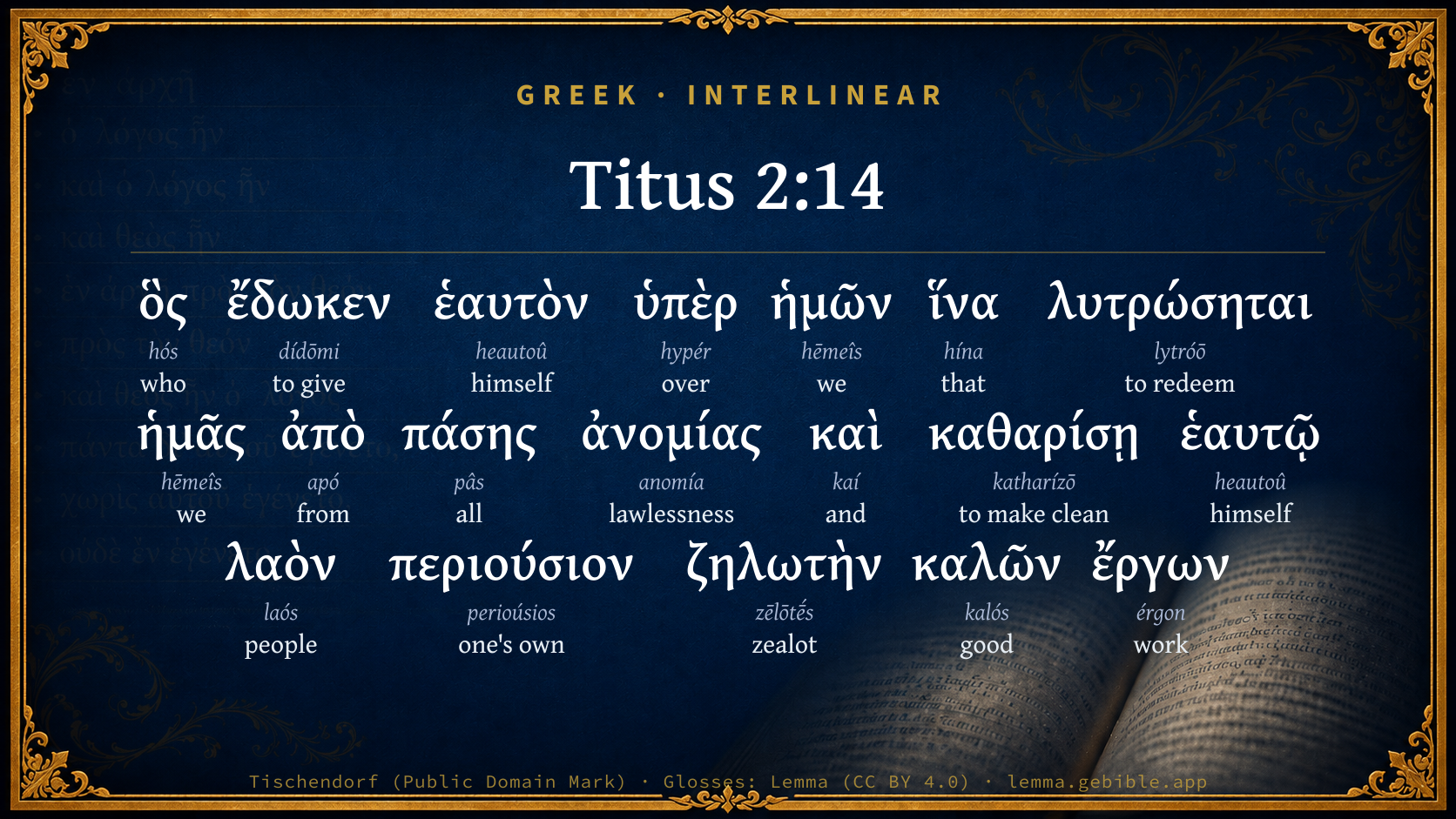
who gave himself for us, that he might redeem us from all iniquity, and purify for himself a people for his own possession, zealous for good works.
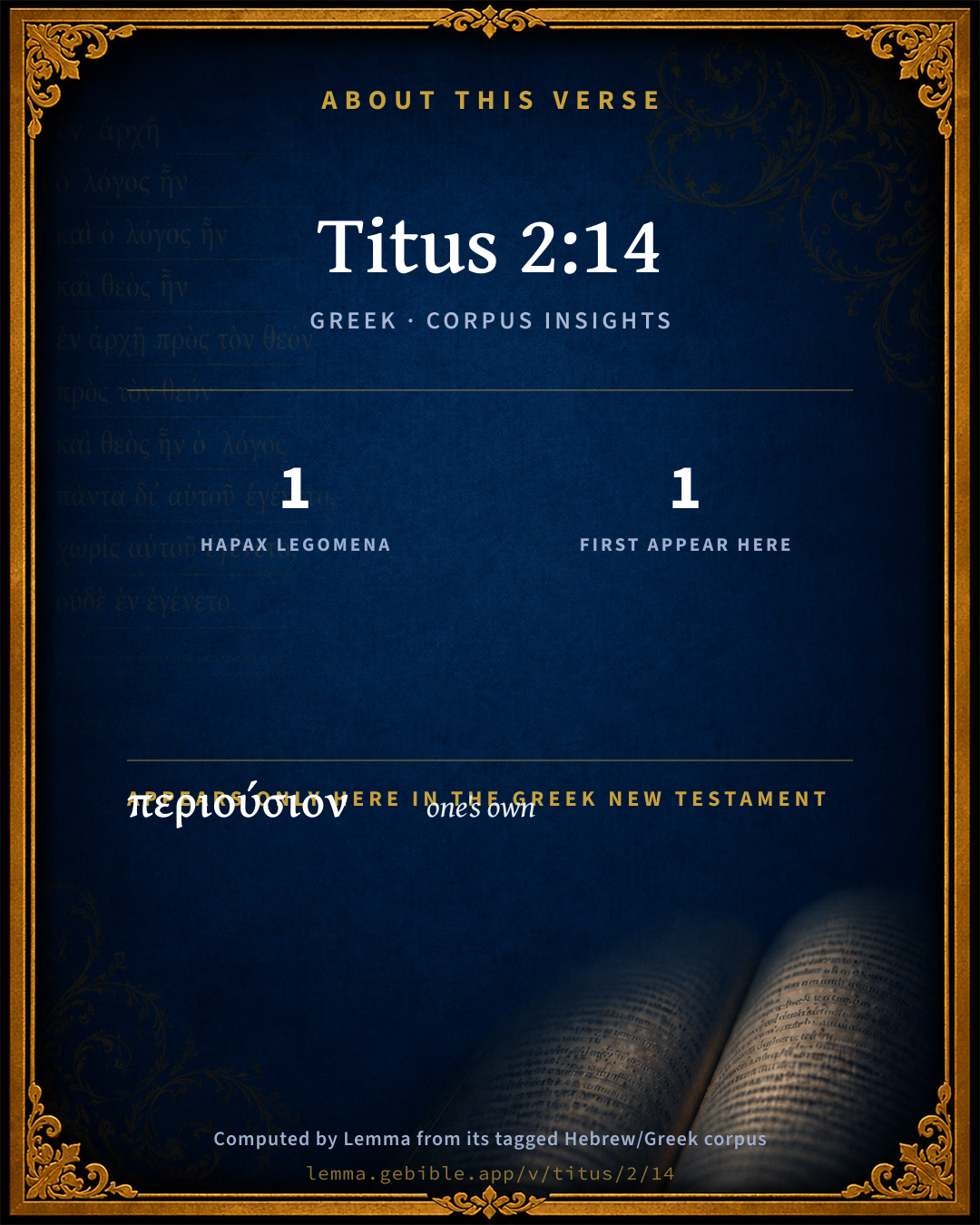
- 1 hapax legomenon — only here in the Greek New Testament
- 1 first appearance in the Greek New Testament
Download a study sheet
One document with this verse’s original text, its word-by-word gloss line, the meaning frame, cross-references with their text, attributed commentary, and full source and license credits — printable, and it pastes into notes with its structure intact.
This verse Autodidact and up
A passage Seminary Student
Up to 50 verses in one chapter. A passage sheet keeps up to 6 commentary sources and 12 cross-references per verse, in the order this page ranks them, and says so on the sheet whenever that leaves anything out. Ask for a single verse and you get the Autodidact verse sheet above.
Everything on this page stays free to read, with no account — the sheet is a download of what is already on screen, not access to it.
Compare translations 3
The same verse in 3 English versions, stacked beneath the original-language interlinear above. Click any original word for its lexicon entry.
Each is an independent rendering of the whole verse — the interlinear is not word-aligned to these translations.
Highlighted words mark where these versions differ — a whole-verse word diff, not a word-by-word alignment.
-
World English Bible Public Domain
who gave himself for us, that he might redeem us from all iniquity, and purify for himself a people for his own possession, zealous for good works.
-
King James Version Public Domain
Who gave himself for us, that he might redeem us from all iniquity, and purify unto himself a peculiar people, zealous of good works.
-
unfoldingWord Literal Text CC BY-SA 4.0
He gave himself for us in order to redeem us from all lawlessness and to purify for himself a chosen people, zealous for good works.
unfoldingWord Literal Text — © unfoldingWord, licensed CC BY-SA 4.0. Word-aligned USFM3 via Door43 (git.door43.org/unfoldingWord/en_ult).
Show all 19 translations
Every available English version of this verse, each an independent rendering of the whole verse.
-
World English Bible Public Domain
who gave himself for us, that he might redeem us from all iniquity, and purify for himself a people for his own possession, zealous for good works.
-
Berean Standard Bible Public Domain
He gave Himself for us to redeem us from all lawlessness and to purify for Himself a people for His own possession, zealous for good deeds.
-
Majority Standard Bible Public Domain
He gave Himself for us to redeem us from all lawlessness and to purify for Himself a people for His own possession, zealous for good deeds.
-
King James Version Public Domain
Who gave himself for us, that he might redeem us from all iniquity, and purify unto himself a peculiar people, zealous of good works.
-
American Standard Version (1901) Public Domain
who gave himself for us, that he might redeem us from all iniquity, and purify unto himself a people for his own possession, zealous of good works.
-
Revised Version (1885) Public Domain
who gave himself for us, that he might redeem us from all iniquity, and purify unto himself a people for his own possession, zealous of good works.
-
Geneva Bible (1599) Public Domain
Who gaue him selfe for vs, that hee might redeeme vs from all iniquitie, and purge vs to bee a peculiar people vnto himselfe, zealous of good woorkes.
-
Douay-Rheims (1899) Public Domain
Who gave himself for us, that he might redeem us from all iniquity, and might cleanse to himself a people acceptable, a pursuer of good works.
-
Young's Literal Translation Public Domain
who did give himself for us, that he might ransom us from all lawlessness, and might purify to himself a peculiar people, zealous of good works;
-
Literal Standard Version CC BY-SA 4.0
who gave Himself for us, that He might ransom us from all lawlessness, and might purify to Himself a special people, zealous of good works.
-
Unlocked Literal Bible CC BY-SA 4.0
Jesus gave himself for us in order to redeem us from all lawlessness and to make pure, for himself, a special people who are eager to do good works.
-
unfoldingWord Literal Text CC BY-SA 4.0
He gave himself for us in order to redeem us from all lawlessness and to purify for himself a chosen people, zealous for good works.
-
Darby Bible Public Domain
who gave himself for us, that he might redeem us from all lawlessness, and purify to himself a peculiar people, zealous for good works.
-
World Messianic Bible Public Domain
who gave himself for us, that he might redeem us from all iniquity and purify for himself a people for his own possession, zealous for good works.
-
Webster's Bible Public Domain
Who gave himself for us, that he might redeem us from all iniquity, and purify to himself a peculiar people, zealous of good works.
-
Free Bible Version CC BY-SA 4.0
He gave himself for us, so that he could set us free from all our wickedness, and to make us clean for him—a people who belong to him, keen to do good.
-
Bible in Basic English Public Domain
Who gave himself for us, so that he might make us free from all wrongdoing, and make for himself a people clean in heart and on fire with good works.
-
Text-Critical English NT CC BY 4.0
He gave himself for us to redeem us from all lawlessness and to purify for himself a people for his own possession, zealous for good works.
-
Tyndale New Testament (1534) Public Domain
which gave him silfe for vs to redeme vs from all vnrightewesnes and to pourge vs a peculiar people vnto him silfe fervently geven vnto good workes.
Literal Standard Version (2020), Covenant Press — licensed CC BY-SA 4.0. Text via the HelloAO Bible API (eBible.org). Unlocked Literal Bible (unfoldingWord) — licensed CC BY-SA 4.0. Text via the HelloAO Bible API (eBible.org). unfoldingWord Literal Text — © unfoldingWord, licensed CC BY-SA 4.0. Word-aligned USFM3 via Door43 (git.door43.org/unfoldingWord/en_ult). Free Bible Version, Dr. Jonathan Gallagher — licensed CC BY-SA 4.0. Text via the HelloAO Bible API (eBible.org).
Word by word
More ways to search: Search by grammar → Find every occurrence → Compare this word →
Practice this passage: Drill this verse → Learn its vocabulary →
- Appears 1× in the Greek New Testament
- First appears here
- Part of Speech
- Adjective
- Case
- Accusative
- Number
- Singular
- Gender
- Masculine
Full Thayer's Definition
- ὃς hós G3739 “who” Relative pronoun, Nominative, Singular, Masculine
- ἔδωκεν dídōmi G1325 “to give” Verb, Aorist, Active, Indicative, 3rd person, Singular
- ἑαυτὸν heautoû G1438 “himself” Reflexive pronoun, 3rd person, Accusative, Singular, Masculine
- ὑπὲρ hypér G5228 “over” Preposition
- ἡμῶν hēmeîs G2249 “we” Personal pronoun, 1st person, Genitive, Plural
- ἵνα hína G2443 “that” Conjunction
- λυτρώσηται lytróō G3084 “to redeem” Verb, Aorist, Middle, Subjunctive, 3rd person, Singular
- ἡμᾶς hēmeîs G2249 “we” Personal pronoun, 1st person, Accusative, Plural
- ἀπὸ apó G575 “from” Preposition
- πάσης pâs G3956 “all” Adjective, Genitive, Singular, Feminine
- ἀνομίας anomía G458 “lawlessness” Noun, Genitive, Singular, Feminine
- καὶ kaí G2532 “and” Conjunction
- καθαρίσῃ katharízō G2511 “to make clean” Verb, Aorist, Active, Subjunctive, 3rd person, Singular
- ἑαυτῷ heautoû G1438 “himself” Reflexive pronoun, 3rd person, Dative, Singular, Masculine
- λαὸν laós G2992 “people” Noun, Accusative, Singular, Masculine
- περιούσιον perioúsios G4041 “one's own” Adjective, Accusative, Singular, Masculine
- ζηλωτὴν zēlōtḗs G2207 “zealot” Noun, Accusative, Singular, Masculine
- καλῶν kalós G2570 “good” Adjective, Genitive, Plural, Neuter
- ἔργων érgon G2041 “work” Noun, Genitive, Plural, Neuter
About this verse
These counts appear in no published source. They are computed here, from the morphology-tagged text and Lemma’s own curated glosses. What Lemma adds →
- 19
- words
- 17
- distinct lemmas
- Pauline Epistles
- section
Notable vocabulary
1 hapax legomenon — a word that appears only here in the entire Greek New Testament:
- περιούσιον one's own G4041
First appearance in Scripture
This word makes its first canonical appearance in the Greek New Testament here:
- περιούσιον one's own G4041
Shared distinctive vocabulary
λυτρώσηται to redeem G3084 occurs in 3 verses of the Greek New Testament. Also found in:
Cross-references
46Topical passages linked to Titus 2:14 in the Treasury of Scripture Knowledge — connected by theme and wording, ordered by reader-vote popularity; previews shown in the World English Bible.
- Hebrews 9:14 how much more will the blood of Christ, who through the eternal Spirit offered himself without blemish to God, cleanse your conscience from dead works to serve the living God?
- Ephesians 2:10 For we are his workmanship, created in Christ Jesus for good works, which God prepared before that we would walk in them.
- 1 Peter 2:9 But you are a chosen race, a royal priesthood, a holy nation, a people for God's own possession, that you may show forth the excellencies of him who called you out of darkness into his marvelous light:
- 1 Peter 1:18 knowing that you were redeemed, not with corruptible things, with silver or gold, from the useless way of life handed down from your fathers,
- Titus 3:8 This saying is faithful, and concerning these things I desire that you affirm confidently, so that those who have believed God may be careful to maintain good works. These things are good and profitable to men;
- Revelation 5:9 They sang a new song, saying, "You are worthy to take the book, And to open its seals: For you were killed, And bought us for God with your blood, Out of every tribe, language, people, and nation,
- Galatians 3:13 Christ redeemed us from the curse of the law, having become a curse for us. For it is written, "Cursed is everyone who hangs on a tree,"
- Ezekiel 36:25 I will sprinkle clean water on you, and you shall be clean: from all your filthiness, and from all your idols, will I cleanse you.
- Galatians 2:20 I have been crucified with Christ, and it is no longer I that live, but Christ living in me. That life which I now live in the flesh, I live by faith in the Son of God, who loved me, and gave himself up for me.
- 1 Peter 1:22 Seeing you have purified your souls in your obedience to the truth through the Spirit in sincere brotherly affection, love one another from the heart fervently:
- Acts 9:36 Now there was at Joppa a certain disciple named Tabitha, which when translated, means Dorcas. This woman was full of good works and acts of mercy which she did.
- Matthew 20:28 even as the Son of Man came not to be served, but to serve, and to give his life as a ransom for many."
- 1 Peter 3:18 Because Christ also suffered for sins once, the righteous for the unrighteous, that he might bring you to God; being put to death in the flesh, but made alive in the spirit;
- Revelation 1:5 and from Jesus Christ, the faithful witness, the firstborn of the dead, and the ruler of the kings of the earth. To him who loves us, and washed us from our sins by his blood;
- Exodus 19:5–6 Now therefore, if you will indeed obey my voice, and keep my covenant, then you shall be my own possession from among all peoples; for all the earth is mine;
- 1 John 3:2 Beloved, now we are children of God, and it is not yet revealed what we will be. But we know that, when he is revealed, we will be like him; for we will see him just as he is.
- Deuteronomy 14:2 For you are a holy people to Yahweh your God, and Yahweh has chosen you to be a people for his own possession, above all peoples who are on the face of the earth.
- Deuteronomy 26:18 and Yahweh has declared you this day to be a people for his own possession, as he has promised you, and that you should keep all his commandments;
- Psalms 130:8 He will redeem Israel from all their sins.
- Ephesians 5:23–27 For the husband is the head of the wife, and Christ also is the head of the assembly, being himself the savior of the body.
- 1 Peter 2:12 having good behavior among the nations, so in that which they speak against you as evil-doers, they may by your good works, which they see, glorify God in the day of visitation.
- Deuteronomy 7:6 For you are a holy people to Yahweh your God: Yahweh your God has chosen you to be a people for his own possession, above all peoples who are on the face of the earth.
- Romans 14:7–8 For none of us lives to himself, and none dies to himself.
- Galatians 1:4 who gave himself for our sins, that he might deliver us out of this present evil age, according to the will of our God and Father--
- Exodus 15:16 Terror and dread falls on them. By the greatness of your arm they are as still as a stone; Until your people pass over, Yahweh, Until the people pass over who you have purchased.
- John 10:15 even as the Father knows me, and I know the Father. I lay down my life for the sheep.
- 2 Corinthians 5:14–15 For the love of Christ constrains us; because we judge thus, that one died for all, therefore all died.
- Genesis 48:16 the angel who has redeemed me from all evil, bless the lads, and let my name be named on them, and the name of my fathers Abraham and Isaac. Let them grow into a multitude in the midst of the earth."
- Psalms 135:4 For Yah has chosen Jacob for himself; Israel for his own possession.
- Ezekiel 37:23 neither shall they defile themselves any more with their idols, nor with their detestable things, nor with any of their transgressions; but I will save them out of all their dwelling-places, in which they have sinned, and will cleanse them: so shall they be my people, and I will be their God.
- Romans 11:26–27 and so all Israel will be saved. Even as it is written, "There will come out of Zion the Deliverer, And he will turn away ungodliness from Jacob.
- Ephesians 5:2 Walk in love, even as Christ also loved you, and gave himself up for us, an offering and a sacrifice to God for a sweet-smelling fragrance.
- 1 Timothy 6:18 that they do good, that they be rich in good works, that they be ready to distribute, willing to communicate;
- Titus 2:7 in all things showing yourself an example of good works; in your teaching showing integrity, seriousness, incorruptibility,
- Hebrews 10:24 Let us consider how to provoke one another to love and good works,
- James 4:8 Draw near to God, and he will draw near to you. Cleanse your hands, you sinners; and purify your hearts, you double-minded.
- Malachi 3:3 and he will sit as a refiner and purifier of silver, and he will purify the sons of Levi, and refine them as gold and silver; and they shall offer to Yahweh offerings in righteousness.
- Matthew 1:21 She shall bring forth a son. You shall call his name Jesus, for it is he who shall save his people from their sins."
- Matthew 3:12 His winnowing fork is in his hand, and he will thoroughly cleanse his threshing floor. He will gather his wheat into the barn, but the chaff he will burn up with unquenchable fire."
- John 6:51 I am the living bread which came down out of heaven. If anyone eats of this bread, he will live forever. Yes, the bread which I will give for the life of the world is my flesh."
- Acts 15:9 He made no distinction between us and them, cleansing their hearts by faith.
- Acts 15:14 Simeon has reported how God first visited the Gentiles, to take out of them a people for his name.
- 1 Timothy 1:15 The saying is faithful and worthy of all acceptance, that Christ Jesus came into the world to save sinners; of whom I am chief.
- 1 Timothy 2:6 who gave himself as a ransom for all; the testimony in its own times;
- 1 Timothy 2:10 but (which becomes women professing godliness) with good works.
- Numbers 25:13 and it shall be to him, and to his seed after him, the covenant of an everlasting priesthood; because he was jealous for his God, and made atonement for the children of Israel.
Cross-references courtesy of OpenBible.info (CC BY 4.0).
Lesson kit
Teaching starters — assembled from the data on this page, not authored interpretation. Every prompt links to the verse data it draws on. Edit before teaching.
Titus, in the Pauline Epistles, opens this verse with 19 words (17 distinct Greek lemmas). Its most distinctive word is perioúsios (“one's own”). A historical commentator’s framing appears above. Read the whole chapter for the surrounding context.
Discussion questions
- What does “one's own” (perioúsios) contribute to the verse as a whole?
- This verse holds 1 word here found nowhere else in the Greek New Testament. What might the rare word draw attention to?
- The word “one's own” first appears here in Scripture. What is being introduced at this debut?
- Luke 24:21 shares the word «to redeem» with this verse. How do the two illuminate each other?
- “himself” occurs 2× in this one verse. What is the effect of the repetition?
- The translations on this page render this verse differently — a whole-verse word diff, not a word-by-word alignment. What might account for the different wordings?
- Reading how The Cambridge Bible for Schools and Colleges and MacLaren's Expositions of Holy Scripture read this verse, where do the two commentators agree and where do they part?
Things to notice
- 1 word in this verse appears nowhere else in the Greek New Testament.
- 1 word makes its first canonical appearance in Scripture here.
- These translations choose different wording for 9 words in this verse.
- “himself” occurs 2× in this single verse.
- 17 distinct Greek lemmas span 19 words in this verse.
Commentary
Notes on Titus 2:14 from classic Christian and Jewish commentators (each source and its license shown beneath its notes). The classic Christian expositions comment on the surrounding passage and are grouped to its opening verse, so a note may address several verses; the Jewish commentaries on the Tanakh (Rashi and others) are per-verse, so they appear only where the commentator wrote on this verse.
Lemma curates 59 commentaries, every one of them public domain or Creative Commons licensed, each selected and text-cleaned for this edition rather than reprinted as found. About our sources →
The Cambridge Bible for Schools and Colleges
gen. ed. J. J. S. Perowne
The Cambridge Bible for Schools and Colleges (gen. ed. J. J. S. Perowne; Cambridge University Press, 1878–1918) — public domain. Text from a community e-Sword module.
MacLaren's Expositions of Holy Scripture
Alexander MacLaren
Alexander MacLaren, Expositions of Holy Scripture (1904–1910) — public domain. Text from a community e-Sword module.
Tyndale Open Study Notes
Tyndale Open Resources
Tyndale Open Study Notes — © Tyndale Open Resources, licensed CC BY-SA 4.0. Text via the HelloAO Bible API.
Bengel's Gnomon
Johann Albrecht Bengel
Bengel's Gnomon of the New Testament — English translation (T&T Clark, Edinburgh, 1860) — public domain. Text from a community e-Sword module.
Meyer's Critical & Exegetical Commentary
Heinrich August Wilhelm Meyer
Meyer — Critical and Exegetical Commentary on the New Testament — English translation by Peter Christie, edited by Frederick Crombie (T&T Clark, 1880) — public domain. Text from a community e-Sword module.
Expositor's Greek Testament
ed. W. Robertson Nicoll
The Expositor's Greek Testament, edited by W. Robertson Nicoll (1897–1910) — public domain. Text from a community e-Sword module.
Cambridge Greek Testament for Schools and Colleges
Cambridge Greek Testament for Schools and Colleges (Cambridge University Press, 1896; 21 vols, various authors incl. Carr, Maclear, Plummer, Farrar, Lumby, Moule, M. R. James, Simcox) — public domain. Text from a community e-Sword module.
Vincent's Word Studies in the New Testament
Marvin R. Vincent
Marvin R. Vincent, Word Studies in the New Testament (1887–1900) — public domain. Text from a community e-Sword/MySword module.
Geneva Bible (1599)
Geneva Bible translators
Geneva Bible (1599) marginal notes — public domain. Text via Bolls.life.
Jamieson, Fausset & Brown
Robert Jamieson, A. R. Fausset & David Brown
Jamieson, Fausset & Brown — Commentary Critical and Explanatory on the Whole Bible (1871) — public domain (CC PDM 1.0). Text via the HelloAO Bible API.
Adam Clarke's Commentary
Adam Clarke's Commentary on the Bible (1810–1826) — public domain. Text from a community e-Sword/MySword module.
John Calvin's Commentaries
John Calvin's Commentaries (1540-1563) — public domain. Text from the Calvin Translation Society English edition (1840s-50s) via the Christian Classics Ethereal Library (ccel.org). Calvin's coverage is partial (roughly two-thirds of the Bible); uncommented books and verses are honest gaps, never fabricated. The 19th-century editor's footnotes and remarks are omitted so the notes are faithfully Calvin's own voice.
Ellicott's Commentary for English Readers
A Bible Commentary for English Readers, edited by Charles John Ellicott (1878–1897) — public domain. Text from a community e-Sword module.
Trapp's Complete Commentary
John Trapp
John Trapp, A Commentary or Exposition upon All the Books of the Old and New Testament (1647–1656) — public domain. Text from a community e-Sword module.
Albert Barnes' Notes on the Bible
Albert Barnes' Notes on the Bible (1834–1885) — public domain. Text from a community e-Sword/MySword module.
Haydock's Catholic Bible Commentary
George Leo Haydock (1774–1849), Haydock's Catholic Family Bible and Commentary, 1859 edition — public domain. Excludes Psalms (Douay-Rheims chapter numbering differs from Protestant) and Deuterocanonical books (Catholic canon only).
Matthew Poole's English Annotations
Matthew Poole's English Annotations on the Holy Bible (1683–1685) — public domain. Text from a community e-Sword/MySword module.
Whedon's Commentary on the Bible
Daniel D. Whedon
Daniel D. Whedon (gen. ed.), Commentary on the Old and New Testaments (1874–1909) — public domain. Text from a community e-Sword module.
The Pulpit Commentary
The Pulpit Commentary (1880–1919), ed. H.D.M. Spence-Jones & Joseph S. Exell — public domain. Text from a community e-Sword module.
John Wesley's Explanatory Notes
John Wesley, Explanatory Notes Upon the Whole Bible (1754–1765) — public domain. Text via the GEBible commentary corpus.
Fairbairn on Ezekiel, Jonah & the Pastoral Epistles
Patrick Fairbairn
Patrick Fairbairn — An Exposition of Ezekiel (1851), Jonah (1849), and The Pastoral Epistles (1874) — public domain. Text from a community e-Sword module.
Scofield Reference Notes
C. I. Scofield
The Scofield Reference Bible (1917 edition), notes by C. I. Scofield — public domain. Text from a community e-Sword module.
Burkitt's Expository Notes on the New Testament
William Burkitt
William Burkitt's Expository Notes on the New Testament (1700–1703) — public domain. Text from a community e-Sword module.
The People's New Testament
B. W. Johnson
B. W. Johnson's The People's New Testament with Notes (1889–1891) — public domain. Electronic text from the Christian Classics Ethereal Library (CCEL) ThML edition.
unfoldingWord translationNotes
Door43 World Missions Community
unfoldingWord translationNotes — © Distant Shores Media and the Door43 World Missions Community, licensed CC BY-SA 4.0. Source: git.door43.org/Door43/en_tn.
International Critical Commentary
International Critical Commentary — older volumes (1896–1929), various authors — public domain. Text from a community e-Sword module.