Luke 24:19

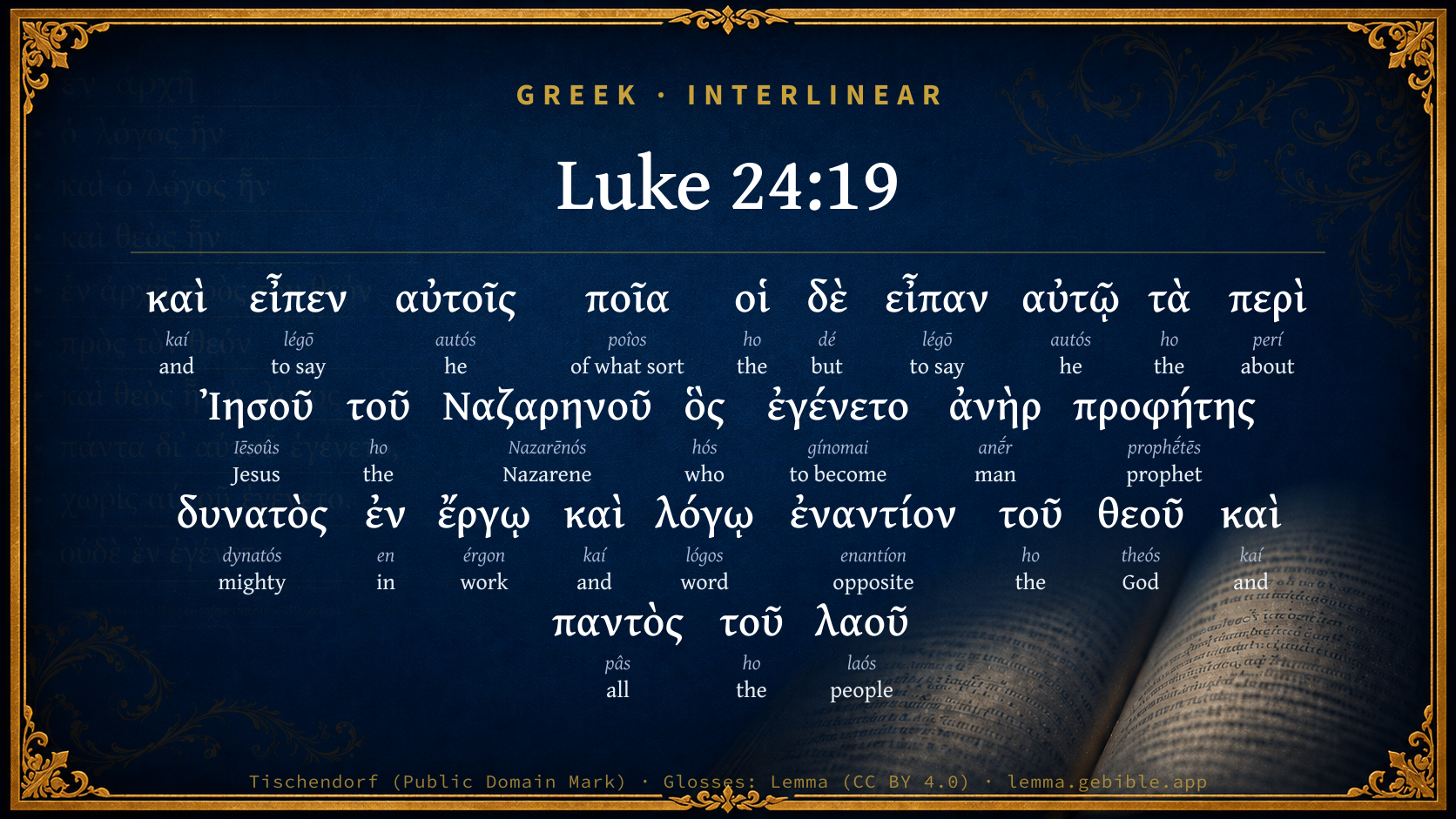
Greek (Tischendorf 8th ed.) Luke 24:19 appears in the Greek New Testament. The text above is from the Tischendorf 8th edition. Each word links to its Strong’s number and a concise gloss. Click any word for its full Thayer’s Greek Lexicon entry.
Download image
Cite this verse

Luke 24:19 (World English Bible). Public Domain. Lemma interlinear Bible study tool, https://lemma.gebible.app/v/luke/24/19.

Show BibTeX & RIS
BibTeX
RIS
English Translation
He said to them, "What things?" They said to him, "The things concerning Jesus, the Nazarene, who was a prophet mighty in deed and word before God and all the people;
World English Bible · Public Domain
Download a study sheet

One document with this verse’s original text, its word-by-word gloss line, the meaning frame, cross-references with their text, attributed commentary, and full source and license credits — printable, and it pastes into notes with its structure intact.

This verse Autodidact and up

Study sheet (.html) Plain text (.txt)

A passage Seminary Student

Up to 50 verses in one chapter. A passage sheet keeps up to 6 commentary sources and 12 cross-references per verse, in the order this page ranks them, and says so on the sheet whenever that leaves anything out. Ask for a single verse and you get the Autodidact verse sheet above.

Everything on this page stays free to read, with no account — the sheet is a download of what is already on screen, not access to it.

Want to remove ads? Support Godless Engineer
Compare translations 3

The same verse in 3 English versions, stacked beneath the original-language interlinear above. Click any original word for its lexicon entry.

Each is an independent rendering of the whole verse — the interlinear is not word-aligned to these translations.

Highlighted words mark where these versions differ — a whole-verse word diff, not a word-by-word alignment.

  • World English Bible Public Domain
    He said to them, "What things?" They said to him, "The things concerning Jesus, the Nazarene, who was a prophet mighty in deed and word before God and all the people;
  • King James Version Public Domain
    And he said unto them, What things? And they said unto him, Concerning Jesus of Nazareth, which was a prophet mighty in deed and word before God and all the people:
  • unfoldingWord Literal Text CC BY-SA 4.0
    And he said to them, “What kind?” And they said to him, “The things concerning Jesus the Nazarene, who was a man, a prophet powerful in work and word in front of God and all the people,

unfoldingWord Literal Text — © unfoldingWord, licensed CC BY-SA 4.0. Word-aligned USFM3 via Door43 (git.door43.org/unfoldingWord/en_ult).

Versions to compare (up to 4)

3 of 4 selected

Show all 19 translations

Every available English version of this verse, each an independent rendering of the whole verse.

  • World English Bible Public Domain
    He said to them, "What things?" They said to him, "The things concerning Jesus, the Nazarene, who was a prophet mighty in deed and word before God and all the people;
  • Berean Standard Bible Public Domain
    “What things?” He asked. “The events involving Jesus of Nazareth,” they answered. “This man was a prophet, powerful in speech and action before God and all the people.
  • Majority Standard Bible Public Domain
    “What things?” He asked. “The events involving Jesus of Nazareth,” they answered. “This man was a prophet, powerful in speech and action before God and all the people.
  • King James Version Public Domain
    And he said unto them, What things? And they said unto him, Concerning Jesus of Nazareth, which was a prophet mighty in deed and word before God and all the people:
  • American Standard Version (1901) Public Domain
    And he said unto them, What things? And they said unto him, The things concerning Jesus the Nazarene, who was a prophet mighty in deed and word before God and all the people:
  • Revised Version (1885) Public Domain
    And he said unto them, What things? And they said unto him, The things concerning Jesus of Nazareth, which was a prophet mighty in deed and word before God and all the people:
  • Geneva Bible (1599) Public Domain
    And he said vnto them, What things? And they sayd vnto him, Of Iesus of Nazareth, which was a Prophet, mightie in deede and in word before God, and all people,
  • Douay-Rheims (1899) Public Domain
    To whom he said: What things And they said: Concerning Jesus of Nazareth, who was a prophet, mighty in work and word before God and all the people;
  • Young's Literal Translation Public Domain
    And he said to them, `What things?' And they said to him, `The things about Jesus of Nazareth, who became a man -- a prophet -- powerful in deed and word, before God and all the people,
  • Literal Standard Version CC BY-SA 4.0
    And He said to them, “What things?” And they said to Him, “The things about Jesus of Nazareth, who became a man—a prophet—powerful in deed and word, before God and all the people,
  • Unlocked Literal Bible CC BY-SA 4.0
    Jesus said to them, “What things?” They answered him, “The things concerning Jesus the Nazarene, who was a prophet, mighty in deed and word before God and all the people,
  • unfoldingWord Literal Text CC BY-SA 4.0
    And he said to them, “What kind?” And they said to him, “The things concerning Jesus the Nazarene, who was a man, a prophet powerful in work and word in front of God and all the people,
  • Darby Bible Public Domain
    And he said to them, What things? And they said to him, The things concerning Jesus the Nazaraean, who was a prophet mighty in deed and word before God and all the people;
  • World Messianic Bible Public Domain
    He said to them, “What things?” They said to him, “The things concerning Yeshua the Nazarene, who was a prophet mighty in deed and word before God and all the people;
  • Webster's Bible Public Domain
    And he said to them, What things? And they said to him, Concerning Jesus of Nazareth, who was a prophet mighty in deed and word before God, and all the people:
  • Free Bible Version CC BY-SA 4.0
    “What things?” Jesus asked. “About Jesus of Nazareth,” they replied. “He was a prophet who spoke powerfully and performed great miracles before God and all the people.
  • Bible in Basic English Public Domain
    And he said to them, What things? And they said, The things to do with Jesus of Nazareth, who was a prophet, great in his acts and his words, before God and all the people:
  • Text-Critical English NT CC BY 4.0
    He said to them, “What things?” So they said to him, “The things concerning Jesus of Nazareth, who was a prophet mighty in deed and word before God and all the people,
  • Tyndale New Testament (1534) Public Domain
    To whom he sayd: what thinges? And they sayd vnto him: of Iesus of Nazareth which was a Prophet myghtie in dede and worde before god and all the people.

Literal Standard Version (2020), Covenant Press — licensed CC BY-SA 4.0. Text via the HelloAO Bible API (eBible.org). Unlocked Literal Bible (unfoldingWord) — licensed CC BY-SA 4.0. Text via the HelloAO Bible API (eBible.org). unfoldingWord Literal Text — © unfoldingWord, licensed CC BY-SA 4.0. Word-aligned USFM3 via Door43 (git.door43.org/unfoldingWord/en_ult). Free Bible Version, Dr. Jonathan Gallagher — licensed CC BY-SA 4.0. Text via the HelloAO Bible API (eBible.org).

Word by word

More ways to search: Search by grammar → Find every occurrence → Compare this word →

Practice this passage: Drill this verse → Learn its vocabulary →

ἐναντίον
enantíon
G1726
“opposite”
Adverb
Part of Speech
Adverb
Full Thayer's Definition

Origin: from G1727

TDNT: None

1. over against, opposite a. of place, opposite, contrary (of the wind) 2. metaph. a. opposed as an adversary, hostile, antagonistic in feeling or act b. an opponent
  1. καὶ kaí G2532 “and” Conjunction
  2. εἶπεν légō G3004 “to say” Verb, Aorist, Active, Indicative, 3rd person, Singular
  3. αὐτοῖς autós G846 “he” Personal pronoun, Dative, Plural, Masculine
  4. ποῖα poîos G4169 “of what sort” Interrogative pronoun, Nominative, Singular, Feminine
  5. οἱ ho G3588 “the” Article, Nominative, Plural, Masculine
  6. δὲ dé G1161 “but” Conjunction
  7. εἶπαν légō G3004 “to say” Verb, Aorist, Active, Indicative, 3rd person, Plural
  8. αὐτῷ autós G846 “he” Personal pronoun, Dative, Singular, Masculine
  9. τὰ ho G3588 “the” Article, Accusative, Plural, Neuter
  10. περὶ perí G4012 “about” Preposition
  11. Ἰησοῦ Iēsoûs G2424 “Jesus” Noun, Genitive, Singular, Masculine
  12. τοῦ ho G3588 “the” Article, Genitive, Singular, Masculine
  13. Ναζαρηνοῦ Nazarēnós G3479 “Nazarene” Noun, Genitive, Singular, Masculine
  14. ὃς hós G3739 “who” Relative pronoun, Nominative, Singular, Masculine
  15. ἐγένετο gínomai G1096 “to become” Verb, Aorist, Middle deponent, Indicative, 3rd person, Singular
  16. ἀνὴρ anḗr G435 “man” Noun, Nominative, Singular, Masculine
  17. προφήτης prophḗtēs G4396 “prophet” Noun, Nominative, Singular, Masculine
  18. δυνατὸς dynatós G1415 “mighty” Adjective, Nominative, Singular, Masculine
  19. ἐν en G1722 “in” Preposition
  20. ἔργῳ érgon G2041 “work” Noun, Dative, Singular, Neuter
  21. καὶ kaí G2532 “and” Conjunction
  22. λόγῳ lógos G3056 “word” Noun, Dative, Singular, Masculine
  23. τοῦ ho G3588 “the” Article, Genitive, Singular, Masculine
  24. θεοῦ theós G2316 “God” Noun, Genitive, Singular, Masculine
  25. καὶ kaí G2532 “and” Conjunction
  26. παντὸς pâs G3956 “all” Adjective, Genitive, Singular, Masculine
  27. τοῦ ho G3588 “the” Article, Genitive, Singular, Masculine
  28. λαοῦ laós G2992 “people” Noun, Genitive, Singular, Masculine

About this verse

These counts appear in no published source. They are computed here, from the morphology-tagged text and Lemma’s own curated glosses. What Lemma adds →

29
words
21
distinct lemmas
Gospels
section

Notable vocabulary

The rarest word here is ἐναντίον opposite G1726 — appearing just 4 times in the whole Greek New Testament.

Shared distinctive vocabulary

ἐναντίον opposite G1726 occurs in 4 verses of the Greek New Testament. Also found in:

Repetition

Words recur within this verse:

  • εἶπεν to say G3004 ×2
  • οἱ the G3588 ×5
  • καὶ and G2532 ×3
  • αὐτοῖς he G846 ×2

Cross-references

11

Topical passages linked to Luke 24:19 in the Treasury of Scripture Knowledge — connected by theme and wording, ordered by reader-vote popularity; previews shown in the World English Bible.

  • Matthew 21:11 The multitudes said, "This is the prophet, Jesus, from Nazareth of Galilee."
  • Luke 7:16 Fear took hold of all, and they glorified God, saying, "A great prophet has arisen among us!" and, "God has visited his people!"
  • John 3:2 The same came to him by night, and said to him, "Rabbi, we know that you are a teacher come from God, for no one can do these signs that you do, unless God is with him."
  • John 4:19 The woman said to him, "Sir, I perceive that you are a prophet.
  • John 6:14 When therefore the people saw the sign which Jesus did, they said, "This is truly the prophet who comes into the world."
  • Acts 2:22 "Men of Israel, hear these words! Jesus of Nazareth, a man approved by God to you by mighty works and wonders and signs which God did by him in the midst of you, even as you yourselves know,
  • Acts 7:22 Moses was instructed in all the wisdom of the Egyptians. He was mighty in his words and works.
  • John 7:40–42 Many of the multitude therefore, when they heard these words, said, "This is truly the prophet."
  • Acts 10:38 even Jesus of Nazareth, how God anointed him with the Holy Spirit and with power, who went about doing good and healing all who were oppressed by the devil, for God was with him.
  • Mark 1:24 saying, "Ha! What do we have to do with you, Jesus, you Nazarene? Have you come to destroy us? I know you who you are: the Holy One of God!"
  • John 7:52 They answered him, "Are you also from Galilee? Search, and see that no prophet has arisen out of Galilee."

Cross-references courtesy of OpenBible.info (CC BY 4.0).

Commentary

Notes on Luke 24:19 from classic Christian and Jewish commentators (each source and its license shown beneath its notes). The classic Christian expositions comment on the surrounding passage and are grouped to its opening verse, so a note may address several verses; the Jewish commentaries on the Tanakh (Rashi and others) are per-verse, so they appear only where the commentator wrote on this verse.

Lemma curates 59 commentaries, every one of them public domain or Creative Commons licensed, each selected and text-cleaned for this edition rather than reprinted as found. About our sources →

Tyndale Open Study Notes

Tyndale Open Resources

24:19 Jesus is often portrayed as a prophet in Luke’s Gospel (see 7:16; cp. the description of Moses in Acts 7:22).

Tyndale Open Study Notes — © Tyndale Open Resources, licensed CC BY-SA 4.0. Text via the HelloAO Bible API.

Bengel's Gnomon

Johann Albrecht Bengel

Luk 24:19. Τὰ περὶ) The things concerning Jesus. This clause, after the description of the Subject (Jesus) has been interposed, is explained in detail in Luk 24:20: with which comp. Luk 24:14; Luk 24:18 at the end.

Bengel's Gnomon of the New Testament — English translation (T&T Clark, Edinburgh, 1860) — public domain. Text from a community e-Sword module.

Meyer's Critical & Exegetical Commentary

Heinrich August Wilhelm Meyer

Luk_24:19-21. Ποῖα] scil. οὐκ ἔγνων γενόμενα κ.τ.λ. The qualitative word of interrogation presupposes things of a special kind which must have happened; προσποιεῖται ἄγνοιαν, Euthymius Zigabenus.

οἱ δὲ εἶπον] Probably here also Cleopas was the speaker, and the other added his own assent to what was said.

ὃς ἐγένετο] not: who was (thus usually), but: who became, whereby the idea se praestitit, se praebuit (see Kühner, ad Xen. Anab. i. 7. 4), is expressed.

ἀνὴρ προφ.] an honourable expression, Bernhardy, p. 48.

δυνατὸς ἐν ἔργῳ κ. λόγῳ] Comp. Thuc. i. 139. 4, where Pericles is called λέγειν τε καὶ πράσσειν δυνατώτατος. ἐν marks the sphere wherein, etc. Comp. Act_18:24; Act_7:22; Jdt_11:8; Sir_21:8. In the classical writers the mere dative of the instrument is the usual form. See Bornemann, Schol. p. 159. See examples of both arrangements: ἔργῳ κ. λ. and λόγῳ κ. ἔ., in Lobeck, Paralip. p. 64 f.; Bornemann, ad Xen. Mem. ii. 3. 6; Pflugk, ad Eur. Hec. 373. In this place ἔργῳ is put first as containing the first ground of acknowledgment of the Messianic dignity. Comp. Act_1:1; Joh_10:38; Act_10:38

ἐναντίον κ.τ.λ.] i.e. so that He represented Himself as such to God and the whole people.

Luk_24:20. ὅπως τε] et quomodo, still depending on the οὐκ ἔγνως of Luk_24:18, which is mentally supplied as governing τὰ περὶ Ἰησοῦ κ.τ.λ. On εἰς κρίμα θανάτου, to the condemnation of death, comp. Luk_23:24

καὶ ἐσταύρωσαν] for it was their work that He was crucified by the governor. Comp. Act_2:23

Luk_24:21. ἡμεῖς δὲ ἠλπίζομεν] but we, on our part, were entertaining the hope (observe the imperfect), etc. This hope, demolished by the crucifixion, how soon was it again inflamed! Act_1:6

αὐτός] He, and no other

λυτροῦσθαι] according to the politico-theocratic idea of the national Messiah. Comp. Act_1:6, and see Theophylact.

ἀλλά γε] but indeed, although we cherished this hope. See Hermann, ad Eur. Ion. 1345, Praef. p. xx.; Kühner, ad Xen. Mem. i. 2. 12. On the immediate juxtaposition of the two particles, a usage foreign to the older Greek writers, see Bornemann, Schol. p. 160; Klotz, ad Devar. pp. 15 f., 25; Stallbaum, ad Plat. Rep. I. p. 331 B.

καί] (see the critical remarks): besides.

σὺν πᾶσι τούτοις] σὺν denotes the accompanying circumstance: with all this, i.e. with the having undergone all this fate, namely, of being delivered up and crucified (Luk_24:20). Comp. Neh_5:18; 3Ma_1:22; and see, generally, Ellendt, Lex. Soph. II. p. 763.

τρίτην ταύτην ἡμέραν ἄγει σήμερον] The subject is Jesus, who immediately before was the subject emphatically made prominent. Comp. Beza, Kypke. ἄγειν, of time: to spend; as e.g. δέκατον ἔτος ἄγειν, to be in the tenth year, and the like, does not belong merely to the later Greek.[273] Compare the passages in Kypke. τρίτην ταύτην ἡμέραν is equivalent to ταύτην τρίτην οὖσαν ἡμέραν, or ταύτην, ἣ τρίτη ἐστὶν ἡμέρα. See Kühner, ad Xen. Anab. iv. 7. 5. Comp. iii. 5. 9. Hence: But indeed, besides all this, He passes this present day as the third since, etc. In this case, it is true, σήμερον is superfluous, but it corresponds to the painful excitement of the words. Comp. Mar_14:29. ἄγει has been ungrammatically taken as impersonal: agitur (Grotius, Bengel, Rosenmüller, Kuinoel, de Wette, Baumgarten-Crusius, Ewald, Buttmann, Bleek, and others); while others grasp at arbitrary modes of supplying the subject, as ὁ χρόνος (Camerarius), Θεός (Heinsius), ὁ ἥλιος (Er. Schmid, Heumann). Bornemann regards Ἰσραήλ as the subject: Is dies, quem Israel hodie celebrat, tertius est, ex quo, etc. But the context leads us neither to Israel nor to the mention of the celebration of the festival.

[273] Sophocles, El. 258, has: ἔπειτα ποίας ἡμέρας δοκεῖς μʼ ἄγειν: What kind of days thinkest thou I am spending?

Meyer — Critical and Exegetical Commentary on the New Testament — English translation by Peter Christie, edited by Frederick Crombie (T&T Clark, 1880) — public domain. Text from a community e-Sword module.

Expositor's Greek Testament

ed. W. Robertson Nicoll

Luk 24:19 . ποῖα , what sort of things? with an affected indifference, the feigning of love οἱ δὲ εἶπον : both speak now, distributing the story between them. ἀνὴρ προφήτης , a prophetic man, a high estimate, but not the highest. ἀνὴρ may be viewed as redundant “eleganter abundat,” Kypke.

The Expositor's Greek Testament, edited by W. Robertson Nicoll (1897–1910) — public domain. Text from a community e-Sword module.

Godet's Commentaries

Frédéric Louis Godet

Vers. 19b-24. Account of the Two Disciples.

Jesus has now brought them to the point where He wished, namely, to open up their heart to Him; σὺν πᾶσι τούτοις (Luk 24:21), in spite of the extraordinary qualities described Luk 24:19.— ῎Αγει may be taken impersonally, as in Latin, agit diem, for agitur dies. But it may also have Jesus for its subject, as in the phrase ἄγει δεκατὸν ἔτος, “he is in his tenth year.” But along with those causes of discouragement, there are also grounds of hope. This opposition is indicated by ἀλλὰ καί, “But indeed there are also...” (Luk 24:22).

Ver. 23. Λέγουσαι, οἱ λέγουσιν, hearsay of a hearsay. This form shows how little faith they put in all those reports (comp. Luk 24:11).

Ver. 24. Peter, then, was not the only one, as he seemed to be from Luk 24:12. Here is an example, among many others, of the traps which are unintentionally laid for criticism by the simple and artless style of our sacred historians. On each occasion they say simply what the context calls for, omitting everything which goes beyond, but sometimes, as here, adding it themselves later (Joh 3:22; comp. with Luk 4:2). The last words, Him they saw not, prove that the two disciples set out from Jerusalem between the return of the women and that of Peter and John, and even of Mary Magdalene.

Frédéric Louis Godet — Commentaries on Luke, John, Romans, and 1 Corinthians — English translation (T&T Clark, Edinburgh, 1870s–1890s) — public domain. Text from a community e-Sword module.

Jamieson, Fausset & Brown

Robert Jamieson, A. R. Fausset & David Brown

Concerning Jesus, &c.--As if feeling it a relief to have someone to unburden his thoughts and feelings to, this disciple goes over the main facts in his own desponding style, and this was just what our Lord wished.

Jamieson, Fausset & Brown — Commentary Critical and Explanatory on the Whole Bible (1871) — public domain (CC PDM 1.0). Text via the HelloAO Bible API.

Adam Clarke's Commentary

Verse 19. Which was a prophet] ανηρ προφητης, a man prophet, a genuine prophet; but this has been considered as a Hebraism: "for, in Ex 2:14, a man prince is simply a prince; and in 1Sa 31:3, men archers mean no more than archers." But my own opinion is, that this word is often used to deepen the signification, so in the above quotations: Who made thee a man prince (i.e. a mighty sovereign) and a judge over us! Ex 2:14. And, the battle went sore against Saul, and the men archers (i.e. the stout, or well aiming archers) hit him, 1Sa 31:3. So in PALAEPHATUS, de Incredib. c. 38. p. 47, quoted by Kypke, ην ανηρ βασιλευς μεγας, He was a great and eminent king. So ανηρ προφητης here signifies, he was a GENUINE prophet, nothing like those false ones by whom the people have been so often deceived; and he has proved the divinity of his mission by his heavenly teaching, and astonishing miracles.

Mighty in - word] Irresistibly eloquent. Powerful in deed, working incontrovertible miracles. See Kypke in loco.

Adam Clarke's Commentary on the Bible (1810–1826) — public domain. Text from a community e-Sword/MySword module.

Ellicott's Commentary for English Readers

(19) What things?—Literally, What kind of things?

Concerning Jesus of Nazareth, which was a prophet.—The words indicate the precise stage of faith which the two disciples had reached. They believed in Jesus as a prophet; they hoped that He would redeem Israel. They had not risen to the belief that He was the Christ, the Son of God. And now even that faith was tottering. The whole narrative suggests that our Lord was choosing this exceptional method of dealing with them as a step in the spiritual education which was to lead them on to the higher truth.

A Bible Commentary for English Readers, edited by Charles John Ellicott (1878–1897) — public domain. Text from a community e-Sword module.

The Cambridge Bible for Schools and Colleges

gen. ed. J. J. S. Perowne

19. a prophet, mighty in deed and word] See a remarkable parallel to this description in Act_2:22.

The Cambridge Bible for Schools and Colleges (gen. ed. J. J. S. Perowne; Cambridge University Press, 1878–1918) — public domain. Text from a community e-Sword module.

John Gill's Exposition

But we trusted,.... "In him", as the Ethiopic version adds:

that it had been he which should have redeemed Israel; they thought, hoped, and believed, that he was the Messiah, spoken of under the character of the Redeemer of Israel; and they had been in expectation of redemption by him, though only of a temporal kind, from the Roman yoke and bondage; but now they could not tell what to think of it, since he was dead; indeed they were not altogether without hope, since there was a report of his being raised from the dead; but what credit was to be given to that, they could not say: but certain it is, that he was the true Messiah, and promised Redeemer; and who was to redeem, and has redeemed the whole Israel of God; even all the elect of God, whether among Jews or Gentiles, from the servitude and damning power of sin, from the slavery of Satan, and the bondage of the law, and from every enemy; and that by his precious blood, his sufferings and death, the very things which were the occasion of these disciples' doubts about him, as the Redeemer: so the Jews say (u),

"that upon the death of the Messiah, the son of Joseph, all Israel shall flee to the deserts, and such as are of a doubtful heart shall turn to the nations of the world and say, "is this the redemption we have waited for", for the Messiah is slain?''

And besides all this, today is the third day, since these things were done; which is either mentioned, as an aggravation of the ignorance of the stranger, that these things should be done so lately, as within three days, and yet he should be ignorant of them, or not remember them, and need to be informed about them; or as a further reason of their doubting, that it was now the third day since the death of Jesus, and there was nothing certain of his resurrection, only the report of the women, which they could not depend upon; or else as a reason of their trusting, that he was the person that should redeem Israel; since this was the third day from his crucifixion; the day on which he said he should rise from the dead, and of which there was a report spread, not to be disproved, that he was that day actually risen: this day is greatly observed by the Jews (w): they take notice that the Scriptures speak of several remarkable third days; and besides Gen 22:4 is cited a passage which refers to the resurrection of Christ on the third day; and they speak

"of the third day of the tribes, Gen 42:18 of the third day of the spies, Jos 2:16 of the third day of the giving of the law, Exo 19:16 of the third day of Jonas, Jon 1:17 (which was a type of the resurrection of the Messiah, Mat 12:40) of the third day of those that came up out of the captivity, Ezr 8:15 of the third day of the resurrection of the dead, Hos 6:2 and of the third day of Esther, Est 5:1.''

(u) Abkath Rocel, l. 1. par. 1. sign. 7. p. 53. (w) Bereshit Rabba, sect. 56. fol. 49. 3.

John Gill's Exposition of the Whole Bible (1746–1763) — public domain (CC PDM 1.0). Text via the HelloAO Bible API.

Trapp's Complete Commentary

John Trapp

19 And he said unto them, What things? And they said unto him, Concerning Jesus of Nazareth, which was a prophet mighty in deed and word before God and all the people:

Ver. 19. Which was a prophet] Yea, and more than a prophet. But the disciples were wondrously ignorant, till the Spirit came down upon them, Act 2:1-4.

John Trapp, A Commentary or Exposition upon All the Books of the Old and New Testament (1647–1656) — public domain. Text from a community e-Sword module.

Albert Barnes' Notes on the Bible

A prophet - A teacher sent from God. They did not now call him the “Messiah,” for his “death” had led them to doubt that, but they had no doubt that he was a distinguished “prophet.” The evidence of that was so clear that they “could” not call it in question.

Mighty in deed - Powerful in working miracles, in raising the dead, healing the sick, etc.

In word - In teaching.

Before God and all the people - Manifestly; publicly. So that “God” owned him, and the people regarded him as a distinguished teacher.

Albert Barnes' Notes on the Bible (1834–1885) — public domain. Text from a community e-Sword/MySword module.

Whedon's Commentary on the Bible

Daniel D. Whedon

19. What things?—He who asks a question does not affirm that he does not know the answer. He may act as a teacher, a catechist, or an experimentist, to draw out and develop the mind of another. This last was our Lord’s design.

A prophet—He has not the faith to say the Messiah. The late events have dashed that hope, but he still dare style him what Moses was called, a prophet mighty in deed and word. Before God and all the people—A brief confession of unbroken faith in the genuine character of the Crucified One.

Daniel D. Whedon (gen. ed.), Commentary on the Old and New Testaments (1874–1909) — public domain. Text from a community e-Sword module.

The Pulpit Commentary

And they said unto him, Concerning Jesus of Nazareth, which was a Prophet mighty in deed and word before God and all the people. To the Stranger"s question, "What things have so lately excited Jerusalem?" they both probably burst out with "the Name," then doubtless on all lips in the holy city, "Jesus of Nazareth," the hated and adored Same. And then they went on with a farther explanation to One who seemed a stranger just arrived: they explained who this Jesus was supposed to have been. "He was a Prophet mighty in deed and word before God and all the people," which Lunge happily paraphrases "equally great in secret contemplative holiness and in public acts of beneficence." But then the "two" explained, This he was; for he is no more. Our chief priests and rulers have done him to death. They have crucified him."

The Pulpit Commentary (1880–1919), ed. H.D.M. Spence-Jones & Joseph S. Exell — public domain. Text from a community e-Sword module.

The People's New Testament

B. W. Johnson

19. What things? Christ asked this, only that they should declare what they believed, had hoped, and their disappointment.

B. W. Johnson's The People's New Testament with Notes (1889–1891) — public domain. Electronic text from the Christian Classics Ethereal Library (CCEL) ThML edition.

unfoldingWord translationNotes

Door43 World Missions Community

What things?

"What things have happened?" or "What things have taken place?"

a prophet, mighty in deed and word before God and all the people

This means that God caused Jesus to be mighty and that the people saw that he was mighty. AT: "a prophet to whom God gave power to do and teach great things that were amazing to all the people"

delivered him up

"gave him over"

to be condemned to death and crucified him

This can be stated in active form. AT: "in order for the governor to put Jesus to death by crucifying him" (See: Active or Passive)

translationWords

Jesus

Nazareth

prophet

works

God

chief priests

rule

condemn

die

crucify

unfoldingWord translationNotes — © Distant Shores Media and the Door43 World Missions Community, licensed CC BY-SA 4.0. Source: git.door43.org/Door43/en_tn.

Cambridge Greek Testament for Schools and Colleges

19. δς ἐγένετο. Not “which was,” A. V[417] but ‘who proved Himself.’

[417] A. V. Authorised Version.

δυνατὸς ἐν ἔργῳ καὶ λόγῳ. See Act 2:22.

Cambridge Greek Testament for Schools and Colleges (Cambridge University Press, 1896; 21 vols, various authors incl. Carr, Maclear, Plummer, Farrar, Lumby, Moule, M. R. James, Simcox) — public domain. Text from a community e-Sword module.

Alford’s Greek Testament

Henry Alford

19-24.] Stier well remarks, that the Lord here gives us an instructive example how far, in the wisdom of love, we may carry dissimulation, without speaking untruth. (See the citation from Jer. Taylor below, on ver. 29.) He does not assert, that he was one of the strangers at this feast at Jerusalem, nor does He deny that he knew what had been done there in those days, but He puts the question by, with What things?

οἱ δὲ εἶπ.] Either, one spoke and the other assented; or perhaps each spoke, sometimes one and sometimes the other;—only we must not break up these verses and allot an imagined portion to each. They contain the substance of what was said, as the reporter of the incident afterwards put it together.

ὃς ἐγ. ἀν. πρ. κ.τ.λ.] See a similar general description of Him to the Jewish people, Act 2:22. They had repeatedly acknowledged Him as a Prophet: see especially Mat 21:11, Mat 21:46. The phrase δυν. ἐν λόγοις κ. ἔργοις occurs of Moses, ref. Acts.

ἐγένετο, was, not became (or was becoming), as Meyer renders it. They speak of the whole life of Jesus as a thing past.

Henry Alford, The Greek Testament (1849–1861) — public domain. Text from a community e-Sword module.

International Critical Commentary

19. Ποῖα ; “What kind of things?” The question leads them on to open their hearts, and He is able to instruct them.

ὅς ἐγένετο ἀνὴρ προφήτης. “Who proved to be, showed Himself to be, a Prophet.” The ἀνήρ is perhaps a mark of respect, as in addresses (Act 1:16, Act 1:2:29, 37, Act 1:7:2, etc.); or mere amplification, προφήτης being a kind of adjective.

δυνατὸς ἐν ἔργῳ. Comp. Act 7:22, Act 7:18:24; Ecclus. 21:8; Judith 11:8. In class. Grk. without ἐν. In Ps. Sol. 17:38, 42 we have both constructions, but in a sense different from this, With the order comp. 2Th 2:17: usually λόγος καὶ ἔργον ἐναντίον. He proved Himself to be all this before God and man; but no more than this. In thinking Him to be more they had made a mistake.

International Critical Commentary — older volumes (1896–1929), various authors — public domain. Text from a community e-Sword module.

Lesson kit

Teaching starters — assembled from the data on this page, not authored interpretation. Every prompt links to the verse data it draws on. Edit before teaching.

Luke, in the Gospels, opens this verse with 29 words (21 distinct Greek lemmas). Its most distinctive word is enantíon (“opposite”). A historical commentator’s framing appears above. Read the whole chapter for the surrounding context.

Discussion questions

  1. How does “opposite” (enantíon) shape what this verse is saying?
  2. How does Luke 1:6, which shares the word «opposite», read alongside this verse?
  3. What does the repetition of “to say” (2× in this one verse) do in this verse?
  4. These translations render this verse differently. What is at stake in choosing one wording over another?
  5. Compare how Tyndale Open Study Notes and Bengel's Gnomon read this verse. Where do they agree or differ?

Things to notice

Reading settings

Reading text

Shown beneath each verse's original-language words.

Old Testament
Old Testament edition

Read the OT as the Masoretic Hebrew (MT) or the Greek Septuagint (LXX).

English shown for the Greek Septuagint (in the Hebrew ↔ Greek comparison).

Comparing translations? Open the Compare panel on any verse page to stack up to four side by side.