
Exodus 23:24

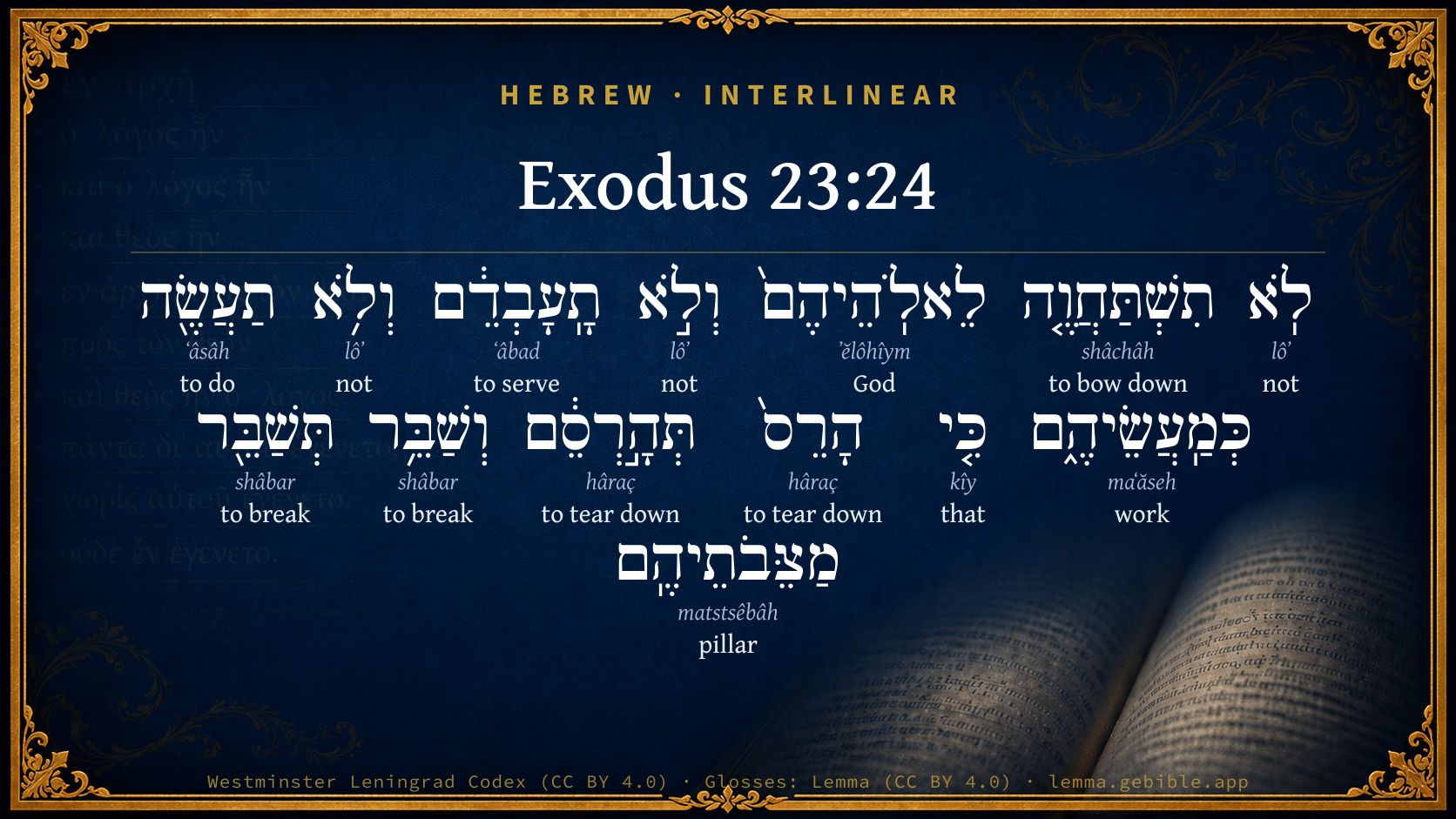
Hebrew (Westminster Leningrad Codex) Exodus 23:24 appears in the Hebrew Old Testament. The text above is from the Westminster Leningrad Codex. Each word links to its Strong’s number, a concise gloss, and parsing drawn from the Open Scriptures Hebrew Bible morphology. Click any word for its full Brown-Driver-Briggs (BDB) entry.
Download image
Cite this verse

Exodus 23:24 (World English Bible). Public Domain. Lemma interlinear Bible study tool, https://lemma.gebible.app/v/exodus/23/24.

Show BibTeX & RIS
BibTeX
RIS
English Translation
You shall not bow down to their gods, nor serve them, nor follow their practices, but you shall utterly overthrow them and demolish their pillars.
World English Bible · Public Domain
Download a study sheet

One document with this verse’s original text, its word-by-word gloss line, the meaning frame, cross-references with their text, attributed commentary, and full source and license credits — printable, and it pastes into notes with its structure intact.

This verse Autodidact and up

Study sheet (.html) Plain text (.txt)

A passage Seminary Student

Up to 50 verses in one chapter. A passage sheet keeps up to 6 commentary sources and 12 cross-references per verse, in the order this page ranks them, and says so on the sheet whenever that leaves anything out. Ask for a single verse and you get the Autodidact verse sheet above.

Everything on this page stays free to read, with no account — the sheet is a download of what is already on screen, not access to it.

Want to remove ads? Support Godless Engineer
Compare translations 3

The same verse in 3 English versions, stacked beneath the original-language interlinear above. Click any original word for its lexicon entry.

Each is an independent rendering of the whole verse — the interlinear is not word-aligned to these translations.

Highlighted words mark where these versions differ — a whole-verse word diff, not a word-by-word alignment.

  • World English Bible Public Domain
    You shall not bow down to their gods, nor serve them, nor follow their practices, but you shall utterly overthrow them and demolish their pillars.
  • King James Version Public Domain
    Thou shalt not bow down to their gods, nor serve them, nor do after their works: but thou shalt utterly overthrow them, and quite break down their images.
  • unfoldingWord Literal Text CC BY-SA 4.0
    You shall not bow down to their gods, and you shall not serve them, and you shall not do as they do. For you shall completely overthrow them and completely smash their stone pillars.

unfoldingWord Literal Text — © unfoldingWord, licensed CC BY-SA 4.0. Word-aligned USFM3 via Door43 (git.door43.org/unfoldingWord/en_ult).

Versions to compare (up to 4)

3 of 4 selected

Show all 18 translations

Every available English version of this verse, each an independent rendering of the whole verse.

  • World English Bible Public Domain
    You shall not bow down to their gods, nor serve them, nor follow their practices, but you shall utterly overthrow them and demolish their pillars.
  • Berean Standard Bible Public Domain
    You must not bow down to their gods or serve them or follow their practices. Instead, you are to demolish them and smash their sacred stones to pieces.
  • Majority Standard Bible Public Domain
    You must not bow down to their gods or serve them or follow their practices. Instead, you are to demolish them and smash their sacred stones to pieces.
  • King James Version Public Domain
    Thou shalt not bow down to their gods, nor serve them, nor do after their works: but thou shalt utterly overthrow them, and quite break down their images.
  • American Standard Version (1901) Public Domain
    Thou shalt not bow down to their gods, nor serve them, nor do after their works; but thou shalt utterly overthrow them, and break in pieces their pillars.
  • Revised Version (1885) Public Domain
    Thou shalt not bow down to their gods, nor serve them, nor do after their works: but thou shalt utterly overthrow them, and break in pieces their pillars.
  • Geneva Bible (1599) Public Domain
    Thou shalt not bow downe to their gods, neither serue them, nor doe after the workes of them: but vtterly ouerthrowe them, and breake in pieces their images.
  • Douay-Rheims (1899) Public Domain
    Thou shalt not adore their gods, nor serve them. Thou shalt not do their works, but shalt destroy them, and break their statues.
  • Young's Literal Translation Public Domain
    `Thou dost not bow thyself to their gods, nor serve them, nor do according to their doings, but dost utterly devote them, and thoroughly break their standing pillars.
  • Literal Standard Version CC BY-SA 4.0
    You do not bow yourself to their gods, nor serve them, nor do according to their doings, but utterly devote them, and thoroughly break their standing pillars.
  • Unlocked Literal Bible CC BY-SA 4.0
    You must not bow down to their gods, worship them, or do as they do. Instead, you must completely overthrow them and smash their stone pillars in pieces.
  • unfoldingWord Literal Text CC BY-SA 4.0
    You shall not bow down to their gods, and you shall not serve them, and you shall not do as they do. For you shall completely overthrow them and completely smash their stone pillars.
  • Darby Bible Public Domain
    Thou shalt not bow down to their gods, nor serve them, nor do after their deeds; but thou shalt utterly destroy them, and utterly shatter their statues.
  • World Messianic Bible Public Domain
    You shall not bow down to their gods, nor serve them, nor follow their practices, but you shall utterly overthrow them and demolish their pillars.
  • Webster's Bible Public Domain
    Thou shalt not bow down to their gods, nor serve them, nor do after their works: but thou shalt utterly overthrow them, and quite break down their images.
  • Free Bible Version CC BY-SA 4.0
    You must not bow down to their gods or worship them or follow their pagan practices. No, you must demolish their idols and smash their sacred pillars into pieces.
  • Bible in Basic English Public Domain
    Do not go down on your faces and give worship to their gods, or do as they do; but overcome them completely, and let their pillars be broken down.
  • JPS Tanakh (1917) Public Domain
    Thou shalt not bow down to their gods, nor serve them, nor do after their doings; but thou shalt utterly overthrow them, and break in pieces their pillars.

Literal Standard Version (2020), Covenant Press — licensed CC BY-SA 4.0. Text via the HelloAO Bible API (eBible.org). Unlocked Literal Bible (unfoldingWord) — licensed CC BY-SA 4.0. Text via the HelloAO Bible API (eBible.org). unfoldingWord Literal Text — © unfoldingWord, licensed CC BY-SA 4.0. Word-aligned USFM3 via Door43 (git.door43.org/unfoldingWord/en_ult). Free Bible Version, Dr. Jonathan Gallagher — licensed CC BY-SA 4.0. Text via the HelloAO Bible API (eBible.org).

Word by word

More ways to search: Search by grammar → Find every occurrence → Compare this word →

Practice this passage: Drill this verse → Learn its vocabulary →

מַצֵּבֹתֵיהֶֽם
matstsêbâh
H4676
“pillars · their”
Noun, Common, Feminine, Plural, Construct + Suffix, Personal, 3rd Person, Masculine, Plural
Part of Speech
Noun
Type
Common
Gender
Feminine
Number
Plural
State
Construct
Full BDB Definition

Origin: (causatively) participle of H5324

TWOT: 1398g

pillar, mastaba, stump - pillar - as monument, personal memorial - with an altar - (Hophal) stock, stump (of tree)
  1. לֹֽא lôʼ H3808 “not” Particle, Negative
  2. תִשְׁתַּחֲוֶ֤ה shâchâh H7812 “to bow down” Verb, Hishtaphel, Imperfect, 2nd Person, Masculine, Singular
  3. לֵאלֹֽהֵיהֶם֙ ʼĕlôhîym H430 “to/for · God(s) · their” Preposition + Noun, Common, Masculine, Plural, Construct + Suffix, Personal, 3rd Person, Masculine, Plural
  4. וְלֹ֣א lôʼ H3808 “and · not” Conjunction + Particle, Negative
  5. תָֽעָבְדֵ֔ם ʻâbad H5647 “to serve · them” Verb, Hophal, Imperfect, 2nd Person, Masculine, Singular + Suffix, Personal, 3rd Person, Masculine, Plural
  6. וְלֹ֥א lôʼ H3808 “and · not” Conjunction + Particle, Negative
  7. תַעֲשֶׂ֖ה ʻâsâh H6213 “to do” Verb, Qal, Imperfect, 2nd Person, Masculine, Singular
  8. כְּמַֽעֲשֵׂיהֶ֑ם maʻăseh H4639 “like/as · works · their” Preposition + Noun, Common, Masculine, Plural, Construct + Suffix, Personal, 3rd Person, Masculine, Plural
  9. כִּ֤י kîy H3588 “that” Conjunction
  10. הָרֵס֙ hâraç H2040 “to tear down” Verb, Piel, Infinitive Absolute
  11. תְּהָ֣רְסֵ֔ם hâraç H2040 “to tear down · them” Verb, Piel, Imperfect, 2nd Person, Masculine, Singular + Suffix, Personal, 3rd Person, Masculine, Plural
  12. וְשַׁבֵּ֥ר shâbar H7665 “and · to break” Conjunction + Verb, Piel, Infinitive Absolute
  13. תְּשַׁבֵּ֖ר shâbar H7665 “to break” Verb, Piel, Imperfect, 2nd Person, Masculine, Singular

About this verse

These counts appear in no published source. They are computed here, from the morphology-tagged text and Lemma’s own curated glosses. What Lemma adds →

14
words
10
distinct lemmas
Pentateuch
section

Shared distinctive vocabulary

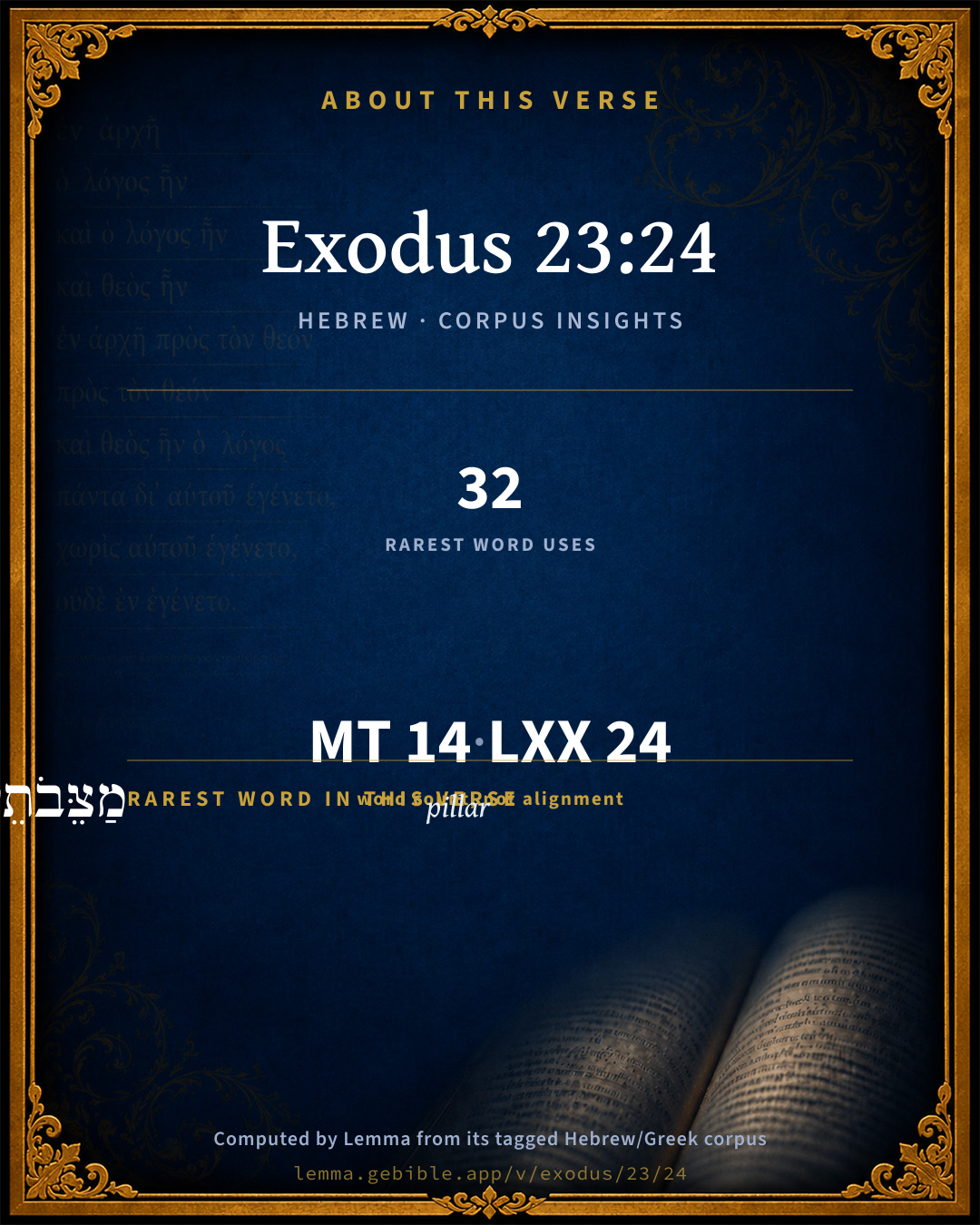
מַצֵּבֹתֵיהֶֽם pillar H4676 occurs in 31 verses of the Hebrew Bible. Also found in:

Grammatical profile

  • 7 verbs
  • 3 nouns
  • 1 conjunction
  • 3 particles

Verb forms

  • תִשְׁתַּחֲוֶ֤ה Hishtaphel · Imperfect
  • תָֽעָבְדֵ֔ם Hophal · Imperfect
  • תַעֲשֶׂ֖ה Qal · Imperfect
  • הָרֵס֙ Piel · Infinitive Absolute
  • תְּהָ֣רְסֵ֔ם Piel · Imperfect
  • וְשַׁבֵּ֥ר Piel · Infinitive Absolute
  • תְּשַׁבֵּ֖ר Piel · Imperfect

Repetition

Words recur within this verse — often emphatic in Hebrew:

  • הָרֵס֙ to tear down H2040 ×2
  • וְשַׁבֵּ֥ר to break H7665 ×2
  • לֹֽא not H3808 ×3

Hebrew & Septuagint length

In English translation the verse runs 25 words from the Hebrew and 28 from the Septuagint (LXX English) — closely comparable.

A rough comparison of the two English renderings, which tokenize alike — not a word-level alignment.

Word counts can differ between the Hebrew and the Greek without any difference in meaning — e.g. the Hebrew direct-object marker אֵת has no separate Greek word, and Greek often adds the article ὁ.

In the original languages it is 14 Hebrew tokens and 24 Greek tokens — but the two are counted differently (Hebrew bundles its prefixes and suffixes into one token; the Greek is in lemma form), so that isn’t a like-for-like length.

Cross-references

16

Topical passages linked to Exodus 23:24 in the Treasury of Scripture Knowledge — connected by theme and wording, ordered by reader-vote popularity; previews shown in the World English Bible.

  • Exodus 20:5 you shall not bow yourself down to them, nor serve them, for I, Yahweh your God, am a jealous God, visiting the iniquity of the fathers on the children, on the third and on the fourth generation of those who hate me,
  • Numbers 33:52 then you shall drive out all the inhabitants of the land from before you, and destroy all their figured [stones], and destroy all their molten images, and demolish all their high places:
  • Deuteronomy 12:30–31 take heed to yourself that you not be ensnared to follow them, after that they are destroyed from before you; and that you not inquire after their gods, saying, How do these nations serve their gods? even so will I do likewise.
  • Deuteronomy 7:5 But thus shall you deal with them: you shall break down their altars, and dash in pieces their pillars, and hew down their Asherim, and burn their engraved images with fire.
  • Deuteronomy 12:3 and you shall break down their altars, and dash in pieces their pillars, and burn their Asherim with fire; and you shall cut down the engraved images of their gods; and you shall destroy their name out of that place.
  • Exodus 32:20 He took the calf which they had made, and burnt it with fire, ground it to powder, and scattered it on the water, and made the children of Israel drink of it.
  • Leviticus 18:3 You shall not do as they do in the land of Egypt, where you lived: and you shall not do as they do in the land of Canaan, where I am bringing you; neither shall you walk in their statutes.
  • 2 Chronicles 33:9 Manasseh seduced Judah and the inhabitants of Jerusalem, so that they did evil more than did the nations whom Yahweh destroyed before the children of Israel.
  • Exodus 34:13–14 but you shall break down their altars, and dash in pieces their pillars, and you shall cut down their Asherim;
  • Leviticus 18:26–30 You therefore shall keep my statutes and my ordinances, and shall not do any of these abominations; neither the native-born, nor the stranger who lives as a foreigner among you;
  • Deuteronomy 7:25–26 The engraved images of their gods shall you burn with fire: you shall not covet the silver or the gold that is on them, nor take it to you, lest you be snared therein; for it is an abomination to Yahweh your God.
  • 2 Chronicles 33:2 He did that which was evil in the sight of Yahweh, after the abominations of the nations whom Yahweh cast out before the children of Israel.
  • 2 Chronicles 34:3–7 For in the eighth year of his reign, while he was yet young, he began to seek after the God of David his father; and in the twelfth year he began to purge Judah and Jerusalem from the high places, and the Asherim, and the engraved images, and the molten images.
  • Psalms 101:3 I will set no vile thing before my eyes. I hate the deeds of faithless men. They will not cling to me.
  • Psalms 106:35–38 But mixed themselves with the nations, And learned their works.
  • Ezekiel 16:47 Yet have you not walked in their ways, nor done after their abominations; but, as [if that were] a very little [thing], you were more corrupt than they in all your ways.

Cross-references courtesy of OpenBible.info (CC BY 4.0).

Hebrew and Greek witnesses Masoretic Hebrew ↔ Greek Septuagint

The same verse in the two great witnesses to the Old Testament, shown verse-for-verse.

These are two independent witnesses, not word-aligned to each other, and the Septuagint is shown in lemma (dictionary) form.

Hebrew Exodus 23:24 Masoretic · Westminster Leningrad Codex

לֹֽא תִשְׁתַּחֲוֶ֤ה לֵאלֹֽהֵיהֶם֙ וְלֹ֣א תָֽעָבְדֵ֔ם וְלֹ֥א תַעֲשֶׂ֖ה כְּמַֽעֲשֵׂיהֶ֑ם כִּ֤י הָרֵס֙ תְּהָ֣רְסֵ֔ם וְשַׁבֵּ֥ר תְּשַׁבֵּ֖ר מַצֵּבֹתֵיהֶֽם

You shall not bow down to their gods, nor serve them, nor follow their practices, but you shall utterly overthrow them and demolish their pillars.

World English Bible · Public Domain

Greek LXX Exodus 23:24 Septuagint · lemma form

οὐ προςκυνέω ὁ θεός αὐτός οὐδέ μή λατρεύω αὐτός οὐ ποιέω κατά ὁ ἔργον αὐτός ἀλλά καθαίρεσις κατααἱρέω καί συντρίβω συντρίβω ὁ στήλη αὐτός

You shall not worship their gods, nor serve them: you shall not do according to their works, but shall utterly destroy them, and break to pieces their pillars.

LXX2012 (modern English Septuagint) · Public Domain

Hebrew: Westminster Leningrad Codex (CC BY 4.0). Greek: Septuagint (public domain); English from LXX2012 (modern English Septuagint) (Public Domain). How the Septuagint differs from the Hebrew →

Targum (Aramaic paraphrase)

2

The Targum is the ancient Jewish Aramaic paraphrase of the Hebrew Scriptures — an interpretive translation, not the Hebrew text itself. Onkelos (literal) and Pseudo-Jonathan (expansive) render the Torah, and Jonathan the Prophets. Coverage is partial: where no permissively-licensed English translation exists for a verse, only the Aramaic is shown. This is verse-level text, not a word-by-word alignment to the Hebrew.

  1. Targum Onkelos Torah (Genesis–Deuteronomy)
    לָא תִסְגוּד לְטַעֲוָתְהוֹן וְלָא תִפְלְחִנוּן וְלָא תַעְבֵּד כְּעוֹבָדֵיהוֹן אֲרֵי פַגָרָא תְּפַגְרִנוּן וְתַבָּרָא תְתַבַּר קָמָתְהוֹן:

    (no public-domain English translation for this verse)

    Targum Onkelos — Aramaic: “Onkelos Genesis” (public domain); “Onkelos Exodus” (public domain); “Onkelos Leviticus” (public domain); “Onkelos Numbers” (public domain); “Onkelos Deuteronomy” (public domain). English: “Sefaria Community Translation” (CC0 1.0 (public-domain dedication)); “J.W. Etheridge. The Targums of Onkelos and Jonathan Ben Uzziel on the Pentateuch. London: Longmans, Green, 1862” (public domain). Text via Sefaria.

  2. Targum Pseudo-Jonathan Torah (Genesis–Deuteronomy)
    לָא תִסְגְּדוּן לְטַעֲוַותְהוֹן וְלָא תִפְלְחִינוּן וְלָא תַעַבְדוּן כְּעוֹבְדֵיהוֹן בִּישַׁיָּיא אֲרוּם מְפַכְרָא תִּפְכַר בֵּית סְגוּדְהוֹן וְתִבְרָא תְּתַבֵּר קָמְתֵי צִילְמֵיהוֹן

    Thou shalt not worship their idols, nor serve them, nor do after their evil works; but thou shalt utterly demolish the house of their worship, and break the statues of their images.

    Targum Pseudo-Jonathan — Aramaic: “Targum Jonathan on Genesis” (public domain); “Targum Jonathan on Exodus” (public domain); “Targum Jonathan on Leviticus” (public domain); “Targum Jonathan on Numbers” (public domain); “Targum Jonathan on Deuteronomy” (public domain). English: “The Targum of Jonathan ben Uzziel, trans. J. W. Etheridge, London, 1862” (public domain). Text via Sefaria.

Commentary

Notes on Exodus 23:24 from classic Christian and Jewish commentators (each source and its license shown beneath its notes). The classic Christian expositions comment on the surrounding passage and are grouped to its opening verse, so a note may address several verses; the Jewish commentaries on the Tanakh (Rashi and others) are per-verse, so they appear only where the commentator wrote on this verse.

Lemma curates 59 commentaries, every one of them public domain or Creative Commons licensed, each selected and text-cleaned for this edition rather than reprinted as found. About our sources →

Trapp's Complete Commentary

John Trapp

Exo 23:24 Thou shalt not bow down to their gods, nor serve them, nor do after their works: but thou shalt utterly overthrow them, and quite break down their images.

Ver. 24. Thou shalt utterly overthrow them.] As Henry VIII began here to do in demolishing the monasteries, and saying, Corvorum nidos esse penitus disturbandos ne iterum ad habitandum convolent. This Saunders relates and discusses. {a}

{a} Schism. Angl., lib. i.

John Trapp, A Commentary or Exposition upon All the Books of the Old and New Testament (1647–1656) — public domain. Text from a community e-Sword module.

Tyndale Open Study Notes

Tyndale Open Resources

23:24 In Canaanite worship, sacred pillars were erected to represent the deities. Sometimes they would have a human likeness carved on them.

Tyndale Open Study Notes — © Tyndale Open Resources, licensed CC BY-SA 4.0. Text via the HelloAO Bible API.

Geneva Bible (1599)

Geneva Bible translators

God commandeth his not only not to worship idols, but to destroy them.

Geneva Bible (1599) marginal notes — public domain. Text via Bolls.life.

Adam Clarke's Commentary

Verse 24. Break down their images.] מצבתיהם matstsebotheyhem, from נצב natsab, to stand up; pillars, anointed stones, &c., such as the baitulia. See Clarke on Ge 28:18.

Adam Clarke's Commentary on the Bible (1810–1826) — public domain. Text from a community e-Sword/MySword module.

Ellicott's Commentary for English Readers

(24) Nor do after their works.—The Canaanitish nations were not merely idolaters, they were corrupt, profligate, and depraved. All the abominations mentioned in Lev_18:6-23 were practised widely among them before they were dispossessed of their territory (Lev_18:24-30). No doubt the idolatry and the profligacy were closely connected, as among idolatrous nations generally; but it was for their profligacy rather than their idolatry that they were driven out. Thus it was necessary to warn Israel against both.

Thou shalt . . . quite break down their images.—Conquerors generally preserved the idols of the conquered nations as trophies of victory; to do so was forbidden to the Israelites. Idolatry had such a powerful and subtle attraction for them, that there was danger of their being seduced into it unless the entire apparatus of the idol-worship were destroyed and made away with. Hence the present injunctions, and others similar to them. (Comp. Exo_34:13; Deu_7:5; &c.)

A Bible Commentary for English Readers, edited by Charles John Ellicott (1878–1897) — public domain. Text from a community e-Sword module.

The Cambridge Bible for Schools and Colleges

gen. ed. J. J. S. Perowne

24. Thou shalt not bow down to …, nor serve them] as Exo_20:5.

nor do after their works] Cf. Lev_18:3.

overthrow] properly, tear down (viz. their images).

pillars] so RV. always, AV. sometimes wrongly images; RVm. obelisks; best, perhaps, standing-stones: Heb. maẓẓçbôth. The maẓẓçbâh (lit. something set up) was a large oblong block of stone—originally, no doubt (cf. on Exo_20:24, and the writer’s note on Gen_28:18, p. 267), conceived as the abode of a numen or deity—set up in or near a temple or high place, or beside an altar. Several such maẓẓçbâhs, or ‘standing stones,’ have been excavated recently at Gezer, Taanach, and Megiddo: at Gezer, for instance, there is a striking row of ten, and at Taanach a double row, each consisting of five (see the writer’s Modern Research as illustrating the Bible, 1908, pp. 62–5, 84). maẓẓçbâhs were the regular accompaniment of a Canaanite temple or other sacred place (cf. 2Ki_10:26 f., in the temple of Baal in Samaria); and during the earlier period of Israel’s history they seem to have been used freely in the worship of Jehovah as well: Moses erects twelve (ch. Exo_24:4); Hos_3:4; Hos_10:1 f. alludes to them as religious symbols of which Israel will be deprived on account of its sins; in Isa_19:19 a maẓẓçbâh is a symbol of Egypt’s conversion to Jehovah. Later, however, they were proscribed on account of their heathen associations: Moses is represented as having commanded the demolition of the Canaanite ‘standing-stones’ (here, Exo_34:13, Deu_7:5; Deu_12:3 : cf. Mic_5:13); and their erection beside Jehovah’s altar is prohibited (Deu_16:22; Lev_26:1 H): the same view of them is also reflected in the notices by the Deuteronomic compiler in 1Ki_14:23, 2Ki_17:10. See further DB. iii. s.v. Pillar, and EB. iii. s.v. Massebah.

The Cambridge Bible for Schools and Colleges (gen. ed. J. J. S. Perowne; Cambridge University Press, 1878–1918) — public domain. Text from a community e-Sword module.

John Gill's Exposition

There shall nothing cast their young, nor be barren in the land,.... There shall be no abortions or miscarriages, nor sterility or barrenness, either among the Israelites, or their cattle of every kind, so that there should be a great increase, both of men and beasts:

the number of thy days I will fulfil; which was fixed for each of them, in his eternal purposes and decrees; or what, according to the temperament of their bodies and the course of nature, which, humanly speaking, it might be supposed they would arrive unto; or generally the common term of human life, which, in the days of Moses, was threescore years and ten, or fourscore, see Job 14:5, it may be considered whether any respect is had to the time of their continuance in the land of Canaan, the term of which was fixed in the divine mind, or the fulness of time in which the Messiah was to come.

John Gill's Exposition of the Whole Bible (1746–1763) — public domain (CC PDM 1.0). Text via the HelloAO Bible API.

Matthew Poole's English Annotations

Thou shalt not bow down nor serve them, i.e. give them neither outward worship with thy body, nor inward with thy mind, nor follow their example in the worship of idols. Them shalt overthrow them, i.e. the people, lest thou be insnared by their counsel or example, and quite break down their images, or statues, or pillars, or any thing else erected in honour to their false gods. See Gen 28:18; 35:20.

Matthew Poole's English Annotations on the Holy Bible (1683–1685) — public domain. Text from a community e-Sword/MySword module.

Whedon's Commentary on the Bible

Daniel D. Whedon

24. Utterly overthrow them — Not only are the first and second commandments of the decalogue here virtually repeated, but the further command is given to destroy idolatry by iconoclastic violence.

Daniel D. Whedon (gen. ed.), Commentary on the Old and New Testaments (1874–1909) — public domain. Text from a community e-Sword module.

The Pulpit Commentary

Thou shalt not bow down to their gods, nor serve them, nor do after their works. It is always to be borne in mind that with the idolatries of the heathen were connected "works of darkness," which it is shameful even to speak of. The rites of Baal and Ashtoreth, of Chemosh, Molech, Rimmon, and the other Canaanite and Syrian deities were at once defiled by the abomination of human sacrifices, and polluted with the still more debasing evil of religious impurity. "The sacrifice offered to Ashtoreth," says Dr. Dollinger, "consisted in the prostitution of women: the women submitted themselves to the visitors of the feast, in the temple of the goddess or the adjoining precinct. A legend told of Astarte (Ashtoreth) having prostituted herself in Tyre for ten years: and in many places matrons, as well as maidens, consecrated themselves for a length of time, or on the festivals of the goddess, with a view of propitiating her, or earning her favour as hieroduli of unchastity In this way they went so far at last as to contemplate the abominations of unnatural lust as a homage rendered to the deity, and to exalt it into a regular cultus. The worship of the goddess at Aphaca in Lebanon was specially notorious in this respect. The temple in a solitary situation was, as Eusebius tells us, a place of evildoing for such as chose to ruin their bodies in scandalous ways Criminal intercourse with women, impurity, shameful and degrading deeds, were practised in the temple, where there was no custom and no law, and no honourable or decent human being could be found." (Jew and Gentile, vol. 1. pp. 428, 429; Darnell"s translation.) Thou shalt utterly overthrow them. The heathen gods are identified with their images. These were to be torn from their bases, overthrown, and rolled in the dust for greater contempt and ignominy. They were then to be broken up and burnt, till the gold and the silver with which they were overlaid was calcined and could be stamped to powder. Nothing was to be spared that had been degraded by idolatry, either for its beauty or its elaborate workmanship, or its value. All was hateful to God, and was to be destroyed.

Vers. 24-33. The prospect in the promised land.

I THE TREATMENT OF ITS FORMER OCCUPANTS.

1. The avoidance of their idolatries. God cautions us against those dangers which we are most likely to overlook. When once the Israelites entered the promised land and were fairly settled there, they would show no lack of energy and discrimination in doing their best to guard their temporal possessions. But the most serious dangers are those against which walled cities and great armies are no defence. God could easily cut off the idolaters and put Israel in their place; but what about the idolatries? Whether these should also be expelled would depend upon the guard which God"s people kept over their own hearts. It is very noticeable that as God takes the thoughts of his people forward to their future habitation, he begins with a solemn caution against idolatry and closes with the same. There is thus a kind of correspondence with the order occupied in the Ten Commandments by those against polytheism and image-worship. It was not possible to make mention too often of the subtle perils which lay in the Canaanitish gods.

2. Jehovah"s complete defeat and expulsion of the former inhabitants. This is indicated in a variety of impressive ways. Only let his people be faithful to him, and Jehovah will go before them as a dread to all who come in contact with them. Evidently God would have his people understand that nothing was to be feared from the very greatest external resources available against them. Let enemies threaten and unite and seek allies far and wide. The greater their efforts, the more signal will be their defeat. We must ever believe that our true strength is in God. It was never intended that Israel should be looked on as a mighty military power. Rather it should be a cause of astonishment among the nations that it was able to stand against all the resources gathered against it. Whenever the Israelites began to trust in themselves and think they were able to awe their enemies, then they were lost. God only can terrify with the terror that lasts. We may confidently leave him to scatter confusion among those whom we, with all our demonstrations, are unable to impress.

3. The injunction to enter into no covenant with the former inhabitants. He who had been expelled by nothing less than an awful Divine force was not to be allowed to return under pretence of a peaceful submission. Peace, concord, mutual help we may say God would ever have these between man and man, nation and nation but at the same time we constantly get the warning against crying, peace! peace! when there is no peace. If a foreigner came forsaking his idolatries, there was an appointed way for him into Israel, and a welcome to be cordially given. But by no stretching of charity could it be made attainable for the idolater to settle down side by side with the worshipper and servant of Jehovah.

II THE LARGE POSITIVE BLESSINGS TO COME UPON ISRAEL. Tile expulsion and permanent exclusion of the former inhabitants, much as they are insisted on, were but the negative condition, the clearing of the ground, so as to bless Israel with something positive. Very fittingly does God blend together the mention of these positive blessings with cautions and warnings as to the treatment of the former occupants. As the blessings were considered, the wisdom of the cautions would appear; and as the cautions were considered, so earnest and express, the greatness of the blessings would appear. God presents himself here as one very solicitous to make the land not only a good land for his people, but one cherished so as to make the best of its advantages. For this purpose he begins with a kind of graduated expulsion of the former inhabitants. Instead of expelling them by a sudden overwhelming blow, he rather does it little by little. The enemies of Israel were not to be multiplied needlessly by exposing their land to wild beasts; and the human enemies, contrary to their own designs and desires, were to leave for Israel the fruit of their own industries. If the Israelites had been asked which would be better, to cast out their enemies at once or by a gradual process, they would probably have replied, "at once." God will ever adopt the right plan to secure the most of blessing for his people. Thus we may learn a lesson with regard to the expulsion of evil still. God is still driving out evil little by little, and in so doing he is building up good little by little. Thus the Israelites were to get a gradual and secure settlement in the land; and then that settlement was to prove eminently profitable. Four great elements of prosperity are mentioned.

1. The blessing of the bread and the water. All that was connected with the obtaining of food and drink would be under God"s watchful providence. What are the bread and the water unless he blesses them? God can turn the most fertile of lands into a very proverb of barrenness. Why, this very Canaan had been afflicted with famine. It was because for some reason the blessing of God had been withheld from the bread and the water that the fathers of Israel had found their way into Egypt.

2. The maintenance of health. This is put in the most expressive way by indicating it in the aspect of banished sickness. Disease is such a common sight to us, and presents itself in such varied forms, that in no way can God"s blessing of health be more emphatically revealed than by describing him as the one who healeth all our diseases. To a large extent this health was to be the consequence of blessing the bread and the water, giving by them, thus blessed, abundant and nutritious food.

3. The productiveness of animal life. In a perfectly obedient Israel there were to be no abortions, no barren wombs. It was just because there was disobedience in Israel that such cries as those of Hannah were heard. (1Sa_1:11) Evidently all this normal generative efficacy largely depended on the blessing of the bread and water and the blessing of health. That any animal whatever, either human, or lower than human, should cast its young or be barren, was in itself a sort of disease.

4. The fulfilling of the days. The hoary head, with its crown of glory is the appointed possession of God"s people. That so few obtained it only showed how much there was of imperfection in Israelite national life. These purposed blessings did not find their way into reality. The people were disobedient, unbelieving, self-regarding; and hence the seeds of blessing which assuredly God sowed among them either remained dead or struggled forth into a very imperfect life. Y.

The Pulpit Commentary (1880–1919), ed. H.D.M. Spence-Jones & Joseph S. Exell — public domain. Text from a community e-Sword module.

Rashi

Rabbi Shlomo Yitzchaki (Rashi)

הרס תהרסם [BUT] THOU SHALT UTTERLY OVERTHROW THEM — those gods.

מצבתיהם THEIR MONUMENTS — stones which they set up (root נצב) before which to prostrate themselves.

Rashi on the Tanakh — English translations: “The Judaica Press complete Tanach with Rashi, translated by A. J. Rosenberg” (CC BY 4.0); “Pentateuch with Rashi's commentary by M. Rosenbaum and A.M. Silbermann, 1929-1934” (public domain); “The Metsudah Tanach series, Lakewood, N.J” (CC BY 4.0); and “The Book of Joshua, Metsudah Publications, 1997” (CC BY 4.0). Text via Sefaria.

Ramban (Nachmanides)

Rabbi Moshe ben Nachman (Ramban / Nachmanides)

THOU SHALT NOT BOW DOWN TO THEIR GODS, NOR SERVE THEM. The Torah has warned against idolatry in many places, and even though there are excessive verses on this subject, the redundancy is not a matter to be concerned about, for because the matter is so stringent — since he who acknowledges the divine nature of the idols, thereby denies the whole Torah, 54. — therefore the Torah warns against it again and again, like one who says to his servant: “remember continually and do not forget the great principle which I have commanded you, since everything depends on it.” It is possible that in the Ten Commandments He warned against making an idol and worshipping it, and now He warned that if they find a ready-made idol which is worshipped by the nations in the land, that they should not worship it at all, but they should uproot it from the land.

NOR DO AFTER THEIR DEEDS. This may possibly be an admonition against adopting the “ways of the Amorites” [i.e., superstitious practices] which the Sages have enumerated, just as He warned against them in another place, saying, Neither shall ye walk in their statutes, on which the Rabbis commented:. “These statutes refer to the ‘ways of the Amorites’ which the Sages have enumerated.” A more all acceptable interpretation is that He is warning here against worshipping an idol in the particular manner in which it is ordinarily worshipped, even if it is a disgraceful act [such as excreting to Baal Peor], just as the Rabbis have interpreted the verse, Take heed… that thou enquire not after their gods, saying: ‘How used these nations to serve their gods? Even so will I do likewise.’ Thus the meaning of the verse here is as follows: He said, [in the Ten Commandments 20:5], Thou shalt not bow down to their gods, nor serve them, “serving” usually being an act of honor that a servant does to his master, and then He said, additionally that even if that act is not one of honor but is disgusting, such as in connection with Baal Peor which one worships by excreting before it, or throwing a stone at Merkulis, nonetheless if that is the customary manner of worshipping them, you may not do such acts at all. Similarly the Rabbis have said: “Even if he intends to worship Peor in this ignominious way, and even if he intends to throw a stone to Merkulis in a contemptible manner [he is still liable].”

Ramban (Nachmanides) on the Tanakh — English translation: “Commentary on the Torah by Ramban (Nachmanides). Translated and annotated by Charles B. Chavel. New York, Shilo Pub. House, 1971-1976” (CC BY 4.0). Text via Sefaria.

Lesson kit

Teaching starters — assembled from the data on this page, not authored interpretation. Every prompt links to the verse data it draws on. Edit before teaching.

Exodus, in the Pentateuch, opens this verse with 14 words (10 distinct Hebrew lemmas). Its most distinctive word is matstsêbâh (“pillar”). A historical commentator’s framing appears above. Read the whole chapter for the surrounding context.

Discussion questions

  1. What does “pillar” (matstsêbâh) contribute to the verse as a whole?
  2. How does Genesis 28:18, which shares the word «pillar», read alongside this verse?
  3. What does the repetition of “to tear down” (2× in this one verse) do in this verse?
  4. These translations render this verse differently; the difference is in the English rendering, not the original. What questions does that raise?
  5. «תִשְׁתַּחֲוֶ֤ה» is a Hishtaphel Imperfect verb. How does that grammatical form shape the action described?
  6. Compare how Trapp's Complete Commentary and Tyndale Open Study Notes read this verse. Where do they agree or differ?

Things to notice

Reading settings

Reading text

Shown beneath each verse's original-language words.

Old Testament
Old Testament edition

Read the OT as the Masoretic Hebrew (MT) or the Greek Septuagint (LXX).

English shown for the Greek Septuagint (in the Hebrew ↔ Greek comparison).

Comparing translations? Open the Compare panel on any verse page to stack up to four side by side.