

Hebrews 6:1
Greek (Tischendorf 8th ed.) Hebrews 6:1 appears in the Greek New Testament. The text above is from the Tischendorf 8th edition. Each word links to its Strong’s number and a concise gloss. Click any word for its full Thayer’s Greek Lexicon entry.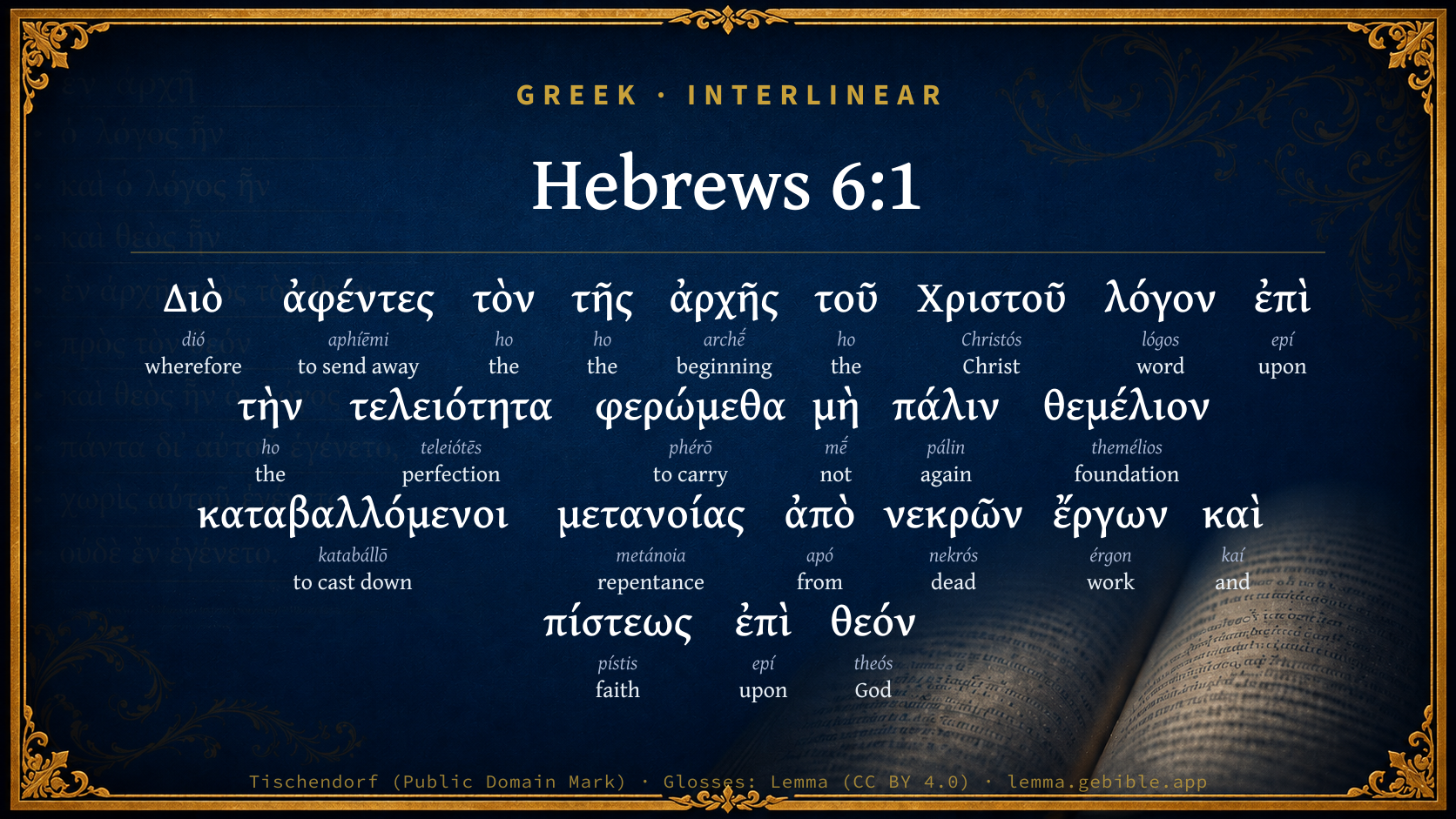
Therefore leaving the doctrine of the first principles of Christ, let us press on to perfection--not laying again a foundation of repentance from dead works, of faith toward God,
Download a study sheet
One document with this verse’s original text, its word-by-word gloss line, the meaning frame, cross-references with their text, attributed commentary, and full source and license credits — printable, and it pastes into notes with its structure intact.
This verse Autodidact and up
A passage Seminary Student
Up to 50 verses in one chapter. A passage sheet keeps up to 6 commentary sources and 12 cross-references per verse, in the order this page ranks them, and says so on the sheet whenever that leaves anything out. Ask for a single verse and you get the Autodidact verse sheet above.
Everything on this page stays free to read, with no account — the sheet is a download of what is already on screen, not access to it.
Compare translations 3
The same verse in 3 English versions, stacked beneath the original-language interlinear above. Click any original word for its lexicon entry.
Each is an independent rendering of the whole verse — the interlinear is not word-aligned to these translations.
Highlighted words mark where these versions differ — a whole-verse word diff, not a word-by-word alignment.
-
World English Bible Public Domain
Therefore leaving the doctrine of the first principles of Christ, let us press on to perfection--not laying again a foundation of repentance from dead works, of faith toward God,
-
King James Version Public Domain
Therefore leaving the principles of the doctrine of Christ, let us go on unto perfection; not laying again the foundation of repentance from dead works, and of faith toward God,
-
unfoldingWord Literal Text CC BY-SA 4.0
So then, having left the message of the beginning of Christ, let us go forward to maturity, not laying again a foundation of repentance from dead works and of faith in God,
unfoldingWord Literal Text — © unfoldingWord, licensed CC BY-SA 4.0. Word-aligned USFM3 via Door43 (git.door43.org/unfoldingWord/en_ult).
Show all 19 translations
Every available English version of this verse, each an independent rendering of the whole verse.
-
World English Bible Public Domain
Therefore leaving the doctrine of the first principles of Christ, let us press on to perfection--not laying again a foundation of repentance from dead works, of faith toward God,
-
Berean Standard Bible Public Domain
Therefore let us leave the elementary teachings about Christ and go on to maturity, not laying again the foundation of repentance from dead works, and of faith in God,
-
Majority Standard Bible Public Domain
Therefore let us leave the elementary teachings about Christ and go on to maturity, not laying again the foundation of repentance from dead works, and of faith in God,
-
King James Version Public Domain
Therefore leaving the principles of the doctrine of Christ, let us go on unto perfection; not laying again the foundation of repentance from dead works, and of faith toward God,
-
American Standard Version (1901) Public Domain
Wherefore leaving the doctrine of the first principles of Christ, let us press on unto perfection; not laying again a foundation of repentance from dead works, and of faith toward God,
-
Revised Version (1885) Public Domain
Wherefore let us cease to speak of the first principles of Christ, and press on unto perfection; not laying again a foundation of repentance from dead works, and of faith toward God,
-
Geneva Bible (1599) Public Domain
Therefore, leauing the doctrine of the beginning of Christ, let vs be led forward vnto perfection, not laying againe ye foundation of repetance from dead workes, and of faith toward God,
-
Douay-Rheims (1899) Public Domain
Wherefore leaving the word of the beginning of Christ, let us go on to things more perfect, not laying again the foundation of penance from dead works, and of faith towards God,
-
Young's Literal Translation Public Domain
Wherefore, having left the word of the beginning of the Christ, unto the perfection we may advance, not again a foundation laying of reformation from dead works, and of faith on God,
-
Literal Standard Version CC BY-SA 4.0
For this reason, having left the word of the beginning of the Christ, we may advance to perfection, not laying again a foundation of conversion from dead works, and of faith on God,
-
Unlocked Literal Bible CC BY-SA 4.0
So then, let us leave the beginning of the message of Christ and move forward to maturity. Let us not lay again the foundation of repentance from dead works and of faith in God,
-
unfoldingWord Literal Text CC BY-SA 4.0
So then, having left the message of the beginning of Christ, let us go forward to maturity, not laying again a foundation of repentance from dead works and of faith in God,
-
Darby Bible Public Domain
Wherefore, leaving the word of the beginning of the Christ, let us go on [to what belongs] to full growth, not laying again a foundation of repentance from dead works and faith in God,
-
World Messianic Bible Public Domain
Therefore leaving the teaching of the first principles of Messiah, let’s press on to perfection—not laying again a foundation of repentance from dead works, of faith toward God,
-
Webster's Bible Public Domain
Therefore leaving the principles of the doctrine of Christ, let us go on to perfection; not laying again the foundation of repentance from dead works, and of faith towards God,
-
Free Bible Version CC BY-SA 4.0
So let's not get stuck on the basic teachings about Christ, but let's progress to a more mature understanding. We don't need to go over again the ideas of repenting from what we used to do, about trusting in God—
-
Bible in Basic English Public Domain
For this reason let us go on from the first things about Christ to full growth; not building again that on which it is based, that is, the turning of the heart from dead works, and faith in God,
-
Text-Critical English NT CC BY 4.0
Therefore, let us leave behind the elementary teaching about Christ and go on to maturity, not laying again a foundation of repentance from dead works and of faith in God,
-
Tyndale New Testament (1534) Public Domain
Wherfore let vs leave the doctryne pertayninge to the beginninge of a Christen man and let vs go vnto perfeccion and now no more laye the foundacion of repentaunce from deed workes and of fayth towarde God
Literal Standard Version (2020), Covenant Press — licensed CC BY-SA 4.0. Text via the HelloAO Bible API (eBible.org). Unlocked Literal Bible (unfoldingWord) — licensed CC BY-SA 4.0. Text via the HelloAO Bible API (eBible.org). unfoldingWord Literal Text — © unfoldingWord, licensed CC BY-SA 4.0. Word-aligned USFM3 via Door43 (git.door43.org/unfoldingWord/en_ult). Free Bible Version, Dr. Jonathan Gallagher — licensed CC BY-SA 4.0. Text via the HelloAO Bible API (eBible.org).
Word by word
More ways to search: Search by grammar → Find every occurrence → Compare this word →
Practice this passage: Drill this verse → Learn its vocabulary →
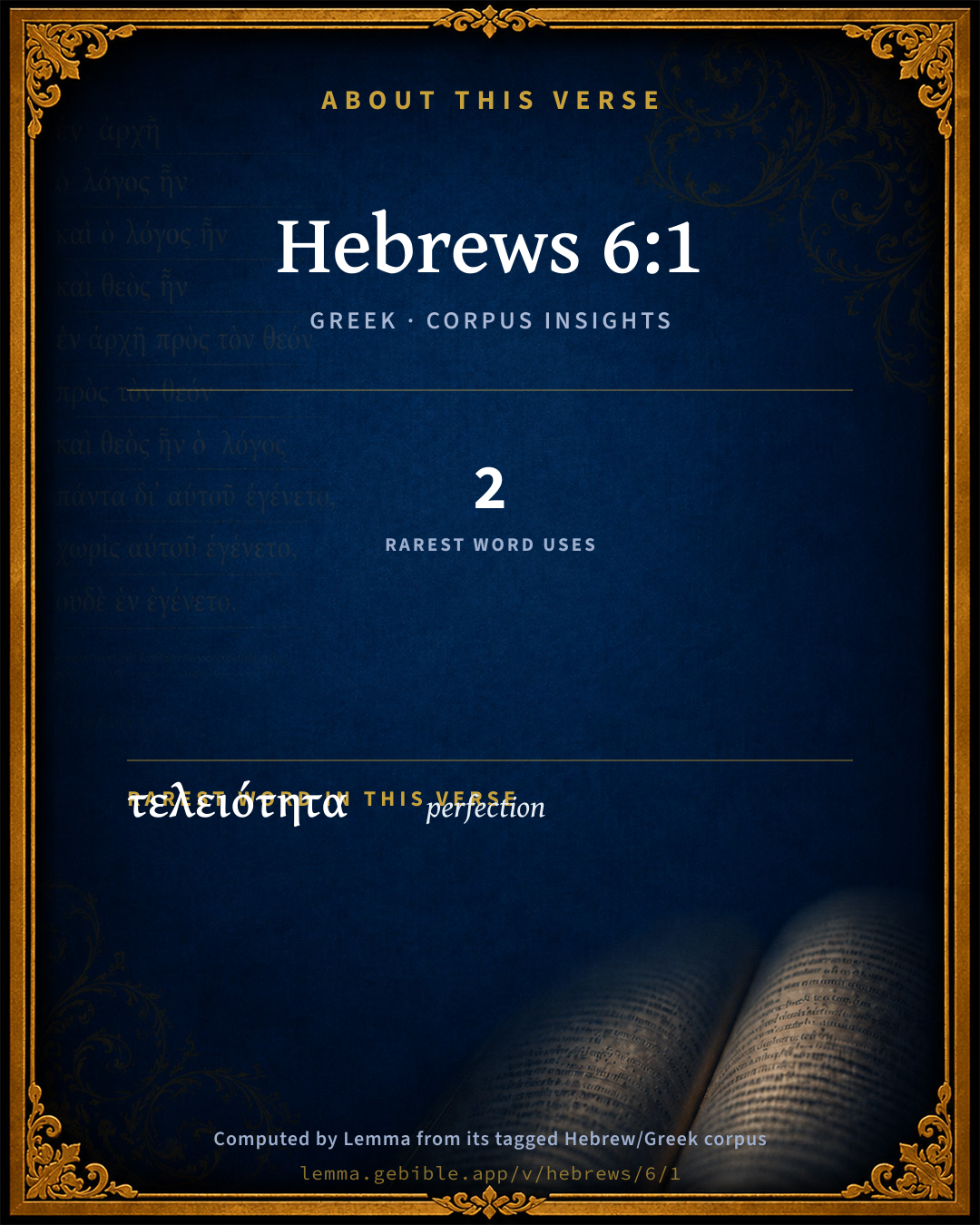
- Appears 2× in the Greek New Testament
- First appears at Colossians 3:14
- Part of Speech
- Noun
- Case
- Accusative
- Number
- Singular
- Gender
- Feminine
Full Thayer's Definition
- Διὸ dió G1352 “wherefore” Conjunction
- ἀφέντες aphíēmi G863 “to send away” Verb, Aorist, Active, Participle, Nominative, Plural, Masculine
- τὸν ho G3588 “the” Article, Accusative, Singular, Masculine
- τῆς ho G3588 “the” Article, Genitive, Singular, Feminine
- ἀρχῆς archḗ G746 “beginning” Noun, Genitive, Singular, Feminine
- τοῦ ho G3588 “the” Article, Genitive, Singular, Masculine
- Χριστοῦ Christós G5547 “Christ” Noun, Genitive, Singular, Masculine
- λόγον lógos G3056 “word” Noun, Accusative, Singular, Masculine
- ἐπὶ epí G1909 “upon” Preposition
- τὴν ho G3588 “the” Article, Accusative, Singular, Feminine
- τελειότητα teleiótēs G5047 “perfection” Noun, Accusative, Singular, Feminine
- φερώμεθα phérō G5342 “to carry” Verb, Present, Passive, Subjunctive, 1st person, Plural
- μὴ mḗ G3361 “not” Particle, Negative
- πάλιν pálin G3825 “again” Adverb
- θεμέλιον themélios G2310 “foundation” Noun, Accusative, Singular, Masculine
- καταβαλλόμενοι katabállō G2598 “to cast down” Verb, Present, Middle, Participle, Nominative, Plural, Masculine
- μετανοίας metánoia G3341 “repentance” Noun, Genitive, Singular, Feminine
- ἀπὸ apó G575 “from” Preposition
- νεκρῶν nekrós G3498 “dead” Adjective, Genitive, Plural, Neuter
- ἔργων érgon G2041 “work” Noun, Genitive, Plural, Neuter
- καὶ kaí G2532 “and” Conjunction
- πίστεως pístis G4102 “faith” Noun, Genitive, Singular, Feminine
- ἐπὶ epí G1909 “upon” Preposition
- θεόν theós G2316 “God” Noun, Accusative, Singular, Masculine
About this verse
These counts appear in no published source. They are computed here, from the morphology-tagged text and Lemma’s own curated glosses. What Lemma adds →
- 24
- words
- 20
- distinct lemmas
- General Epistles
- section
Cross-references
48Topical passages linked to Hebrews 6:1 in the Treasury of Scripture Knowledge — connected by theme and wording, ordered by reader-vote popularity; previews shown in the World English Bible.
- Hebrews 5:12–14 For when by reason of the time you ought to be teachers, you again need to have someone teach you the rudiments of the first principles of the oracles of God. You have come to need milk, and not solid food.
- 2 Corinthians 7:1 Having therefore these promises, beloved, let us cleanse ourselves from all defilement of flesh and spirit, perfecting holiness in the fear of God.
- Hebrews 9:14 how much more will the blood of Christ, who through the eternal Spirit offered himself without blemish to God, cleanse your conscience from dead works to serve the living God?
- Acts 26:20 but declared first to them of Damascus, at Jerusalem, and throughout all the country of Judea, and also to the Gentiles, that they should repent and turn to God, doing works worthy of repentance.
- Philippians 3:12–15 Not that I have already obtained, or am already made perfect; but I press on, if it is so that I may take hold of that for which also I was taken hold of by Christ Jesus.
- Hebrews 12:13 and make straight paths for your feet, so that which is lame may not be dislocated, but rather be healed.
- Matthew 21:32 For John came to you in the way of righteousness, and you didn't believe him, but the tax collectors and the prostitutes believed him. When you saw it, you didn't even repent afterward, that you might believe him.
- Hebrews 7:11 Now if there was perfection through the Levitical priesthood (for under it the people have received the law), what further need was there for another priest to arise after the order of Melchizedek, and not be called after the order of Aaron?
- 1 John 5:10–13 He who believes in the Son of God has the testimony in himself. He who doesn't believe God has made him a liar, because he has not believed in the testimony that God has given concerning his Son.
- Ezekiel 18:30–32 Therefore I will judge you, house of Israel, everyone according to his ways, says the Lord Yahweh. Return you, and turn yourselves from all your transgressions; so iniquity shall not be your ruin.
- Matthew 3:2 "Repent, for the Kingdom of Heaven is at hand!"
- John 5:24 "Most assuredly I tell you, he who hears my word, and believes him who sent me, has eternal life, and doesn't come into judgment, but has passed out of death into life.
- John 12:44 Jesus cried out and said, "Whoever believes in me, believes not in me, but in him who sent me.
- 2 Corinthians 7:10 For godly sorrow works repentance to salvation, which brings no regret. But the sorrow of the world works death.
- Ephesians 4:12 for the perfecting of the saints, to the work of serving, to the building up of the body of Christ;
- 1 Timothy 3:16 Without controversy, the mystery of godliness is great: God was revealed in the flesh, Justified in the spirit, Seen by angels, Preached among the nations, Believed on in the world, And received up in glory.
- 2 Timothy 2:19 However God's firm foundation stands, having this seal, "The Lord knows those who are his," and, "Let every one who names the name of the Lord depart from unrighteousness."
- James 1:4 Let endurance have its perfect work, that you may be perfect and complete, lacking in nothing.
- Isaiah 55:6–7 Seek you Yahweh while he may be found; call you on him while he is near:
- Matthew 4:17 From that time, Jesus began to preach, and to say, "Repent! For the Kingdom of Heaven is at hand."
- Mark 1:1 The beginning of the Gospel of Jesus Christ, the Son of God.
- Mark 6:12 They went out and preached that people should repent.
- John 14:1 "Don't let your heart be troubled. Believe in God. Believe also in me.
- Acts 3:19 "Repent therefore, and turn again, that your sins may be blotted out, so that there may come times of refreshing from the presence of the Lord,
- Acts 11:18 When they heard these things, they held their peace, and glorified God, saying, "Then God has also granted to the Gentiles repentance to life!"
- Acts 20:21 testifying both to Jews and to Greeks repentance toward God, and faith toward our Lord Jesus.
- Ephesians 2:5 even when we were dead through our trespasses, made us alive together with Christ (by grace you have been saved),
- Colossians 1:28 whom we proclaim, admonishing every man and teaching every man in all wisdom, that we may present every man perfect in Christ Jesus;
- Hebrews 11:6 Without faith it is impossible to be well pleasing to him, for he who comes to God must believe that he exists, and that he is a rewarder of those who seek him.
- 1 Peter 5:10 But may the God of all grace, who called you to his eternal glory by Christ Jesus, after you have suffered a little while, perfect, establish, strengthen, and settle you.
- 1 Corinthians 3:10–12 According to the grace of God which was given to me, as a wise master builder I laid a foundation, and another builds on it. But let each man be careful how he builds on it.
- Galatians 5:19–21 Now the works of the flesh are obvious, which are: adultery, sexual immorality, uncleanness, lustfulness,
- Colossians 4:12 Epaphras, who is one of you, a servant of Christ, salutes you, always striving for you in his prayers, that you may stand perfect and complete in all the will of God.
- 2 Timothy 2:25–26 in gentleness correcting those who oppose him: perhaps God may give them repentance leading to a full knowledge of the truth,
- 1 Peter 1:21 who through him are believers in God, who raised him from the dead, and gave him glory; so that your faith and hope might be in God.
- 1 John 4:12 No one has seen God at any time. If we love one another, God remains in us, and his love has been perfected in us.
- Proverbs 4:18 But the path of the righteous is like the dawning light, That shines more and more until the perfect day.
- Matthew 5:48 Therefore you shall be perfect, just as your Father in heaven is perfect.
- Matthew 7:25 The rain came down, the floods came, and the winds blew, and beat on that house; and it didn't fall, for it was founded on the rock.
- Acts 2:38 Peter said to them, "Repent, and be baptized, everyone of you, in the name of Jesus Christ for the forgiveness of sins, and you will receive the gift of the Holy Spirit.
- Acts 17:30 The times of ignorance therefore God overlooked. But now he commands that all people everywhere should repent,
- 1 Corinthians 13:10 but when that which is complete has come, then that which is partial will be done away with.
- Ephesians 2:1 You were made alive when you were dead in transgressions and sins,
- 1 Timothy 6:19 laying up in store for themselves a good foundation against the time to come, that they may lay hold of eternal life.
- Zechariah 12:10 I will pour on the house of David, and on the inhabitants of Jerusalem, the spirit of grace and of supplication; and they will look to me whom they have pierced; and they shall mourn for him, as one mourns for his only son, and will grieve bitterly for him, as one grieves for his firstborn.
- Matthew 21:29 He answered, 'I will not,' but afterward he changed his mind, and went.
- Luke 6:48 He is like a man building a house, who dug and went deep, and laid a foundation on the rock. When a flood arose, the stream broke against that house, and could not shake it, because it was founded on the rock.
- John 1:1–3 In the beginning was the Word, and the Word was with God, and the Word was God.
Cross-references courtesy of OpenBible.info (CC BY 4.0).
Lesson kit
Teaching starters — assembled from the data on this page, not authored interpretation. Every prompt links to the verse data it draws on. Edit before teaching.
Hebrews, in the General Epistles, opens this verse with 24 words (20 distinct Greek lemmas). Its most distinctive word is teleiótēs (“perfection”). A historical commentator’s framing appears above. Read the whole chapter for the surrounding context.
Discussion questions
- How does “perfection” (teleiótēs) shape what this verse is saying?
- How does Colossians 3:14, which shares the word «perfection», read alongside this verse?
- What does the repetition of “upon” (2× in this one verse) do in this verse?
- The translations on this page render this verse differently — a whole-verse word diff, not a word-by-word alignment. What might account for the different wordings?
- Compare how The Biblical Illustrator and Joseph Benson's Commentary read this verse. Where do they agree or differ?
Things to notice
- These translations choose different wording for 16 words in this verse.
- “upon” occurs 2× in this single verse.
- 20 distinct Greek lemmas span 24 words in this verse.
Commentary
Notes on Hebrews 6:1 from classic Christian and Jewish commentators (each source and its license shown beneath its notes). The classic Christian expositions comment on the surrounding passage and are grouped to its opening verse, so a note may address several verses; the Jewish commentaries on the Tanakh (Rashi and others) are per-verse, so they appear only where the commentator wrote on this verse.
Lemma curates 59 commentaries, every one of them public domain or Creative Commons licensed, each selected and text-cleaned for this edition rather than reprinted as found. About our sources →
The Biblical Illustrator
Joseph S. Exell
The Biblical Illustrator, edited by Joseph S. Exell (c. 1880s–1900s) — public domain. Text from a community e-Sword module.
Joseph Benson's Commentary
Joseph Benson's Commentary on the Old and New Testaments (1811–1818) — public domain. Text from a community e-Sword module.
The Preacher's Complete Homiletical Commentary
Joseph S. Exell (gen. ed.)
The Preacher's Complete Homiletical Commentary (gen. ed. Joseph S. Exell; Funk & Wagnalls, c. 1892) — public domain (pre-1929). A full-Bible homiletical/sermon-outline anthology covering 65 of 66 books (2 John is absent from the source module). Text from a community e-Sword module.
Lange's Commentary on the Holy Scriptures
Lange's Commentary on the Holy Scriptures (Critical, Doctrinal, and Homiletical), ed. John Peter Lange, English translation edited by Philip Schaff (1864–1880) — public domain. Text from a community e-Sword module.
The Annotated Bible
Arno C. Gaebelein
Arno C. Gaebelein, The Annotated Bible (1913–1922) — public domain. Text from a community e-Sword module.
The Sermon Bible
William Robertson Nicoll (ed.)
The Sermon Bible, ed. William Robertson Nicoll (1888–1900) — public domain. Text from a community e-Sword module.
Darby's Synopsis of the New Testament
John Nelson Darby
John Nelson Darby — Synopsis of the Books of the Bible: the New Testament (c. 1857–1862) — public domain. Text from a community e-Sword module.
Tyndale Open Study Notes
Tyndale Open Resources
Tyndale Open Study Notes — © Tyndale Open Resources, licensed CC BY-SA 4.0. Text via the HelloAO Bible API.
Bengel's Gnomon
Johann Albrecht Bengel
Bengel's Gnomon of the New Testament — English translation (T&T Clark, Edinburgh, 1860) — public domain. Text from a community e-Sword module.
Meyer's Critical & Exegetical Commentary
Heinrich August Wilhelm Meyer
Meyer — Critical and Exegetical Commentary on the New Testament — English translation by Peter Christie, edited by Frederick Crombie (T&T Clark, 1880) — public domain. Text from a community e-Sword module.
Expositor's Greek Testament
ed. W. Robertson Nicoll
The Expositor's Greek Testament, edited by W. Robertson Nicoll (1897–1910) — public domain. Text from a community e-Sword module.
Alford’s Greek Testament
Henry Alford
Henry Alford, The Greek Testament (1849–1861) — public domain. Text from a community e-Sword module.
Geneva Bible (1599)
Geneva Bible translators
Geneva Bible (1599) marginal notes — public domain. Text via Bolls.life.
Matthew Henry's Commentary
Matthew Henry's Commentary on the Whole Bible (1708–1710) — public domain (CC PDM 1.0). Text via the HelloAO Bible API.
Adam Clarke's Commentary
Adam Clarke's Commentary on the Bible (1810–1826) — public domain. Text from a community e-Sword/MySword module.
John Calvin's Commentaries
John Calvin's Commentaries (1540-1563) — public domain. Text from the Calvin Translation Society English edition (1840s-50s) via the Christian Classics Ethereal Library (ccel.org). Calvin's coverage is partial (roughly two-thirds of the Bible); uncommented books and verses are honest gaps, never fabricated. The 19th-century editor's footnotes and remarks are omitted so the notes are faithfully Calvin's own voice.
Ellicott's Commentary for English Readers
A Bible Commentary for English Readers, edited by Charles John Ellicott (1878–1897) — public domain. Text from a community e-Sword module.
The Cambridge Bible for Schools and Colleges
gen. ed. J. J. S. Perowne
The Cambridge Bible for Schools and Colleges (gen. ed. J. J. S. Perowne; Cambridge University Press, 1878–1918) — public domain. Text from a community e-Sword module.
John Gill's Exposition
John Gill's Exposition of the Whole Bible (1746–1763) — public domain (CC PDM 1.0). Text via the HelloAO Bible API.
Trapp's Complete Commentary
John Trapp
John Trapp, A Commentary or Exposition upon All the Books of the Old and New Testament (1647–1656) — public domain. Text from a community e-Sword module.
Albert Barnes' Notes on the Bible
Albert Barnes' Notes on the Bible (1834–1885) — public domain. Text from a community e-Sword/MySword module.
Haydock's Catholic Bible Commentary
George Leo Haydock (1774–1849), Haydock's Catholic Family Bible and Commentary, 1859 edition — public domain. Excludes Psalms (Douay-Rheims chapter numbering differs from Protestant) and Deuterocanonical books (Catholic canon only).
Matthew Poole's English Annotations
Matthew Poole's English Annotations on the Holy Bible (1683–1685) — public domain. Text from a community e-Sword/MySword module.
Dummelow's Commentary on the Holy Bible
J. R. Dummelow
J. R. Dummelow, A Commentary on the Holy Bible (Macmillan, 1909) — public domain. Text from a community e-Sword module.
Whedon's Commentary on the Bible
Daniel D. Whedon
Daniel D. Whedon (gen. ed.), Commentary on the Old and New Testaments (1874–1909) — public domain. Text from a community e-Sword module.
The Pulpit Commentary
The Pulpit Commentary (1880–1919), ed. H.D.M. Spence-Jones & Joseph S. Exell — public domain. Text from a community e-Sword module.
John Wesley's Explanatory Notes
John Wesley, Explanatory Notes Upon the Whole Bible (1754–1765) — public domain. Text via the GEBible commentary corpus.
Scofield Reference Notes
C. I. Scofield
The Scofield Reference Bible (1917 edition), notes by C. I. Scofield — public domain. Text from a community e-Sword module.
Kretzmann's Popular Commentary
Paul E. Kretzmann
Paul E. Kretzmann, Popular Commentary of the Bible (1921–1924) — public domain. Text from a community e-Sword module.
Burkitt's Expository Notes on the New Testament
William Burkitt
William Burkitt's Expository Notes on the New Testament (1700–1703) — public domain. Text from a community e-Sword module.
The People's New Testament
B. W. Johnson
B. W. Johnson's The People's New Testament with Notes (1889–1891) — public domain. Electronic text from the Christian Classics Ethereal Library (CCEL) ThML edition.
unfoldingWord translationNotes
Door43 World Missions Community
unfoldingWord translationNotes — © Distant Shores Media and the Door43 World Missions Community, licensed CC BY-SA 4.0. Source: git.door43.org/Door43/en_tn.
Cambridge Greek Testament for Schools and Colleges
Cambridge Greek Testament for Schools and Colleges (Cambridge University Press, 1896; 21 vols, various authors incl. Carr, Maclear, Plummer, Farrar, Lumby, Moule, M. R. James, Simcox) — public domain. Text from a community e-Sword module.
Vincent's Word Studies in the New Testament
Marvin R. Vincent
Marvin R. Vincent, Word Studies in the New Testament (1887–1900) — public domain. Text from a community e-Sword/MySword module.
Westcott on Hebrews & the Epistles of John
Brooke Foss Westcott
Brooke Foss Westcott (1825–1901), The Epistle to the Hebrews (1889) and The Epistles of St John (1883) — public domain (pre-1929). Text recovered from Internet Archive / Google Books OCR scans. Westcott’s Gospel of John commentary is not included (its OCR lost the chapter running-heads required for reliable verse-keying). Some Greek quoted in the Hebrews volume is imperfectly rendered by the OCR.