
Philippians 1:22

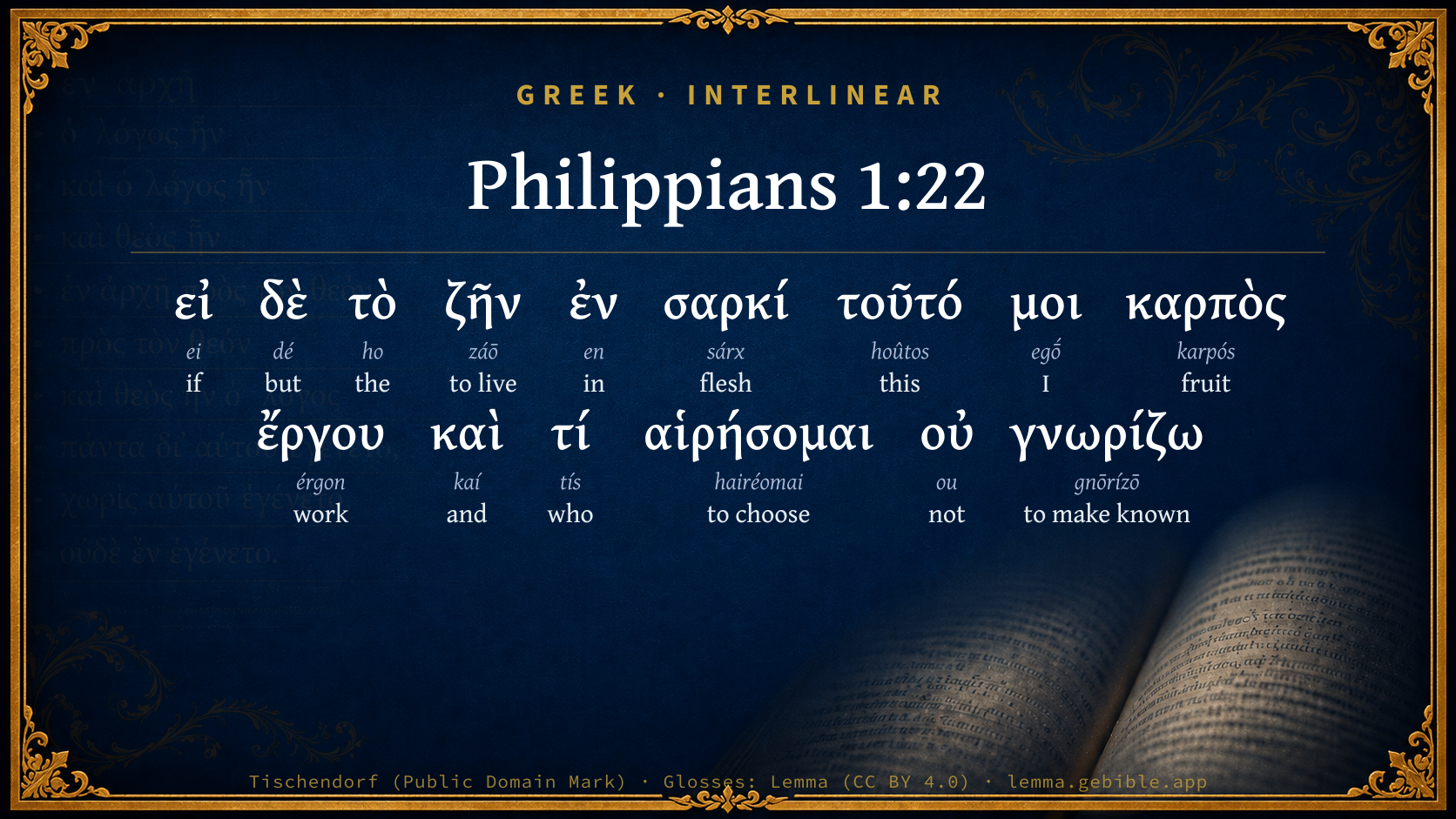
Greek (Tischendorf 8th ed.) Philippians 1:22 appears in the Greek New Testament. The text above is from the Tischendorf 8th edition. Each word links to its Strong’s number and a concise gloss. Click any word for its full Thayer’s Greek Lexicon entry.
Download image
Cite this verse

Philippians 1:22 (World English Bible). Public Domain. Lemma interlinear Bible study tool, https://lemma.gebible.app/v/philippians/1/22.

Show BibTeX & RIS
BibTeX
RIS
English Translation
But if I live on in the flesh, this will bring fruit from my work; yet I don't make known what I will choose.
World English Bible · Public Domain
Highlights
  • 1 first appearance in the Greek New Testament
Full analysis ↓
Download a study sheet

One document with this verse’s original text, its word-by-word gloss line, the meaning frame, cross-references with their text, attributed commentary, and full source and license credits — printable, and it pastes into notes with its structure intact.

This verse Autodidact and up

Study sheet (.html) Plain text (.txt)

A passage Seminary Student

Up to 50 verses in one chapter. A passage sheet keeps up to 6 commentary sources and 12 cross-references per verse, in the order this page ranks them, and says so on the sheet whenever that leaves anything out. Ask for a single verse and you get the Autodidact verse sheet above.

Everything on this page stays free to read, with no account — the sheet is a download of what is already on screen, not access to it.

Want to remove ads? Support Godless Engineer
Compare translations 3

The same verse in 3 English versions, stacked beneath the original-language interlinear above. Click any original word for its lexicon entry.

Each is an independent rendering of the whole verse — the interlinear is not word-aligned to these translations.

Highlighted words mark where these versions differ — a whole-verse word diff, not a word-by-word alignment.

  • World English Bible Public Domain
    But if I live on in the flesh, this will bring fruit from my work; yet I don't make known what I will choose.
  • King James Version Public Domain
    But if I live in the flesh, this is the fruit of my labour: yet what I shall choose I wot not.
  • unfoldingWord Literal Text CC BY-SA 4.0
    Now if to live in the flesh, this fruitful labor for me, but I do not know which I will choose.

unfoldingWord Literal Text — © unfoldingWord, licensed CC BY-SA 4.0. Word-aligned USFM3 via Door43 (git.door43.org/unfoldingWord/en_ult).

Versions to compare (up to 4)

3 of 4 selected

Show all 19 translations

Every available English version of this verse, each an independent rendering of the whole verse.

  • World English Bible Public Domain
    But if I live on in the flesh, this will bring fruit from my work; yet I don't make known what I will choose.
  • Berean Standard Bible Public Domain
    But if I go on living in the body, this will mean fruitful labor for me. So what shall I choose? I do not know.
  • Majority Standard Bible Public Domain
    But if I go on living in the body, this will mean fruitful labor for me. So what shall I choose? I do not know.
  • King James Version Public Domain
    But if I live in the flesh, this is the fruit of my labour: yet what I shall choose I wot not.
  • American Standard Version (1901) Public Domain
    But if to live in the flesh, --`if' this shall bring fruit from my work, then what I shall choose I know not.
  • Revised Version (1885) Public Domain
    But if to live in the flesh,—if this is the fruit of my work, then what I shall choose I wot not.
  • Geneva Bible (1599) Public Domain
    And whether to liue in the flesh were profitable for me, and what to chuse I knowe not.
  • Douay-Rheims (1899) Public Domain
    And if to live in the flesh, that is to me the fruit of labour, and what I shall choose I know not.
  • Young's Literal Translation Public Domain
    And if to live in the flesh `is' to me a fruit of work, then what shall I choose? I know not;
  • Literal Standard Version CC BY-SA 4.0
    And if to live in the flesh [is] to me a fruit of work, then what will I choose? I do not know;
  • Unlocked Literal Bible CC BY-SA 4.0
    But if I am to live in the flesh, that means fruitful labor for me. Yet which to choose? I do not know.
  • unfoldingWord Literal Text CC BY-SA 4.0
    Now if to live in the flesh, this fruitful labor for me, but I do not know which I will choose.
  • Darby Bible Public Domain
    but if to live in flesh [is my lot], this is for me worth the while: and what I shall choose I cannot tell.
  • World Messianic Bible Public Domain
    But if I live on in the flesh, this will bring fruit from my work; yet I don’t know what I will choose.
  • Webster's Bible Public Domain
    But if I live in the flesh, this is the fruit of my labor: yet what I shall choose I know not.
  • Free Bible Version CC BY-SA 4.0
    But if I'm to go on living here and this would be productive work, then I really don't know what's best to choose!
  • Bible in Basic English Public Domain
    But if I go on living in the flesh--if this is the fruit of my work--then I do not see what decision to make.
  • Text-Critical English NT CC BY 4.0
    But if I am to live in the flesh, it will mean fruit from my labor. Yet I do not know which I prefer.
  • Tyndale New Testament (1534) Public Domain
    Yf it chaunce me to live in the flesshe that is to me frutefull forto worke and what to chose I wote not.

Literal Standard Version (2020), Covenant Press — licensed CC BY-SA 4.0. Text via the HelloAO Bible API (eBible.org). Unlocked Literal Bible (unfoldingWord) — licensed CC BY-SA 4.0. Text via the HelloAO Bible API (eBible.org). unfoldingWord Literal Text — © unfoldingWord, licensed CC BY-SA 4.0. Word-aligned USFM3 via Door43 (git.door43.org/unfoldingWord/en_ult). Free Bible Version, Dr. Jonathan Gallagher — licensed CC BY-SA 4.0. Text via the HelloAO Bible API (eBible.org).

Word by word

More ways to search: Search by grammar → Find every occurrence → Compare this word →

Practice this passage: Drill this verse → Learn its vocabulary →

αἱρήσομαι
hairéomai
G138
“to choose”
Verb, Future, Middle, Indicative, 1st person, Singular
Part of Speech
Verb
Tense
Future
Voice
Middle
Mood
Indicative
Person
1st person
Number
Singular
Full Thayer's Definition

Origin: probably akin to G142

TDNT: 04:00,3

1. to take for oneself, to prefer, choose 2. to choose by vote, elect to office
  1. εἰ ei G1487 “if” Conditional
  2. δὲ dé G1161 “but” Conjunction
  3. τὸ ho G3588 “the” Article, Nominative, Singular, Neuter
  4. ζῆν záō G2198 “to live” Verb, Present, Active, Infinitive
  5. ἐν en G1722 “in” Preposition
  6. σαρκί sárx G4561 “flesh” Noun, Dative, Singular, Feminine
  7. τοῦτό hoûtos G3778 “this” Demonstrative pronoun, Nominative, Singular, Neuter
  8. μοι egṓ G1473 “I” Personal pronoun, 1st person, Dative, Singular
  9. καρπὸς karpós G2590 “fruit” Noun, Nominative, Singular, Masculine
  10. ἔργου érgon G2041 “work” Noun, Genitive, Singular, Neuter
  11. καὶ kaí G2532 “and” Conjunction
  12. τί tís G5101 “who” Interrogative pronoun, Accusative, Singular, Neuter
  13. οὐ ou G3756 “not” Particle, Negative
  14. γνωρίζω gnōrízō G1107 “to make known” Verb, Present, Active, Indicative, 1st person, Singular

About this verse

These counts appear in no published source. They are computed here, from the morphology-tagged text and Lemma’s own curated glosses. What Lemma adds →

15
words
15
distinct lemmas
Pauline Epistles
section

Notable vocabulary

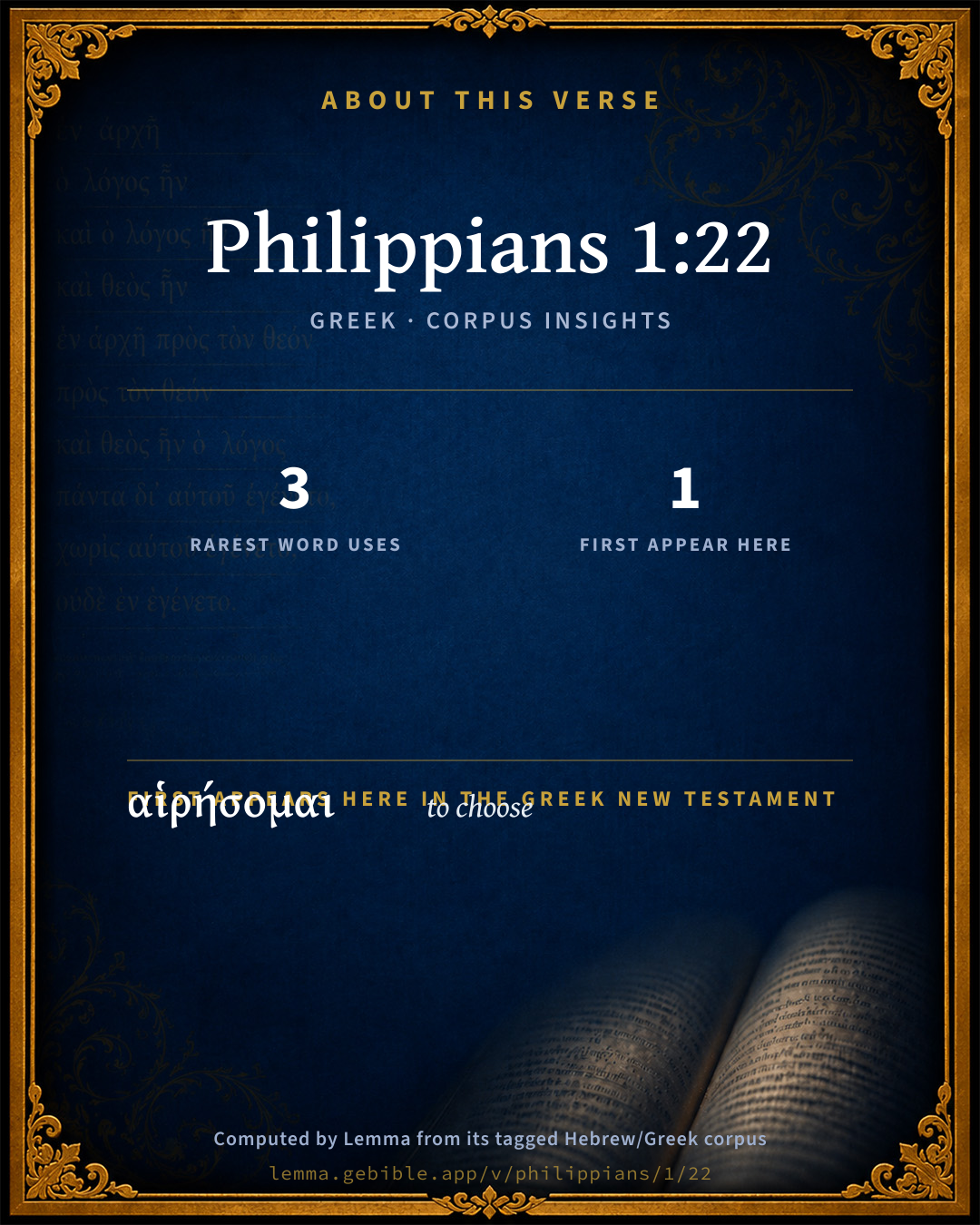
The rarest word here is αἱρήσομαι to choose G138 — appearing just 3 times in the whole Greek New Testament.

First appearance in Scripture

This word makes its first canonical appearance in the Greek New Testament here:

  • αἱρήσομαι to choose G138

Shared distinctive vocabulary

αἱρήσομαι to choose G138 occurs in 3 verses of the Greek New Testament. Also found in:
Cross-references

7

Topical passages linked to Philippians 1:22 in the Treasury of Scripture Knowledge — connected by theme and wording, ordered by reader-vote popularity; previews shown in the World English Bible.

  • 1 Peter 4:2 that you no longer should live the rest of your time in the flesh for the lusts of men, but for the will of God.
  • Galatians 2:20 I have been crucified with Christ, and it is no longer I that live, but Christ living in me. That life which I now live in the flesh, I live by faith in the Son of God, who loved me, and gave himself up for me.
  • Philippians 1:24 Yet, to remain in the flesh is more needful for your sake.
  • 2 Corinthians 10:3 For though we walk in the flesh, we don't wage war according to the flesh;
  • Psalms 71:18 Yes, even when I am old and gray-haired, God, don't forsake me, Until I have declared your strength to the next generation, Your might to everyone who is to come.
  • Acts 3:17 "Now, brothers, I know that you did this in ignorance, as did also your rulers.
  • Colossians 2:1 For I desire to have you know how greatly I struggle for you, and for those at Laodicea, and for as many as have not seen my face in the flesh;

Cross-references courtesy of OpenBible.info (CC BY 4.0).

Commentary

Notes on Philippians 1:22 from classic Christian and Jewish commentators (each source and its license shown beneath its notes). The classic Christian expositions comment on the surrounding passage and are grouped to its opening verse, so a note may address several verses; the Jewish commentaries on the Tanakh (Rashi and others) are per-verse, so they appear only where the commentator wrote on this verse.

Lemma curates 59 commentaries, every one of them public domain or Creative Commons licensed, each selected and text-cleaned for this edition rather than reprinted as found. About our sources →

The Biblical Illustrator

Joseph S. Exell

Php_1:22-26

But if I live in the flesh this is the fruit of my labour

I.

The personal weighed with the public, or the difficulties of the veteran philanthropist.

II. Mans sublimest reason for not wishing immediate translation is that he may be of spiritual service to the world.

III. The next best condition to that of being with Christ is to be working for his people. To be with Christ … to abide with you. How could there be hesitation in deciding the choice? Selfishness could not have hesitated. True, but selfishness would never have been called upon to make the election. Benevolence has its difficulties as well as selfishness. Love lifts a finger to the heavens and points another to the earth. The choice is between gain and service, and rightly estimated service is gain. It is worth all pain and inconvenience to remain out of heaven so long as you can prepare your contemporaries for it. You are with Christ as long as you are with His work. The apostle is not a dreamy contemplatist always wishing for some more pleasant conditions of existence. He is a worker who finds satisfaction in labour. There is a disease in the Church which confounds religion with wishing for heaven. Persons afflicted with it hold their heads so erectly as not to see the spiritual darkness around them. They are dreamers, transcendentalists, but are they Christians? They are fond of hymns that warble the blessedness of heaven; they revel in texts that describe the rest, the power, the fascinations of the heavenly state. Let such diseased ones mark how the apostle conjoins labour and gain, and how he balances what is needful for man with what would be pleasant to himself; and let them be rebuked and stimulated by the joy with which he anticipated restoration to his laborious life.

IV. There is only one world in which you can serve men evangelically; do not be in indecent haste to escape the opportunity. When you wish to enter heaven may you have a strong drawing to the service still to be done on earth.

V. God never leaves the earth entirely destitute of great men. Elijah may deem himself alone, but God knows that there are seven thousand who have never kissed the worlds dumb god. (J. Parker, D. D.)

St. Pauls choice

As an overfondness for life is a mean, effeminate passion that exposes us to the basest impressions, and renders us insensible to every honourable purpose, so a contempt of death has been esteemed one of the principal ingredients in a great character. From the views of heathen morality it is difficult to understand why he who had no sure prospect of another life should be over prodigal of this; but when we behold a man raised above the world by a just sense of immortality we cannot but applaud the example as an honour to human nature, and a glorious instance of the power of the gospel. Notice--

I. The reasons that inclined Paul to desire to depart--To be with Christ.

1. This signifies that state of happiness revealed by our Lord in His promise to His disciples that where He was they should be also.

2. What the nature and degree of it is the Scripture has nowhere informed us; and, indeed, in our present state exact notions of it are impossible.

3. It is enough to know that to be with Christ is to be partakers of His glory. This is two-fold.

(1) Real but imperfect immediately upon death.

(2) Complete after the resurrection.

II. The motives that reconciled him to a longer stay.

1. He had not only a certain prospect of happiness in another life, but uncommon reasons to be weary of this.

2. But persecuted and discouraged as he was and would still be, his charity for the souls of men, and his zeal for his Master, prevailed with him to defer his own felicity. He was moved with compassion to the errors of a deluded world, and affected with the concern of a father for the happiness of his converts.

III. The submission he expresses to the wisdom and appointment of God. He did not presume to make his own choice. He knew (Php_1:25) that God had determined he should abide, and therefore he cheerfully acquiesces in the Divine will, and is as eager to promote the glory of God in one world as to partake of it in another. Application:

1. The prospect of being with Christ is as much ours as it was his.

2. This prospect is a powerful support against death, and a great encouragement to duty.

3. The prospect, however, of being of use to Christ here should beget a willingness to postpone our departure that Christs will may be done. (J. Rogers, D. D.)

A strait betwixt two

I. Continuance. Continued life meant--

1. Continued labour. Nothing which God makes is without a work to do. All things are full of labour. To Gods moral creatures is given the sublime privilege that not blindly through the action of material laws, but consciously and by resolutions of their own, they may fulfil the end of their existence.

(1) To work, then, according to the faculties and opportunities which God has given us is our duty.

(2) Work is the law of the new life in Christ Jesus. Son, go work.

(3) The manifestation of Gods life is holy, beneficent activity. Here is our example.

(4) The highest conceivable honour for Gods creatures is to be labourers together with Him.

(5) As this is duty, so is it the direction in which the love of Christ constraineth us to turn our energies.

(6) But what if through illness, etc., a Christian cannot work? Then he works by the influence of his resignation and his prayers.

2. Fruit of labour--success in the work to which God calls him.

(1) As a rule honest, hearty labour of every kind succeeds more or less. Yet there are often failures. Shipwreck overwhelms the vessel, or fire consumes the factory, or disease enfeebles. The Christian, when calamities of this kind overtake him, recognizes in them a reminder that there is higher wealth and nobler work than that which has to do with this world.

(2) In the spiritual sphere there is always fruit of labour, though very often neither as, nor when, nor where we look for it. All earnest effort for personal spiritual advancement succeeds, for this is the will of God. Fruit of this kind is yielded, too, by every Christian effort to benefit others. With regard to the direct effort of Christian labour for the good of others, even where there is little or no visible fruit, still the conscientious worker has abundant ground of encouragement. Christian labourers casually learn, long after, of spiritual good done when they complained of labouring in vain. The seed may long lie inactive.

3. This, then, is what Paul sees to counterbalance the influence of the reflection to die is gain.

II. Departure.

1. One grand thought. Pauls wish was that by departure he should be with Christ.

2. Some Christians have held that the intermediate state is one of sleep. But our Lords declaration to the dying thief disposes of that; and had it been Pauls view he would have counted it better to remain with Christ here.

3. To depart and be with Christ was better by very far than remaining in a world of ignorance, and sin, and trouble.

III. The strait between the two.

1. Of struggle between liking and a sense of duty every soul of any strength and nobleness has experience every day.

2. Paul was led to choose the less desirable personally out of love to Christ and His cause.

3. The principle on which this choice was based is that God, having a plan of life for each of His people, no one of them will pass away so long as any work remains for them to do. No Christian dies prematurely. (R. Johnson, LL. B.)

The Biblical Illustrator, edited by Joseph S. Exell (c. 1880s–1900s) — public domain. Text from a community e-Sword module.

Bengel's Gnomon

Johann Albrecht Bengel

Php 1:22. Εἰ δὲ, but if) Here he begins to discuss the first member of the period: the second at ch. Php 2:17, yea, and if I am offered. Moreover, he uses δὲ, but, because, from the disjunction [two alternatives] laid down in the preceding verse, he now assumes the one; and on this assumption, presently, as if repenting, he begins to doubt, in such a way, however, as not to avoid assuming it in the meantime.—τὸ ζῇν, viz. ἐστί μοι) if living is to me: if I am to live.—ἐν σαρκί) This is a limitation; for even they who die, live.—καρπὸς ἔργου, the fruit of my labour) I derive this fruit from it [from living], that I may thereby do the more work; a noble work, ch. Php 2:30; desirable fruit, Rom 1:13. Another seeks fruit from [by means of] his labour; Paul regards the labour itself as the fruit. This living is the fruit of my labour. The expression, καρπὸς ἔργου, the fruit of labour [= the labour (is) my fruit]; as, the river of the Rhine, the virtue of liberality [for the river Rhine; the virtue, liberality]. The price of the labour is its immediate result.[11] Cicero says, “I propose to myself as the fruit of friendship, friendship itself, than which nothing is more abundant.”—αἱρήσομαι, I shall choose) He supposes the condition, viz. if the power of choosing were given to him. This is the reason of [the ground on which he uses] the Future. [The lot of the Christian is truly an excellent one. It is only of things that are good that the choice can be made, so as to perplex or put his mind in a strait with hesitation. He never can be disappointed.—V. g.]—οὐ γνωρίζω) I do not explain, viz. to myself; i.e. I do not determine.

[11] The reward which the labour itself affords is an immediate result, independent of its future rewards.—ED.

Bengel's Gnomon of the New Testament — English translation (T&T Clark, Edinburgh, 1860) — public domain. Text from a community e-Sword module.

Meyer's Critical & Exegetical Commentary

Heinrich August Wilhelm Meyer

Php_1:22. Δέ] carrying onward the discourse to the comparison between the two cases as regards their desirability. Weiss understands δέ as antithetic, namely to τὸ ἀποθανεῖν κέρδος, and Hofmann as in contrast also to the ἐμοὶ τὸ ζῆν Χριστός, but both proceed on an erroneous view of what follows; as does also Huther.

According to the τὸ ἀποθανεῖν κέρδος just expressed, the ἀποθανεῖν was put as the case more desirable for Paul personally; but because the ζῆν, in which indeed Christ is his one and all, conditioned the continuance of his official labours, he expresses this now in the hypothetical protasis and, as consequence thereof, in the apodosis, that thus he is in doubt respecting a choice between the two.

The structure of the sentence is accordingly this, that the apodosis sets in with καὶ τί αἱρήσομαι, and nothing is to be supplied: But if the remaining in my bodily life, and just this, avails for my work, I refrain from a making known what I should choose. We have to remark in detail: (1) that εἰ does not render problematical that which was said of the ζῆν ἐν σαρκί, but in accordance with the well-known and, especially in Pauls writings, frequent (Rom_5:17; Rom_6:15, and often) syllogistic usage (Herbst and Kühner, ad Xen. Mem. i. 5. 1), posits the undoubted certainty (Wilke, Rhetor. p. 258), which would take place in the event of a continuance of life; (2) that Paul was the more naturally led to add here the specially defining ἐν σαρκί to τὸ ζῆν (comp. Gal_2:20; 2Co_10:3), because, in the previously mentioned κέρδος, the idea of life apart from the body (comp. 2Co_5:8) must have been floating in his mind; (3) that τοῦτο again sums up with the emphasis of emotion (comp. Rom_7:10) the τὸ ζῆν ἐν σαρκί which had just been said, and calls attention to it (Bernhardy, p. 283; Kühner, II. 1, p. 568 f.; Fritzsche, ad Matth. p. 219), for it was the remaining in life, just this, this and nothing else (in contrast to the ἀποθανεῖν), which was necessarily to the apostle καρπὸς ἔργου; (4) that καρπός is correlative to the preceding κέρδος, and embodies the idea emolumentum (Rom_1:13; Rom_6:21, et al.; Wis_3:13), which is more precisely defined by ἔργου: work-fruit, gain of work, i.e. advantage which accrues to my apostolical work; comp. on the idea, Rom_1:13; (5) that καί, at the commencement of the apodosis, is the subjoining also, showing that if the one thing takes place, the other also sets in; see Hartung, Partikell. I. p. 130 f.; Baeumlein, Partik. p. 146; Nägelsbach, z. Ilias, p. 164, ed. 3; comp. on 2Co_2:2; (6) that τί stands in the place of the more accurate πότερον (Xen. Cyrop. i. 3. 17; Stallbaum, ad Phileb. p. 168; Jacobs, ad Del. epigr. p. 219; Winer, p. 159 [E. T. 211]), and that the future αἱρήσομαι (what I should prefer) is quite in order (see Eur. Hel. 631, and Pflugk in loc.; and Winer, p. 280 [E. T. 374]), while also the sense of the middle, to choose for himself, to prefer for himself, is not to be overlooked; comp. 2Th_2:13; Xen. Mem. iv. 2. 29: οἱ δὲ μὴ εἰδότες ὅ τι ποιοῦσι, κακῶς δὲ αἱρούμενοι, Soph. Ant. 551: σὺ μὲν γὰρ εἵλου ζῆν; (7) that οὐ γνωρίζω is not to be taken, as it usually has been, according to the common Greek usage with the Vulgate, in the cense of ignoro, but, following the invariable usage of the N. T. (comp. also 3Ma_2:6; 3 Maccabees 3 Esr. 6:12; Aesch. Prom. 487; Athen. xii. p. 539 B; Diod. Sic. i. 6), as: I do not make it known, I do not explain myself on the point, give no information upon it.[73] Comp. van Hengel, Ewald, Huther, Schenkel, also Bengel, who, however, without any ground, adds mihi. Paul refrains from making and declaring such a choice, because (see Php_1:23 f.) his desire is so situated between the two alternatives, that it clashes with that which he is compelled to regard as the better.

The conformity to words and context, and the simplicity, which characterize the whole of this explanation (so, in substance, also Chrysostom, Theodoret, Oecumenius, Theophylact, Erasmus, Luther, Calvin, and many others, including Heinrichs, Rheinwald, van Hengel, de Wette, Wiesinger, Ewald, Ellicott, Hilgenfeld),in which, however, καρπ. ἔργου is not to be taken as operae pretium (Calvin, Grotius, and others), nor καί as superfluous (Casaubon, Heinrichs, and others), nor Οὐ ΓΝΩΡΊΖΩ as equivalent to ΟὐΚ ΟἾΔΑ (see above),exclude decisively all other interpretations, in which ΤΟῦΤΟ and the ΚΑΊ of the apodosis have been the special stumbling blocks. Among these other explanations are (a) that of Pelagius, Estius, Bengel, Matthies, and others (comp. Lachmann, who places a stop after ἔργου), that ἘΣΤΊ is to be understood with ἘΝ ΣΑΡΚΊ, that the apodosis begins with ΤΟῦΤΟ, and that ΚΑῚ ΤΊ ΑἹΡ. Κ.Τ.Λ. is a proposition by itself: if the living in the flesh is appointed to me, then this has no other aim for me than by continuous labour to bring forth fruit, etc. (Huther, l.c. p. 581 f.). But how arbitrarily is the simple ἐστί, thus supplied, interpreted (mihi constitutum est)! The words τοῦτό μοι καρπὸς ἔργου, taken as an apodosis, areimmediately after the statement ἘΜΟῚ ΓᾺΡ ΤῸ ΖῆΝ ΧΡΙΣΤΌς, in which the idea of ΚΑΡΠῸς ἜΡΓΟΥ is substantially conveyed alreadyadapted less for a new emphatic inference than for a supposition that has been established; and the discourse loses both in flow and force. Nevertheless Hofmann has in substance followed this explanation.[74] (b) Bezas view, that εἰ is to be taken as whether: an vero vivere in carne mihi operae pretium sit, et quid eligam ignoro. This is linguistically incorrect (καρπὸς ἔργου), awkward (ΕἸ … ΚΑῚ ΤΊ), and in the first member of the sentence un-Pauline (Php_1:24-26). (c) The assumption of an aposiopesis after ἔργου: if life, etc., is to me ΚΑΡΠῸς ἜΡΓΟΥ, non repugno, non aegre fero (so Corn. Müller), or, je ne dois pas désirer la mort (Rilliet). See Winer, p. 557 f. [E. T. 751]; Meineke, Menand. p. 238. This is quite arbitrary, and finds no support in the emotional character of the passage, which is in fact very calm. (d) Hoelemanns explanationwhich supplies καρπός from the sequel after ΖῆΝ, takes ΤΟῦΤΟ, which applies to the ἈΠΟΘΑΝΕῖΝ, as the beginning of the apodosis, and understands ΚΑΡΠῸς ἜΡΓΟΥ as an actual fruit: but if life is a fruit in the flesh (an earthly fruit), this (death) is also a fruit of (in) fact (a substantial, real fruit)is involved, artificial, and contrary to the genius of the language (καρπ. ἔργου!). (e) The explanation of Weiss is that, after ἐν σαρκί, κέρδος is to be again supplied as a predicate, so that ΤΟῦΤΟ, which is made to apply to the entire protasis, begins the apodosis: but if life is a gain, that is a fruit of his labour, because the successes of his apostolic ministry can alone make his life worth having to him (Php_1:24). This supplying of ΚΈΡΔΟς, which was predicated of the antithesis of the ΖῆΝ, is as arbitrary as it is intolerably forced; and, indeed, according to Php_1:21, not ΚΈΡΔΟς merely would have to be supplied, but ἘΜΟῚ ΚΈΡΔΟς; and, since ΚΈΡΔΟς is not to be taken from ἈΠΟΘΑΝΕῖΝ, of which it is predicate, we should have to expect an also before τὸ ζῆν, so that Paul would have written: ΕἸ ΔῈ (or ἈΛΛʼ ΕἸ) ΚΑῚ ΤῸ ΖῆΝ ἘΝ ΣΑΡΚῚ ἘΜΟῚ ΚΈΡΔΟς Κ.Τ.Λ.

[73] Not as if Paul intended to say that he kept it to himself, a sense which Hofmann wrongly ascribes to this declaration. He intends to say rather that he refrains from a decision regarding what he should choose. The dilemma in which he found himself (comp. ver. 23) caused him to waive the giving of such a decision, in order not to anticipate in any way the divine purpose by his own choice.

[74] If it be life in the flesh, namely, which I have to expect instead of dying (?), then this, namely the life in the flesh, is to me produce of labour, in so far as by living I produce fruit, and thus then (καί) it is to me unknown, etc. This interpretation of Hofmanns also is liable to the objection that, if Paul intended to say that he produced fruit by his life, logically he must have predicated of his ζῆν ἐν σαρκί, not that it was to him καρπὸς ἔργου, but rather that it was ἔργον καρποῦ, a work (a working) which produces fruit.

Meyer — Critical and Exegetical Commentary on the New Testament — English translation by Peter Christie, edited by Frederick Crombie (T&T Clark, 1880) — public domain. Text from a community e-Sword module.

Expositor's Greek Testament

ed. W. Robertson Nicoll

Phi 1:22 . To show the diversities of interpretation to which this verse has given rise, it is enough to note that in the first clause Hpt [54] would supply ζῇν ἐστιν , while Ws [55] suggests κέρδος . Others regard the first two clauses as protasis ( τοῦτο summing up the words preceding), making the apodosis begin with καί . The context suggests an explanation more simple and more natural. Paul has sought to convince them that death has no terror for him; that, on the contrary, it is pure gain. Yet he will not have them suppose that therefore life on earth ( ἐν σαρκί , life with the encumbrance of sinful flesh) is a burden and a trouble. In the circumstances, as he points out immediately, it is probably best for him and them. And he will give a preliminary hint of this. Must we not supply μοί ἐστι , in thought, in the first clause? This is suggested both by ἐμοί preceding and by the μοι which follows. ἐστί has to be supplied, admittedly, in both clauses of Phi 1:21 . There is no greater difficulty in doing so here. “But if life in the flesh be my portion, this means (so we must also translate the ἐστί supplied in first clause of Phi 1:21 ) for me fruit of ( i.e. , springing from) labour.” τὸ ζῇν is qualified by ἐν σ ., because the Apostle felt that he could not regard physical death as quenching his life. Death only meant fuller life, therefore he must define when he wishes to speak of life on this earth. καρπὸς ἔργου . For the phrase see Psa 103 . (104) 13, ἀπὸ καρποῦ τῶν ἔργων σου χορτασθήσεται ἡ γῆ ; Wis 3:15 , ἀγαθῶν γὰρ πόνων ὁ καρπὸς εὐκλεής . Aptly Thphyl., καὶ τὸ ζῇν ἐν σαρκὶ οὐκ ἄκαρπόν μοί ἐστιν · καρποφορῶ γὰρ διδάσκων καὶ φωτίζων πάντας . τί αἱρής . τί has practically ousted πότερον from N.T. It is quite natural to have the fut. indicat. in a deliberative sentence. γνωρίζω . Its invariable meaning in N.T. = “make known”. This sense suits almost every instance in LXX. So here, “I do not make known,” “I cannot tell”.

[54] Haupt.

[55] Weiss.

The Expositor's Greek Testament, edited by W. Robertson Nicoll (1897–1910) — public domain. Text from a community e-Sword module.

Geneva Bible (1599)

Geneva Bible translators

An example of a true shepherd, who maketh more acount how he may profit his sheep, than he doth of any commodity of his own whatsoever.

To live in this mortal body.

Geneva Bible (1599) marginal notes — public domain. Text via Bolls.life.

Jamieson, Fausset & Brown

Robert Jamieson, A. R. Fausset & David Brown

Rather as Greek, "But if to live in the flesh (if), this (I say, the continuance in life which I am undervaluing) be the fruit of my labor (that is, be the condition in which the fruit of my ministerial labor is involved), then what I shall choose I know not (I cannot determine with myself, if the choice were given me, both alternatives being great goods alike)." So ALFORD and ELLICOTT. BENGEL takes it as English Version, which the Greek will bear by supposing an ellipsis, "If to live in the flesh (be my portion), this (continuing to live) is the fruit of my labor," that is, this continuance in life will be the occasion of my bringing in "the fruit of labor," that is, will be the occasion of "labors" which are their own "fruit" or reward; or, this my continuing "to live" will have this "fruit," namely, "labors" for Christ. GROTIUS explains "the fruit of labor" as an idiom for "worthwhile"; If I live in the flesh, this is worth my while, for thus Christ's interest will be advanced, "For to me to live is Christ" (Phi 1:21; compare Phi 2:30; Rom 1:13). The second alternative, namely, dying, is taken up and handled, Phi 2:17, "If I be offered."

Jamieson, Fausset & Brown — Commentary Critical and Explanatory on the Whole Bible (1871) — public domain (CC PDM 1.0). Text via the HelloAO Bible API.

Adam Clarke's Commentary

Verse 22. But if I live in the flesh] Should I be spared longer, I shall labour for Christ as I have done; and this is the fruit of my labour, that Christ shall be magnified by my longer life, Php 1:20.

Yet what I shall choose I wot not.] Had I the two conditions left to my own choice, whether to die now and go to glory, or whether to live longer in persecutions and affliction, (glorifying Christ by spreading the Gospel,) I could not tell which to prefer.

Adam Clarke's Commentary on the Bible (1810–1826) — public domain. Text from a community e-Sword/MySword module.

John Calvin's Commentaries

22 But if to live in the flesh. As persons in despair feel in perplexity as to whether they ought to prolong their life any farther in miseries, or to terminate their troubles by death, so Paul, on the other hand, says that he is, in a spirit of contentment, so well prepared for death or for life, because the condition of believers, both in the one case and in the other, is blessed, so that he is at a loss which to choose. If it is worth while; that is, “If I have reason to believe that there will be greater advantage from my life than from my death, I do not see which of them I ought to prefer.” To live in the flesh, is an expression which he has made use of in contempt, from comparing it with a better life.

John Calvin's Commentaries (1540-1563) — public domain. Text from the Calvin Translation Society English edition (1840s-50s) via the Christian Classics Ethereal Library (ccel.org). Calvin's coverage is partial (roughly two-thirds of the Bible); uncommented books and verses are honest gaps, never fabricated. The 19th-century editor's footnotes and remarks are omitted so the notes are faithfully Calvin's own voice.

Ellicott's Commentary for English Readers

(22) But if I live in the flesh . . .—The translation of this verse in the Authorised version is inaccurate, and perhaps a gloss to soften the difficulty of the original. The exact translation is, But if to live in the flesh this is to me a fruit of work, and what (or, what also) I shall choose I know not. The construction is clearly broken by emotion or absorption in thought; it can only be supplied by conjecture. If (as in 2Co_2:2) the word “and,” or “also,” can be used to introduce the principal clause (“what then I shall choose,” &c.), the construction will be correct, though harsh. If otherwise, we must suppose either that the sentence is broken at the word “work,” or that the whole should run, But what if to live in the flesh is a part of work? And what I shall choose, I know not, &c. But though the construction is obscure, the sense is plain. St. Paul had said, “to die is gain.” But the thought crosses him that to live still in the flesh, this and this only is (i.e., carries with it) a fruit of apostolical labour, in souls brought to Christ or built up in Him. Accordingly what to choose he knows not. For in such a harvest there is a gain, which outweighs his own personal gain on the other side.

I am in a strait betwixt (the) two.—The word here used signifies “to be hemmed in,” or “confined,” and is generally associated with some idea of distress (as in Luk_8:45; Luk_19:43), not unfrequently with the pressure of disease (Mat_4:24; Luk_4:38; Act_28:8). Our Lord uses it of mental distress in Himself (Luk_12:50): “How am I straitened till it be accomplished!” Here the sense is clear. St. Paul’s mind is “hemmed in” between two opposing considerations, till it knows not which way to move, even in desire.

A Bible Commentary for English Readers, edited by Charles John Ellicott (1878–1897) — public domain. Text from a community e-Sword module.

The Cambridge Bible for Schools and Colleges

gen. ed. J. J. S. Perowne

22. But if I live in the flesh, &c.] The Greek construction here is difficult by its brevity and abruptness. R.V. renders “But if to live in this flesh—if this is the fruit of my work, then &c.”; and, in the margin, “But if to live in the flesh be my lot, this is the fruit of my work; and &c.”; a rendering practically the same as A.V. This latter we much prefer, for grammatical reasons. It requires the mental insertion of “be my lot,” or the like; but this is quite easy, in a sentence where the words “to live” are obviously echoed from the words “to live is Christ” just above. As if to say, “But if this ‘living’ is still to be a ‘living in the flesh,’ this is fruit &c.”

this is the fruit of my labour] Rather better, in view of the Greek idiom, this I shall find fruit of work. This “living in the flesh,” as it will be “Christ,” so will be “fruit,” result, of lifelong work. He means that work for Christ, the being employed by Christ, is for him the pulse of life on earth; is life for him, in a certain sense. And this he expresses with additional force by saying not merely “work” but “fruit of work.” For the work is of course fruitful: he who abides in Christ “beareth much fruit,” fruit that shall “remain” (Joh_15:5; Joh_15:16), whether or no he sees it. It is only the “works of darkness” that can be “unfruitful” (Eph_5:11).

yet] Lit. and better, and. The simple word suits the great rapidity of transition.

wot] An old English present indicative, of which the infinitive is to wit. It was probably a past tense originally. See Skeat’s Etymological Dictionary.—Wyclif has “knowe”.—The Greek here is, precisely, “I recognize not”; “I do not see clearly” (Ellicott).

The Cambridge Bible for Schools and Colleges (gen. ed. J. J. S. Perowne; Cambridge University Press, 1878–1918) — public domain. Text from a community e-Sword module.

John Gill's Exposition

But if I live in the flesh,.... To be in the flesh sometimes signifies to be in a state of nature and unregeneracy, and to live in and after the flesh, to live according to the dictates of corrupt nature; but here it signifies living in the body, or the life which is in the flesh, as the Syriac version renders the phrase here, and as the apostle expresses it in Gal 2:20, and the sense is, if I should live any longer in the body, and be continued for some time in this world:

this is the fruit of my labour; or "I have fruit in my works", as the above version renders it:

yet what I shall choose I wot not, or "know not"; whether life or death; since my life will be for the honour and glory of Christ, and though a toilsome and laborious one, yet useful and fruitful: by his "labour", he means his ministerial work and service; the ministry is a work, a good and honourable work, and a laborious one. Christ's faithful ministers are labourers; they labour in the word and doctrine, both in studying and preaching it; and such a labourer was the apostle, who by the grace of God laboured more abundantly than others; the "fruit" of which was the conversion of many sinners, the edification, comfort, and establishment of the saints, their fruitfulness in grace and works, the spread of the Gospel far and near, the enlargement of the kingdom of Christ, and the weakening of Satan's kingdom, and the glorifying of Christ in his person, offices, and great salvation; all which was a strong and swaying argument with him, to desire to live longer in the body, and made it on the one hand so difficult with him what to choose: for as a certain Jew (b) says,

"the righteous man desires to live to do the will of God while he lives;

but not with that view, he adds,

"to increase the reward of the soul in the world to come.

(b) Kimchi in Psal. vi. 5.

John Gill's Exposition of the Whole Bible (1746–1763) — public domain (CC PDM 1.0). Text via the HelloAO Bible API.

Trapp's Complete Commentary

John Trapp

22 But if I live in the flesh, this is the fruit of my labour: yet what I shall choose I wot not.

Ver. 22. What I shall choose, I wot not] As a loving wife sent for by her husband far from home, and yet loth to leave her children, is in a muse and doubt what to do, so was the apostle. He had mortem in desiderio, et vitam in patientia (as Fulgentius hath it), he rather endured life than desired it, he accepted it rather than affected it.

John Trapp, A Commentary or Exposition upon All the Books of the Old and New Testament (1647–1656) — public domain. Text from a community e-Sword module.

Albert Barnes' Notes on the Bible

But if I live in the flesh - If I continue to live; if I am not condemned and make a martyr at my approaching trial.

This is the fruit of my labour - The meaning of this passage, which has given much perplexity to commentators, it seems to me is, “If I live in the flesh, it will cost me labor; it will be attended, as it has been, with much effort and anxious care, and I know not which to prefer - whether to remain on the earth with these cares and the hope of doing good, or to go at once to a world of rest.” A more literal version of the Greek will show that this is the meaning. Τοῦτό μοι καρπὸς ἔργου Touto moi karpos ergou - “this to me is (or would be) the fruit of labor.” Coverdale, however, renders it: “Inasmuch as to live in the flesh is fruitful to me for the work, I wot not what I shall choose.” So Luther: “But since to live in the flesh serves to produce more fruit.” And so Bloomfield: “But if my life in the flesh be of use to the gospel (be it so, I say no more), verily what I shall choose I see and know not.”

See also Koppe, Rosenmuller, and Calvin, who give the same sense. According to this, the meaning is, that if his life were of value to the gospel, he was willing to live; or that it was a valuable object - operae pretium - worth an effort thus to live. This sense accords well with the connection, and the thought is a valuable one, but it is somewhat doubtful whether it can be made out from the Greek. To do it, it is necessary to suppose that μοι moi - “my” - is expletive (Koppe, and that καὶ kai - “and” - is used in an unusual sense. See Erasmus. According to the interpretation first suggested, it means, that Paul felt that it would be gain to die, and that he was entirely willing; that he felt that if he continued to live it would involve toil and fatigue, and that, therefore, great as was the natural love of life, and desirous as he was to do good, he did not know which to choose - an immediate departure to the world of rest, or a prolonged life of toil and pain, attended even with the hope that he might do good. There was an intense desire to be with Christ, joined with the belief that his life here must be attended with toil and anxiety; and on the other hand an earnest wish to live in order to do good, and he knew not which to prefer.

Yet - The sense has been obscured by this translation. The Greek word (καὶ kai) means “and,” and should have been so rendered here, in its usual sense. “To die would be gain; my life here would be one of toil, and I know not which to choose.”

What I shall choose I wot not - I do not know which I should prefer, if it were left to me. On each side there were important considerations, and he knew not which overbalanced the other. Are not Christians often in this state, that if it were left to themselves they would not know which to choose, whether to live or to die?

Albert Barnes' Notes on the Bible (1834–1885) — public domain. Text from a community e-Sword/MySword module.

Haydock's Catholic Bible Commentary

This is to me, &c. His meaning is, that although his dying immediately for Christ, would be his gain, by putting him presently in possession of heaven; yet he is doubtful what he should choose, because by staying longer in the flesh, he should be more beneficial to the souls of his neighbours. (Challoner) --- What I shall choose I know not: though my earnest desire is to be dissolved from this mortal body, and to be with Christ, as my greater happiness, yet if it be the will of God that I labour longer, as necessary for your good, and that I again come to you, let God dispose of me according to his holy will. (Witham)

George Leo Haydock (1774–1849), Haydock's Catholic Family Bible and Commentary, 1859 edition — public domain. Excludes Psalms (Douay-Rheims chapter numbering differs from Protestant) and Deuterocanonical books (Catholic canon only).

Matthew Poole's English Annotations

But if I live in the flesh, this is the fruit of my labour: some, from the various use of the Greek particles, render this first clanse interrogatively; But whether to live in the flesh were worth the while? Or more profitable? (understand, than to die). The apostle having intimated the equality and indifferency of his mind in an entire submission to the will of God, whether that glorifying of Christ by his life or that by his death were more eligible, is upon deliberation, finding the advantage to Christ and himself, upon expense of circumstances either way, in an equal balance, weighing one thing with another: living in the flesh, i.e. abiding here in this mortal body, which he thus expresseth by way of diminution, Gal 2:20; 1Pe 4:1; in opposition to, and comparison of, dying for and in the Lord, and so being with him, Phi 1:23.

Yet what I shall choose I wot not; he seems, loving the Philippians as himself, to be at a loss what to determine, if God should permit him his choice, whether by labouring in his ministry for rite good of their souls he should bring more fruit to Christ, or by suffering, that which would arise from the blood of a martyr, who himself should receive a crown, 2Ti 4:8.

Matthew Poole's English Annotations on the Holy Bible (1683–1685) — public domain. Text from a community e-Sword/MySword module.

Whedon's Commentary on the Bible

Daniel D. Whedon

22. Fruit… labour—Besides this personal view, there is his relation to his apostolical work. Continuance in life implies a continued ministry, with its precious harvest of souls saved and believers comforted, so that he is quite at a loss to say what his personal preference would really be.

Daniel D. Whedon (gen. ed.), Commentary on the Old and New Testaments (1874–1909) — public domain. Text from a community e-Sword module.

The Pulpit Commentary

But if I live in the flesh, this is the fruit of my labor: yet what I shall choose I wot not; or perhaps, as Meyer, "I make not known." St. Paul wavers between his own personal longing for rest in Paradise with Christ, and the thought that the continuance of his life on earth might conduce to the spreading of the gospel. The grammar of the Greek sentence aptly represents the apostle"s hesitation. The construction is almost hopelessly confused. Perhaps the interpretation of the R.V is the simplest: "But if to live in the flesh, if this is the fruit of my work, then what shall choose I wot not." Thus karpov is parallel with kerdov (Ver. 21); to zhn en sarki is also a gain, a fruit; the genitive is one of apposition; the work itself is the fruit. St. Paul, says Bengel, regards his work as fruit, others seek fruit from their work. Bishop Lightfoot proposes another rendering, "But what if my living in the flesh will bear fruit, etc.? In fact what to choose I know not." Surely, says Bengel, the Christian"s lot is excellent; he can hesitate only in the choice of blessings; disappointed he cannot be.

Vers. 22-24. The apostle"s dilemma.

The last sentence touched his more personal life; but now he think"s of his official relation to others, with its large promise of blessing to the world. This thought creates his dilemma. He does not know whether to choose life or death. Let us mark the two sides of the dilemma.

I THE CHOICE OF LIFE. This had no relation to himself. It had exclusive relation to others.

1. His life would be more fruitful in labors for others. "But if I live in the flesh, this is the fruit of my labor. That is, his life would be fruitful through his unceasing labors. "The life of a pious minister is far more profitable for his people than his death." The Church wants him, the world wants him, his family wants him. There was no leisure in the long career of the apostle. His life was brimful of labor to the last.

2. His life would be more advantageous to others than his death. "Nevertheless, to abide in the flesh is more needful on your account." On the shoulders of this apostle rested the care of all the Churches; he was in the front of battle all his life; the Christians everywhere looked to him for help and guidance; while there were still many dark spots of earth to which he might carry the glad tidings of salvation. The apostle was not one of those men who live too long alike for their reputation and their happiness; he had not outlived his power of work; he had shown no signs of failure, for he was still abundant in labors and in consolations and in the strength which inspires confidence.

II THE CHOICE OF DEATH. "I am hemmed in on both sides, having a desire to depart, and be with Christ, which is very far better.

1. The desire of death is not sinful, but rather commendable, as a sign of faith and fearlessness. There is a longing for death on the part of the miserable, who are "weary of their life," and only anxious to escape from its evils. The longing sometimes deepens into the madness that leads to suicide. This longing is sinful, because it is selfish, and seems to argue a weak trust in the Divine hand which supports our life. But there is a longing without any selfish element, that springs out of the desire to escape from sin into a state of perfect holiness. Such a desire for death argues our belief in a future state, our faith in the Lord"s mercy, our love to him, and our interest in his manifested glory.

2. Death involves our immediate translation into Christs presence. "Having a desire to depart, and be with Christ." There is no ground for the supposition of a long sleep of the soul between death and the resurrection, however difficult it may be to conceive the conscious existence of a disembodied spirit. "Absent from the body, present with the Lord." To be with Christ implies:

a. That we shall see him as he is.

b. That we shall enjoy him when we see him in the fullness of joy that is at his right hand.

c. That we shall never be parted from him. It is the glory of the heavenly state that believers "shall be for ever with the Lord". (1Th_4:17)

3. Presence with Christ is far better than anything life can give. It is better

a. in respect of exemption from sin and sorrow;

b. in respect of honor and dignity, for the saints shall reign with him;

c. in respect of profit, for they are joint heirs with him;

d. in respect of the perpetuity that is stamped upon all the realities of heaven. T.C.

Vers. 22-26. Self-love and social love.

"But if I live in the flesh, this is the fruit of my labor: yet what I shall choose I wot not," etc. Dr. Samuel Davidson"s rendering of this passage, which is as follows, is evidently an improvement on our own version: "But if to live in the flesh this is some fruit of work; and what I shall choose I know not. But I am in a strait betwixt the two, having the desire towards departing and being with Christ, for it is very far better: but to abide in the flesh is more necessary for your sakes. And of this I am confidently persuaded, that I shall abide, and abide with you all for the advancement and joy of the faith: that in me your matter for glorifying may abound in Christ Jesus through my presence again with you." There are three loves in all human souls self-love, which concerns itself with one"s own interest; social love, which concerns itself with the good of others; and religious love, which concerns itself with the claims of God. Being constitutional, they are all good and designed to answer useful purposes in the full and perfect development of our nature. They, however, separately considered, are not of equal value. The second, social love, is greater than the first; the third, religious love, is greater than either it underlies both, and is intended to be the inspiration and ruler of both. Society is greater than the individual, and God is infinitely greater than both. He is the all. Bishop Butler, if I recollect rightly, in one of his sermons on human nature, expounds the nature and relative importance of the two loves the love of self and the love of society. These two are set forth in the text as working in the mind of the apostle.

I Here is SELF-LOVE DESIRING EXIT from the world. "Having a desire to depart, and to be with Christ; which is far better." Observe two things.

1. Paul"s idea of the nature of his death.

(1) He speaks of it as a departure; analusai, to loose anchor. (2Ti_4:6) He seems to have regarded his mortal life as a vessel intended and fitted to plough the ocean and visit distant shores, fastened and confined to the port, and death as the unfastening of all that binds it down. A sublimely elevating idea of death is this.

(2) He speaks of it as being with Christ. "To be with Christ." This mortal life, he felt, kept him to some extent away from Christ, and that death would conduct him more immediately into his presence, and he expresses the highest delight. What greater joy can we imagine than to be with the object of our supreme affection? For this the heart is ever craving. Death, then, does not terminate existence, but gives it more freedom and a wider range; does not take us away from the Object we love most, but conducts us more consciously into his presence and fellowship.

2. Paul"s idea of the advantage of his death. "Far better." Is not the noble bark better out on the boundless sea, with its sails unfurled, filled by the propitious breeze, and moving under the smiles of a sunny azure, than tied up in the dusky docks? Is it not better to gaze into the eye and listen to the living voice of the object of our chief affection than to be leagues away as a matter of consciousness? Hence Paul desired death; his self-love yearned for it. So far as he himself was concerned it would be in every way an advantage.

II Here is SOCIAL LOVE URGING CONTINUANCE in the world. "Nevertheless to abide in the flesh is more needful for you." To promote the gospel amongst them, and to diffuse it amongst his contemporaries, was an object very dear to Paul"s heart. But he felt that if he were not to remain in the flesh, but to depart into the great spirit-realm, his power in this direction would be at an end. And this I take to be:

1. A solemn fact. We can only serve our fellow-men while we are in the flesh. There is no proof that one of all the millions of departed saints has been able, by personal agency, to render any good whatever to any left on earth, however near and dear to his heart. All personal communications seem to cease at death.

2. A practical fact. This fact should influence every man to do the utmost he can to render spiritual service to his fellow-man during his life. When Paul departed, society lost the influence of his personal presence, and the personal presence of a good man is always most beneficent. And more, he lost his personal agency too he delivered no more speeches, be wrote no mere letters, his voice was hushed, his pen was stilled for ever. Earth alone is the sphere in which we can serve our fellow-men. Pious parents can no more help their children when they are gone, pious pastors cease to serve their congregations when they have passed away. Hence any work we have to do must be done now and here. Here then, were the two principles, the love of self and the love of society, working in the mind of the apostle, one urging him to depart and the other to remain, so that he says, "What I shall choose I wet not." I am in suspense. "I am in a strait betwixt two," that is, between the aspirations of the two loves.

III Here is SELF-LOVE OVERCOME BY SOCIAL, LOVE. "And having this confidence, I know that I shall abide and continue with you all for your furtherance and joy of faith." "I know." That is, it is my present feeling. The knowledge sprang from his desire, the wish was father to the thought. On the whole, his choice was to remain. In reaching this decision he felt assured of two things.

1. That he would have trying work. "But if I live in the flesh, this is the fruit of my labor." "If I live, my life will be one continuous labor, productive of much fruit, keeping me back from my reward, but useful to you" (Lewin).

2. That he should render useful service. "And continue with you all for your furtherance and joy of faith; that your rejoicing may be more abundant in Christ Jesus for me by my coming to you again." Most heartily did he desire such a joy in their faith, that they might abundantly rejoice in the continuation of his presence and work amongst them.

Conclusion. Paul"s experience here is sublime and exemplary. His love of self was submerged in his philanthropy, his love for his contemporaries. He sought not his own things, but the things of others. He said, "For I could wish that I myself were accursed from Christ for my brethren, my kinsmen, according to the flesh." It is the Christly spirit, the spirit of self-sacrificing love, and this alone is genuine Christianity. D.T.

Vers. 22-24. Fruit and gain.

St. Paul is balancing the comparative advantages of death and life. He is doubtful which to choose. To die is gain; to live is to be fruitful. When he has put the question in this form his doubts vanish. Gain for himself is not to be considered in comparison with fruit for his Master and for mankind.

I THE END OF CREATED NATURE IS THE PRODUCTION, OF FRUIT. It is through fruit that the life of nature is prolonged, for the fruit is also the seed. The purpose of grace is that it should be fruitful. The Lord desired that his disciples should glorify God in bringing forth much fruit. It was in seeing his seed that he was to prolong his days. When the harvest of the world is ripe it will be reaped. When the number of the elect is complete the end will come.

II FRUIT CAN ONLY BE PRODUCED BY THE SURRENDER OF LIFE. The corn of wheat must die if it would bring forth fruit. The vine must be purged. The exuberant natural growth of the plant must be checked if it is to be fruitful. The tree which bears leaves only is not merely useless, it is doomed to destruction, since it has no power of reproducing the life which has been bestowed upon it.

III Our prayer should be, not that we may GAIN salvation for ourselves, but that we may bring forth FRUIT for our Master"s service. VW.H.

The Pulpit Commentary (1880–1919), ed. H.D.M. Spence-Jones & Joseph S. Exell — public domain. Text from a community e-Sword module.

John Wesley's Explanatory Notes

Here he begins to treat of the former clause of the preceding verse. Of the latter he treats, chap. ii, 17. But if I am to live is the flesh, this is the fruit of my labour - This is the fruit of my living longer, that I can labour more. Glorious labour! desirable fruit! in this view, long life is indeed a blessing. And what I should choose I know not - That is, if it were left to my choice.

John Wesley, Explanatory Notes Upon the Whole Bible (1754–1765) — public domain. Text via the GEBible commentary corpus.

Kretzmann's Popular Commentary

Paul E. Kretzmann

Paul’s complete trust in his Savior’s gracious will:

v. 22. but if I live in the flesh, this is the fruit of my labor; yet what I shall choose I wot not.

v. 23. For I am in a strait betwixt two, having a desire to depart and to be with Christ, which is far better;

v. 24. nevertheless, to abide in the flesh is more needful for you.

v. 25. And having this confidence, I know that I shall abide and continue with you all for your furtherance and joy of faith,

v. 26. that your rejoicing may be more abundant in Jesus Christ for me by my coming to you again.

Here is a wonderful example of childlike trust and faith, the entire passage being an exposition of the words: He knoweth best! The apostle’s words are convincing and inspiring: But if the living in the flesh, this is the fruit of my labor, then also what I shall choose I know not. No matter what may happen to him, Paul has become a partaker of the true life in and with Christ. It is merely a question of degree between the two. And the lower degree, the physical, earthly life, gives opportunity for service in the kingdom of Christ. This service will tend to yield fruit of his labor to the apostle. If God gives the increase as in the past, his hard work will not be in vain, but will redound to the glory of God and the welfare of many souls, thus yielding the most splendid fruit. For that reason the apostle does not know, he is in a dilemma, he is undecided which to choose. It is an unselfish weighing of advantages, and the apostle wishes to be impartial and remain where his presence will do the most good at this time: For I am in a dilemma between the two, having the desire toward departing and being with Christ; for by much more this would be useful, but to remain in the flesh is more necessary on your account. Both sides of the question offered great advantages and therefore pressed heavily upon him. On the one side he had the earnest desire to depart, to leave this earthly life behind, since all difficulties would then be overcome forever, so far as he was concerned. He would be with Christ, he would awake with His likeness, Psa 17:15, and there was no doubt in his mind that this would be by far, beyond all comparison, the better for him. It was evidently the side which most appealed to him, since he emphasizes it in such an extraordinary way. But there was also the other side, that of his congregations, to be considered. For himself, for his own person, the apostle expected nothing in the world; he had found out abundantly what this world has to offer; but their interests, their welfare weighs heavily upon his mind. Desire lies on the side of death; obligation lies on the side of life. For their sake, in. their interest, the greater necessity is his staying in the flesh, his remaining in this world, to continue his work among them and in their behalf

The latter consideration, that of service, finally decided the matter: And having this confidence, I know that I shall stay and remain with you all for your progress and joy of the faith, that your glorying may exceed in Christ Jesus in me through my advent again to you. This conviction, that his life was still needful to them, decided the question in favor of living. A careful weighing of all facts has effected in him the full persuasion and conviction: he knows that he will remain. His present imprisonment will not culminate in his death. His life will be spared: a conviction based also upon prophetical knowledge. He knew that he would live, that he would continue and remain in this physical, earthly life with them all, side by side with them in Christian life and labor. Thus his remaining has a definite purpose, a specific object, namely, their progress and the joy of their faith. By his teaching and preaching they were to be furthered in the knowledge of Christ so as to make constant progress in their faith, to grow in the knowledge of their Savior. This would incidentally result in the joy of their faith. Their true rejoicing would be in Christ. The greater and surer the faith, the firmer the joy of this faith. They would thus have ample reason for praise and thanks giving, but always in Christ Jesus, from whom and in whom all good gifts and blessings are possible. But their glorifying would also be over Paul, on his account, because of his coming again to them. Theirs was not a mere outward joy of loving friends and acquaintances, but the love of pupils for their teacher who had brought them the words of eternal life, the love of converted souls for the agent of their conversion. Had they received so much spiritual food, so many spiritual blessings in the past, they might expect a further abundance after his return to them. Thus would that communion, that most intimate fellowship, again be established, followed by the most glorious blessings, for which all glory must ever be given to the great Giver of all blessings.

Paul E. Kretzmann, Popular Commentary of the Bible (1921–1924) — public domain. Text from a community e-Sword module.

Burkitt's Expository Notes on the New Testament

William Burkitt

But if I live in the flesh, that is, if I shall continue to live longer in this mortal body, this is the fruit of my labour; that is, I foresee what will be the blessed fruit of my labour, namely, the conversion and gaining of more souls unto God and Christ; at least, as it is worthy labour, so shall it be my endeavour, to glorify Christ, by my continuance in the world.

Learn hence, That as it is the end if a minister’s life, so he makes it the end of his living, to glorify Christ, by gaining souls unto him; and in order to the obtaining this great end, he is willing for the present to deny himself the advantage of being with Christ.

Observe next, St. Paul’s strait which he was now in, which to choose, either life or death, if God should leave it to his choice; I am in a strait betwixt two: that is, I am divided in my thoughts and desires, whether to wish for life or death; his ardent love to Christ and himself inclined him to desire a dissolution, I desire to be dissolved, and to be with Christ; but his affectionate regard to his beloved Philippians inclined him to desire a continuation of his time and talents; nevertheless to abide still in the flesh is more needful for you.

Learn hence, That the life of pious ministers is far more profitable for their people than death.

2. That their death, being a departure unto Christ, is far better, and more desirable to themselves, than life: their life is profitable to civilize some, to convert others, to convince the erroneous, to confirm the weak; the world wants them, the church wants them, their flocks want them, their families want them, and they want them most that think they could spare them best. But their death being a departure, an immediate departure unto Christ, is far better, and more desirable to themselves, than life. Having a desire to depart and to be with Christ, which is far better: better in point of honour; for as they here laboured in the work of the ministry for him, they shall there sit down upon the throne with him, Rev 3:21.

Better in point of profit: he is heir and possessor of all things, and they shall be joint heirs, and joint possessors with him.

Thus may the words be considered, with relation to St. Paul, as a minister of the gospel: but they may be further considered with reference to him as a private Christian; I desire to depart.

Hence learn, That it is not only warrantable, but highly commendable, for a Christian to be not only fearless but desirous of death.

There are, 1. Unwarrantable and sinful desires of death; as when they are rash and hasty, when they are positive and peremptory, when they are directing and prescribing to God, either as to the time, or kind, or manner, of our dissolution, and when our desires are purely selfish, desiring death only as a freedom from present evils, and as a prevention of future sufferings.

2. There are warrantable and justifiable desires of death and dissolution; namely, when we desire it, to free us from the indwelling presence of sin, to put us into a state of perfect holiness, to bring us to the sight of Christ, to give us the possession of that happiness, which was contrived by infinite wisdom, purchased by infinite merit, prepared by infinite power, and bestowed by infinite love.

3. There are also commendable desires, or, the last-mentioned desires are highly commendable: they commend our faith, and proclaim our certain belief of a future state; they commend our love to God, to Christ; they commend our obedience, &c,

Learn, 2. That the souls of believers, at their departure from the body, are with Christ.

Quest. What is it to be with Christ?

Ans. It implies intuition; we shall see him, and see him as he is, not as once he was in a state of abasement:

it implies fruition; we shall enjoy him, as well as see him, and enjoy him to satisfaction, Psalms 18 ult. and

it implies duration: we shall for ever be with the Lord.

Quest. But how doth it appear that the souls of good men, upon their departure from the body, are with Christ?

Ans. Thus: they are immediately capable of his presence and enjoyment upon their departure, and they are fully prepared for it.

If we be not fit for heaven when we die, we shall never be fit; all is done upon us that was ever intended to be done; and neither Christ’s ardent desires to have his children with him, nor the vehement longings of their souls for the fruition and enjoyment of him, can or shall be delayed; such delays would make their hearts sick: no, they expect satisfaction, and God will not disappoint their expectation.

William Burkitt's Expository Notes on the New Testament (1700–1703) — public domain. Text from a community e-Sword module.

The People's New Testament

B. W. Johnson

22–26. But if I live in the flesh. In the body; i. e., on earth. In this state the fruit of his labor is Christ. See verse 21. Yet what I shall choose. He can hardly tell whether he would choose the gain of death, or to continue to live in order that he may work for Christ.

B. W. Johnson's The People's New Testament with Notes (1889–1891) — public domain. Electronic text from the Christian Classics Ethereal Library (CCEL) ThML edition.

unfoldingWord translationNotes

Door43 World Missions Community

But if I am to live in the flesh

The word "flesh" here is a metonym for the body, and "living in the flesh" is a metonym for being alive. AT: "But if I am to remain alive in my body" or "But if I continue to live" (See: Metonymy)

Yet which to choose?

"But which should I choose?"

that means fruitful labor for me

The word "fruit" here refers to the good results of Paul's work. AT: "that means I will be able to work and my work will produce good results" or "then I will have more chances to encourage people to believe in Christ" (See: Metaphor and Assumed Knowledge and Implicit Information)

For I am hard pressed between the two

Paul speaks of how hard it is for him to choose between living and dying as if two heavy objects, like rocks or logs, were pushing on him from opposite sides at the same time. Your language might prefer the objects to pull rather than push. AT: "I am under tension. I do not know if I should choose to live or to die" (See: Metaphor)

My desire is to depart and be with Christ

Paul uses a euphemism here to show that he is not afraid of dying. AT: "I would like to die because I will go to be with Christ" (See: Euphemism)

translationWords

flesh

labor

unfoldingWord translationNotes — © Distant Shores Media and the Door43 World Missions Community, licensed CC BY-SA 4.0. Source: git.door43.org/Door43/en_tn.

Cambridge Greek Testament for Schools and Colleges

22. εἰ δὲ τὸ ζῆν ἐν σαρκί, τοῦτο κτλ. His thought, after the avowal that for him “to die is gain,” is that the other alternative—to live still in the body—has a charm in it, for it implies so much more time for fruitful toil for Christ; and so he is in suspense between bliss and bliss. We may translate, slightly paraphrasing, “But if it” (my actual lot, in the will of God) “should be to live (on) in flesh,” i.e. under the conditions of mortality (cp. Gal 2:20), “this I shall find (μοι) to be full of fruit of work.” Living will mean working, working will mean fruit-bearing (see Joh 15:5; Joh 15:16) for Christ; and life so lived will indeed be “worth living.”

The rendering of R.V. (text) is “But if to live in the flesh—if this be the fruit of my work, then (καὶ) what I shall choose, &c.” But the explanation of καὶ by “then” is improbable, and the thought of continued life as a “fruit” of previous efforts is difficult and scarcely in place.

καὶ. Simply “and.” The “then” of R.V. and “yet” of A.V. are alike needless. He merely takes another step in the same line of thought.

γνωρίζω. The knowledge of insight, recognition, is suggested. “I do not see clearly” (Ellicott).

Cambridge Greek Testament for Schools and Colleges (Cambridge University Press, 1896; 21 vols, various authors incl. Carr, Maclear, Plummer, Farrar, Lumby, Moule, M. R. James, Simcox) — public domain. Text from a community e-Sword module.

Alford’s Greek Testament

Henry Alford

22.] But if (the syllogistic, not the hypothetical ‘if:’ assuming that it is so) the continuing to live in the flesh (epexegesis of τὸ ζῇν above), this very thing (τοῦτο directs attention to the antecedent as the principal or only subject of that which is to be asserted: this very ζῇν which I am undervaluing is) is to me the fruit of my work (i.e. that in which the fruit of my apostolic ministry will be involved,—the condition of that fruit being brought forth), then (this use of καί to introduce an apodosis is abundantly justified: cf. Simonides, fragm. Danae, εἰ δέ τοι δεινὸν τόγε δεινὸν ἦν, καί κεν ἐμῶν ῥημάτων λεπτὸν ὑπεῖχες οὖας: Hom. Il. ε. 897, εἰ δέ τευ ἐξ ἄλλου γε θεῶν γένευ ὧδʼ ἀΐδηλος, καί κεν δὴ πάλαι ἦσθα ἐνέρτερος οὐρανιώνων: Od. ξ. 112, αὐτὰρ ἐπεὶ δείπνησε κ. ἤραρε θυμὸν ἐδωδῇ, καί οἱ πλησάμενος δῶκε σκύφον, ᾧπερ ἔπινεν. And the construction is imitated by Virg. Georg. i. 200, ‘si brachia forte remisit, Atque illum præceps prono rapit alveus amni.’ See Hartung, Partikell. i. 130, where more examples are given. The primary sense is ‘also,’ introducing a new feature—for whereas he had before said that death was gain to him, he now says, but, if life in the flesh is to be the fruit of my ministry, then (I must add,—this besides arises—), &c.) what (i.e. which of the two) I shall choose (for myself) I know not. The above rendering is in the main that of Chr., Thdrt., Œc, Thl., Erasm., Luth., Calv., all., Meyer, De Wette,—and as it appears to me, the only one which will suit the construction and sense. Beza’s ‘an vero vivere in carne mihi operæ pretium sit et quid eligam ignoro,’ adopted (except in his omission of the τοῦτο and his rendering of καρπὸς ἔργου by ‘operæ pretium’) by Conyb., is open to several objections: (1) the harshness of attaching to οὐ γνωρίζω the two clauses εἰ …, and τί …: (2) the doubtfulness of such a construction at all as οὐ γνωρίζω, εἰ … (3) the extreme clumsiness of the sentence when constructed, “whether this life in the flesh shall be the fruit of my labour, and what I shall choose, I know not” (Conyb.): (4) in this last rendering, the lameness of the apodosis in the clause εἰ δὲ (τὸ ζῇν ἐν σαρκὶ τοῦτό) μοι καρπὸς ἔργου, which would certainly, were τοῦτο to be taken with τὸ ζῇν, have been καρπός μοι ἔργου or καρπὸς ἔργου μοι.

Henry Alford, The Greek Testament (1849–1861) — public domain. Text from a community e-Sword module.

International Critical Commentary

22. εἰ δὲ τὸ ζῇν ἐν σαρκί, τοῦτό μοι καρπὸς ἔργου, … καὶ τί αἱρήσομαι οὐ γνωρίζω:

B reads αιρησωμαι.

Render: ‘But if living in the flesh—(if) this is fruit of toil to me, then what I shall choose I do not declare.’

The protasis is thus εἰ δὲ τὸ ζῇν … ἔργου. The apodosis is καὶ τί αἱρήσομαι, etc. The subject of the protasis, τὸ ζῇν ἐν σαρκί, is resumed by τοῦτο, which brings out the contrast of καρπὸς ἔργου with the subjective personal κέρδος (vs. 21). The apodosis is introduced by καὶ ‘then.’ (So Chrys., (Ec., Mey., Ellic., Dw., De W., Alf., Lum., Kl., Lips., Ead.) Several other arrangements have been advocated, the principal one of which is to take εἰ δὲ τὸ ζῇν ἐν σαρκί as protasis, and τοῦτο … ἔργου as apodosis, making καὶ merely connective: ‘But if living in the flesh (be my lot), this is fruit of toil to me, and what I shall choose I do not declare.’ (So Weiss and Beet.) Lightf. suggests an arrangement in which he has been anticipated by Rilliet,—to take εἰ as implying an interrogation (as Rom 9:22; Act 23:9), and to regard the apodosis as suppressed: ‘But what if my living in the flesh is to bear fruit? In fact what to choose I know not.’ The rendering adopted seems to me to satisfy most of the conditions, though neither of those proposed is entirely free from objection. On the one hand, the awkward ellipsis required by the second appears quite inadmissible. On the other hand, the καὶ introducing the apodosis after a conditional protasis with εἰ is of doubtful authority, though I think that Jas 4:15, with the reading ζήσομεν καὶ ποιήσομεν, is a fair case in point, not to mention 2Co 2:2, which is perhaps a little more doubtful. Some weight also should be allowed to the LXX passages, Exo 33:22; Lev 14:34, Lev 14:23:10, Lev 14:25:2; Jos 3:8, Jos 8:24. Though not strictly analogous, these imply a sort of condition in the protasis. The exact construction is certainly found in Gk. poetry (see Hom. Il. v. 897; Od. xiv. 112). Δὲ is also used in the same way (Hom. Il. i. 135, xii. 246; Od. xii. 54). In Rev 3:20, καί in the apodosis after ἐάν is retained by Tisch. and stands in marg. in WH. (See Blass, § 77, 6.) The use of εἰ as explained by Lightf., though legitimate, leaves some awkwardness attaching to καὶ. (See Win. lxiv. 7.)

Εἰ is not conditional or problematical (Beet), but syllogistic. (Comp. Rom 5:17.) It assumes that fruitfulness will follow his continuance in life. Τοῦτο is not redundant, but resumptive and emphatic, calling attention to remaining in life. It was just this, in contrast with dying, which was to mean fruit of toil.

καρπὸς ἔργου: fruit which follows toil and issues from it.

τί αἱρήσομαι. Τί for πότερον. (Comp. Mat 9:5, Mat 9:21:31; Luk 7:42, Luk 7:22:27; and see Win. xxv. 1.) The future αἱρήσομαι takes the place of the deliberative subjunctive (Win. xli. 4 b).

οὐ γνωρίζω: ‘I do not declare.’ Most modern commentators render ‘I do not perceive’ or ‘know.’ The meaning ‘to make known,’ ‘point out,’ ‘declare,’ is extremely rare in class. One case occurs (Æsch. Prom. 487). In the sense of ‘to become known’ (passive) it is found in Plato and Aristotle (see Stallbaum on Phaedrus, 262 B); but the prevailing sense is ‘to become acquainted with,’ ‘to gain knowledge of.’ In the N.T. the sense, without exception, is ‘to make known’ or ‘declare.’ This is also the prevailing sense in LXX, though there are a few instances of the other meaning, as Job 34:25. See, on the other hand, 1Sa 6:2, 1Sa 6:10:8, 1Sa 6:14:12; Dan 2:6, Dan 2:10, Dan 2:5:7; Psa_16 (15):11; cit. Act 2:28. For Paul’s usage, see 4:6; 1Co 12:3, 1Co 12:15:1; Gal 1:11. No sufficient reason can be urged for departing from universal N.T. usage. Paul says ‘to die is gain; but if the case is put to me that it is for your interest that I should continue to live, then I have nothing to say about my personal choice.’ Possibly he felt that under the strong pressure of his desire to depart, he might be tempted to express himself too strongly in favor of his own wish. As it is, he will leave the matter in the hands of his Master. “Marvellous!” says Chrys. “How great was his philosophy! How hath he both cast out the desire of the present life, and yet thrown no reproach upon it.”

International Critical Commentary — older volumes (1896–1929), various authors — public domain. Text from a community e-Sword module.

Vincent's Word Studies in the New Testament

Marvin R. Vincent

If I live [ει το ζην] . Rev., better, if to live : the living, as ver. 21. This is the fruit of my labor. According to the A. V. these words form the offset of the conditional clause, and conclude the sentence : if I live - this is the fruit. It is better to make the two clauses parallel, thus : if living after the flesh, (if) this is fruit of labor. The conditional suspended clause will then be closed by what I shall choose I do not declare. Fruit of labor, advantage accruing from apostolic work. Compare Rom 1:13.

Yet what I shall choose I wot not [και τι αιρησομαι ου γνωριζω] . Kai rendered yet has the force of then. If living in the flesh be, etc., then what I shall choose, etc. Wot is obsolete for know. In classical Greek gnwrizw means : 1, to make known point out; 2, to become acquainted with or discover; 3, to have acquaintance with. In the Septuagint the predominant meaning seems to be to make known. See Pro 22:19; Eze 44:23; Dan 2:6, 10; Dan 5:7. The sense here is to declare or make known, as everywhere in the New Testament. Compare Luk 2:15; Joh 17:26; Act 2:28; Col 4:7; 2Pe 1:16, etc. If I am assured that my continuing to live is most fruitful for the Church, then I say nothing as to my personal preference. I do not declare my choice. It is not for me to express a choice.

Marvin R. Vincent, Word Studies in the New Testament (1887–1900) — public domain. Text from a community e-Sword/MySword module.

Lesson kit

Teaching starters — assembled from the data on this page, not authored interpretation. Every prompt links to the verse data it draws on. Edit before teaching.

Philippians, in the Pauline Epistles, opens this verse with 15 words (15 distinct Greek lemmas). Its most distinctive word is hairéomai (“to choose”). A historical commentator’s framing appears above. Read the whole chapter for the surrounding context.

Discussion questions

  1. The word hairéomai carries the sense “to choose.” How does it shape the verse?
  2. The word “to choose” first appears here in Scripture. What is being introduced at this debut?
  3. 2 Thessalonians 2:13 shares the word «to choose» with this verse. How do the two illuminate each other?
  4. These translations render this verse differently; the difference is in the English rendering, not the original. What questions does that raise?
  5. Reading how The Biblical Illustrator and Bengel's Gnomon read this verse, where do the two commentators agree and where do they part?

Things to notice

  • 1 word makes its first canonical appearance in Scripture here.
  • These translations choose different wording for 18 words in this verse.
  • 15 distinct Greek lemmas span 15 words in this verse.

Reading settings

Reading text

Shown beneath each verse's original-language words.

Old Testament
Old Testament edition

Read the OT as the Masoretic Hebrew (MT) or the Greek Septuagint (LXX).

English shown for the Greek Septuagint (in the Hebrew ↔ Greek comparison).

Comparing translations? Open the Compare panel on any verse page to stack up to four side by side.