

1 Peter 1:17
Greek (Tischendorf 8th ed.) 1 Peter 1:17 appears in the Greek New Testament. The text above is from the Tischendorf 8th edition. Each word links to its Strong’s number and a concise gloss. Click any word for its full Thayer’s Greek Lexicon entry.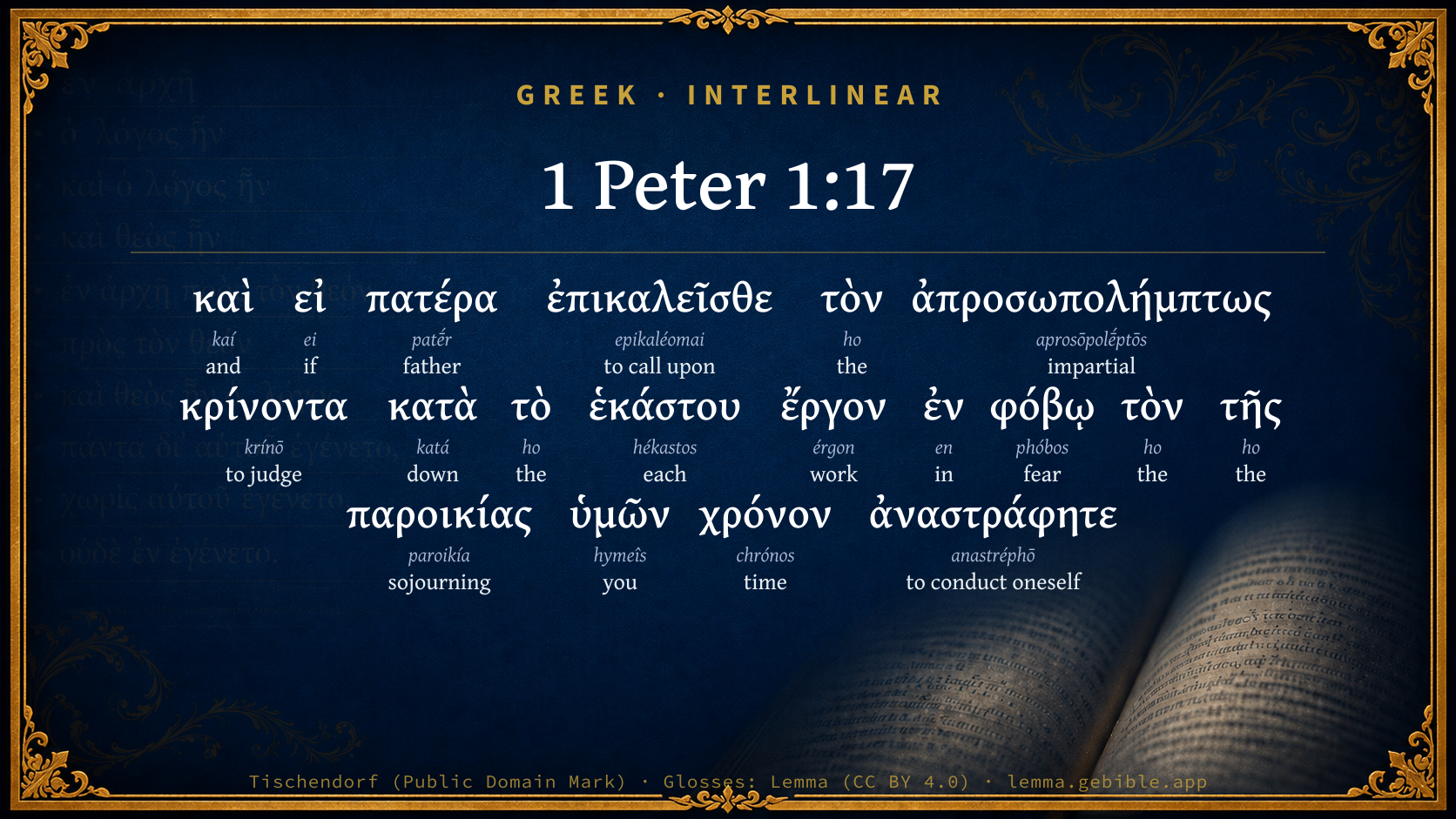
If you call on him as Father, who without respect of persons judges according to each man's work, pass the time of your living as strangers here in reverent fear:
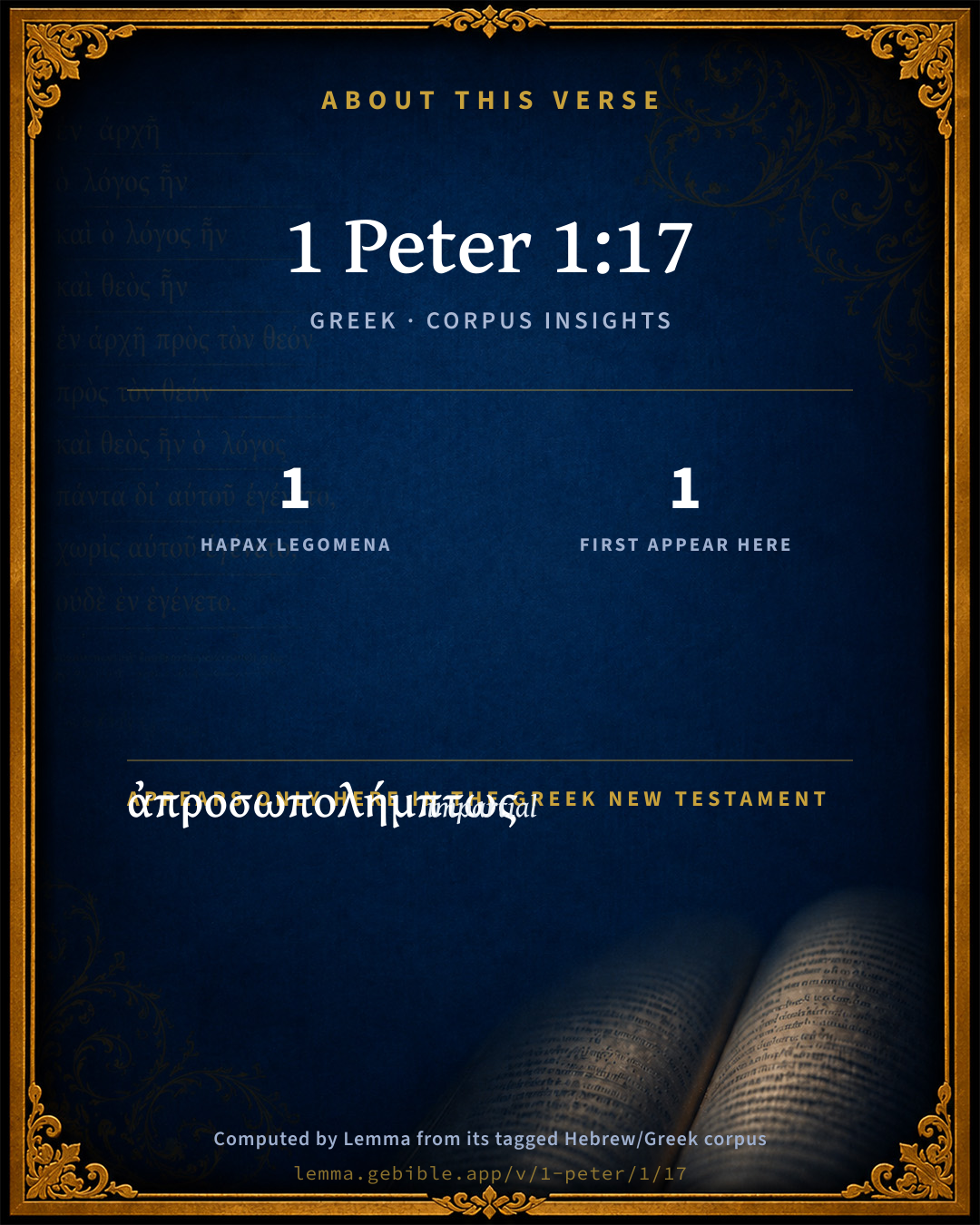
- 1 hapax legomenon — only here in the Greek New Testament
- 1 first appearance in the Greek New Testament
Download a study sheet
One document with this verse’s original text, its word-by-word gloss line, the meaning frame, cross-references with their text, attributed commentary, and full source and license credits — printable, and it pastes into notes with its structure intact.
This verse Autodidact and up
A passage Seminary Student
Up to 50 verses in one chapter. A passage sheet keeps up to 6 commentary sources and 12 cross-references per verse, in the order this page ranks them, and says so on the sheet whenever that leaves anything out. Ask for a single verse and you get the Autodidact verse sheet above.
Everything on this page stays free to read, with no account — the sheet is a download of what is already on screen, not access to it.
Compare translations 3
The same verse in 3 English versions, stacked beneath the original-language interlinear above. Click any original word for its lexicon entry.
Each is an independent rendering of the whole verse — the interlinear is not word-aligned to these translations.
Highlighted words mark where these versions differ — a whole-verse word diff, not a word-by-word alignment.
-
World English Bible Public Domain
If you call on him as Father, who without respect of persons judges according to each man's work, pass the time of your living as strangers here in reverent fear:
-
King James Version Public Domain
And if ye call on the Father, who without respect of persons judgeth according to every man's work, pass the time of your sojourning here in fear:
-
unfoldingWord Literal Text CC BY-SA 4.0
And if you call “Father” the one judging impartially according to the work of each one, conduct yourselves in fear the time of your sojourn,
unfoldingWord Literal Text — © unfoldingWord, licensed CC BY-SA 4.0. Word-aligned USFM3 via Door43 (git.door43.org/unfoldingWord/en_ult).
Show all 19 translations
Every available English version of this verse, each an independent rendering of the whole verse.
-
World English Bible Public Domain
If you call on him as Father, who without respect of persons judges according to each man's work, pass the time of your living as strangers here in reverent fear:
-
Berean Standard Bible Public Domain
Since you call on a Father who judges each one’s work impartially, conduct yourselves in reverent fear during your stay as foreigners.
-
Majority Standard Bible Public Domain
Since you call on a Father who judges each one’s work impartially, conduct yourselves in reverent fear during your stay as foreigners.
-
King James Version Public Domain
And if ye call on the Father, who without respect of persons judgeth according to every man's work, pass the time of your sojourning here in fear:
-
American Standard Version (1901) Public Domain
And if ye call on him as Father, who without respect of persons judgeth according to each man's work, pass the time of your sojourning in fear:
-
Revised Version (1885) Public Domain
And if ye call on him as Father, who without respect of persons judgeth according to each man’s work, pass the time of your sojourning in fear:
-
Geneva Bible (1599) Public Domain
And if ye call him Father, which without respect of person iudgeth according to euery mans woorke, passe the time of your dwelling here in feare,
-
Douay-Rheims (1899) Public Domain
And if you invoke as Father him who, without respect of persons, judgeth according to every one's work: converse in fear during the time of your sojourning here.
-
Young's Literal Translation Public Domain
and if on the Father ye do call, who without acceptance of persons is judging according to the work of each, in fear the time of your sojourn pass ye,
-
Literal Standard Version CC BY-SA 4.0
and if you call on the Father, who is judging without favoritism according to the work of each, pass the time of your sojourn in fear,
-
Unlocked Literal Bible CC BY-SA 4.0
So if you call “Father” the one who judges impartially and according to each person's work, go through the time of your journey in reverence.
-
unfoldingWord Literal Text CC BY-SA 4.0
And if you call “Father” the one judging impartially according to the work of each one, conduct yourselves in fear the time of your sojourn,
-
Darby Bible Public Domain
And if ye invoke as Father him who, without regard of persons, judges according to the work of each, pass your time of sojourn in fear,
-
World Messianic Bible Public Domain
If you call on him as Father, who without respect of persons judges according to each man’s work, pass the time of your living as foreigners here in reverent fear,
-
Webster's Bible Public Domain
And if ye call on the Father, who without respect of persons judgeth according to every man's work, pass the time of your sojourning here in fear:
-
Free Bible Version CC BY-SA 4.0
Since you call him Father, and recognize he judges everyone impartially based on what they do, take your time here on earth seriously, respecting him.
-
Bible in Basic English Public Domain
And if you give the name of Father to him who, judging every man by his acts, has no respect for a man's position, then go in fear while you are on this earth:
-
Text-Critical English NT CC BY 4.0
If you call on the Father who judges without partiality according to each person's work, pass the time of your sojourn in reverent fear.
-
Tyndale New Testament (1534) Public Domain
And yf so be that ye call on the father which with out respecte of person iudgeth accordinge to every manes worke se that ye passe the tyme of youre pilgremage in feare.
Literal Standard Version (2020), Covenant Press — licensed CC BY-SA 4.0. Text via the HelloAO Bible API (eBible.org). Unlocked Literal Bible (unfoldingWord) — licensed CC BY-SA 4.0. Text via the HelloAO Bible API (eBible.org). unfoldingWord Literal Text — © unfoldingWord, licensed CC BY-SA 4.0. Word-aligned USFM3 via Door43 (git.door43.org/unfoldingWord/en_ult). Free Bible Version, Dr. Jonathan Gallagher — licensed CC BY-SA 4.0. Text via the HelloAO Bible API (eBible.org).
Word by word
More ways to search: Search by grammar → Find every occurrence → Compare this word →
Practice this passage: Drill this verse → Learn its vocabulary →
- Appears 1× in the Greek New Testament
- First appears here
- Part of Speech
- Adverb
Full Thayer's Definition
- καὶ kaí G2532 “and” Conjunction
- εἰ ei G1487 “if” Conditional
- πατέρα patḗr G3962 “father” Noun, Accusative, Singular, Masculine
- ἐπικαλεῖσθε epikaléomai G1941 “to call upon” Verb, Present, Middle, Indicative, 2nd person, Plural
- τὸν ho G3588 “the” Article, Accusative, Singular, Masculine
- ἀπροσωπολήμπτως aprosōpolḗptōs G678 “impartial” Adverb
- κρίνοντα krínō G2919 “to judge” Verb, Present, Active, Participle, Accusative, Singular, Masculine
- κατὰ katá G2596 “down” Preposition
- τὸ ho G3588 “the” Article, Accusative, Singular, Neuter
- ἑκάστου hékastos G1538 “each” Adjective, Genitive, Singular, Masculine
- ἔργον érgon G2041 “work” Noun, Accusative, Singular, Neuter
- ἐν en G1722 “in” Preposition
- φόβῳ phóbos G5401 “fear” Noun, Dative, Singular, Masculine
- τὸν ho G3588 “the” Article, Accusative, Singular, Masculine
- τῆς ho G3588 “the” Article, Genitive, Singular, Feminine
- παροικίας paroikía G3940 “sojourning” Noun, Genitive, Singular, Feminine
- ὑμῶν hymeîs G5210 “you” Personal pronoun, 2nd person, Genitive, Plural
- χρόνον chrónos G5550 “time” Noun, Accusative, Singular, Masculine
- ἀναστράφητε anastréphō G390 “to conduct oneself” Verb, Aorist, Passive, Imperative, 2nd person, Plural
About this verse
These counts appear in no published source. They are computed here, from the morphology-tagged text and Lemma’s own curated glosses. What Lemma adds →
- 19
- words
- 16
- distinct lemmas
- General Epistles
- section
Notable vocabulary
1 hapax legomenon — a word that appears only here in the entire Greek New Testament:
- ἀπροσωπολήμπτως impartial G678
First appearance in Scripture
This word makes its first canonical appearance in the Greek New Testament here:
- ἀπροσωπολήμπτως impartial G678
Shared distinctive vocabulary
παροικίας sojourning G3940 occurs in 2 verses of the Greek New Testament. Also found in:
Repetition
A word recurs within this verse:
- τὸν the G3588 ×4
Cross-references
31Topical passages linked to 1 Peter 1:17 in the Treasury of Scripture Knowledge — connected by theme and wording, ordered by reader-vote popularity; previews shown in the World English Bible.
- Acts 10:34–35 Peter opened his mouth and said, "Truly I perceive that God doesn't show favoritism;
- 2 Chronicles 19:7 Now therefore let the fear of Yahweh be on you; take heed and do it: for there is no iniquity with Yahweh our God, nor respect of persons, nor taking of bribes.
- 2 Corinthians 7:1 Having therefore these promises, beloved, let us cleanse ourselves from all defilement of flesh and spirit, perfecting holiness in the fear of God.
- Philippians 2:12 So then, my beloved, even as you have always obeyed, not only in my presence, but now much more in my absence, work out your own salvation with fear and trembling.
- Matthew 6:9 Pray like this: 'Our Father in heaven, may your name be kept holy.
- Hebrews 12:28 Therefore, receiving a Kingdom that can't be shaken, let us have grace, through which we serve God acceptably, with reverence and awe,
- Jeremiah 3:19 But I said, How I will put you among the children, and give you a pleasant land, a goodly heritage of the hosts of the nations! and I said, You shall call me My Father, and shall not turn away from following me.
- Job 34:19 Who doesn't respect the persons of princes, Nor regards the rich more than the poor; For they all are the work of his hands.
- Proverbs 28:14 Blessed is the man who always fears; But one who hardens his heart falls into trouble.
- Matthew 7:7–11 "Ask, and it will be given you. Seek, and you will find. Knock, and it will be opened for you.
- Matthew 22:16 They sent their disciples to him, along with the Herodians, saying, "Teacher, we know that you are honest, and teach the way of God in truth, no matter who you teach, for you aren't partial to anyone.
- Romans 11:20 True; by their unbelief they were broken off, and you stand by your faith. Don't be conceited, but fear;
- Galatians 2:6 But from those who were reputed to be important (whatever they were, it makes no difference to me; God doesn't show partiality to man)--they, I say, who were respected imparted nothing to me,
- Ephesians 1:17 that the God of our Lord Jesus Christ, the Father of glory, may give to you a spirit of wisdom and revelation in the knowledge of him;
- Romans 2:10–11 But glory and honor and peace to every man who works good, to the Jew first, and also to the Greek.
- Ephesians 3:14 For this cause, I bow my knees to the Father of our Lord Jesus Christ,
- Ephesians 6:9 You masters, do the same things to them, and give up threatening, knowing that he who is both their Master and yours is in heaven, and there is no partiality with him.
- Colossians 3:25 But he who does wrong will receive again for the wrong that he has done, and there is no partiality.
- Hebrews 4:1 Let us fear therefore, lest perhaps a promise being left of entering into his rest, anyone of you should seem to have come short of it.
- Hebrews 11:13–16 These all died in faith, not having received the promises, but having seen them and embraced them from afar, and having confessed that they were strangers and pilgrims on the earth.
- 1 Peter 2:11 Beloved, I beg you as foreigners and pilgrims, to abstain from fleshly lusts, which war against the soul;
- Proverbs 14:16 A wise man fears, and shuns evil, But the fool is hotheaded and reckless.
- Zephaniah 3:9 For then I will purify the lips of the peoples, that they may all call on the name of Yahweh, to serve him shoulder to shoulder.
- 2 Corinthians 1:2 Grace to you and peace from God our Father and the Lord Jesus Christ.
- 2 Corinthians 5:6 Being therefore always of good courage, and knowing that, while we are at home in the body, we are absent from the Lord;
- 1 Peter 3:15 But sanctify the Lord God in your hearts; and always be ready to give an answer to everyone who asks you a reason concerning the hope that is in you, with humility and fear:
- Genesis 47:9 Jacob said to Pharaoh, "The days of the years of my pilgrimage are one hundred thirty years. Few and evil have been the days of the years of my life, and they have not attained to the days of the years of the life of my fathers in the days of their pilgrimage."
- Deuteronomy 10:17 For Yahweh your God, he is God of gods, and Lord of lords, the great God, the mighty, and the awesome, who doesn't regard persons, nor takes reward.
- 1 Chronicles 29:15 For we are strangers before you, and foreigners, as all our fathers were: our days on the earth are as a shadow, and there is no abiding.
- Psalms 39:12 "Hear my prayer, Yahweh, and give ear to my cry. Don't be silent at my tears. For I am a stranger with you, A foreigner, as all my fathers were.
- 2 Corinthians 7:11 For behold, this same thing, that you were made sorry in a godly way, what earnest care it worked in you. Yes, what defense, indignation, fear, longing, zeal, and vengeance! In everything you demonstrated yourselves to be pure in the matter.
Cross-references courtesy of OpenBible.info (CC BY 4.0).
Lesson kit
Teaching starters — assembled from the data on this page, not authored interpretation. Every prompt links to the verse data it draws on. Edit before teaching.
1 Peter, in the General Epistles, opens this verse with 19 words (16 distinct Greek lemmas). Its most distinctive word is aprosōpolḗptōs (“impartial”). A historical commentator’s framing appears above. Read the whole chapter for the surrounding context.
Discussion questions
- What does “impartial” (aprosōpolḗptōs) contribute to the verse as a whole?
- This verse holds 1 word here found nowhere else in the Greek New Testament. What might the rare word draw attention to?
- The word “impartial” first appears here in Scripture. What is being introduced at this debut?
- Acts 13:17 shares the word «sojourning» with this verse. How do the two illuminate each other?
- “the” occurs 4× in this one verse. What is the effect of the repetition?
- These translations render this verse differently. What is at stake in choosing one wording over another?
- Reading how The Biblical Illustrator and Joseph Benson's Commentary read this verse, where do the two commentators agree and where do they part?
Things to notice
- 1 word in this verse appears nowhere else in the Greek New Testament.
- 1 word makes its first canonical appearance in Scripture here.
- These translations choose different wording for 23 words in this verse.
- “the” occurs 4× in this single verse.
- 16 distinct Greek lemmas span 19 words in this verse.
Commentary
Notes on 1 Peter 1:17 from classic Christian and Jewish commentators (each source and its license shown beneath its notes). The classic Christian expositions comment on the surrounding passage and are grouped to its opening verse, so a note may address several verses; the Jewish commentaries on the Tanakh (Rashi and others) are per-verse, so they appear only where the commentator wrote on this verse.
Lemma curates 59 commentaries, every one of them public domain or Creative Commons licensed, each selected and text-cleaned for this edition rather than reprinted as found. About our sources →
The Biblical Illustrator
Joseph S. Exell
The Biblical Illustrator, edited by Joseph S. Exell (c. 1880s–1900s) — public domain. Text from a community e-Sword module.
Joseph Benson's Commentary
Joseph Benson's Commentary on the Old and New Testaments (1811–1818) — public domain. Text from a community e-Sword module.
Whedon's Commentary on the Bible
Daniel D. Whedon
Daniel D. Whedon (gen. ed.), Commentary on the Old and New Testaments (1874–1909) — public domain. Text from a community e-Sword module.
The Preacher's Complete Homiletical Commentary
Joseph S. Exell (gen. ed.)
The Preacher's Complete Homiletical Commentary (gen. ed. Joseph S. Exell; Funk & Wagnalls, c. 1892) — public domain (pre-1929). A full-Bible homiletical/sermon-outline anthology covering 65 of 66 books (2 John is absent from the source module). Text from a community e-Sword module.
MacLaren's Expositions of Holy Scripture
Alexander MacLaren
Alexander MacLaren, Expositions of Holy Scripture (1904–1910) — public domain. Text from a community e-Sword module.
Tyndale Open Study Notes
Tyndale Open Resources
Tyndale Open Study Notes — © Tyndale Open Resources, licensed CC BY-SA 4.0. Text via the HelloAO Bible API.
Bengel's Gnomon
Johann Albrecht Bengel
Bengel's Gnomon of the New Testament — English translation (T&T Clark, Edinburgh, 1860) — public domain. Text from a community e-Sword module.
Meyer's Critical & Exegetical Commentary
Heinrich August Wilhelm Meyer
Meyer — Critical and Exegetical Commentary on the New Testament — English translation by Peter Christie, edited by Frederick Crombie (T&T Clark, 1880) — public domain. Text from a community e-Sword module.
Expositor's Greek Testament
ed. W. Robertson Nicoll
The Expositor's Greek Testament, edited by W. Robertson Nicoll (1897–1910) — public domain. Text from a community e-Sword module.
Geneva Bible (1599)
Geneva Bible translators
Geneva Bible (1599) marginal notes — public domain. Text via Bolls.life.
Jamieson, Fausset & Brown
Robert Jamieson, A. R. Fausset & David Brown
Jamieson, Fausset & Brown — Commentary Critical and Explanatory on the Whole Bible (1871) — public domain (CC PDM 1.0). Text via the HelloAO Bible API.
Adam Clarke's Commentary
Adam Clarke's Commentary on the Bible (1810–1826) — public domain. Text from a community e-Sword/MySword module.
John Calvin's Commentaries
John Calvin's Commentaries (1540-1563) — public domain. Text from the Calvin Translation Society English edition (1840s-50s) via the Christian Classics Ethereal Library (ccel.org). Calvin's coverage is partial (roughly two-thirds of the Bible); uncommented books and verses are honest gaps, never fabricated. The 19th-century editor's footnotes and remarks are omitted so the notes are faithfully Calvin's own voice.
Ellicott's Commentary for English Readers
A Bible Commentary for English Readers, edited by Charles John Ellicott (1878–1897) — public domain. Text from a community e-Sword module.
The Cambridge Bible for Schools and Colleges
gen. ed. J. J. S. Perowne
The Cambridge Bible for Schools and Colleges (gen. ed. J. J. S. Perowne; Cambridge University Press, 1878–1918) — public domain. Text from a community e-Sword module.
John Gill's Exposition
John Gill's Exposition of the Whole Bible (1746–1763) — public domain (CC PDM 1.0). Text via the HelloAO Bible API.
Trapp's Complete Commentary
John Trapp
John Trapp, A Commentary or Exposition upon All the Books of the Old and New Testament (1647–1656) — public domain. Text from a community e-Sword module.
Albert Barnes' Notes on the Bible
Albert Barnes' Notes on the Bible (1834–1885) — public domain. Text from a community e-Sword/MySword module.
Matthew Poole's English Annotations
Matthew Poole's English Annotations on the Holy Bible (1683–1685) — public domain. Text from a community e-Sword/MySword module.
The Pulpit Commentary
The Pulpit Commentary (1880–1919), ed. H.D.M. Spence-Jones & Joseph S. Exell — public domain. Text from a community e-Sword module.
John Wesley's Explanatory Notes
John Wesley, Explanatory Notes Upon the Whole Bible (1754–1765) — public domain. Text via the GEBible commentary corpus.
Kretzmann's Popular Commentary
Paul E. Kretzmann
Paul E. Kretzmann, Popular Commentary of the Bible (1921–1924) — public domain. Text from a community e-Sword module.
Burkitt's Expository Notes on the New Testament
William Burkitt
William Burkitt's Expository Notes on the New Testament (1700–1703) — public domain. Text from a community e-Sword module.
The People's New Testament
B. W. Johnson
B. W. Johnson's The People's New Testament with Notes (1889–1891) — public domain. Electronic text from the Christian Classics Ethereal Library (CCEL) ThML edition.
Cambridge Greek Testament for Schools and Colleges
Cambridge Greek Testament for Schools and Colleges (Cambridge University Press, 1896; 21 vols, various authors incl. Carr, Maclear, Plummer, Farrar, Lumby, Moule, M. R. James, Simcox) — public domain. Text from a community e-Sword module.
Alford’s Greek Testament
Henry Alford
Henry Alford, The Greek Testament (1849–1861) — public domain. Text from a community e-Sword module.
Vincent's Word Studies in the New Testament
Marvin R. Vincent
Marvin R. Vincent, Word Studies in the New Testament (1887–1900) — public domain. Text from a community e-Sword/MySword module.