
James 2:18

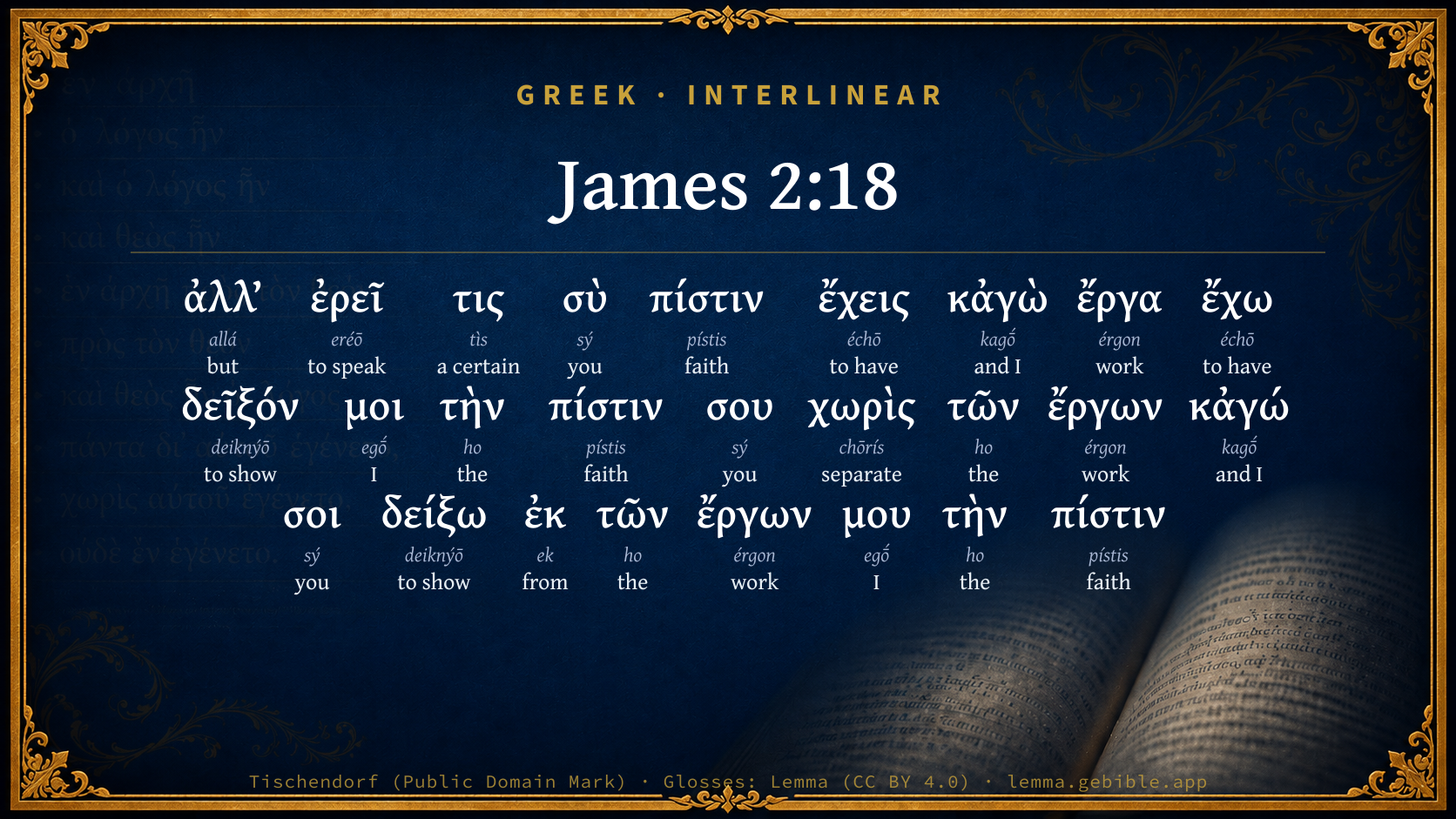
Greek (Tischendorf 8th ed.) James 2:18 appears in the Greek New Testament. The text above is from the Tischendorf 8th edition. Each word links to its Strong’s number and a concise gloss. Click any word for its full Thayer’s Greek Lexicon entry.
Download image
Cite this verse

James 2:18 (World English Bible). Public Domain. Lemma interlinear Bible study tool, https://lemma.gebible.app/v/james/2/18.

Show BibTeX & RIS
BibTeX
RIS
English Translation
Yes, a man will say, "You have faith, and I have works." Show me your faith from your works, and I by my works will show you my faith.
World English Bible · Public Domain
Download a study sheet

One document with this verse’s original text, its word-by-word gloss line, the meaning frame, cross-references with their text, attributed commentary, and full source and license credits — printable, and it pastes into notes with its structure intact.

This verse Autodidact and up

Study sheet (.html) Plain text (.txt)

A passage Seminary Student

Up to 50 verses in one chapter. A passage sheet keeps up to 6 commentary sources and 12 cross-references per verse, in the order this page ranks them, and says so on the sheet whenever that leaves anything out. Ask for a single verse and you get the Autodidact verse sheet above.

Everything on this page stays free to read, with no account — the sheet is a download of what is already on screen, not access to it.

Want to remove ads? Support Godless Engineer
Compare translations 3

The same verse in 3 English versions, stacked beneath the original-language interlinear above. Click any original word for its lexicon entry.

Each is an independent rendering of the whole verse — the interlinear is not word-aligned to these translations.

Highlighted words mark where these versions differ — a whole-verse word diff, not a word-by-word alignment.

  • World English Bible Public Domain
    Yes, a man will say, "You have faith, and I have works." Show me your faith from your works, and I by my works will show you my faith.
  • King James Version Public Domain
    Yea, a man may say, Thou hast faith, and I have works: shew me thy faith without thy works, and I will shew thee my faith by my works.
  • unfoldingWord Literal Text CC BY-SA 4.0
    But someone will say, “You have faith, and I have works.” Show me your faith without the works, and I will show you my faith from the works.

unfoldingWord Literal Text — © unfoldingWord, licensed CC BY-SA 4.0. Word-aligned USFM3 via Door43 (git.door43.org/unfoldingWord/en_ult).

Versions to compare (up to 4)

3 of 4 selected

Show all 19 translations

Every available English version of this verse, each an independent rendering of the whole verse.

  • World English Bible Public Domain
    Yes, a man will say, "You have faith, and I have works." Show me your faith from your works, and I by my works will show you my faith.
  • Berean Standard Bible Public Domain
    But someone will say, “You have faith and I have deeds.” Show me your faith without deeds, and I will show you my faith by my deeds.
  • Majority Standard Bible Public Domain
    But someone will say, “You have faith and I have deeds.” Show me your faith apart from your deeds, and I will show you my faith by my deeds.
  • King James Version Public Domain
    Yea, a man may say, Thou hast faith, and I have works: shew me thy faith without thy works, and I will shew thee my faith by my works.
  • American Standard Version (1901) Public Domain
    Yea, a man will say, Thou hast faith, and I have works: show me thy faith apart from `thy' works, and I by my works will show thee `my' faith.
  • Revised Version (1885) Public Domain
    Yea, a man will say, Thou hast faith, and I have works: shew me thy faith apart from thy works, and I by my works will shew thee my faith.
  • Geneva Bible (1599) Public Domain
    But some man might say, Thou hast the faith, and I haue woorkes: shewe me thy faith out of thy woorkes, and I will shewe thee my faith by my woorkes.
  • Douay-Rheims (1899) Public Domain
    But some man will say: Thou hast faith, and I have works: shew me thy faith without works; and I will shew thee, by works, my faith.
  • Young's Literal Translation Public Domain
    But say may some one, Thou hast faith, and I have works, shew me thy faith out of thy works, and I will shew thee out of my works my faith:
  • Literal Standard Version CC BY-SA 4.0
    But someone may say, “You have faith, and I have works.” Show me your faith without works, and I will show you my faith out of works.
  • Unlocked Literal Bible CC BY-SA 4.0
    Yet someone may say, “You have faith, and I have works.” Show me your faith without works, and I will show you my faith by my works.
  • unfoldingWord Literal Text CC BY-SA 4.0
    But someone will say, “You have faith, and I have works.” Show me your faith without the works, and I will show you my faith from the works.
  • Darby Bible Public Domain
    But some one will say, *Thou* hast faith and *I* have works. Shew me thy faith without works, and *I* from my works will shew thee my faith.
  • World Messianic Bible Public Domain
    Yes, a man will say, “You have faith, and I have works.” Show me your faith without works, and I will show you my faith by my works.
  • Webster's Bible Public Domain
    Also a man may say, Thou hast faith, and I have works: show me thy faith without thy works, and I will show thee my faith by my works.
  • Free Bible Version CC BY-SA 4.0
    Someone may argue, “You have your trust in God; I have my good deeds.” Well, show me your trust in God without good deeds, and I will show you my trust in God by my good deeds!
  • Bible in Basic English Public Domain
    But a man may say, You have faith and I have works; let me see your faith without your works, and I will make my faith clear to you by my works.
  • Text-Critical English NT CC BY 4.0
    But someone will say, “Yoʋ have faith, and I have works.” Show me yoʋr faith by yoʋr works, and I, by my works, will show yoʋ my faith.
  • Tyndale New Testament (1534) Public Domain
    Ye and a man myght saye: Thou hast fayth and I have dedes: Shewe me thy fayth by thy dedes: and I will shewe the my fayth by my dedes.

Literal Standard Version (2020), Covenant Press — licensed CC BY-SA 4.0. Text via the HelloAO Bible API (eBible.org). Unlocked Literal Bible (unfoldingWord) — licensed CC BY-SA 4.0. Text via the HelloAO Bible API (eBible.org). unfoldingWord Literal Text — © unfoldingWord, licensed CC BY-SA 4.0. Word-aligned USFM3 via Door43 (git.door43.org/unfoldingWord/en_ult). Free Bible Version, Dr. Jonathan Gallagher — licensed CC BY-SA 4.0. Text via the HelloAO Bible API (eBible.org).

Word by word

More ways to search: Search by grammar → Find every occurrence → Compare this word →

Practice this passage: Drill this verse → Learn its vocabulary →

δεῖξόν
deiknýō
G1166
“to show”
Verb, Aorist, Active, Imperative, 2nd person, Singular
Part of Speech
Verb
Tense
Aorist
Voice
Active
Mood
Imperative
Person
2nd person
Number
Singular
Full Thayer's Definition

Origin: a prolonged form of an obsolete primary of the same meaning

TDNT: 2:25,*

1. to show, expose to the eyes 2. metaph. a. to give evidence or proof of a thing b. to show by words or teach
  1. ἀλλ’ allá G235 “but” Conjunction
  2. ἐρεῖ eréō G2046 “to speak” Verb, Future, Active, Indicative, 3rd person, Singular
  3. τις tìs G5100 “a certain” Indefinite pronoun, Nominative, Singular, Masculine
  4. σὺ sý G4771 “you” Personal pronoun, 2nd person, Nominative, Singular
  5. πίστιν pístis G4102 “faith” Noun, Accusative, Singular, Feminine
  6. ἔχεις échō G2192 “to have” Verb, Present, Active, Indicative, 2nd person, Singular
  7. κἀγὼ kagṓ G2504 “and I” Personal pronoun, 1st person, Nominative, Singular, Aramaic form
  8. ἔργα érgon G2041 “work” Noun, Accusative, Plural, Neuter
  9. ἔχω échō G2192 “to have” Verb, Present, Active, Indicative, 1st person, Singular
  10. μοι egṓ G1473 “I” Personal pronoun, 1st person, Dative, Singular
  11. τὴν ho G3588 “the” Article, Accusative, Singular, Feminine
  12. πίστιν pístis G4102 “faith” Noun, Accusative, Singular, Feminine
  13. σου sý G4771 “you” Personal pronoun, 2nd person, Genitive, Singular
  14. χωρὶς chōrís G5565 “separate” Adverb
  15. τῶν ho G3588 “the” Article, Genitive, Plural, Neuter
  16. ἔργων érgon G2041 “work” Noun, Genitive, Plural, Neuter
  17. κἀγώ kagṓ G2504 “and I” Personal pronoun, 1st person, Nominative, Singular, Aramaic form
  18. σοι sý G4771 “you” Personal pronoun, 2nd person, Dative, Singular
  19. δείξω deiknýō G1166 “to show” Verb, Future, Active, Indicative, 1st person, Singular
  20. ἐκ ek G1537 “from” Preposition
  21. τῶν ho G3588 “the” Article, Genitive, Plural, Neuter
  22. ἔργων érgon G2041 “work” Noun, Genitive, Plural, Neuter
  23. μου egṓ G1473 “I” Personal pronoun, 1st person, Genitive, Singular
  24. τὴν ho G3588 “the” Article, Accusative, Singular, Feminine
  25. πίστιν pístis G4102 “faith” Noun, Accusative, Singular, Feminine

About this verse

These counts appear in no published source. They are computed here, from the morphology-tagged text and Lemma’s own curated glosses. What Lemma adds →

26
words
13
distinct lemmas
General Epistles
section

Shared distinctive vocabulary

δεῖξόν to show G1166 occurs in 30 verses of the Greek New Testament. Also found in:
Repetition

Words recur within this verse:

  • πίστιν faith G4102 ×3
  • ἔργα work G2041 ×3
  • ἔχεις to have G2192 ×2
  • κἀγὼ and I G2504 ×2
  • δεῖξόν to show G1166 ×2
  • τὴν the G3588 ×4
  • σὺ you G4771 ×3
  • μοι I G1473 ×2

Cross-references

19

Topical passages linked to James 2:18 in the Treasury of Scripture Knowledge — connected by theme and wording, ordered by reader-vote popularity; previews shown in the World English Bible.

  • James 3:13 Who is wise and understanding among you? Let him show by his good conduct that his deeds are done in gentleness of wisdom.
  • James 2:14 What good is it, my brothers, if a man says he has faith, but has no works? Can faith save him?
  • Galatians 5:6 For in Christ Jesus neither circumcision amounts to anything, nor uncircumcision, but faith working through love.
  • 1 Timothy 1:5 but the end of the charge is love, out of a pure heart and a good conscience and unfeigned faith;
  • Titus 2:7 in all things showing yourself an example of good works; in your teaching showing integrity, seriousness, incorruptibility,
  • Titus 2:11–14 For the grace of God has appeared, bringing salvation to all men,
  • Matthew 7:16–17 By their fruits you will know them. Do you gather grapes from thorns, or figs from thistles?
  • Romans 14:23 But he who doubts is condemned if he eats, because it isn't of faith; and whatever is not of faith is sin. (14:24) Now to him who is able to establish you according to my Gospel and the preaching of Jesus Christ, according to the revelation of the mystery which has been kept secret through long ages, (14:25) but now is revealed, and by the Scriptures of the prophets, according to the commandment of the eternal God, is made known for obedience of faith to all the nations; (14:26) to the only wise God, through Jesus Christ, to whom be the glory forever! Amen.
  • 1 Thessalonians 1:3–10 remembering without ceasing your work of faith and labor of love and patience of hope in our Lord Jesus Christ, before our God and Father.
  • Hebrews 11:31 By faith, Rahab the prostitute, didn't perish with those who were disobedient, having received the spies in peace.
  • Romans 3:28 We maintain therefore that a man is justified by faith apart from the works of the law.
  • 1 Corinthians 13:2 If I have the gift of prophecy, and know all mysteries and all knowledge; and if I have all faith, so as to remove mountains, but don't have love, I am nothing.
  • Hebrews 11:6 Without faith it is impossible to be well pleasing to him, for he who comes to God must believe that he exists, and that he is a rewarder of those who seek him.
  • Hebrews 11:33 who, through faith subdued kingdoms, worked out righteousness, obtained promises, stopped the mouths of lions,
  • Romans 4:6 Even as David also pronounces blessing on the man to whom God counts righteousness apart from works,
  • Romans 8:1 There is therefore now no condemnation to those who are in Christ Jesus, who don't walk according to the flesh, but according to the Spirit.
  • 2 Corinthians 5:17 Therefore if anyone is in Christ, he is a new creation. The old things have passed away. Behold, all things have become new.
  • 2 Corinthians 7:1 Having therefore these promises, beloved, let us cleanse ourselves from all defilement of flesh and spirit, perfecting holiness in the fear of God.
  • James 2:22–25 You see that faith worked with his works, and by works faith was perfected;

Cross-references courtesy of OpenBible.info (CC BY 4.0).

Commentary

Notes on James 2:18 from classic Christian and Jewish commentators (each source and its license shown beneath its notes). The classic Christian expositions comment on the surrounding passage and are grouped to its opening verse, so a note may address several verses; the Jewish commentaries on the Tanakh (Rashi and others) are per-verse, so they appear only where the commentator wrote on this verse.

Lemma curates 59 commentaries, every one of them public domain or Creative Commons licensed, each selected and text-cleaned for this edition rather than reprinted as found. About our sources →

Ellicott's Commentary for English Readers

(18) Yea, a man may say . . .—The bearing of this verse is commonly misunderstood; its words are those of scorn, uttered probably by some enemy of the faith—Jewish or Pagan—and are another instance, like that of the unruly tongue, by which those outside the pale of Christianity may and will judge us within. Jas_2:18-22 are all the speech of this practical opponent of first century solifidianism. The English version, “Show me thy faith without thy works” is correct, though according to some editors (see marginal variation) it should be by or from.

The sense is obvious; and whether the speaker be Christian or no, he lays claim to faith in God, the Father of all, as the efficient cause of his good deeds.

A Bible Commentary for English Readers, edited by Charles John Ellicott (1878–1897) — public domain. Text from a community e-Sword module.

Joseph Benson's Commentary

Jas 2:18-20. Yea, a man — Who judges better; may say — To such a vain talker, in order to bring matters to a short issue; thou hast faith — Thou sayest; and I make it appear by my life and conversation that I have works — Which naturally spring from that principle. Show me thy faith without thy works — If thou canst. Or, εκ των εργων σου, by thy works, as the most and the best copies read it, and as it is read in the margin. And I will show thee my faith by my works — Let us, without contending about different explications of faith, make it manifest to each other that our profession is solid, by its substantial effects upon our tempers and lives. As if he had said, The only way in which thou canst show thy faith is by thy works; but as thou hast no works to produce, thou never canst show thy faith in this way. Thou believest that there is one God — I allow that thou dost: but this only proves that thou hast the same faith which the devils have. Nay, they not only believe, but tremble at the dreadful expectation of eternal torments. So far is that faith from either justifying or saving them. But wilt thou — Art thou willing; to know — Indeed thou art not, thou wouldest fain be ignorant of it: O vain — Κενε, empty, man — Devoid of all true religion; that faith without works — A persuasion of the truths of the gospel, if it produces no real fruits of holiness; is dead — As to any valuable purpose that can be expected from it. Indeed it cannot justly be said to be faith, as a dead carcass is not a man. By a dead faith, then, St. James means a faith which, because it has no influence on a man’s actions, is as incapable to justify him, as a dead carcass is to perform the offices of a living man.

Joseph Benson's Commentary on the Old and New Testaments (1811–1818) — public domain. Text from a community e-Sword module.

Tyndale Open Study Notes

Tyndale Open Resources

2:18-19 James demonstrates the futility of believing that something is true without acting upon it. • Now someone may argue: James presents another diatribe (see study note on 1:13), in which he presents a hypothetical counterargument that one person may have the gift of faith while another person has the gift of works (see 1 Cor 12:7-9).

Tyndale Open Study Notes — © Tyndale Open Resources, licensed CC BY-SA 4.0. Text via the HelloAO Bible API.

Bengel's Gnomon

Johann Albrecht Bengel

Jas 2:18. Ἀλλʼ ἐρεῖ τις, but some one will say) entertaining more correct sentiments than the other person, mentioned in Jas 2:14, and asserting the true nature of faith and works.—δεῖξόν μοι) show me thy faith without thy works (show, if thou canst; that is, thou canst not); and I will show thee by my works, of which I know that I cannot be destitute, my faith. There are two sayings, the former of which[24] speaks of faith before works, the latter of works before faith, and this for the sake of emphasis; the former has reference to the clause, Thou hast faith; the latter to the clause, and I have works. See Apparat. Crit., Ed. ii., on this passage.[25] [The ΧΩΡῚς gives point to the challenge, ΔΕῖΖΟΝ, Κ.Τ.Λ.—Not. Crit.]

[24] Thus also verse 22. See the note on Luk 11:36.

[25] ABC Vulg. have χωρίς. But Stephens’ Rec. Text (not Engl. Vers.) has ἐκ, with later authorities.—E.

Bengel's Gnomon of the New Testament — English translation (T&T Clark, Edinburgh, 1860) — public domain. Text from a community e-Sword module.

Meyer's Critical & Exegetical Commentary

Heinrich August Wilhelm Meyer

Jam_2:18. The words ἀλλʼ ἐρεῖ τις, with which this verse begins, apparently introduces an objection, as in 1Co_15:35; by which under τις a certain one is to be considered as an opponent of the thought above expressed, who with σύ addresses James, and by κἀγώ denotes himself. But against this explanation the sentiment itself is opposed; for as James reproaches those, against whom he argues, that they have indeed faith but not works, he could not possibly put into the mouth of his opponent, that the same had works, but he (James) had faith. The opinion of Pott, that σὺ … κἀγώ = ἄλλος καὶ ἄλλος, cannot be justified (so also Bouman: hic … ille). By that explanation it would require to be said: σὺ ἔργα ἔχεις, κἀγὼ πίστιν ἔχω, namely, in the sense: If thou place all stress on works, I am not the less entitled to place all stress on faith. Kern attempts to remove the difficulty by taking the first sentence: σὺ πίστιν ἔχεις, as a hypothetical protasis, and the second, on the other hand, κἀγὼ ἔργα ἔχω, as the apodosis, and explains it: If thou hast faith, so have I also works, because, as thou sayest, faith and works cannot be separated. But to this explanation is opposed not only the fact that James has not in what has gone before properly expressed the inseparableness of faith and works, but has only presupposed it; but also that the opponent should appeal to works, whilst James considers him as a person who has no works.[135] With these difficulties it is not to be wondered at that almost all expositors have decided for the view that ἈΛΛʼ ἘΡΕῖ ΤΙς is not here to be taken as the form of an objection, and that by ΤΙς not an opponent of James is meant, but a vir sapiens et intelligens, to whom James assigns the part of carrying on the argument in his stead against his opponent. Wiesinger: ἀλλʼ ἐρεῖ τις cannot here be possibly taken, as in 1Co_15:35, Rom_9:19, as an objection, for, as ΣῪ ΠΊΣΤΙΝ ἜΧΕΙς already shows, the person introduced as speaking is on the side of James, and like him combats faith without works. Accordingly, with ΣΎ the same opponent is addressed whom James had hitherto in view, and with ΚἈΓΏ the person called ΤΙς designates himself as agreeing with James. But against this explanation there are many objections. 1. It cannot be denied that the words ἈΛΛʼ ἘΡΕῖ ΤΙς have most decidedly the character of an objection. 2. If they are not so understood, then ἈΛΛʼ is not only an interruption, but inexplicable; Hottinger, indeed, maintains: ἈΛΛΆ hic non adversativum esse per se patet; but who will agree with him in this? De Wette assumes that by ἈΛΛΆ here is expressed not primarily the contrast with what immediately precedes, but with the error already combated. Wiesinger has, however, correctly rejected this opinion, which is the less to be justified as the error has not yet been per se expressed. ἀλλά must at all events be referred to what directly precedes. According to Schneckenburger, it refers ad negationem, quam notitio ΝΕΚΡΌς involvit, quasi dictum foret: ista fides non est fides, sed dicat aliquis; but that πίστις, if it has not works, is not ΠΊΣΤΙς at all, is so little the opinion of James that he ascribes a ΠΙΣΤΕΎΕΙΝ to the devils (Jam_2:19); ΝΕΚΡΆ is here arbitrarily explained as = nulla, and not less arbitrarily is it observed on ΠΊΣΤΙΝ ἜΧΕΙς: interlocutor ad hominis errorcm descendens fidem, quam profitetur, eum habere sumit, since James does not the least indicate that the words σὺ πίστιν ἔχεις are to be understood in the sense: I will even assume that thou hast faith. The opinion of several critics, that ἈΛΛΆ is here (= quin etiam) a correction of the preceding judgment, heightening it (Wiesinger), and indicates that the opinion that a faith without works is dead is here surpassed (Gunkel), is of no avail, as the opinion contained in this verse on faith without works is evidently not, as Brückner falsely thinks, stronger than that which is expressed in Jam_2:17 with ΝΕΚΡΆ ἘΣΤΙΝ.[136] Accordingly, all attempts at the explanation of ἀλλά do not attain their object.[137] 3. With this explanation it is entirely uncertain how far the speech of τις extends, and where James again resumes; and accordingly the greatest uncertainty here occurs among expositors. 4. Lastly, it cannot be perceived why James should express his own opinion in the person of another who is designated by the entirely indefinite term τις. Wiesinger and most expositors do not touch on this point at all. Baumgarten thinks that James speaks here in the words of a stranger, in order the better and the more freely to convey the notion of erroneousness in severer terms. But this is a pure fiction; that James did not shun from expressing himself freely and strongly the whole Epistle is a proof.[138] These objections are too important to permit us in spite of them to rest on the above explanation. But, on the other hand, the difficulties which arise if ἈΛΛʼ ἘΡΕῖ ΤΙς is taken as a form of objection appear to be invincible. They are only so, however, when it is assumed that the person introduced with ΣΎ as speaking means James, and with ΚἈΓΏ himself. But this assumption is by no means necessary. Since James introduces ΤΙς as speaking, so both words ΣΎ and ΚἈΓΏ can be understood as well from the standpoint of James as from that of the speaker; that is to say, that with ΣΎ the opponent with whom James argues, and against whom he asserts that πίστις without works is dead, is meant, and with ἘΓΏ James himself. The meaning, then, is as follows: But some might say in answer to what I have just stated, defending thee,[139] thou (who hast not the works) hast faith, and I, on the other hand (who affirm that faith without works is dead), have works;[140] my one-sided insisting on works is no more right than thy one-sided insisting on faith. By this explanation, which has nothing linguistically against it, not only is the nature of ἀλλʼ ἐρεῖ τις preserved, but it expresses a thought entirely suited to the context, whilst the following words give the answer by which this objection is decidedly repelled. This answer is in form not directed to the person introduced as speaking, but to the opponent with whom only James has properly to do, and whom he in his lively style can now the more directly address, as the objection made was the expression of his soul. The meaning of this answer is as follows: Hast thou actually, as that person says, faith, and if this is to be of use it must manifest itself, but this without works is impossible; thou canst not even show thy faith without works; as for myself, who have works, these are a proof that faith is not wanting, for without faith I could do no works. On δεῖξον, Schneckenburger correctly remarks: vide ne verbo tribuas significationem exhibendi et manifestandi (per vitam), sed retine primam et simplicem comprobari quasi ante judicem.

τὴν πίστιν σου is said because the opponent ascribed faith to himself (Jam_2:14); thus the faith which thou sayest thou hast (Wiesinger).

With the reading of the Rec. ἐκ τ. ἔργων (instead of χωρὶς τῶν ἔργων) the words are to be taken as ironical (so also Lange), as the supposition is that works are wanting to him.

With these words not faith generally, but living faith which saves is denied to the opponent; if the same is not proved by works, it is dead.

In what James says of himself, ἔργα are the works which proceed from faith, as these could not otherwise authenticate it. It is to be observed that in the first clause τὴν πίστιν, and in the second ἐκ τῶν ἔργων, stand first, because these ideas are the points on which the whole turns.

[135] The explanation of Knapp, that the first words are interrogative: tune quia ipse fide cares, propterea eam contemnis? and to which the answer is then given: immo vero plus habeo, quam quantum tu et habes et postulas, fidem videlicet cum factis conjunctam, is correctly relinquished by himself, as it is too artificial to be considered as correct.

[136] Wiesinger observes: The person introduced as speaking not only confirms what was said before, but goes beyond it; not only that such a faith is dead, but that it cannot even prove its existence without works: it is nothing. But with these last words Wiesinger inserts a thought into the words which they by no means contain, the same thought which, according to Schneckenburger, is contained in νεκρά ἐστι.

[137] The pointing ἀλλʼ, ἐρεῖ τις, σὺ κ.τ.λ. (Schulthess, Gebser, Rauch) does in no way remove the difficulty, and has also this against it, that the closely-united formula ἀλλʼ ἐρεῖ τις is thus disunited.

[138] Lange thinks to remove the difficulty by ascribing to the words a grand prophetical character, whilst by τις is meant the Gentile-Christian world, which has proved by its works of faith that it has had the true faith, whereas Ebionism, with its want of consistency in Christian works of love, has proved that its orthodoxy was not a living faith. But, apart from the arbitrariness of this interpretation, ἀλλά is by it referred not to the preceding declaration, but falsely to the erroneous opinion of τις (ver. 14).

[139] The view of Stier, that by the speaker a Pharisaical Jew is to be understood, who takes occasion from the inoperative faith of Christians to mock the Christian faith in general, has been rightly rejected by Wiesinger. If James had meant by τις a Jew, he would have called him such.

[140] This is a form of expression which frequently occurs. Thus, if one speaks with Charles, and says to him: Henry says thou hast found the book which I have lost. Brückner, indeed, thinks that this example is not appropriate, but he does not give his reasons for saying so. Lange calls the explanation here given artificial, but he does not say in what its artificial character consists. The objections which Lange brings against it are founded on his having read erroneously defending himself instead of defending thee.

Meyer — Critical and Exegetical Commentary on the New Testament — English translation by Peter Christie, edited by Frederick Crombie (T&T Clark, 1880) — public domain. Text from a community e-Sword module.

Expositor's Greek Testament

ed. W. Robertson Nicoll

Jas 2:18 . ἀλλʼ ἐρεῖ τις : these words, together with the argumentative form of the verses that follow, imply that a well-known subject of controversy is being dealt with. Ἀλλʼ ἐρεῖ τις is a regular argumentative phrase, used of an objection. “Instead of the future the optative with ἄν would be more common in classical Greek, but the latter form is rather avoided by the Hellenistic writers, occurring only eight times in the N.T., thrice in Luke, five times in Acts” (Mayor). ἔχεις : the interrogative here suggested by WH does not commend itself, as the essence of the argument is the setting-up of two opposing and definite standpoints. κἀγὼ : In the N.T. καί “often coalesces with ἐγώ (and its oblique cases), ἐκεῖ , ἐκεῖθεν , ἐκεῖνος , and ἄν ; but there are many exceptions, and especially where there is distinct coordination of ἐγώ with another pronoun or a substantive. There is much division of evidence” (WH, Ths N.T. in Greek , II. App., p. 145). δεῖξόν μοι τὴν πίστιν σου …: πίστις is not used quite consistently by the writer; faith which requires works to prove its existence is not the same thing which is spoken of in the next verse as the possession of demons; the difference is graphically illustrated in the account of the Gadarene demoniac; in Luk 8:28 the words, What have I to do with thee, Jesus, thou Son of the Most High God , express a purely intellectual form of faith, which is a very different thing from the attitude of mind implied in the words which describe the whilom demoniac, as, sitting, clothed and in his tight mind, at the feet of Jesus (Luk 8:35 ). With the whole verse cf. Rom 3:28 ; Rom 4:6 .

The Expositor's Greek Testament, edited by W. Robertson Nicoll (1897–1910) — public domain. Text from a community e-Sword module.

Geneva Bible (1599)

Geneva Bible translators

Nay, thus may every man beat down the pride.

Geneva Bible (1599) marginal notes — public domain. Text via Bolls.life.

Jamieson, Fausset & Brown

Robert Jamieson, A. R. Fausset & David Brown

"But some one will say": so the Greek. This verse continues the argument from Jam 2:14, Jam 2:16. One may say he has faith though he have not works. Suppose one were to say to a naked brother, "Be warmed," without giving him needful clothing. "But someone (entertaining views of the need of faith having works joined to it) will say (in opposition to the 'say' of the professor)."

show me thy faith without thy works--if thou canst; but thou canst not SHOW, that is, manifest or evidence thy alleged (Jam 2:14, "say") faith without works. "Show" does not mean here to prove to me, but exhibit to me. Faith is unseen save by God. To show faith to man, works in some form or other are needed: we are justified judicially by God (Rom 8:33); meritoriously, by Christ (Isa 53:11); mediately, by faith (Rom 5:1); evidentially, by works. The question here is not as to the ground on which believers are justified, but about the demonstration of their faith: so in the case of Abraham. In Gen 22:1 it is written, God did tempt Abraham, that is, put to the test of demonstration the reality of his faith, not for the satisfaction of God, who already knew it well, but to demonstrate it before men. The offering of Isaac at that time, quoted here, Jam 2:21, formed no part of the ground of his justification, for he was justified previously on his simply believing in the promise of spiritual heirs, that is, believers, numerous as the stars. He was then justified: that justification was showed or manifested by his offering Isaac forty years after. That work of faith demonstrated, but did not contribute to his justification. The tree shows its life by its fruits, but it was alive before either fruits or even leaves appeared.

Jamieson, Fausset & Brown — Commentary Critical and Explanatory on the Whole Bible (1871) — public domain (CC PDM 1.0). Text via the HelloAO Bible API.

Adam Clarke's Commentary

Verse 18. Show me thy faith without thy works] Your pretending to have faith, while you have no works of charity or mercy, is utterly vain: for as faith, which is a principle in the mind, cannot be discerned but by the effects, that is, good works; he who has no good works has, presumptively, no faith.

I will show thee my faith by my works.] My works of charity and mercy will show that I have faith; and that it is the living tree, whose root is love to God and man, and whose fruit is the good works here contended for.

Adam Clarke's Commentary on the Bible (1810–1826) — public domain. Text from a community e-Sword/MySword module.

John Calvin's Commentaries

18 Yea, a man may say. Erasmus introduces here two persons as speakers; one of whom boasts of faith without works, and the other of works without faith; and he thinks that both are at length confuted by the Apostle. But this view seems to me too forced. He thinks it strange, that this should be said by James, Thou hast faith, who acknowledges no faith without works. But in this he is much mistaken, that he does not acknowledge an irony in these words. Then ἀλλὰ I take for “nay rather;” and τὶς for “any one;” for the design of James was to expose the foolish boasting of those who imagined that they had faith when by their life they shewed that they were unbelievers; for he intimates that it would be easy for all the godly who led a holy life to strip hypocrites of that boasting with which they were inflated.

Shew me. Though the more received reading is, “by works,” yet the old Latin is more suitable, and the reading is also found in some Greek copies. I therefore hesitated not to adopt it. Then he bids to shew faith without works, and thus reasons from what is impossible, to prove what does not exist. So he speaks ironically. But if any one prefers the other reading, it comes to the same thing, “Shew me by works thy faith;” for since it is not an idle thing, it must necessarily be proved by works. The meaning then is, “Unless thy faith brings forth fruits, I deny that thou hast any faith.”

But it may be asked, whether the outward uprightness of life is a sure evidence of faith? For James says, “I will shew thee my faith by my works.” To this I reply, that the unbelieving sometimes excel in specious virtues, and lead an honorable life free from every crime; and hence works apparently excellent may exist apart from faith. Nor indeed does James maintain that every one who seems good possesses faith. This only he means, that faith, without the evidence of good works, is vainly pretended, because fruit ever comes from the living root of a good tree.

John Calvin's Commentaries (1540-1563) — public domain. Text from the Calvin Translation Society English edition (1840s-50s) via the Christian Classics Ethereal Library (ccel.org). Calvin's coverage is partial (roughly two-thirds of the Bible); uncommented books and verses are honest gaps, never fabricated. The 19th-century editor's footnotes and remarks are omitted so the notes are faithfully Calvin's own voice.

The Cambridge Bible for Schools and Colleges

gen. ed. J. J. S. Perowne

18. Yea, a man may say …] The objector thus introduced, after the same manner as by St Paul in 1Co_15:35, is here the representative neither of an opponent to be refuted, nor yet of the writer’s own thoughts, but rather, as we should say, of an outsider, the man of common sense and practical piety, in this instance, of the Gentile convert whom the orthodox Jew or Jewish Christian despised, who might be less expert in formulating the Truth, but lived by the Truth which he believed.

shew me thy faith without thy works] The reading followed by the English version is at once more intelligible and supported by better MS. authority, than the alternative “by thy works,” which, in fact, destroys the whole point of the antithesis. The man who relied on faith is challenged to exhibit it, if he can, apart from works, as a distinct entity by itself. It is assumed that no such exhibition is possible. If he is to give any evidence that he has the faith that saves, it must be by having recourse to the works which he neglects, and, it may be, disparages. On the other hand, the challenger, starting with works, can point to them as proofs of something beyond themselves. Deeds of love, implying a victory over self, could not have been wrought without, not a dead faith in the dogma of the Divine Unity, but a living trust in God.

The Cambridge Bible for Schools and Colleges (gen. ed. J. J. S. Perowne; Cambridge University Press, 1878–1918) — public domain. Text from a community e-Sword module.

John Gill's Exposition

Yea, a man may say, thou hast faith, and I have works,.... That is, a true believer in Christ may very justly call upon a vain boaster of his faith, who has no works, to give proof and evidence of it, and address him after this manner; you say you have faith, be it so that you have; I have works, you see I have, I say nothing about my faith at present; now,

shew me thy faith without thy works, if thou canst; see what ways, means, and methods thou canst make use of, to make it appear to me, or any other, that you have the faith you talk of: the words are a sort of sarcasm and jeer upon the man, and yet very just, calling upon him to do that which is impossible to be done, and thereby exposing his vain boast; for faith is an inward principle in the heart; an hidden thing, and cannot be seen and known but by external acts; and where it is right, it is operative, and shows itself by works, which is not practicable in those who have none:

and I will show thee my faith by my works; there may be indeed an appearance of good works, where there is no faith, as in the Heathens, in the Scribes and Pharisees, and in the Papists, and others; and on the other hand, there may be the principle of faith implanted, where there is not an opportunity of showing it by a series of good works, or a course of godly living, as in elect infants dying in infancy, and in those who are converted in their last moments, as the thief upon the cross; wherefore works are not infallible proofs and evidences of faith, yet they are the best we are capable of giving of it to men, or they of receiving. In short, works may deceive, and do not infallibly prove truth of faith, yet it is certain, that where they are not, but persons live in a continued course of sinning, there cannot be true faith.

John Gill's Exposition of the Whole Bible (1746–1763) — public domain (CC PDM 1.0). Text via the HelloAO Bible API.

Trapp's Complete Commentary

John Trapp

18 Yea, a man may say, Thou hast faith, and I have works: shew me thy faith without thy works, and I will shew thee my faith by my works.

Ver. 18. My faith by my works] It appeared by the fruits it was a good land, Num 13:23. It appeared that Dorcas was a true believer by the coats she had made: so here.

John Trapp, A Commentary or Exposition upon All the Books of the Old and New Testament (1647–1656) — public domain. Text from a community e-Sword module.

Albert Barnes' Notes on the Bible

Yea, a man may say ... - The word which is rendered “yea” (ἀλλὰ alla) would be better rendered by “but.” The apostle designs to introduce an objection, not to make an affirmation. The sense is, “some one might say,” or, “to this it might be urged in reply.” That is, it might perhaps be said that religion is not always manifested in the same way, or we should not suppose that, because it is not always exhibited in the same form, it does not exist. One man may manifest it in one way, and another in another, and still both have true piety. One may be distinguished for his faith, and another for his works, and both may have real religion. This objection would certainly have some plausibility, and it was important to meet it. It would seem that all religion was not to be manifested in the same way, as all virtue is not; and that it might occur that one man might be particularly eminent for one form of religion, and another for another; as one man may be distinguished for zeal, and another for meekness, and another for integrity, and another for truth, and another for his gifts in prayer, and another for his large-hearted benevolence. To this the apostle replies, that the two things referred to, faith and works, were not independent things, which could exist separately, without the one materially influencing another - as, for example, charity and chastity, zeal and meekness; but that the one was the germ or source of the other, and that the existence of the one was to be known only by its developing itself in the form of the other. A man could not show that he possessed the one unless it developed itself in the form of the other. In proof of this, he could boldly appeal to anyone to show a case where faith existed without works. He was himself willing to submit to this just trial in regard to this point, and to demonstrate the existence of his own faith by his works.

Thou hast faith, and I have works - You have one form or manifestation of religion in an eminent or prominent degree, and I have another. You are characterized particularly for one of the virtues of religion, and I am for another; as one man may be particularly eminent for meekness, and another for zeal, and another for benevolence, and each be a virtuous man. The expression here is equivalent to saying, “One may have faith, and another works.”

Show me thy faith without thy works - That is, you who maintain that faith is enough to prove the existence of religion; that a man may be justified and saved by that alone, or where it does not develop itself in holy living; or that all that is necessary in order to be saved is merely to believe. Let the reality of any such faith as that be shown, if it can be; let any real faith be shown to exist without a life of good works, and the point will be settled. I, says the apostle, will undertake to exhibit the evidence of my faith in a different way - in a way about which there can be no doubt, and which is the appropriate method. It is clear, if the common reading here is correct, that the apostle meant to deny that true faith could be evinced without appropriate works. It should be said, however, that there is a difference of reading here of considerable importance. Many manuscripts and printed editions of the New Testament, instead of “without” (works - χωρίς chōris), read “from” or “by” (ἐκ ek), as in the other part of the verse, “show me thy faith by thy works, and I will show thee my faith by my works.”

This reading is found in Walton, Wetstein, Mill, and in the received text generally; the other (without) is found in many manuscripts, and in the Vulgate, Syriac, Coptic, English, and Armenian versions; and is adopted by Beza, Castalio, Grotius, Bengel, Hammond, Whitby, Drusius, Griesbach, Tittman, and Hahn, and is now commonly received as the correct reading. It may be added that this reading seems to be demanded by the similar reading in Jam 2:20, “But wilt thou know that faith “without works” (χωρὶς τὼν ἔργων chōris tōn ergōn) is dead,” evidently implying that something had been said before about “faith without works.” This reading also is so natural, and makes so good sense in the connection, that it would seem to be demanded. Doddridge felt the difficulty in the other reading, and has given a version of the passage which showed his great perplexity, and which is one of the most unhappy that he ever made.

And I will show thee my faith by my works - I will furnish in this way the best and most certain proof of the existence of faith. It is implied here that true faith is adapted to lead to a holy life, and that such a life would be the appropriate evidence of the existence of faith. By their fruits the principles held by men are known. See the notes at Mat 7:16.

Albert Barnes' Notes on the Bible (1834–1885) — public domain. Text from a community e-Sword/MySword module.

Haydock's Catholic Bible Commentary

Some men will say: Thou hast faith, and I have works. Shew me thy faith, &c. He confutes the same error, by putting them in mind that one can shew that he has faith, which is an interior virtue, only by good works, and that good works in a man shew also his faith; which is not to be understood, as if good works were merely the marks, signs, and effects of faith, as some would pretend, but that good works must concur with faith to a man’s salvation by an increase in grace. (Witham)

George Leo Haydock (1774–1849), Haydock's Catholic Family Bible and Commentary, 1859 edition — public domain. Excludes Psalms (Douay-Rheims chapter numbering differs from Protestant) and Deuterocanonical books (Catholic canon only).

Matthew Poole's English Annotations

A man; any true believer.

May say; to any such boasting hypocrite.

Thou hast faith; thou pretendest to have faith, or admit thou hast faith; and an historical faith he might have, as Jam 2:19.

And I have works: I do not boast of my faith; or, to say nothing of my faith, yet works I do profess to have.

Show me thy faith without thy works: there are two readings of these words, but in both the sense agrees with the rest of the apostle’s discourse. If we take the marginal reading, show me thy faith by thy works, the sense is, evidence the faith thou pretendest to by thy works, as the fruits of it; let thy actions vouch for thy profession. But if we take the reading in the text, without thy works, it is a kind of ironical expression; q.d. Make it appear by convincing arguments that thou hast true faith, when yet thou wantest works, the only argument of the truth of it. Understand here, but this thou canst not.

And I will show thee my faith by my works; I will easily prove my faith to be true and genuine, by those good works it brings forth in me. Demonstrate the cause to me without the effect, if thou canst; but I will easily demonstrate the cause by the effect, and prove the root of faith to be in me, by my bringing forth that fruit which is proper to it. It cannot hence be inferred, that wherever such works are, as men count and call good, there must needs be faith: the apostle’s meaning only is, that wherever true faith is, there good works will certainly be.

Matthew Poole's English Annotations on the Holy Bible (1683–1685) — public domain. Text from a community e-Sword/MySword module.

Whedon's Commentary on the Bible

Daniel D. Whedon

18. May (wisely) say—That is, the advocate of works evidencing his faith, may say to the mere holder of faith without works, thus.

Show… without… works—And prove thyself an antinomian.

And I… faith by… works—And prove myself a duty-doing believer. I hold faith and duty in correspondence and symmetry with each other. My faith inspires my works, and my works evidence my faith.

Works are rightly said to justify a man by evidencing his faith. Yet this is not all. Works are a direct justification of faith before God. According to Paul it is by the act of submitting and self-consecrating faith alone that a man comes into reconciliation and justification with God. But the condition of the continuance of that state of justification is not faith alone, but faith with works correspondent to that faith. And those works justify, not only indirectly, as evidence of the trueness of the faith, but directly, being graciously accepted by God as works of righteousness and true holiness.

Daniel D. Whedon (gen. ed.), Commentary on the Old and New Testaments (1874–1909) — public domain. Text from a community e-Sword module.

The Pulpit Commentary

Vers. 18, 19. (2) Second point: Even the devils believe (pisteuousi). How worthless, then, must be faith (pistiv) alone!

Yea, a man may say (ajll ejreitiv). The objection in 1Co_15:35 is introduced by precisely the same words. It is somewhat difficult to see their drift here, as what follows cannot be an objection, for it is just the position which St. James himself adopts. The formula must, therefore, be taken as introducing the perfectly fair retort to which the man who gives utterance to the sentiments of ver. 16 lays himself open. Without thy works. Instead of cwriv (a, A, B, C, Latt., Syriac, Coptic), the Received Text has the manifestly erroneous reading ejk (K, L), in which it is happily not followed by the A.V

The Pulpit Commentary (1880–1919), ed. H.D.M. Spence-Jones & Joseph S. Exell — public domain. Text from a community e-Sword module.

John Wesley's Explanatory Notes

But one - Who Judges better. Will say - To such a vain talker. Show me, if thou canst, thy faith without thy works.

John Wesley, Explanatory Notes Upon the Whole Bible (1754–1765) — public domain. Text via the GEBible commentary corpus.

Burkitt's Expository Notes on the New Testament

William Burkitt

St. James brings in these words by way of dialogue, between a sincere believer that has true faith, and a falsehearted hypocrite that only pretends to it; thus, "Thou sayest thou hast true faith, though thou hast no works to evidence its truth; I say, I have true faith, because I have good works, which are the genuine effects and fruits of it. Come we now to the trial and let it appear who saith truth, thou or I; if thou that hast no works sayest true, prove thy faith to be true some other way. Works thou hast none, shew thy faith then be something else; but that is impossible, therefore thou vainly boastest of that which thou hast not; but, on the other side, says the sincere believer, I can make good what I say, proving the truth of my faith by the fruits of it is my works; this is a real demonstration that my faith is no vain ostentation as your’s is." This way of arguing is very convincing; it grips the conscience of the hypocrite, and covers him with shame and confusion of face.

Learn hence, that good works are the evidences by which Christ will judge of our faith now, and according to which Christ will judge of us, and our faith at the great day. These two, faith and good works, ought to be as inseparable as light and the sun, as fire and heat. Obedience is the daughter of faith, and faith the parent and principle of obedience.

William Burkitt's Expository Notes on the New Testament (1700–1703) — public domain. Text from a community e-Sword module.

The People's New Testament

B. W. Johnson

18. A man may say. One may claim works, another faith. They must go hand in hand. One cannot show faith without works. The life lived is the proof of the faith held. If a man lives in obedience to Christ that is proof that he has faith in Christ.

B. W. Johnson's The People's New Testament with Notes (1889–1891) — public domain. Electronic text from the Christian Classics Ethereal Library (CCEL) ThML edition.

unfoldingWord translationNotes

Door43 World Missions Community

Yet someone may say

James describes a hypothetical situation where someone objects to his teaching. James seeks to correct his audience's understanding of faith and works. (See: Hypothetical Situations)

"You have faith, and I have works." Show me your faith without works, and I will show you my faith by my works

James is describing how someone may argue against his teaching and how he would respond. This can be restated to remove the abstract nouns "faith" and "works." AT: "'It is acceptable that you believe God and that I do what God commands.' Prove to me that you can believe God and not do what he commands, and I will prove to you that I believe God by doing what he commands" (See: Abstract Nouns)

the demons believe that, and they tremble

"the demons also believe, but they shake with fear." James contrasts the demons with those who claim to believe and not do good deeds. James states that the demons are wiser because they fear God while the others do not.

Do you want to know, foolish man, that faith without works is useless?

James uses this question to introduce the next part of his teaching. AT: "Listen to me, foolish man, and I will show that faith without works is useless." (See: Rhetorical Question)

that faith without works is useless

This can be restated to remove the abstract nouns "faith" and "works." AT: "that if you do not do what God commands, then it is useless for you to say that you believe in God" (See: Abstract Nouns)

translationWords

faith

works

God

demon

fool

unfoldingWord translationNotes — © Distant Shores Media and the Door43 World Missions Community, licensed CC BY-SA 4.0. Source: git.door43.org/Door43/en_tn.

Cambridge Greek Testament for Schools and Colleges

18. ἀλλʼ ἐρεῖ τις. The objector denoted by τις is virtually St James. The ἀλλά is adversative to Jas 2:15-16. Shew me the faith without works, i.e. Shew me a faith which is consistent with standing aloof and bidding the hungry begone and feed himself and the naked clothe himself. Such faith is indeed a thing inconceivable. But I will shew you my faith as evidenced and proved by works of ἔλεος.

ἐκ τῶν ἔργων, as an inference or deduction from its works.

Cambridge Greek Testament for Schools and Colleges (Cambridge University Press, 1896; 21 vols, various authors incl. Carr, Maclear, Plummer, Farrar, Lumby, Moule, M. R. James, Simcox) — public domain. Text from a community e-Sword module.

Alford’s Greek Testament

Henry Alford

18.] But (in any case of faith without works, analogous to that supposed above, of one of you having dismissed the naked and hungry with mere words) some one will say (he will be liable to this reproach from any one who takes the more effectual and sensible method, of uniting faith with works), Thou hast faith, and I have works: shew me (not, ‘prove to me,’ but ‘exhibit to me,’ ‘ostenta mihi’) thy faith without the works (which ought to accompany it), and I will shew thee my faith by (from the evidence of, out of, as the ground of the manifestation) my works. The whole difficulty found in this verse by Commentators has arisen from overlooking the fact that it continues the argument from the previous verses, and does not begin a new portion of the subject. And the reason why this has been overlooked, is, the occurrence between the two of the general clause in ver. 17. The same mistaken person is in the Apostle’s view throughout, down to ver. 22: and it is as addressed to him, on the part of a chance objector to his inconsistency, that the ἀλλʼ ἐρεῖ τις is introduced: the ἀλλά conveying the opposition of an objection not to the Apostle himself, but to him whom the Apostle is opposing. For the various and curious difficulties and confusions which have been raised on the verse, see Huther’s note.

Henry Alford, The Greek Testament (1849–1861) — public domain. Text from a community e-Sword module.

International Critical Commentary

18. A possible rejoinder in behalf of the censured persons, and its refutation.

Supposed bringer of excuses: “One has pre-eminently faith, another has pre-eminently works.”

James: “A live faith and works do not exist separately.”

ἀλλʼ ἐρεῖ τις. An objection or defense suggested, as in 1:13, 2:8-11. For the half-dialogue form, cf. Rom 9:19, Rom 9:11:19, 1Co 15:35 ἀλλὰ ἐρεῖ τις, 4 Macc. 2:24, Ep. Barn. 9:6, and innumerable passages in the Greek moralists. See Introduction, supra, p. 12.

The future here “denotes a merely supposable case” (Lat. dicat), Winer, § 40, b, p. 280; Buttmann, § 139, 18; Viteau, Grec du N. T., Le verbe, § 43. Cf. Heb 11:32.

In reply to the censure upon those who rely on faith and neglect conduct, it is here suggested that one person has faith (cf. 1Co 12:9 ἑτέρῳ πίστις ἐν τῷ αὐτῷ πνεύματι), another works, doubtless not in either case with perfect exclusiveness but in pre-eminent degree. This is a defense which suggests antinomianism, but includes a curious tolerance. While obviously weak—a weaker position, indeed, than downright antinomianism—it has a certain plausibility, and very likely fairly expresses the underlying unformulated philosophy of not a few persons.

The objector’s words are contained in one sentence; then James replies with δεῖξόν μοι κτλ. This sentence is evidently from the point of view of vv. 14-17, and is intended flatly and comprehensively to deny that faith and works are separate gifts, like, for instance, prophecy and healing.σύ, κἀγώ. The pronouns do not refer to James and the objector, but are equivalent to εἷς, ἕτερος, “one,” “another,” and are merely a more picturesque mode of indicating two imaginary persons. Very much the same is true of “thou” and “I” in the second half of the verse, where James has no idea of emphasising his own superior uprightness.

σύ cannot be made to refer to James (1) because James is contending not for faith but for works, and (2) because James’s personality has up to this point been so little prominent (the first person has been only used in the conventional address ἀδελφοί μου), that some clear indication of such a direct contrast between him and the objector would be expected, at least ἐρεῖ τις ἐμοί instead of ἐρεῖ τις.

For a similar usage cf. the quotation from Bion in a fragment of the Cynic Teles (ed. Hense2, pp. 5 f., from Stobæus, Anthol. iii, 1, 98 [Mein. v, 67]), μὴ οὖν βούλου δευτερολόγος ῶν τὸ πρωτολόγου πρόσωπον· εἰ δὲ μὴ, ἀνάρμοστόν τι ποιήσεις. σὺ μὲν ἄρχεις καλῶς, ἐγὼ δὲ ἄρχομαι, φησὶ (sc. ὁ Βίων), καὶ σὺ μὲν πολλῶν, ἐγὼ δὲ ἑνὸς τουτουῒ παιδαγωγὸς γενόμενος, καὶ σὺ μὲν εὔπορος γενόμενος δίδως ἐλευθερίως, ἐγὼ δὲ λαμβάνω εὐθαρσῶς παρὰ σοῦ οὐχ ὑποπίπτων οὐδὲ ἀγεννίζων οὐδὲ μεμψιμοιρῶν.

Teles (c. 230 b.c.), quoting his predecessor Bion, is urging that every man must play the part that Fortune assigns him, and says: “If, then, you are a second-class actor, don’t envy the rôle of the first-class player. If you do, you will commit blunders. You are a ruler, I am a subject (says [Bion]); you have many under you, I, as a tutor, but this one; and you grow prosperous and give generously, while I cheerfully receive from you without fawning or degrading myself or complaining.”

It is to be noted that in the first sentence from Teles σύ is the man with the inferior actor’s part, while in the rest of the passage σύ is the more prosperous man, in contrast to the speaker, who modestly presents himself as the representative of lesser worldly fortune. This is not unlike the way in which James (see below) fails to preserve strictly the rôles of his fragmentary dialogue.

On the “ideal” second person in Greek (equivalent to τις), see Gildersleeve, Syntax of Classical Greek, ix, 1900, p. 41, with many examples.

ἔχεις. To be taken as an affirmation not a question. ἔχεις and ἔχω are manifestly parallel. πίστιν means πίστιν χωρὶς τῶν ἔργων, or, at least, with a minimum of ἔργα. ἔργα is ἔργα with a minimum of πίστις.

δεῖξον, “show,” “prove,” “demonstrate,” cf. Jas 3:13. Here begins the reply addressed to the objector. James replies, first, by a challenge to the objector to produce a case of faith standing by itself without accompanying works. This challenge rests on the assumption that such a “dead” faith is really no faith at all. James, however, does not pursue that aspect of the matter, but proceeds, secondly (κἀγώ σοι δείξω), with the converse of the first challenge, in the form of an offer to show that any case of works supposed to stand by themselves without underlying faith is merely deceptive and really implies a co-existent faith.

On the form of expression, by challenge and offer, cf. Theoph. Ad Autol. i, 2 δεῖξόν μοι τὸν ἄνθρωπόν σου κἀγώ σοι δείξω τὸν θεόν μου, Epictet. i, 6.43 ἐγώ σοι δείξω … σὺ δʼ ἐμοὶ δείκνυε and other references in Bultmann, p. 33.

χωρίς]BאACP minn ff vg boh sah syrpesh. hel arm.

ἐκ] KL minnlonge plu. An unfortunate conformation to the following clause, which spoils the sense.

It is interesting that in the English A.V. the influence of the Vulgate (sine) led to the rendering “without,” which is not a correct translation of the Received Greek Text, which reads ἐκ.

χωρὶς τῶν ἔργων] CKL minnpler add σου, doubtless part of the same emendation which produced ἐκ.

κἀγώ σοι δείξω. “From the very existence of righteous conduct the fact of faith can be demonstrated, for without faith I could not do the works.” Note the elegant construction of this sentence in which the chiastic order πίστιν—ἔργων, ἔργων—πίστιν well corresponds to the natural emphasis.

κἀγώ σοι δείξω] Bא minn.

κἀγὼ δείξω σοι] ACKL minn vg. A weakening conformation to order of preceding δεῖξόν μοι.

ἐκ τῶν ἔργων μου] ff vg syrhcl omit μου, by a conformation to their text of the preceding clause.

πίστιν 3°] BאC 33 minn ff.

πίστιν μου] AKLR minnpler vg boh sah syrpesh. hel. Conformation to τὴν πίστιν σου.

The interpretations of this difficult verse are very numerous and for the most part highly subtle and unsatisfactory. The interpretation presented above, which was given by Pott in Koppe’s Novum Testamentum3, 1816, and by H. Bouman, Commentarius perpetuus in Jacobi epistolam, Utrecht, 1865, differs from others in taking σύ and ἐγώ in the defense as referring merely to two representatives of different types of religion, not to the writer of the epistle and the objector himself. Thereby one of the chief difficulties of the exegesis is overcome, namely, the difficulty that σύ and ἐγώ in the objection (v. 18 a) do not suit well the corresponding ἐμοί, μου, and σου, σοι, in the retort of James (v. 18 b). With any other mode of interpretation it seems impossible to gain a satisfactory sense from the passage.

The interpretations are divided into two main groups, according as ἀλλʼ ἐρεῖ τις is taken (1) as interposing a reply in defense of the tendency censured in vv. 14-17, or (2) as introducing the reinforcement of an ally who adds his word in the same contention as that of James.

I. τις as an objector.

This interpretation (which I adopt) finds its support chiefly in the argument used above, that this is the only natural meaning of the phrase ἀλλʼ ἐρεῖ τις in such a context. Under this view the words introduced by ἐρεῖ will not extend beyond ἔχω, v. 18 a, for δεῖξον κτλ. is evidently spoken in the interest of James’s main contention. As to how the words (18 a) can express an objection, and what that objection is, opinions have been various. The first and most obvious difficulty in this view has always been that the objector seems to declare that James has faith, while the objector himself has works. That would reverse their respective parts, and the difficulty has been met in three ways.

International Critical Commentary — older volumes (1896–1929), various authors — public domain. Text from a community e-Sword module.

Vincent's Word Studies in the New Testament

Marvin R. Vincent

Without [χωρις] . Rev., more literally, apart from.

And I will shew thee, etc. The Rev. brings out the antithesis more sharply by keeping more closely to the Greek order : I by my works will shew, etc.

Marvin R. Vincent, Word Studies in the New Testament (1887–1900) — public domain. Text from a community e-Sword/MySword module.

Lesson kit

Teaching starters — assembled from the data on this page, not authored interpretation. Every prompt links to the verse data it draws on. Edit before teaching.

James, in the General Epistles, opens this verse with 26 words (13 distinct Greek lemmas). Its most distinctive word is deiknýō (“to show”). A historical commentator’s framing appears above. Read the whole chapter for the surrounding context.

Discussion questions

  1. How does “to show” (deiknýō) shape what this verse is saying?
  2. How does Matthew 4:8, which shares the word «to show», read alongside this verse?
  3. What does the repetition of “faith” (3× in this one verse) do in this verse?
  4. These translations render this verse differently; the difference is in the English rendering, not the original. What questions does that raise?
  5. Compare how Ellicott's Commentary for English Readers and Joseph Benson's Commentary read this verse. Where do they agree or differ?

Things to notice

  • These translations choose different wording for 9 words in this verse.
  • “faith” occurs 3× in this single verse.
  • 13 distinct Greek lemmas span 26 words in this verse.

Reading settings

Reading text

Shown beneath each verse's original-language words.

Old Testament
Old Testament edition

Read the OT as the Masoretic Hebrew (MT) or the Greek Septuagint (LXX).

English shown for the Greek Septuagint (in the Hebrew ↔ Greek comparison).

Comparing translations? Open the Compare panel on any verse page to stack up to four side by side.