

3 John 1:10
Greek (Tischendorf 8th ed.) 3 John 1:10 appears in the Greek New Testament. The text above is from the Tischendorf 8th edition. Each word links to its Strong’s number and a concise gloss. Click any word for its full Thayer’s Greek Lexicon entry.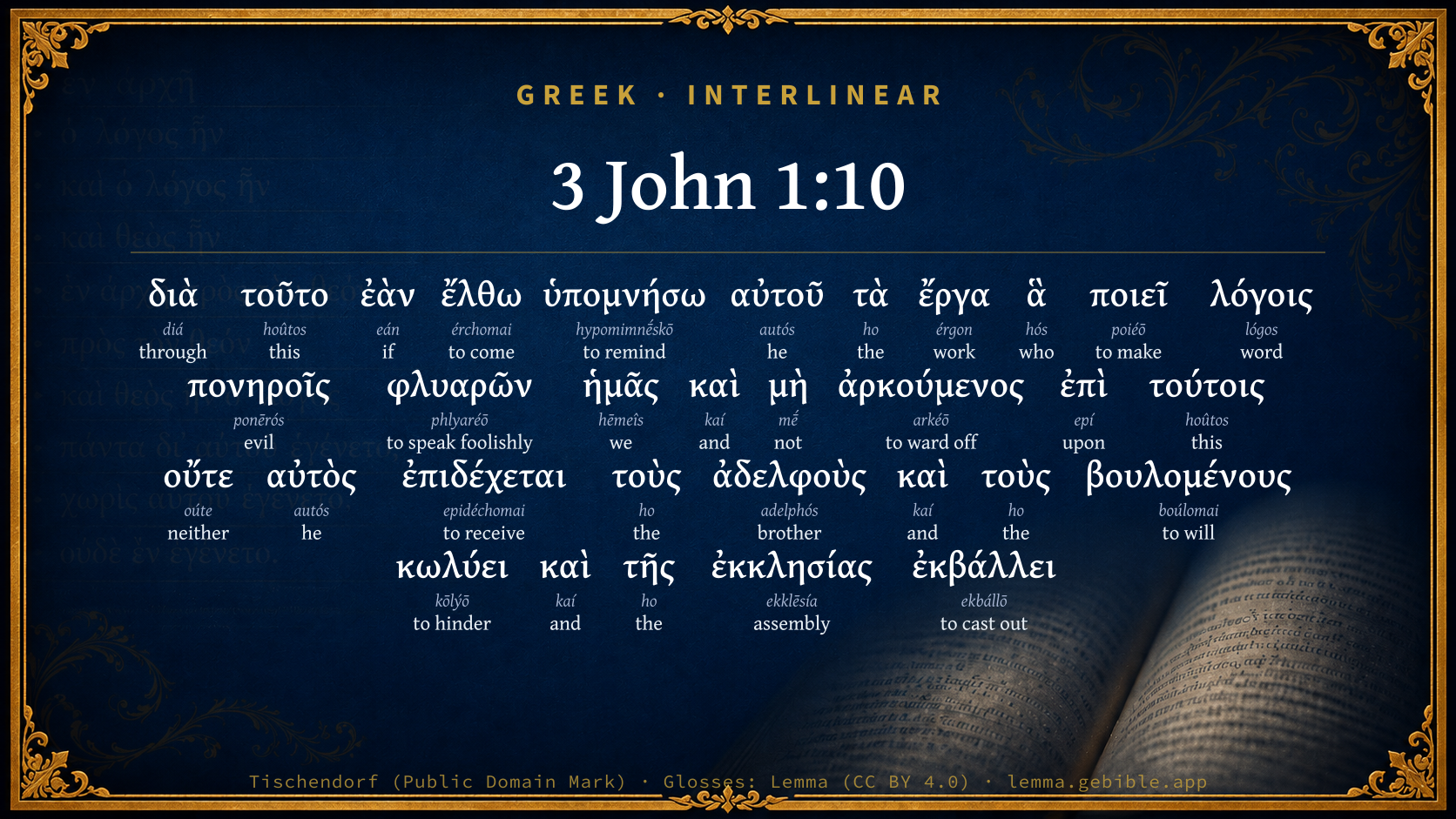
Therefore, if I come, I will call attention to his deeds which he does, unjustly accusing us with wicked words. Not content with this, neither does he himself receive the brothers, and those who would, he forbids and throws out of the assembly.
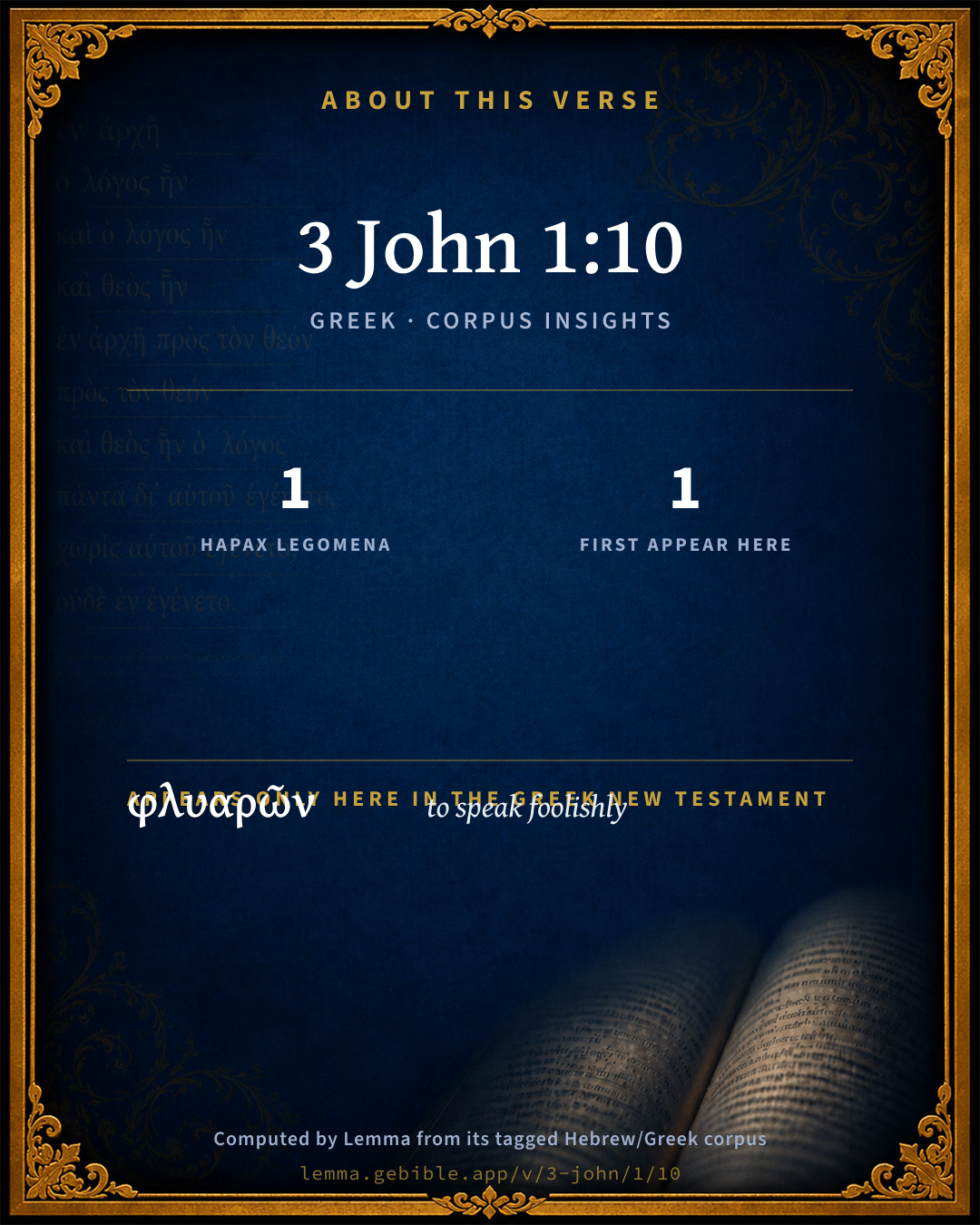
- 1 hapax legomenon — only here in the Greek New Testament
- 1 first appearance in the Greek New Testament
Download a study sheet
One document with this verse’s original text, its word-by-word gloss line, the meaning frame, cross-references with their text, attributed commentary, and full source and license credits — printable, and it pastes into notes with its structure intact.
This verse Autodidact and up
A passage Seminary Student
Up to 50 verses in one chapter. A passage sheet keeps up to 6 commentary sources and 12 cross-references per verse, in the order this page ranks them, and says so on the sheet whenever that leaves anything out. Ask for a single verse and you get the Autodidact verse sheet above.
Everything on this page stays free to read, with no account — the sheet is a download of what is already on screen, not access to it.
Compare translations 3
The same verse in 3 English versions, stacked beneath the original-language interlinear above. Click any original word for its lexicon entry.
Each is an independent rendering of the whole verse — the interlinear is not word-aligned to these translations.
Highlighted words mark where these versions differ — a whole-verse word diff, not a word-by-word alignment.
-
World English Bible Public Domain
Therefore, if I come, I will call attention to his deeds which he does, unjustly accusing us with wicked words. Not content with this, neither does he himself receive the brothers, and those who would, he forbids and throws out of the assembly.
-
King James Version Public Domain
Wherefore, if I come, I will remember his deeds which he doeth, prating against us with malicious words: and not content therewith, neither doth he himself receive the brethren, and forbiddeth them that would, and casteth them out of the church.
-
unfoldingWord Literal Text CC BY-SA 4.0
Because of this, if I come, I will call attention to his works that he is doing—accusing us with evil words. And not being satisfied with these things, he does not receive the brothers, and he stops the ones willing and puts them out of the church.
unfoldingWord Literal Text — © unfoldingWord, licensed CC BY-SA 4.0. Word-aligned USFM3 via Door43 (git.door43.org/unfoldingWord/en_ult).
Show all 19 translations
Every available English version of this verse, each an independent rendering of the whole verse.
-
World English Bible Public Domain
Therefore, if I come, I will call attention to his deeds which he does, unjustly accusing us with wicked words. Not content with this, neither does he himself receive the brothers, and those who would, he forbids and throws out of the assembly.
-
Berean Standard Bible Public Domain
So if I come, I will call attention to his malicious slander against us. And unsatisfied with that, he refuses to welcome the brothers and forbids those who want to do so, even putting them out of the church.
-
Majority Standard Bible Public Domain
So if I come, I will call attention to his malicious slander against us. And unsatisfied with that, he refuses to welcome the brothers and forbids those who want to do so, even putting them out of the church.
-
King James Version Public Domain
Wherefore, if I come, I will remember his deeds which he doeth, prating against us with malicious words: and not content therewith, neither doth he himself receive the brethren, and forbiddeth them that would, and casteth them out of the church.
-
American Standard Version (1901) Public Domain
Therefore, if I come, I will bring to remembrance his works which he doeth, prating against us with wicked words: and not content therewith, neither doth he himself receive the brethren, and them that would he forbiddeth and casteth `them' out of the church.
-
Revised Version (1885) Public Domain
Therefore, if I come, I will bring to remembrance his works which he doeth, prating against us with wicked words: and not content therewith, neither doth he himself receive the brethren, and them that would he forbiddeth, and casteth them out of the church.
-
Geneva Bible (1599) Public Domain
Wherefore if I come, I will call to your remembrance his deedes which he doeth, pratling against vs with malicious wordes, and not therewith content, neither he himselfe receiueth the brethren, but forbiddeth them that woulde, and thrusteth them out of the Church.
-
Douay-Rheims (1899) Public Domain
For this cause, if I come, I will advertise his works which he doth, with malicious words prating against us. And as if these things were not enough for him, neither doth he himself receive the brethren, and them that do receive them he forbiddeth, and casteth out of the church.
-
Young's Literal Translation Public Domain
because of this, if I may come, I will cause him to remember his works that he doth, with evil words prating against us; and not content with these, neither doth he himself receive the brethren, and those intending he doth forbid, and out of the assembly he doth cast.
-
Literal Standard Version CC BY-SA 4.0
because of this, if I may come, I will cause him to remember his works that he does, talking nonsense against us with evil words; and not content with these, neither does he himself receive the brothers, and he forbids those intending [to receive them], and he casts [them] out of the assembly.
-
Unlocked Literal Bible CC BY-SA 4.0
So if I come, I will call attention to what he is doing, talking wicked nonsense against us. Not satisfied with that, he not only refused to welcome the brothers himself, but he also stops those who want to welcome them and puts them out of the church.
-
unfoldingWord Literal Text CC BY-SA 4.0
Because of this, if I come, I will call attention to his works that he is doing—accusing us with evil words. And not being satisfied with these things, he does not receive the brothers, and he stops the ones willing and puts them out of the church.
-
Darby Bible Public Domain
For this reason, if I come, I will bring to remembrance his works which he does, babbling against us with wicked words; and not content with these, neither does he himself receive the brethren; and those who would he prevents, and casts [them] out of the assembly.
-
World Messianic Bible Public Domain
Therefore, if I come, I will call attention to his deeds which he does, unjustly accusing us with wicked words. Not content with this, he doesn’t receive the brothers himself, and those who would, he forbids and throws out of the assembly.
-
Webster's Bible Public Domain
Wherefore, if I come, I will remember his deeds which he doeth, prating against us with malicious words: and not content with that, neither doth he himself receive the brethren, and forbiddeth them that would, and casteth them out of the church.
-
Free Bible Version CC BY-SA 4.0
So if I do visit, I will make it clear what he's been doing. He's been making malicious accusations against us. Not satisfied with doing that, he refuses to welcome any other brothers. He won't let anyone else welcome them either, and throws those who do so out of the church.
-
Bible in Basic English Public Domain
So if I come, I will keep in mind the things he does, talking against us with evil words: and as if this was not enough, he does not take the brothers into his house, and those who are ready to take them in, he keeps from doing so, putting them out of the church if they do.
-
Text-Critical English NT CC BY 4.0
So if I come, I will call attention to what he is doing and the evil accusations of nonsense that he is making against us. And he is not satisfied with that! He not only refuses to receive the brothers, but also stops those who want to do so and throws them out of the church.
-
Tyndale New Testament (1534) Public Domain
Wherfore yf I come I will declare his dedes which he doeth iestinge on vs with malicious wordes nether is therewith content. Not only he him silfe receaveth not the brethren: but also he forbiddeth them that wolde and thrusteth them out of the congregacion.
Literal Standard Version (2020), Covenant Press — licensed CC BY-SA 4.0. Text via the HelloAO Bible API (eBible.org). Unlocked Literal Bible (unfoldingWord) — licensed CC BY-SA 4.0. Text via the HelloAO Bible API (eBible.org). unfoldingWord Literal Text — © unfoldingWord, licensed CC BY-SA 4.0. Word-aligned USFM3 via Door43 (git.door43.org/unfoldingWord/en_ult). Free Bible Version, Dr. Jonathan Gallagher — licensed CC BY-SA 4.0. Text via the HelloAO Bible API (eBible.org).
Word by word
More ways to search: Search by grammar → Find every occurrence → Compare this word →
Practice this passage: Drill this verse → Learn its vocabulary →
- Appears 1× in the Greek New Testament
- First appears here
- Part of Speech
- Verb
- Tense
- Present
- Voice
- Active
- Mood
- Participle
- Case
- Nominative
- Number
- Singular
- Gender
- Masculine
Full Thayer's Definition
- διὰ diá G1223 “through” Preposition
- τοῦτο hoûtos G3778 “this” Demonstrative pronoun, Accusative, Singular, Neuter
- ἐὰν eán G1437 “if” Conditional
- ἔλθω érchomai G2064 “to come” Verb, Aorist, Active, Subjunctive, 1st person, Singular
- ὑπομνήσω hypomimnḗskō G5279 “to remind” Verb, Future, Active, Indicative, 1st person, Singular
- αὐτοῦ autós G846 “he” Personal pronoun, Genitive, Singular, Masculine
- τὰ ho G3588 “the” Article, Accusative, Plural, Neuter
- ἔργα érgon G2041 “work” Noun, Accusative, Plural, Neuter
- ἃ hós G3739 “who” Relative pronoun, Accusative, Plural, Neuter
- ποιεῖ poiéō G4160 “to make” Verb, Present, Active, Indicative, 3rd person, Singular
- λόγοις lógos G3056 “word” Noun, Dative, Plural, Masculine
- πονηροῖς ponērós G4190 “evil” Adjective, Dative, Plural, Masculine
- φλυαρῶν phlyaréō G5396 “to speak foolishly” Verb, Present, Active, Participle, Nominative, Singular, Masculine
- ἡμᾶς hēmeîs G2249 “we” Personal pronoun, 1st person, Accusative, Plural
- καὶ kaí G2532 “and” Conjunction
- μὴ mḗ G3361 “not” Particle, Negative
- ἀρκούμενος arkéō G714 “to ward off” Verb, Present, Passive, Participle, Nominative, Singular, Masculine
- ἐπὶ epí G1909 “upon” Preposition
- τούτοις hoûtos G3778 “this” Demonstrative pronoun, Dative, Plural, Masculine
- οὔτε oúte G3777 “neither” Conjunction, Negative
- αὐτὸς autós G846 “he” Personal pronoun, Nominative, Singular, Masculine
- ἐπιδέχεται epidéchomai G1926 “to receive” Verb, Present, Middle or Passive deponent, Indicative, 3rd person, Singular
- τοὺς ho G3588 “the” Article, Accusative, Plural, Masculine
- ἀδελφοὺς adelphós G80 “brother” Noun, Accusative, Plural, Masculine
- καὶ kaí G2532 “and” Conjunction
- τοὺς ho G3588 “the” Article, Accusative, Plural, Masculine
- βουλομένους boúlomai G1014 “to will” Verb, Present, Middle or Passive deponent, Participle, Accusative, Plural, Masculine
- κωλύει kōlýō G2967 “to hinder” Verb, Present, Active, Indicative, 3rd person, Singular
- καὶ kaí G2532 “and” Conjunction
- τῆς ho G3588 “the” Article, Genitive, Singular, Feminine
- ἐκκλησίας ekklēsía G1577 “assembly” Noun, Genitive, Singular, Feminine
- ἐκβάλλει ekbállō G1544 “to cast out” Verb, Present, Active, Indicative, 3rd person, Singular
About this verse
These counts appear in no published source. They are computed here, from the morphology-tagged text and Lemma’s own curated glosses. What Lemma adds →
- 32
- words
- 25
- distinct lemmas
- General Epistles
- section
Notable vocabulary
1 hapax legomenon — a word that appears only here in the entire Greek New Testament:
- φλυαρῶν to speak foolishly G5396
First appearance in Scripture
This word makes its first canonical appearance in the Greek New Testament here:
- φλυαρῶν to speak foolishly G5396
Shared distinctive vocabulary
ἐπιδέχεται to receive G1926 occurs in 2 verses of the Greek New Testament. Also found in:
Cross-references
10Topical passages linked to 3 John 1:10 in the Treasury of Scripture Knowledge — connected by theme and wording, ordered by reader-vote popularity; previews shown in the World English Bible.
- Isaiah 66:5 Hear the word of Yahweh, you who tremble at his word: Your brothers who hate you, who cast you out for my name's sake, have said, Let Yahweh be glorified, that we may see your joy; but it is those who shall be disappointed.
- Proverbs 10:8 The wise in heart accept commandments, But a chattering fool will fall.
- Proverbs 10:10 One winking with the eye causes sorrow, But a chattering fool will fall.
- Luke 6:22 Blessed are you when men shall hate you, and when they shall exclude and mock you, and throw out your name as evil, for the Son of Man's sake.
- 2 Corinthians 13:2 I have said beforehand, and I do say beforehand, as when I was present the second time, so now, being absent, I write to those who have sinned before now, and to all the rest, that, if I come again, I will not spare;
- John 9:22 His parents said these things because they feared the Jews; for the Jews had already agreed that if any man would confess him as Christ, he would be put out of the synagogue.
- John 9:34–35 They answered him, "You were altogether born in sins, and do you teach us?" They threw him out.
- 1 Corinthians 5:1–5 It is actually reported that there is sexual immorality among you, and such sexual immorality as is not even named among the Gentiles, that one has his father's wife.
- 2 Corinthians 10:1–11 Now I Paul, myself, entreat you by the humility and gentleness of Christ; I who in your presence am lowly among you, but being absent am of good courage toward you.
- 3 John 1:5 Beloved, you do a faithful work in whatever you accomplish for those who are brothers and strangers.
Cross-references courtesy of OpenBible.info (CC BY 4.0).
Lesson kit
Teaching starters — assembled from the data on this page, not authored interpretation. Every prompt links to the verse data it draws on. Edit before teaching.
3 John, in the General Epistles, opens this verse with 32 words (25 distinct Greek lemmas). Its most distinctive word is phlyaréō (“to speak foolishly”). A historical commentator’s framing appears above. Read the whole chapter for the surrounding context.
Discussion questions
- What does “to speak foolishly” (phlyaréō) contribute to the verse as a whole?
- This verse holds 1 word here found nowhere else in the Greek New Testament. What might the rare word draw attention to?
- The word “to speak foolishly” first appears here in Scripture. What is being introduced at this debut?
- 3 John 1:9 shares the word «to receive» with this verse. How do the two illuminate each other?
- “the” occurs 4× in this one verse. What is the effect of the repetition?
- These translations render this verse differently. What is at stake in choosing one wording over another?
- Reading how Bengel's Gnomon and Expositor's Greek Testament read this verse, where do the two commentators agree and where do they part?
Things to notice
- 1 word in this verse appears nowhere else in the Greek New Testament.
- 1 word makes its first canonical appearance in Scripture here.
- These translations choose different wording for 40 words in this verse.
- “the” occurs 4× in this single verse.
- 25 distinct Greek lemmas span 32 words in this verse.
Commentary
Notes on 3 John 1:10 from classic Christian and Jewish commentators (each source and its license shown beneath its notes). The classic Christian expositions comment on the surrounding passage and are grouped to its opening verse, so a note may address several verses; the Jewish commentaries on the Tanakh (Rashi and others) are per-verse, so they appear only where the commentator wrote on this verse.
Lemma curates 59 commentaries, every one of them public domain or Creative Commons licensed, each selected and text-cleaned for this edition rather than reprinted as found. About our sources →
Bengel's Gnomon
Johann Albrecht Bengel
Bengel's Gnomon of the New Testament — English translation (T&T Clark, Edinburgh, 1860) — public domain. Text from a community e-Sword module.
Expositor's Greek Testament
ed. W. Robertson Nicoll
The Expositor's Greek Testament, edited by W. Robertson Nicoll (1897–1910) — public domain. Text from a community e-Sword module.
Alford’s Greek Testament
Henry Alford
Henry Alford, The Greek Testament (1849–1861) — public domain. Text from a community e-Sword module.
Jamieson, Fausset & Brown
Robert Jamieson, A. R. Fausset & David Brown
Jamieson, Fausset & Brown — Commentary Critical and Explanatory on the Whole Bible (1871) — public domain (CC PDM 1.0). Text via the HelloAO Bible API.
Adam Clarke's Commentary
Adam Clarke's Commentary on the Bible (1810–1826) — public domain. Text from a community e-Sword/MySword module.
The Cambridge Bible for Schools and Colleges
gen. ed. J. J. S. Perowne
The Cambridge Bible for Schools and Colleges (gen. ed. J. J. S. Perowne; Cambridge University Press, 1878–1918) — public domain. Text from a community e-Sword module.
John Gill's Exposition
John Gill's Exposition of the Whole Bible (1746–1763) — public domain (CC PDM 1.0). Text via the HelloAO Bible API.
Trapp's Complete Commentary
John Trapp
John Trapp, A Commentary or Exposition upon All the Books of the Old and New Testament (1647–1656) — public domain. Text from a community e-Sword module.
Albert Barnes' Notes on the Bible
Albert Barnes' Notes on the Bible (1834–1885) — public domain. Text from a community e-Sword/MySword module.
Whedon's Commentary on the Bible
Daniel D. Whedon
Daniel D. Whedon (gen. ed.), Commentary on the Old and New Testaments (1874–1909) — public domain. Text from a community e-Sword module.
The Pulpit Commentary
The Pulpit Commentary (1880–1919), ed. H.D.M. Spence-Jones & Joseph S. Exell — public domain. Text from a community e-Sword module.
John Wesley's Explanatory Notes
John Wesley, Explanatory Notes Upon the Whole Bible (1754–1765) — public domain. Text via the GEBible commentary corpus.
The People's New Testament
B. W. Johnson
B. W. Johnson's The People's New Testament with Notes (1889–1891) — public domain. Electronic text from the Christian Classics Ethereal Library (CCEL) ThML edition.
Cambridge Greek Testament for Schools and Colleges
Cambridge Greek Testament for Schools and Colleges (Cambridge University Press, 1896; 21 vols, various authors incl. Carr, Maclear, Plummer, Farrar, Lumby, Moule, M. R. James, Simcox) — public domain. Text from a community e-Sword module.
International Critical Commentary
International Critical Commentary — older volumes (1896–1929), various authors — public domain. Text from a community e-Sword module.
Vincent's Word Studies in the New Testament
Marvin R. Vincent
Marvin R. Vincent, Word Studies in the New Testament (1887–1900) — public domain. Text from a community e-Sword/MySword module.
Westcott on Hebrews & the Epistles of John
Brooke Foss Westcott
Brooke Foss Westcott (1825–1901), The Epistle to the Hebrews (1889) and The Epistles of St John (1883) — public domain (pre-1929). Text recovered from Internet Archive / Google Books OCR scans. Westcott’s Gospel of John commentary is not included (its OCR lost the chapter running-heads required for reliable verse-keying). Some Greek quoted in the Hebrews volume is imperfectly rendered by the OCR.