Exodus 24:10

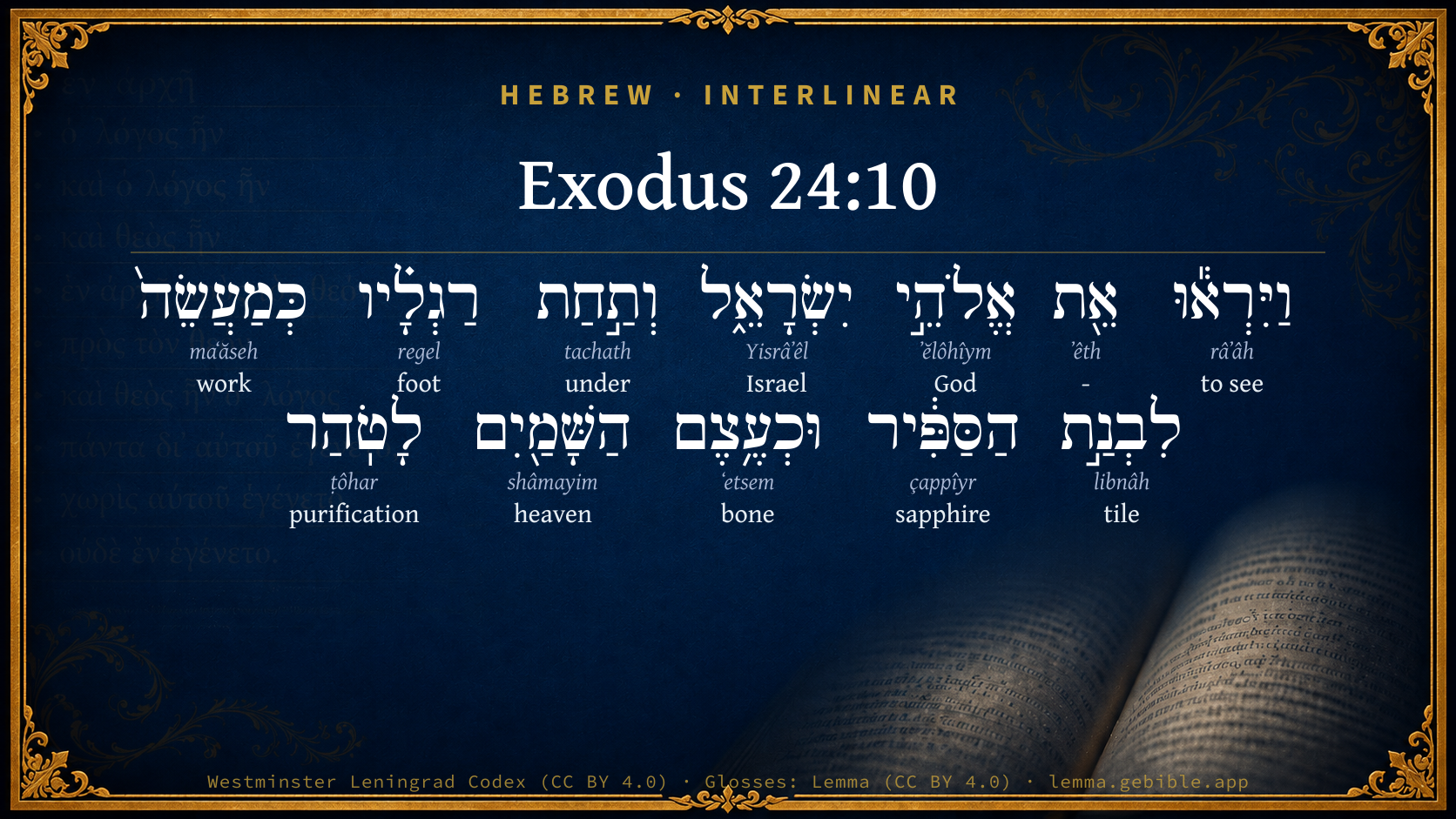
Hebrew (Westminster Leningrad Codex) Exodus 24:10 appears in the Hebrew Old Testament. The text above is from the Westminster Leningrad Codex. Each word links to its Strong’s number, a concise gloss, and parsing drawn from the Open Scriptures Hebrew Bible morphology. Click any word for its full Brown-Driver-Briggs (BDB) entry.
Download image
Cite this verse

Exodus 24:10 (World English Bible). Public Domain. Lemma interlinear Bible study tool, https://lemma.gebible.app/v/exodus/24/10.

Show BibTeX & RIS
BibTeX
RIS
English Translation
They saw the God of Israel. Under his feet was like a paved work of sapphire stone, like the skies for clearness.
World English Bible · Public Domain
Highlights Full analysis ↓
Download a study sheet

One document with this verse’s original text, its word-by-word gloss line, the meaning frame, cross-references with their text, attributed commentary, and full source and license credits — printable, and it pastes into notes with its structure intact.

This verse Autodidact and up

Study sheet (.html) Plain text (.txt)

A passage Seminary Student

Up to 50 verses in one chapter. A passage sheet keeps up to 6 commentary sources and 12 cross-references per verse, in the order this page ranks them, and says so on the sheet whenever that leaves anything out. Ask for a single verse and you get the Autodidact verse sheet above.

Everything on this page stays free to read, with no account — the sheet is a download of what is already on screen, not access to it.

Want to remove ads? Support Godless Engineer
Compare translations 3

The same verse in 3 English versions, stacked beneath the original-language interlinear above. Click any original word for its lexicon entry.

Each is an independent rendering of the whole verse — the interlinear is not word-aligned to these translations.

Highlighted words mark where these versions differ — a whole-verse word diff, not a word-by-word alignment.

  • World English Bible Public Domain
    They saw the God of Israel. Under his feet was like a paved work of sapphire stone, like the skies for clearness.
  • King James Version Public Domain
    And they saw the God of Israel: and there was under his feet as it were a paved work of a sapphire stone, and as it were the body of heaven in his clearness.
  • unfoldingWord Literal Text CC BY-SA 4.0
    And they saw the God of Israel. And under his feet was like tile made of sapphire, and its substance was as the sky in purity.

unfoldingWord Literal Text — © unfoldingWord, licensed CC BY-SA 4.0. Word-aligned USFM3 via Door43 (git.door43.org/unfoldingWord/en_ult).

Versions to compare (up to 4)

3 of 4 selected

Show all 18 translations

Every available English version of this verse, each an independent rendering of the whole verse.

  • World English Bible Public Domain
    They saw the God of Israel. Under his feet was like a paved work of sapphire stone, like the skies for clearness.
  • Berean Standard Bible Public Domain
    and they saw the God of Israel. Under His feet was a work like a pavement made of sapphire, as clear as the sky itself.
  • Majority Standard Bible Public Domain
    and they saw the God of Israel. Under His feet was a work like a pavement made of sapphire, as clear as the sky itself.
  • King James Version Public Domain
    And they saw the God of Israel: and there was under his feet as it were a paved work of a sapphire stone, and as it were the body of heaven in his clearness.
  • American Standard Version (1901) Public Domain
    And they saw the God of Israel; and there was under his feet as it were a paved work of sapphire stone, and as it were the very heaven for clearness.
  • Revised Version (1885) Public Domain
    and they saw the God of Israel; and there was under his feet as it were a paved work of sapphire stone, and as it were the very heaven for clearness.
  • Geneva Bible (1599) Public Domain
    And they saw the God of Israel, and vnder his feete was as it were a worke of a Saphir stone, and as the very heauen when it is cleare.
  • Douay-Rheims (1899) Public Domain
    And they saw the God of Israel: and under his feet as it were a work of sapphire stone, and as the heaven, when clear.
  • Young's Literal Translation Public Domain
    and they see the God of Israel, and under His feet `is' as the white work of the sapphire, and as the substance of the heavens for purity;
  • Literal Standard Version CC BY-SA 4.0
    and they see the God of Israel, and under His feet [is] as the work of a pavement of sapphire, and as the substance of the heavens for purity;
  • Unlocked Literal Bible CC BY-SA 4.0
    They saw the God of Israel. Under his feet there was a pavement made of sapphire stone, as clear as the sky itself.
  • unfoldingWord Literal Text CC BY-SA 4.0
    And they saw the God of Israel. And under his feet was like tile made of sapphire, and its substance was as the sky in purity.
  • Darby Bible Public Domain
    and they saw the God of Israel; and there was under his feet as it were work of transparent sapphire, and as it were the form of heaven for clearness.
  • World Messianic Bible Public Domain
    They saw the God of Israel. Under his feet was like a paved work of sapphire stone, like the skies for clearness.
  • Webster's Bible Public Domain
    And they saw the God of Israel: and there was under his feet as it were a paved work of a sapphire-stone, and as it were the body of heaven in its clearness.
  • Free Bible Version CC BY-SA 4.0
    and they saw the God of Israel. Under his feet was something like a tiled pavement made of lapis lazuli, as clear blue as the sky itself.
  • Bible in Basic English Public Domain
    And they saw the God of Israel; and under his feet there was, as it seemed, a jewelled floor, clear as the heavens.
  • JPS Tanakh (1917) Public Domain
    and they saw the God of Israel; and there was under His feet the like of a paved work of sapphire stone, and the like of the very heaven for clearness.

Literal Standard Version (2020), Covenant Press — licensed CC BY-SA 4.0. Text via the HelloAO Bible API (eBible.org). Unlocked Literal Bible (unfoldingWord) — licensed CC BY-SA 4.0. Text via the HelloAO Bible API (eBible.org). unfoldingWord Literal Text — © unfoldingWord, licensed CC BY-SA 4.0. Word-aligned USFM3 via Door43 (git.door43.org/unfoldingWord/en_ult). Free Bible Version, Dr. Jonathan Gallagher — licensed CC BY-SA 4.0. Text via the HelloAO Bible API (eBible.org).

Word by word

More ways to search: Search by grammar → Find every occurrence → Compare this word →

Practice this passage: Drill this verse → Learn its vocabulary →

לִבְנַ֣ת
libnâh
H3840
“tile of”
Noun, Common, Feminine, Singular, Construct
Part of Speech
Noun
Type
Common
Gender
Feminine
Number
Singular
State
Construct
Full BDB Definition

Origin: from H3835

TWOT: 1074g

tile, pavement, brick
  1. וַיִּרְא֕וּ râʼâh H7200 “and · to see” Conjunction + Verb, Qal, Sequential Imperfect, 3rd Person, Masculine, Plural
  2. אֵ֖ת ʼêth H853 “-” Particle, Direct Object
  3. אֱלֹהֵ֣י ʼĕlôhîym H430 “God(s) of” Noun, Common, Masculine, Plural, Construct
  4. יִשְׂרָאֵ֑ל Yisrâʼêl H3478 “Israel” Noun, Proper
  5. וְתַ֣חַת tachath H8478 “and · under” Conjunction + Preposition
  6. רַגְלָ֗יו regel H7272 “feet · his” Noun, Common, Feminine, Dual, Construct + Suffix, Personal, 3rd Person, Masculine, Singular
  7. כְּמַעֲשֵׂה֙ maʻăseh H4639 “like/as · work of” Preposition + Noun, Common, Masculine, Singular, Construct
  8. הַסַּפִּ֔יר çappîyr H5601 “the · sapphire” Particle, Definite Article + Noun, Common, Masculine, Singular, Absolute
  9. וּכְעֶ֥צֶם ʻetsem H6106 “and · like/as · bone of” Conjunction + Preposition + Noun, Common, Feminine, Singular, Construct
  10. הַשָּׁמַ֖יִם shâmayim H8064 “the · heaven(s)” Particle, Definite Article + Noun, Common, Masculine, Plural, Absolute
  11. לָטֹֽהַר ṭôhar H2892 “to/for the · purification” Preposition, Determined + Noun, Common, Masculine, Singular, Absolute

About this verse

These counts appear in no published source. They are computed here, from the morphology-tagged text and Lemma’s own curated glosses. What Lemma adds →

12
words
12
distinct lemmas
Pentateuch
section

Notable vocabulary

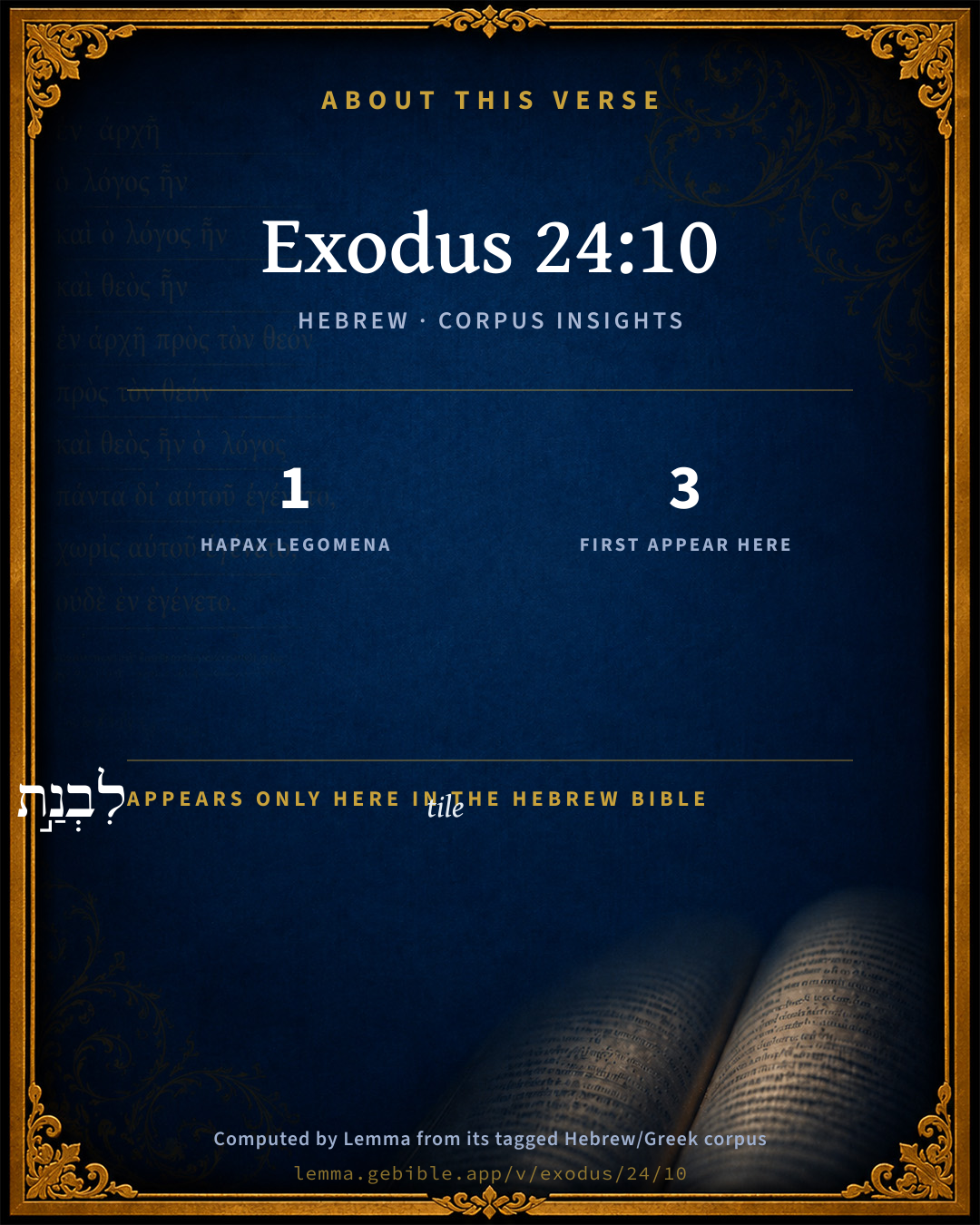
1 hapax legomenon — a word that appears only here in the entire Hebrew Bible:

  • לִבְנַ֣ת tile H3840

First appearance in Scripture

These words make their first canonical appearance in the Hebrew Bible here:

  • לִבְנַ֣ת tile H3840
  • הַסַּפִּ֔יר sapphire H5601
  • לָטֹֽהַר purification H2892

Shared distinctive vocabulary

לָטֹֽהַר purification H2892 occurs in 2 verses of the Hebrew Bible. Also found in:

Grammatical profile

  • 1 verb
  • 9 nouns
  • 1 preposition
  • 1 particle

Verb forms

  • וַיִּרְא֕וּ Qal · Sequential Imperfect

Hebrew & Septuagint length

In English translation the verse runs 22 words from the Hebrew and 38 from the Septuagint (LXX English) — the Septuagint runs noticeably longer here. See the side-by-side →

A rough comparison of the two English renderings, which tokenize alike — not a word-level alignment.

Word counts can differ between the Hebrew and the Greek without any difference in meaning — e.g. the Hebrew direct-object marker אֵת has no separate Greek word, and Greek often adds the article ὁ.

Cross-references

20

Topical passages linked to Exodus 24:10 in the Treasury of Scripture Knowledge — connected by theme and wording, ordered by reader-vote popularity; previews shown in the World English Bible.

  • John 1:18 No one has seen God at any time. The one and only Son, who is in the bosom of the Father, he has declared him.
  • Ezekiel 10:1 Then I looked, and see, in the expanse that was over the head of the cherubim there appeared above them as it were a sapphire stone, as the appearance of the likeness of a throne.
  • Genesis 32:30 Jacob called the name of the place Peniel: for, he said, "I have seen God face to face, and my life is preserved."
  • Exodus 33:20 He said, "You cannot see my face, for man may not see me and live."
  • Exodus 33:23 then I will take away my hand, and you will see my back; but my face shall not be seen."
  • Isaiah 6:1–5 In the year that king Uzziah died, I saw the Lord sitting on a throne, high and lifted up; and his train filled the temple.
  • Ezekiel 1:26–28 Above the expanse that was over their heads was the likeness of a throne, as the appearance of a sapphire stone; and on the likeness of the throne was a likeness as the appearance of a man on it above.
  • 1 Timothy 6:16 who alone has immortality, dwelling in unapproachable light; whom no man has seen, nor can see: to whom be honor and eternal power. Amen.
  • Revelation 4:3 that looked like a jasper stone and a sardius. There was a rainbow around the throne, like an emerald to look at.
  • Matthew 17:2 He was transfigured before them. His face shone like the sun, and his garments became as white as the light.
  • John 6:46 Not that anyone has seen the Father, except he who is from God. He has seen the Father.
  • John 14:9 Jesus said to him, "Have I been with you such a long time, and do you not know me, Philip? He who has seen me has seen the Father. How do you say, 'Show us the Father?'
  • 1 John 4:12 No one has seen God at any time. If we love one another, God remains in us, and his love has been perfected in us.
  • Revelation 21:11 having the glory of God. Her light was like a most precious stone, as if it was a jasper stone, clear as crystal;
  • Exodus 3:6 Moreover he said, "I am the God of your father, the God of Abraham, the God of Isaac, and the God of Jacob." Moses hid his face; for he was afraid to look at God.
  • Judges 13:21–22 But the angel of Yahweh did no more appear to Manoah or to his wife. Then Manoah knew that he was the angel of Yahweh.
  • 1 Kings 22:19 [Micaiah] said, Therefore hear you the word of Yahweh: I saw Yahweh sitting on his throne, and all the host of heaven standing by him on his right hand and on his left.
  • Song of Solomon 6:10 Who is she who looks forth as the morning, Beautiful as the moon, Clear as the sun, Awesome as an army with banners?
  • Revelation 1:16 He had seven stars in his right hand. Out of his mouth proceeded a sharp two-edged sword. His face was like the sun shining at its brightest.
  • Revelation 21:18–23 The construction of its wall was jasper. The city was pure gold, like pure glass.

Cross-references courtesy of OpenBible.info (CC BY 4.0).

Hebrew and Greek witnesses Masoretic Hebrew ↔ Greek Septuagint

The same verse in the two great witnesses to the Old Testament, shown verse-for-verse.

Here the Septuagint runs noticeably longer than the Hebrew — LXX2012 (modern English Septuagint) 38 words vs World English Bible 22. A rough length comparison of the two English translations, not a word-level alignment — read both below.

These are two independent witnesses, not word-aligned to each other, and the Septuagint is shown in lemma (dictionary) form.

Hebrew Exodus 24:10 Masoretic · Westminster Leningrad Codex

וַיִּרְא֕וּ אֵ֖ת אֱלֹהֵ֣י יִשְׂרָאֵ֑ל וְתַ֣חַת רַגְלָ֗יו כְּמַעֲשֵׂה֙ לִבְנַ֣ת הַסַּפִּ֔יר וּכְעֶ֥צֶם הַשָּׁמַ֖יִם לָטֹֽהַר

They saw the God of Israel. Under his feet was like a paved work of sapphire stone, like the skies for clearness.

World English Bible · Public Domain

Greek LXX Exodus 24:10 Septuagint · lemma form

καί ὁράω ὁ τόπος οὗ ἵστημι ἐκεῖ ὁ θεός ὁ ἰσραήλ καί ὁ ὑπό ὁ πούς αὐτός ὡσεί ἔργον πλίνθος σάπφειρος καί ὥσπερ εἶδος στερέωμα ὁ οὐρανός ὁ καθαριότης

And they saw the place where the God of Israel stood; and under his feet was as it were a work of sapphire slabs, and as it were the appearance of the firmament of heaven in its purity.

LXX2012 (modern English Septuagint) · Public Domain

On this verse, Joseph Benson's Commentary discusses the Septuagint’s reading. Read the note in Commentary ↓

Hebrew: Westminster Leningrad Codex (CC BY 4.0). Greek: Septuagint (public domain); English from LXX2012 (modern English Septuagint) (Public Domain). How the Septuagint differs from the Hebrew →

Targum (Aramaic paraphrase)

2

The Targum is the ancient Jewish Aramaic paraphrase of the Hebrew Scriptures — an interpretive translation, not the Hebrew text itself. Onkelos (literal) and Pseudo-Jonathan (expansive) render the Torah, and Jonathan the Prophets. Coverage is partial: where no permissively-licensed English translation exists for a verse, only the Aramaic is shown. This is verse-level text, not a word-by-word alignment to the Hebrew.

  1. Targum Onkelos Torah (Genesis–Deuteronomy)
    וַחֲזוֹ יָת יְקַר אֱלָהָא דְיִשְׂרָאֵל וּתְחוֹת כָּרְסָא יְקָרֵהּ כְּעוֹבַד אֶבֶן טָבָא וּכְמֶחֱזֵי שְׁמַיָא לְבָרִירוּ:

    (no public-domain English translation for this verse)

    Targum Onkelos — Aramaic: “Onkelos Genesis” (public domain); “Onkelos Exodus” (public domain); “Onkelos Leviticus” (public domain); “Onkelos Numbers” (public domain); “Onkelos Deuteronomy” (public domain). English: “Sefaria Community Translation” (CC0 1.0 (public-domain dedication)); “J.W. Etheridge. The Targums of Onkelos and Jonathan Ben Uzziel on the Pentateuch. London: Longmans, Green, 1862” (public domain). Text via Sefaria.

  2. Targum Pseudo-Jonathan Torah (Genesis–Deuteronomy)
    וּזְקָפוּ נָדָב וַאֲבִיהוּא יַת עֵינֵיהוֹן וְחָמוּן יַת אִיקַר אֱלָהָא דְיִשְרָאֵל וּתְחוֹת אַפִּיפּוּרִין דְּרִיגְלוֹי דְמַיְצַע תְּחוֹת כּוּרְסֵיהּ הֵי כְעוֹבַד אַבַן סַפִּירִינוּן מִידְכַּר שִׁעֲבּוּדָא דְשַׁעְבִּידוּ מִצְרָאֵי יַת בְּנֵי יִשְרָאֵל בְּטִינָא וּבְלִיבְנִין וַהֲווֹן נְשַׁיָא בָּטְשָׁן יַת טִינָא עִם גּוּבְרֵיהוֹן הֲוַת תַּמָּן רִיבָא מְפַנְקָתָא מַעְבַּרְתָּא וְאַפִּילַת יַת עוּבְרָא וְאִיתְבַּטַּשׁ עִם טִינָא נָחָת גַּבְרִיאֵל וְעָבַד מִנֵיהּ לְבֵינְתָא וְאַסְקֵיהּ לִשְׁמֵי מְרוֹמָא וְאַתְקְנֵיהּ גִּילוּגְדַק תְּחוֹת אַפִּיפּוּרִין דְּמָרֵי עַלְמָא זִיוֵיהּ הֵי כְּעוֹבַד אֲבַן טָבָא וְהֵי כִּתְקוּף שְׁפַר שְׁמַיָא כַּד הִינוּן בְּרִירִין מִן עֲנָנַיָא

    And Nadab and Abihu lifted up their eyes, and saw the glory of the God of Israel; and under the footstool of His feet which was placed beneath His throne, was like the work of sapphire stone a memorial of the servitude with which the Mizraee had made the children of Israel to serve in clay and bricks, (what time) there were women treading clay with their husbands; the delicate young woman with child was also there, and made abortive by being beaten down with the clay. And thereof did Gabriel, descending, make brick, and, going up to the heavens on high, set it, a footstool under the cathedra of the Lord of the world whose splendour was as the work of a precious stone, and as the power of the beauty of the heavens when they are clear from clouds.

    Targum Pseudo-Jonathan — Aramaic: “Targum Jonathan on Genesis” (public domain); “Targum Jonathan on Exodus” (public domain); “Targum Jonathan on Leviticus” (public domain); “Targum Jonathan on Numbers” (public domain); “Targum Jonathan on Deuteronomy” (public domain). English: “The Targum of Jonathan ben Uzziel, trans. J. W. Etheridge, London, 1862” (public domain). Text via Sefaria.

Commentary

Notes on Exodus 24:10 from classic Christian and Jewish commentators (each source and its license shown beneath its notes). The classic Christian expositions comment on the surrounding passage and are grouped to its opening verse, so a note may address several verses; the Jewish commentaries on the Tanakh (Rashi and others) are per-verse, so they appear only where the commentator wrote on this verse.

Lemma curates 59 commentaries, every one of them public domain or Creative Commons licensed, each selected and text-cleaned for this edition rather than reprinted as found. About our sources →

Trapp's Complete Commentary

John Trapp

Exo 24:10 And they saw the God of Israel: and [there was] under his feet as it were a paved work of a sapphire stone, and as it were the body of heaven in [his] clearness.

Ver. 10. And they saw the God of Israel.] A glimpse of his glory. {See Trapp on "1Ti 6:16"}

As it were a paved work of sapphire stone.] To show that God had now changed their condition, their bricks, made in their bondage, to sapphire. Compare Isa 54:11.

John Trapp, A Commentary or Exposition upon All the Books of the Old and New Testament (1647–1656) — public domain. Text from a community e-Sword module.

Joseph Benson's Commentary

Exo 24:10. They saw the God of Israel — That is, they had some glimpse of his glory, in light and fire, though they saw no manner of similitude. They saw the place where the God of Israel stood, so the Septuagint; whatever they saw, it was certainly something of which no image or picture could be made, and yet enough to satisfy them that God was with them of a truth. Nothing is described but that which was under his feet, for our conceptions of God are all below him. They saw not so much as God’s feet, but at the bottom of the brightness they saw (such as they never saw before or after, and as the footstool or pedestal of it) a most rich and splendid pavement, as it had been of sapphires, azure, or sky-coloured. The heavens themselves are the pavement of God’s palace, and his throne is above the firmament.

Joseph Benson's Commentary on the Old and New Testaments (1811–1818) — public domain. Text from a community e-Sword module.

Tyndale Open Study Notes

Tyndale Open Resources

24:10 There they saw . . . God: This statement must be interpreted in the light of 33:20. They saw some representation of God, the description of which is limited to the surface under his feet. When Isaiah saw God, the only description given was of the hem of his robe (Isa 6:1).

Tyndale Open Study Notes — © Tyndale Open Resources, licensed CC BY-SA 4.0. Text via the HelloAO Bible API.

Geneva Bible (1599)

Geneva Bible translators

As perfectly as their infirmities could behold his majesty.

Hebrew, brick work.

Geneva Bible (1599) marginal notes — public domain. Text via Bolls.life.

Jamieson, Fausset & Brown

Robert Jamieson, A. R. Fausset & David Brown

And they saw the God of Israel--That there was no visible form or representation of the divine nature, we have expressly intimated (Deu 4:15). But a symbol or emblem of His glory was distinctly, and at a distance, displayed before those chosen witnesses. Many think, however, that in this private scene was discovered, amid the luminous blaze, the faint adumbrated form of the humanity of Christ (Eze 1:26; compare Gal 3:24).

sapphire--one of the most valuable and lustrous of the precious gems--of a sky-blue or light azure color and frequently chosen to describe the throne of God (see Eze 1:26; Eze 10:1).

Jamieson, Fausset & Brown — Commentary Critical and Explanatory on the Whole Bible (1871) — public domain (CC PDM 1.0). Text via the HelloAO Bible API.

Adam Clarke's Commentary

Verse 10. They saw the God of Israel] The seventy elders, who were representatives of the whole congregation, were chosen to witness the manifestation of God, that they might be satisfied of the truth of the revelation which he had made of himself and of his will; and on this occasion it was necessary that the people also should be favoured with a sight of the glory of God; see Ex 20:18. Thus the certainty of the revelation was established by many witnesses, and by those especially of the most competent kind.

A paved work of a sapphire stone] Or sapphire brick-work. I suppose that something of the Musive or Mosaic pavement is here intended; floors most curiously inlaid with variously coloured stones or small square tiles, disposed in a great variety of ornamental forms. Many of these remain in different countries to the present day. The Romans were particularly fond of them, and left monuments of their taste and ingenuity in pavements of this kind, in most countries where they established their dominion. Some very fine specimens are found in different parts of Britain.

Sapphire is a precious stone of a fine blue colour, next in hardness to the diamond. The ruby is considered by most mineralogists of the same genus; so is also the topaz: hence we cannot say that the sapphire is only of a blue colour; it is blue, red, or yellow, as it may be called sapphire, ruby, or topaz; and some of them are blue or green, according to the light in which they are held; and some white. A very large specimen of such a one is now before me. The ancient oriental sapphire is supposed to have been the same with the lapis lazuli. Supposing that these different kinds of sapphires are here intended, how glorious must a pavement be, constituted of polished stones of this sort, perfectly transparent, with an effulgence of heavenly splendour poured out upon them! The red, the blue, the green, and the yellow, arranged by the wisdom of God, into the most beautiful emblematic representations, and the whole body of heaven in its clearness shining upon them, must have made a most glorious appearance. As the Divine glory appeared above the mount, it is reasonable to suppose that the Israelites saw the sapphire pavement over their heads, as it might have occupied a space in the atmosphere equal in extent to the base of the mountain; and being transparent, the intense brightness shining upon it must have greatly heightened the effect.

It is necessary farther to observe that all this must have been only an appearance, unconnected with any personal similitude; for this Moses expressly asserts, De 4:15. And though the feet are here mentioned, this can only be understood of the sapphirine basis or pavement, on which this celestial and indescribable glory of the Lord appeared. There is a similar description of the glory of the Lord in the Book of Revelation, Re 4:3: "And he who sat [upon the throne] was to look upon like a jasper and a sardine stone; and there was a rainbow round about the throne, in sight like unto an emerald." In neither of these appearances was there any similitude or likeness of any thing in heaven, earth, or sea. Thus God took care to preserve them from all incentives to idolatry, while he gave them the fullest proofs of his being. In Scheuchzer's Physica Sacra, among his numerous fine engravings, there is one of this glorious manifestation, which cannot be too severely reprehended. The Supreme Being is represented as an old man, sitting on a throne, encompassed with glory, having a crown on his head, and a sceptre in his hand, the people prostrate in adoration at the foot of the piece. A print of this kind should be considered as utterly improper, if not blasphemous.

Adam Clarke's Commentary on the Bible (1810–1826) — public domain. Text from a community e-Sword/MySword module.

Ellicott's Commentary for English Readers

(10) They saw the God of Israel.—Probably, in human form, as Isaiah saw Him (Isa_6:1-5), and Ezekiel (Eze_1:26), and even Nebuchadnezzar (Dan_3:25). It is not of this appearance that Moses says: “Ye saw no similitude” (Deu_4:12). The appearance which they saw had “feet.”

A paved work of a sapphire stone.—Heb., a work of the clearness of sapphire. The “sapphire” (sappir) of the Pentateuch is probably lapis lazuli.

The body of heaven—i.e., “the very heaven,” or “the heaven itself.”

A Bible Commentary for English Readers, edited by Charles John Ellicott (1878–1897) — public domain. Text from a community e-Sword module.

The Cambridge Bible for Schools and Colleges

gen. ed. J. J. S. Perowne

10. and they saw, &c.] LXX., to avoid its being supposed that God could be ‘seen’ (cf. on Exo Exo_23:15 b, Exo_33:20), paraphrase by ‘and they saw the place where the God of Israel stood.’

and there was under his feet, &c.] The idea appears to be that they saw the Divine glory, not directly, but as they looked up at it from below, through what seemed to be a transparent blue sapphire pavement, comparable only to the sky in its clearness. Cf. the sapphire throne upon which, in his vision, Ezekiel sees the Divine form (Eze_1:26). On what is meant by ‘sapphire,’ see on Exo_28:18.

paved work] lit. brick- or tile-work. Bright (RVm.) is a meaning unsupported by usage.

The Cambridge Bible for Schools and Colleges (gen. ed. J. J. S. Perowne; Cambridge University Press, 1878–1918) — public domain. Text from a community e-Sword module.

John Gill's Exposition

And they saw the God of Israel,.... The Targum of Jonathan restrains this to Nadab and Abihu whereas it is doubtless true of Moses and Aaron, and the seventy elders, who all saw him, and who were witnesses to the people that it was a divine Person that spoke to Moses, and delivered the laws unto him, to be observed by them; which seems to be the reason of their being called up, and favoured with this sight which must not be understood as of anything criminal in them, as if they curiously looked and pried to see something they should not, for which they deserved some sort of punishment, as the Targum intimates; but of a privilege, and a very high one they were favoured with: and this sight they had was not by a vision of prophecy, or with the eyes of their understanding, but corporeally; they saw the Son of God, the God of Israel, in an human form, as a pledge and presage of his future incarnation, who is the Angel that spoke to Moses on Mount Sinai, as Stephen says, and the Lord that was among the angels there, who afterwards became incarnate, and having done his work on earth, ascended on high, Act 7:38.

and there was under his feet; which shows that there was a visible form, and that human; nor is this contrary to what is said, "ye saw no similitude"; Deu 4:12, since what is here related does not respect the same time, nor the same persons; this was after the giving of the ten commands, that at the time of it; this is said of the seventy elders, with Moses, Aaron, and his two sons, that of all the people:

as it were paved work of a sapphire stone: like a pavement pitched with sapphire. The Septuagint version is,"and they saw the place where the God of Israel stood, and what were under his feet, as the work of a sapphire brick.''The sapphire stones, of which the pavement was, were as broad as bricks, and being like a brick, was a memorial, as the Targum of Jonathan says, of the servitude the Egyptians made the children of Israel to serve with in clay and bricks; but being a sapphire, bright and glorious, may denote the liberty they now enjoyed in exchange for their bondage. And the Targum of Jonathan understands it of the colour, and not of the form of the sapphire, and renders it, the white sapphire; and so do some Jewish writers (w); though the colour of the sapphire is azure, or sky coloured, with which agrees what follows:

and as it were the body of heaven in his clearness; and Ruaeus (x) says, the sapphire is sky coloured, and some of them shine and sparkle with golden points or spots, and are reckoned the best sapphires; so that this represents the heaven as quite clear and serene, bespangled with stars; and as the heavens, covered with clouds, may denote the displeasure of God, so a serene heaven his favour and good will, and in such an amiable light was he now beheld.

(w) Saadiah Gaon in Aben Ezra, & R. Jonah in Ben Melech in loc. (x) De Gemmis, c. 2.

John Gill's Exposition of the Whole Bible (1746–1763) — public domain (CC PDM 1.0). Text via the HelloAO Bible API.

Albert Barnes' Notes on the Bible

And they saw the God of Israel - As they ate the sacrificial feast, the presence of Yahweh was manifested to them with special distinctness. In the act of solemn worship, they perceived that He was present with them, as their Lord and their Deliverer. It is idle to speculate on the mode of this revelation. That no visible form was presented to their bodily eyes, we are expressly informed, Deu 4:12; see Exo 33:20; compare Isa 6:1. The latter part of this verse may be read: “under His feet, it was like a work of bright sapphire stone, and like the heaven itself in clearness.” On the sapphire, see Exo 28:18; compare Eze 1:26. The pure blue of the heaven above them lent its influence to help the inner sense to realize the vision which no mortal eye could behold.

Albert Barnes' Notes on the Bible (1834–1885) — public domain. Text from a community e-Sword/MySword module.

Matthew Poole's English Annotations

They saw the God of Israel; not any visible resemblance of the Divine nature, which is expressly denied, Deu 4:15; 1Ti 6:16, and was refused to Moses when he desired it, Exo 33:18,20, and therefore surely would never be granted to the elders of Israel; but some glorious appearance or token of God’s special presence; or rather, the Second Person in the Trinity, who now showed himself to them in a human and glorious shape, as an essay and testimony of his future incarnation. This may seem probable,

1. Because here is mention of his feet.

2. Because this way of Christ’s appearance was not unusual. See Ge 18, &c.

3. Because the person who delivered the law in Sinai was Christ, as appears from Act 7:38, though he be there called an angel, a name oft given to Christ, as hath been formerly showed.

A sapphire stone is of a clear sky colour, mixed with golden spots like stars in the sky.

In his clearness, or, for clearness. A clear sky in prophetical style signifying God’s favour, as a cloudy sky notes his anger.

Matthew Poole's English Annotations on the Holy Bible (1683–1685) — public domain. Text from a community e-Sword/MySword module.

Whedon's Commentary on the Bible

Daniel D. Whedon

10. They saw the God of Israel — Not his face, (Exo_33:20,) nor even his similitude, (Deu_4:12; Deu_4:15,) but some impressive symbol of his presence, most awe-inspiring in its majesty. It is vain to presume to tell the exact form of the glory which these elders saw; no description of it is here given, but our thought of it is enhanced by the statement that there was under his feet as it were a paved work of a sapphire stone. This accords with what Ezekiel saw in vision, (Eze_1:26,) a kind of tesselated pavement, brilliant as the sapphire stone, upon which the symbol of Deity appeared to stand. This pavement, for clearness, was like the body of heaven; that is, like the blue substance of the heavens above.

Daniel D. Whedon (gen. ed.), Commentary on the Old and New Testaments (1874–1909) — public domain. Text from a community e-Sword module.

The Pulpit Commentary

They saw the God of Israel. These words can scarcely mean less than that they saw with their bodily eyes some appearance of the Divine being who had summoned them to his presence for the purpose. Moses, we know, saw a "similitude of God". (Num_12:8) Isaiah "saw the Lord sitting upon his throne". (Isa_6:1) Ezekiel saw upon the throne "the appearance of a man". (Eze_1:26) It does not follow Deu_4:12, Deu_4:15, that the elders saw no similitude, since in that passage Moses is speaking, not to the elders, but to the people, and referring, not to what occurred at the sacrificial feast after the ratification of the covenant, but to the scene at the giving of the Ten Commandments previously. (Exo_20:1-18) What the form was which the elders saw, we are not told; but as it had "feet," it was probably a human form. It may have been hazy, indefinite, "too dazzling bright for mortal eye" to rest upon. But it was a true "vision of God and, as Keil says, "a foretaste of the blessedness of the sight of God in eternity." There was under his feet, as it were, a paved work of a sapphire stone. Rather, "and under his feet was, as it were, a work of clear sapphire." Nothing is said concerning a pavement, but only that below the feet of the figure which they saw was something, which looked as if it were made of bright blue sapphire stone, something as clear and as blue as the blue of heaven. Canon Cook supposes the actual sky to be meant; but the expression, as it were, the body of heaven," or "like the very heaven," makes this impossible. A thing is not like itself.

The Pulpit Commentary (1880–1919), ed. H.D.M. Spence-Jones & Joseph S. Exell — public domain. Text from a community e-Sword module.

John Wesley's Explanatory Notes

They saw the God of Israel - That is, they had some glimpse of his glory, in light and fire, though they saw no manner of similitude. They saw the place where the God of Israel stood, so the seventy, something that came near a similitude, but was not; whatever they saw it was certainly something of which no image or picture could be made, and yet enough to satisfy them that God was with them of a truth. Nothing is described but that which was under his feet, for our conceptions of God are all below him. They saw not so much as God's feet, but at the bottom of the brightness they saw (such as they never saw before or after, and as the foot- stool or pedestal of it) a most rich and splendid pavement, as it had been of sapphires, azure, or sky-coloured. The heavens themselves are the pavement of God's palace, and his throne is above the firmament.

John Wesley, Explanatory Notes Upon the Whole Bible (1754–1765) — public domain. Text via the GEBible commentary corpus.

Rashi

Rabbi Shlomo Yitzchaki (Rashi)

ויראו את אלהי ישראל NOW THEY SAW THE GOD OF ISRAEL — They gazed intently and failing in this they peeped in their attempt to catch a glimpse of the Supreme Being, and thereby made themselves liable to death. But it was only because God did not wish to disturb the joy caused by the Giving of the Torah, that He did not punish them instantly, but waited (postponed the punishment) for Nadab and Abihu until the day when the Tabernacle was dedicated, when they were stricken with death, and for the elders until the event of which the text relates, (Numbers 11:16) “And when the people complained …. and the fire of the Lord burned among them and destroyed בקצה המחנה” — those who were the קצינים “nobles” of the camp (Midrash Tanchuma, Beha'alotcha 16).

כמעשה לבנת הספיר AS IT WERE THE BRICKWORK OF SAPPHIRE — This had been before Him during the period of Egyptian slavery as a symbol of Israel’s woes — for they were subjected to do brick-work (cf. Jerusalem Talmud Succah 6:3; Leviticus Rabbah 23:8).

וכעצם השמים לטהר AND AS IT WERE AS THE BODY OF HEAVEN FOR PURITY — This implies that as soon as they (the Israelites) were delivered there was radiance and rejoicing before Him.

וכעצם — Translate it as the Targum does: “as the appearance”.

לטהר means FOR BRIGHTNESS AND CLEARNESS.

Rashi on the Tanakh — English translations: “The Judaica Press complete Tanach with Rashi, translated by A. J. Rosenberg” (CC BY 4.0); “Pentateuch with Rashi's commentary by M. Rosenbaum and A.M. Silbermann, 1929-1934” (public domain); “The Metsudah Tanach series, Lakewood, N.J” (CC BY 4.0); and “The Book of Joshua, Metsudah Publications, 1997” (CC BY 4.0). Text via Sefaria.

Ramban (Nachmanides)

Rabbi Moshe ben Nachman (Ramban / Nachmanides)

AND THEY SAW THE G-D OF ISRAEL. Rabbi Abraham ibn Ezra explained: “They saw Him in a prophetic vision, this being similar to the verse: I saw the Eternal standing beside the altar. — And there was under His feet the like of a paved work of sapphire stone. This is identical with what the prophet Ezekiel saw: as the appearance of a sapphire stone was the likeness of a throne. — And the like of the very heaven for clearness, means that they saw under the paved work of sapphire stone the likeness of the very heaven for clearness, which is identical with the firmament, like the color of the terrible ice, stretched forth, Verse 22. over the heads of the living creatures [that Ezekiel saw]. Now here it is written, And they saw the G-d of Israel, and there it is written, This is the living creature that I saw under the G-d of Israel., 10:20. [In saying that he saw the living creature under the G-d of Israel, the prophet Ezekiel] used a shortened expression, for the living creature was under the firmament which was under the throne, and all this was under the Glorious Name.” [Thus far is Ibn Ezra’s language.]In line with the simple meaning of Scripture the expression the G-d of Israel is used here to indicate that the merit of their father Israel [Jacob] was with them, and it was through his merit that they beheld this vision. And by the way of the Truth, [the mystic doctrine of the Cabala], it is because Scripture mentioned at the Giving of the Torah, and G-d spoke, this being identical with the verse, Behold, the Eternal our G-d hath shown us His glory and His greatness, and we have heard His voice out of the midst of the fire, therefore Scripture explained here that they saw the G-d of Israel. It does not say as it does in all other places, the Eternal, the G-d of Israel, but mentioned this [the G-d of Israel] in order to say that the seventy elders perceived in this vision more than the rest of the people who saw upon the earth His great fire, because the people saw through a partition of cloud and thick darkness., 5:19. Onkelos hinted at this, for he translated here, “and they saw the Glory of the G-d of Israel,” but did not render it, “and the Glory of G-d revealed itself to them,” as is his way of translating in other places., Onkelos translated: “and the Glory of the Eternal revealed itself…” Here, however, he wrote “and they saw,” in order to indicate that they achieved a greater insight in this vision than the rest of the people.

Ramban (Nachmanides) on the Tanakh — English translation: “Commentary on the Torah by Ramban (Nachmanides). Translated and annotated by Charles B. Chavel. New York, Shilo Pub. House, 1971-1976” (CC BY 4.0). Text via Sefaria.

Lesson kit

Teaching starters — assembled from the data on this page, not authored interpretation. Every prompt links to the verse data it draws on. Edit before teaching.

Exodus, in the Pentateuch, opens this verse with 12 words (12 distinct Hebrew lemmas). Its most distinctive word is libnâh (“tile”). The Greek Septuagint runs longer here. A historical commentator’s framing appears above. Read the whole chapter for the surrounding context.

Discussion questions

  1. What does “tile” (libnâh) contribute to the verse as a whole?
  2. 1 word here appears nowhere else in the Hebrew Bible. Why might the author reach for such rare wording?
  3. 3 words make their first appearance in Scripture here. What does this debut establish?
  4. How does Psalms 89:44, which shares the word «purification», read alongside this verse?
  5. The Septuagint runs longer here than the Hebrew. What might account for the difference?
  6. These translations render this verse differently; the difference is in the English rendering, not the original. What questions does that raise?
  7. «וַיִּרְא֕וּ» is a Qal Sequential Imperfect verb. How does that grammatical form shape the action described?
  8. Compare how Trapp's Complete Commentary and Joseph Benson's Commentary read this verse. Where do they agree or differ?

Things to notice

  • 1 word in this verse appears nowhere else in the Hebrew Bible.
  • 3 words make their first canonical appearance in Scripture here.
  • These translations choose different wording for 14 words in this verse.
  • 12 distinct Hebrew lemmas span 12 words in this verse.

Reading settings

Reading text

Shown beneath each verse's original-language words.

Old Testament
Old Testament edition

Read the OT as the Masoretic Hebrew (MT) or the Greek Septuagint (LXX).

English shown for the Greek Septuagint (in the Hebrew ↔ Greek comparison).

Comparing translations? Open the Compare panel on any verse page to stack up to four side by side.