
2 Peter 2:8

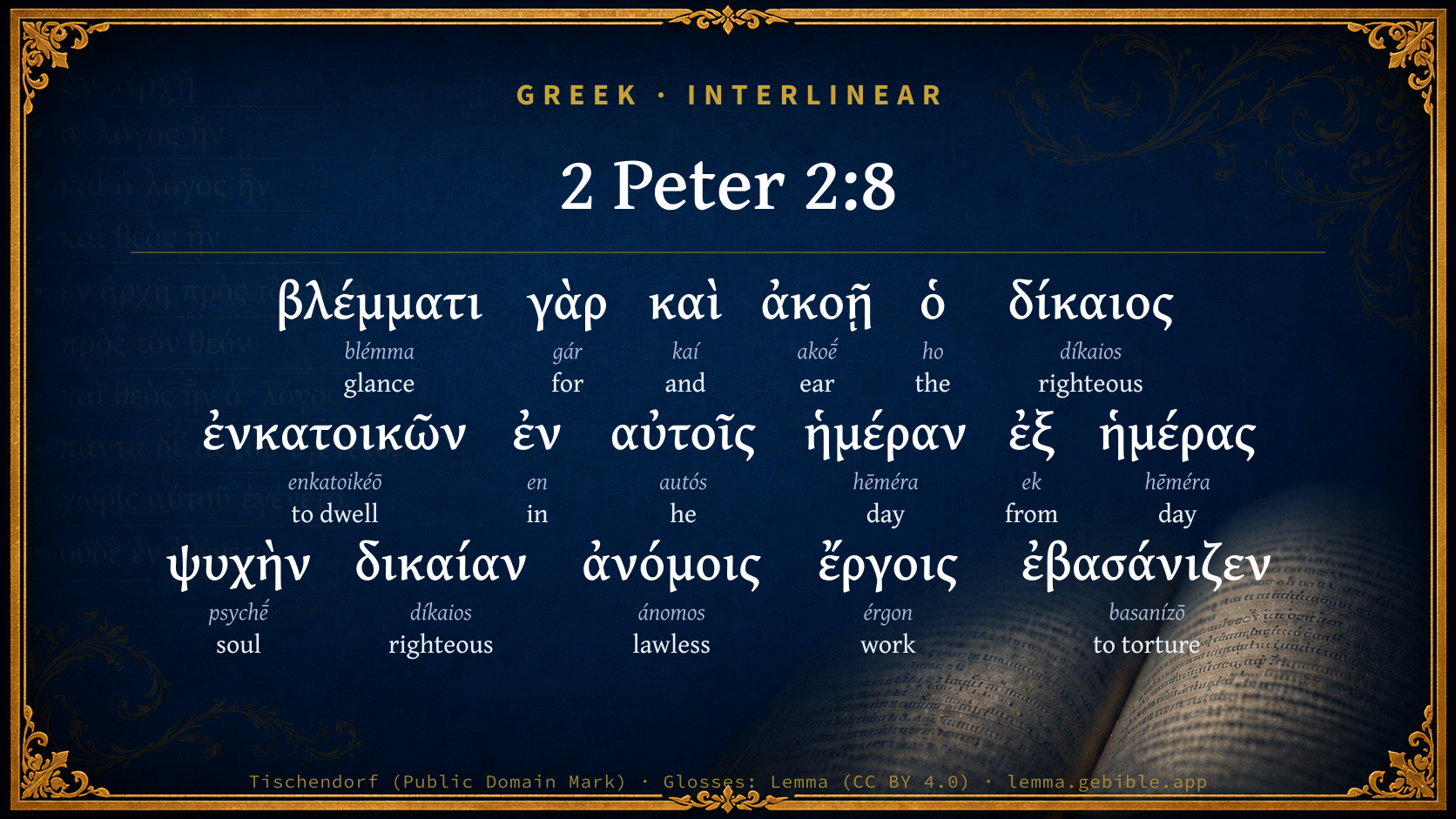
Greek (Tischendorf 8th ed.) 2 Peter 2:8 appears in the Greek New Testament. The text above is from the Tischendorf 8th edition. Each word links to its Strong’s number and a concise gloss. Click any word for its full Thayer’s Greek Lexicon entry.
Download image
Cite this verse

2 Peter 2:8 (World English Bible). Public Domain. Lemma interlinear Bible study tool, https://lemma.gebible.app/v/2-peter/2/8.

Show BibTeX & RIS
BibTeX
RIS
English Translation
(for that righteous man dwelling among them, was tormented in his righteous soul from day to day with seeing and hearing lawless deeds):
World English Bible · Public Domain
Highlights
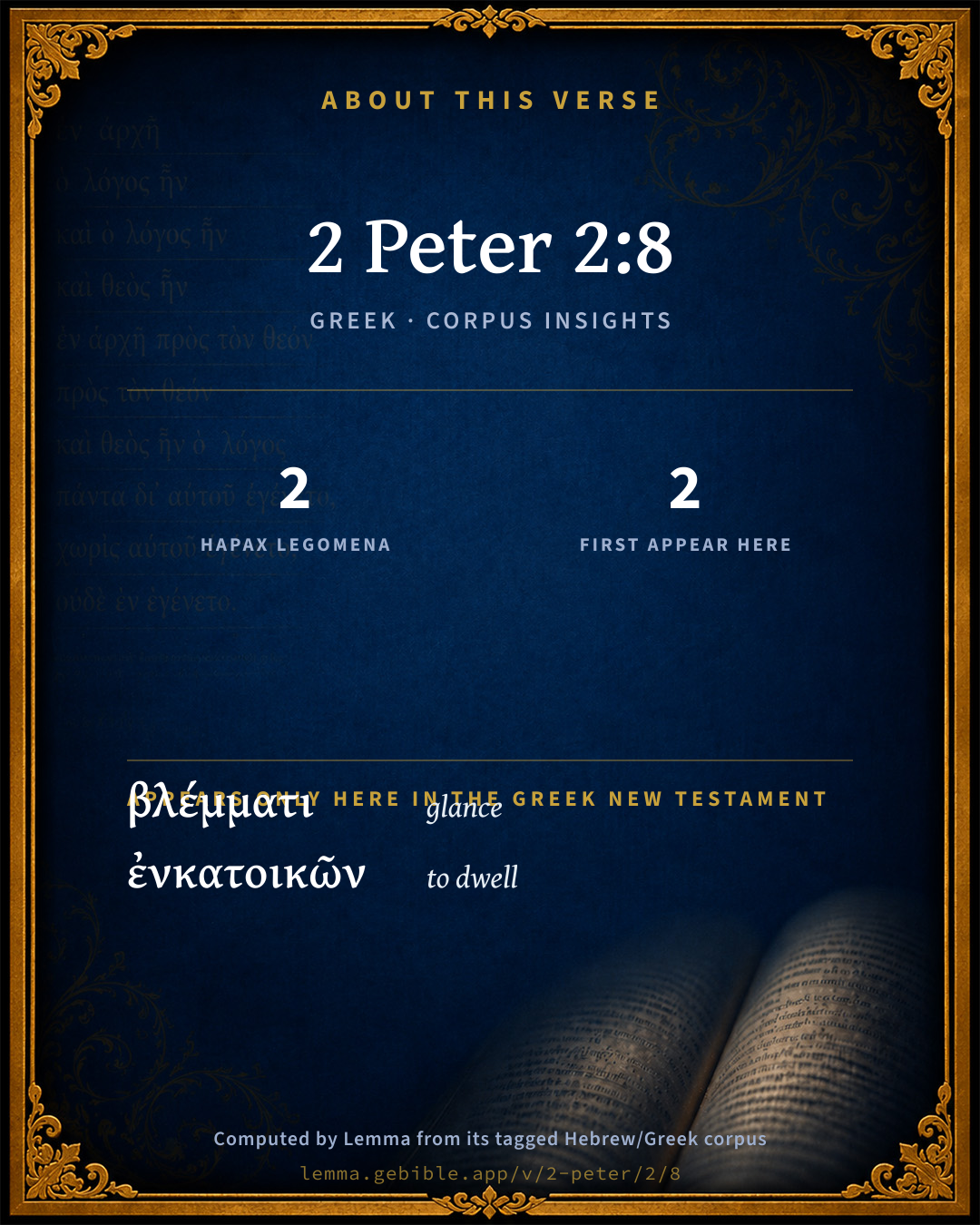
  • 2 hapax legomena — only here in the Greek New Testament
  • 2 first appearances in the Greek New Testament
Full analysis ↓
Download a study sheet

One document with this verse’s original text, its word-by-word gloss line, the meaning frame, cross-references with their text, attributed commentary, and full source and license credits — printable, and it pastes into notes with its structure intact.

This verse Autodidact and up

Study sheet (.html) Plain text (.txt)

A passage Seminary Student

Up to 50 verses in one chapter. A passage sheet keeps up to 6 commentary sources and 12 cross-references per verse, in the order this page ranks them, and says so on the sheet whenever that leaves anything out. Ask for a single verse and you get the Autodidact verse sheet above.

Everything on this page stays free to read, with no account — the sheet is a download of what is already on screen, not access to it.

Want to remove ads? Support Godless Engineer
Compare translations 3

The same verse in 3 English versions, stacked beneath the original-language interlinear above. Click any original word for its lexicon entry.

Each is an independent rendering of the whole verse — the interlinear is not word-aligned to these translations.

Highlighted words mark where these versions differ — a whole-verse word diff, not a word-by-word alignment.

  • World English Bible Public Domain
    (for that righteous man dwelling among them, was tormented in his righteous soul from day to day with seeing and hearing lawless deeds):
  • King James Version Public Domain
    (For that righteous man dwelling among them, in seeing and hearing, vexed his righteous soul from day to day with their unlawful deeds;)
  • unfoldingWord Literal Text CC BY-SA 4.0
    (for, by seeing and by hearing, that righteous, living among them day from day, was tormenting his righteous soul by lawless works);

unfoldingWord Literal Text — © unfoldingWord, licensed CC BY-SA 4.0. Word-aligned USFM3 via Door43 (git.door43.org/unfoldingWord/en_ult).

Versions to compare (up to 4)

3 of 4 selected

Show all 19 translations

Every available English version of this verse, each an independent rendering of the whole verse.

  • World English Bible Public Domain
    (for that righteous man dwelling among them, was tormented in his righteous soul from day to day with seeing and hearing lawless deeds):
  • Berean Standard Bible Public Domain
    (for that righteous man, living among them day after day, was tormented in his righteous soul by the lawless deeds he saw and heard)—
  • Majority Standard Bible Public Domain
    (for that righteous man, living among them day after day, was tormented in his righteous soul by the lawless deeds he saw and heard)—
  • King James Version Public Domain
    (For that righteous man dwelling among them, in seeing and hearing, vexed his righteous soul from day to day with their unlawful deeds;)
  • American Standard Version (1901) Public Domain
    (for that righteous man dwelling among them, in seeing and hearing, vexed `his' righteous soul from day to day with `their' lawless deeds):
  • Revised Version (1885) Public Domain
    (for that righteous man dwelling among them, in seeing and hearing, vexed his righteous soul from day to day with their lawless deeds):
  • Geneva Bible (1599) Public Domain
    (For he being righteous, and dwelling among them, in seeing and hearing, vexed his righteous soule from day to day with their vnlawfull deedes.)
  • Douay-Rheims (1899) Public Domain
    For in sight and hearing he was just: dwelling among them, who from day to day vexed the just soul with unjust works.
  • Young's Literal Translation Public Domain
    for in seeing and hearing, the righteous man, dwelling among them, day by day the righteous soul with unlawful works was harassing.
  • Literal Standard Version CC BY-SA 4.0
    for the righteous [man] dwelling among them was tormented in [his] righteous soul, day by day, in seeing and hearing unlawful works—
  • Unlocked Literal Bible CC BY-SA 4.0
    So that righteous man, who was living among them day after day, was tormented in his righteous soul because of what he saw and heard.
  • unfoldingWord Literal Text CC BY-SA 4.0
    (for, by seeing and by hearing, that righteous, living among them day from day, was tormenting his righteous soul by lawless works);
  • Darby Bible Public Domain
    (for the righteous man through seeing and hearing, dwelling among them, tormented [his] righteous soul day after day with [their] lawless works,)
  • World Messianic Bible Public Domain
    (for that righteous man dwelling among them was tormented in his righteous soul from day to day with seeing and hearing lawless deeds),
  • Webster's Bible Public Domain
    (For that righteous man dwelling among them, in seeing and hearing, grieved his righteous soul from day to day with their unlawful deeds;)
  • Free Bible Version CC BY-SA 4.0
    (Lot lived among them, but he did what was good and right. He saw and heard what they did day after day, and their wickedness tormented him.)
  • Bible in Basic English Public Domain
    (Because the soul of that upright man living among them was pained from day to day by seeing and hearing their crimes):
  • Text-Critical English NT CC BY 4.0
    (for as that righteous man dwelt among them, his righteous soul was tormented day after day over their lawless deeds that he saw and heard);
  • Tyndale New Testament (1534) Public Domain
    For he beynge ryghteous and dwellynge amonge them in seynge and hearynge vexed his righteous soule from daye to daye with their vnlawfull dedes.

Literal Standard Version (2020), Covenant Press — licensed CC BY-SA 4.0. Text via the HelloAO Bible API (eBible.org). Unlocked Literal Bible (unfoldingWord) — licensed CC BY-SA 4.0. Text via the HelloAO Bible API (eBible.org). unfoldingWord Literal Text — © unfoldingWord, licensed CC BY-SA 4.0. Word-aligned USFM3 via Door43 (git.door43.org/unfoldingWord/en_ult). Free Bible Version, Dr. Jonathan Gallagher — licensed CC BY-SA 4.0. Text via the HelloAO Bible API (eBible.org).

Word by word

More ways to search: Search by grammar → Find every occurrence → Compare this word →

Practice this passage: Drill this verse → Learn its vocabulary →

βλέμματι
blémma
G990
“glance”
Noun, Dative, Singular, Neuter
Part of Speech
Noun
Case
Dative
Number
Singular
Gender
Neuter
Full Thayer's Definition

Origin: from G991

TDNT: None

1. a look, a glance
  1. γὰρ gár G1063 “for” Conjunction
  2. καὶ kaí G2532 “and” Conjunction
  3. ἀκοῇ akoḗ G189 “ear” Noun, Dative, Singular, Feminine
  4. ὁ ho G3588 “the” Article, Nominative, Singular, Masculine
  5. δίκαιος díkaios G1342 “righteous” Adjective, Nominative, Singular, Masculine
  6. ἐνκατοικῶν enkatoikéō G1460 “to dwell” Verb, Present, Active, Participle, Nominative, Singular, Masculine
  7. ἐν en G1722 “in” Preposition
  8. αὐτοῖς autós G846 “he” Personal pronoun, Dative, Plural, Masculine
  9. ἡμέραν hēméra G2250 “day” Noun, Accusative, Singular, Feminine
  10. ἐξ ek G1537 “from” Preposition
  11. ἡμέρας hēméra G2250 “day” Noun, Genitive, Singular, Feminine
  12. ψυχὴν psychḗ G5590 “soul” Noun, Accusative, Singular, Feminine
  13. δικαίαν díkaios G1342 “righteous” Adjective, Accusative, Singular, Feminine
  14. ἀνόμοις ánomos G459 “lawless” Adjective, Dative, Plural, Neuter
  15. ἔργοις érgon G2041 “work” Noun, Dative, Plural, Neuter
  16. ἐβασάνιζεν basanízō G928 “to torture” Verb, Imperfect, Active, Indicative, 3rd person, Singular

About this verse

These counts appear in no published source. They are computed here, from the morphology-tagged text and Lemma’s own curated glosses. What Lemma adds →

17
words
15
distinct lemmas
General Epistles
section

Notable vocabulary

2 hapax legomena — words that appear only here in the entire Greek New Testament:

  • βλέμματι glance G990
  • ἐνκατοικῶν to dwell G1460

First appearance in Scripture

These words make their first canonical appearance in the Greek New Testament here:

  • βλέμματι glance G990
  • ἐνκατοικῶν to dwell G1460

Shared distinctive vocabulary

ἀνόμοις lawless G459 occurs in 6 verses of the Greek New Testament. Also found in:
Repetition

Words recur within this verse:

  • δίκαιος righteous G1342 ×2
  • ἡμέραν day G2250 ×2

Cross-references

10

Topical passages linked to 2 Peter 2:8 in the Treasury of Scripture Knowledge — connected by theme and wording, ordered by reader-vote popularity; previews shown in the World English Bible.

  • Psalms 119:158 I look at the faithless with loathing, Because they don't observe your word.
  • Ezekiel 9:4 Yahweh said to him, Go through the midst of the city, through the midst of Jerusalem, and set a mark on the foreheads of the men that sigh and that cry over all the abominations that are done in the midst of it.
  • Psalms 119:136 Streams of tears run down my eyes, Because they don't observe your law.
  • Proverbs 25:26 Like a muddied spring, and a polluted well, So is a righteous man who gives way before the wicked.
  • Psalms 119:139 My zeal wears me out, Because my enemies ignore your words.
  • Proverbs 28:12 When the righteous triumph, there is great glory; But when the wicked rise, men hide themselves.
  • Malachi 3:15–17 Now we call the proud happy; yes, those who work wickedness are built up; yes, they tempt God, and escape.'
  • 1 Timothy 1:9 as knowing this, that law is not made for a righteous man, but for the lawless and insubordinate, for the ungodly and sinners, for the unholy and profane, for murderers of fathers and murderers of mothers, for manslayers,
  • James 5:16 Confess your offenses to one another, and pray one for another, that you may be healed. The effective, earnest prayer of a righteous man is powerfully effective.
  • Ezekiel 9:6 kill utterly the old man, the young man and the virgin, and little children and women; but don't come near any man on whom is the mark: and begin at my sanctuary. Then they began at the old men that were before the house.

Cross-references courtesy of OpenBible.info (CC BY 4.0).

Commentary

Notes on 2 Peter 2:8 from classic Christian and Jewish commentators (each source and its license shown beneath its notes). The classic Christian expositions comment on the surrounding passage and are grouped to its opening verse, so a note may address several verses; the Jewish commentaries on the Tanakh (Rashi and others) are per-verse, so they appear only where the commentator wrote on this verse.

Lemma curates 59 commentaries, every one of them public domain or Creative Commons licensed, each selected and text-cleaned for this edition rather than reprinted as found. About our sources →

The Biblical Illustrator

Joseph S. Exell

2Pe_2:8

Make merchandise of you.

False teachers as merchantmen

The apostle here makes a continuation of their sins and a declaration of their plagues. They extend the thread of their mischief very long, till hell fire burn it off. They broach heresies, corrupt multitudes, sell souls, as merchants do their wares; cozen mens consciences, colour foul natures with fair words, blaspheme the gospel, deny Jesus Christ. Oh, how constant and long-winded are they in their wickedness! But there is a judgment that wakes while they slumber.

I. The general similitude (merchandising) here used. The calling of a merchant is of great antiquity and necessary use. Merchants are the feet of the world, whereby distant countries meet together. Yet it is a dangerous profession, not only for wreck of life and goods, but also of conscience; which is not always made in their ships abroad, but too commonly in their shops at home.

1. The merchants are false teachers. As Judas sold Christ for thirty pieces, so they sell men to sin, little esteeming the price that a soul cost.

2. The wares--you; your estates, liberties, lives, and souls. They set up a mart of holy things, and with their impostures fill their purses. An evil pastor may sell his flock three ways--

(1) By flattery. He that encourages a man in his errors sells him for his own gain.

(2) By heresy. Broaching schisms and factions and erroneous opinions, as it were feeding the people with bones, or rather poisons, instead of wholesome meat.

(3) By silence. The watchman who does not ring the alarm bell at the approach of danger betrays the city to the enemy.

3. Through covetousness. This is the ground or motive of their traffic. It is true of every schism, what was said of Lucillas faction, with a little inversion: anger bred it, pride fostered it, and covetousness confirmed it.

(1) This sin of covetousness is iniquity in all men, blasphemy in a clergyman. The titles we bear, the office we sustain, the Person we represent, the nearness of our calling to that absolute integrity, are remembrances unto us that we be not covetous.

(2) There is no fault in a minister like covetousness, because there is no sin reigning in the world like worldliness. We may preach our hearts out to dissuade mens affections from this world; if we embrace it ourselves, they will never believe us.

(3) The vice of covetousness is an epidemical disease, the grand Cairo of mischief, the metropolis of wickedness, a universal plague that has infected all conditions of people.

4. The means of their utterance, feigned words! Heresy was never found disjoined from hypocrisy. Their speeches are so ambiguous and equivocal, that they seem to hold both ours and our adversaries tenets. What they cannot perform by the evidence of truth, they seek to attain by the eloquence of art. As rebels Drake their proclamations in the name of the king, and pirates intending to rob merchants hang out the flags of other nations, both to scandal them and to conceal themselves; so do hypocrites wear Christian colours that they may be the devils cozeners.

II. Their perdition.

1. The severity of it.

(1) Their judgment. The menaces of God are not always followed with an infallible event, being sometimes on purpose signified, that they may be by penitence prevented.

(2) For whose sake doth God execute judgment upon these false teachers? For His own glory and the Churchs good, that they may no longer cozen mens souls with their impostures.

(3) Though the Lord will judge these wicked persons, yet this forbids not magistrates to execute justice upon them.

(4) Their judgment--their own; as proper to them as the inheritance they bought with their money. Sin doth naturally draw a punishment.

(5) Their judgment. But is it so certainly theirs, that no repentance can prevent it? Yes, serious repentance may avert the vengeance, if their gracious God gives the repentance.

(6) Their judgment and their damnation. Observe the proportion and adaptation of their punishment to their sin. It holds in divers analogies.

(a) They denied the Lord that bought them, therefore the same Lord shall judge them.

(b) They acted all their villainy in secret, therefore now it shall be laid open.

(c) The way of truth hath been blasphemed by them, therefore now it is fit that it be glorified on them.

(d) Before they sold men in covetousness, therefore now they shall be sold themselves in justice.

(e) Before they brought in the heresy of damnation, therefore now they shall sustain the penalty of damnation.

(f) Before they did pull on themselves destruction voluntarily, therefore now must father the child of their own begetting, and suffer destruction nesessarily.

(g) Their sin did hasten punishment and make it swift, therefore fit it should no longer tarry; it lingereth not.

(7) Damnation is principally taken for the censure or sentence condemning; as the sentence follows the trial, and the execution the sentence; here it intends the execution of the judgment.

2. Sleepeth not, lingereth not, slumbereth not. Though it be not yet present, it is propinquant; if not extant, yet instant.

(1) This wakeful vengeance is threatened against the ungodly very fitly; for nothing is more proper to the nature of sin than to sleep in security.

(2) Sin will not let justice sleep, bug sends it up continual challenges, provoking Him to draw that sword, which He had rather should rest in the scabbard, than be sheathed in His own creatures.

3. Long ago. There is a preordination of plagues for reprobates, and the very moment of the execution appointed (Jud_1:4).

Lessons:

1. Seeing God doth not sleep in His justice, let not us sleep in our injustice.

2. As this is terror to the ungodly, so comfort to the righteous. As justice is ever waking, so mercy is never asleep. (Thos. Adams.)

Manhood in the market

Who are they that are engaged in this business?

1. The liquor-dealers.

2. Writers and publishers of obscene literature.

3. Purchasers of the virtue of women.

4. Bribers and bribe-takers.

5. Mercenary journalists.

6. Atheistic orators and religious quacks. (A. Little.)

The Biblical Illustrator, edited by Joseph S. Exell (c. 1880s–1900s) — public domain. Text from a community e-Sword module.

Bengel's Gnomon

Johann Albrecht Bengel

2Pe 2:8. Ὁ δίκαιος—ψυχὴν δικαίαν, the righteous man—his righteous soul) The reflex influence of grief is elegantly expressed. Lot tortured himself: and the guilty men of Sodom were his torment.—ἡμέραν ἐξ ἡμέρας, from day to day) Thus the Septuagint often renders יום יום.—ἔργοις) by deeds, spoken of.

Bengel's Gnomon of the New Testament — English translation (T&T Clark, Edinburgh, 1860) — public domain. Text from a community e-Sword module.

Meyer's Critical & Exegetical Commentary

Heinrich August Wilhelm Meyer

2Pe_2:8. Explanation of the καταπονούμενον.

βλέμματι γὰρ καὶ ἀκοῇ] is to be joined neither with δίκαιος (Vulg.: adspectu et auditu Justus erat), nor with ἐγκατοικῶν (Gerhard), but with the finite verb; it was by seeing and hearing that Lots soul suffered, and is added in order more strongly to emphasize Lots painful position among the ungodly.

ψυχὴν δικαίαν ἀνόμοις ἔργοις ἐβασάνιζεν] he vexed his righteous soul by the ungodly works, i.e. his soul, because it was righteous, felt vexation at the evil which he was obliged to see and hear. ἐβασάνιξειν serves to show that the pain at the sight of the sinful lives arose out of personal activity, out of inclination of the soul to the good, out of positive opposition to the evil (Dietlein). The earlier interpreters have for the most part missed the correct idea; Calvin, Hornejus, Pott, de Wette, and the modern commentators generally, have interpreted correctly.[69]

[69] Cf. Xenophon, hist. Graec. I. 4, p. 407: ὥστʼ ἐνίους καὶ τῶν τυπτομένων, νομίμων δὲ ὄντων ἀνθρώπων, ἀδημονῆσαι τὰς ψυχὰς, ἰδόντας τὴν ἀσέβειαν; Only it must be observed that Lot was vexed at the godlessness in itself, not because he personally had to suffer by it.

Meyer — Critical and Exegetical Commentary on the New Testament — English translation by Peter Christie, edited by Frederick Crombie (T&T Clark, 1880) — public domain. Text from a community e-Sword module.

Expositor's Greek Testament

ed. W. Robertson Nicoll

2Pe 2:8 . βλέμματι γὰρ καὶ ἀκοῇ . Two interpretations are possible (1) Instrumental dative after ἐβασάνιζεν . “He vexed his righteous soul by what he saw and heard.” The objections are ( a ) the long interval that separates βλ . κ . τ . λ . from ἐβασάνιζεν , ( b ) that βλέμμα is never elsewhere used of the thing seen, but is used of sight from the subjective, emotional, and volitional point of view. Hence (2), reading δίκαιος without the article, and taking βλ . κ . τ . λ . with that word, we may translate with the Vulgate “aspectu et auditu Justus”. His instincts of eye and ear were nobler than those of the society around him. ἡμέραν ἐξ ἡμέρας . “Day in, day out.” Cf. ἡμέρα καθ ἡμέραν in Psa 68:19 . ἐβασάνιζεν . It is somewhat peculiar that the active should be used. “He vexed, distressed his righteous soul.” May it not be that in the use of the active a certain sense of personal culpability is implied? Lot was conscious that the situation was ultimately due to his own selfish choice ( cf. von Soden).

The Expositor's Greek Testament, edited by W. Robertson Nicoll (1897–1910) — public domain. Text from a community e-Sword module.

Geneva Bible (1599)

Geneva Bible translators

Which way soever he looked and turned his ears.

He had a troubled soul, and being vehemently grieved, lived a painful life.

Geneva Bible (1599) marginal notes — public domain. Text via Bolls.life.

Jamieson, Fausset & Brown

Robert Jamieson, A. R. Fausset & David Brown

vexed--Greek, "tormented."

Jamieson, Fausset & Brown — Commentary Critical and Explanatory on the Whole Bible (1871) — public domain (CC PDM 1.0). Text via the HelloAO Bible API.

Adam Clarke's Commentary

Verse 8. That righteous man dwelling among them] Lot, after his departure from Abraham, A. M. 2086, lived at Sodom till A. M. 2107, a space of about twenty years; and, as he had a righteous soul, he must have been tormented with the abominations of that people from day to day.

The word εβασανιζεν, tormented, is not less emphatic than the word καταπονουμενον, grievously pained, in the preceding verse, and shows what this man must have felt in dwelling so long among a people so abandoned.

Adam Clarke's Commentary on the Bible (1810–1826) — public domain. Text from a community e-Sword/MySword module.

John Calvin's Commentaries

8. In seeing and hearing. The common explanation is, that Lot was just in his eyes and ears, because all his senses abhorred the crimes of Sodom. However, another view may be taken of his seeing and hearing, so as to make this the meaning, that when the just man lived among the Sodomites, he tormented his soul by seeing and hearing; for we know that he was constrained to see and hear many things which greatly vexed his mind. The purport of what is said then is, that though the holy man was surrounded with every kind of monstrous wickedness, he yet never turned aside from his upright course.

But Peter expresses more than before, that is, that just Lot underwent voluntary sorrows; as it is right that all the godly should feel no small grief when they see the world rushing into every kind of evil, so the more necessary it is that they should groan for their own sins. And Peter expressly mentioned this, lest when impiety everywhere prevails, we should be captivated and inebriated by the allurements of vices, and perish together with others, but that we might prefer this grief, blessed by the Lord, to all the pleasures of the world.

John Calvin's Commentaries (1540-1563) — public domain. Text from the Calvin Translation Society English edition (1840s-50s) via the Christian Classics Ethereal Library (ccel.org). Calvin's coverage is partial (roughly two-thirds of the Bible); uncommented books and verses are honest gaps, never fabricated. The 19th-century editor's footnotes and remarks are omitted so the notes are faithfully Calvin's own voice.

Ellicott's Commentary for English Readers

(8) For that righteous man.—This epithet, here thrice given to Lot, seems at first sight to be at variance with his willingness to remain, for the sake of worldly advantages, in the midst of such wickedness. But “righteous is a relative term; and in this case we must look at Lot both in comparison with the defective morality of the age and also with the licentiousness of those with whom he is here contrasted. Moreover, in the midst of this corruption he preserves some of the brighter features of his purer nomad life, especially that “chivalrous hospitality” (Gen_19:2-3; Gen_19:8) to which the author of the Epistle to the Hebrews seems to point as a model: “Be not forgetful to entertain strangers, for thereby some have entertained angels unawares” (Gen_13:2). Add to this the fact of God’s rescuing him and his family, especially in connexion with the declaration that ten “righteous” people would have saved the whole city (Gen_18:32), and his ready belief and obedience when told to leave all, and also the fact that Zoar was saved at his intercession (Gen_19:21), and we must then admit that the epithet “righteous” as applied to Lot is by no means without warrant.

A Bible Commentary for English Readers, edited by Charles John Ellicott (1878–1897) — public domain. Text from a community e-Sword module.

The Cambridge Bible for Schools and Colleges

gen. ed. J. J. S. Perowne

8. for that righteous man …] Literally, the righteous man. We note the use of the term in this half-generic, half-individual, way as analogous to that of Jas_5:6.

vexed his righteous soul] Literally, tortured, as in Mar_5:7; Mar_6:48. It would have seemed scarcely necessary to point out that the words refer to the pain suffered by a man of sensitive moral nature at the sight and report of flagrant evil (comp. Ezekiel’s language (Eze_9:4) as to those “that sigh and that cry” for the abominations done in Jerusalem) had not some patristic interpreters of authority (Theophylact and Œcumenius) seen in them a description of the self-inflicted ascetic discipline by which Lot maintained his purity. It may be noted that the “seeing” is peculiar to St Peter.

The Cambridge Bible for Schools and Colleges (gen. ed. J. J. S. Perowne; Cambridge University Press, 1878–1918) — public domain. Text from a community e-Sword module.

John Gill's Exposition

For that righteous man dwelling among them,.... Which is sometimes the lot of good men, to their great sorrow and grief, Psa 120:5. Upon mentioning those words in Gen 13:12 "and pitched his tent towards Sodom", but the men of Sodom were wicked, &c. says R. Eleazar (i);

"he is a righteous man that dwells between two wicked men, and does not learn their works;''

and such an one was Lot, whatever they are elsewhere pleased to say of him: "in seeing and hearing"; the Vulgate Latin version reads this in connection with the word "righteous", thus, "in seeing and hearing he was righteous": he could not bear to see their filthy actions, and hear their obscene language, but turned away from them, and shut his eyes, and stopped his ears, by which he appears to be a righteous and good man; though rather this belongs to what follows, seeing their wicked practices, and hearing their filthy talk:

vexed his righteous soul from, day today with their unlawful deeds; either "they vexed" him, as the Vulgate Latin and Ethiopic versions read; or rather "he vexed" himself; he fretted and teased himself, and became exceeding uneasy, and was put upon a rack and tortured, as the word signifies, continually, with their wicked actions; see Psa 119:158.

(i) T. Bab. Yoma, fol. 38. 2.

John Gill's Exposition of the Whole Bible (1746–1763) — public domain (CC PDM 1.0). Text via the HelloAO Bible API.

Trapp's Complete Commentary

John Trapp

8 (For that righteous man dwelling among them, in seeing and hearing, vexed his righteous soul from day to day with their unlawful deeds;)

Ver. 8. In seeing and hearing] Every sinful Sodomite was a Hazael to his eyes, a Hadadrimmon to his heart.

Vexed his righteous soul] Guilt or grief is all that the good soul gets by conversing with the wicked.

John Trapp, A Commentary or Exposition upon All the Books of the Old and New Testament (1647–1656) — public domain. Text from a community e-Sword module.

Albert Barnes' Notes on the Bible

For that righteous man dwelling among them - The Latin Vulgate renders this, “For in seeing and hearing he was just;” meaning that he maintained his uprightness, or that he did not become contaminated by the vices of Sodom. Many expositors have supposed that this is the correct rendering; but the most natural and the most common explanation is that which is found in our version. According to that, the meaning is, that compelled as he was, while living among them, to see and to hear what was going on, his soul was constantly troubled.

In seeing and hearing - Seeing their open acts of depravity, and hearing their vile conversation. The effect which this had on the mind of Lot is not mentioned in Genesis, but nothing is more probable than the statement here made by Peter. Whether this statement was founded on tradition, or whether it is a suggestion of inspiration to the mind of Peter, cannot be determined. The words rendered “seeing” and “hearing” may refer to the ACT of seeing, or to the object seen. Wetstein and Robinson suppose that they refer here to the latter, and that the sense is, that he was troubled by what he saw and heard. The meaning is not materially different. Those who live among the wicked are compelled to see and hear much that pains their hearts, and it is well if they do not become indifferent to it, or contaminated by it. “Vexed” his “righteous soul from day to day with” their “unlawful deeds.”

Tortured or tormented his soul - ἐβασάνιζεν ebasanizen Compare Mat 8:6, Mat 8:29; Luk 8:28; Rev 9:5; Rev 11:10; Rev 14:10; Rev 20:10, where the same word is rendered “tormented.” The use of this word would seem to imply that there was something active on the part of Lot which produced this distress on account of their conduct. He was not merely troubled as if his soul were passively acted on, but there were strong mental exercises of a positive kind, arising perhaps from anxious solicitude how he might prevent their evil conduct, or from painful reflections on the consequences of their deeds to themselves, or from earnest pleadings in their behalf before God, or from reproofs and warnings of the wicked. At all events, the language is such as would seem to indicate that he was not a mere passive observer of their conduct. This, it would seem, was “from day to day,” that is, it was constant. There were doubtless reasons why Lot should remain among such a people, and why, when he might so easily have done it, he did not remove to another place.

Perhaps it was one purpose of his remaining to endeavor to do them good, as it is often the duty of good men now to reside among the wicked for the same purpose. Lot is supposed to have resided in Sodom - then probably the most corrupt place on the earth - for 16 years; and we have in that fact an instructive demonstration that a good man may maintain the life of religion in his soul when surrounded by the wicked, and an illustration of the effects which the conduct of the wicked will have on a man of true piety when he is compelled to witness it constantly. We may learn from the record made of Lot what those effect will be, and what is evidence that one is truly pious who lives among the wicked.

(1) He will not be contaminated with their wickedness, or will not conform to their evil customs.

(2) He will not become indifferent to it, but his heart will be more and more affected by their depravity. Compare Psa 119:136; Luk 19:41; Act 17:16.

(3) He will have not only constant, but growing solicitude in regard to it - solicitude that will be felt every day: “He vexed his soul from day to day.” It will not only be at intervals that his mind will be affected by their conduct, but it will be an habitual and constant thing. True piety is not fitful, periodical, and spasmodic; it is constant and steady. It is not a “jet” that occasionally bursts out; it is a fountain always flowing.

(4) He will seek to do them good. We may suppose that this was the case with Lot; we are certain that it is a characteristic of true religion to seek to do good to all, however wicked they may be.

(5) He will secure their confidence. He will practice no improper arts to do this, but it will be one of the usual results of a life of integrity, that a good man will secure the confidence of even the wicked. It does not appear that Lot lost that confidence, and the whole narrative in Genesis leads us to suppose that even the inhabitants of Sodom regarded him as a good man. The wicked may hate a good man because he is good; but if a man lives as he should, they will regard him as upright, and they will give him the credit of it when he dies, if they should withhold it while he lives.

Albert Barnes' Notes on the Bible (1834–1885) — public domain. Text from a community e-Sword/MySword module.

Matthew Poole's English Annotations

Seeing and hearing: their wickedness was so open and shameless, that he not only heard the report of it, but saw them commit it, Isa 3:9.

Vexed; Greek, tormented, i.e. extremely afflicted and troubled his own soul, provoking himself to godly sorrow at the sight and fame of their unlawful deeds. His grief was voluntary, and he active in it; the like is said of Christ, on occasion of Lazarus’s death, Joh 11:33, where the margin reads, he troubled himself.

Matthew Poole's English Annotations on the Holy Bible (1683–1685) — public domain. Text from a community e-Sword/MySword module.

Whedon's Commentary on the Bible

Daniel D. Whedon

8. Explanatory of the vexed in 2Pe_2:7.

Vexed—Lot tormented himself by what he daily saw and heard of their conduct. The inference is, that he sought to reform them, though unsuccessfully.

Daniel D. Whedon (gen. ed.), Commentary on the Old and New Testaments (1874–1909) — public domain. Text from a community e-Sword module.

The Pulpit Commentary

For that righteous man dwelling among them; literally, for the righteous man. It was through his own choice that he dwelt among the people of Sodom. The recollection of this grave mistake must have added bitterness to the daily distress caused by the sins of his neighbours. (Gen_13:11) In seeing and hearing, vexed his righteous soul from day to day with their unlawful deeds. The words, "in seeing and hearing," are best connected with the verb that follows, not with "righteous" according to the Vulgate (though this would be the natural connection, if with the Vatican Manuscript we omit the article), nor with "dwelling among them." The literal translation is, "was tormenting his righteous soul." The sight of lawless deeds and the sound of wicked words were a daily grief to Lot. He distressed himself; he felt the guilt and danger of his neighbours, the dishonour done to God, and his own unhappy choice. St. Peter cannot mean (as OEcumenius and Theophylact suppose) that Lot"s affliction was caused by the sustained effort to resist the temptation of falling into the like vices himself. The Greek words for "seeing" and "dwelling among" occur only here in the New Testament.

The Pulpit Commentary (1880–1919), ed. H.D.M. Spence-Jones & Joseph S. Exell — public domain. Text from a community e-Sword module.

The People's New Testament

B. W. Johnson

8. For that righteous man, etc. Lot, seeing and hearing the wickedness around him, was sore distressed.

B. W. Johnson's The People's New Testament with Notes (1889–1891) — public domain. Electronic text from the Christian Classics Ethereal Library (CCEL) ThML edition.

Cambridge Greek Testament for Schools and Colleges

8. A parenthesis, telling why Lot needed deliverance.

δίκαιος is preceded by the article ὁ in all MSS. except B. Westcott and Hort follow B. Some difference in rendering is entailed; omitting ὁ we translate “righteous in respect of looking and listening,” like the man in Isa 33:15 “that stoppeth his ears from hearing of blood, and shutteth his eyes from seeing evil.” The Latin Vulgate takes this view, “aspectu enim et auditu iustus erat.” Inserting ὁ, we must connect the datives βλέμματι καὶ ἀκοῇ with ἐβασάνιζεν as A.V., “in seeing and hearing, vexed his righteous soul,” etc.

ᾑμέραν ἐξ ἡμέρας = καθʼ ἡμέραν. It occurs in Psa 96:2 (LXX) “Be telling of His salvation from day to day.”

ψυχὴν … ἐβασάνιζεν. Compare Apocalypse of Peter, § 1, And then shall God come to my faithful ones that hunger and thirst and are afflicted, καὶ ἐν τούτῳ τῷ βίῳ τὰς ψυχὰς ἑαυτῶν δοκιμάζοντας. But though the idea of testing may underlie ἐβασάνιζεν here, it is not safe to discard the ordinary N.T. meaning of “tormented.”

The Latin Vulgate must have had a different text, which is not found in any Greek MS. It reads, “habitans apud eos qui de die in diem animam iustam iniquis operibus cruciabant,” i.e. ἐν αὐτοῖς οἳ … ἐβασάνιζον.

Cambridge Greek Testament for Schools and Colleges (Cambridge University Press, 1896; 21 vols, various authors incl. Carr, Maclear, Plummer, Farrar, Lumby, Moule, M. R. James, Simcox) — public domain. Text from a community e-Sword module.

Vincent's Word Studies in the New Testament

Marvin R. Vincent

Dwelling [εγκατοικων] . Only here in New Testament. Dwelling, and therefore suffering continually, from day to day.

In seeing [βλεμματι] . Only here in New Testament. Usually of the look of a man from without, through which the vexation comes to the soul. "Vexed his righteous soul."

Vexed [εβασανιζεν] . See on Mt 4:24, torments. The original sense is to test by touchstone or by torture. See on toiling, Mr 6:48. Rev. gives tormented, in margin.

Unlawful [ανομοις] . Rev., lawless. Only here in New Testament with things. In all other cases it is applied to persons.

Marvin R. Vincent, Word Studies in the New Testament (1887–1900) — public domain. Text from a community e-Sword/MySword module.

Lesson kit

Teaching starters — assembled from the data on this page, not authored interpretation. Every prompt links to the verse data it draws on. Edit before teaching.

2 Peter, in the General Epistles, opens this verse with 17 words (15 distinct Greek lemmas). Its most distinctive word is blémma (“glance”). A historical commentator’s framing appears above. Read the whole chapter for the surrounding context.

Discussion questions

  1. How does “glance” (blémma) shape what this verse is saying?
  2. This verse holds 2 words here found nowhere else in the Greek New Testament. What might the rare words draw attention to?
  3. 2 words here appear for the first time in Scripture. What is being introduced at this debut?
  4. Luke 22:37 shares the word «lawless» with this verse. How do the two illuminate each other?
  5. “righteous” occurs 2× in this one verse. What is the effect of the repetition?
  6. These translations render this verse differently. What is at stake in choosing one wording over another?
  7. Reading how The Biblical Illustrator and Bengel's Gnomon read this verse, where do the two commentators agree and where do they part?

Things to notice

  • 2 words in this verse appear nowhere else in the Greek New Testament.
  • 2 words make their first canonical appearance in Scripture here.
  • These translations choose different wording for 10 words in this verse.
  • “righteous” occurs 2× in this single verse.
  • 15 distinct Greek lemmas span 17 words in this verse.

Reading settings

Reading text

Shown beneath each verse's original-language words.

Old Testament
Old Testament edition

Read the OT as the Masoretic Hebrew (MT) or the Greek Septuagint (LXX).

English shown for the Greek Septuagint (in the Hebrew ↔ Greek comparison).

Comparing translations? Open the Compare panel on any verse page to stack up to four side by side.