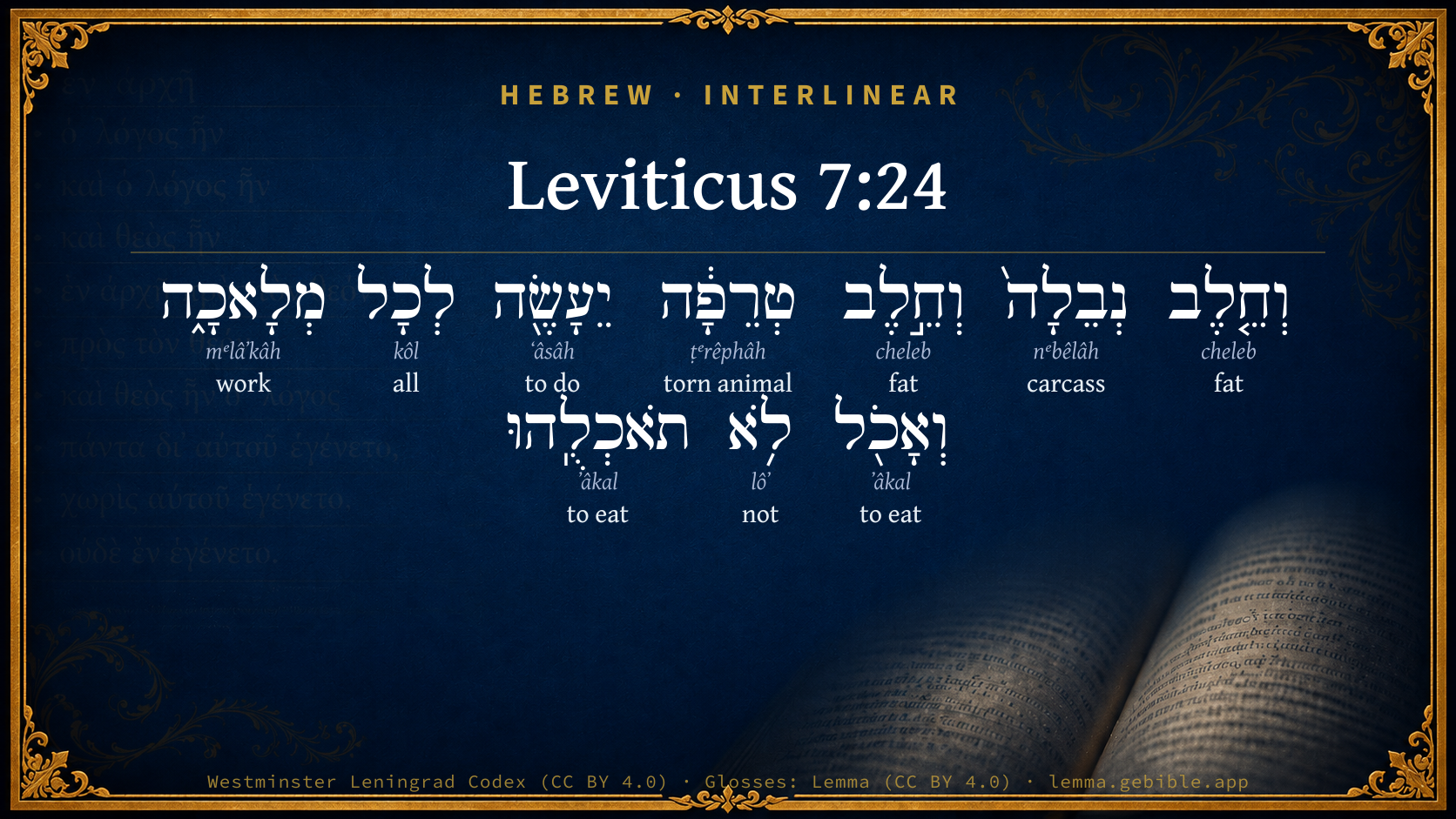
Leviticus 7:24

Hebrew (Westminster Leningrad Codex) Leviticus 7:24 appears in the Hebrew Old Testament. The text above is from the Westminster Leningrad Codex. Each word links to its Strong’s number, a concise gloss, and parsing drawn from the Open Scriptures Hebrew Bible morphology. Click any word for its full Brown-Driver-Briggs (BDB) entry.
Download image
Cite this verse

Leviticus 7:24 (World English Bible). Public Domain. Lemma interlinear Bible study tool, https://lemma.gebible.app/v/leviticus/7/24.

Show BibTeX & RIS
BibTeX
RIS
English Translation
The fat of that which dies of itself, and the fat of that which is torn of animals, may be used for any other service, but you shall in no way eat of it.
World English Bible · Public Domain
Download a study sheet

One document with this verse’s original text, its word-by-word gloss line, the meaning frame, cross-references with their text, attributed commentary, and full source and license credits — printable, and it pastes into notes with its structure intact.

This verse Autodidact and up

Study sheet (.html) Plain text (.txt)

A passage Seminary Student

Up to 50 verses in one chapter. A passage sheet keeps up to 6 commentary sources and 12 cross-references per verse, in the order this page ranks them, and says so on the sheet whenever that leaves anything out. Ask for a single verse and you get the Autodidact verse sheet above.

Everything on this page stays free to read, with no account — the sheet is a download of what is already on screen, not access to it.

Want to remove ads? Support Godless Engineer
Compare translations 3

The same verse in 3 English versions, stacked beneath the original-language interlinear above. Click any original word for its lexicon entry.

Each is an independent rendering of the whole verse — the interlinear is not word-aligned to these translations.

Highlighted words mark where these versions differ — a whole-verse word diff, not a word-by-word alignment.

  • World English Bible Public Domain
    The fat of that which dies of itself, and the fat of that which is torn of animals, may be used for any other service, but you shall in no way eat of it.
  • King James Version Public Domain
    And the fat of the beast that dieth of itself, and the fat of that which is torn with beasts, may be used in any other use: but ye shall in no wise eat of it.
  • unfoldingWord Literal Text CC BY-SA 4.0
    And the fat of a carcass or the fat of a torn animal shall be made for any work, but you shall certainly not eat it.

unfoldingWord Literal Text — © unfoldingWord, licensed CC BY-SA 4.0. Word-aligned USFM3 via Door43 (git.door43.org/unfoldingWord/en_ult).

Versions to compare (up to 4)

3 of 4 selected

Show all 18 translations

Every available English version of this verse, each an independent rendering of the whole verse.

  • World English Bible Public Domain
    The fat of that which dies of itself, and the fat of that which is torn of animals, may be used for any other service, but you shall in no way eat of it.
  • Berean Standard Bible Public Domain
    The fat of an animal found dead or mauled by wild beasts may be used for any other purpose, but you must not eat it.
  • Majority Standard Bible Public Domain
    The fat of an animal found dead or mauled by wild beasts may be used for any other purpose, but you must not eat it.
  • King James Version Public Domain
    And the fat of the beast that dieth of itself, and the fat of that which is torn with beasts, may be used in any other use: but ye shall in no wise eat of it.
  • American Standard Version (1901) Public Domain
    And the fat of that which dieth of itself, and the fat of that which is torn of beasts, may be used for any other service; but ye shall in no wise eat of it.
  • Revised Version (1885) Public Domain
    And the fat of that which dieth of itself, and the fat of that which is torn of beasts, may be used for any other service: but ye shall in no wise eat of it.
  • Geneva Bible (1599) Public Domain
    Yet the fat of the dead beast, and the fat of that, which is torne with beastes, shalbe occupied to any vse, but ye shall not eate of it.
  • Douay-Rheims (1899) Public Domain
    The fat of a carcass that hath died of itself, and of a beast that was caught by another beast, you shall have for divers uses.
  • Young's Literal Translation Public Domain
    and the fat of a carcase, and the fat of a torn thing is prepared for any work, but ye do certainly not eat it;
  • Literal Standard Version CC BY-SA 4.0
    and the fat of a carcass, and the fat of a torn thing, is prepared for any work, but you certainly do not eat it;
  • Unlocked Literal Bible CC BY-SA 4.0
    The fat of an animal that died without being a sacrifice, or the fat of an animal torn by wild animals, may be used for other purposes, but you must certainly not eat it.
  • unfoldingWord Literal Text CC BY-SA 4.0
    And the fat of a carcass or the fat of a torn animal shall be made for any work, but you shall certainly not eat it.
  • Darby Bible Public Domain
    But the fat of a dead carcase, and the fat of that which is torn, may be used in any other use; but ye shall in no wise eat it.
  • World Messianic Bible Public Domain
    The fat of that which dies of itself, and the fat of that which is torn of animals, may be used for any other service, but you shall in no way eat of it.
  • Webster's Bible Public Domain
    And the fat of the beast that dieth of itself, and the fat of that which is torn with beasts, may be used for any other purpose; but ye shall in no wise eat of it.
  • Free Bible Version CC BY-SA 4.0
    You can use the fat of an animal found dead or killed by wild beasts for whatever purpose you want, but you must not eat it.
  • Bible in Basic English Public Domain
    And the fat of that which comes to a natural death, and the fat of that which is attacked by beasts, may be used for other purposes, but not in any way for food.
  • JPS Tanakh (1917) Public Domain
    And the fat of that which dieth of itself, and the fat of that which is torn of beasts, may be used for any other service; but ye shall in no wise eat of it.

Literal Standard Version (2020), Covenant Press — licensed CC BY-SA 4.0. Text via the HelloAO Bible API (eBible.org). Unlocked Literal Bible (unfoldingWord) — licensed CC BY-SA 4.0. Text via the HelloAO Bible API (eBible.org). unfoldingWord Literal Text — © unfoldingWord, licensed CC BY-SA 4.0. Word-aligned USFM3 via Door43 (git.door43.org/unfoldingWord/en_ult). Free Bible Version, Dr. Jonathan Gallagher — licensed CC BY-SA 4.0. Text via the HelloAO Bible API (eBible.org).

Word by word

More ways to search: Search by grammar → Find every occurrence → Compare this word →

Practice this passage: Drill this verse → Learn its vocabulary →

טְרֵפָ֔ה
ṭᵉrêphâh
H2966
“torn animal”
Noun, Common, Feminine, Singular, Absolute
Part of Speech
Noun
Type
Common
Gender
Feminine
Number
Singular
State
Absolute
Full BDB Definition

Origin: from (collectively) H2964

TWOT: 827c

that which is torn, animal torn (by beasts)
  1. וְחֵ֤לֶב cheleb H2459 “and · fat of” Conjunction + Noun, Common, Masculine, Singular, Construct
  2. נְבֵלָה֙ nᵉbêlâh H5038 “carcass” Noun, Common, Feminine, Singular, Absolute
  3. וְחֵ֣לֶב cheleb H2459 “and · fat of” Conjunction + Noun, Common, Masculine, Singular, Construct
  4. יֵעָשֶׂ֖ה ʻâsâh H6213 “to do” Verb, Niphal, Imperfect, 3rd Person, Masculine, Singular
  5. לְכָל kôl H3605 “to/for · all of” Preposition + Noun, Common, Masculine, Singular, Construct
  6. מְלָאכָ֑ה mᵉlâʼkâh H4399 “work” Noun, Common, Feminine, Singular, Absolute
  7. וְאָכֹ֖ל ʼâkal H398 “and · to eat” Conjunction + Verb, Qal, Infinitive Absolute
  8. לֹ֥א lôʼ H3808 “not” Particle, Negative
  9. תֹאכְלֻֽהוּ ʼâkal H398 “to eat · him” Verb, Qal, Imperfect, 2nd Person, Masculine, Plural + Suffix, Personal, 3rd Person, Masculine, Singular

About this verse

These counts appear in no published source. They are computed here, from the morphology-tagged text and Lemma’s own curated glosses. What Lemma adds →

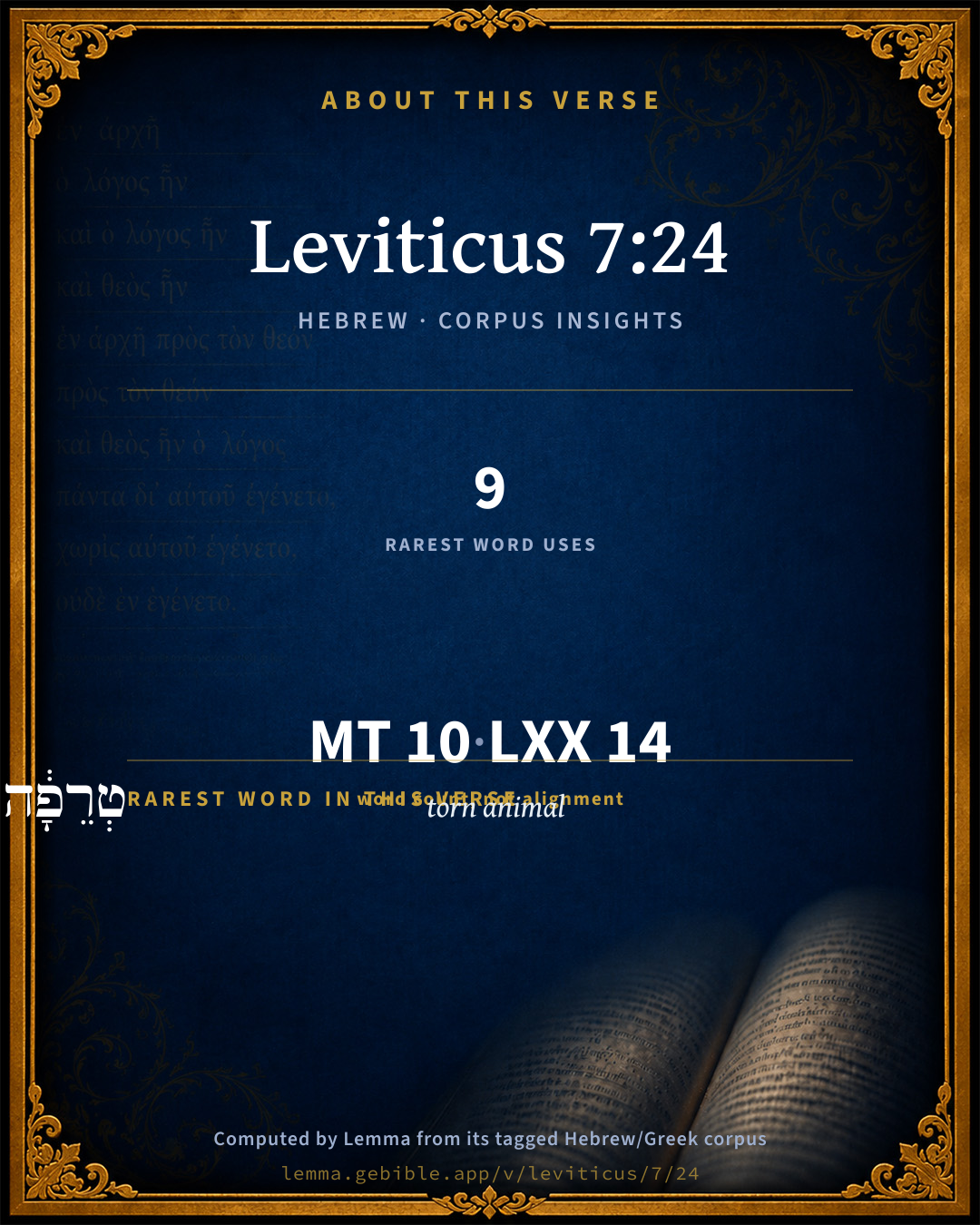
10
words
8
distinct lemmas
Pentateuch
section

Notable vocabulary

The rarest word here is טְרֵפָ֔ה torn animal H2966 — appearing just 9 times in the whole Hebrew Bible.

Shared distinctive vocabulary

טְרֵפָ֔ה torn animal H2966 occurs in 9 verses of the Hebrew Bible. Also found in:

Grammatical profile

  • 3 verbs
  • 6 nouns
  • 1 particle

Verb forms

  • יֵעָשֶׂ֖ה Niphal · Imperfect
  • וְאָכֹ֖ל Qal · Infinitive Absolute
  • תֹאכְלֻֽהוּ Qal · Imperfect

Repetition

Words recur within this verse — often emphatic in Hebrew:

  • וְחֵ֤לֶב fat H2459 ×2
  • וְאָכֹ֖ל to eat H398 ×2

Hebrew & Septuagint length

In English translation the verse runs 34 words from the Hebrew and 42 from the Septuagint (LXX English) — closely comparable.

A rough comparison of the two English renderings, which tokenize alike — not a word-level alignment.

Word counts can differ between the Hebrew and the Greek without any difference in meaning — e.g. the Hebrew direct-object marker אֵת has no separate Greek word, and Greek often adds the article ὁ.

In the original languages it is 10 Hebrew tokens and 14 Greek tokens — but the two are counted differently (Hebrew bundles its prefixes and suffixes into one token; the Greek is in lemma form), so that isn’t a like-for-like length.

Cross-references

6

Topical passages linked to Leviticus 7:24 in the Treasury of Scripture Knowledge — connected by theme and wording, ordered by reader-vote popularity; previews shown in the World English Bible.

  • Exodus 22:31 "You shall be holy men to me, therefore you shall not eat any flesh that is torn by animals in the field. You shall cast it to the dogs.
  • Leviticus 17:15 "'Every person that eats what dies of itself, or that which is torn by animals, whether he is native-born or a foreigner, he shall wash his clothes, and bathe himself in water, and be unclean until the evening: then he shall be clean.
  • Leviticus 22:8 That which dies of itself, or is torn by animals, he shall not eat, defiling himself by it. I am Yahweh.
  • Deuteronomy 14:21 You shall not eat of anything that dies of itself: you may give it to the foreigner living among you who is within your gates, that he may eat it; or you may sell it to a foreigner: for you are a holy people to Yahweh your God. You shall not boil a kid in its mother's milk.
  • Ezekiel 4:14 Then said I, Ah Lord Yahweh! behold, my soul has not been polluted; for from my youth up even until now have I not eaten of that which dies of itself, or is torn of animals; neither came there abominable flesh into my mouth.
  • Ezekiel 44:31 The priests shall not eat of anything that dies of itself, or is torn, whether it be bird or animal.

Cross-references courtesy of OpenBible.info (CC BY 4.0).

Hebrew and Greek witnesses Masoretic Hebrew ↔ Greek Septuagint

The same verse in the two great witnesses to the Old Testament, shown verse-for-verse.

These are two independent witnesses, not word-aligned to each other, and the Septuagint is shown in lemma (dictionary) form.

Hebrew Leviticus 7:24 Masoretic · Westminster Leningrad Codex

וְחֵ֤לֶב נְבֵלָה֙ וְחֵ֣לֶב טְרֵפָ֔ה יֵעָשֶׂ֖ה לְכָל מְלָאכָ֑ה וְאָכֹ֖ל לֹ֥א תֹאכְלֻֽהוּ

The fat of that which dies of itself, and the fat of that which is torn of animals, may be used for any other service, but you shall in no way eat of it.

World English Bible · Public Domain

Greek LXX Leviticus 7:24 Septuagint · lemma form

καί στέαρ θνησιμαῖος καί θηριάλωτος ποιέω εἰς πᾶς ἔργον καί εἰς βρῶσις οὐ βιβρώσκω

For I have taken the wave-breast and shoulder of separation from the children of Israel from the sacrifices of your peace-offerings, and I have given them to Aaron the priest and his sons, a perpetual ordinance due from the children of Israel.

LXX2012 (modern English Septuagint) · Public Domain

Hebrew: Westminster Leningrad Codex (CC BY 4.0). Greek: Septuagint (public domain); English from LXX2012 (modern English Septuagint) (Public Domain). How the Septuagint differs from the Hebrew →

Targum (Aramaic paraphrase)

2

The Targum is the ancient Jewish Aramaic paraphrase of the Hebrew Scriptures — an interpretive translation, not the Hebrew text itself. Onkelos (literal) and Pseudo-Jonathan (expansive) render the Torah, and Jonathan the Prophets. Coverage is partial: where no permissively-licensed English translation exists for a verse, only the Aramaic is shown. This is verse-level text, not a word-by-word alignment to the Hebrew.

  1. Targum Onkelos Torah (Genesis–Deuteronomy)
    וּתְרַב נְבִילָא וּתְרַב תְּבִירָא יִתְעֲבֵד לְכָל עִבִדְתָּא וּמֵיכַל לָא תֵיכְלוּנֵהּ

    (no public-domain English translation for this verse)

    Targum Onkelos — Aramaic: “Onkelos Genesis” (public domain); “Onkelos Exodus” (public domain); “Onkelos Leviticus” (public domain); “Onkelos Numbers” (public domain); “Onkelos Deuteronomy” (public domain). English: “Sefaria Community Translation” (CC0 1.0 (public-domain dedication)); “J.W. Etheridge. The Targums of Onkelos and Jonathan Ben Uzziel on the Pentateuch. London: Longmans, Green, 1862” (public domain). Text via Sefaria.

  2. Targum Pseudo-Jonathan Torah (Genesis–Deuteronomy)
    וּתְרֵיב חֵיוָא דִמְקַלְקְלָא בְּשַׁעַת נִיכְסְתָא וּדְמִיתְנַבְלָא בְּמוֹתָנָא וּתְרֵיב חֵיוָא תְבִירָא אֶפְשַׁר דְיִתְעֲבֵיד לְכָל עִיבִידְתָּא בְּרַם תְּרֵיב חֵיוָא דִמְכַשְׁרָא יִתְסַק עַל מַדְבְּחָא וּמֵיכַל לָא תֵיכְלוּנֵיהּ

    but the fat of an animal which corrupteth in the hour of sacrifice, or which dieth a dead thing by death, or the fat of a beast that is torn, may be used in any work; but the fat of an animal that is in a right (condition) shall be burned upon the altar, and shall in no wise be eaten.

    Targum Pseudo-Jonathan — Aramaic: “Targum Jonathan on Genesis” (public domain); “Targum Jonathan on Exodus” (public domain); “Targum Jonathan on Leviticus” (public domain); “Targum Jonathan on Numbers” (public domain); “Targum Jonathan on Deuteronomy” (public domain). English: “The Targum of Jonathan ben Uzziel, trans. J. W. Etheridge, London, 1862” (public domain). Text via Sefaria.

Commentary

Notes on Leviticus 7:24 from classic Christian and Jewish commentators (each source and its license shown beneath its notes). The classic Christian expositions comment on the surrounding passage and are grouped to its opening verse, so a note may address several verses; the Jewish commentaries on the Tanakh (Rashi and others) are per-verse, so they appear only where the commentator wrote on this verse.

Lemma curates 59 commentaries, every one of them public domain or Creative Commons licensed, each selected and text-cleaned for this edition rather than reprinted as found. About our sources →

John Gill's Exposition

For whosoever eateth the fat of the beast, of which men offer an offering made by fire unto the Lord,.... As oxen, sheep, rams, goats; meaning not only the fat of those that are offered, but the fat of all those of the like kind:

even the soul that eateth it shall be cut off from his people; See Gill on Lev 7:20 Maimonides (n) observes, that the punishment of cutting off is enjoined for the eating of fat, because men used to count it delicious, for which reason also God would honour his sacrifices with it: and he further observes (o), that the fat of the intestines too much saturates, hinders concoction, generates gross and frigid blood, hence it is much better it should be burnt than eaten; and that blood and what dies of itself are of difficult digestion, and of bad nourishment, wherefore the latter is forbidden in the Lev 7:24, and the former in Lev 7:26, of the punishment for eating fat, the same writer (p) observes, he that eats fat the quantity of an olive, presumptuously, is guilty of cutting off; if ignorantly, he must bring the fixed sin offering: and elsewhere (q) he says, he that eats fat is beaten for it; and he eats it a second time, and is beaten for it; but if he eats it a third time they do not beat him, but put him into a prison, which is a strait place according to his height, where he cannot stand upright, nor can he lie down in it; and they give him bread and water of affliction till his bowels are distressed, and he become sick, and then they feed him with barley till his belly bursts.

(n) Moreh Nevochim, par. 3. c. 41. (o) Ibid. c. 48. (p) Hilchot Maacolot Asurot, c. 7. sect. 1. (q) Hilchot Sanhedrin, c. 18. sect. 4.

John Gill's Exposition of the Whole Bible (1746–1763) — public domain (CC PDM 1.0). Text via the HelloAO Bible API.

Trapp's Complete Commentary

John Trapp

Lev 7:24 And the fat of the beast that dieth of itself, and the fat of that which is torn with beasts, may be used in any other use: but ye shall in no wise eat of it.

Ver. 24. Used in any other use.] Though not in sacrifice. Mud walls may be made up of any refuse matter: not so the walls of a church or palace.

John Trapp, A Commentary or Exposition upon All the Books of the Old and New Testament (1647–1656) — public domain. Text from a community e-Sword module.

Tyndale Open Study Notes

Tyndale Open Resources

7:24 Animals found dead had not been drained of their blood and were therefore unclean. Their fat was unfit to offer to the Lord and could not be eaten. However, it could be used for any other purpose, such as greasing cart axles, waterproofing animal hides, and other household uses.

Tyndale Open Study Notes — © Tyndale Open Resources, licensed CC BY-SA 4.0. Text via the HelloAO Bible API.

Ellicott's Commentary for English Readers

(24) And the fat of the beast that dieth of itself.—That is, of the aforesaid animals which died of any disease or accident, or were killed by wild beasts, and which, therefore, are entirely unclean (see Lev_17:15; Lev_22:8), might be used for common purposes in ordinary life, such as making candles, &c., &c.

A Bible Commentary for English Readers, edited by Charles John Ellicott (1878–1897) — public domain. Text from a community e-Sword module.

Albert Barnes' Notes on the Bible

Compare Lev 11:39.

Albert Barnes' Notes on the Bible (1834–1885) — public domain. Text from a community e-Sword/MySword module.

Haydock's Catholic Bible Commentary

Uses. Hebrew, "for any other use: but you shall not eat it." Origen (hom. 5,) seems to reject this fat entirely.

George Leo Haydock (1774–1849), Haydock's Catholic Family Bible and Commentary, 1859 edition — public domain. Excludes Psalms (Douay-Rheims chapter numbering differs from Protestant) and Deuterocanonical books (Catholic canon only).

Matthew Poole's English Annotations

He speaketh still of the same kinds of beasts, and showeth that this prohibition reacheth not only to the fat of those beasts which were offered to God, but also of those that died, or were killed at home. And if this seems a superfluous prohibition concerning the fat, since the lean as well as the fat of such beasts was forbidden, Lev 22:8, it must be noted that that prohibition reached only to the priests, Lev 7:4.

Matthew Poole's English Annotations on the Holy Bible (1683–1685) — public domain. Text from a community e-Sword/MySword module.

John Wesley's Explanatory Notes

He speaks still of the same kinds of beasts, and shews that this prohibition reaches not only to the fat of those beasts which were offered to God, but also of those that died, or were killed at home. And if this seems a superfluous prohibition, since the lean as well as the fat of such beasts were forbidden, chap. xxii, 8, it must be noted, that prohibition reached only to the priests, ver. 4.

John Wesley, Explanatory Notes Upon the Whole Bible (1754–1765) — public domain. Text via the GEBible commentary corpus.

Keil & Delitzsch

C. F. Keil & F. Delitzsch

The fat of cattle that had fallen (נבלה), or been torn to pieces (viz., by beasts of prey), was not to be eaten, because it was unclean and defiled the eater (Lev 17:15; Lev 22:8); but it might be applied "to all kinds of uses," i.e., to the common purposes of ordinary life. Knobel observes on this, that "in the case of oxen, sheep, and goats slain in the regular way, this was evidently not allowable. But the law does not say what was to be done with the fat of these animals." Certainly it does not disertis verbis; but indirectly it does so clearly enough. According to Lev 17:3., during the journey through the desert any one who wanted to slaughter an ox, sheep, or goat was to bring the animal to the tabernacle as a sacrificial gift, that the blood might be sprinkled against the altar, and the fat burned upon it. By this regulation every ordinary slaughtering was raised into a sacrifice, and the law determined what was to be done with the fat. Now if afterwards, when the people dwelt in Canaan, cattle were allowed to be slaughtered in any place, and the only prohibition repeated was that against eating blood (Deu 12:15-16, Deu 12:21.), whilst the law against eating fat was not renewed; it follows as a matter of course, that when the custom of slaughtering at the tabernacle was restricted to actual sacrifices, the prohibition against eating the fat portions came to an end, so far as those animals were concerned with were slain for consumption and not as sacrifices. The reason for prohibiting fat from being eaten was simply this, that so long as every slaughtering was a sacrifice, the fat portions, which were to be handed over to Jehovah and burned upon the altar, were not to be devoted to earthly purposes, because they were gifts sanctified to God. The eating of the fat, therefore, was neither prohibited on sanitary or social grounds, viz., because fat was injurious to health, as Maimonides and other Rabbins maintain, nor for the purpose of promoting the cultivation of olives, as Michaelis supposes, nor to prevent its being put into the unclean mouth of man, as Knobel imagines; but as being an illegal appropriation of what was sanctified to God, a wicked invasion of the rights of Jehovah, which was to be punished with extermination according to the analogy of Num 15:30-31. The prohibition of blood in Lev 7:26, Lev 7:27, extends to birds and cattle; fishes not being mentioned, because the little blood which they possess is not generally eaten. This prohibition Israel was to observe in all its dwelling-places (Exo 12:20, cf. Lev 17:10), not only so long as all the slaughterings had the character of sacrifices, but for all ages, because the blood was regarded as the soul of the animal, which God had sanctified as the medium of atonement for the soul of man (Lev 17:11), whereby the blood acquired a much higher degree of holiness than the fat.

Keil & Delitzsch — Biblical Commentary on the Old Testament (1861–1891) — public domain (CC PDM 1.0). Text via the HelloAO Bible API. (Old Testament only.)

Rashi

Rabbi Shlomo Yitzchaki (Rashi)

יעשה לכל מלאכה [AND THE FAT OF CARRION AND THE FAT OF THAT WHICH IS TORN] MAY BE USED IN ANY WORK — Scripture comes and teaches you with regard to חלב (the forbidden fat) of carrion that it does not acquire the “uncleanness of carrion” (‎‏טומאת נבלות), i.e. that whilst the flesh is unclean (cf. Leviticus 11:39) the fat (חלב) does not acquire this uncleanness (cf. Sifra, Tzav, Section 10 5; Pesachim 23a, b).

תאכלוה ‎לא ‎‏ ואכל[AND THE FAT OF CARRION … MAY BE USED IN ANY WORK] BUT YE SHALL IN NO WISE EAT OF IT — By these words it is not intended to forbid the eating of the חלב of a נבלה and טרפה because it is חלב for this has already been forbidden in Leviticus 3:17, but the Torah in effect says here: The prohibition of eating נבלה or טרפה shall come and fall upon (shall form an additional prohibition to) that of חלב — that if one eats it (the חלב of נבלה or of טרפה) he becomes liable to the punishment for transgressing the prohibition of נבלה also, (or of טרפה also), and you should not say: No prohibition can be super-imposed upon another prohibition already existing (Zevachim 70a).

Rashi on the Tanakh — English translations: “The Judaica Press complete Tanach with Rashi, translated by A. J. Rosenberg” (CC BY 4.0); “Pentateuch with Rashi's commentary by M. Rosenbaum and A.M. Silbermann, 1929-1934” (public domain); “The Metsudah Tanach series, Lakewood, N.J” (CC BY 4.0); and “The Book of Joshua, Metsudah Publications, 1997” (CC BY 4.0). Text via Sefaria.

Lesson kit

Teaching starters — assembled from the data on this page, not authored interpretation. Every prompt links to the verse data it draws on. Edit before teaching.

Leviticus, in the Pentateuch, opens this verse with 10 words (8 distinct Hebrew lemmas). Its most distinctive word is ṭᵉrêphâh (“torn animal”). A historical commentator’s framing appears above. Read the whole chapter for the surrounding context.

Discussion questions

  1. The word ṭᵉrêphâh carries the sense “torn animal.” How does it shape the verse?
  2. How does Genesis 31:39, which shares the word «torn animal», read alongside this verse?
  3. What does the repetition of “fat” (2× in this one verse) do in this verse?
  4. These translations render this verse differently; the difference is in the English rendering, not the original. What questions does that raise?
  5. «יֵעָשֶׂ֖ה» is a Niphal Imperfect verb. How does that grammatical form shape the action described?
  6. Compare how John Gill's Exposition and Trapp's Complete Commentary read this verse. Where do they agree or differ?

Things to notice

Reading settings

Reading text

Shown beneath each verse's original-language words.

Old Testament
Old Testament edition

Read the OT as the Masoretic Hebrew (MT) or the Greek Septuagint (LXX).

English shown for the Greek Septuagint (in the Hebrew ↔ Greek comparison).

Comparing translations? Open the Compare panel on any verse page to stack up to four side by side.