2 Corinthians 10:11

Greek (Tischendorf 8th ed.) 2 Corinthians 10:11 appears in the Greek New Testament. The text above is from the Tischendorf 8th edition. Each word links to its Strong’s number and a concise gloss. Click any word for its full Thayer’s Greek Lexicon entry.
Download image
Cite this verse

2 Corinthians 10:11 (World English Bible). Public Domain. Lemma interlinear Bible study tool, https://lemma.gebible.app/v/2-corinthians/10/11.

Show BibTeX & RIS
BibTeX
RIS
English Translation
Let such a person consider this, that what we are in word by letters when we are absent, such are we also in deed when we are present.
World English Bible · Public Domain
Download a study sheet

One document with this verse’s original text, its word-by-word gloss line, the meaning frame, cross-references with their text, attributed commentary, and full source and license credits — printable, and it pastes into notes with its structure intact.

This verse Autodidact and up

Study sheet (.html) Plain text (.txt)

A passage Seminary Student

Up to 50 verses in one chapter. A passage sheet keeps up to 6 commentary sources and 12 cross-references per verse, in the order this page ranks them, and says so on the sheet whenever that leaves anything out. Ask for a single verse and you get the Autodidact verse sheet above.

Everything on this page stays free to read, with no account — the sheet is a download of what is already on screen, not access to it.

Want to remove ads? Support Godless Engineer
Compare translations 3

The same verse in 3 English versions, stacked beneath the original-language interlinear above. Click any original word for its lexicon entry.

Each is an independent rendering of the whole verse — the interlinear is not word-aligned to these translations.

Highlighted words mark where these versions differ — a whole-verse word diff, not a word-by-word alignment.

  • World English Bible Public Domain
    Let such a person consider this, that what we are in word by letters when we are absent, such are we also in deed when we are present.
  • King James Version Public Domain
    Let such an one think this, that, such as we are in word by letters when we are absent, such will we be also in deed when we are present.
  • unfoldingWord Literal Text CC BY-SA 4.0
    Let such consider this, that such as we are in our word through letters being absent, such also in our deed being present.

unfoldingWord Literal Text — © unfoldingWord, licensed CC BY-SA 4.0. Word-aligned USFM3 via Door43 (git.door43.org/unfoldingWord/en_ult).

Versions to compare (up to 4)

3 of 4 selected

Show all 19 translations

Every available English version of this verse, each an independent rendering of the whole verse.

  • World English Bible Public Domain
    Let such a person consider this, that what we are in word by letters when we are absent, such are we also in deed when we are present.
  • Berean Standard Bible Public Domain
    Such people should consider that what we are in our letters when absent, we will be in our actions when present.
  • Majority Standard Bible Public Domain
    Such people should consider that what we are in our letters when absent, we will be in our actions when present.
  • King James Version Public Domain
    Let such an one think this, that, such as we are in word by letters when we are absent, such will we be also in deed when we are present.
  • American Standard Version (1901) Public Domain
    Let such a one reckon this, that, what we are in word by letters when we are absent, such `are we' also in deed when we are present.
  • Revised Version (1885) Public Domain
    Let such a one reckon this, that, what we are in word by letters when we are absent, such are we also in deed when we are present.
  • Geneva Bible (1599) Public Domain
    Let such one thinke this, that such as wee are in woorde by letters, when we are absent, such wil we be also in deede, when we are present.
  • Douay-Rheims (1899) Public Domain
    Let such a one think this, that such as we are in word by epistles, when absent, such also we will be indeed when present.
  • Young's Literal Translation Public Domain
    This one -- let him reckon thus: that such as we are in word, through letters, being absent, such also, being present, `we are' in deed.
  • Literal Standard Version CC BY-SA 4.0
    This one—let him reckon thus: that such as we are in word, through letters, being absent, such also, being present, [we are] in deed.
  • Unlocked Literal Bible CC BY-SA 4.0
    Let such people be aware that what we are in the words of our letters when we are absent is what we will be in our actions when we are there.
  • unfoldingWord Literal Text CC BY-SA 4.0
    Let such consider this, that such as we are in our word through letters being absent, such also in our deed being present.
  • Darby Bible Public Domain
    Let such a one think this, that such as we are in word by letters [when] absent, such also present in deed.
  • World Messianic Bible Public Domain
    Let such a person consider this, that what we are in word by letters when we are absent, such are we also in deed when we are present.
  • Webster's Bible Public Domain
    Let such one think this, that such as we are in word by letters when we are absent, such will we be also in deed when we are present.
  • Free Bible Version CC BY-SA 4.0
    People like that should realize that what we say through letters when we're not there we will do when we are there!
  • Bible in Basic English Public Domain
    Let those who say this keep in mind that, what we are in word by letters when we are away, so will we be in act when we are present.
  • Text-Critical English NT CC BY 4.0
    The people who say such things should realize that what we say in our letters when we are absent, we will demonstrate by our actions when we are present.
  • Tyndale New Testament (1534) Public Domain
    Let him that is soche thynke on this wyse that as we are in wordes by letters when we are absent soche are we in dedes when we are present.

Literal Standard Version (2020), Covenant Press — licensed CC BY-SA 4.0. Text via the HelloAO Bible API (eBible.org). Unlocked Literal Bible (unfoldingWord) — licensed CC BY-SA 4.0. Text via the HelloAO Bible API (eBible.org). unfoldingWord Literal Text — © unfoldingWord, licensed CC BY-SA 4.0. Word-aligned USFM3 via Door43 (git.door43.org/unfoldingWord/en_ult). Free Bible Version, Dr. Jonathan Gallagher — licensed CC BY-SA 4.0. Text via the HelloAO Bible API (eBible.org).

Word by word

More ways to search: Search by grammar → Find every occurrence → Compare this word →

Practice this passage: Drill this verse → Learn its vocabulary →

ἀπόντες
ápeimi
G548
“to depart”
Verb, Present, Active, Participle, Nominative, Plural, Masculine
Part of Speech
Verb
Tense
Present
Voice
Active
Mood
Participle
Case
Nominative
Number
Plural
Gender
Masculine
Full Thayer's Definition

Origin: from G575 and G1510

TDNT: None

1. to go away, depart
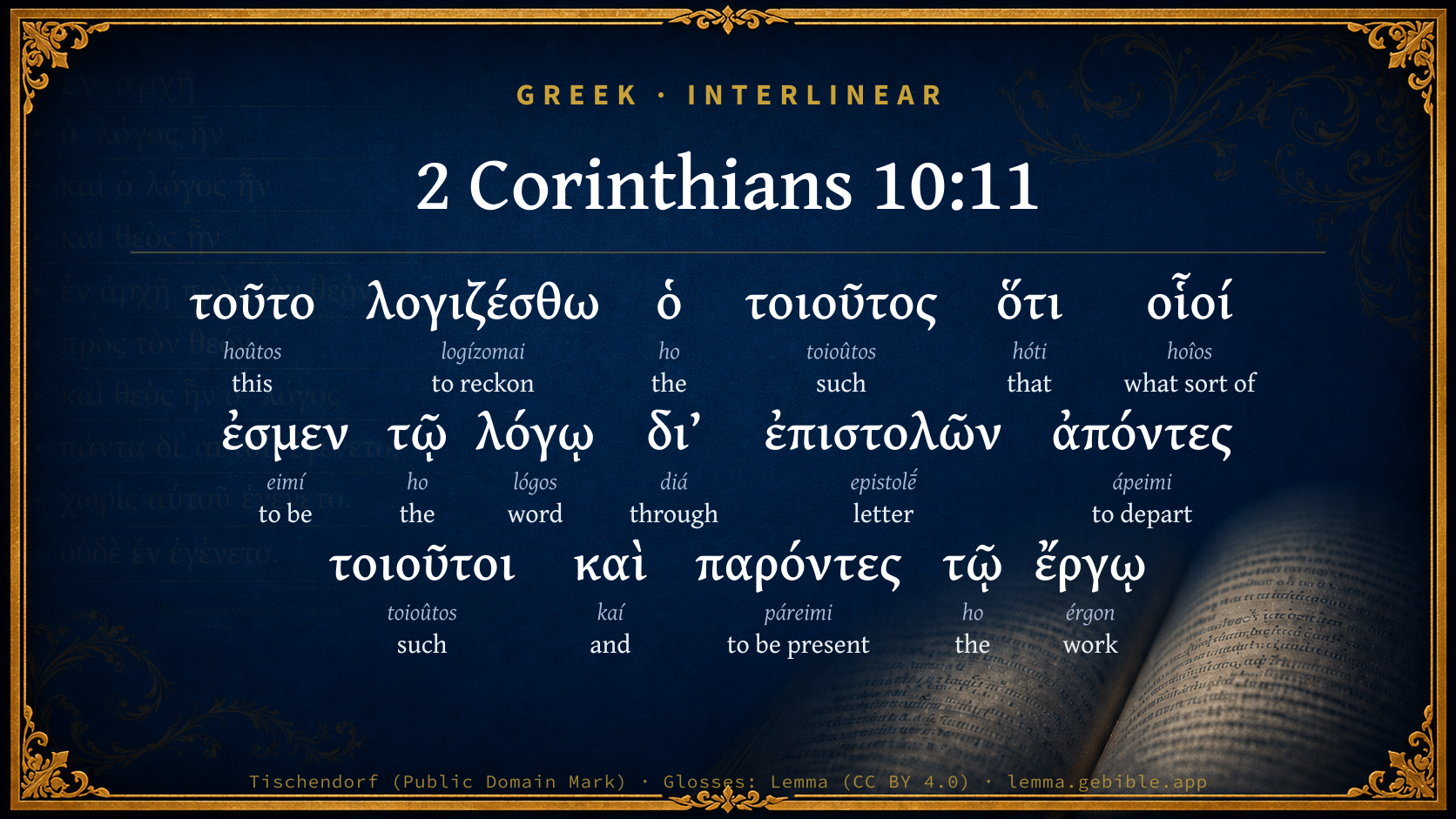
  1. τοῦτο hoûtos G3778 “this” Demonstrative pronoun, Accusative, Singular, Neuter
  2. λογιζέσθω logízomai G3049 “to reckon” Verb, Present, Middle or Passive deponent, Imperative, 3rd person, Singular
  3. ὁ ho G3588 “the” Article, Nominative, Singular, Masculine
  4. τοιοῦτος toioûtos G5108 “such” Demonstrative pronoun, Nominative, Singular, Masculine
  5. ὅτι hóti G3754 “that” Conjunction
  6. οἷοί hoîos G3634 “what sort of” Correlative pronoun, Nominative, Plural, Masculine
  7. ἐσμεν eimí G1510 “to be” Verb, Present, Active, Indicative, 1st person, Plural
  8. τῷ ho G3588 “the” Article, Dative, Singular, Masculine
  9. λόγῳ lógos G3056 “word” Noun, Dative, Singular, Masculine
  10. δι’ diá G1223 “through” Preposition
  11. ἐπιστολῶν epistolḗ G1992 “letter” Noun, Genitive, Plural, Feminine
  12. τοιοῦτοι toioûtos G5108 “such” Demonstrative pronoun, Nominative, Plural, Masculine
  13. καὶ kaí G2532 “and” Conjunction
  14. παρόντες páreimi G3918 “to be present” Verb, Present, Active, Participle, Nominative, Plural, Masculine
  15. τῷ ho G3588 “the” Article, Dative, Singular, Neuter
  16. ἔργῳ érgon G2041 “work” Noun, Dative, Singular, Neuter

About this verse

These counts appear in no published source. They are computed here, from the morphology-tagged text and Lemma’s own curated glosses. What Lemma adds →

17
words
14
distinct lemmas
Pauline Epistles
section

Notable vocabulary

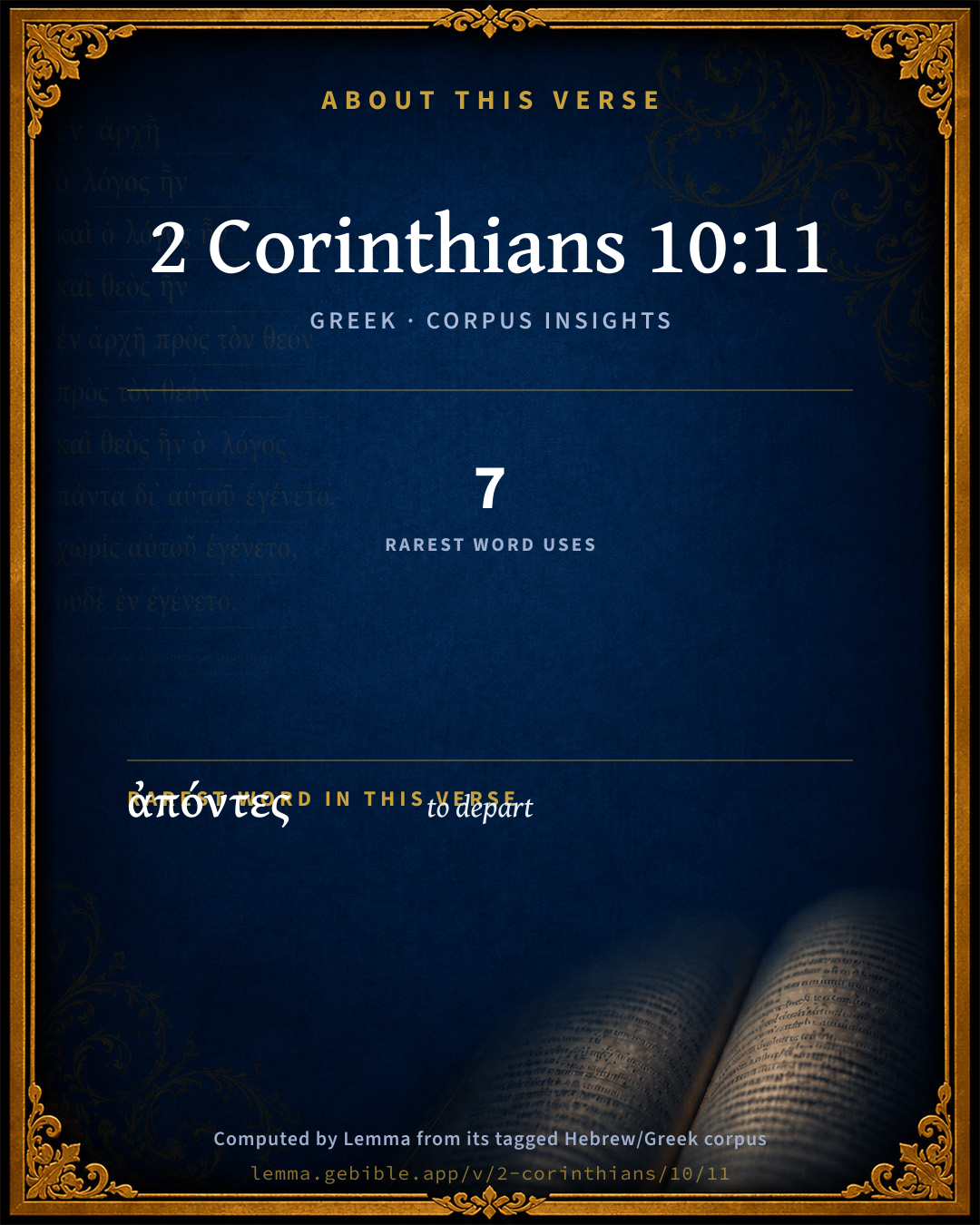
The rarest word here is ἀπόντες to depart G548 — appearing just 7 times in the whole Greek New Testament.

Shared distinctive vocabulary

ἀπόντες to depart G548 occurs in 7 verses of the Greek New Testament. Also found in:

Repetition

Words recur within this verse:

  • τοιοῦτος such G5108 ×2
  • ὁ the G3588 ×3

Cross-references

4

Topical passages linked to 2 Corinthians 10:11 in the Treasury of Scripture Knowledge — connected by theme and wording, ordered by reader-vote popularity; previews shown in the World English Bible.

  • 2 Corinthians 12:20 For I am afraid that by any means, when I come, I might find you not the way I want to, and that I might be found by you as you don't desire; that by any means there would be strife, jealousy, outbursts of anger, factions, slander, whisperings, proud thoughts, riots;
  • 2 Corinthians 13:2–3 I have said beforehand, and I do say beforehand, as when I was present the second time, so now, being absent, I write to those who have sinned before now, and to all the rest, that, if I come again, I will not spare;
  • 2 Corinthians 13:10 For this cause I write these things while absent, that I may not deal sharply when present, according to the authority which the Lord gave me for building up, and not for tearing down.
  • 1 Corinthians 4:19–20 But I will come to you shortly, if the Lord is willing. And I will know, not the word of those who are puffed up, but the power.

Cross-references courtesy of OpenBible.info (CC BY 4.0).

Commentary

Notes on 2 Corinthians 10:11 from classic Christian and Jewish commentators (each source and its license shown beneath its notes). The classic Christian expositions comment on the surrounding passage and are grouped to its opening verse, so a note may address several verses; the Jewish commentaries on the Tanakh (Rashi and others) are per-verse, so they appear only where the commentator wrote on this verse.

Lemma curates 59 commentaries, every one of them public domain or Creative Commons licensed, each selected and text-cleaned for this edition rather than reprinted as found. About our sources →

The Biblical Illustrator

Joseph S. Exell

2Co_10:11-18

Such as we are in word … will we be also in deed.

The vital in character, foolish in judgment, dishonourable in conduct, and supreme in obligation

Here is--

I. A trait of character that is vital (2Co_10:11). The apostle claims for himself thorough and inflexible honesty. His enemies implied that he would not say in their presence what he wrote in his epistles. He denies this. A good man is incarnate honesty, always, everywhere, and with all. A splendid attribute of character this, albeit rare. Truculency and time-serving are, alas! rampant; they are a cancer that is eating up the life of the social body.

II. A judgment of self that is foolish (2Co_10:12).

1. They had represented Paul as cowardly. With oblique irony he says, We dare not make ourselves of the number, as if he had said, Of course we cannot compare ourselves with men of your transcendent courage. Satire is often a serviceable element in conveying truth; it cuts its way into the heart, and makes the nerves of self-conceit quiver,

2. But the point to be noticed is contained in the last clause of the verse, that is their foolish test of self-judgment, viz., the character of others. Nothing can be more unwise than for a man to make the character of another the standard by which to try his own, because--

(1) It would lead to a wrong estimate of self. The best of men are imperfect, and conformity to them would leave us far from what we ought to be.

(2) It will exert a pernicious influence. It will nurse vanity in the soul. Those who are conspicuously vain have their settled society among those who are inferior to themselves. On the other hand, the presence of the great humbles us.

III. A conduct of ministers that is dishonourable (2Co_10:13-16).

1. The teachers at Corinth who were calumniating Paul had gone into his measure or province of labour; they had gone to the Church at Antioch, which he had founded, and to the Church at Galatia, now they were stirring up strife at Corinth. They did not break up fresh ground. Paul did so everywhere; his commission was to the whole Gentile world; therefore he did not stretch himself beyond his province; therefore he did not boast of things without his measure, or of other mens labours.

2. The conduct which the apostle here deprecates is pursued in these times--

(1) In interfering in other mens spheres of labour.

(2) In appropriating other ministers sermons,

IV. moral obligations that are supreme.

1. Glorying in the Lord (2Co_10:17). This implies--

(1) Supreme appreciation. We can only glory in that which we value.

(2) Soul-appropriation. As a rule we can only glory in that which belongs to us. He who can say, The Lord is my portion may well glory.

2. Seeking the approval of the Lord (2Co_10:18). To please Him is our highest duty and sublimest happiness (D. Thomas, D. D.)

The false and true method of estimating men

I. The false and true method of estimating the character of others (2Co_10:13).

1. To judge by public report is a wrong method. There was an impression in Corinth that not only was Pauls bodily presence contemptible, but that his letters displayed a heroism of which the writer was destitute, and hence he was judged to be a boaster and charlatan. How common it is for people to judge by general report! But a miserably false standard of judgment is this. I have often received impressions concerning a person I have never seen, which a subsequent personal acquaintance has completely dispelled.

2. To judge by personal knowledge is the true method. Wait, until I come, and you will find that I am true to the character of my letters. A mans letters, even when rightly interpreted, will not give a complete idea of the author. The author is greater than his book, and one hour with him will give a better idea of him than all the productions of his pen.

II. The false and true method of estimating our own characters.

1. The false method is comparing our own character with the character of others (verse 19).

(1) This is the general tendency of mankind. When we are accused we are prone to say we are not worse than so-and-so. A false standard this, because--

(a) The mass of mankind are corrupt.

(b) The best of men are more or less imperfect.

(c) There is only one perfect character--Jesus Christ.

(2) In these words Paul indicates--

(a) That it is a terrible thing thus to judge ourselves. We dare not (are not bold enough) make ourselves of the number. It is a terrible thing, for it leads to fearful issues.

(b) An unwise thing.

2. The true method is judging ourselves by the will of God (2Co_10:13). Though the apostle by the expression rule which God hath distributed primarily refers to the Divine limits or his apostolic work, as will appear again, the rule applies also to his personal character. Gods will is the standard or canon by which all characters are to be determined. Conclusion: Search me, O God, and know my heart, etc. (D. Thomas, D. D.)

The Biblical Illustrator, edited by Joseph S. Exell (c. 1880s–1900s) — public domain. Text from a community e-Sword module.

Joseph Benson's Commentary

2Co 10:11-12. Let such a one, whoever he be, think this — Reckon upon this as a certain fact; that such as we are in word by letters — However weighty and powerful they may be; when we are absent, such — The same also; will we be in deed, or action, when we are present — Our deeds will fully correspond to our words, and we shall do something to vindicate these pretences, if their speedy repentance do not prevent it. For we dare not, &c. — As if he had said, I, whose appearance and speech are so contemptible, cannot presume to make myself of the number, or to equal myself, as a partner of the same office, or to compare myself with some that commend themselves — As a partaker of the same labour! A strong irony. But they, measuring themselves by themselves — That is, by their own opinion of themselves, and making it the only standard whereby to judge of themselves; are not wise — Do not understand themselves, nor see their own inferiority to the apostles, evangelists, and many other extraordinary or even ordinary ministers of Christ. The meaning is, that the false teachers, in their conversations among themselves, measured or estimated themselves not according to their real worth, but according to the opinion which they had formed of themselves. They looked continually on themselves, surveying their own great imaginary qualifications, but not considering the vastly superior abilities of many others; and so formed a disproportionate opinion of themselves. And this is everywhere one of the greatest sources of pride.

Joseph Benson's Commentary on the Old and New Testaments (1811–1818) — public domain. Text from a community e-Sword module.

Bengel's Gnomon

Johann Albrecht Bengel

2Co 10:11. Τῷ λόγῳ, in word) In antithesis to τῷ ἔργῳ, in deed.

Bengel's Gnomon of the New Testament — English translation (T&T Clark, Edinburgh, 1860) — public domain. Text from a community e-Sword module.

Meyer's Critical & Exegetical Commentary

Heinrich August Wilhelm Meyer

2Co_10:11. After 2Co_10:10 a full stop is to be put (see on 2Co_10:9), so that now, without any connecting particle, but with the more striking force, there follows what is suggested for the consideration of the person judging in such wis.

τοιοῦτοι καὶ παρόντες τῷ ἔργῳ] sc. ἐσμέν. Such a double part we do not play.

Meyer — Critical and Exegetical Commentary on the New Testament — English translation by Peter Christie, edited by Frederick Crombie (T&T Clark, 1880) — public domain. Text from a community e-Sword module.

Expositor's Greek Testament

ed. W. Robertson Nicoll

2Co 10:11 . τοῦτο λογιζέσθω κ . τ . λ .: let such an one, sc. , as makes comments of the kind just quoted, reckon this, that ( cf. constr. 2Co 10:7 ) what we are in word by letters when we are absent, such are we also in deed when we are present .

The Expositor's Greek Testament, edited by W. Robertson Nicoll (1897–1910) — public domain. Text from a community e-Sword module.

Jamieson, Fausset & Brown

Robert Jamieson, A. R. Fausset & David Brown

think this--"consider this."

such will we be--or "are," in general, not merely shall we be at our next visit.

Jamieson, Fausset & Brown — Commentary Critical and Explanatory on the Whole Bible (1871) — public domain (CC PDM 1.0). Text via the HelloAO Bible API.

Adam Clarke's Commentary

Verse 11. Such as we are in word] A threatening of this kind would doubtless alarm the false apostle; and it is very likely that he did not await the apostle's coming, as he would not be willing to try the fate of Elymas.

Adam Clarke's Commentary on the Bible (1810–1826) — public domain. Text from a community e-Sword/MySword module.

Ellicott's Commentary for English Readers

(11) Such will we be also.—As a verb of some kind must be supplied, it would be better to give the present: Such are we. It is not so much a threat of what will happen in a particular instance as a statement of the general consistent character of his life.

A Bible Commentary for English Readers, edited by Charles John Ellicott (1878–1897) — public domain. Text from a community e-Sword module.

The Cambridge Bible for Schools and Colleges

gen. ed. J. J. S. Perowne

11. such a one] i.e. the man who speaks in this way. See note on ch. 2Co_2:7.

that, such as we are in word by letters] It is evident that St Paul’s opponents were not very measured in their opposition to him. Not only did they deny his Apostolic authority (1Co_9:1; 1Co_9:6), not only did they ridicule his appearance, but they even charged him with the grossest cowardice. For nothing is more contemptible than to utter loud threats when at a distance, and to subside into silence and meekness when confronted with an adversary. See note on. 2Co_10:1.

The Cambridge Bible for Schools and Colleges (gen. ed. J. J. S. Perowne; Cambridge University Press, 1878–1918) — public domain. Text from a community e-Sword module.

John Gill's Exposition

But we will not boast of things without our measure,.... Or things unmeasurable; meaning not doctrines, the knowledge of which they had not attained to, and which were not to be measured by reason or revelation, such as the Gnostics boasted of; but the sense is, that they would not glory in, and boast of actions, that were never done by them, within the compass of their ministration, as the false apostles did; who pretended that they had been everywhere, and had preached the Gospel, and had made converts in all parts of the world; but the apostle and his fellow labourer, desired only to speak of those things which were done of them, and of their successful labours:

according to the measure of the rule; not the measure of the gift of Christ, or of faith bestowed upon them; nor the measuring rule and canon of the Scriptures, though both are truths; but the places or parts of the world, which God in his secret purpose had fixed, and in his providence directed them to preach in: or as he says,

which God hath distributed to us; parted and divided to them; assigning such and such places to some, and such and such to others, as he himself pleased, to discharge their ministerial office in; drawing as it were a line, or setting a bound, by which and how far each should go, and no further:

a measure to reach even unto you; the line of their ministration was drawn, or the bounds of their preaching were carried from Judea, and through all the intermediate places to Corinth, so that the Corinthians were properly under the jurisdiction of the apostles, and in their district; wherefore the false apostles had really no right nor claim to be among them; nay, their measure reached to the ends of the world, according to Psa 19:4 "their line" "is gone out through all the earth, and their words to the end of the world".

John Gill's Exposition of the Whole Bible (1746–1763) — public domain (CC PDM 1.0). Text via the HelloAO Bible API.

Trapp's Complete Commentary

John Trapp

11 Let such an one think this, that, such as we are in word by letters when we are absent, such will we be also in deed when we are present.

Ver. 11. Such will we be, &c.] That we have not hitherto been so, was because we spared you. Posse et nolle nobile, saith Chrysostom. Kindness is godliness, Isa 40:6, חסד

John Trapp, A Commentary or Exposition upon All the Books of the Old and New Testament (1647–1656) — public domain. Text from a community e-Sword module.

Albert Barnes' Notes on the Bible

Let such an one think this ... - Let them not flatter themselves that there will be any discrepancy between my words and my deeds. Let them feel that all which has been threatened will be certainly executed unless there is repentance. Paul here designedly contradicts the charge which was made against him; and means to say that all that he had threatened in his letters would he certainly executed unless there was a reform. I think that the evidence here is clear that Paul does not intend to admit what they said about his bodily presence to be true; and most probably all that has been recorded about his deformity is mere fable.

Albert Barnes' Notes on the Bible (1834–1885) — public domain. Text from a community e-Sword/MySword module.

Matthew Poole's English Annotations

I would have no such person think so of me, for he shall find me the same in deed when I come, that I have spoken myself to be by my letters. I do not write vainy, merely to terrify you, but what I truly intend to do, and when I come he shall find that I will do.

Matthew Poole's English Annotations on the Holy Bible (1683–1685) — public domain. Text from a community e-Sword/MySword module.

Whedon's Commentary on the Bible

Daniel D. Whedon

11. Think—Count upon, assume.

Letters… absent… deed… present— He does not promise that his elocution will be improved. It is his deed, not his speech, that will be as powerful as his letters.

Daniel D. Whedon (gen. ed.), Commentary on the Old and New Testaments (1874–1909) — public domain. Text from a community e-Sword module.

The Pulpit Commentary

Such a one. A formula used to avoid mentioning a special name. (see note on 2Co_2:7) Such will we be; rather, such are we. The verb is not expressed, but it would have been if the future tense had been intended. In this verse St. Paul is not saying what he would do hereafter, but is rebutting with calmness and dignity the false charge that he was in any way different when absent from what he was when present.

Vers. 11-13.

The false and true method of estimating men.

such a one think this, that, such as we are in word by letters when we are absent, such will we be also in deed when we are present. For we dare not make ourselves of the number, or compare ourselves with some that commend themselves: but they measuring themselves by themselves, and comparing themselves among themselves, are not wise. But we will not boast of things without our measure, but according to the measure of the rule which God hath distributed to us, a measure to reach even unto you." In these verses we have two subjects worthy of notice.

I THE FALSE AND TRUE METHOD OF ESTIMATING THE CHARACTER OF OTHERS. "Let such a one think this, that, such as we are in word by letters," etc.

1. To judge by public report is a wrong method. It would almost seem that there was a general impression in Corinth that not only was Paul"s "bodily presence" somewhat contemptible, but that his letters were not a fair representation of himself, that they displayed an elevation and a heroism of which the writer was destitute, and from this general impression he was judged and considered to be something of a boaster and charlatan. How common it is for people to judge those they have never seen by general report! But a miserably false standard of judgment is this. Not unfrequently have I received impressions concerning a person whom I have never seen, which a subsequent personal acquaintance has completely dispelled. As a rule, the public estimate of men, both in Church and state, is most fallacious and unjust.

2. To judge by personal knowledge is the true method. "Let such a one think reckon this, that, such as we are in word by letters such will we be also in deed when we are present." The meaning of this seems to be Wait until I come amongst you, and you will find that I am true to the character of my letters, that I will act out their spirit. A man"s own letters, even when rightly interpreted, will not give a free and a complete idea of the author. The author is greater than his book, the man greater than his productions. One hour with an author will give me a better idea of him than I could obtain from all the productions of his pen, however voluminous.

II THE FALSE AND TRUE METHOD OF ESTIMATING OUR OWN CHARACTERS.

1. The false method is comparing our own character with the character of others. "Measuring themselves by themselves." This the Corinthians seem to have done, and this, perhaps, is the general tendency of mankind. We judge ourselves by the characters of others. When we are accused we are prone to say we are not worse than So-and-so. A false standard this, because:

(1) The mass of mankind are corrupt.

(2) The best of men are more or less imperfect.

(3) There is only One perfect character Jesus Christ.

In these words Paul indicates:

(a) That it is a terrible thing thus to judge ourselves. "We dare not are not bold enough to make ourselves of the number." Truly it is a terrible thing, for it leads to fearful issues.

(b) That it is an unwise thing thus to judge ourselves. Those who compare themselves with others "are not wise," or are "without understanding.

2. The true method is judging ourselves by the will of God. "According to the measure of the rule which God hath distributed to us." Though the apostle by the expression, "rule which God hath distributed," primarily refers to the Divine limits of his apostolic work, as will appear again, the "rule" applies also to his personal character, God"s will is the standard or canon by which all characters are to be determined.

CONCLUSION. "Search me, O God, and know my heart: try me, and know my thoughts: and see if there be any wicked way in me, and lead me in the way everlasting."

The Pulpit Commentary (1880–1919), ed. H.D.M. Spence-Jones & Joseph S. Exell — public domain. Text from a community e-Sword module.

McGarvey & Pendleton's Commentaries

J. W. McGarvey

Let such a one reckon this, that, what we are in word by letters when we are absent, such are we also in deed when we are present .

J. W. McGarvey (with Philip Y. Pendleton), Commentaries on the New Testament (The Fourfold Gospel, 1914; Acts; and the epistles) — public domain. Text from a community e-Sword/MySword module.

The People's New Testament

B. W. Johnson

11. Let such an one think this. Let all who make such statements know that when I come I will in presence do just as I have written.

B. W. Johnson's The People's New Testament with Notes (1889–1891) — public domain. Electronic text from the Christian Classics Ethereal Library (CCEL) ThML edition.

unfoldingWord translationNotes

Door43 World Missions Community

Let such people be aware

"I want such people to be aware"

what we are in the words of our letters when we are absent is what we will be in our actions when we are there

"we will do the same things when we are there with you that we have written about in our letters while we have been away from you"

we ... our

All instances of these words refer to Paul's ministry team but not the Corinthians. (See: Exclusive and Inclusive "We")

to group ourselves or compare

"to say we are as good as"

they measure themselves by one another and compare themselves with each other

Paul is saying much the same thing twice. (See: Parallelism)

they measure themselves by one another

Paul is speaking of goodness as though it were something whose length people could measure. AT: "they look at each other and try to see who is better" (See: Metaphor)

have no insight

"show everyone that they do not know anything"

translationWords

people group

epistle

praise

unfoldingWord translationNotes — © Distant Shores Media and the Door43 World Missions Community, licensed CC BY-SA 4.0. Source: git.door43.org/Door43/en_tn.

Cambridge Greek Testament for Schools and Colleges

11. τοῦτο λογιζέσθω. Count this: comp. 2Co 10:2; 2Co 10:7. It is as well to have the same English word throughout: the R.V. has a different word in each verse; ‘count,’ ‘consider,’ ‘reckon.’

οἷοί ἐσμεν … τοιοῦτοι. No doubt ἐσμεν (R.V.) and not ἐσόμεθα (A.V.) is to be supplied. ‘Will we be’ confines the meaning to the projected visit to Corinth. ‘When he comes, they will find that he can be as vigorous in action as in his letters.’ The meaning rather is, that such inconsistency as writing strongly and acting feebly is quite alien from him and impossible. One whose words and deeds do not correspond could not have founded and sustained a Christian Church in Corinth. For the opposition between λόγῳ and ἔργῳ comp. Rom 15:18; Act 7:22. To omit διʼ ἐπιστολῶν would make the opposition more terse, but there is no reason for believing that the words are a gloss: no authority omits them. Note the chiasmus; τῷ λόγῳ ἀπόντες, παρόντες τῷ ἔργῳ: comp. 2Co 9:6.

Cambridge Greek Testament for Schools and Colleges (Cambridge University Press, 1896; 21 vols, various authors incl. Carr, Maclear, Plummer, Farrar, Lumby, Moule, M. R. James, Simcox) — public domain. Text from a community e-Sword module.

Alford’s Greek Testament

Henry Alford

11.] λογιζέσθω, as in ver. 7.

ὁ τοιοῦτος, viz. who thus speaks. The introduction of the verse without any connecting particle gives force and emphasis.

After παρόντες supply ἐσμεν, not ἐσόμεθα Not only the conduct of the Apostle on his next visit, but his general character, is in question.

Henry Alford, The Greek Testament (1849–1861) — public domain. Text from a community e-Sword module.

International Critical Commentary

11. τοῦτο λογιζέσθω. ‘Count this.’ It is worth while to have the same rendering in vv. 2, 7, 11; RV. has ‘count,’ ‘consider,’ ‘reckon.’ Τοῦτο is emphatic, ‘just this.’

τοιοῦτος. Not ‘ the person in question,’ but ‘such a one,’ ὁ λόγος would include the thought as well as the expression.

‘a person of this kind.’ The Apostle is not alluding to a definite individual, but quoting a current criticism.

οἷοί ἐσμεν τῷ λόγῳ. ‘What we are in word by letters when we are absent, such are we also in act when we are present.’ Menzies and Moffatt follow AV in supplying ἐσόμεθα with τοιοῦτοι which confines the meaning to his intended visit to Corinth. RV. is almost certainly right in supplying ἐσμεν, which makes the statement apply to his whole character and conduct. He is not one in whom the inconsistency of writing forcibly and acting feebly is found. So Alford, Bachmann, Bernard, Lietzmann, McFadyen, Schmiedel. The antithesis between λόγῳ and ἔργῳ, so freq. in Thucydides, is found Rom 15:18; and Act 7:22 we have δυνατὸς ἐν λόγοις καὶ ἔργοις αὐτοῦ. In the antithesis here, we again have chiasmus; τῷ λόγͅ ἀπόντες, παρόντες τῷ ἔργῳ: cf. 4:3, 6:8, 9:6, 13:3. Baljon needlessly suggests that διʼ ἐπιστολῶν is a gloss.

International Critical Commentary — older volumes (1896–1929), various authors — public domain. Text from a community e-Sword module.

Lesson kit

Teaching starters — assembled from the data on this page, not authored interpretation. Every prompt links to the verse data it draws on. Edit before teaching.

2 Corinthians, in the Pauline Epistles, opens this verse with 17 words (14 distinct Greek lemmas). Its most distinctive word is ápeimi (“to depart”). A historical commentator’s framing appears above. Read the whole chapter for the surrounding context.

Discussion questions

  1. What does “to depart” (ápeimi) contribute to the verse as a whole?
  2. How does 1 Corinthians 5:3, which shares the word «to depart», read alongside this verse?
  3. What does the repetition of “such” (2× in this one verse) do in this verse?
  4. The translations on this page render this verse differently — a whole-verse word diff, not a word-by-word alignment. What might account for the different wordings?
  5. Compare how The Biblical Illustrator and Joseph Benson's Commentary read this verse. Where do they agree or differ?

Things to notice

  • These translations choose different wording for 9 words in this verse.
  • “such” occurs 2× in this single verse.
  • 14 distinct Greek lemmas span 17 words in this verse.

Reading settings

Reading text

Shown beneath each verse's original-language words.

Old Testament
Old Testament edition

Read the OT as the Masoretic Hebrew (MT) or the Greek Septuagint (LXX).

English shown for the Greek Septuagint (in the Hebrew ↔ Greek comparison).

Comparing translations? Open the Compare panel on any verse page to stack up to four side by side.