2 John 1:11

Greek (Tischendorf 8th ed.) 2 John 1:11 appears in the Greek New Testament. The text above is from the Tischendorf 8th edition. Each word links to its Strong’s number and a concise gloss. Click any word for its full Thayer’s Greek Lexicon entry.
Download image
Cite this verse

2 John 1:11 (World English Bible). Public Domain. Lemma interlinear Bible study tool, https://lemma.gebible.app/v/2-john/1/11.

Show BibTeX & RIS
BibTeX
RIS
English Translation
for he who welcomes him participates in his evil works.
World English Bible · Public Domain
Download a study sheet

One document with this verse’s original text, its word-by-word gloss line, the meaning frame, cross-references with their text, attributed commentary, and full source and license credits — printable, and it pastes into notes with its structure intact.

This verse Autodidact and up

Study sheet (.html) Plain text (.txt)

A passage Seminary Student

Up to 50 verses in one chapter. A passage sheet keeps up to 6 commentary sources and 12 cross-references per verse, in the order this page ranks them, and says so on the sheet whenever that leaves anything out. Ask for a single verse and you get the Autodidact verse sheet above.

Everything on this page stays free to read, with no account — the sheet is a download of what is already on screen, not access to it.

Want to remove ads? Support Godless Engineer
Compare translations 3

The same verse in 3 English versions, stacked beneath the original-language interlinear above. Click any original word for its lexicon entry.

Each is an independent rendering of the whole verse — the interlinear is not word-aligned to these translations.

Highlighted words mark where these versions differ — a whole-verse word diff, not a word-by-word alignment.

  • World English Bible Public Domain
    for he who welcomes him participates in his evil works.
  • King James Version Public Domain
    For he that biddeth him God speed is partaker of his evil deeds.
  • unfoldingWord Literal Text CC BY-SA 4.0
    For the one saying to him, “Greetings,” shares in his evil deeds.

unfoldingWord Literal Text — © unfoldingWord, licensed CC BY-SA 4.0. Word-aligned USFM3 via Door43 (git.door43.org/unfoldingWord/en_ult).

Versions to compare (up to 4)

3 of 4 selected

Show all 19 translations

Every available English version of this verse, each an independent rendering of the whole verse.

  • World English Bible Public Domain
    for he who welcomes him participates in his evil works.
  • Berean Standard Bible Public Domain
    Whoever greets such a person shares in his evil deeds.
  • Majority Standard Bible Public Domain
    Whoever greets such a person shares in his evil deeds.
  • King James Version Public Domain
    For he that biddeth him God speed is partaker of his evil deeds.
  • American Standard Version (1901) Public Domain
    for he that giveth him greeting partaketh in his evil works.
  • Revised Version (1885) Public Domain
    for he that giveth him greeting partaketh in his evil works.
  • Geneva Bible (1599) Public Domain
    For he that biddeth him, God speede, is partaker of his euill deedes. Although I had many things to write vnto you, yet I woulde not write with paper and ynke: but I trust to come vnto you, and speake mouth to mouth, that our ioy may be full.
  • Douay-Rheims (1899) Public Domain
    For he that saith unto him, God speed you, communicateth with his wicked works.
  • Young's Literal Translation Public Domain
    for he who is saying to him, `Hail,' hath fellowship with his evil works.
  • Literal Standard Version CC BY-SA 4.0
    For he who is saying to him, “Greetings,” has fellowship with his evil works.
  • Unlocked Literal Bible CC BY-SA 4.0
    For the one who greets him participates in his evil deeds.
  • unfoldingWord Literal Text CC BY-SA 4.0
    For the one saying to him, “Greetings,” shares in his evil deeds.
  • Darby Bible Public Domain
    for he who greets him partakes in his wicked works.
  • World Messianic Bible Public Domain
    for he who welcomes him participates in his evil deeds.
  • Webster's Bible Public Domain
    For he that wisheth him happiness, is partaker of his evil deeds.
  • Free Bible Version CC BY-SA 4.0
    for if you encourage them you share in their evil work.
  • Bible in Basic English Public Domain
    For he who gives him words of love has a part in his evil works.
  • Text-Critical English NT CC BY 4.0
    for whoever greets him takes part in his evil works.
  • Tyndale New Testament (1534) Public Domain
    For he that biddeth him God spede is parttaker of his evyll dedes.

Literal Standard Version (2020), Covenant Press — licensed CC BY-SA 4.0. Text via the HelloAO Bible API (eBible.org). Unlocked Literal Bible (unfoldingWord) — licensed CC BY-SA 4.0. Text via the HelloAO Bible API (eBible.org). unfoldingWord Literal Text — © unfoldingWord, licensed CC BY-SA 4.0. Word-aligned USFM3 via Door43 (git.door43.org/unfoldingWord/en_ult). Free Bible Version, Dr. Jonathan Gallagher — licensed CC BY-SA 4.0. Text via the HelloAO Bible API (eBible.org).

Word by word

More ways to search: Search by grammar → Find every occurrence → Compare this word →

Practice this passage: Drill this verse → Learn its vocabulary →

κοινωνεῖ
koinōnéō
G2841
“to share”
Verb, Present, Active, Indicative, 3rd person, Singular
Part of Speech
Verb
Tense
Present
Voice
Active
Mood
Indicative
Person
3rd person
Number
Singular
Full Thayer's Definition

Origin: from G2844

TDNT: 16:17,4

1. to come into communion or fellowship with, to become a sharer, be made a partner 2. to enter into fellowship, join one's self to an associate, make one's self a sharer or partner
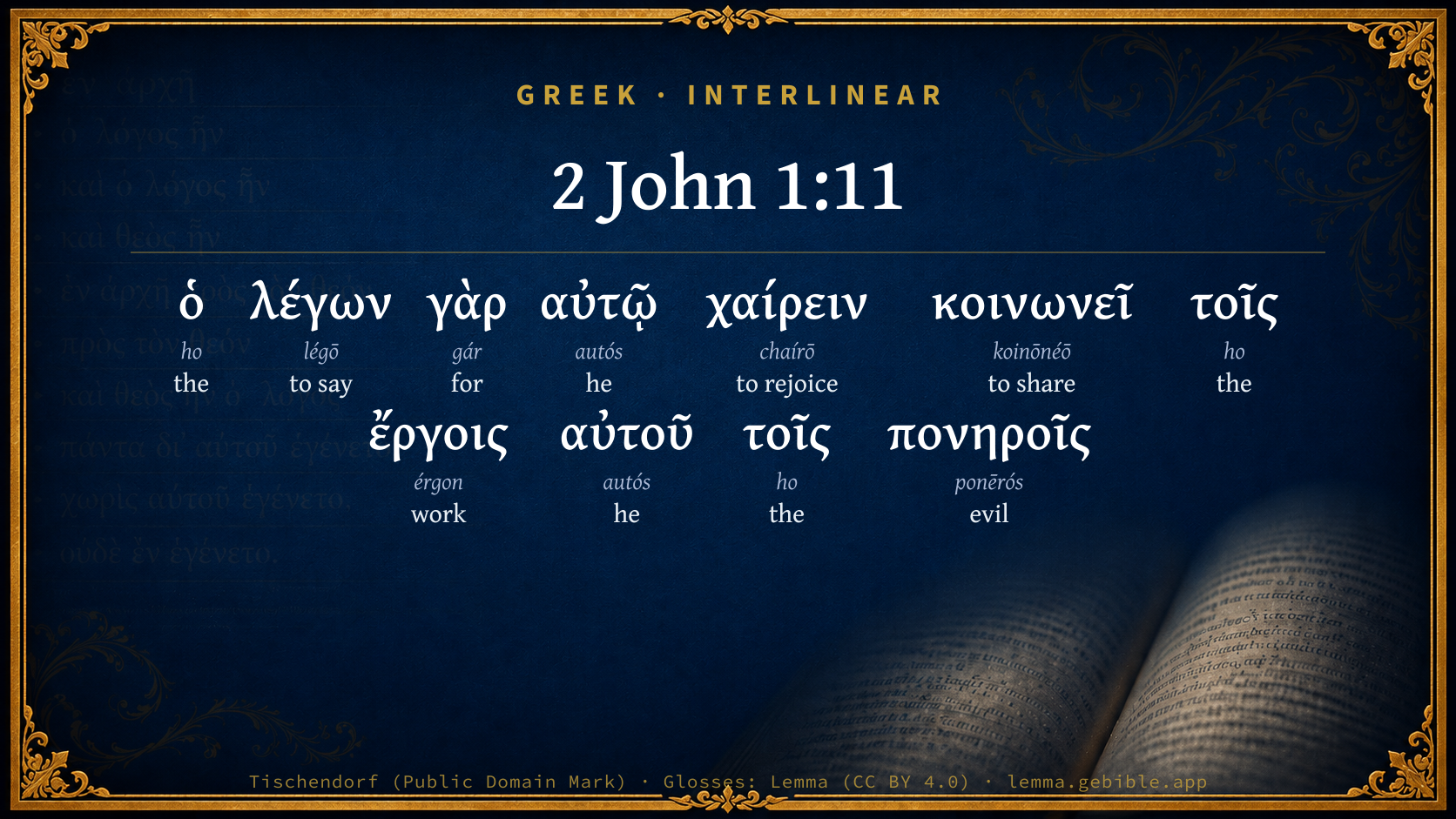
  1. ὁ ho G3588 “the” Article, Nominative, Singular, Masculine
  2. λέγων légō G3004 “to say” Verb, Present, Active, Participle, Nominative, Singular, Masculine
  3. γὰρ gár G1063 “for” Conjunction
  4. αὐτῷ autós G846 “he” Personal pronoun, Dative, Singular, Masculine
  5. χαίρειν chaírō G5463 “to rejoice” Verb, Present, Active, Infinitive
  6. τοῖς ho G3588 “the” Article, Dative, Plural, Neuter
  7. ἔργοις érgon G2041 “work” Noun, Dative, Plural, Neuter
  8. αὐτοῦ autós G846 “he” Personal pronoun, Genitive, Singular, Masculine
  9. τοῖς ho G3588 “the” Article, Dative, Plural, Neuter
  10. πονηροῖς ponērós G4190 “evil” Adjective, Dative, Plural, Neuter

About this verse

These counts appear in no published source. They are computed here, from the morphology-tagged text and Lemma’s own curated glosses. What Lemma adds →

11
words
8
distinct lemmas
General Epistles
section

Notable vocabulary

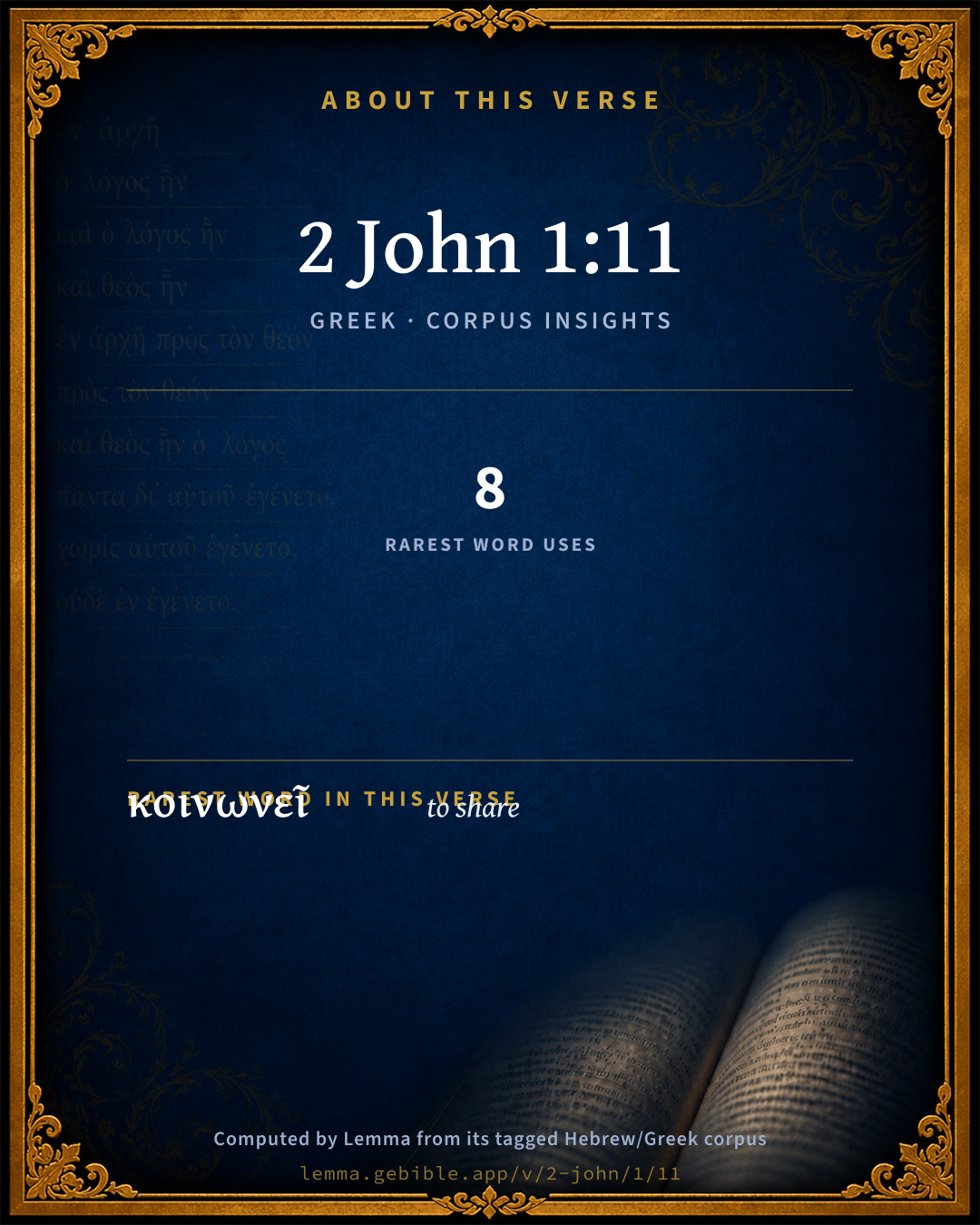
The rarest word here is κοινωνεῖ to share G2841 — appearing just 8 times in the whole Greek New Testament.

Shared distinctive vocabulary

κοινωνεῖ to share G2841 occurs in 8 verses of the Greek New Testament. Also found in:

Repetition

Words recur within this verse:

Cross-references

4

Topical passages linked to 2 John 1:11 in the Treasury of Scripture Knowledge — connected by theme and wording, ordered by reader-vote popularity; previews shown in the World English Bible.

  • 1 Timothy 5:22 Lay hands hastily on no one, neither be a participant in other men's sins. Keep yourself pure.
  • Ephesians 5:11 Have no fellowship with the unfruitful works of darkness, but rather even reprove them.
  • Psalms 50:18 When you saw a thief, you consented with him, And have participated with adulterers.
  • Revelation 18:4 I heard another voice from heaven, saying, "Come out of her, my people, that you have no participation in her sins, and that you don't receive of her plagues,

Cross-references courtesy of OpenBible.info (CC BY 4.0).

Commentary

Notes on 2 John 1:11 from classic Christian and Jewish commentators (each source and its license shown beneath its notes). The classic Christian expositions comment on the surrounding passage and are grouped to its opening verse, so a note may address several verses; the Jewish commentaries on the Tanakh (Rashi and others) are per-verse, so they appear only where the commentator wrote on this verse.

Lemma curates 59 commentaries, every one of them public domain or Creative Commons licensed, each selected and text-cleaned for this edition rather than reprinted as found. About our sources →

Bengel's Gnomon

Johann Albrecht Bengel

2Jn 1:11. Γὰρ, for) Severity in love.—κοινωνεῖ, he partakes) For he declares him to be capable of joy and salvation, even in that antichristian state. [The bearings and relations of purer doctrine are of the nicest kind.—V. g.]—ἔργοις) his works: opposed to faith and love.—τοῖς πονηροῖς, evil) On the contrary, the partaking in good works brings a blessing.

Bengel's Gnomon of the New Testament — English translation (T&T Clark, Edinburgh, 1860) — public domain. Text from a community e-Sword module.

Meyer's Critical & Exegetical Commentary

Heinrich August Wilhelm Meyer

2Jn_1:11. Confirmation of the preceding prohibition.

ὁ λέγων γὰρ αὐτῷ χαίρειν] The apostle mentions only this one thing, because what he says about it is self-evident in regard to the rest also.

κοινωνεῖ τοῖς ἔργοις αὐτοῦ τοῖς πονηροῖς] i.e. inasmuch as the χαίρειν λέγειν is not merely an outward display of politeness, but an expression of an intimate relation of fellowship.

By τὰ ἔργα τὰ πονηρά we are to understand, of course, the false doctrine, but, at the same time, along with this the whole evil character of the false teachers, which was very closely connected with their doctrine.[14]

[14] De Wettes remark, justly rejected by Brückner, is utterly erroneous: This prohibition finds its justification in polemic zeal, and the necessity for defence against what seemed fatal to the maintenance of the Church. We, with the sure foundation of the Christian Church, and in accordance with the higher view, then perhaps impossible, that man even in his errors still remains man, and an object of esteem and love, see in it impatience.Difficult though it may be under present circumstances, considering the development which doctrine has taken, in many particular cases rightly to apply what is here said by John, yet it must still be regarded as a valid maxim, not only that the Christian should remain conscious of the antithesis between anti-Christianity and Christianity, but also that he should not deny this consciousness in his conduct towards his neighbour.Besser unjustifiably seeks to make use of the expression of the apostle as a weapon against union.

Meyer — Critical and Exegetical Commentary on the New Testament — English translation by Peter Christie, edited by Frederick Crombie (T&T Clark, 1880) — public domain. Text from a community e-Sword module.

Expositor's Greek Testament

ed. W. Robertson Nicoll

2Jn 1:11 . κοινωνεῖ , cf. 1Jn 1:3 . An unholy κοινωνία . τοῖς ἔργ . αὐτ . τοῖς πον ., cf. 1Jn 1:2 : τὴν ζωὴν τὴν αἰώνιον . The adjective is an emphatic afterthought.

This counsel recalls the story of St. John’s behaviour to Cerinthus (see Introd. p. 157), and it was cited by Irenæus (i. ix. 3) as inculcating intolerance of heretics. If so, it is certainly an unChristian counsel, contrary to the spirit and teaching of our Lord ( cf. Mar 9:38-39 ; Luk 9:51-56 ; Mat 13:28-29 ). Heretics are our fellow-creatures; Jesus died for them also, and our office is to win them. If we close our doors and our hearts against them, we lose our opportunity of winning them and harden them in their opposition. There are two thoughts which may well teach us forbearance and humility: (1) The patience of the Lord. A Jewish fable tells how Abraham thrust an aged wayfarer from his tent because he asked no blessing on his food and avowed himself a fire-worshipper. And the Lord said: “I have suffered him these hundred years, although he dishonoured Me; and couldst not thou endure him for one night?” (2) The mystery of the things of God and the blindness of our intellects. “Illi,” says St. Augustine ( Contra Epistolam Manichcæi , 2), “in vos sæviant, qui neseiunt cum quo labore verum inveniatur, et quam difficile caveantur errores”. This counsel of the Apostle must be read in the light of local circumstances. There was need of caution and discrimination in receiving the itinerant “apostles and prophets” who went from church to church, lest they should prove “false apostles” ( ψευδαπόστολοι ) and “false prophets” ( ψευδοπροφῆται ). See Didache , xi. xii., where the test is given: οὐ πᾶς ὁ λαλῶν ἐν πνεύματι προφήτης ἐστίν , ἀλλʼ ἐὰν ἔχῃ τοὺς τπρόπους Κυρίου . It is not until the second century that there is any appearance of buildings set apart for worship. The primitive ἐκκλησίαι met in private houses ( cf. Rom 16:5 ; 1Co 16:19 ; Col 4:15 ; Phm 1:2 ); and when St. John warns Kyria against “receiving into her house” a heretical teacher, it is not showing him hospitality that he forbids, but affording him an opportunity to unsettle the faith of the brethren. She must neither let him pervert “the church in her house” nor send him on his way to a neighbouring church with the recommendation of her confidence and goodwill. This is expressed, though somewhat vaguely, by Clem. Alex.: “Hoc in hujusmodi non est inhumanum, sed nec conquirere vel condisputare cum talibus admonet qui non valent intelligibiliter divina tractare, ne per eos traducantur a doctrina veritatis, verisimilibus inducti rationibus. Arbitror autem, quia et orare cum talibus non oportet, quoniam in oratione quæ fit in domo, postquam ab orando surgitur, salutatio gaudii est et pacis indicium.”

The Expositor's Greek Testament, edited by W. Robertson Nicoll (1897–1910) — public domain. Text from a community e-Sword module.

Jamieson, Fausset & Brown

Robert Jamieson, A. R. Fausset & David Brown

By wishing a false brother or teacher "God (or 'good') speed," you imply that he is capable as such of good speed and joy (the literal meaning of the Greek), and that you wish him it while opposing Christ; so you identify yourself with "his evil deeds." The Greek of "partaker" is "having communion with." We cannot have communion with saints and with Antichrist at the same time. Here we see John's naturally fiery zeal directed to a right end. POLYCARP, the disciple of John, told contemporaries of IRENÆUS, who narrates the story on their authority, that on one occasion when John was about to bathe, and heard that Cerinthus, the heretic, was within, he retired with abhorrence, exclaiming, Surely the house will fall in ruins since the enemy of the truth is there.

Jamieson, Fausset & Brown — Commentary Critical and Explanatory on the Whole Bible (1871) — public domain (CC PDM 1.0). Text via the HelloAO Bible API.

Adam Clarke's Commentary

Verse 11. Is partaker of his evil deeds.] He that acts towards him as if he considered him a Christian brother, and sound in the faith, puts it in his power to deceive others, by thus apparently accrediting his ministry. No sound Christian should countenance any man as a Gospel minister, who holds and preaches erroneous doctrines; especially concerning the Lord Jesus. Nor can any Christian attend the ministry of such teachers without being criminal in the sight of God. He who attends their ministry is, in effect, bidding them God speed; no matter whether such belong to an established Church, or to any congregation of dissenters from it. But what St. John says here does not mean that we should deny such the common offices of humanity, charity, and mercy. No. In these offices we are equally bound to all men; far less does it intimate that we should persecute such on account of their heretical or heterodox sentiments. No. This right has God given to no man, to no Church, to no state. They who persecute others, even for the worst heretical opinions, may expect the heaviest judgments of Almighty God.

There is a remarkable addition here in several MSS. Of the Vulgate, and in some printed editions. Ecce praedixi vobis, ut in diem Domini nostri Jesu Christi non confundamini. "Behold, I have foretold this to you, that ye may not be confounded in the day of our Lord Jesus Christ."

This addition is found in the edition of Pope Sixtus the Fifth, and in the Complutensian Polyglot; but it is not acknowledged by any of the versions, nor by any Greek MSS.

Adam Clarke's Commentary on the Bible (1810–1826) — public domain. Text from a community e-Sword/MySword module.

The Cambridge Bible for Schools and Colleges

gen. ed. J. J. S. Perowne

11. For he that biddeth him God speed] Much more, therefore, he that by receiving him into his house affords a home and head-quarters for false teaching.

is partaker of his evil deeds] More accurately, as R. V., partaketh in his evil works: literally, with much emphasis on ‘evil’, partaketh in his works, his evil (works). The word for ‘partake’ (κοινωνεῖν) occurs nowhere else in S. John, but is cognate with the word for ‘fellowship’ (κοινωνία), 1Jn_1:3; 1Jn_1:6-7. The word for ‘evil’ (πονηρός) is the same as that used of ‘the evil one’, 1Jn_2:13-14; 1Jn_3:12; 1Jn_5:18-19. What is involved, therefore, in having fellowship with such men is obvious. At a Council of Carthage (a.d. 256), when Cyprian uttered his famous invective against Stephen, Bishop of Rome,—Aurelius, Bishop of Chullabi, quoted this passage with the introductory remark, “John the Apostle laid it down in his Epistle”: and Alexander, Bishop of Alexandria (c. a.d. 315), quotes the passage as an injunction of “the blessed John” (Socrates H.E. I. vi.). The change from ‘deeds’ to ‘works’ may seem frivolous and vexatious, but it is not unimportant. ‘Works’ is a wider word and better represents ἔργα: words no less than deeds are included, and here it is specially the words of these deceivers that is meant. Moreover in 1Jn_3:12 the same word is rendered ‘works’ of the ‘evil works’ of Cain. See on Joh_5:20; Joh_6:27; Joh_6:29. Wiclif and the Rhemish have ‘works’ here.

At the end of this verse some Latin versions insert, ‘Lo I have told you beforehand, that ye be not confounded (or, condemned) in the day of the Lord (or, of our Lord Jesus Christ)’. Wiclif admits the insertion, but the Rhemish does not: Cranmer puts it in italics and in brackets. It has no authority.

The Cambridge Bible for Schools and Colleges (gen. ed. J. J. S. Perowne; Cambridge University Press, 1878–1918) — public domain. Text from a community e-Sword module.

John Gill's Exposition

For he that biddeth him God speed,.... Wishes him well, and success in his ministry, or in a friendly and familiar way converses with him:

is partaker of his evil deeds; he has fellowship with him, instead of reproving or shunning him, as he ought; he is an abettor of him in his principles, and so far joins in the propagation of them, and helps to spread them, and gives too much reason to think he is one with him in them.

John Gill's Exposition of the Whole Bible (1746–1763) — public domain (CC PDM 1.0). Text via the HelloAO Bible API.

Trapp's Complete Commentary

John Trapp

11 For he that biddeth him God speed is partaker of his evil deeds.

Ver. 11. Is partaker of his evil] 1. By his sinful silence and dissimulation. 2. Next, by confirming the sinner in his evil way. 3. Lastly, by offence given to others.

John Trapp, A Commentary or Exposition upon All the Books of the Old and New Testament (1647–1656) — public domain. Text from a community e-Sword module.

Albert Barnes' Notes on the Bible

For he that biddeth him God speed, is partaker of his evil deeds - Shows that he countenances and approves of the doctrine which is taught. Compare the notes at 1Ti 5:22.

Albert Barnes' Notes on the Bible (1834–1885) — public domain. Text from a community e-Sword/MySword module.

Whedon's Commentary on the Bible

Daniel D. Whedon

11. For—Reason for this precaution. To sustain the errorist is to be responsible for his error.

Evil deeds—Both in destroying the true Christ and in introducing antinomianism. See note on 1Jn_1:8.

Daniel D. Whedon (gen. ed.), Commentary on the Old and New Testaments (1874–1909) — public domain. Text from a community e-Sword module.

The Pulpit Commentary

To give countenance and sanction to false doctrine is to share in the responsibility for all the harm which such false doctrine does. With which solemn warning the main portion of the Epistle ends.

The Pulpit Commentary (1880–1919), ed. H.D.M. Spence-Jones & Joseph S. Exell — public domain. Text from a community e-Sword module.

John Wesley's Explanatory Notes

For he that biddeth him God speed - That gives him any encouragement, is accessory to his evil deeds.

John Wesley, Explanatory Notes Upon the Whole Bible (1754–1765) — public domain. Text via the GEBible commentary corpus.

The People's New Testament

B. W. Johnson

11. For he that biddeth, etc. He that gives him these prayerful greetings and encouragement becomes a partaker, to that extent, in his evil deeds.

B. W. Johnson's The People's New Testament with Notes (1889–1891) — public domain. Electronic text from the Christian Classics Ethereal Library (CCEL) ThML edition.

Cambridge Greek Testament for Schools and Colleges

11. For ὁ γὰρ λέγων ([902][903]) read ὁ λέγων γάρ ([904][905][906]). When γάρ appeared in the third place, the copyists frequently transposed it to the more usual second place.

[902] 9th century. All three Epistles.

[903] 9th century. All three Epistles.

[904] 4th century. Discovered by Tischendorf in 1859 at the monastery of S. Catherine on Mount Sinai, and now at Petersburg. All three Epistles.

[905] 5th century. Brought by Cyril Lucar, Patriarch of Constantinople, from Alexandria, and afterwards presented by him to Charles I. in 1628. In the British Museum. All three Epistles.

[906] 4th century. Brought to Rome about 1460. It is entered in the earliest catalogue of the Vatican Library, 1475. All three Epistles.

11. ὁ λέγων γὰρ αὐτῷ χ. Much more, therefore, he that by receiving him into his house affords a home and head-quarters for false teaching. The reading ὁ γὰρ λέγων is an obvious correction.

κοινωνεῖ τ. ἔργοις αὐ. τ. πονηροῖς. As R.V., partaketh in his evil works: literally, with much emphasis on ‘evil’, partaketh in his works, his evil (works). Κοινωνεῖν occurs nowhere else in S. John, but he uses the cognate κοινωνία, 1Jn 1:3; 1Jn 1:6-7. The word for ‘evil’ (πονηρός) is the same as that used of ‘the evil one’, 1Jn 2:13-14; 1Jn 3:12; 1Jn 5:18-19. What is involved, therefore, in having fellowship with such men is obvious. At a Council of Carthage (A.D. 256), when Cyprian uttered his famous invective against Stephen, Bishop of Rome,—Aurelius, Bishop of Chullabi, quoted this passage with the introductory remark, “John the Apostle laid it down in his Epistle”: and Alexander, Bishop of Alexandria (C. A.D. 315), quotes the passage as an injunction of “the blessed John” (Socrates H. E. I. vi.). The change from ‘deeds’ to ‘works’ may seem frivolous and vexatious, but it is not unimportant. ‘Works’ is a wider word and better represents ἔργα: words no less than deeds are included, and here it is specially the words of these deceivers that are meant. Moreover in 1Jn 3:12 the same word is rendered ‘works’ of the ἔργα πονηρά of Cain. See on Joh 5:20; Joh 6:27; Joh 6:29. Wiclif and the Rhemish have ‘works’ here.

At the end of this verse some Latin authorities add: Ecce praedixi vobis, ut in die Domini non confundamini (or in die Domini nostri Jesu Christi). Wiclif admits the insertion; the Rhemish does not: Cranmer puts it in italics and in brackets. It has no authority.

Cambridge Greek Testament for Schools and Colleges (Cambridge University Press, 1896; 21 vols, various authors incl. Carr, Maclear, Plummer, Farrar, Lumby, Moule, M. R. James, Simcox) — public domain. Text from a community e-Sword module.

Alford’s Greek Testament

Henry Alford

11.] The exercise of the love of the brethren is conditioned and limited by the truth: and is not to be extended to those who are enemies and impugners of the truth. Those who harbour or encourage such, make common cause with them, and their evil deeds. If any cometh to you, and bringeth not (the indic. after εἰ shews that the case supposed actually existed: that such persons were sure to come to them: cf. Joh 11:12, 2Co 2:5, 1Jn 4:11. It is not = ἐάν with subj., which always carries a purely hypothetical force, corresponding to an interrogation, whereas the other corresponds to an assertion: e. g. in 1Jn 2:15, ἐάν τις ἀγαπᾷ τὸν κόσμον, which may be resolved, “Does any among you love the world? If he do,” &c. On the other hand, εἴ τις ἔρχεται πρὸς ὑμᾶς may be resolved, “Some will come to you,” &c., “If any does,” &c.) this doctrine (the expression ταύτην τὴν διδαχὴν οὐ φέρει points out the person as a teacher, not a mere traveller seeking hospitality. And the οὐ, not μή, distinctly reverses the φέρει: he not only comes without this doctrine, but by so doing brings the contrary doctrine. The absence of testimony for the truth is, in one who brings any testimony at all, equivalent to testifying for error), receive him not into (your) house, and do not bid him good speed: for he that biddeth him good speed, partaketh in his evil deeds (these words must be understood with their right reference: “non de iis qui alieni semper fuerunt ab ecclesia, 1Co 5:10, sed de iis qui volunt fratres haberi et doctrinam evertunt,” as Grot. These were not to be received with the φιλοξενία with which all Christian brethren were to be entertained. Such reception of them would in fact be only opening an inlet for their influence. But this is not the point on which the Apostle mainly dwells. It is the κοινωνία which the host in such a case would incur with them and their antichristian designs, by encouraging them. And this is further impressed by the caution against saying χαίρειν to them: which is to be understood not with , of the solemn salutation after prayer, “quoniam in oratione quæ fit in domo, postquam ab orando surgitur salutatio gaudii est et pacis indicium,” Adumbrat. in 2 Joan. juxt. fin., p. 1011 P. (not in Migne): nor with Corn.-a-lap., of all intercourse whatever, “omne colloquium, omne consortium, omne commercium cum hæreticis:” but it is a further intensification of the exclusion from the house, and forms a climax, καὶ μὴ = μηδέ: do not even, by wishing him χαίρειν, good speed, and if spoken by a Christian, God speed, identify yourselves with his course and fortunes. If you do, you pronounce approval of his evil deeds, and so far share his guilt, advancing their success by your wishes for it.

This command has been by some laid to the fiery and zealous spirit of St. John, and it has been said that a true Christian spirit of love teaches us otherwise. But as rightly understood, we see that this is not so. Nor are we at liberty to set aside direct ethical injunctions of the Lord’s Apostles in this manner. Varieties of individual character may play on the surface of their writings: but in these solemn commands which come up from the depths, we must recognize the power of that One Spirit of Truth which moved them all as one. It would have been infinitely better for the Church now, if this command had been observed in all ages by her faithful sons).

12,

Henry Alford, The Greek Testament (1849–1861) — public domain. Text from a community e-Sword module.

International Critical Commentary

11. This verse gives the grounds on which the injunctions of the preceding verse are based. The welcome and greeting contemplated are clearly such as express approval of the character and work of those who claim such reception.

κοινωνεῖ] always expresses a participation realized in active intercourse. It never denotes a mere passing sharing. Cf. 1Ti 5:22; 1Ti_1 P. 4:13.

τοῖς πονηροῖς] The form of expression is chosen which lays greatest stress on the adjective. Cf. 1Jn 2:7, 1Jn 2:8, 1Jn 2:1:2, 1Jn 2:3; Joh 10:11.

ο (?)] om. Ia 1402 (219) K2 (S) | λεγων] post γαρ K L P al. pler. cat. Ir. Thphyl. Oec. | αυτω] om K al. 25 Oec. | πονηροις] + ecce praedixi nobis ne in diem Domini condemnemini m63 : + ecce praedixi nobis ut in diem Domini nostri Jesu Christi non confundamini vgsix Such additions are not uncommon in the text of the Speculum.

International Critical Commentary — older volumes (1896–1929), various authors — public domain. Text from a community e-Sword module.

Vincent's Word Studies in the New Testament

Marvin R. Vincent

Is partaker [κοινωνει] . The verb occurs nowhere else in John's writings. The kindred noun koinwnia fellowship, is peculiar to the First Epistle. See on 1Jo 1:3; also on partners (Luk 5:10); fellowship (Act 2:42); partaker (1Pe 5:1.).

Paper [χαρτου] . Only here in the New Testament. The Egyptian papyrus or byblus, Cyperus papyrus, anciently very common, but not now found within the limits of the country. It is a tall, smooth flag or reed, with a large triangular stalk, containing the pith which furnished the paper. The paper was manufactured by cutting the pith into strips, arranging them horizontally, and then placing across them another layer of strips, uniting the two layers by a paste, and subjecting the whole to a heavy pressure. The upper and middle portions of the reed were used for this purpose. The fact that the plant is no longer found is significant in connection with Isaiah's prophecy that "the flags (Hebrews suph, papyrus) shall waste away" (Isa 19:6). The plant grew in shallow water or in marshes, and is accordingly represented on the monuments as at the side of a stream or in irrigated lands. 71 The Jews wrote on various materials, such as the leaves of the olive and palm, the rind of the pomegranate, and the skins of animals. The tablet (pinakidion, Luk 1:63) was in very common use. It consisted of thin pieces of wood, strung together, and either plain, or covered with papyrus or with wax.

Ink [μελανος] . Lit., that which is black. The word occurs only once outside of John's Epistles (2Co 3:3), and only three times in all (2 John 12; 3Jo 1:13). Ink was prepared of soot or of vegetable or mineral substances. Gum and vitriol were also used. Colored inks, red and gold, were also employed. 72 To come unto you [γενεσθαι προς υμας] . Or, to be present with you. For the phrase, see 1Co 2:3; 1Co 16:10.

Face to face [στομα προς στομα] . Lit, mouth to mouth. Compare proswpon prov proswpon, face to face, 1Co 8:12. Full [πεπληρωμενη] . Rev., rightly, fulfilled.

Marvin R. Vincent, Word Studies in the New Testament (1887–1900) — public domain. Text from a community e-Sword/MySword module.

Westcott on Hebrews & the Epistles of John

Brooke Foss Westcott

11. κοινωνεῖ τ. €...] communicat operibus illius malignis V. Comp. 1 Tim. v. 22. The word κοινωνεῖν implies more than participation in the definite acts. It suggests fellowship with the character of which they are the outcome,

3. The conclusion (12, 13>. The main request and the main

warning have been spoken. Other subjects St John reserves for a per-

sonal interview. A general salutation closes the letter. Comp. 3 John 13—I5.

2Though I have many things to write to you, 7 would not write them with paper and ink; but I hope to be present with you, and to speak face to face, that your joy may be fulfilled.

13 The children of thine elect sister salute thee.

Brooke Foss Westcott (1825–1901), The Epistle to the Hebrews (1889) and The Epistles of St John (1883) — public domain (pre-1929). Text recovered from Internet Archive / Google Books OCR scans. Westcott’s Gospel of John commentary is not included (its OCR lost the chapter running-heads required for reliable verse-keying). Some Greek quoted in the Hebrews volume is imperfectly rendered by the OCR.

Lesson kit

Teaching starters — assembled from the data on this page, not authored interpretation. Every prompt links to the verse data it draws on. Edit before teaching.

2 John, in the General Epistles, opens this verse with 11 words (8 distinct Greek lemmas). Its most distinctive word is koinōnéō (“to share”). A historical commentator’s framing appears above. Read the whole chapter for the surrounding context.

Discussion questions

  1. The word koinōnéō carries the sense “to share.” How does it shape the verse?
  2. Romans 12:13 shares the word «to share» with this verse. How do the two illuminate each other?
  3. “the” occurs 3× in this one verse. What is the effect of the repetition?
  4. These translations render this verse differently; the difference is in the English rendering, not the original. What questions does that raise?
  5. Reading how Bengel's Gnomon and Meyer's Critical & Exegetical Commentary read this verse, where do the two commentators agree and where do they part?

Things to notice

Reading settings

Reading text

Shown beneath each verse's original-language words.

Old Testament
Old Testament edition

Read the OT as the Masoretic Hebrew (MT) or the Greek Septuagint (LXX).

English shown for the Greek Septuagint (in the Hebrew ↔ Greek comparison).

Comparing translations? Open the Compare panel on any verse page to stack up to four side by side.