Revelation 16:11

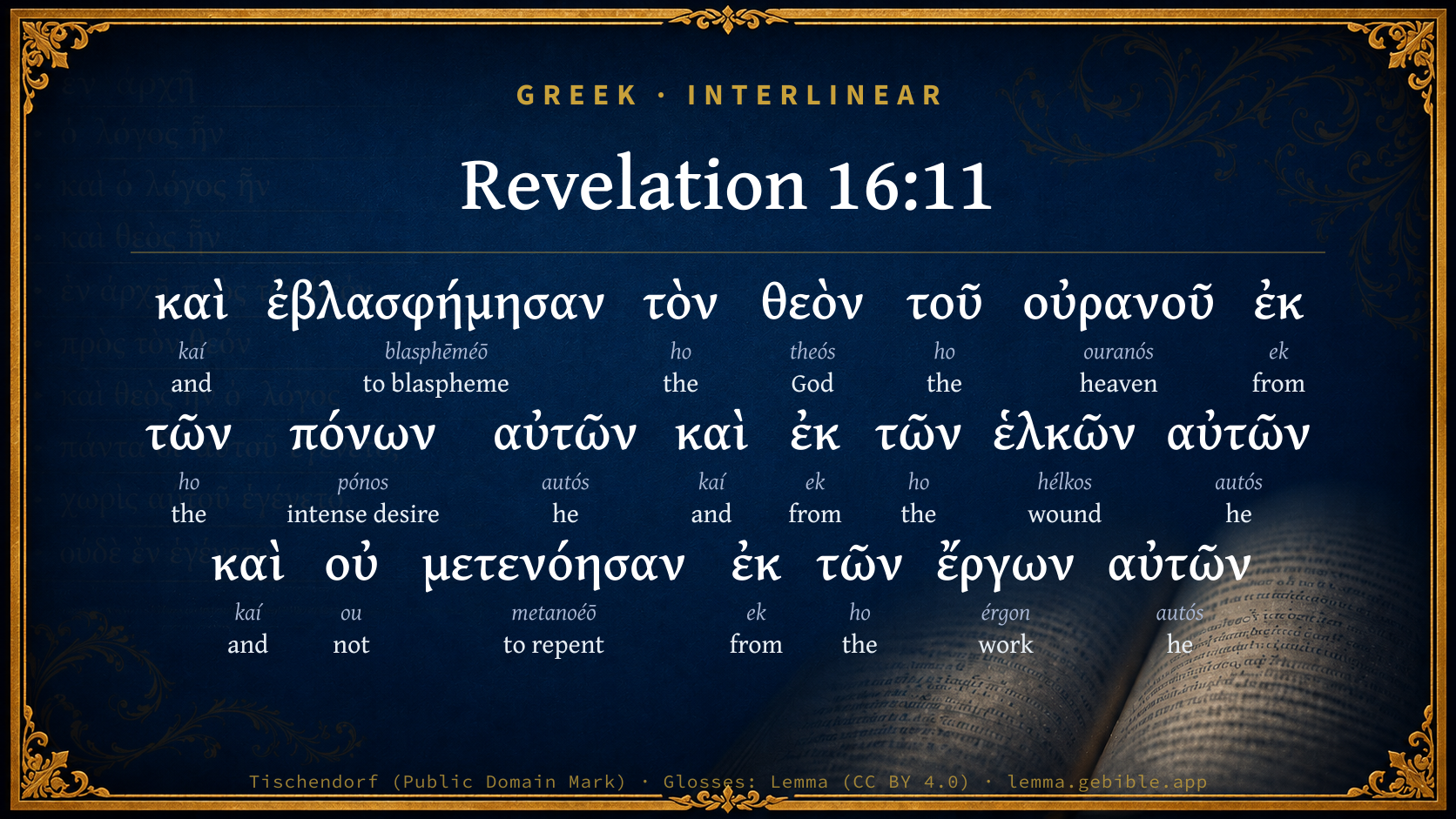
Greek (Tischendorf 8th ed.) Revelation 16:11 appears in the Greek New Testament. The text above is from the Tischendorf 8th edition. Each word links to its Strong’s number and a concise gloss. Click any word for its full Thayer’s Greek Lexicon entry.
Download image
Cite this verse

Revelation 16:11 (World English Bible). Public Domain. Lemma interlinear Bible study tool, https://lemma.gebible.app/v/revelation/16/11.

Show BibTeX & RIS
BibTeX
RIS
English Translation
and they blasphemed the God of heaven because of their pains and their sores. They didn't repent of their works.
World English Bible · Public Domain
Download a study sheet

One document with this verse’s original text, its word-by-word gloss line, the meaning frame, cross-references with their text, attributed commentary, and full source and license credits — printable, and it pastes into notes with its structure intact.

This verse Autodidact and up

Study sheet (.html) Plain text (.txt)

A passage Seminary Student

Up to 50 verses in one chapter. A passage sheet keeps up to 6 commentary sources and 12 cross-references per verse, in the order this page ranks them, and says so on the sheet whenever that leaves anything out. Ask for a single verse and you get the Autodidact verse sheet above.

Everything on this page stays free to read, with no account — the sheet is a download of what is already on screen, not access to it.

Want to remove ads? Support Godless Engineer
Compare translations 3

The same verse in 3 English versions, stacked beneath the original-language interlinear above. Click any original word for its lexicon entry.

Each is an independent rendering of the whole verse — the interlinear is not word-aligned to these translations.

Highlighted words mark where these versions differ — a whole-verse word diff, not a word-by-word alignment.

  • World English Bible Public Domain
    and they blasphemed the God of heaven because of their pains and their sores. They didn't repent of their works.
  • King James Version Public Domain
    And blasphemed the God of heaven because of their pains and their sores, and repented not of their deeds.
  • unfoldingWord Literal Text CC BY-SA 4.0
    and they blasphemed the God of heaven because of their pain and because of their sores, but they did not repent of their deeds.

unfoldingWord Literal Text — © unfoldingWord, licensed CC BY-SA 4.0. Word-aligned USFM3 via Door43 (git.door43.org/unfoldingWord/en_ult).

Versions to compare (up to 4)

3 of 4 selected

Show all 19 translations

Every available English version of this verse, each an independent rendering of the whole verse.

  • World English Bible Public Domain
    and they blasphemed the God of heaven because of their pains and their sores. They didn't repent of their works.
  • Berean Standard Bible Public Domain
    and curse the God of heaven for their pains and sores; yet they did not repent of their deeds.
  • Majority Standard Bible Public Domain
    and curse the God of heaven for their pains and sores. Yet they did not repent of their deeds.
  • King James Version Public Domain
    And blasphemed the God of heaven because of their pains and their sores, and repented not of their deeds.
  • American Standard Version (1901) Public Domain
    and they blasphemed the God of heaven because of their pains and their sores; and they repented not of their works.
  • Revised Version (1885) Public Domain
    and they blasphemed the God of heaven because of their pains and their sores; and they repented not of their works.
  • Geneva Bible (1599) Public Domain
    And blasphemed the God of heauen for their paines, and for their sores, and repented not of their workes.
  • Douay-Rheims (1899) Public Domain
    And they blasphemed the God of heaven, because of their pains and wounds, and did not penance for their works.
  • Young's Literal Translation Public Domain
    and they did speak evil of the God of the heaven, from their pains, and from their sores, and they did not reform from their works.
  • Literal Standard Version CC BY-SA 4.0
    and they slandered the God of Heaven, from their pains, and from their sores, and they did not convert from their works.
  • Unlocked Literal Bible CC BY-SA 4.0
    They blasphemed the God of heaven because of their pain and sores, and they still refused to repent of what they had done.
  • unfoldingWord Literal Text CC BY-SA 4.0
    and they blasphemed the God of heaven because of their pain and because of their sores, but they did not repent of their deeds.
  • Darby Bible Public Domain
    and blasphemed the God of the heaven for their distresses and their sores, and did not repent of their works.
  • World Messianic Bible Public Domain
    and they blasphemed the God of heaven because of their pains and their sores. They still didn’t repent of their works.
  • Webster's Bible Public Domain
    And blasphemed the God of heaven, because of their pains and their sores, and repented not of their deeds.
  • Free Bible Version CC BY-SA 4.0
    and they cursed the God of heaven because of their pain and their sores, but they did not repent and stop what they were doing.
  • Bible in Basic English Public Domain
    And they said evil things against the God of heaven because of their pain and their wounds; and they were not turned from their evil works.
  • Text-Critical English NT CC BY 4.0
    and blasphemed the God of heaven because of their pains and sores, but they did not repent of their works.
  • Tyndale New Testament (1534) Public Domain
    and blasphemed the god of heven for sorowe and payne of their sores and repented not of their dedes.

Literal Standard Version (2020), Covenant Press — licensed CC BY-SA 4.0. Text via the HelloAO Bible API (eBible.org). Unlocked Literal Bible (unfoldingWord) — licensed CC BY-SA 4.0. Text via the HelloAO Bible API (eBible.org). unfoldingWord Literal Text — © unfoldingWord, licensed CC BY-SA 4.0. Word-aligned USFM3 via Door43 (git.door43.org/unfoldingWord/en_ult). Free Bible Version, Dr. Jonathan Gallagher — licensed CC BY-SA 4.0. Text via the HelloAO Bible API (eBible.org).

Word by word

More ways to search: Search by grammar → Find every occurrence → Compare this word →

Practice this passage: Drill this verse → Learn its vocabulary →

ἑλκῶν
hélkos
G1668
“wound”
Noun, Genitive, Plural, Neuter
Part of Speech
Noun
Case
Genitive
Number
Plural
Gender
Neuter
Full Thayer's Definition

Origin: probably from G1670

TDNT: None

1. a wound, esp. a wound producing a discharge pus 2. a sore, an ulcer
  1. καὶ kaí G2532 “and” Conjunction
  2. ἐβλασφήμησαν blasphēméō G987 “to blaspheme” Verb, Aorist, Active, Indicative, 3rd person, Plural
  3. τὸν ho G3588 “the” Article, Accusative, Singular, Masculine
  4. θεὸν theós G2316 “God” Noun, Accusative, Singular, Masculine
  5. τοῦ ho G3588 “the” Article, Genitive, Singular, Masculine
  6. οὐρανοῦ ouranós G3772 “heaven” Noun, Genitive, Singular, Masculine
  7. ἐκ ek G1537 “from” Preposition
  8. τῶν ho G3588 “the” Article, Genitive, Plural, Masculine
  9. πόνων pónos G4192 “intense desire” Noun, Genitive, Plural, Masculine
  10. αὐτῶν autós G846 “he” Personal pronoun, Genitive, Plural, Masculine
  11. καὶ kaí G2532 “and” Conjunction
  12. ἐκ ek G1537 “from” Preposition
  13. τῶν ho G3588 “the” Article, Genitive, Plural, Neuter
  14. αὐτῶν autós G846 “he” Personal pronoun, Genitive, Plural, Masculine
  15. καὶ kaí G2532 “and” Conjunction
  16. οὐ ou G3756 “not” Particle, Negative
  17. μετενόησαν metanoéō G3340 “to repent” Verb, Aorist, Active, Indicative, 3rd person, Plural
  18. ἐκ ek G1537 “from” Preposition
  19. τῶν ho G3588 “the” Article, Genitive, Plural, Neuter
  20. ἔργων érgon G2041 “work” Noun, Genitive, Plural, Neuter
  21. αὐτῶν autós G846 “he” Personal pronoun, Genitive, Plural, Masculine

About this verse

These counts appear in no published source. They are computed here, from the morphology-tagged text and Lemma’s own curated glosses. What Lemma adds →

22
words
12
distinct lemmas
Revelation
section

Notable vocabulary

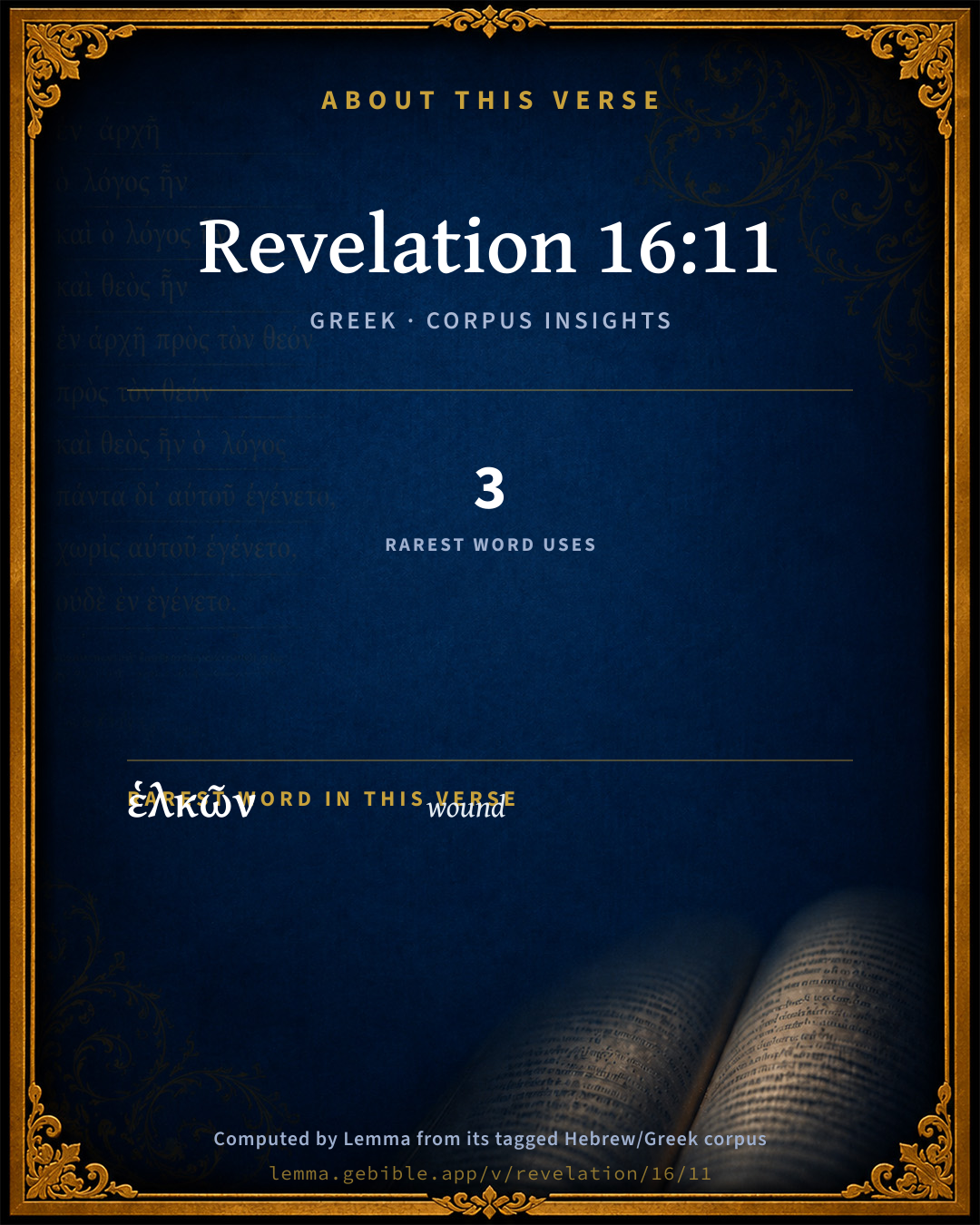
The rarest word here is ἑλκῶν wound G1668 — appearing just 3 times in the whole Greek New Testament.

Shared distinctive vocabulary

ἑλκῶν wound G1668 occurs in 3 verses of the Greek New Testament. Also found in:

Repetition

Words recur within this verse:

Cross-references

18

Topical passages linked to Revelation 16:11 in the Treasury of Scripture Knowledge — connected by theme and wording, ordered by reader-vote popularity; previews shown in the World English Bible.

  • Revelation 16:9 People were scorched with great heat, and people blasphemed the name of God who has the power over these plagues. They didn't repent and give him glory.
  • Revelation 11:13 In that day there was a great earthquake, and a tenth of the city fell. Seven thousand people were killed in the earthquake, and the rest were terrified, and gave glory to the God of heaven.
  • Revelation 16:2 The first went, and poured out his bowl into the earth, and it became a harmful and evil sore on the people who had the mark of the beast, and who worshiped his image.
  • Revelation 16:21 Great hailstones, about the weight of a talent, came down out of the sky on people. People blasphemed God because of the plague of the hail, for this plague is exceedingly severe.
  • Revelation 2:21 I gave her time to repent, but she refuses to repent of her sexual immorality.
  • Psalms 136:26 Oh give thanks to the God of heaven; For his loving kindness endures forever.
  • Ezra 1:2 Thus says Cyrus king of Persia, All the kingdoms of the earth has Yahweh, the God of heaven, given me; and he has charged me to build him a house in Jerusalem, which is in Judah.
  • Ezra 5:11–12 Thus they returned us answer, saying, We are the servants of the God of heaven and earth, and are building the house that was built these many years ago, which a great king of Israel built and finished.
  • Ezra 6:10 that they may offer sacrifices of sweet savor to the God of heaven, and pray for the life of the king, and of his sons.
  • Ezra 7:23 Whatever is commanded by the God of heaven, let it be done exactly for the house of the God of heaven; for why should there be wrath against the realm of the king and his sons?
  • Daniel 2:18–19 that they would desire mercies of the God of heaven concerning this secret; that Daniel and his companions should nor perish with the rest of the wise men of Babylon.
  • 2 Timothy 3:13 But evil men and impostors will grow worse and worse, deceiving and being deceived.
  • 2 Chronicles 36:23 Thus says Cyrus king of Persia, All the kingdoms of the earth has Yahweh, the God of heaven, given me; and he has charged me to build him a house in Jerusalem, which is in Judah. Whoever there is among you of all his people, Yahweh his God be with him, and let him go up.
  • Ezra 7:12 Artaxerxes, king of kings, to Ezra the priest, the scribe of the law of the God of heaven, perfect and so forth.
  • Ezra 7:21 I, even I Artaxerxes the king, do make a decree to all the treasurers who are beyond the River, that whatever Ezra the priest, the scribe of the law of the God of heaven, shall require of you, it be done with all diligence,
  • Nehemiah 1:4 It happened, when I heard these words, that I sat down and wept, and mourned certain days; and I fasted and prayed before the God of heaven,
  • Nehemiah 2:4 Then the king said to me, For what do you make request? So I prayed to the God of heaven.
  • Daniel 2:44 In the days of those kings shall the God of heaven set up a kingdom which shall never be destroyed, nor shall the sovereignty of it be left to another people; but it shall break in pieces and consume all these kingdoms, and it shall stand forever.

Cross-references courtesy of OpenBible.info (CC BY 4.0).

Commentary

Notes on Revelation 16:11 from classic Christian and Jewish commentators (each source and its license shown beneath its notes). The classic Christian expositions comment on the surrounding passage and are grouped to its opening verse, so a note may address several verses; the Jewish commentaries on the Tanakh (Rashi and others) are per-verse, so they appear only where the commentator wrote on this verse.

Lemma curates 59 commentaries, every one of them public domain or Creative Commons licensed, each selected and text-cleaned for this edition rather than reprinted as found. About our sources →

Jamieson, Fausset & Brown

Robert Jamieson, A. R. Fausset & David Brown

sores--This shows that each fresh plague was accompanied with the continuance of the preceding plagues: there was an accumulation, not a mere succession, of plagues.

repented not--(Compare Rev 16:9).

Jamieson, Fausset & Brown — Commentary Critical and Explanatory on the Whole Bible (1871) — public domain (CC PDM 1.0). Text via the HelloAO Bible API.

Adam Clarke's Commentary

Verse 11. Blasphemed the God of heaven] Neither did they repent; therefore other judgments must follow. Some think that the sun was Vitellius, the Roman emperor, and that his throne means Rome; and the darkening refers to the injuries she sustained in her political consequence by the civil wars which then took place, from which she never entirely recovered. Others apply it all to papal Rome, and in this respect make out a very clear case! Thus have men conjectured, but how much nearer are we to the truth?

Adam Clarke's Commentary on the Bible (1810–1826) — public domain. Text from a community e-Sword/MySword module.

John Gill's Exposition

And the sixth angel poured his vial on the great river Euphrates,.... Which is not to be understood literally of the river Euphrates, which ran through Mesopotamia and Chaldea, and by the walls of Babylon; and of the drying of it up to make way for the Jews in the eastern parts of the world, to pass into their own land, and possess it; when a like miracle will be wrought for them as was when they came out of Egypt, by dividing the Red sea for them; and as when they entered into Canaan's land, by laying the waters of Jordan on heaps, so that they passed over as on dry land; in favour of which sense the passage in Isa 11:15 is thought to be, which the Targum interprets of God's smiting the river Euphrates; though the river Nile in Egypt seems rather to be meant: but it does not appear that there is any number of Jews beyond the river Euphrates; the far greater number of them is in the western and northern parts of the world; so that there will be no need for the drying up of this river for their passage into their own land; nor, if there were any in those parts, can any reason be given why they should be called the kings of the east, who, wherever they are, are a poor contemptible people, and have never had any ensigns of royalty among them for many hundreds of years; nor can that river be thought much to hinder, were all other impediments out of the way, nor the drying of it up much facilitate their passage to Judea, and much less affect their conversion: besides, this vial, as the rest, is a plague on antichrist, in some branch or other, or on some part or other, of the antichristian state; which, if not designed here, is nowhere in the account of this vial, and therefore this must be understood mystically; there is no doubt an allusion to the draining of this river at the taking of Babylon by Cyrus, according as was predicted in prophecy, Isa 44:27 who, making sluices and drains, turned the river another way, and marched through it with his army, and surprised and took the city at once, while Belshazzar and his nobles were indulging themselves in rioting and drunkenness, as Daniel relates, Dan 5:1. Now some, because that Babylon was situated upon the river Euphrates, and Rome, or the Romish antichrist, is mystical Babylon, think that is here designed, and is the object of this vial; and that the drying up of this river designs the withdrawing of nations and kingdoms, signified by waters, Rev 17:15 from its jurisdiction and power, which will bring on its ruin; and also the stoppage of dues and tithes, annates, Peter's pence, and of all its traffic in indulgences, pardons, &c. whereby it will be greatly impoverished, and brought to nothing: but it should be observed, that the fifth vial affects Rome, the seat of the beast; and as for the beast himself, he will not be destroyed till the battle of Armageddon; and mystical Babylon, or the antichristian state, in the whole compass of it, will not be destroyed until the pouring out of the seventh vial; wherefore rather the eastern antichrist, the Turks are meant, in whose dominions this river is; for as the Assyrian monarch is signified by the waters of this river, when he was in his glory, and had his seat at Babylon, by which this river ran, Isa 8:7 so may the Turks, who inhabit by this river, be intended by it; and the rather, as this sense exactly corresponds with the sixth trumpet; for as the sounding of that trumpet looses the four angels bound in the great river Euphrates, which founded the Turkish empire, as we have seen; so the pouring out of this sixth vial affects the same empire, and brings it to ruin. Mr. Daubuz is of opinion that this plague refers to the depopulation and destruction of the Grecian empire, and the bringing of the Turks into Europe, who have greatly distressed and tormented the corrupted Christians or Papists.

And the water thereof was dried up; the Ottoman empire will be extinct, just as the destruction of the Babylonish monarchy is expressed by the drying up of its sea, Jer 51:36 so the destruction of the Turkish empire is signified by the drying up of the water of this river, which is in the heart of it: and this is the passing away of the second woe, Rev 11:14

that the way of the kings of the east might be prepared; which some understand of Christians in general, who are made kings and priests unto God, and of Christian kings in particular, whose way will be prepared, by the declining state of antichrist, to express their hatred to the whore of Rome, and burn her flesh with fire; but the Romish antichrist is not here intended: others think, as before observed, that the Jews are designed; that the Jews will be converted in the last days seems manifest from Hos 3:5 and other places; and that they will return to their own land is suggested in abundance of prophecies, particularly in Eze 37:21 Amo 9:14 and it must be allowed that the eastern, as well as the western antichrist, is a stumbling to them; and especially the advantage which the Turks have gained over the powers that go under the Christian name, and their possession of their land is an hinderance to their return to it; so that the destruction of the Turkish empire will undoubtedly make way for their conversion, and restoration to their own land; but then this will be equally advantageous to the Jews in the west as to those in the east, if there be any numbers of them there, which does not appear, and therefore there seems no reason why they should be pointed at, and be called the kings of the east: rather therefore to me it seems, that, through the fall of the Ottoman empire, way will be made for the kings and princes of the east, literally understood, to have and embrace the Gospel of Christ; for, the Turks being destroyed, the Mahometan religion will decline, the Gospel will be carried into the eastern parts of the world, into those vast kingdoms and countries which lie in those parts, when they will become the kingdoms of our Lord, and the kings and princes of them will come to the brightness of Zion's rising; so that the ruin of this monarchy will pave the way for the spread of Christ's kingdom from sea to sea, and front the river, the river Euphrates, to the ends of the earth; and this also will prepare the way, and lead on for all the saints, who are kings, and shall reign with Christ a thousand years, who is said to come from the east, Rev 7:2 or from the rising of the sun, as these are said to do, as the words may be rendered, to possess the kingdom under the whole heaven: Philo the Jew (z) has some expressions illustrating the literal sense of this, where he speaks of a Roman army on the banks of Euphrates, which kept the passage of "the eastern kings".

(z) De Legat. ad Caium, p. 1022.

John Gill's Exposition of the Whole Bible (1746–1763) — public domain (CC PDM 1.0). Text via the HelloAO Bible API.

Trapp's Complete Commentary

John Trapp

11 And blasphemed the God of heaven because of their pains and their sores, and repented not of their deeds.

Ver. 11. And blasphemed the God of heaven] As they did in 1588, when the Spaniards gave out that Christ was turned Lutheran; and as Faux the gunpowder traitor did, when he told those that took him, that not God, but the devil, had brought to light and to nought that desperate design. (Lonicer. Theatr. Histor.) Thus they set their mouths against heaven, and their tongue walketh through the earth; as if Augustus Caesar were dealing with some god Neptune; or the three sons, trying their archery at their father’s heart, to see who can shoot nearest. What an execrable blasphemy is that of John Hunt, a Roman Catholic, in his humble appeal to King James in the 6th chapter of that Pamphlet: "The God of the Protestants is the most uncivil and evil mannered God of all those who have borne the names of gods upon the earth, yea, worse than Pan, god of the clowns, which can endure no ceremonies nor good manners at all." See Dr Sheldon’s Mark of the Beast.

And rspented not] This leopard {Rev 13:2} can never change his spots, because they are not in the skin, but in the flesh and bones, in the sinews and most inward parts. Tigers rage and tear themselves at the sound of a drum, and at the smell of sweet spices; so do these savage Papists, when called to repent.

John Trapp, A Commentary or Exposition upon All the Books of the Old and New Testament (1647–1656) — public domain. Text from a community e-Sword module.

Albert Barnes' Notes on the Bible

And blasphemed the God of heaven - The same effect which it was said would be produced by the pouring out of the fourth vial, Rev 16:9.

Because of their pains and their sores - Of the calamities that had come upon them.

And repented not of their deeds - See the notes on Rev 16:9. Compare Rev 9:21.

In regard to the fulfillment and application of this, the following general remarks may be made here:

(a) It would succeed, at no great interval probably, what is referred to under the previous “vials,” and would be one in the series tending to the same result.

(b) It would fall directly on the seat of the authority of the “beast” - on the central power of the papacy, according to the interpretation of the other symbols; and we should look, therefore, for some calamity that would come upon Rome itself, and still more specifically upon the pope himself, and those immediately around him.

(c) This would be attended with deep distress and darkness in the papal dominions.

(d) There would be an increase of what is here called “blasphemy”; that is, of impiety and reproaches of the Divine Being.

(e) There would be no repentance produced. There would be no reformation. The system would be as corrupt as it was before, and people would be as much under its influence. And,

(f) we should not expect that this would be the final overthrow of the system. That is reserved for the outpouring of the seventh and last vial in the series Rev 16:17-21, and under that the system would be overthrown, and would come to an end. This is distinctly stated in the account of that “vial”; and therefore we are not to expect to find, in the application of the fifth “vial,” that the calamity brought upon “the seat of the beast” would be such that it would not recover for a time, and maintain, apparently, in some good degree, its former power and influence.

With this view of what we are to expect, and in connection with the explanations of the previous symbols, it seems to me that there can be no hesitation in applying this to the direct attacks on the papal power and on the pope himself, as one of the consequences of the French revolution, and to the calamities that were thus brought upon the papal States. In order to show the appropriateness of this application, I will state a few facts which will show that, on the supposition that it was the intention in this symbol to refer to the papal power at that time, the symbol has been well chosen, and has been fulfilled. And, in doing this, I will merely copy from Alison’s History of Europe (vol. 1, pp. 542-546) a few statements, which, like many that have been quoted from Mr. Gibbon in the former part of these notes, would seem almost to have been penned in view of this prophecy, and with a view to record its fulfillment. The statement is as follows:

“The Ecclesiastical States were the next object of attack. It had long been an avowed object of ambition with the Republican government to revolutionize the Roman people, and plant the tricolor flag in the city of Brutus,” and fortune at length presented them with a favorable opportunity to accomplish the design.

“The situation of the pope had become, since the French conquests in Italy, in the highest degree precarious. Cut off by the Cisalpine Republic from any support from Austria; left by the treaty of Campo Formio entirely at the mercy of the French republic; threatened by the heavings of the democratic spirit within his own dominions; and exposed to all the contagion arising from the complete establishment and close vicinity of republican governments in the north of Italy, he was almost destitute of the means of resisting so many seen and unseen enemies. The pontifical treasury was exhausted by the immense payments stipulated by the treaty of Tolentino; while the activity and zeal of the revolutionary clubs in all the principal towns of the Ecclesiastical States was daily increasing with the prospect of success. To enable the government to meet the enormous demands of the French army, the principal Roman families, like the pope, had sold their gold, their silver, their jewels, their horses, their carriages - in a word, all their valuable effects; but the exactions of the republican agents were still unabated.

In despair they had recourse to the fatal expedient of issuing a paper circulation; but that, in a country destitute of credit, soon fell to an inconsiderable value, and augmented rather than relieved the public distress. Joseph Bonaparte, brother to Napoleon, had been appointed ambassador at the court of Rome; but as his character was deemed too honorable for political intrigue, Generals Duphot and Sherlock were sent along with him, the former of whom had been so successful in effecting the overthrow of the Genoese aristocracy. The French embassy, under their direction, soon became the center of the revolutionary action; and those numerous ardent characters with which the Italian cities abound, flocked there as to a common focus, from whence the next great explosion of democratic power was to be expected. In this extremity, Pius VI., who was above eighty years of age, and sinking into the grave, called to his counsels the Austrian general Provera, already distinguished in the Italian campaigns; but the Directory soon compelled the humiliated pontiff to dismiss that intrepid counselor. As his recovery then seemed hopeless, the instructions of government to their ambassador were to delay the proclamation of a republic until his death, when the vacant chair of Peter might be overturned with little difficulty; but such was the activity of the revolutionary agents, that the train was ready to take fire before that event took place, and the cars of the Romans were assailed by incessant abuse of the ecclesiastical government, and vehement declamations in favor of republican freedom.

“The resolution to overturn the papal government, like all the other ambitious projects of the Directory, received a very great impulse from the re-ascendant of Jacobin influence at Paris, by the results of the revolution of 18th Fructidor. One of the first measures of the new government was to despatch an order to Joseph Bonaparte at Rome, to promote, by all the means in his power, the approaching revolution in the papal States; and, above all things, to take care that at the pope’s death no successor should be elected to the chair of Peter. Napoleon’s language to the Roman pontiff became daily more menacing. Immediately before setting out for Rastadt, he ordered his brother Joseph to intimate to the pope that three thousand additional troops had been forwarded to Ancona; that if Provera was not dismissed within twenty-four hours, war would be declared; that if any of the revolutionists who had been arrested were executed, reprisals would immediately be exercised on the cardinals; and that, if the Cisalpine Republic was not recognized, it would be the signal for immediate hostilities.

At the same time ten thousand troops of the Cisalpine Republic advanced to Leon, in the papal duchy of Urbino, and made themselves masters of that fortress; while at Ancona, which was still garrisoned by French troops, notwithstanding its stipulated restoration by the treaty of Tolentino to the Holy See, the democratic party openly proclaimed the ‘Anconite Republic.’ Similar revolutionary movements took place at Corneto, Civita Vecchia, Pesaro, and Senigaglia; while at Rome itself, Joseph Bonaparte, by compelling the papal government to liberate all persons confined for political offences, suddenly vomited forth upon the capital several hundreds of the most heated republicans in Italy. After this great addition, measures were no longer kept with the government. Seditious meetings were constantly held in every part of the city; immense collections of tricolor cockades were made to distinguish the insurgents, and deputations of the citizens openly waited on the French ambassador to invite him to support the insurrection, to which he replied, in ambiguous terms - ‘The fate of nations, as of individuals, being buried in the womb of futurity, it is not given to me to penetrate its mysteries. ‘

“In this temper of men’s minds, a spark was sufficient to occasion an explosion. On the 27th of December, 1797, an immense crowd assembled, with seditious cries, and moved to the palace of the French ambassador, where they exclaimed, ‘Vive la Republique Romaine!’ and loudly invoked the aid of the French to enable them to plant the tricolor flag on the Capitol. The insurgents displayed the tricolor cockade, and evinced the most menacing disposition; the danger was extreme; from similar beginnings the overthrow of the governments of Venice and Genoa had rapidly followed. The papal ministers sent a regiment of dragoons to prevent any sortie of the revolutionists from the palace of the French ambassador; and they repeatedly warned the insurgents that their orders were to allow no one to leave its precincts. Duphot, however, indignant at being restrained by the pontifical troops, drew his sword, rushed down the staircase, and put himself at the head of one hundred and fifty armed Roman democrats, who were now contending with the dragoons in the courtyard of the palace. He was immediately killed by a discharge ordered by the sergeant commanding the patrol of the papal troops; and the ambassador himself, who had followed to appease the tumult, narrowly escaped the same fate. A violent scuffle ensued; several persons were killed and wounded on both sides; and, after remaining several hours in the greatest alarm, Joseph Bonaparte, with his suite, retired to Florence.

“This catastrophe, however, obviously occasioned by the revolutionary schemes which were in agitation at the residence of the French ambassador, having taken place within the precincts of his palace, was, unhappily, a violation of the law of nations, and gave the Directory too fair a ground to demand satisfaction. But they instantly resolved to make it the pretext for the immediate occupation of Rome and overthrow of the papal government. The march of troops out of Italy was countermanded, and Berthier, the commander-in-chief, received orders to advance rapidly into the Ecclesiastical States. Meanwhile, the democratic spirit burst forth more violently than ever at Ancona and the neighboring towns, and the papal authority was soon lost in all the provinces on the eastern slope of the Apennines. To these accumulated disasters the pontiff could only oppose the fasts and prayers of an aged conclave - weapons of spiritual warfare little calculated to arrest the conquerors of Arcola and Lodi.

“Berthier, without an instant’s delay, carried into execution the orders of the Directory. Six thousand Poles were stationed at Rimini to cover the Cisalpine Republic; a reserve was established at Tolentino, while the commander-in-chief, at the head of eighteen thousand veteran troops, entered Ancona. Having completed the work of revolution in that turbulent district, and secured the fortress, he crossed the Apennines; and, advancing by Foligno and Narni, appeared on the 10th of February before the Eternal City. The pope, in the utmost consternation, shut himself up in the Vatican, and spent night and day at the foot of the altar in imploring the divine protection.

“Rome, almost defenseless, would have offered no obstacle to the entrance of the French troops; but it was part of the policy of the Directory to make it appear that their aid was invoked by the spontaneous efforts of the inhabitants. Contenting himself, therefore, with occupying the castle of Angelo, from which the feeble guards of the pope were soon expelled, Berthier kept his troops for five days encamped without the walls. At length, the revolutionists having completed their preparations, a noisy crowd assembled in the Campo Vaccino, the ancient Forum; the old foundations of the Capitol were made again to resound with the cries, if not the spirit, of freedom, and the venerable ensigns, S. P. Q. R., after the lapse of 1,400 years, again floated in the winds. The multitude tumultuously demanded the overthrow of the papal authority; the French troops were invited to enter; the conquerors of Italy, with a haughty air, passed the gates of Aurelian, defiled through the Piazza del Popolo, gazed on the indestructible monuments of Roman grandeur, and, amid the shouts of the inhabitants, the tricolor flag was displayed from the summit of the Capitol.

“But while part of the Roman populace were surrendering themselves to a pardonable intoxication upon the fancied recovery of their liberties, the agents of the Directory were preparing for them the sad realities of slavery. The pope, who had been guarded by five hundred soldiers ever since the entry of the republicans, was directed to retire into Tuscany; his Swiss guard relieved by a French one; and he himself ordered to dispossess himself of all his temporal authority. He replied, with the firmness of a martyr, ‘I am prepared for every species of disgrace. As supreme pontiff, I am resolved to die in the exercise of all my powers. You may employ force - you have the power to do so; but know that, though you may be masters of my body, you are not so of my soul. Free in the region where it is placed, it fears neither the events nor the sufferings of this life. I stand on the threshold of another world; there I shall be sheltered alike from the violence and impiety of this.’ Force was soon employed to dispossess him of his authority; he was dragged from the altar in his palace, his repositories all ransacked and plundered, the rings even torn from his fingers, the whole effects in the Vatican and Quirinal inventoried and seized, and the aged pontiff conducted, with only a few domestics, amid the brutal jests and sacrilegious songs of the French dragoons, into Tuscany, where the generous hospitality of the grand-duke strove to soften the hardships of his exile. But, though a captive in the hands of his enemies, the venerable old man still retained the supreme authority in the church. From his retreat in the convent of the Chartreuse, he yet guided the counsels of the faithful; multitudes fell on their knees wherever he passed, and sought that benediction from a captive which they would, perhaps, have disregarded from a ruling pontiff.

“The subsequent treatment of this venerable man was as disgraceful to the republican government as it was honorable to his piety and constancy as the head of the church. Fearful that from his virtues and sufferings he might have too much influence on the continent of Italy, he was removed by their orders to Leghorn, in March, 1799, with the design of transferring him to Cagliari in Sardinia; and the English cruisers in the Mediterranean redoubled their vigilance in the generous hope of rescuing the father of an opposite church from the persecution of his enemies. Apprehensive of losing their prisoner, the French altered his destination; and forcing him to traverse, often during the night, the Apennines and the Alps in a rigorous season, he at length reached Valence, where, after an illness of ten days, he expired, in the eighty-second year of his age, and the twenty-fourth of his pontificate. The cruelty of the Directory increased as he approached their dominions, all his old attendants were compelled to leave him, and the father of the faithful was allowed to expire, attended only by his confessor. Yet even in this disconsolate state he derived the highest satisfaction from the devotion and reverence of the people in the provinces of France through which he passed. Multitudes from Gap, Vizelle, and Grenoble flocked to the road to receive his benediction; and he frequently repeated, with tears in his eyes, the words of Scripture: ‘Verily, I say unto you, I have not seen such faith, no, not in Israel. ‘

“But long before the pope had sunk under the persecution of his oppressors, Rome had experienced the bitter fruits of republican fraternization. Immediately after the entry of the French troops, commenced the regular and systematic pillage of the city. Not only the churches and the convents, but the palaces of the cardinals and of the nobility, were laid waste. The agents of the Directory, insatiable in the pursuit of plunder, and merciless in the means of exacting it, ransacked every quarter within its walls, seized the most valuable works of art, and stripped the Eternal City of those treasures which had survived the Gothic fire and the rapacious hands of the Spanish soldiers. The bloodshed was much less, but the spoil collected incomparably greater, than at the disastrous sack which followed the death of the Constable Bourbon. Almost all the great works of art which have since that time been collected throughout Europe, were then scattered abroad.

The spoliation exceeded all that the Goths or Vandals had effected. Not only the palaces of the Vatican, and the Monte Cavallo, and the chief nobility of Rome, but those of Castel Gandolfo, on the margin of the Alban Lake, of Terracina, the Villa Albani, and others in the environs of Rome, were plundered of every article of value which they possessed. The whole sacerdotal habits of the pope and cardinals were burned, in order to collect from the flames the gold with which they were adorned. The Vatican was stripped to its naked walls; the immortal frescoes of Raphael and Michael Angelo, which could not be removed, remained in solitary beauty amid the general desolation. A contribution of four million in money, two million in provisions, and three thousand horses, was imposed on a city already exhausted by the enormous exactions it had previously undergone. Under the direction of the infamous commissary Haller, the domestic library, museum, furniture, jewels, and even the private clothes of the pope were sold. Nor did the palaces of the Roman nobility escape devastation. The noble galleries of the Cardinal Braschi, and the Cardinal York, the last relic of the Stuart line, underwent the same fate. Others, as those of the Chigi, Borghese, and Doria palaces, were rescued from destruction only by enormous ransoms. Everything of value that the treaty of Tolentino had left in Rome became the prey of republican cupidity, and the very name of freedom soon became odious, from the sordid and infamous crimes which were committed in its name.

“Nor were the exactions of the French confined to the plunder of palaces and churches. Eight cardinals were arrested and sent to Civita Castellana, while enormous contributions were levied on the papal territory, and brought home the bitterness of conquest to every poor man’s door. At the same time the ampie territorial possessions of the church and the monasteries were confiscated, and declared national property - a measure which, by drying up at once the whole resources of the affluent classes, precipitated into the extreme of misery the numerous poor who were maintained by their expenditure, or fed by their bounty. All the respectable citizens and clergy were in fetters; and a base and despicable faction alone, among whom, to their disgrace be it told, were found fourteen cardinals, followed in the train of the oppressors; and, at a public festival, returned thanks to God for the miseries they had brought upon their country.”

Albert Barnes' Notes on the Bible (1834–1885) — public domain. Text from a community e-Sword/MySword module.

Matthew Poole's English Annotations

This is the same that was said, Rev 16:9, of a former party belonging to the beast, and doth but signify, that there will be found the same vein of blindness of mind, hardness of heart, and reprobacy of sense, running through that whole party, until they be wholly ruined.

Matthew Poole's English Annotations on the Holy Bible (1683–1685) — public domain. Text from a community e-Sword/MySword module.

Whedon's Commentary on the Bible

Daniel D. Whedon

11. Blasphemed… because… pains—It strikingly illustrates this passage to note that the papacy has grown more bold in its theological blasphemies as its political power has waned. The syllabus of Pope Pius IX, and his assumption of infallibility, were his blasphemous defiance of the modern age, wrung from the beast by the plagues upon his throne. Dusterdieck notes, that there is in the four vials no such limitation of the ruin to the third part as appears in the seals and trumpets, and so infers that they indicate the final destruction of the world. The mistaken inference arises from his not noting the fact that Babylon’s destruction alone is the object of this triad of chapters; and the non-limitation signifies simply that the whole of Babylon is to be destroyed, and the destruction is to be total.

Daniel D. Whedon (gen. ed.), Commentary on the Old and New Testaments (1874–1909) — public domain. Text from a community e-Sword module.

The Pulpit Commentary

And blasphemed the God of heaven because of their pains and their sores. The expression, "God of heaven," seems to enhance the exaltation of God, and to place in more terrible contrast the sin of those who ventured to blaspheme One so high, so far above them. This title is only mentioned here and in Rev_11:13, where, however, some repented. (On the word "blaspheme," see on ver. 9) In spite, therefore, of their plagues, and perhaps as a consequence of their spiritual darkness, they still own the supremacy of the beast and deny God; just as Pharaoh hardened his heart. Compare the previous verses for an account of their pains and their sores; the allusion to which shows plainly that these plagues are not necessarily consecutive in time. And repented not of their deeds (see on ver. 9).

The Pulpit Commentary (1880–1919), ed. H.D.M. Spence-Jones & Joseph S. Exell — public domain. Text from a community e-Sword module.

John Wesley's Explanatory Notes

And they - His followers. Gnawed their tongues - Out of furious impatience. Because of their pains and because of their ulcers - Now mentioned together, and in the plural number, to signify that they were greatly heightened and multiplied.

John Wesley, Explanatory Notes Upon the Whole Bible (1754–1765) — public domain. Text via the GEBible commentary corpus.

Cambridge Greek Testament for Schools and Colleges

11. Primas[555] omits; Beatus quotes as follows (? from Tyc[556]) et comedebant linguas suas a doloribus suis, blasphemantes ex ira Dei, et paenitentiam non egerunt.

[555] Primasius, edited by Haussleiter.

[556] Tyconius.

ἐκ τῶν πόνων αὐτῶν καὶ ἐκ τῶν ἑλκῶν αὐτῶν. א omits the second half of the clause. Cop[557] reads et per opera sua.

[557] Coptic.

ἐκ τῶν ἔργων αὐτῶν. א omits.

Cambridge Greek Testament for Schools and Colleges (Cambridge University Press, 1896; 21 vols, various authors incl. Carr, Maclear, Plummer, Farrar, Lumby, Moule, M. R. James, Simcox) — public domain. Text from a community e-Sword module.

Alford’s Greek Testament

Henry Alford

11.] And the fifth poured out his vial upon the throne of the beast (given to it by the dragon, ch. 13:2. That is, on the spot where the power and presence of the beast had its proper residence): and his kingdom (those lands which owned his rule) became darkened (as in the ninth Egyptian plague, Exo 10:21 ff., the darkness is specially sent over the land, not occasioned by any failure of the lights of heaven). And they (the inhabitants: the subjects of the beast. They are by and by identified with those who had received his mark) chewed their tongues (the word μασάομαι is confined to the comedians and later Gr. prose. ἡ τῶν γλωσσῶν μάσησις τὴν ὑπερβολὴν τῆς ὀδύνης δηλοῖ, says Andreas) from (ἐκ, of the source of the action: see reff.) their pain (viz. under which they were previously suffering: not, that occasioned by the darkness, which would not of itself occasion pain: see below), and blasphemed the God of heaven (see ch. 11:13) by reason of (ἐκ as above) their pains and their sores (these words bind on this judgment to that of the first and following vials, and shew that they are cumulative, not simply successive. The sores, and pains before mentioned, are still in force), and repented not of (see ch. 9:20, 21) their works.

Henry Alford, The Greek Testament (1849–1861) — public domain. Text from a community e-Sword module.

Lesson kit

Teaching starters — assembled from the data on this page, not authored interpretation. Every prompt links to the verse data it draws on. Edit before teaching.

Revelation, in the Revelation, opens this verse with 22 words (12 distinct Greek lemmas). Its most distinctive word is hélkos (“wound”). A historical commentator’s framing appears above. Read the whole chapter for the surrounding context.

Discussion questions

  1. How does “wound” (hélkos) shape what this verse is saying?
  2. Luke 16:21 shares the word «wound» with this verse. How do the two illuminate each other?
  3. “the” occurs 5× in this one verse. What is the effect of the repetition?
  4. These translations render this verse differently; the difference is in the English rendering, not the original. What questions does that raise?
  5. Reading how Jamieson, Fausset & Brown and Adam Clarke's Commentary read this verse, where do the two commentators agree and where do they part?

Things to notice

Reading settings

Reading text

Shown beneath each verse's original-language words.

Old Testament
Old Testament edition

Read the OT as the Masoretic Hebrew (MT) or the Greek Septuagint (LXX).

English shown for the Greek Septuagint (in the Hebrew ↔ Greek comparison).

Comparing translations? Open the Compare panel on any verse page to stack up to four side by side.