
Exodus 20:9

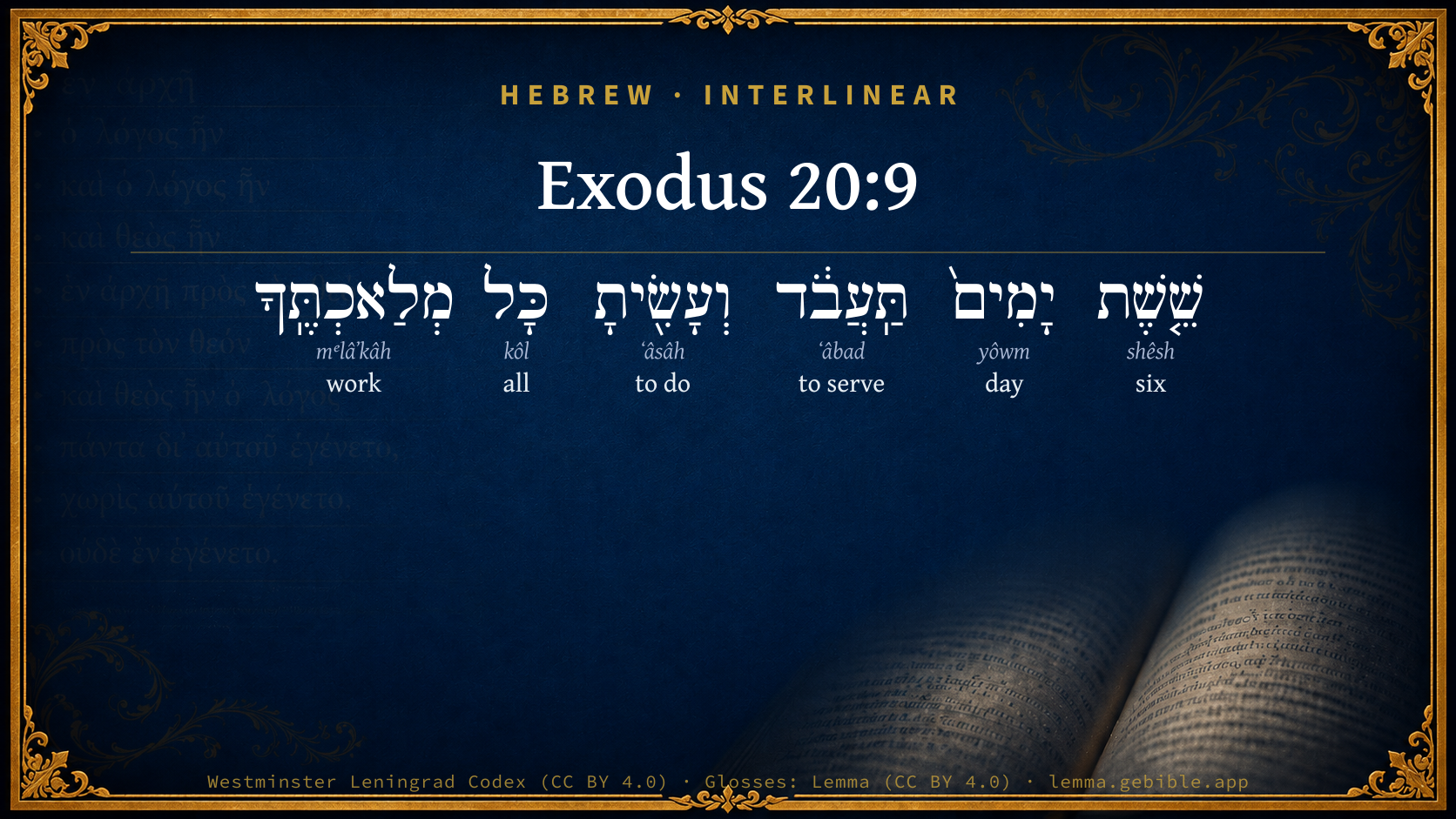
Hebrew (Westminster Leningrad Codex) Exodus 20:9 appears in the Hebrew Old Testament. The text above is from the Westminster Leningrad Codex. Each word links to its Strong’s number, a concise gloss, and parsing drawn from the Open Scriptures Hebrew Bible morphology. Click any word for its full Brown-Driver-Briggs (BDB) entry.
Download image
Cite this verse

Exodus 20:9 (World English Bible). Public Domain. Lemma interlinear Bible study tool, https://lemma.gebible.app/v/exodus/20/9.

Show BibTeX & RIS
BibTeX
RIS
English Translation
You shall labor six days, and do all your work,
World English Bible · Public Domain
Download a study sheet

One document with this verse’s original text, its word-by-word gloss line, the meaning frame, cross-references with their text, attributed commentary, and full source and license credits — printable, and it pastes into notes with its structure intact.

This verse Autodidact and up

Study sheet (.html) Plain text (.txt)

A passage Seminary Student

Up to 50 verses in one chapter. A passage sheet keeps up to 6 commentary sources and 12 cross-references per verse, in the order this page ranks them, and says so on the sheet whenever that leaves anything out. Ask for a single verse and you get the Autodidact verse sheet above.

Everything on this page stays free to read, with no account — the sheet is a download of what is already on screen, not access to it.

Want to remove ads? Support Godless Engineer
Compare translations 3

The same verse in 3 English versions, stacked beneath the original-language interlinear above. Click any original word for its lexicon entry.

Each is an independent rendering of the whole verse — the interlinear is not word-aligned to these translations.

Highlighted words mark where these versions differ — a whole-verse word diff, not a word-by-word alignment.

  • World English Bible Public Domain
    You shall labor six days, and do all your work,
  • King James Version Public Domain
    Six days shalt thou labor, and do all thy work:
  • unfoldingWord Literal Text CC BY-SA 4.0
    Six days you may labor and do all your work,

unfoldingWord Literal Text — © unfoldingWord, licensed CC BY-SA 4.0. Word-aligned USFM3 via Door43 (git.door43.org/unfoldingWord/en_ult).

Versions to compare (up to 4)

3 of 4 selected

Show all 18 translations

Every available English version of this verse, each an independent rendering of the whole verse.

  • World English Bible Public Domain
    You shall labor six days, and do all your work,
  • Berean Standard Bible Public Domain
    Six days you shall labor and do all your work,
  • Majority Standard Bible Public Domain
    Six days you shall labor and do all your work,
  • King James Version Public Domain
    Six days shalt thou labor, and do all thy work:
  • American Standard Version (1901) Public Domain
    Six days shalt thou labor, and do all thy work;
  • Revised Version (1885) Public Domain
    Six days shalt thou labour, and do all thy work:
  • Geneva Bible (1599) Public Domain
    Sixe dayes shalt thou labour, and doe all thy worke,
  • Douay-Rheims (1899) Public Domain
    Six days shalt thou labour, and shalt do all thy works.
  • Young's Literal Translation Public Domain
    six days thou dost labour, and hast done all thy work,
  • Literal Standard Version CC BY-SA 4.0
    six days you labor and have done all your work,
  • Unlocked Literal Bible CC BY-SA 4.0
    You must labor and do all your work for six days.
  • unfoldingWord Literal Text CC BY-SA 4.0
    Six days you may labor and do all your work,
  • Darby Bible Public Domain
    Six days shalt thou labour, and do all thy work;
  • World Messianic Bible Public Domain
    You shall labor six days, and do all your work,
  • Webster's Bible Public Domain
    Six days shalt thou labor, and do all thy work:
  • Free Bible Version CC BY-SA 4.0
    You have six days to work and earn your living,
  • Bible in Basic English Public Domain
    On six days do all your work:
  • JPS Tanakh (1917) Public Domain
    Six days shalt thou labour, and do all thy work;

Literal Standard Version (2020), Covenant Press — licensed CC BY-SA 4.0. Text via the HelloAO Bible API (eBible.org). Unlocked Literal Bible (unfoldingWord) — licensed CC BY-SA 4.0. Text via the HelloAO Bible API (eBible.org). unfoldingWord Literal Text — © unfoldingWord, licensed CC BY-SA 4.0. Word-aligned USFM3 via Door43 (git.door43.org/unfoldingWord/en_ult). Free Bible Version, Dr. Jonathan Gallagher — licensed CC BY-SA 4.0. Text via the HelloAO Bible API (eBible.org).

Word by word

More ways to search: Search by grammar → Find every occurrence → Compare this word →

Practice this passage: Drill this verse → Learn its vocabulary →

About this verse

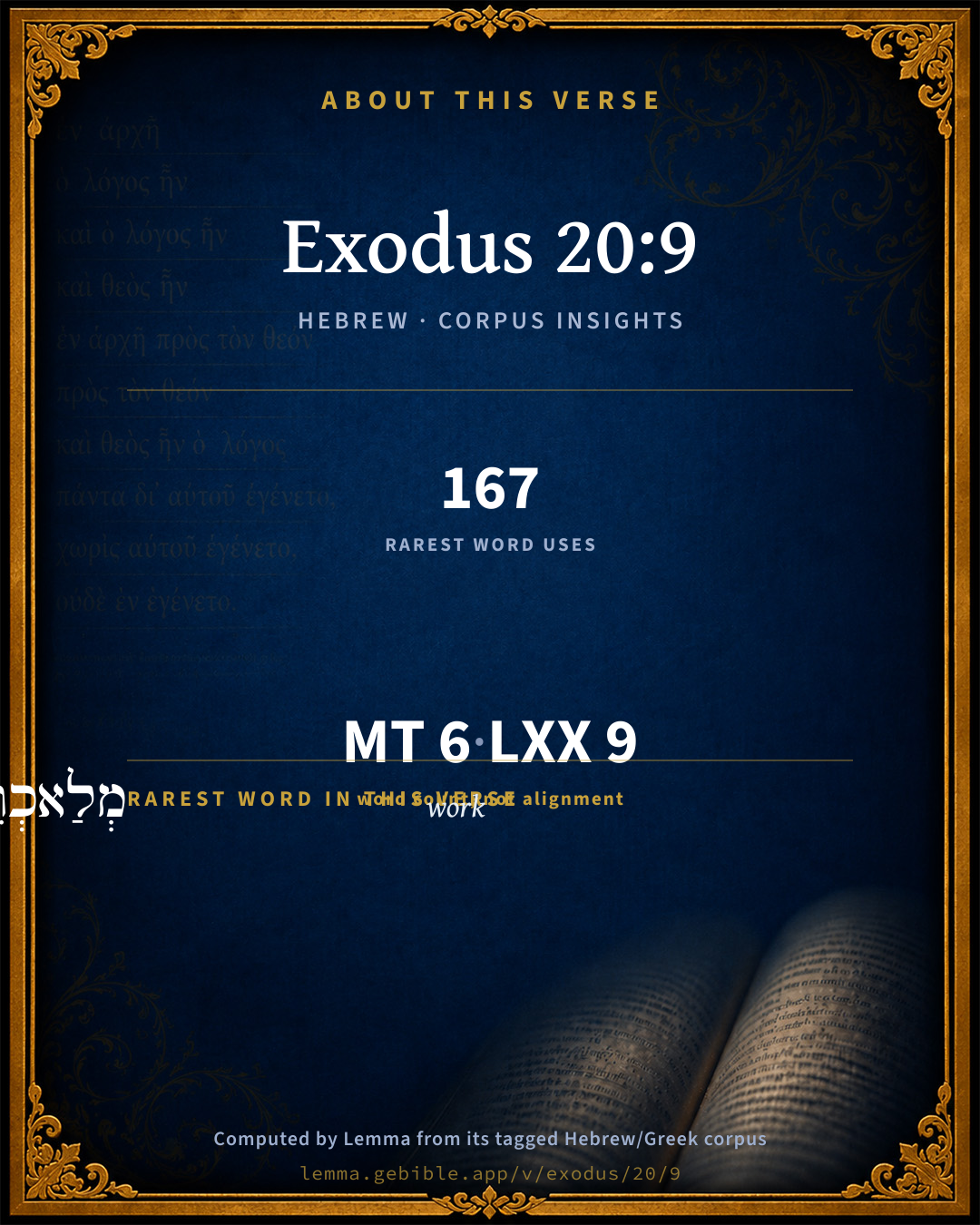
These counts appear in no published source. They are computed here, from the morphology-tagged text and Lemma’s own curated glosses. What Lemma adds →

6
words
6
distinct lemmas
Pentateuch
section

Grammatical profile

  • 2 verbs
  • 3 nouns
  • 1 adjective

Verb forms

  • תַּֽעֲבֹ֔ד Qal · Imperfect
  • וְעָשִׂ֖יתָ Qal · Sequential Perfect

Hebrew & Septuagint length

In English translation the verse runs 10 words from the Hebrew and 11 from the Septuagint (LXX English) — closely comparable.

A rough comparison of the two English renderings, which tokenize alike — not a word-level alignment.

Word counts can differ between the Hebrew and the Greek without any difference in meaning — e.g. the Hebrew direct-object marker אֵת has no separate Greek word, and Greek often adds the article ὁ.

In the original languages it is 6 Hebrew tokens and 9 Greek tokens — but the two are counted differently (Hebrew bundles its prefixes and suffixes into one token; the Greek is in lemma form), so that isn’t a like-for-like length.

Cross-references

5

Topical passages linked to Exodus 20:9 in the Treasury of Scripture Knowledge — connected by theme and wording, ordered by reader-vote popularity; previews shown in the World English Bible.

  • Luke 13:14 The ruler of the synagogue, being indignant because Jesus had healed on the Sabbath, said to the multitude, "There are six days in which men ought to work. Therefore come on those days and be healed, and not on the Sabbath day!"
  • Exodus 23:12 "Six days you shall do your work, and on the seventh day you shall rest, that your ox and your donkey may have rest, and the son of your handmaid, and the alien may be refreshed.
  • Exodus 34:21 Six days you shall work, but on the seventh day you shall rest: in plowing time and in harvest you shall rest.
  • Leviticus 23:3 "'Six days shall work be done: but on the seventh day is a Sabbath of solemn rest, a holy convocation; you shall do no manner of work. It is a Sabbath to Yahweh in all your dwellings.
  • Exodus 35:2 'Six days shall work be done, but on the seventh day there shall be a holy day for you, a Sabbath of solemn rest to Yahweh: whoever does any work in it shall be put to death.

Cross-references courtesy of OpenBible.info (CC BY 4.0).

Hebrew and Greek witnesses Masoretic Hebrew ↔ Greek Septuagint

The same verse in the two great witnesses to the Old Testament, shown verse-for-verse.

These are two independent witnesses, not word-aligned to each other, and the Septuagint is shown in lemma (dictionary) form.

Hebrew Exodus 20:9 Masoretic · Westminster Leningrad Codex

שֵׁ֤שֶׁת יָמִים֙ תַּֽעֲבֹ֔ד וְעָשִׂ֖יתָ כָּל מְלַאכְתֶּֽךָ

You shall labor six days, and do all your work,

World English Bible · Public Domain

Greek LXX Exodus 20:9 Septuagint · lemma form

ἕξ ἡμέρα ἐργάζομαι καί ποιέω πᾶς ὁ ἔργον σύ

Six days you shall labor, and shall perform all your work.

LXX2012 (modern English Septuagint) · Public Domain

Hebrew: Westminster Leningrad Codex (CC BY 4.0). Greek: Septuagint (public domain); English from LXX2012 (modern English Septuagint) (Public Domain). How the Septuagint differs from the Hebrew →

Targum (Aramaic paraphrase)

2

The Targum is the ancient Jewish Aramaic paraphrase of the Hebrew Scriptures — an interpretive translation, not the Hebrew text itself. Onkelos (literal) and Pseudo-Jonathan (expansive) render the Torah, and Jonathan the Prophets. Coverage is partial: where no permissively-licensed English translation exists for a verse, only the Aramaic is shown. This is verse-level text, not a word-by-word alignment to the Hebrew.

  1. Targum Onkelos Torah (Genesis–Deuteronomy)
    שִׁתָּא יוֹמִין תִּפְלָח וְתַעְבֵּד כָּל עִבִדְתָּךְ:

    (no public-domain English translation for this verse)

    Targum Onkelos — Aramaic: “Onkelos Genesis” (public domain); “Onkelos Exodus” (public domain); “Onkelos Leviticus” (public domain); “Onkelos Numbers” (public domain); “Onkelos Deuteronomy” (public domain). English: “Sefaria Community Translation” (CC0 1.0 (public-domain dedication)); “J.W. Etheridge. The Targums of Onkelos and Jonathan Ben Uzziel on the Pentateuch. London: Longmans, Green, 1862” (public domain). Text via Sefaria.

  2. Targum Pseudo-Jonathan Torah (Genesis–Deuteronomy)
    שִׁיתָּא יוֹמִין תִּפְלְחוּן וְתַעַבְדוּן כָּל עֲבִדְתֵּיכוֹן

    Six days you shall labour, and do all your service:

    Targum Pseudo-Jonathan — Aramaic: “Targum Jonathan on Genesis” (public domain); “Targum Jonathan on Exodus” (public domain); “Targum Jonathan on Leviticus” (public domain); “Targum Jonathan on Numbers” (public domain); “Targum Jonathan on Deuteronomy” (public domain). English: “The Targum of Jonathan ben Uzziel, trans. J. W. Etheridge, London, 1862” (public domain). Text via Sefaria.

Commentary

Notes on Exodus 20:9 from classic Christian and Jewish commentators (each source and its license shown beneath its notes). The classic Christian expositions comment on the surrounding passage and are grouped to its opening verse, so a note may address several verses; the Jewish commentaries on the Tanakh (Rashi and others) are per-verse, so they appear only where the commentator wrote on this verse.

Lemma curates 59 commentaries, every one of them public domain or Creative Commons licensed, each selected and text-cleaned for this edition rather than reprinted as found. About our sources →

Trapp's Complete Commentary

John Trapp

Exo 20:9 Six days shalt thou labour, and do all thy work:

Ver. 9. Six days shalt thou labour.] God hath reserved but one day in seven, as he reserved the tree of knowledge of good and evil; {Gen 2:2-3} yet wretched men must needs clip the Lord’s coin. In many places God’s Sabbaths are made the voider and dunghill for all refuse businesses. The Sabbath of the Lord, the sanctified day of his rest, saith one, is shamelessly troubled and disquieted. The world is now grown perfectly profane, saith another, and can play on the Lord’s day without concern. {a} {See Trapp (for summary of Law) on "Exo 20:17"}

{a} Bishop King, On John, lect. vii.

John Trapp, A Commentary or Exposition upon All the Books of the Old and New Testament (1647–1656) — public domain. Text from a community e-Sword module.

Adam Clarke's Commentary

Verse 9. Six days shalt thou labour] Therefore he who idles away time on any of the six days, is as guilty before God as he who works on the Sabbath. No work should be done on the Sabbath that can be done on the preceding days, or can be deferred to the succeeding ones. Works of absolute necessity and mercy are alone excepted. He who works by his servants or cattle is equally guilty as if he worked himself. Hiring out horses, &c., for pleasure or business, going on journeys, paying worldly visits, or taking jaunts on the Lord's day, are breaches of this law. The whole of it should be devoted to the rest of the body and the improvement of the mind. God says he has hallowed it - he has made it sacred and set it apart for the above purposes. It is therefore the most proper day for public religious worship.

Adam Clarke's Commentary on the Bible (1810–1826) — public domain. Text from a community e-Sword/MySword module.

Ellicott's Commentary for English Readers

(9) Six days shalt thou labour.—The form is certainly imperative; and it has been held that the fourth commandment is “not limited to a mere enactment respecting one day, but prescribes the due distribution of a week, and enforces the six days’ work as much as the seventh day’s rest” (Garden in Smith’s Dictionary of the Bible, vol. iii., p. 1068). But the work on the six days is really rather assumed as what will be than required as what must be; and the intention of the clause is prohibitory rather than mandatory—“thou shalt not work more than six days out of the seven.”

A Bible Commentary for English Readers, edited by Charles John Ellicott (1878–1897) — public domain. Text from a community e-Sword module.

The Cambridge Bible for Schools and Colleges

gen. ed. J. J. S. Perowne

9. work] more precisely, business,—the word regularly used of the ‘work’ or ‘business’ forbidden on the sabbath (Exo_31:14-15, Jer_17:22; Jer_17:24 al.: cf. Gen_2:2), or other sacred day (Exo_12:16).

9, 10. Explanation how the sabbath is to be kept holy.

The Cambridge Bible for Schools and Colleges (gen. ed. J. J. S. Perowne; Cambridge University Press, 1878–1918) — public domain. Text from a community e-Sword module.

John Gill's Exposition

Six days shalt thou labour,.... This is not to be taken for a precept, but a permission; not as a command enjoining men to work and labour with their hands, to provide for themselves and families things useful and necessary, and honest in the sight of God; but as a grant and allowance of so many days to employ themselves in, for their own profit and advantage, and that of their families; the Lord only reserving one day out of seven for his service, which ought to be looked upon as a singular favour, that he required no more of their time for his use, and the rest they might spend as they pleased, so that they did not indulge themselves in sin. It is required indeed of all men to labour in some sort and way or another, with their heads or with their hands; though all are not obliged to labour in the same way, or to the same degree, for he that will not work ought not to eat; but this law is not an injunction of that kind, only a toleration of labour on the six days of the week, if proper and necessary, when it is forbidden on the seventh:

and do all thy work, which is incumbent on a man, he is called unto, and is necessary to be done for the good of him and his family; particularly care should be taken, that all should be done on the six days that could possibly be done, and nothing left to be done on the seventh.

John Gill's Exposition of the Whole Bible (1746–1763) — public domain (CC PDM 1.0). Text via the HelloAO Bible API.

Haydock's Catholic Bible Commentary

Six, &c. This must be understood if no festival of obligation occurred. For many were in force in the old law; such as the Passover, Encenia, Purim, &c., as there are still in the Church. (Haydock)

George Leo Haydock (1774–1849), Haydock's Catholic Family Bible and Commentary, 1859 edition — public domain. Excludes Psalms (Douay-Rheims chapter numbering differs from Protestant) and Deuterocanonical books (Catholic canon only).

Matthew Poole's English Annotations

This may be either,

1. A command to employ those days in our worldly occasions, yet so as God and religion be not neglected on those days, as many scriptures teach us. Or,

2. A permission to do so; which I prefer,

1. Because so it is a proper argument to enforce the observation of the sabbath: q.d. Grudge not me one day, when I allow you six for it.

2. Because the command of diligence in our callings would seem improperly placed here, as being of a quite different nature, and belonging to the second table, and being provided for in a distinct command, as we shall see.

Matthew Poole's English Annotations on the Holy Bible (1683–1685) — public domain. Text from a community e-Sword/MySword module.

Whedon's Commentary on the Bible

Daniel D. Whedon

9. Six days shalt thou labour — Here is a positive commandment, as explicit as that which enjoins the sabbath rest. No man is at liberty, before God, to spend his days in idleness and inactivity, and the healthfulness and full vigour of the physical constitution depend as much upon bodily activity as does the soundness of the religious life demand a weekly day of rest.

Daniel D. Whedon (gen. ed.), Commentary on the Old and New Testaments (1874–1909) — public domain. Text from a community e-Sword module.

The Pulpit Commentary

Six days shalt thou labour. This is not so much a command as a prohibition" Thou shaft not labor more than six (consecutive) clays." In them thou shelf do all thy necessary work, so as to have the Sabbath free for the worship and service of God.

The Pulpit Commentary (1880–1919), ed. H.D.M. Spence-Jones & Joseph S. Exell — public domain. Text from a community e-Sword module.

Rashi

Rabbi Shlomo Yitzchaki (Rashi)

ועשית כל מלאכתך [SIX DAYS SHALT THOU LABOUR] AND DO ALL THY WORK — When the Sabbath comes it should be in thy eyes as though all thy work were done (completed), so that thou shouldst not think at all about work (Mekhilta).

Rashi on the Tanakh — English translations: “The Judaica Press complete Tanach with Rashi, translated by A. J. Rosenberg” (CC BY 4.0); “Pentateuch with Rashi's commentary by M. Rosenbaum and A.M. Silbermann, 1929-1934” (public domain); “The Metsudah Tanach series, Lakewood, N.J” (CC BY 4.0); and “The Book of Joshua, Metsudah Publications, 1997” (CC BY 4.0). Text via Sefaria.

Ramban (Nachmanides)

Rabbi Moshe ben Nachman (Ramban / Nachmanides)

SIX DAYS SHALT THOU LABOR, AND DO ALL THY WORK. The term “labor” applies to work which is not for the needs of the body, such as cooking and the like, something like it is said: and in all manner of labor in the field; when thou tillest the ground; and ye shall be tilled and sown, and as I will yet explain with the help of G-d. It is for this reason that He said: “Six days you shall work the ground and do all thy work which is for your physical needs and your benefit, something like, bake that which you will bake. But on the Sabbath, you shall not do any kind of work, thou, thy son, nor thy daughter — i.e., the minors.” Thus He has warned us against our minor children doing work on the Sabbath with our knowledge and consent. Nor thy manservant, nor thy maidservant means the servants who have undergone circumcision and immersion, (children of the covenant). See Mechilta here. See also above, Note 79. who are obligated to observe all laws of the Sabbath just as Israelites, even as He said in the Book of Deuteronomy, that thy manservant and thy maidservant may rest as well as thou. In all [other] commandments of the Torah, observance is incumbent upon them as it is upon women, as is explained in the words of our Rabbis. Now it would have been proper that He warn them directly, for they themselves are duty-bound to observe the Sabbath. Scripture, however, speaks to us because the servants are in our possession, thus telling us that their resting is incumbent upon us and that if they are not hindered from doing work, we will be punished on account of them. Besides, it is with Israel that G-d speaks in all of the Ten Commandments, [and for this reason, the command is not given directly to the servants].

Ramban (Nachmanides) on the Tanakh — English translation: “Commentary on the Torah by Ramban (Nachmanides). Translated and annotated by Charles B. Chavel. New York, Shilo Pub. House, 1971-1976” (CC BY 4.0). Text via Sefaria.

Lesson kit

Teaching starters — assembled from the data on this page, not authored interpretation. Every prompt links to the verse data it draws on. Edit before teaching.

Exodus, in the Pentateuch, opens this verse with 6 words (6 distinct Hebrew lemmas). Its most distinctive word is mᵉlâʼkâh (“work”). A historical commentator’s framing appears above. Read the whole chapter for the surrounding context.

Discussion questions

  1. What does “work” (mᵉlâʼkâh) contribute to the verse as a whole?
  2. How does Luke 13:14, which shares this passage’s theme, read alongside this verse?
  3. These translations render this verse differently; the difference is in the English rendering, not the original. What questions does that raise?
  4. «תַּֽעֲבֹ֔ד» is a Qal Imperfect verb. How does that grammatical form shape the action described?
  5. Compare how Trapp's Complete Commentary and Adam Clarke's Commentary read this verse. Where do they agree or differ?

Things to notice

Reading settings

Reading text

Shown beneath each verse's original-language words.

Old Testament
Old Testament edition

Read the OT as the Masoretic Hebrew (MT) or the Greek Septuagint (LXX).

English shown for the Greek Septuagint (in the Hebrew ↔ Greek comparison).

Comparing translations? Open the Compare panel on any verse page to stack up to four side by side.