
Revelation 2:6

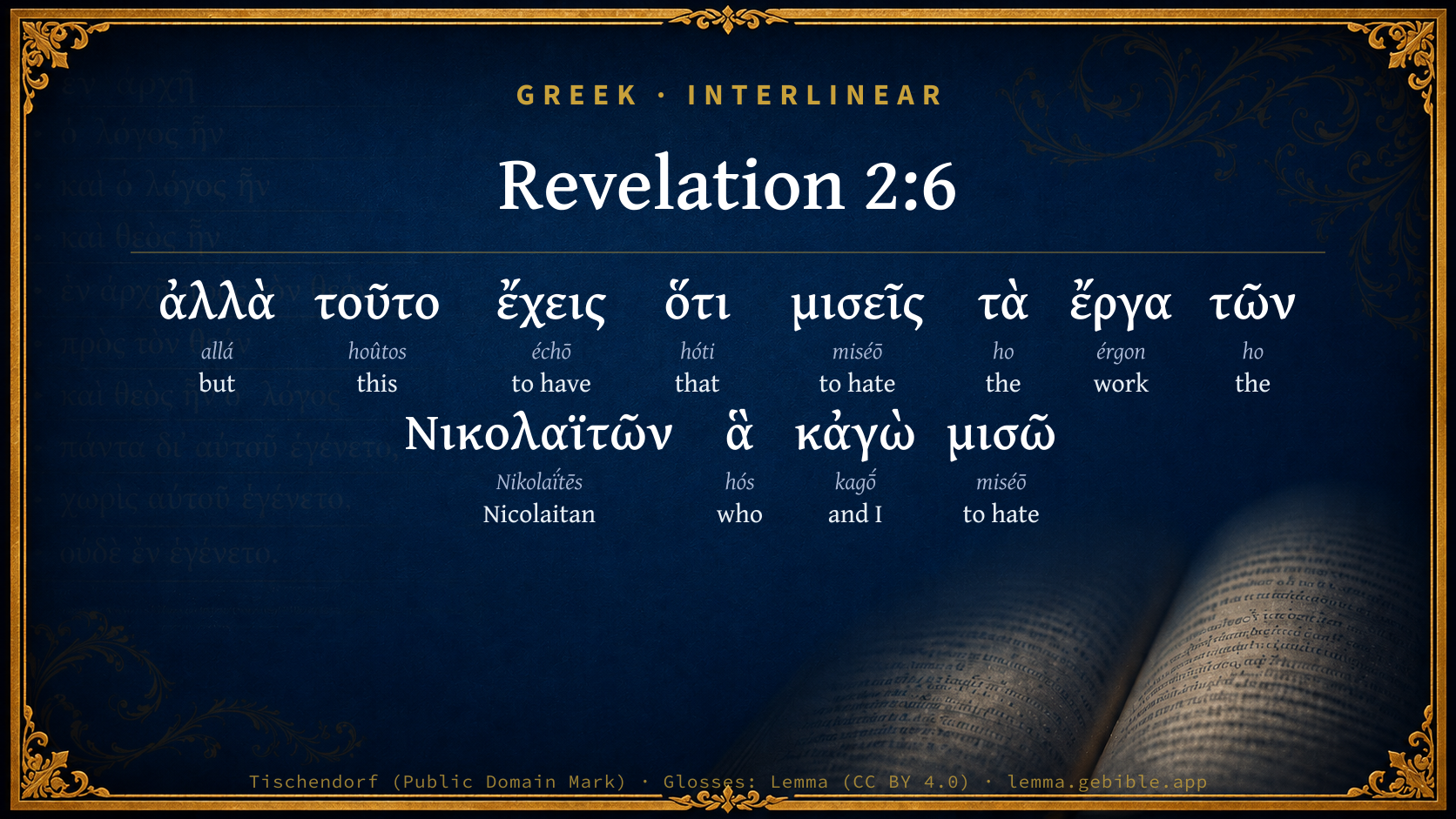
Greek (Tischendorf 8th ed.) Revelation 2:6 appears in the Greek New Testament. The text above is from the Tischendorf 8th edition. Each word links to its Strong’s number and a concise gloss. Click any word for its full Thayer’s Greek Lexicon entry.
Download image
Cite this verse

Revelation 2:6 (World English Bible). Public Domain. Lemma interlinear Bible study tool, https://lemma.gebible.app/v/revelation/2/6.

Show BibTeX & RIS
BibTeX
RIS
English Translation
But this you have, that you hate the works of the Nicolaitans, which I also hate.
World English Bible · Public Domain
Highlights
  • 1 first appearance in the Greek New Testament
Full analysis ↓
Download a study sheet

One document with this verse’s original text, its word-by-word gloss line, the meaning frame, cross-references with their text, attributed commentary, and full source and license credits — printable, and it pastes into notes with its structure intact.

This verse Autodidact and up

Study sheet (.html) Plain text (.txt)

A passage Seminary Student

Up to 50 verses in one chapter. A passage sheet keeps up to 6 commentary sources and 12 cross-references per verse, in the order this page ranks them, and says so on the sheet whenever that leaves anything out. Ask for a single verse and you get the Autodidact verse sheet above.

Everything on this page stays free to read, with no account — the sheet is a download of what is already on screen, not access to it.

Want to remove ads? Support Godless Engineer
Compare translations 3

The same verse in 3 English versions, stacked beneath the original-language interlinear above. Click any original word for its lexicon entry.

Each is an independent rendering of the whole verse — the interlinear is not word-aligned to these translations.

Highlighted words mark where these versions differ — a whole-verse word diff, not a word-by-word alignment.

  • World English Bible Public Domain
    But this you have, that you hate the works of the Nicolaitans, which I also hate.
  • King James Version Public Domain
    But this thou hast, that thou hatest the deeds of the Nicolaitanes, which I also hate.
  • unfoldingWord Literal Text CC BY-SA 4.0
    But you have this, that you hate the works of the Nicolaitans, which I also hate.

unfoldingWord Literal Text — © unfoldingWord, licensed CC BY-SA 4.0. Word-aligned USFM3 via Door43 (git.door43.org/unfoldingWord/en_ult).

Versions to compare (up to 4)

3 of 4 selected

Show all 19 translations

Every available English version of this verse, each an independent rendering of the whole verse.

  • World English Bible Public Domain
    But this you have, that you hate the works of the Nicolaitans, which I also hate.
  • Berean Standard Bible Public Domain
    But you have this to your credit: You hate the works of the Nicolaitans, which I also hate.
  • Majority Standard Bible Public Domain
    But you have this to your credit: You hate the works of the Nicolaitans, which I also hate.
  • King James Version Public Domain
    But this thou hast, that thou hatest the deeds of the Nicolaitanes, which I also hate.
  • American Standard Version (1901) Public Domain
    But this thou hast, that thou hatest the works of the Nicolaitans, which I also hate.
  • Revised Version (1885) Public Domain
    But this thou hast, that thou hatest the works of the Nicolaitans, which I also hate.
  • Geneva Bible (1599) Public Domain
    But this thou hast, that thou hatest the workes of the Nicolaitanes, which I also hate.
  • Douay-Rheims (1899) Public Domain
    But this thou hast, that thou hatest the deeds of the Nicolaites, which I also hate.
  • Young's Literal Translation Public Domain
    but this thou hast, that thou dost hate the works of the Nicolaitans, that I also hate.
  • Literal Standard Version CC BY-SA 4.0
    but this you have, that you hate the works of the Nicolaitans, that I also hate.
  • Unlocked Literal Bible CC BY-SA 4.0
    But you have this: You hate what the Nicolaitans have done, which I also hate.
  • unfoldingWord Literal Text CC BY-SA 4.0
    But you have this, that you hate the works of the Nicolaitans, which I also hate.
  • Darby Bible Public Domain
    But this thou hast, that thou hatest the works of the Nicolaitanes, which *I* also hate.
  • World Messianic Bible Public Domain
    But this you have, that you hate the works of the Nicolaitans, which I also hate.
  • Webster's Bible Public Domain
    But this thou hast, that thou hatest the deeds of the Nicolaitans, which I also hate.
  • Free Bible Version CC BY-SA 4.0
    However, you do have this to your credit: you hate the actions of the Nicolaitans, just as I do.
  • Bible in Basic English Public Domain
    But at least you have the credit of hating the works of the Nicolaitans, as I do.
  • Text-Critical English NT CC BY 4.0
    Yet yoʋ do have this: Yoʋ hate the works of the Nicolaitans, which I also hate.
  • Tyndale New Testament (1534) Public Domain
    But this thou haste because thou hatest the dedes of the Nicolaitans which dedes I also hate.

Literal Standard Version (2020), Covenant Press — licensed CC BY-SA 4.0. Text via the HelloAO Bible API (eBible.org). Unlocked Literal Bible (unfoldingWord) — licensed CC BY-SA 4.0. Text via the HelloAO Bible API (eBible.org). unfoldingWord Literal Text — © unfoldingWord, licensed CC BY-SA 4.0. Word-aligned USFM3 via Door43 (git.door43.org/unfoldingWord/en_ult). Free Bible Version, Dr. Jonathan Gallagher — licensed CC BY-SA 4.0. Text via the HelloAO Bible API (eBible.org).

Word by word

More ways to search: Search by grammar → Find every occurrence → Compare this word →

Practice this passage: Drill this verse → Learn its vocabulary →

Νικολαϊτῶν
Nikolaḯtēs
G3531
“Nicolaitan”
Noun, Genitive, Plural, Masculine
Part of Speech
Noun
Case
Genitive
Number
Plural
Gender
Masculine
Full Thayer's Definition

Origin: from G3532

TDNT: None

Nicolaitans = "destruction of people" 1. a sect mentioned in Rev. 2:6 , 15 , who were charged with holding the error of Balaam, casting a stumbling block before the church of God by upholding the liberty of eating things sacrificed to idols as well as committing fornication
  1. ἀλλὰ allá G235 “but” Conjunction
  2. τοῦτο hoûtos G3778 “this” Demonstrative pronoun, Accusative, Singular, Neuter
  3. ἔχεις échō G2192 “to have” Verb, Present, Active, Indicative, 2nd person, Singular
  4. ὅτι hóti G3754 “that” Conjunction
  5. μισεῖς miséō G3404 “to hate” Verb, Present, Active, Indicative, 2nd person, Singular
  6. τὰ ho G3588 “the” Article, Accusative, Plural, Neuter
  7. ἔργα érgon G2041 “work” Noun, Accusative, Plural, Neuter
  8. τῶν ho G3588 “the” Article, Genitive, Plural, Masculine
  9. ἃ hós G3739 “who” Relative pronoun, Accusative, Plural, Neuter
  10. κἀγὼ kagṓ G2504 “and I” Personal pronoun, 1st person, Nominative, Singular, Aramaic form
  11. μισῶ miséō G3404 “to hate” Verb, Present, Active, Indicative, 1st person, Singular

About this verse

These counts appear in no published source. They are computed here, from the morphology-tagged text and Lemma’s own curated glosses. What Lemma adds →

12
words
10
distinct lemmas
Revelation
section

Notable vocabulary

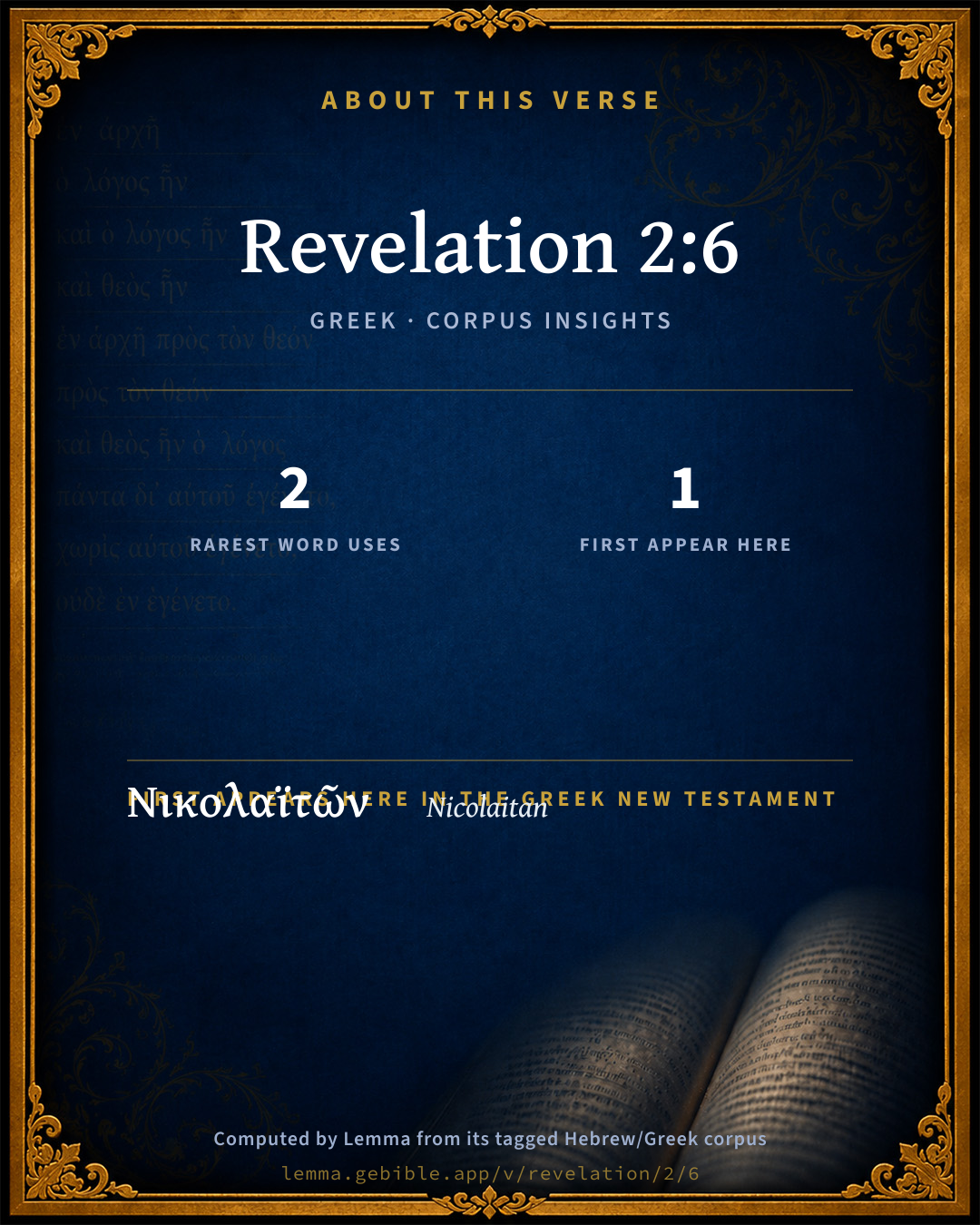
The rarest word here is Νικολαϊτῶν Nicolaitan G3531 — appearing just 2 times in the whole Greek New Testament.

First appearance in Scripture

This word makes its first canonical appearance in the Greek New Testament here:

  • Νικολαϊτῶν Nicolaitan G3531

Shared distinctive vocabulary

Νικολαϊτῶν Nicolaitan G3531 occurs in 2 verses of the Greek New Testament. Also found in:
Repetition

Words recur within this verse:

  • μισεῖς to hate G3404 ×2
  • τὰ the G3588 ×2

Cross-references

6

Topical passages linked to Revelation 2:6 in the Treasury of Scripture Knowledge — connected by theme and wording, ordered by reader-vote popularity; previews shown in the World English Bible.

  • Psalms 101:3 I will set no vile thing before my eyes. I hate the deeds of faithless men. They will not cling to me.
  • Psalms 26:5 I hate the assembly of evil-doers, And will not sit with the wicked.
  • 2 John 1:9–10 Whoever transgresses and doesn't remain in the teaching of Christ, doesn't have God. He who remains in the teaching, the same has both the Father and the Son.
  • Revelation 2:14–15 But I have a few things against you, because you have there some who hold the teaching of Balaam, who taught Balak to throw a stumbling block before the children of Israel, to eat things sacrificed to idols, and to commit sexual immorality.
  • 2 Chronicles 19:2 Jehu the son of Hanani the seer went out to meet him, and said to king Jehoshaphat, Should you help the wicked, and love those who hate Yahweh? for this thing wrath is on you from before Yahweh.
  • Psalms 139:21–22 Yahweh, don't I hate those who hate you? Am I not grieved with those who rise up against you?

Cross-references courtesy of OpenBible.info (CC BY 4.0).

Commentary

Notes on Revelation 2:6 from classic Christian and Jewish commentators (each source and its license shown beneath its notes). The classic Christian expositions comment on the surrounding passage and are grouped to its opening verse, so a note may address several verses; the Jewish commentaries on the Tanakh (Rashi and others) are per-verse, so they appear only where the commentator wrote on this verse.

Lemma curates 59 commentaries, every one of them public domain or Creative Commons licensed, each selected and text-cleaned for this edition rather than reprinted as found. About our sources →

Joseph Benson's Commentary

Rev 2:6. But — Or nevertheless; this thou hast — This honour and praise remaining; divine grace seeks whatever may help him that is fallen to recover his standing; that thou hatest the deeds of the Nicolaitanes — A sect so called, it is thought, from Nicolas, one of the seven deacons mentioned Act 6:5; according to ancient writers, their doctrine and their lives were equally corrupt. They allowed the practice of the most abominable lewdness and adulteries, as well as sacrificing to idols; all which they placed among things indifferent, and pleaded for as branches of Christian liberty.

Joseph Benson's Commentary on the Old and New Testaments (1811–1818) — public domain. Text from a community e-Sword module.

Scofield Reference Notes

C. I. Scofield

Nicolaitanes

From nikao, "to conquer," and laos, "the people," or "laity." There is no ancient authority for a sect of the Nicolaitanes. If the word is symbolic it refers to the earliest form of the notion of a priestly order, or "clergy," which later divided an equal brotherhood Mat 23:8 into "priests" and "laity." What in Ephesus was "deeds" Rev 2:6 had become in Pergamos a "doctrine Rev 2:15.

Nicolaitanes Rev 2:15, contra,; 1Pe 5:2; 1Pe 5:3; Mat 24:49.

The Scofield Reference Bible (1917 edition), notes by C. I. Scofield — public domain. Text from a community e-Sword module.

Tyndale Open Study Notes

Tyndale Open Resources

2:6 Not much is known of the Nicolaitans, but their teaching (2:15) seems to link them with those who ate food sacrificed to idols and who were involved in sexual immorality, behavior prohibited by the council in Jerusalem (see Acts 15:20, 29). Irenaeus argued (about AD 180) that the Nicolaitans were dependent on Nicolas (Acts 6:3-5) and that John’s writings were directed against the heresies of the Nicolaitans who followed Cerinthus (see 1 John Book Introduction, “Setting”).

Tyndale Open Study Notes — © Tyndale Open Resources, licensed CC BY-SA 4.0. Text via the HelloAO Bible API.

Meyer's Critical & Exegetical Commentary

Heinrich August Wilhelm Meyer

Rev_2:6. Not for the purpose of alleviating the pain of the church concerning the reproof of Rev_2:4,[968] but because the Lords love for his church gladly recognizes what is to be properly acknowledged, and once more, but in a new and more definite way, makes prominent in opposition to Rev_2:4 sqq. (ἈΛΛΆ) the one point of commendation already in Rev_2:2. Just because the church was rejected for no longer having the first love to their Lord, is it once more expressly acknowledged that it is still so far of one mind with him, as to hate the wicked works which he hates. Thus Rev_2:6 has enough that is peculiar, as not to appear a mere repetition of Rev_2:2, and contains no marks whatever whereby Rev_2:2-3, are to be understood in the sense of Hengstenberg.

With τοῦτο ἔχ. neither ἈΓΑΘΌΝ, nor the like, is used to complete the construction: the explanation of the ΤΟῦΤΟ in ὌΤΙ ΜΙΣ., Κ.Τ.Λ., shows that the common possession is commendable.

The ΜΙΣΕῖς is not a strong expression for censuring,[969] but is just as earnestly meant as the ΜΙΣῶ.[970] But it is justly remarked already by N. de Lyra,[971] that the hatred is directed not against the persons, but against the works.[972]

Concerning the Nicolaitans,[973] as well concerning their name as also their conduct, it is possible to judge only by a comparison with Rev_2:14 sqq. Irenaeus,[974] Hippolyt.,[975] Tertullian,[976] Clemens Alex.,[977] Jerome,[978] Augustine,[979] and other Church Fathers derive the sect from a founder Nicolaus, and that, too, the deacon mentioned in Act_6:5, of whom they have more to relate as they are more remote from him in time. That this is derived entirely from this passage, and is of no more importance than that according to which the Ebionites are represented as springing from a certain Ebion,[980] is shown, first, from the fluctuation of the tradition which also knew how to defend that church officer, so highly commended in Acts, from the disgrace of having founded a troublesome sect,[981] and, secondly, from the circumstance that the patristic tradition, from the very beginning, refers to Rev_2:6; Rev_2:14 sqq. Nicolaus of Acts 6 was thought of because none other of that name was known.[982] Since Chr. A. Heumann,[983] and J. W. Janus,[984] the opinion has become almost universal, that the designation Νικολαἰται (from ΝΙΚᾶΝ and ΛΑΌς) suggests the Hebrew name Balaam (from בֶלַע and עָם, i.e., swallowing-up, or destruction, of the people), whereby the Balaamite nature of those Nicolaitanes is to be indicated. To this Rev_2:14-15, refer.[985] Yet it cannot be positively decided whether John found the word used already in this sense, or was himself the first to frame it. A comparison may be made with the name Armillus given to antichrist,[986] i.e., ἘΡΗΜΌΛΑΟς.[987]

The Nicolaitans are of course not identical[988] with the ΚΑΚΟΊ mentioned in Rev_2:2, since the latter expression is very general: yet, at all events, they belong to them which are evil; and the idea, which in itself is highly improbable, must not be inferred,[989] that in Rev_2:2; Rev_2:6, two entirely different kinds of false teachers are meant, of whom the former may be regarded disciples of John,[990] or Jewish teachers,[991] or strict Jewish Christians,[992] while the Nicolaitans, who, according to De Wette, etc., are again distinct from Balaamites,[993] as those of a more heathen tendency, viz., false teachers who surrendered themselves[994] to a false freedom.[995] Tertullian and other Church fathers, N. de Lyra, and the older expositors, connect the Nicolaitans with the Gnostics; Hengstenb. also regards them identical with the deniers of the Son, in the Epistles of John, by referring the warning in Joh_5:21[996] to the ethnicizing ways of the false teachers there antagonized. But for all this, there is no foundation. What especially contradicts Hengstenbergs conjecture is the fact that the (Gnostic) false teachers of the Epistles of John are attacked just as decidedly because of their false doctrines, as the Nicolaitans of the Apoc. because of their evil deeds.[997] That the aberrations are practical, which even Hengstenb. emphasizes, but without ground alleges also of the false teachers in 1 John, is shown already by Rev_2:2 (ΚΑΚΟΎς). We shall therefore have to think of the Nicolaitans as ethnicizing libertines.[998] This is not contradicted by the fact that they assumed apostolic authority; for if they possibly professed to vindicate their Christian freedom in the Pauline sense, they might likewise wish to be apostles like Paul.[999] [See Note XXIX., p. 155.]

[968] Grot., Hengstenb.

[969] De Wette.

[970] Cf. on Rev_2:2.

[971] Cf. also Hengstenb., etc.

[972] Cf. Rev_2:14. Incorrectly, Calov.: dogmas.

[973] Cf. Gieselers Kirchengeschichte, i. 1, sec. 29; Winer, Rwb.; literature in Wolf.

[974] Haer., i. 26.

[975] Ref. Omn. Haer., ed. Gott., 1859, p. 408.

[976] Praescr. Haer., 46.

[977] Strom., ii. 20, p. 490; iii. 4, p. 522.

[978] Adv. Lucifer, 23.

[979] Haer., 5.

[980] Cf. Tertullian, l. c. 33.

[981] Cf. Clemens Alex.

[982] Against Ebrard and Klief., who, as well as Grot., Calov., and the older and Catholic expositors in general, hold to the patristic statement.

[983] Act. Erud. Ann., 1712, p. 179; Poecile, ii. 392.

[984] De Nicol. ex Haeret. Catalogo Expungendis. Viteb., 1723. Cf. Vitr., Wetst., Eichh., Herder, Heinrichs, who, however, is inclined to affirm that there was at Ephesus a Nicolaus. Cf. also Ewald, Gesch., Jer., vii. 172 sqq., Züllig, Hengstenb., etc.

[985] Cf., on the other hand, De Wette.

[986] Cf. Commentary on 1Jn_2:18.

[987] K. Wieseler, Chronol. d. apost. Zeitalt., p. 263 sqq

[988] Hengstenb.

[989] Ewald.

[990] Eichh.

[991] Züll.

[992] Ewald.

[993] See on Rev_2:14-15.

[994] Ewald.

[995] Cf. Rev_2:14 with Act_15:29.

[996] Which, however, is not directed against heathenism clothed in a Christian garb.

[997] Cf. Rev_2:14; Rev_2:20.

[998] Cf. also A. Ritschl, Entst. d. Altkath. K. Bonn, 1857, p. 134 sq.

[999] According to Volkm., the strict Judæo-Christian author of the Apoc. had in mind the Apostle to the Gentiles and his adherents. Cf. also Hilgenfeld, Kanon, p. 228. Cf. Introduction, sec. 2, note.

NOTES BY THE AMERICAN EDITOR

XXIX. Rev_2:6. τῶν Νικολαϊτῶν

The argument in the long and thorough discussion in Gebhardt (pp. 206216) is to prove the distinction between the Nicolaitans and those errorists mentioned in Rev_2:2, them which say they are apostles, etc., referring to Judaizing teachers, the conflict with whom is now in the background, while, with Dust., he regards the Nicolaitans as ethnicizing teachers of an Antinomian type. He traces the two classes, as prophesied already by St. Paul in his charge to the elders of Ephesus, Act_28:29-30, the latter verse referring to those here mentioned. Sieffert (Herzog, R. E.): Gentile Christian Antinomians who abused Pauls doctrine of freedom. Schultze (in Zöcklers Handbuch): A Gnostic Antinomianism, against which Paul had contended in the Epistle to the Colossians, and especially Jude, and Peter in his Second Epistle; and whose adherents John means in his First Epistle, by the name of antichrists, combining with false gnosis docetic error and a heathen life, as the head of whom Cerinthus appeared (Iren., i. 26; Euseb., iii. 28).

Meyer — Critical and Exegetical Commentary on the New Testament — English translation by Peter Christie, edited by Frederick Crombie (T&T Clark, 1880) — public domain. Text from a community e-Sword module.

Expositor's Greek Testament

ed. W. Robertson Nicoll

Rev 2:6 . The message ends with a tardy echo of 2 b . The prophet admits that one redeeming feature in the church is the detestation of the N. Not all the spirit of animosity at Ephesus is amiss. When directed, as moral antipathy, against these detestable Nikolaitans (corresponding to the Greek quality of μισοπονηρία ), it is a healthy feature of their Christian consciousness. The Nikolaitans have been identified by patristic tradition, from Irenæus downwards, with the followers of the proselyte Nikolaos (Act 6:5 , where see note), who is alleged, especially by Tertullian and Epiphanius, to have lapsed into antinomian license, as the result of an overstrained asceticism, and to have given his name to a sect which practised religious sensuality in the days before Cerinthus. The tenets of the latter are in fact declared by Irenæus to have been anticipated by the Nicolaitans, who represented the spirit of libertinism which, like the opposite extreme of legalism at an earlier period, threatened the church’s moral health. But if the comment of Vict. were reliable, that the N [899] principle was merely ut delibatum exorcizaretur et manducari posset et ut quicumque fornicatus esset octauo die pacem acciperet , the representation of John would become vigorously polemical rather than historically accurate. The tradition of the N [900] ’s origin may of course be simply due to the play of later imagination upon the present narrative taken with the isolated reference to Nikolaos in Act 6:6 . On the other hand it was not in the interest of later tradition to propagate ideas derogatory to the character of an apostolic Christian; indeed, as early as Clem. Alex. ( Strom . ii. 20, iii. 4; cf. Constit. Ap. vi. 8), a disposition (shared by Vict.) to clear his character is evident. Whatever was the precise relation of the sect to Nikolaos, whether some tenet of his was exploited immorally or whether he was himself a dangerously lax teacher, there is no reason to doubt the original connexion of the party with him. Its accommodating principles are luminously indicated by the comment of Hippolytus ( ἐδίδασκεν ἀδιαφορίαν βίου ) and the phrase attributed to him by Clem. Alex, ( παραχρήσασθαι τῇ σαρκὶ δεῖ ), a hint which is confirmed, if the Nikolaitans here and in Rev 2:15 are identified with the Balaamites ( νικο - λαος , in popular etymology, a rough Greek equivalent for בלע עם , perdidit uel absorpsit populum). This symbolic interpretation has prevailed from the beginning of the eighteenth century (so Ewald, Hengstenberg, Düst., Schürer, Julicher, Bousset). The original party-name was probably interpreted by opponents in this derogatory sense. It was thus turned into a covert censure upon men who were either positively immoral or liberally indifferent to scruples (on food, clubs, marriage, and the like) which this puritan prophet regarded as vital to the preservation of genuine Christianity in a pagan city. A contemporary parallel of moral laxity is quoted by Derenbourg, Hist, de la Palestine (1867), p. 363. If Nikolaos was really an ascetic himself, the abuse of his principles is quite intelligible, as well as their popularity with people of inferior character. Pushed to an extreme, asceticism confines ethical perfection to the spirit. As the flesh has no part in the divine life, it may be regarded either as a foe to be constantly thwarted or as something morally indifferent. In the latter case, the practical inference of sensual indulgence is obvious, the argument being that the lofty spirit cannot be soiled by such indulgence any more than the sun is polluted by shining on a dunghill.

[899]. cod. Purpureus. 6th century (fragments of all the Gospels).

[900]. cod. Purpureus. 6th century (fragments of all the Gospels).

The Expositor's Greek Testament, edited by W. Robertson Nicoll (1897–1910) — public domain. Text from a community e-Sword module.

Jamieson, Fausset & Brown

Robert Jamieson, A. R. Fausset & David Brown

But--How graciously, after necessary censure, He returns to praise for our consolation, and as an example to us, that we would show, when we reprove, we have more pleasure in praising than in fault-finding.

hatest the deeds--We should hate men's evil deeds, not hate the men themselves.

Nicolaitanes--IRENÆUS [Against Heresies, 1.26.3] and TERTULLIAN [Prescription against Heretics, 46] make these followers of Nicolas, one of the seven (honorably mentioned, Act 6:3, Act 6:5). They (CLEMENT OF ALEXANDRIA [Miscellanies, 2.20 3.4] and EPIPHANIUS [Heresies, 25]) evidently confound the latter Gnostic Nicolaitanes, or followers of one Nicolaos, with those of Revelation. MICHAELIS' view is probable: Nicolaos (conqueror of the people) is the Greek version of Balaam, from Hebrew "Belang Am," "Destroyer of the people." Revelation abounds in such duplicate Hebrew and Greek names: as Apollyon, Abaddon: Devil, Satan: Yea (Greek, "Nai"), Amen. The name, like other names, Egypt, Babylon, Sodom, is symbolic. Compare Rev 2:14-15, which shows the true sense of Nicolaitanes; they are not a sect, but professing Christians who, like Balaam of old. tried to introduce into the Church a false freedom, that is, licentiousness; this was a reaction in the opposite direction from Judaism, the first danger to the Church combated in the council of Jerusalem, and by Paul in the Epistle to Galatians. These symbolical Nicolaitanes, or followers of Balaam, abused Paul's doctrine of the grace of God into a plea for lasciviousness (Pe2 2:15-16, Pe2 2:19; Jde 1:4, Jde 1:11 who both describe the same sort of seducers as followers of Balaam). The difficulty that they should appropriate a name branded with infamy in Scripture is met by TRENCH: The Antinomian Gnostics were so opposed to John as a Judaizing apostle that they would assume as a name of chiefest honor one which John branded with dishonor.

Jamieson, Fausset & Brown — Commentary Critical and Explanatory on the Whole Bible (1871) — public domain (CC PDM 1.0). Text via the HelloAO Bible API.

Adam Clarke's Commentary

Verse 6. The deeds of the Nicolaitanes] These were, as is commonly supposed, a sect of the Gnostics, who taught the most impure doctrines, and followed the most impure practices. They are also supposed to have derived their origin from Nicolas, one of the seven deacons mentioned Ac 6:5, where see the note. The Nicolaitanes taught the community of wives, that adultery and fornication were things indifferent, that eating meats offered to idols was quite lawful; and mixed several pagan rites with the Christian ceremonies. Augustine, Irenaeus, Clemens Alexandrinus, and Tertullian, have spoken largely concerning them. See more in my preface to 2d Peter, where are several particulars concerning these heretics.

Adam Clarke's Commentary on the Bible (1810–1826) — public domain. Text from a community e-Sword/MySword module.

Ellicott's Commentary for English Readers

(6) But this thou hast, that thou hatest the deeds (better, works) of the Nicolaitanes.—The Nicolaitanes were, as has been expressed, the Antinomians of the Asiatic Church. The life and conduct were little thought of, and the faith professed was everything. Some have thought that they were a sect who derived their name, under some colourable pretext, from Nicolas the Proselyte; others hold that the name is purely symbolical, signifying “destroyer of the people,” and that it is no more than the Greek form of Balaam. (See Notes on Rev_2:14-15, below.) The existence of a sect called Nicolaitanes in the second century is attested by Irenæus, Tertullian, and Clement of Alexandria.

A Bible Commentary for English Readers, edited by Charles John Ellicott (1878–1897) — public domain. Text from a community e-Sword module.

The Cambridge Bible for Schools and Colleges

gen. ed. J. J. S. Perowne

6. But this thou hast] This is one point in which thou art not wanting. Compare Rev_2:25, Rev_3:2; Rev_3:11, where faithfulness is conceived as a treasure possessed and to be guarded.

thou hatest the deeds] Compatible with love to the persons: cf. St Jude 23.

Nicolaitans] See Excursus II.

The Cambridge Bible for Schools and Colleges (gen. ed. J. J. S. Perowne; Cambridge University Press, 1878–1918) — public domain. Text from a community e-Sword module.

John Gill's Exposition

But this thou hast, that thou hatest the deeds of the Nicolaitans,.... Though these Christians had left their first love, yet they bore an hatred to the filthy and impure practices of some men, who were called "Nicolaitans"; who committed fornication, adultery, and all uncleanness, and had their wives in common, and also ate things offered to idols; who were so called, as some think (c), from Nicolas of Antioch, one of the seven deacons in Act 6:5; though as to Nicolas himself, it is said (d), that he lived with his own lawful married wife, and no other, and that his daughters continued virgins all their days, and his son incorrupt; and that these men, so called, only shrouded themselves under his name, and abused a saying or action of his, or both, to patronize their wicked deeds: he had used to advise , by which he meant a restraining of all carnal and unlawful lusts; but these men interpreted it of an indulgence in them, and so gave themselves up to all uncleanness; and whereas, he having a beautiful wife, and being charged with jealousy, in order to clear himself of it, he brought her forth, and gave free liberty to any person to marry her as would; which indiscreet action of his these men chose to understand as allowing of community of wives. Dr. Lightfoot conjectures, that these Nicolaitans were not called so from any man, but from the word "Nicolah", "let us eat", which they often used to encourage each other to eat things offered to idols. However this be, it is certain that there were such a set of men, whose deeds were hateful; but neither their principles nor their practices obtained much in this period of time, though they afterwards did; see Rev 2:15. Professors of the Christian religion in general abhorred such impure notions and deeds, as they were by Christ:

which also I hate; all sin is hateful to Christ, being contrary to his nature, to his will, and to his Gospel; and whatever is hateful to him should be to his people; and where grace is, sin will be hateful, both in themselves and others; and men's deeds may be hated when their persons are not; and hatred of sin is taken notice of by Christ, with a commendation,

(c) Vid. Irenaeum adv. Haeres, l. 1. c. 27. & Tertull. de Praescript. Haeret. c. 46, 47. (d) Clement. Alex. Strom. l. 3. p. 436. & Euseb, Hist. Eccl. l. 2. c. 29.

John Gill's Exposition of the Whole Bible (1746–1763) — public domain (CC PDM 1.0). Text via the HelloAO Bible API.

Trapp's Complete Commentary

John Trapp

6 But this thou hast, that thou hatest the deeds of the Nicolaitans, which I also hate.

Ver. 6. But this thou hast] That they might not say, when called upon to repent, Nay, but there is no hope, Jer 2:25; Jer 18:12. Christ picks out that which is praiseworthy in them, and commends it. Despair carries men to hell, as the devils did the swine into the sea; cast not away therefore your confidence, &c.

The works of the Nicolaitans] Who taught a community of wives, and that it was but a thing indifferent to commit adultery. (Irenaeus, Theod.)

John Trapp, A Commentary or Exposition upon All the Books of the Old and New Testament (1647–1656) — public domain. Text from a community e-Sword module.

Albert Barnes' Notes on the Bible

But this thou hast - This thou hast that I approve of, or that I can commend.

That thou hatest the deeds of the Nicolaitans - Greek, “works” (τὰ ἔργα ta erga). The word “Nicolaitanes” occurs only in this place, and in the Rev 2:15 verse of this chapter. From the reference in the latter place it is clear that the doctrines which they held prevailed at Pergamos as well as at Ephesus; but from neither place can anything now be inferred in regard to the nature of their doctrines or their practices, unless it be supposed that they held the same doctrine that was taught by Balaam. See the notes on Rev 2:15. From the two passages, compared with each other, it would seem that they were alike corrupt in doctrine and in practice, for in the passage before us their deeds are mentioned, and in Rev 2:15 their doctrine. Various conjectures, however, have been formed respecting this class of people, and the reasons why the name was given to them:

I. In regard to the origin of the name, there have been three opinions:

(1) That mentioned by Irenaeus, and by some of the other fathers, that the name was derived from Nicolas, one of the deacons ordained at Antioch, Act 6:5. Of those who have held this opinion, some have supposed that it was given to them because he became apostate and was the founder of the sect, and others because they assumed his name, in order to give the greater credit to their doctrine. But neither of these suppositions rests on any certain evidence, and beth are destitute of probability. There is no proof whatever that Nicolas the deacon ever apostatized from the faith, and became the founder of a sect; and if a name had been assumed, in order to give credit to a sect and extend its influence, it is much more probable that the name of an apostle would have been chosen, or of some other prominent man, than the name of an obscure deacon of Antioch.

(2) Vitringa, and most commentators since his time, have supposed that the name Nicolaitanes was intended to be symbolical, and was not designed to designate any sect of people, but to denote those who resembled Balaam, and that this word is used in the same manner as the word “Jezebel” in Rev 2:20, which is supposed to be symbolical there. Vitringa supposes that the word is derived from νίκος nikos, “victory,” and λαός laos, “people,” and that thus it corresponds with the name Balaam, as meaning either בּצל צם bàal ̀am, “lord of the people,” or בּלץ צם baalà ̀am, “he destroyed the people”; and that, as the same effect was produced by their doctrines as by those of Balaam, that the people were led to commit fornication and to join in idolatrous worship, they might be called “Balaamites” or “Nicolaitanes,” that is, corrupters of the people. But to this it may be replied:

(a)That it is far-fetched, and is adopted only to remove a difficulty;

(b)That there is every reason to suppose that the word used here refers to a class of people who bore that name, and who were well known in the two churches specified;

(c)That in Rev 2:15 they are expressly distinguished from those who held the doctrine of Balaam, Rev 2:14, “So hast thou also (καὶ kai) those that hold the doctrine of the Nicolaitanes.”

(3) It has been supposed that some person now unknown, probably of the name Nicolas, or Nicolaus, was their leader, and laid the foundation of the sect. This is by far the most probable opinion, and to this there can be no objection. It is in accordance with what usually occurs in regard to sects, orthodox or heretical, that they derive their origin from some person whose name they continue to bear; and as there is no evidence that this sect prevailed extensively, or was indeed known beyond the limits of these churches, and as it soon disappeared, it is easily accounted for that the character and history of the founder were so soon forgotten.

II. In regard to the opinions which they held, there is as little certainty. Irenaeus (Adv. Haeres. i., 26) says that their characteristic tenets were the lawfulness of promiscuous sexual intercourse with women, and of eating things offered to idols. Eusebius (Hist. Eccl. iii., 29) states substantially the same thing, and refers to a tradition respecting Nicolaus, that he had a beautiful wife, and was jealous of her, and being reproached with this, renounced all intercourse with her, and made use of an expression which was misunderstood, as implying that illicit pleasure was proper. Tertullian speaks of the Nicolaitanes as a branch of the Gnostic family, and as, in his time, extinct. Mosheim (De Rebus Christian Ante. Con. section 69) says that “the questions about the Nicolaitanes have difficulties which cannot be solved.” Neander (History of the Christian Religion, as translated by Torrey, vol. i, pp. 452, 453) numbers them with Antinomians; though he expresses some doubt whether the actual existence of such a sect can be proved, and rather inclines to an opinion noticed above, that the name is symbolical, and that it is used in a mystical sense, according to the usual style of the Book of Revelation, to denote corrupters or seducers of the people, like Balaam. He supposes that the passage relates simply to a class of persons who were in the practice of seducing Christians to participate in the sacrificial feasts of the pagans, and in the excesses which attended them - just as the Jews were led astray of old by the Moabites, Num. 25.

What was the origin of the name, however, Neander does not profess to be able to determine, but suggests that it was the custom of such sects to attach themselves to some celebrated name of antiquity, in the choice of which they were often determined by circumstances quite accidental. He supposes also that the sect may have possessed a life of Nicolas of Antioch, drawn up by themselves or others from fabulous accounts and traditions, in which what had been imputed to Nicolas was embodied. Everything, however, in regard to the origin of this sect, and the reason of the name given to it, and the opinions which they held, is involved in great obscurity, and there is no hope of throwing light on the subject. It is generally agreed, among the writers of antiquity who have mentioned them, that they were distinguished for holding opinions which countenanced gross social indulgences. This is all that is really necessary to be known in regard to the passage before us, for this will explain the strong language of aversion and condemnation used by the Saviour respecting the sect in the epistles to the Churches of Ephesus and Pergamos.

Which I also hate - If the view above taken of the opinions and practices of this people is correct, the reasons why he hated them are obvious. Nothing can be more opposed to the personal character of the Saviour, or to his religion, than such doctrines and deeds.

Albert Barnes' Notes on the Bible (1834–1885) — public domain. Text from a community e-Sword/MySword module.

Matthew Poole's English Annotations

But this thou hast; thou hast yet thus much to commend thee.

That thou hatest the deeds of the Nicolaitanes; thou hatest the deeds of those who teach the lawfulness of a common use of wives, and eat things offered to idols; for these, they say, were the tenets of the Nicolaitanes, so called from one Nicholas; but whether he were one of the first deacons, named Act 6:5, (who, they say, to avoid the imputation of jealousy, brought forth his wife, being a beautiful woman, and prostituted her), or from some other of that name, I cannot determine.

Which I also hate: God, as a lover of his own order, and of human society, hateth such doctrines and practices as are contrary to the rule of his word, and tend to the confusion of human societies.

Matthew Poole's English Annotations on the Holy Bible (1683–1685) — public domain. Text from a community e-Sword/MySword module.

Whedon's Commentary on the Bible

Daniel D. Whedon

6. But—An added mitigation of the rebuke, and a directing how to avoid the removal.

Hatest the deeds—The Ephesians hated better than they loved. Severe pietists hate sinners often more than they love goodness. They abhor antichrist more than they love Christ. And these are in danger of mixing an impure passion with their moral antagonism, which may produce a fall from Christian love. After having warned his Ephesians of this danger, our seer reiterates the rightness of their abhorrence of the corruptionists, assuring them of Christ’s authentication therein.

Nicolaitans—The professed followers of Nicolas, one of the first seven deacons of Jerusalem, as we have noted on Act_6:5. The earliest authorities are decisive on this point. Says Irenaeus: “The Nicolaitans also have Nicolaus as their master, one of the first seven who were ordained to the deaconship by the apostles.” Tertullian: “Another heretic emerged— Nicolaus. He was one of the seven deacons mentioned in the Acts of the Apostles.” Later, and so less trustworthy, authorities exculpate Nicolas, under excuse either that he was misunderstood by his followers or that they claimed his authority falsely, or that it was another Nicolas, a bishop of Samaria, who was their real founder. As we have said in our note above quoted, the sexual licentiousness of the sect was based upon a philosophical maxim, namely, that all evil resides in matter. From this principle two opposite inferences could be drawn, and two opposing sects be formed. 1. It could be affirmed that all material indulgence must be avoided, and thence would arise asceticism, with its rejection of meats, monasticism, enforced celibacy, self-flagellation, and denial of the real corporeity of Christ. 2. It could, on the other hand, be affirmed that all material sins could be indulged, and yet the spirit be pure, and thence would arise the most unrestrained inebriety and debauchery. It was this last sect which our Lord gives over to a holy and divine hate. See our note on Act_6:5; Act_8:9-12; Rom_14:1-6; 2Th_2:7. Well might the true heart hate the deeds of this sect, for it would have buried Christianity in base licentiousness. But while the Christian would hate their deeds, he would earnestly wish to save the men.

Daniel D. Whedon (gen. ed.), Commentary on the Old and New Testaments (1874–1909) — public domain. Text from a community e-Sword module.

The Pulpit Commentary

They are again commended for their good points. But it is possible to hate what Christ hates without loving what he loves. It is possible to hate false doctrine and lawlessness, and yet be formal and dead one"s self. Who the Nicolaitans were we cannot now determine with certainty. The name Nicolaus may be intended as a Greek equivalent of Balaam, but this is by no means certain. Irenaeus and Clement of Alexandria write as if the sect of Nicolaitans existed in their day. A common belief was that their founder was Nicolaus of Antioch, one of the seven deacons. Irenaeus (1:26), followed by Hippolytus ("Refut.," 7:24), supports this view; Ignatius ("Trall.," 9) and the Apostolic Constitutions (6:8), are against it. The Nicolaitans may have claimed him as their founder, or similarity of name may have caused confusion with a different person. The doctrine of the Nicolaitans, and that of Balaam (ver. 14), and that of the woman Jezebel (ver. 20), seem to have this much in common a contention that the freedom of the Christian placed him above the moral Law. Neither idolatry nor sensuality could harm those who had been made free by Christ. The moral enactments of the Law had been abrogated by the gospel, no less than the ceremonial. The special mention of "the pollutions of idols" and "fornication," in the decrees of the Council of Jerusalem, (Act_15:20, Act_15:29) seems to show that this pernicious doctrine was already in existence in A.D. 50. In 2Pe 2 and Jud_1:7-13 a similar evil is denounced. It appears in other heretical sects, especially those of Gnostic origin, e.g. Cerinthians, Cainites, Carpocratians. In this way we may explain the statement of Eusebius, ("Hist. Ec:," 3:29) that the Nieelaitan heresy lasted only for a short time; i.e. its religious libertinism did not die out, but passed over into other sects. Note that it is "the works of the Nicolaitans," not the men themselves, that Christ hates. He loves the sinner, while he hates the sin. "It would have been well with the Church had this always been remembered" (Alford).

The Pulpit Commentary (1880–1919), ed. H.D.M. Spence-Jones & Joseph S. Exell — public domain. Text from a community e-Sword module.

John Wesley's Explanatory Notes

But thou hast this - Divine grace seeks whatever may help him that is fallen to recover his standing. That thou hatest the works of the Nicolaitans - Probably so called from Nicolas, one of the seven deacons, Acts vi, 5. Their doctrines and lives were equally corrupt. They allowed the most abominable lewdness and adulteries, as well as sacrificing to idols; all which they placed among things indifferent, and pleaded for as branches of Christian liberty.

John Wesley, Explanatory Notes Upon the Whole Bible (1754–1765) — public domain. Text via the GEBible commentary corpus.

Burkitt's Expository Notes on the New Testament

William Burkitt

As if Christ had said, "Though thou art not what thou shouldest be, yet this thou hast commendable in thee, that thou shouldest be, yet this thou hast commendable in thee, that thou hatest the deeds of the Nicolaitans, (who held community of wives, and ate things offered to idols,) which impure sect I also hate for their licentious doctrine and lewd practices, which tend to the ruin and bane of human societies."

Note here, 1. That it is not unlawful to call heretics by the name of their leaders; the Nicolaitans are here so called from one Nicolas, supposed to be the deacon mentioned, who having a beautiful wife exposed her as common, to avoid the imputation of jealousy.

Note, 2. That Christ hated all licentious doctrines and loose practices, and so should we.

William Burkitt's Expository Notes on the New Testament (1700–1703) — public domain. Text from a community e-Sword module.

Godbey's Commentary on the New Testament

William B. Godbey

6. Here God again commends their scrupulous orthodoxy in the loyal fight they nobly maintain against the Nicolaitan heresy, which taught then, as now, that sin resided in the body; so their bodies were compelled to sin so long as they lived.

William B. Godbey, Commentary on the New Testament (1896–1900) — public domain. Text from a community e-Sword module.

The People's New Testament

B. W. Johnson

6. But this thou hast. There is another ground of commendation. They hate the deeds of the Nicolaitanes. Opinions are not agreed concerning this sect, but it is probable that the followers of a Nicolaus are meant who taught that Christian liberty meant license to commit sensual sins.

B. W. Johnson's The People's New Testament with Notes (1889–1891) — public domain. Electronic text from the Christian Classics Ethereal Library (CCEL) ThML edition.

unfoldingWord translationNotes

Door43 World Missions Community

Nicolaitans

people who followed the teachings of a man named Nicolaus (See: How to Translate Names)

Let the one who has an ear listen

Being willing to listen is spoken of as having an ear. AT: "Let the one who is willing to listen, listen" or "If you are willing, listen" (See: Metaphor)

the one who conquers

This refers anyone who conquers. AT: "anyone who resists evil" or "those who do not agree to do evil" (See: Generic Noun Phrases)

the paradise of God

"God's garden." This is a symbol for heaven.

translationWords

Holy Spirit

church

life

God

unfoldingWord translationNotes — © Distant Shores Media and the Door43 World Missions Community, licensed CC BY-SA 4.0. Source: git.door43.org/Door43/en_tn.

Cambridge Greek Testament for Schools and Colleges

6. ἃ κἀγὼ μισῶ. A omits ἅ.

6. ἀλλὰ τοῦτο ἔχεις. This one point in which thou art not wanting. Compare Rev 2:25, Rev 3:2; Rev 3:11, where faithfulness is conceived as a treasure possessed and to be guarded.

μισεῖς τὰ ἔργα. Compatible with love to the persons: cf. St Jud 1:23.

τῶν Νικολαϊτῶν. See Excursus II.

Cambridge Greek Testament for Schools and Colleges (Cambridge University Press, 1896; 21 vols, various authors incl. Carr, Maclear, Plummer, Farrar, Lumby, Moule, M. R. James, Simcox) — public domain. Text from a community e-Sword module.

Alford’s Greek Testament

Henry Alford

6.] Notwithstanding, this thou hast (this one thing: there is no need to supply ἀγαθόν or the like: of what sort the τοῦτο is, is explained by what follows. We may notice the tender compassion of our blessed Lord, who, in his blame of a falling church, yet selects for praise one particular in which His mind is yet retained. This is for our comfort: but let us not forget that it is for our imitation also. μεταξὺ τῶν λυπηρῶν τίθησι καὶ τὰ πρὸς εὐθυμίαν ἄγοντα, ἵνα μὴ τῇ περισσοτέρᾳ λύπῃ καταποθῇ τὰ τῆς ἐκκλησίας. Areth. in Cat.) that thou hatest the works (“non dixit Nicolaitas, sed facta: quia personæ sunt ex charitate diligendæ, sed eorum vitia odio sunt habenda.” Lyra. It would have been well with the church, had this always been remembered. τὰ ἔργα, see below, must be referred to the moral delinquencies of this sect) of the Nicolaitans (there has been much dispute who these were. The prevailing opinion among the fathers was, that they were a sect founded by Nicolaus the proselyte of Antioch, one of the seven deacons. So Irenæus (Hær. i. 26. 3(27), p. 105, “Nicolaitæ autem magistrum quidem habent Nicolaum, unum ex vii., qui primi ad diaconium ab apostolis ordinati sunt: qui indiscrete vivunt”), Tertullian (Præscr. Hær. 46, vol. ii. p. 63, “alter hæreticus Nicolaus emersit. Hic de septem diaconis qui in Actis App. allecti sunt, fuit.” He then describes his execrable impurities), (in two passages, which are worth citing, as I shall presently have to comment on them: 1) Strom, ii.20 (118), p. 490 P.,—τοιοῦτοι δὲ καὶ οἱ φάσκοντες ἐαυτοὺς Νικολάῳ ἓπεσθαι ἀπομνημόνευμά τι τἀνδρὸς φέροντες ἐκ παρατροπῆς τὸ δεῖν παραχρήσασθαι τῇ σαρκί. ἀλλʼ ὁ μὲν γενναῖος κολούειν δεῖν ἐδήλου τάς τε ἡδονὰς τάς τε ἐπιθυμίας, καὶ τῇ ἀσκήσει ταύτῃ καταμαραίνειν τὰς τῆς σαρκὸς ὁρμάς τε καὶ ἐπιθέσεις. οἱ δὲ εἰς ἡδονὴν τράγων δίκην ἐκχυθέντες οἷον ἐφυβρίζοντες τῷ σώματι καθηδυπαθοῦσιν: 2) ib. iii. 4 (25), p. 522 P.: περὶ τῆς Νικολάου ῥήσεως διαλεχθέντες ἐκεῖνο παρελείπομεν· ὡραίαν, φησί, γυναῖκα ἔχων οὗτος μετὰ τὴν ἀνάληψιν τὴν τοῦ σωτῆρος πρὸς τῶν ἀποστόλων ὀνειδισθεὶς ζηλοτυπίαν εἰς μέσον ἀγαγὼν τὴν γυναῖκα γῆμαι τῷ βουλομένῳ ἐπέτρεψεν· ἀκόλουθον γὰρ εἶναί φασι τὴν πρᾶξιν ταύτην ἐκείνῃ τῇ φωνῇ τῇ ὅτι παραχρήσασθαι τῇ σαρκὶ δεῖ), Euseb. (H. E. iii. 29, citing Clem.-Alex., as above), Epiphanius (Hær. xxv. pp. 76 ff., where he gives a long account of Nicolaus and his depravation and his followers): so also Jerome (dial. adv. Lucif. 23, vol. ii. p. 197) and (de hæres. 5, vol. viii. p. 26), and many other fathers, citations from whom may be seen in Stern’s notes, h. 1.: also Areth. in Catena, referring to Epiph.

We have already seen, in Clem.-Alex., symptoms of a desire to vindicate Nicolaus the deacon from the opprobrium of having been the founder of such a sect; and we find accordingly in the apostolical constitutions, οἱ νῦν ψευδώνυμοι Νικολαΐται are spoken of: and Victorinus of Pettau, in our earliest extant commentary on the Apocalypse, says, “Nicolaitæ autem erant illo tempore ficti homines et pestiferi, qui sub nomine Nicolai ministri fecerunt sibi hæresin,” &c. Thence we advance a step farther, and find another Nicolaus substituted for the deacon of that name. So in Dorotheus (cited in Stern) we find him described as a bishop of Samaria (ὃς ἐπίσκοπος Σαμαρείας γενόμενος ἑτεροδόξησεν ἅμα τῷ Σίμωνι). And an apocryphal Acts of the Apostles in Fabricius, Cod. Apocr. N. T. i. p. 498 (Stern), speaks of a Corinthian of this name, infamous for licentious practices. We come now to the second principal view with regard to this sect, which supposes their name to be symbolic, and Nicolaus to be the Greek rendering of Balaam, בָּלַע עָם, or, Chald., בְּלַע עָם, ‘perdidit vel absorpsit populum.’ Consequently the name Nicolaitans = Balaamites, as is also inferred from ver. 14. This view seems first to have been broached by Chr. A. Heumann in the Acta Eruditorum for 1712, and since then has been the prevailing one. (There is a trace in ancient times of a mystical interpretation, e. g. in , gloss. ord., who says, “Nicolaus, stultus populus, id est, Gentiles Deum ignorantes:” and Ambrose Ansbert, “si a proprietate ad figuram, ut solet, sermo recurrit, omnes hæretici Nicolaitæ esse probantur: Nicolaus enim interpretatur stultus populus.” What this means, I am as unable to say as was Vitringa: it perhaps arises from thus understanding בַּל עָם, ‘non-populus:’ cf. Deu 32:21.) But this is very forced, and is properly repudiated by some of the best modern Commentators: e. g. by De Wette, Ebrard, and Stern. (See also Winer, Realw. sub voce: Neander, Kirchengesch. i. 2. 774 ff.: Gieseler, Kirchengesch. i. 1. 113 note.) In the first place, the names are by no means parallel, even were we to make Balaam, as some have done, into בַּעַל עָם, lord of the people (Ἀρχέλαος): and next, the view derives no support from ver. 14 f., where the followers of Balaam are distinct from the Nicolaitans: see note there. And besides, there is no sort of reason for interpreting the name otherwise than historically. It occurs in a passage indicating simple matters of historical fact, just as the name Antipas does in ver. 13. If we do not gain trustworthy accounts of the sect from elsewhere, why not allow for the gulf which separates the history of the apostolic from that of the post-apostolic period, and be content with what we know of them from these two passages? There is nothing repugnant to verisimilitude in what Clem.-Alex. relates of the error of Nicolaus; nor need all of those, who were chosen to aid the Apostles in distributing alms, have been, even to the end of their lives, spotless and infallible. At least it may be enough for us to believe that possible of one of them, which the post-apostolic Fathers did not hesitate to receive), which I also hate (this strong expression in the mouth of our Lord unquestionably points at deeds of abomination and impurity: cf. Isa 59:8; Jer 44:4; Amo 5:21; Zec 8:17).

Henry Alford, The Greek Testament (1849–1861) — public domain. Text from a community e-Sword module.

Lesson kit

Teaching starters — assembled from the data on this page, not authored interpretation. Every prompt links to the verse data it draws on. Edit before teaching.

Revelation, in the Revelation, opens this verse with 12 words (10 distinct Greek lemmas). Its most distinctive word is Nikolaḯtēs (“Nicolaitan”). A historical commentator’s framing appears above. Read the whole chapter for the surrounding context.

Discussion questions

  1. What does “Nicolaitan” (Nikolaḯtēs) contribute to the verse as a whole?
  2. This is the first place “Nicolaitan” appears in Scripture (first appears here). What does its debut here establish?
  3. How does Revelation 2:15, which shares the word «Nicolaitan», read alongside this verse?
  4. What does the repetition of “to hate” (2× in this one verse) do in this verse?
  5. These translations render this verse differently; the difference is in the English rendering, not the original. What questions does that raise?
  6. Compare how Joseph Benson's Commentary and Scofield Reference Notes read this verse. Where do they agree or differ?

Things to notice

  • 1 word makes its first canonical appearance in Scripture here.
  • These translations choose different wording for 7 words in this verse.
  • “to hate” occurs 2× in this single verse.
  • 10 distinct Greek lemmas span 12 words in this verse.

Reading settings

Reading text

Shown beneath each verse's original-language words.

Old Testament
Old Testament edition

Read the OT as the Masoretic Hebrew (MT) or the Greek Septuagint (LXX).

English shown for the Greek Septuagint (in the Hebrew ↔ Greek comparison).

Comparing translations? Open the Compare panel on any verse page to stack up to four side by side.