
Romans 2:6

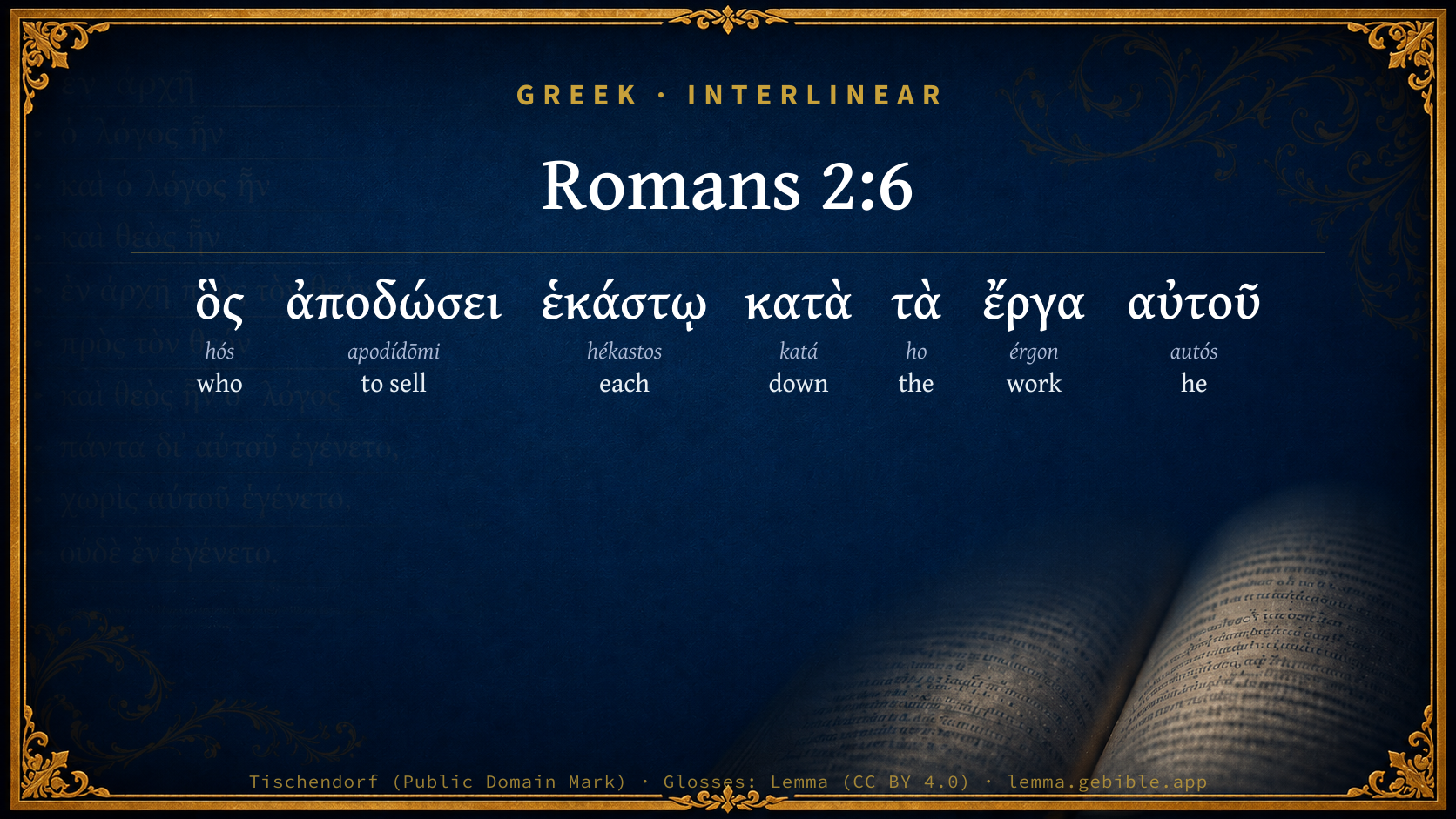
Greek (Tischendorf 8th ed.) Romans 2:6 appears in the Greek New Testament. The text above is from the Tischendorf 8th edition. Each word links to its Strong’s number and a concise gloss. Click any word for its full Thayer’s Greek Lexicon entry.
Download image
Cite this verse

Romans 2:6 (World English Bible). Public Domain. Lemma interlinear Bible study tool, https://lemma.gebible.app/v/romans/2/6.

Show BibTeX & RIS
BibTeX
RIS
English Translation
who "will pay back to everyone according to their works:"
World English Bible · Public Domain
Download a study sheet

One document with this verse’s original text, its word-by-word gloss line, the meaning frame, cross-references with their text, attributed commentary, and full source and license credits — printable, and it pastes into notes with its structure intact.

This verse Autodidact and up

Study sheet (.html) Plain text (.txt)

A passage Seminary Student

Up to 50 verses in one chapter. A passage sheet keeps up to 6 commentary sources and 12 cross-references per verse, in the order this page ranks them, and says so on the sheet whenever that leaves anything out. Ask for a single verse and you get the Autodidact verse sheet above.

Everything on this page stays free to read, with no account — the sheet is a download of what is already on screen, not access to it.

Want to remove ads? Support Godless Engineer
Compare translations 3

The same verse in 3 English versions, stacked beneath the original-language interlinear above. Click any original word for its lexicon entry.

Each is an independent rendering of the whole verse — the interlinear is not word-aligned to these translations.

Highlighted words mark where these versions differ — a whole-verse word diff, not a word-by-word alignment.

  • World English Bible Public Domain
    who "will pay back to everyone according to their works:"
  • King James Version Public Domain
    Who will render to every man according to his deeds:
  • unfoldingWord Literal Text CC BY-SA 4.0
    who will pay back to each one according to his deeds:

unfoldingWord Literal Text — © unfoldingWord, licensed CC BY-SA 4.0. Word-aligned USFM3 via Door43 (git.door43.org/unfoldingWord/en_ult).

Versions to compare (up to 4)

3 of 4 selected

Show all 19 translations

Every available English version of this verse, each an independent rendering of the whole verse.

  • World English Bible Public Domain
    who "will pay back to everyone according to their works:"
  • Berean Standard Bible Public Domain
    God “will repay each one according to his deeds.”
  • Majority Standard Bible Public Domain
    God “will repay each one according to his deeds.”
  • King James Version Public Domain
    Who will render to every man according to his deeds:
  • American Standard Version (1901) Public Domain
    who will render to every man according to his works:
  • Revised Version (1885) Public Domain
    who will render to every man according to his works:
  • Geneva Bible (1599) Public Domain
    Who wil reward euery man according to his woorkes:
  • Douay-Rheims (1899) Public Domain
    Who will render to every man according to his works.
  • Young's Literal Translation Public Domain
    who shall render to each according to his works;
  • Literal Standard Version CC BY-SA 4.0
    who will render to each according to his works;
  • Unlocked Literal Bible CC BY-SA 4.0
    He will pay back to every person according to his actions:
  • unfoldingWord Literal Text CC BY-SA 4.0
    who will pay back to each one according to his deeds:
  • Darby Bible Public Domain
    who shall render to each according to his works:
  • World Messianic Bible Public Domain
    who “will pay back to everyone according to their works:”
  • Webster's Bible Public Domain
    Who will render to every man according to his deeds:
  • Free Bible Version CC BY-SA 4.0
    God will make sure everyone receives what they deserve according to what they've done.
  • Bible in Basic English Public Domain
    Who will give to every man his right reward:
  • Text-Critical English NT CC BY 4.0
    who will repay each person according to his works.
  • Tyndale New Testament (1534) Public Domain
    which will rewarde every man accordinge to his dedes:

Literal Standard Version (2020), Covenant Press — licensed CC BY-SA 4.0. Text via the HelloAO Bible API (eBible.org). Unlocked Literal Bible (unfoldingWord) — licensed CC BY-SA 4.0. Text via the HelloAO Bible API (eBible.org). unfoldingWord Literal Text — © unfoldingWord, licensed CC BY-SA 4.0. Word-aligned USFM3 via Door43 (git.door43.org/unfoldingWord/en_ult). Free Bible Version, Dr. Jonathan Gallagher — licensed CC BY-SA 4.0. Text via the HelloAO Bible API (eBible.org).

Word by word

More ways to search: Search by grammar → Find every occurrence → Compare this word →

Practice this passage: Drill this verse → Learn its vocabulary →

ἀποδώσει
apodídōmi
G591
“to sell”
Verb, Future, Active, Indicative, 3rd person, Singular
Part of Speech
Verb
Tense
Future
Voice
Active
Mood
Indicative
Person
3rd person
Number
Singular
Full Thayer's Definition

Origin: from G575 and G1325

TDNT: 04:47,2

1. to deliver, to give away for one's own profit what is one's own, to sell 2. to pay off, discharge what is due a. a debt, wages, tribute, taxes, produce due b. things promised under oath c. conjugal duty d. to render account 3. to give back, restore 4. to requite, recompense in a good or a bad sense
  1. ὃς hós G3739 “who” Relative pronoun, Nominative, Singular, Masculine
  2. ἑκάστῳ hékastos G1538 “each” Adjective, Dative, Singular, Masculine
  3. κατὰ katá G2596 “down” Preposition
  4. τὰ ho G3588 “the” Article, Accusative, Plural, Neuter
  5. ἔργα érgon G2041 “work” Noun, Accusative, Plural, Neuter
  6. αὐτοῦ autós G846 “he” Personal pronoun, Genitive, Singular, Masculine

About this verse

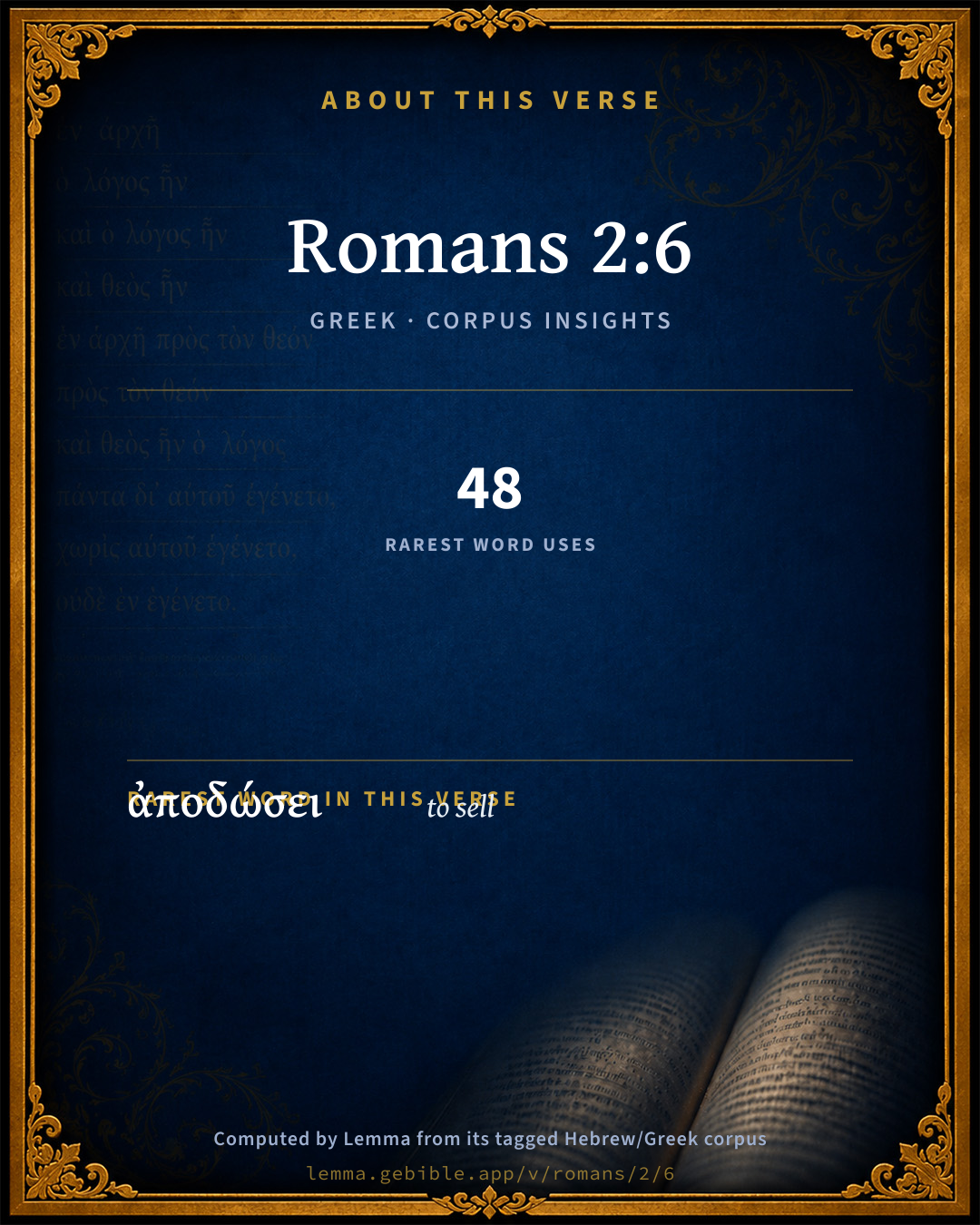
These counts appear in no published source. They are computed here, from the morphology-tagged text and Lemma’s own curated glosses. What Lemma adds →

7
words
7
distinct lemmas
Pauline Epistles
section

Shared distinctive vocabulary

ἀποδώσει to sell G591 occurs in 46 verses of the Greek New Testament. Also found in:
Cross-references

18

Topical passages linked to Romans 2:6 in the Treasury of Scripture Knowledge — connected by theme and wording, ordered by reader-vote popularity; previews shown in the World English Bible.

  • Psalms 62:12 Also to you, Lord, belongs loving kindness, For you reward every man according to his work.
  • Jeremiah 32:19 great in counsel, and mighty in work; whose eyes are open on all the ways of the sons of men, to give everyone according to his ways, and according to the fruit of his doings:
  • Matthew 16:27 For the Son of Man will come in the glory of his Father with his angels, and then he will render to everyone according to his deeds.
  • 2 Corinthians 5:10 For we must all be revealed before the judgment seat of Christ; that each one may receive the things in the body, according to what he has done, whether good or bad.
  • Jeremiah 17:10 I, Yahweh, search the mind, I try the heart, even to give every man according to his ways, according to the fruit of his doings.
  • Revelation 20:12 I saw the dead, the great and the small, standing before the throne, and they opened books. Another book was opened, which is the book of life. The dead were judged out of the things which were written in the books, according to their works.
  • Revelation 22:12 "Behold, I come quickly. My reward is with me, to repay to each man according to his work.
  • Job 34:11 For the work of a man will he render to him, And cause every man to find according to his ways.
  • Isaiah 3:10–11 Tell the righteous "Good!" For they shall eat the fruit of their deeds.
  • 1 Corinthians 3:8 Now he who plants and he who waters are the same, but each will receive his own reward according to his own labor.
  • Ezekiel 18:30 Therefore I will judge you, house of Israel, everyone according to his ways, says the Lord Yahweh. Return you, and turn yourselves from all your transgressions; so iniquity shall not be your ruin.
  • Galatians 6:7–8 Don't be deceived. God is not mocked, for whatever a man sows, that will he also reap.
  • Revelation 2:23 I will kill her children with Death, and all the assemblies will know that I am he who searches the minds and hearts. I will give to each one of you according to your deeds.
  • Matthew 25:34–46 Then the King will tell those on his right hand, 'Come, blessed of my Father, inherit the Kingdom prepared for you from the foundation of the world;
  • 1 Corinthians 4:5 Therefore judge nothing before the time, until the Lord comes, who will both bring to light the hidden things of darkness, and reveal the counsels of the hearts. Then each man will get his praise from God.
  • Proverbs 24:12 If you say, "Behold, we didn't know this;" Doesn't he who weighs the hearts consider it? He who keeps your soul, doesn't he know it? Shall he not render to every man according to his work?
  • Romans 14:22 Do you have faith? Have it to yourself before God. Happy is he who doesn't judge himself in that which he approves.
  • Proverbs 24:2 For their hearts plot violence, And their lips talk about mischief.

Cross-references courtesy of OpenBible.info (CC BY 4.0).

Commentary

Notes on Romans 2:6 from classic Christian and Jewish commentators (each source and its license shown beneath its notes). The classic Christian expositions comment on the surrounding passage and are grouped to its opening verse, so a note may address several verses; the Jewish commentaries on the Tanakh (Rashi and others) are per-verse, so they appear only where the commentator wrote on this verse.

Lemma curates 59 commentaries, every one of them public domain or Creative Commons licensed, each selected and text-cleaned for this edition rather than reprinted as found. About our sources →

The Biblical Illustrator

Joseph S. Exell

Rom_2:6

Who will render to every man according to his deeds.

Well-doing rewarded

In some parts of the Bible the inheritance of the saints is set forth as the recompense of good works, while there are others in which it is represented as the free gift of grace, a thing that faith alone can receive. Without faith no one can hope to see heaven; neither can anyone see it without good works, or, which is the same thing, without that newness of heart in which they take their rise. They are not related to heaven, however, in the same manner.

I. Eternal life cannot, in any strict sense, be said to be the reward of any well-doing or merit of our own. For who is there that can look for anything at the hands of God, or even hope to stand in peace before Him, on the simple ground of his own character? Even the best parts of the very holiest of lives in this world cannot bear His rule of retribution. It is only of infinite grace that anyone, even when he has done his utmost, can enter into the joy of the Lord. Eternal life is not wages, it is the gift of God through Jesus Christ.

II. While the work of our Saviour accounts for the gift of eternal life as enjoyed in common by all the saints, it leaves unexplained those diversities by which their life in heaven is characterised. The ground on which the gift of life is given, is the meritorious work done by Christ in our behalf--a righteousness that is made ours by faith, and that comes up to all that the holy law of God can require of us. This righteousness is not only perfect in its nature, but also infinite in measure; so rich in merit that it can extend to any number of souls, and secure for us any degree, however high, in the joys of heaven. Its virtue is no wise dependent on the strength of the faith by which we embrace it, but is entirely inherent in itself, as the work of One in whom the Divine and the human are alike combined in all their fulness. Hence, if there is no other consideration to come into view, the honours and the enjoyments of heaven must be the same to all; there can be no degrees of blessedness; one saint cannot have a higher place in glory than another. But does this agree with what we are taught concerning the heavenly world? We read of diversities of gifts in the early Church, all proceeding from the same Spirit--some more, and some less honourable--some more, and some less profitable: diversities of somewhat the same kind prevail at this day. May we not expect that these distinctions in the Church on earth will give rise to corresponding distinctions in the Church in heaven, and that the various degrees of blessedness among the saints in light will have their root in those varieties of character and services by which Christians are distinguished in the present world?

1. As the believer is accepted in Christ, so all that is good in him, whether in heart or life, is accepted also, and not only accepted but rewarded. An illustration may be used, in the light of which eternal life as a free gift may be seen to be in perfect harmony with the idea of recompense. Take the case of some institution in this world, the inmates of which are received into it not on the ground of anything meritorious in themselves, but simply by virtue of the free gift of some generous benefactor who procures the right of admission for them. Side by side with this, may there not be room in the internal arrangements of such an institution for various measures of benefit and various degrees of enjoyment, arising from diversities of character among those who have found a home in it?

2. Another reason why heaven will be richer in blessing to some than to others is, that many of the works in which they engage on earth are of such a kind that their results will meet them there, and thus prove a source of joy to them. The landscape glowing on the canvas is an object of pleasant interest to everyone, but to none so much as to the artist whose taste, and skill, and patient labour have produced it. When a tract of waste and barren land has been reclaimed and brought under cultivation--when golden harvests and pleasant homes are seen to spread over a whole district where but lately there was nothing to meet the eye but crags and marshes--the contemplation of a scene like this will be a source of peculiar pleasure to the man to whose enterprise the change is due. One who spends his time and his means in civilising some rude and degraded tribe, secures for himself a pleasure of a higher kind. But of a still higher and more lasting nature must the pleasure be that is enjoyed by the man who is instrumental, under God, in reclaiming lost souls, and to whom it is given to behold peace and holiness where there was nothing but disorder and sin. For what is the utmost that a mere earthly civilisation can do for mankind, in comparison with those blessings to which they may be raised through the gospel--blessings imperishable as the soul and lasting as eternity?

3. A further reason why some will stand higher than others in the joy of heaven, is to be found in the larger capacity for spiritual enjoyment to which they have attained in their course on earth. The new man of the heart is capable of increase in knowledge, and power, and love, and holiness, and consequently in the capacity for happiness. This increase depends partly on the use we make of the means of grace, but also on the faithfulness with which we employ the powers we already have, both natural and spiritual, in doing the work that God has given us to do. Exercise is one of the indispensable conditions of the souls growth: there must be a patient continuance in well-doing. And the more we abound in those things by which man is blessed and God glorified, the more do we grow in sympathy with the Divine character, the purer is the joy we are capable of receiving, and the more meet do we become for the employments and the pleasures of a higher world; so that on this principle well-doing has a part in working out its own recompense. (G. Hutchison, D. D.)

Divine justice

is--

I. Essential--proved a priori by--

1. Revelation.

2. Reason.

3. Example.

II. Retributive.

1. To the good, glory, etc. (verse 7).

2. To the wicked, wrath (verse 8).

III. Impartial. To the Jews, etc., for there is no respect of persons with God (verses 9-12). (J. Lyth, D. D.)

The final judgment

I. Its certainty, will render.

II. Its universality, to every man.

III. Its equity, according to their deeds. (J. Lyth, D. D.)

Justification by faith and works

It has been asked how this maxim can be reconciled With the doctrine of justification by faith. There is only one answer to this question, viz., that justification by faith alone applies to the time of entrance into salvation through the free pardon of sin, but not to the time of judgment. When God of free grace receives the sinner at the time of his conversion, He asks nothing of him except faith; but from that moment the believer enters on a wholly new responsibility; God demands from him, as the recipient of grace, the fruits of grace. This is obvious from the parable of the talents. The Lord commits His gifts to His servants freely; but from the moment when that extraordinary grace has been shown, He expects something from their labour. Compare also the parable of the wicked debtor, where the pardoned sinner who refuses to forgive his brother is replaced under the rule of justice, and consequently under the burden of debt. The reason is that faith is not the dismal prerogative of being able to sin with impunity; it is, on the contrary, the means of overcoming sin and acting holily, and if this life fruit is not produced it is dead, and will be declared vain (Mat_3:10; 1Co_6:9-10; Gal_6:7). (Prof. Godet.)

Deeds recompensed

according to--

I. Their quality.

II. Their frequency.

III. Their degree.

IV. Their circumstances.

V. Their effects. (T. Robinson, D. D.)

Deeds are seeds

The crop may extend through many generations. The consequences of our deeds may end only with the world. Mens example, instructions, institutions, written works. Believers good deeds receive a righteous reward of grace (Mat_25:34-35; Heb_6:10); their evil ones though pardoned in Christ are visited with chastisements here. (T. Robinson, D. D.)

The Biblical Illustrator, edited by Joseph S. Exell (c. 1880s–1900s) — public domain. Text from a community e-Sword module.

Tyndale Open Study Notes

Tyndale Open Resources

2:6-11 Paul uses a chiasm (“X” arrangement) to make his point:

A God judges everyone the same (2:6)

B Life is the reward for doing good (2:7)

C Wrath is the penalty for evil (2:8)

C′ Wrath for doing evil (2:9)

B′ Life for doing good (2:10)

A′ God shows no favoritism (2:11)

Tyndale Open Study Notes — © Tyndale Open Resources, licensed CC BY-SA 4.0. Text via the HelloAO Bible API.

Bengel's Gnomon

Johann Albrecht Bengel

Rom 2:6. Ὃς ἀποδώσει ἑκάστῳ κατὰ τὰ ἔργα ἀυτο͂υ). So the LXX. expressly in Pro 24:12, and Ps. 62:13, συ ἀποδώσεις κτλ. This saying, and especially that below, Rom 2:11, is often quoted.—ἀποδώσει, will render) not only will give, but will repay. [See that you make this the rule of your plans.—V. g.]—κατὰ, according to) Paul describes those, who shall obtain either life or death, generally, and according to the condition [or else in a way suited to the apprehension] of those, with whom he is concerned in this place, cutting them off still from all special ground of obtaining or losing salvation. Therefore, this passage is of no advantage to the argument for the merit of good works.

Bengel's Gnomon of the New Testament — English translation (T&T Clark, Edinburgh, 1860) — public domain. Text from a community e-Sword module.

Meyer's Critical & Exegetical Commentary

Heinrich August Wilhelm Meyer

Rom_2:6. Compare Psa_62:12; Pro_24:12; analogies from Greek writers in Spiess, Logos spermat. p. 214.

κατὰ τὰ ἔργα αὐτοῦ] i.e. according as shall be commensurate with the moral quality of his actions. On this, and on the following amplification down to Rom_2:16, it is to be observed:(1) Paul is undoubtedly speaking of the judgment of the world, which God will cause to be held by Christ, Rom_2:16; (2) The subjects who are judged are Jews and Gentiles, Rom_2:9 ff., consequently all men, Rom_2:16. The distinction, as to whether they are Christians or not, is left out of view in this exposition, as the latter is partly intended to introduce the reader to a knowledge of the necessity of justification by faith (down to Rom_3:20); and it is consequently also left out of view that judgment according to works cannot result in bliss for the unbelievers, because there is wanting to them the very thing whose vital action produces the works in accordance with which the Judge awards bliss, namely, faith and the accompanying regeneration. (3) The standard of the decision is moral action and its opposite, Rom_2:6-10; and this standard is really and in fact the only one, to which at the last judgment all, even the Christians themselves, shall be subjected, and by which their fate for eternity shall be determined, Mat_16:27; Mat_25:31 ff.; 2Co_5:10; Gal_6:7 ff.; Eph_6:8; Col_3:24; Rev_2:23; Rev_20:12; Rev_22:12. But (4) the relation of moral action in the case of the Christian to the fides salvifica, as the necessary effect and fruit of which that action must be demanded at the judgment, cannot, for the reason given above under (2), be here introduced into the discussion. (5) On the contrary, the law only (in the case of the Jews the Mosaic, in the case of the Gentiles the natural), must be presented as the medium of the decision, Rom_2:12 ff.; a view which has likewise its full truth (compare what was remarked under (3) above), since the Christian also, because he is to be judged according to his action, must be judged according to law (compare the doctrine of the tertius legis usus), and indeed according to the πλήρωσις τοῦ νόμου introduced by Christ, Mat_5:17. Comp Mat_25:31 ff.; Mat_13:8-10,although he becomes partaker of salvation, not through the merit of works (a point the further development of which formed no part of the Apostles general discussion here), but through faith, of which the works are the practical evidence and measure.[610] Accordingly the phrasis legis (Melancthon) is indeed to be recognised in our passage, but it is to be apprehended in its full truth, which does not stamp as a mere theoretic abstraction (Baur) the contrast, deeply enough experienced by Paul himself, between the righteousness of works and righteousness of faith. It is neither to be looked upon as needing the corrective of the Christian plan of salvation; nor as an inconsistency (Fritzsche); nor yet in such a light, that the doctrine of justification involves a partial abrogation of the moral order of the world (Reiche), which is, on the contrary, confirmed and established by it, Rom_3:31. But our passage yields nothing in favour of the possibility, which God may grant to unbelievers, of turning to Christ after death (Tholuck), or of becoming partakers of the salvation in Christ in virtue of an exercise of divine power (Th. Schott): and the representation employed for that purpose,that the life of faith is the product of a previous life-tendency, and that the ἐργα perfect themselves in faith (Luthardt, Tholuck),is erroneous, because incompatible with the N. T. conception of regeneration as a new creation, as a putting off of the old man, as a having died and risen again, as a being begotten of God through the Spirit, etc. etc. The new life (Rom_6:4) is the direct opposite of the old (Rom_6:19 ff.). The possibility referred to is to be judged of in connection with the descensus Christi ad inferos, but is irrelevant here.

[610] It is rightly observed by Calovius: secundum opera, i.e. secundum testimonium operum, is something different from propter opera, i.e. propter meritum operum. Comp. Apol. Conf. A, art. 3, and Beza in loc.

Meyer — Critical and Exegetical Commentary on the New Testament — English translation by Peter Christie, edited by Frederick Crombie (T&T Clark, 1880) — public domain. Text from a community e-Sword module.

Expositor's Greek Testament

ed. W. Robertson Nicoll

Rom 2:6 . The law enunciated in the Psalm, that God will render to every one according to his works, is valid within the sphere of redemption as well as independent of it. Paul the Christian recognises its validity as unreservedly as Saul the Pharisee would have done. The application of it may lead to very different results in the two cases, but the universal moral conscience, be it in bondage to evil, or emancipated by Christ, accepts it without demur. Paul had no feeling that it contradicted his doctrine of justification by faith, and therefore we are safe to assert that it did not contradict it. It seems a mistake to argue with Weiss that Paul is here speaking of the Urnorm of the Divine righteousness, i.e. , of the way in which the destiny of men would be determined if there were no Gospel . The Gospel does not mean that God denies Himself; He acts in it according to His eternal nature; and though Paul is speaking to men as under the law, the truth which he is insisting upon is one which is equally true whether men are under the law or under grace. It is not a little piece of the leaven of a Jewish or Pharisaic conception of God, not yet purged out, that is found here; but an eternal law of God’s relation to man.

The Expositor's Greek Testament, edited by W. Robertson Nicoll (1897–1910) — public domain. Text from a community e-Sword module.

Hodge's Commentary on Romans, Ephesians & First Corinthians

Charles Hodge

Rom_2:6

Who will render to every man according to his works. This is the fourth important principle which the apostle teaches us regulates the judgment of God. He will judge men neither according to their professions nor their relations, but according to their works. The question at his bar will be, not whether a man is a Jew or a Gentile, whether he belongs to the chosen people or to the heathen world, but whether he has obeyed the law. This principle is amplified and applied in what follows, in Rom_2:7-11. The question has been asked, how the declaration that God will render to every man, whether Jew or Gentile, according to his works to the good, eternal life, to the wicked, indignation and wrath is to be reconciled with the apostles doctrine, that no man is justified by works, that righteousness and life are not by works, but by faith, and through grace. In answering this question, two things are to be born in mind. The first is, that notwithstanding the doctrine of gratuitous justification, and in perfect consistency with it, the apostle still teaches that the retributions of eternity are according to our works. The good only are saved, and the wicked only are condemned. For we must all appeal before the judgment-seat of Christ, that every one may receive the things done in his body, whether good or bad, 2Co_5:10; Eph_6:8. Reproborum, says Calvin, malitiam justa ultione si puniet Dominus, rependet illis quod meriti sunt. Rursum quia sanctificat, quos olim statuit glorificare, in illis quoque bona opera coronabit, sed non pro merito. With this accord the words of Bernard: Bona opera sunt via regni, non causa regnandi. The wicked will be punished on account of their works, and according to their works; the righteous will be rewarded, not on account of, but according to their works. Good works are to them the evidence of their belonging to that class to whom, for Christs sake, eternal life is graciously awarded; and they are, in some sense and to some extent, the measure of that reward. But it is more pertinent to remark, in the second place, that the apostle is not here teaching the method of justification, but is laying down those general principles of justice, according to which, irrespective of the gospel, all men are to be judged. He is expounding the law, not the gospel. And as the law not only says that death is the stages of sin, but also that those who keep its precepts shall live by them, so the apostle says, that God will punish the wicked and reward the righteous. This is perfectly consistent with what he afterwards teaches, that there are none righteous; that there are none who so obey the law as to be entitled to the life which it promises; and that for such the gospel provides a plan of justification without works, a plan for saving those whom the law condemns. He is here combating the false hopes of the Jews, who, though trusting to the law, were, by the principles of the law, exposed to condemnation. This he does to drive them from this false dependence, and to show them that neither Jew nor Gentile can be justified before the bar of that God, who, while he promises eternal life to the obedient, has revealed his purpose to punish the disobedient. All, therefore, that this passage teaches is that, irrespective of the gospel, to those who either never heard of it, or who, having heard, reject it, the principle of judgment will be law.

Charles Hodge — Commentary on Romans (1835), First Corinthians (1857), and Ephesians (1856) — public domain. Text from a community e-Sword module.

Geneva Bible (1599)

Geneva Bible translators

The ground of the former disputation, That both the Jews and Gentiles have together need of righteousness.

Geneva Bible (1599) marginal notes — public domain. Text via Bolls.life.

Adam Clarke's Commentary

Verse 6. Who will render] Who, in the day of judgment, will reward and punish every man according as his life and conversation have been.

Adam Clarke's Commentary on the Bible (1810–1826) — public domain. Text from a community e-Sword/MySword module.

John Calvin's Commentaries

6. Who will render to every one, etc. As he had to do with blind saintlings, who thought that the wickedness of their hearts was well covered, provided it was spread over with some disguises, I know not what, of empty works, he pointed out the true character of the righteousness of works, even that which is of account before God; and he did this, lest they should feel confident that it was enough to pacify him, if they brought words and trifles, or leaves only. But there is not so much difficulty in this verse, as it is commonly thought. For the Lord, by visiting the wickedness of the reprobate with just vengeance, will recompense them with what they have deserved: and as he sanctifies those whom he has previously resolved to glorify, he will also crown their good works, but not on account of any merit: nor can this be proved from this verse; for though it declares what reward good works are to have, it does yet by no means show what they are worth, or what price is due to them. And it is an absurd inference, to deduce merit from reward.

John Calvin's Commentaries (1540-1563) — public domain. Text from the Calvin Translation Society English edition (1840s-50s) via the Christian Classics Ethereal Library (ccel.org). Calvin's coverage is partial (roughly two-thirds of the Bible); uncommented books and verses are honest gaps, never fabricated. The 19th-century editor's footnotes and remarks are omitted so the notes are faithfully Calvin's own voice.

Ellicott's Commentary for English Readers

(6) According to his deeds.—The Apostle here lays down with unmistakable definiteness and precision the doctrine that works, what a man has done, the moral tenor of his life, will be the standard by which he will be judged at the last day. There can be no question that this is the consistent doctrine of Scripture. (Comp. Mat_16:27; Mat_25:31 et seq.; 2Co_5:10; Gal_6:7 et seq.; Eph_6:8; Col_3:24; Rev_2:23; Rev_20:12; Rev_22:12.) How is this to be reconciled with the main theme of the Epistle, the doctrine of justification by faith?

We may observe (1) that the theology of St. Paul has two main sides or elements: (a) that which is common to all the Jewish schools, developed in direct line from the teaching of the Old Testament, and (b) that which is peculiar to himself, or developed from minute and scattered germs in the Old Testament or from the teaching of our Lord. The doctrine of justification by faith belongs to the latter category; that of final recompense in accordance with moral action belongs to the former. Hence we are prepared to find a difference of terminology without any necessary divergence of idea. (2) If we accordingly separate the two doctrines, and look at each in the connection to which it properly belongs, we shall see that they correspond to a difference in the point of view, (a) The two great classes into which mankind will be divided at the judgment will be determined by works, by the tangible outcome of their lives. No opposition is thought of here between the inward and the outward. Of course such an opposition is possible, but it is not present to the mind of the writer. The rule followed is simply that laid down in Mat_7:16, “By their fruits ye shall know them.” The nature of his actions, as the expression of his character, will decide whether a man is to be classed among “the good” or among “the wicked.” But (b) if we isolate the individual, and consider him no longer in relation to other men and to the great classification of mankind, but in his own intimate relations to the Judge and to the judgment, a totally different train of thought is suggested. If the conduct of the believer is to be regarded merely in the light of obedience to law (in other words, as a question of works), then he can neither claim nor expect any reward at all. He has broken more commandments than he has kept, and to break the Law, though only on a single point, is to lay himself open to its penalties. In any case, the extent of the reward promised to him far exceeds in proportion the extent of his obedience. It cannot therefore be by works, but must be due to a divine act, and that act is conditioned by faith. In consideration, not of any fulfilment of the Law, but that the main tenor and direction of a man’s life has been right as proved by his faith in Christ, the grace of God is extended towards him, and makes up that in which he is behind. Though not deserving, in a strict sense, the bliss of the Messianic kingdom, the believer is, nevertheless, admitted to it on account of his faith in the great Head of that kingdom, and his participation through that faith in the Christian scheme. That scheme has been wrought out objectively, i.e., independently of him, but he by a subjective act, in other words, by faith, appropriates it to himself. (3) Bearing in mind this difference in the sequence of the thought, the apparent contradiction between the two doctrines is resolved. In the doctrine of final retribution there is no opposition between faith and works, in the doctrine of justification there is no opposition between works and faith. In the former, works may be regarded as the evidence of faith; in the latter, they may be regarded as its natural and necessary outcome. They may, it is true, be set in opposition, as we shall find them later on by St. Paul himself, but that is by a special abstraction of the mind. Works are there regarded as disconnected from faith, though in the nature of things they are rather associated with it. Works may be sincere or they may be hypocritical. They may have an inward foundation in the heart, or they may not. And the Apostle looks at them in both lights, according as the course of his argument requires it. That there is no radical opposition is clearly seen if we refer to the description of the last judgment in the Synoptic Gospels. There can be no question that in those Gospels the doctrine prominently put forward is that of retribution according to works, and yet it is most distinctly laid down that the works so insisted upon are not merely the outward tangible act apart from the inward disposition; on the contrary, when such works are pleaded they are expressly disowned (Mat_7:23-24; comp. Mat_25:44); and. on the other hand, we are left to infer that the righteous will have little ostensibly to allege in their own favour (Mat_25:36-39). We are thus led up by easy stages to the Pauline doctrine of justification by faith, even out of the midst of that doctrine of retribution which forms the subject of the section on which we are now commenting.

A Bible Commentary for English Readers, edited by Charles John Ellicott (1878–1897) — public domain. Text from a community e-Sword module.

The Cambridge Bible for Schools and Colleges

gen. ed. J. J. S. Perowne

6. who will render to every man, &c.] According to the promise, Mat_16:27; Rev_22:12. (Note that the very phrase used here of the Father, is used there of Himself by the Son).

The Cambridge Bible for Schools and Colleges (gen. ed. J. J. S. Perowne; Cambridge University Press, 1878–1918) — public domain. Text from a community e-Sword module.

John Gill's Exposition

Who will render to every man according to his deeds. God will be the Judge, who is righteous, holy, just, and true; every man in particular will be judged; as the judgment will be general to all, it will be special to everyone, and will proceed according to their works; for God will render to wicked men according to the demerit of their sins, the just recompense of reward, eternal damnation; and to good men eternal life, not according to the merit of their good works, which have none in them, but according to the nature of them; such who believe in Christ, and perform good works from a principle of grace, shall receive the reward of the inheritance, which is a reward of grace, and not of debt. In other words, God will render to evil men according to the true desert of their evil deeds; and of his own free grace will render to good men, whom he has made so by his grace, what is suitable and agreeable to those good works, which, by the assistance of his grace, they have been enabled to perform.

Who will render to every man according to his deeds. God will be the Judge, who is righteous, holy, just, and true; every man in particular will be judged; as the judgment will be general to all, it will be special to everyone, and will proceed according to their works; for God will render to wicked men according to the demerit of their sins, the just recompense of reward, eternal damnation; and to good men eternal life, not according to the merit of their good works, which have none in them, but according to the nature of them; such who believe in Christ, and perform good works from a principle of grace, shall receive the reward of the inheritance, which is a reward of grace, and not of debt. In other words, God will render to evil men according to the true desert of their evil deeds; and of his own free grace will render to good men, whom he has made so by his grace, what is suitable and agreeable to those good works, which, by the assistance of his grace, they have been enabled to perform.

Romans 2:7

rom 2:7

rom 2:7

rom 2:7To them who by patient continuance in well doing,.... These words are descriptive of one sort of persons, to whom God will render according to their works; and must be understood not of the Gentiles, the best and most moralized among them; for they sought after worldly things, after human wisdom, and popular applause, and not after God, his honour and glory, nor after immortality, which is only brought to light by the Gospel; nor of the pharisaical Jews, who sought for righteousness by the works of the law, and honour and glory from men, and not from God; nor of any unregenerate persons, but only of such who have the true principles of grace implanted in them, whether Jews or Gentiles: now the things which these men seek after are

glory; not the glory of this world, nor any from the men of it; but the glory of God and Christ; to be glorious within and without, by the grace and righteousness of Christ here, and to enjoy eternal glory with him hereafter.

Honour; not that which Adam had in innocence, and did not abide in; but that which is, and abides with Christ, and which all the saints have, and shall have.

Immortality; not the immortality of the soul, which is common to all; but the incorruption of the body, or the glorious resurrection of it to everlasting life at the great day, or the incorruptible crown, and never fading inheritance of the saints in light. The manner in which these things are sought is, "by patient continuance in well doing"; by doing good works, and by doing these good works well, from a principle of faith and love, and with a view to the glory of God; and by patiently enduring reproaches and sufferings for well doing, and by persevering therein: not that these things are to be had, or are expected by the saints to be had for the sake of patience and well doing; yet they may be sought for, and looked unto, as an encouragement to well doing, and continuance therein; and though not "for", yet "in" well doing there is a reward. These words do not express that for the sake of which glory is had; but only describe the persons who seek, and the manner in which they seek for it, to whom God will render

eternal life, which he of his rich grace promised them before the world was, and of his free favour has put into the hands of Christ for them, and which, as a pure gift of grace, he bestows on them through him.

John Gill's Exposition of the Whole Bible (1746–1763) — public domain (CC PDM 1.0). Text via the HelloAO Bible API.

Trapp's Complete Commentary

John Trapp

6 Who will render to every man according to his deeds:

Ver. 6. Who shall render] The Papists hence infer merit of works. But it is well observed that the Church in the Canticles is nowhere described by the beauty of her hands, or fingers. Christ concealeth the mention of her hands, that is, of her works (Cotton on Canticles): 1. Because he had rather his Church should abound in good works in silence than boast of them (especially when they are wanting), as Rome doth. 2. Because it is he above that worketh all our works for us, Isa 26:12; Hos 14:4; Joh 15:5. Certum est nos facere quod facimus; sed ille facit, ut faciamus. (Augustine.) We do what we do; but it is he that causeth us so to do. {See Trapp on "Mat 16:27"}

John Trapp, A Commentary or Exposition upon All the Books of the Old and New Testament (1647–1656) — public domain. Text from a community e-Sword module.

Albert Barnes' Notes on the Bible

Who will render - That is, who will make retribution as a righteous Judge; or who will give to every man as he deserves.

To every man - To each one. This is a general principle, and it is clear that in this respect God would deal with the Jew as he does with the Gentile. This general principle the apostle is establishing, that he may bring it to bear on the Jew, and to show that he cannot escape simply because he is a Jew.

According to his deeds - That is, as he deserves; or God will be just, and will treat every man as he ought to be treated, or according to his character. The word “deeds” (ἔργα erga)is sometimes applied to the external conduct. But it is plain that this is not its meaning here. It denotes everything connected with conduct, including the acts of the mind, the motives, the principles, as well as the mere external act. Our word character more aptly expresses it than any single word. It is not true that God will treat people according to their external conduct: but the whole language of the Bible implies that he will judge people according to the whole of their conduct, including their thoughts, and principles, and motives; that is, as they deserve. The doctrine of this place is abundantly taught elsewhere in the Bible, Pro 24:12; Mat 16:27; Rev 20:12; Jer 32:19. It is to be observed here that the apostle does not say that people will be rewarded for their deeds, (compare Luk 17:10,) but according to κατά kata their deeds. Christians will be saved on account of the merits of the Lord Jesus Christ, Tit 3:5, but still the rewards of heaven will be according to their works; that is, they who have labored most, and been most faithful, shall receive the highest reward, or their fidelity in their Master’s service shall be the measure or rule according to which the rewards of heaven shall be distributed, Mat. 25:14-29. Thus, the ground or reason why they are saved shall be the merits of the Lord Jesus. The measure of their happiness shall be according to their character and deeds. On what principle God will distribute his rewards the apostle proceeds immediately to state.

Albert Barnes' Notes on the Bible (1834–1885) — public domain. Text from a community e-Sword/MySword module.

Matthew Poole's English Annotations

This proves what he had said, that the judgment of God, in that day, will be according to righteousness, or most righteous judgment. Parallel places you will find, Psa 62:12; Mat 16:27; 2Co 5:10; Rev 22:12. The papists from hence infer the merit of works; but the reward to the godly is a reward of grace, and not of debt. The word αποδουναι imports not only a just retribution, but a free gift, as in Mat 20:8, and elsewhere. Good works are the rule of his proceeding, not the cause of his retribution: see Luk 17:10.

Matthew Poole's English Annotations on the Holy Bible (1683–1685) — public domain. Text from a community e-Sword/MySword module.

Whedon's Commentary on the Bible

Daniel D. Whedon

6. Every man—Of the human race at the one day of judgment.

According to his deeds—Rightly considered all true faith is a graciously acceptable work, and all true works are acceptable acts of faith. Works not of faith are dead works and sin, and no works truly at all. In form faith and works are permanently distinct; in essence they are one. Hence the two doctrines that salvation is of faith alone, and yet that we are rewarded according to our works, are not two doctrines only but also one. Those works by which man can never be justified are faithless doings and no true works at all.

But how can faith be attributed to the heathen included by Paul in the present passage? We reply that no one can understand Paul’s idea of faith who has not well studied the eleventh chapter of his Epistle to the Hebrews. Of the illustrious ancient heroes of the faith there commemorated, perhaps not one fully understood Christ as the atoning object of saving faith. Yet they had a true faith in that of which Christ is the reality and impersonation. Faith, in its essential temper, is that elevation of soul by which it aspires to the good, the true, and the divine; and the soul who possesses it tends upward to glory, honour, and immortality, while the soul that possesses it not tends downwardly to animalism, scepticism, and eternal death. To that aspiring faith God is a sought necessity, and Christ, when rightly presented is the one supremely lovely; so lovely, indeed, that even when the aspiring but dimly seeing soul catches but a glimpse of Him it feels a divine attraction. (See our work on “The Will,” pp. 349-351.) And so at the present time of scepticism and rebuke, Christ, even to the sceptical, is a strangely fascinating problem, which they cannot banish from their thoughts. (See note Rom_4:24.)

Daniel D. Whedon (gen. ed.), Commentary on the Old and New Testaments (1874–1909) — public domain. Text from a community e-Sword module.

The Pulpit Commentary

Who will render to every man according to his works. This assertion is no contradiction of the main portion of the Epistle as it proceeds, as to justification being not of works; the phrase here being, not on account of his works, but according to them. "Nequaquam tamen quid valeant, sed quid illis debeatur pretii pronunciat" (Calvin). The ground of justification is not here involved. All that is asserted is what is essential to any true conception of God"s justice, viz. that he has regard to what men are in assigning reward or punishment; it is what is given in Heb_11:6 as a first principle of faith about God, "that he is a Rewarder of them that diligently seek him." It is further evident from ekastw , and still more from all that follows, that all such will be so rewarded, whether before Christ or after his coming, whether knowing him or not knowing him. Nor is the inclusion of the latter inconsistent with the doctrine that salvation is through Christ alone. For the effect of his atonement is represented as retrospective as well as prospective, and as availing virtually for all mankind. (cf. Rom_3:25 Rom_5:15, Rom_5:18, Rom_5:20) Hence the narrow doctrine of some divines, who would confine the possibility of salvation to those who have had in some way during life a conscious faith in the atonement, is evidently not the doctrine of St. Paul.

Vers. 6-11. A righteous Judge.

That the anticipation of a judgment rises naturally in the mind is shown by the present testimony of conscience a law recognized as in, yet above us, and by the utterances of heathen writers on morals. The Scriptures corroborate and clarify this conception. The apostle asserts of the future what Abraham felt of the present Providence, "Shall not the Judge of all the earth do right? Will he slay the righteous with the wicked?" Note some particulars confirming the righteousness of God"s judgment.

I THE RECOMPENSE WILL BE PROPORTIONED TO MEN"S DEEDS. Not their professions, but their acts, will determine their destiny. And the character and number of their acts will be reckoned. There is no conflict between this statement and other Scripture passages which speak of the reward as one of grace, not of merit, and as a gift bestowed on all Christians. For the reward will be immensely greater than men"s deeds deserve, and will not be earned by them, but conditioned by their conduct. The gospel comes not as a substitute for, but as a help to realizing, practical righteousness; and whilst every justified believer will be saved, each will have the praise that is his, according to his works of faith and labours of love.

II THE JUDGMENT WILL TAKE ACCOUNT OF MEN"S AIMS IN LIFE, The one class seek "glory, honour, and incorruption," and also "peace." Their choice does them credit; they selected what is fair and lovely and permanent, what is opposed to the rule of the flesh, and is unaffected by the ravages of time. Their goal is not the "vain pomp and glory of the world;" not simply success, but to reach a position of pure, lasting excellence. And they shall receive in fullest measure what they desire. "Eternal life" comprehends all blessedness deliverance from the thraldom of sin; no need to gather up the skirts lest defilement ensue, for the very streets of their city shall be of pure gold; enwrapment with the Divine splendour; walking in the light of God; manifested as his sons by the likeness they wear; elevated to princely employments and regal dignities. The objects for which the other class strive are not definitely stated, but may be gathered from antithesis and from the unrighteousness to which they yield themselves. They seek not "peace" and "truth," and their harvest likewise is the multiplied outcome of the seeds they have sown. No description of hell can transcend the awful picture of" wrath and indignation, tribulation and anguish," resting upon the soul; that, clasping unrighteousness to its bosom as a prize on earth, finds it sting like a serpent and burn with fiercest remorse when allowed full sway in its "own place.

III THE AWARD WILL BEAR RELATION TO THE METHODS BY WHICH THE OBJECTS OF EARTHLY ENDEAVOUR HAVE BEEN PURSUED. A righteous aim can be permanently attained only in righteous ways. The recognition of this stamps the government of the universe as moral. The "patient continuance" of the one class could only be practised by the well-doing. It includes passive endurance and active perseverance; the stationary posture of the caryatides, and the carrying of a burden in the face of wind and storm. The other class are described as "factious," quarrelling with their lot, coveting pleasure and notoriety, "working evil." Refusing to bow to the yoke of truth, they become the slaves of unrighteousness; and a hard master and terrible paymaster does unrighteousness prove. The judgment of God will proceed on easily intelligible principles. It is not difficult for men to decide whether they are working good or working evil. It is not reaching a conclusion after abstract speculation, nor holding a creed with multitudinous details. Only an omniscient Judge, however, could bring to light the hidden deeds of darkness, the secret thing, good or bad.

IV THE JUDGE WILL OBSERVE RIGOROUS IMPARTIALITY. With him "is no respect of persons." Jew and Greek shall be tried with due regard to the presence or absence of religious light. (cf. Act_10:35 in the history of Cornelius) It is impossible to bribe the almighty Arbiter or to overawe his tribunal. The anticipation of a Divine judgment has been a comfort to the oppressed, remembering that "One higher than the high regardeth;" and it will be a terror to the worker of iniquity, and an incentive to all noble deeds. "Knowing the terror of the Lord, we persuade men." None can complain that their condition makes it impossible to be patient in well-doing. Christ, our Pattern and our Power, offers his "very present help" to all who find the stress and strain of life too severe for mortal strength. S.R.A.

The Pulpit Commentary (1880–1919), ed. H.D.M. Spence-Jones & Joseph S. Exell — public domain. Text from a community e-Sword module.

John Wesley's Explanatory Notes

Prov. xxiv, 12

John Wesley, Explanatory Notes Upon the Whole Bible (1754–1765) — public domain. Text via the GEBible commentary corpus.

Burkitt's Expository Notes on the New Testament

William Burkitt

The apostle in the foregoing verse had given a description of the general day of judgment, which he called, A revelation of the righteous judgment of God. Here he acquaints us with the impartiality and uprightness of God in the distribution of rewards and punishments in that day, according to the merits and deserts of men: Who will render to every one according to his deeds; that is, according to the kind and quality, and according to the measures and degrees of every man’s works.

Where note, He doth not say, God will render to every man a reward for his works, but according to his works? Works are regula retributionis, non causa meredis: "Our works are the rule of God’s proceedings, but not the cause of his rewards." Having thus described the impartiality of the Judge, he next declares the universality of the persons that shall then be judged; namely, the righteous and the wicked: which shall both have their distinct rewards assigned them, according to the quality of their works.

Observe, 1. The righteous persons described, and their reward declared; they are described by their well-doing, by their continuance in well-doing, by their patient continuance in well-doing; they are not weary in well-doing, they can undergo sufferings for the sake of well-doing, and they can patiently wait for the reward of well-doing till hereafter whilst others snatch at their reward here: Yet in the meantime they are seeking after, and securing of this their reward: They seek for glory, honour, and immortality; that is, they seek for a portion of glory and immortality in the world to come; they leave the world to the men of the world, and whilst they are scrambling for earth, they are making sure of heaven.

Next, Their persons being described, their reward is declared, eternal life; an eternity of glory and happiness in a future state, shall certainly be the reward of well-doers, and of patient continuers in well-doing.

Observe, 2. The wicked are here characterized, and their reward assigned: They are contentious, and obey not the truth, but obey unrighteousness; that is, they contend with God, and resist the light of his revealed truth; they refuse the offers of his grace, and kick against his word, disobeying offers of his grace, and kick against his word, disobeying the gospel of truth, but obeying unrighteousness. God will pour forth upon such, indignation and wrath, tribulation and anguish.

Lord, who knoweth the power of thine anger, or who can bear the weight of thy wrath! It broke the back of angels, how shall sinners stand under it? It is styled fire in scripture, it is a consuming fire, and an unquenchable fire: It preys upon the sinner, but never devours him: It is unquenchable by anything but the blood of Christ. A mysterious fire, whose strange property is always to torment, but never to kill; or always to kill, but never to consume.

Observe, 3. With what equity, as well as impartiality, this distribution of God’s indignation and wrath will be made: Upon every soul that doeth evil; but upon the Jew first, and then of the Gentile. The Jew first, that is principally and especially; because the light and mercy which the Jews abused and sinned against, was far greater than that bestowed upon the Gentiles.

Learn hence, That the light under which men sin, puts extraordinary aggravations upon their sins, answerable whereunto will be the degrees of their punishment. The Gentiles will be condemned for disobeying the light of nature, the law of God written on their hearts; but much greater wrath is reserved for the Jews, unto whom were committed the oracles of God: But the greatest of all is reserved for Christians, who obey not the gospel of our Lord Jesus Christ; these shall be punished with everlasting destruction from the presence of the Lord, and from the glory of his power, when he shall come to be glorified in his saints, and to admired in all them that believe, 2Th 1:9-10.

William Burkitt's Expository Notes on the New Testament (1700–1703) — public domain. Text from a community e-Sword module.

McGarvey & Pendleton's Commentaries

J. W. McGarvey

who will render to every man according to his works [The apostle here touches upon a second error which is still common among men. It is, as Cook says, that "vague and undefined hope of impunity which they do not acknowledge even to themselves." God's present economy, which sends rain upon the just and the unjust, and which postpones the day of punishment to allow opportunity for repentance, leads untold numbers to the false conclusion that God is slack as to his judgment, and that he will ever be so. They mistake for indifference or weakness that longsuffering grace of his which exercises patience, hoping that he may thereby lead men to repentance ( 2Pe_3:9 ). Those who, by hardness of heart, steel themselves against repentance, thereby accumulate punishments which will be inflicted upon them in the day when God reveals that righteous judgment which has been so long withheld or suspended, for God is righteous, and he will render to every man in that day according to his works, after the following described manner]:

J. W. McGarvey (with Philip Y. Pendleton), Commentaries on the New Testament (The Fourfold Gospel, 1914; Acts; and the epistles) — public domain. Text from a community e-Sword/MySword module.

The People's New Testament

B. W. Johnson

6. Who will render. Sinners escape punishment for a time, and hence think they will escape altogether, but God will render, at the final day of judgment, to every man according to his works, whether he be sinner or saint, Jew or Gentile.

B. W. Johnson's The People's New Testament with Notes (1889–1891) — public domain. Electronic text from the Christian Classics Ethereal Library (CCEL) ThML edition.

Cambridge Greek Testament for Schools and Colleges

6. ὃς ἀποδώσει. Cf. Psa 42:3; Pro 24:12.

τὰ ἔργα. The judgment will correspond to the man’s real character as shown by the works he produces, not as merits that earn but as evidence of character: the works are then described in Rom 2:8 f. as the main effort and tendency of a man’s life, the temper which governs him, and the aims he affects.

Cambridge Greek Testament for Schools and Colleges (Cambridge University Press, 1896; 21 vols, various authors incl. Carr, Maclear, Plummer, Farrar, Lumby, Moule, M. R. James, Simcox) — public domain. Text from a community e-Sword module.

International Critical Commentary

6. ὃς ἀποδώσει: Pro 24:12 (LXX). The principle here laid down, though in full accord with the teaching of the N. T. generally (Mat 16:27; 2Co 5:10; Gal 6:7; Eph 6:8; Col 3:24, Col 3:25; Rev 2:23; Rev 20:12; Rev 22:12), may seem at first sight to conflict with St. Paul’s doctrine of Justification by Faith. But Justification is a past act, resulting in a present state: it belongs properly to the beginning, not to the end, of the Christian’s career (see on δικαιωθήσονται in ver. 13). Observe too that there is no real antithesis between Faith and Works in themselves. Works are the evidence of Faith, and Faith has its necessary outcome in Works. The true antithesis is between earning salvation and receiving it as a gift of God’s bounty. St. Paul himself would have allowed that there might have been a question of earning salvation if the Law were really kept (Rom 10:5; Gal 3:12). But as a matter of fact the Law was not kept, the works were not done.

International Critical Commentary — older volumes (1896–1929), various authors — public domain. Text from a community e-Sword module.

Godet's Commentaries

Frédéric Louis Godet

Vv. 6. “Who will render to every one according to his deeds.”

No account will be taken of any external circumstance, but solely of the aim which has governed the man’s moral action. It has been asked how this maxim can be reconciled with the doctrine of justification by faith. Fritzsche finds in them two different theories presenting an insoluble contradiction. Others think that in the judgment the moral imperfections of believers will be covered by their faith; which would convert faith into a means of sinning with impunity. What a just judgment that would be! Melanchthon, Tholuck, and others hold that this standard is purely hypothetical; it would be the standard which God would have applied if redemption had not intervened. But the future, “will render,” is not a conditional (would render). Besides, judgment according to the deeds done, is attested by many other passages, both from Paul (Rom 14:12; 2Co 5:10; Gal 6:6), from Jesus Himself (Joh 5:28-29; Mat 12:36-37, etc.), and from other writings of the New Testament (Rev 20:13). Ritschl thinks that throughout this passage it is a Pharisee whom Paul introduces as speaking, and who starts from a narrow idea of divine justice—the idea, viz., of retributive justice. But what trace is there in the text of such an accommodation on the apostle’s part to a standpoint foreign to his own? The logical tissue of the piece, and its relation to what precedes and follows, present no breach of continuity. There is only one answer to the question raised, unless we admit a flagrant contradiction in the apostle’s teaching: that justification by faith alone applies to the time of entrance into salvation through the free pardon of sin, but not to the time of judgment. When God of free grace receives the sinner at the time of his conversion, He asks nothing of him except faith; but from that moment the believer enters on a wholly new responsibility; God demands from him, as the recipient of grace, the fruits of grace. This is obvious from the parable of the talents. The Lord commits His gifts to His servants freely; but from the moment when that extraordinary grace has been shown, He expects something from their labor. Comp. also the parable of the wicked debtor, where the pardoned sinner who refuses to pardon his brother is himself replaced under the rule of justice, and consequently under the burden of his debt. The reason is that faith is not the dismal prerogative of being able to sin with impunity; it is, on the contrary, the means of overcoming sin and acting holily; and if this life-fruit is not produced, it is dead, and will be declared vain. “Every barren tree will be hewn down and cast into the fire” (Mat 3:10). Comp. the terrible warnings, 1Co 6:9-10, Gal 6:7, which are addressed to believers.

The two following verses develop the idea of the verb ἀποδώσει, will render.

Frédéric Louis Godet — Commentaries on Luke, John, Romans, and 1 Corinthians — English translation (T&T Clark, Edinburgh, 1870s–1890s) — public domain. Text from a community e-Sword module.

Lesson kit

Teaching starters — assembled from the data on this page, not authored interpretation. Every prompt links to the verse data it draws on. Edit before teaching.

Romans, in the Pauline Epistles, opens this verse with 7 words (7 distinct Greek lemmas). Its most distinctive word is apodídōmi (“to sell”). A historical commentator’s framing appears above. Read the whole chapter for the surrounding context.

Discussion questions

  1. What does “to sell” (apodídōmi) contribute to the verse as a whole?
  2. Matthew 5:26 shares the word «to sell» with this verse. How do the two illuminate each other?
  3. These translations render this verse differently; the difference is in the English rendering, not the original. What questions does that raise?
  4. Reading how The Biblical Illustrator and Tyndale Open Study Notes read this verse, where do the two commentators agree and where do they part?

Things to notice

Reading settings

Reading text

Shown beneath each verse's original-language words.

Old Testament
Old Testament edition

Read the OT as the Masoretic Hebrew (MT) or the Greek Septuagint (LXX).

English shown for the Greek Septuagint (in the Hebrew ↔ Greek comparison).

Comparing translations? Open the Compare panel on any verse page to stack up to four side by side.