Titus 3:14

Greek (Tischendorf 8th ed.) Titus 3:14 appears in the Greek New Testament. The text above is from the Tischendorf 8th edition. Each word links to its Strong’s number and a concise gloss. Click any word for its full Thayer’s Greek Lexicon entry.

Download image
Cite this verse

Titus 3:14 (World English Bible). Public Domain. Lemma interlinear Bible study tool, https://lemma.gebible.app/v/titus/3/14.

Show BibTeX & RIS
BibTeX
RIS
English Translation
Let our people also learn to maintain good works for necessary uses, that they may not be unfruitful.
World English Bible · Public Domain
Download a study sheet

One document with this verse’s original text, its word-by-word gloss line, the meaning frame, cross-references with their text, attributed commentary, and full source and license credits — printable, and it pastes into notes with its structure intact.

This verse Autodidact and up

Study sheet (.html) Plain text (.txt)

A passage Seminary Student

Up to 50 verses in one chapter. A passage sheet keeps up to 6 commentary sources and 12 cross-references per verse, in the order this page ranks them, and says so on the sheet whenever that leaves anything out. Ask for a single verse and you get the Autodidact verse sheet above.

Everything on this page stays free to read, with no account — the sheet is a download of what is already on screen, not access to it.

Want to remove ads? Support Godless Engineer
Compare translations 3

The same verse in 3 English versions, stacked beneath the original-language interlinear above. Click any original word for its lexicon entry.

Each is an independent rendering of the whole verse — the interlinear is not word-aligned to these translations.

Highlighted words mark where these versions differ — a whole-verse word diff, not a word-by-word alignment.

  • World English Bible Public Domain
    Let our people also learn to maintain good works for necessary uses, that they may not be unfruitful.
  • King James Version Public Domain
    And let our's also learn to maintain good works for necessary uses, that they be not unfruitful.
  • unfoldingWord Literal Text CC BY-SA 4.0
    And also, our own must learn to engage themselves in good works toward essential needs, in order not to be unfruitful.

unfoldingWord Literal Text — © unfoldingWord, licensed CC BY-SA 4.0. Word-aligned USFM3 via Door43 (git.door43.org/unfoldingWord/en_ult).

Versions to compare (up to 4)

3 of 4 selected

Show all 19 translations

Every available English version of this verse, each an independent rendering of the whole verse.

  • World English Bible Public Domain
    Let our people also learn to maintain good works for necessary uses, that they may not be unfruitful.
  • Berean Standard Bible Public Domain
    And our people must also learn to devote themselves to good works in order to meet the pressing needs of others, so that they will not be unfruitful.
  • Majority Standard Bible Public Domain
    And our people must also learn to devote themselves to good works in order to meet the pressing needs of others, so that they will not be unfruitful.
  • King James Version Public Domain
    And let our's also learn to maintain good works for necessary uses, that they be not unfruitful.
  • American Standard Version (1901) Public Domain
    And let our `people' also learn to maintain good works for necessary uses, that they be not unfruitful.
  • Revised Version (1885) Public Domain
    And let our people also learn to maintain good works for necessary uses, that they be not unfruitful.
  • Geneva Bible (1599) Public Domain
    And let ours also learne to shewe foorth good woorkes for necessary vses, that they be not vnfruitfull.
  • Douay-Rheims (1899) Public Domain
    And let our men also learn to excel in good works for necessary uses: that they be not unfruitful.
  • Young's Literal Translation Public Domain
    and let them learn -- ours also -- to be leading in good works to the necessary uses, that they may not be unfruitful.
  • Literal Standard Version CC BY-SA 4.0
    and let them learn—ours also—to be leading in good works to the necessary uses, that they may not be unfruitful.
  • Unlocked Literal Bible CC BY-SA 4.0
    Our people must learn to engage themselves in good works that provide for urgent needs, and so not be unfruitful.
  • unfoldingWord Literal Text CC BY-SA 4.0
    And also, our own must learn to engage themselves in good works toward essential needs, in order not to be unfruitful.
  • Darby Bible Public Domain
    and let ours also learn to apply themselves to good works for necessary wants, that they may not be unfruitful.
  • World Messianic Bible Public Domain
    Let our people also learn to maintain good works to meet necessary needs, that they may not be unfruitful.
  • Webster's Bible Public Domain
    And let ours also learn to maintain good works for necessary uses, that they may not be unfruitful.
  • Free Bible Version CC BY-SA 4.0
    May our people learn the habit of doing good in providing for the daily needs of others. They need to be productive!
  • Bible in Basic English Public Domain
    And let our people go on with good works for necessary purposes, so that they may not be without fruit.
  • Text-Critical English NT CC BY 4.0
    Our people must learn to devote themselves to good works in order to meet pressing needs, so that they will not be unfruitful.
  • Tyndale New Testament (1534) Public Domain
    And let oures olso learne to excell in good workes as farforth as nede requyreth that they be not vnfrutefull.

Literal Standard Version (2020), Covenant Press — licensed CC BY-SA 4.0. Text via the HelloAO Bible API (eBible.org). Unlocked Literal Bible (unfoldingWord) — licensed CC BY-SA 4.0. Text via the HelloAO Bible API (eBible.org). unfoldingWord Literal Text — © unfoldingWord, licensed CC BY-SA 4.0. Word-aligned USFM3 via Door43 (git.door43.org/unfoldingWord/en_ult). Free Bible Version, Dr. Jonathan Gallagher — licensed CC BY-SA 4.0. Text via the HelloAO Bible API (eBible.org).

Word by word

More ways to search: Search by grammar → Find every occurrence → Compare this word →

Practice this passage: Drill this verse → Learn its vocabulary →

ἡμέτεροι
hēméteros
G2251
“our”
Possessive pronoun, 1st person, Nominative, Plural, Masculine
Part of Speech
Possessive pronoun
Person
1st person
Case
Nominative
Number
Plural
Gender
Masculine
Full Thayer's Definition

Origin: from G2349

TDNT: None

1. our, your
  1. μανθανέτωσαν manthánō G3129 “to learn” Verb, Present, Active, Imperative, 3rd person, Plural
  2. δὲ dé G1161 “but” Conjunction
  3. καὶ kaí G2532 “and” Conjunction
  4. οἱ ho G3588 “the” Article, Nominative, Plural, Masculine
  5. καλῶν kalós G2570 “good” Adjective, Genitive, Plural, Neuter
  6. ἔργων érgon G2041 “work” Noun, Genitive, Plural, Neuter
  7. προΐστασθαι proḯstēmi G4291 “to set before” Verb, Present, Middle, Infinitive
  8. εἰς eis G1519 “into” Preposition
  9. τὰς ho G3588 “the” Article, Accusative, Plural, Feminine
  10. ἀναγκαίας anankaîos G316 “necessary” Adjective, Accusative, Plural, Feminine
  11. χρείας chreía G5532 “necessity” Noun, Accusative, Plural, Feminine
  12. ἵνα hína G2443 “that” Conjunction
  13. μὴ mḗ G3361 “not” Particle, Negative
  14. ὦσιν eimí G1510 “to be” Verb, Present, Active, Subjunctive, 3rd person, Plural
  15. ἄκαρποι ákarpos G175 “unfruitful” Adjective, Nominative, Plural, Masculine

About this verse

These counts appear in no published source. They are computed here, from the morphology-tagged text and Lemma’s own curated glosses. What Lemma adds →

16
words
15
distinct lemmas
Pauline Epistles
section

Notable vocabulary

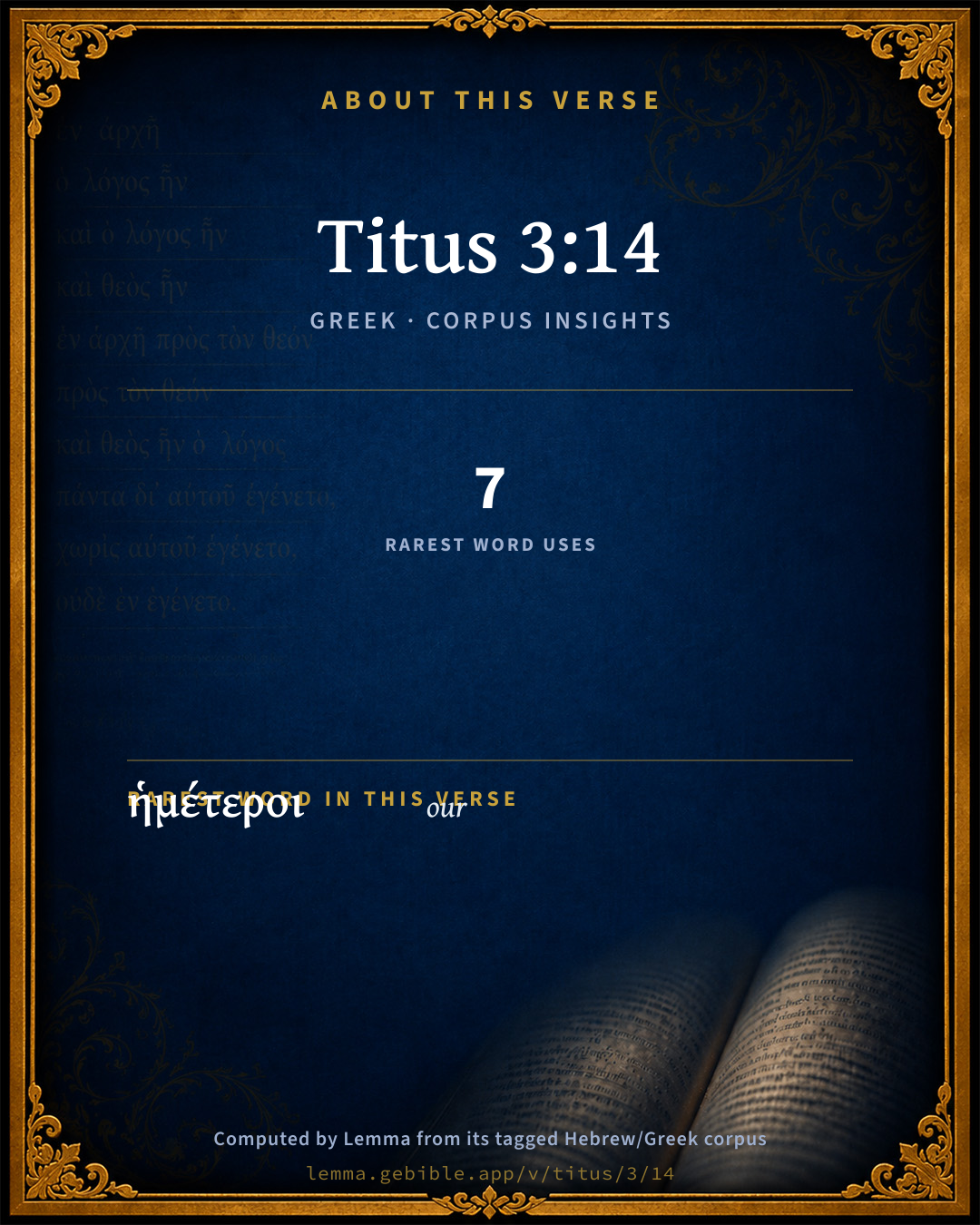
The rarest word here is ἡμέτεροι our G2251 — appearing just 7 times in the whole Greek New Testament.

Shared distinctive vocabulary

ἡμέτεροι our G2251 occurs in 7 verses of the Greek New Testament. Also found in:

Repetition

A word recurs within this verse:

Cross-references

18

Topical passages linked to Titus 3:14 in the Treasury of Scripture Knowledge — connected by theme and wording, ordered by reader-vote popularity; previews shown in the World English Bible.

  • Colossians 1:10 that you may walk worthily of the Lord, to please him in all respects, bearing fruit in every good work, and increasing in the knowledge of God;
  • Titus 3:8 This saying is faithful, and concerning these things I desire that you affirm confidently, so that those who have believed God may be careful to maintain good works. These things are good and profitable to men;
  • Matthew 7:19 Every tree that doesn't grow good fruit is cut down, and thrown into the fire.
  • Philippians 1:11 being filled with the fruits of righteousness, which are through Jesus Christ, to the glory and praise of God.
  • Luke 13:6–9 He spoke this parable. "A certain man had a fig tree planted in his vineyard, and he came seeking fruit on it, and found none.
  • 2 Peter 1:8 For if these things are yours and abound, they make you to be not idle nor unfruitful to the knowledge of our Lord Jesus Christ.
  • John 15:8 "In this is my Father glorified, that you bear much fruit; and so you will be my disciples.
  • John 15:16 You didn't choose me, but I chose you, and appointed you, that you should go and bear fruit, and that your fruit should remain; that whatever you will ask of the Father in my name, he may give it to you.
  • Ephesians 4:28 Let him who stole steal no more; but rather let him labor, working with his hands the thing that is good, that he may have something to give to him who has need.
  • Philippians 4:17 Not that I seek for the gift, but I seek for the fruit that increases to your account.
  • Matthew 21:19 Seeing a fig tree by the road, he came to it, and found nothing on it but leaves. He said to it, "Let there be no fruit from you forever!" Immediately the fig tree withered away.
  • Acts 20:35 In all things I gave you an example, that so laboring you ought to help the weak, and to remember the words of the Lord Jesus, that he himself said, 'It is more blessed to give than to receive.'"
  • 2 Thessalonians 3:8 neither did we eat bread from anyone's hand without paying for it, but in labor and travail worked night and day, that we might not burden any of you;
  • Isaiah 61:3 to appoint to those who mourn in Zion, to give to them a garland for ashes, the oil of joy for mourning, the garment of praise for the spirit of heaviness; that they may be called trees of righteousness, the planting of Yahweh, that he may be glorified.
  • Acts 18:3 and because he practiced the same trade, he lived with them and worked, for by trade they were tent makers.
  • Romans 15:28 When therefore I have accomplished this, and have sealed to them this fruit, I will go on by way of you to Spain.
  • 1 Thessalonians 2:9 For you remember, brothers, our labor and travail; for working night and day, that we might not burden any of you, we preached to you the Gospel of God.
  • Hebrews 6:6–12 and then fell away, it is impossible to renew them again to repentance; seeing they crucify the Son of God for themselves again, and put him to open shame.

Cross-references courtesy of OpenBible.info (CC BY 4.0).

Commentary

Notes on Titus 3:14 from classic Christian and Jewish commentators (each source and its license shown beneath its notes). The classic Christian expositions comment on the surrounding passage and are grouped to its opening verse, so a note may address several verses; the Jewish commentaries on the Tanakh (Rashi and others) are per-verse, so they appear only where the commentator wrote on this verse.

Lemma curates 59 commentaries, every one of them public domain or Creative Commons licensed, each selected and text-cleaned for this edition rather than reprinted as found. About our sources →

Ellicott's Commentary for English Readers

(14) And let our’s also learn to maintain good works for necessary uses.—“Ours,” that is, those who with St. Paul and Titus in Crete called upon the name of Jesus. A last reminder to the brethren, whom with a loving thought he calls “ours,” constantly to practise good and beneficent works. In the expression “let ours also learn,” it would seem as though St. Paul would have Christians trained to the wise and thoughtful performance of works of mercy and charity.

It was with such injunctions as these that men like St. Paul and St. James laid the foundation storeys of those great Christian works of charity—all undreamed of before the Resurrection morning—but which have been for eighteen centuries in all lands, the glory of the religion of Jesus—one grand result of the Master’s presence with us on earth, which even His bitterest enemies admire with a grudging admiration.

In the short compass of these Pastoral Epistles, in all only thirteen chapters, we have no less than eight special reminders to be earnest and zealous in good works. There was evidently a dread in St. Paul’s mind that some of those who professed a love of Jesus, and said that they longed after the great salvation, would content themselves with a dreamy acquiescence in the great truths, while the life remained unaltered. It is noteworthy that these Epistles, containing so many urgent exhortations to work for Christ, were St. Paul’s last inspired utterances. The passages in question are Tit_1:16; Tit_2:7; Tit_2:14; Tit_3:14; 1Ti_2:10; 1Ti_5:10; 1Ti_6:18; 2Ti_2:21.

A Bible Commentary for English Readers, edited by Charles John Ellicott (1878–1897) — public domain. Text from a community e-Sword module.

The Biblical Illustrator

Joseph S. Exell

Tit_3:14

Let ours also learn

The mutual property and purpose of good men

I.

The mutual property of good men. Ours.

1. A mutual appreciation.

2. A mutual accumulation.

II. The mutual purpose of good men. To maintain good works.

1. What are good works? Works that grow out of supreme love to God, and tender and disinterested sympathy with man.

2. Why is the maintenance of good works so transcendently important?

(1) Because they are essential to the building up of a true moral character.

(2) Because they are necessary to the spiritual reformation of mankind. (Homilist.)

That they be not unfruitful

Christianity fruitful

The metaphor implieth that as the Church is Gods orchard or garden, and His ministers are His planters and waterers, so the faithful are the trees, even trees of righteousness, the planting of the Lord, and planted by the rivers of waters, that they might bring forth their fruit in due season; and teacheth that true Christianity is not a barren but a fruitful profession, unto which Christians are everywhere called. In Eze_47:12, we have a notable resemblance of those manifold fruits, which by the power of the gospel should be by believers produced in the Church of the New Testament. The vision was of waters which ran from the Temple, and from under the threshold of the sanctuary. And wheresoever these waters should run, they should cause admirable fruitfulness, in so much as on both sides of the river shall grow all kind of fruitful trees, whose leaves shall not fade, and their fruit shall not fail. These waters are the gospel which issue from under the threshold: that is, from Christ the door, typified by that beautiful gate of the Temple; from the Temple at Jerusalem these waters were with swift current to run not only over Judaea, but all the world in a short space: hence was the Church mightily increased, for though these waters run into the dead sea, wherein (if we believe histories) abideth no living thing, yet such a quickening power they carry with them, as even there everything shall live; such as were dead in trespasses and sins are hereby quickened, and become trees of righteousness green and flourishing, yea, and constantly fruitful in all godly conversation. And this the same which our Saviour noteth (Joh_15:17), that His Father is the husbandman, Himself is the Vine, Christians are the branches of that vine, who if they be found, His Father purgeth that they may bring forth more fruit; teaching us hereby that it is the Lords scope and aim that Christians should be abundant in fruits beseeming their profession. The Apostle Paul accordingly exhorteth the Philippians to be much in goodness, to abound in love, in knowledge, and in all judgment; yea, to be filled with fruits of righteousness which are by Jesus Christ unto the glory and praise of God. And the same apostle calleth rich men to be rich in good works.

I. The conditions of this fruitfulness.

1. Every Christian must be fruitful; for every fruitless branch is cut down and made fuel for the fire.

2. Every Christian must bring forth good fruit.

3. This fruitfulness must proceed from good causes.

(1) The tree must be good, for men gather not grapes of thistles.

(2) He must have a good root (Joh_15:4),

(3) He must draw thence good sap and juice through the fellowship and communion of Christs death and resurrection.

(4) He must have the Spirit of the Son to be a principal agent in the setting and ripening of these fruits.

(5) He must have the love of God within him, constraining him, which will be as the sun helping on these fruits to their perfection.

(6) He must have good ends in his eye, viz., Gods glory and mans good (Php_1:2).

4. Every Christian must bring forth much fruit, and not for clusters scarce berries, trees of righteousness are: laden with the fruits of the Spirit; and herein is the Father glorified, that ye bring forth much fruit (Joh_15:8).

5. Christians must continue fruitful, and grow daily more fruitful (Joh_15:2).

II. Reasons to move Christians to this fruitfulness.

1. Gods pains and costs with us.

2. It is more than time to yield up our fruits. Let us consider how much we have already lost, and how little remaineth behind, and this cannot but be as a loud voice in our ears unto fruitfulness.

3. Heavenly wisdom which is from above is full of good fruits; which, if it have taken up our hearts, will bewray itself in love, in joy, peace, long suffering, gentleness, goodness, faith, meekness, temperance, and such like; and as naturally we rejoice to see everything about us fruitful--our fields, our cattle, our orchards--even so this supernatural wisdom would make it the delight of our souls to see our hearts and lives laden with the best fruits.

4. The barren condition hath little comfort in it, and the danger of unfruitfulness is very great; for Gods fearful displeasure disburdeneth itself, and seizeth on such persons by sundry degrees.

(1) The Lord rejecteth them.

(2) Degree of Gods curse on such fruitless branches is the withering which presently followeth their casting forth, and this the Lord bringeth on them two ways: sometimes by removing means of fruitfulness, and so having laid His vineyard waste, He threateneth, in the next place, that the clouds should not rain upon it (Isa_5:6): and sometimes by blowing upon the gifts He had given, he shall lose his sap and greenness he once had; the unprofitable servant after conviction must have his talent taken from him; and this curse is so eminent upon many men that, comparing them with themselves not long since, a man may say, as the disciples of the fig tree, against which the curse was passed from the mouth of Christ, How soon is the fig tree withered!

(3) Another degree is, that no means shall be able henceforth to do such a person any good; but the curse being passed against him, this is one branch of it, that he shall be like the heath in the wilderness, which shall not see when any good cometh. Now the heath it hath good coming upon it, the rain falleth, the sun shineth, the spring and summer season returneth upon it, but it seeth none of this good, but remaineth a dry and parched heath still; even so it is with a barren soul which God hath begun to curse--the rain, the sun, the season, the Word, sacraments, days of grace, Jesus Christ Himself do him no good; he sees no good towards him in all these; nay, the Word judgeth him, the sacraments are poison unto him, and Christ Himself is a rock of offence to him, on whom he breaketh the neck of his soul.

(4) After all these cometh the heavy sentence, unto which by all these this sinner hath been prepared. Cut him down, bring now the are, for the pruning knife hath done him no good; hew him down by death from the ministry under which he hath been so long fruitless, bind him hand and foot, make a faggot of him, and east him into hell fire--cast, I say, that unprofitable servant into utter darkness, there shall be wailing and gnashing of teeth: and this is the woeful hire of unfruitfulness.

III. The hindrances of this fruitfulness.

1. Superfluity of lusts and inordinate desires, which are as dead branches, and therefore must be lopped off before fruit can be expected; the denial of a mans self so far as corrupt is the first lesson in Christianity.

2. The unfitness of the soil, as if it be stony, or near unto a rock where it cannot take deep roots; the hard and stony heart suffereth not any good seed to take root, and much less rise up to fruit. Or if the soil be a dry ground on which the rain falls not, or on a high and hilly ground on which the rain stayeth not; so the haughty and proud heart shutteth off the rain as fast as it cometh; it moisteneth the crust and outside a little, but it stayeth not to get within it to prepare it to fruitfulness. Or if the ground be shaded that the sun cannot, or seldom, look upon it; if the mind and affections are otherwise distracted, that seldom men set themselves under the means of instruction; the Sun of Righteousness shining in His Church not enlightening, not warming nor cherishing them, not bringing back a new spring upon them, how can we expect fruit from such, unless we can look that a tree which hath been fruitless all the summer should be laden with fruit in the midst of winter.

3. Sundry vain conceits suggested by the devil, and assented unto by men to keep them in unfruitful courses.

(1) As many will not stick to object, I hope notwithstanding I have not been hitherto so fruitful as you speak of, yet I have done well enough all this while, and why may I not do so still? and thus resolve because God hath used patience and spared them, He will therefore spare them still in their unfruitfulness. But this is the devils logic, the clean contrary whereof is the conclusion of the Scripture. Hath God spared thee the second and third year, and art thou still fruitless? He must now needs call for the axe, and this is that which thou must expect.

(2) Another saith, Oh, but I am a member of the Church, and what talk you to me. I hear the Word, receive the sacraments, and though I be not so forward and strict, I hope I shall do well enough. Which is all one as if a fruitless tree should reply to the master and say, I hope, master, thou wilt not cut me down, I am in thy orchard, and stand near thy house; if I were in the waste I should think thou should care less for me. But will not the master reply, that Thou must rather go down, because thou standest unprofitable in my orchard.

(3) Others say, Oh, but we are not so fruitless as you take us, and what desire you more? Whereunto I say, that such have great need to desire better evidences to allege for themselves than this. Thou must not be a privative, but a positive Christian, laden with the fruits of the Spirit, else thou hast lost all thy labour. (T. Taylor, D. D.)

Fruifulness the true test

It is with professions of religion, especially such as become so in a time of outpouring of the Spirit of God, as it is with blossoms in the spring; there are vast numbers of them upon the trees which all look fair and promising, but yet many of them never come to anything, and many of those that in a little while wither up, drop off, and rot under the trees, yet for a while look as beautiful and gay as others; and not only so, but smell sweet and send forth a pleasant odour, so that we cannot, by any of our senses, certainly distinguish those blossoms which have in them that secret virtue which will afterward appear in the fruit, and that inward solidity and strength which shall enable them to bear, and cause them to be perfected by the hot summer sun that will dry up the others. It is the mature fruit which comes afterward, and not the beautiful colour and smell of the blossoms, that we must judge by. (Jonathan Edwards.)

The Biblical Illustrator, edited by Joseph S. Exell (c. 1880s–1900s) — public domain. Text from a community e-Sword module.

Tyndale Open Study Notes

Tyndale Open Resources

3:14 This final exhortation is connected to the responsibility to take care of Zenas and Apollos (see Rom 12:13; Eph 4:28; 1 Thes 4:11; 1 Tim 5:8, 16; 6:18). • Our people must involve themselves in the life-giving ministry of the Good News rather than in the unproductive speculations of the false teachers.

Tyndale Open Study Notes — © Tyndale Open Resources, licensed CC BY-SA 4.0. Text via the HelloAO Bible API.

Bengel's Gnomon

Johann Albrecht Bengel

Tit 3:14. Μανθανέτωσαν, let them learn) by thy admonition and example.—καὶ οἱ ἡμέτεροι, ours also) not only we, but also ours, whom we have gained at Crete. These seem not to have given sufficient assistance to Zenas and Apollos, when they ought to have done so. [It is not proper that some should ever and anon devolve the business in hand from themselves upon others.—V. g.] Zenas and Apollos were already in Crete with Titus; for this is the reason why he distinguishes them from Artemas and Tychicus, who were not until afterwards to be sent.—εἰς τὰς ἀναγκείας χρείας, for necessary uses) even as spiritual necessity [i.e. the tie which necessarily binds saints to help one another] requires; so χρεία, Act 6:3. Spiritual necessity [‘necessitudo,’ tie of necessary obligation or relationship] lays the foundation of obligations, so that one cannot withdraw from another [so as not to help him].[15]

[15] Bengel, J. A. (1860). Vol. 4: Gnomon of the New Testament (M. E. Bengel & J. C. F. Steudel, Ed.) (J. Bryce, Trans.) (317–326). Edinburgh: T&T Clark.

Bengel's Gnomon of the New Testament — English translation (T&T Clark, Edinburgh, 1860) — public domain. Text from a community e-Sword module.

Meyer's Critical & Exegetical Commentary

Heinrich August Wilhelm Meyer

Tit_3:14. Μανθανέτωσαν δὲ καὶ οἱ ἡμέτεροι] οἱ ἡμέτεροι are the Christian brethren in Crete, not, as Grotius thought, Zenas and Apollo. Καί stands with reference not merely to the Jews (Hofmann), but to non-Christians in general. As non-Christians provide for the needs of their own, so ought Christians, and not refrain through their anxiety for heavenly things.

καλῶν ἔργων προΐστασθαι] in the same general sense as in Tit_3:8, but the words following give the phrase a more special reference to works of benevolence; εἰς τὰς ἀναγκαίας χρείας, in regard to the necessary wants.

ἵνα μὴ ὦσιν ἄκαρποι] The subject is οἱ ἡμέτεροι. Hofmann construes the words εἰς τὰς ἀναγκαίας χρείας with the clause of purpose following them. He says that the particle of purpose is placed after the emphatic part of the clause, a thing which frequently occurs in the N. T., and for this he appeals to Winer, p. 522 [E. T. p. 764]. In this he is entirely wrong. Such a construction seldom occurs, and of all the passages there quoted by Winer, that from 2Co_12:7 alone is to the point; the rest are of quite another kind. It is quite clear from what was said on ἵνα in 1Ti_1:3; 1Ti_1:1[22] that such a construction is not to be admitted here. The exhortation in the passage does not refer simply to the present case of equipping Zenas and Apollo, which indeed occasioned it, but is in general terms, and is applicable to all cases where the necessary wants of others have to be considered (van Oosterzee).

[22] To say that with the common construction the clause of purpose is too general (Hofmann), is not to the point, since it can easily be defined from what precedes.

Meyer — Critical and Exegetical Commentary on the New Testament — English translation by Peter Christie, edited by Frederick Crombie (T&T Clark, 1880) — public domain. Text from a community e-Sword module.

Expositor's Greek Testament

ed. W. Robertson Nicoll

Tit 3:14 . The δέ does not mark an antithesis between οἱ ἡμέτεροι and the persons who have just been mentioned, but is rather resumptive of Tit 3:8 ; repeating and emphasising at the close of the letter that which St. Paul had most at heart, the changed lives of the Cretan converts. οἱ ἡμέτεροι of course means those of our faith in Crete.

καλῶν ἔργων προΐστασθαι : See on Tit 3:8 .

εἰς τὰς ἀναγκαίας χρείας : The best commentary on this expression is 1Th 4:9-12 . Although καλῶν ἔργων προΐστασθαι does not mean to profess honest occupations , yet it is plain from St. Paul’s letters that he would regard the earning one’s own bread respectably as a condition precedent to the doing of good works. The necessary wants to which allusion is made are the maintenance of oneself and family, and helping brethren who are unable to help themselves (Act 20:35 ; Rom 12:13 ; Eph 4:28 ). This view is borne out by the reason which follows, ἵνα μὴ ὦσιν ἄκαρποι . See Joh 15:2 , Phi 4:17 , Col 1:10 , 2Pe 1:8 .

The Expositor's Greek Testament, edited by W. Robertson Nicoll (1897–1910) — public domain. Text from a community e-Sword module.

Jamieson, Fausset & Brown

Robert Jamieson, A. R. Fausset & David Brown

And . . . also--Greek, "But . . . also." Not only thou, but let others also of "our" fellow believers (or "whom we have gained over at Crete") with thee.

for necessary uses--to supply the necessary wants of Christian missionaries and brethren, according as they stand in need in their journeys for the Lord's cause. Compare Tit 1:8, "a lover of hospitality."

Jamieson, Fausset & Brown — Commentary Critical and Explanatory on the Whole Bible (1871) — public domain (CC PDM 1.0). Text via the HelloAO Bible API.

Adam Clarke's Commentary

Verse 14. And let others also learn to maintain good works] There is something very remarkable in this expression. The words καλων εργων προιστασθαι, which we translate to maintain good works, occur also in Tit 3:8; and some think they mean, to provide for our own, and the necessities of others, by working at some honest occupation; and that this was necessary to be taught to the Cretans, let OURS also learn, c., who were naturally and practically idle gluttons. Kypke observed that the words mean,

1. To be employed in good works.

2. To defend good works, and to recommend the performance of them.

3. To promote and forward good works to be always first in them.

For necessary uses] That they may be able at all times to help the Church of God, and those that are in want.

That they be not unfruitful.] As they must be if they indulge themselves in their idle, slothful disposition.

Adam Clarke's Commentary on the Bible (1810–1826) — public domain. Text from a community e-Sword/MySword module.

John Calvin's Commentaries

14 And let ours also learn to excel in good works. That the Cretans, on whom he lays this burden, may not complain of being loaded with the expense, he reminds them that they must not be unfruitful, and that therefore they must be warmly exhorted to be zealous in good works. But of this mode of expression we have already spoken. Whether, therefore, he enjoins them to excel in good works, or to assign the highest rank to good works, he means that it is useful for them to have an opportunity afforded for exercising liberality, that they may not “be unfruitful” on this ground, that there is no opportunity, or that it is not demanded by necessity. What follows has been already explained in the other Epistles.

END OF CALVIN’S COMMENTARY ON TITUS

John Calvin's Commentaries (1540-1563) — public domain. Text from the Calvin Translation Society English edition (1840s-50s) via the Christian Classics Ethereal Library (ccel.org). Calvin's coverage is partial (roughly two-thirds of the Bible); uncommented books and verses are honest gaps, never fabricated. The 19th-century editor's footnotes and remarks are omitted so the notes are faithfully Calvin's own voice.

The Cambridge Bible for Schools and Colleges

gen. ed. J. J. S. Perowne

14. let ours also learn] More clearly as R.V. and let our people also learn. Theod. Mops, excellently, because Titus (as a poor person) could not be expected to do all, ‘teach,’ he says, ‘your people to attend carefully to the support of their religious teachers.’ St Paul quotes again half of the ‘Faithful saying’ of Tit_3:8, ‘maintain good works,’ and gives this as a most important and primary application of the general law for a practical Christian life, by adding ‘for such necessary wants’ for the needful wants of the ministry. The article requires this interpretation; these well-known and existing wants that are inevitable, when your ministers have to spend their time in saving, not money, but men’s souls. For the usage of this word (in the plural) always as ‘wants,’ not ‘uses,’ cf. Act_20:34 ‘these hands ministered unto my necessities,’ Rom_12:13 ‘communicating to the necessities of the saints.’

This passage recording the visit of an ‘apostle,’ and a ‘teacher,’ and dwelling on the support of the ministry, finds a striking illustration in the Teaching of the Twelve Apostles, which dwells with especial prominence on the work of travelling and resident apostles, and prophets, and teachers, and on their support. It is noticeable too how in the twenty or thirty years which probably elapsed between this Epistle and the ‘Teaching’ the large-hearted law here laid down had been liable to abuse, and required guarding. Three out of the sixteen chapters. xi., xii., xiii., are occupied with this subject. See introduction, pp. 22–24.

The Cambridge Bible for Schools and Colleges (gen. ed. J. J. S. Perowne; Cambridge University Press, 1878–1918) — public domain. Text from a community e-Sword module.

John Gill's Exposition

And let ours also learn to maintain good works,.... By which are not only meant honest trades, as some choose to render the words: it is true, that a trade is a work; and an honest lawful employment of life is a good work; and which ought to be maintained, attended to, and followed, and to be learnt, in order to be followed. The Jews say, that he that does not teach his son a trade, it is all one as if he taught him to rob or steal; hence their doctors were brought up to trades; See Gill on Mar 6:3; as was the Apostle Paul, though he had an education under Gamaliel: and such an one is to be learned and maintained for necessary uses, for the good of a man's self, and for the supply of his family; for the assistance of others that are in need; for the support of the Gospel, and the interest of Christ; and for the relief of poor saints; that such may not be unfruitful and useless, in commonwealths, neighbourhoods, churches, and families. The Jews say (c).

"there are four things which a man should constantly attend to with all his might, and they are these; the law, "good works", prayer, , and "the way of the earth", or "business"; if a tradesman, to his trade; if a merchant, to his merchandise; if a man of war to war.''

But though this may be part of the sense of these words, it is not the whole of it; nor are acts of beneficence to the poor of Christ, to the household of faith, to strangers and ministers, to whom good is especially to be done, only intended; though they, may be taken into the account, in agreement with the context; but all good works in general, which are done in conformity to the revealed will of God, in faith, from a principle of love, and with a view to the glory of God, are meant: to maintain them, is to endeavour to outdo others in them, not only the men of the world, but one another; and to set examples of them to others, and to provoke one another, by an holy emulation, to them; and to be constant in the performance of them: and which believers may "learn" partly from the Scriptures, which contain what is the good and perfect will of God; these show what are good works, and direct unto them, and furnish the man of God for them; and also the grace part of the Scripture, the doctrines of the grace of God, teach to deny sin, and to live sober, righteous, and godly lives; and from the examples of the apostles and followers of Christ; and above all from Christ himself, the great pattern and exemplar of good works: and this lesson of good works is to be learnt by ours; meaning not only those of the same function, who were in the same office, ministers of the Gospel, as were the apostle and Titus; but all that believed in God, who were of the same Christian community and society, professors of the same religion, and partakers of the same grace; and were not only nominally, but really of the same number, even of the number of God's elect, the redeemed from among men, the family of Christ, sharers in the common faith, and heirs of the grace of life; who lie under the greatest obligations to learn to do good works: "for necessary uses"; not to make their peace with God, or to atone for their sins, or to procure the pardon of them, or to cleanse them from them, or for their justification before God, or to obtain salvation and eternal life; but to glorify God, testify their subjection to him, and gratitude for mercies received; to show forth their faith to men; to adorn the doctrine of Christ, and a profession of it; to recommend religion to others; to stop the mouths of gainsayers, and put to silence the ignorance of foolish men: and "that they be not unfruitful"; in them, and in the knowledge of Christ; good works are the fruits of the Spirit, and of his grace; they are fruits of righteousness; and such as are without them are like trees without fruit, useless and unprofitable.

(c) T. Bab. Beracot, fol. 32. 2. & Gloss. in. ib.

John Gill's Exposition of the Whole Bible (1746–1763) — public domain (CC PDM 1.0). Text via the HelloAO Bible API.

Trapp's Complete Commentary

John Trapp

14 And let ours also learn to maintain good works for necessary uses, that they be not unfruitful.

Ver. 14. To maintain good works] {See Trapp on "Tit 3:8"}

That they be not unfruitful] As drone bees or body lice, living upon others’ labours, and so opening the mouths of heathens who will be ready to say, as he once did, Odi homines ignava opera, philosopha sententia, I hate those that can give fair words, but that is all they are good for. See we not how every creature in its kind is fruitful The sun, moon, and stars in their courses restlessly move to impart their light, heat, and influence to the inferior creatures. The clouds fly up and down emptying themselves, to enrich the earth, from which notwithstanding they reap no harvest. The earth is cut and wounded with shares and coulters, yet is patient, and yields her riches and strength to the tiller; yea, what herb, plant, or tree grows upon the earth which is not in its kind fruitful, spending itself and the principal parts of its sap and moisture in bringing forth some pleasant berry or such like fruit? (Plin.) And shall only man remain unfruitful, and not serve God and man with cheerfulness in the abundance of all things? Shall he be like the cypress tree, which the more it is watered, the more it is withered? Or like cyparet, whose neither fruit, nor leaves, nor berry, nor shadow is useful, but rather hurtful? Hear what Cicero saith, Pudeat illos qui ita vixerunt, ut ad vitam communem nullum fructum afferre possint. Let them learn to be ashamed of their sloth that have so lived, as to have been altogether useless and unfruitful.

John Trapp, A Commentary or Exposition upon All the Books of the Old and New Testament (1647–1656) — public domain. Text from a community e-Sword module.

Albert Barnes' Notes on the Bible

And let ours - Our friends; that is, those who were Christians Paul had just directed Titus to aid Zenas and Apollos himself, and he here adds that he wished that others who were Christians would be char acterized by good works of all kinds.

To maintain good works - Margin, profess honest trades. The Greek will admit of the interpretation in the margin, or will include that, but there is no reason why the direction should be supposed to have any special reference to an honest mode of livelihood, or why it should be confined to that. It rather means, that they should be distinguished for good works, including benevolent deeds, acts of charity, honest toil, and whatever would enter into the conception of an upright life; see the notes at Tit 3:8.

For necessary uses - Such as are required by their duty to their families, and by the demands of charity; see Tit 3:8.

That they be not unfruitful - - That it may be seen that their religion is not barren and worthless, but that it produces a happy effect on themselves and on society; compare the Joh 15:16 note; Eph 4:28 note.

Albert Barnes' Notes on the Bible (1834–1885) — public domain. Text from a community e-Sword/MySword module.

Haydock's Catholic Bible Commentary

Let our men (that is, all Christians) also learn to excel in good and charitable works, by furnishing to others, for necessary uses, according to their wants. (Witham)

George Leo Haydock (1774–1849), Haydock's Catholic Family Bible and Commentary, 1859 edition — public domain. Excludes Psalms (Douay-Rheims chapter numbering differs from Protestant) and Deuterocanonical books (Catholic canon only).

Matthew Poole's English Annotations

And let ours also; either those of our order, ministers of the gospel, or those that are Christians.

Learn to maintain good works; in the Greek it is, to excel, or to be in the front, or to show forth, or maintain, and each sense hath its patrons of note.

For necessary uses; for the necessary uses of the church, or of others, or for their own necessary uses. I take their sense who would expound the phrase,

maintain good works, by learning some honest trade, to be foreign to the true sense of the phrase.

Matthew Poole's English Annotations on the Holy Bible (1683–1685) — public domain. Text from a community e-Sword/MySword module.

Whedon's Commentary on the Bible

Daniel D. Whedon

14. Ours—Our Christian converts; who should learn to be liberal contributors as well as Titus.

Good works for necessary uses— Benevolent contributions to necessary expenses.

Unfruitful— Unproductive of benefit to the Church and world. He who is fruitful in holy emotions and holy professions should never be barren in liberal benefactions.

Daniel D. Whedon (gen. ed.), Commentary on the Old and New Testaments (1874–1909) — public domain. Text from a community e-Sword module.

The Pulpit Commentary

Our people for ours, A.V Our people also. The natural inference is that Titus had some fund at his disposal with which he was to help the travelers, but that St. Paul wished the Cretan Christians to contribute also. But it may also mean, as Luther suggests, "Let our Christians learn to do what Jews do, and even heathens too, viz. provide for the real wants of their own." To maintain good works (ver. 8, note) for necessary uses (eiv taav creiav); such as the wants of the missionaries. (comp. 3Jn_1:5:6; see also Rom_12:13 Php_2:25 4:16, etc.) The phrase means urgent necessities," the "indispensable wants." In classical Greek ta anagkaia are "the necessaries of life." That they be not unfruitful (akarpoi); comp. 2Pe_1:8 and Col_1:6, Col_1:10.

A last reminder concerning good works.

The suggestion just made leads to this adjunction: "And let ours also learn to maintain good works for necessary uses, that they be not unfruitful.

I IT IS AN INJUNCTION TO THE BRETHREN GENERALLY. "Ours also." It is the duty of all believers, sharers in the common faith, and heirs of the grace of life, to learn to do good works.

II BELIEVERS NEED TO RE TRAINED TO THIS SERVICE. "Let ours also learn." They will learn it from the Scriptures, which tell us what is the good and perfect and acceptable will of God; and from the doctrines of grace, which teach us to follow as an example the Lord Jesus, who went about every day doing good.

III THESE GOOD WORKS ARE TO HAVE A PRACTICAL BEARING UPON THE WANTS OF OTHERS. They are "for necessary wants.

1. Not to atone for sin, or recommend us as sinners to God"s favor.

2. But to glorify God by doing for others what he so abundantly does for us. By adorning the doctrine of Christ by our beneficence; by putting to silence the gainsaying of foolish men, because they see we are "not unfruitful." We are thus seen to be trees of righteousness, bearing all manner of fruits. It is an interesting fact that, in the last inspired teachings of the apostle, he should have eight times enforced the duty of maintaining good works. T.C.

The Pulpit Commentary (1880–1919), ed. H.D.M. Spence-Jones & Joseph S. Exell — public domain. Text from a community e-Sword module.

John Wesley's Explanatory Notes

And let ours - All our brethren at Crete. Learn - Both by thy admonition and example. Perhaps they had not before assisted Zenas and Apollos as they ought to have done.

John Wesley, Explanatory Notes Upon the Whole Bible (1754–1765) — public domain. Text via the GEBible commentary corpus.

Burkitt's Expository Notes on the New Testament

William Burkitt

Let ours, that is, either,

1. Those of our order, the ministers of the gospel, or

2. those that are our converts, such as are Christians,

let them study to excel in good works, be diligent in the labours of their calling, that they may have wherewith to supply the necessities of others, to the intent that they may not appear unfruitful.

Learn hence, That as Christianity is no barren and fruitless profession, but all persons professing religion ought to take care that good works may accompany their faith; so the ministers of Christ in special ought to be careful herein, and by no means to bind that duty upon others, which they do not practise themselves; they must by charity and good works second their doctrine, and so win persons to a love of religion.

William Burkitt's Expository Notes on the New Testament (1700–1703) — public domain. Text from a community e-Sword module.

The People's New Testament

B. W. Johnson

14. Let ours. Our fellow-Christians. This suggests that it would be a good work to aid Zenas and Apollos.

B. W. Johnson's The People's New Testament with Notes (1889–1891) — public domain. Electronic text from the Christian Classics Ethereal Library (CCEL) ThML edition.

unfoldingWord translationNotes

Door43 World Missions Community

Connecting Statement:

Paul explains why it is important to provide for Zenas and Apollos.

Our people

Paul is referring to the believers in Crete.

that provide for urgent needs

"that enable them to help people who need important things immediately"

needs, and so not be unfruitful

Paul speaks of people doing good work as if they were trees bearing good fruit. This double negative means they should be fruitful or productive. AT: "needs; in this way they will be fruitful" or "needs, and so they will do good works" (See: Double Negatives)

translationWords

people group

works

fruit

unfoldingWord translationNotes — © Distant Shores Media and the Door43 World Missions Community, licensed CC BY-SA 4.0. Source: git.door43.org/Door43/en_tn.

Cambridge Greek Testament for Schools and Colleges

14. FINAL CHARGE TO THE CHRISTIANS AT CRETE

14. μανθανέτωσαν δὲ καὶ οἱ ἡμέτεροι καλῶν ἕργων προῑ̓στασθαι. And let our people also, sc. the Christian brethren at Crete, learn to maintain good works. Although the letter is primarily for Titus, yet it also has words of counsel for his flock. Probably a letter like this would be read aloud when the brethren were assembled for public worship.

For καλῶν ἔργων προῑ̓στασθαι see on Tit 3:8 above; here it is directly connected with what follows, viz:

εἰς τὰς ἀναγκαίας χρείας, ἵνα μὴ ὦσιν ἄκαρποι, for necessary uses, that they be not unfruitful. The definite article τάς is significant, viz. such necessary uses as may present themselves from time to time.

For χρεία cp. Eph 4:28; Php 4:16; and for ἄκαρπος cp. 1Co 14:14.

Cambridge Greek Testament for Schools and Colleges (Cambridge University Press, 1896; 21 vols, various authors incl. Carr, Maclear, Plummer, Farrar, Lumby, Moule, M. R. James, Simcox) — public domain. Text from a community e-Sword module.

Alford’s Greek Testament

Henry Alford

14.] Moreover (connexion of δὲ καί: the contrast in the δέ is, ‘and I will not that thou only shouldest thus forward them, though I use the singular number; but see that the other brethren also join with thee in contributing to their outfit’), let also our people (our fellow-believers who are with thee) learn to practise (see note, ver. 8) good works, contributions to (εἰς, for the supply of) the necessary wants which arise (such is the force of τάς: such wants as from time to time are presented before Christians, requiring relief in the course of their Father’s work in life), that they may not be unfruitful (implying, that in the supply by us of such ἀναγκαῖαι χρεῖαι, our ordinary opportunities are to be found of bearing fruit to God’s praise).

Henry Alford, The Greek Testament (1849–1861) — public domain. Text from a community e-Sword module.

International Critical Commentary

14. καί “as well as yourself.” Yes, and let all our people be always prepared to help; perhaps also “as well as their pagan neighbours”; cf. note on ἄκαρποι.

οἱ ἡμέτεροι not to be limited to “all of our friends” (=τοὺς φιλοῦντας ἡμᾶς ἐν πίστει 15; cf. πάντες οἱ ἐμοί, Oxyr. Pap. i. p. 181, “les notres” of the Port Royalists) as opposed to the false teachers, 1:10: but = “the whole household of faith,” “our brothers and sisters,” in contrast to their pagan neighbours: cf. Mart. Polyc. c. 9, τῶν ἡμετέρων οἱ πάροντες: Iren. adv. Hær. v. 28. 4, ὡς εἶπέ τις τῶν ἡμετέρων.

καλῶν ἔργων προΐστ.] A special application of the general rule, with reference to a new purpose, and here peculiarly applicable to working at trades; cf. 8 note.

εἰς τὰς ἀναγκ. χρείας] common both in classical writers and in the papyri (cf. Wetstein and M.M. s.v.), will include both “for their own needs” (1Th 4:12 ἵνα μηδενὸς χρείαν ἔχητε) and “for helping others” (Eph 4:28 ἵνα ἔχῃ μεταδιδόναι τῷ χρείαν ἔχοντι). Herm. Sim. x. 4: “Dic omnibus ut non cessent, quicunque (Qy. legendum, “quæcumque”) recte facere possunt, bona opera exercere; utile est illis. Dico autem omnem hominem de incommodis eripi oportere”; perhaps a reminiscence of this chapter. A comparison of 1Th 4:12, Eph 4:28 with this place is very suggestive as to the gradual deepening of Christian motives, the desire of independence, the willingness to help individuals, the desire to be a useful member of society.

ἄκαρποι] cf. Rom 7:4, Rom 7:2 P 1:8, Jud 1:12, and the expansion of the simile in Herm. Sim. 4. But here the special reference seems to be to the Roman taunt that Christians were unprofitable to the State, as keeping apart from many trades, that they were “infructuosi in negotiis,” Tert. Apol. 42, and his reply, “Navigamus nos vobiscum et militamus et rusticamur et mercamur: proinde miscemus artes nostras, operas nostras publicamus usui vestro”; cf. notes on 3 and 8.

International Critical Commentary — older volumes (1896–1929), various authors — public domain. Text from a community e-Sword module.

Lesson kit

Teaching starters — assembled from the data on this page, not authored interpretation. Every prompt links to the verse data it draws on. Edit before teaching.

Titus, in the Pauline Epistles, opens this verse with 16 words (15 distinct Greek lemmas). Its most distinctive word is hēméteros (“our”). A historical commentator’s framing appears above. Read the whole chapter for the surrounding context.

Discussion questions

  1. How does “our” (hēméteros) shape what this verse is saying?
  2. How does Acts 2:11, which shares the word «our», read alongside this verse?
  3. What does the repetition of “the” (2× in this one verse) do in this verse?
  4. The translations on this page render this verse differently — a whole-verse word diff, not a word-by-word alignment. What might account for the different wordings?
  5. Compare how Ellicott's Commentary for English Readers and The Biblical Illustrator read this verse. Where do they agree or differ?

Things to notice

Reading settings

Reading text

Shown beneath each verse's original-language words.

Old Testament
Old Testament edition

Read the OT as the Masoretic Hebrew (MT) or the Greek Septuagint (LXX).

English shown for the Greek Septuagint (in the Hebrew ↔ Greek comparison).

Comparing translations? Open the Compare panel on any verse page to stack up to four side by side.