Exodus 27:4

Hebrew (Westminster Leningrad Codex) Exodus 27:4 appears in the Hebrew Old Testament. The text above is from the Westminster Leningrad Codex. Each word links to its Strong’s number, a concise gloss, and parsing drawn from the Open Scriptures Hebrew Bible morphology. Click any word for its full Brown-Driver-Briggs (BDB) entry.
Download image
Cite this verse

Exodus 27:4 (World English Bible). Public Domain. Lemma interlinear Bible study tool, https://lemma.gebible.app/v/exodus/27/4.

Show BibTeX & RIS
BibTeX
RIS
English Translation
You shall make a grating for it of network of brass: and on the net you shall make four brazen rings in its four corners.
World English Bible · Public Domain
Highlights
  • 2 first appearances in the Hebrew Bible
Full analysis ↓
Download a study sheet

One document with this verse’s original text, its word-by-word gloss line, the meaning frame, cross-references with their text, attributed commentary, and full source and license credits — printable, and it pastes into notes with its structure intact.

This verse Autodidact and up

Study sheet (.html) Plain text (.txt)

A passage Seminary Student

Up to 50 verses in one chapter. A passage sheet keeps up to 6 commentary sources and 12 cross-references per verse, in the order this page ranks them, and says so on the sheet whenever that leaves anything out. Ask for a single verse and you get the Autodidact verse sheet above.

Everything on this page stays free to read, with no account — the sheet is a download of what is already on screen, not access to it.

Want to remove ads? Support Godless Engineer
Compare translations 3

The same verse in 3 English versions, stacked beneath the original-language interlinear above. Click any original word for its lexicon entry.

Each is an independent rendering of the whole verse — the interlinear is not word-aligned to these translations.

Highlighted words mark where these versions differ — a whole-verse word diff, not a word-by-word alignment.

  • World English Bible Public Domain
    You shall make a grating for it of network of brass: and on the net you shall make four brazen rings in its four corners.
  • King James Version Public Domain
    And thou shalt make for it a grate of network of brass; and upon the net shalt thou make four brazen rings in the four corners thereof.
  • unfoldingWord Literal Text CC BY-SA 4.0
    And you shall make a grate for it, a work of a network of bronze. And you shall make four rings of bronze on the network, on its four corners.

unfoldingWord Literal Text — © unfoldingWord, licensed CC BY-SA 4.0. Word-aligned USFM3 via Door43 (git.door43.org/unfoldingWord/en_ult).

Versions to compare (up to 4)

3 of 4 selected

Show all 18 translations

Every available English version of this verse, each an independent rendering of the whole verse.

  • World English Bible Public Domain
    You shall make a grating for it of network of brass: and on the net you shall make four brazen rings in its four corners.
  • Berean Standard Bible Public Domain
    Construct for it a grate of bronze mesh, and make a bronze ring at each of the four corners of the mesh.
  • Majority Standard Bible Public Domain
    Construct for it a grate of bronze mesh, and make a bronze ring at each of the four corners of the mesh.
  • King James Version Public Domain
    And thou shalt make for it a grate of network of brass; and upon the net shalt thou make four brazen rings in the four corners thereof.
  • American Standard Version (1901) Public Domain
    And thou shalt make for it a grating of network of brass: and upon the net shalt thou make four brazen rings in the four corners thereof.
  • Revised Version (1885) Public Domain
    And thou shalt make for it a grating of network of brass; and upon the net shalt thou make four brasen rings in the four corners thereof.
  • Geneva Bible (1599) Public Domain
    And thou shalt make vnto it a grate like networke of brasse: also vpon that grate shalt thou make foure brasen rings vpon the foure corners thereof.
  • Douay-Rheims (1899) Public Domain
    And a grate of brass in manner of a net: at the four corners of which shall be four rings of brass,
  • Young's Literal Translation Public Domain
    `And thou hast made for it a grate of net-work of brass, and hast made on the net four rings of brass on its four extremities,
  • Literal Standard Version CC BY-SA 4.0
    And you have made a grate of network of bronze for it, and have made four rings of bronze on the net on its four extremities,
  • Unlocked Literal Bible CC BY-SA 4.0
    You must make a grate for the altar, a network of bronze. Make a bronze ring for each of the grate's four corners.
  • unfoldingWord Literal Text CC BY-SA 4.0
    And you shall make a grate for it, a work of a network of bronze. And you shall make four rings of bronze on the network, on its four corners.
  • Darby Bible Public Domain
    And thou shalt make for it a grating of network of copper; and on the net shalt thou make four copper rings at its four corners;
  • World Messianic Bible Public Domain
    You shall make a grating for it of network of bronze. On the net you shall make four bronze rings in its four corners.
  • Webster's Bible Public Domain
    And thou shalt make for it a grate of net-work of brass; and upon the net shalt thou make four brazen rings in its four corners.
  • Free Bible Version CC BY-SA 4.0
    Make a bronze mesh grate for it with a bronze ring on each of its corners.
  • Bible in Basic English Public Domain
    And make a network of brass, with four brass rings at its four angles.
  • JPS Tanakh (1917) Public Domain
    And thou shalt make for it a grating of network of brass; and upon the net shalt thou make four brazen rings in the four corners thereof.

Literal Standard Version (2020), Covenant Press — licensed CC BY-SA 4.0. Text via the HelloAO Bible API (eBible.org). Unlocked Literal Bible (unfoldingWord) — licensed CC BY-SA 4.0. Text via the HelloAO Bible API (eBible.org). unfoldingWord Literal Text — © unfoldingWord, licensed CC BY-SA 4.0. Word-aligned USFM3 via Door43 (git.door43.org/unfoldingWord/en_ult). Free Bible Version, Dr. Jonathan Gallagher — licensed CC BY-SA 4.0. Text via the HelloAO Bible API (eBible.org).

Word by word

More ways to search: Search by grammar → Find every occurrence → Compare this word →

Practice this passage: Drill this verse → Learn its vocabulary →

מִכְבָּ֔ר
makbêr
H4345
“lattice”
Noun, Common, Masculine, Singular, Absolute
Part of Speech
Noun
Type
Common
Gender
Masculine
Number
Singular
State
Absolute
Full BDB Definition

Origin: from H3527 in the sense of covering [compare H3531 ]

TWOT: 948d

grating, lattice-work
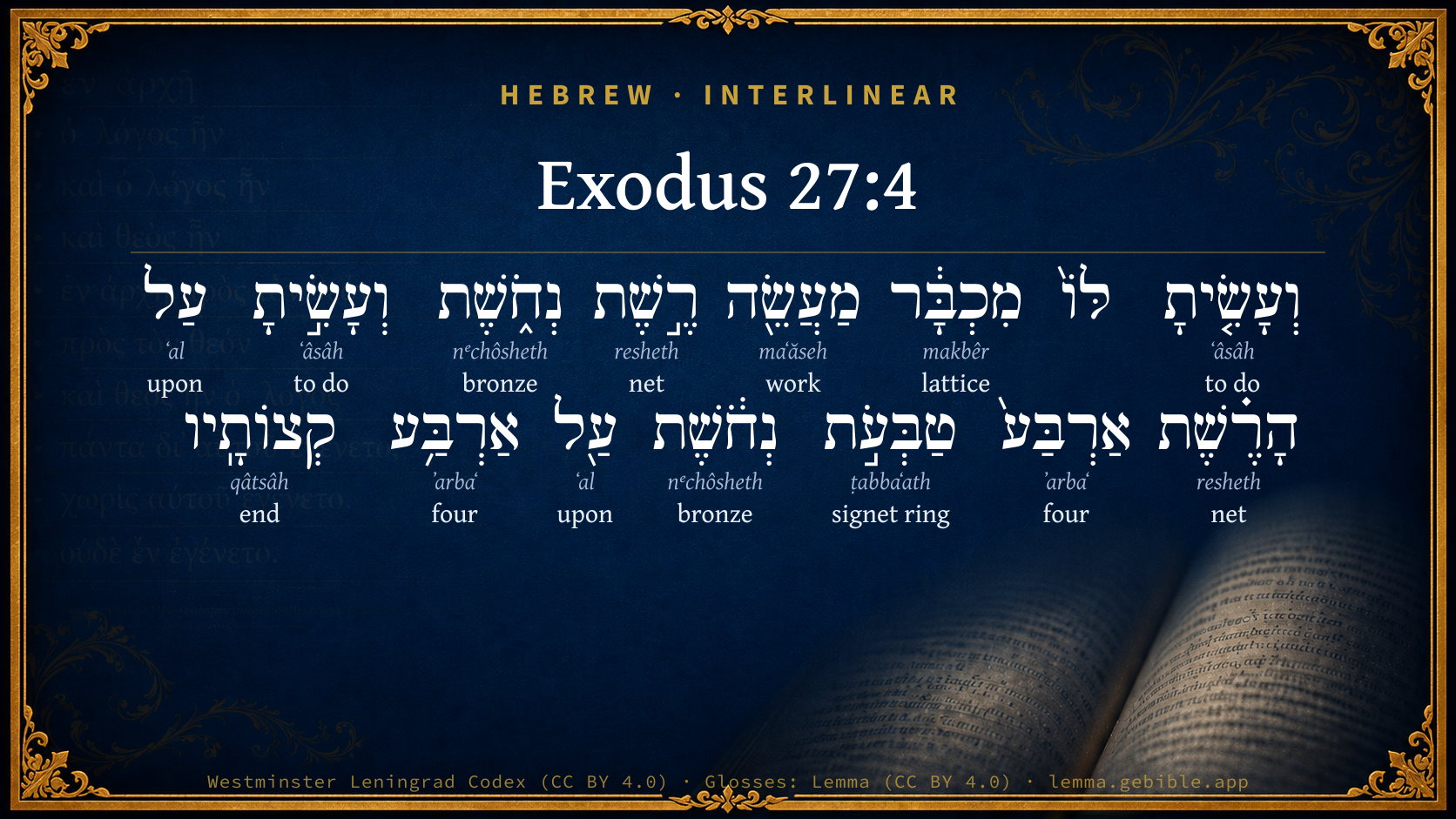
  1. וְעָשִׂ֤יתָ ʻâsâh H6213 “and · to do” Conjunction + Verb, Qal, Sequential Perfect, 2nd Person, Masculine, Singular
  2. מַעֲשֵׂ֖ה maʻăseh H4639 “work of” Noun, Common, Masculine, Singular, Construct
  3. רֶ֣שֶׁת resheth H7568 “net of” Noun, Common, Feminine, Singular, Construct
  4. נְחֹ֑שֶׁת nᵉchôsheth H5178 “bronze” Noun, Common, Feminine, Singular, Absolute
  5. וְעָשִׂ֣יתָ ʻâsâh H6213 “and · to do” Conjunction + Verb, Qal, Sequential Perfect, 2nd Person, Masculine, Singular
  6. עַל ʻal H5921 “upon” Preposition
  7. הָרֶ֗שֶׁת resheth H7568 “the · net” Particle, Definite Article + Noun, Common, Feminine, Singular, Absolute
  8. אַרְבַּע֙ ʼarbaʻ H702 “four” Adjective, Cardinal number, Feminine, Singular, Absolute
  9. טַבְּעֹ֣ת ṭabbaʻath H2885 “signet rings of” Noun, Common, Feminine, Plural, Construct
  10. נְחֹ֔שֶׁת nᵉchôsheth H5178 “bronze” Noun, Common, Feminine, Singular, Absolute
  11. עַ֖ל ʻal H5921 “upon” Preposition
  12. אַרְבַּ֥ע ʼarbaʻ H702 “four” Adjective, Cardinal number, Feminine, Singular, Absolute
  13. קְצוֹתָֽיו qâtsâh H7098 “ends · his” Noun, Common, Both, Plural, Construct + Suffix, Personal, 3rd Person, Masculine, Singular

About this verse

These counts appear in no published source. They are computed here, from the morphology-tagged text and Lemma’s own curated glosses. What Lemma adds →

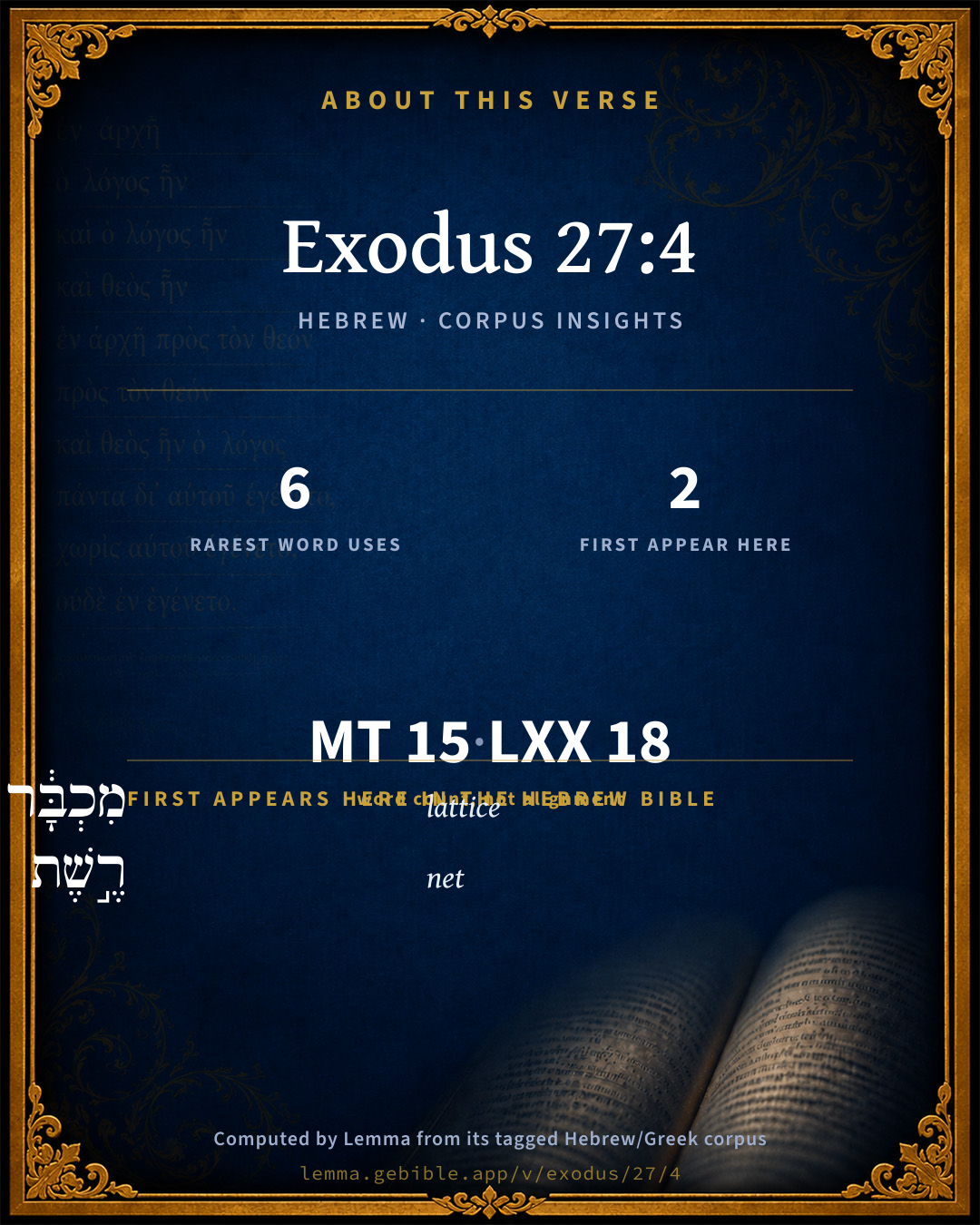
15
words
9
distinct lemmas
Pentateuch
section

Notable vocabulary

The rarest word here is מִכְבָּ֔ר lattice H4345 — appearing just 6 times in the whole Hebrew Bible.

First appearance in Scripture

These words make their first canonical appearance in the Hebrew Bible here:

  • מִכְבָּ֔ר lattice H4345
  • רֶ֣שֶׁת net H7568

Shared distinctive vocabulary

מִכְבָּ֔ר lattice H4345 occurs in 6 verses of the Hebrew Bible. Also found in:

Grammatical profile

  • 2 verbs
  • 8 nouns
  • 2 adjectives
  • 3 prepositions

Verb forms

  • וְעָשִׂ֤יתָ Qal · Sequential Perfect
  • וְעָשִׂ֣יתָ Qal · Sequential Perfect

Repetition

Words recur within this verse — often emphatic in Hebrew:

  • וְעָשִׂ֤יתָ to do H6213 ×2
  • רֶ֣שֶׁת net H7568 ×2
  • נְחֹ֑שֶׁת bronze H5178 ×2
  • עַל upon H5921 ×2
  • אַרְבַּע֙ four H702 ×2

Hebrew & Septuagint length

In English translation the verse runs 25 words from the Hebrew and 25 from the Septuagint (LXX English) — the same length.

A rough comparison of the two English renderings, which tokenize alike — not a word-level alignment.

Word counts can differ between the Hebrew and the Greek without any difference in meaning — e.g. the Hebrew direct-object marker אֵת has no separate Greek word, and Greek often adds the article ὁ.

In the original languages it is 15 Hebrew tokens and 18 Greek tokens — but the two are counted differently (Hebrew bundles its prefixes and suffixes into one token; the Greek is in lemma form), so that isn’t a like-for-like length.

Cross-references

3

Topical passages linked to Exodus 27:4 in the Treasury of Scripture Knowledge — connected by theme and wording, ordered by reader-vote popularity; previews shown in the World English Bible.

  • Exodus 25:12 You shall cast four rings of gold for it, and put them in its four feet. Two rings shall be on the one side of it, and two rings on the other side of it.
  • Exodus 35:16 the altar of burnt offering, with its grating of brass, it poles, and all its vessels, the basin and its base;
  • Exodus 38:4–5 He made for the altar a grating of a network of brass, under the ledge around it beneath, reaching halfway up.

Cross-references courtesy of OpenBible.info (CC BY 4.0).

Hebrew and Greek witnesses Masoretic Hebrew ↔ Greek Septuagint

The same verse in the two great witnesses to the Old Testament, shown verse-for-verse.

These are two independent witnesses, not word-aligned to each other, and the Septuagint is shown in lemma (dictionary) form.

Hebrew Exodus 27:4 Masoretic · Westminster Leningrad Codex

וְעָשִׂ֤יתָ לּוֹ֙ מִכְבָּ֔ר מַעֲשֵׂ֖ה רֶ֣שֶׁת נְחֹ֑שֶׁת וְעָשִׂ֣יתָ עַל הָרֶ֗שֶׁת אַרְבַּע֙ טַבְּעֹ֣ת נְחֹ֔שֶׁת עַ֖ל אַרְבַּ֥ע קְצוֹתָֽיו

You shall make a grating for it of network of brass: and on the net you shall make four brazen rings in its four corners.

World English Bible · Public Domain

Greek LXX Exodus 27:4 Septuagint · lemma form

καί ποιέω αὐτός ἐσχάρα ἔργον δικτυωτός χαλκοῦς καί ποιέω ὁ ἐσχάρα τέσσαρες δακτύλιος χαλκοῦς ἐπί ὁ τέσσαρες κλίτος

And you shall make for it a brazen grate with network; and you shall make for the grate four brazen rings under the four sides.

LXX2012 (modern English Septuagint) · Public Domain

Hebrew: Westminster Leningrad Codex (CC BY 4.0). Greek: Septuagint (public domain); English from LXX2012 (modern English Septuagint) (Public Domain). How the Septuagint differs from the Hebrew →

Targum (Aramaic paraphrase)

2

The Targum is the ancient Jewish Aramaic paraphrase of the Hebrew Scriptures — an interpretive translation, not the Hebrew text itself. Onkelos (literal) and Pseudo-Jonathan (expansive) render the Torah, and Jonathan the Prophets. Coverage is partial: where no permissively-licensed English translation exists for a verse, only the Aramaic is shown. This is verse-level text, not a word-by-word alignment to the Hebrew.

  1. Targum Onkelos Torah (Genesis–Deuteronomy)
    וְתַעְבֵּד לֵהּ סְרָדָא עוֹבַד מְצַדְתָּא דִנְחָשָׁא וְתַעְבֵּד עַל מְצַדְתָּא אַרְבַּע עִזְקָן דִנְחָשָׁא עַל אַרְבַּע סִטְּרוֹהִי:

    (no public-domain English translation for this verse)

    Targum Onkelos — Aramaic: “Onkelos Genesis” (public domain); “Onkelos Exodus” (public domain); “Onkelos Leviticus” (public domain); “Onkelos Numbers” (public domain); “Onkelos Deuteronomy” (public domain). English: “Sefaria Community Translation” (CC0 1.0 (public-domain dedication)); “J.W. Etheridge. The Targums of Onkelos and Jonathan Ben Uzziel on the Pentateuch. London: Longmans, Green, 1862” (public domain). Text via Sefaria.

  2. Targum Pseudo-Jonathan Torah (Genesis–Deuteronomy)
    וְתַעֲבֵיד לֵיהּ קַנְקַל עוֹבַד מְצַרְתָּא דְנַחָשָׁא וְתַעֲבֵיד עַל מְצַרְתָּא אַרְבַּע עִזְקַן דִּנְחָשָׁא עַל אַרְבַּע צִיטְרוֹי

    And thou shalt make for it a grate of network of brass, and upon the network four brass rings upon its four corners.

    Targum Pseudo-Jonathan — Aramaic: “Targum Jonathan on Genesis” (public domain); “Targum Jonathan on Exodus” (public domain); “Targum Jonathan on Leviticus” (public domain); “Targum Jonathan on Numbers” (public domain); “Targum Jonathan on Deuteronomy” (public domain). English: “The Targum of Jonathan ben Uzziel, trans. J. W. Etheridge, London, 1862” (public domain). Text via Sefaria.

Commentary

Notes on Exodus 27:4 from classic Christian and Jewish commentators (each source and its license shown beneath its notes). The classic Christian expositions comment on the surrounding passage and are grouped to its opening verse, so a note may address several verses; the Jewish commentaries on the Tanakh (Rashi and others) are per-verse, so they appear only where the commentator wrote on this verse.

Lemma curates 59 commentaries, every one of them public domain or Creative Commons licensed, each selected and text-cleaned for this edition rather than reprinted as found. About our sources →

Trapp's Complete Commentary

John Trapp

Exo 27:4 And thou shalt make for it a grate of network [of] brass; and upon the net shalt thou make four brasen rings in the four corners thereof.

Ver. 4. A grate.] Which served for a hearth, and represented Christ bearing the fire of his Father’s displeasure.

John Trapp, A Commentary or Exposition upon All the Books of the Old and New Testament (1647–1656) — public domain. Text from a community e-Sword module.

Joseph Benson's Commentary

Exo 27:4. Thou shalt make for it a grate of net-work — This was the principal part of the altar. It was let into the hollow about the middle of it, and here the fire was kept, and the sacrifice burned. It was a broad plate of brass full of holes, like a net or sieve, and partly hollow that the fire might burn the better, and the ashes might fall through to the bottom of the altar, where there was a door on the east side to open and take out the ashes.

Now this brazen altar was a type of Christ dying to make atonement for our sins. Christ sanctified himself for his church as their altar, (Joh 17:19,) and by his mediation sanctifies the daily services of his people. To the horns of this altar poor sinners flee for refuge, and are safe in virtue of the sacrifice there offered.

Joseph Benson's Commentary on the Old and New Testaments (1811–1818) — public domain. Text from a community e-Sword module.

Geneva Bible (1599)

Geneva Bible translators

Hebrew, net.

Geneva Bible (1599) marginal notes — public domain. Text via Bolls.life.

Jamieson, Fausset & Brown

Robert Jamieson, A. R. Fausset & David Brown

a grate of network of brass--sunk latticework to support the fire.

four brazen rings--by which the grating might be lifted and taken away as occasion required from the body of the altar.

Jamieson, Fausset & Brown — Commentary Critical and Explanatory on the Whole Bible (1871) — public domain (CC PDM 1.0). Text via the HelloAO Bible API.

Adam Clarke's Commentary

Verse 4. Thou shalt make for it a grate] Calmet supposes this altar to have been a sort of box, covered with brass plates, on the top of which was a grating to supply the fire with air, and permit the ashes to fall through into the siroth or pan that was placed below. At the four corners of the grating were four rings and four chains, by which it was attached to the four horns; and at the sides were rings for the poles of shittim wood with which it was carried. Even on this there is a great variety of opinions.

Adam Clarke's Commentary on the Bible (1810–1826) — public domain. Text from a community e-Sword/MySword module.

Ellicott's Commentary for English Readers

(4) A grate of network.—Rather, a grating of network. The position of the grating is doubtful. According to one view, it reached from the middle of the altar to its base, and protected the sides of the altar from the feet of the ministering priests. According to another, it surrounded the upper part of the altar, and was intended to catch any portions of the victims that accidentally fell off. There are no sufficient data to enable us to determine between these views.

Upon the net shalt thou make four brasen rings.—The brazen altar, like the ark and the table of shewbread, was to be carried by the priests when the Israelites changed their camping-ground. It therefore required “rings,” like them (Exo_25:12; Exo_25:26). These were, in the case of the altar, to be attached to the network, which must have been of a very solid and substantial character.

A Bible Commentary for English Readers, edited by Charles John Ellicott (1878–1897) — public domain. Text from a community e-Sword module.

The Cambridge Bible for Schools and Colleges

gen. ed. J. J. S. Perowne

4. a grating] Exo_35:16, Exo_38:4-5; Exo_38:30, Exo_39:39†. This formed a vertical support for the ‘ledge’ (v. 5), resting on the ground, and supporting it at its outer edge.

The Cambridge Bible for Schools and Colleges (gen. ed. J. J. S. Perowne; Cambridge University Press, 1878–1918) — public domain. Text from a community e-Sword module.

John Gill's Exposition

And thou shalt, make for it a grate of network of brass,.... Or "sieve", as in Amo 9:9, it was a plate of brass with holes in it, to let through either the blood that drained from the parts of the sacrifice, or the ashes of it; for this was the focus or hearth, on which the sacrifice and the wood were laid and burnt: this, according to the Targum of Jonathan on Exo 38:4 was to receive the coals and bones which fell from the altar: and so may denote the purity of Christ's sacrifice, which was offered up without spot to God, and the use of him as the altar to sanctify our gifts, and take away the sins of our holy things:

and upon the net shalt thou make four brazen rings in the four corners thereof; by which, with chains put into them, the grate was fastened to the four horns of the altar, and the use of them was to let it down and hang in the middle of the altar, and to take it up when there was occasion for it; though some think these rings were not "in" the grate, but "by" it, as the particle may be rendered, a little lower than that, on the sides of the altar; into which the staves after mentioned were put, and with which the altar was carried when removed from place to place.

John Gill's Exposition of the Whole Bible (1746–1763) — public domain (CC PDM 1.0). Text via the HelloAO Bible API.

Matthew Poole's English Annotations

A grate of net-work, which was competently strong and thick, this being as it were the hearth of the altar, upon which they laid both the wood and the sacrifices, and it was full of holes, through which the blood and ashes might fall down into the place appointed for them.

Upon the net, or rather at, or beside, or under the net, for so the rings were placed, as their use shows, and the Hebrew preposition al is oft so used.

Four brazen rings, which were either,

1. Peculiar to the grate, which by these was carried apart from the altar, having the perpetual fire kept in it; for had it been carried with the altar, the cloth wherewith the altar was covered, Num 4:13, would have been endangered by the fire. Or,

2. Common to the altar, to which these were fixed on the outside, as on the inside to the grate, that by them the grate might be both kept even and upright, and also carried together with the altar, and that with such caution that the fire included might not hurt the covering-cloth, which was not difficult to do.

Matthew Poole's English Annotations on the Holy Bible (1683–1685) — public domain. Text from a community e-Sword/MySword module.

Whedon's Commentary on the Bible

Daniel D. Whedon

4, 5. A grate of network — The design of this is not made very clear by the statements of these verses. The compass of the altar is commonly supposed to have been a projecting border or framework running around the outside, and affording a place for the officiating priest to stand, or pass around, when arranging the fire or the victims offered. Accordingly, this network grating has by some been explained as reaching from this border to the ground, and so being beneath it, (Hebrews, from below.) It would thus serve as a support for the border. Others have imagined that it extended horizontally beyond the border, and served to catch coals or any thing else which might fall from the altar. Others, however, have located the grate inside of the altar, so as to serve for a sieve through which ashes might fall, as through a fire grate, into a hollow place within the altar, from whence they were removed by means of the shovels. In this case the four brazen rings at the corners were for the purpose of easily lifting the grate out, or setting it in its place. There appears nothing by which to determine which of these views is correct. If the rings mentioned in Exo_27:7 are identical with those upon the net, then the first view named above would be the most natural explanation. But as the staves to fit into those rings are mentioned as for the altar, while these were for the net, we are not justified in assuming that they were identical. But while the exact location and purpose of this grating are not certainly fixed, the general form and appearance of the altar probably resembled the preceding cut.

Daniel D. Whedon (gen. ed.), Commentary on the Old and New Testaments (1874–1909) — public domain. Text from a community e-Sword module.

The Pulpit Commentary

Thou shalt make for it a grate. Rather, "a grating." This was probably a protection for the lower part of the altar, and prevented it from being touched by the feet of the ministrant priests. It was outside the altar, and had the rings attached to it, by which the altar was carried when the Israelites journeyed.

The Pulpit Commentary (1880–1919), ed. H.D.M. Spence-Jones & Joseph S. Exell — public domain. Text from a community e-Sword module.

John Wesley's Explanatory Notes

The grate was set into the hollow of the altar, about the middle of it, in which the fire was kept, and the sacrifice burnt; it was made of net-work like a sieve, and hung hollow, that the fire might burn the better, and that the ashes might fall through. Now, this brazen altar was a type of Christ dying to make atonement for our sins. Christ sanctified himself for his church as their altar, John xvii, 19, and by his mediation sanctifies the daily services of his people. To the horns of this altar poor sinners fly for refuge, and are safe in virtue of the sacrifice there offered.

John Wesley, Explanatory Notes Upon the Whole Bible (1754–1765) — public domain. Text via the GEBible commentary corpus.

Keil & Delitzsch

C. F. Keil & F. Delitzsch

The altar was to have מכבּר a grating, רשׂת מעשׂה net-work, i.e., a covering of brass made in the form of a net, of larger dimensions that the sides of the altar, for this grating was to be under the "compass" (כּרכּב) of the altar from beneath, and to reach to the half of it (half-way up, Exo 27:5); and in it, i.e., at the four ends (or corners) of it, four brass rings were to be fastened, for the poles to carry it with. כּרכּב (from כּרכּב circumdedit) only occurs here and in Exo 38:4, and signifies a border (סבבא Targums), i.e., a projecting framework or bench running round the four sides of the altar, about half a cubit or a cubit broad, nailed to the walls (of the altar) on the outside, and fastened more firmly to them by the copper covering which was common to both. The copper grating was below this bench, and on the outside. The bench rested upon it, or rather it hung from the outer edge of the bench and rested upon the ground, like the inner chest, which it surrounded on all four sides, and in which there were no perforations. It formed with the bench or carcob a projecting footing, which caused the lower half of the altar to look broader than the upper on every side. The priest stood upon this carcob or bench when offering sacrifice, or when placing the wood, or doing anything else upon the altar. This explains Aaron's coming down (ירד) from the altar (Lev 9:22); and there is no necessity to suppose that there were steps to the altar, as Knobel does in opposition to Exo 20:26. For even if the height of the altar, viz., three cubits, would be so great that a bench half-way up would be too high for any one to step up to, the earth could be slightly raised on one side so as to make the ascent perfectly easy; and when the priest was standing upon the bench, he could perform all that was necessary upon the top of the altar without any difficulty.

Keil & Delitzsch — Biblical Commentary on the Old Testament (1861–1891) — public domain (CC PDM 1.0). Text via the HelloAO Bible API. (Old Testament only.)

Rashi

Rabbi Shlomo Yitzchaki (Rashi)

מכבר A GRATE — מכבר is an expression connected with כברה, a sieve which is called in old French crible. A kind of covering was made for the altar, constructed with many holes just like a net. The word of this verse are transposed, and its explanation is as follows: And thou shalt make for it a grate of copper, of network.

Rashi on the Tanakh — English translations: “The Judaica Press complete Tanach with Rashi, translated by A. J. Rosenberg” (CC BY 4.0); “Pentateuch with Rashi's commentary by M. Rosenbaum and A.M. Silbermann, 1929-1934” (public domain); “The Metsudah Tanach series, Lakewood, N.J” (CC BY 4.0); and “The Book of Joshua, Metsudah Publications, 1997” (CC BY 4.0). Text via Sefaria.

Lesson kit

Teaching starters — assembled from the data on this page, not authored interpretation. Every prompt links to the verse data it draws on. Edit before teaching.

Exodus, in the Pentateuch, opens this verse with 15 words (9 distinct Hebrew lemmas). Its most distinctive word is makbêr (“lattice”). A historical commentator’s framing appears above. Read the whole chapter for the surrounding context.

Discussion questions

  1. The word makbêr carries the sense “lattice.” How does it shape the verse?
  2. 2 words make their first appearance in Scripture here. What does this debut establish?
  3. How does Exodus 35:16, which shares the word «lattice», read alongside this verse?
  4. What does the repetition of “to do” (2× in this one verse) do in this verse?
  5. These translations render this verse differently; the difference is in the English rendering, not the original. What questions does that raise?
  6. «וְעָשִׂ֤יתָ» is a Qal Sequential Perfect verb. How does that grammatical form shape the action described?
  7. Compare how Trapp's Complete Commentary and Joseph Benson's Commentary read this verse. Where do they agree or differ?

Things to notice

Reading settings

Reading text

Shown beneath each verse's original-language words.

Old Testament
Old Testament edition

Read the OT as the Masoretic Hebrew (MT) or the Greek Septuagint (LXX).

English shown for the Greek Septuagint (in the Hebrew ↔ Greek comparison).

Comparing translations? Open the Compare panel on any verse page to stack up to four side by side.