Titus 2:7

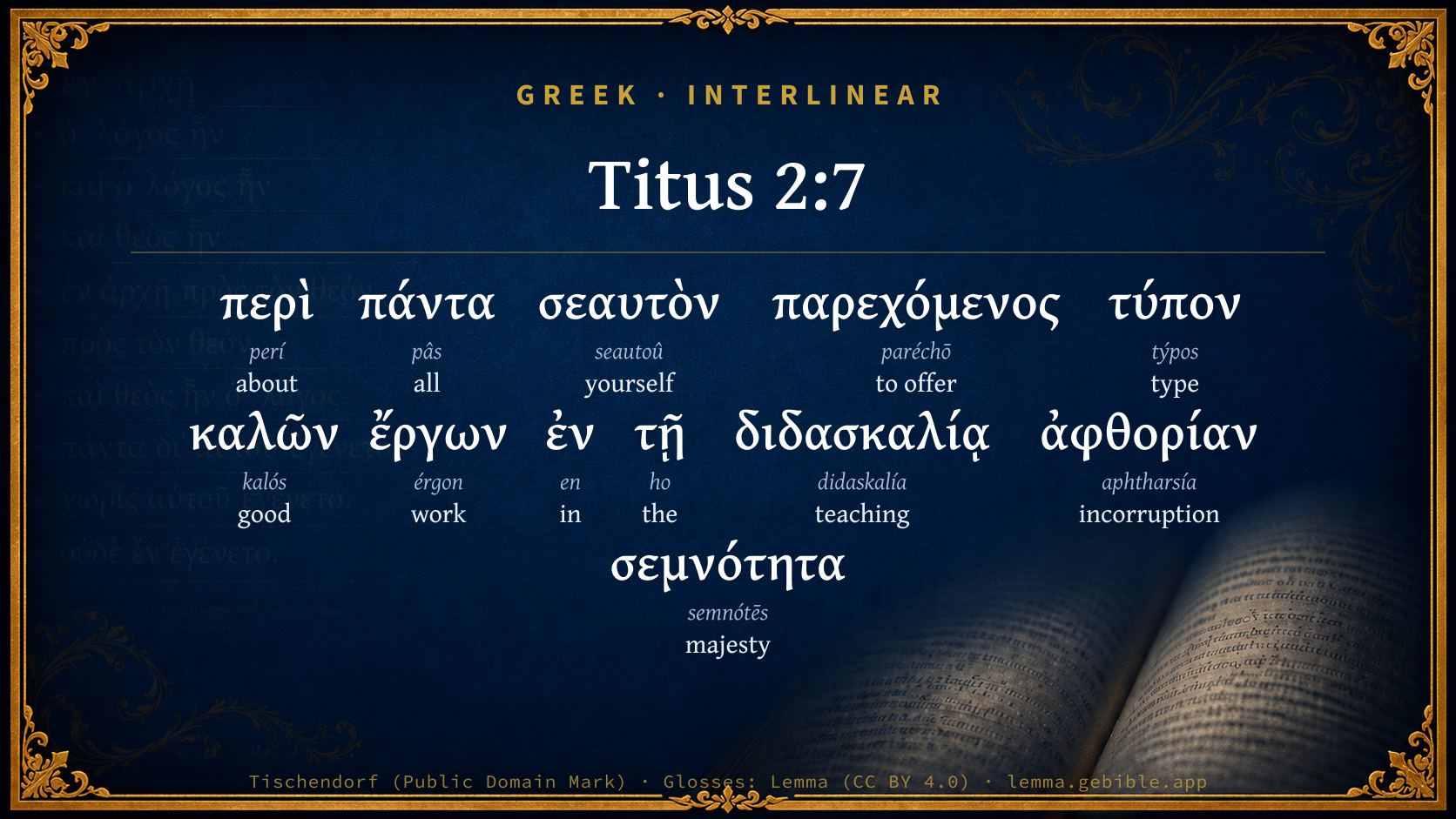
Greek (Tischendorf 8th ed.) Titus 2:7 appears in the Greek New Testament. The text above is from the Tischendorf 8th edition. Each word links to its Strong’s number and a concise gloss. Click any word for its full Thayer’s Greek Lexicon entry.
Download image
Cite this verse

Titus 2:7 (World English Bible). Public Domain. Lemma interlinear Bible study tool, https://lemma.gebible.app/v/titus/2/7.

Show BibTeX & RIS
BibTeX
RIS
English Translation
in all things showing yourself an example of good works; in your teaching showing integrity, seriousness, incorruptibility,
World English Bible · Public Domain
Download a study sheet

One document with this verse’s original text, its word-by-word gloss line, the meaning frame, cross-references with their text, attributed commentary, and full source and license credits — printable, and it pastes into notes with its structure intact.

This verse Autodidact and up

Study sheet (.html) Plain text (.txt)

A passage Seminary Student

Up to 50 verses in one chapter. A passage sheet keeps up to 6 commentary sources and 12 cross-references per verse, in the order this page ranks them, and says so on the sheet whenever that leaves anything out. Ask for a single verse and you get the Autodidact verse sheet above.

Everything on this page stays free to read, with no account — the sheet is a download of what is already on screen, not access to it.

Want to remove ads? Support Godless Engineer
Compare translations 3

The same verse in 3 English versions, stacked beneath the original-language interlinear above. Click any original word for its lexicon entry.

Each is an independent rendering of the whole verse — the interlinear is not word-aligned to these translations.

Highlighted words mark where these versions differ — a whole-verse word diff, not a word-by-word alignment.

  • World English Bible Public Domain
    in all things showing yourself an example of good works; in your teaching showing integrity, seriousness, incorruptibility,
  • King James Version Public Domain
    In all things shewing thyself a pattern of good works: in doctrine shewing uncorruptness, gravity, sincerity,
  • unfoldingWord Literal Text CC BY-SA 4.0
    In everything present yourself an example of good works. In the teaching, incorruption, dignity,

unfoldingWord Literal Text — © unfoldingWord, licensed CC BY-SA 4.0. Word-aligned USFM3 via Door43 (git.door43.org/unfoldingWord/en_ult).

Versions to compare (up to 4)

3 of 4 selected

Show all 19 translations

Every available English version of this verse, each an independent rendering of the whole verse.

  • World English Bible Public Domain
    in all things showing yourself an example of good works; in your teaching showing integrity, seriousness, incorruptibility,
  • Berean Standard Bible Public Domain
    In everything, show yourself to be an example by doing good works. In your teaching show integrity, dignity,
  • Majority Standard Bible Public Domain
    In everything, show yourself to be an example by doing good works. In your teaching show integrity, dignity, incorruptibility,
  • King James Version Public Domain
    In all things shewing thyself a pattern of good works: in doctrine shewing uncorruptness, gravity, sincerity,
  • American Standard Version (1901) Public Domain
    in all things showing thyself an ensample of good works; in thy doctrine `showing' uncorruptness, gravity,
  • Revised Version (1885) Public Domain
    in all things shewing thyself an ensample of good works; in thy doctrine shewing uncorruptness, gravity,
  • Geneva Bible (1599) Public Domain
    In all things shewe thy selfe an ensample of good woorkes with vncorrupt doctrine, with grauitie, integritie,
  • Douay-Rheims (1899) Public Domain
    In all things shew thyself an example of good works, in doctrine, in integrity, in gravity,
  • Young's Literal Translation Public Domain
    concerning all things thyself showing a pattern of good works; in the teaching uncorruptedness, gravity, incorruptibility,
  • Literal Standard Version CC BY-SA 4.0
    Concerning all things, present yourself [as] a pattern of good works—in the teaching [with] uncorruptedness, dignity,
  • Unlocked Literal Bible CC BY-SA 4.0
    In all ways present yourself as an example of good works. In your teaching, show integrity, dignity,
  • unfoldingWord Literal Text CC BY-SA 4.0
    In everything present yourself an example of good works. In the teaching, incorruption, dignity,
  • Darby Bible Public Domain
    in all things affording thyself as a pattern of good works; in teaching uncorruptedness, gravity,
  • World Messianic Bible Public Domain
    In all things show yourself an example of good works. In your teaching, show integrity, seriousness, incorruptibility,
  • Webster's Bible Public Domain
    In all things showing thyself a pattern of good works: in doctrine showing incorruptness, gravity, sincerity,
  • Free Bible Version CC BY-SA 4.0
    You should set an example of doing good in all areas of life: show integrity and seriousness in what you teach,
  • Bible in Basic English Public Domain
    In all things see that you are an example of good works; holy in your teaching, serious in behaviour,
  • Text-Critical English NT CC BY 4.0
    Show yoʋrself to be a model of good works in every way, and in yoʋr teaching show integrity, dignity, incorruptibility,
  • Tyndale New Testament (1534) Public Domain
    Above all thynges shewe thy silfe an insample of good workes with uncorrupt doctryne with honestie

Literal Standard Version (2020), Covenant Press — licensed CC BY-SA 4.0. Text via the HelloAO Bible API (eBible.org). Unlocked Literal Bible (unfoldingWord) — licensed CC BY-SA 4.0. Text via the HelloAO Bible API (eBible.org). unfoldingWord Literal Text — © unfoldingWord, licensed CC BY-SA 4.0. Word-aligned USFM3 via Door43 (git.door43.org/unfoldingWord/en_ult). Free Bible Version, Dr. Jonathan Gallagher — licensed CC BY-SA 4.0. Text via the HelloAO Bible API (eBible.org).

Word by word

More ways to search: Search by grammar → Find every occurrence → Compare this word →

Practice this passage: Drill this verse → Learn its vocabulary →

About this verse

These counts appear in no published source. They are computed here, from the morphology-tagged text and Lemma’s own curated glosses. What Lemma adds →

12
words
12
distinct lemmas
Pauline Epistles
section

Notable vocabulary

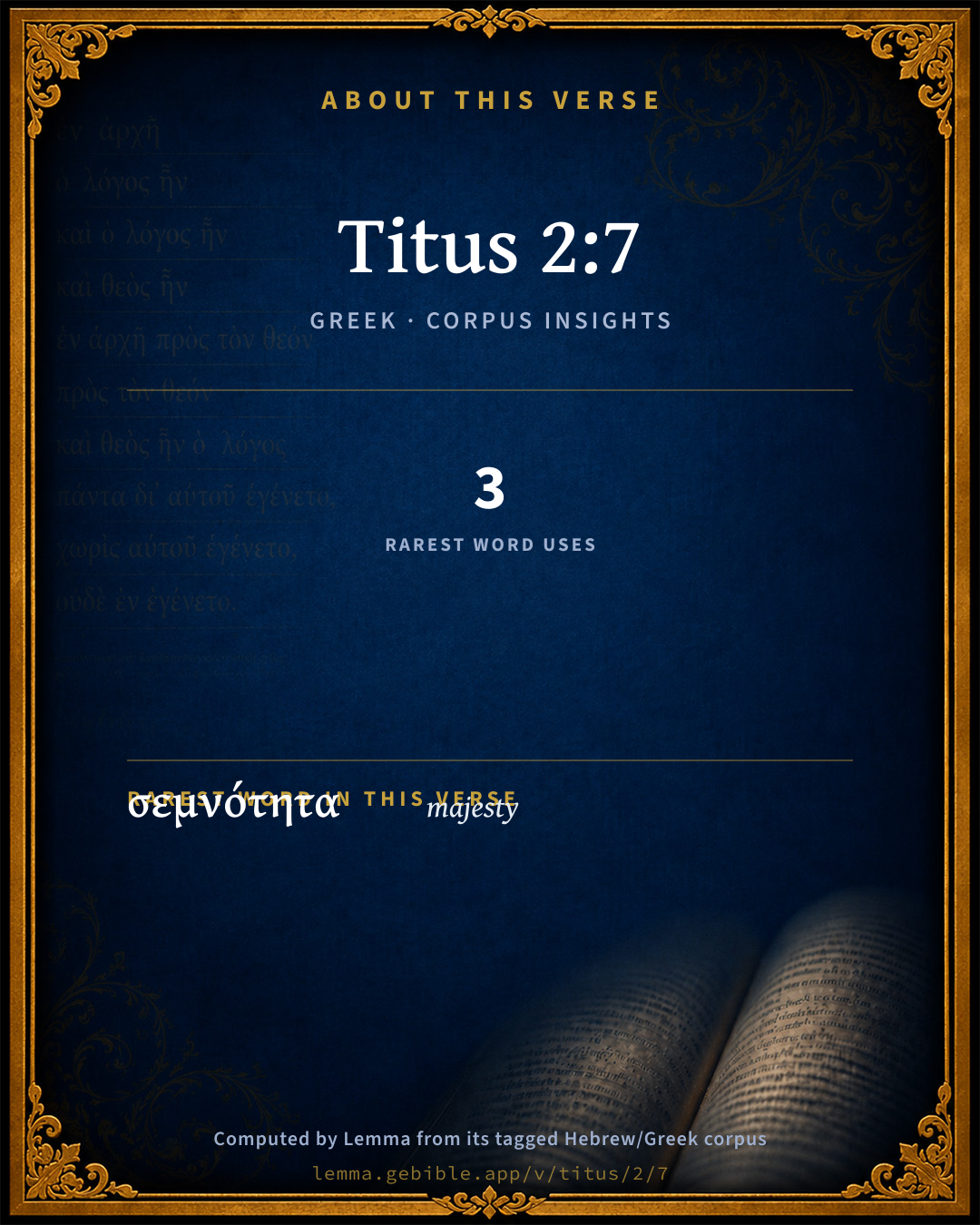
The rarest word here is σεμνότητα majesty G4587 — appearing just 3 times in the whole Greek New Testament.

Shared distinctive vocabulary

σεμνότητα majesty G4587 occurs in 3 verses of the Greek New Testament. Also found in:

Cross-references

9

Topical passages linked to Titus 2:7 in the Treasury of Scripture Knowledge — connected by theme and wording, ordered by reader-vote popularity; previews shown in the World English Bible.

  • 1 Peter 5:3 neither as lording it over the charge allotted to you, but making yourselves examples to the flock.
  • 1 Timothy 4:12 Let no man despise your youth; but be an example to those who believe, in word, in your way of life, in love, in spirit, in faith, and in purity.
  • 2 Corinthians 4:2 But we have renounced the hidden things of shame, not walking in craftiness, nor handling the word of God deceitfully; but by the manifestation of the truth commending ourselves to every man's conscience in the sight of God.
  • Philippians 1:10 so that you may approve the things that are excellent; that you may be sincere and without offense to the day of Christ;
  • 2 Corinthians 1:12 For our boasting is this: the testimony of our conscience, that in holiness and sincerity of God, not in fleshly wisdom but in the grace of God we behaved ourselves in the world, and more abundantly toward you.
  • Ephesians 6:24 Grace be with all those who love our Lord Jesus Christ with incorruptible love. Amen.
  • 2 Thessalonians 3:9 not because we don't have the right, but to make ourselves an example to you, that you should imitate us.
  • 2 Corinthians 2:17 For we are not as so many, peddling the word of God. But as of sincerity, but as of God, in the sight of God, we speak in Christ.
  • 2 Corinthians 8:8 I speak not by way of commandment, but as proving through the earnestness of others the sincerity also of your love.

Cross-references courtesy of OpenBible.info (CC BY 4.0).

Where the printed editions differ

1 variant

Places in this verse where the major printed Greek editions disagree on the wording in a way that affects the translation — a comparison of editions, not a manuscript-by-manuscript collation. The editions are the modern critical texts (Nestlé-Aland 28/27, SBL, Westcott-Hort, Tregelles, Tyndale House) and the traditional texts behind the KJV (the Textus Receptus and the Byzantine/Majority text). It is not a claim about which reading is original.

  1. Extra text
    ἀδιαφθορίαν

    “unspoilable”

    In TRByz Not in NA28NA27TynSBLWHTreg

    ἀδιαφθορίαν (adiaphthorian) 'unspoilable' is only in traditional manuscripts (TR+Byz)

Textual data: Translators Amalgamated Greek New Testament (STEPBible TAGNT) · CC BY 4.0.

Commentary

Notes on Titus 2:7 from classic Christian and Jewish commentators (each source and its license shown beneath its notes). The classic Christian expositions comment on the surrounding passage and are grouped to its opening verse, so a note may address several verses; the Jewish commentaries on the Tanakh (Rashi and others) are per-verse, so they appear only where the commentator wrote on this verse.

Lemma curates 59 commentaries, every one of them public domain or Creative Commons licensed, each selected and text-cleaned for this edition rather than reprinted as found. About our sources →

Albert Barnes' Notes on the Bible

In all things showing thyself a pattern of good works - Not merely teaching others, but showing them by example how they ought to live. On the word rendered “pattern” (τύπον tupon, type), see the Heb 9:5 note; 1Co 10:6 note; Phi 3:17 note.

In doctrine - In your manner of teaching; notes, 1Ti 4:16.

Showing uncorruptness - The word here used does not occur elsewhere in the New Testament. It means, here, the same as purity - that which is not erroneous, and which does not tend to corrupt or vitiate the morals of others, or to endanger their salvation. Everything in his teaching was to be such as to make men purer and better.

Gravity - See this word explained in the notes at 1Ti 2:2, where it is rendered “honesty;” compare the notes at 1Ti 3:4, where it is rendered “gravity.” It does not elsewhere occur; see the use of the adjective, however, in Phi 4:8; 1Ti 3:8, 1Ti 3:11; Tit 2:9. The word properly means “venerableness;” then, whatever will insure respect, in character, opinions, deportment. The sense here is, that the manner in which a preacher delivers his message, should be such as to command respect. He should evince good sense, undoubted piety, an acquaintance with his subject, simplicity, seriousness, and earnestness, in his manner.

Sincerity - See this word (ἀφθαρσία aphtharsia) explained in the notes at Eph 6:24. It is rendered immortality in Rom 2:7; 2Ti 1:10; incorruption, in 1Co 15:42, 1Co 15:50, 1Co 15:53-54; and sincerity, Eph 6:24, and in the place before us. It does not elsewhere occur in the New Testament. It means incorruption, incapacity of decay; and, therefore, would be here synonymous with purity. It should be said, however, that it is wanting in many msS, and is rejected in the later editions of the New Testament by Wetstein, Tittman, and Hahn.

Albert Barnes' Notes on the Bible (1834–1885) — public domain. Text from a community e-Sword/MySword module.

The Biblical Illustrator

Joseph S. Exell

Tit_2:7-8

In all things showing thyself a pattern

A good example

Having propounded the several precepts fitted to all ages of men and women, the last whereof was unto young men, our apostle here inserteth a precept unto Titus himself, whence it is probably gathered that Titus was now a young man, as Timothy also was, in the same office of an evangelist; and being a minister, in him he closely again instituteth every minister, notwithstanding he hath been most ample in that argument, as though ministers could never sufficiently be instructed.

In these two verses we will consider two things.

1. A precept.

2. An enforcement of it.

I. The precept is, That Titus show himself an example to others. For as all the persons formerly taught, so more especially the last sort, namely, young men, for the slipperiness of their age need the benefit of good example as well as good doctrines and counsel. And this exhortation is enlarged by setting down wherein Titus must become an example, which is done, first, more generally, in all things, we read it, above all things; others, above all men, which readings may be true, and grounds of good instruction, but I take the first aptest to the place. Secondly, by a more particular enumeration of shining virtues, as

1. Uncorrupt doctrine.

2. Good life fruitful in good works; and these not one or two, or now and then in good moods, but there must be a constant trading in them throughout a grave and pare conversation.

3. There must be joined gracious speeches and words, for I take it fitliest interpreted of private communication, described by two necessary adjuncts.

1. It must be wholesome.

2. Unblameable, or not liable to reproof.

II. The enforcement of the precept is taken from the end or fruit of it, which is twofold.

1. Shame.

2. Silence to the withstanders and opposers.

And thus the general scope of the verses is as if he had more largely said, That this thy doctrine, O Titus, thus aptly applied to all sorts of men, may carry more weight and authority with it, see thou that (considering thou art set in a more eminent place, and clearer sun, and hast all eyes beholding and prying into thee) thou show thyself a pattern and express type wherein men may behold all these graces shining in thy own life: let them look in thy glass, and see the lively image of a grave and pure conversation, which may allure them to the love of the doctrine which thou teachest: let them hear from thy mouth in thy private conferences and speech nothing but what may work them to soundness; at the least, keep thou such a watch over thy tongue, as that nothing pass thee which may be reprehended, and hence will it come to pass that although thou hast many maliciously minded men, seeking by all means to oppose thy doctrine and life, and to destroy the one by the other, these shall either be put to silence and have nothing to say, or if they take boldness to speak anything, it being unjust, the shame shall be removed from thee and fall justly upon themselves; and all the reproach shall return home to their own doors. (T. Taylor, D. D.)

That he that is of the contrary part may be ashamed

Lessons

I. It is the lot of faithful ministers to have opposites and adversaries: yea, such as are just contrary and directly opposite, for so the word is used (Mar_15:39). The case is clearer than needeth proof. How the prophets were entertained our Saviour showeth by that speech to the Jews, Which of the prophets have not your fathers persecuted and slain? Moses was often resisted by the people, and before he shall go scot free, his own brother and sister shall withstand him; and as he was resisted by Jannes and Jambres, so in all ages to the end men of corrupt minds shall start up to resist the truth. That the disciples and apostles, notwithstanding their apostolical rod and power, were resisted, appeareth by Alexander the coppersmith, who was a sore enemy to Pauls preaching; and Elimas, who was full of subtlety to pervert the truth, and strongly withstood the apostles. How was Christ Himself, the chief Doctor, withstood by the Scribes, Pharisees, Sadducees, rulers, and people, that He had never come into the world if He had not made His reckoning to give His back to the smiters, His face to shame and spitting, yea, Himself to the shameful and accursed death of the cross. If it was thus to the green tree, we shall need seek no further what was done to the dry, but rather to inquire into the reason hereof, and that is this: So long as there is a devil, darkness, and death in mens souls, so long will there be resistance unto God, His light, and life, in whomsoever it is; the devil not only suggesting, but working effectually in the hearts of reprobates, and natural men, to withstand Gods work, as Sanballat and Tobiah used all means to hinder the building of Jerusalem. And so do his instruments, the spirits of devils, go about the world to provoke men unto war against Christ and His little flock. Those spirits of devils are graceless and wicked men, carried by devilish motion and violence against Christ and His kingdom, and the battle between Michael and his angels, and the devil and his angels, shall not cease till time be no more.

II. These that oppose themselves to good ministers and men are ever speaking evil, and opening their mouths with reproaches against them and their Godly courses. Moses was charged, and that not in corners, but to his face, that he took too much upon him, whereas he was unwilling to undertake all that the Lord laid upon him. It went current in court and country that Elias troubled all Israel. Amaziah accuseth Amos to the king, that the land is not able to bear all his words. Diotrephes not only withstood the apostle John, but prattled against him. But what is the reason of all this, have they any cause given them? The reason is partly positive in themselves, and partly negative in the other.

1. In themselves.

(1) The malice of their heart is such as cannot but continually out of the abundance thereof set their tongues at work: the fire within sendeth out such smoke abroad.

(2) With this malice is joined exceeding pride and swelling, which moveth them to seek the raising of themselves, although with the fall of others, and make the reproach of others as a ladder for themselves to climb by.

(3) With this malice and pride is joined exceeding subtlety and policy in their generation. Well know they that they have gotten ever more conquests by the strokes of their tongues than of their hands, and seldom have they failed of their purposes.

2. Now the negative reason in good men themselves, why their withstanders speak evil of them, is set down (1Pe_4:4).

III. Every Godly mans endeavour must be to stop the mouths of such adversaries, and so make them ashamed. But it is an impossible thing they will have always something to say. Yet so live thou as thou mayst boldly appeal unto God. Let thine own conscience be able to answer for thy uprightness, and so thou openest not their mouths; if now they open them against thee, it is their sin and not thine, and thus this precept is expounded (1Ti_5:14). Give no occasion to the adversaries to speak evil. And is enforced with special reason (1Pe_2:12; 1Pe_2:15). This is the will of God, by well doing to silence the ignorance of foolish men. If any shall say, Why I care not what they say on me, they are dogs and wicked men, and what are we to regard them? The apostle telleth us that yet for Gods commandment sake we must not open their mouths, but perform all duties of piety and humanity unto them.

2. Because they watch occasions to traduce, we must watch to cut off such occasions (Luk_6:7). The Scribes and Pharisees watched Christ whether He would heal on the Sabbath, to find an accusation against Him. Christ did the good work, but by His question to them cut off so far as be could the matter of their malice; by clearing the lawfulness of it. So out of their malice we shall draw our own good, and thus it shall be true which the heathen said, that the enemy often hurteth less and profiteth more than many friends.

3. What a glory is it for a Christian thus to slaughter envy itself? To keep shut that mouth that would fain open itself against him? To make him be clothed with his own shame, who sought to bring shame upon him and his profession? When a wretch cannot so put off his forehead as to accuse him whom he abhorreth, no more than he can the sun of darkness when it shineth; yea, when the Prince of the world cometh to sift such a member of Christ, yet He findeth nothing justly to upbraid him withal. (T. Taylor, D. D.)

A scoffer silenced

I remember a story connected with my native place. One of the most saintly of men lived there, Dr. Andrew Symington, a Cameronian minister, Professor of Theology to the Reformed Presbyterian body who represented the old Scottish Covenanters. He was one day walking down the streets of Paisley, and when he came to the Cross there was a knot of men lounging there, among whom was a sort of ruling spirit, a man who liked to scoff at spiritual matters, and at people who lived a spiritual life. Dr. Symington was passing through the group, with his grave, tender look, and as he passed by the crowd, with the scoffing man in their midst, an awe and silence came upon them. He went on; and the man who scoffed just looked after him and whispered, Enoch walked with God! What a sermon to preach! and yet the good man never knew it! (Prof. Graham.)

A consistent Christian

A friend told me of a young man who was a true soldier of the Cross, and suffered much in consequence, not only from his companions, but from his own father, who was overseer in the same works. That young man showed forth Christ in all his actions, even when his companions who worked with him were unusually provoking in tormenting him about his religion, and, I am ashamed to say, were often encouraged in their wickedness by his own father. One morning, after enduring their cruel and insulting words for some time, he turned to them with a calm look and said: Friends, tell me, is there anything in my life that is not consistent in a Christian? If there is, tell it to me, and I will kneel in your presence and ask God to forgive me. Complete silence fell on the men, not one dared to open his mouth as that, young man stood there and challenged them to find anything against him. (Major Mathers.)

The Biblical Illustrator, edited by Joseph S. Exell (c. 1880s–1900s) — public domain. Text from a community e-Sword module.

Joseph Benson's Commentary

Tit 2:7-8. In all things — In all these and other respects not here mentioned; showing thyself a pattern of good works — Of every thing amiable and excellent; of every disposition and practice which thou enjoinest to others. Titus himself was then young. In doctrine — Or in thy teaching, namely, in public; uncorruptness — As to the matter of it; or without any mixture of error; gravity — Or seriousness, as to the manner of delivering it; weightiness, solemnity; sound — Or wholesome; speech — Even in private conversation; that cannot be condemned — Or found fault with on any principles of reason or religion: or, as some render it, that cannot be confuted; that he who is of the contrary part — An unbeliever, or an opposer of the truth; may be ashamed — Of his unbelief of, and opposition to it; having no evil thing to say of you — Of thee, of the elders thy assistants, or of any, whether old or young, who are under thy care, but may be obliged, with all his prejudices, to acknowledge that thou art a worthy president of a worthy and useful society of people.

Joseph Benson's Commentary on the Old and New Testaments (1811–1818) — public domain. Text from a community e-Sword module.

Bengel's Gnomon

Johann Albrecht Bengel

Tit 2:7. [5] ΠΕΡῚ ΠΆΝΤΑ) in all things.—σεαυτὸν, thyself) Even thou, Titus, though rather young thyself.—ἐν τῇ διδασκαλίᾳ, in doctrine) Public doctrine or teaching is intended, to which λόγος, the word, in daily practice is presently opposed. In the case of the former, ἀφθορία and ΣΕΜΝΌΤΗς are required, to which the epithets ὙΓΙῆ and ἈΚΑΤΆΓΝΩΣΤΟΝ correspond in the case of the latter, so that the subject-matter and the form may be rightly framed in the case of both.—ἈΦΘΟΡΊΑΝ) viz. ΠΑΡΕΧΌΜΕΝΟς: here we must not repeat ΣΕΑΥΤΌΝ.

[5] οἰκουροὺς) ver. 5, properly, those who keep the house, Pro 7:11.—V.g.

Bengel's Gnomon of the New Testament — English translation (T&T Clark, Edinburgh, 1860) — public domain. Text from a community e-Sword module.

Meyer's Critical & Exegetical Commentary

Heinrich August Wilhelm Meyer

Tit_2:7-8. The exhortation by word is to be accompanied by the exhortation of example.

περὶ πάντα does not belong to what precedes, but begins a new sentence, and is put first for emphasis. ΙΙάντα is not masculine: towards every one, but neuter: in regard to all things, in all points.

σεαυτὸν παρεχόμενος τύπον καλῶν ἔργων] On the use of the middle παρέχεσθαι with the pronoun ἑαυτόν, show himself, see Winer, p. 242 [E. T. p. 322] (comp. Xenophon, Cyrop. viii. 1.39: παράδειγμα … τοίονδε ἑαυτὸν παρείχετο).

τύπον, type, is in the N. T. only found here with the genitive of the thing.

καλὰ ἔργα] 1Ti_5:10; an expression often occurring in the Pastoral Epistles.

ἐν τῇ διδασκαλίᾳ ἀφθορίαν] This and the following accusatives are dependent on παρεχόμενος; see Col_4:1. Luther inaccurately: with unadulterated doctrine, with sobriety, etc.; Jerome: in doctrina, in integritate et castitate.

ἀφθορία, only in later Greek, is from ἄφθορος (in Artemidorus, ver. 2:95: de virginibus puerisque intactis et illibatis legitur; Reiche; Est_2:2 : κοράσια ἄφθορα καλὰ τῷ εἴδει), which is equivalent to chaste, and therefore means unstained chastity. Ἀδιαφθορία (Rec.) is of more general signification; it is also used of virgin chastity (Artac. 26, Diodorus Siculus, i. 59), but denotes in general soundness, also especially incorruptibility. Older as well as more recent expositors (Heydenreich, Mack, Wiesinger) refer the word here to the disposition: purity of disposition;[1] but it is more in accordance with the context to understand by it something immediately connected with the ΔΙΔΑΣΚΑΛΊΑ, to which ΣΕΜΝΌΤΗΤΑ also refers. Matthies, de Wette, and others refer it (as does Luther also) to the subject-matter of the doctrine; de Wette: incorruptness in doctrine, i.e. unadulterated doctrine. But in that case it would mean the same thing as the following λόγον ὑγιῆ; there is no justification for Bengels interpreting ἘΝ ΔΙΔΑΣΚΑΛΊᾼ to mean public addresses, and λόγον the talk of daily intercourse. According to its original meaning, ἈΦΘΟΡΊΑ is most suitably taken to mean chastity in doctrine, which avoids everything not in harmony with its true subject and aim, and it has a special reference to the form (comp. 1Co_2:1; 1Co_2:3). So, too, van Oosterzee: the form of the doctrine which Titus preaches is to be pure, chaste, free from everything that conflicts with the nature of the gospel

ΣΕΜΝΌΤΗΤΑ, on the other hand, denotes dignity in the style of delivery. Both these things, the ἈΦΘΟΡΊΑ and the ΣΕΜΝΌΤΗς, were injured by the heretics in their ΛΟΓΟΜΑΧΊΑΙς.[2]

λόγον ὑγιῆ ἀκατάγνωστου (ἄπ. λεγ.) refers to the subject-matter of the doctrine: sound, unblameable word, in opposition to the corruptions made by the heretics.

The purpose is thus given: ἵνα ὁ ἐξ ἐναντίας ἐντραπῇ] ὁ ἐξ ἐναντίας (ἅπ. λεγ.), qui ex adverso est; according to Chrysostom: ὁ διάβολος καὶ πᾶς ὁ ἐκείνῳ διακονούμενος; but the next words are against this interpretation. According to Tit_2:5 and 1Ti_6:1, it means the non-Christian opponent of the gospel, and not the Christian heretic (Heydenreich, Wiesinger).

ἐντραπῇ, be ashamed, take shame to oneself; 1Co_4:14; 2Th_3:14. The reason for the shame is contained in the words: μηδὲν ἔχων περὶ ἡμῶν (or ὑμῶν) λέγειν φαῦλον] having nothing wicked to say of us.

If περὶ ἡμῶν be the correct reading, it is not to be limited to Titus and Paul, but should be taken more generally. With the reading ὑμῶν, on the other hand, the apostles words refer to Titus and the churches that follow his example.

[1] Reiche, who prefers the reading ἀδιαφθορίαν, agrees with the exposition of Erasmus: integritas animi nullis cupiditatibus corrupti, non ira non ambitione non avaritia.

[2] Hofmann wishes to refer both words to the subject-matter and form alike, and so, also, with λόγον ὑγιῆ; but we cannot see why in that case Paul does not specially name the latter.

Meyer — Critical and Exegetical Commentary on the New Testament — English translation by Peter Christie, edited by Frederick Crombie (T&T Clark, 1880) — public domain. Text from a community e-Sword module.

Expositor's Greek Testament

ed. W. Robertson Nicoll

Tit 2:7 . περὶ πάντα is joined with the preceding words by Jerome and Lucifer ( ut pudici [ sobrii ] sint in omnibus ), followed by Tischendorf and von Soden. For this use of περί , See on 1Ti 1:19 . St. Paul’s usual phrase is ἐν παντί (fifteen times in all; ten times in 2 Cor.; not in Pastorals), or ἐν πᾶσιν (ten times, five of which are in the Pastorals: 1Ti 3:11 ; 2Ti 2:7 ; 2Ti 4:5 ; Tit 2:9-10 ); also εἰς πάντα , 2Co 2:9 ; κατὰ πάντα , Col 3:20 ; Col 3:22 .

σεαυτὸν παρεχόμενος τύπον : The middle is appropriate with σεαυτὸν ; see reff. given by Deissmann, Bible Studies , trans. p. 254; but with ἀφθορίαν , etc., the active would seem more natural, as in reff. For τύπον , see 1Ti 4:12 , and for καλὰ ἔργα , see 1Ti 3:1 . This exhortation, following νεωτέρους κ . τ . λ ., and also Tit 2:15 , suggest that Titus was comparatively young.

διδασκαλία here is not doctrine (A.V.), but teaching; thy doctrine (R.V.), including the person of the teacher as well as what he says. See note on 1Ti 1:10 .

ἀφθορίαν , σεμνότητα , sincerity … impressiveness, integritatem … gravitatem . See on 1Ti 2:2 . These refer respectively to the principles and the manner of the teacher, while λόγον , κ . τ . λ ., describes the matter of his teaching.

The Expositor's Greek Testament, edited by W. Robertson Nicoll (1897–1910) — public domain. Text from a community e-Sword module.

Geneva Bible (1599)

Geneva Bible translators

Not such a gravity as may drive men from coming to the minister, but such as may cause them to come in most reverent and honest sort.

The sixth admonition: That both the Pastor’s life and doctrine must be sound.

Geneva Bible (1599) marginal notes — public domain. Text via Bolls.life.

Jamieson, Fausset & Brown

Robert Jamieson, A. R. Fausset & David Brown

In--with respect to all things.

thyself a pattern--though but a young man thyself. All teaching is useless unless the teacher's example confirm his word.

in doctrine--in thy ministerial teaching (showing) uncorruptness, that is, untainted purity of motive on thy part (compare Co2 11:3), so as to be "a pattern" to all. As "gravity," &c., refers to Titus himself, so "uncorruptness"; though, doubtless, uncorruptness of the doctrine will be sure to follow as a consequence of the Christian minister being of simple, uncorrupt integrity himself.

gravity--dignified seriousness in setting forth the truth.

sincerity--omitted in the oldest manuscripts.

Jamieson, Fausset & Brown — Commentary Critical and Explanatory on the Whole Bible (1871) — public domain (CC PDM 1.0). Text via the HelloAO Bible API.

Adam Clarke's Commentary

Verse 7. In all things showing thyself a pattern] As the apostle had given directions relative to the conduct of old men, Tit 2:2, of old women, Tit 2:3, of young women, Tit 2:4, and of young men, Tit 2:6, the words περι παντα, which we translate in all things, should be rather considered in reference to the above persons, and the behaviour required in them: showing thyself a pattern of good works to all these persons-being, in sobriety, gravity, temperance, what thou requirest others to be.

In doctrine showing uncorruptness] Mixing nothing with the truth; taking nothing from it; adding nothing to it; and exhibiting it in all its connection, energy, and fulness.

Adam Clarke's Commentary on the Bible (1810–1826) — public domain. Text from a community e-Sword/MySword module.

John Calvin's Commentaries

7. In all things shewing thyself For doctrine will otherwise carry little authority, if its power and majesty do not shine in the life of the bishop, as in a mirror. He wishes, therefore, that the teacher may be a pattern, which his scholars may copy.

A pattern of good works in doctrine, uprightness, gravity In the original Greek the style is here involved and obscure, and this creates ambiguity. First, he makes use of the words in doctrine, and then adds, in the accusative case, integrity, gravity, etc. Without mentioning the interpretations given by others, I shall state that which appears to me to be the most probable. First, I connect these words, of good works in doctrine; for, after having enjoined Titus that, in teaching he shall inculcate the practice of good works, he wishes that good works, which correspond to this doctrine, may be visible in his life; and consequently the preposition in means that they shall be suitable, or shall correspond, to the doctrine. What follows is in no degree obscure; for; in order that he may exhibit a representation of his doctrine in morals, he bids him be “upright and grave.”

John Calvin's Commentaries (1540-1563) — public domain. Text from the Calvin Translation Society English edition (1840s-50s) via the Christian Classics Ethereal Library (ccel.org). Calvin's coverage is partial (roughly two-thirds of the Bible); uncommented books and verses are honest gaps, never fabricated. The 19th-century editor's footnotes and remarks are omitted so the notes are faithfully Calvin's own voice.

Ellicott's Commentary for English Readers

(7) In all things shewing thyself a pattern of good works.—Here St. Paul shows Titus that his especial work is the instruction of no one peculiar class or order, or age or sex, but that he is so to fashion his whole life that it may afford a “pattern” to all—men and women, bond as well as free; in all things a ceaseless activity was prescribed to the superintending presbyter in Crete. In everything that was earnest and true, Titus ought to be the one showing an example to the rest; in peaceful, quiet days, as in times of danger and threatening, he must set the pattern—now of useful labour and toil—now of brave, patient endurance for the Lord’s sake.

In doctrine shewing uncorruptness, gravity, sincerity.—The older authorities omit “sincerity.” Neither of the terms “uncorruptness” and “gravity” refers to the subject-matter of the “doctrine” or “teaching,” but to the bearing and behaviour of the “teacher.” While he occupies the place of a teacher, Titus must show in his life and conversation “uncorruptness”—apthoria, the word found in the older authorities, the meaning of which differs very slightly from the word adiapthoria, found in the received text. He must, in all those points of his life which are connected with his teaching, show a purity (chastity) and freedom from all interested motives; he must be above seeking for popular applause; but besides this “uncorruptness,” in everything touching public instruction he must aim at a certain “gravity,” not only in his public delivery of sermons and lectures, but also in his general private intercourse with his flock. He must, in a word, never forget he is the chief teacher in the Church of Crete of his Master’s religion.

A Bible Commentary for English Readers, edited by Charles John Ellicott (1878–1897) — public domain. Text from a community e-Sword module.

The Cambridge Bible for Schools and Colleges

gen. ed. J. J. S. Perowne

7. shewing thyself] The middle participle and the reflex pron. for emphasis; Winer, iii. 38, 6.

a pattern of good works] The simple word—our ‘type’—here with the thing, as in 1Ti_4:12 with the person. So the compound with the thing, 2Ti_1:13, with the person, 1Ti_1:16. The latter is the first rough model of the sculptor; the former, the model when worked over afterwards with care. So in the sister art, the compound (1Pe_2:21) and the simple word (whence our ‘graphic’) are the ‘pencil drawing’ and the ‘painting.’ See Bp Lightfoot on Clem. Rom. ad Cor. 1. 5, ‘the greatest example of patience.’

The phrase ‘good works’ is perhaps the most striking of the characteristic phrases of the Epistle. See note on Tit_2:3 and on 1Ti_6:18. Its exact force in St Paul’s mind seems to be an echo of Mat_5:16, ‘let your light shine … that they may see your good works (kalos) and glorify your Father.’ The word kalos is ‘good to view as well as good within,’ agathos, ‘good in itself.’ Hence the two are joined to describe ‘a gentleman.’ The Christian religion was felt to be by this time on its trial before the world, and its works must be ‘fair and white’ in the fierce light of ill-wishing scrutiny, which ‘blackens every blot.’

in doctrine shewing uncorruptness] ‘Shewing’ is to be supplied from ‘shewing thyself’ as a second clause; again, the doctrine, as 1Ti_1:10, &c.

‘Uncorruptness’ joined with ‘gravity’ points to the absence of corruption ‘from the intrusion of a lower motive’ in the teacher; ‘with no doubtful motive and no doubtful manner.’ For this sense of ‘uncorruptness’ compare 1Ti_6:5, ‘men corrupted in mind and bereft of the truth, whose motive in religion is gain.’ For ‘gravity’ as before compare 1Ti_2:2. The word rendered ‘sincerity’ in A.V. should be omitted from lack of ms. authority.

The Cambridge Bible for Schools and Colleges (gen. ed. J. J. S. Perowne; Cambridge University Press, 1878–1918) — public domain. Text from a community e-Sword module.

John Gill's Exposition

Exhort servants to be obedient to their own masters,.... And not others, whether they be believers, or unbelievers, gentle or froward, all their lawful commands ought to be obeyed; See Gill on Eph 6:5 and to please them well in all things; not only to obey and serve them, and do what they order, but to seek and endeavour to do it in such a way as may be grateful, acceptable, and well pleasing to them, whereby an interest in their affection, esteem, and commendation, may be gained: and this should be done always, and in all things, that are not contrary to a good conscience and to the Christian religion, and to the laws of God and nature. Or "that they may be well pleased in all things"; that is, be satisfied and contented with such things as they have, and in their state and condition as servants, and cheerfully abide in the calling wherein they are called:

not answering again; replying to their masters' orders, or complaints, either in a pert, or saucy, or grumbling manner; an evil very incident to servants, and which greatly provokes.

John Gill's Exposition of the Whole Bible (1746–1763) — public domain (CC PDM 1.0). Text via the HelloAO Bible API.

Trapp's Complete Commentary

John Trapp

7 In all things shewing thyself a pattern of good works: in doctrine shewing uncorruptness, gravity, sincerity,

Ver. 7. A pattern of good] Gr. τυπος, a stamp. Digging thy sermons out of thine own breast, and living them, when thou hast done.

John Trapp, A Commentary or Exposition upon All the Books of the Old and New Testament (1647–1656) — public domain. Text from a community e-Sword module.

Haydock's Catholic Bible Commentary

In gravity: to which is added in the Protestant [translation] sincerity,[2] from some Greek copies; but it is left out by Dr. Wells, as being not in the best Greek manuscripts nor is it in the Amsterdam edition, (1711.) (Witham)

===============================

[BIBLIOGRAPHY]

In some Greek [copies] is added Greek: aphtharsian, sincerity

George Leo Haydock (1774–1849), Haydock's Catholic Family Bible and Commentary, 1859 edition — public domain. Excludes Psalms (Douay-Rheims chapter numbering differs from Protestant) and Deuterocanonical books (Catholic canon only).

Matthew Poole's English Annotations

In all things showing thyself a pattern of good works: he is an ill teacher of others who teacheth them not by his own example, as well as by his doctrine; for that physician proves ordinarily little valued in his prescriptions to his patients, whom they know to be in the same danger, and sick of the same disease, and yet refuseth himself to use what he prescribeth others: the patients will surely say to him:

Physician, heal thyself. The apostle therefore requires of Titus that he should be himself a pattern of holiness; and those ministers who are not so, vainly persuade others to be such. People (let ministers say what they will) will believe little danger to be in those courses in which their leader himself walks.

In doctrine showing uncorruptness; preaching not rotten, but sound doctrine; and doing it with authority, and

gravity, and

sincerity; the word is αφθαρσιαν, incorruptibility. It is not read in many copies, nor translated by many interpreters; and is much of the same sense with αδιαφθοριαν, which is the first word, by our translation interpreted uncorruptness.

Matthew Poole's English Annotations on the Holy Bible (1683–1685) — public domain. Text from a community e-Sword/MySword module.

Whedon's Commentary on the Bible

Daniel D. Whedon

7. Pattern—Greek, a type, a model, a living exemplification of his own sober teaching.

Daniel D. Whedon (gen. ed.), Commentary on the Old and New Testaments (1874–1909) — public domain. Text from a community e-Sword module.

The Pulpit Commentary

An ensample for a pattern, A.V; thy doctrine for doctrine, A.V; R.T. omits sincerity (afyarsian), which is in the T.R. In all things (peri panta); as 1Ti_1:19 ( peri thstin); "concerning, in the matter of" (Ellicott on 1Ti_1:19). St. Jerome and others connect these words with the preceding clause, "to be sober-minded in all things." But it is usually taken as in the text, "in all things showing thyself," etc. Showing thyself, etc. With regard to the somewhat unusual addition of the reflexive pronoun to the verb in the middle voice, Bishop Ellicott remarks, "Emphasis and perspicuity are gained" by it. An ensample ( tupon). Huther remarks that this is the only passage in the New Testament where tupov is followed by a genitive of the thing. In 1Ti_4:12 the genitive is of the person to whom the example is given, in word, in conversation, etc., and in 1Pe_5:3, tupov tou pomniou . Of good works. (comp. Tit_3:8) Note the stress laid by St. Paul upon Christian practice as the result of sound doctrine. Mere talk is absolutely worthless. Uncorruptness (afyorian , or, as T.R., adiafyorian); only here in the New Testament, and not in the LXX or in classical Greek. Afyoria has the best manuscript authority; but the sense of adiafyoria as deduced from the good classical word adiafyorov , which means among other things "incorruptible not to be influenced by entreaties or bribes seems to make it preferable. The word describes the quality of the teacher rather than of his doctrine. He is to preach the truth without fear or favor. Gravity (semnothta); as 1Ti_2:2 1Ti_3:4. This, again, is a quality of the teacher. These accusatives depend upon parecomenov . But the construction of the sentence is somewhat irregular for brevity"s sake.

Vers. 7, 8. Titus himself a pattern of good works.

As a faithful minister of God, he was to mirror forth in his life and teaching the doctrines of the gospel.

I THE MINISTER OUGHT TO BE A PATTERN OF GOOD WORKS.

1. His teaching is useless unless it is enforced by the power of a holy example. There must be a harmony between his doctrine and his life.

2. Good works are the natural proofs of good principles, and can only issue from the fountain of a purified heart. The very principles are tested by the preacher"s life.

3. His whole life is to be an ensample. "In all things." This implies consistency in toil, endurance, and teaching.

II THE MINISTER MUST BE A PATTERN BOTH IN THE SUBSTANCE AND IN THE SPIRIT OF HIS TEACHING. Teaching is his special sphere.

1. It must be imparted in a right spirit. "In doctrine showing uncorruptness and gravity.

(1) He must exhibit an example of personal sincerity, not like one either seeking for applause or influenced by interested motives like the false teachers who were in quest of filthy lucre. Sincerity has a very penetrative force among a people.

(2) He must have a dignified gravity of manner, to indicate his profound seriousness of purpose and spirit. Foolish jesting and vain talking are very inconvenient in g minister of the gospel.

2. The doctrine imparted must be sound and convincing. "Sound speech, that cannot be condemned.

(1) It must be wholesome doctrine, as contrasted with a sickly pietism; free from error, because drawn from "the sincere milk of the Word," conveyed not in the enticing words of man"s wisdom," but as the Holy Ghost teacheth.

(2) It must have convincing power. "That cannot be condemned.

(a) Ministers must expect their words to be sharply criticized as well as their lives.

(b) The truth ought to be conveyed in such a spirit and with such a regard to the analogy of faith that it cannot be justly found fault with.

(c) It must effectually silence gainsayers. "That he that is of the contrary part may be ashamed, having no bad thing to say of us." Whether the adversary be a false teacher or a pagan, the sound speech ought to reduce him to shame and silence. T.C.

Vers. 7, 8. A teacher"s influence.

Titus is to remember that personal character is the most eloquent counsel and the most convincing argument of the gospel.

I PATTERS. Not a slavish example of mere deeds. For this is not the gospel ideal. We are not to copy mere actions, but to catch the spirit of the teacher. This makes true art, and it makes also true religion. We admire the pattern, but we do not copy it by "the rule of thumb," but by the adoption of the same spirit. Christ in us. The mind of Christ.

II DOCTRINE. Not mere dogma, which is an artificial thing, and may or may not be true, according as the authority which gives it may be wise and enlightened, or ignorant and superstitious. Doctrine is different. It is a revealed truth which has its response in the heart and conscience, and its attestation in life. This the gospel has. And he is to show "uncorruptness;" that is, he is not to defile it with worldly compromises. And "gravity;" for it is not meant to be the light theme of intellectual discussion, but the gravest matter of obedience. And "sincerity." It is not to be preached for expedient reasons, as, for instance, the security of life, or the safety of the state, or the ways in which even Socrates would have men honor the gods, although inwardly he disbelieved in them; but with sincerity of conviction as to their reality and truth.

III SOUND SPEECH. No hollow rhetoric. No statements in excess of fact for the sake of impression; but sound all through in argument, illustration, and attestation. Such conduct and speech will shame those who "see the fruits," and can say no "evil" of us. W.M.S.

The Pulpit Commentary (1880–1919), ed. H.D.M. Spence-Jones & Joseph S. Exell — public domain. Text from a community e-Sword module.

John Wesley's Explanatory Notes

Showing thyself a pattern - Titus himself was then young. In the doctrine which thou teachest in public: as to matter, uncorruptness; as to the manner of delivering it, seriousness - Weightiness, solemnity.

John Wesley, Explanatory Notes Upon the Whole Bible (1754–1765) — public domain. Text via the GEBible commentary corpus.

Fairbairn on Ezekiel, Jonah & the Pastoral Epistles

Patrick Fairbairn

Ver. 7. Not only teach and exhort so, but—having respect to Titus, as himself comparatively a young man—showing thyself (the σεαυτὸν used with the middle voice, though it might have been dispensed with, for the sake of greater distinctness and emphasis; see Winer, Gr. § 38, 6, who points to a similar instance, with the same verb, in Xen. Cyr. viii. 1, 39, παράδειγμα τοιόνδε ἑαυτὸ̀ν παρείχετο) in all things a pattern of good works—(τύπον used here only with the genitive of the thing)—in your teaching [showing] incorruption, gravity? (The correct text here evidently is ἀφθορίαν, σεμνότητα. L and certain cursives insert ἀφθορίαν after the two; and instead of ἀφθορίαν, ἀδιαφθορίαν is the reading of L and some others.) The latter of these two expressions must plainly be referred to the manner, not to the matter, of the teaching; and this renders it natural that we should also regard the other in the same light—should understand it subjectively of the teacher, not of what was taught by him. This is confirmed also by the circumstance, that the verse which follows has respect to the substance or matter of the teaching. By requiring Titus to show a spirit of incorruption, as well as gravity, in his teaching, the apostle appears to have meant, that in his very mode of communicating divine truth, he should give unmistakeable evidence of a mind freed from all corrupt tendencies and prurient imaginations—a mind in full accord with the sublime realities and holy aims of the gospel of Christ.

Patrick Fairbairn — An Exposition of Ezekiel (1851), Jonah (1849), and The Pastoral Epistles (1874) — public domain. Text from a community e-Sword module.

Burkitt's Expository Notes on the New Testament

William Burkitt

St. Paul having directed Titus what doctrine to preach, comes now to instruct him what example to lead, in all things show thyself a pattern of good works; as if he had said, In all the good which thou exhortest thy hearers to, be an eminent pattern of it thyself; that they may see that visibly in thy life, which thou pressest upon them by thy preaching. By piety and good works second thy doctrine; there must be a sweet harmony between a minister’s doctrine and his conversation; otherwise he pulls down faster than he builds up: an heterodox conversation will carry an orthodox preacher to hell.

He closes this admonition to Titus concerning preaching, with this solemn charge, namely, that his doctrine be sound and profitable, sincere without mixture, grave without levity, sound words that can never be confuted by gainsayers, which must be expected; but happy will you be if they can have nothing justly to charge your doctrine or conversation with.

Learn hence, that the ministers of God have ever had, and must always expect, some that will withstand, oppose, and gainsay them, as long as there is a devil in the world: and so long as the ministers of God endeavour to batter down the walls of his kingdom, he will raise up storms about their ears.

Learn, 2. That it is the duty, and must be the care and endeavour, of all the ministers of God, to oblige themselves to such an exemplary piety of conversation, as may stop the mouth of slander. That the contrary part may be ashamed, having no evil to say against them.

William Burkitt's Expository Notes on the New Testament (1700–1703) — public domain. Text from a community e-Sword module.

The People's New Testament

B. W. Johnson

7, 8. Showing thyself a pattern. While exhorting others. Showing uncorruptness. Sincerity.

B. W. Johnson's The People's New Testament with Notes (1889–1891) — public domain. Electronic text from the Christian Classics Ethereal Library (CCEL) ThML edition.

Cambridge Greek Testament for Schools and Colleges

7. ἐν τῇ διδασκαλία ἀφθορίαν. This is undoubtedly the true reading and is found in א*ACD2*E*KLP; G has ἀφθονίαν. The rec. text has ἀδιαφθορίαν with אcD2cE**L and cursives.

After σεμνότητα the rec. text adds ἀφθαρσίαν, with D2cE**KL and about 30 cursives; instead of which C and a few other authorities have ἁγνείαν. But neither addition is sufficiently well supported to entitle it to a place in the text.

7. περὶ πάντα σεαυτὸν παρεχόμενος τύπον καλῶν ἔργων, in all things shewing thyself an example of good works. The use of the reflexive pronoun along with the middle voice of the verb makes the personal application of the injunction more pointed. Example is better than precept, and Titus is to set an example in his own person. For the use of τύπος cp. 1Ti 4:12, and the note thereon; and for the stress laid on καλὰ ἔργα in the Pastorals and the significance of the adjective καλός see on 1Ti 2:10.

It will be remembered that these words, together with those of Tit 2:8 and of Tit 2:12, form the substance of one of the solemn questions which are put to a bishop before his consecration.

ἐν τῇ διδασκαλίᾳ ἀφθορίαν, σεμνότητα, in thy teaching (shewing) uncorruptness, gravity. These two attributes have reference to the qualities of the teacher, rather than to the content of the doctrine taught; the character of that is defined by the words which follow. σεμνότης (see on 1Ti 2:2) is peculiarly a quality of persons, not of doctrine; and ἀφθορία (ἄπ. λεγ. in N.T.) well expresses the single-mindedness and sincerity which a teacher of sacred things should exhibit. It signifies his whole-heartedness, while σεμνότης rather has reference to his outward demeanour.

ἡ διδασκαλία here is to be taken actively, thy teaching, and not (as in the A.V. and R.V.) in the objective sense of the doctrine taught. It has been pointed out in the note on 1Ti 1:10, that it is used in both senses in the Pastoral Epistles, but here the context as well as the close juxtaposition of the verb παρακαλεῖν (παράκλησις exhortation being contrasted with διδασκαλία instruction, as at 1Ti 4:13) seems to require us to translate teaching, as Wiclif’s version has it.

The A.V. has at the end of this verse the additional attribute sincerity, the rendering of ἀφθαρσίαν of the rec. text. But as the critical note shews, it is a later gloss, and not entitled to a place in the text at all.

Cambridge Greek Testament for Schools and Colleges (Cambridge University Press, 1896; 21 vols, various authors incl. Carr, Maclear, Plummer, Farrar, Lumby, Moule, M. R. James, Simcox) — public domain. Text from a community e-Sword module.

International Critical Commentary

7. περὶ πάντα] possibly with σωφρονεῖν, “tam mente quam corpore … in omnibus rebus, ne honores indebitos appetamus, ne accendamur avaritia, ne ulla passione superemur” (Jerome), but more probably with παρεχόμενος, being expanded in the following words; cf. 1Ti 4:12.

παρεχόμενος] scarcely different from the active in Hellenistic Greek, cf. Col 4:1; and fairly common with the reflexive pronoun in inscriptions; cf. Deissmann, B.S., p. 254; Moulton, N.T. Greek, 1, 2. pp. 155-59.

ἐν τῇ διδασκαλίᾳ] “in your teaching,” to be joined with all the following words ἀφθορίαν . . . ἀκατάγνωστον.

ἀφθορίαν] the quality of the ἄφθορος, chaste, pure (cf. M.M. s.v.): purity of motive, without desire of gain (cf. 1:11) or respect of persons, and purity of doctrine (Cf. 2Co 4:2 ἀπειπάμεθα τὰ κρυπτὰ τῆς αἰσχύνης, μὴ περιπατοῦντες ἐν πανουργίᾳ μηδὲ δολοῦντες τὸν λόγον).

σεμνότητα] dignity of phrase and utterance. λόγον ὑγιῆ, the message in true proportion, well-balanced; cf. ἐξ ὑγιοῦς καὶ ἐπʼ ἀληθείας, Pap. Oxyr. ii. p. 215. ἀκατάγνωστον (found in 2 Mac 4:47 and in several contemporary epitaphs; Deissmann, B.S., p. 200), not liable to be censured, criticized, silenced; contrast 1:10, 3:11, Gal 2:11.

International Critical Commentary — older volumes (1896–1929), various authors — public domain. Text from a community e-Sword module.

Vincent's Word Studies in the New Testament

Marvin R. Vincent

In all things [περι παντα] . Lit. concerning all things. The exact phrase, N. T. o. For analogous use of peri comp. Luk 10:40, 41; Act 19:25; 1Ti 1:19; 1Ti 6:4, 21; 2Ti 3:8.

Shewing thyself [σεαυτον παρεχομενος] . See on 1Ti 1:4. The phrase N. T. o. but occurs in Class., as, to show one's self holy or righteous; wise or skillful; parecein to make himself scarce. 154 Incorruptness [αφθοριαν] . Const. with shewing. N. T. o. o Class. LXX once, Hag 2:18. Omit sincerity.

Marvin R. Vincent, Word Studies in the New Testament (1887–1900) — public domain. Text from a community e-Sword/MySword module.

Lesson kit

Teaching starters — assembled from the data on this page, not authored interpretation. Every prompt links to the verse data it draws on. Edit before teaching.

Titus, in the Pauline Epistles, opens this verse with 12 words (12 distinct Greek lemmas). Its most distinctive word is semnótēs (“majesty”). A historical commentator’s framing appears above. Read the whole chapter for the surrounding context.

Discussion questions

  1. What does “majesty” (semnótēs) contribute to the verse as a whole?
  2. 1 Timothy 2:2 shares the word «majesty» with this verse. How do the two illuminate each other?
  3. These translations render this verse differently; the difference is in the English rendering, not the original. What questions does that raise?
  4. Reading how Albert Barnes' Notes on the Bible and The Biblical Illustrator read this verse, where do the two commentators agree and where do they part?

Things to notice

Reading settings

Reading text

Shown beneath each verse's original-language words.

Old Testament
Old Testament edition

Read the OT as the Masoretic Hebrew (MT) or the Greek Septuagint (LXX).

English shown for the Greek Septuagint (in the Hebrew ↔ Greek comparison).

Comparing translations? Open the Compare panel on any verse page to stack up to four side by side.