Exodus 28:39

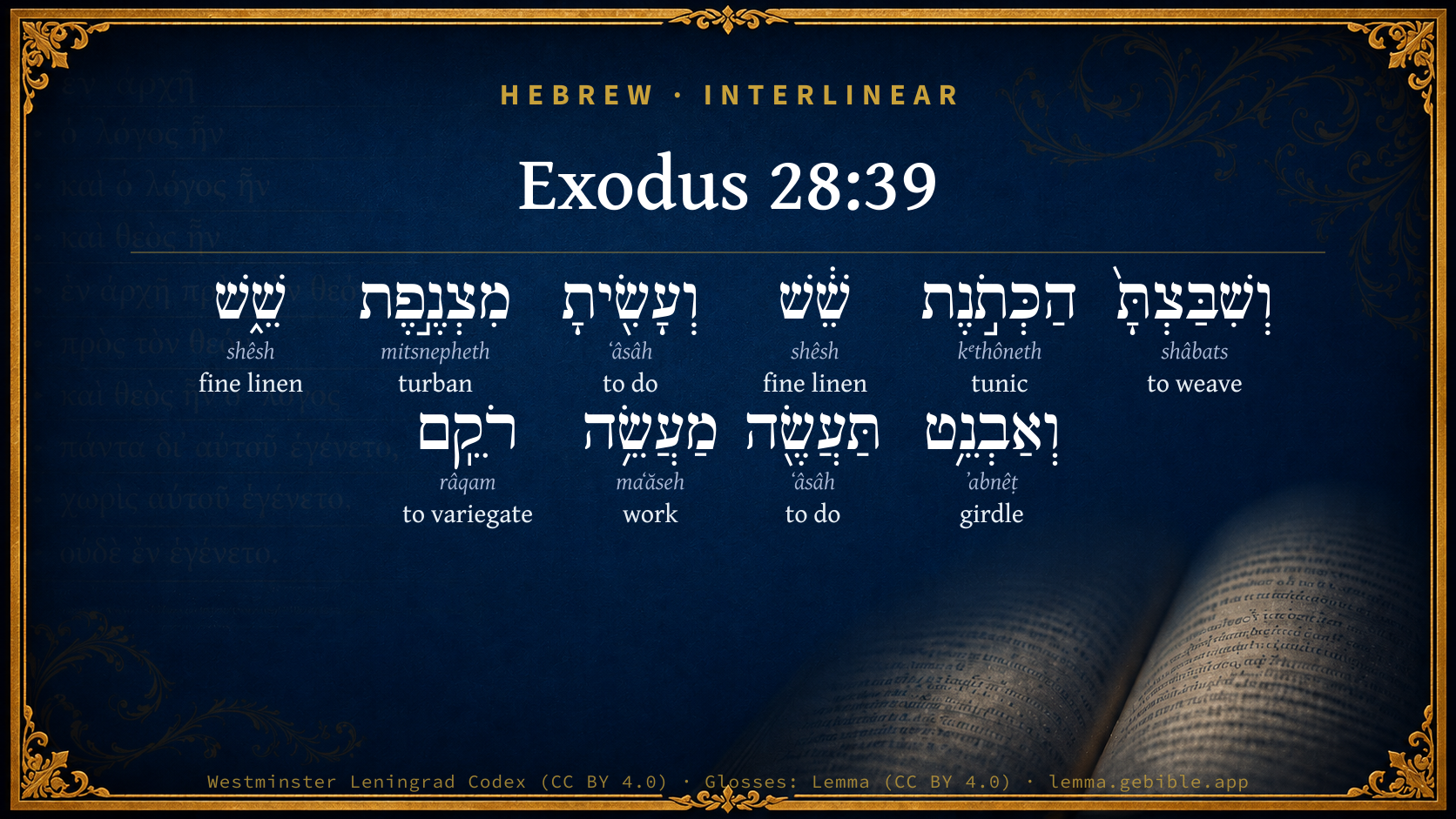
Hebrew (Westminster Leningrad Codex) Exodus 28:39 appears in the Hebrew Old Testament. The text above is from the Westminster Leningrad Codex. Each word links to its Strong’s number, a concise gloss, and parsing drawn from the Open Scriptures Hebrew Bible morphology. Click any word for its full Brown-Driver-Briggs (BDB) entry.
Download image
Cite this verse

Exodus 28:39 (World English Bible). Public Domain. Lemma interlinear Bible study tool, https://lemma.gebible.app/v/exodus/28/39.

Show BibTeX & RIS
BibTeX
RIS
English Translation
You shall weave the coat in checker work of fine linen, and you shall make a turban of fine linen, and you shall make a sash, the work of the embroiderer.
World English Bible · Public Domain
Download a study sheet

One document with this verse’s original text, its word-by-word gloss line, the meaning frame, cross-references with their text, attributed commentary, and full source and license credits — printable, and it pastes into notes with its structure intact.

This verse Autodidact and up

Study sheet (.html) Plain text (.txt)

A passage Seminary Student

Up to 50 verses in one chapter. A passage sheet keeps up to 6 commentary sources and 12 cross-references per verse, in the order this page ranks them, and says so on the sheet whenever that leaves anything out. Ask for a single verse and you get the Autodidact verse sheet above.

Everything on this page stays free to read, with no account — the sheet is a download of what is already on screen, not access to it.

Want to remove ads? Support Godless Engineer
Compare translations 3

The same verse in 3 English versions, stacked beneath the original-language interlinear above. Click any original word for its lexicon entry.

Each is an independent rendering of the whole verse — the interlinear is not word-aligned to these translations.

Highlighted words mark where these versions differ — a whole-verse word diff, not a word-by-word alignment.

  • World English Bible Public Domain
    You shall weave the coat in checker work of fine linen, and you shall make a turban of fine linen, and you shall make a sash, the work of the embroiderer.
  • King James Version Public Domain
    And thou shalt embroider the coat of fine linen, and thou shalt make the mitre of fine linen, and thou shalt make the girdle of needlework.
  • unfoldingWord Literal Text CC BY-SA 4.0
    And you shall weave the tunic with fine linen, and you shall make a turban of fine linen. And you shall make a sash, the work of an embroiderer.

unfoldingWord Literal Text — © unfoldingWord, licensed CC BY-SA 4.0. Word-aligned USFM3 via Door43 (git.door43.org/unfoldingWord/en_ult).

Versions to compare (up to 4)

3 of 4 selected

Show all 18 translations

Every available English version of this verse, each an independent rendering of the whole verse.

  • World English Bible Public Domain
    You shall weave the coat in checker work of fine linen, and you shall make a turban of fine linen, and you shall make a sash, the work of the embroiderer.
  • Berean Standard Bible Public Domain
    You are to weave the tunic with fine linen, make the turban of fine linen, and fashion an embroidered sash.
  • Majority Standard Bible Public Domain
    You are to weave the tunic with fine linen, make the turban of fine linen, and fashion an embroidered sash.
  • King James Version Public Domain
    And thou shalt embroider the coat of fine linen, and thou shalt make the mitre of fine linen, and thou shalt make the girdle of needlework.
  • American Standard Version (1901) Public Domain
    And thou shalt weave the coat in checker work of fine linen, and thou shalt make a mitre of fine linen, and thou shalt make a girdle, the work of the embroiderer.
  • Revised Version (1885) Public Domain
    And thou shalt weave the coat in chequer work of fine linen, and thou shalt make a mitre of fine linen, and thou shalt make a girdle, the work of the embroiderer.
  • Geneva Bible (1599) Public Domain
    Likewise thou shalt embroyder the fine line coat, and thou shalt make a miter of fine line, but thou shalt make a girdell of needle worke.
  • Douay-Rheims (1899) Public Domain
    And thou shalt gird the tunick with fine linen, and thou shalt make a fine linen mitre, and a girdle of embroidered work.
  • Young's Literal Translation Public Domain
    `And thou hast embroidered the coat of linen, and hast made a mitre of linen, and a girdle thou dost make -- work of an embroiderer.
  • Literal Standard Version CC BY-SA 4.0
    And you have embroidered the coat of linen, and have made a turban of linen, and you make a girdle—the work of an embroiderer.
  • Unlocked Literal Bible CC BY-SA 4.0
    You must make the coat with fine linen, and you must make a turban of fine linen. You must also make a sash, the work of an embroiderer.
  • unfoldingWord Literal Text CC BY-SA 4.0
    And you shall weave the tunic with fine linen, and you shall make a turban of fine linen. And you shall make a sash, the work of an embroiderer.
  • Darby Bible Public Domain
    And thou shalt weave the vest of byssus; and thou shalt make a turban of byssus; and thou shalt make a girdle of embroidery.
  • World Messianic Bible Public Domain
    You shall weave the tunic with fine linen. You shall make a turban of fine linen. You shall make a sash, the work of the embroiderer.
  • Webster's Bible Public Domain
    And thou shalt embroider the coat of fine linen, and thou shalt make the miter of fine linen, and thou shalt make the girdle of needle-work.
  • Free Bible Version CC BY-SA 4.0
    Weave the tunic with finely-spun linen and make the turban of the same material, and also make a sash and have it embroidered.
  • Bible in Basic English Public Domain
    The coat is to be made of the best linen, worked in squares; and you are to make a head-dress of linen, and a linen band worked in needlework.
  • JPS Tanakh (1917) Public Domain
    And thou shalt weave the tunic in chequer work of fine linen, and thou shalt make a mitre of fine linen, and thou shalt make a girdle, the work of the weaver in colours.

Literal Standard Version (2020), Covenant Press — licensed CC BY-SA 4.0. Text via the HelloAO Bible API (eBible.org). Unlocked Literal Bible (unfoldingWord) — licensed CC BY-SA 4.0. Text via the HelloAO Bible API (eBible.org). unfoldingWord Literal Text — © unfoldingWord, licensed CC BY-SA 4.0. Word-aligned USFM3 via Door43 (git.door43.org/unfoldingWord/en_ult). Free Bible Version, Dr. Jonathan Gallagher — licensed CC BY-SA 4.0. Text via the HelloAO Bible API (eBible.org).

Word by word

More ways to search: Search by grammar → Find every occurrence → Compare this word →

Practice this passage: Drill this verse → Learn its vocabulary →

וְשִׁבַּצְתָּ֙
shâbats
H7660
“and · to weave”
Conjunction + Verb, Piel, Sequential Perfect, 2nd Person, Masculine, Singular
Part of Speech
Conjunction + Verb
Stem
Piel
Form
Sequential Perfect
Person
2nd Person
Gender
Masculine
Number
Singular
Full BDB Definition

Origin: a primitive root

TWOT: 2320

to weave in checkered or plaited work or pattern (meaning probable) - (Piel) to weave, plait - (Pual) inwoven, set (participle)
  1. הַכְּתֹ֣נֶת kᵉthôneth H3801 “the · tunic” Particle, Definite Article + Noun, Common, Feminine, Singular, Absolute
  2. שֵׁ֔שׁ shêsh H8336 “fine linen” Adjective, Cardinal number, Feminine, Singular, Absolute
  3. וְעָשִׂ֖יתָ ʻâsâh H6213 “and · to do” Conjunction + Verb, Qal, Sequential Perfect, 2nd Person, Masculine, Singular
  4. מִצְנֶ֣פֶת mitsnepheth H4701 “turban” Noun, Common, Feminine, Singular, Absolute
  5. שֵׁ֑שׁ shêsh H8336 “fine linen” Adjective, Cardinal number, Feminine, Singular, Absolute
  6. וְאַבְנֵ֥ט ʼabnêṭ H73 “and · girdle” Conjunction + Noun, Common, Masculine, Singular, Absolute
  7. תַּעֲשֶׂ֖ה ʻâsâh H6213 “to do” Verb, Qal, Imperfect, 2nd Person, Masculine, Singular
  8. מַעֲשֵׂ֥ה maʻăseh H4639 “work of” Noun, Common, Masculine, Singular, Construct
  9. רֹקֵֽם râqam H7551 “variegating” Verb, Qal, Participle Active, Masculine, Singular, Absolute

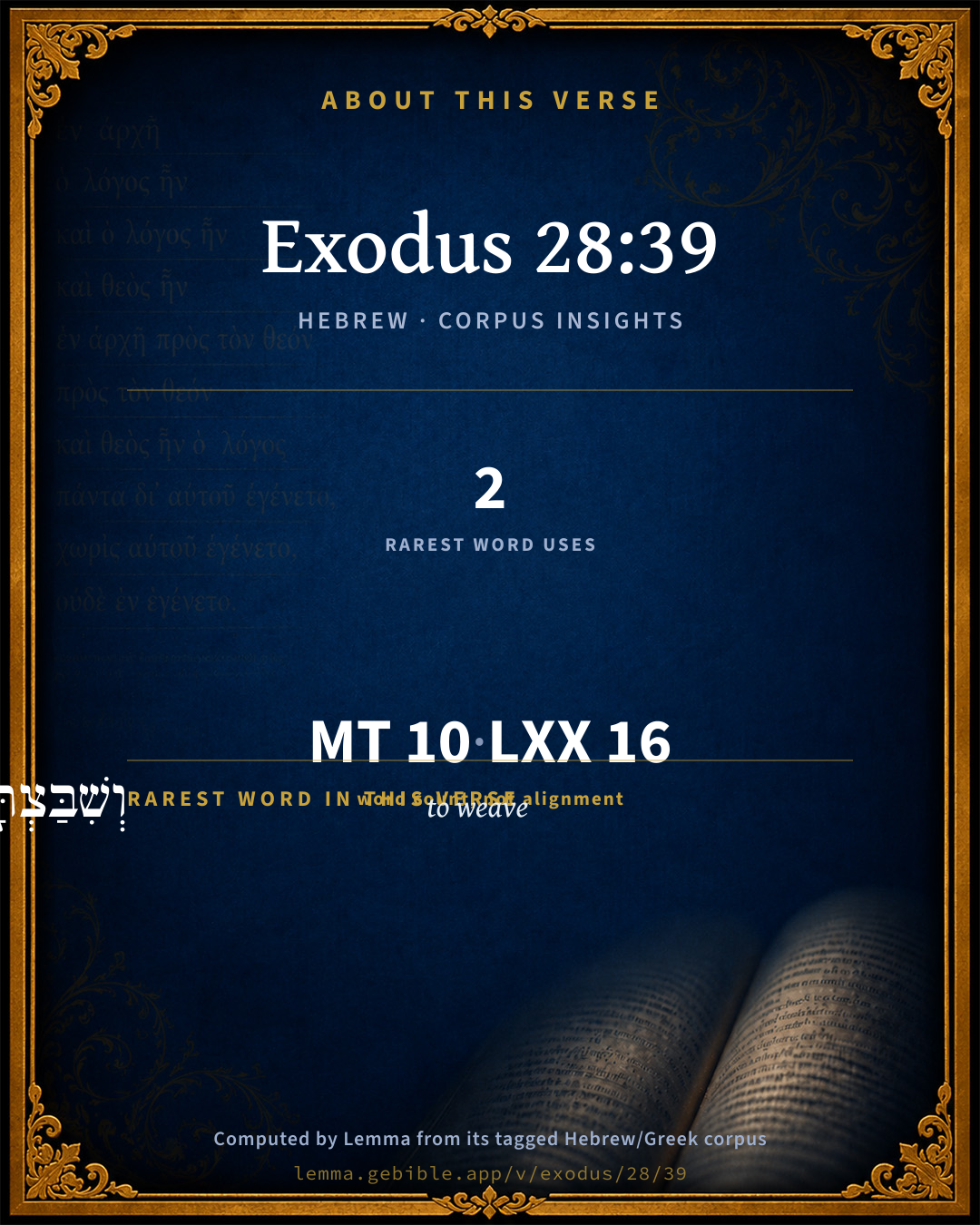
About this verse

These counts appear in no published source. They are computed here, from the morphology-tagged text and Lemma’s own curated glosses. What Lemma adds →

10
words
8
distinct lemmas
Pentateuch
section

Notable vocabulary

The rarest word here is וְשִׁבַּצְתָּ֙ to weave H7660 — appearing just 2 times in the whole Hebrew Bible.

Shared distinctive vocabulary

וְשִׁבַּצְתָּ֙ to weave H7660 occurs in 2 verses of the Hebrew Bible. Also found in:

Grammatical profile

  • 4 verbs
  • 4 nouns
  • 2 adjectives

Verb forms

  • וְשִׁבַּצְתָּ֙ Piel · Sequential Perfect
  • וְעָשִׂ֖יתָ Qal · Sequential Perfect
  • תַּעֲשֶׂ֖ה Qal · Imperfect
  • רֹקֵֽם Qal · Participle Active

Repetition

Words recur within this verse — often emphatic in Hebrew:

  • שֵׁ֔שׁ fine linen H8336 ×2
  • וְעָשִׂ֖יתָ to do H6213 ×2

Hebrew & Septuagint length

In English translation the verse runs 31 words from the Hebrew and 53 from the Septuagint (LXX English) — the Septuagint runs noticeably longer here. See the side-by-side →

A rough comparison of the two English renderings, which tokenize alike — not a word-level alignment.

Word counts can differ between the Hebrew and the Greek without any difference in meaning — e.g. the Hebrew direct-object marker אֵת has no separate Greek word, and Greek often adds the article ὁ.

In the original languages it is 10 Hebrew tokens and 16 Greek tokens — but the two are counted differently (Hebrew bundles its prefixes and suffixes into one token; the Greek is in lemma form), so that isn’t a like-for-like length.

Cross-references

1

Topical passages linked to Exodus 28:39 in the Treasury of Scripture Knowledge — connected by theme and wording, ordered by reader-vote popularity; previews shown in the World English Bible.

  • Psalms 45:14 She shall be led to the king in embroidered work. The virgins, her companions who follow her, shall be brought to you.

Cross-references courtesy of OpenBible.info (CC BY 4.0).

Hebrew and Greek witnesses Masoretic Hebrew ↔ Greek Septuagint

The same verse in the two great witnesses to the Old Testament, shown verse-for-verse.

Here the Septuagint runs noticeably longer than the Hebrew — LXX2012 (modern English Septuagint) 53 words vs World English Bible 31. A rough length comparison of the two English translations, not a word-level alignment — read both below.

These are two independent witnesses, not word-aligned to each other, and the Septuagint is shown in lemma (dictionary) form.

Hebrew Exodus 28:39 Masoretic · Westminster Leningrad Codex

וְשִׁבַּצְתָּ֙ הַכְּתֹ֣נֶת שֵׁ֔שׁ וְעָשִׂ֖יתָ מִצְנֶ֣פֶת שֵׁ֑שׁ וְאַבְנֵ֥ט תַּעֲשֶׂ֖ה מַעֲשֵׂ֥ה רֹקֵֽם

You shall weave the coat in checker work of fine linen, and you shall make a turban of fine linen, and you shall make a sash, the work of the embroiderer.

World English Bible · Public Domain

Greek LXX Exodus 28:39 Septuagint · lemma form

καί ὁ κόσυμβος ὁ χιτών ἐκ βύσσος καί ποιέω κίδαρις βύσσινος καί ζωνή ποιέω ἔργον ποικιλτής

And Aaron shall have them, and his sons, whenever they enter into the tabernacle of witness, or when they shall advance to the altar of the sanctuary to minister, so they shall not bring sin upon themselves, lest they die: it is a perpetual statute for him, and for his seed after him.

LXX2012 (modern English Septuagint) · Public Domain

Hebrew: Westminster Leningrad Codex (CC BY 4.0). Greek: Septuagint (public domain); English from LXX2012 (modern English Septuagint) (Public Domain). How the Septuagint differs from the Hebrew →

Targum (Aramaic paraphrase)

2

The Targum is the ancient Jewish Aramaic paraphrase of the Hebrew Scriptures — an interpretive translation, not the Hebrew text itself. Onkelos (literal) and Pseudo-Jonathan (expansive) render the Torah, and Jonathan the Prophets. Coverage is partial: where no permissively-licensed English translation exists for a verse, only the Aramaic is shown. This is verse-level text, not a word-by-word alignment to the Hebrew.

  1. Targum Onkelos Torah (Genesis–Deuteronomy)
    וּתְרַמֵץ כִּתּוּנָא בוּצָא וְתַעְבֵּד מִצְנֶפְתָּא דְבוּצָא וְהֶמְיָנָא תַּעְבֵּד עוֹבַד צַיָר:

    (no public-domain English translation for this verse)

    Targum Onkelos — Aramaic: “Onkelos Genesis” (public domain); “Onkelos Exodus” (public domain); “Onkelos Leviticus” (public domain); “Onkelos Numbers” (public domain); “Onkelos Deuteronomy” (public domain). English: “Sefaria Community Translation” (CC0 1.0 (public-domain dedication)); “J.W. Etheridge. The Targums of Onkelos and Jonathan Ben Uzziel on the Pentateuch. London: Longmans, Green, 1862” (public domain). Text via Sefaria.

  2. Targum Pseudo-Jonathan Torah (Genesis–Deuteronomy)
    וּתְרַמֵץ כִּיתּוּנָא דְבוּצָא לִמְכַפְּרָא עַל שִׁידֵי אַדְמָא זַכָּאָה וְתַעֲבֵיד מִצְנַפְתָּא דְבוּצָא לִמְכַפְּרָא עַל מַגִּיסֵי רַעֲיוֹנֵיהוֹן וְקָמוּר תַּעֲבֵיד עוֹבַד צִיּוּר

    And thou shalt weave the tunic of fine linen to expiate for the shedding of innocent blood; and shalt make the tiara of fine linen to expiate for the pride of their thoughts; and the girdle shalt thou make of the work of the embroiderer.

    Targum Pseudo-Jonathan — Aramaic: “Targum Jonathan on Genesis” (public domain); “Targum Jonathan on Exodus” (public domain); “Targum Jonathan on Leviticus” (public domain); “Targum Jonathan on Numbers” (public domain); “Targum Jonathan on Deuteronomy” (public domain). English: “The Targum of Jonathan ben Uzziel, trans. J. W. Etheridge, London, 1862” (public domain). Text via Sefaria.

Commentary

Notes on Exodus 28:39 from classic Christian and Jewish commentators (each source and its license shown beneath its notes). The classic Christian expositions comment on the surrounding passage and are grouped to its opening verse, so a note may address several verses; the Jewish commentaries on the Tanakh (Rashi and others) are per-verse, so they appear only where the commentator wrote on this verse.

Lemma curates 59 commentaries, every one of them public domain or Creative Commons licensed, each selected and text-cleaned for this edition rather than reprinted as found. About our sources →

John Gill's Exposition

And for Aaron's sons thou shalt make coats,.... Of fine linen, of woven work, as in Exo 39:27, these were different from the broidered coat of the high priest, and the blue robe of the ephod:

and thou shall make for them girdles; linen ones, to gird up their linen coats, which were long, that they might the more expeditiously perform their service; and which is an instruction to all the priests of the Lord, true believers in Christ, to be ready, forward, and diligent in the work of the Lord; and especially to ministers of the word, who, as their doctrines and lives ought to be pure, signified by the priest's linen garment, so they should be girt about with the girdle of truth, and ready upon all occasions to publish and defend it, and to do their work with cheerfulness and faithfulness:

and bonnets shall thou make for them: these were coverings for the head, and of the same kind with the mitre of the high priest, and of the same length, but differed from that in the manner of wrapping the linen, of which they were made; see Gill on Exo 28:39, and all these were to be made

for glory and beauty: to beautify and adorn them, to make them look like persons of some note and figure, and that they might be respectable among men, and typical, as they all were, of our great and glorious High Priest, the Son of God.

John Gill's Exposition of the Whole Bible (1746–1763) — public domain (CC PDM 1.0). Text via the HelloAO Bible API.

Trapp's Complete Commentary

John Trapp

Exo 28:39 And thou shalt embroider the coat of fine linen, and thou shalt make the mitre [of] fine linen, and thou shalt make the girdle [of] needlework.

Ver. 39. Embroider the coat.] See Rev 1:13. Christ is clothed with such a robe, as king and counsellor of his Church.

John Trapp, A Commentary or Exposition upon All the Books of the Old and New Testament (1647–1656) — public domain. Text from a community e-Sword module.

The Biblical Illustrator

Joseph S. Exell

Exo_28:39

The coat of fine linen.

The embroidered coat

The portion of the high priests dress called the coat was more properly a tunic. It was the innermost garment worn by the high priest, being placed first upon him after he was washed (Lev_8:7). It seems to be derived from a verb meaning to cover, or hide. It seems to have been interwoven, like net or chequer work, so as to present what in modern days we should call a damask appearance, combining weaving with a species of embroidery. The blue robe, and gorgeous ephod with its cluster of brilliant precious stones on the shoulders and breastplate, would entirely conceal from the eye of an observer this fine linen coat. Beneath, therefore, the splendid dress of the high priest there was a more humble attire of pure white, though it was still a garment for glory and beauty. The outer garments were distinctly of a representative character; that is, they bore the names of Israel before the Lord. But in this under tunic there was no apparent connection with that people. It was rather the personal clothing of the high priest, manifesting him, beneath all his official glory, as one who could minister before the Lord in a perfect righteousness of his own. A glory and beauty no less costly and precious than was displayed by the other garments, though to the eye of sense not so striking in appearance. In fact, the high priest could not have worn his magnificent apparel Unless he could previously exhibit a spotless purity, diversified in every possible way like the embroidered fine linen coat. The Lord Jesus, in the days of His flesh, passed through an ordeal of temptation and suffering, throughout which He evinced His complete fitness to be the Great High Priest in resurrection, showing forth a righteousness and holiness, as well as grace, sympathy, and tenderness which proved Him perfectly suited for this high dignity and responsibility. (H. W. Soltau.)

The embroidered coat

This garment was most proper to our High Priest of the New Testament, Jesus Christ, who is by it described (Rev_1:13), clothed in a garment down to the feet. Noting--

1. The excellency of His person, who is Prince of Peace (Isa_9:6), for such long white garments ever betoken peace, both within the church and without.

2. That He excelled in wisdom and counsel, being the Great Counsellor and the Spirit of counsel and understanding resting in His breast (Isa_11:2), for to such also the garments belonged (Dan_5:7; Dan_5:16).

3. The lovely and beautiful connection and conjunction of His prophetical, priestly, and princely offices; sincerely and perfectly fulfilling them and appearing before God in them as in a most costly embroidered garment consisting of many pieces and many colours fitly couched and laid together. And this garment He wore, not only on earth (as the priests did), but now after His ascension, He continues to perform the office of the High Priest for His Church, in the same embroidered garment, presenting before God the merit of His only sacrifice and making intercession to the Father for it. (T. Taylor, D. D.)

The girdle.

The girdle

This was worn by the Hebrews as an ornament and as a strengthener. It was put on Aaron, but our Jesus has in Himself everything that was symbolized by this, and everything else that was put on Aaron. I like to look at the girdle as the symbol of service, and at Jesus Christ as our girded High Priest, ever ready to go to God on His peoples errands. Jesus is ever ready for any service His people may need. He will present their prayers to God and obtain answers for His beloved disciples, or He will stoop to wash their feet. (G. Rodgers.)

The girdle

This girdle was made of the same materials as the vail; but the order of their arrangement was that of the innermost curtains of the Tabernacle, viz., fine linen, blue, purple, scarlet. The fine linen, type of righteousness, comes first, answering to that beautiful passage in Isa_11:5. Righteousness and faithfulness which the Lord Jesus has made perfectly manifest and proved to the utmost in His death upon the Cross. The object of the girdle was to strengthen the loins for service. And the high priest, beneath garments of majesty, glory, brilliancy, and power, still preserved his place as the girded righteous servant of the Lord. So the Lord Jesus upon the throne of glory, having all power in heaven and in earth, and with the name above every name, yet delights to maintain His place as Gods servant, fulfilling the Fathers counsels and accomplishing His will in the salvation and ultimate perfection of those that are His. We have in Joh_13:1-38 a striking illustration of our blessed Lords holy service; deeply instructive to us in two ways: first, as teaching us what His present occupations are in our behalf, and next, as giving us an example which we have to follow if we would taste of His happiness and joy. One way in which we may wash one anothers feet is by prayer and intercession for one another; and another mode is by seeking to deliver any of the Lords people that may be ensnared, from the entanglements into which they have fallen. (H. W. Soltau.)

The girdle

The sixth garment is the girdle of needlework (verse 39). Of divers matter, linen, blue silk, purple and scarlet, and of divers colours (Exo_39:29). The use of it was to fasten the priests garment unto him, that they may not hang loose upon him in his ministration; and specially points out unto us our High Priest, Jesus Christ, described after His ascension (Rev_1:13), And girt about the paps with a golden girdle. Noting in Christ four things.

1. The truth and constancy in accomplishing all the gracious promises of the gospel, seeing our High Priest is girt about with a girdle of verity.

2. His justice, integrity, pure and uncorrupt judgment, as gold (Isa_11:5), Righteousness shall be the girdle of His loins and faithfulness the girdle of His reins.

3. His readiness to do the office of a Mediator.

4. His mindfulness and care in performing His office. For as not girding is a sign of carelessness and negligence, so girding of care and industry. So our Lord and High Priest never carelessly cast off any poor and penitent sinner; but in the days of His flesh minded their misery; and now in heaven keeps on His girdle, casts not off the care of His Church, but perpetually accomplisheth whatsoever is needful for her salvation. (T. Taylor, D. D.)

.

The Biblical Illustrator, edited by Joseph S. Exell (c. 1880s–1900s) — public domain. Text from a community e-Sword module.

Joseph Benson's Commentary

Exo 28:39. The embroidered coat of fine linen — Was the innermost of the priestly garments, it reached to the feet, and the sleeves to the wrists, and was bound to the body with a girdle or sash of needle-work. The mitre or diadem was of linen, such as kings anciently wore in the East, typifying the kingly office of Christ.

Joseph Benson's Commentary on the Old and New Testaments (1811–1818) — public domain. Text from a community e-Sword module.

The Preacher's Complete Homiletical Commentary

Joseph S. Exell (gen. ed.)

THE KINGDOM OF PRIESTS.—Exo_28:39-43

Aaron was the high priest, but all his sons were priests also, and in the text we have given more particularly the garments of the common priests. Let us notice these as suggestive of the character of the kingdom of priests created by Christ Jesus.

I. The holiness of the garments. Not only are Aaron’s garments called “holy,” Exo_28:2; but the garments for his sons are called “holy” also, Exo_28:4. He who wore these garments was separated to God, doing God’s service. The sons of Christ are thus holy unto God. These garments indicate the completeness of their sanctification. The garments of the priest in several parts indicate that he is entirely clothed in holiness. Does not the coat of fine linen or the tunic, Exo_28:39, indicate the sanctification of the heart which beats beneath it? Does not the girdle, Exo_28:39, which is a symbol of readiness and service, indicate the sanctification of the active life? Does not the bonnet or turban, Exo_28:4, indicate the hallowing of the intellect? Do not the linen drawers, Exo_28:42, indicate the sanctification of the flesh? The whole nature and life for God. These garments indicate the thoroughness of their sanctification. The tunic above the drawers, the girdle around the tunic. Our purity must be deep and thorough. “Thou desirest truth in the inward parts.” Are we thus sanctified to God?

II. The beauty of the garments. The workmen were to “take the gold, and the blue, and the red, and the crimson, and the fine linen,” Exo_28:5. The tunic was of fine linen, the girdle was the work of the embroiderer, and the turban was for glory and beauty. Holiness is beauty. Is not this the grand idea of the priest’s gorgeous apparel? Purity causes the whole man to shine, and touches his whole life into beauty. Many aim to make themselves beautiful, but it is a mistake to aim at beauty; we must aim at purity, and purity transfigures all. What beauty about a true heart! A noble mind! A chaste body! A sincere and transparent life! Holiness is the highest beauty. Gold, blue, crimson, red, fine linen—here you have the richest material, the finest fabric, the highest colours. Holiness of heart and life reveal the highest beauty. Physical, intellectual beauty are alike inferior to the beauty of holiness. “I will greatly rejoice in the Lord, my soul shall be joyful in my God: for He hath clothed me with the garments of salvation; He hath covered, me with the robe of righteousness” (Isa_61:10). Notice—

III. The indispensability of these garments, Exo_28:43. “Without holiness no man shall see the Lord.” Without this holiness our worship will not be acceptable; our services for society not be efficacious; our spirit shall not stand acquitted in the judgment It is the wedding-garment of the Gospel.

ILLUSTRATIONS

BY

REV. WILLIAM ADAMSON

Scripture-Secrets! Exo_28:1-43. “The Bible can never be exhausted. The most learned commentators and eloquent preachers have but crossed the threshold of the magnificent temple. As in Nature, so in Revelation: the materials of every steam-engine, telegraph, microscope, and other mechanical and scientific contrivances, have been lying for countless ages under the dust of the earth undisturbed until a comparatively recent date.… And what yet may be fashioned out of the materials of nature no sagacity can prognosticate. Our present conquests form the starting-points of more dazzling victories. So, in reference to Revelation: generations yet unborn will group around its pages, and gather from them more sublime and radiant truths than those which have flashed on our intellect and cheered our heart—from the harps of the Hebrew bards they will hear a more elevating melody than ever charmed our spirits, and in the living words of the Divine Man perceive a depth, a grandeur, and a significance of which no conception can be formed. The ancient prophets have yet more to relate. Isaiah will reveal glories surpassing imagination, and Ezekiel unfold splendours which would overpower our visual organs. Intellectual perception will be quickened so as to penetrate the clouds which intercept man’s vision of the truth. No NEW Revelation, however, will be granted; but from the present Bible will stream ‘a light above the brightness of the sun.’ Never need we fear an exhaustion of the truth. It is sempiternal as God, and perennial as the springs of immortality.”

“The Book of God! a well of streams divine!

But who would wish the riches of that mine

To make his own, his thirst to satisfy

From that pure well, must ear, eye, soul apply.”

—Mant.

Holy Wholly! Exo_28:40-43. In the raiment of Aaron, as in all the tabernacle appurtenances, every part was holy throughout. Not a carven pomegranate—not a bell, silver or golden, but was holy wholly. The table and its lamps, with flowers of silver light, tent and stones, fluttering curtains and ascending incense, altar and sacrifice, breastplate and ephod, mitre and gem-clasped girdle, wreathen chains and jewelled hangings, were holy. This signified not only

(1) the entire holiness of God, with whom we have to do, but also

(2) the absolute necessity for thorough sanctification of heart and life in ourselves. This is the will of God; and to accomplish this He sets His jewels in the fires that they may be purified, and like Himself in holiness.

“No spot or wrinkle on their holy brow,

No film upon their robes of dazzling white,

Most beautiful, most glorious; every saint

HOLY in individual HOLINESS.”

The Preacher's Complete Homiletical Commentary (gen. ed. Joseph S. Exell; Funk & Wagnalls, c. 1892) — public domain (pre-1929). A full-Bible homiletical/sermon-outline anthology covering 65 of 66 books (2 John is absent from the source module). Text from a community e-Sword module.

Tyndale Open Study Notes

Tyndale Open Resources

28:39 Apparently the tunic was a shirt worn under the robe (see 29:5).

Tyndale Open Study Notes — © Tyndale Open Resources, licensed CC BY-SA 4.0. Text via the HelloAO Bible API.

Jamieson, Fausset & Brown

Robert Jamieson, A. R. Fausset & David Brown

coat of fine linen--a garment fastened at the neck, and reaching far down the person, with the sleeves terminating at the elbow.

girdle of needlework--a piece of fine twined linen, richly embroidered, and variously dyed. It is said to have been very long, and being many times wound round the body, it was fastened in front and the ends hung down, which, being an impediment to a priest in active duty, were usually thrown across the shoulders. This was the outer garment of the common priests.

Jamieson, Fausset & Brown — Commentary Critical and Explanatory on the Whole Bible (1871) — public domain (CC PDM 1.0). Text via the HelloAO Bible API.

Ellicott's Commentary for English Readers

5. THE INNER TUNIC OR “COAT.”

(39) The garments hitherto described have been the outer garments. To these are now added the inner ones, of which there was but little to be said. They consisted of linen drawers (Exo_28:42-43), a linen tunic or shirt, woven in a peculiar way, and, to confine the tunic, a girdle, which was to be of many colours (Exo_39:29), and ornamented with embroidery.

Thou shalt embroider.—It is generally agreed that this is a wrong rendering. Kalisch translates, “thou shalt weave.” Gesenius, “thou shalt work in chequer.” Canon Cook, “thou shalt weave in diaper work.” The word used, which is a rare one, probably designates some peculiar kind of weaving.

The coat.—“Coat” is an unfortunate translation. The ketôneth (comp. Gr. χιτών) was a long white linen tunic or shirt, having tight-fitting sleeves, and reaching nearly to the feet. The sleeves must certainly have shown, as they were the only covering of the priest’s arms; and the lower part of the tunic probably showed below the “robe of the ephod.”

6. THE INNER GIRDLE.

It appears from Exo_39:29 that the girdle was to be “of fine twined linen, and blue, and purple, and scarlet,” like the ephod (Exo_28:6). It was not, however, to be woven of these colours, but to have them worked into it with the needle. As it was worn immediately above the tunic and underneath the robe of the ephod (Lev_8:7), little, if any, of it could have been seen. Perhaps, however, the ends may have depended below the robe of the ephod.

A Bible Commentary for English Readers, edited by Charles John Ellicott (1878–1897) — public domain. Text from a community e-Sword module.

The Cambridge Bible for Schools and Colleges

gen. ed. J. J. S. Perowne

39. The high priest’s tunic, turban, and sash. With vv. 39–42 compare (condensed) Exo_39:27-29.

the coat] the tunic. This was made of fine linen, the ‘work of the weaver’ (Exo_39:27), woven in one piece. Josephus says (Ant. iii. 7. 2) that it reached down to the feet, fitted close to the body, and had tight sleeves: it had a narrow aperture about the neck, and was girt about the breast by a sash (see below). It would thus resemble a cassock or dressing-gown (see ill. of an ordinary tunic in DB. i. 624b). Linen, as a clean and cool material, was much prized in antiquity (cf. on Exo_25:4); and was worn in particular by priests both in Egypt Hdt. ii. 37; Wilk.-B. ii. 159), and also often elsewhere (see Di.).

chequer work] what exactly is denoted by shibbçẓ is uncertain; but not improbably something of the nature of a ‘check,’ obtained by the weaver alternating threads of different colours in warp and woof; or, if the threads were all of the same colour, quilted or honey-combed work (cf. Ges. Thes. 1356; Kennedy, EB. iv. 5288). The tunic was only the ‘work of the (ordinary) weaver’ (Exo_39:27), which was not as elaborate as the two other kinds described on Exo_26:1; but it was something more than perfectly plain weaving. Work of the same kind is mentioned also in v. 4, Psa_45:13 (‘chequer-work of gold (-thread),’ but the text is doubtful); and, of plaited settings of gems (‘rosettes’), vv. 11, 13, 14, 20, Exo_39:6; Exo_39:13; Exo_39:16; Exo_39:18†.

a turban] Heb. miẓnépheth, something wound round (the cogn. verb occurs in Isa_22:5; see RVm.), i.e. what we call not a ‘mitre,’ but a turban. It was of fine white linen (v. 39); and probably was folded many times round the head: the Talm. says that it contained 16 cubits (= 24 ft.) length of material. Except in Eze_21:26 [Heb. 31], where it denotes the royal turban of the Jewish king (Zedekiah), the word occurs only here and elsewhere in P of the high priest’s turban. See further (esp. with reference to Jos.’s statements) the very full art. Mitre in EB. RVm. silk for shçsh, as in AV. of Pro_31:22. The rend. is not probable: though ‘white silk’ was used for shçsh by Luther.

a girdle] a sash; Heb. ’abnçṭ, only of the sash worn by the priests, and (Isa_22:21) by a high officer of state. It was made (see the next note) of richly coloured material: Jos. (Ant. iii. 7. 2) adds that it was four fingers broad, wound twice round the body, beginning at the breast, and tied in front in a bow: the ends reached the ankles, but while the priest was officiating, they were thrown over the left shoulder so as not to be in his way (EB. ii. 1735; see ill. in Braun, de vest. sacerdd. opp. to p. 404). According to the Talmud, it was 32 cubits (48 ft.) long. It is thus very inadequately described as a ‘girdle.’

the work of the embroiderer] or variegator (see on Exo_26:1): the ||, Exo_39:29, prefixes ‘fine twined linen, and blue, and purple, and scarlet.’ The materials and work were thus the same as those of the screens at the entrances to the Tent and the court (Exo_26:36, Exo_27:16).

The Cambridge Bible for Schools and Colleges (gen. ed. J. J. S. Perowne; Cambridge University Press, 1878–1918) — public domain. Text from a community e-Sword module.

Matthew Poole's English Annotations

The coat was a loose and large garment made with sleeves, worn under the ephod, reaching down to the feet, which was girt with a girdle, Lev 8:7.

Matthew Poole's English Annotations on the Holy Bible (1683–1685) — public domain. Text from a community e-Sword/MySword module.

Whedon's Commentary on the Bible

Daniel D. Whedon

39. The coat of fine linen — This appears to have been an undergarment, or body coat, made of the same material as the mitre, namely, of fine linen, to be worn next to the skin, and fitted closely about the body by a girdle of needlework. An approximate representation of the high priest in full costume is exhibited on the next page.

Daniel D. Whedon (gen. ed.), Commentary on the Old and New Testaments (1874–1909) — public domain. Text from a community e-Sword module.

The Pulpit Commentary

THE TUNIC AND GIRDLE. From the outer garments, which were the most important and distinctive, a transition is now made to the inner ones, in which there was nothing very remarkable. The linen drawers are for the present omitted, as not peculiar to the high priest. Directions are given for the tunic and the girdle. The former is to be woven in some peculiar way so as to be diapered, as some think and the latter is to be "the work of the embroiderer.

Thou shalt embroider. This is certainly not the meaning of the Hebrew. Some peculiar mode of weaving the coat is intended. The coat. Rather, "the tunic" or "shirt." The keloneth was a long linen gown or cassock, worn immediately over the drawers. It reached to the feet, and had tightly-fitting sleeves (Joseph. Ant. Jud: 3:7, Whether it showed beneath the "robe of the ephod," or not, is uncertain; but the sleeves must certainly have been visible. The keloneth was white. Thou shalt make the mitre of fine linen. This direction had not been previously given. It is a little out of place. Thou shalt make the girdle of needlework. Literally, "of the work of the embroiderer." The girdle was worn directly over the linen shirt, and under "the robe of the ephod." It would seem that it was not seen at all, unless its ends hung down below "the robe of the ephod." It was however to be artistically embroidered. (see Exo_39:29)

Ver. 39. The Lesson of the Tunic.

The tunic, or inner vest, was to be of fine linen, and of spotless white. Both the material and the hue denoted purity. God"s priests must be clothed in purity from top to toe. Purity must wrap them round on every side. This purity may be hidden unseen of man, or nearly unseen. But God sees it and honours it. The tunic, though it must be all of white, shall not lack its ornamentation. It is to be diapered with a pattern, like the best damask cloths, and so to be rich and costly.

The Lessons of the Girdle.

(1) Girdles were less for beauty than for use. Men girded themselves for battle, for a race, for active exertion of any kind. The high priest was to have his loins continually girded, that he might be ready at all times for God"s service. But he was not to make a parade of this readiness. The girdle was to be hidden under the robe of the ephod.

(2) Hidden as it was, the girdle was to be costly and beautiful of many colours, the work of the skilled embroiderer. The Israelites were taught by this, that things devoted to God"s service, whether they be seen or not , should be of the best. The intention is not to please men"s eyes by beauty of colour or form, or richness of material, but to do honour to God. Scamped work in places where it is not seen has been thought allowable by many a church-architect; dust and untidiness in hidden corners are tolerated by many who have the care of sacred buildings. True piety will make no difference between the seen and the unseen, the hidden and that which is open to sight, but aim at comeliness, fitness, beauty, in all that appertains to the worship of God.

The Pulpit Commentary (1880–1919), ed. H.D.M. Spence-Jones & Joseph S. Exell — public domain. Text from a community e-Sword module.

John Wesley's Explanatory Notes

The embroidered coat of fine linen - Was the innermost of the priestly garments, it reached to the feet, and the sleeves to the wrists, and was bound to the body with a girdle or sash of needlework. The mitre or diadem was of linen, such as kings anciently wore in the east, typifying the kingly office of Christ.

John Wesley, Explanatory Notes Upon the Whole Bible (1754–1765) — public domain. Text via the GEBible commentary corpus.

Keil & Delitzsch

C. F. Keil & F. Delitzsch

In addition to the distinguishing dress of the high priest, Aaron was also to wear, as the official costume of a priest, a body-coat (cetoneth) made of byssus, and woven in checks or cubes; the head-band (for the diadem), also made of simple byssus; and a girdle (abnet, of uncertain etymology, and only applied to the priest's girdle) of variegated work, i.e., made of yarn, of the same four colours as the holy things were to be made of (cf. Exo 39:29).

Keil & Delitzsch — Biblical Commentary on the Old Testament (1861–1891) — public domain (CC PDM 1.0). Text via the HelloAO Bible API. (Old Testament only.)

unfoldingWord translationNotes

Door43 World Missions Community

General Information:

God continues to tell Moses what the people must do.

turban

This was a tall head covering made from cloth wrapped around the head several times. See how you translated this in Exodus 28:4.

sash

A sash is a decorative piece of cloth that a person wears around his waist or across his chest. See how you translated this in Exodus 28:4.

the work of an embroiderer

An embroiderer is a person who sews designs into cloth. See how you translated this in Exodus 26:36.

translationWords

works

unfoldingWord translationNotes — © Distant Shores Media and the Door43 World Missions Community, licensed CC BY-SA 4.0. Source: git.door43.org/Door43/en_tn.

Rashi

Rabbi Shlomo Yitzchaki (Rashi)

ושבצת means make them with many checkered figures, and entirely of fine linen.

Rashi on the Tanakh — English translations: “The Judaica Press complete Tanach with Rashi, translated by A. J. Rosenberg” (CC BY 4.0); “Pentateuch with Rashi's commentary by M. Rosenbaum and A.M. Silbermann, 1929-1934” (public domain); “The Metsudah Tanach series, Lakewood, N.J” (CC BY 4.0); and “The Book of Joshua, Metsudah Publications, 1997” (CC BY 4.0). Text via Sefaria.

Lesson kit

Teaching starters — assembled from the data on this page, not authored interpretation. Every prompt links to the verse data it draws on. Edit before teaching.

Exodus, in the Pentateuch, opens this verse with 10 words (8 distinct Hebrew lemmas). Its most distinctive word is shâbats (“to weave”). The Greek Septuagint runs longer here. A historical commentator’s framing appears above. Read the whole chapter for the surrounding context.

Discussion questions

  1. The word shâbats carries the sense “to weave.” How does it shape the verse?
  2. Exodus 28:20 shares the word «to weave» with this verse. How do the two illuminate each other?
  3. “fine linen” occurs 2× in this one verse. What is the effect of the repetition?
  4. Compared with the Hebrew, the Septuagint runs longer here. What questions does that raise?
  5. These translations render this verse differently; the difference is in the English rendering, not the original. What questions does that raise?
  6. The verb «וְשִׁבַּצְתָּ֙» is Piel Sequential Perfect. How does its form color the action?
  7. Reading how John Gill's Exposition and Trapp's Complete Commentary read this verse, where do the two commentators agree and where do they part?

Things to notice

Reading settings

Reading text

Shown beneath each verse's original-language words.

Old Testament
Old Testament edition

Read the OT as the Masoretic Hebrew (MT) or the Greek Septuagint (LXX).

English shown for the Greek Septuagint (in the Hebrew ↔ Greek comparison).

Comparing translations? Open the Compare panel on any verse page to stack up to four side by side.