
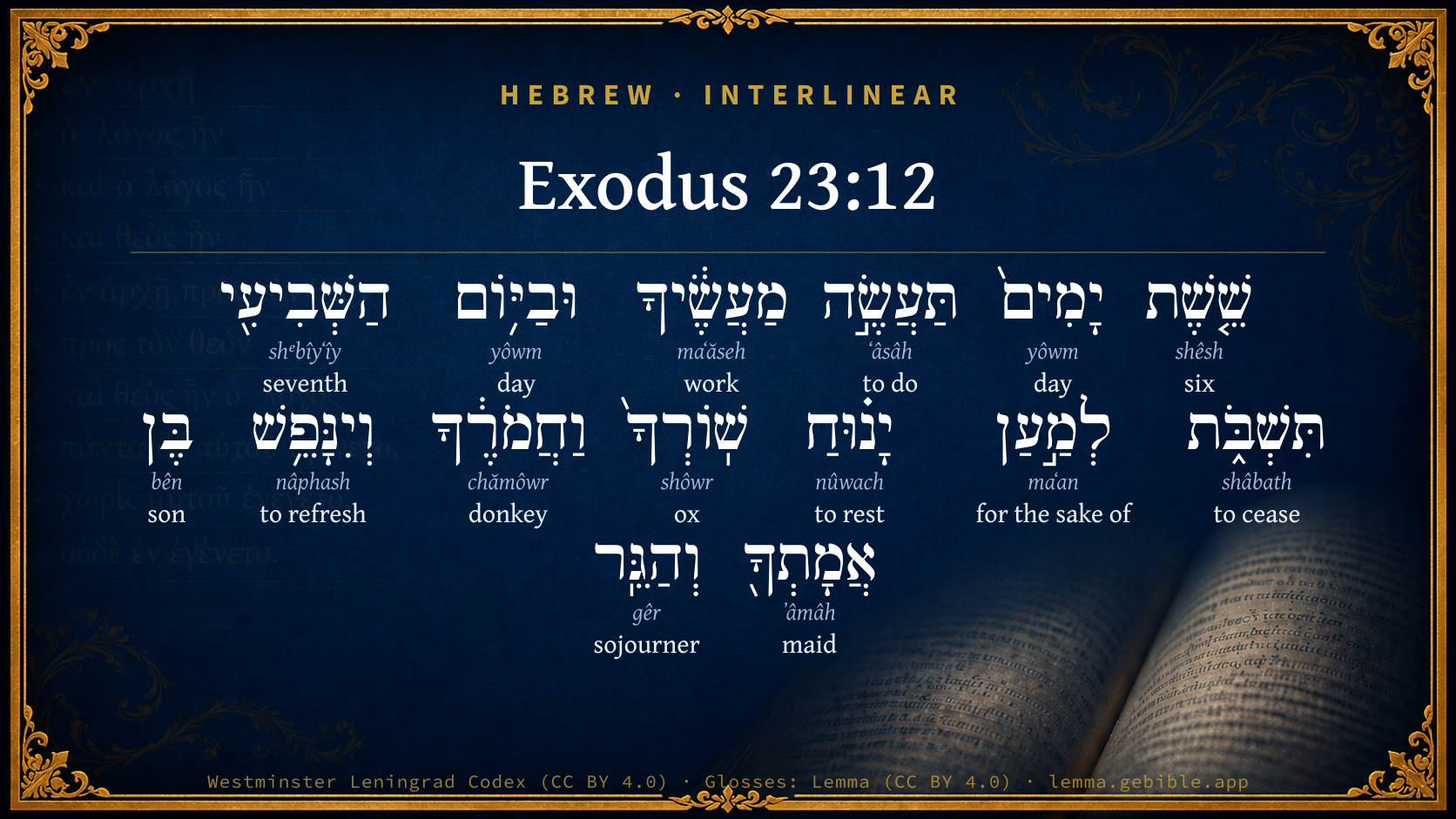
Exodus 23:12

Hebrew (Westminster Leningrad Codex) Exodus 23:12 appears in the Hebrew Old Testament. The text above is from the Westminster Leningrad Codex. Each word links to its Strong’s number, a concise gloss, and parsing drawn from the Open Scriptures Hebrew Bible morphology. Click any word for its full Brown-Driver-Briggs (BDB) entry.
Download image
Cite this verse

Exodus 23:12 (World English Bible). Public Domain. Lemma interlinear Bible study tool, https://lemma.gebible.app/v/exodus/23/12.

Show BibTeX & RIS
BibTeX
RIS
English Translation
"Six days you shall do your work, and on the seventh day you shall rest, that your ox and your donkey may have rest, and the son of your handmaid, and the alien may be refreshed.
World English Bible · Public Domain
Highlights
  • 1 first appearance in the Hebrew Bible
Full analysis ↓
Download a study sheet

One document with this verse’s original text, its word-by-word gloss line, the meaning frame, cross-references with their text, attributed commentary, and full source and license credits — printable, and it pastes into notes with its structure intact.

This verse Autodidact and up

Study sheet (.html) Plain text (.txt)

A passage Seminary Student

Up to 50 verses in one chapter. A passage sheet keeps up to 6 commentary sources and 12 cross-references per verse, in the order this page ranks them, and says so on the sheet whenever that leaves anything out. Ask for a single verse and you get the Autodidact verse sheet above.

Everything on this page stays free to read, with no account — the sheet is a download of what is already on screen, not access to it.

Want to remove ads? Support Godless Engineer
Compare translations 3

The same verse in 3 English versions, stacked beneath the original-language interlinear above. Click any original word for its lexicon entry.

Each is an independent rendering of the whole verse — the interlinear is not word-aligned to these translations.

Highlighted words mark where these versions differ — a whole-verse word diff, not a word-by-word alignment.

  • World English Bible Public Domain
    "Six days you shall do your work, and on the seventh day you shall rest, that your ox and your donkey may have rest, and the son of your handmaid, and the alien may be refreshed.
  • King James Version Public Domain
    Six days thou shalt do thy work, and on the seventh day thou shalt rest: that thine ox and thine ass may rest, and the son of thy handmaid, and the stranger, may be refreshed.
  • unfoldingWord Literal Text CC BY-SA 4.0
    Six days you shall do your work, and on the seventh day you shall rest so that your ox and your donkey may rest, and the son of your female slave and the sojourner may be refreshed.

unfoldingWord Literal Text — © unfoldingWord, licensed CC BY-SA 4.0. Word-aligned USFM3 via Door43 (git.door43.org/unfoldingWord/en_ult).

Versions to compare (up to 4)

3 of 4 selected

Show all 18 translations

Every available English version of this verse, each an independent rendering of the whole verse.

  • World English Bible Public Domain
    "Six days you shall do your work, and on the seventh day you shall rest, that your ox and your donkey may have rest, and the son of your handmaid, and the alien may be refreshed.
  • Berean Standard Bible Public Domain
    For six days you are to do your work, but on the seventh day you must cease, so that your ox and your donkey may rest and the son of your maidservant may be refreshed, as well as the foreign resident.
  • Majority Standard Bible Public Domain
    For six days you are to do your work, but on the seventh day you must cease, so that your ox and your donkey may rest and the son of your maidservant may be refreshed, as well as the foreign resident.
  • King James Version Public Domain
    Six days thou shalt do thy work, and on the seventh day thou shalt rest: that thine ox and thine ass may rest, and the son of thy handmaid, and the stranger, may be refreshed.
  • American Standard Version (1901) Public Domain
    Six days thou shalt do thy work, and on the seventh day thou shalt rest; that thine ox and thine ass may have rest, and the son of thy handmaid, and the sojourner, may be refreshed.
  • Revised Version (1885) Public Domain
    Six days thou shalt do thy work, and on the seventh day thou shalt rest: that thine ox and thine ass may have rest, and the son of thy handmaid, and the stranger, may be refreshed.
  • Geneva Bible (1599) Public Domain
    Sixe dayes thou shalt do thy worke, and in the seuenth day thou shalt rest, that thine oxe, and thine asse may rest, and the sonne of thy maide and the stranger may be refreshed.
  • Douay-Rheims (1899) Public Domain
    Six days thou shalt work: the seventh day thou shalt cease, that thy ox and thy ass may rest: and the son of thy handmaid and the stranger may be refreshed.
  • Young's Literal Translation Public Domain
    `Six days thou dost do thy work, and on the seventh day thou dost rest, so that thine ox and thine ass doth rest, and the son of thine handmaid and the sojourner is refreshed;
  • Literal Standard Version CC BY-SA 4.0
    Six days you do your work, and on the seventh day you rest, so that your ox and your donkey rest, and the son of your handmaid and the sojourner is refreshed;
  • Unlocked Literal Bible CC BY-SA 4.0
    During six days you will do your work, but on the seventh day you must rest. Do this so that your ox and your donkey may have rest, and so that your female slave's son and any foreigner may rest and be refreshed.
  • unfoldingWord Literal Text CC BY-SA 4.0
    Six days you shall do your work, and on the seventh day you shall rest so that your ox and your donkey may rest, and the son of your female slave and the sojourner may be refreshed.
  • Darby Bible Public Domain
    -- Six days thou shalt do thy work, but on the seventh day thou shalt rest; that thine ox and thine ass may rest, and the son of thy handmaid, and the stranger may be refreshed.
  • World Messianic Bible Public Domain
    “Six days you shall do your work, and on the seventh day you shall rest, that your ox and your donkey may have rest, and the son of your servant, and the alien may be refreshed.
  • Webster's Bible Public Domain
    Six days thou shalt do thy work, and on the seventh day thou shalt rest: that thy ox and thy ass may rest, and the son of thy handmaid, and the stranger, may be refreshed.
  • Free Bible Version CC BY-SA 4.0
    You have six days to do your work, but on the seventh day you must stop working, so that your ox and your donkey can rest, and your slaves' families can catch their breath, as well as the foreigners living among you.
  • Bible in Basic English Public Domain
    For six days do your work, and on the seventh day keep the Sabbath; so that your ox and your ass may have rest, together with the son of your servant and the man from a strange land living among you.
  • JPS Tanakh (1917) Public Domain
    Six days thou shalt do thy work, but on the seventh day thou shalt rest; that thine ox and thine ass may have rest, and the son of thy handmaid, and the stranger, may be refreshed.

Literal Standard Version (2020), Covenant Press — licensed CC BY-SA 4.0. Text via the HelloAO Bible API (eBible.org). Unlocked Literal Bible (unfoldingWord) — licensed CC BY-SA 4.0. Text via the HelloAO Bible API (eBible.org). unfoldingWord Literal Text — © unfoldingWord, licensed CC BY-SA 4.0. Word-aligned USFM3 via Door43 (git.door43.org/unfoldingWord/en_ult). Free Bible Version, Dr. Jonathan Gallagher — licensed CC BY-SA 4.0. Text via the HelloAO Bible API (eBible.org).

Word by word

More ways to search: Search by grammar → Find every occurrence → Compare this word →

Practice this passage: Drill this verse → Learn its vocabulary →

וְיִנָּפֵ֥שׁ
nâphash
H5314
“and · to refresh”
Conjunction + Verb, Niphal, Imperfect, 3rd Person, Masculine, Singular
Part of Speech
Conjunction + Verb
Stem
Niphal
Form
Imperfect
Person
3rd Person
Gender
Masculine
Number
Singular
Full BDB Definition

Origin: a primitive root

TWOT: 1395

(Niphal) to take breath, refresh oneself
  1. שֵׁ֤שֶׁת shêsh H8337 “six” Adjective, Cardinal number, Masculine, Singular, Construct
  2. יָמִים֙ yôwm H3117 “days” Noun, Common, Masculine, Plural, Absolute
  3. תַּעֲשֶׂ֣ה ʻâsâh H6213 “to do” Verb, Qal, Imperfect, 2nd Person, Masculine, Singular
  4. מַעֲשֶׂ֔יךָ maʻăseh H4639 “works · your” Noun, Common, Masculine, Plural, Construct + Suffix, Personal, 2nd Person, Masculine, Singular
  5. וּבַיּ֥וֹם yôwm H3117 “and · in/at the · day” Conjunction + Preposition, Determined + Noun, Common, Masculine, Singular, Absolute
  6. הַשְּׁבִיעִ֖י shᵉbîyʻîy H7637 “the · seventh” Particle, Definite Article + Adjective, Ordinal number, Masculine, Singular, Absolute
  7. תִּשְׁבֹּ֑ת shâbath H7673 “to cease” Verb, Qal, Imperfect, 2nd Person, Masculine, Singular
  8. לְמַ֣עַן maʻan H4616 “for the sake of” Preposition
  9. יָנ֗וּחַ nûwach H5117 “to rest” Verb, Qal, Imperfect, 3rd Person, Masculine, Singular
  10. שֽׁוֹרְךָ֙ shôwr H7794 “ox · your” Noun, Common, Masculine, Singular, Construct + Suffix, Personal, 2nd Person, Masculine, Singular
  11. וַחֲמֹרֶ֔ךָ chămôwr H2543 “and · donkey · your” Conjunction + Noun, Common, Both, Singular, Construct + Suffix, Personal, 2nd Person, Masculine, Singular
  12. בֶּן bên H1121 “son of” Noun, Common, Masculine, Singular, Construct
  13. אֲמָתְךָ֖ ʼâmâh H519 “maid · your” Noun, Common, Feminine, Singular, Construct + Suffix, Personal, 2nd Person, Masculine, Singular
  14. וְהַגֵּֽר gêr H1616 “and · the · sojourner” Conjunction + Particle, Definite Article + Noun, Common, Masculine, Singular, Absolute

About this verse

These counts appear in no published source. They are computed here, from the morphology-tagged text and Lemma’s own curated glosses. What Lemma adds →

15
words
14
distinct lemmas
Pentateuch
section

Notable vocabulary

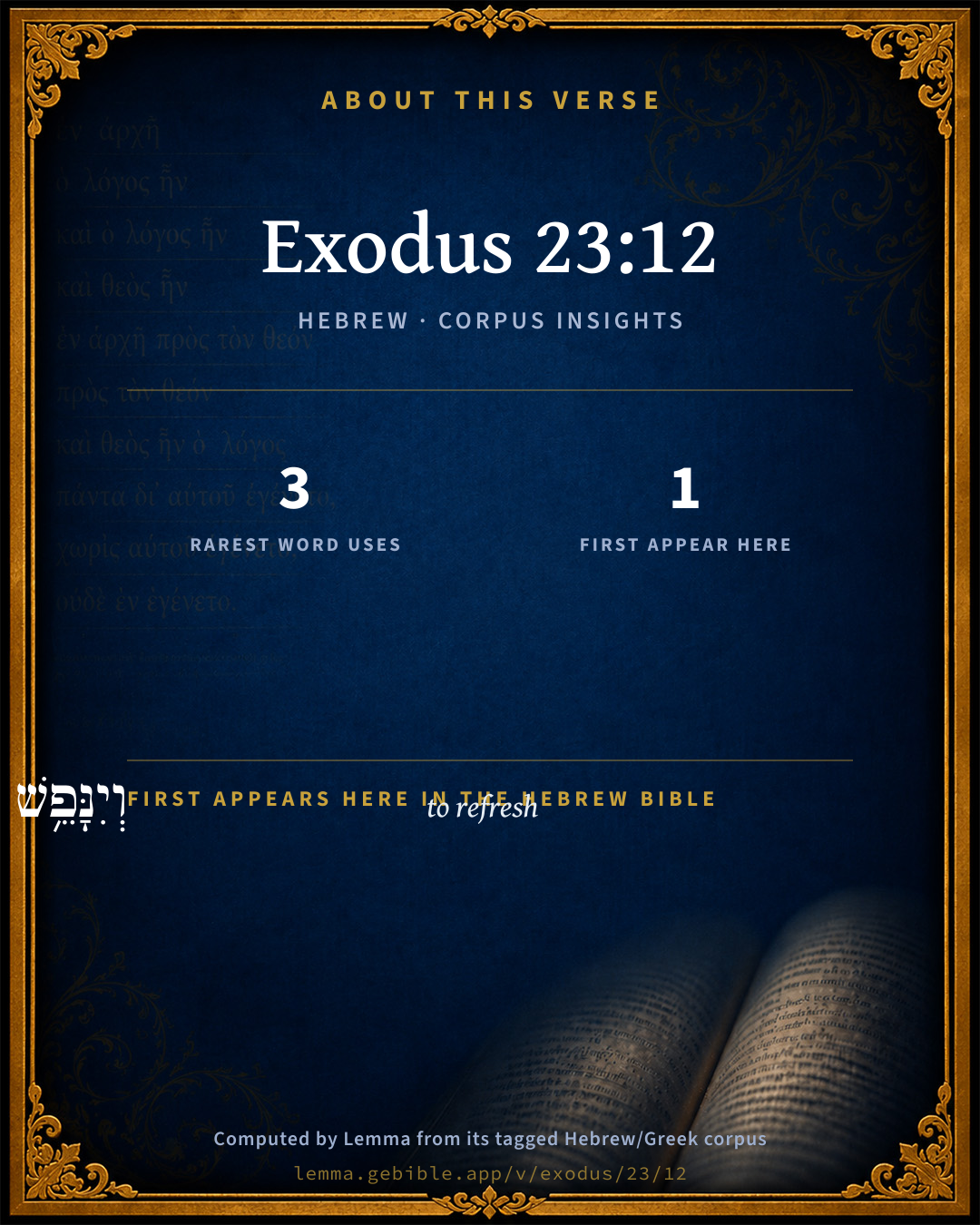
The rarest word here is וְיִנָּפֵ֥שׁ to refresh H5314 — appearing just 3 times in the whole Hebrew Bible.

First appearance in Scripture

This word makes its first canonical appearance in the Hebrew Bible here:

  • וְיִנָּפֵ֥שׁ to refresh H5314

Shared distinctive vocabulary

וְיִנָּפֵ֥שׁ to refresh H5314 occurs in 3 verses of the Hebrew Bible. Also found in:

Grammatical profile

  • 4 verbs
  • 8 nouns
  • 2 adjectives
  • 1 preposition

Verb forms

  • תַּעֲשֶׂ֣ה Qal · Imperfect
  • תִּשְׁבֹּ֑ת Qal · Imperfect
  • יָנ֗וּחַ Qal · Imperfect
  • וְיִנָּפֵ֥שׁ Niphal · Imperfect

Repetition

A word recurs within this verse — often emphatic in Hebrew:

  • יָמִים֙ day H3117 ×2

Hebrew & Septuagint length

In English translation the verse runs 36 words from the Hebrew and 37 from the Septuagint (LXX English) — closely comparable.

A rough comparison of the two English renderings, which tokenize alike — not a word-level alignment.

Word counts can differ between the Hebrew and the Greek without any difference in meaning — e.g. the Hebrew direct-object marker אֵת has no separate Greek word, and Greek often adds the article ὁ.

Cross-references

7

Topical passages linked to Exodus 23:12 in the Treasury of Scripture Knowledge — connected by theme and wording, ordered by reader-vote popularity; previews shown in the World English Bible.

  • Luke 13:14 The ruler of the synagogue, being indignant because Jesus had healed on the Sabbath, said to the multitude, "There are six days in which men ought to work. Therefore come on those days and be healed, and not on the Sabbath day!"
  • Exodus 20:8–11 "Remember the Sabbath day, to keep it holy.
  • Exodus 31:15–16 Six days shall work be done, but on the seventh day is a Sabbath of solemn rest, holy to Yahweh. Whoever does any work on the Sabbath day shall surely be put to death.
  • Exodus 34:21 Six days you shall work, but on the seventh day you shall rest: in plowing time and in harvest you shall rest.
  • Exodus 35:3 You shall kindle no fire throughout your habitations on the Sabbath day.'"
  • Deuteronomy 5:13–15 Six days shall you labor, and do all your work;
  • Isaiah 58:3 Why have we fasted, [say they], and you don't see? [why] have we afflicted our soul, and you take no knowledge? Behold, in the day of your fast you find [your own] pleasure, and exact all your labors.

Cross-references courtesy of OpenBible.info (CC BY 4.0).

Hebrew and Greek witnesses Masoretic Hebrew ↔ Greek Septuagint

The same verse in the two great witnesses to the Old Testament, shown verse-for-verse.

These are two independent witnesses, not word-aligned to each other, and the Septuagint is shown in lemma (dictionary) form.

Hebrew Exodus 23:12 Masoretic · Westminster Leningrad Codex

שֵׁ֤שֶׁת יָמִים֙ תַּעֲשֶׂ֣ה מַעֲשֶׂ֔יךָ וּבַיּ֥וֹם הַשְּׁבִיעִ֖י תִּשְׁבֹּ֑ת לְמַ֣עַן יָנ֗וּחַ שֽׁוֹרְךָ֙ וַחֲמֹרֶ֔ךָ וְיִנָּפֵ֥שׁ בֶּן אֲמָתְךָ֖ וְהַגֵּֽר

"Six days you shall do your work, and on the seventh day you shall rest, that your ox and your donkey may have rest, and the son of your handmaid, and the alien may be refreshed.

World English Bible · Public Domain

Greek LXX Exodus 23:12 Septuagint · lemma form

ἕξ ἡμέρα ποιέω ὁ ἔργον σύ ὁ δέ ἡμέρα ὁ ἕβδομος ἀνάπαυσις ἵνα ἀναπαύω ὁ βοῦς σύ καί ὁ ὑποζύγιον σύ καί ἵνα ἀναψύχω ὁ υἱός ὁ παιδίσκη σύ καί ὁ προσήλυτος

Six days shall you do your works, and on the seventh day there shall be rest, that your ox and your ass may rest, and that the son of your maidservant and the stranger may be refreshed.

LXX2012 (modern English Septuagint) · Public Domain

Hebrew: Westminster Leningrad Codex (CC BY 4.0). Greek: Septuagint (public domain); English from LXX2012 (modern English Septuagint) (Public Domain). How the Septuagint differs from the Hebrew →

Targum (Aramaic paraphrase)

2

The Targum is the ancient Jewish Aramaic paraphrase of the Hebrew Scriptures — an interpretive translation, not the Hebrew text itself. Onkelos (literal) and Pseudo-Jonathan (expansive) render the Torah, and Jonathan the Prophets. Coverage is partial: where no permissively-licensed English translation exists for a verse, only the Aramaic is shown. This is verse-level text, not a word-by-word alignment to the Hebrew.

  1. Targum Onkelos Torah (Genesis–Deuteronomy)
    שִׁתָּא יוֹמִין תַּעְבֵּד עוֹבָדָיךְ וּבְיוֹמָא שְׁבִיעָאָה תָּנוּחַ בְּדִיל דִינוּחַ תּוֹרָךְ וְחַמָרָךְ וְיִשְּׁקוֹט בַּר אַמְתָךְ וְגִיוֹרָא:

    (no public-domain English translation for this verse)

    Targum Onkelos — Aramaic: “Onkelos Genesis” (public domain); “Onkelos Exodus” (public domain); “Onkelos Leviticus” (public domain); “Onkelos Numbers” (public domain); “Onkelos Deuteronomy” (public domain). English: “Sefaria Community Translation” (CC0 1.0 (public-domain dedication)); “J.W. Etheridge. The Targums of Onkelos and Jonathan Ben Uzziel on the Pentateuch. London: Longmans, Green, 1862” (public domain). Text via Sefaria.

  2. Targum Pseudo-Jonathan Torah (Genesis–Deuteronomy)
    שִׁיתָּא יוֹמִין תַּעֲבֵד עוּבְדָךְ וּבְיוֹמָא שְׁבִיעָאָה תִּנּוּחַ מִן בִּגְלַל דִּינוּחוּן תּוֹרָךְ וְחַמְרָךְ וְיִשְׁקוֹט בַּר אַמְתָךְ עַרְלָאָה וְגִיּוֹרָא

    Six days do thy work, and on the seventh day repose, that thy ox and thy ass may rest, and that the uncircumcised son of thy handmaid, and the stranger, may rest.

    Targum Pseudo-Jonathan — Aramaic: “Targum Jonathan on Genesis” (public domain); “Targum Jonathan on Exodus” (public domain); “Targum Jonathan on Leviticus” (public domain); “Targum Jonathan on Numbers” (public domain); “Targum Jonathan on Deuteronomy” (public domain). English: “The Targum of Jonathan ben Uzziel, trans. J. W. Etheridge, London, 1862” (public domain). Text via Sefaria.

Commentary

Notes on Exodus 23:12 from classic Christian and Jewish commentators (each source and its license shown beneath its notes). The classic Christian expositions comment on the surrounding passage and are grouped to its opening verse, so a note may address several verses; the Jewish commentaries on the Tanakh (Rashi and others) are per-verse, so they appear only where the commentator wrote on this verse.

Lemma curates 59 commentaries, every one of them public domain or Creative Commons licensed, each selected and text-cleaned for this edition rather than reprinted as found. About our sources →

Trapp's Complete Commentary

John Trapp

Exo 23:12 Six days thou shalt do thy work, and on the seventh day thou shalt rest: that thine ox and thine ass may rest, and the son of thy handmaid, and the stranger, may be refreshed.

Ver. 12. Six days.] {See Trapp on "Exo 20:8"}

John Trapp, A Commentary or Exposition upon All the Books of the Old and New Testament (1647–1656) — public domain. Text from a community e-Sword module.

The Biblical Illustrator

Joseph S. Exell

Exo_23:12

On the seventh day thou shalt rest.

Labour and rest

I. That rest is needful--May be refreshed.

1. Rest is needful that the exhausted faculties may repose after past work.

2. Rest is needful that those faculties may be invigorated for future service.

3. Rest is needful that work may not become irksome; for if so

(1) it will be done slovenly; and

(2) done imperfectly.

4. Rest is needful that work may be free and joyous.

II. That rest is mercifully provided.

1. This rest is provided by God, lest man should overlook its necessity.

2. This rest is provided by God lest the servant, the foreigner, or the beast should be defrauded of their right to it.

III. That rest should be diligently earned. Six days shalt thou do thy work.

1. Not lounge over it;

2. Not neglect it; but

3. Do it earnestly, conscientiously, and well.

Application:

1. A lesson to employers. God has provided this rest; beware how you steal what God has given to man.

2. A lesson to working-men. This rest is yours by right. Then

(1) claim it;

(2) dont abuse it;

(3) dont curtail that of others;

(4) work during your own time, rest during Gods.

3. A lesson to the world at large. Sabbath-breaking is the direct cause of

(1) intellectual evils; overtaxed brains, etc.;

(2) moral evils; neglect of the rights of God and man;

(3) physical evils. Science has demonstrated the need of one days rest in seven. (J. W. Burn.)

Need of rest

We know well enough that if trains are run at fifty miles an hour over roads built to endure only a speed of thirty miles an hour, everything in a short time begins to give way, and to wear out, and the whole road and all the rolling stock gets into a dangerous condition. Every rail, every tie, every joint, every nail, every wheel and bit of machinery feels the strain and wear. The human mechanism is not less sensitive than are railroads and locomotives. The tendency of the time is to increase the speed of individual movement and progress. The over-driven human being needs constant rest and repairs, as do railroads and locomotives, and a thousand-fold more, for his mechanism is infinitely more complicated and delicate. Instead of adding more fuel to a disordered engine to make it go, we would send it to the repair shop, and let it be restored by skilled workmen to soundness. So when the mind and body are worn and weary, send them to the repair shop for rest. Sleep, quiet, nutritious food, the absence of all stimulants and whips, and goads--these skilled positive and negative workmen of nature will restore (if anything can) the wasted vitality, and bring back health and strength and soundness. (Christian Advocate.)

The Biblical Illustrator, edited by Joseph S. Exell (c. 1880s–1900s) — public domain. Text from a community e-Sword module.

Joseph Benson's Commentary

Exo 23:12. The seventh day thou shalt rest — This command is here repeated lest any should think the weekly rest might cease when the whole year was consecrated to rest. There were three sorts of sabbaths to the Jews, 1st, Of days: 2d, Of years, namely, the seventh year: 3d, Of weeks of years, namely, the jubilee. And all these are types of the eternal rest in heaven, where pain and sorrow shall never enter.

Joseph Benson's Commentary on the Old and New Testaments (1811–1818) — public domain. Text from a community e-Sword module.

Jamieson, Fausset & Brown

Robert Jamieson, A. R. Fausset & David Brown

Six days thou shalt do thy work, and on the seventh day thou shalt rest--This law is repeated [Exo 20:9] lest any might suppose there was a relaxation of its observance during the sabbatical year.

Jamieson, Fausset & Brown — Commentary Critical and Explanatory on the Whole Bible (1871) — public domain (CC PDM 1.0). Text via the HelloAO Bible API.

Adam Clarke's Commentary

Verse 12. Six days thou shalt do thy work] Though they were thus bound to keep the sabbatical year, yet they must not neglect the seventh day's rest or weekly Sabbath; for that was of perpetual obligation, and was paramount to all others. That the sanctification of the Sabbath was of great consequence in the sight of God, we may learn from the various repetitions of this law; and we may observe that it has still for its object, not only the benefit of the soul, but the health and comfort of the body also. Doth God care for oxen? Yes; and he mentions them with tenderness, that thine ox and thine ass may rest. How criminal to employ the labouring cattle on the Sabbath, as well as upon the other days of the week! More cattle are destroyed in England than in any other part of the world, in proportion, by excessive and continued labour. The noble horse in general has no Sabbath! Does God look on this with an indifferent eye? Surely he does not. "England," said a foreigner, "is the paradise of women, the purgatory of servants, and the hell of horses.

The son of thy handmaid, and the stranger - be refreshed.] ינפש yinnaphesh may be respirited or new-souled; have a complete renewal both of bodily and spiritual strength. The expression used by Moses here is very like that used by St. Paul, Ac 3:19: "Repent ye therefore, and be converted, that your sins may be blotted out, when the times of refreshing (καιροι αναψυξεως, the times of re-souling) shall come from the presence of the Lord;" alluding, probably, to those times of refreshing and rest for body and soul originally instituted under the law.

Adam Clarke's Commentary on the Bible (1810–1826) — public domain. Text from a community e-Sword/MySword module.

Ellicott's Commentary for English Readers

(12) The law of the weekly Sabbath is here repeated in conjunction with that of the Sabbatical year, to mark the intimate connection between the two, which were parts of one and the same system—a system which culminated in the Jubilee year (Lev_25:8-13). Nothing is added to the requirements of the fourth commandment; but the merciful intention of the Sabbath day is more fully brought out—it is to be kept in order that the cattle may rest, and the slave and stranger may be refreshed.

A Bible Commentary for English Readers, edited by Charles John Ellicott (1878–1897) — public domain. Text from a community e-Sword module.

The Cambridge Bible for Schools and Colleges

gen. ed. J. J. S. Perowne

12. The sabbath, treated here as a day of cessation from (in particular) field-labour, designed with a humanitarian end.

thy work] The word (ma‘ǎseh),—which is not the same as the one (melâ’khâh) rendered ‘work’ in Exo_20:10,—though in itself a general one, seems rather from the context to suggest work in the field: cf. v. 16, where it is twice rendered ‘labours’; also Deu_14:29; Deu_16:15; Deu_24:19; Deu_Exo_28:12 (note in each case the context).

rest] desist (from work), or keep sabbath (RVm.): see on Exo_20:8.

and thine ass may rest] as Exo_20:11. This is the word that expresses the positive idea of rest (Job_3:13; Job_3:17). (‘Have rest’ in RV. is intended for distinction from ‘rest’ just before; but it is better to be express the distinction by giving a more exact rendering of shâbath.)

the son of thy bondwoman] i.e. a slave ‘born in the house’ (cf. on Exo_12:44), of parents who were themselves slaves—intended, it must be supposed, to represent slaves in general (cf. Deu_5:14 end): as Di. remarks, most slaves were probably of this kind. Bertholet (Die Stellung der Isr. u. der Juden zu den Fremden, p. 55) and Bä. think ‘the son of thy concubine’ to be meant (cf. the sense of ’âmâh in Exo_21:7 [see note]); but there seems no sufficient reason for this limitation.

the sojourner] the sojourner in thy employment (Exo_20:10).

be refreshed] properly, get breath: so Exo_31:17, 2Sa_16:14†.

The Cambridge Bible for Schools and Colleges (gen. ed. J. J. S. Perowne; Cambridge University Press, 1878–1918) — public domain. Text from a community e-Sword module.

John Gill's Exposition

And in all things that I have said unto you, be circumspect,.... Or observe them, be careful to keep them punctually and constantly, even all that are delivered in this and the preceding chapters:

and make no mention of the name of other gods; neither call upon them, nor swear by them, nor make vows to them; and, as little as possible, ever utter their names, and never with pleasure and delight, and showing any honour of them, and reverence to them, but with the utmost detestation and abhorrence:

neither let it be heard out of thy mouth; not any of their names; the same thing in different words, the more to inculcate and impress the thing upon the mind, and to show with what vehemence and earnestness this is pressed.

John Gill's Exposition of the Whole Bible (1746–1763) — public domain (CC PDM 1.0). Text via the HelloAO Bible API.

Matthew Poole's English Annotations

This command is here repeated, lest any should think the weekly rest might cease when the whole year was consecrated to rest. There were three sorts of sabbaths to the Jews:

1. Of days.

2. Of years, to wit; the seventh year.

3. Of weeks of years, to wit, the jubilee; and all these are types of the eternal rest in heaven.

Matthew Poole's English Annotations on the Holy Bible (1683–1685) — public domain. Text from a community e-Sword/MySword module.

Whedon's Commentary on the Bible

Daniel D. Whedon

12. The seventh day — See note on Exo_20:8.

Daniel D. Whedon (gen. ed.), Commentary on the Old and New Testaments (1874–1909) — public domain. Text from a community e-Sword module.

The Pulpit Commentary

Law of the Sabbath, repeated. Nothing is here added to the teaching of the Fourth Commandment; but its merciful character is especially brought out. Men are called on to observe it, in order that their cattle may obtain rest, and their servants, together with the stranger that is within their gates, may find refreshment. It is to be borne in mind that the foreign population of Palestine was mostly held to hard service. (see 2Ch_2:17, 2Ch_2:18)

The rest of the Sabbath.

In the fourth commandment it is the main object of the Sabbath that is put prominently forward. It is a day to be "kept holy a day which God has "blessed and hallowed." Here, on the contrary, our attention is called to its secondary object it is for rest" and refreshment." Perhaps men of the classes who are in easy circumstances do not sufficiently realise the intense relief that is furnished by the Sunday rest to the classes below them, to the over-taxed artisan, the household drudge, the wearied and stupefied farm-labourer nay, even to the clerk, the accountant, the shopkeeper, the salesman. Continuous mechanical work of one and the same kind is required of most of those who labour, from morning till night, and from one end of the week to the other. The monotony of their occupations is terrible is deadening is sometimes maddening. For them, the treat that the Sunday affords is the single gleam of light in their uniformly murky sky, the single ray of hope that gilds their else miserable existence, the single link that connects them with the living world of thought, and sentiment, and feeling, for which they were born, and in which their spirits long to expatiate. Rest! To the tired brute, forced to slave for his owner up to the full measure of his powers, and beyond them ready to sink to the earth the moment he is not artificially sustained who goes through his daily round in a state that is half-sleep, half-waking what a blessed change is the quietude of the Sunday, when for four-and-twenty hours at least he enjoys absolute and entire repose, recruits his strength, rests all his muscles, is called on to make no exertion! Refreshment! How thrice blessed to the overwrought man, and still more to the overwrought woman, is the relaxation of the dreadful tension of their lives which Sunday brings! "No rest, no pause, no peace," for six long days days beginning early and ending late days without change or variety without relaxation or amusement wretched, miserable days, during which they wish a hundred times that they had never been born. On such the Sunday rest falls as a refreshing dew. Their drooping spirits rise to it. They inhale at every pore its beneficent influences. They feel it to be "a refuge from the storms of life, a bourne of peace after six days of care and toil, a goal to which they may look with glad hearts, and towards which they may work with hopeful spirits amid the intense struggles, and fervid contests, and fierce strifes of existence." Without the Sunday rest, modern life, at any rate, would be intolerable; and the mass of those who are actively engaged in its various phases would drift into idiocy, or be driven to madness!

The Pulpit Commentary (1880–1919), ed. H.D.M. Spence-Jones & Joseph S. Exell — public domain. Text from a community e-Sword module.

unfoldingWord translationNotes

Door43 World Missions Community

General Information:

Yahweh continues telling Moses his laws for the people of Israel.

Pay attention to

"Do" or "Obey"

your ox and your donkey

"your work animals"

any foreigner may rest and be refreshed

This can be stated in active form. AT: "any foreigner may rest and regain his strength" (See: Active or Passive)

mention the names of other gods

This represents praying to other gods. AT: "pray to other gods" (See: Metonymy)

translationWords

rest

servant

unfoldingWord translationNotes — © Distant Shores Media and the Door43 World Missions Community, licensed CC BY-SA 4.0. Source: git.door43.org/Door43/en_tn.

Rashi

Rabbi Shlomo Yitzchaki (Rashi)

וביום השביעי תשבת [SIX DAYS SHALT THOU DO THY WORK] AND ON THE SEVENTH DAY THOU SHALT LEAVE OFF — Even in the Sabbatical year you shall not abrogate the weekly Sabbath: you shall not say, “Since the whole year bears the name of ‘Sabbath’, the weekly Sabbath need not to be observed” (Mekhilta).

למען ינוח שורך means, give it (the animal) some satisfaction (ניח) by permitting it to pull up and eat grass from the ground as it pleases. Or, perhaps, this is not the meaning but it means that is must rest: that one must tie it up in its stall so that it does no work in the field! You will, however, admit this is no satisfaction but a source of annoyance (Mekhilta).

בן אמתך THE SON OF THY HANDMAID — Scripture speaks of an uncircumcised Canaanitish servant; (that the circumcised servant should rest is already mentioned in Deuteronomy 5:14: עבדך ואמתך כמוך) (cf. Mekhilta).

והגר means a גר תושב, a proselyte settler (one who renounces idolatry and thus acquires limited citizenship in Palestine).

Rashi on the Tanakh — English translations: “The Judaica Press complete Tanach with Rashi, translated by A. J. Rosenberg” (CC BY 4.0); “Pentateuch with Rashi's commentary by M. Rosenbaum and A.M. Silbermann, 1929-1934” (public domain); “The Metsudah Tanach series, Lakewood, N.J” (CC BY 4.0); and “The Book of Joshua, Metsudah Publications, 1997” (CC BY 4.0). Text via Sefaria.

Ramban (Nachmanides)

Rabbi Moshe ben Nachman (Ramban / Nachmanides)

L’MA’AN’ (THAT) THINE OX AND THINE ASS MAY HAVE REST. Because the word l’ma’an is like ba’avur (“in order that”), we must explain neither can it be referring to a case where the owner works together with the animal, for if that were so, why does the Torah not mention that the reason is that he himself should have rest? Hence Ramban explains the verse in the following way: “Six days thou shalt do thy work in such a manner as if it were all completed by the Sabbath-day, so that the animal can have rest by itself on that day.” that the verse is stating: “Six days you shall do all your work in the house and in the field, in order that the ox and the ass may have rest on the seventh day. And the son of thy handmaid, and the stranger, may be refreshed — in order that they all be witnesses to the Creation.” The verse here is then similar in meaning to: Bake that which ye will bake. Similarly He said, Six days shalt thou labor, and do all thy work, 20:9. as I have explained there.

Ramban (Nachmanides) on the Tanakh — English translation: “Commentary on the Torah by Ramban (Nachmanides). Translated and annotated by Charles B. Chavel. New York, Shilo Pub. House, 1971-1976” (CC BY 4.0). Text via Sefaria.

Lesson kit

Teaching starters — assembled from the data on this page, not authored interpretation. Every prompt links to the verse data it draws on. Edit before teaching.

Exodus, in the Pentateuch, opens this verse with 15 words (14 distinct Hebrew lemmas). Its most distinctive word is nâphash (“to refresh”). A historical commentator’s framing appears above. Read the whole chapter for the surrounding context.

Discussion questions

  1. What does “to refresh” (nâphash) contribute to the verse as a whole?
  2. The word “to refresh” first appears here in Scripture. What is being introduced at this debut?
  3. Exodus 31:17 shares the word «to refresh» with this verse. How do the two illuminate each other?
  4. “day” occurs 2× in this one verse. What is the effect of the repetition?
  5. These translations render this verse differently; the difference is in the English rendering, not the original. What questions does that raise?
  6. The verb «תַּעֲשֶׂ֣ה» is Qal Imperfect. How does its form color the action?
  7. Reading how Trapp's Complete Commentary and The Biblical Illustrator read this verse, where do the two commentators agree and where do they part?

Things to notice

  • 1 word makes its first canonical appearance in Scripture here.
  • These translations choose different wording for 11 words in this verse.
  • “day” occurs 2× in this single verse.
  • 14 distinct Hebrew lemmas span 15 words in this verse.

Reading settings

Reading text

Shown beneath each verse's original-language words.

Old Testament
Old Testament edition

Read the OT as the Masoretic Hebrew (MT) or the Greek Septuagint (LXX).

English shown for the Greek Septuagint (in the Hebrew ↔ Greek comparison).

Comparing translations? Open the Compare panel on any verse page to stack up to four side by side.